




Abstract
The rise of video-on-demand streaming services has facilitated more intensive television watching. When novel consumption behaviors emerge, cultural intermediaries may be mobilized to make sense of it and potentially legitimize it. This often takes place by raising moral panic, as it draws attention to new cultural practices and asks tastemakers to take a stance. The current study takes “binge-watching” as a discursive anchor point to investigate this process. We argue that moral panic is not only a strategy that can be employed to condemn cultural practices, but by deflecting moral concerns through mechanisms of social distinction, it can also allow intermediaries to normalize new cultural phenomena. Through inductive and deductive coding of U.S. news articles on binge-watching (n: 681), we discern three pathways through which intensive video-on-demand watching is reframed: first, the shows that are binge-watched are high quality; second, binge-watching can be controlled, at least by the right type of audiences; and third, binge-watching is fun, in that if undertaken in moderation, it can be good for viewers. All three pathways resonate strongly with new middle-class dispositions. This study shows how the legitimization of new cultural boundaries demands an interplay between social distinction and moralization.
Introduction: Moral concern but not moral panic?
Binge viewing fills some hearts with horror. The idea of even, unbroken hours collapsed on a couch, bleary eyed, unwashed, surrounded by junk food. It just seems so wrong. Bercovici (2013)
This quote from a 2013 article in Forbes paints an alarming picture, conjuring up popular imagery of addiction, and mental and social breakdown. It refers to a novel form of television consumption that gained momentum after the breakthrough of video-on-demand (VOD) streaming services. VOD became hugely popular in the 2010s with the global rise of Netflix, fundamentally altering our understanding of television viewing. With VOD, it became possible to watch episodes of series back-to-back, sometimes entire seasons in marathon sittings. This phenomenon became known as “binge-watching.” The word echoes other forms of addiction-like overconsumption, such as binge-eating and binge-drinking. This new term gained such traction that in 2015, Collins Dictionary voted binge-watching the (English) word of the year (BBC, 2015)
The current article uses the term binge-watching as a discursive anchor point to explore how cultural intermediaries, such as bloggers, journalists, and critics, make sense of VOD as a new cultural practice. The chief difference between VOD and traditional television watching is the viewer’s level of agency and choice, as people now have control over what to watch and when to watch it (Chambers, 2019). This freedom of consumption brings with it new risks that generate moral concern. However, in contrast with other “risky” and “uncontrolled” media consumption—for example new music genres, violent video games, or sexualized media content—and despite the alarmist label, binge-watching has not sparked a fully-fledged moral panic.
Binge-watching therefore offers an opportunity for a case study concerning the legitimization of new and potentially dangerous cultural practices. We build on literature dealing with moral panics (Cohen, 1980; Goode and Ben-Yehuda, 1994; McRobbie and Thornton, 1995), but reverse its central insight. Accordingly, we suggest that if moral panics are the result of concerted efforts at delegitimization, particularly with regard to the practices of dominated groups, then dampened moral panics will result from legitimization processes, especially with regard to the practices of privileged groups. This requires the work of cultural intermediaries and gatekeepers, who shape public debate through evaluating, categorizing, and regulating cultural practices (Hamann and Beljean, 2019; Maguire and Matthews, 2012). By asking why binge-watching never became associated with a moral panic, we investigate which discursive “pathways” lead toward legitimization (Johnson et al., 2006). Moral concern about cultural practices is thus understood as a social regulation strategy (McRobbie and Thornton, 1995; Hier, 2016) that shapes and steers consumption through dynamics of moralization, legitimization, and cultural distinction.
We research this process using a content analysis of 681 online news articles, combining deductive and inductive coding. We find that cultural intermediaries use the term binge-watching to draw attention to this new practice, but deflect the ensuing moral concern by framing it as a manageable, hedonistic, yet high-quality form of entertainment. While they acknowledge potential problems with intensive watching, intermediaries often adopt a therapeutic role by offering self-help tips and viewing advice.
Media and moral panics: The legitimization or delegitimization of cultural consumption as a social regulation strategy
Television as a moral hazard
Television, the dominant medium of the past half century, has usually been framed as a moral hazard rather than a social good, both for individuals and for society at large (Newman and Levine, 2012; Putnam, 2000). Deemed the hallmark of mass-produced popular culture, television has been considered as an “opiate pacifier,” making people socially numb, uninterested, and unengaged (Spigel, 1992). This understanding of television contrasts TV with “authentic” traditional culture and “quality” highbrow art, with television representing cultural consumption based on marketability and amusement value. This classification of the medium as “popular” effectively means the same label is applied to its audiences: implying they are less educated and lower class.
This negative image of television has been shaped to a large extent by cultural intermediaries: journalists, intellectuals, and educators who shape and frame cultural worth and legitimacy (Alasuutari, 1992; Newman and Levine, 2012; Spigel, 1992). In her analysis of American discourse on TV, Spigel found this discourse frames television as source of passivity, loss of control, and even danger: “gum for the eyes,” and an “idiot box” that colonizes people’s minds and leisure time, challenging their capacity to self-discipline. Analogies with addiction are common, for example television as a “plug-in-drug” (Spigel, 1992: 53). Television was portrayed as the cause of social, psychological, and physical ills: obesity, inattentiveness, passivity, hyperactivity, stupidity, and even violence (Newman and Levine, 2012: 16–18). The medium was delegitimized, with discourses highlighting the lack of moral and aesthetic qualities of both TV and its audiences. These discourses in turn shaped practices, leading to regulations to restrict or suppress specific TV genres or to shield “vulnerable” audiences, and to some groups of viewers being discredited.
Like all cultural practices, television is subject to change. The introduction of new technologies, such as cable, VCR, DVD, and digital television, has altered viewing opportunities and experiences (Chambers, 2019; Levine, 2008). Consequently, the task of framing television consumption has not yet been completed. With the latest developments in television, including online VOD streaming, intermediaries again have to reconceptualize the medium and regulate viewing behavior. The terminology about binge-watching suggests that this new form of TV watching is, again, negatively framed. This leads us to ask how cultural gatekeepers, as “tastemakers,” frame this new practice, and if the existing delegitimization of the medium is reinforced.
Moral panic as social regulation and delegitimization of practices and groups
A common way for cultural gatekeepers and tastemakers to draw attention to a new phenomenon is by creating moral concern and anxiety. Cohen (1980) coined the term “moral panic” to show how journalists interpreted the youth subcultures of the 1960s as dangerous deviations from the social order, resulting in concern among wider audiences, and eventually to delegitimization and policy measures against both the cultural forms (mostly music) and the groups consuming it (mostly the young and the lower class) (Cohen, 1980; Deflem, 2020; Griffiths, 2010). By expressing disproportional concerns and anxiety, “moral barricades”: (Cohen, 1980: 9) are thrown up around new cultural practices to protect existing norms and values. Such barricades can appear whenever a new cultural phenomenon reaches a larger public. This moral panic dynamic has been involved in making sense of, for example, cinema (Springhall, 1998), video games (Ferguson et al., 2008), and various television genres (Biltereyst, 2004). Moral panics are deeply intertwined with media culture. First, the mass media is instrumental in fostering moral panic. Second, forms of cultural consumption given exposure in the media are the most likely to spark moral concern (Drotner, 1999).
The sensational and anxious connotations of the term binge-watching suggest similar dynamics of a media-generated moral panic. The media coined this term to draw attention to intensive VOD watching as a new, potentially dangerous activity. Building on older framings of television, the term “binge” is a negative, morally-charged concept, associated with excess and self-harm (Jenner, 2015; Pittman and Sheehan, 2015).
Moral panic, however, pertains to more than only identifying a potential problem: it is a social regulation device that involves conflicts over social order and control (Hier, 2016; McRobbie and Thornton, 1995). The question is therefore not whether intensive television watching can become a moral concern, but how debates about VOD are used to determine what desirable or legitimate consumption is, and who or what needs to be controlled. Thus, examining moral panic dynamics leads us to investigate how the term “binge-watching” opens up specific discursive pathways that not only make sense of VOD, but categorize it as a legitimate cultural practice—or a non-legitimate one.
According to Goode and Ben-Yehuda (1994), a moral reaction only becomes a panic when it involves—in addition to a search for consensus and disproportional concerns—hostility toward a harmful outgroup. A moral panic asks for “folk devils” to take the blame (Goode and Ben-Yehuda, 1994: 156). Throughout history, dominated, precarious, and marginalized groups have functioned as scapegoats in moral panic stories: from women perceived as witches (Trevor-Roper, 1967), to working-class youths or ethnic minorities held responsible for crimes, misdemeanors, or disrupting the social order (e.g., de Young, 2004; Hall et al., 2013; Rothe and Muzzatti, 2004). Thus, cultural intermediaries are also “moral crusaders” (Goode and Ben-Yehuda, 1994: 153), trying to restore the social order by forcing deviant groups back into line through blame and stigmatization. With regard to binge-watching, the question is therefore not only what is or is not delegitimized, but also who is delegitimized. Who are the “folk devils” trespassing the norm?
Television and the boundaries of social class
Although almost everybody watches television, its position on the ladder of cultural esteem has always been low (Alasuutari, 1992; Brunsdon, 1997; Kuipers, 2006; Newman and Levine, 2012). The status of cultural markers, as Bourdieu (1984) explains, lies not in activities themselves but in the social (class) position and symbolic power of their consumers. Through a process of cultural distinction, some cultural activities become associated with specific groups, thus ending up higher or lower on the cultural ladder.
Although Bourdieu barely considered television as a marker for distinction, others following his understanding of cultural consumption have shown that television viewing clusters with other passive, home-centered, and mainstream activities. These studies identify television watching as characteristic of lower social strata (lower income and educational levels). Upper-class consumers (higher income and educational levels) are more engaged in active cultural participation, such as visiting museums or theaters (Bennett et al., 2009). Hence, the general disregard toward television viewing is not just an intellectual criticism of the mass consumption of popular culture (Adorno, 2002), but is also an outcome of a process of class distinction that aligns “active” and “passive” cultural forms with higher and lower social strata.
This does not necessarily mean that higher status groups universally reject television. Although higher classes express general disdain for television watching, this delegitimization varies according to the type of television. Non-fiction, news, and current affairs programs are usually classified as more legitimate than entertainment forms such as reality TV or soap operas. In addition, even within narrative genres there are distinctions between highbrow and lowbrow forms (Alasuutari, 1992; Kuipers, 2006; Scarborough and McCoy, 2016). The boundary between television and active cultural forms, and that between different forms of TV, both mark a class division that can be re-established in moral panics.
Much has shifted in television landscapes, however. The rise of new technologies (cable, VOD, etc.) has coincided with the emergence of so-called quality television series or the new “golden age of TV.” These changes have, as Levine (2008) argues, altered cultural understandings of television, increasing its cultural legitimacy. This raises the question of whether the alarmist framing of binge-watching can have the traditional effect of stigmatizing lower-class viewers and their passive pastimes.
Data and methods: Making sense of binge-watching
This study analyses how cultural intermediaries make sense of serial or binge-watching through video-on-demand services. We are particularly interested in the moral discourses and frames intermediaries introduce, and whether they construct binge-watching as legitimate or non-legitimate. Our data source consists of articles published between 1 January 1 2013 and 1 January 2016 in the U.S. Edition of Google News that mention “binge-watching” or “binge viewing.” Google News is the largest database of online and print news sources, covering over 20,000 publications that meet basic journalistic standards.
The first article containing one of the terms “binge-watching” or “binge viewing” appeared in 2013; by 2016 their use had become commonplace. After deduplication, we ended up with a corpus of 681 articles. In these articles, “binge-watching” was either the main subject, or a “hook,” for instance in an article about the dangers of a sedentary lifestyle, or a list of “good shows to binge-watch.” In both cases, these articles are framed by, and part of American public discourse about binge-watching. Given the negative connotation of the term “binge,” it is likely that we preselected articles containing elements of moral panic discourse. Since we aim to study how moral concerns are created, and whether they are “ignited” into a moral panic, this is not a problem for our analysis.
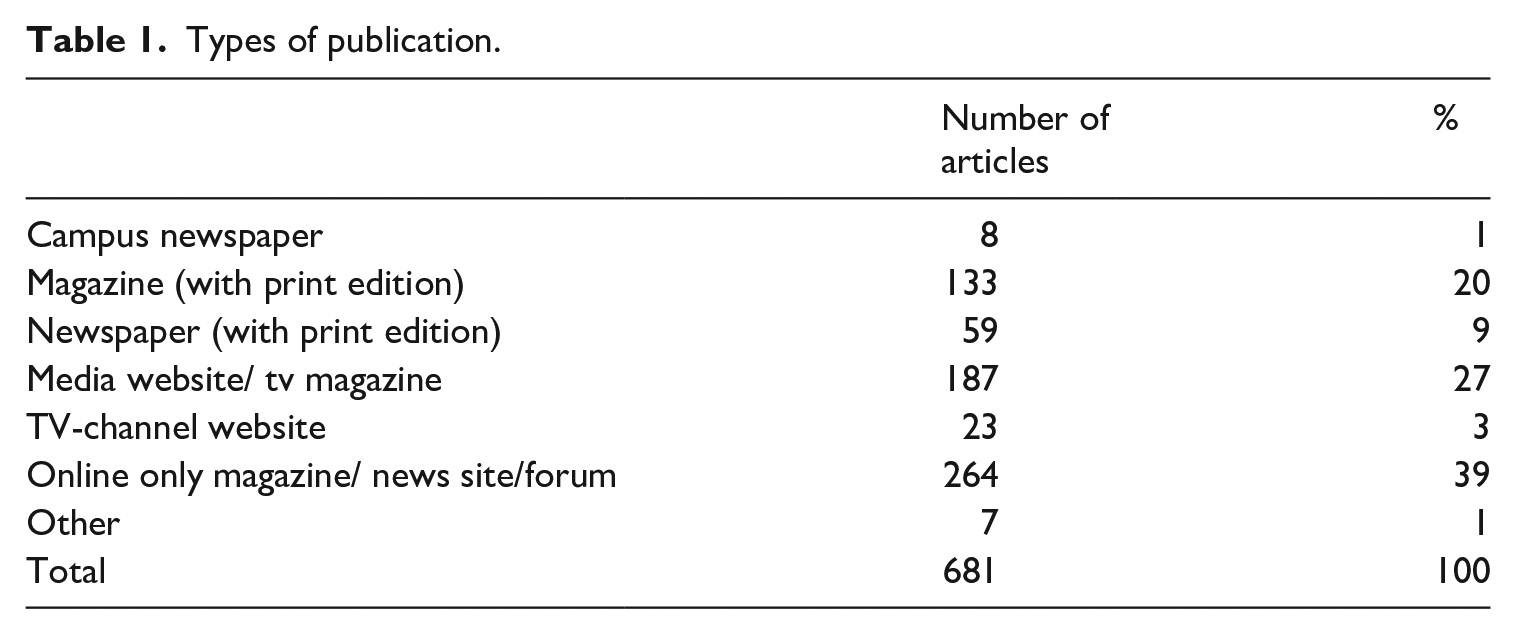
Table 1 shows the publication types included in our corpus. About 30% of the articles appeared in online versions of print media, 40% in online-only general media, and another 30% in specialized media sites. Most articles are what Hanusch (2012) terms “lifestyle journalism”: popular news or infotainment focusing on culture, consumption, lifestyle advice, and other lifestyle issues. Some 240 articles (35%) are reviews and the other contributions range from short news items, to background pieces, lists, interviews, blogs, columns, research reports, and info-graphics. Of the content, 99% was written by cultural intermediaries such as journalists, reviewers, columnists, and bloggers; the remainder was written by experts or scientists (see the Supplemental Appendix 1 for more details).
Types of publication.
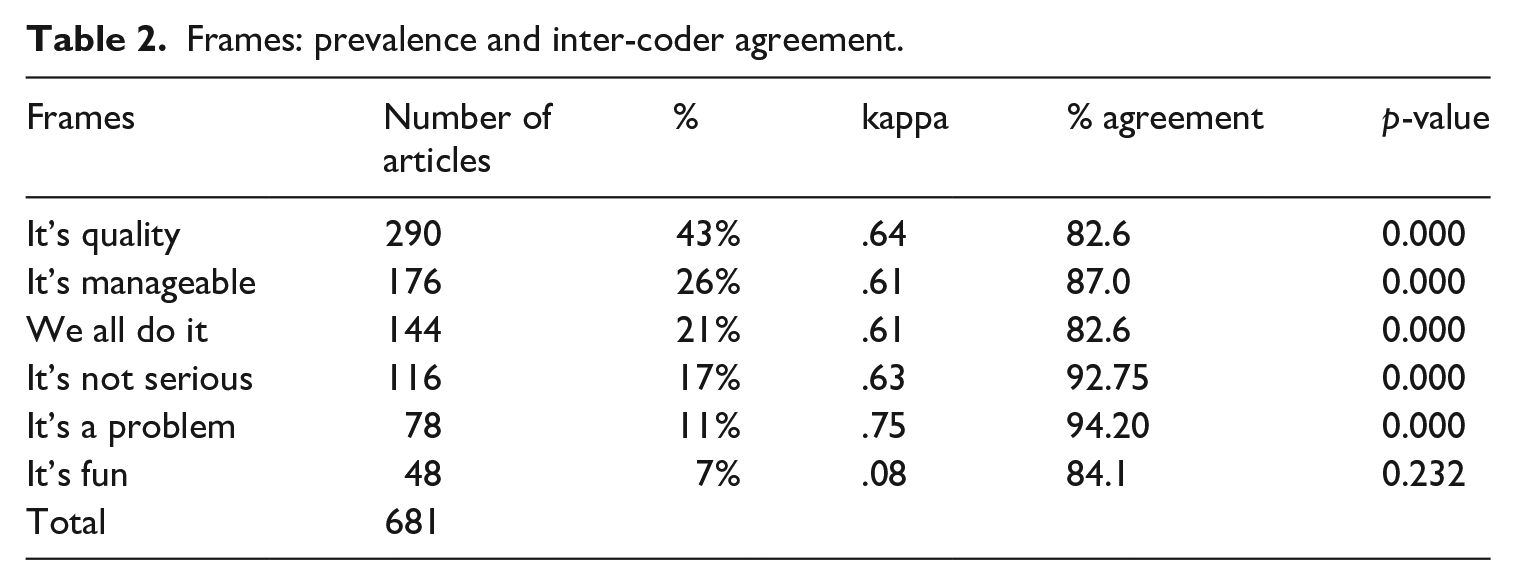
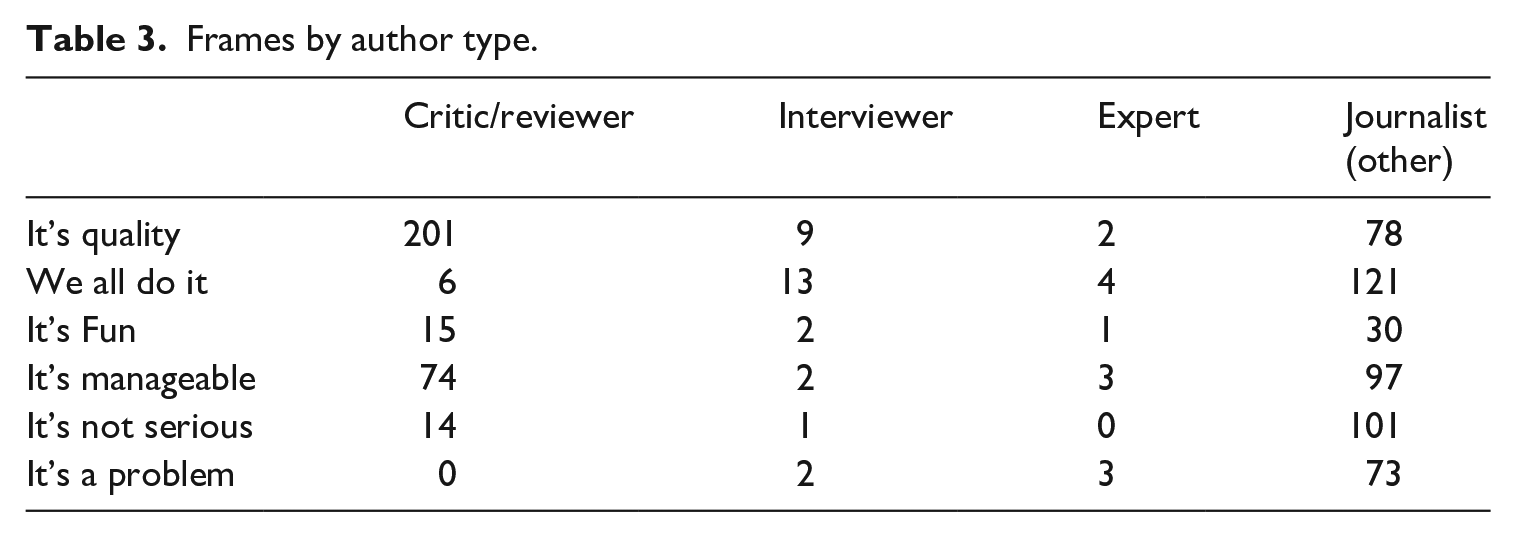
Our methods are based on inductive thematic discourse analysis, followed by quantitative content analysis (Krippendorff, 2018). We used discourse analysis to identify central themes in American public discourse about binge-watching. The list of themes was refined in various rounds until saturation occurred, and then used for quantitative coding. The final coding schema is included in the Appendix. The replicability of the coding schema was validated through double blind coding of a random selection of 10%. As Table 2 shows, there was considerable consensus for all the categories but one. For “it is fun,” interrater agreement is relatively high (84.1%), but Cohen’s Kappa is quite low. As we discuss below, this ambiguity in understanding the nature of “fun” is central to the discursive construction of binge-watching. In Table 3 we offer a general overview of the prevelance of themes coded, comparing different types of cultural intermediaries. Further information on the article characteristics and reference information for all the quotes used here can also be found in the Appendix.
Frames: prevalence and inter-coder agreement.
Frames by author type.
Findings: Diffusing a moral panic
What is it and should we worry?
Many articles in our corpus show attempts to come to terms with binge-watching, with titles such as “Making Sense of Binge Watching” (Kopp, 2014) or “From Arrested Development to Dr. Who, Binge Watching Is Changing Our Culture” (McCracken, 2013). These articles discuss whether binge-watching is a new or old phenomenon, an addiction, excessive consumption, a guilty pleasure, a sport, a quality time experience, a therapy, a reward, an American tradition, and much more. Some answers, as in the quote below from the Atlantic, are quite factual:
The most detailed definition of binge-watching comes from Netflix itself. In December, a Harris Interactive poll conducted on behalf of the company quantified what constituted a binge. [. . .] The survey concluded that binge-watching meant consuming a minimum of two episodes in one sitting, and reported that, across demographics, the session average was 2.3 episodes—“moderate behavior,” according to the release. (Feeney, 2014)
Most answers, however, combine descriptive and normative elements:
Although surely everyone is guilty of watching more than one episode of their favorite show on a Sunday afternoon, a new study suggests that frequent indulgence in this activity is associated with feelings of loneliness and depression and may be a sign of poor self-control. (Dovey, 2015 in Medical Daily)
Here, the author describes what binge-watching is, in order to judge whether it is acceptable. Often, these articles rely on traditional alarmist discourses on television as a form of addiction, calling binge-watching the “crack cocaine of TV” (Surette, 2014), “drug of choice” (Pikul, 2014), “a feeding frenzy” (Friedman, 2015), “a drug disguised as candy” (Brach, 2015), “a perfectly addictive drug” (Heid, 2015), and a “hungry habit” (Kuperinsky, 2014).
The question “what is binge-watching?” is not neutral, but leads to a moral question: is it a problem? This urge to determine moral acceptability is present throughout our data and is the central topic of articles such as “Binge Viewing Gets A Bad Rap; Here’s The Reality” (Bercovici, 2013), and “Why Everything You Know About Binge Viewing Is Wrong” (Wallenstein, 2013). However, as Table 2 shows, only 11% of the articles suggest that binge-watching is problematic. Instead of suggesting panic, the articles typically give nuanced, reflexive interpretations, often calling into question the negative connotations of “binge.” As Broder (2014) writes in Bustle Magazine:
I understand the desire to grab hold of this zeitgeist-y practice and assign it meaning. Variety suggested there are nuances in the kind of viewing that falls under the blanket of “binge.” The article uses words like “splurge,” “gorge,” and “marathon” to differentiate the shades of over-consumption. None quite fit. “Marathon” swings too much in the opposite direction of “binge.” Though TV-watching is not a disease, it’s not an accomplishment either. “Splurge” sounds like a yoga mom eating a gourmet cupcake. “Binge” is so catchy because it touches a particular nerve, but perhaps the best descriptor for the way we watch TV now ought to be something more mundane, more neutral, more forgiving, and less tied up in gut-wrenching guilt.
Strikingly, and in clear contrast with older discourses on television, most articles end up framing binge-watching positively. Although all the articles refer to the negative framing inherent in the term binge-watching, they generally use this as a starting point for reframing intensive TV consumption as socially acceptable. Some 21% of the articles reassure the readers that “we all do it” (Table 2). The prevalence of the first-person perspective reinforces this normalization: cultural intermediaries also binge-watch.
Thus, the danger of binge-watching is defused in multiple ways. On the basis of our discourse analysis we distinguish—in addition to the “normalizing” discourse of “we all do it”—three normative pathways toward legitimization: (1) Categorizing binge-watching as quality; (2) Offering self-help advice on how to manage binge-watching; (3) Categorizing binge-watching as not serious and compatible with an ethic of fun. As we will show, all three pathways resonate with a middle-class habitus.
Pathway 1: It is quality
One strategy for defusing the moral dangers of television is by stressing that binge-watched television has quality, a theme found in 42% of the corpus. Many articles connect binge-viewing with consuming highbrow culture: “At least now we’re on the edge of our seats watching quality programming, rather than slumped and glazed in front of an infomercial” (Taylor, 2014). VOD shows are described using words and phrases such as complex, innovative, with depth, ambiguity, and character development. All these are traditional characteristics of “high art” (Jenner, 2015). As John Eperjesi, an associate professor of English, writes in the Huffington Post: “The sophisticated, morally and politically ambiguous narratives that make up this golden age of the television drama are realistic and stereotypical, historically specific and mythological, exotic and easy to relate to.” That the arrival of VOD heralded a new golden age of television is a salient trope used by several tastemakers in our corpus (e.g. Lutes, 2013; Montenegro, 2014; O’Keefer, 2014).
Because the intricate storylines in some TV programs have lengthy character developments and require attentive, immersive engagement, many authors make comparisons with classical literature. “Binge TV is dwelling TV. They watch one show, often consuming a season a week, and an entire story arc over a month or so. This is the way we have always read Dickens. It’s a new way to watch TV” (Bercovici, 2013). Accordingly, binge-watching does not have to be a problem, because the things people binge-watch have “quality,” and this quality is best appreciated in long, immersive sessions. In fact, these high-quality shows even offer a necessary counterbalance to a general mass culture, which is otherwise superficial, fleeting, and fast: “In a highly fragmented 140 character 24/7 world, viewers are seeking out longer form, complex storytelling” (West, 2013).
Binge-watching then is presented as involving the concentration needed to consume art. Online magazine Wired even has a “Binge-watching guide,” with long, serious reviews of each show’s quality and potential for binge-watching. Tellingly, the vast majority of the 240 reviews in the corpus refer to the “quality” frame. In these reviews, critics—in their traditional roles of gatekeepers and tastemakers (Foster et al., 2011; Hamann and Beljean, 2019)—recommend high-quality series (mostly produced by the BBC, HBO, Amazon, and Netflix) as “binge-watchable.”
Some articles even credit VOD with having made the emergence of quality TV possible. Although these new, quality series were originally produced for cable TV and (equally suited to binge-watching) DVD box sets, streaming services such as Netflix have made binge-watching easier, and even the preferred way of watching. In one article, Vince Mulligan (the creator of the acclaimed show Breaking Bad) states that “Binge-watching saved his show,” as Netflix would have removed it from their schedule if not for the binge-watchers. “It is very possible we wouldn’t have made it to 62 episodes without this creation of these technologies and this cultural creation of binge-watching” (Wattercutter, 2013).
Articles even describe “binge bragging” (Wollcot, 2015); people proudly describing their binge-watching, listing all the shows they have watched, and reporting their binge-watching experiences on social media. The authors in our corpus interpret this as status markers or “conspicuous consumption.” This form of viewing illustrates that some forms of television are not morally suspect, but instead have gained so much cultural legitimacy that it can be flaunted.
The linking of quality and television points to the “ratification” of some types of the medium. This is a dual process, which involves both a change of content and a change of (implied) audience: better, more complex content to attract and retain more-educated, middle-class audiences (Baumann, 2007; Shapiro and Heinich, 2012). Thus, the notion of quality TV points to a move from the delegitimization of television as a whole, toward a boundary between “good television” and “bad television” (Kuipers, 2006). This boundary can then be extended to distinguish “good audiences” from “bad audiences.” If good audiences binge-watch quality TV, it is not a moral or social problem. However, the question then is: what is a good audience?
Pathway 2: It is manageable
A second pathway to defuse the potential danger of binge-watching is by assuring readers that binge-watching is manageable. About 26% of the articles guide the reader through the experience of binge-watching by giving instructions on how to do this in a healthy way. Such advice is necessary because, as many authors point out, binge-watching inevitably comes with risks. Just as in the case of traditional television watching, cultural intermediaries point out social (e.g. loneliness and isolation), physical (e.g. obesity and diabetes), and psychological (e.g. anxiety, problems sleeping, and depression) risks. They frequently use pseudo-neuroscientific language, referring to serotonin, neurotransmitters, dopamine, or oxytocin: “When we check an episode (or season!) off our list and move to the next, it triggers that gorgeous neurochemical cascade of serotonin (satiety) and dopamine” (Franssen, 2015). As yet pointed out by Rose (2018), Lay-people’s understanding of the human psyche has become strongly infused by psychotherapeutic and neurological vocabulary and imagery.
Binge-watchers should make sure not to “rot your brain” by “spiral[ling] down the binge-watching hole” (Paskin, 2013) and to avoid “the bad trance, when you’re spacing out, your mouth is hanging half open and you’re just sort of lost” (Weingus, 2014). The articles give four types of self-help suggestions for people to fully enjoy the bingeing experience while avoiding an addiction and preventing health risks. Strikingly, these tips are often presented as ways to make the experience more pleasurable, or even to increase the amount the reader is able to binge-watch.
The first piece of advice given is to embrace the desire to binge-watch and to use it to get through difficult times, to recharge, or to become happier. Thus, TV is technique of the self that, like music, helps people to “work through moods” (DeNora, 2000: 56). Lewis (2014) in The Week suggests saving favorite episodes to binge-watch in times of sadness or despair. Other authors describe bingeing as a good way to get through a break-up, dealing with loneliness, overcoming depression, processing a disappointment, or coping with an injury or chronic illness. Viruet (2015) writes in Flavorwire: “Binge-watching isn’t exactly a substitute for therapy or medicine, but if it’s all I’ve got, it’ll often do the trick.”
A second piece of advice centers on preparation, involving tips and tricks regarding how to prepare for a pleasurable, comfortable “TV binge.” Watching several hours of television is repeatedly described, semi-jokingly, as a demanding activity requiring serious preparation:
OK guys, let’s get serious. Binge-watching isn’t for the faint of heart. You need to have a pantry that is stocked, the ability to watch a screen for extended periods of time, the right attire (sweatpants), and you have to be willing to elongate your binge-watching session when things like cliffhangers or unexpected recommendations pop up. (Dye, 2015)
Although couched in irony, authors give practical advice on how to organize space, time, wardrobe, company, supplies, and the choice of programs to ensure a pleasant experience. This type of advice is also related to the first pathway, as it is a way to increase the immersion. An extreme, ironic, example of this type is the do-it-yourself guides on how to build “the Netflix button” and “Netflix socks.” The button turns off the lights, silences your phone, turns on Netflix, and orders pizza with one push (Sullivan, 2014), while the socks register when you fall asleep, so that the series automatically stops playing (Coldewey, 2014).
A third piece of advice revolves around staying physically healthy and minimizing any negative consequences of binge-watching. In contrast to the second type, these suggestions are intended to prevent health risks instead of increasing comfort. The tips are focused on preventing risks from sitting for too long or snacking too much, and on avoiding insomnia. There are concrete tips on exercising, suggestions for (healthy) snacks, pointers on keeping the eyes hydrated, minimizing exposure to blue light to prevent sleeplessness, and advice on avoiding watching after bedtime:
If you are feeling like a binge after work, plan to get home and watch three straight episodes starting at 7 so you can be in bed by 11. This is much healthier than trying to resist until you give in and watch six episodes starting at 10 pm. (Friedman, 2015)
Some of this advice aims to prevent addiction, or its less threatening “little brother,” watching longer than people intended to. Authors advise using technology to prevent a binge getting out of hand by turning off auto-play: “Not only will this force you to manually select the next episode to watch, but it will also give you time to think about what you’re really committing to before you hit ‘play’” (Brach, 2015). The same article teaches readers to use knowledge of narrative structure to their advantage: “Each episode usually ends with a cliffhanger, leaving the viewer wanting more. By stopping the episode early, this temptation is reduced.”
Strikingly, these self-help tips never suggest giving up binge-watching altogether. Although the term “binge” signifies loss of control, these self-help tips suggest that regaining control over the situation is essential for responsible, high-quality consumption. Hence, intensive television watching only becomes a problem when viewers lack the discipline to moderate their indulgence; therefore they should avoid possible ill effects through “work on the self.” In effect, what these articles advise is what Elias and Dunning (2008), writing about the role of sports in contemporary societies, called the “controlled decontrolling of emotions” (see also De Keere and Spruyt, 2019; Wouters, 2007).
Moreover, this focus on self-discipline, along with the strong reliance on therapeutic and psychological language, gives a clear clue to the nature of the intended audience. Self-discipline is the harbinger of middle-class culture; the ability to socially regulate one’s emotions is a strong driver of social distinction that characterizes both cultural tastes and moral stances (De Keere, 2020). The fact that binge-watching is made acceptable through a discourse of self-help and advice is a further indication that cultural intermediaries mainly target middle-class audiences. Members of the middle-class are prone to turn to psychology and self-help literature to solve problems and make life decisions (De Keere, 2014, 2020; Illouz, 2008). Thus, we see how moral concern is defused in a move that reverses the logic of moral panics: good, quality TV is connected with good, middle-class audiences that can control their appetites.
Pathway 3: It is fun, and therefore we should not take it too seriously
The understanding of television as high-quality and manageable opens up the possibility of understanding television—including watching it in copious amounts—as simultaneously good and fun. This is the last pathway for defusing moral concern: binge-watching is not a problem because it is not serious, as 17% of the articles observe, and it is fun, as 7% of the articles argue:
Netflix and on-demand services have simply managed to tap into our desire to enjoy leisure time when we can, in large chunks. The way we watch now is not extreme or perilous, but it is an opportunity. As our relationship with TV evolves from once-weekly episodes to several-episode blocks, we may have to re-identify ourselves as TV watchers. If we stop calling ourselves “bingers,” we can do so with our self-respect intact. (Broder, 2014)
Through a logic of fun-seeking, cultural intermediaries downplay their own co-produced framing of binge-watching as unhealthy and immoral.
As Table 2 shows, intercoder reliability for the “fun” frame is problematic. This is because the notion of fun is double-edged: the fun aspect of binge-watching is what makes it tempting, immersive, and potentially addictive. “Fun” thus is a morally complex category, as it can be considered both dangerous and harmless. Moreover, the “fun” frame often coincides with the framing that binge-watching is not serious, making it ambiguous and thus difficult to code.
Many articles rely on humor to ease the conflict between quality and restraint, and on the other hand, enjoyment and indulgence:
With thousands of shows and movies at our disposal, we are not known for our moderation. Binge-watching, or “watch[ing] multiple episodes in rapid succession, typically by means of DVDs or digital streaming,” has entered the common lexicon, and it’s no longer strange to confess you swallowed down a season or two in a weekend. (Hale-Stern, 2015 in Gizmodo)
Authors rely on irony to minimize or even ridicule any sense of guilt or self-blame people might feel during their binge-watching experience. Self-mockery and exaggeration operate as stylistic tools, signaling to the reader their approbation to trespass the social norm:
Do you enjoy sleep? How about warm meals? Because you can kiss these things goodbye. Do you enjoy Friday nights out with friends? How about friends at all? Because once you begin, you’ll find it very hard to quit. I hope you know how to cover up those dark bags under your eyes, and if you don’t, I sure hope you can wear them with pride. (Dye, 2015)
Despite this irony, however, several articles present striving for fun as necessary and even admirable. This admiration is not expressed for exerting restraint and willpower, but for giving in to hedonism and escapism, and for exercising the right to “cut loose” and have fun:
How to succeed at binge watching by checking your dignity at the door; I love binge watching television. I don’t know why the term “binge watching” has such a negative connotation. It’s like “binge drinking.” It’s totally fine so don’t ruin my good time, thankyouverymuch. If, by the time you’ve finished a new series, someone isn’t using the Jaws of Life to get you out of your apartment, well, then, you’re doing it wrong (Varone, 2015).
Journalists thus rebuff negative associations with binge-watching, by ironic, often first-person accounts of the enjoyment it brings, and by referring to positive effects of hedonistic behavior.
So what are the positive effects of hedonism? Enjoyment is often presented as escapism. Binge-watching allows the viewer to keep all their sorrows and anxieties at bay;
and by indulging ourselves in an incessant stream of sensory stimulation we can escape worries – at least for a little while. And because we’re living in a world where too many things are constantly competing for our attention, developing a habit of binge-watching is like seeking shelter in the calm eye of that storm. (Fallon, 2014)
Authors credit binge-watching’s lengthened immersion, and the sense of “flow” that comes with continuous watching, for creating a more complete escape from everyday life than a person obtains from watching one episode. The writers praise the fact that VOD services do not have commercial breaks, or breaks between episodes, and provide the option to skip introductions and watch whole seasons, because this contributes to being more absorbed by television, keeping everyday life at bay. Many articles contain suggestions about how to reduce interruptions, for example by making sure you already have food in the house, letting your friends know you are not available, and carefully considering the best time to schedule a binge session.
This escapism through consumption is a well-documented phenomenon. Most of the time, the focus has been on negative forms of escapism, such as becoming mentally absorbed in video games (Kuo et al., 2017), striving for excitement in sports (Allman et al., 2009), or avoiding reality through excessive drinking (Kubacki et al., 2011). However, in our sample, binge-watching is often presented as a type of escapism of a more benign, controllable nature that does not include dangerous forays outside of the home:
We tend to gravitate toward binge-watching when we experience more stress in our lives. And who wouldn’t want to escape after a grueling week of finals or a bad breakup? Guilty as charged: right now, I’m plowing through Friday Night Lights in an attempt to avoid working on my dissertation. (Smith, 2014)
The world demands so much from people (taking care of family, having a career, keeping up friendships, exercising, and self-development) that “binge holidays” are not only permitted, but necessary. Therefore, instead of the term binge-watching signaling danger, authors frame it as an opportunity to temporarily suspend social norms, obligations, and regulations: a “moral holiday” (Weenink, 2013). As Bianco and Western (2014) write in the Huffington Post, “Television is an escape, not a chore, and you need to find the way that you enjoy it most.”
To sum up, these quotes suggest that binge-watching is not a problem, because it is beneficial to have fun and—although hedged with some irony—the act is ascribed a somewhat class-neutral framing. Yet a closer look reveals that several features of this framing are again grounded in middle-class subjectivity. Not only because, as pointed out earlier, using irony as a discursive bridge to cross between taste patterns has been identified as a common middle-class status strategy (McCoy and Scarborough, 2014; Peters et al., 2018), but also because the way in which people can have fun and enjoy themselves is used to legitimize binge-watching. This brings to mind Bourdieu’s portrayal of a new middle-class morality driven by a duty of pleasure (moral de devoir de plaisir) (1984: 365–366). From the 1960s onward, a new generation of middle-class attempted to oppose the old petite bourgeoisie ethic of duty and restraint, by instead emphasizing expression, informality, and fun (De Keere and Spruyt, 2019; Wouters, 2007). This new morality allowed them to defy the restricting “gravity” of the social space and so acquire social status. Thus, our third pathway also legitimizes binge-watching by addressing middle-class dispositions that allow for controlled, responsible hedonism and well-chosen, quality binge-watching.
Conclusion: Binge-watching and the legitimization of middle-class consumption
When new cultural practices emerge, people look to cultural gatekeepers, such as journalists, columnists, and critics, to make sense of them: what is it? Is it any good? Is this suitable for me or not? Often, such framing involves simultaneous social placement and moral evaluation: What type of people is it intended for? Is this cause for moral concern or panic, or instead, applause or recommendation? This is what took place with the introduction of Video on Demand. While the fast rise of the term binge-watching suggested a continuation of older framings of television as passive, addictive, unhealthy consumption for the lower classes, this negative framing was quickly defused. Our content analysis of U.S. coverage of binge-watching shows that almost 90% of the articles do not consider binge-watching to be problematic. The articles indicate three distinct pathways by which binge-watching was reframed, and the moral concern defused. Binge-watching is described as not being a problem because: (1) The shows that are binge-watched are high quality; (2) Binge-watching can be managed, at least by the right type of audiences; and (3) Binge-watching is hedonistic fun that, if indulged in moderation, is good for viewers.
Our research is based on a discourse analysis of U.S. articles published between 2013 and 2016. In the U.S., processes of class distinction have been expressed in terms of cultural consumption to a lesser extent than in Europe, particularly in the UK, which is the focus of most moral panic literature. Further comparative studies could help us understand whether similar processes of legitimization have occurred elsewhere. The corpus is also a possible limitation of this study, as the selection of articles mentioning binge-watching may have overstated the level of moral concern. We should stress, however, that we started this study assuming that we would find a moral panic. In other words, this study emerges from a falsified hypothesis. In order to make sense of the unexpected lack of panic revealed, we integrated insights from literature on moral panics—which is mostly based in cultural and media studies—with the cultural sociology of taste, morality, and consumption.
Our analysis builds on, and contributes to, ongoing debates about moral panics. This rich body of literature shows how moral panics are social regulation mechanisms that consolidate the social order by simultaneously discrediting a cultural practice and scapegoating the people engaging in this practice (Cohen, 1980; Goode and Ben-Yehuda, 1994; McRobbie and Thornton, 1995). The fast rise of the term “binge-watching” could suggest another instance of this mechanism. To our surprise we found the opposite: the articles in our corpus used this alarmist term mostly to reframe it. Thus, we found a reversal of moral panic dynamics, in that legitimization goes hand in hand with ascription to a dominant social group: middle-class viewers, similar to the media professionals writing the articles. This discovery allowed us to analyze in-depth strategies for the legitimization of cultural practices.
In order to perform this analysis, we turned to sociological insights on cultural distinction and the middle-class habitus. Classes attempt to distinguish themselves from lower social strata, both through cultural tastes and moral stances (Bourdieu, 1984; De Keere, 2020). This takes place not only through the consumption of high culture, but also increasingly through artification; that is, the legitimization of “good” forms of popular or mass-produced culture—which is exactly what happens with the invention of “quality TV.” Moreover, class boundaries are increasingly marked not by what people consume, but by how they consume it (Holt, 1995; McCoy and Scarborough, 2014; Peters et al., 2018). The ethos of “controlled decontrolling” and therapeutic watching is a good example of policing social boundaries not through the what, but through the how of television watching. Here, the “how” is infused by a striking combination of self-discipline and self-help advice. In the third pathway, we discern the well-documented practice of ironic consumption, whereby consumers actively acknowledge their inconsistent taste preferences, but reinterpret them in a mocking and self-reflexive manner (McCoy and Scarborough, 2014; Peters et al., 2018). Through humor, they try to avoid potential blame and allow themselves, in the form of guilty pleasures, to crossover between genres. Thus, all three pathways to legitimization resonate with the cultural distinction strategies typical of the reflexive, therapeutic, and hedonistic middle classes of the early twenty-first century (Bellah et al., 1985; Bourdieu, 1984; De Keere, 2020; Illouz, 2008; Wouters, 2007).
In line with literature concerning moral panic, these pathways toward legitimization re-establish the social order. Fist, by legitimizing the behaviors of the middle classes, by implication they erect “moral barricades” against the practices of the lower classes. Second, these pathways reproduce the active-passive opposition underlying older criticisms of television and the television-watching lower classes. Thus, defused moral panics also function as regulating devices, not only for society as a whole, but also for individuals who are induced to regulate themselves.
Our analysis highlights the moral dimensions of cultural taste. To establish new cultural boundaries, moral work also has to be undertaken (Lamont, 1992, 2000; Jarness and Friedman, 2017; Kuipers et al., 2019). Any type of cultural consumption—including television watching—accordingly demands moral justification; not only to determine what can be consumed by whom, but also—or possibly even more so—to establish how it can be consumed and under what conditions. Thus, although condoning binge-watching appears a loosening of moral regulations, the way it is legitimized as a fun yet manageable and high quality practice, actually urges an imagined audience to control themselves in accordance with middle-class standards. As Huddelston (2015) advises in Fortune: “It may be a contradiction, but please do remember to binge in moderation.”
Supplemental Material
sj-pdf-1-mcs-10.1177_0163443720972315 – Supplemental material for Defusing moral panic: Legitimizing binge-watching as manageable, high-quality, middle-class hedonism
Supplemental material, sj-pdf-1-mcs-10.1177_0163443720972315 for Defusing moral panic: Legitimizing binge-watching as manageable, high-quality, middle-class hedonism by Kobe De Keere, Estrelle Thunnissen and Giselinde Kuipers in Media, Culture & Society
Footnotes

References
Supplementary Material
Please find the following supplemental material available below.
For Open Access articles published under a Creative Commons License, all supplemental material carries the same license as the article it is associated with.
For non-Open Access articles published, all supplemental material carries a non-exclusive license, and permission requests for re-use of supplemental material or any part of supplemental material shall be sent directly to the copyright owner as specified in the copyright notice associated with the article.
