




Abstract
The political context for practicing free and independent journalism has always been challenging in Turkey and ever more so after the failed coup d’état of 2016. This article examines and analyzes the changes brought about by this failed coup d’état in terms of their civil, legal, and political significance for news journalism and news journalists. More specifically and based on two sets of semi-structured interviews with Turkish editors and senior journalists supported by an analysis of gray literature, we argue that between 2013 and 2018 Turkey has moved from a pre-coup repression of news journalism (2013–2016) to a post-coup oppression of news journalism (2016–2018). The former was characterized by unsystematic attacks on news journalism conducted with impunity leading to a climate of fear that made self-censorship inescapable. In contrast, the latter relied on constitutional changes and the use of law to systematically compromise the civil institution of news journalism and to cast news journalists as political enemies of the Turkish state resulting in what can be likened to a loss of their citizenship. We further argue that the development from the repression to oppression of news journalism has been ‘authorized’ and ‘legalized’ by the constitutional changes that came into force on 9 July 2018.
Introduction
Turkey has been governed by the AKP Party (Adalet ve Kalkınma Partisi/Justice and Development Party) since 2002. Co-founded by Turkey’s current President Erdoğan, it positioned itself as a pro-Western liberal party, started accession talks with the EU in 2005 (which effectively broke down in 2016) and, hesitantly, undertook legal reforms with a view to increasing media freedom (Eldem, 2013; Yilmaz, 2016). However, after the election success of 2007, it started to exhibit illiberal tendencies which culminated in the infamous Gezi Park protest in 2013. Initially a protest against an urban environmental issue, it became a protest against the government’s attacks on freedom of expression and freedom of assembly. Despite the fact that Erdoğan announced a ‘democratization reform’ on 30 September 2013, there have been no improvements regarding the freedom of the press. Compounding the problems facing the Turkish press are two important internal political struggles.
First, the long-standing Kurdish issue. In 2009, the third AKP government made a proposal that sought a sustainable solution concerning the recognition of the Kurds’ cultural and political rights in Turkey. However, this proposal, termed the ‘Democratic opening’, failed due to a lack of concrete implementation proposals, parliamentary opposition, and the banning of the pro-Kurdish Democratic Socialist Party (DTP). It was not until 2013 that peace negotiations between the Turkish government and the PKK (Partiya Karkerên Kurdistanê/Kurdistan Worker Party) were announced. During these talks the HDP (Halkların Demokratik Partisi/The Peoples’ Democratic Party), a pro-Kurdish Turkish party, gained in popular support and achieved 14% of votes in the June 2015 general election. Its success was seen as a threat to Erdoğan’s monopoly of power and so, following the collapse of the peace talks in July 2015, Erdoğan imposed curfews in the Kurdish stronghold of South-Eastern Turkey allegedly to protect civilians while authorities were ‘tracking down militants form the outlawed Kurdish PKK group’ (BBC, 2015). However, the curfews resulted in large-scale human rights violations and violence against Kurdish civilians. According to the BBC (2015), ‘critics accuse [. . .] Erdogan of renewing violence to curb support for the HDP’. These developments had severe consequence for journalism 1 and led to the ‘closure of almost all Kurdish language local and national media outlets’ (OHCHR, 2017: 4) as well as continuous arrests of journalists for allegedly being affiliated with the PKK and for reporting on an ongoing conflict (Article 19, 2014). In short, ‘an effective media blackout’ (Article 19 and PEN International, unpublished draft: 4).
Second, there was the increasing power competition between former allies Erdoğan and Fetüllah Gülen. Tensions between the two came to a head in 2013 in the context of a large-scale corruption scandal which involved members of the AKP as well as members of Erdoğan’s family. Erdoğan denied accusations of corruption, called it a ‘complot’ and a ‘judicial coup’ by followers of Gülen and subsequently attempted to delegitimize the Gülen movement by referring to it as a ‘parallel state structure’ and a ‘terrorist organization’(Butler and Tattersall, 2014) and to restrict its influence by raiding Gülen-related news organizations. Since May 2016, Gülen’s movement is listed as a terrorist organization in Turkey (FETÖ/Fetullah Gülen Terrorist Organization). 2 Subsequently, Erdoğan blamed the attempted coup d’état on Gülen and his movement, though Gülen has denied personal involvement. Nevertheless, Erdoğan used the failed coup to justify a systematic crackdown on legal and journalistic institutions and increasingly attempted to control the national narrative by reframing these internal political struggles as fundamental threats to Turkey.
In this context, the challenges facing media freedom were exacerbated. The Turkish press was seen as moving toward too close a relationship with political power and interests (referred to as political parallelism) (Kaya and Çakmur, 2010; Kurban and Sözeri, 2011; Way et al., 2018). Media ownership was associated with increasing corruption (Christensen, 2007; Corke et al., 2014; Tunç, 2015). Censorship (Akdeniz, 2010; Arsan, 2013) and off- and online surveillance (Bilge et al., 2017) became endemic.
Within the context of Turkey’s illiberal agenda (Esen and Gumuscu, 2016; Somer, 2016; Yesil, 2016), we wanted to understand how the restrictions on media freedom were experienced by editors and senior journalists. Specifically, we set out to understand what the experience to work as a journalist felt like in a political environment characterized by internal power struggles, increasing autocratic tendencies and in which political power aims to silence critical journalism with impunity. To this end, we conducted a series of semi-structured interviews in the spring of 2016 until the attempted coup d’état of 15 July 2016 disrupted our ability to carry on. When it was again possible, and safe, to speak to further interviewees we aimed to understand whether the failed coup had significantly worsened the situation for journalists or whether the differences pre- and post-coup were perceived as negligible by the journalists. Our main finding is that the situation for journalists indeed significantly worsened and that Turkey moved from a form of pre-coup repression of news journalism (2013–2016) to a post-coup form of oppression of news journalism (2016–2018).
Conceptual vocabulary: the repression and oppression of news journalism
Political repression is usually defined in a broad way to include threats to and intimidation of specific actors, the use of coercive state power, attacks on personal safety as well as ‘torture, “disappearance”, imprisonment, extrajudicial execution, and mass killing’ (Davenport, 2007: 2). Whereas Regan and Henderson (2002: 120) define repression as ‘the systematic violation of the civil liberties and human rights of groups and/or individuals’, Josua and Edel (2015: 292) consider it ‘the sum of all strategies by ruling elites to contain challenges to their rule by constraining [. . .] or incapacitating’ dissenters. The range of repressive means include ‘imprisonment, forced disappearances, house arrest, killing, [. . .] exiling’ as well as ‘torture, house-to-house search, restricting assembly and association rights, restricting the freedom of expression, physical harassment, non-physical intimidation, surveillance, libel, and the restriction of employment and career opportunities’ (Josua and Edel, 2015). None of these definitions captures, however, different degrees of intensity or sliding scales from the randomness of attacks and violations to them being systematically pursued. Therefore, and in order to be able to assess the changes brought about by the failed coup, it is necessary to develop a conceptual vocabulary that adequately captures the differences pre- and post-coup with regard to journalism. We propose to redefine repression in a more nuanced way and to distinguish it from ‘oppression’ in the following way.
In a repressive setting for journalism, states and state-sponsored actors mobilize domestic laws to restrict media freedom on specific occasions chosen by them, but don’t use them in any systematic way. What is systematic though is the legal inertia that occurs when journalists or news organizations try to appeal against state-sponsored violations and violence. If appeal procedures are evoked, they are not pursued by legal authorities with any vigor. Cases simply get closed or decided in favor of the government. In other words, the legal system is visibly compromised. States and state-sponsored actors will, again on occasion, threaten individual journalists publicly and condemn independent and critical journalism. Importantly and characteristically, regimes aiming to repress journalism operate with a certain ‘randomness’ creating a climate of insecurity, uncertainty, and fear (also Davenport, 2007). The message that is sent by the random attacks on media freedom is that no independent and critical journalist can ever rely on being safe but rather that journalists are required to live ‘constantly at tiptoe stance’ (King, 1963: 2). Accordingly, and experientially, a random attack becomes a constant possibility for every journalist. This generates a climate of fear which, in turn, can lead to two reactions that exist side by side: first, the practice of self-censorship. Here, it is important to understand the subjective experiences of journalists – particularly the way in which they understand and perceive the pressures and constraints placed upon them and how they try to avoid them by resorting to self-censorship. Second, the refusal to self-censor where journalists decide strategically on a story-to-story basis ‘how far they can go’ in directly providing critiques or how they can appear to follow the official line while undertaking criticism obliquely through codes, tropes, insider metaphors, and similes. In short, journalists adopt a set of navigational skills. The first reaction is a matter of how repression produces the affective conditions that generate conformity; the second reaction shows that the civil capacity of journalism, although restricted, can survive and, on occasions, manifest itself in a form of civil resistance against the repressive regime. What sustains the climate of fear in such a repressive regime is the Politics of Impunity which refers to the way state-sponsored actors can commit acts of violence against journalism with guaranteed legal immunity (Harrison and Pukallus, 2018).
An oppressive regime can be defined by ‘laws, customs or practices that systematically produce inequalities that oppress specific groups within a society’ (ShareAction, 2017). In relation to journalism, we define oppression as comprehensive civil diminishment (see ahead) brought about by active and systematic attacks on both journalism and journalists. The outcome is an institutional oppression of journalism. This is achieved through legal means whereby legal institutions become weapons of the state: oppressive states do away with procedures for securing consent (unless fabricated) and weaponize the constitutional base of law through the (mis)use of amendments. They display the exercise of their unlimited power by using the civil institutions themselves to crush any form of civil dissent and protest including independent journalism. The law targets journalists in terms of their citizenship and their profession. With regard to the former, journalists experience a concrete loss of their citizenship rights and are turned into enemies of the state, effectively non-citizens. With regard to the latter, journalists are charged with terrorism or treason and are accused of belonging to propaganda or terrorism organizations. Professionally they are declared a danger to public safety and domestic security unless, of course, they follow the official line. In all cases, oppressive regimes ensure that ‘the criminalisation of journalists [is] all done “in accordance with the letter of the law”’ (RCMF, 2019). However, this actually means that the legal institutions have been turned into agents of ‘fundamental injustice’ (Cudd, 2006) and laws have become unjust (King, 1963). An oppressive state is institutionally perverse in structure and intent. It is systematic and ultimately represents a state of comprehensive civil diminishment in which the civil capacity for resistance has been destroyed and the critical voice of civil society silenced. Undoing a state of oppression requires constitutional reform, legal repair, institutional change, and the (re-)building of trust in the institutions of civil society culminating in the safeguarding of civil rights.
We used the above distinction in order to analyze our interview findings and the relevant ‘gray literature’ we consulted.
Methodology
Our study was conducted in two phases: first, in pre-coup Turkey and second, in post-coup Turkey. In both cases guarantees of anonymity were observed and issues of personal safety addressed. For the study of pre-coup Turkey, we refer to the interviewees by number and the indicative letter ‘N’ or ‘R’ to indicate whether they worked for a national (N) or regional (R) news organization. For the study of post-coup Turkey, we did not audio-record the interviews but used short-hand to record the interviewees’ responses. In the analysis, the interviews are simply referred to as J9, J10, J11, and J12. All of the interviewees worked for traditional print news media.
During the first phase, we conducted eight 1-hour in-depth semi-structured interviews with Turkish senior editors and journalists from both national and regional news organizations in spring 2016. More specifically, we asked these interviewees about the challenges in their daily journalistic work and challenges to media freedom generally, how they experienced impunity and what impact impunity had on their daily lives. The interviews were conducted by a Turkish research assistant in Turkish, audio-recorded, transcribed, and translated.
Regarding post-coup Turkey, we wanted to understand whether the failed coup d’état, the subsequent state of emergency and ultimately, the constitutional changes had any significant impact on journalists’ professional and personal lives as well as their standing as Turkish citizens that would justify us to speak about a move from repression to oppression. In order to find out, we conducted a set of four 30-minute semi-structured telephone interviews with Turkish journalists in November 2018. We are acutely aware of the fact that the interviews are shorter and less numerous than before and only represent a very small sample. Some of our interviewees actually used burner phones to talk to us or public phones at police stations where they trusted the officials. In short, by November 2018, the situation in Turkey was very dangerous for journalists and it was therefore nearly impossible to find journalists willing to talk and to ensure that interviews were untraceable and undertaken in safe conditions. More interviews had been planned but had to be canceled because the journalists we intended to interview had been either arrested or detained. Accordingly, the conclusions we draw from the data have to be used with caution. Nevertheless, we think that this small set of interviews provides a valuable insight into the precarious and dangerous lives of Turkish journalists post-coup. The interviewees’ narrative also reflected the accounts provided in the ‘gray literature’ specifically in reports from Pen International, Freedom House, and Amnesty International, which we have used to develop the illustrative profiles of Turkey’s repressive and oppressive attitudes toward journalism as laid out in Table 1.
Repression versus oppression.
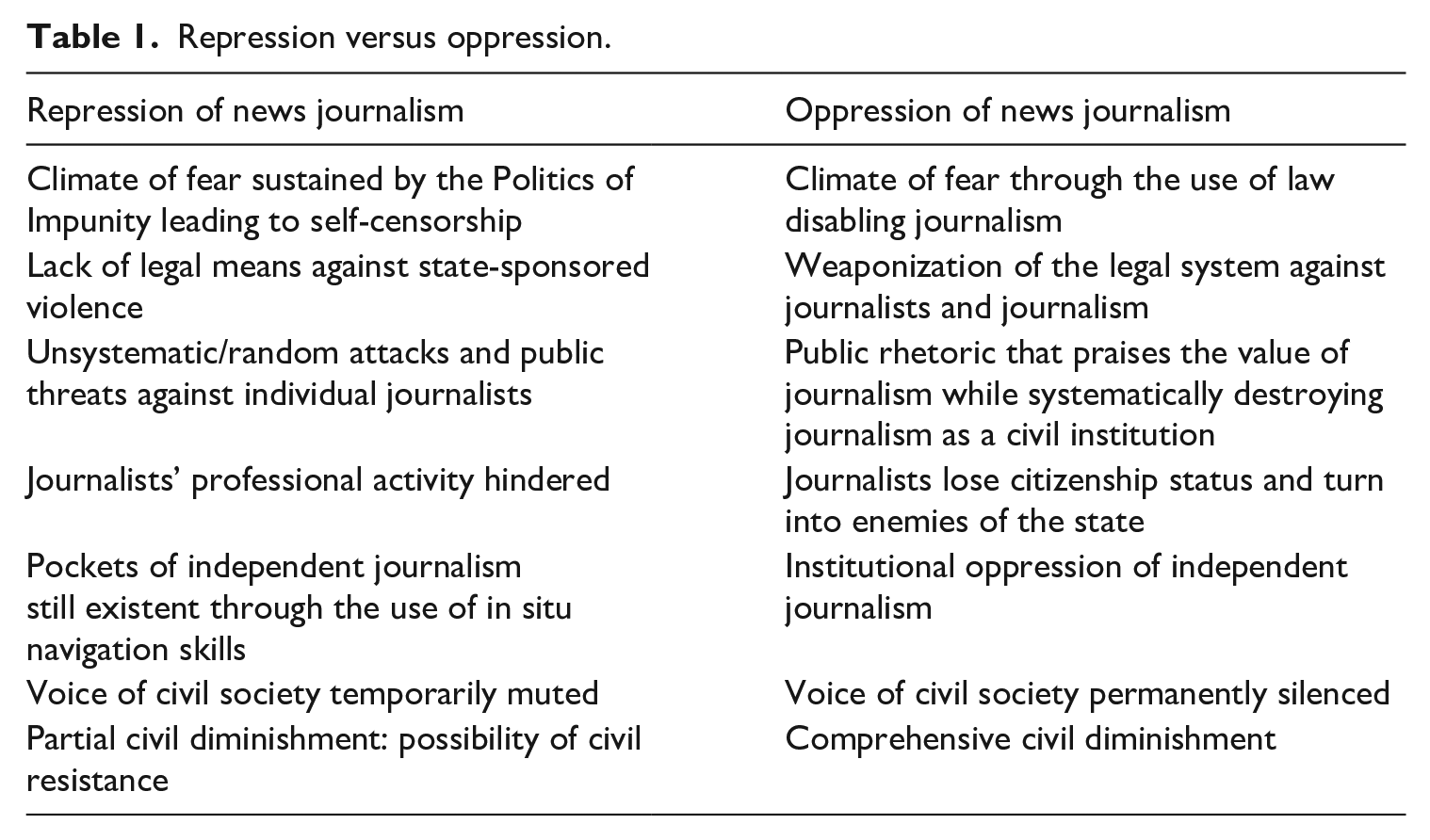
Our analysis proceeds according to the following structure: the repression of journalism in pre-coup Turkey, the catalyst for the move from repression to oppression, the oppression of journalism in post-coup Turkey.
News journalism in pre-coup Turkey (2013–2016) – repression and the creation of fear through the use of the Politics of Impunity
In 2013, Freedom House changed Turkey’s media freedom classification from partly free to not free. The pressure on journalists continued in 2013, unsystematically but yet significantly. On the occasion of the Gezi park protests – ‘the biggest challenge yet to the AKP government after 11 years in power’ (Girit, 2013) – the government and state-sponsored actors attempted to censor and ban all reporting on the protests. Whereas many media outlets supportive of the government obliged, independent journalists did not comply with the ban and ‘at least 75 journalists [were] fired or [. . .] resigned’ (Girit, 2013), without legal recourse. According to Freedom House, media freedom deteriorated further in 2014 as ‘the authorities continued to aggressively use the penal code, criminal defamation laws, and the antiterrorism law to crack down on journalists and media outlets’ (Freedom House, 2015). In addition, the government continued to use the financial and other leverage it holds over media owners to influence coverage of politically sensitive issues. Several dozen journalists, including prominent columnists, lost their jobs as a result of such pressure during the year, and those who remained had to operate in a climate of increasing self-censorship and media polarization. (Freedom House, 2015)
Across the country the authorities became increasingly intolerant of political opposition, public protest, and critical media, while government interference started to genuinely undermine judicial independence and the rule of law (see Freedom House, 2017). Media ownership had been transformed, leading to a dominance of pro-government media in the country. Intimidation, firing of critical journalists, and denial of accreditation to foreign reporters further eroded independent reporting. Restrictive laws had been deployed to arrest and prosecute journalists, while media groups who criticize the government had been fined. By 2015, Turkey had become the country with the highest imprisonment rate of journalists (CPJ, 2015a) and the highest number of cases of violations of freedom of expression before the European Court of Human Rights. By the time of the failed coup in 2016, Turkey exhibited all the aspects of a regime that aims to repress journalism including the still unsystematic use of the law to attack journalists without legal redress against the state and state-sponsored actors in the case of such attacks. Despite increasing pressure on journalists to comply with ‘the official line’ and Erdoğan’s public threats against journalists such as ‘The person who wrote this story will pay a heavy price for it; I won't let him go unpunished’ (CPJ, 2015b), some independent media outlets continued to resist the government’s attempts to be silenced.
In a previous study of India, Pakistan, Democratic Republic of Congo, Bulgaria, and Mexico, the authors developed and applied a typology consisting of seven affective states that serves as an analytical tool to describe the conditions and journalists’ practical experiences of impunity. We used this typology to analyze our interview data from pre-coup Turkey.
A feeling of helplessness due to a lack of protection from the government, media houses, the police, and the international community and concomitantly a feeling of helplessness
State power was seen as the most serious challenge to media freedom and journalistic activity and as such, protection from the government was not considered to be a realistic expectation. Rather, the interviewees expressed their disappointment regarding the lack of help and protection from the international community and generally doubted the effectiveness of international initiatives to protect journalists. For example, J1N said, referring to the 2012 UN Action Plan on the Safety of Journalists and the Issue of Impunity: ‘I can’t really, I can’t believe . . . I am not really sure this ever helped any country, anywhere . . . Unless the UN acts in an aggressive way, it is very hard to change the actual . . . the country the way it works, . . . when talking about media freedom we’re talking about an entire system’. This feeling was echoed by J2N: ‘If there is an action plan by the UN, I think this is a bit late for Turkey. [. . .] This action plan is too late. If I knew about the plan I would like to help and do everything I can to enforce it in Turkey’. The attitudes toward any protection from ‘the West’ differed as well. On one hand ‘the West’ should not permit Turkey to leave the Western world (J2N), but at the same time ‘the West’ was seen as hypocritical in its actions. For example, J5R expressed the view that Turkey had become a place the West experiments with. Accordingly, ‘the West’s’ sincerity regarding the protection of journalists in Turkey was genuinely questioned. J5R further explained that it was good of ‘the West’ to support media freedom in Turkey but at the same time the interviewee pointed out that ‘the West’ also supported some of the most dangerous anti-media freedom groups in Turkey. J4N similarly believed that Europe only applied pressure selectively and only ‘if it wanted something’ – in other words, Europe acted out of political expediency rather than based on a firm commitment to values and fundamental rights. J4N further pointed out that Europe had been overlooking human rights violations in Turkey in order not to jeopardize the refugee crisis deal – even EU membership negotiations had been re-opened which, so J4N believed, was unbelievable given Turkey’s level of human rights violations. For J4N the West was hypocritical when it came to the protection of human rights and media freedom. In conclusion, the helplessness was experienced due to a lack of protection from the Turkish State accompanied by a perceived lack of sincerity in Western governments’ claims to support media freedom in Turkey.
A feeling of professional isolation due to a lack of solidarity among journalists
Opinions about to what extent journalistic solidarity still existed in Turkey and could act in some way as a counterweight to impunity differed. According to J5R, there were still opposition media and associations that campaigned for independent journalism under the slogan ‘we will insist and carry on journalism’ (translation by interviewee). J6R felt that although in normal circumstances there wasn’t a strong journalistic solidarity, journalists came together on the occasion of attacks. J7R, however, said that only the media company whose own journalist died would cover the killing because ‘this journalist belongs to this media company’ but wasn’t considered a member of any kind of broader journalistic community. J7R also pointed out that journalists generally didn’t respect each other and that media companies did not only compete but ‘fought’ each other. J8R thought that maybe if the UN brought journalism associations together it could make a difference. Overall, the interviewees agreed that pockets of journalism solidarity and associations still existed, but that there wasn’t anything that could be likened to a journalistic community on a national level.
A feeling of fear due to continuous direct and indirect threats from government and state-sponsored actors and a feeling of fear
The Turkish government was, as noted above, identified as the main threat to independent journalism. J1N, for example, argued that Turkey was deeply divided and caught in a patriotic struggle (though non-systematic at this stage) where you were either a patriot or a traitor. In a similar vein, J2N spoke of the tyranny of the State and the continuous pressure emanating from the government on what could be reported (also J4N). To this J4N added that journalists’ biggest fear was to express an anti-AKP opinion, to publish anything that didn’t make the government look good. According to J3N, Erdoǧan and the AKP had been establishing ‘their own media environment’ to protect themselves from any kind of criticism or scrutiny.
A feeling of civil isolation due to the belief that there was a lack of interest (or disbelief) by the public in daily crimes and threats against journalists
Generally, the perception of all the interviewees was that the public believed that journalists were under attack but, as J1N and J2N pointed out, their experience was that the public expressed no particular interest in the situation of journalists. This aspect of the typology of impunity was less of an immediate concern for almost all interviewees.
A feeling of being in a ‘dead end’ situation due to the belief that there was no legal redress
All interviewees were acutely aware of the changing judicial system and its dependence on political power. For example, J3N said that the legal system was not working and that it didn’t protect journalists because journalists had become part of a bigger fight in society and were merely considered casualties. Equally, J4N pointed state-sponsored actors usually claim that journalists were spies and were helping terrorist organizations in an attempt to silence them. Problematically, the courts chose to remain inert though they could have ameliorated the situation for journalists. J1N and J7R noted that the legal system had deteriorated over the past few years and that it was impossible to know how it actually worked. All journalists agreed that the recent assassinations and attacks on journalists made them more careful; J1N felt that there was no hope for the legal system to improve.
A feeling of a loss of professionalism due to the inability to undertake independent journalism
All the interviewees agreed that independent journalism had become very difficult. J3N pointed out that before the 2000s journalistic associations were allowed and media pluralism was accepted but that now, journalists were seen as a mouthpiece for state ideology. J8R echoed this view by saying that journalists were being turned into ideologists. For J8R, the way of reporting was determined by the question of who would be disturbed by the report, whether there would be threats and how the news organization would react. According to J1N, Turkish media owners depended on good relationships with the government. J8R added to this that an anti-government line would lead to financial disadvantages thereby potentially making the news organizations financially unviable. The interviewees considered the impact of these developments on professional journalism was serious. According to J4N, the climate of impunity killed journalism, especially opposition journalism. J7R said that any kind of ethical journalism had become dangerous and J4N believed that ‘real’ journalism wasn’t possible anymore in the South-East. J2N summarized the impact of impunity on journalism as turning it into ‘Goebbels-like media’ without ethics. For this journalist, journalism had turned into propaganda – it felt as if the whole media environment consisted of a single newspaper.
A feeling of the inevitability and inescapability of self-censorship
The inevitability of self-censorship was expressed by all interviewees. More specifically, J5R argued that the biggest obstacle to media freedom was self-censorship of journalists and the existence of partisan media organizations. More specifically, J2N, J5R, and J6R emphasized that Turkey was a country of fear for journalists and that this fear led to self-censorship. Self-censorship occurred when stories that were worth reporting were deleted because they didn’t fit the editorial line (J5R and J7R). Any kind of resistance was made impossible (J2N).
What the above analysis lays bare are journalists’ feelings, experiences, and perceptions usually hidden from the public eye. It shows how regimes can enhance journalists’ risk perception – whether the risk is imagined or real – and create fear while yet upholding the illusion that self-censorship is voluntary. In short, fear and continuous ‘what if . . .’ questions sustain the repression of news journalism.
From repression to oppression: the failed coup d’état and subsequent legal and political changes
As a response to the failed coup d’état which Erdoğan called a ‘gift from God’ (Taş, 2018: 402), the Council of Ministers, based on recommendation nr. 498 made by the National Security Council, declared a state of emergency on 20 July 2016 for a period of 90 days starting from 21 July 2016 in accordance with Article 120 of the Turkish Constitution. 3 In total, the state of emergency (OHAL) was to last 24 months. Although domestically legal, 4 the scope and length of the state of emergency enabled restrictions on human rights and fundamental freedoms (including the right to freedom of expression and to a fair trial) far beyond what is permissible under international human rights law (see also Freedom House, 2018).
In 2017, the Turkish government held a referendum on constitutional changes which was approved by the Turkish people in a climate of uncertainty and chaos. The referendum marked ‘a transition from an already incongruous parliamentary system to rampant presidentialism’ (Bilgin and Erdogan, 2018: 29). Picarella (2018: 9) spoke of ‘super-presidentialism’ which required absolute loyalty to the President and an unconditional effort to secure the integrity of the Turkish state. It also undermined the separation of powers and provided the President with a high degree of power over the legislative branch and the judiciary.
The constitutional amendments that came into force on 9 July 2018 with the declaration of the Fourth Erdoğan Cabinet gave the Turkish President almost limitless discretionary powers which, in turn, allowed the undermining of civil liberties to be continued legally even after the state of emergency was officially lifted on 18 July 2018. In fact, the use of pre-coup anti-terror laws as well as specific articles from the Turkish Penal Code started to be used more systematically than before to bring charges against critical journalists (for details see . Article 19 and PEN International, unpublished draft). Journalists were equally accused of ‘denigrating state institutions’, ‘inciting the public to enmity and hatred’, and ‘attempting to overthrow the constitutional order’ (RCMF, 2019). Amendments to pre-coup laws, especially anti-terrorism laws, 5 enable the ‘Turkish executive to apply sweeping measures, including against the media and NGOs (among others), without any evidentiary requirement, in the absence of judicial decisions and on the basis of vague criteria of alleged “connection” to a terrorist organisation’ (Article 19 and PEN International, unpublished draft: 4). Overall, the constitutional changes and other legal amendments in combination with the dismantlement of the legal system, that is, the rule of law, allowed for the continuation of the post-coup crackdown on civil liberties and civil institutions particularly the news media.
In line with Taş (2018: 402) who identified the failed coup d’état as a ‘pretext and catalyst to [. . .] re-engineer the state’s structure’ and destroy critical and independent journalism, our interviewees considered the failed coup d’état a crucial moment in the deterioration of Turkish journalism and civil liberties – or in the establishment of what we call an oppressive setting for journalism. According to our interviewees, the Turkish government used the failed coup as an excuse to divide and polarize society. J9 pointed out, After the coup the government picked up a political rhetoric [through] which society was polarized. You were either in favor, in their eyes, of the coup perpetrators [considered by the AKP government to be Gülenists] or of the government that ‘defended civilian politics’.
In short, pro-government journalists would be praised by Erdoğan whereas oppositional journalists became enemies of the state. Accordingly, the state of emergency, so the Turkish government reasoned, needed to be maintained in order for Turkey to be able to persecute the new enemies of the state – independent judges, civil servants, NGOs and importantly, journalists. Journalists were now seen as political actors, as ‘militants’ (J11) rather than as part of ‘civilian politics’. Accordingly, as J12 argued, ‘the coup was a chance for the government to legitimize the crackdown in the eyes of its voters and it has used it well’. Indeed, the unprecedented crackdown on civil liberties and importantly civil institutions – both the law and the factual mass media – that started in the immediate aftermath of the failed coup d’état continues to this day. With regard to the former, the legal system has been dismantled with great speed since 15 July 2016. What judicial independence existed prior to the coup has been eviscerated as the courts are packed with political appointees and the legal system has been transformed wholescale into a system of repression. In fact, ‘by late 2017, more than 4,000 judges and prosecutors had been removed. Judges and trials in high-profile cases are transferred to ensure that the government’s arguments are presented before a sympathetic court’ (Freedom House, 2018). With regard to the latter, the crackdown on the independent factual mass media means that since July 2016, at ‘least 156 media outlets have been shut down by executive decree’ 668 6 (Amnesty International, 2017: 2) and according to the Union of Journalists in Turkey (TGS), an estimated 2500 journalists and other media workers have lost their jobs as a result. In addition, the Directorate General of Press and Information has revoked the press credentials of 778 journalists (Amnesty International, 2017).
What is crucial here is that the courts have played ‘a central role in the deterioration of press freedom’ (Index on Censorship, 2017). In other words, the legal system has been perverted to become a weapon in the fight against freedom of expression and critical oppositional journalism. At the time of writing, 204 journalists in total have been arrested or detained on account of their publications. Of these, 42 have been convicted, 89 remain under arrest or detained and 73 have been released. New arrests of journalists and media workers continued throughout 2018 in particular in the Kurdish South-East area. (Article 19 and PEN International, unpublished draft: 3)
The comprehensive oppression of news journalism in post-coup Turkey (2016–2018)
Turkey’s move toward the oppression of journalism reflects Agamben’s (2005: 2) definition of authoritarianism as the establishment, by means of the state of exception, of a legal civil war that allows for the physical elimination not only of political adversaries but of entire categories of citizens who for some reason cannot be integrated into the political system.
In Turkey, those who undertake critical journalism, aim to hold power to account and don’t follow the official line, are now cast as enemies of the state. They are required to live in a comprehensive state of civil diminishment – some have referred to it as ‘civil death’ (Moritz-Rabson, 2018) – which, as the interviews and the analysis of gray literature revealed, has two main features.
Journalists as enemies of the state and non-citizens
The oppression of Turkish journalism has reduced the civil standing of journalists. They have been stripped of fundamental citizenship rights including the right to a passport, free movement, and a fair trial. The restriction of free movement extends to both journalists’ professional and personal lives. J9 argued that it was very dangerous for journalists to travel without the yellow press card.
7
The card provided some form of security as it was issued by the government to those journalists who were still allowed to report (also J11). J10 expressed concerns about traveling within the country to simply interview a source or to even go on the street to report. In fact, journalism had become limited to what could be done from a desk. J12 described how both he or she and his or her partner were affected by restrictions to freedom of movement. His or her partner worked for an NGO but his or her work and residence permits were revoked and he or she was denied his or her right to enter Turkey. The journalist talked about his or her constant fear of having his or her passport confiscated and becoming stuck in Turkey. Freedom House spoke of an unknown number [who] had their passports revoked and were forbidden from leaving the country, and 54 journalists [who] had their property confiscated (Freedom House, 2017). Article 19 and PEN International referred to ‘Many of those who have been released have been given a suspended sentence and placed under travel ban, preventing them from leaving the country. (unpublished report: 3)
To this Amnesty International (2017: 4) added that journalists and their families lost ‘housing and health care benefits’, that the stigmatization of being branded a terrorist has left them unable to find work, and that they have also ‘been prevented from seeking employment abroad, as the decrees also require the cancelation of their passports’. Civil rights such as the freedom of movement, the right to work, and the right to join associations have effectively been suspended for journalists (Freedom House, 2018) and by extension their families. This has been equally the case for their citizens’ rights concerning the rule of law. Journalists have been facing a systematic threat of arbitrary detention and have been outcast to such an extent that anyone who wants to attack them can do so with impunity.
The majority of arrested Turkish journalists have faced charges for being in some way apologists for terrorism or for ‘membership’ of armed organizations (Article 19 and PEN International, unpublished draft). J12 noted that ‘arbitrary detentions, being blocked from seeing a lawyer, long arrests and being jailed without indictment are almost common practice now’ with ‘court cases based on statements of anonymous witnesses’. To this J10 added that the cases of imprisoned journalists in Turkey are full of fabricated evidence, arbitrary arrests, long prison sentences and non-proportional penalties. Most journalists are in jail because of what they have written, said, or according to which media they worked for. News or tweets are often used as criminal evidence.
What this shows is that journalists have become neither prisoners nor persons accused, but simply ‘detainees’. In fact, they have become the object of a pure de facto rule, of a detention that is indefinite not only in the temporal sense but in its very nature as well, since it is entirely removed from the law and juridical oversight. (Agamben, 2005: 4)
International law has been breached, the domestic rule of law has broken down, and therefore the restrictions of their civil rights have been extending far beyond physical imprisonment. Exacerbating the situation was the failure of both the Constitutional Court and the European Court of Human Rights to provide justice in a reasonable amount of time.
Physical violence including ‘torture’ has been exercised against journalists with impunity by the ‘State, civilians and police’ (J11). According to J9, if ‘you are not a pro-government journalist whatever happens to you is simply collateral damage [. . .] You go out, [. . .] you could be tear-gassed, kicked, bullied’. J11 further explained that the police operated with impunity and that doctors didn’t dare to document injuries caused by the police out of fear for repercussions: When I went to the doctor he refused to sign the form to say this injury had been caused by the police. He claimed it was the way I had been sitting for years at my desk. But this was a sudden injury. He just didn’t want to be prosecuted for making false statements about the police hurting a journalist. (J11)
J11 also explained how the digital environment now posed more threats for journalists and that therefore digital safety had become crucially important: These people find who you are, look through all your accounts, work out where you are going to be. One reporter I knew had his location posted online and posts put up asking people to find him and beat him to death. But nothing was done about it.
What this shows is to what extent Turkish journalists have been, to use Agamben’s (1998: 171) insight, ‘so completely deprived of their rights and prerogatives that no act committed against them could appear any longer as a crime’.
Living in an environment characterized by comprehensive civil diminishment
The permanentization of the state of emergency into ‘constitutional law’ has had severe consequences for Turkish journalists, journalism, and civil society. Protected by the Constitution, the Turkish government has been able to systematically oppress journalism and journalists. It has created an environment of comprehensive civil diminishment. Civil diminishment is twofold and occurs (a) when the enabling factors of meaningful citizen interaction are undermined and (b) when the enabling factors of a participatory civil life are indirectly frustrated, immiserated, or directly prevented (Harrison, 2019). In other words, and regarding our particular argument, journalistic associative life has changed. Usually, professional associations can act as a vehicle for what can be called civil resistance, that is, a form of sustainable civil capacity that enables journalism to (a) resist and push back against an antagonistic setting thereby preventing it from becoming an oppressive setting, or a dominant setting; or (b) and more progressively, to champion its opposition to the circumstances of targeted oppression and repression in a form of journalistic solidarity (ibid.) However, this kind of professional solidarity as a ‘push back mechanism’ has become impossible in Turkey due to years of erosion of journalistic freedom and protection, which further worsened as a consequence of the failed coup d’état. For example, J12 argued that because of ‘the crack down after the failed coup and massive arrests, our campaigns are limited with twitter and trying to keep the problem alive on the agenda of the EU and similar institutions to put pressure on Turkey’. To this J12 added that physical solidarity went down. We can’t organise demonstrations, open stands on streets, get signatures from people. In short, we can’t do anything on the street because of OHAL, the state of emergency [see above], which was in effect between July 2016 to 2018 and is still continuing in practice.
Attempts at citizen journalism as an alternative to professional journalism have equally been frustrated. For example, J9 argued (and it is worth quoting at length) that citizen journalism changed as after the coup there were mass round ups of citizens, people accused of supporting the formation of the coup and there were thousands of investigation being filed, thousands being arrested and there was that atmosphere of intimidation, for anyone who tried to question or inform their own environment in their own capacity.
This meant that people on social media no longer dared to ‘use their own names as they were afraid people would show up on their doorstops’ (J9). Whereas shortly after the coup, ‘using VPNs became much more commonplace as you could make sure you couldn’t be traced by the IPN address’ (J9), people have since become afraid to use those as even needing a VPN account makes people suspicious. Effectively, so J9 noted, ‘citizen journalism died as everyone is now in fear of being labeled pro-coup’. Being a vocal citizen, member of an opposition party, or simply having opened a bank account with a black-listed bank can cause any civilian to be reduced to bare life in this permanentized state of exception. The Turkish government has not only targeted journalists as journalists but also as citizens and used various means to strip them of their citizenship rights. Especially, the complete absence of the rule of law has made, according to J12, life as a citizen [. . .] painful. It’s not easy to keep a sane brain when laws are not implemented, when judges decide according to orders they receive from above, when people that I personally know are in jail without indictment for more than a year.
Conclusion
We wanted to show that the distinction between repression and oppression is indeed a useful one both for understanding Turkey during the period under consideration and by extension as an analytical tool for understanding attacks on free and independent journalism elsewhere. Through the use of this conceptual distinction, the characteristic features of life under, respectively, repressive and oppressive conditions – in legal, political, and civil terms but also in experiential terms – in both pre-coup Turkey (2013–2016) and post-coup Turkey (2016–2018) can be shown. Combined and overall, the difference between the repression and oppression of news journalism is one of scale and scope which, in Turkey, manifested itself in an emphatic change from attacking individuals to perverting entire institutions into vehicles of injustice. Repression was supported and driven by the Politics of Impunity and left spaces for forms of civil resistance such as protests and manifestations as well as certain forms of legal recourse. Equally, journalists were still able to be ‘critical’ – typically of an inconsequential kind. Clearly off limits were taboo subjects such as the Gülen movement or the Kurdish issue. Neither were subject to critical review by Turkish journalists. Oppression was supported and driven by the weaponization of the law and led to Turkey finding itself in a state of comprehensive civil diminishment which made any form of civil resistance practically impossible and too dangerous to attempt. Such resistance as exists is most likely to be found in Turkish exilic communities rather than on Turkish territory itself where a blanket attempt to silence the press and to control the national narrative exists. Presidential power is to remain uncontested with the result that, according to RSF (2019), the ‘rule of law is a fading memory in the “New Turkey” of paramount presidential authority’.
Footnotes
Funding
The author(s) disclosed receipt of the following financial support for the research, authorship, and/or publication of this article: The first set of interviews in Turkey in 2016 was funded by UNESCO’s International Programme for the Development of Communication (IPDC) as contributing to its priority area ‘Promotion of freedom of expression and press freedom (including the safety of journalists), pluralism and independence’.
