




Abstract
This article explores one of the most notorious and controversial initiatives by tech corporations to increase connectivity across the Global South: Facebook’s Free Basics project. Public attention focused on its ban in India following nationwide protests about net neutrality. In Africa, however, Free Basics expanded without much public scrutiny to some 32 countries. This article traces this quiet expansion by using an innovative virtual private network (VPN)-based method and by calling for an analytical focus on the landscape of the digital civil society in Africa. Specifically, I outline two key, interrelated phenomena: (1) Facebook’s evolving strategy, including a greater engagement with civil society organizations and (2) the focus of digital rights activists in Africa on issues like Internet shutdowns, government surveillance, and the lack of data privacy frameworks. In the process, I illuminate broader trends in the digital industry including tech corporations’ growing investments in mobile social media, network infrastructures, and in civil society; the use of disadvantaged populations and unregulated territories for digital experiments and data extraction; and the mounting recognition of Facebook’s political role, both within and outside the corporation.
Keywords
Introduction
Amid discussions of social media’s disruptive role for democracy, access to the Internet can easily be taken for granted. Yet, for most of the world’s population, connectivity remains too expensive, technically inaccessible, or unreliable. In response to the digital divide, tech corporations like Google and Facebook have invested in various projects to increase connectivity across the Global South. This article traces the history of one of the most notorious and controversial of these initiatives, Facebook’s Free Basics project. Free Basics provides mobile users with access to a small number of data-lite websites of basic services, free of data charge – a model widely described as a walled-garden Internet experience. Framed by Facebook as a philanthropic effort, Free Basics was fiercely contested in India, and eventually banned in 2016 following pressure from a civil society campaign. Many commentators saw this as a massive blow to the expansion of Facebook’s connectivity efforts. To an extent, it constituted Facebook’s first major political scandal on the global stage, before the controversies surrounding misinformation and data privacy following the 2016 US presidential elections and the Cambridge Analytica scandal.
As I will show, however, Free Basics’ defeat in India did not stop the project’s expansion throughout the world, particularly across Africa. As of July 2019, Free Basics was reportedly available in 65 countries, including 30 African nations. In this article, I seek to understand why Free Basics’ implementation in these African countries was not met with strong pushback, as it was in India; and why we did not see a spillover effect from the India debate to these other parts of the world. To explore this, I put the analytical focus on the landscape of the digital civil society in Africa. By the concept of digital civil society (Bernholz et al., 2013), I refer to the emerging space between market and state that comprises, primarily, civil society groups defending digital rights, and secondarily, civil society groups increasingly reliant on digital technologies. I argue that Free Basics’ quiet expansion across Africa was notably made possible by the combination of two key interrelated phenomena: (1) Facebook’s evolving strategy, particularly its growing engagement with civil society organizations and (2) the focus of digital rights activists across the continent on other issues, including Internet shutdowns, government censorship, and the lack of data privacy frameworks.
My analysis draws on various sources: promotional material from Facebook and its telecom and civil society partners; articles from international and African news, and from the technology press and expert blogs; video recordings of industry conferences’ talks and Facebook earnings call transcripts; industry reports and gray literature from digital rights organizations and expert think tanks. The analysis is also grounded in a review of academic publications on Facebook’s connectivity efforts across disciplines, including communication, development studies, law, science and technology studies, and engineering. Finally, it relies on a quantitative analysis of global news coverage of Free Basics and an innovative virtual private network (VPN)-based method used to independently assess the availability of the program across Africa.
Part I traces Free Basics’ history from the 2013 launch of the Internet.org initiative to the India ban in early 2016. Against the prevalent perception that this ban signaled the end of Free Basics, part II provides an overview of the program’s expansion in Africa. Parts III and IV turn to Facebook’s evolving strategy and to the landscape of digital rights activism in Africa to better understand why we did not see more pushback or spillover effect from the India debate. I find that Facebook refined its public strategy by minimizing the press surrounding Free Basics, by pursuing less controversial projects around Wi-Fi technologies, and by increasing its interactions with civil society groups. In parallel, digital rights activists across the continent were preoccupied with ongoing issues of government censorship, Internet shutdowns, and the lack of data privacy frameworks, which relegated debates about zero-rating regulation to the background.
Throughout, I relocate Free Basics within the context of broader trends shaping the digital economy including: the importance of a growing user base amid increased competition between tech corporations (van Dijck, 2013) and the rise of a mobile and social media centric Internet (Willems, 2016); the use of disadvantaged communities and less regulated territories as testing grounds for data extraction and technological experiments (Madianou, 2019); the mounting recognition of Facebook as a political institution, both within and outside the corporation (Persily, 2017); and, perhaps less known, tech corporations’ growing investments in network infrastructures and in civil society.
In doing so, I follow the lead of anthropologists, and communication and development scholars who highlight the importance of understanding modernity from the Global South (Arora, 2019; Burrell, 2012; Comaroff and Comaroff, 2012; Wasserman, 2018; Willems, 2019). This approach constitutes both a theoretical and empirical orientation which, on one hand, recognizes long-standing, global patterns of inequalities and domination shaping the world’s history and which, on the other hand, seeks to move beyond the South/North binary by shedding light on the dialectical dimension of historical processes such as the global growth of digital connectivity. For, as Comaroff and Comaroff (2012) explain ‘while Euro-America and the south are currently caught up in the same all-embracing world-historical processes, it is in the latter that the effects of those processes tend most graphically to manifest themselves’ (p. 12).
From Facebook’s’ ‘philanthropic’ mission to India ‘saving’ the Internet
In August 2013, Mark Zuckerberg released a White Paper titled ‘Is Connectivity a human right?’ At the time, one-third of the world’s population was online; about 5 billion did not have access. Zuckerberg (2013) outlined a strategic vision to increase global connectivity, while challenging any profit motive behind the corporations’ concern for the digital divide, arguing that people ‘already on Facebook have way more money than the rest of the world combined, so it may not actually be profitable for us to serve the next few billion people for a very long time, if ever’. The White Paper aligned with techno-optimistic narratives characteristic of the field of information and communications technology (ICT) for development (Arora, 2019) by defending a causal link between connectivity and economic development. It also echoed a 2011 UN report linking connectivity and human rights, thereby framing Facebook’s mission as a moral imperative. A few days after this publication, Facebook launched Internet.org, a partnership with several companies to increase global connectivity.
One week before the 2014 Mobile World Congress (MWC), Facebook purchased WhatsApp for US$19 billion. WhatsApp then had around 450 million users and was adding 1 million new users per day (Covert, 2014). Documents revealed during a British parliamentary committee show that Facebook was closely monitoring WhatsApp’s performance and realized that WhatsApp constituted a huge threat, ‘heavily outpacing Facebook Messenger on mobile in certain areas. [. . .] WhatsApp was sending 8.2 billion messages a day compared to Facebook Messenger’s (on mobile) 3.5 billion’ (Warzel and Mac, 2018).
During the Congress’s opening keynote, Zuckerberg linked WhatsApp’s acquisition to Internet.org. He introduced various projects including a lab simulating different connectivity environments for developers to test mobile apps for emerging markets, and a project providing Rwandan students access to educational material via low-cost smartphones. Mostly, he focused on another Internet.org initiative known then within the company as project Apollo (Bhatia, 2016) – named for the Greek god of, among other things, knowledge, the sun, and deadly plagues. Just as citizens may dial 911 in case of emergency, Facebook wanted to create ‘a similar dial tone for the Internet’ where everyone could access some basics services. Relying on a philanthropic discourse, he framed access to food prices, health information, Wikipedia, and Facebook messages as basic human necessities.
To do this, he proposed that mobile operators partner with Facebook based on the following argument: the reasons why most unconnected people are not yet online are high data costs, and because they do not yet know the benefits of connectivity. By offering access to basic online services free of data charge, users would get a taste of the Internet and ultimately want to pay to access the whole Internet. The ‘free’ services would be entirely text-based, such that shouldering the connectivity costs would be reasonable for telecom operators, and that ultimately, they would gain customers and increase their sales. To support this point, Zuckerberg shared findings from tests in the Philippines and Paraguay showing significant increase in subscribers and consumption. His onstage interviewer put it in plain terms for the telecom CEOs in the room by calling this service a ‘gateway drug’ whose point was ‘to lead to further consumption’. Together, the WhatsApp acquisition and these mobile-centric Internet.org initiatives signaled Facebook’s push to become the dominant player in the mobile digital space, particularly in emerging markets of the Global South.
Internet.org would also provide a response to Google’s investments in network infrastructures. After 2 years in development in its secretive R&D facility, Google had recently launched Project Loon (Levy, 2013), which deployed balloons in the stratosphere to connect remote areas and maintain communication after disasters. Facebook, then, hired leading experts from NASA; acquired a UK engineering company developing solar-powered drones; and announced the development of high-altitude drones capable of beaming connectivity lasers. A new Internet.org White Paper barely concealed the rivalry between Google and Facebook, noting that ‘drones have more endurance than balloons’ and can be controlled precisely ‘unlike balloons’.
Publicly, Internet.org emphasized its mobile-focused basic service. In July 2014, Internet.org launched the ‘Internet.org app’ with operator Airtel in Zambia. It allowed users to browse 13 services without data charge, including Google, Facebook, Wikipedia, a Johnson & Johnson-sponsored maternal health site, the Zambian government’s app, a local job portal, and a women’s rights organization. Tanzania, Kenya, and Ghana followed suit in the next 6 months.
The Internet.org app had its roots in an earlier initiative, Facebook Zero, which provided mobile users with access to a text-only version of Facebook, free of data charge. ‘Zero’ stands for the fact that traffic is zero-rated, that is, it does not count against the data cap of users. Just like the Internet.org app, Facebook Zero merged two growing areas of the tech industry, social and mobile media, and was first announced at the 2010 MWC. However, Facebook Zero was presented as a business venture, not a philanthropic mission. In May 2010, 50 mobile operators launched it in 45 countries, including DRC, Rwanda, Uganda, and Ivory Coast (Mims, 2012). Facebook hoped to access emerging markets with low Internet penetration rate and high data costs, but with high mobile phone uptake and tremendous demographic growth (MacMillan, 2012). By targeting these users, Facebook Zero sought to make Facebook their first entry point to the web, while boosting its user growth ahead of its 2012 initial public offering (IPO). That same year, Twitter, Wikipedia, and Google launched similar zero-rated services invariably presented as efforts targeting the ‘next billion users’ in emerging, mobile-first markets (Wagstaff, 2012). The Internet.org app should thus be understood in continuity with previous Facebook efforts to expand to new markets and in the context of increased competition with other tech companies.
In its global search for new users, Facebook had its sights set on India. With only 15% of its population online and a billion not online in 2013, Facebook saw a tremendous opportunity for user growth. In October 2014, Zuckerberg traveled to New Delhi for an Internet.org summit, met with Prime Minister Modi, and visited the rural town of Chandauli (Grossman, 2014). A few months later, Internet.org announced the upcoming launch of its app in six Indian states. But this introduction did not unfold as planned for Facebook, to say the least.
Internet.org found itself in the crosshairs of an informal and highly efficient group of Indian activists who gathered under the label Save the Internet (STI) and led a year-long, highly publicized, nationwide debate over net neutrality (Mukerjee, 2016). They decried Internet.org as a violation of net neutrality, that is, the principle that Internet service providers should treat all Internet traffic equally, and refrain from charging differential fees for different types of traffic. For them, Facebook was acting as a gatekeeper of the Internet by pre-selecting services available on Internet.org, without transparency and with a Western bias detrimental to local services and start-ups. In response, Facebook launched a platform allowing any service that met Facebook’s technical requirements to be included on Internet.org. Facebook also invested heavily in a nationwide, online, and offline advertisement campaign emphasizing Internet.org’s ‘philanthropic’ mission. The activists further argued that the name Internet.org was misleading: for first-time Internet users, it implied they would access the whole Internet, not a Facebook-centric walled-garden; and since the top-level domain ‘.org’ is largely used by non-profits, it made Internet.org sound like a formally registered non-profit, instead of the multi-stakeholder business venture it was. In response, the Internet.org app was renamed ‘Free Basics’ before its nationwide launch.
With growing public pressure, the Telecom Regulatory Authority of India (TRAI) invited public comments as part of a consultation on net neutrality. Facebook launched another massive ad campaign with the taglines ‘Save Free Basics’ and ‘India supports Free Basics’ (Mukerjee, 2016), even using its platform to systematically encourage Indian Facebook users to send an auto-filled email to TRAI stating ‘I support Free Basics and digital equality for India’. Critics pointed to the money spent on the campaign as proof that Facebook’s incentives were far from philanthropic. After temporarily blocking Free Basics, TRAI released in February 2016 regulations banning zero-rated services, including Free Basics.
STI’s success had largely to do with its members’ social position and strategies. Most were urban, middle-class developers, coders, tech workers, or journalists or lawyers in technology policy (Prasad, 2018). Their advocacy displayed digital savviness (blogs, Reddit forums, digital petitions, YouTube videos, reaching Indian CEOs on Twitter to convince them to support net neutrality). These activists also drew on a ‘transnational grammar’ of digital rights activism (Prasad, 2018) borrowing strategies activists successfully deployed during the US net neutrality debate. These included using similar hashtags (#savetheinternet, #netneutrality) and taking inspiration from late-night TV host John Oliver’s influential role in the United States by working with the popular comedy group, All India Bakchod, which produced three notable videos supporting net neutrality. STI also received support from the global digital rights community, with 67 leading organizations signing an open letter condemning Free Basics’ negative impact on market pluralism, local innovation, and users’ security and privacy.
Within India, STI members embodied a new, digital, globalized middle class – a social positioning that resonated strongly with a political discourse championed by Modi’s ruling party in which the IT sector was key to India’s future (Prasad, 2018). Furthermore, the campaign discursively relied on anti-colonial sentiments as interviews with influential coalition members suggest, such as Nitin Pai – the cofounder of a prominent policy think tank – who commented about Facebook’s responses to the activists: ‘You know that foreigners talking down to Indians and telling them what is good for them is going to backfire’ (Bhatia, 2016). By arguing that net neutrality was key to support Indian tech entrepreneurs, STI activists successfully tapped into the ruling party’s discourse and broader imaginaries of anti-colonial, national self-determination to spur public support for new regulation.
Free basics in Africa: an overview
Media coverage and search interest data show that global online attention into Free Basics peaked with the India debate, and declined dramatically after. Based on data retrieved from some 1500 English news sources through MIT’s Media Cloud tool, Figure 1 shows the number of news stories about ‘Free Basics’ and ‘Internet.org’ published between June 2013 and June 2019. Most of the coverage happened between March 2015 – when Facebook announced Internet.org in India – and early 2016 – when TRAI banned zero-rating. India was the main geographic focus in 61.85% of the stories (n = 1529), followed by the United States with 15.29% (n = 378) and Nigeria with 4.85% (n = 120). Similarly, peaks in search interest (Figure 2) correspond to key developments in India.
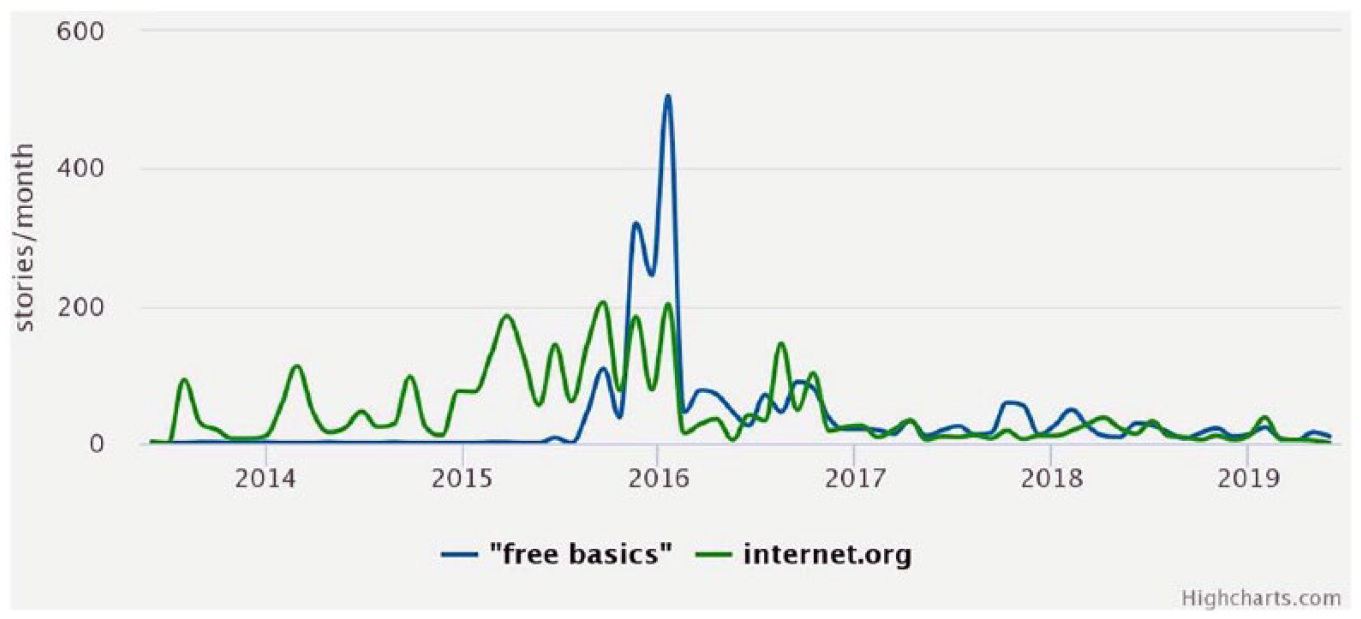
Number of news stories about ‘Free Basics’ and ‘Internet.org’ across 1500 Global English Language sources, June 2013 to July 2019.
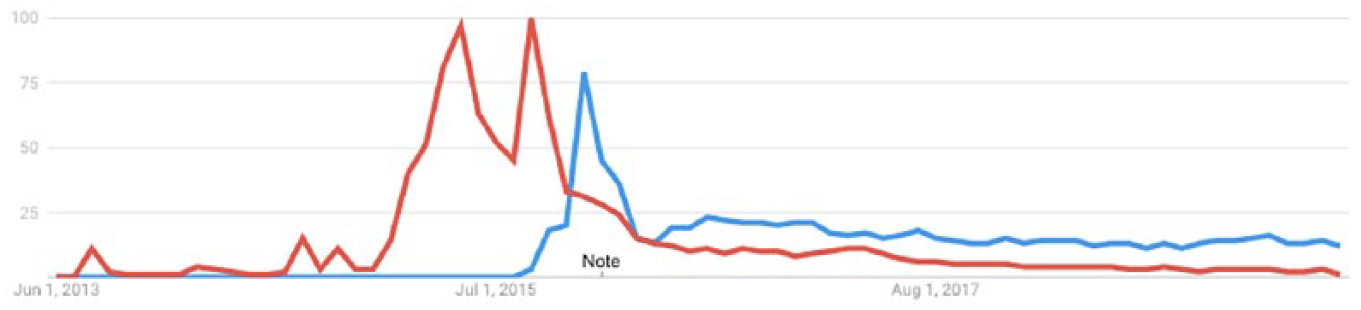
Search interest (worldwide) for the terms ‘Internet.org’ (red) and ‘Free Basics’ (blue), June 2013 to July 2019.
This focus created a perception among observers that the India ban signaled the end of Free Basics globally. Yet this is misleading as, in fact, Free Basics continued its expansion, particularly in Africa. At the end of 2015, 30 countries offered Free Basics; by November 2016, Facebook reported that Internet.org brought 40 million people online and in 2018 almost 100 million people (Constine, 2018). According to the Internet.org webpage (accessed July 2019), Free Basics was live in 65 countries, including 30 in Africa. This expansion was particularly facilitated by a partnership with Airtel Africa – a subsidiary of Indian operator Airtel, which announced, during the net neutrality debate in India, that it would launch Free Basics in its 17 African markets (Internet.org, 2015).
One should proceed with caution here. The Internet.org website has been dormant for a few years, raising questions about its accuracy. To independently assess the availability of Free Basics in Africa, I used a VPN to connect to the Free Basics website (https://0.freebasics.com) from nearly all countries on the continent. 1 This process does not allow to access Free Basics itself, but it provides information about its availability: when available in a country, the landing page states so, along with information about the partnering operator(s) (Figure 3); where it is unavailable, the URL redirects to the Facebook Connectivity website.
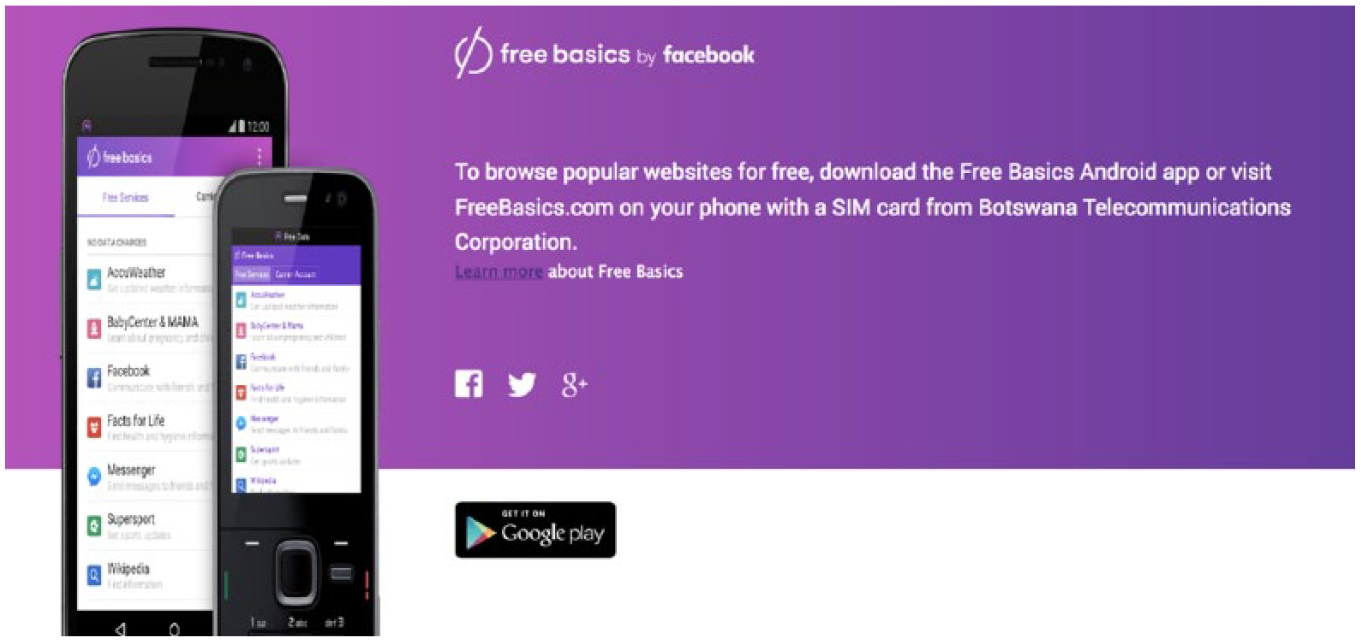
Landing page for https://0.freebasics.com in Botswana (accessed using a VPN connection, July 2019).
Through this process, I found that Free Basics was live in 28 African countries in July 2019. Interestingly, Free Basics was available in Botswana (a country not listed on the Internet.org webpage) but no longer in Congo, Morocco, and Chad. 2 Another discrepancy was that several telecom partners not on the official Internet.org list actually offered the service: Safaricom (Kenya); Moov (Ivory Coast); bip (Madagascar); MTN, Tizeti, and Coolink (Nigeria); and MTN (Rwanda and South Africa); while others stopped offering it: Orange and Blueline (Madagascar); TNM (Malawi); Vodacom (Tanzania). Following typical patterns in the mobile industry (Hoskins, 2019), the availability of Free Basics is in constant flux which calls for further ongoing assessment.
Based on this original VPN analysis and my review of news articles and promotional material from Facebook and its partners, Figure 4 provides an overview of Free Basics in Africa including countries: where, in July 2019, it was live (n = 28) and no longer available (n = 3); where it had been announced but not launched (n = 4); and where it was banned (n = 1). In the last section, I come back to the few countries where it was announced or banned. For now, I want to highlight how widespread the initiative has been in Africa – with 32 countries offering Free Basics at one point since 2014.
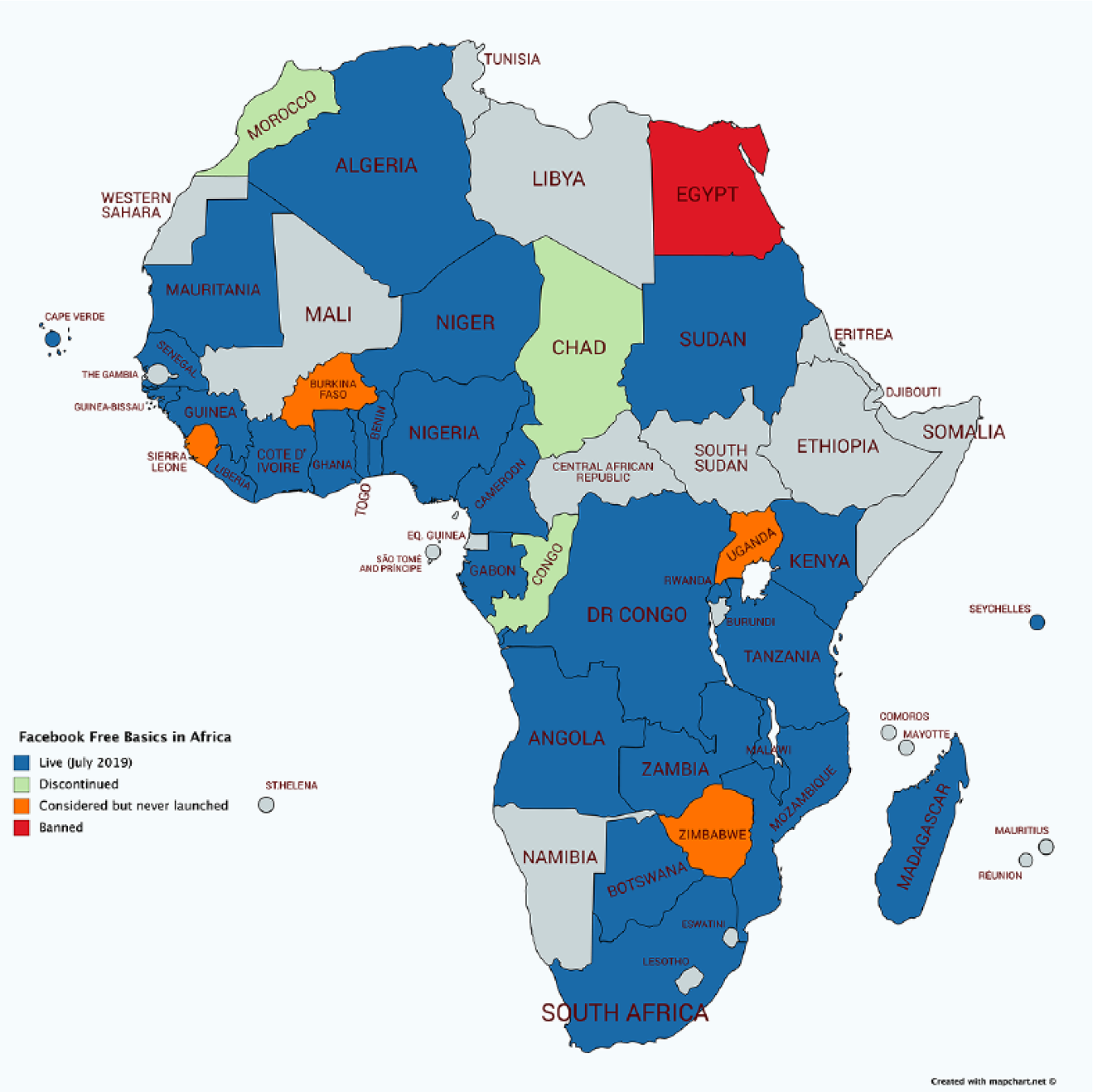
Overview of Free Basics in Africa (the data about availability of the service as of July 2019 were obtained independently using a VPN connection).
In Free Basics’ global history, the pushback in India was an outlier. The norm, instead, has been a quiet, uncontroversial rolling out of the program. This norm fits into a pattern of South/North power relations with many historical antecedents. A fitting historical analogy noted by Graham (2016) is that of infant formula. In the 1970s, Nestlé’s marketing practices came under scrutiny for promoting a dependency on formula among mothers throughout Africa, Asia, and Latin America. An influential report in the New Internationalist (Baer, 1982) outlined the multinational’s strategy: (1) creating a need where none existed; (2) convincing consumers that their product was essential to a ‘good life’; and (3) giving free samples. Never mind that formula was more expensive than breast milk, Nestlé’s ads framed breastfeeding as difficult and prone to failure. Moreover, the free samples contributed to create a physiological need for formula, as breast milk production would start to decrease. In many ways, Free Basics followed a similar pattern. Facebook aimed to convinced poor people in the now ‘developing world’ that connectivity was essential to economic development and a ‘good life’. It similarly gave ‘free’ samples with the view that it would lead to further consumption. Finally, recent insights about the intentionally addictive design of social media (Alter, 2017) echo the physiological needs created by the formula industry.
Free Basics also fits within two broader and interrelated trends in the digital industry, digital experiments on marginalized populations and data extraction. There is increasing evidence that vulnerable and disadvantaged populations, such as minority groups, refugees, and impoverished communities are prime, albeit largely nonconsenting subjects of digital experiments – be they designed to ‘help’ or surveil these communities (Latonero and Kift, 2018; Madianou, 2019; Mann and Daly, 2018). Data extraction, for its part, is central to the digital economy (Zuboff, 2019). It is key to building unique, rich datasets that train competitive algorithms, which are then generally used to connect businesses to customers. Despite initially dismissing claims of underlying profit motive, Free Basics was always a way to promote Facebook to first-time Internet users, to grow its user base, and to provide a competitive advantage to the corporation in emerging markets. Reflecting on Facebook’s Africa strategy, Ime Archibong, Facebook’s Director of Product Partnerships, explained: ‘We knew that 2014 and 2015 probably just felt like the right time to invest in the continent. To get out in front of it early and make sure that we’ve established a presence’ (Market place Africa, 2017). Beyond this, Free Basics also provides Facebook access to unique data streams. As Global Voices (2017) activists highlighted, Free Basics’ technical configuration positions Facebook almost like an Internet service provider, allowing them to collect ‘unique streams of user metadata from all user activities on Free Basics’ (p. 3), not just of those logged into Facebook. A possibility is that data extracted through Free Basics contributed to the creation of products aimed at telecom operators, such as Facebook’s recently announced analytics tools for network operators to plan infrastructures, and gain insights on traffic performance and customer engagement (Facebook Connectivity, 2018).
These trends in the digital economy exist in a historical continuum of South/North inequalities, which led scholars, activists, and journalists to talk of ‘digital colonialism’ that is, the idea that tech corporations today play a role similar to colonial powers. It is beyond this paper’s remit to trace the concept’s history and its analytical usefulness; 3 however, it is important to highlight that this critique gained particular visibility in the aftermath of the Free Basics/India debate. This was further fueled by Facebook board member Marc Andreessen tweeting after the ban: ‘Anti-Colonialism has been economically catastrophic for India for decades. Why stop now?’ This led to widespread outrage given the embarrassing implication that Indians should have welcomed Facebook’s form of colonization. Since then, the digital colonialism critique has grown increasingly visible, with Free Basics routinely evoked as the perfect example.
In light of this, we could have imagined seeing more spillover effect of the controversy to other parts of the world. African contexts particularly offer grounds for the digital colonialism argument to take hold since anti-colonial sentiments continue to thrive in political discourse across the continent. Furthermore, several countries which launched Free Basics such as Kenya (Nyabola, 2018), Ghana (Lindtner and Avle, 2017), Nigeria (Oyedemi, 2019), or South Africa (Bosch, 2017) experienced the proliferation of technology-centered political rhetoric, local tech ecosystems, and/or digital activism – all essential components to the pushback in India. Instead, and as Zuckerberg himself put it: ‘Africa is the opposite [of India in terms of opposition]’ (Levy, 2016). To better understand why we did not see similar pushback or more spillover effect, I now turn to Facebook’s evolving strategy, and then to the landscape of digital rights activism in Africa.
Facebook’s evolving strategy
While introducing Free Basics, Facebook developed links with civil society groups across Africa. It particularly did so through a South African non-profit, the Praekelt Foundation. Established in 2007 by mobile services entrepreneur Gustav Praekelt, the foundation became a leading organization for mobile health in Africa, through projects reportedly reaching ‘more than 100 million people in over 60 countries’ within a decade (Praekelt.org, 2017), and with support from major Western funders including the Bill and Melinda Gates Foundation, Omidyar network, Johnson & Johnson, and the United States Agency for International Development (USAID).
In November 2015, while the debate was raging in India, Facebook launched the Praekelt Foundation Incubator for Free Basics (Internet.org, 2015) through which 100 organizations received support to establish Free Basics compatible versions of their websites and services. The organizations covered the areas of advocacy, agriculture, economic empowerment, education, gender, health, youth, and human rights and mostly had a regional focus on Africa. They included major intergovernmental organizations like the World Food Program and the United Nations High Council for Refugees; well-established Western non-profits like Save the Children, Planned Parenthood, or the Nike Foundation ’s Girl Effect; digitally oriented, Africa-based civil society organizations, such as Code for Africa (data journalism and civic technology), Amandla Mobi (cell phone powered community advocacy), or Africa Check (fact-checking); and, smaller local, mainly South African, civil society groups, such as HOLAAfrica (sex education), the AmaBhungane Center for Investigative Journalism, or Childline Gauteng (children’s rights). While the chosen organizations reflected Praekelt’s geographical positioning in South Africa and its links to major Western donors, the incubator also allowed Facebook to reach several key organizations in the African digital civil society space.
Facebook also increasingly invested in another connectivity initiative: Wi-Fi hotspots. Starting as early as 2014, Facebook partnered with Project Isizwe, a South African non-profit dedicated to increasing connectivity for low-income communities (Hempel, 2016). Facebook provided funds for the establishment of Wi-Fi hot spots in poor areas, while project Isizwe oversaw their maintenance and engagement with the need of local communities. Three years later, Internet.org launched Express Wi-Fi in Kenya in partnership with the ISP Surf, starting with the cities of Nairobi, Mombasa, and Kisumu. In February 2017, there were 100 hotspots in Kenya. In September 2018, this number had increased to 1100 (Tiku, 2018). Express Wi-Fi is currently also available in Tanzania, Nigeria, 4 India, and Indonesia, and in February 2019, it was launched nationwide in Ghana and South Africa.
The project encourages local entrepreneurs to start businesses providing low-cost/high-bandwidth options to get online: they become Express Wi-Fi retailers who sell data packs and use a billing and account management platform developed by Facebook. At first, Express Wi-Fi seems to avoid one of the main issues that led to the pushback against Free Basics; instead of offering unlimited access to a limited version of the Internet, it provides access to the full Internet for a fee (and sometimes offering some free data to browse the entire Internet for promotional purposes). However, Facebook gives retailers the option to include Free Basics on Express Wi-Fi. According to the Surf CEO, this proved particularly popular in Kenya (Tiku, 2018). Express Wi-Fi thus also constitutes a discreet backdoor to continue expanding the reach of Free Basics.
In August 2016, Zuckerberg embarked on his first trip to sub-Saharan Africa (Oyedemi, 2019) – signaling the growing importance of the continent in the wake of the India controversy. He visited Nigeria, the continent’s most populated country, and Kenya, a country often considered a leader in African digital innovation. In both countries, he met with developers and tech entrepreneurs and visited tech hubs, CcHUB in Lagos and iHub in Nairobi. If Zuckerberg’s visit in a rural Indian town emphasized Internet.org’s development angle, his visit of tech hubs in Africa suggested an engagement with local tech innovators and start-ups – a strategic turn confirmed by the launch in May 2018 of a Facebook-funded tech hub in Lagos, NG Hub.
Since then, Zuckerberg and Facebook have shied away from large public relations campaigns about Internet.org. Internet.org’s Facebook page has not published any new posts since March 2017; the official Twitter handles for Internet.org and Free Basics have not been used since October and February 2016, respectively; and the Internet.org website has not published press releases since 2017. Facebook initially welcomed media coverage of Internet.org, for instance, by providing access to Zuckerberg and Internet.org staff for interviews, as could be seen in several long format stories published in TIME (Grossman, 2014), Wired (Hempel, 2016), or The Verge (Newton, 2016). Now instead, Facebook remains tight lipped about Free Basics and does not provide any information about how many people use it around the world.
In 2018, Facebook revamped its webpage dedicated to connectivity projects (https://connectivity.fb.com/), which appeared to become the new online home for Free Basics. Whereas the Internet.org website framed unequal access as a philanthropic concern, the connectivity website emphasized it as a technical issue to be solved by engineers. In addition to various wireless systems and transmission technologies for rural and urban areas, Facebook Connectivity has been investing in the construction of fiber optic infrastructures in South Africa and Uganda in partnership with Airtel since 2017. Since September 2018, Facebook has also been involved in the funding of other core infrastructures across Africa – Internet exchange points (IXPs) – via a partnership with the American non-profit organization, the Internet Society (2018). In February 2019, Facebook announced further investments in fiber optic infrastructures in Nigeria, and in April 2019, it was reportedly discussing the construction of an undersea cable around Africa code-named ‘Simba’ (Fitzgerald, 2019). 5
Meanwhile, public concerns over data privacy and the weaponization of social media grew tremendously. This was the aftermath not only of the 2016 US presidential elections and of the Cambridge Analytica scandal but also of social media–led violence in Myanmar – a country which successfully introduced Free Basics in 2016 (Roose, 2017). In this context, Facebook seemingly invested in building links with civil society groups ahead of elections in countries deemed to be potential hotspots of social media-driven unrest and violence, particularly in Africa. Ahead of the 2018 presidential elections in Cameroon, Facebook co-sponsored a symposium in Yaoundé bringing together local civil society organizations to discuss elections and digital rights (Tiku, 2018). In October 2018, Africa Check – the leading fact-checking organization on the continent – entered into a partnership with Facebook to become a third-party fact checker for the platform (Dahir, 2018). In February 2019, Facebook partnered with more than 20 civil society organizations across 15 African countries in support of Safer Internet Day (CNBC Africa, 2019). These include Paradigm Initiative, a Nigerian non-profit specializing in digital rights that will host workshops on safer Internet use; Media Monitoring Africa – a South African organization that will grow a local Web Rangers Program; and Watoto Watch, a Kenyan organization dedicated to protecting children’s digital rights. While these initiatives likely stem from a desire to put out PR fires before they happen (Cox, 2019), they nonetheless constitute a greater engagement with local civil society groups, drawing on organizational links the company established during earlier Internet.org efforts. And they signal a growing recognition of the platform’s role as a political institution, not only among experts and scholars (Persily, 2017) but also within the corporation itself.
Digital rights activism in Africa: facing governments, sidelining zero-rating
In addition to Facebook’s evolving strategy, it is important to consider the broader political and regulatory landscape shaping the advocacy agenda of digital rights activism across Africa. Since the Arab spring, social media have been widely linked to a range of social protests on the continent, from the student movements #FeesMustFall and #RhodesMustFall in South Africa to the citizen-led campaigns #EthiopiaProtests, #BringBackOurGirls in Nigeria or #ThisFlag in Zimbabwe (see Mutsvairo, 2016 for an overview), and accompanied the departure of several authoritarian leaders, from Ben Ali in Tunisia and Compaoré in Burkina Faso to al-Bashir in Sudan. Threatened by the digital activists’ ability to circumvent traditional communication channels, several governments across the continent have turned to radical strategies to crackdown on digital freedoms (Dwyer and Molony, 2019). One method increasingly used to stifle protest is to shut down the Internet in the name of public safety and the fight against disinformation and rumors: ‘between 2014 and 2016, access to the Internet was restricted during about one-third of the elections in sub-Saharan African countries’ (Freyburg and Garbe, 2018: 3911). Other repressive measures against digital freedoms include the implementation of taxes on social media use, cyber security laws which violate privacy and attack-free speech, the restriction of access to social media, and arrests of bloggers (Ogola, 2018).
For digital rights activists across Africa, government-led digital surveillance and repression have constituted particularly pressing threats. The birth of Africtivistes – an influential pan-African network of cyber activists – testifies to this focus on state actors (Mayault, 2018). Throughout 2012, activists in Senegal, Benin, Burkina Faso, and Ghana turned to social media for various campaigns related to elections, good governance, and civil liberties. These groups formally coalesced in late 2015 under the Africtivistes banner to primarily tackle state censorship and authoritarianism. Since then, the network has fostered pan-African digital solidarity, for instance, during the campaign that led to the departure of Gambia’s Yahya Jammeh after 22 years in power, or for the #BringBackOurInternet campaign against the 230-day-long Internet shutdown in Cameroon. Similarly, for most digital rights organizations active across Africa – be they global organizations like Internet without Borders and Access Now or more local ones like Kenya’s KICTANet, Uganda’s CIPESA, or Nigeria’s Paradigm Initiative – state attacks on digital freedoms constitute priorities in their advocacy.
This does not mean that Free Basics in Africa went unchallenged. In particular, groups from Uganda, South Africa, Kenya, and Nigeria signed the previously mentioned 2015 open letter to Zuckerberg raising questions about Internet.org. Facebook addressed some of their concerns regarding nomenclature and security, by replacing the name ‘Internet.org’ with ‘Free Basics’ and by allowing the use of the secure HTTPS protocol on Free Basics. However, the other issues their letter raised – net neutrality, data privacy, digital divide, government censorship, and surveillance – pointed toward the regulatory vacuum, and often politically repressive conditions, within which an initiative like Free Basics was allowed to take place.
Indeed, no country on the continent has currently enacted net neutrality regulations – with one consequence being that, even before Free Basics, zero-rating was relatively widespread. In 2014, the African Union developed the Malabo Convention on Cyber Security and Personal Data Protection; but as of June 2019, only 14 countries had signed it. By early 2018, only 22 countries in Africa had a data protection and/or privacy framework in place (Theodorou and Yongo, 2018). Yet, SIM card registration is mandatory almost everywhere on the continent (Donovan and Martin, 2014) with 43 countries requiring mobile operators to capture and store the customers’ identity information as part of the registration. Meanwhile, 28 countries have passed cybersecurity legislation (UNCTAD, 2019) with several governments abusing the interpretation of national security to crackdown on opposition, journalists, and civil society (Ogola, 2018).
Tellingly, Egypt – which banned Free Basics – reportedly did so because Facebook refused to give the government the ability to surveil users of the program (Abutaleb and Menn, 2016). Similarly, in Uganda and Zimbabwe where Free Basics was announced but not launched, 6 such an outcome is likely explained by a repressive political and regulatory landscape. Free Basics was slated to launch in Zimbabwe in January 2016 with mobile operator Telecel (Gambanga, 2015); however, in late 2015, the Mugabe government acquired a majority stake in Telecel in the context of increased governmental control over the Internet and growing popular discontent (Freedom on the Net – Zimbabwe, 2016). As for Uganda, the introduction of Free Basics was likely halted by the steep decline in Internet freedom ahead of the 2016 election and discussions of a social media tax (Magelah, 2016).
How issues of government control over the Internet took over the agenda of digital rights activism in Africa is best exemplified by a 2016 blog post from Ugandan social entrepreneur Sherifah Tumusiime: I was supposed to write a post explaining how ISPs in Africa have embraced zero rating and are actively pushing for differential pricing of OTT services such as WhatsApp as well as the dangers of Free Basics. Echoing the war cry of many digital rights activists in India who managed to have it banned from their country. All this was before 18th February, election day for Uganda. The fateful day that my government turned my beautiful nation into a frightening mimic of North Korea, blocking access to Social Media [. . .] and mobile money [. . .] Clearly, this is no longer a matter of discriminatory access projects like Facebook’s Free Basics. The state has turned against its own.
Throughout the Global South, zero-rating offers have been ubiquitous for several years in the form of data bundles and promotions designed by operators to attract customers (Hoskins, 2019); Free Basics is one of the various types of zero-rated services existing today. Generally, net neutrality proponents strongly reject zero-rating as a net neutrality violation (Crawford, 2015; van Schewick, 2015). 7 Yet, in most African markets where data costs are high and zero-rating has already been established for years, a regulatory ban on zero-rating could directly and significantly impacts poorer users. In 2016, Research ICT Africa – an influential think tank in the ICT policy sector in Africa – published a report generally defending zero-rating in Africa. It argued that zero-rating was a useful ‘gateway to the Internet for first time and price sensitive users’ and could enhance competition when ‘deployed by non-dominant mobile network operators’ (Gillwald et al., 2016: 3). It concluded ‘in the African context, where it is the mobile market that is providing access for the majority of Internet users, regulators should not prohibit the zero-rating of products when the zero-rating is found to be competition enhancing’ (Gillwald et al., 2016: 4). As mentioned previously, Facebook primarily partnered with Airtel to expand Free Basics in Africa. Back then, Airtel was generally not the dominant player in its various African markets. Facebook’s choice to partner with Airtel, then, aligned with the report’s recommendation that zero-rating may be welcome when deployed by non-dominant operators to foster greater competition. In sum, this sense that zero-rating may not be such a clear-cut issue, combined with increased threats to Internet freedom from governments, likely explains why digital rights activists in Africa did not put calls for regulating zero-rating more at the forefront of their agenda.
Conclusion
This article chronicled the history of a prominent Facebook initiative across the Global South, which attracted, in one country, tremendous public scrutiny, and, in most others, little to no pushback. While Free Basics’ ban in India was widely perceived as a significant blow to Facebook’s connectivity plans, I showed that it did not stop its global expansion, particularly throughout the African continent. Using the digital civil society as my driving analytical lens, I argued that Facebook was notably able to move forward across Africa due to, on one hand, adjustments the corporation made to its strategy and, on the other hand, to the political and regulatory dynamics shaping the landscape of digital rights activism on the continent. Facebook retreated from grand public relations campaigns about its philanthropic intentions, opting instead for a greater engagement with civil society groups and for the development of less controversial but related initiatives, particularly Wi-Fi hotspots. For their part, digital rights organizations in Africa found themselves facing threats that felt more pressing, from Internet shutdowns and government-led digital surveillance to a lack of data privacy regulation, thereby relegating issues of zero-rating regulation to the background. In the process, I shed light on broader trends in the digital industry, including the rise of mobile social media; tech corporate investments in network infrastructures and in civil society; the use of disadvantaged populations and less regulated territories as testing grounds for digital experiments and data extraction; and the growing recognition of Facebook as a political institution, both outside and within the corporation.
This research underscores two areas currently understudied in the emerging literature on social media and democracy. Most studies have focused on issues of hate speech, misinformation, content moderation, and political polarization (see an overview in Persily and Tucker, in press); their analytical focus is primarily on the content circulating on social media platforms. Instead, I have highlighted the growing investments of social media corporations in connectivity initiatives and network infrastructures. This aspect remains largely untouched in the literature and deserves more attention. That corporations which are already gatekeepers of Internet content are increasingly becoming caretakers of its backbone infrastructures raises questions of transparency, accountability, and undemocratic concentration of power. In addition, the article shed light on a practice of data consumption – zero-rating – rarely considered in current debates about social media and democracy. Yet, zero-rating programs are pervasive across the Global South and thus shape the Internet experience of a tremendous number of people across the world. This silence in the literature is conspicuous and reveals a Euro-American bias that future research should redress.
Footnotes
Acknowledgements
I am grateful to the anonymous reviewers and to the guest editors of the special issue on ‘Social media and democratization in Africa’, Bruce Mutsvairo and Helge Ronning, for their insightful comments. Many thanks also to the participants at the following seminars where early versions of this paper were presented: the Platform and Data Matters Seminar series at the University of Massachusetts–Amherst and the PACS seminar and Digital Civil Society seminar, both at Stanford University.
Funding
The author(s) received no financial support for the research, authorship, and/or publication of this article.
