




Abstract
Building on the results of a qualitative study with 16 male refugees (mostly from Syria) settled in the Netherlands, this article reports on an investigation that applied insights from the Uses and Gratifications (U&G) framework and refugee studies to examine the media use of refugees and to link these to the material, social and psychological needs emerging from the journey. With a focus on the smartphone, our study distinguished four significant clusters of media U&G among the sampling population: smartphone as companion, an organisational hub, a lifeline and diversion. First, the use of smartphones was linked to refugees’ need to contact family, friends and connect with migrant communities. The importance of establishing contact with other refugees and smugglers through smartphones reinforces the agency of these migration networks within mobility processes. The findings also point to refugees’ smartphone usage for getting a sense of security. Finally, this study demonstrated the use of smartphones for preserving memories of the journey through the storage of pictures taken of important moments experienced during the flight. Additional studies should include other methodologies and samples to further validate our theoretical framework and findings.
Keywords
Introduction
In light of the European refugee ‘crisis’ in 2015 and beyond, the perilous path to the ‘safe haven’ of the West is usually marked by high death rates in the sea, dangers of human trafficking, risky border crossing and exposure to numerous life-threatening and stressful events (United Nations High Commissioner for Refugees (UNHCR), 2016). The ‘refugee journey’ has been consistently described as a traumatic period reflecting on the individual’s social world and mental and physical health (Mazzetti, 2008). Several scholars have investigated thoroughly the psychological aspect of the migration experience, however, to a larger extent focusing on post-traumatic stress disorder (PTSD) and depression among refugees and their consequences for the settlement phase (Fazel et al., 2005). Yet, a focus on the process and event of the journey itself and how refugees cope with the extreme conditions that cause suffering and stress in the context of the flight experience has not yet been fully explored (BenEzer and Zetter, 2014). Existing research on refugee journeys lacks the development of a more coherent and systematic conceptual apparatus for explaining the contemporary context of refugee movements, where journeys are less linear and where refugees are often in situations where they are waiting in transit for several days, months or years (Kuschminder, 2017).
In this regard, Collyer (2010: 277) states that the development of fragmented journeys can be connected to technological changes in refugee movements and argues that digital technologies have allowed migrants to stretch their migration connections so that they can reach far more varied and distant destinations while utilising many of the same resources. The 2015 flows and European Union (EU) ‘refugee crisis’ have been important in directing scholarly attention towards refugees’ use of digital technologies, in particular the smartphone (Dekker et al., 2018; Zijlstra and Van Liempt, 2017). These recent studies demonstrate that smartphones can potentially improve the stressful conditions of the flight by helping refugees navigate their journey and enhance their networks of social connections. However, the risks associated with exposure to these technologies are also described as important factors limiting their agency during the flight (Gillespie et al., 2018).
This article aims to contribute to current understandings of how refugees experience and make sense of their journeys through the digital by exploring the role of smartphones in the lived reality of refugees in exile while at the same time addressing the material, physical and psychological stressors shaping refugees’ uses of mobile technology in various phases of the journey. Our central research question is thus, How are the needs and stress factors that arise during the stage of flight linked to refugees’ motivations to use smartphones? Building on insights from the Uses and Gratifications (U&G) framework (Rubin, 2009; Ruggiero, 2000) and refugee studies, as well as on the results of 16 in-depth interviews with male refugees (15 of whom are Syrians; one man is Iraqi), this study explains refugees’ ability to use smartphones in relation to four main clusters of media U&G emerging from their journey experience: smartphone as companion, an organisational hub, a lifeline and diversion. In this article, the contested term ‘refugee’ has been purposefully used to refer to study participants who had (successfully) arrived and received refugee status in their host country at the time of the research in 2016 and strongly identified themselves as being refugees.
Refugees’ needs during the stage of flight
The ‘refugee journey’ includes the many ways in which people seek refuge in other countries and the stressful conditions under which they have to live, marked by the deprivation of basic human needs at a material, psychological and social level (Moreno and Gibbons, 2002). A review of the literature revealed several stressors that refugees may encounter during their flight. The most common stressor for refugees in exile is family deprivation and it has strong implications for the later emotional state of individuals (BenEzer and Zetter, 2014). Extended separation from family and relatives often results in psychological trauma which is enhanced by the lack of news from home and the feeling of guilt for leaving families behind (Rousseau et al., 2001).
Furthermore, it is important to account for the wider sociocultural vulnerability of refugees within migration processes, mainly in relation to the absence of sufficient cultural knowledge and basic information to tackle both intercultural challenges and orientation problems that may arise during the journey (BenEzer and Zetter, 2014). In this sense, the lack of knowledge of the local language, cultural differences (in terms of racist and discriminative prejudices targeting refugees) and disorientation in urban and rural areas are elements conducive to social deprivation and psychological stress (Kinzie, 2006). For instance, previous studies have already demonstrated that refugees often seek peer social support in the group they are travelling with in order to overcome social isolation and to receive emotional support (Mazzetti, 2008), as well as to obtain practical information of the new environment (Kuschminder, 2017).
At the same time, the flight experience is likely to expose refugees to events related to extreme material deprivations and physical living conditions (e.g. lack of food, water and shelter, being close to death, low or high temperatures), which they will need to overcome in order to successfully reach their host country. The accumulation of traumatic events that accompany the refugees’ journey can affect not only their physical existence but also cause psychological damages that lead to suffering and anxiety (Collyer, 2010; Mazzetti, 2008).
Last but not least, the refugee crisis situation in Europe has put into question the effectiveness of current refugee laws and policies across many European countries. In Bulgaria and Greece, for example, the lack of sufficient accommodation facilities and both countries’ inability to handle the immigration flow caused numerous changes in refugee legislations. These include among others closing borders, establishing of immigrant quotas that involve further resettlement of asylum seekers and, thus, preventing them from arriving in the host country (Kuschminder, 2017). Likewise, when arriving in the host country, refugees need information on where and how to apply for asylum. Deprivation of relevant information should also be considered as a significant part of the journey when examining in-depth refugees’ media needs.
Although a thorough understanding of the material, social and psychological needs experienced by migrants during the flight can provide sufficient ground for exploring digital technological use among refugees, a priori theory that specifically explains media attraction is still needed. In this regard, the U&G framework is very useful for connecting the needs of refugees in flight with their exposure to digital technologies and services.
Media selection
Research into the attractions and uses of (digital) technologies has a long-standing tradition within the communication sciences (e.g. Ruggiero, 2000) and media psychology (e.g. Hartmann, 2009). One well-established framework that particularly resonates with the emphasis on addressing needs and coping behaviour is the U&G framework (Rubin, 2009; Ruggiero, 2000). It explains media use by focusing on the characteristics and the perceived problems of an individual, as well as on the surrounding structure in which media use takes place. Within this framework, individuals are not conceived as passive but are instead – within the material and social constraints of the environment (i.e. flight conditions) – characterised as active and turn to media as a response to specific needs and emotions. Given the focus on the surrounding context (flight experience), the individual (refugees)’s material, social and psychological needs and media, the U&G approach is particularly suited to explain differential media use within varying contexts and the attraction for specific types of media (content) (Ribbens and Malliet, 2015).
In the past decades, scholars mapped out the attractions of media for different social groups in various contexts. Not surprisingly given the congruence between the needs forwarded in refugee and migrant studies and the gratifications of media described by communication scholars, researchers have started to specifically investigate the functions media may serve for refugees and migrants (Yoon et al., 2011). Specifically focusing on refugee populations, most studies have been limited to the use of these technologies during (re)settlement processes (Alencar, 2017; Gifford and Wilding, 2013). Scholars have found, for instance, that digital media technologies are used for social reasons such as maintaining ties with fellow migrants (e.g. Tudsri and Hebbani, 2015) and with family and friends (e.g. Leung et al., 2009), as well as for promoting the physical and mental health and wellbeing of refugees (Walker et al., 2015).
More recently, scholars have shown an increased interest in examining the specific interactions between digital technologies and refugee mobility (Dekker et al., 2018; Gillespie et al., 2018; Schaub, 2012; Zijlstra and Van Liempt, 2017). However, most of these studies focused solely on the role of mobile technologies in refugees’ decisions and acquisition of information about the routes and methods of travel (Dekker et al., 2018; Schaub, 2012; Zijlstra and Van Liempt, 2017). One notable exception to this trend is the study of Gillespie et al. (2018), in which the particular affordances of smartphones for refugees are explored through the lens of the sociotechnical constraints associated with forced migration contexts. In light of their empirical findings, the authors call further attention to the spatial and sociocultural aspects of digital practices and their meaning for users who can shape digital environments and exercise agency even in critical contexts of refugee migration (Gillespie et al., 2018: 7). A more integrated approach is therefore needed to address the material, social and psychological needs that arise from the journey as well as to understand how the use of mobile technologies can help refugees cope with these needs.
Despite the complexity of current refugee movements and the diverse media practices emerging from these contexts, relevant motivations for refugees’ use of technology can be derived from the large body of empirical studies applying the U&G framework to both traditional and digital media content. The most common motivations, on a broad level, are (1) cognitive (or information seeking), (2) entertainment, (3) interpersonal communication (or relationship maintenance, social connection), (4) diversion (escape boredom, pass time) and (5) surveillance (acquire information about events, society and civic engagement) (Rubin, 2009; Ruggiero, 2000). With mobile communication technologies however, such as the smartphone, gratifications become easily accessible anytime and everywhere (Jung, 2014). The smartphone and its app driven mobile operating system in particular enhances daily productivity and facilitates formal and informal socialisation, entertainment (e.g. games), communication (e.g. messengers, social media), localisation (e.g. maps) and information acquisition (e.g. social media and news media applications) (Gerlich et al., 2015).
Given that refugees are on to move to a host country and that studies have revealed on the importance of mobile phones over other technologies during the flight (Gillespie et al., 2016), it is important to pay particular attention to the smartphone and its ecology. Social media are among the most popular smartphone applications worldwide (Nielsen, 2016). They combine the functions of traditional media (consuming content, news, …) and new media (participation in and creation of content) and are best described as interactive platforms via which individuals and communities share, co-create, discuss and modify (user-generated) content (Kietzmann et al., 2011: 241). As such, social media not only subsume the functions of information seeking, entertainment or communication, but they also become a powerful tool for self-expression and organisation (Lev-On, 2010). Lev-On (2010), for instance, describes social media as organisation hubs, ‘easily accessed focal points to which organizers, activists, and sympathizers can converge to coordinate their efforts’ (p. 1223). These organisational hubs can serve a variety of purposes, ranging from discussing information or meeting friends, over organising an event, to serving as a catalyst for political activism (Tudoroiu, 2014). Similar to the findings of media use in refugee communities (Dekker et al., 2018) and during political change (Tudoroiu, 2014), social media may facilitate information sharing and the construction of formal and informal communities with an internal (e.g. other refugees) and external outreach (e.g. governments, NGOs) during the flight.
While it is true that smartphones are currently playing an increasingly crucial role for people in different contexts, to afford using and maintaining such technology in forced migration circumstances can be a challenge for refugees who often rely on limited resources to face the uncertain conditions of their journey (Wall et al., 2017).
Smartphone use in the context of the refugee journey
Despite increasing Internet penetration and mobile device proliferation in the lives of displaced people (Gillespie et al., 2016), the use of smartphones by refugees in exile may be constrained by problems related to limited connectivity and the issues of surveillance and information quality and credibility (Dekker et al., 2018). First, refugees’ connectivity while on the move is subject to fragile and unpredictable access to Internet via Wi-Fi, SIM-cards and battery charging resources. When facing conditions of ‘information precarity’ (Wall et al., 2017), mainly regarding the challenges of access to online information, Gillespie et al. (2018: 5) highlight that refugees also tend to make complementary use of analog sources of information, such as leaflets at refugee camps and hand-drawn maps.
Second, the use of smartphones also enables new forms of digital surveillance of (irregular) migration by both state and non-state actors (Dekker et al., 2018: 3). Studies revealed that refugees have developed strategies to reduce this risk and protect their digital identities and access to any information about routes, smugglers, for example, through the use of avatars and pseudonyms (Gillespie et al., 2016), as well as communicating with smugglers and/or other travellers through closed Facebook groups and encrypted platforms such as WhatsApp (Gillespie et al., 2018: 5). On the other contrary, the fact that refugees can access a wide range of sources through their smartphones does not imply that all the information that is available online is trustworthy (Wall et al., 2017; Zijlstra and Van Liempt, 2017). Many report struggling to identify which information can be trusted, who the sources of information are and the reasons behind the sharing of this information (e.g. false promises by smugglers and government deterrence) (Dekker et al., 2018: 3).
Finally, in analysing digital practices in contexts of refugee mobility, it is also important to consider the various contingencies that are encountered while fleeing (e.g. distance to cover, borders to cross, transport, accommodation and food insecurity and anxiety), as well as the characteristics of the people on the move (e.g. demographic and gender dimensions), as these factors will shape not only refugees’ personal experiences and needs but also the ‘gratifications’ that their specific use of smartphones can provide. In the following sections of this article, we introduce our methodology and the results of this study, in which we present the main themes (needs) that emerge from the journey experiences of refugees and immediately link them to the gratifications provided by smartphones, as both aspects are scrutinised together.
Methods
This study used semi-structured interviews and the U&G framework to understand refugees’ everyday digital media practices during their forced migration journeys and more specifically to explore their motivations and experiences of media use in detail. Using symbolic interactionism as our methodological approach, we recognise the individual as an autonomous entity and emphasise the context in which meaning is generated and the individual differences in meaning generation (Altheide, 1985).
Participants and sampling
A combination of purposive sampling and snowball sampling was used to select respondents (Silverman, 2011). Following criteria were used as a guideline to sample respondents:
Given the nature of the recent refugee crisis, the focus was on refugees from the Middle East (mostly Syrians) who fled their home country in the past 3 years.
Participants needed to be active media users during their flight.
Refugees needed to have the Netherlands as their current host country.
Language is a crucial research and communication tool. Hence, the research included participants with a reasonable level of spoken English.
At first, contact was established with some of the major organisations dealing with refugees in the Netherlands, such as the Dutch Council for Refugees and the Central Agency for the Reception of Asylum Seekers, as well as with refugee camps in the Southern Netherlands. However, due to privacy reasons or other running (non-media related) academic or journalistic requests at that time, these organisations were not willing to cooperate. Therefore, we targeted communication channels used to reach refugees, such as the Refugee Start Force Community and complemented it with snowball sampling. Interview requests were posted on active communication platforms. Given the limited time frame of this study and the additional difficulty of reaching female participants, we decided early on to focus on male participants. Although the sampling procedure certainly induces a bias in our sample, it also guaranteed that refugees were active smartphone users and that the data were varied yet comparable. Hence, the sample aligned with our goal of theoretical refinement. Table 1 (Appendix 1) provides an overview of the participants’ age, origin and educational level.
Procedure and material
As described in the theoretical framework, several types of media use and gratifications can be theoretically linked to refugees’ experienced needs and stress factors during their flight. This allowed us to structure the interview using a topic list. In line with the procedures employed in grounded theory (Boeije, 2010), theoretical insights were not used as pre-defined assumptions to be tested. Rather, they were used as sensitising concepts that were continuously questioned, refined and related to the lived experience of the participants.
Data analysis
During data analysis, the principles of thematic analysis were followed, which aims for theoretical refinement and elaboration instead of theory building (Boeije, 2010). At its core lies the iterative evaluation of data. Data were recorded, transcribed verbatim and entered in NVivo, a qualitative data analysis software package. Following immersion in the article, all material that related to one sensitising concept was put into one analytical category, enabling data to be coded and analysed. Subsequently, the material within each of these nodes was scrutinised in order to find variations and nuances in meaning. This phase entailed refining, re-coding, organising and evaluating the emerging hierarchical structure on refugees’ media use. Finally, the data were compared across the categories and participants to discover possible connections between concepts and themes in order to facilitate the integration of findings.
Ethics approval
Ethics approval for the study was granted by the Ethics Review Board of the Erasmus University Rotterdam.
Results
The smartphone as companion
The feeling of sadness, homesickness and the great sense of connection to the home country were strongly observed among our sample of study participants (Rousseau et al., 2001). In this part of the analysis, we conceptualise this separation from one’s origin in two major dimensions – separation from home and family and connecting with the refugee community – and describe how refugees’ use of smartphones can be linked to these social and psychological needs deriving from the journey.
Family
The relation of individuals with their families reflects substantially on their psychological state in different stages of life (Rousseau et al., 2001). Finding themselves in a situation characterised by uncertainty and unpredictability was found to evoke polar reactions in the respondents regarding their contact with loved ones. While half of the participants felt the strong need to get in touch with a member of their family during each phase of the journey, the other half preferred to avoid contacting home until they reached their end-goal: The phone value was splitted in two parts – for the way or to know how to act, and for the family. Otherwise, especially for our mothers, if they know nothing about us for ten days, they will be crazy. (Participant 10) You don’t need to call your family. For me … I don’t want to make them be afraid. (Participant 5) For them, I am good. They did not know that I travelled. (Participant 12)
Even though some participants reported not maintaining contact with their families and friends on a regular basis, connection with home during this period was not completely interrupted. Family and friends constitute their strong ties and the most trustworthy network for sharing information on the decisions made during the journey (Dekker et al., 2018), as well as for their own security in case of an unpredicted event (Schaub, 2012). Participants in our sample realised the importance of introducing someone else to their experiences and, therefore, shared every single step of the way with a reliable friend through the help of mobile technology. In case of a sudden danger during the flight, the ‘best friend’ would pass the information to their parents if needed (participants 2 and 16). One participant reported communicating with his friend back home through codes as a fast way to send updates about his situation and avoid regular surveillance from the Syrian regime and other hostile groups: ‘When I send you a dot, that means, like, “I’m good,” if I don’t send you anything, like, that means “I’m dead” or something’ (participant 3). Other two participants said they used false names on Facebook to communicate with friends as an alternative to government monitoring (participants 13 and 16).
At the same time, the need to contact home and family had a significant impact on refugees’ psychological conditions (BenEzer and Zetter, 2014). By calling their families, interviewees could obtain emotional gratifications, alleviate anxiety and share personal achievements, and these factors played a great role in their behaviour with smartphones. In all cases, the high costs of accessing and maintaining digital connectivity during the journey did not prevent the participants – who carried a mobile phone with them – from immediately buying a SIM card in the country they arrived in and searching for coverage in order to be able to call. Another solution was to search for Wi-Fi connection wherever possible (participants 1 and 6). In addition, access to a charger or charging station was a crucial element in order to contact family and share updates on locations (Zijlstra and Van Liempt, 2017). On the contrary, the lack of stable Internet connection in Syria made it difficult for participants to regularly contact family and friends, with whom communication was usually limited to text messages or photos (participant 15).
Connecting with the refugee community
Having a companion or a ‘trustworthy’ group on the road is one of the main psychological needs of the refugees (Mazzetti, 2008). The majority of the interviewees were always travelling in a group of people who often shared the same struggles and goals. As participant 6 puts it, ‘It’s very rare to have someone alone. Even if he’s alone, during the journey, he’ll meet someone who will be a friend’.
Even though the theoretical framework does not explicitly investigate the impact of social networks on the psychological experiences during the course of the flight, the themes of creating and maintaining social relationships recurred throughout the dataset. In line with past research on the U&G of smartphones (Jung, 2014), participants referred to the sense of community, socialisation, sense of isolation and loneliness as key factors explaining their use of smartphones.
According to the participants, smartphones played a significant mediating role for finding future group members, as they often shared contacts of acquaintances who have also left Syria and with whom they could call and ‘get together’ (participants 2 and 16). At the same time, the socialisation and community-building gratifications were obtained through (more) unconventional uses of smartphones. The practice of sharing mobile Wi-Fi hotspot was very common among participants in temporary camps and often a source of bonding, facilitating social connections between migrants in transit and in many cases the possibility for them to continue the journey together. Hence, this sense of community allowed participants to form reliable migrant networks for providing the most relevant information that can help them during their journey and create a strong feeling of responsibility to the wellbeing and migration goal of their fellow travellers. For instance, participant 4 reported saving his closest friends from being deceived by smugglers on the border between Macedonia and Serbia and from being caught by the police.
Finally, the significant role of a companion’s presence during the journey was emphasised multiple times by almost all of the participants. The sense of isolation and loneliness could be enhanced in case of losing a fellow traveller or their group, hence the importance of having a smartphone for connecting with other refugees in order to reduce negative feelings, fear, anxiety or stress. As mentioned above, the emotional support provided by the group of friends of the road is essential for their motivation and determination to reach the goal (BenEzer and Zetter, 2014). Being accompanied in such a crisis by someone sharing the same experiences may contribute to reducing psychological stress and increasing confidence.
The smartphone as an organisational hub
Recent research shows that migrating with the help of smugglers is generally the norm for refugees (Kuschminder, 2017). However, new digital technologies such as GPS applications, social media, instant messaging and voice over IP may provide refugees with new resources to organise their flight or at least provide refugees with new ways to interact with smugglers. Collyer (2007), in his research on trans-Saharan transit migrants, even describes a tendency towards ‘DIY migrants’ (p. 674), who use technological developments to get a grip on their flight. In our study, all refugees made use of smugglers during their journey. Those who fled Syria in 2014 reported taking additional precautions when crossing borders, as they faced the danger of being caught and arrested by local authorities. After the international agreements in 2015, border police (in Greece and Turkey, in particular) became more actively involved in the management of the journey by, in certain cases, facilitating the smuggling process. At the same time, the assistance and aid provided by non-governmental organisations, such as the Red Cross and Red Crescent, reduced uncertainty rates among participants travelling in 2015. All of them, however, also resorted to the ecology of their smartphone to retrieve information to arrange their journey. More specifically, our results reveal three ways in which the smartphone and its associated functions were used by refugees as an organising tool during the journey, thereby reducing feelings of uncertainty and anxiety.
Localisation
In line with recent findings of Zijlstra and Van Liempt (2017), this study shows that refugees make use of GPS applications to orient themselves and to guide them towards their next destination. When arriving in certain areas, such as large cities, the Internet and GPS were used to navigate to desired locations, such as refugee camps and bus stops. Participants highlighted the importance of GPS applications such as Google Maps by referring to these applications as ‘my best friend’ (participant 2), or as ‘the first’ (participant 1), or ‘most essential’ (participant 6) application to have on a mobile phone. At least three of our participants also had an application via which they could consult offline maps. Nonetheless, many participants still made use of smugglers to progress in their journey (Kuschminder, 2017). As shown throughout our findings, the smartphone then still provided refugees with some reassurance. Some refugees shared the experience of being driven in the back of a truck without knowing where exactly they were heading for. This experience of being locked in a truck with ‘no space to even move your leg’ (participant 7), where you can ‘barely breathe’ (participant 2), and with ‘no knowledge of where you are’ (participant 5) was highlighted as one of the most frightening by some of our interviewees. Not surprisingly, the first thing they did during – although usually forbidden by smugglers – and after arrival to a destination was to check their location.
Liaising
The flight stage of the refugee experience is characterised by a lot of uncertainty because information is often unavailable or fragmented (Wall et al., 2017; Zijlstra and Van Liempt, 2017). The participants in this study stated that reducing the anxiety caused by incomplete information was one the main challenges on the road. We already pointed out that becoming part of the refugee community online allowed refugees to form more reliable migrant networks that supported them with relevant information during the flight. In particular, refugees considered Facebook or WhatsApp groups as very useful platforms for getting advice on planning the next phase of the flight, for finding accommodation or transportation, or for getting the contact details of smugglers that could be considered trustworthy: I got into contact with somebody who got into Greece before me. I asked him with whom he connected, uh, with whom he talked for the trip. (Participant 4) And most of the talking was done on Facebook. […] So if is safe for them, it is safe for us, I think. […] If somebody does something wrong you post his picture. So, let’s say, he can’t find a job anymore. Stay away from him. He’s a fraud. (Participant 2)
On the contrary, refugees highlighted the contradictory role of social media in terms of obtaining reliable information about what to do and who to contact. As stated by participant 1, ‘A lot of people on Facebook would say bad things to stop you from trying this journey. They would say … don’t cross to Greece, they are going to return you back to Turkey’. The reliance on these smartphone applications may also expose participants to the serious issue of online fraud (Gillespie et al., 2018). Participant 15, for instance, reported that while living in Lebanon, he was deceived by a fake ‘Lebanon embassy’ contact on Facebook who stole 3000 dollars from him with the false promise of helping him obtain a European visa. In line with previous research, participants also highlighted the importance of checking the veracity of online information by ‘comparing the stories from different social media groups’ (participant 2), ‘selecting the most recent information’ (participant 14) and ‘walking around and talking to people to check the information I read online’ (participant 16).
Despite the fragile mobile digital connectivity during the journey, the smartphone gives refugees access to ‘organisational hubs’, where communication, coordination and mutual help are offered by current and already resettled refugees, and state or humanitarian organisations (Lev-On, 2010; Tudoroiu, 2014). What is more, even after a smuggler was found and chosen, the phone remains a crucial resource for actually securing a smuggler. Some of our participants reported that the smartphone had to be ‘always on’ so that they could receive a return call about the date and time of departure. The use of the smartphone for communicating and connecting with both other refugees and smugglers were pivotal for the success of the journey.
Administration
Some of the most valuable possessions of a refugee in flight are their personal and legal documents. Not only do they prove their citizenship, but they also serve as evidence of their lives before fleeing their country of origin. Keeping these documents safe was therefore an important concern of all refugees. Some refugees sent key documents to family and friends already living in the host country. Others stored these on their smartphone and if possible on cloud services. The latter was considered the safest option given the numerous challenges on the road. In fact, several participants shared experiences of losing important documents because of theft or situations in which they had to flee from the police: Before I left Syria, I scanned all my documents. Uh, I saved them on my mobile phone, my laptop, a flash drive, but the most ultimate way to save them was cloud services. Because I could lose my phone, my laptop, but cloud service is the most safe way. (Participant 2)
Past research has not thoroughly described refugees’ use of applications and other digital tools as online storage of valuable items (Gillespie et al., 2018). We believe that the above-described measures to store data again can be framed within refugees’ need to increase a sense of confidence or reassurance, to be sure that the most precious belongings will still exist in a digital form even if lost in extreme situations.
The smartphone as a lifeline
Lev-On (2010) calls for more research on media use in crisis situations as he anticipates that during emergency circumstances in which ‘the degree of uncertainty is heightened’, media can play a pivotal role in ‘alleviating anxiety’ and ‘dealing with the crisis’ by being the transmitter in creating, receiving and exchanging information (p. 1210). Our findings strongly corroborate his claims. Most refugees referred to the smartphone as a lifeline, as the (only) solution in case of an emergency, or at least as a resource that provided some emotional relief because it allows refugees to feel connected to potential sources of help. In particular, the journey by boat serves as an exemplary case. There is little refugees can do to prepare themselves for an emergency while crossing the sea. According to participants, their only ‘lifeline’ is a smartphone that allows them to call for help: When we were on the boat, on my mobile phone, I had the coast guard for Greece and the coast guard for Turkey on my mobile. And I fortunately had a water-resistant mobile, so even if I go down in water, I can still call. And it was the safe mobile for the group. Everybody turned their mobile off, except me. And, of course, it’s a lot like, let’s say, ‘safer’ to know that if something goes wrong, we can call the coast guard maybe. (Participant 2)
In accord with other research that examined migrants or refugees’ GPS use or social media use (Schaub, 2012; Zijlstra and Van Liempt, 2017), participants also mentioned applications for localisation (such as Google Maps), information retrieval (for weather and sea conditions) and instant messaging groups (WhatsApp groups to keep track of family and friends and vice versa) to alleviate some of the stress and anxiety the journey brings about and to increase their confidence in the upcoming challenges. Similar stories were shared about the journey on land, where the smartphone gives a sense of security as you can get in touch with the authorities, friends or families, or other sources of help at the touch of a button. ‘If someone want to make a problem with you and you don’t have a mobile phone, you will be afraid. The mobile phone make you [feel] more safe’ (Participant 5).
The smartphone as (meaningful) diversion
A tremendous body of literature suggests that media are actively used for reinforcing positive moods and avoiding or distracting from negative moods (Reinecke, 2016), especially in situations of stress. Most refugees who are faced with stressful life events are no exception and actively use their smartphones to relieve boredom and to capture milestones or memories from their journey.
A substantial amount of the flight consists of waiting for transportation, waiting for an opportunity to cross a border, waiting for a smuggler to take you on board, waiting for administrative reasons and so on. About half of the participants therefore mentioned media as a valuable means to pass time. Refugees made references to playing digital games or watching movies on their phone with the help of mobile applications such as Popcorn and Netflix. The other half of the participants said they felt too exhausted to play digital games or to watch television. They were more focused on the journey. In addition, there were practical reasons for not using the mobile phone as an entertainment device: ‘With playing games, you will use your battery. And, uh, if you lost your battery, it’s the most precious thing that you have on your journey. So no, avoiding games’ (participant 6).
Despite the stressful and arduous journey, refugees also used their smartphones to capture milestones or ‘moments of joy’ during the journey, for instance, when making it to Greece. Having reached a place with coverage and Internet, the refugees use the time to take a picture of the moment, ‘smiling’ with their friends and families. Similar to the use of smartphones to store important documents or evidence, the smartphone also acted as a resource to capture the journey, including preserving memories from cities they encountered on the road:
I can show you the photos from the boat.
Oh, you have photos from the journey?
Yes, absolutely, because it’s for remembering. […] It’s for the memory of me, of my friends, of my journey. (Participant 11)
Discussion
This study analysed the extent to which refugees’ material, social and psychological needs can be associated with the different uses they make of smartphones during the stage of flight. This article demonstrated that the smartphone is a crucial resource in linking refugees, people, organisations in their homelands or elsewhere in a diaspora, and to help them cope with the stressors they face along their journey. Yet, technological barriers, such as limited access to a connection, battery life issues and affordability of data, as well as the threats of surveillance and misinformation can constrain refugees’ agency through their smartphones during this process.
In this study, we argue that the U&G framework provides a solid base to connect the social and psychological needs of refugees, as described in migrant and refugees studies, to motivations for media use as described by communication scholars and media psychologists. Especially for complex processes such as migration, its strength lies in its ability to permit researchers to investigate the interplay between multiple social and psychological antecedents and the media use resulting from these (Rubin, 2009). More specifically, the U&G perspective provides an overarching framework to understand how the structural constraints (or context) of the flight stage impact the social and psychological needs experienced by the refugee, which in turn explain their media U&G sought. By using an integrated approach, we have also been able to address the call for more nuanced and narrowly defined gratifications (Gillespie et al., 2018; Lev-On, 2010).
Building upon this theoretical perspective, we distinguished during the data analysis four significant clusters of media U&G among the sampling population: smartphone as companion, a organisational hub, a lifeline and diversion. In accordance with previous studies (Schaub, 2012), refugees’ use of smartphones was greatly linked to their need to contact family, friends and connect with refugee communities. In contexts of forced displacement, the role of mobile technologies for social bonding and community-building processes requires different forms of interpretation. The practices of maintaining strong ties and forming migration networks will be reflected on the refugees’ ability and motivation to flee as well as on the decisions made regarding the routes and destination countries (Zijlstra and Van Liempt, 2017).
Likewise, the importance of establishing contact with other refugees and smugglers through smartphones reinforces the agency of these migration networks within mobility processes. In their study on the impact of social media on migration, Dekker et al. (2018) have already acknowledged refugees’ strategic and organisational use of the media available to facilitate their ability to move. In our study, participants’ specific (material and physical) needs to obtain reliable information or assistance in organising routes, find accommodation and transportation explained in most cases their attendance to smartphones. At the same time, the capabilities of these technologies for organising the journey move beyond the mere purpose of information gathering and route planning and point at underexplored avenues in terms of media functions in the context of migration (Gillespie et al., 2018). The fact that smartphones served administration needs, such as storage of relevant personal documentation (e.g. passport and diplomas), gives rise to a line of study that is unprecedented within refugee migration research, as the possession or absence of these valuable items may have implications for the various phases of the refugee experience.
The current findings also point to refugees’ smartphone usage for getting a sense of security (Schaub, 2012). Several respondents explained they felt safe – at least to some extent – during dangerous and stressful moments just because they had the opportunity to reach family, the coast guard or other sources of help. In fact, in some occasions, the smartphone truly was a lifeline in life-threatening situations.
Finally, this study has shown the use of smartphones for preserving memories of the journey through the storage of pictures taken of important moments and places experienced during the flight. Exploring these storage practices could also be particularly useful for studies investigating the social and individual processes of identity construction arising in the course of migration (BenEzer and Zetter, 2014). Here, one might consider how attributes such as resilience, coping capacities, aspirations and the physical experiences of the journey are reflected on refugees’ smartphone digital archives.
Despite the richness of the data, this study has several limitations. First, given the limited number of participants and their rather similar background, more research is needed to validate our theoretical framework and findings. Participants’ language skills, gender as well as the fact that more highly educated migrants are more comfortable with using the Internet also resulted in a sample with more possibilities to benefit from the use of smartphones during the journey process (Gillespie et al., 2018). Thus, we encourage the research community to include in their research agendas those refugee populations whose journeys are scarcely investigated, and for whom access to mobile phones and digital connectivity is greatly constrained by their socioeconomic and cultural backgrounds as well as by exposure to harsher structural conditions during their flight (UNHCR, 2016).
Second, while most refugees were able to vividly share their stories during the interview, the use of other methodologies would allow to paint a more complete picture of refugees moment-by-moment use of ICT. Zijlstra and Van Liempt (2017), for instance, have successfully used trajectory ethnography to understand refugees’ media use. Likewise, content analysis of media messages created by refugees will further clarify the ways in which media are used to sooth and circumvent some of the needs that are experienced on the road, as well as expose refugees’ interactions with the refugee community and smugglers. Finally, following previous findings from recent studies (Gillespie et al., 2018), this study also suggests that continuous efforts from governments and international organisations are necessary to promote refugees’ access to reliable, affordable and usable mobile connectivity and information, as digital technologies are paramount in their day-to-day struggles, and can even be a matter of life and death.
Footnotes
Appendix 1
Key demographics of refugee participants.
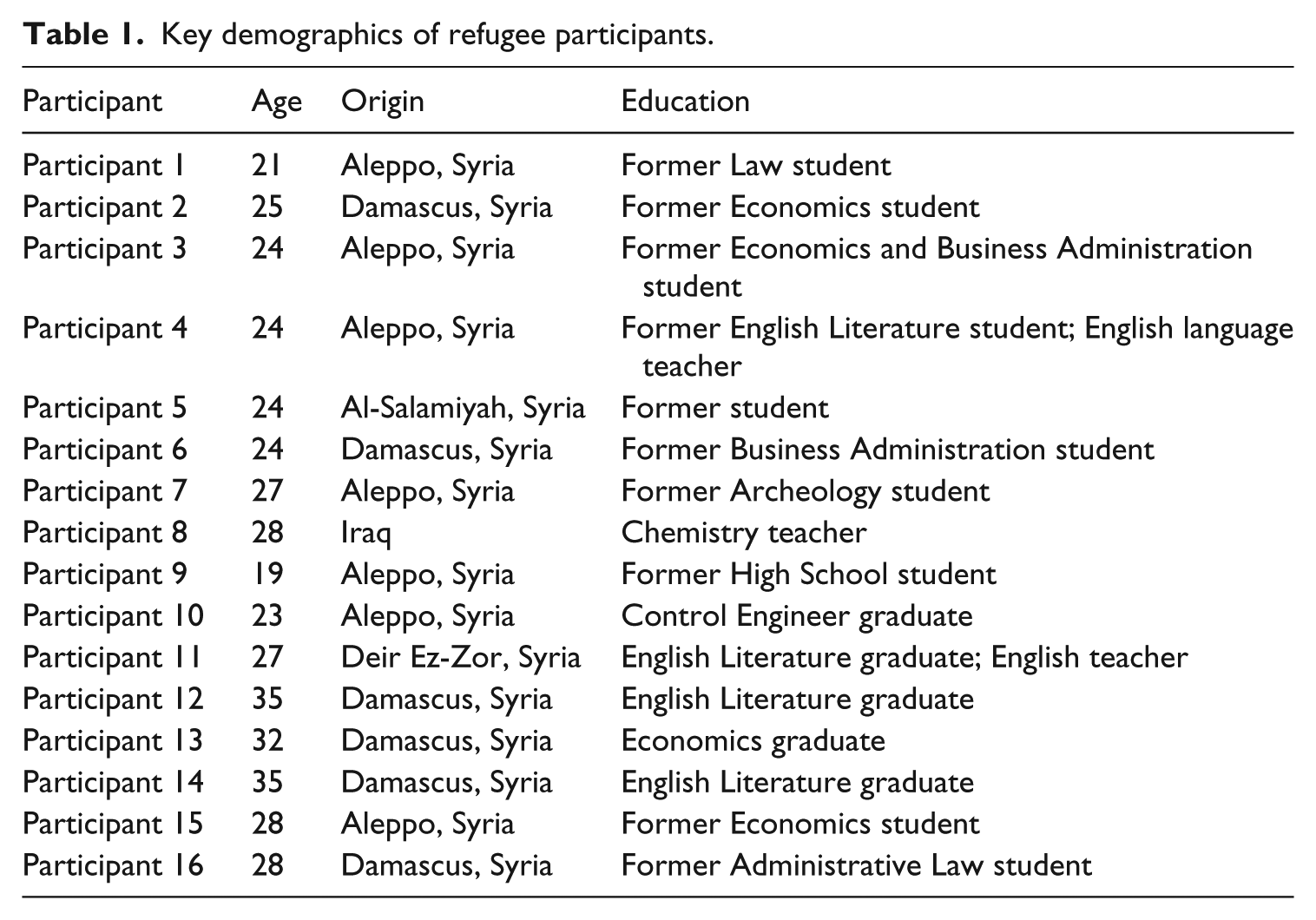
| Participant | Age | Origin | Education |
|---|---|---|---|
| Participant 1 | 21 | Aleppo, Syria | Former Law student |
| Participant 2 | 25 | Damascus, Syria | Former Economics student |
| Participant 3 | 24 | Aleppo, Syria | Former Economics and Business Administration student |
| Participant 4 | 24 | Aleppo, Syria | Former English Literature student; English language teacher |
| Participant 5 | 24 | Al-Salamiyah, Syria | Former student |
| Participant 6 | 24 | Damascus, Syria | Former Business Administration student |
| Participant 7 | 27 | Aleppo, Syria | Former Archeology student |
| Participant 8 | 28 | Iraq | Chemistry teacher |
| Participant 9 | 19 | Aleppo, Syria | Former High School student |
| Participant 10 | 23 | Aleppo, Syria | Control Engineer graduate |
| Participant 11 | 27 | Deir Ez-Zor, Syria | English Literature graduate; English teacher |
| Participant 12 | 35 | Damascus, Syria | English Literature graduate |
| Participant 13 | 32 | Damascus, Syria | Economics graduate |
| Participant 14 | 35 | Damascus, Syria | English Literature graduate |
| Participant 15 | 28 | Aleppo, Syria | Former Economics student |
| Participant 16 | 28 | Damascus, Syria | Former Administrative Law student |
Funding
The author(s) received no financial support for the research, authorship and/or publication of this article.