




Abstract
This article seeks to capture material and sensory dimensions of everyday news use that usually remain unexplored. To that end, we developed a two-sided-ethnography, filming people while they use news, allowing both researchers and participants to look in and reflect on their news use. Tapping into news users’ embodied, tacit knowledge, we found that the materiality of devices and platforms and the ways users physically handle and navigate them impact how they engage with news, in ways they themselves had not realized. We also deepened our understanding of previously found news user practices, and identified the distinct practice scrolling, which is characterized by an embodied urge to keep up the movement of the hand, even when the user finds content appealing. Finally, we show how people actively ‘make’ place and time through their news practices, using coping strategies that mediate between the comfortability of ritual news use and the disruptiveness of news content. We conclude by discussing the theoretical, methodological, and epistemological implications of our research, which include a call for a more in-situ, real-time, and non-news-centric approach to studying everyday news use.
Keywords
It is a weird way of reading, and I THINK that digital medium invites that. […] You don’t have that whole page in front of you so with that mouse you constantly have to select a piece of text.
Our participant Fiona was surprised to learn that when she reads her e-paper on her (large) laptop, she sometimes starts reading in the middle of an article. Not because she chooses to, but because she uses her mouse to navigate: the text of the e-paper is too small to read without zooming in, but the mouse makes it difficult to ‘blow up’ a specific piece of text. As a result, she sometimes reads articles in a random, fragmented order. This example illustrates the importance of taking material and sensory dimensions into account when studying everyday news use. To begin with, fragmented reading could have major consequences for people’s understanding and interpretation of news. Yet, within media and journalism studies, the relation between news media as material objects and news users’ sensory experiences of them has been virtually overlooked, especially in an everyday context (for an exception, see Fortunati et al., 2015). In this article, we therefore seek to capture the material and sensory dimensions of people’s everyday news use and make sense of their significance.
In focusing on materiality and sensory experiences, this article answers recent calls for non-representational and non-media-centric approaches to media use (Couldry, 2012; Moores, 2012). Non-representational theory (NRT) is an umbrella term whose principles include shifting attention from cognition to the pre-cognitive (or non-cognitive), focusing on practices, giving equal weight to (material) things, and stressing affect and sensation (Thrift, 2008). In line with NRT’s focus on practices, non-media-centric approaches seek to understand how everyday media practices are integrated into and intertwined with other everyday practices (Couldry, 2012; Moores, 2012).
A key contribution of a non-representational (and non-media-centric) approach to studying media is its emphasis on how material and sensory aspects of media practices are central to processes of mediation (Couldry and Hepp, 2016; Pink, 2015). If one seeks to understand how social reality is created, one must look at the interrelation of symbolic and material (and sensory) dimensions of everyday media practices (Couldry and Hepp, 2016). It is therefore somewhat alarming that within journalism studies, user research has concerned itself mostly with the former, focusing on the cognition and interpretation of content. News users are typically conceived of as disembodied, cognitive beings whose devices and platforms are neutral conduits of information. Uses and Gratifications Theory, for instance, aims to explain how people actively seek out media to fulfill particular social and psychological needs (Katz et al., 1973), while Hall’s (1973) influential encoding/decoding model looks at how people interpret messages. Although studies approaching news use as a ritual do center on the routinized and therefore often automatic, subconscious character of everyday news practices (Bird, 2011; Couldry, 2004; Madianou, 2010; Silverstone, 1994), here, too, the sensory experiences involved are largely overlooked.
In alignment with NRT, rather than focusing on cognition, in this article, we take as our point of departure people’s embodied ways of knowing: knowledge they may not be able to produce off the top of their head but ‘know’ in their body (Merleau-Ponty, 1962; Moores, 2015; Pink and Leder Mackley, 2013). Our research therefore also responds to recent calls for more attention to haptic dimensions of media use (Parisi et al., 2017) and the embodied ways of knowing involved (Richardson and Hjorth, 2017). We also draw from postphenomenology, which is similarly concerned with the relation between technological objects and users’ experience of them (Ihde, 2008; Verbeek, 2005). We first describe how we developed a method – the two-sided video-ethnography – that makes visible and thus researchable people’s tacit, embodied knowledge of their news use. Second, we show how the materiality of devices and platforms and people’s sensory, embodied experiences of them influence how they engage with news, in ways even they themselves had not realized. After illustrating additional unexpected findings, we discuss the theoretical, epistemological and methodological implications of our research.
Studying news use: non-representational, non-media-centric, and non-news-centric
As suggested above, a non-representational approach to studying news use has at least four implications. First, it requires a shift from cognition toward embodied ways of knowing (Moores, 2012; Thrift, 2008). The approach starts from the idea that people ‘know as they go’, as their bodies move (and feel) through environments (Ingold, 2011: 154). Pink and Leder Mackley (2013) capture the responsive, know-as-they-go character of embodied knowing well when they argue that people’s routes and routines are ‘habitual and learned, known in the body, while part of a process of ongoing, continual learning that […] is sensitive to the contingencies of the environment and its affordances’ (p. 683). These ideas can also be applied to how people (learn how to) use media. Drawing on Merleau-Ponty’s (1962: 144) ‘knowledge in the hands’, Moores (2014) argues that when people (start to) use a digital medium, they (literally) feel their way through the material object itself and the online environments it provides access to. To illustrate, he describes how he has come to know his way around his email inbox just as his hands have gotten to know their way around his keyboard (Moores, 2014). Because such knowledge is embodied and accessed only when put into practice, it is difficult to transfer without being in-situ and in-process; as a result, this source of knowledge about news use has remained largely untapped.
Second, a non-representational approach shifts attention from how news users make sense of media messages toward people’s actual everyday news practices. The shift also aligns with a non-media-centric approach looking at how practices of media use are intertwined with other everyday practices (Couldry, 2012; Moores, 2012). In order to properly grasp how information is received, one must first understand what people actually do with, in, and around media (Couldry, 2004). Couldry (2011) proposes three dimensions of audience practice worth looking at: texture (‘the rhythms, density, and patterning’ (p. 223) of people’s practices); contents (particularly people’s trajectories across different media); and wider uses and purposes associated with media practices.
While already implicit in these three dimensions of practice, we argue that when studying everyday news use, it is necessary to emphasize a third ‘non-centric’ approach: non-news-centric. News has become all but completely interwoven with other types of information; for instance, when doing a ‘checking cycle’ (Costera Meijer and Groot Kormelink, 2015) on their smartphone, people check news sites or apps, social media, dating apps, and so on all in one go. Likewise, in social media news feeds, news is but one among many different information types. As a result, especially newer forms of digital news use can no longer be understood in their ‘pure’, isolated form.
The final implications of a non-representational approach to news use concern a focus on both material ‘things’ and people’s sensory and affective experiences of them. As noted, the sensory, embodied experience of news use has been especially overlooked. A notable exception is Fortunati et al. (2015), who show how the material qualities of news media impact users’ experience. For instance, whereas print represented ‘pleasantness’ to their participants, online media were associated with ‘a sensation of coldness’ (Fortunati et al., 2015: 841). Due to their different physical nature, print newspapers were also manipulated, controlled, and mastered differently than online newspapers (Fortunati et al., 2015). Zerba’s (2011) participants noted material disadvantages of print newspapers, including the effort of reading (‘flipping pages, holding, folding, and carrying’) (p. 602) and recycling. Benefits of online news seemed to have less to do with tactile dimensions and more with the technological affordances of digital media, allowing for instantaneity, up-to-dateness, and interaction (Fortunati et al., 2015; Zerba, 2011). Ytre-Arne (2011) discovered through focus groups that readers of women’s magazines associated the glossy print version with feelings of relaxation and comfort, whereas computers were associated with work and clicking was found ‘annoying and tiresome’ (p. 471).
Especially relevant to our research is postphenomenology’s notion of ‘multistability’, which recognizes that technologies mediate our experiences and practices by enabling some actions and constraining others, while emphasizing that different people can use, manipulate, and interpret technologies in different ways (Ihde, 2008; Rosenberger and Verbeek, 2015). In an effort to move beyond the enable–constrain binary suggested in affordance theory, Davis and Chouinard (2016) propose that artifacts can ‘request, demand, allow, encourage, discourage, and refuse’ actions. They also emphasize how people’s experiences of affordances depend on their ‘perception’ (awareness) and ‘dexterity (knowledge), and on ‘cultural and institutional legitimacy’. Their conceptual vocabulary serves as a helpful starting point for making sense of how news users experience and interact with their news media as material objects.
Developing the two-sided video-ethnography
As Deuze (2011) argues, people live ‘in, rather than with, media’ (p. 138), and therefore do not always recognize their own media habits. This makes methods that rely on people’s own perceptions and reflections (surveys, interviews, diaries) less suitable for studying material and sensory dimensions of news use; at least the tacit, automatic, and habitual micro-processes we are interested in. Experiments – even those approximating a natural setting (e.g. Kruikemeier et al., 2018; Neijens and Voorveld, 2018; Segijn et al., 2016) – are also less suitable for our research aims because the devices used are not the participants’ own, and consequently the learned character of embodied knowledge is not captured. The think-aloud protocol partly overcomes these limitations but ultimately is unsuitable because it interrupts the flow of people’s news use (cf. Groot Kormelink and Costera Meijer, 2018). We also tested ‘video re-enactment’, having participants perform their news practices on camera as they normally would while commenting and answering questions from the researcher (Pink and Leder Mackley, 2013). However, this proved less appropriate for our research aims because (1) it interrupted the flow of news use, forcing participants to stop and reflect on movements they usually do very quickly or automatically; (2) while commenting on their practices, participants used gestures related to the realm of explanation rather than to their news use.
In order to bring material and sensory dimensions of everyday news use into view, a new method was needed. We devised, tested, and refined a method that first captures people’s news use in real time and then allows them to ‘look in’ and reflect on it (cf. Lahlou, 2011): the ‘two-sided video-ethnography’. It consists of five steps. First, we filmed participants from two sides simultaneously while they used news: a frontal perspective to capture participants’ position, posture, gestures, and expressions, and an over-the-shoulder perspective to capture the content of the news as well as people’s trajectories in and physical handling of their devices. Second, we watched and made sense of the videos with each participant individually, having them comment on and clarify their actions. Third, we analyzed the videos and transcripts. The analysis was characterized by constant comparison between data and analysis (cf. Corbin and Strauss, 1990). Following postphenomenology, our research process not only departed from first-person experience (as is central to phenomenology) but also included ‘intersubjective checking and critique’, making it ‘experiential, but not “subjectivistic”’ (Ihde, 2008: 6). This collaborative nature of our analysis proved important: discussing interpretations of the data between researchers significantly moved forward the analysis. Fourth, we shared our interpretations with the participants to see if they could elaborate on them. This step proved especially helpful for making sense of the significance of our participants’ practices and (micro-)gestures. Finally, we adapted and improved our analyses accordingly.
We combined the two-sided video-ethnographies with day-in-your-life interviews, which were held immediately prior to filming. Participants were asked to take the researcher through a typical day of news use: ‘Imagine it’s morning, your alarm goes off. What is the first moment you encounter news?’ followed repeatedly by ‘What is the next moment you encounter news?’ Going through their day chronologically allowed participants to envisage their news use, resulting in a vivid account of their news routines. Whereas video-ethnography was useful for zooming in on ‘hidden’ dimensions, the day-in-the-life method captured overall patterns of news use.
We selected 13 participants through purposeful sampling (Patton, 1990). As we are especially interested in material and sensory dimensions of news use, we selected participants so as to include a variety of devices (newspaper, computer, smartphone, tablet, TV) and platforms (website, app, e-paper, Facebook, Twitter) (see Table 1). We opted for a location where we could easily capture diverse news practices: the home. Our approach was user-centered: we filmed only practices participants actually engage in, including when and where they engage in them. We selected participants from and through the social circle of the first researcher: First, a ‘relationship of trust’ (Madianou, 2010: 434) is necessary when engaging in ethnography, especially when filming people during intimate moments, including in the morning while wearing pajamas. Second, because the research process (including the day-in-your-life interview, filming the practice(s), watching and discussing the recordings) is time-consuming, participants had to be willing to put in time and effort. Third, as we shared our findings with our participants – sometimes repeatedly – it was important that they were easily reachable. Our sample is dominated by young, well-educated people. All participants live in the Netherlands, a country characterized by high rates of Internet penetration (95%) and online news use (79%) (Newman et al., 2018). Rather than being representative for a particular demographic or phenomenon, this article is a first step in exploring how material, tactile, and sensory dimensions matter in different contexts of everyday news use. By showing how these dimensions are not isolated phenomena but are intimately related and integral to how people use and experience news, we aim to raise theoretical, epistemological, and methodological questions regarding how to capture and make sense of everyday news use.
Participants in two-sided video-ethnography.
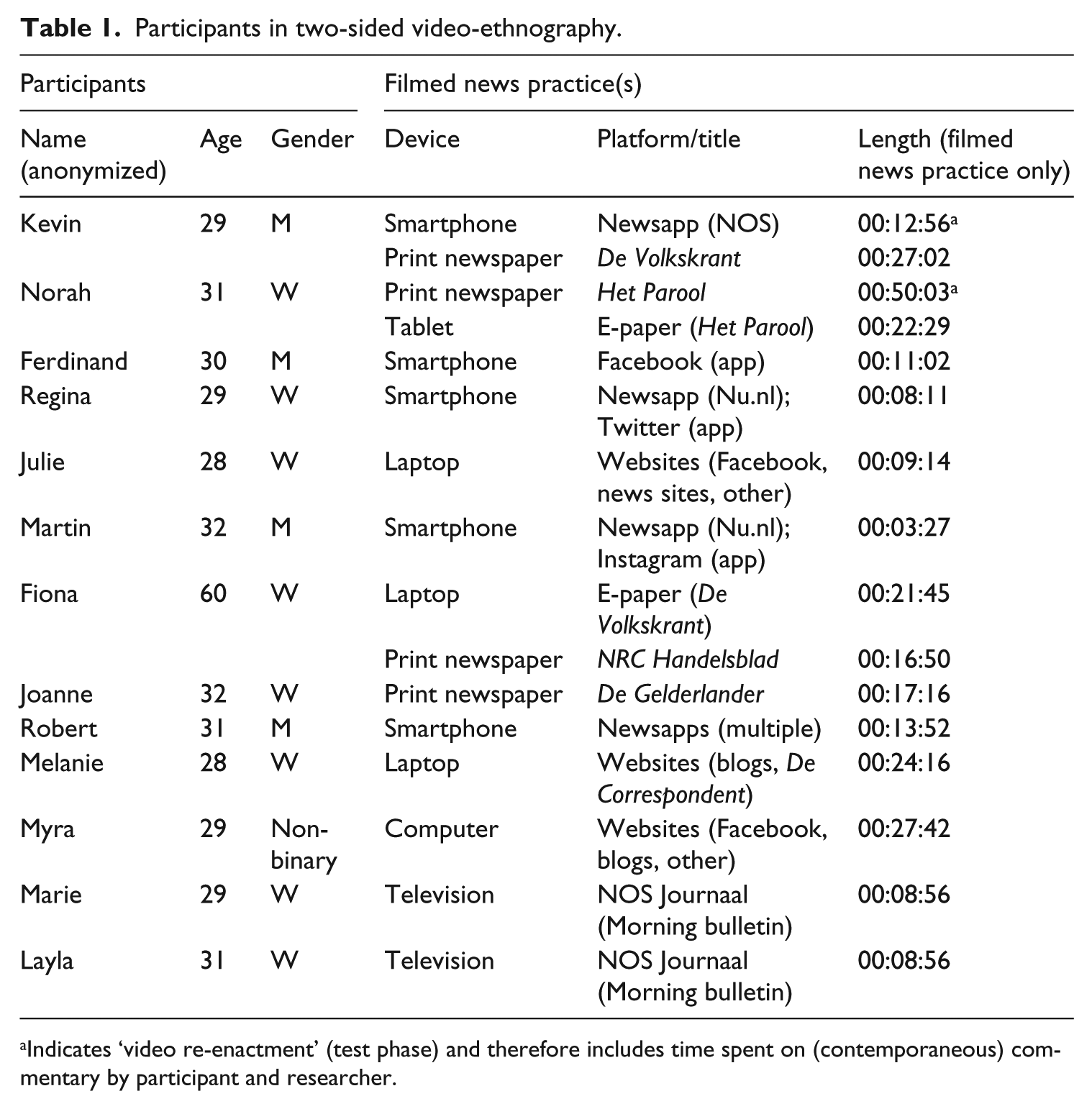
Indicates ‘video re-enactment’ (test phase) and therefore includes time spent on (contemporaneous) commentary by participant and researcher.
Results
First, our method enabled us to capture the sensory, embodied experiences of our participants. As evidenced by their use of phrases such as ‘I hadn’t realized’, the video-ethnography made visible and thus discussable tacit, habitual, and automatic dimensions of their news use. Especially notable were the subtle micro-gestures involved in efficiently handling and navigating their devices. Their hands were often future-oriented, already anticipating the next move, even while their cognitive focus was still directed toward the information at hand. A common example is how the participants already grabbed the lower-right corner of the newspaper while still reading the current page. When asked about this, Joanne suspected she did this because ‘while reading you can easily already do that, you don’t have to think about it and then when you’re ready you can immediately move on’. Similarly, after Kevin turned his phone horizontally to make the news video he was watching bigger, he turned it back vertically before the video had finished, explaining that he was ‘already anticipating that I go back to the list [of headlines]’. Robert swiped his left forefinger upward shortly after opening a news app on his smartphone, to ensure he saw the very latest headlines.
Material matters
Capturing the material and sensory aspects of news use matters because, first, the way our participants (physically) handle news devices and interfaces affects how they engage with news. Their devices and platforms invite or inhibit participants’ actions in ways they themselves were usually not aware of. This was most evident in the example that opened this article: Fiona’s use of her newspaper in print and her e-paper on her laptop. Similar to the respondents in Neijens and Voorveld’s (2018) experiment, Fiona initially believed her reading style on both versions was the same: reading and skimming through articles linearly. While watching the recording of her e-paper use with her, however, we discovered that her mouse use impacted her reading style: she sometimes zoomed in and started reading at a seemingly random part of an article. When asked to clarify, she explained, It is a weird way of reading, and I THINK that digital medium invites that. […] You don’t have that whole page in front of you so with that mouse you constantly have to select a piece of text. […] Do you get what I mean? Because of that zooming in with that mouse you constantly get a little piece of text, you have the tendency to constantly select a little piece.
Fiona reads e-paper articles in a fragmented way; not because she desires or chooses to, but because the combination of her e-paper, her laptop, and her mouse ‘demands’ (Davis and Chouinard, 2016) it. By contrast, in her print newspaper, she reads and skims articles linearly.
Second, the sensory and tactile dimensions involved in using platforms and their interfaces also affect how our participants physically engage with them and the content they contain. The most prominent example of this is the movements and micro-gestures involved in using Facebook. Indeed, we identified a distinct user practice our participants engaged in on Facebook: ‘scrolling’. Scrolling is their default mode for Facebook on both smartphone and laptop, described by our participants in terms of a desire or – more precisely – an urge to ‘keep it going’. Ferdinand, when asked why he made certain choices on Facebook, kept using phrases like ‘so let’s just keep it going’ and ‘so I just kept scrolling’. Even stopping or pausing was experienced as an interruption: Should I click on the page? Because maybe there is something more interesting to read, but then I was just too impatient and I kept scrolling, I didn’t want to stop.
The video also captured Ferdinand’s embodied impatience when he did click to watch a video. After 20 seconds, he briefly touched the screen to check the length of the video. When asked about this, he described this was not because he was bored, but rather because he longed to get back to the feed and keep it going: Yeah that moment I was already getting impatient and wanted to move on. […] I thought [the video] was really nice but I don’t wanna spend too much time doing it. This is the moment I remember thinking that I was like ‘ok, the information that I wanted is already [passed], so I can keep scrolling but then I was like no maybe there is …’
Ferdinand also described getting out of the scrolling flow as laborious. Upon encountering a BBC post in his feed, he hesitated for a moment, contemplating whether to visit the BBC page, before scrolling on. Asked why he had not clicked, he answered, ‘Too much work (laughs)’.
Similarly, Julie paused at a Facebook video that started playing automatically, but then moved on because it did not have any subtitles and she did not want to click the sound button. This was not because she did not want to make noise, but because clicking was laborious: If there’d been text at the bottom […] I would’ve been more triggered to stay, you know, then I can consume the news without having to actually do ANOTHER action.
Apparently, when scrolling, one click is already considered too much work. It appears participants do not want to leave the flow of scrolling and feel they must get back to their feed as soon as possible when they do get out of it. Both participants stopped their scrolling practice when they became ‘bored’ (Julie) or ‘tired’ (Ferdinand).
(In)experience and mastery
It is important to emphasize that while devices and platforms invite or demand certain uses, our participants also use and manipulate them in ways beyond their designers’ intention. Some participants showed far-going mastery of their devices and platforms through their manual dexterity. While watching her recording with her, we noticed that Regina used different fingers when clicking within her news app (right thumb) versus her Twitter-app (left forefinger). Emphasizing that she had been unaware of this, she explained that Twitter requires her to ‘click a little more precisely’ to avoid accidently liking or retweeting a post. When scrolling, through both Facebook (‘I pretty much only scroll on Facebook’) and Twitter, she instead used her right thumb; except when she wants to quickly jump to the ‘top’ of Twitter – then she uses her left forefinger because it works faster. Her micro-gestures are so natural and automatic to her that the smartphone has become an extension of her body, enabling her to optimize her news practices in terms of time investment. The Dutch expression for mastering something, ‘het in de vingers krijgen’ (‘getting it in the fingers’), certainly applies here.
For other participants, it was their lack of experience and mastery that shaped their news experience. This is illustrated by Norah, who had recently subscribed to a weekend paper. Reading it on Saturday morning, she became ‘satiated’ after reading the first 10 pages or so. The recording shows how she started leafing through the paper faster and faster, grabbing the corner of the next page as soon as she had turned the previous. She explained that at this point, she was only scanning headlines. Notably, she did come across articles she did want to read, especially in the arts and science sections, but by that time, she had run out of time and concentration. When asked why she did not start with these sections that most appealed to her, she simply said this had never occurred to her: ‘It’s so ingrained in your head, you start a book at the beginning too and then you leaf through it. You don’t start in the middle’. It was not the newspaper’s particular materiality (print) that demanded this chronological order. When 2 weeks later we filmed Norah’s use of the same title’s e-paper version on her tablet, she – apparently having forgotten the researcher’s suggestion – similarly remarked, ‘By the time I’m on page 18 about arts and media […] I’m actually already like so pfff tired of it that I go through it very quickly, so actually they should have this [section] at the beginning’.
Following a (pre-determined) sequence was due to Norah’s dominant reading practice of fiction and her inexperience as a newspaper reader. She read the paper as a book (‘you start a book at the beginning […] and then you leaf through it’) and consequently it did not occur to her to follow an idiosyncratic route, the way more experienced newspaper readers might. Kevin, for instance, started with his weekend paper’s light-hearted supplement because he wanted to go ‘from easy to difficult’. Norah had neither the ‘perception’ nor the ‘dexterity’ to use these affordances of the newspaper (Davis and Chouinard, 2016). Instead, she seamlessly tapped into her knowledge of fiction reading. This negatively affected her reading experience, as she felt she needed to go through the ‘bad’ news on the first pages in order to get to the lighter supplements.
Norah’s inexperience with the e-paper also negatively impacted her experience in a different way. Unaware of the option to make articles instantly more readable by clicking on them, she – again tapping into her knowledge of fiction reading – she zoomed in on articles as if moving the page closer to her face. The recording shows her continuously making wrong gestures while trying to zoom in and out. Once she even accidently ‘zoomed out’ of the entire newspaper, which put her back at the front page, much to her frustration (and instead of jumping straight to the page she had zoomed out of, she – rather tellingly – again swiped through the entire paper to get there). In the follow-up interview, she admitted she had not given the e-paper enough of a chance ‘to get used to it’. As Tuan (1977) notes, becoming experienced ‘requires that one venture forth into the unfamiliar and experiment with the elusive and the uncertain’ (p. 9). For Norah, the e-paper was not worth this effort.
Deepening news user practices
In addition to shedding light on the interaction between news as material object and its users, capturing the material and sensory dimensions of news use also enables a fuller, deeper understanding of previously discovered everyday news user practices (Costera Meijer and Groot Kormelink, 2015). Following Moores (2012, 2015), we found the concepts of ‘wayfaring’ and ‘inhabitant knowledge’ (Ingold, 2000, 2007, 2011), particularly helpful. Consider Julie, who uses her laptop for news online through a practice we previously called ‘snacking’: consuming ‘bits and pieces of information in a relaxed, easy-going fashion to gain a sense of what is going on’ (Costera Meijer and Groot Kormelink, 2015: 670). By minutely following her movements, we realized this easy-goingness is in fact actively evoked and maintained. She manages her mood (Zillmann, 1988) by following familiar routes (visiting ‘feel good’ websites) and expertly slaloming around negative content. While seemingly effortless, these movements in fact require experience and skill. First, Julie explores these online environments responsively, skillfully ‘feeling’ her way as she goes – both sensorially and affectively. When she watched a video on Facebook about Rio de Janeiro (which she had visited), she moved on as soon as she realized it was about pickpockets being beaten up: ‘Everything I experience as negative I scroll through as quickly as possible, because I don’t want to, I don’t need to experience that’. It is worth emphasizing that feeling here refers to both Julie’s emotional state and the movements of her hand: she quickly scrolled away when the news ‘hit’ her. Second, routinely visiting a set of ‘feel good’ websites, Julie has come to ‘inhabit’ these online environments in the sense that she has learned exactly where to go to find the typical content she desires when snacking the news.
Wayfaring is like making a forest your own: not only do you learn which routes to go, but you also gain knowledge of its characteristics so you can make better choices as you go. It is not limited to any material: users can also create their own routes through newspapers, for example, by starting at their favorite section. Yet, we did find that participants who used news websites on computers and laptops ‘roamed’ more freely. Myra, for instance, repeatedly and effortlessly switched between websites on their iMac, using the constantly visible URL bar to jump to different websites and the tabs in the browser as shortcuts to their favorite ‘spots’. Participants who used news apps on their smartphone, on the contrary, visited them in succession, moving onto the next one only when they were done with the previous one. The material characteristics of news media, then, seem to afford different forms of movement. We might say that websites – by the mere availability and visibility of URL bars and tabs – ‘allow’ constant change of direction making them more suitable for snacking, whereas apps ‘discourage’ (Davis and Chouinard, 2016) this as it takes effort – closing one app and opening another – to do so.
Smartphone: seducer and enricher
Another news user practice deepened through our video-ethnography was ‘reading’, which is ‘done individually, with great attention, […] in longer sessions’ (Costera Meijer and Groot Kormelink, 2015: 667). An eye-opener in particular was how interruptions from one’s smartphone can be experienced as extension of the news experience rather than a distraction. On Saturday morning, Kevin aims to be fully immersed in the paper: ‘I try to force myself to not divide my attention between everything, multitasking is an illusion. […] I’m like, otherwise I shouldn’t do it, […] then there’s no point’. However, when we watched his recording, we saw that during his 24-minute reading session, he grabbed his phone three times:
to take a picture of an exhibition so he would remember it when later scrolling through his photo gallery (after which he checked his WhatsApp messages);
to take a picture of a headline and send it to a friend;
to check a push-notification that made his phone buzz: he received a WhatsApp-message and went on to check several group chats.
It might be tempting to conclude – as we initially did – that Kevin’s reading practice was repeatedly interrupted by his smartphone. This is certainly true for the third time, when the phone demanded Kevin’s attention by buzzing. Here Kevin described his phone as ‘seducing’ him when he is less focused. His phone represents an ongoing stream of social information that apparently is hard to get away from. Stone (n.d.) coined the term ‘continuous partial attention’ which she described as ‘motivated by a desire to be a LIVE node on the network’.
However, in his follow-up interview, Kevin clarified that he did not experience his first two interactions with his phone as interruptions. On the contrary, he saw them as ‘an extension’ of the practice of reading, comparable to looking up an unclear term when reading news online. Illustrating the importance of asking users themselves how they experience technology and its affordances, Kevin’s smartphone both ‘demanded’ interruption and ‘allowed’ (Davis and Chouinard, 2016) extension of his newspaper reading. While still ‘done individually, with great attention, […] in longer sessions’ (Costera Meijer and Groot Kormelink, 2015: 667), Kevin’s reading is imbued with multiple social micro-processes that enrich his experience. His practice also emphasizes that although reading is about ‘immersion’ (Costera Meijer and Groot Kormelink, 2015: 667), this is less about effective information processing than about allowing oneself the time to fully enjoy one’s (ritual) practice, far beyond merely engaging with the text itself.
Minutely following Kevin’s actions also allowed us to uncover (details of) the practice ‘sharing’ that might be hard to capture with other methods. The recording showed him taking a picture of a news article and sending it to a friend using WhatsApp. As we looked more closely, the researcher noticed that the picture showed only a headline; it did not contain any other text his friend could actually read. Only when asked about this, Kevin said he knew his friend would never read the article, nor did he himself have any interest in reading it, but he just wanted to share that he had come across something his friend had mentioned a while ago. In the follow-up interview, Kevin further clarified that sharing the headline was not about sharing actual content – rather, it was about ‘just connecting’ with his friend. This form of news sharing is an example of ‘phatic communications’, which Miller (2008) describes as follows: […] although they may not always be ‘meaningless’, they are almost always content-less in any substantive sense. The overall result is that in phatic media culture, content is not king, but ‘keeping in touch’ is. More important than anything said, it is the connection to the other that becomes significant, and the exchange of words becomes superfluous. (p. 395)
Bycatch: making home through news
Through our two-sided video-ethnography, we also generated insights that do not directly relate to the material, sensory angle of this article, but that do concern affective dimensions of news use, therefore fitting within a non-representative approach. Specifically, we found the notion of place-making very helpful for understanding the significance of news use in people’s home. Place-making describes how people – through their repeated practices and routines – eventually come to feel familiar in and ascribe meaning to environments (Ingold, 2000; Pink, 2012; Tuan, 1977). What we found is that news use not only co-constitutes place (Peters, 2012), but that people through their news practices also create a sense of space – of home. Seamon (1979) defines ‘at-homeness’ as ‘the usually unnoticed, taken-for-granted situation of being comfortable in and familiar with the everyday world in which one lives’, but in the context of this article, we also use the concept more literally to denote feelings of warmth, safety, and comfort people (can) associate with being inside their home (p. 70). Our participants created a sense of home – or, in the words of Pink and Leder Mackley (2013), made their home ‘feel right’ – through news in various ways, such as taking the time to fully immerse oneself in the beloved ritual of reading the newspaper (Fiona) or watching the morning news in bed to engage in a shared activity (Layla and Marie). These findings align with the ritual and thus (ultimately) reassuring function of news that is often emphasized (Silverstone, 1994). Yet, for some participants, news played a more ambiguous role, sometimes also disrupting their feeling of at-homeness. We discuss two examples here.
Norah’s video-ethnography uncovered an intriguing paradox between an ideal picture in her head that reading the weekend paper she had recently subscribed to ‘should’ invoke and her actual experience while reading it. When she gets up on Saturday morning, she first makes breakfast which she eats in bed while watching series on Netflix. She was adamant about not reading the newspaper in bed; this space is reserved for ‘nice things instead of the troublesome things that news usually is’. Only afterward she grabs the newspaper from the cabinet in the hallway – where her roommate has left it for her – and puts it on her living table.
Because I think a newspaper belongs on the table, I just already think that’s nice, like, you have a cozy living room and the fresh newspaper from today that is laying so beautifully crackling, unopened on the table waiting for me […] and I grab a cup of coffee with it.
Spreading the newspaper out on her living room table is a place-making activity: it helps create a ‘cozy living room’. Her phrasing ‘belongs on the table’ implies that this is the correct way to read the newspaper. Despite noting the paper’s ‘troublesome’ content, Norah compared (when asked) her Saturday morning newspaper ritual to a breakfast buffet: In other words, there is a lot and you pick out the nice things that seem attractive to you and you sit at the table to nicely read those, to munch on.
Her use of the words ‘attractive’ and ‘nice’ imply that reading the paper is a pleasurable activity. Her actual experience while reading suggests, however, that this ritual is an ideal she aspires to rather than a practice she enjoys herself. Most notably, she tried to skip negative content because it did not fit her sought-after mood on Saturday: Because here I’m already reading that 16% of women is raped, here I read that people are dying of hunger, you know, it is Saturday and I kind of have to keep my good spirits a bit. I’m a bit egotistical in that perhaps, but well, you can’t carry all the suffering in the world on your shoulders.
Her justification for skipping negative content that ‘it is Saturday’ is not insignificant. We argue that limiting her engagement with negative news can be interpreted as having a ‘place-making’ as well as ‘time-making’ function. She aims to construct a Saturday morning experience after a particular ideal picture of it: a time she apparently is supposed to be ‘in good spirits’. News about suffering does not fit this picture. Norah also ‘makes time’ by restricting her time with the paper. Whereas some other participants saw reading the paper as a treat, a moment to relax that they allocated time for, Norah restricted her time: she wants to spend a maximum of 30–45 minutes, and was acutely aware of the passing of time: Now that I’m discussing this consciously, I’m thinking jeez, it’s pretty important what’s on the first ten pages, because you kind of lose your attention and think, well, it’s Saturday, we’ve already been reading for 45 minutes, I’m in the mood to go out to do things, go to the store.
Again she used Saturday as an explanation: she wanted to finish reading the paper and do what she was in the mood for: to go out.
The disconnect between the way Norah romanticized the ritual of Saturday morning reading and her less-than-enthusiastic actual experience suggests that rather than being inherently interested in reading the news, it was the practice itself and its supposedly place-making qualities that she valued. When carefully probed in our follow-up interview, Norah said that one of the reasons she subscribed to the newspaper was that it would be ‘homely, because of course back in the day at home with your parents you always had the newspaper too’, referring to her parents’ cozy practice of reading the weekend paper at the kitchen table. Quite literally, Norah had thought of the newspaper as a homemaker. More than modeling after her parents’ news habits (Edgerly et al., 2018), her attempt at this Saturday morning ritual was an effort to (re-)create a sense of home on a fundamental level: the nostalgia of yesteryear. However, the actual act of reading the newspaper disrupted this home-making. Norah eventually canceled her subscription.
Safe space from which to venture out
For Melanie, news played a similarly ambiguous yet different role in creating a sense of home. After arriving back from work, Melanie divides her attention between The Gilmore Girls (GG) – a show she has seen several times – on her TV (Netflix), and news sites and blogs on her laptop. The recording shows Melanie averting her eyes constantly from laptop to TV and vice versa, revealing that she did not read any article from start to finish. Rather, she alternated reading parts of articles with catching parts of GG. Melanie’s news practice, thus, is characterized by fragmentation; even though one of the sites she visits is Dutch news website De Correspondent, which typically has longer pieces which one would assume to require a more concentrated mode of reading. When asked, Melanie explained she finds the news ‘too serious’ to fully engage with, but she does ‘want to just check everything’. Watching GG is also a fragmented activity: she only looks up when her favorite characters (Rory’s circle) are on her TV screen and goes back to her laptop screen when less favorite characters (like Emily) appear. Dividing her attention is not about ‘continuous partial attention’ (Stone, n.d.), multitasking, or being efficient. Rather, re-watching GG creates a nice, homely, nostalgic, predictable, reassuring atmosphere that could best be described as ‘ontological security’ (Giddens, 1991). In her follow-up interview, Melanie confirmed that re-watching GG – unlike trying a new series – provides the homeliness and predictability she desires. The show is like a warm blanket from under which she can then safely peek into or have a sense of connection with the ‘serious’ public world.
Conclusion
In this article, we captured and made sense of the material and sensory dimensions of everyday news use by employing the two-sided video-ethnography. Our first conclusion is that users are not only coaxed into certain behavior by carefully designed interfaces (Van Dijck, 2013), but that news devices and platforms also invite and inhibit different ways of physically – and often manually – handling and navigating them, resulting in different ways of engaging with news content. It is important to emphasize that our participants were typically unaware of this until we watched and discussed the recordings of their own news use.
Second, news users’ mastery of devices and platforms – or lack thereof –impacts how optimized their news practices are in terms of time investment. Consequently, time cannot be taken as an unproblematic indicator of people’s attention or interest in news: the more ‘practiced’ the user, the more efficient their news use. Our third conclusion is that whether and how people make use of technologies’ affordances is shaped not only by their perception and knowledge of the technology in question (Davis and Chouinard, 2016) but also by their (prior) experience with different technologies. Note how the participant who – against her wishes, in retrospect – read through both her print and e-paper chronologically did so because she projected her book reading experiences onto them; she had been ‘primed’ to read linearly. This example makes a non-news-centric approach especially relevant; not only for studying the adoption and ‘incorporation’ (i.e. embodiment) of new devices and platforms but also for seeing whether news content comes to fruition in use.
Fourth, contrary to the common assumption that smartphones distract from newspaper reading – as we also presumed – they are also used as an enrichment or an extension of the reading experience. This finding highlights the value of checking one’s interpretations with the research participants in question. Five, we identified a new distinct user practice: scrolling, marked by a strong, embodied urge to keep up the movement of the hand and to not interrupt this flow by (what is experienced as) the laborious act of clicking, even when the user finds the content appealing. This warrants further attention to what it means when people say they use Facebook for news (Newman et al., 2018). Does it just pass by without making an impression or do they really pay attention to it?
Sixth, we found that people through their news practices actively make place and time. Especially notable were participants’ coping strategies that mediated between the comforting ritual character of news practices and the disruptiveness of (negative) news content, such as expertly slaloming around disturbing news or ‘dampening the shock’ by simultaneously watching reruns of familiar TV shows. Whereas research has looked into motivations for news use (most notably through uses and gratifications research) and news avoidance (e.g. Toff and Nielsen, 2018; Zerba, 2011), the domain in between, where people – apparently rather meticulously – measure and negotiate their exposure to and engagement with news, has received less attention (for an exception, see Couldry and Markham, 2008).
Epistemologically, people’s lack of awareness about their news use raises concerns over knowledge generated through methods that rely on people’s own recollection (surveys, interviews, diaries, etc.). Less worried about social desirability – our participants seemed to have little problem watching cat videos or swiping straight to entertainment news – we were surprised by the irregularities between people’s perception of their news practices from just minutes earlier and what the recordings showed. While well-known that people have limited ability to accurately estimate their own news behavior, our participants sometimes wrongly recalled even basic elements of their news use, such as how much of and even which articles they had read. This makes grasping the phenomenological experience of using news even more important: only then can people’s (systematic) blind spots regarding their own news use be taken into account. Finally, in order to understand and measure how users’ handling and navigation of devices and platforms impacts their cognition and sense-making of news, rather than approximating a natural setting, more in-situ research is needed: people should be studied using the devices and platforms they actually use, when and where they actually use them.
Footnotes
Acknowledgements
The authors thank Kiki de Bruin for her help during the testing phase of the video-ethnography. They also thank the anonymous reviewers for their valuable and constructive suggestions. This article has also benefited from being presented (in various forms) at conferences and workshops, including ICA, ECREA, Future of Journalism, and RMeS Winter School.
