




Abstract
Photography contests have assumed an increasingly significant public role in the context of the global surge of mass-mediated war reporting. This study focuses on the recurrence of visual tropes in press photographs awarded in the annual contest World Press Photo (WPP) in the years 2009–11. By tropes, we mean conventions (e.g. a mourning woman, a civilian facing soldiers, a distressed witness to an atrocity) that remain unchanged despite their travels across the visual sphere, gaining professional and public recognition and having a strong affective impact. We contend that photography contests such as the WPP influence and organize a process of generic understanding of war, disaster and atrocity that is based on a number of persistent tropes, such as the mourner, the protester or the survivor amidst chaos and ruins. We further show that these tropes are gendered along traditional conceptions of femininity and masculinity, appealing strongly to both judges and wider audiences. The evidence for our claim comes from an analysis of the photographs that won awards, observation of the judging sessions, semi-structured interviews with three jury chairmen, and public commentary on the juries’ choices (blogs, newspapers and websites).
Photography contests have assumed an increasingly significant public role in the context of the global surge of war reporting. Spectacles on a par with contemporary art fairs, contests such as Visa Pour L’image, Pictures of the Year International, the Pulitzer Prize in Photography, or the Sony Photography Award draw increasingly large audiences and abundant media attention, functioning as showcases of professional press coverage of war, disaster and poverty. Here, printed newspaper pages give way to images divorced from comprehensive stories to which they pertain, appreciated for their aesthetic qualities and exhibited on gallery walls, posters, billboards and albums.
In this article we examine the case of the World Press Photo (WPP) Foundation, an independent, non-profit organization based in Amsterdam, known for holding one of the world’s largest annual press photography competitions since 1955. Although selection procedures and the decisions of the jury (esteemed international figures in the photographic profession) are widely debated and heatedly contested (see Broomberg and Chanarin, 2005), the WPP prizes (particularly the title of Photo of the Year, given to a single image) add prestige to a photographer’s status and contribute to the worldwide dissemination of his or her work. First, second and third prizes are given in nine categories; in each category, a single image and a story comprising a maximum of 12 photos are awarded. The winning photographs are assembled into a travelling exhibition seen by over 3 million people in 45 countries. A yearbook presenting all winning entries is published annually in seven languages; the WPP website is visited by 3 million visitors a year.
Already at a first glance, the history of the world appears in the WPP contest as a number of flashpoints of human demise (World Press Photo Foundation, 2007). Just as the “criminal” body has been produced out of an endless repository of physiognomies in 19th-century police photo archives (Sekula, 1986), the image of conflict and violence in the 20th and 21st centuries relies on similar processes of framing and exposure. Similarly, Kim and Smith (2005) examined the most dominant representations in the international news photographs that have won the Pulitzer Prize between 1942 and 2002. In this study, more than two-thirds of all award-winning international photographs have been found to portray war and coups. However, unlike scholarship which more-or-less explicitly identifies the formulas that produce winning entries in photography contests (e.g. Andén-Papadopoulos, 2000; Buell, 1999; Corner, 2011; Greenwood, 2012), we propose an alternative look at the processes of selection and recognition of images, that are deeply grounded in cultural (mis)conceptions. We argue that, despite the massive number of entries each year, the images awarded in the WPP reflect the prevalence of a selected number of tropes, forming an endless variation on a few established iconographic motives. By tropes, we mean conventions, such as a mourning women, a young non-western girl, or a civilian facing soldiers, that remain solid and unaltered despite their travels across geopolitical contexts (Bal, 2002), and that act as figurative rhetorical devices appealing to both judges and wider audiences. We further contend that a significant number of tropes rely strongly on the gender of the represented subjects and its cultural representations.
Our argument is substantiated using two research methods. In the first part of the article, we introduce the concept of the trope in cultural theory, situating it within the field of photography studies. In the second part, we define the four main features of a trope and apply these in a quantitative analysis of the winning photos at WPP as both single entries and stories, from 2009 to 2011, years in which we were able to observe the judging process. Since tropes pertaining to atrocity are our main scope, we only coded the images representing war, disaster and conflict, awarded in the categories General News, Spot News, People in the News, Daily Life, Contemporary Issues and Portraits. 1 We further narrowed our scope to include only the images awarded the first prize (singles) and first, second and third prize (stories), since only these are eligible to become the Photo of the Year. In the third part, we look at the three images that became Photo of the Year in 2009, 2010 and 2011, including our observation of the judging process and semi-structured interviews with the three chairmen right after they had been chosen. We interviewed the chairman of the 2009 contest Ayperi Karabuda Ecer, David Burnett, who chaired the 2010 contest and Aidan Sullivan, who was the chair of the 2011 contest. Furthermore, we analysed public commentary on the jury’s choices (blogs, newspapers and websites). 2 Finally, we reflect on how the findings of the quantitative and qualitative analysis come together and conclude the article with a reassessment of the cultural significance of tropes at a time of rapid growth of digital imagery.
Tropes, icons and visual keywords
What are tropes and, more importantly, what do they do? Photographic tropes can be likened to the notion of the “strong image” (Groys, 2008: 84), an image that can guarantee its own identity, independently of its specific time, space and context; being single, the trope is nevertheless present in a multitude of separate instances without being split apart.
We might perceive tropes as close to icons (from Greek eikon: picture, honoured by early Christians and later by the Eastern Orthodox Church as keeping the true form of the holy images, absolutely unique yet infinitely shareable). In present times, photographic icons are “stock figures in memorial statuary, ceremonial oratory, and other representational practices” (Hariman and Lucaites, 2007: 1–2). However, while icons can be seen as commemorating decisive moments of history (Goldberg, 1991; Kleppe, 2013; Paul, 2008; Perlmutter, 1998, 2004), tropes can be compared to a frame that holds visually homogeneous content (Zarzycka, 2012a). That frame can dramatize and highlight less graphic representations (an African child), but also offset or neutralize the disturbing content (a bloody corpse). Whereas photographic icons witness historical moments, reproduce ideology, and model political identity and citizenship, the all-encompassing quality of the photographic trope tends to increasingly crowd out the politicized and the activist dimension, appealing to a broader cultural consensus of meaning. As a result, a photo, assumed to be an index of a historical event, might become a suggestive, safely communicable illustration of suffering, courage or some other seemingly universal aspect of the human condition, caught in an endless process of the media’s “circular confirmation” (Roberts, 2009: 285). Many iconic photographs represent a certain trope (a dying soldier, a poverty-stricken mother with her children, charred human remains), but not every picture relying on a trope gains the status of an icon.
Easily accessible, undemanding in their familiarity, and well-suited to mass-mediated collective memory, tropes prove particularly effective in case of coverage of atrocity: while trauma is culturally understood as a form of data loss or representational void (Baer, 2002; Das, 2007), tropes replace the un-picturable with the recognizable, transporting internal sensations into a knowable, external world. Didi-Huberman (2008: 34) defined the contemporary cultural desire to see the whole realm of human atrocity in one photograph as hypertrophy; bringing war, famine, migration to the level of the experience of one individual, tropes effectively individualize the social and vice versa.
The urgency of research on the recurrence of tropes in the WPP contest lies in the fact that tropes have recently become a way of sorting through contemporary global reporting among massively growing data. The concept of a trope has often been the focus of traditional art historical research based on iconology: a method of reading images based on layers including immediate identification of signs, recognition of conventional meanings, and consequent attaching of these meanings to symbolic values (Panofsky, 1972). Nowadays, however, produced both by institutions and amateurs, photographic tropes rely on the filing system in digital archives compiled by the state (police, military, ethnographic), the media (newspapers, television, advertisements) and the arts (museums, galleries, private archives). Ideologically pre-structured, they function as mental and emotional templates; they do not document or bear witness, but rather symbolically represent marketable concepts (Newton, 2008). While the photograph of a mourning woman is frequently read as a Pieta and, as such, facilitates wide engagement of communities raised in an awareness of Christian symbols, it also constitutes a basic search category in online stock image banks (Getty, Reuters, Corbis), photojournalism agencies (Agence France-Presse or Associated Press), online photography archives (e.g. Magnum), online memorial sites (e.g. hereisnewyork.org), and determines the algorithms that govern our results as we navigate the image depositories of Google or Flickr. Archived as stock shots, pre-packaged and labelled, tropes can be reused in the context of multiple historical events and ordered according to “visual keywords” that can easily be applied to many different advertising and marketing purposes (Machin, 2004: 317), becoming an intertextual system of continual borrowing and cross-referencing. In the following section, we present the WPP online archive as an example of such system, where the uniqueness of certain tropes is paradoxically based on their repeated exposure.
Bodies, feelings, meanings – the WPP archive
Photo contests, with their wide cultural impact and huge distributive powers, inevitably fix and sustain the photographs of war and atrocity as a part of “a capitalist and imperialist meta-archive” (Roberts, 2009: 29). The WPP online archive, containing all the prize-winning images, is a space where our preconceptions about war, conflict and violence are formed. To inhabit that space, strict procedures have to be followed. Each photograph entering the contest has to be made by a professional photographer 3 and be submitted either by the photographer him/herself, by the agency that distributed the image, or by the newspaper or magazine that published it. Photographs can be cropped, but retouching is only allowed when it “conforms to currently accepted standards in the industry”. 4 All entries are consequently judged in one of the following categories: Spot News (pictures of unscheduled events for which no advance planning was possible), General News (pictures of planned or organized events), People in the News, Contemporary Issues (pictures exploring contemporary environmental and health issues), Daily Life (illustrations of the richness and diversity of everyday life), Arts and Entertainment (pictures of visual and performing arts, rituals, festivals), Sports, Portraits and Nature. All entries are judged by category, but, in reality, judges often shuffle images from one category to another to avoid voting out the pictures that have a strong competition in other categories. Daily Life, Contemporary Issues, and Portraits, in particular, seem to be relatively comprehensive and are therefore open to incorporating images originally entered in different categories.
We discerned four features that in our view characterize tropes and took these as criteria for analysing the images of war and disaster awarded in the years 2009–11. In establishing these features, we are indebted to the cultural tradition of iconology (Bock et al., 2011), semiotics (van Leeuwen, 2004), as well as to feminist work on affect and emotions (Ahmed, 2004; Berlant, 2008).
Presence of the body. In tropes, atrocity is signalled primarily as an action on the body, usually caught in mid- or close-up shot. Frequently featured are dramatic gestures and facial expressions, as well as marks left by death, massacre and torture (an “identifiable victim effect”, Campbell in Batchen et al., 2012: 86). Represented bodies function as primary markers of gender, ethnicity, class, age and (dis)ability.
Recognizability. Tropes’ intertextual connection to an ever-growing inventory of images embedded in western visual and literary culture (i.e. history of art or journalism) assures their strength and circulation. A child at gunpoint or a weeping woman, adhering to broader cultural traditions and tapping visual conventions, conjures primordial images that most viewers easily recognize (Zelizer, 2010).
Affective powers. Tropes spark relationships with their audiences that are not purely cognitive, but also affective – relationships that range from outrage at the perpetrators, grief and compassion for the victims, fear and shock at the sight of carnage, or shame about one’s own good fortune (Boltanski, 1999; Moeller, 1999). These powers characterize immediate reactions to an image, but can also expand in time, making an image memorable. Provoking particular emotional states, tropes facilitate the social expression of individual feelings among their audiences.
Symbolic accessibility. Tropes lend themselves to representing the greater event or the general issue, often subsumed by the generic ideological conditions of meaning – that is, good versus evil or war versus peace. They often rely on a limited and normative set of symbolic categories: “the horrors of war”, “the innocence of children”, “patriotic acts of courage” or “vulnerable women”, evoking notions of civil authority, or moral standards, or the precariousness of human life. Symbolic accessibility can also be determined through semiotic signs such as a military uniform, a weapon, a corpse, or a flag, making “every combat a semantic one” (Barthes, 1981: 127).
At first sight, our coding methodology seems to differ significantly from other cultural breakdowns of the concept of the trope. Hayden White (1973) sees trope as a compilation of four figurations: metaphor (where an image literally denoting one kind of object or idea is used in place of another to suggest a likeness or analogy between them), metonymy (where one single thing stands for the multitude of others of which it is an attribute or with which it is associated), synecdoche (where the part is used to symbolize a quality presumed to inhere in the totality through an intrinsic relationship of shared qualities), and irony (where words or images express something other than the literal meaning). However, White generally defines trope as a form of expression used to convey meaning or heighten effect, often by comparing or identifying one thing with another that has a connotation familiar to the audience. In our understanding of a photographic trope, things translate as bodies; heightening effect corresponds to affective powers, familiarity to recognizability and meaning to symbolic accessibility. Our breakdown borrows also from what Hall calls typing: foregrounding a few traits of a person into a “simple, vivid, memorable, easily grasped and widely recognized characterization” (Hall, 1997: 257). Furthermore, the features we discerned reflect the main forces assigned to photography by Barthes (1981): denotation (referencing a particular event), connotation (suggesting some general condition beyond what is caught by the camera), and “third meaning,” or “punctum” (affective power, drawing the viewer in).
Both authors analysed all pictures, compared results and resolved discrepancies by means of discussion. When all the four features of a trope as formulated above were present, we concluded that the photo in question represents a trope. Each image containing a trope was labelled inductively in order to compare the tropes found (Bell, 2004: 21–4). We are aware that each of the features we established are open to considerable interpretation, and yet we let them function here as the basis for coding of images. We also realize that the above criteria are largely determined by our own background: western, middle-class, educated, highly familiar with representations of war, disaster and poverty in today’s media as well as with Christian iconography. While we do not want to adopt that standpoint as hegemonic and self-evident by any means, we realize that it is very much in line with the average constitution of the WPP jury (where the overwhelming majority of members come from Western Europe and North America). 5 Furthermore, the exhibition in which the winning photos are exhibited travels mostly to these regions. Therefore, rather than reproduce western supremacy, we use our positioning to deepen an understanding of how the actual mechanism of institutional power can continue to reproduce long-standing cultural preconceptions. In that, we are informed by feminist standpoint theory, claiming that no knowledge foundation should be taken for granted, but all foundations are contingent and open to an epistemological investigation (Butler and Scott, 1992; Harding, 1986).
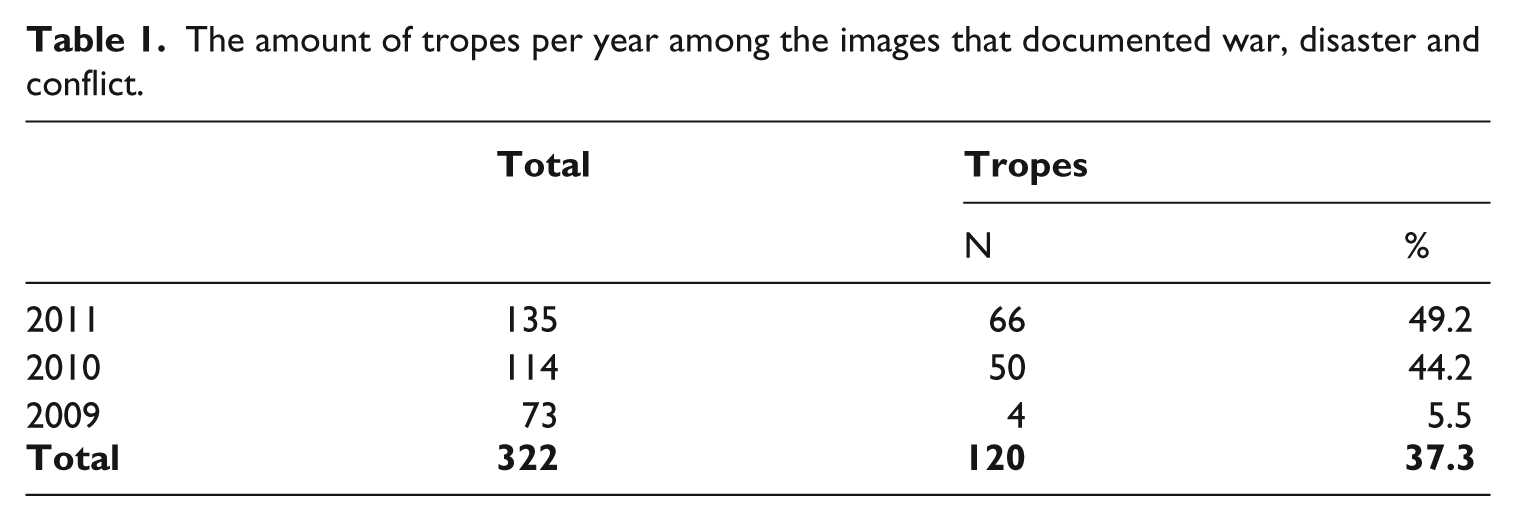
The four features became the focus of our analysis of the images awarded in the categories where images of atrocities are dominant: General News, Spot News, People in the News, Daily Life, Contemporary Issues, and Portraits. 6 Consequently, from the total of 623 images awarded in these categories, we further narrowed our scope to 322 images that documented war, disaster or conflict (based on the information in the image and provided by the accompanying captions). Among these, we expected to find a significant number of tropes. Indeed, 120 (37.3%) of the images were identified as tropes (see Table 1). We found tropes in all categories; each year, a different category contained the most tropes (Contemporary Issues in 2011; General News in 2010; Spot News in 2009). The results of 2009 are divergent from 2010 and 2011. While we have no plausible explanation for this outcome, we did find that the photos in 2009 scored low on recognizability and symbolic accessibility, resulting in fewer tropes. Furthermore, we will later argue that the World Press Photo of the Year of 2009 is also divergent compared to the winners of 2010 and 2011.
The amount of tropes per year among the images that documented war, disaster and conflict.
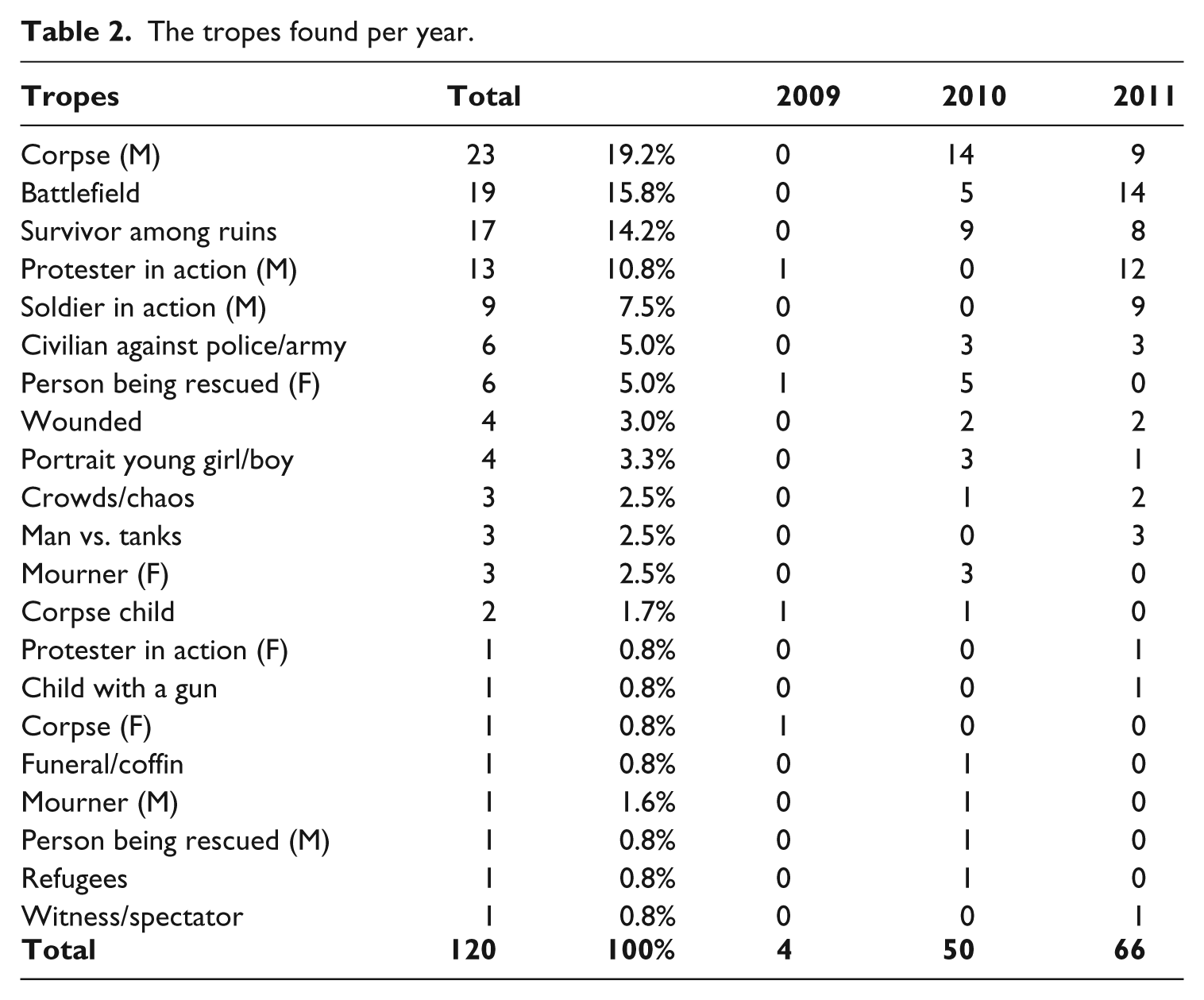
What are the dominant tropes in the WPP? Among 120 photographs we qualified as tropes, corpses are dominant (19.2%), followed by battlefield scenes (15.8%) and survivors among ruins (14.2%). Given the significant presence of women in the images that became the Photo of the Year (see next part of the article), we coded some recurrent tropes male (M) and female (F). Having done that, we discovered that women are more frequently represented as passive. In the tropes “mourners” and “persons being rescued”, we observed 9 females versus 2 males. Men are mainly portrayed in action: in the tropes soldiers and protesters in action we found 22 men versus 1 woman.
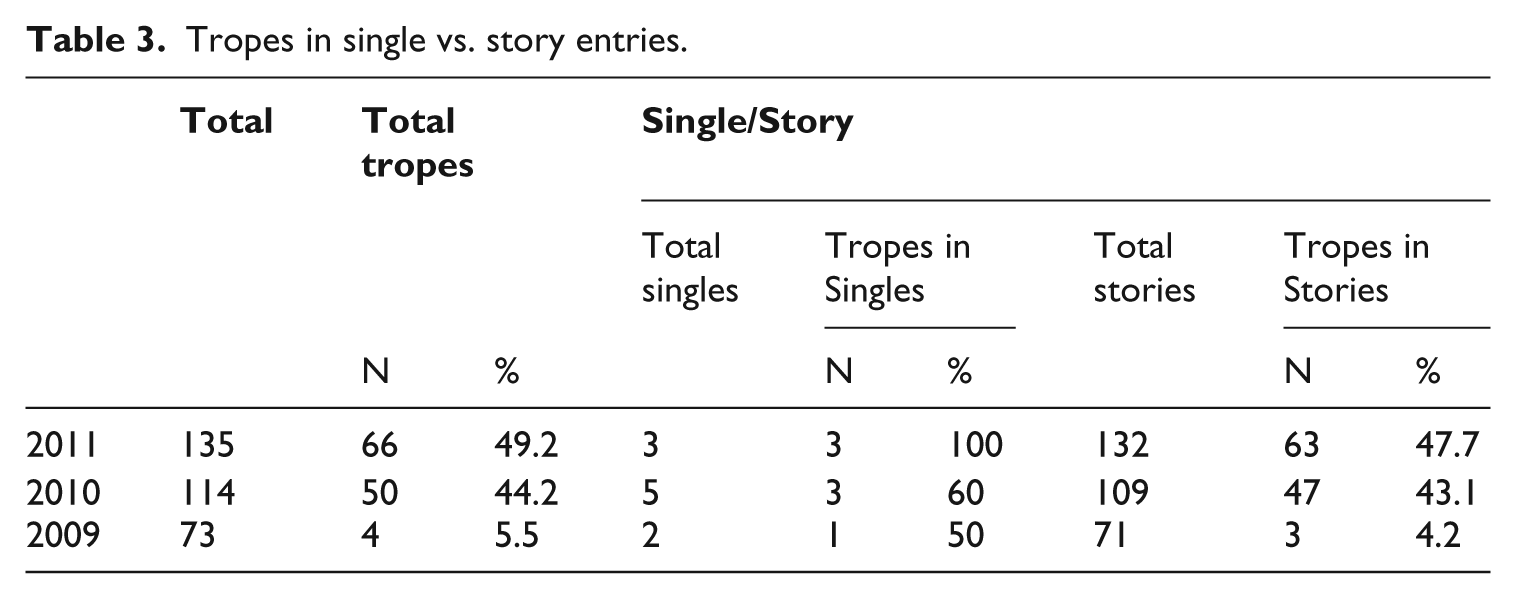
Another tendency we noticed is that images entered as singles are more identifiable as tropes than images from stories (see Table 3). That mirrors the idea of “episodic” (specific events or particular cases) versus “thematic” (general political and social context) framing (Iyengar, 1991). Our explanation is that the stories (usually documenting social problems such as poverty, public health, unemployment, malfunctioning welfare systems, or discrimination against racial, ethnic or sexual minorities) might illustrate crises that are systemic, structural and somewhat mundane. Single entries, required to be more emblematic than those in a sequence, usually follow the dramatic, “newsworthy”, more engaging format, reflecting the cultural perception of photography as what photographers and theorists refer to as the “decisive moment” (Cartier-Bresson, 1952): the single, emotionally and narratively charged instant that captures the essence of the event (see also Lessing’s [1836] essay on Laocoön).
To sum up our coding results, we concluded that the WPP is characterized by a large number of tropes (Table 1), predominantly present in the images entered as singles (Table 3). The most recurrent tropes are corpses, usually male, battlefield photographs and survivors amongst ruins (Table 2). Moreover, recurring tropes are predominantly gendered along the traditional conceptions of femininity and masculinity (Table 2). In the following section, we establish the differences/convergences between the images we analysed in the archive and three consecutive Photos of the Year 2009–11.
The tropes found per year.
Three winners, three women, one pattern
Among thousands of images, only one photograph impresses the jury enough to be named the Photo of the Year, an image “that is not only the photojournalistic encapsulation of the year, but represents an issue, situation or event of great journalistic importance, and does so in a way that demonstrates an outstanding level of visual perception and creativity” (www.worldpressphoto.org/awards). In this section, we take a closer look at the winners from the years 2009–11 and analyse the discussions surrounding these images through our observation of judging proceedings, interviews with the three chairpersons, and the analysis of online commentary. Subsequently, we point to the absence/presence of the features defining tropes in the analysed photographs and reflect upon the interrelations between our findings in the WPP archive and the three particular case studies.
The photograph by Samuel Aranda, the World Press Photo of the Year 2011, depicts the following scene (Figure 1): Fatima al-Qaws cradles her son Zayed (18), who is suffering from the effects of tear gas after participating in a street demonstration, in Sanaa, Yemen, on 15 October. Ongoing protests against the regime of authoritarian President Ali Abdullah Saleh, which had been in place for 33 years, escalated that day. Witnesses said that thousands marched down Zubairy Street, a main city thoroughfare, and were fired on when they reached a government checkpoint near the Ministry of Foreign Affairs. Some demonstrators retreated, others carried on and were shot at again. At least 12 people were killed and some 30 injured. Ms Qaws – who was herself involved in resistance to the regime – found her son after a second visit to look for him, among the wounded at a mosque that was being used as a temporary field hospital. Zayed remained in a coma for two days after the incident. He was injured on two further occasions, as demonstrations continued. On 23 November, President Saleh flew to Saudi Arabia, and signed an agreement transferring power to his deputy, Abdurabu Mansur Hadi. Saleh’s rule ended formally when Hadi was sworn in as president, following an election, on 25 February 2012.
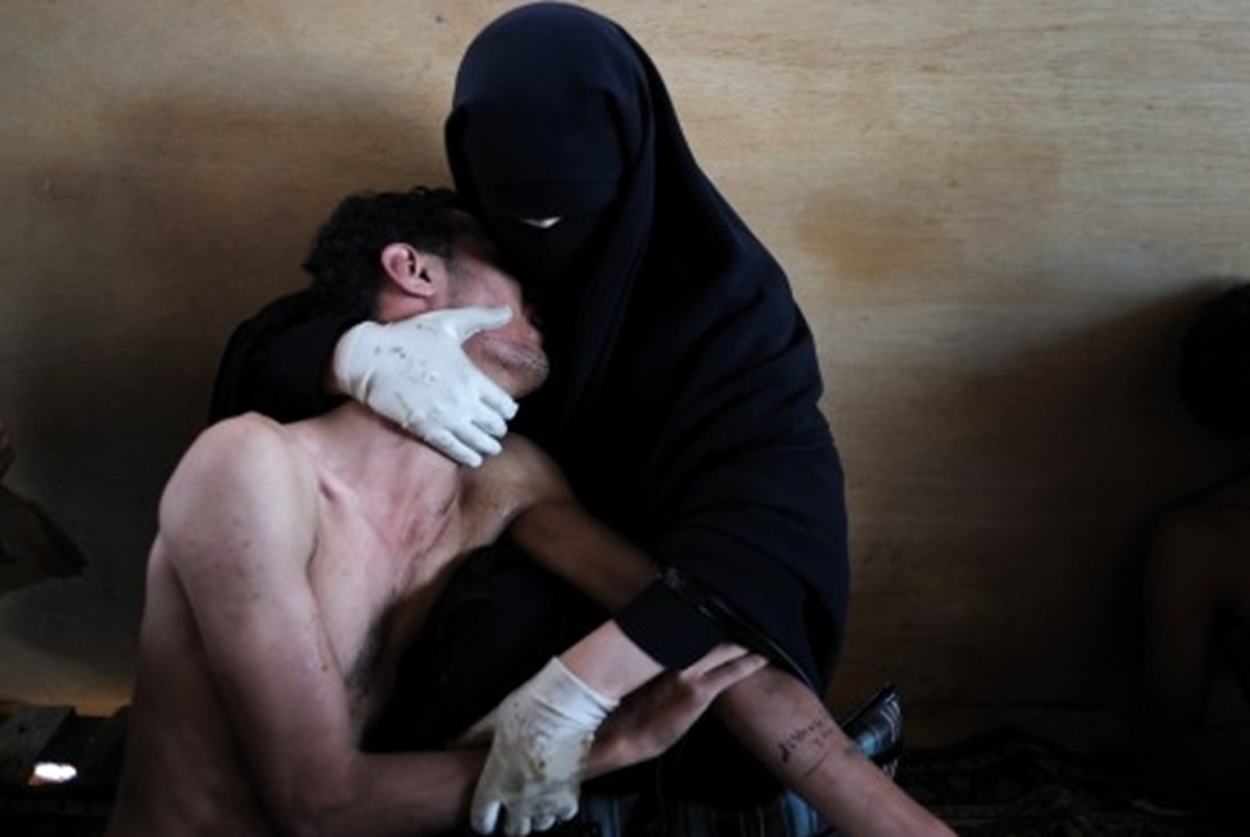
Samual Aranda, World Press Photo of the Year 2011.
A woman covered in a niqab and wearing white gloves cradles an injured protester with a naked torso. The contrast between veiling and revealing, between the exposed male body and the darkly covered female one catches our eye; the light which illuminates the bare skin is then absorbed by the black fabric; one face is turned away from us in agony, while the other figure appears virtually faceless. The style can be described as reminiscent of 19th-century Orientalist artwork, seen as dramatic and mysterious (Said, 1978). The gloves with flowers embroidered on them, the code written with a pen on the man’s forearm (presumably doctors’ indication of his wounds), the handbag hanging from the woman’s elbow, and the bare wooden background against which the scene takes place give the image a surreal, uncanny quality.
According to the jury chairman, in line with the uplifting and mobilizing spirit in which the Arab Spring had been framed in the western media in 2011, an image that could potentially win the contest that year had to evoke primarily positive feelings, such as hope, solidarity and compassion (World Press Photo Foundation, 2012a). Out of 101,254 images submitted, the jury in its search for the winner discarded ones of enraged protesters on Tahrir Square, toppling statues and banners with angry slogans, selecting instead a photograph that appears not only gentle but also versatile. In their comments, the judges claimed that the image stands not only for the Yemeni population, but also for that of Egypt, Tunisia, Libya, Syria, and virtually anyplace where violence happens, and praised the photograph for its ability to evoke compassion and sympathy and to appeal to maternal love that prevails beyond geopolitical constraints (World Press Photo Foundation, 2012b). This general eagerness to acclaim the photograph’s universal character was evident long before it won the WPP: first published in The New York Times in October 2011, it accompanied an article about US drone strikes in Yemen, even though the picture’s subject was injured by Yemeni government forces (Kasinof, 2011).
The image can be classified as a long-standing trope in war reporting: that of a mourning woman. Here, however, the woman does not mourn the actual loss of her son, but rather the unforeseen, potential losses she might soon experience: of her loved ones, safety, freedom, and a reliable future. Disseminated online after the awards have been announced, it gained a life of its own, undergoing various forms of social tagging from its global audiences. Reactions were predominantly centred around the “not again” feeling: numerous renditions of Pieta were evoked by online commentators. These included the photograph of a Cambodian TB patient by James Nachtwey in 2004, a Japanese victim of Minamata disease by W. Eugene Smith in 1971, or previous winners of the WPP (e.g. the one from 2003, made by Jean-Marc Bouju, where an Iraqi prisoner comforts his little son, notably reversing the gender roles of the sacral convention). Aranda’s image was seen as assimilating Islamic politics to a distinctly Christian iconographic tradition and, therefore, as being more dismissive than representative of the uprising. Despite several Yemenis speaking approvingly about the picture in the press (Coomes, 2012), the jury’s choice was widely seen as evidence of the hegemonic western eye, shrinking the public and the political to the intimate and the personal.
The photograph by Jodi Bieber, the World Press Photo of the Year 2010, shows Bibi Aisha, 18 at the time (Figure 2), disfigured as retribution for fleeing her husband’s house in Oruzgan province, in the centre of Afghanistan. At the age of 12, Aisha and her younger sister had been given to the family of a Taliban fighter under a Pashtun tribal custom for settling disputes. When she reached puberty she was married to him, but she later returned to her parents’ home, complaining of violent treatment by her in-laws. Men arrived there one night demanding that she be handed over to be punished for running away. Aisha was taken to a mountain clearing, where, at the orders of a Taliban commander, she was held down and had first her ears sliced off, then her nose. In local culture, a man who has been shamed by his wife is said to have lost his nose, and this is seen as punishment in return. Aisha was abandoned, but later rescued and taken to a shelter in Kabul run by the aid organization Women for Afghan Women, where she was given treatment and psychological help. After time in the refuge, she was taken to America to receive further counselling and reconstructive surgery.
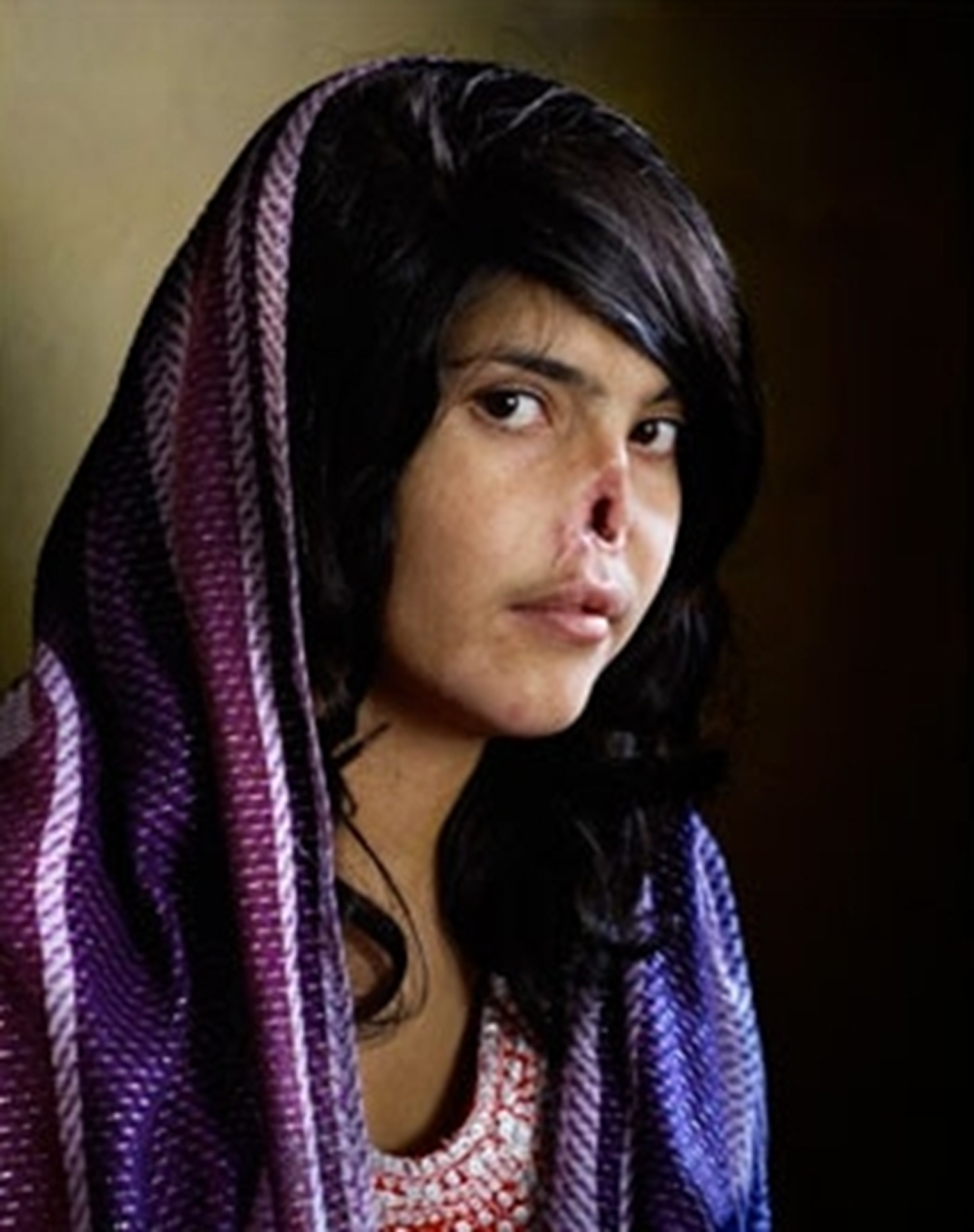
Jodi Bieber, World Press Photo of the Year 2010.
The photograph appeared first on the front cover of Time magazine in August 2010 as an emblem for the Taliban’s mistreatment of Afghan women. The gaping hole in the middle of a young girl’s face provokes horror or occasionally disgust. However, despite the image’s graphic nature, the viewer is invited to indulge in many visual pleasures: the rich texture of the girl’s hair and shawl, the light falling upon her cheek, the dark framing of her eyes. The photograph stays within the confines of both the western and the Orientalist tradition, in which female desirability and beauty assume central place. Similarly, the significance of “lost beauty” was continuously stressed in the Time article, in the story by the photographer herself, and in the comments of the jury.
The use of a portrait of an Afghan girl to represent poverty, violence and oppression is another powerful cultural trope invoked by, among others, Laura Bush as one of the justifications of so-called “war on terror” in the aftermath of the attacks on September 11 (Mackie, 2012). However, the judges selected the image as a powerful message about the miserable conditions in which all women live across the globe, therefore connecting it to a debate much larger than the situation in Afghanistan (World Press Photo Foundation, 2010). That, again, has caused a backlash of online reactions: the WPP jury was accused of extracting the girl from the politically charged context and reconstituting her as depoliticized object of contemplation, much as the Afghan Girl shot by Steve McCurry for the cover of National Geographic magazine in 1985 was (Lutz and Collins, 1993). Bieber’s photograph has been seen as a mirror held up to the media, informed by the interests and tastes of the western consumer, rather than a source of knowledge about Aisha’s life.
The third image, taken by Pietro Masturzo, awarded the World Press Photo of the Year in 2009 (Figure 3), captures women who shout their dissent from a Tehran rooftop on 24 June, following Iran’s disputed presidential election. The result had been a victory for President Mahmoud Ahmadinejad over opposition candidate Mir Hossein Mousavi, but there were allegations of vote-rigging. In the ensuing weeks, violent demonstrations took place in the streets. At night, people shouted from the roofs, an echo of protests that took place during the 1979 Islamic Revolution.
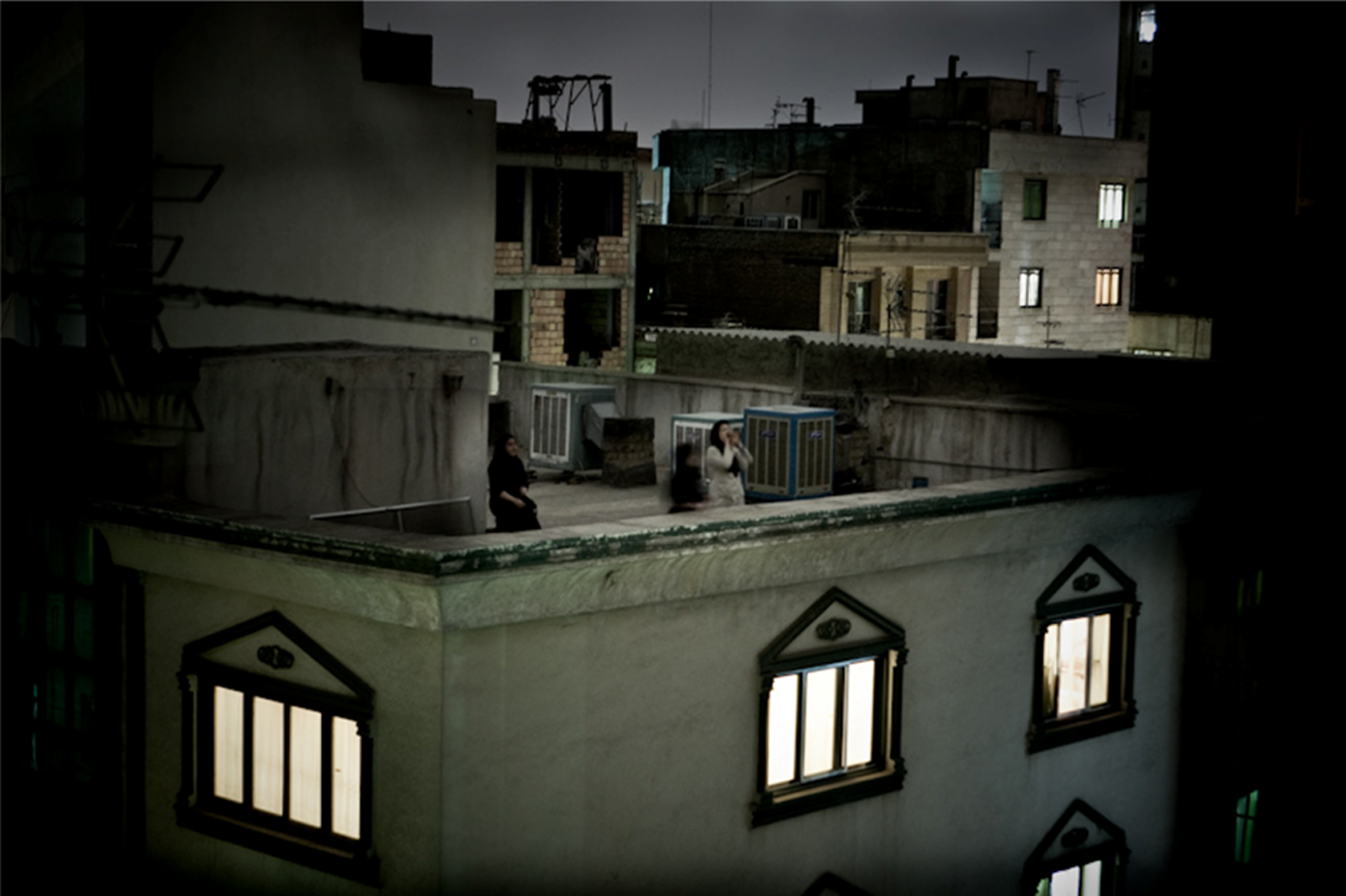
Pietro Masturzo, World Press Photo of the Year 2009.
Unlike in the previous two pictures, the photographer used a very long exposure, resulting in intriguing softness, blurriness and lack of immediate context. The image breaks with the convention of the dramatic pose, the violent gesture, and the expressive face, and presents us with something that is not quite recognizable at first sight. The jury appreciated the loneliness of separate figures, hardly discernible in the dark: A lot of the images of the WPP do look the same and it begins to look like a system. We thought that we would open up doors: for me it’s a picture that is … not frontal, frontal as in a picture of a demonstration … (Interview Ayperi Karabuda Ecer)
However, many criticized the jury’s choice, pointing out the lack of graphicness of the image, its too heavy reliance on a story in the caption, the anonymity of the protesters, as well as the fact that many Iranian photographers risked their lives making photos of the uprising that were much more explicit (Dunlap, 2011).
The original caption entered by a photographer identifies the shouting: these are cries of “death to the dictator” and “Allah u Akbar” (Allah is great) echoed thorough Tehran. Vocalization as a form of civil disobedience against the regime adds another, auditory aspect to the image (Zarzycka, 2012b). The photograph’s meditative character is matched by the almost hypnotic, repetitious chanting caught in several videos covering the protests that were posted on YouTube.
Let us now examine the three images for the features we discerned in the previous section (the presence of the body, recognizability, affective powers, symbolic accessibility). All three photographs show human bodies as signifiers of politicized events and their aftermath; on two of them the bodies are visibly marked by violence. Remarkably, all three show non-western women, following a common cultural pattern: the feminine acts as a signifier of cultural and political differences. The juries’ decision to choose the photographs by Aranda and Bieber as Photos of the Year can be interpreted as reinforcing traditional gender roles, where women act as caregivers or victims more often than actors challenging existing systems and structures (significantly, the winners of 2008 and 2007, a US policemen and US soldier – white, male carriers of authority invested by the state – performed the function of reinstating commonly understood masculinity). Consequently, both our quantitative and qualitative findings indicate that recurring tropes are predominantly gendered along the traditional conceptions of femininity and masculinity.
Regarding recognizability, whereas the first two images can easily be traced back to other well-known images in the long tradition of representing suffering, war and conflict (as pointed out above), part of the appeal of Masturzo’s image is its intriguing lack of immediate reference.
The familiarity of the composition, the graphic nature, or the conveyed mood in the three photographs stirred strong feelings among the juries: emotions were powerful impulses in the WPP judging process. Commentary such as “It’s a beautiful picture but leaves me cold”, “That picture will make people angry” or “This image chills me to the bone” were common during judging sessions and testified to the affective component of assessment. We have argued above that it is the female bodies that effectively touch the viewers, already culturally conditioned to associate victimhood, death and loss with the feminine (Pollock in Batchen et al., 2012: 71). However, these emotional reactions, based on an inequitable power relationship between the subject and the object of compassion or horror, may easily become an emotional outlet emptied of radical action (Azoulay, 2008; Berlant, 1999; Chouliaraki, 2010), as online reactions to Aranda’s and Bieber’s photographs show. Masturzo’s photograph, highly aestheticized and painterly, runs the risk of making us indulge in a pleasurable pathos rather than rendering us aware of systemic oppression (Reinhardt et al., 2006; Sontag, 2003). Consequently, all three images become a part of the affective circuit that may generate, but also commodify intense emotional experience (Butler, 2006, 2009; Hardt and Negri, 2001).
As for symbolic accessibility, the images of a mother holding her son, of a disfigured girl, and of unidentified women on a rooftop inform conceptions of precariousness, subservience, and man-on-woman or systemic violence (Fahmy, 2004; Said, 1978). At the same time, their ability to deploy generic traits comes with a price: the way the photographs have been framed by the jury and the online reactions reflect how they inevitably force certain associations and prohibit others, neutralizing the personal, the local and the particular into the abstract, the generic and the global. Despite Fatima al-Qaws’s active, strong way of holding herself and her son, and despite the fact that she herself claimed that the professional recognition of the photograph makes her “proud for being a woman, proud for being a mother, and also for being a Yemeni” (Coomes, 2012), she is reduced to the role of provider of solace to a male protester (even though her involvement in the resistance is vaguely mentioned in the caption). Similarly, Bibi Aisha functions as an embodiment of the pressing need to “save brown women from brown men” as Gayatri Spivak (1988) put it. Masturzo’s photograph, showing the liminal space of a rooftop (not quite in the public sphere, but no longer a domestic environment), might be read as offering some space for female political agency. Nevertheless, any accessibility it might have pertaining to the autonomy or moral stance of its subjects is dissolved in the lyrical character of the image.
To sum up, examining the presence of these four features allowed us to conclude that the first two of the three winners match the criteria we have established for photographic tropes. Masturzo’s image, not easily recognizable and lacking symbolic accessibility, partly escapes the definition of a trope. In that, the photograph reflects well the general pattern of the year 2009, where we only recognized tropes in 5.5 percent of images. That these three photographs include two or more features characteristic of tropes can be explained by the fact that, according to our observation, the judges, when choosing the Photo of the Year, anticipate a broad audience (judges’ comments like “this will be picture that will hang on the walls as a poster worldwide” attest to that). Consequently, the images they choose rely more on a limited set of images that are widely resonant with the western collective imaginary. Conversely, as we remarked during our observations, when awarding images in other categories, the jury targets professional audiences – editors, photographers, and publishers – anticipating professional criticism rather than a broad public reception. There are further convergences between the patterns we discovered in the WPP archive and three consecutive Photos of the Year 2009–11: the two images we have qualified as tropes (Aranda and Bieber) were entered as singles, while Masturzo’s image was a part of a story. That is in accord with our findings that photographic tropes are more recurrent among single images (Table 3). Furthermore, while the most recurrent tropes found in the WPP archive are victims of violence or images of battlefields (Table 2), the three winners are static and poised, characterized by a much less dynamic composition.
Tropes in single vs. story entries.
Afterword
While the number of images published online has reached billions, in our impulse to record and share we have not formulated new strategies to gain a better understanding of today’s pressing issues of a globalized visual sphere. The models we had inherited for understanding photography (Barthes, Sontag, Sekula, Szarkowski) are being challenged by the new social and technological conditions of the early 21st century. In this article, we have problematized the ongoing debate on representations of war, conflict and disaster in press photographs by arguing that tropes, with their recognizability, affective impact and symbolic accessibility, fit contemporary patterns of cultural practices particularly well. In the age of global digital image banks, tropes have become especially expedient semiotic resources; the more multi-purpose and generic they are, the more commercial and widespread they become, capturing the contemporary shift of photography from witnessing to becoming a symbolic system, a system actively and intentionally sustained by powerful agents.
We further demonstrated that photography contests put selected photographs in a specific context for perception and evaluation, foregrounding iconographic conventions rather than journalistic criteria of impact or accuracy. Through our analysis of the images awarded in the WPP, we pointed out how tropes organize western audiences’ encounter with atrocity, but also how they are grounded within normative associations and cultural prejudices, often connected to gender. This article has not been written in order to condemn recognizable formulas or their presence in photography contests, but rather to signal the pressing need to look past the limitations and distortions of tropes and to serve as an example of a method of research in archives where tropes are dominant.
The purpose of this study was to provide a preliminary examination of the tropes recurrent among the images awarded prizes in the WPP and to demonstrate how the contest influences and organizes understanding of, but also codifies, existing cultural discourses. It also constitutes a basis for a much larger follow-up research analysing over 60 years of awarded images. However, established photographic tropes are not the only way to convey war and carnage. The extraordinary number of photographs taken during the attacks on September 11, followed by the revelation of torture at Abu Ghraib prison in Iraq and the tsunamis in Asia in 2004, has introduced citizen journalism on the scale unknown before (van Dijck, 2007). Social media increasingly perform an endless introduction of the new and reinterpretation of the old images. Photographs, often exhibited in art spaces as part of installations fusing still images with words, sounds and videos, are a major feature of socially engaged art today (see work by Martha Rosler, Jeff Wall, Alfredo Jaar, Thomas Hirschhorn, Simon Norfolk, Sophie Ristelheuber and Oscar Muñoz). Recent changes in the WPP echo these shifts: in 2010, a Special Mention category was (re)introduced to recognize work by a non-professional that has had an undeniable effect on world news. The first video grab granted a Special Mention, captured by a cell phone camera, was the post mortem image of the 26-year-old Neda Soltan, shot and killed on the streets of Tehran in June 2009. Last year’s entries showed television screens, digital camera screens, or people creating photos of themselves to be uploaded to Facebook or Twitter, signalling the increasing self-reflexive tendency of photographic practice and the politics of appropriation. In 2011, a series of images captured by Google Streetview software was entered in the contest and was granted an Honourable Mention in Contemporary Issues category. Since 2011, the WPP multimedia contest has run parallel to the main contest: the productions entered, both linear and interactive, need to have an extended storyline, including photographic stills and/or films, interviews and voiceovers. All these projects offer a slower, less graphic representation of conflict or disaster. They do not provide immediate visual or emotional gratification but rather present themselves to us in all the constraints of their materiality; framing, blurriness, distance, technical imperfections overturn customary relations and modes of engagement in press photography. The results of these new practices and shifts in existing categories have not as yet replaced the images regularly given awards in the WPP contest. Whether we will ever be able to think war, disaster and violence without the trope of a mourning woman or a helpless child remains to be seen.
Footnotes
Funding
This research was made possible by funding for Marta Zarzycka from the Netherlands Organisation for Scientific Research (NWO) and for Martijn Kleppe from the Sem Presser Foundation.