




Abstract
Repeated reading is an intervention with strong evidence for improving students’ oral reading fluency. However, little research has examined the use of this intervention outside of traditional school contexts. School closures due to COVID-19 forced schools and teacher preparation programs to create new approaches to evidence-based reading interventions that could be delivered online. This study examined the effects of a repeated reading fluency intervention delivered synchronously online. A single-case repeated acquisition design examined the intervention’s effects on three upper elementary students’ correct word reading fluency, defined as the number of words read correctly per minute. Visual analysis indicated repeated readings had a positive impact on all students’ reading fluency. Future research should examine whether this intervention can improve students’ comprehension when delivered online.
Introduction
As the COVID-19 pandemic swept across the United States, nearly every school in America experienced a closure of some duration as state and local governments acted to prevent further spread of the disease. Teachers were left to transition face-to-face instruction to online instruction formats without much of an evidence base for how to do so effectively. Students with disabilities, who were on average over 3 years behind their peers without disabilities (Gilmour et al., 2019), were at increased risk of falling further behind academically due to the loss of high-quality special education services. The school closures created significant challenges for teaching and learning but also provided opportunities to develop innovative instructional solutions to meet these challenges. In this study, undergraduate preservice teacher candidates implemented an evidence-based reading intervention – repeated readings – to upper elementary students who were struggling readers. This online practicum experience created an opportunity to study the effects of the repeated reading intervention delivered synchronously online on students’ correct word reading fluency.
Reading Fluency
Reading fluency is the ability to read text quickly, accurately, and with proper expression (National Reading Panel, 2000). The National Reading Panel (2000) identified fluency as one of the five pillars of reading. According to the theory of automatic processing (LaBerge & Samuels, 1974), fluent reading “frees the mind from attention to detail” (Huey, 1908, pg. 104) and allows the reader to focus on other elements of the reading process. Reading fluency is a common deficit for many students (Pinnell et al., 1995) but is especially troublesome for students with learning disabilities (LD; Wanzek, AlOtaiba, & Petscher, 2014).
Chard et al. (2002) identified dozens of studies that examined interventions aimed at improving students’ reading fluency. In their synthesis, they identified common features of interventions that improved reading fluency for elementary students with LD: explicit modeling of fluent reading, multiple opportunities to repeatedly read familiar text with corrective feedback, and an established performance criterion for increasing text difficulty. This seminal work has guided the development of reading fluency interventions for the past nearly 20 years. The second feature they identified – multiple opportunities to repeatedly read familiar text, or repeated readings – has become a ubiquitous intervention in elementary reading instruction.
Repeated Reading
Repeated reading is a feature of fluency-focused interventions with a long history of improving students’ reading fluency (Chard et al., 2002; Therrien, 2004; Lee & Yoon, 2017) and is perhaps the most commonly-used procedure to improve students’ reading fluency (National Reading Panel, 2000; Therrien & Hughes, 2008). A What Works Clearinghouse practice guide recommended the use of repeated readings to support reading fluency for kindergarten-third grade students (Foorman et al., 2016).
At its core, repeated reading instruction involves students repeatedly reading the same passage for a certain number of times or until a criterion goal is met. Interventions using repeated readings have been implemented with student peers as tutors (Begeny et al., 2009), adult tutors (Therrien & Hughes, 2008), paraprofessionals (Therrien et al., 2012), or teachers (Gilbert et al., 1996). Repeated reading interventions generally use narrative passages for intervention materials, but Kostewicz and Kubina (2011) found repeated readings to be effective at improving reading fluency with science texts. Repeated reading is often combined with other instructional strategies such as modeling, systematic error correction, passage preview, or performance feedback.
Therrien (2004) conducted a meta-analysis of peer-reviewed studies examining repeated readings with school-aged participants (5–18 years old). An important contribution of his work was the categorization of dependent measures into transfer passages or nontransfer passages. Transfer passages refer to novel passages that were not repeatedly read during the intervention. Nontransfer passages refer to dependent measures collected on the passages that were repeatedly read during the intervention. In his analysis, Therrien found several features of interventions leading to higher effect sizes for nontransfer passages. First, cueing students to focus on fluency and comprehension led to higher fluency and comprehension effect sizes than only cueing students to focus on fluency. Interventions that included corrective feedback had lower fluency effect sizes than interventions that did not include corrective feedback. Fluency effect sizes increased with each reading (e.g., passages read two, three, or four times). However, improvement on nontransfer passages alone should not be the end goal of repeated readings. A reading intervention should lead to generalized reading ability on novel passages.
When analyzing effect sizes on transfer passages, Therrien (2004) found the following results regarding individual intervention components. First, interventions with adult tutors led to higher fluency effect sizes than interventions with peer tutors. Second, including a model of the passage before repeatedly reading led to higher fluency effect sizes than studies with no passage modeling. The same was true for interventions that included corrective feedback, explicit comprehension support, and charting students’ progress: interventions with these components had higher effect sizes for fluency than interventions that did not include them. . Finally, interventions that prescribed reading passages for a fixed number of times had substantially lower effect sizes on average (m = .38) than interventions that prescribed reading passages to a performance criterion (m = 1.70).
When examining study samples, Therrien (2004) found studies that included students with LD had lower fluency effect sizes for these students on average (m = .75) than for their peers without LD (m = .85) on nontransfer passages but higher effect sizes (LD m = .79; non-LD m = .59) on transfer passages. In his meta-analysis, Therrien found fluency effects on transfer passages were on average greater for students with disabilities than their non-disabled peers.
Results from Meta-analyses of RR Interventions.
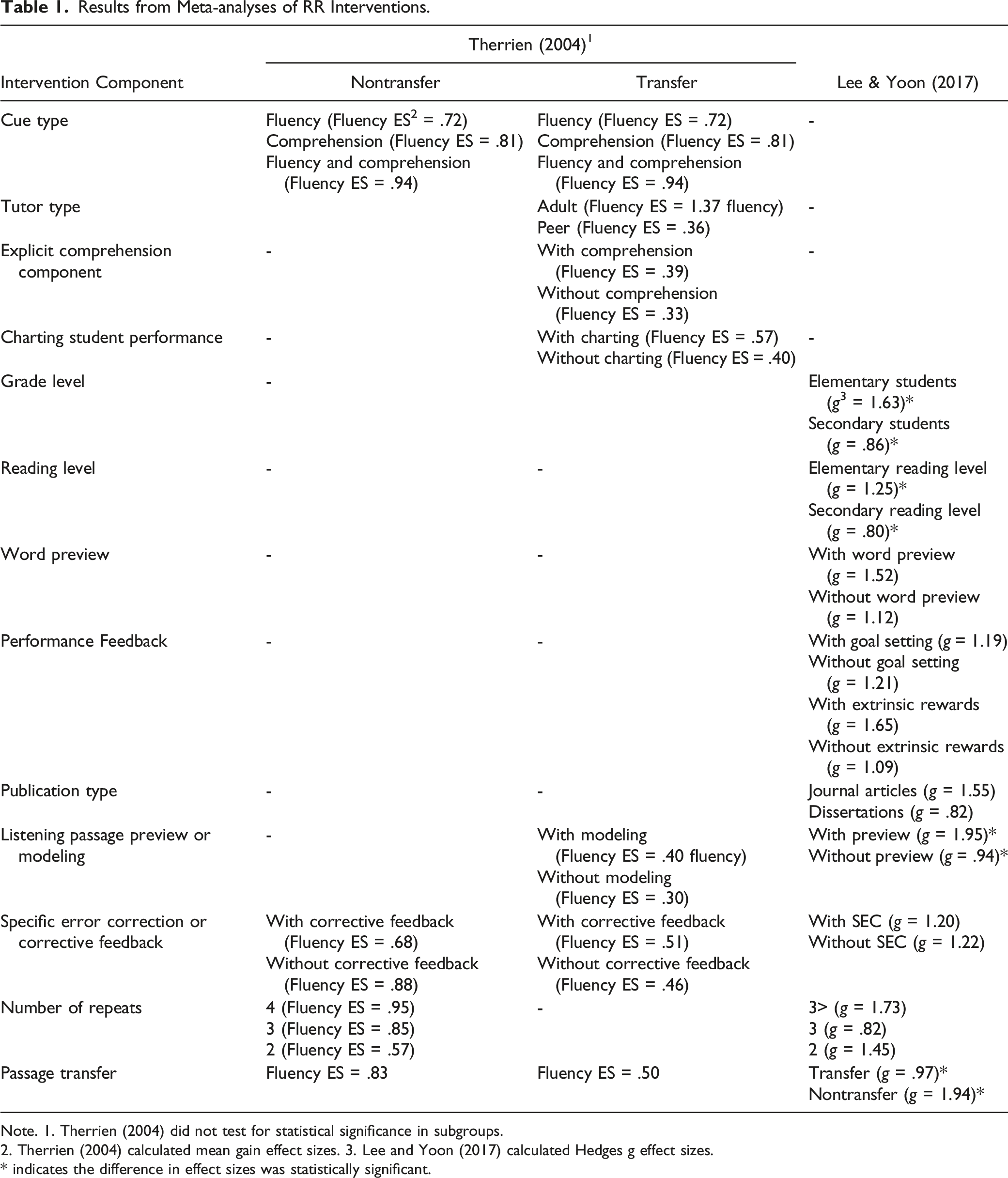
Note. 1. Therrien (2004) did not test for statistical significance in subgroups.
2. Therrien (2004) calculated mean gain effect sizes. 3. Lee and Yoon (2017) calculated Hedges g effect sizes.
* indicates the difference in effect sizes was statistically significant.
It is clear from both meta-analyses that even when there are statistical (i.e., Lee and Yoon, 2017) or descriptive (i.e., Therrien, 2004) differences in effect sizes based on intervention components the intervention is effective at improving reading fluency. To illustrate, the smallest average effect size reported by Lee and Yoon (2017) was .82. In combination with certain components, these average effect sizes can be as high as 1.95 (Lee & Yoon, 2017). Importantly, these gains in reading fluency can generalize to transfer passages. When examining essential components of repeated reading interventions, these two meta-analyses echo what Chard et al. (2002) found for elementary fluency interventions generally: in order to build fluency, students need modeling of fluent reading and repeated reading practice to an established criterion.
Online Learning
Some evidence suggested teachers had low confidence in their ability to teach online entering the COVID-19 school closures (Boltz et al., 2021). Teachers reported many challenges associated with online teaching in the COVID-19 era, including a lack of student participation or engagement (An et al., 2021) Given these challenges, it is unsurprising that some evidence suggested that some special education teachers used evidence-based interventions and behavioral supports (such as teaching replacement behaviors) with few students (Hirsch et al., 2022).
Even before the pandemic, online learning was rapidly growing across all levels of education in the United States (Wicks, 2010). For example, as early as 2015 all 50 states and Washington D.C. offered fully online or supplemental online learning formats (Wicks, 2010). Many opportunities provided by online learning have specific application to students with disabilities. For example, Wicks (2010) identified the following uses of online learning that could be directly applicable to students with disabilities: providing highly qualified teachers to students who might not otherwise have access to them, providing opportunities for at-risk students and homebound students to continue their studies outside the classroom, providing tutoring on-demand, and providing credit recovery programs for students who have failed courses or dropped out of school. Given the dual dynamics of teachers’ identified challenges of teaching online and the increasing prevalence and opportunity of online teaching, it is important that researchers identify strategies for teaching online effectively.
Teaching reading online presents its own unique challenges. Reading requires the ability to hear and manipulate sounds in words. Poor audio connections may make this challenging. Teaching reading often requires shared texts or materials. Supporting students in following along with the text could be more challenging in online environments. To illustrate some of these challenges, consider a simple word reading error correction. When correcting a student’s reading error in-person, it requires little time to point to the word and say, “This word is cat. What is this word? [pause] Now reread that sentence.” When teaching online, this error correction could break down at several points. First, the teacher may not hear students clearly, which could cause the teacher not to hear words read incorrectly or to think a student read a word incorrectly that was actually correct. To implement an error correct, the teacher must share his or her screen and highlight the incorrectly read word or have another way to show the student what word was read incorrectly (e.g., holding a piece of paper up to the camera). Then, the teacher must continue with the error correction procedure. At this point, audio challenges may cause the student to mishear the teacher’s correction (e.g., “Did you say that word is bat?). Due to the challenges of teaching online, it is not safe to assume that interventions traditionally delivered online will be effective when delivered synchronously online.
Purpose and Research Questions
Repeated readings has an extensive record of improving reading fluency and often improving reading comprehension. However, repeated readings has typically been delivered in traditional face-to-face formats. This study examined the effects of a repeated reading intervention – RAAC – delivered online. The intervention was delivered online out of necessity due to COVID-19 school closures. However, as online instruction increases for a variety of reasons, it is important to know whether traditional evidence-based practices can be successfully implemented online.
The purpose of this study was to determine whether RR instruction, specifically the RAAC intervention, delivered online can improve students’ oral reading fluency. The following research questions guided the study. 1. Does RAAC delivered online increase students’ correct word reading fluency on nontransfer passages for three upper elementary students at risk for reading disability? 2. What are parents’ perceptions of a repeated reading intervention delivered synchronously online?
Method
This study examined data from an online reading program designed to help undergraduate preservice teachers studying special education complete their course field experience requirements. When school closures due to COVID-19 prevented the undergraduates from completing field experiences in schools, the course instructor created the online reading program and recruited students via social media.
Participants and Setting
Students
Student participants for the online reading program were recruited via social media. Separate Facebook and Twitter posts were posted to the author’s personal social media accounts. The posts asked interested parents to respond and asked others to share with others who may be interested. The post was shared 16 times on Facebook. It was retweeted 26 times on Twitter. On Twitter, the post had 2,237 impressions and 77 engagements. Facebook does not report impression and engagement data; however, based on these data, the recruitment posts reached far beyond the first author’s personal network.
Parents who expressed interest were asked to privately share an email address for further communication. A description of the program and list of expectations for students and tutors was emailed to parents who expressed interest. Parents who were still interested completed an information survey to help tutors know more about the students.
A total of 21 K-6th grade students completed the whole recruitment process and participated in the online reading program to some degree. To be included in this study students had to complete at least five video recorded sessions, be in fourth-sixth grades, and consent/assent to their data being included in the analysis. Three students met these criteria and are included in this study. All were male. One was in fourth grade; two were in sixth grade.
Tutors
The tutor was an undergraduate student pursuing a degree in special education at a large university. She was enrolled in a face-to-face junior level course focused on methods of teaching reading and writing. As part of the course requirements, she was assigned a field experience in a local public school. This school placement was to be her first extensive field experience in the undergraduate program. Field placements were cancelled after she had completed 2–3 weeks of observations. Therefore, she was a relatively inexperienced teacher at the beginning of her teacher education. The tutor was female and between the ages of 18–23 with no prior teaching certification or experience.
Setting
This study was conducted online via Zoom. Tutors emailed Zoom meeting invitations to students or their parents, and students connected to the Zoom meeting through laptop computers or tablets. All sessions were conducted one-on-one via Zoom.
Dependent Variables
Correct Words per Minute
Reading fluency, defined as the number of correct words per minute, was the dependent variable. Reading comprehension was not included in the dependent variables. Because the tutors were beginning teachers who were inexperienced at delivering interventions and collecting data simultaneously, the data collection procedures were limited to provide them a smooth, successful introductory experience.
To assess correct words per minute, a researcher watched a recording of the tutoring session and counted the total number of words read in the first minute of each passage reading and subtracted the number of reading errors to calculate the correct words per minute. If the student took longer than 1 minute to read the passage, only the correct words in the first minute were counted and recorded. Correct words per minute data were collected simultaneously with the intervention. That is, as students were repeatedly reading passages for the intervention, data on correct word fluency were collected for the first minute of each intervention reading.
To calculate interrater reliability, two researchers double scored two videos for each participant (21% of all videos). We calculated intraclass correlations (ICC) using a two-way, agreement model. ICC was .94, indicating a high level of agreement between the scorers.
Social Validity
To assess social validity, parents were asked to complete a survey on their perceptions of the intervention. The survey included a mix of Likert-type items and open-response items. See survey items in Figure 1. Social validity survey items.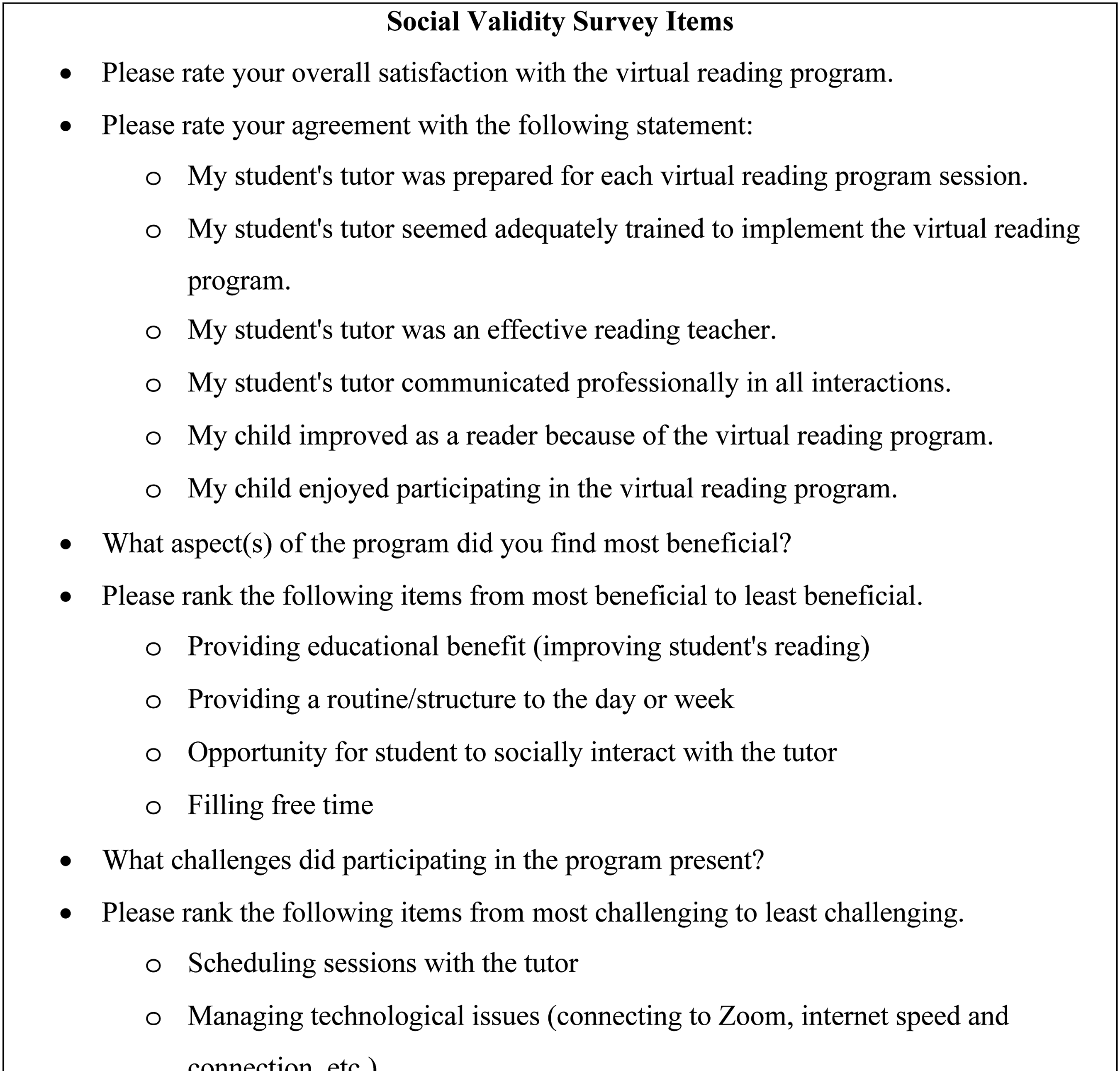
Independent Variable
The independent variable in this study was the RAAC intervention delivered with tutor modeling. In the RAAC intervention, students repeatedly read passages and received feedback on reading, including error correction, after each reading.
Materials
Tutors signed up for a free Zoom account and used their personal laptop computers with internal webcams and microphones. Tutors emailed Zoom meeting invitations to students or their parents. Students connected to the Zoom meeting through their personal laptop computer or tablet.
The reading passages used in this study were used in previous studies of the RAAC intervention (Therrien et al., 2006, 2012). Passages were on the first through sixth grade reading levels based on the Flesch Kincaid reading level score. Each grade level had 50 passages. Passages were narrative and included a wide variety of topics typical of children’s literature.
Training
Tutors were trained in how to model, provide feedback, and collect data as part of the standard curriculum for the course they were enrolled in. Before the intervention began, one class period was dedicated to reviewing the intervention’s procedures and practicing the intervention on fellow classmates. The course instructor provided feedback on their implementation of the intervention during this class period and answered any questions tutors had throughout the semester.
Implementation Fidelity
All sessions were recorded via Zoom. Researchers randomly selected five videos to check for implementation fidelity. A graduate student reviewed the recordings and assessed implementation fidelity using a checklist. The tutor completed 86% of the intervention steps on average.
Procedures
During the baseline phase, the tutor modeled fluent reading of a passage and prompted students to read the passage one time. Each student had three baseline sessions. Separate passages were used for all baseline and intervention sessions. During the intervention phase, the tutor began the session by modeling fluent reading of the passage. Then, students read each passage a minimum of two times and no more than four times. After each reading, the tutor provided feedback on students’ oral reading. The tutor also shared her computer screen to display the reading passage to the students and highlighted any reading errors that students made. The tutor read the highlighted word correctly and asked the student to repeat it. After giving feedback and correcting reading errors, students began the next reading of the same passage.
If students met the grade-level fluency goal on any of the repeated readings, the tutor moved to the next passage in the same grade level. Likewise, if students read a passage four times and failed to meet the fluency goal on all four readings, the tutor moved to the next passage in the same grade level. If students met the fluency goal on three consecutive passages, the grade level was increased. If students failed to meet the fluency goal on three consecutive passages, the grade level was decreased. See Figure 2 for display of step-by-step procedures for the intervention. RAAC intervention procedures.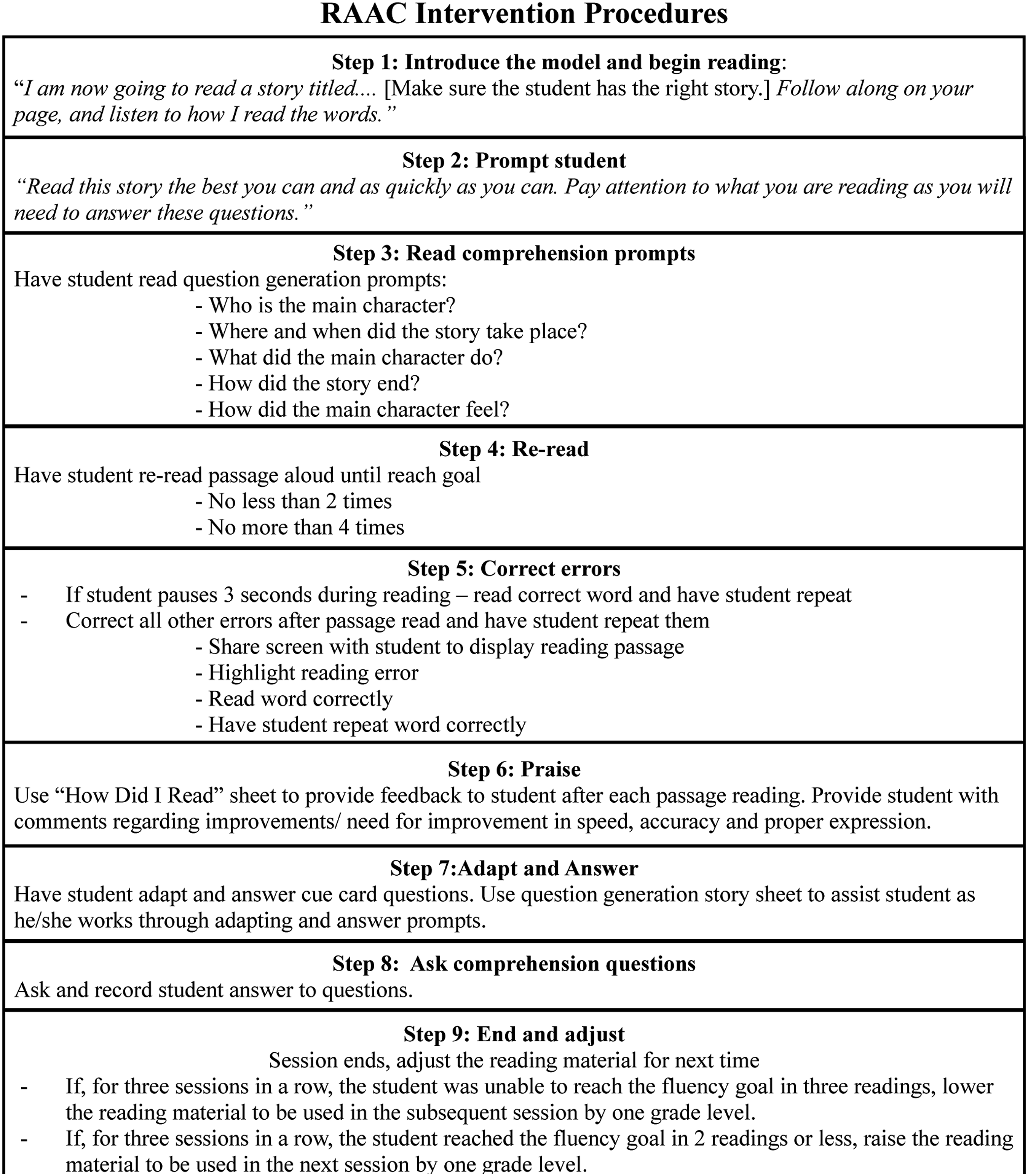
Experimental Design
This study used a single case repeated acquisition experimental design. The repeated acquisition design examined the effects of each repeated reading. This design allowed for within-subject replication and inter-subject replication (Horner et al., 2005). To demonstrate experimental control, an effect had to be demonstrated three times within a participant (within-subject replication) and data change patterns had to be consistent across participants in the study (inter-subject replication). Data were displayed on time series graphs and examined visually for changes in level, trend, and variability. When examining these changes, the immediacy of change, overlap with other phases, and pattern consistency was considered.
The graphs are presented in Figure 3. The shape of the data markers indicates which passage reading is represented: circles are the first passage reading, triangles are the second passage reading, squares are the third passage reading, and diamonds are the fourth passage reading. The Y axis (left side of the graph) is the number of words read correctly per minute, and the X axis (bottom of the graph) indicates the session number. Effects of repeated reading intervention on correct word reading fluency.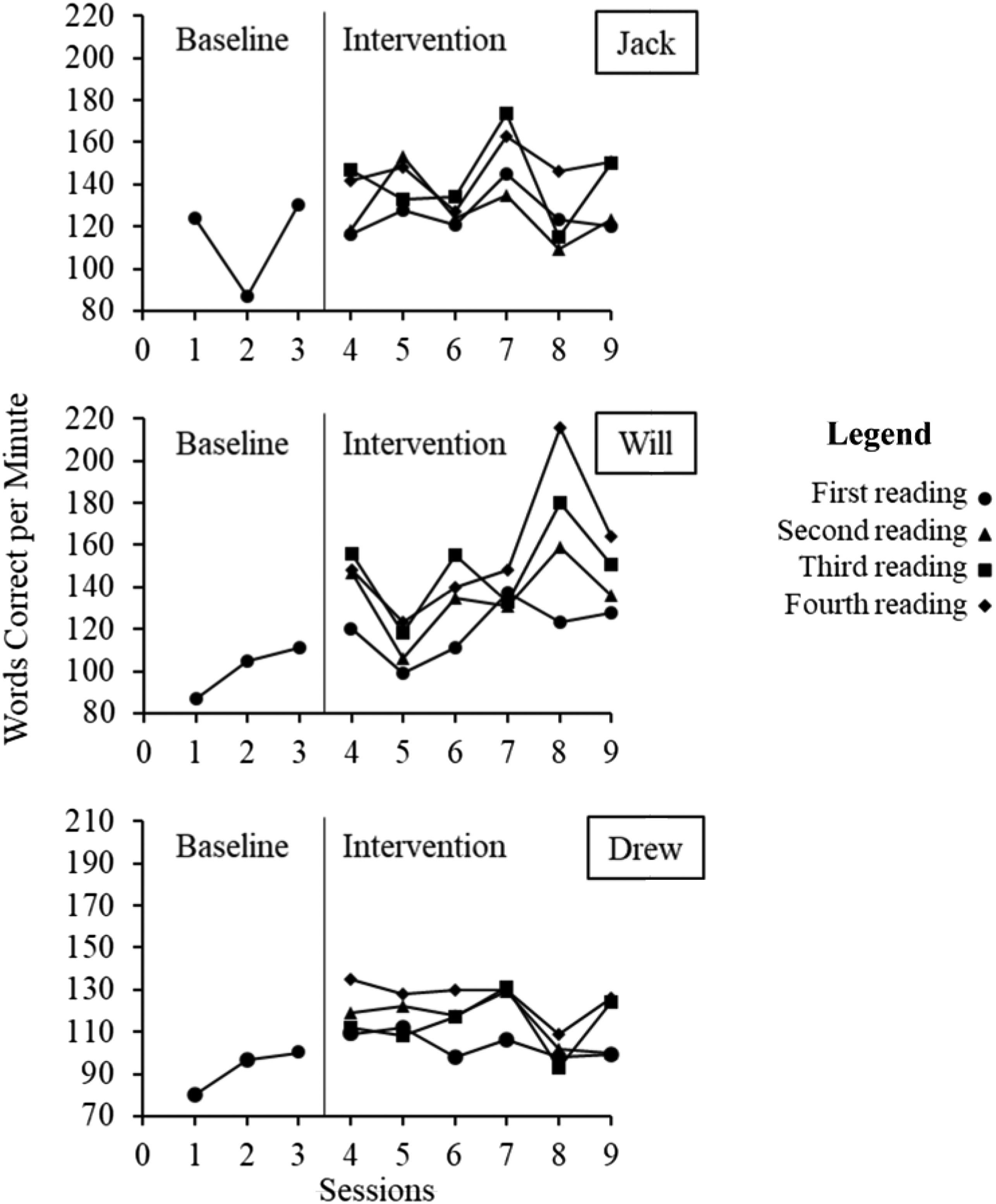
Results
Correct Word Reading Fluency
Visual analysis for all three students indicated the RAAC intervention consistently improved correct word reading fluency as indicated by an increase in level with little to no overlap consistently across participants. The change in level can be detected visually. All participants had low to low-average fluency in the baseline condition according to national norms from Hasbrouck and Tindal (2017). In the intervention condition, students’ performance on the final passage reading increased to average to above average, relative to their same grade peers.
There was a decreasing amount of overlap between the baseline condition and each repeated reading during the intervention condition such that by the final passage reading there was little to no overlap across participants. For example, Jack had 83% overlap between his baseline fluency and his first passage reading fluency (i.e., the first time he read a passage in the repeated reading condition). A high amount of overlap makes sense because the first passage reading is functionally the same as the baseline condition in that the student has not had the opportunity to repeatedly read the passage yet. On the second passage reading, his amount of overlap decreased to 66%. On the third and fourth passage readings, Jack had 17% overlap with the baseline condition, respectively. Similar patterns were identified in Will and Drew’s data. Will had 66% overlap between baseline and first passage readings, 17% overlap between baseline and second passage reading, and no overlap between baseline and third and fourth passage readings, respectively. Drew had 50% overlap between baseline and first intervention readings, 17% overlap between baseline and the second and third passage reading, and no overlap between baseline and the fourth passage reading.
Each passage reading during the intervention had additive effects. That is, on each repeated passage reading, students’ scores tended to increase from the previous reading of the same passage. Within each passage, there was a clear increasing trend. To illustrate, Jack completed six passages with four repeated readings in each session (24 total readings). Only 6 times (25%) did his fluency on a passage not increase from the previous reading of that same passage. Will had three such instances (13%) and Drew had five (21%). In other words, a significant majority of the time (i.e., 75% or more), fluency increased with each repeated reading.
Social Validity
All parents reported they were “extremely satisfied” with the virtual reading program. They also all “strongly agreed” that the tutor was prepared for each session, seemed adequately trained to implement the intervention, was an effective reading teacher, and communicated professionally. There was less consensus around the students’ experience with the program. Two parents neither agreed nor disagreed that their child improved as a reader because of the program, and one parent “somewhat agreed.” Again, two parents (the same two from the previous item) neither agreed nor disagreed that their child enjoyed participating in the program; one parent “somewhat agreed.” Scheduling issues were a common challenge. Scheduling issues included trying to participate in the program in addition to school activities and trying to schedule intervention sessions around the tutor’s schedule.
Discussion
Repeated reading has an extensive history of improving reading fluency in traditional settings. Specifically, the RAAC intervention has improved reading fluency and comprehension for a wide range of students in traditional settings. This study examined the effects of RAAC delivered in an online setting. Schools may want to use online instruction for a variety of reasons including school closures due to pandemics, extra practice opportunities for students, alternative instructional options for students, or a child being ill (e.g., homebound instruction). As schools increase online instruction, it is important to know whether traditional interventions are effective in online settings and how to successfully transition these interventions to online settings.
This study’s results indicated that the RAAC intervention can be successfully implemented online with results for reading fluency similar to what is expected of RR interventions in traditional settings (Lee &Yoon, 2017; Therrien, 2004). When students repeatedly read passages, their correct words per minute consistently increased on each passage reading. These results are positive for teachers and researchers moving traditional instruction online.
The reading fluency gains in this study were significant, especially in light of the brief intervention period. National reading fluency norms from Hasbrouck and Tindal (2017) provide some context for the students’ performance. However, we present these national norms cautiously because they are based on cold readings of texts, and none of the readings in this study (baseline or intervention) were based on cold readings. Therefore, the data in this study and the national norms are not an equivalent comparison. Drew was the lowest performing reader during baseline. His reading performance placed him around the 10th percentile according to national reading fluency norms (Hasbrouck and Tindal, 2017). However, because his baseline readings were not cold readings (a model of fluent reading of the passage was given to him before each baseline reading), his true percentile on the national norms is likely lower. During the intervention, his final passage reading consistently approached or exceeded the 50th percentile mark for his grade level. Again, comparing the third or fourth reading of a passage to the national norms (cold first reading of a passage) is not a fair comparison. We are simply presenting these data to show the magnitude of students’ gains on each passage. The improvements in reading fluency were large. These results were similarly replicated in Jack and Will’s data. Jack’s baseline data were all below the 50th percentile with one data point slightly above the 10th percentile. During the intervention, all his final passage readings were above the 50th percentile with one session exceeding the 75th percentile. Will’s baseline sessions were all below the 25th percentile with one session below the 10th percentile. During the intervention, all his final passage readings were above the 50th percentile with one passage reading exceeding the 90th percentile. Again, these percentiles should not be interpreted to suggest the students general reading ability had improved to the upper percentiles of the national norms. In fact, the persistently low number of words read correctly on the first reading suggests these students continue to struggle with reading fluency.
The social validity results are helpful as researchers think about transitioning this and other interventions to synchronous online formats. First, parents rated their student’s experience (i.e., improved as a reader and enjoyed participating in the program) lower than other elements of the program. Results from the open-response items indicated an increased social-emotional connection between tutor and students could be beneficial. These connections are often naturally made during in-person instruction. When teaching in-person, teachers can naturally get to know their students on a more informal level. During synchronous online instruction, there is often little down time for informal conversations. Students and teachers join the virtual classroom at a designated time and instruction begins immediately. Thus, student-teacher relationships may suffer. Researchers and teachers involved in online instruction should consider explicitly planning time for building these relationships.
Limitations and Future Research
This study should be viewed in light of some limitations with implications for future research. First, the participant sample may not be representative of other students. Participants in this study were volunteers for an extracurricular reading program. Students may have been personally motivated to participate in the program or had parents who were motivated to support reading. Students’ reading motivation can have a significant relationship on a reading intervention’s success (Toste et al., 2020). Future studies should replicate this study with larger samples and examine strategies for increasing motivation.
Second, this study did not collect data on students’ reading comprehension. Reading fluency alone is not a sufficient reading outcome; ultimately, readers must be able to make meaning from text. Previous studies found positive impacts on students’ comprehension for this intervention when delivered traditionally (Therrien, 2004). Future studies should examine the effects of the intervention on comprehension when delivered online.
A final important consideration for future research is how to implement behavior management strategies online. Behavior disruptions were not a significant issue in this study, but anecdotally, one parent noted that her student would have benefited from implementing his behavior intervention plan. Scaling this online intervention to a broad range of students with disabilities would require strategies for managing student behavior that are effective in an online setting.
Implications for Practice
One advantage of the intervention is its relative simplicity. In this study a novice teacher with little to no practical teaching experience implemented the intervention with an acceptable level of fidelity and positive results for students’ reading fluency. These results suggest the intervention may be used by parents, paraprofessionals, tutors, or others with relatively little training required.
Successful implementation online has broad applications. Schools with limited access to reading interventionists (e.g., rural schools) or schools with many closures due to inclement weather may consider synchronous instruction to meet these challenges. This study suggests a traditionally in-person intervention can be successfully implemented online with relatively few modifications. Although it is premature to determine whether synchronous online instruction in whole is an effective mode of instruction for elementary students, it is encouraging to know that this traditionally in-person intervention remained successful when forced to move to a synchronous online format.
Conclusion
In summary, RAAC and RR interventions are relatively simple to implement synchronously online. This study indicated RAAC can increase correct word reading fluency on passages read repeatedly. However, questions remain whether the improvements on repeated passages translate to improved reading on novel passages. Future research should identify ways to improve the implementation of RR interventions in online settings and explore other traditionally in-person interventions that could be implemented in online settings.
Footnotes
Acknowledgements
The authors would like to thank Dr. Bill Therrien for sharing intervention resources, colleagues on social media for sharing recruitment posts, and the parents and children for participating in the online reading program amid a challenging semester. The authors have no conflicts of interest to report.
Declaration of Conflicting Interests
The author(s) declared no potential conflicts of interest with respect to the research, authorship, and/or publication of this article.
Funding
The author(s) received no financial support for the research, authorship, and/or publication of this article.
