




Abstract
The purpose of this study was to examine the effects of an online multi-component intervention (video modeling, virtual manipulatives, digital games, self-monitoring and least to most prompting techniques) on the acquisition of several mathematical skills of two autistic elementary school students. We used a multiple probe design of a single-case experimental design across three skills and two autistic elementary students to examine whether a causal relation existed between the intervention and children’s skill acquisition. Both children reached 100% accuracy on all skills by the end of the intervention phase and showed some evidence response generalization and maintenance. The findings add to limited research on online instructional practices in teaching mathematics to autistic children. The intervention involving the use of video modeling instructional clips, virtual manipulatives, guided practice via mathematics games along with self-monitoring and least to most prompting strategies has the potential to help autistic children improve their mathematical skills in a virtual instructional setting.
Introduction
Research on mathematics instruction for autistic students has increased across several years (e.g., Root et al., 2021; Yakubova et al., 2015). Yet, evidence on instructional strategies to support mathematics learning in online instructional contexts is scarce. While intervention research on online instructional practices started to emerge with the onset of the COVID-19 pandemic (e.g., Bouck & Long, 2021; Yakubova et al., 2022), students with disabilities have been participating in online or hybrid education long before the pandemic (e.g., Burdette et al., 2013). Research focusing on the online education needs of students with disabilities have examined various factors related to online education (e.g., parental and child perceptions and experiences; Smith et al., 2016; Tonks et al., 2021) with limited evidence on the types of instructional practices that can be effectively used to support the online instruction (Vasquez III & Serianni, 2012).
Of the limited existing research examining effective online instructional practices for students with disabilities, studies have found virtual manipulatives, synchronous explicit instruction, and video modeling (VM) instruction to be promising practices. In one of the recent studies focused on online instruction, three upper elementary students with various disabilities or those at risk for disabilities improved their skills of finding equivalent fractions using virtual manipulatives and synchronous explicit instruction (Bouck & Long, 2021). Bouck and colleagues (2022a) further examined the effects of online instruction with virtual manipulatives to teach students with mathematics difficulties how to find partial products in multiplication problems and found online instruction as an effective method of teaching students. Regarding online instruction to teach mathematics to autistic students, one study examined online VM instruction with virtual manipulatives to teach arithmetic skills to a 5-year-old autistic child and found positive effects of such instruction (Yakubova et al., 2022). Another study examined the effects of online instruction using synchronous explicit instruction with least to most prompting technique and virtual-representational-abstract (VRA) instructional sequence when teaching four autistic students (Long et al., 2022). All students learned how to subtract double-digit equations with regrouping and maintained skill performance during a two-week follow-up assessment. Findings from the emerging research provide evidence on the potential effectiveness of these practices to support students in online instruction not only during pandemic but also in situations when students and parents choose online/hybrid education or need access to educational services which may be facilitated via tele-practice.
Video Modeling Instruction
Though evidence on the effects of video modeling (VM), a type of video-based intervention (VBI), in teaching mathematics to autistic students has increased over time (e.g., Hughes & Yakubova, 2019), research evidence on VM in online instructional settings is scarce. Video modeling instruction provides modeling of a skill or task in a systematic, step-by-step manner, similar to explicit instruction. The use of VM when teaching mathematics, frequently, has been supplemented with other strategies, e.g., least to most prompting, self-monitoring checklists, manipulatives, to teach mathematics (Hughes & Yakubova, 2019). During face-to-face instructional settings, students have successfully used VM to learn a diverse range of mathematics skills in various grade levels. For instance, using VM, kindergarten and elementary school autistic children acquired addition, subtraction, and other arithmetic skills (e.g., Jowett et al., 2012; Yakubova et al., 2016). In addition, VM has been successfully used to teach word problem solving to secondary school autistic students (e.g., Karal et al., 2022; Yakubova et al., 2015). Although few studies have examined the use of VM in online settings (e.g., Yakubova et al., 2022), the evidence of effectiveness for VM in in-person settings is promising.
Virtual Manipulatives
Manipulatives, whether concrete or virtual, historically have been shown to produce positive effects in teaching students with and without disabilities (National Council of Teachers of Mathematics [NCTM], 2000). More recently, both concrete and virtual manipulatives have been classified as evidence-based practices for individuals with intellectual and developmental disabilities, including autism, through systematic reviews of the existing literature (Long et al., 2022). When virtual manipulatives (e.g., virtual base ten blocks, fraction tiles, tens frames, unifix cubes, number lines, and color tiles) have been used as stand-alone instructional tools, they have been effective in teaching a range of mathematics skills to autistic students and students with developmental disabilities, including single and multi-digit addition and subtraction, fraction equivalence, fraction addition, adding positive and negative integers, multiplication, division, word problems, and numeracy skills (Bassette et al., 2019; 2020; Bouck & Park, 2020; Bouck et al., 2014; 2020; 2021; Root et al., 2021; Shurr et al., 2021; Yakubova et al., 2022). In addition, studies comparing the two virtual and concrete manipulatives have found that students typically perform with greater accuracy and faster independence with virtual than concrete manipulatives (Bouck et al., 2014; 2017a, 2017b, 2017c; Shurr et al., 2021).
While there is growing evidence for using virtual manipulatives as stand-alone instructional tools, manipulative-based instruction can also be presented in graduated instructional sequences, such as VRA or any combinations of sequencing formats, e.g., VR/VA. For example, when using VRA via explicit instruction, students with various disabilities learned how to generate equivalent fractions using virtual manipulatives, then drawing representations of fraction strips, and then using a mathematical formula (e.g., Bouck et al., 2017a). When some students struggle with the representational aspect due to difficulties with drawing or due to some topics being hard to draw, VA instructional sequence have been effective as well (Bouck et al., 2017c).
Despite the evidence for the effectiveness of manipulative-based instruction whether in a stand-alone or sequential format, only a few studies have examined the effects of virtual manipulative-based instruction in remote, online settings. Bouck et al. (2022b) evaluated the effects of VRA sequencing instruction with a system of least prompts on the division problem-solving of three elementary school students with developmental or math-related disabilities in an online setting, finding overall positive effects and evidence of maintenance. Yakubova and colleagues (2022) studied the effects of an online mathematics instructional package, which included VM, virtual manipulatives, and error correction to teach addition, subtraction, and number comparison to an autistic child, also finding positive results and evidence of generalization of these skills. Although these are encouraging findings, ultimately additional replication is needed.
Mathematical Games
Another intervention that has promising effects on student learning involves the use of instructional games in teaching mathematics to students with and without disabilities (e.g., Long & Bouck, 2022; Moyer-Packenham et al., 2019; Satsangi & Bofferding, 2017). Using instructional games in teaching mathematics to students with disabilities has several benefits. For example, the National Center on Intensive Interventions (NCII, 2016) endorsed the use of instructional games as an effective practice to help students develop procedural fluency. One study demonstrated that when autistic elementary school children played 1.5 hours of numerical board games, their numerical awareness improved compared to control group participants (Satsangi & Bofferding, 2017). Moradi (2017) found that when mathematics computer games supplemented teacher-provided instruction on addition, subtraction, multiplication, and division concepts, autistic third-grade students performed significantly higher than those who only had the teacher-provided instruction. While not specific to autism, studies have also examined the effects of digital games on mathematics learning of students with different skill levels. Moyer-Packenham et al. (2019) examined the effects of playing various digital mathematical games on elementary school children’s mathematical knowledge and found digital games to be helpful in improving children’s understanding of mathematical concepts. Another study found that sixth grade students improved their mathematical skills better with digital games than video lessons (Lin et al., 2013). Shin et al. (2012) compared the effects of digital games and paper-based games in teaching arithmetic skills to elementary school students and found that students learned better with digital games. Taken together, the literature demonstrates that the use of mathematical games, particularly digital games supplementing teacher-led instruction, can be an effective practice for increasing autistic students’ math skills.
The Purpose of the Study
Given the limited research on best practices to teach mathematics to autistic children in an online instructional setting and the emerging evidence on using virtual manipulatives and games, this study sought to examine the effects of a synchronous online multi-component intervention (including video modeling, virtual manipulatives, and digital games) with parental and supplemental supports on the acquisition of several mathematical skills of two autistic elementary school students. We chose to examine a multi-component intervention rather than a single intervention based on best practices in mathematics research for students with disabilities and the heterogenous learning characteristics of this population. Therefore, the aim of this study was to evaluate the intervention package as a whole, rather than to evaluate the component parts separately. The parental support in the study was intentionally limited to non-computational help, such as helping the child stay on-task and help navigate any technology needs of the children. Additionally, this study occurred when some schools in the region had not yet fully returned to in-person instruction due to the pandemic, and some parents were still homeschooling their children. Therefore, we specifically aimed to target this population in order to examine ways to support such children’s learning in virtual instructional formats. The research questions included the following: (1) Is there a causal relation between the synchronous, online intervention (video modeling, virtual manipulatives, and digital games) and the acquisition of three mathematics skills per participant (i.e., simple fraction subtraction, multiplication of two single-digit numbers, and simple division of two digits within 20 for Eric; simple fraction addition, fraction equivalence, and multiplication of multi-digit numbers using both single- and double-digit numbers for Matthew) for two autistic children? (2) Do children show response generalization (i.e., word problems using the three computational skills for Eric, and mixed fraction addition problems with like denominators, generating two equivalent fractions instead of one, and word problems with multi-digit multiplication for Matthew) following the intervention? And (3) What are the perceptions of the children and their parents towards the synchronous, online multi-component intervention used during the study and its impact on the children’s learning?
Method
Participants
A total of two child-parent dyads participated in this study. The research team recruited participants by distributing flyers electronically through social media and electronic listservs of local advocacy groups of parents of autistic children in the Mid-Atlantic region of the United States. Given the goals of the study, the recruitment flyers targeted elementary school children with their parents. Those who were interested in participating completed a short survey and were then contacted by the first author to deem eligibility. To participate, the following criteria needed to be met: (a) an educational or medical diagnosis of autism spectrum disorder (ASD) per parent reports and provision of the children’s school records, such as information from their prior Individualized Education Programs (IEPs) or clinic evaluation reports, (b) being in grades K-12, (c) ability to participate in a virtual intervention, and (d) willingness of both the parent and child to participate. We obtained all information about the child participant characteristics and learning needs from their parents as these children were homeschooled and parents were actively involved in their children’s homeschooling.
Eric was a nine-year-old Asian-American male in third grade when the study began. He was previously enrolled in a public school but was homeschooled by his mother during the time of the study. Eric was friendly, quiet, and worked quickly on most tasks. As per parent report, Eric had a medical diagnosis of autism and received his diagnosis at two-and-a-half years old by a developmental pediatrician. Then, when he started in-person school before being homeschooled, the school administered the Gilliam Autism Rating Scale (GARS-3) on which Eric scored an autism index score of 118, equating to the DSM-5 severity level 3 for ASD. In addition, Eric had a non-verbal IQ score of 101 (Leiter-3), indicating an average IQ, but scored in the low range for adaptive behavior (Vineland-3). Eric lived in a two-parent household. His mother, who attended study sessions, was a 45-year-old woman of Asian descent, whose highest level of education was a master’s degree. Eric’s mother reported that both English and Mandarin Chinese were spoken in the child’s home. Eric had limited verbal skills but could answer simple questions verbally. During the introduction meeting, his mother reported he was at second-grade level math and used drawings and manipulatives to help him solve problems. By the end of the introduction meeting, his mother suggested fraction, multiplication, and division topics as potential skills to work on.
Matthew was an eight-year-old white male in third grade when the study began and was also being homeschooled by his mother during the time of the study using a second-grade curriculum. Matthew was energetic, social, and eager to work. His mother reported that he received his ASD diagnosis when he was six-years-old at an autism health clinic, using the Autism Diagnostic Observation Schedule (ADOS). Matthew lived in a two-parent household and his mother attended study sessions. Matthew’s mother was a 44-year-old white woman, whose highest level of education was a doctorate degree (J.D.). Matthew was previously enrolled in a public school before beginning homeschooling a year prior to the study. According to his mother, he struggled with working memory, could get easily frustrated and give up, and had some difficulties with fine motor skills so preferred typing instead of writing. Sometimes, he tried to solve math problems mentally, resisting writing anything down, which his mother reported led him to make some small mistakes he could have avoided. However, she reported that he had been doing well in the one-on-one teaching format since beginning homeschooling. Similar to Eric, his mother suggested fraction and multiplication skills.
Setting, Interventionists, and Secondary Coder
All sessions of the study were conducted synchronously using the Zoom platform with two co-interventionists, the participant, and the participant’s parent. Eric sat in the kitchen at a table with his mother sitting next to him throughout the entirety of each session. Occasionally he would be accompanied by his father if his mother was unavailable. Matthew sat at a desk in a small room on his mother’s lap during most sessions or a computer chair if his mother needed to step away for a few moments. Co-interventionists joined sessions from their respective homes.
The co-interventionists were female, doctoral students in special education, both of whom attended all sessions and implemented different parts of the study procedures and collected data during each session. One co-interventionist was a white female and another co-interventionist was of Middle-Eastern descent. The co-interventionists had several years of experience in teaching autistic children in a variety of settings. The secondary coder, a South Asian female, was also a doctoral student in special education. She collected data on the procedural fidelity and participant’s accuracy of responses for interrater reliability. Their research advisor (the first author) trained them on how to correctly implement the study procedures and collect data for the different phases.
Independent Variable
The independent variable involved a combination of video modeling instructional clips, virtual manipulatives, guided practice via mathematics games, self-monitoring checklists, and least-to-most prompting.
Video modeling instructional clips
One of the co-interventionists created a video modeling clip on the three target skills for each participant. In each VM clip, the interventionist systematically modeled how to complete the math skill with the virtual manipulatives that the students would later use. All VM clips included use of audio narration as well. The interventionist developed the VM clips using the Zoom screen-recording feature, with the recording showing the interventionist’s entire screen. All videos followed a similar sequence, where the interventionist began by explaining what they would be doing, such as “today we are going to practice finding equivalent fractions.” Then, she introduced the operation sign (e.g., multiplication and division signs), related vocabulary (e.g., numerator, denominator, etc.), and/or information about the manipulatives that would be used (e.g., “This is a tens block; It represents 10 ones”). She also defined the target skill (e.g., “A fraction shows us part of a whole. The numerator, or top number, tells us how many parts we have. The denominator, or bottom number, tells us how many parts make up the whole”). The interventionist used both visuals (written examples, representations, or virtual manipulatives) and audio narration for the introduction. After this introduction, the VM showed the interventionist systematically completing the math skill in a step-by-step manner, using a sample problem. Each math skill was task-analyzed prior to the recording, so that the entire task was broken down into discrete problem-solving steps. These same steps were used in the participants’ self-monitoring checklists. The interventionist modeled each of the problem-solving steps, one at a time, using the virtual manipulatives and an on-screen pen to write the abstract notation, draw groups, or bring the viewer’s attention to a particular item. She also provided voice-over narration for each modeled step, matching the language of the self-monitoring checklist. Each VM included one modeled sample problem (also included on the self-monitoring checklist), except for Matthew’s equivalent fraction VM, which included two examples. Eric’s VM for multiplication and fraction subtraction also included an example of how to solve the same sample problem abstractly after demonstrating with the manipulatives (via repeated addition and subtracting numerators, respectively). To aid with language comprehension, the interventionist also used color coding in the VM where applicable. For example, for Eric’s division skill, the interventionist drew color-coded boxes around the numbers that matched the color of the manipulatives or groups (see Figure 1). At the end of each VM, the interventionist said “Now you try!” which signaled the end of the video. Eric’s video modeling clips had a duration of 3:40 (division), 3:47 (multiplication), and 4:52 (fractions). Participant Matthew’s video modeling clips had a duration of 2:45 (fraction addition), 4:45 (fraction equivalence), and 6:14 (multiplication). Screenshot of Eric’s video modeling clip for division.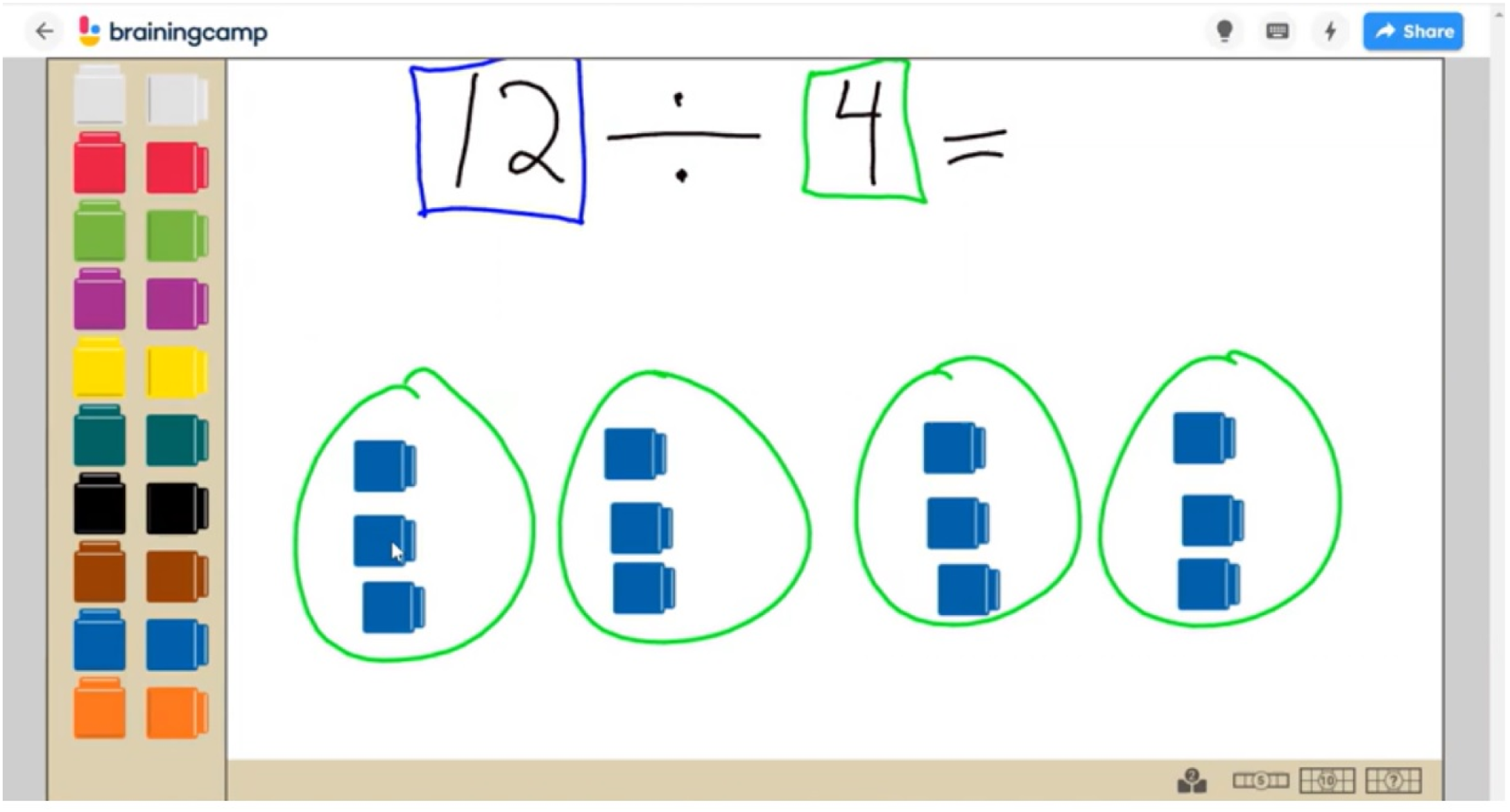
At the request of Eric’s mother, his VM clips also included an additional visual example to put the concept into a real-world context during the introduction portion of the VM (prior to the step-by-step modeling of problem solving). Eric enjoyed food, so the interventionists added food-based examples to provide more concrete context. For example, fraction subtraction was first illustrated via a representative drawing of taking away pieces of a pizza cut into eighths. Multiplication was introduced by showing representations of three boxes with four donuts each (i.e., three equal groups of four or 3 x 4). Division was introduced by a representative drawing of splitting up 12 cookies equally between four friends (i.e., 12 ÷ 4). Initially, Eric had two intervention sessions for the first skill (fraction subtraction) without a real-world visual example. Per his parent’s request, a real-world visual example was added to the beginning of the video and the intervention was re-started. The videos for his remaining skills (multiplication and division) included a real-world visual example from the first intervention session.
During intervention sessions, the co-interventionists played the VM clips via screen-sharing. The same VM clip was played for each intervention session on the particular skill and was offered to students during the generalization and maintenance phases. This use of VM during the synchronous session was intended as a way to provide the student a modeled example but using more consistent modeling and language and fewer distractions and deviations (via using the same clip) than live modeling could provide. A screenshot of the VM for Eric’s division skill is shown in Figure 1.
Virtual manipulatives
The authors used a total of two virtual manipulatives websites in the study, which gave access to different types of virtual manipulatives to use with the participants. The virtual manipulatives chosen (i.e., fraction circles, linking cubes, and base ten blocks) are those that are typically used for the students’ selected skills, whether in physical or virtual formats. The chosen websites offered these desired manipulatives, along with other useful built-in features, such as color-coded manipulatives, drawing tools, gridlines, and positional guidance (e.g., automatically linking cubes that are placed near each other).
The first website, Mathigon (https://mathigon.org/polypad/), is a free tool allowing users to place a variety of different math-related manipulatives on a virtual pad, including shapes, number tiles, and fraction circles. For this specific study, the authors used Mathigon to explain double-digit multiplication using base tens blocks to create area models. In the video model, the authors first adjusted the pad to show a grid pattern as the base, then created two perpendicular lines by dragging the “construction tool” from the menu at the bottom of the screen and connecting their corners to create an upside-down L shape. Then, each of the lines were labeled with the numbers from the problem using the “drawing tool,” with one number on the left side of the vertical line and the other above the horizontal line. Then, the number tiles, which are comprised of base ten blocks (i.e., one, ten, and one hundred), could be dragged accordingly to illustrate each number from the multiplication problem, and to create the resulting area model to solve the problem.
The second platform for virtual manipulatives the authors used was BrainingCamp (https://app.brainingcamp.com/), which is an online host to a plethora of different virtual manipulatives, including fraction circles, linking cubes, clocks, and geoboards. It does require a subscription to access the tools, so the authors purchased the classroom subscription, which allowed them to create individualized log-in information for each participant utilizing this specific website. For the study, the authors used fraction circles to teach fraction equivalency, fraction addition, and fraction subtraction, and the linking cubes to teach simple multiplication and division. Similar to Mathigon, the desired shapes and tools could be dragged to a blank page where the participant could use their computer mouse to rearrange the positions of the fraction tiles or linking cubes, stack them next to one another, or separate them. The drawing tool could be used to write numbers on the screen or create different groups when dividing a number. For example, if the participant was given the problem “6 ÷ 3 = ?”, they would begin by dragging six linking cubes onto the screen, then drawing three circles to indicate the three groups before dragging one cube into each group until all the cubes are in groups. Afterward, the student could count how many cubes are in each group to find the answer.
Guided practice via mathematics games
Another component of our independent variable was mathematics games as a form of guided practice. After choosing each participant’s target skills, the authors searched the internet for mathematics games that were engaging, age-appropriate, allowed the participant to practice problems for the target skills, and were appropriate for their skill levels. There were otherwise no specific required elements for selection of the games. The authors used games from the following two websites: (1) SplashLearn (https://www.splashlearn.com) and (2) Math Playground (https://www.mathplayground.com). When using SplashLearn, one of the co-interventionists created a teacher’s account using the email provided by her university, allowing her to create unique usernames and passwords for each participant. This allowed her to assign different games to each student depending on the targeted skill. As for Math Playground, a subscription fee was paid to allow access to all the games on the website, giving the co-interventionists more options to choose from. Games from either website were usually played for three to five rounds, giving each participant several practice opportunities. Furthermore, each game gave the participant immediate feedback on whether the answer was correct or not. When an error was made, some games gave participants another chance to respond while others immediately provided the participant with the correct answer. When necessary, the co-interventionists provided verbal or visual (via the Zoom screen-writing feature) prompts to support the participants if they made continuous errors or requested assistance.
Self-monitoring checklist
One of the co-interventionists created a visual self-monitoring checklist to match the instructional steps and visuals portrayed in the video modeling clips. She created the checklist in a Word document, listing the numbered instructional steps with an included screenshot of the step with virtual manipulatives from the video model. The co-interventionists sent the checklists to the participants and their parents during the intervention phase, upon viewing the video modeling clip for the first time, in a PDF format via the chat feature on Zoom. This allowed parents to immediately download and save a soft copy of the checklist, which could also be printed if desired. Figure 2 displays a copy of the self-monitoring checklist for Matthew’s simple fraction addition skill. Matthew’s self-monitoring checklist for simple fraction addition.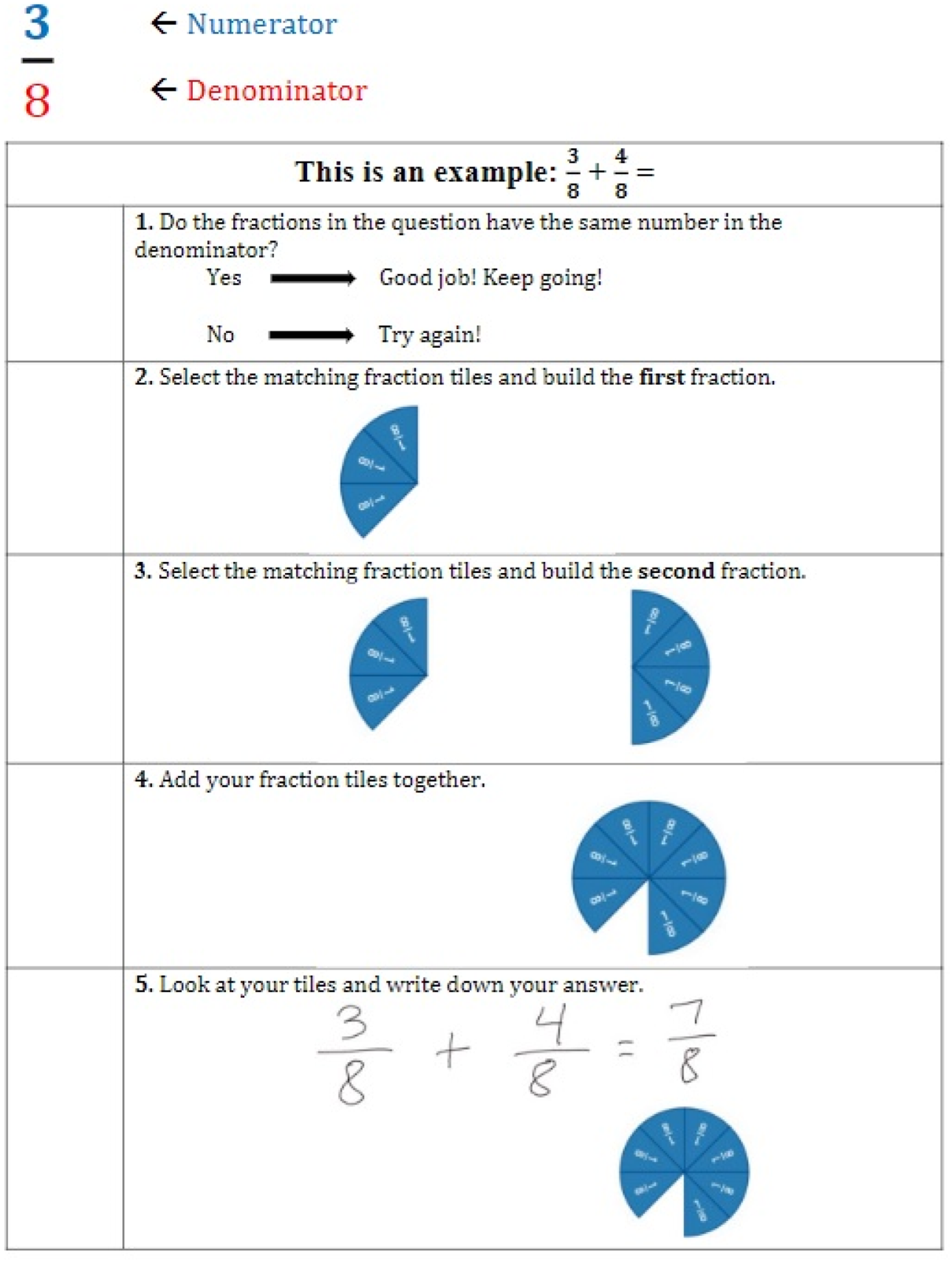
Least to most prompting
We used least to most prompting as error correction to guide the participants to the correct answer. If a participant made an error, the co-interventionists began with an indirect verbal prompt such as, “Hold on, something does not look quite right. Check your work. Remember, you can use your checklist to help you.” If the participant was unable to self-correct, they gave direct verbal prompts. The co-interventionists clearly stated what the participant needed to do, referring to the specific checklist step where the student had made an error. Finally, if the participant was still unable to correct the mistake, the co-interventionists instructed the participant to watch the screen and used a model prompt. One of the co-interventionists shared her screen and modeled how to solve the problem correctly, with a side-by-side view of the checklist to quickly refer back to it during each step.
Dependent Variable and Data Collection
The primary dependent variable was the independent accuracy (i.e., without error correction) of completing mathematical problems for each skill from a total of three problems. For each participant, a total of three mathematical skills were targeted in the study, based on parent recommendations and a consensus reached in the initial interview involving the parent and research team members. The authors also collected data on the frequency and type of prompts students needed during the intervention phase as the secondary dependent variables.
For all phases, the authors developed electronic worksheets using Google Forms, each containing three problems relating to the target skill. A unique link was automatically generated for each form, which was shared with the participant during the session via Zoom chat.
Eric completed math problems targeting (1) simple fraction subtraction, (2) simple multiplication with two single-digit numbers, and (3) simple division problems involving two digits within 20. Matthew completed math problems targeting (1) simple fraction addition, (2) fraction equivalence, and (3) multiplication of two-digit numbers using both single- and double-digit numbers. All problems involving fractions included denominators to represent halves, thirds, fourths, fifths, sixths, eighths, tenths, and twelfths. No other denominators were used, such as 11, since they were not available in the virtual manipulatives used.
Before initiating baseline sessions with each participant, the co-interventionists worked to create a list of problems that could be used throughout the study for each skill, with different sets used for each session of baseline, intervention, and generalization phases. The authors used event recording when collecting data to record the percentage of problems solved correctly per skill type during each session, as well as the number and type of prompts used, if any. If problems for a set were solved 100% independently correct, without error correction, for two consecutive sessions, then the mastery criterion was met.
Experimental Design
A multiple probe across skills single-case research design (SCRD) was used for each participant to determine the relation between virtual math manipulatives, games, and video modeling and each participant’s acquisition of the three target skills. This design has been deemed most appropriate for non-reversible behaviors, such as academic skills (Ledford & Gast, 2018), and it also allows for the intervention to be replicated across different math skills at different times (Kratochwill et al., 2013). Furthermore, per design guidelines, a minimum of three baseline and five intervention sessions were set for each participant.
Procedures
General procedures
Study sessions were held three times a week, according to each participant’s schedule and availability, with each session lasting up to approximately 45 minutes. As per the multiple-probe design, students often completed probes across multiple skills in the same session with breaks in between. Before the sessions, a unique Zoom link with a password was created for each participant using a secure, university-authorized Zoom account. This automatically placed non-university members in a waiting room until they were invited to join the session by either one of the co-interventionists. This information was shared directly with parents through a Google calendar invitation via email. Once the session commenced, co-interventionists began by greeting the parent and participant, ensuring audio and video were working, securing the participant’s attention, and asking how the participant was doing and if they were ready to start working on some math problems. Parents were reminded not to provide computational assistance to avoid inadvertently influencing research outcomes.
Parental role
Each parent played a somewhat active role throughout the study. During the introduction meeting, they provided valuable information about their child’s disability, needs, strengths, work style, and possible skills to target during the study. Before beginning the first baseline session, co-interventionists sent parents and instructional guide explicitly stating what they could and could not do during the study. For example, parents could help redirect their child’s attention but could not help their child solve computational problems. Co-interventionists also sent parents the Zoom link and Google calendar invitation for each session along with an electronic version of the checklist for each skill, which could be printed and used during intervention, generalization, and/or maintenance sessions by the child.
Baseline
The baseline phase involved at least three sessions for each skill and continued until data were stable. As the participant worked on a set of three problems per skill, no assistance was provided from either the parent or the co-interventionists. Each session began with a co-interventionist stating, “It’s okay if you do not know how to solve these problems, we just want you to try your best. If you are unsure of what to do, you can skip a problem and move on to the next one. Remember, we can’t help you, so just try your best.” Afterward, the participant (or parent) was asked to share their screen and a link to the Google form with three problems was sent via the chat feature in the Zoom meeting. To ensure security, Google forms were created using university-authorized Google accounts and shared only with those who required access to the form, including the research team and parents of participants. Once the participant completed a problem, verbal praise was provided, such as “Good job completing the first problem, let’s try the next one.” Once the participant completed problems for each skill, the co-interventionists ended the session by praising the participant for their effort and confirming the schedule of the next session with the parent.
Pre-intervention
Upon completing the baseline phase, a pre-intervention session was held to introduce the new virtual math manipulatives and help the participants familiarize themselves before beginning the intervention phases. Similar to baseline phases, the participant and parent were greeted at the beginning of the session, and afterward, one of the co-interventionists explained the purpose of the new virtual manipulatives and how they would be used to help the participant learn a new skill. The interventionist then shared her screen and demonstrated how to navigate the tool before sending a link via the Zoom chat and asking the participant to share their screen to help them while navigating the tool themselves.
Intervention
There were at least five sessions per skill for the intervention phases, which continued until the participant reached the mastery criterion of 100% accuracy across two consecutive sessions. During this phase, the participant and parent were first greeted before the participant was asked about their day. Afterward, the co-interventionists ensured the participant was ready to begin by gaining their attention and asking them directly. Next, one interventionist briefly explained to the participant what he was about to watch by stating, “We are going to watch a video about _______, so make sure you pay attention since it will be your turn to solve some math problems next,” before sharing her screen via Zoom and playing the video. If at any point there were technical issues or the participant did not appear to be paying attention, the interventionist paused the video, regained the participant’s attention, and prompted them to pay attention before resuming the video. Once the video concluded, the other co-interventionist sent a link to the appropriate mathematical game and instructed the participant (or the parent) to share their screen to be able to guide them to the correct game and monitor their progress. The co-interventionists provided the participant with specific verbal praise, such as “great job trying to solve those problems,” upon completion of the games and offered feedback if they were having any difficulties navigating or solving a problem. Once the participant completed at least three rounds of the game independently and while they were still sharing their screen, an interventionist sent a link to the virtual manipulatives presented in the video along with a link to the Google form. The Google form contained three questions written in the form of short answers so that the student could either type or have their parent help type the answer after solving independently. The co-interventionists gave the following directions, “We want you to try to solve these problems on your own. Try your best—you can use the manipulatives or your checklist to help. Once you’re finished, you can type your answer in the form or have Mom type it for you.” The participant then independently solved the problems while sharing their screen for the co-interventionists to observe. If the student answered the question correctly, they were given verbal praise such as, “Good job solving that problem!” On the other hand, if a question was incorrectly answered, error correction procedures using least-to-most prompting (as discussed above) were implemented by one or both of the co-interventionists. The co-interventionists started first with an indirect verbal prompt to check his work, and then continued with increasing prompts, as needed, starting at the problem-solving step where the student made an error. Given that both students shared their screen as they worked, the co-interventionists could typically pin-point where they made an error in the problem-solving process (e.g., dividing the virtual cubes into equal groups, choosing the correct number of fraction tiles, drawing the correct number of groups). Once they provided error correction on the step, the student was instructed to continue with the rest of the steps, with continuing error correction, as needed.
Generalization
Generalization data were collected for both participants. Eric was presented with problems in a real-world context via word problems to extend the three skills he worked on during the intervention phases. Matthew was presented with mixed fraction addition problems with like denominators to generalize simple fraction addition, word problems to generalize multiplication, and was asked to write two fractions equivalent to the one presented to generalize fraction equivalence. Similar to baseline and intervention phases, all questions were presented in a Google Form, which was sent to the participants using the chat feature on Zoom. During generalization, students had access to the video model (sent via chat), virtual manipulatives, and checklist, but were not required to watch the video model. Error correction was not used during generalization.
Maintenance
The maintenance phase occurred immediately upon the completion of the generalization phase but 1 week after the intervention phase ended, both of which lasted two sessions. Procedures in maintenance phase were the same as those in the generalization phase with only one exception – students worked on the three skills targeted during baseline and intervention. Due to participants’ personal schedules, Matthew participated in the maintenance phase only for two of the three skills (adding fractions and fraction equivalence).
Interobserver Agreement and Procedural Reliability
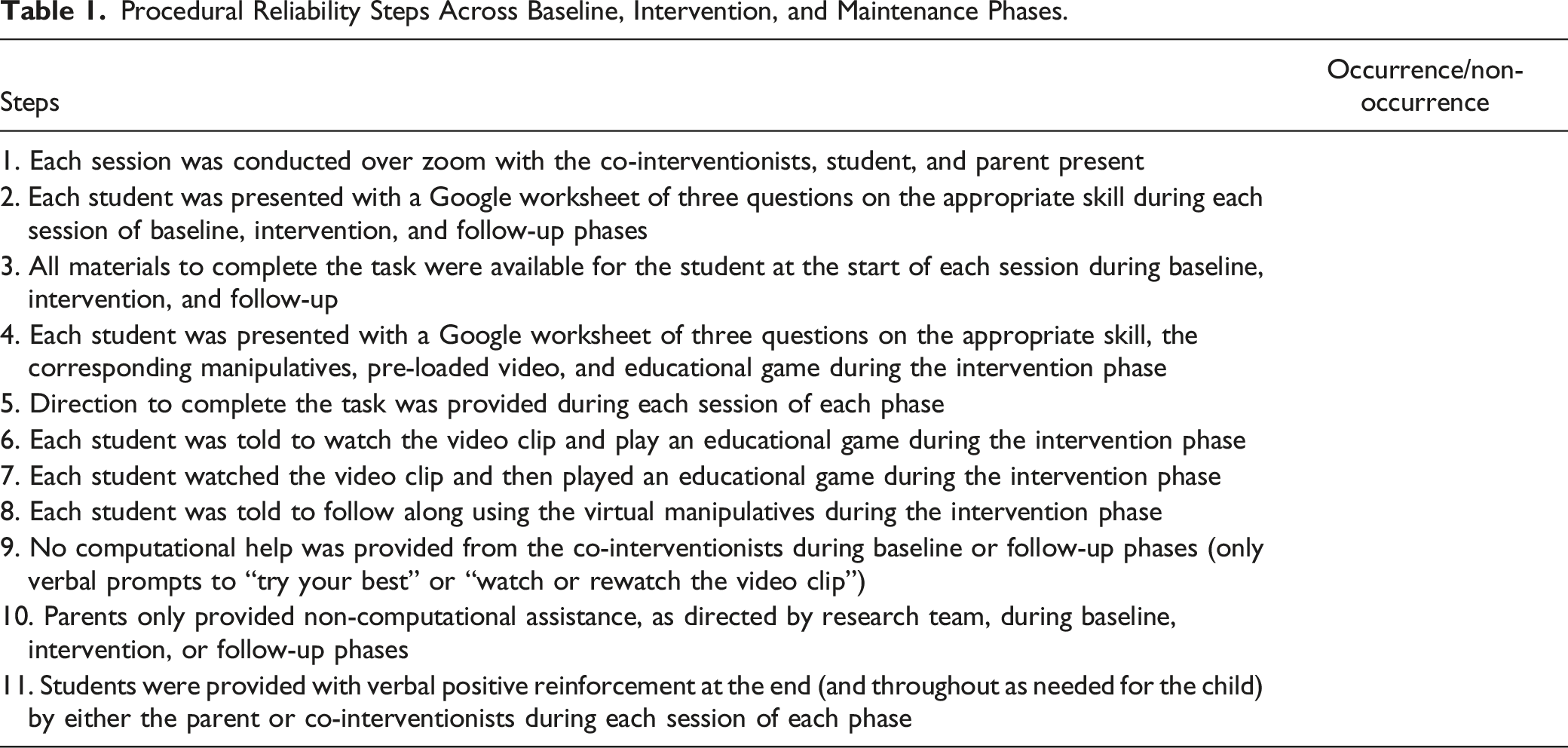
Procedural Reliability Steps Across Baseline, Intervention, and Maintenance Phases.
Social Validity
Upon completion of all phases of the study, the co-interventionists provided both the parent and child with a social validity questionnaire with the option to complete it with the co-interventionists via Zoom or send it to them at a later time via email. The parent social validity questionnaire included nine Likert scale questions, ranging from Strongly Disagree to Strongly Agree. The prompts included the following: (1) The intervention (using videos, games, and virtual manipulatives) was acceptable for my child’s math needs, (2) The intervention was effective in supporting my child’s math needs, (3) I would suggest the use of this intervention to other parents, (4) I would be willing to continue using this type of intervention, (5) This intervention did not result in negative side effects for my child, (6) This intervention was a good way to support/teach my child math skills, (7) This intervention was reasonable for the needs of my child, (8) I liked the procedures used in this intervention, and (9) Overall, this intervention was beneficial for my child.The parent questionnaire also included four open-ended questions: (1) What did you like about your child’s use of this intervention? (2) What did you not like? (3) Is there anything about using any component of this intervention you would change? And (4) Is there anything else you’d like to share about your experience having your child use this intervention to learn math concepts? The participants were given five yes/no and open-ended questions to answer verbally: (1) Did you like the things (videos, games, virtual manipulatives) you did in the study? (2) What did you like/not like? (3) Was it easy to learn using the materials we gave you? (3a) Was it easy to learn via videos? (3b) Was it easy to learn via games? (3c) Was it easy to learn via manipulatives? (4) Would you like to continue using these strategies in the future? And (5) Is there anything else you would like to tell us about the things you did in the study?
Data Analyses
Visual analysis was the main method of data analysis, which is a standard practice in SCRD when determining the presence or absence of a functional relation between the independent and dependent variables. The authors used the systematic process for conducting visual analysis outlined by Ledford and Gast (2018) and began by reviewing graphs for appropriate scaling, examining the research questions for predicted patterns of change, reviewing the number of data points per condition, and analyzing level, trend, and stability/variability within each condition along with consistency, the overlap of data, and immediacy of change across conditions. To calculate trends, the authors used the split-middle technique to describe the trend line as zero-celerating, accelerating, or decelerating. When analyzing stability, the authors used the 80–25 rule, where if 80% of the data was within 25% of the median in each phase, the data was considered stable.
To supplement visual analysis, the authors calculated Tau-U effect sizes (Parker et al., 2011) using the web-based calculator (http://singlecaseresearch.org/calculators/tau-u; Vannest et al., 2016). First, we calculated the Tau-U score for each skill of each participant and then calculated the weighted score across three skills per participant for baseline and intervention phases. The following Tau-U interpretations were used (Parker et al., 2011): weak (0–0.65), medium to high (0.66–0.92) and strong effect (0.93–1.0).
Results
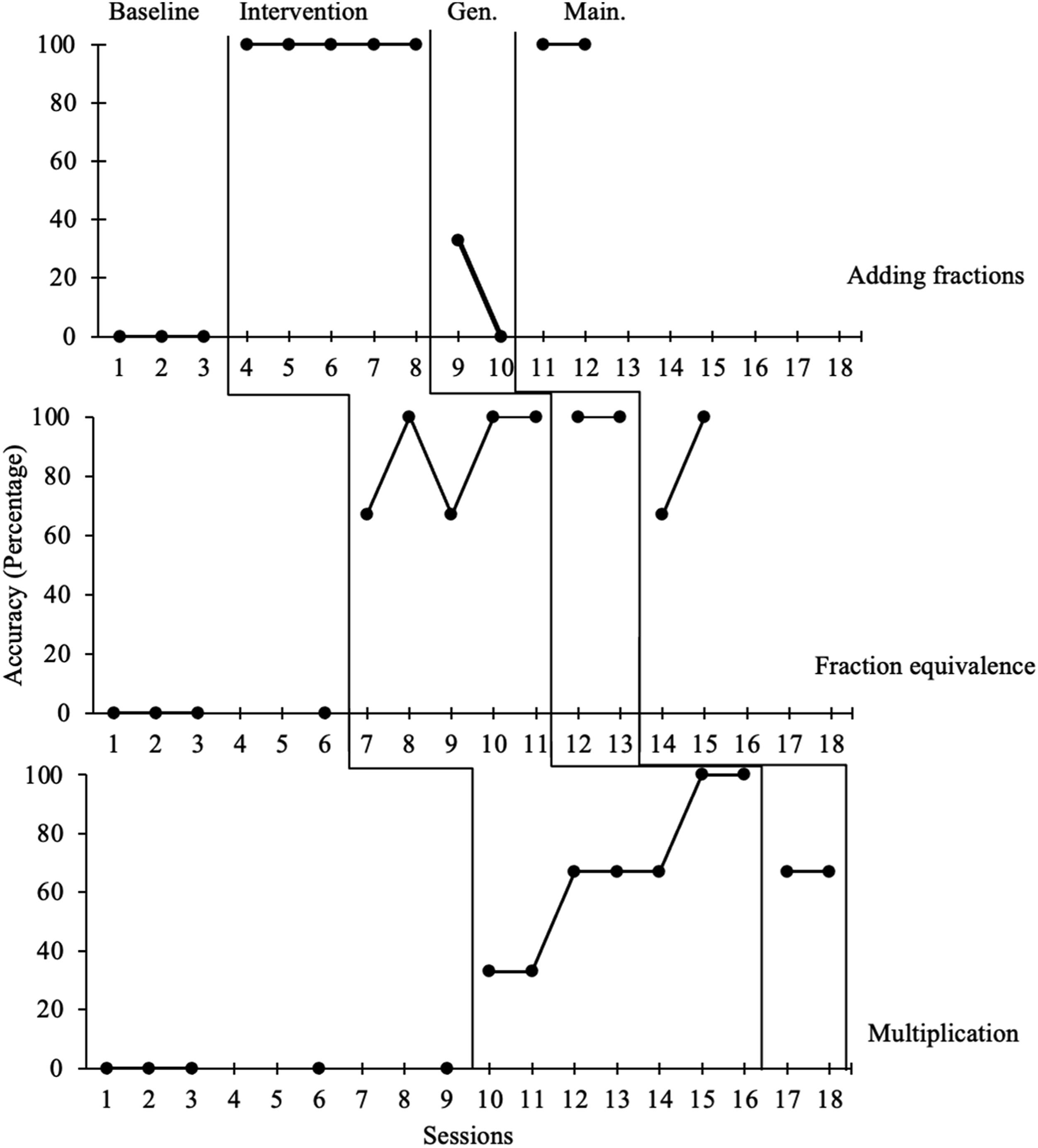
Figures 3 and 4 represent percentage of independent correct responses across three skills for Eric and Matthew, respectively. Both figures were scaled to meet the SCRD graphing guidelines to reduce the likelihood of type I error in visual analysis (Peltier et al., 2022) and have the DDPXYR ratio of 0.14. Analysis of findings indicates that there is a causal relation between the online intervention and each student’s acquisition of skills. Students also showed evidence of skill generalization and maintenance. The weighted average Tau-U resulted in strong effect size scores (0.91 and 1.00) for Eric and Matthew, respectively. Eric’s Percentage of Independent and Accurate Responses in Each Session across Skills Note. Session 9, indicated by a dashed line, is an incomplete session where the student only got through one problem within the allotted time. Matthews’s Percentage of Independent and Accurate Responses in Each Session across Skills Note. Gen.- generalization; Main. - maintenance.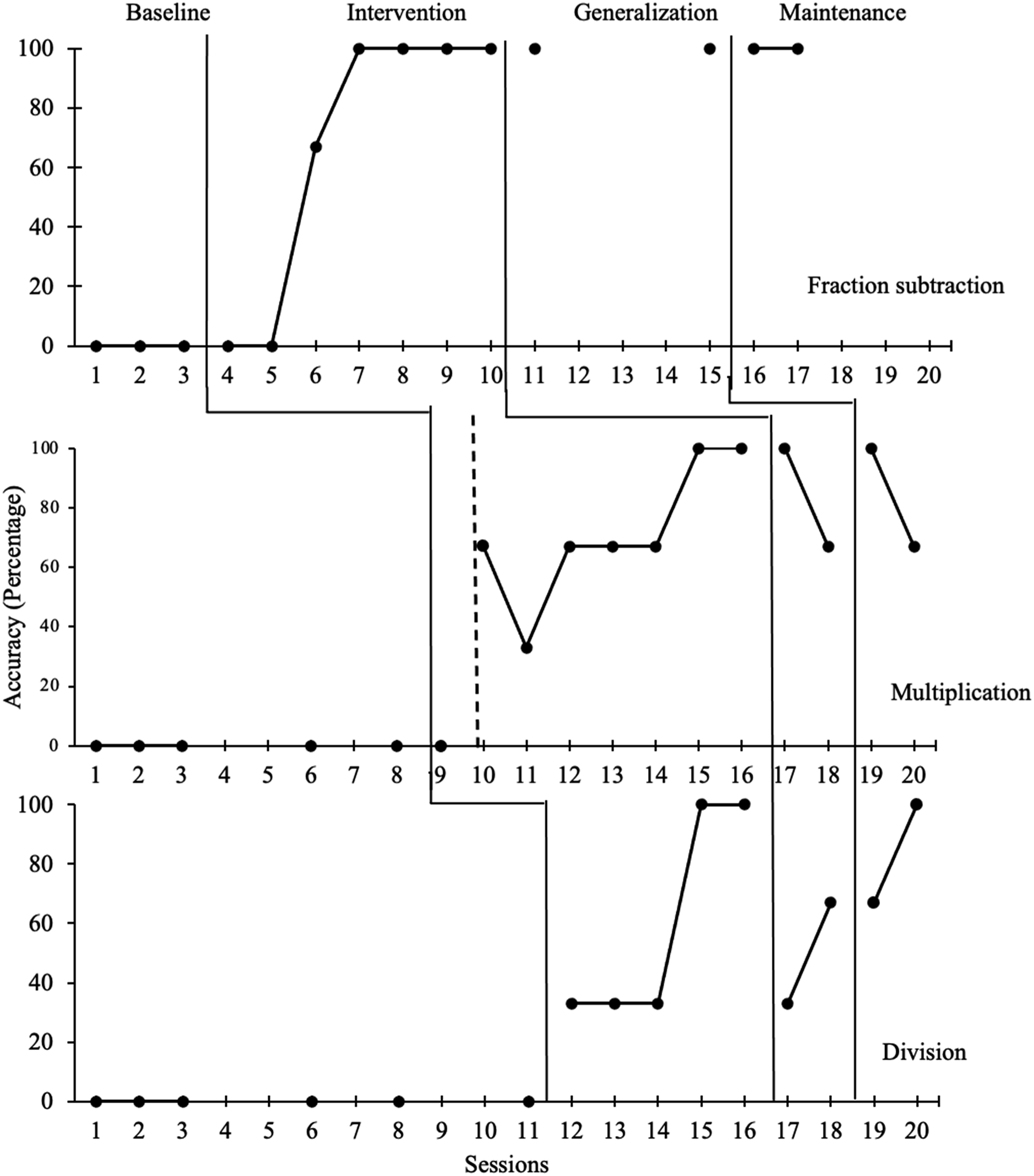
Eric
Fraction subtraction
For the first skill of fraction subtraction, Eric had a mean baseline performance of 0% with a zero-celerating and stable trend. Using the 80–25 rule to analyze stability, the baseline data was 100% stable. During intervention, there was a gradual increase in his responses and an increasing trend of performance. Eric subtracted fractions with an average of 78% accuracy with 57% of data were within the stable range. There were two data point (28.5% overlap) overlapping between baseline and intervention. Both generalization and maintenance phases continued at a ceiling level with 100% accuracy and a stable trend. The baseline-intervention Tau–U score (Tau-U = 0.86, p = 0.0233, 90% confidence interval [CI] = [0.235, 1]) indicated a medium-to-high effect of the intervention on fraction subtraction.
Multiplication
Similarly, when presented with the second skill of multiplication, Eric had a mean baseline performance of 0% with a zero-celerating trend and stable data (100%). Once intervention started, Eric solved multiplication equations with 71.5% accuracy, on average. His response during intervention gradually improved and displayed an increasing trend with variable performance (57% of data falling in the stable range). There was only one data point overlapping between baseline and intervention (13% overlap). Both generalization and maintenance phases began with 100% accuracy in the first session and declined to 67% accuracy, with an average of 84% accuracy. The baseline-intervention Tau–U score (Tau-U = 0.87, p = 0.0104, 90% CI = [0.313, 1]) indicated a medium-to-high effect of the intervention on the multiplication skill.
Division
With his final skill of division, Eric also demonstrated a mean baseline performance of 0% with zero-celerating trend and 100% stable responding. During intervention, he solved division equations with 60% on average. His data showed an increasing trend with variable performance (60% of the falling in the stable range). There was no overlapping data between baseline and intervention. During the generalization phase, Eric’s accuracy immediately decreased to 33% before increasing to 67%. Similarly, maintenance began at 67% before increasing to 100% accuracy. The baseline-intervention Tau–U score (Tau-U = 1.00, p = 0.0062, 90% CI = [0.399, 1]) indicated a strong effect of the intervention on the division skill.
Matthew
Fraction addition
When adding fractions, Matthew’s mean baseline performance was 0% with zero-celerating trend and stable responding (100%). Upon introduction of the intervention, there was an immediate improvement (100% accuracy) with stable responding and ceiling level trend, with no overlapping data points between baseline and intervention. Matthew’s accuracy during generalization decreased to an average of 17% across two sessions. However, Matthew maintained the skill with 100% accuracy. The baseline-intervention Tau–U score (Tau-U = 1.0, p = 0.0253, 90% CI = [0.264, 1]) indicated a strong effect of the intervention.
Fraction equivalence
For equivalent fractions, Matthew’s mean baseline performance was 0%, with a zero-celerating and stable trend. Upon introduction of intervention, the data showed an immediate increasing trend, with 87% level change from baseline to intervention and no overlapping data points. Matthew’s intervention data trend was variable-to-stable with 40% of the intervention data falling within the stable range. Matthew’s response generalization showed 100% accuracy. When examining maintenance of skills, an average of 84% response accuracy was noted. The baseline-intervention Tau–U score (Tau-U = 1.0, p = 0.0143, 90% CI = [0.328, 1]) indicated a strong effect of the intervention.
Multiplication
When solving multiplication problems, Matthew’s mean baseline performance was 0% with zero-celerating trend and stable data (100%). During the intervention phase, Matthew showed gradually improved with response accuracy averaging 67% with an increasing trend. There were no overlapping data points with baseline. During intervention, 43% of data fell in the stable range. During generalization, Matthew solved problems with an average of 67% accuracy. The baseline-intervention Tau–U score (Tau-U = 1.0, p = 0.0045, 90% CI = [0.421, 1]) indicated a strong effect of the intervention.
Interobserver Agreement and Procedural Reliability
Results showed 100% IOA per skill per phase for both Eric and Matthew. Procedural reliability data for Eric’s sessions for each skill was as follows: Baseline = 86% (subtracting fractions) and 100% (multiplication and division), Intervention = 90% per skill, Generalization = 86% per skill, and Maintenance = 86% per skill. The lower rates of procedural reliability during sessions with Eric were due to the parent providing error correction prompts. Procedural reliability for Matthew was 100% across all phases and skills.
Social Validity
Overall, both Eric and Matthew and their parents rated the intervention as highly socially valid. Eric’s and Matthew’s parents both rated eight of the nine parent social validity questions as “strongly agree,” and one question as “agree” (i.e., Question two for Eric, Question six for Matthew). Eric’s mother noted in the free response section that she appreciated the repetition, which she felt helped with Eric’s attention. She also reported that she found the games “engaging and motivating” and the manipulatives and visuals “useful.” She also noted that she wished that the VM clips “could have been changed or evolved a little based on his progress.” Similarly, Matthew’s mother suggested using multiple VM clips or different examples in the VM over the course of the intervention, as she felt that rewatching the VM each intervention session was repetitive, resulting in Matthew losing his attention and becoming fidgety. However, Matthew’s mother also noted that she liked the “methodical approach to teaching” including the use of correct terminology, videos, games, and error correction. Eric indicated that he liked the things he did in the study, that it was easy to learn using the materials, and that he would like to continue using these in the future. Matthew echoed his mother’s comments, noting that he liked the games and virtual manipulatives, but did not like watching the same VM clip repeatedly over multiple intervention sessions. He reported that he felt the materials made it easy to learn and that he would be interested in using these in the future.
Discussion
The aim of this study was to examine the effects of online instruction using a combination of synchronous video modeling, virtual manipulatives, and mathematical games with supplemental supports of self-monitoring checklists, a least to most prompting technique, and parental support when teaching mathematics skills to autistic children in elementary grades. There was a functional relation between the multi-component intervention and students’ acquisition of mathematical skills. The findings add to scarce research on online instructional practices in teaching mathematics to autistic students.
Studies on instructional techniques in providing mathematics instruction to autistic students using VBI, virtual manipulatives, and games have been focused mostly on in-person instruction (e.g., Hughes & Yakubova, 2019; Satsangi & Bofferding, 2017; Yakubova et al., 2020). Research on online instructional practices for teaching autistic students and students with other disabilities started to emerge in the last couple of years due to the onset of pandemic (Bouck et al., 2022a, 2022b; Yakubova et al., 2022). Though in-person instruction has since resumed in schools, the public health crisis demonstrated the need to examine and identify evidence-based practices in online instruction in order to be ready to accommodate students in the future, not only in case of public health emergencies, but also in case of student illnesses, e.g., seasonal flu, allergies, etc., that may prevent them from physically attending an in-person class or for students who are homeschooled. Identifying effective instructional practices in online teaching could ensure uninterrupted learning for autistic students and provide additional instructional methods for autistic students who are homeschooled. The positive effects of the intervention on the acquisition of mathematics skills for two autistic elementary students add novel findings the literature.
Furthermore, this study adds novel findings to using both video modeling and virtual manipulative-based instruction in an online synchronous learning environment. Prior research focused mainly on using video modeling (e.g., Hughes & Yakubova, 2019) or using manipulative-based instruction in an instructional sequencing format, gradually transitioning from the concrete or virtual phase to representational to abstract phase (CRA or VRA; Bouck et al., 2022b; Yakubova et al., 2016) or variations of sequencing (e.g., VR, VA; Bouck, et al., 2020) in in-person instructional settings. Following the viewing of the VM, demonstrating how to solve problems using virtual manipulatives, both students successfully navigated through the virtual manipulatives independently. Both students were able to quickly fade the use of manipulatives for their first skills (i.e., adding and subtracting fractions), but benefited from continued use of the manipulatives for the other skills. Eric used the manipulatives for multiplication and division for some problems but was able to correctly complete others without the use of the manipulatives. Given that he was minimally vocal, it was beneficial for the interventionists to “see” his thought process while using the manipulatives and offer specific feedback on which of the problem-solving steps he made an error, when applicable. Matthew continued to use the area model manipulatives to complete multiplication problems across the intervention sessions. After a few sessions of fraction equivalence, he typically completed the problems using abstract notation (to find the answer faster, without guessing), but then checked his answers using the fraction tiles. Both participants seem to like using the manipulatives and were able to use them to accurately solve and visualize problems.
The findings also add to the literature regarding the use of mathematical games to reinforce students’ knowledge of the topic. Following the VM instruction demonstrating how to solve problems using virtual manipulatives, students practiced how to solve problems by playing mathematical games. This helped to reinforce learning from VM instruction and provided an opportunity to check for understanding with immediate feedback (right and wrong answers displayed on the game and feedback from the co-interventionists to explain wrong answers). Both students seemed to benefit from the guided practice, but this typically varied by how closely the digital game’s visualizations and representations of problems matched those in the video model and intervention probes. For example, Eric’s game for division required him to divide objects into equal groups, which closely mirrored the VM’s use of dividing linking cubes into equal groups. In contrast, Matthew’s game for multiplication used area models, but not via base tens blocks like his VM instruction, so the connection between the examples for this skill was not as strong. However, the games seemed to offer a more engaging and interactive component to guided practice than traditional guided practice (i.e., using practice problems that mirrored the VM and intervention probes). Thus, the study contributes to previous research on positive effects of using digital mathematical games to enhance knowledge of mathematics topics among autistic students and students with other disabilities (e.g., Long & Bouck, 2022; Moyer-Packenham et al., 2019).
Limitations and Directions for Future Research
This study examined the effects of the intervention on mathematics skills acquisition for two autistic children who self-identified as Asian American and White, respectively. It may be of interest to future research to examine the effects of the intervention when teaching students with different racial and ethnic backgrounds. While the authors examined the intervention effects using a multiple probe baseline design across three skills with two students, further replications with larger sample size and a wider range of basic and advanced mathematic skills are necessary. Another limitation to consider when interpreting findings is that based on the parent’s request, we modified the video modeling clip for the skill of adding fractions after two sessions of intervention. While the only modification was adding a real-life comparison to a pizza as the introduction to the video instruction, two sessions of exposure to the original video instruction could have contributed to student learning. Examining parental involvement and role in an online intervention is another area of future research. We did not experimentally evaluate parents’ involvement as parents provided only non-computational help in this study. Both children lived in two-parent households and were homeschooled. The participating parents had graduate degrees. Examining the effects of instructional strategies with children from various family backgrounds can contribute to research on instructional strategies for autistic children with diverse family dynamics.
Practical Implications
From a practical perspective, the preliminary findings in this study support the use of an online multi-component intervention including video modeling instructional clips, virtual manipulatives, guided practice via mathematics games, and supplemental supports via self-monitoring checklists and least-to-most prompting to help autistic children improve their mathematical knowledge skills. The intervention was implemented in a completely virtual setting, however, it has the potential to also be used in a classroom or home setting by educators or families, as long as there is reliable access to the internet with technological devices, such as computers, laptops, or tablets. The self-monitoring checklists are customizable to every child’s individual needs and least-to-most prompting is a less intrusive way of guiding the child to the correct answer, while encouraging opportunities for independent answers. The increased independence and knowledge children in elementary grades can gain in mathematical skills could have a positive impact on their overall academic performance.
Footnotes
Declaration of Conflicting Interests
The author(s) declared no potential conflicts of interest with respect to the research, authorship, and/or publication of this article.
Funding
The author(s) received no financial support for the research, authorship, and/or publication of this article.
