




Abstract
Gifted children may underachieve in various subjects, putting them at risk of dropping out of school. Several factors can influence both achievement and underachievement. In the understanding of these children’s success or difficulties at school, teacher–student and parent–child relationships should be considered. The objective of this article is to document the level of performance and underachievement of 71 gifted children ages 6 to 12 and to assess the contribution of both type of relationships. Results indicate that gifted children demonstrate overall good academic results, yet an appreciable proportion exhibit underachievement. Autonomy in school tasks is a significant factor enhancing children performance. Therefore, educators are encouraged to facilitate their autonomy within the classroom and during learning activities. Although the parent–child relationship is not linked to performance or underachievement, it is nevertheless important to pursue the study of this variable, given its influence on learning and academic success.
People commonly expect gifted students to excel academically, identifying them based on intellectual abilities that surpass those of their peers (Gauvrit, 2021). Although this expectation is often accurate, it is not always the case (Gauvrit, 2021; Hately & Townend, 2020). Despite mastering a significant portion of classroom content before instruction—sometimes up to 50% of the material presented (Neihart & Yeo, 2018)—many gifted students struggle to achieve academic success commensurate with their potential (Reis & McCoach, 2000; Siegle & McCoach, 2021). This disparity between gifted students’ cognitive abilities and their academic performance, known as underachievement, raises short- and long-term concerns (Renzulli & Park, 2002; Siegle & McCoach, 2018). These challenges underscore the importance of addressing both achievement and underachievement among gifted students to ensure that their educational needs are effectively met (Rimm et al., 1993). However, empirical studies assessing these factors remain limited (White et al., 2018). Prior research has examined individual factors, such as self-esteem and self-regulation (White et al., 2018), but has often omitted important environmental influences, including the quality of the students’ relationships with the adults in their lives. This has been frequently overlooked in understanding underachievement, despite being widely examined in studies of typically developing students and those with academic adjustment difficulties (Magro et al., 2023; Martins et al., 2022). It is therefore possible that gifted students’ underachievement may be associated with the quality of their relationships with teachers and caregivers. This article seeks to document the academic achievement and underachievement of gifted youth using Siegle and McCoach’s (2005) model of underachievement while examining the quality of their parent–child and teacher–student relationships. By documenting both ongoing performance and underachievement, the study aims to determine whether specific variables related to these relationships better predict one or the other, with the ultimate goal of identifying strategies to improve school outcomes and reduce underachievement among gifted students.
Giftedness
In the absence of a universal definition of giftedness, this study adopts the thresholds outlined in Gagné’s (2015) Differentiated Model of Giftedness and Talent (DMGT), which is widely used in Australia, North America, and Quebec—the Canadian French-speaking province where the present study was conducted. According to this model, an individual is recognized as gifted if their natural abilities place them in the top 10% of peers. In educational contexts, intellectual ability is typically the primary identification criterion; in many places, this is often defined as a total score of 120 or higher on a standardized intelligence measure, such as the Wechsler Intelligence Scale for Children (WISC-V, Weschler, 2014), where 100 represents the mean score (Gagné, 2020), although this score varies depending on the educational system. Giftedness can also occur with a neurodevelopmental disorder, such as attention-deficit/hyperactivity disorder (ADHD), specific learning disorders, or autism spectrum disorder (ASD). This co-occurrence, known as twice-exceptionality (Trail, 2022), may lead to unique challenges that can negatively affect academic performance (Hately & Townend, 2020).
Academic Achievement and Underachievement
The tendency for gifted students to demonstrate higher academic performance due to high cognitive abilities such as advanced problem-solving skills, rapid learning, and strong memory has been well documented in the literature (Bergold et al., 2020; Best et al., 2011; Roth et al., 2015). Age and gender are also important variables to consider when examining giftedness and academic performance, as both have consistently been shown to relate to academic performance (Freeman & Garces-Bacsal, 2021; Price, 2017; Siegle et al., 2017).
Although some gifted students exceed the class average, others fall below it. Underachieving students are typically those who face challenges in meeting class norms. Although there is no single definition of underachievement in gifted education, researchers commonly describe it as the gap between a student’s intellectual potential and their current academic performance (Siegle et al., 2021; Snyder et al., 2019). From this perspective, underachievement occurs when students of similar age, intelligence quotient (IQ), and family background demonstrate differing levels of academic performance (Reis & McCoach, 2000). Teachers often use classroom assessments to measure these criteria.
According to Reis and McCoach (2000), a gifted student is considered underachieving if they meet certain established conditions. First, the student should score significantly above average on standardized IQ assessments (i.e., at or above 120 on standardized scales) while performing at or below the class average on classroom assessments. This classification may also include students who score in the middle third of school achievement scores (Reis & McCoach, 2000). Significant underachievement occurs when a student scores in the bottom third of academic achievement. The underperforming subject should be a core area of the curriculum, such as reading, writing, or mathematics (Green et al., 1988). In addition, there must be a consistent gap between the student’s ability and classroom performance for at least 3 months. For instance, a student who scores 81% on a mathematics midterm—slightly below the class average of 83%—would not be classified as underachieving if this discrepancy is isolated. Although some scholars suggest that underachievement should not be identified in twice-exceptional students (e.g., Siegle & McCoach, 2021), others view twice-exceptionality as a key factor in understanding patters of achievement and underachievement (e.g., White et al., 2018).
The reported prevalence of underachievement among gifted students varies across studies and countries. For example, Veas et al. (2018) found that 28% of gifted students in Spain experience underachievement, compared with 12% in China and 10% in the United States. Reis (2000) recommended evaluating students’ entire academic trajectories rather than focusing on a single point in time to obtain a more accurate representation of the issue. She emphasized that many at-risk students remain unidentified, estimating that underachievement may affect up to 50% of gifted individuals (Reis, 2020). In Canada, few studies have examined this topic. Cornejo-Araya et al. (2021) identified only five Canadian articles on underachievement of the 203 studies reviewed, making it difficult to accurately depict the phenomenon in Quebec.
To better understand the phenomenon of underachievement, particularly within gifted education where a persistent bias exists toward viewing gifted students as consistently high achievers, researchers have developed models that encompass multiple factors contributing to this challenge among specific groups of gifted learners. Understanding these variables is critical for a comprehensive analysis of underachievement.
Achievement-Orientation Model
Siegle and McCoach (2005) introduced an explanatory model to improve understanding of underachievement among gifted students. The Achievement-Orientation Model has been validated with gifted students across primary, secondary, and university levels (Ritchotte et al., 2014; Siegle et al., 2021). The model suggests that various variables such as task value, self-efficacy, social relationships, and school environment influence individual achievement and performance levels. These variables and their complex interactions have a substantial impact on academic outcomes; however, other important factors related to students’ optimal development, such as teacher–student and parent–child relationships, remain understudied.
Teacher–Student Relationships
The quality of teacher–student relationships is important for students’ overall functioning, largely due to the significant amount of time they spend with teachers each week. Teachers can positively influence students’ attitudes, behaviors, and academic habits through their relations (Camp, 2011; Haider & Asif, 2024). A positive teacher–student relationship, characterized by warmth, closeness, and minimal conflict, empowers students to regulate their emotions effectively, inspires their pursuit of knowledge, and increases their levels of engagement and academic achievement (Croft, 2003; Johnston et al., 2022; Ma et al., 2022; Martins et al., 2022; Pianta & Stuhlman, 2004; Roorda et al., 2017; Sabol & Pianta, 2012; Vancraeyveldt et al., 2015). Conversely, interactions characterized by conflicts may lead students to view others as unavailable, untrustworthy, or even hostile (e.g., Verschueren & Koomen, 2012).
The impact of teacher–student relationships on students with developmental and learning disabilities is well documented (McGrath & Van Bergen, 2015; Sabol & Pianta, 2012); however, research on this topic remains limited for gifted students (Dever, 2016; Weyns et al., 2021). Prior studies have primarily used qualitative data (Desmet et al., 2019; Manabayeva & Hermandez-Torrano, 2023), which provides valuable insights and deepens understanding of the phenomenon, encouraging further exploration in this area. Although limited, existing studies involving gifted youth suggest the presence of relationship challenges. For example, Weyns et al. (2021) found that teachers often hold more pessimistic views of gifted students, leading to more fraught relationships. Teachers perceived gifted students as more emotionally demanding, introverted, less cooperative, and less capable of emotional regulation (Weyns et al., 2021). In addition, teachers may find gifted students challenging because they tend to ask frequent questions and occasionally challenge authority (Kaya, 2015). As a result, the teacher’s self-efficacy may decrease, which can negatively affect their interactions with gifted learners (Zee & Koomen, 2016). When conflict and controlling dynamics are present in teacher–student relationships, the likelihood of behavioral problems, disengagement, academic struggles, and underachievement among gifted youth increases (Ladd & Burgess, 2001; Pianta et al., 1995).
Recently, Magro et al. (2023) examined the relationship between teacher–student interactions measured in elementary school and parent–child relationships measured in early childhood in relation to later academic achievement among typically developing adolescents. Both types of relationships were associated with academic achievement in adolescence, underscoring the importance of considering these relational contexts as potential influences on gifted students’ academic performance.
Parent–Child Relationships
The daily and reciprocal interactions between parent and children characterize the quality of the parent–child relationship (Madigan et al., 2024). From the parental perspective, quality interactions are reflected in prompt, sensitive, and consistent responses to a child’s needs (van IJzendoorn & Bakermans-Kranenburg, 2019). These responses should be predictable, reliable, and conveyed with warmth (Chen et al., 2017). From the child’s perspective, attachment refers to the sense of security and trust developed with a caregiver who provides consistent support and appropriate responses to daily needs. This sense of security enables children to explore their environment with confidence and develop autonomy and competence. The quality of this bond remains essential across infancy, childhood, and adolescence (Markiewicz et al., 2006). A child’s sense of security and autonomy with respect to their parents represents a key determinant of relationship quality throughout development. This relationship is closely linked to multiple domains of a child’s emotional, social, behavioral, and cognitive development (Malekpour, 2007; Moss et al., 2011; Ronksley-Pavia et al., 2019; Tus, 2021). More specifically, high-quality parent–child relationships are associated with positive cognitive development as well as positive academic outcomes (Carmona-Halty et al., 2022; Clingenpeel & Pianta, 2007; Martins et al., 2022; Stams et al., 2002; Vorria et al., 2006). In a recent study conducted with 2,590 children, Kim and Kim (2021) found that positive parenting interactions and attitudes significantly improved children’s school performance.
When parents respond insensitively to a child’s needs—demonstrating intrusive, threatening, rejecting, or hostile behaviors or showing neglect—they inhibit the child’s ability to develop a sense of security and trust in others (Koehn & Kerns, 2018). As a result, the child may develop an insecure attachment style, which is associated with difficulties such as low self-confidence, reduced trust in others, challenges in emotional regulation (Fearon et al., 2010; Fuentes-Balderrama et al., 2023; Malekpour, 2007), and school-related problems (Holt, 2014; Moss & St-Laurent, 2001). Although such difficulties have been documented among gifted youth (Yildirim & Dong, 2022), they have rarely been examined through a developmental lens.
Although these two relational concepts (teacher–student and parent–child relationships) are clearly identified and integrated into Siegle and McCoach’s (2005) model for understanding giftedness, they are rarely examined in empirical studies (Jung & Jihyun, 2024; Weyns et al., 2021) and even less so from the perspective of understanding the phenomenon of underachievement. When these relationships are studied, the often-qualitative, interview-based designs with gifted youth may limit the ability to draw clear conclusions about the phenomenon (Wellisch et al., 2011). Furthermore, giftedness is frequently underidentified in such studies, as teachers are often asked to nominate students they perceive as potentially gifted (Wellisch & Brown, 2012). With little or no training in giftedness and difficulty conceptualizing the underachievement of gifted young people, it is reasonable to assume that the children identified in these studies are not necessarily representative of all gifted children.
The first purpose of this study is to document achievement and underachievement using a sample of gifted children identified using a standardized measure. The second goal is to examine the contribution of parent–child and teacher–student relationships to the academic performance of gifted students. The third goal is to examine the influence of these same relational variables on underachievement. By analyzing both continuous measures of school performance and categorical measures of underachievement, the study seeks to determine whether the effects of parent–child and teacher–student relationships differ depending on whether the focus is overall achievement or underachievement. The potential influence of additional variables including age, gender, and twice-exceptionality is also considered.
Method
Sample and Procedure
Descriptive Statistics for Sociodemographic Characteristics of Children, Parents, and Teachers
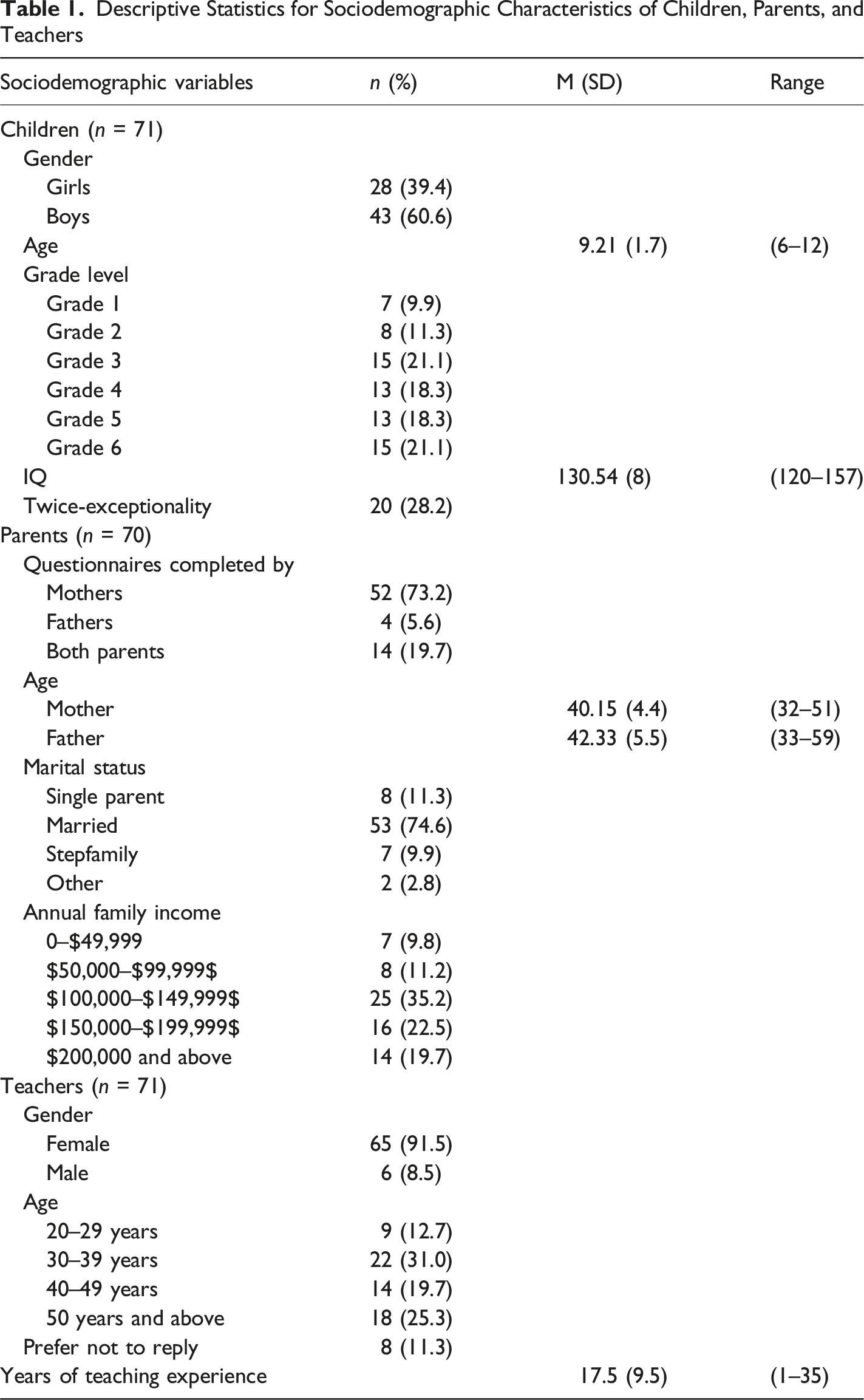
Recruitment occurred through local school boards after the project was presented to school principals. Additional participants were recruited through social media and nonprofit organizations that support gifted education. Parents provided teachers’ contact information, allowing the research team to invite them to participate in the study.
To be eligible for the study, children were required to be identified as gifted based on their overall IQ score on a standardized intelligence test (General IQ Scale, GIQS; Weschler, 2014). In accordance with Gagné’s (2020) definition, children were considered intellectually gifted if they obtained an overall IQ or General Aptitude Index (GIA) score of 120 or higher, corresponding to the 91st percentile or above.
For children already identified as gifted at recruitment, the raw score summary page of the Wechsler Preschool and Primary Scale of Intelligence (WPPSI-III) or Wechsler Intelligence Scale for Children (WISC-IV or WISC-V) was collected, with parental permission, from the psychologists/neuropsychologists who conducted their assessment. For children who were not previously identified as gifted but referred by teachers, the WISC-V was administered by trained research assistants (graduate students in psychology), as this type of assessment was not routinely provided through the school system.
In the province of Québec, school-based services are typically determined by a child’s specific needs rather than by formal identification or diagnosis, largely due to the high financial cost of professional evaluations. The mean IQ score of the sample was 130.54 (SD = 8.00).
Data collection for the study took place during visits to the participants’ homes. Two research assistants administered questionnaires separately to children and families. They also collected children’s school reports and teacher questionnaires, which had been distributed to teachers in advance. Informed consent was obtained from all participating children, parents, and teachers. All procedures were approved by the research ethics board of the principal investigator’s university (Université of Quebec at Trois-Rivières, CER-18-251-07-27).
Instruments
Sociodemographic Questionnaires
Parents and teachers completed a sociodemographic questionnaire that included items on age, gender, family income, and number of siblings. For teachers, additional questions addressed their personal and professional experience with giftedness, such as years of experience working with gifted students.
Giftedness
The WISC-V (Wechsler, 2014) measures the cognitive skills of children aged 6 to 16 years and 11 months. In addition to the WISC-V, an earlier version of the assessment, the WISC-IV (n = 5), and a version for younger children, the WPPSI-III (n = 7), were used for some children identified prior to the project. These standardized instruments assess children’s intellectual functioning through comprehensive evaluation across five primary indices: verbal comprehension, visual-spatial reasoning, fluid reasoning, working memory, and processing speed. The scores on these indices are combined to produce an overall IQ, which is compared against age-based norms (M = 100, SD = 15; Wechsler, 2014). Consistent with Gagné’s (2020) criteria, giftedness was defined as a global IQ score of 120 or higher.
School Performance and Achievement/Underachievement
Each student’s level of school performance was determined using their school report cards, which documented average grades in mathematics, French, and other subjects (e.g., English as a second language) over a 4-month period. For the purposes of this study, average grades in French and mathematics were used to assess school performance.
To identify underachievement in these subjects, each gifted student’s results were compared with the mean grades of their respective class. A student was classified as underachieving in a subject when their average score was at or below the class mean. For example, if a gifted student’s semester average in mathematics was 75% and the class mean was 79%, the student was considered underachieving in mathematics. For both subjects, students were coded as either underachieving or not underachieving.
Student-Teacher Relationship, Child’s Perception
The Young Children’s Appraisals of Teacher Support scale (YCATS, Mantzicopoulos & Neuharth-Pritchett, 2003) was completed by children to assess their perceptions of their relationship with their teacher. This 28-item scale measures the warmth, conflict, and autonomy that children experience in their interactions with their teacher. Each item is rated on a five-point Likert-type scale ranging from 1 (strongly disagree) to 5 (strongly agree; e.g., “My teacher tells me I’m doing well”; “My teacher gets angry with me”). The YCATS demonstrates good psychometric properties, such as fidelity and predictive validity for school adjustment (Mantzicopoulos & Neuharth-Pritchett, 2003). The internal consistency of each dimension ranges from .61 to .72 (Spilt et al., 2010).
Teacher–Student Relationship, Teacher’s Perception
The Student-Teacher Relationship Scale-Short Form (STRS-S; Pianta, 2001) consists of 15 self-reported items that assess the teacher’s perception of the relationship with the student. The scale measures four dimensions: conflict, closeness, dependence/autonomy, and overall relationship quality. Each item is rated on a five-point Likert-type scale ranging from 1 (does not apply) to 5 (really applies). Example items include “I share a warm, affectionate relationship with this child” and “This child gets angry with me easily.” The STR-S demonstrates good psychometric properties, such as validity and reliability (Ogelman & Seven, 2014). The internal consistency of each dimension ranges from .86 to .89 (Hamre & Pianta, 2001; Pianta et al., 1995).
Parent–Child Attachment, Child’s Perception
The 15-item Kerns Security Scale (KERNS; Kerns et al., 1996) was used to assess the attachment security and autonomy the child perceives in their relationship with their mother. During administration, the child, assisted by the assessor, is presented with statements consisting of two contrasting options. First, the child selects the option that most closely resembles them and then indicates whether the statement is “a little like me” or “a lot like me.” For example, “Some children worry about whether their mother really loves them, but other children are quite sure that their mother does.”
Higher scores on the security subscale indicate greater perceived attachment security, whereas higher scores on the autonomy subscale reflect greater perceived autonomy within the attachment relationship. The instrument demonstrates good psychometric properties, such as construct validity and predictive validity (Bacro, 2011; Van Ryzin & Leve, 2012). The French-language adaptation of the KSS also shows satisfactory reliability, with Cronbach’s α = .76 for the mother subscale and a one-week test–retest reliability coefficient of α = .73 (Kerns et al., 1996).
Analyses
All statistical analyses were conducted using IBM SPSS Statistics (Version 28; IBM Corp., 2021). Preliminary analyses were conducted to verify the normality of distributions and the presence of extreme or missing data. In the sample, there were no extreme values (exceeding three standard deviations above or below the mean), nor any missing data (absence of values). Additional analyses examined associations and multicollinearity between the different variables under study.
For the first objective of the study—accurately assessing the performance of gifted children in mathematics and French and to identifying those who are underperforming—descriptive analyses were conducted. Correlational analyses (bivariate and biserial) were performed to meet the second objective, which examined the association between children’s performance in mathematics or French and their relationships with parents and teacher. Correlations to determine significant associations between variables were followed by two multiple linear regressions to assess the relative contribution of relational variables such as parent–child relationships and teacher–child relationships on academic performance (in mathematics and French, respectively).
To meet the third objective and to consider the phenomenon of underachievement in accordance with the definition of the concept, the presence of twice-exceptionality was considered and controlled in analyses related to underachievement. After looking for significant correlations between underachievement in mathematics or French and the relational variables, two binary logistic regressions were carried out. Both regressions were used to determine whether the studied relational variables predicted underachievement in mathematics or French. Only variables significantly associated with the presence or absence of underperformance in mathematics and French were included in the regression models performed on each dependent variable. The Wald ascendant method was used to retain only significative variables in both regressions. This statistical method can be used with small sample sizes to detect significant effects (Hosmer & Lemeshow, 2000).
Results
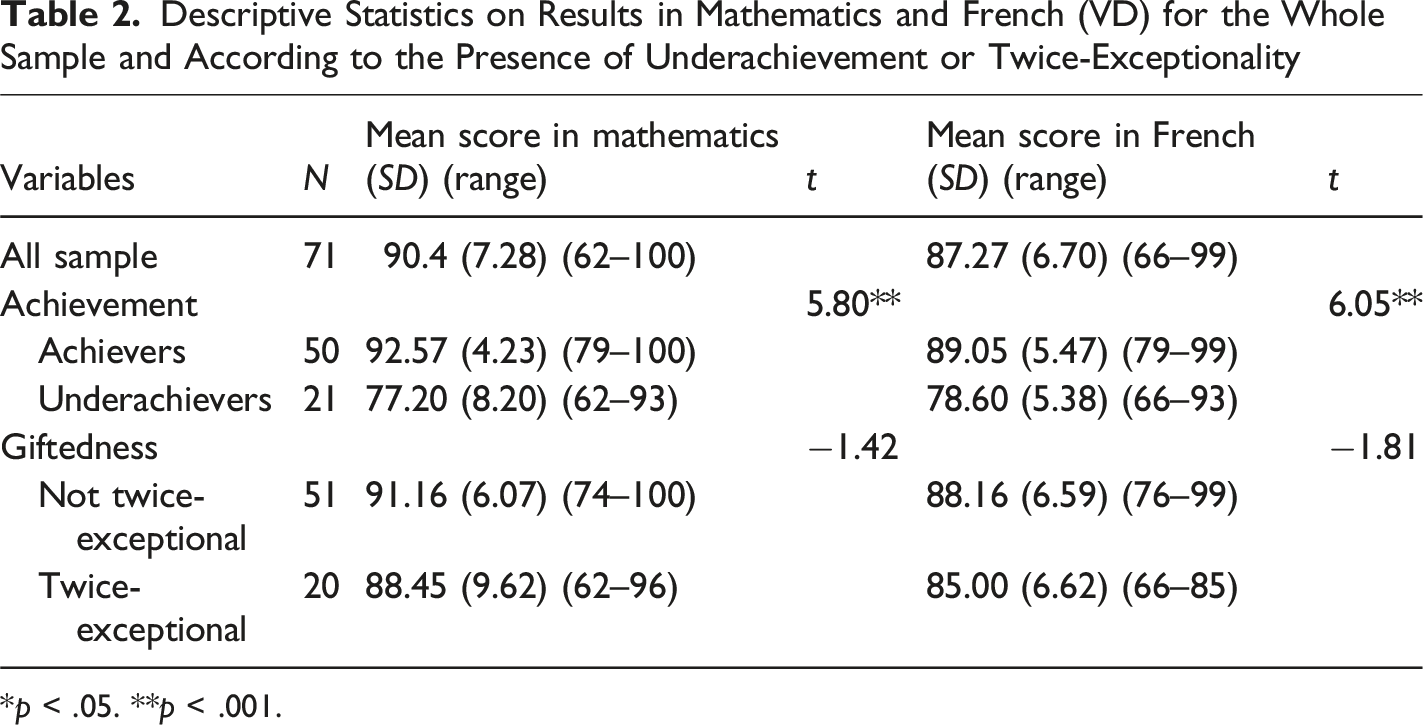
Descriptive Statistics on Results in Mathematics and French (VD) for the Whole Sample and According to the Presence of Underachievement or Twice-Exceptionality
*p < .05. **p < .001.
Overall, gifted students demonstrated high levels of academic performance, with higher mean scores in mathematics (M = 90.4; SD = 7.28) than in French (M = 87.27; SD = 6.70). Significant discrepancies between mathematics and French performance were observed, with 38% of students below the class mean in mathematics and 30% below the class mean in French (see Table 2). In total, 19.7% of gifted children in the sample performed below average in at least one subject.
Independent-samples t-tests revealed that achievers scored significantly higher than underachievers in both mathematics, t(69) = 5.80, p < .001, and French, t(69) = 6.05, p < .001. Comparisons between twice-exceptional (n = 20) and non-twice-exceptional (n = 51) students indicated no significant differences in academic achievement for either mathematics, t(69) = −1.42, p = .08, or French, t(69) = −1.81, p = .07. Twice-exceptional gifted children performed as well as the others. To account for potential Type 1 errors associated with multiple comparisons, Tukey’s Honest Significant Difference (HSD) test was conducted. Results confirmed that differences between groups remained significant under this more stringent correction.
Associations Between Sociodemographic Variables, Teacher–Student and Parent–Child Relationships, and School Performance in Mathematics and French
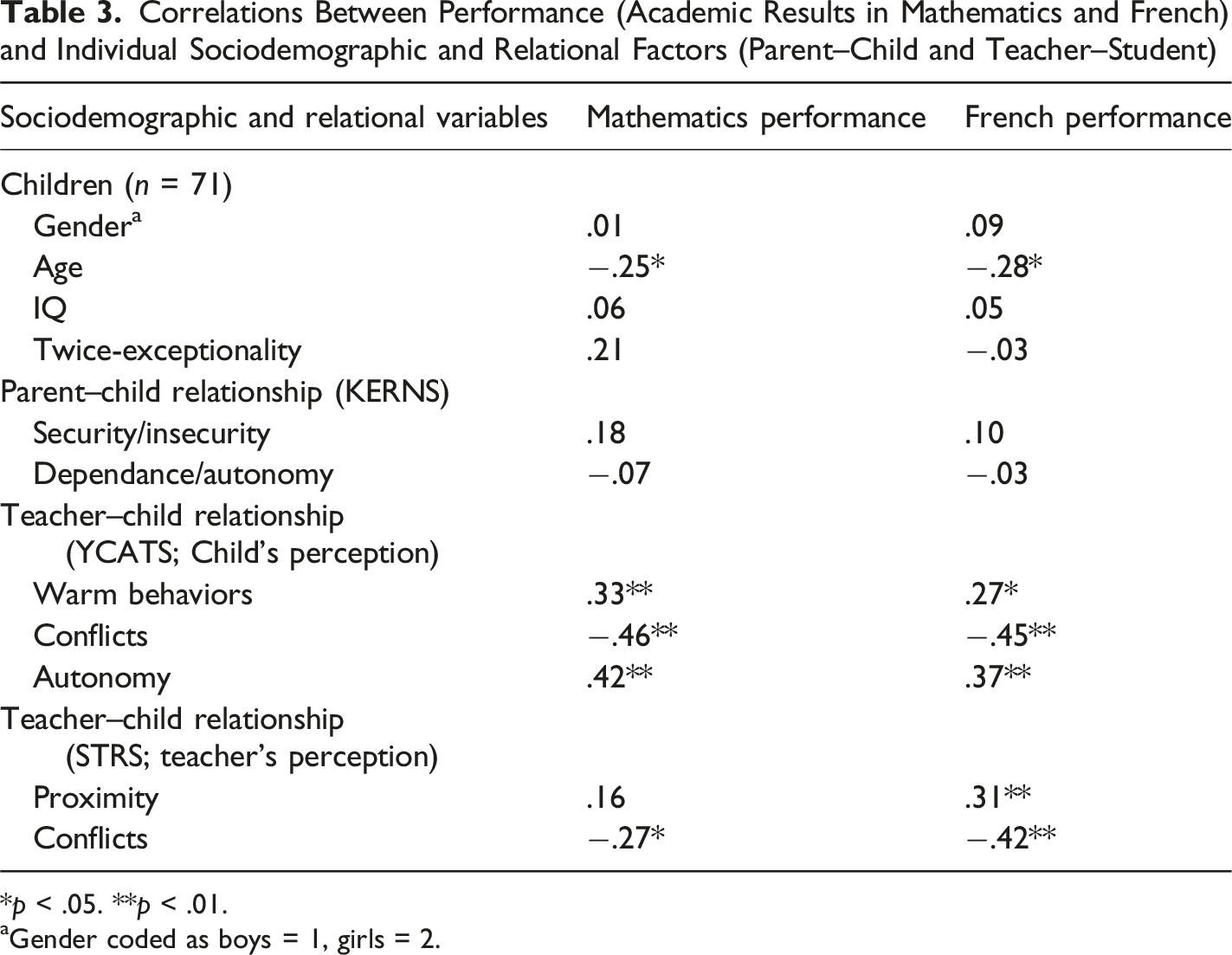
Correlations Between Performance (Academic Results in Mathematics and French) and Individual Sociodemographic and Relational Factors (Parent–Child and Teacher–Student)
*p < .05. **p < .01.
aGender coded as boys = 1, girls = 2.
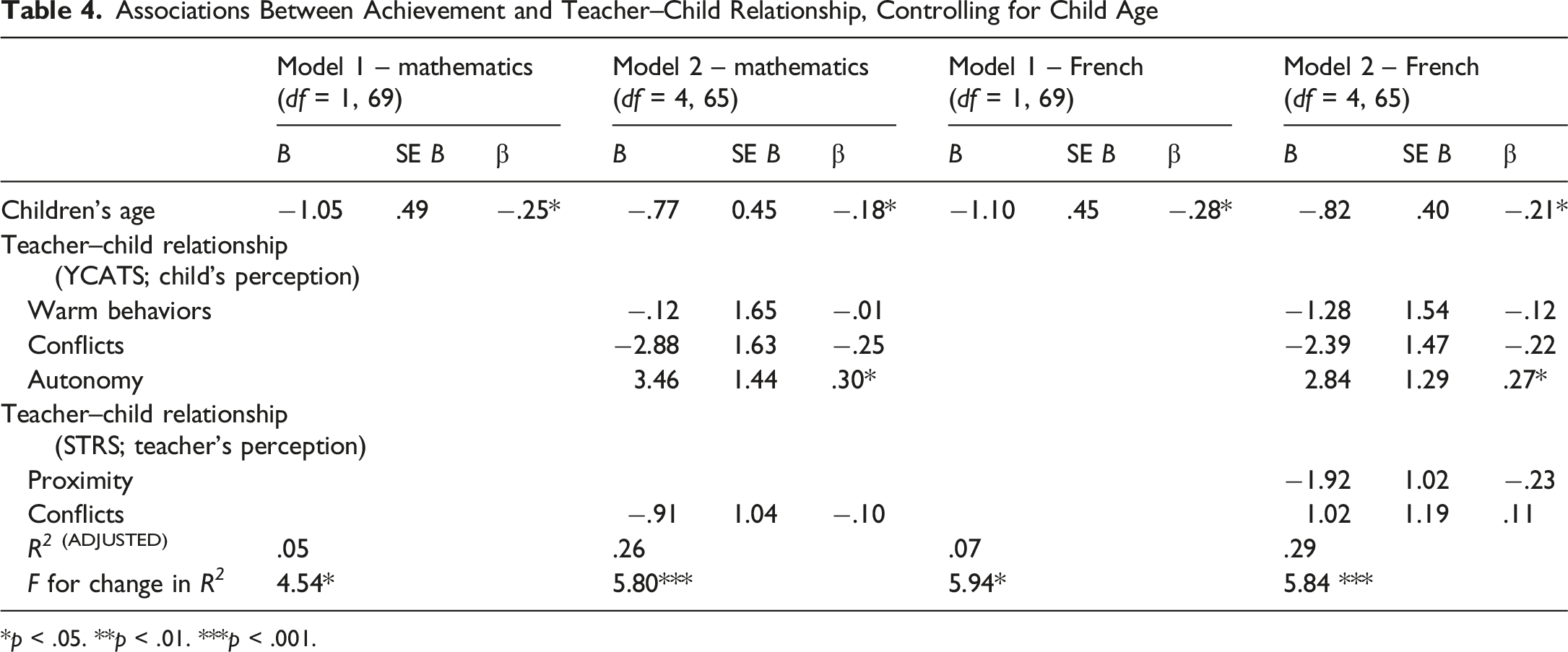
Associations Between Achievement and Teacher–Child Relationship, Controlling for Child Age
*p < .05. **p < .01. ***p < .001.
Regarding performance in mathematics, both overall models were significant. Among the relational variables, only the autonomy dimension of the teacher–student relationship, as perceived by the child, significantly predicted mathematics achievement. Greater perceived autonomy in the classroom was associated with higher mathematics performance. This model accounted for 26% of the variance in students’ mathematics scores, suggesting a contribution of the teacher–child relationships. There were no significant associations between mathematics performance and the other relationship dimensions as perceived by either the child or the teacher. Proximity was not included in the second model as it was not correlated to the results in mathematics.
For French performance, the results indicate that children’s age is significantly associated with French performance in both models. Among the relational variables, only the autonomy dimension of the teacher–student relationship, as perceived by the child, was significantly related to French performance. Greater perceived autonomy in the classroom was associated with higher French achievement. The model accounted for 29% of the variance in students’ French performance, underscoring the role of teacher–student relationships. No significant associations were observed between performance in French and the other dimensions of the relationship as perceived by either the child or the teacher.
Predicting Underachievement in Mathematics and in French
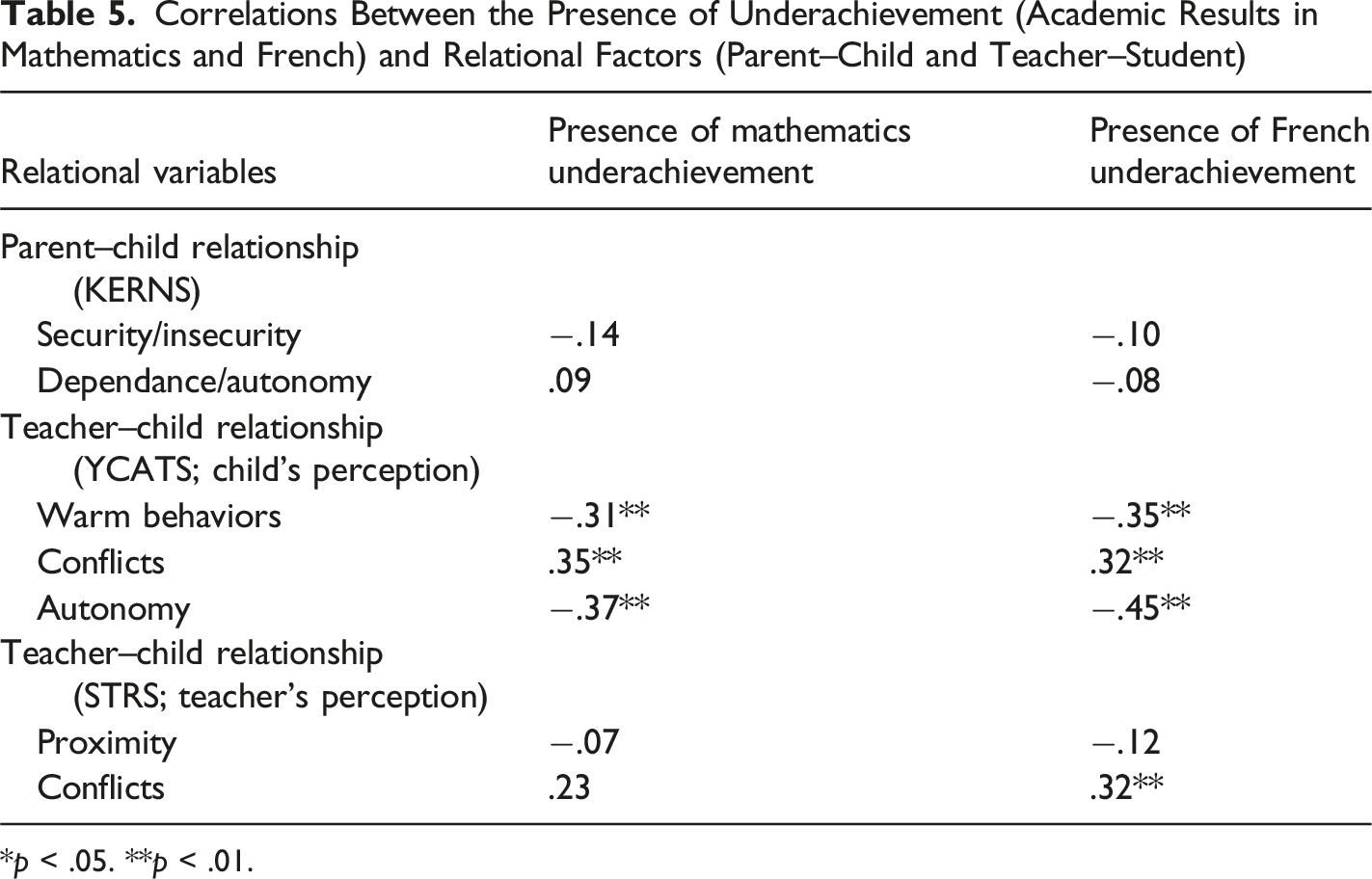
Correlations Between the Presence of Underachievement (Academic Results in Mathematics and French) and Relational Factors (Parent–Child and Teacher–Student)
*p < .05. **p < .01.
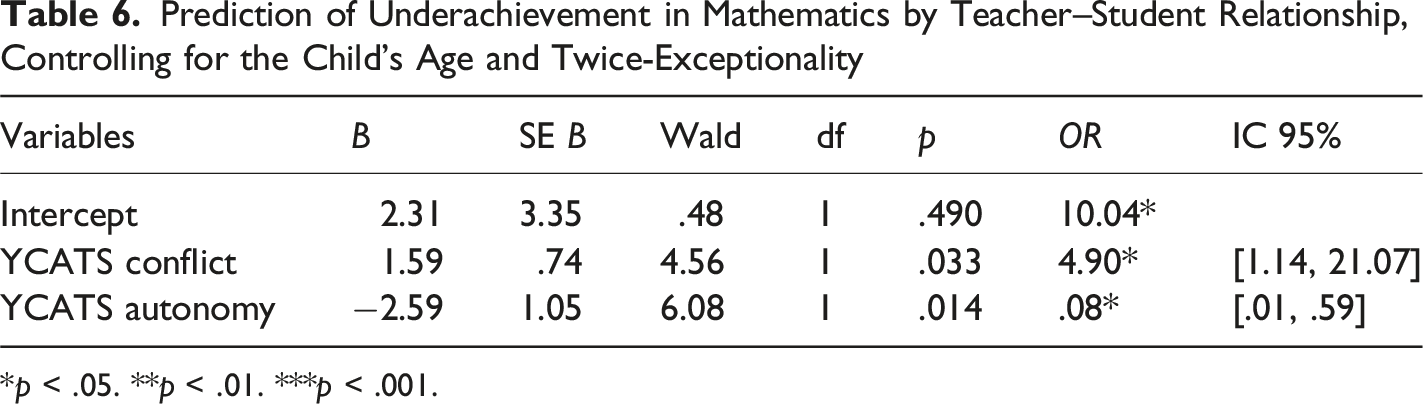
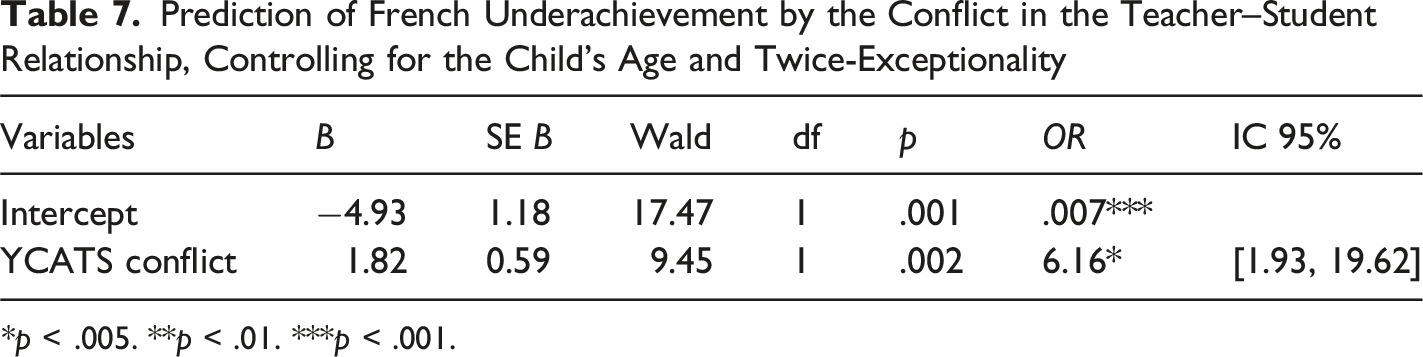
Two binary logistic regression analyses were conducted to examine the predictive role of teacher–student relationship factors in underachievement in mathematics and French, while controlling for age and twice-exceptionality.
Risk of Underachievement in Mathematics
Prediction of Underachievement in Mathematics by Teacher–Student Relationship, Controlling for the Child’s Age and Twice-Exceptionality
*p < .05. **p < .01. ***p < .001.
Risk of Underachievement in French
Prediction of French Underachievement by the Conflict in the Teacher–Student Relationship, Controlling for the Child’s Age and Twice-Exceptionality
*p < .005. **p < .01. ***p < .001.
Discussion
In alignment with prior findings (Roth et al., 2015; Vialle et al., 2007), the school performance of gifted students in this sample was generally superior to the class averages in both mathematics and French. Overall, 19.7% of gifted children demonstrated underachievement in mathematics and French. These findings are consistent with those of previous studies that have documented a conservative prevalence of 10% to 20% (Veas et al., 2018). However, several researchers have postulated that this figure may in fact be an underestimation, with a prevalence potentially reaching up to 50% among gifted children (Reis, 2000; Siegle, 2018). This discrepancy may be attributed to the fact that instances of underachievement are often not recognized by teachers, particularly in cases where the underlying causes are not readily apparent (Hsieh et al., 2007; Rimm, 2003; Steenbergen-Hu et al., 2020; White et al., 2018).
Upon examination of the academic achievement of twice-exceptional children, it becomes evident that their abilities are on par with those of other gifted children. Nevertheless, the existing literature suggests that these children may potentially face academic challenges (Carpenter, 2021; Lim, 2021). It is plausible that these children possess the cognitive capacity to effectively navigate the current challenges, thereby achieving a performance level comparable to that of their similarly gifted counterparts. Moreover, the specific type of twice-exceptionality may be a contributing factor to the observed similarity between the two groups. Notably, a considerable proportion of the twice-exceptional children in the sample (n = 20) have been diagnosed with ADHD or inattentive ADHD (n = 17). Even though this condition can impact school achievement (Zendarski et al., 2022), it is possible that in this study, these twice-exceptional children were able to reach the performance level of their classmates more easily than other twice-exceptional children with more complex neurodevelopmental profiles. Furthermore, it is possible that the adaptive measures (e.g., academic support) offered by the school environment in elementary school enabled them to overcome the challenges they faced and achieve better academic results. Another possibility is that school challenges (e.g., falling grades and dropping out) may appear later, when gifted young people enter high school (Lan & Lanthier, 2003) and they have less support and guidance with assignments and homework. Because the individuals in this sample are still in primary school, they would not yet be affected.
School Performance and the Teacher–Student Relationship
Findings document a clear relationship between the autonomy perceived in the teacher–student relationship and the performance of gifted children in mathematics and French. In fact, the more gifted children perceive that they have autonomy in their schoolwork and that they can choose certain tasks and diversify them (e.g., choosing a task or the way to complete it, choosing their seat in class), the more they perform up to their potential in both subjects. Already documented in other populations (Roth et al., 2007), the autonomy offered by the teacher allows children to deeply explore their interests, develop their knowledge at their pace, and cultivate their intrinsic motivation (Baudry et al., 2021; Garn & Jolly, 2014; Winner, 2000). According to self-determination theory (Ryan & Deci, 2002), this autonomy is a key psychological component that fosters motivation and well-being. The concept of autonomy is also linked to academic performance in gifted children, who can develop positive attitudes toward learning opportunities offered to them or that they can choose themselves (Baudry et al., 2024; Miserandino, 1996). The desire for opportunities to use creativity and their own working methods is also highlighted by gifted children when discussing autonomy (Baudry et al., 2024; Baudry et al., 2019; Baudry et al., 2021; Massé et al., 2021). Consequently, autonomy provides them with the opportunity to reach their full potential by allowing them to learn in a manner that aligns with their individual skills and interests, at a pace that suits them, and in a way that is effective, creative, and satisfying. The presence of autonomy has been found to lower the risk of underachievement, especially in mathematics, in addition to increasing continuous performance (e.g., Cimon-Paquet et al., 2020). This conclusion is in line with the results set out above.
Academic Underachievement and the Teacher–Student Relationship
Although the relationship between a gifted child and their teacher, along with the support provided by the latter, are crucial factors in the academic success of gifted students (Baudry et al., 2019; Baudry et al., 2021), the presence of conflict in the relationship between the child and their teacher as perceived by the child has been identified as an important predictor of underachievement in both mathematics and French. It has been observed that the more a gifted child perceives that their teacher displays anger, lacks attention towards them, and remarks about their lack of effort in class, the more likely they are to underachieve. This result aligns with the findings of several studies in samples of normative children (Burchinal et al., 2002; Hamre & Pianta, 2001). It is documented that the presence of conflict and negative exchanges in the student-teacher relationship is a significant predictor of negative school performance and problematic academic trajectory in the longer term (Hamre & Pianta, 2001). The perception of conflict in the relationship with an authority figure, such as a teacher, can instill feelings of insecurity in gifted children, leading to the development of anxiety and stress (Zee & Roorda, 2018). Such feelings may subsequently affect their ability and readiness to learn. Furthermore, their capacity to concentrate and memorize may also be affected, which in turn impacts their performance on assessments at a primary school level and beyond (Akanpaadgi et al., 2023; Goodman et al., 2012). The perception of conflict with one’s teacher can also result in a cascade of negative effects on the child, beginning with a loss of motivation and subsequently leading to disinterest in the subject being taught. This, in turn, can cause disengagement and difficulties in performing (Patrick et al., 2008; Ryan & Deci, 2002). In instances where the relationship is characterized by conflict and negativity, it is also plausible that gifted children may be reluctant to ask questions or seek help when needed. By avoiding the relationship and foregoing the opportunity to seek help from the teacher, the gifted child may spare themself from negative reprimands from the teacher. A positive and conflict-free relationship is necessary to cultivate autonomy and may help prevent the underachievement of gifted students.
School Performance and the Parent–Child Relationship
Although the quality of the parent–child relationship is a key factor in understanding academic performance and success (Carmona-Halty et al., 2022) and is typically linked to cognitive development across infancy, childhood, and adolescence (Bronfenbrenner, 2005; Carmona-Halty et al., 2022; Li et al., 2022), it was not associated with the academic achievement of the gifted children in this sample. In fact, contrary to expectations (Magro et al., 2023; Oh-Hwan, 1993), no significant association was found between children’s perceived attachment security and autonomy and their academic performance. On one hand, this finding suggests that the relationships within the school environment play a particularly important role in the functioning of gifted students. Although parent–child relationships can promote confidence, self-esteem, and academic support at home, these influences appear secondary to the relational context experienced in the classroom. However, the measures used in this study may not have been optimal for capturing the nuances of this relationship. The use of observational measures could provide an alternative means of assessing the parent–child relationship more objectively.
It is possible that self-reported measures by gifted children reflect their heightened needs for autonomy and security, which may differ from those of typically developing peers aged 6 to 12 (Baudry et al., 2024). It will therefore be important to conduct future research comparing self-reported and observational measures to ensure that these constructs are accurately assessed and to gain a more complete understanding of gifted children’s attachment and parent–child relationships.
It is also possible to consider that the relationship of gifted children with their parents may be expressed differently than that of other children, such as those born prematurely (Spinelli et al., 2013), those with ASD (Rutgers et al., 2004), or those with developmental disabilities (Goagoses et al., 2021), for which the association between parent–child relationship and school performance has been documented. Additional research is needed to explore whether similar or distinct patterns emerge among gifted populations.
Limitations
Several factors may limit the interpretation of the results of this study. Although the sample size is noteworthy for a study involving a population of gifted children, the number of participants may limit the generalizability of the results. Only 71 children, their parents, and teachers ultimately enrolled in the study, despite a concerted recruitment effort. The advent of the global pandemic significantly impeded this recruitment effort, particularly at the school level, making it challenging to reach teachers and consequently excluding several families from the project.
The limited sample size restricts the ability to draw broad conclusions about the population of gifted children. Additionally, the composition of the sample could have been more diverse. Including a comparison group of children from various backgrounds would have enabled a more nuanced understanding of the differences between gifted children and their nongifted peers, extending beyond school performance and underachievement. It would also have allowed for a more thorough study of relational variables, like the teacher and parent involvement, in the gifted children’s lives. The self-reported tools used with children, teachers, and parents also restrict the ability to draw conclusions, particularly about the parent–child relationship and its potential, although unproven in the present study, to correlate with school performance. Future studies may wish to consider the use of observational measures as a means of investigation. Finally, as studies have connected high parental expectations with student achievement, particularly in the context of immigrant families (see, e.g., Chan, 2021), this concept may be another avenue for further investigation, as it relates to underachievement.
Conclusion
The teacher–student relationship plays an essential role in the academic success of gifted children that should not be underestimated. Providing gifted children with autonomy in school tasks and offering them choices can foster engagement and academic success. It is essential to make teachers aware of this dimension, which can be addressed through minor pedagogical adjustments rather than major curriculum changes.
When conflicts arise in the teacher–student relationship, even minor ones, they should be addressed directly with the student to minimize potential negative effects on academic performance and to preserve the quality of the relationship. Although the parent–child relationship does not appear to be significantly associated with the academic achievement of gifted students in this study, a warm, consistent, and predictable relationship remains essential for the child’s overall adjustment and development.
Footnotes

Funding
The authors disclosed receipt of the following financial support for the research, authorship, and/or publication of this article: Conseil de recherches en sciences humaines du Canada - sshrc crsh.
Declaration of Conflicting Interests
The authors declared no potential conflicts of interest with respect to the research, authorship, and/or publication of this article.