




Abstract
Research suggests that the effect of emergency remote education on the motivation of gifted students during the COVID-19 pandemic differs from that observed in traditional students. The main aim of the present study was to explore the lived experience of academic motivation among gifted high school students in Croatia, Serbia, and Slovenia. Semistructured interviews were conducted with 47 gifted students aged 15 to 18, using the same methodological procedure in the three countries with similar educational backgrounds. Grounded in gifted students’ narratives about their academic motivation, we detected three groups of students who experienced decreased, no change in, or increased academic motivation. Furthermore, we identified group-specific patterns based on the most common activities and salient features of students’ school context, learning, and leisure time during the pandemic.
Introduction
Motivation plays a crucial role in nurturing and developing the talents of gifted students while also serving as a vital factor in the theories and frameworks surrounding giftedness (Clinkenbeard, 2012; Howard et al., 2021; McCoach & Flake, 2018; Worrell, 2018). For instance, Renzulli’s Three-Ring Model of Giftedness posits motivation (i.e., task commitment) among three essential components of giftedness, in addition to intellectual abilities and creativity (Renzulli & Reis, 2020). In his Differentiated Model of Giftedness and Talent, Gagné (2021) sets motivation at the core of the intrapersonal catalysts in transforming abilities into knowledge and skills. Similarly, the Talent Development Megamodel (Subotnik et al., 2021) posits motivation as a key process variable from the beginning of giftedness development.
Research shows that intellectually gifted students have significantly higher academic intrinsic motivation than their nongifted peers (Bergold et al., 2020; Juriševič, 2017; Wirthwein et al., 2019). Moreover, despite the general decline in motivation observed across all students as they age, gifted learners continue to maintain a higher degree of motivation than nongifted students (Gottfried & Gottfried, 2004). However, motivation is a multidimensional construct (Elliot et al., 2017; Ryan & Deci, 2020), and more research is needed to gain deeper insights into the motivational dynamics of gifted students. Hornstra et al. (2023) found that when the complex nature of motivation is considered, the higher level of motivation among younger gifted students compared to their classmates gradually declines towards the end of primary school.
Gifted Students and Remote Teaching and Learning
Prepandemic research on online learning environments suggested that gifted students desire social interaction with their peers in such settings and that the lack of a social atmosphere in online classes is a deciding factor in whether students would enroll in similar courses in the future (Adams & Cross, 1999/2000; Adams-Byers et al., 2004; Olszewski-Kubilius & Lee, 2004; Potts, 2019; Steenbergen-Hu et al., 2016). Although some students reported a high prevalence of distractions during online teaching and learning, others appreciated the opportunity to work and learn at their own pace. This suggests that some gifted students benefit from online learning in terms of the use of self-regulating strategies (Lu et al., 2017; Rogers, 2007; Swan et al., 2015; Wallace, 2009) whereas others struggle with a range of problems, especially a lack of social relations with peers and support networks, technical issues, and the quality of distance teaching (Abakumova et al., 2019; Adams & Cross, 1999/2000; Kaya & Islekeller-Bozca, 2022).
However, online education during the COVID-19 pandemic cannot be interpreted as what was traditionally thought of as distance education but instead as emergency remote education in crises (ERE), given it represented a sudden, unexpected change and challenge for the whole education system internationally from March 2020 onward (Hammerstein et al., 2021; Hodges et al., 2020). Therefore, ERE presents a risk that not all the essential and particular psychosocial and educational needs of the gifted will be met, as well as a possibility that the physical localization of the teaching environment will have an unfavorable impact on students’ academic motivation (Potts, 2019). Thus, it seems necessary to explore the motivation of gifted students further during ERE to understand its dynamic nature better, especially because research findings on this topic are still scarce.
Samsen-Bronsveld et al. (2022), for example, showed that the well-being and motivation of gifted elementary school students did not decrease during the pandemic. One possible explanation is that students could organize their course load and complete their schoolwork at their own pace (Alshehri, 2022; Grewenig et al., 2021; McCormick & Guilbault, 2022; Papandreu et al., 2023). In contrast, analysis of the impact of school closings on gifted services in the United States has shown that gifted students’ teachers and parents perceive that regular education does not provide sufficient challenges and enrichment for gifted students (Wolfgang & Snyderman, 2022). In the aforementioned study, both parents and teachers reported a lack of synchronous learning and extracurricular activities for gifted students. Thus, gifted students’ academic motivation did not change significantly during the pandemic. At the same time, they still experienced obstacles, as well as less involvement in enrichment activities (Hyseni Duraku & Hoxha, 2021) but had more opportunities to practice hobby activities (Krnjaić, 2020).
An online qualitative survey (Krnjaić et al., 2023) about Serbian adolescents’ experiences during the first year of the pandemic indicated some relevant findings for gifted students. Although high school students’ narratives referred more to new practices as difficult, narratives of university students were more related to the positive aspects of online learning and the advantages of self-organization, similar to the aforementioned reports of gifted students' experiences during ERE.
Gifted Education in Croatia, Serbia, and Slovenia
The legal education framework in all three countries recognizes the need for the support of gifted students. Croatian, Serbian, and Slovenian gifted students are treated similarly, following the legacy of the education system of the former Yugoslavia from more than three decades ago. The educational systems under consideration primarily focus on identifying gifted students and providing them with the necessary educational opportunities. These opportunities include various approaches such as differentiated curriculum models, individualized programs, and acceleration. Although enrichment opportunities, including competition preparation, are available in schools, their duration and quality vary. Gifted secondary school students have the opportunity to obtain national scholarships and awards for outstanding achievement. Despite these programs, there is an absence of a national monitoring and evaluation system available to these countries (Antulić Majcen et al., 2019; Bogunović & Krnjaić, 2013; Juriševič, 2011, 2020; Ministarstvo kulture i prosvjete, 1993; Ministarstvo prosvete, nauke i tehnološkog razvoja, 2021; Smjernice za rad, 2022).
Additionally, none of the countries involved have a national strategy for gifted education. Consequently, there are vast differences in the implementation of gifted programs within educational institutions. The most significant transnational difference is the identification process of gifted learners. In Croatia and Serbia, the identification procedure is left to the individual preschool or school and the school counselors, while in Slovenia, a program document exists at the national level, based on which the identification process can be carried out in all schools in the same way across Slovenia (Koncept, 1999; Koncept dela, 2007).
High School Education in Croatia, Serbia, and Slovenia During the COVID-19 Pandemic
During the COVID-19 pandemic, different epidemiological waves occurred, with a diverse set of restrictions and measures put in place in schools. In the first wave, from March 2020, all elementary and high schools were closed during a strict lockdown, and the ERE was implemented (Akcijski plan, 2020; Ministry of Science and Education, 2020). Gradually, different hybrid forms of teaching and learning were also introduced. In all three countries, a decision on the educational model (i.e., in-person, hybrid model, the ERE) was made through the coordination of schools, county governments, and epidemiologists, with the possibility of changing the chosen educational model at any time during the school year (Kustec et al., 2020; Ministarstvo znanosti i obrazovanja, 2021). As such, Croatia and Serbia were one of the European countries with the fewest fully closed weeks (i.e., 8 and 12 weeks, respectively), and Slovenia among the countries with the longest fully closed weeks (i.e., 21 weeks) in 2 school years (Ministarstvo prosvete, nauke i tehnološkog razvoja, 2020a, 2020b, 2021; UNESCO, 2022).
Aims of the Study
This research aimed to explore the academic motivation of Croatian, Serbian, and Slovenian gifted high school students during the COVID-19 pandemic. We also focused on gifted student’ leisure activities (i.e., hobbies and extracurricular activities) that they believed to be important for their talent development. Specifically, we formulated four research questions: • RQ1: How did the COVID-19 pandemic influence the academic motivation of gifted students from Croatia, Serbia, and Slovenia? • RQ2: How did gifted students perceive the school context during the COVID-19 pandemic? • RQ3: What were the learning experiences of gifted students during the COVID-19 pandemic? • RQ4: How did gifted students spend their leisure time during the COVID-19 pandemic?
Method
The cross-national study was conducted as an in-depth investigation into the academic motivation, school context, and out-of-school activities of gifted students during the pandemic. To do so, we employed a comparative qualitative research methodology. The present study was part of broader international cooperation between researchers involved in three national projects: (a) Changes in the Organisation of the Educational Process caused by the COVID-19 Pandemic: Effects on Educational Experiences, Well-Being, and Aspirations of Pupils in Croatia; (b) Effects of the COVID-19 Pandemic on Educational Processes and Practices in the Republic of Serbia: Qualitative Research; and (c) Evaluation of the Implementation and Impact of Distance Education During the COVID-19 Epidemic in Primary and Secondary Schools in Terms of Achievement of Learning Objectives and Knowledge Standards, and in Terms of Socio-Emotional Response 2021/22 in Slovenia. Studies were approved by relevant ethical committees in Croatia, Serbia, and Slovenia.
Study Design
The study was conducted as phenomenological research (Creswell & Poth, 2018), with the aim of understanding gifted students’ school, out-of-school, and family experiences during the COVID-19 pandemic. The main research goal was to obtain deep insight and a thick description of how gifted students experienced the pandemic and what they experienced during it. As such, data were collected by conducting semistructured interviews with triads: gifted students, their parents, and their teachers. The study took a comparative approach, with identical procedures for participants’ recruitment, instrument development, and data collection in Croatia, Serbia, and Slovenia.
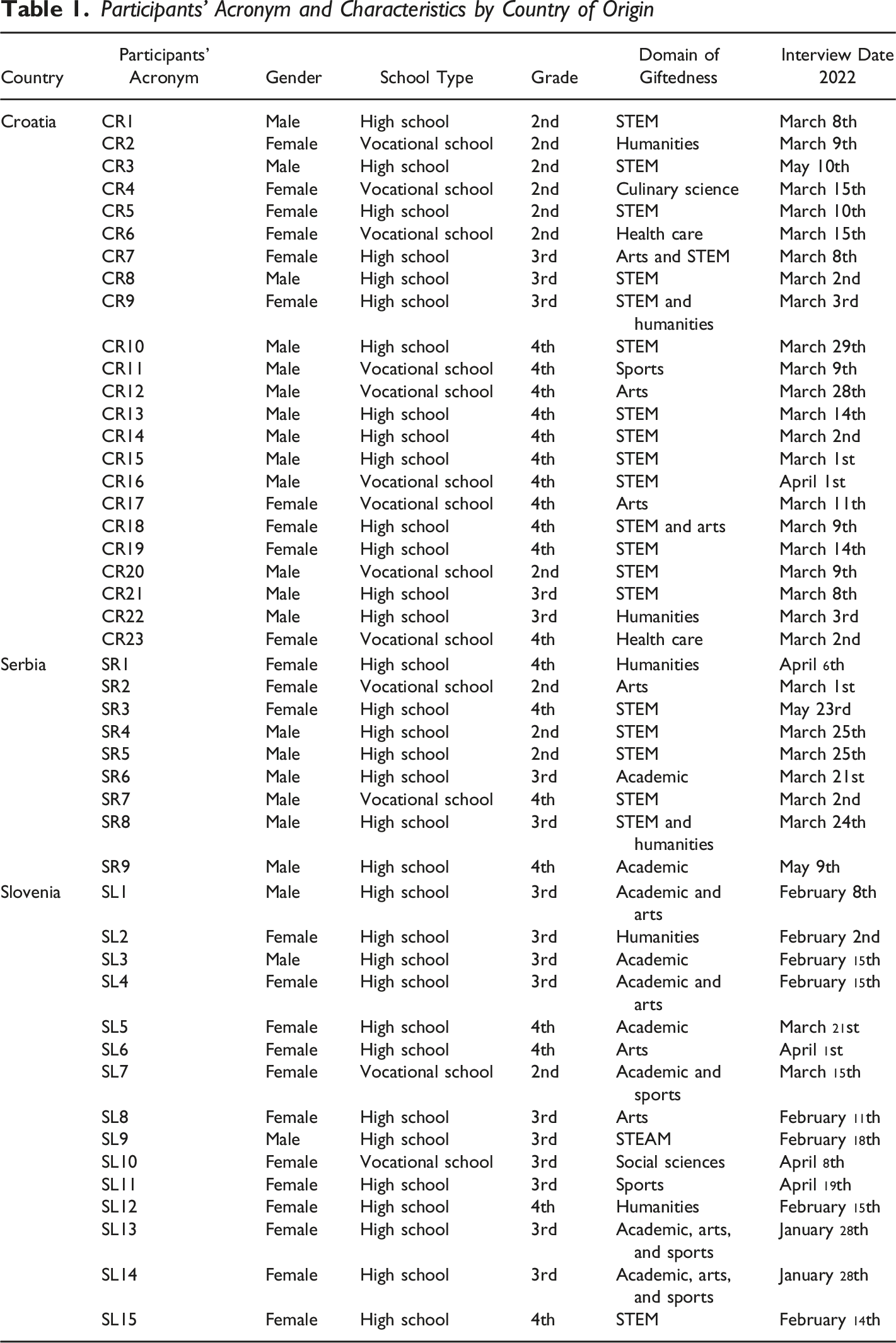
The study was conducted in high schools in different regions of Croatia, Serbia, and Slovenia, varying by the level of urban/rural development. In each country, a nationally representative sample of schools was selected for study participation. To provide a detailed portrayal of the gifted students’ academic motivation during the pandemic, we utilized a purposive homogeneous sampling of participants to obtain a representative group of gifted students, as suggested by Patton (2015). School counselors and—in rare cases—teachers, in all three countries recruited students who are identified as gifted or demonstrate outstanding abilities and achievements in one or more domains (e.g., competing and/or receiving awards at the national or international level, producing exceptional products). Therefore, participants were homogenous by the characteristic of being selected as gifted in their high schools but heterogeneous by other attributes, such as socioeconomic status of the family and being in vocational or traditional high school. No further or additional criteria were used to recruit the study participants.
Participants
Participants' Acronym and Characteristics by Country of Origin
Instruments
The development of the interview protocol for gifted students was established and performed by an international team of experts from Croatia, Serbia, and Slovenia in the national projects mentioned above. The protocol was developed with respect to Bronfenbrenner’s (1979) ecological paradigm and different environmental influences on students’ lives, thus taking into account students’ characteristics, their educational experiences during the pandemic, and the impact of the pandemic on their well-being, as well as on their out-of-school and family life. Two authors of this paper participated in the development of the interview protocol, which was then validated by research teams from all three countries. The protocol included general topics for discussion as well as specific questions and prompts (used for more detailed elaboration of responses, if needed).
To answer the study’s research questions, the interview protocol contained questions related to the gifted students’ academic motivation during the pandemic, perceived school response to the pandemic, educational adjustments during the ERE, learning experiences, and leisure time during the pandemic. Interview questions used in data analysis are provided in the Appendix.
Data Collection
According to ethical guidelines in each country, participants and/or their parents were informed about the study, and written informed consent was obtained before the interview was conducted. We present generalized descriptions of the groups/subgroups to protect the participants’ anonymity. Semistructured interviews with gifted students were conducted from January to June 2022. At the time the interviews, secondary educational institutions implemented a hybrid of in-person and ERE in all three countries. Most interviews were conducted in person at the high school that the student attended, with a few interviews in Croatia and Slovenia conducted ef by video call. All interviews were conducted by the trained members of the national teams. The interviews lasted between 20 and 60 minutes.
Data Analysis
All interviews were audio-recorded and transcribed verbatim. We used reflexive thematic analysis (RTA), with themes emerging from the iterative data analysis process (Braun & Clarke, 2006; Miles et al., 2014). We took several steps: noting patterns, developing codes and coding, identifying and defining themes, clustering, and making contrasts/comparisons between contexts and students regarding the change in their academic motivation during the pandemic. All analytical procedures were conducted using MAXQDA software. First, the initial codes were generated deductively, based on the preexisting analytical framework using protocol coding (Braun & Clarke, 2022; Saldaña, 2016). Second, data-driven inductive coding was used to search for patterns/themes. Third, these codes were then refined by authors through elaborate discussion. All phases of the analytical procedures and coding were performed in continuous collaboration with the team of authors.
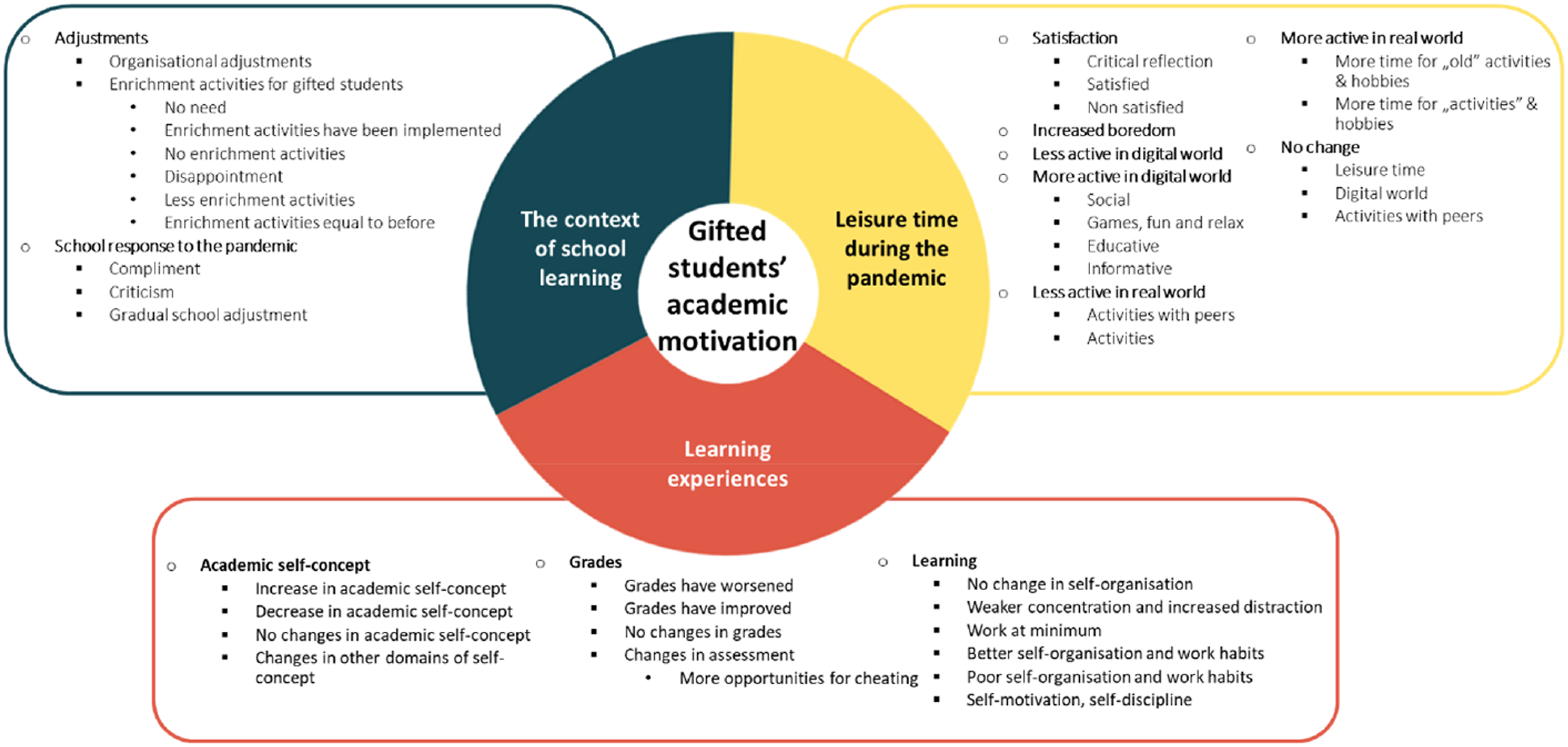
Regarding the first research question, through a constant comparison between cases, we aimed to identify distinct groups of students in relation to their experience of change in academic motivation during the pandemic. The criteria for the grouping consisted of gifted students’ subjective evaluation of the influence of the pandemic on their academic motivation. We further explored and interpreted the themes present in the data in relation to these identified groups of gifted students. As such, in the second, third, and fourth research question subsection, findings are categorized by each student group concerning their experience of change in academic motivation during the pandemic. We also analyzed the results from a comparative angle, trying to detect possible cross-national differences and similarities in gifted high school students’ experiences during the pandemic (further explained at the beginning of the Results section). Interview extracts are provided to support the arguments made in the Results section. The hierarchically organized coding system developed for the purpose of this study is presented in Figure 1.
Derived Coding System on Three Areas of Students’ Experiences
Researchers’ Positionality
All three authors of this study are psychologists engaged in the research and practice of psychology in education, with a particular focus on gifted education. They come from the same cultural milieu of democracy and justice in the former Yugoslavia, notwithstanding some generational differences between them. Their institutions have a solid research background that ensures the present work is considered ethical, professional, well-informed, and respectful of the interlocutors.
The first researcher is a professor of educational psychology at the Faculty of Education at the University of Ljubljana with a strong research interest in learning processes and giftedness. She heads the Centre for Research and Promotion of Giftedness and contributes her professional knowledge to national education policy regarding gifted education. Her students are preservice and in-service teachers to whom she provides evidence-based knowledge about the psychological characteristics of gifted students and their learning and how to teach them to reach their full potential in and out of school.
The second researcher works at the Faculty of Philosophy at the University of Belgrade and currently heads the Institute of Psychology. Her research interests are in developmental psychology, particularly in giftedness, extracurricular activities, and the everyday life and leisure time of young people. She has experience working with gifted adolescents within extracurricular science programs, identifying intellectually gifted students, and selecting them for scholarships. She incorporated her scientific beliefs in the field of youth policy in the creation of documents for youth and intervention participative programs for supporting the development of gifted and vulnerable groups.
The third researcher currently works as a research assistant at the Institute for Social Research in Zagreb. She is a first-year doctoral student in the field of psychology, with experience working with gifted children as a preschool psychologist and doing educational research. The researcher attended one of the top-achieving high schools in Croatia, where she observed inadequate educational provisions for gifted students. As such, she is strongly motivated to integrate gifted students’ voices and experiences in her research. However, she is aware of the need for constant reflection and self-reflection to avoid bias stemming from her experiences.
Results
The main aim of this study was to examine the impact of the COVID-19 pandemic and ERE on the academic motivation of gifted students. Of particular interest was the comparison of the experiences of gifted Croatian, Serbian, and Slovenian high school students. As no substantive differences were found in the narratives of students from these three countries, they were treated as one group in which three patterns of their academic motivation during the pandemic were identified: decreased motivation, unchanged motivation, and increased motivation. These patterns are presented in the preliminary results section and further explored in the main results section in relation to the school context, perceived characteristics of school learning, and students’ leisure activities during the COVID-19 pandemic.
Preliminary Results: the Academic Motivation of Gifted Students During the COVID-19 Pandemic
Code Name of Participants and Number of Participants per Group by Each Country
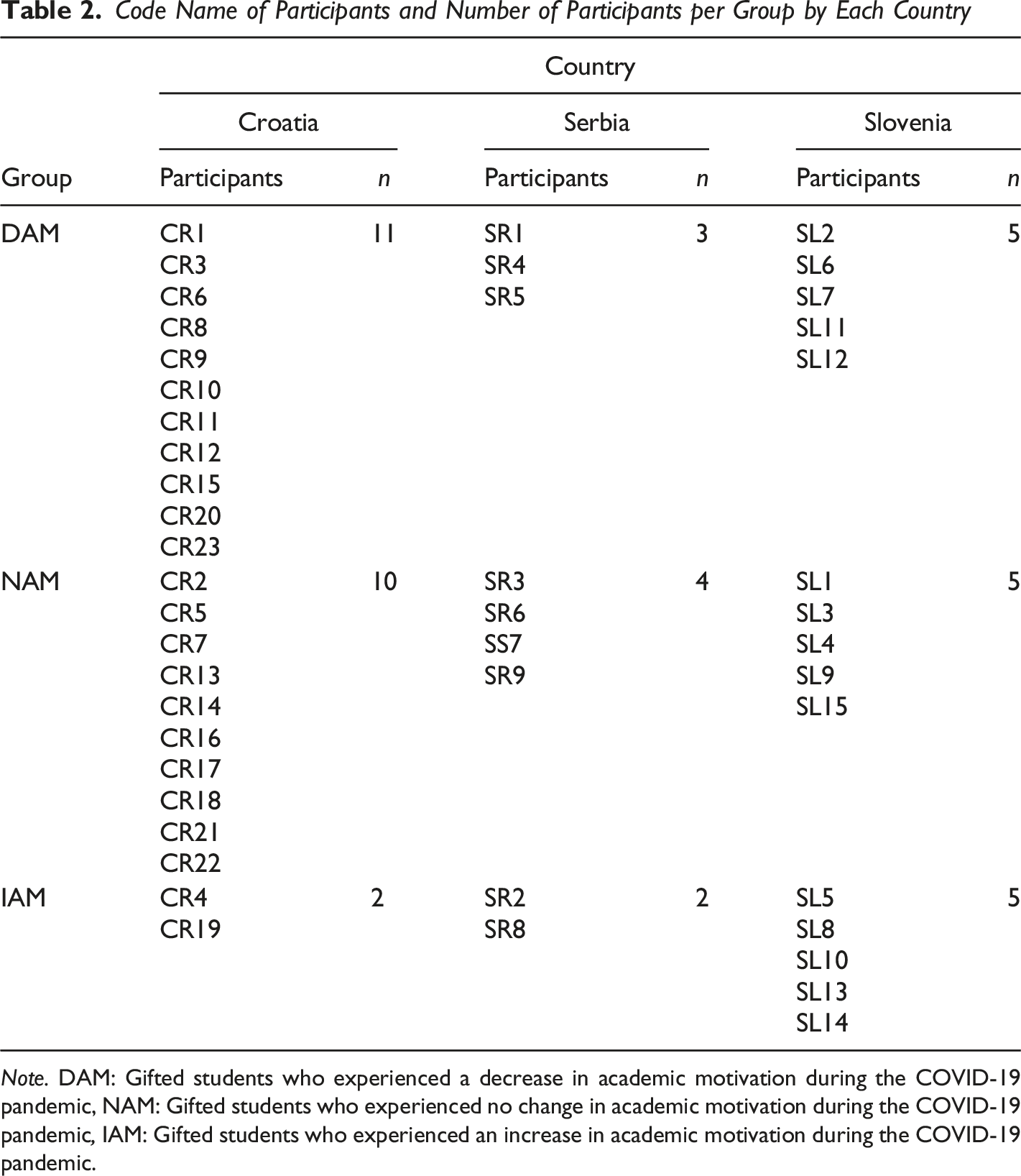
Note. DAM: Gifted students who experienced a decrease in academic motivation during the COVID-19 pandemic, NAM: Gifted students who experienced no change in academic motivation during the COVID-19 pandemic, IAM: Gifted students who experienced an increase in academic motivation during the COVID-19 pandemic.
Main Results
We examined, analyzed, and interpreted the data regarding the second, third, and fourth research questions in relation to the three identified motivational groups of gifted students (i.e., DAM, NAM, and IAM). Regarding the country of origin, we could not identify any specificities regarding the respective school systems or national contexts that could be relevant for interpreting the results. Therefore, we present the results for all three countries together. To support the arguments in the results, excerpts from the interviews are presented.
The School Context During the COVID-19 Pandemic
The school context was examined from two related perspectives in order to understand how gifted students perceived the school context and their experiences of the impact of the pandemic on their academic motivation.
The first, a more general one, was students’ assessment of how schools responded to the pandemic, whereas the second, a more specific one, was on their experience of the schools’ provision of enrichment activities for them as gifted students during this time.
As for the schools’ response to the ERE, three categories emerged from the analysis of the students’ narratives. The first category (gradual school adjustments) includes a variety of descriptions of the increasing functional adjustment of schools from organizational, pedagogical, and social points of view. The second category (compliments) contains explicit compliments and approvals to the school or individuals for their special efforts to make ERE as high quality as possible. The third category (criticism) contains various comments on observed or experienced dysfunctional reactions of the school in general or of certain teachers. Regarding the schools’ adaptations to the needs of gifted students during the pandemic, we focused on explanations of enrichment activities in terms of their qualitative and quantitative implementation (i.e., categories: no enrichment activities, fewer enrichment activities, enrichment activities implemented, and the same number of enrichment activities as before the pandemic). Some students stated that they either did not need enrichment activities (category: no need) because they had either not received them before the pandemic or because of the pandemic emergency (e.g., cancellation of competitions for gifted students, movement restrictions, ERE). Only a minority of students explained the adjustments with some specific organizational changes, but these affected all students in the classes, not specifically the gifted ones (category: organizational adjustments). Nevertheless, just one or two students from each group mentioned some level of negative emotions due to pandemic restrictions (category: disappointment), such as the cancellation of a competition and related preparation for the competition and the reduction of extracurricular activity.
Gifted Students Who Experienced Decreases in Academic Motivation During the COVID-19 Pandemic (DAM)
Regarding students’ experiences of their schools’ adjustment to the pandemic, and in particular ERE, students from this group mainly reported on the differences between the first and the other waves of pandemic adaptation: In the beginning, it was still like that; some professors just kind of made things up as we went along. I think nobody really knew how long it was really going to take, so there were some; in the beginning, I think they gave us some work and said just do it from here to here, but those were the exceptions. But I just don’t think it was because, I don’t know, that they didn’t give it to us or they didn’t care, but it actually seems to me that from the beginning, people didn’t know how long it was going to take, I mean we didn’t. (SL2)
They praised the efforts of the school and teachers to adapt to ERE and to take care of the relationships with the students: “It was actually very chaotic, and it differed from teacher to teacher. Some of them really showed a lot of effort, understanding, and hard work, while others called every two weeks, like solve this, that” (CR8). The students also voiced criticism, mainly because of the poor relationship between teachers and students (poor communication and less responsiveness), the unclear new rules and timetables (poor organization), and the inconsistency (one-sidedness) in following these newly introduced rules during the pandemic. For example, a Croatian student made a critical remark: “Some did not keep to the deadlines at all, but they demanded it of us and were quite strict if we did not complete our assignments before the deadline” (CR12).
Regarding the provision of enrichment activities during ERE, students critically assessed the changes because of the educational adjustments (working in small groups, in the same classroom, combining in-person and distance learning, shorter lessons, extensive hygiene measures, and numerous instructions), which put pressure on both their learning and their social relationships. According to a Croatian student, “It was a little more difficult because when we came to the first year, we were divided by how we sat, there were small groups, and we didn’t get close like this with others” (CR6). The students also explained that enrichment activities were initiated by some teachers (preparation for competitions, extra assignments), either remotely or in person, and that teachers mostly followed the students’ needs: That is, not only for me but for other students, for those of us who expressed a desire to prepare for competitions and specifically for research papers, we went over the holidays, that is, even over the holidays, until they were obliged to come to school and while we were excusing ourselves and taking online courses, if we were in school, working every day, so yes. . . . There was always a possibility; it was just a matter of wanting it and how many people were willing to make it happen and help us. (CR8)
Enrichment activities were carried out to a lesser extent, mainly in science subjects and at the initiative of the students, with teachers responding by preparing assignments and providing appropriate explanations. In addition, some students reported that enrichment activities were not offered at their schools and were not even necessary because of ERE.
Gifted Students Who Experienced No Changes in Their Academic Motivation During the COVID-19 Pandemic (NAM)
The students in this group mainly reported confusion among teachers and students at the beginning of the pandemic because they were not familiar with the use of digital technology. Still, they highlighted teachers’ efforts and some good examples of ERE learning practice from individual teachers. For example, one Serbian interviewee said: I can praise the chemistry teacher; he somehow tried the hardest of all. He was the first to create interactive content, while, for example, all the others mostly didn’t get connected; I can’t say that they didn’t get connected, but the quality was really bad with those tablets. The chemistry teacher, for example, had a camera and bugs, but then he would record all the lessons and upload them to YouTube, and then it is much easier to learn from there when we have a lesson in person, and he looks at the camera, and everything is really nice to see, and he conceived it all nicely and so the chemistry lessons were still of high quality. (SR6)
The students were also critical of some individual teaching methods. They highlighted the poor organization of ERE, the lack of motivation of teachers for online courses, the inconsistency of requirements and deadlines, excessively high expectations of students, and the rigidity of teachers: “Some professors, there were really a small number of them who wouldn’t respect the deadlines like that and would get angry if we didn’t respect the deadlines when they themselves didn’t either” (CR7).
Experiences with school provision of enrichment activities for the gifted during the ERE differed between students. Some described that the school provided some enrichment activities for them, such as preparation for competitions, challenging tasks, discussions for clarification and explanation of the learning material, or they reported no activities for gifted students going on during the ERE, as a student from Croatia stated: “No, there was nothing except for the optional math class, which was carried out, but that’s because the whole class is taking the optional class because everyone is preparing for graduation” (CR22). Students who stated that schools did not offer enrichment activities during the pandemic felt that they were unnecessary due to the school emergency or because schools had not offered them before the pandemic: I know of enriching activities, but there are none. Because I tried to get to that point and. . . But it did not only happen at our high school; it happened to me in primary school when I asked, “Teacher, do you want me to prepare?” and she said, “Yes,” and made an appointment with me a week before the competition. And I said, “Okay, I’ll study in a week, that’s not possible, but okay.” (SR9)
Gifted Students Who Experienced Increases in Academic Motivation During the COVID-19 Pandemic (IAM)
Students who reported the perceived positive impact of the pandemic and ERE on their academic motivation also addressed the gradual enhancement of ERE compared to face-to-face teaching and learning. They pointed out the initial disorganization and confusion for both learners and teachers, the negative impact on knowledge, and reduced demands on students’ schoolwork. They also noticed greater mutual understanding among school staff and students over time and the enhancement of assessment approaches during the pandemic. Some students explicitly praised the good organization of the school and/or the teachers and highlighted teachers who did their best; some empathy was present in their narratives about adapting to ERE as well. The following quote speaks about how students appreciate the teacher’s perspective: It was chaotic at first. I cannot say that this was the fault of the school or the fault of the teachers. Certainly, the teachers have given their maximum, but I see it from my perspective and from that of the teachers. Teachers and school counselors, too, have their own families, and they have their own fears, their own obligations, and their own children. (SR5)
In contrast, some students criticized teachers’ unprofessional or inadequate approach, including teachers’ incompetence, lack of motivation to teach, lack of responsiveness to students’ needs, mixing of classes and free time, disregard for timetables, and unrealistically high expectations of students: Maybe that was the problem that teachers, in their desire, their need to teach us as much knowledge as possible, forgot that we are also only human. That we are not robots, that we will not do everything perfectly. It is not the same situation, and it seems to me that half of all our problems stemmed from that. (SL5)
As for the special provision of enrichment activities for the gifted students in schools during the pandemic, the students mentioned mainly the preparation for competitions; as the Slovenian student highlighted, “I was satisfied with the preparations for the competition, as many extracurricular activities were canceled or were organized remotely. It’s not the same. I would like to emphasize this the most.” (SL13). They also mentioned that they received extra assignments from time to time from certain teachers and were asked to provide online support to their classmates who needed additional help with their studies. In addition, some of them said that the number of school enrichment activities decreased due to restricted movement and security measures, resulting in fewer competitions and research projects.
The School Context as a Framework for Understanding the Experienced Changes in Academic Motivation During the COVID-19 Pandemic
Overall, students in all three groups (DAM, NAM, and IAM) shared similar experiences about how their school context dealt with the new reality of the pandemic and ERE (see Figure 2). They predominantly talked about their experiences with the adaptation processes of schools and school staff to ERE. They spoke sympathetically about the perceived inadequacies and barriers of the transition to distance education, especially in the first wave of the epidemic, between March and June 2020, and the gradual improvements observed afterward. They highlighted various organizational, technical, and digital issues faced by the teachers and students themselves. They mainly attributed them to the new and unfamiliar emergency they experienced due to a virulent pandemic. They devoted a large part of their comments to the quality of communication with teachers. They criticized the unprofessional behavior and approach of specific teachers, though they acknowledged significant differences among individual teachers. Some students even expressed an empathetic attitude, placing the teachers in a broader perspective of life and, in some way, trying to understand their behavior. In addition, they particularly emphasized and complimented the specific teaching methods of the teachers that, in their opinion, worked well. Moreover, we found that the groups NAM and IAM were more likely than the group DAM to express their appreciation for the good work of the teachers. Code matrix by groups of students related to their experience of change in academic motivation during the COVID-19 pandemic. Note. Dots represent the frequency of the codes per group of students (the larger the dot, the larger the frequency). The method of counting is one hit per document. DAM - Gifted students who experienced a decrease in academic motivation during the COVID-19 pandemic, NAM - Gifted students who experienced no change in academic motivation during the COVID-19 pandemic, IAM - Gifted students who experienced an increase in academic motivation during the COVID-19 pandemic.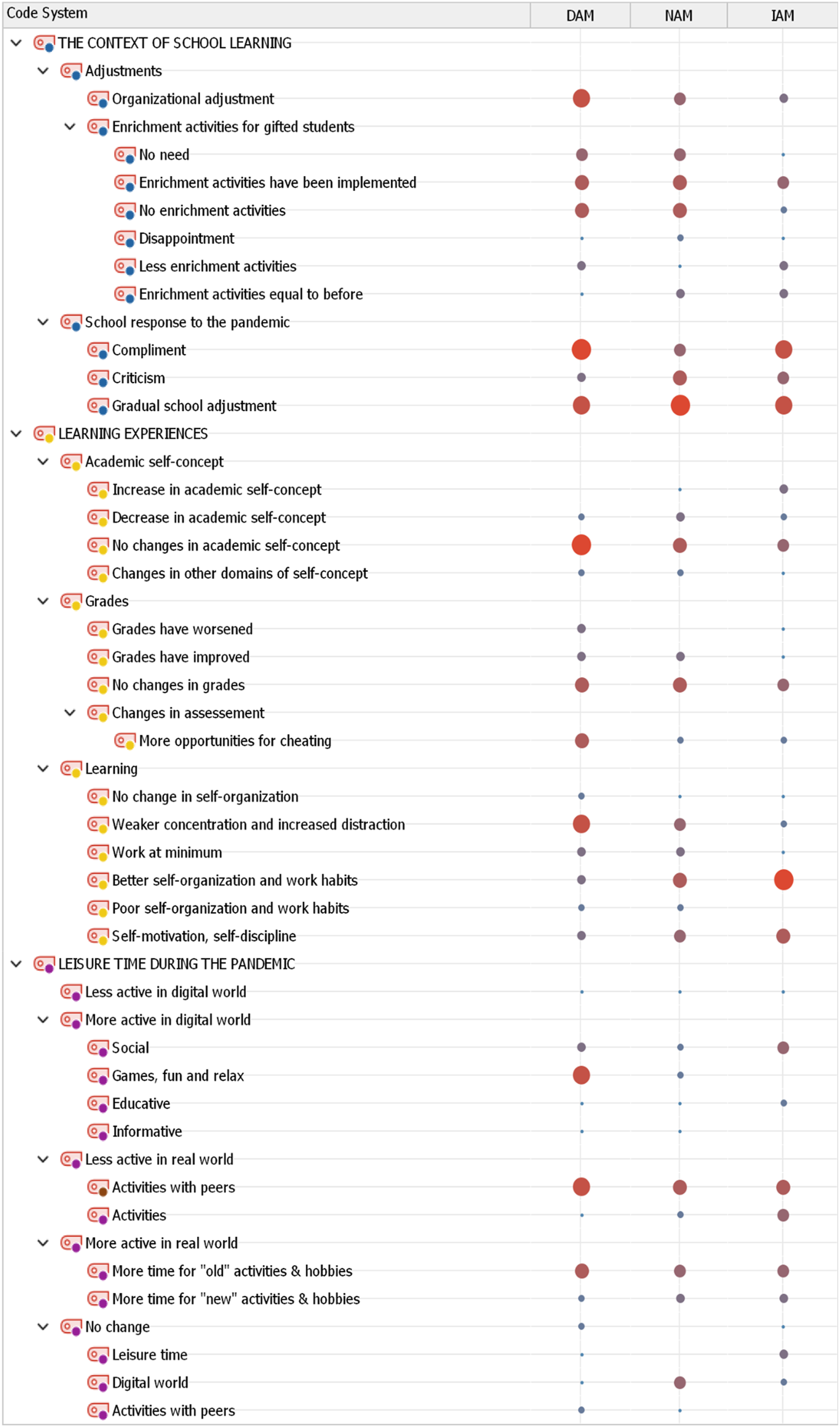
From their narratives, we could detect that in all schools and countries, special arrangements for gifted students depended on individual teachers and were not part of the more systematic approach of the schools in a situation of emergency. About a third of the students in each group described at least some enrichment activities they had participated in at their school. Students in the IAM group, in contrast to the other two groups, more strongly emphasized their observation that significantly fewer of these activities took place during the pandemic, while less frequently pointed to the fact that there were no enrichment activities at school during the pandemic (or even before it). However, many students noted that most teachers were willing to help students in their classes (i.e., every student, not just the gifted students) but that they were expected to ask for help. Students in the DAM group focused more than those in the other two groups on the negative changes due to the constraints and the emergency (i.e., the adjustments resulted in a poorer classroom organization and structure), while they described the presence or absence of enrichment activities. Students in the IAM group did not agree that enrichment activities were not necessary during the pandemic, as did the students in the other two groups. Preparation for competitions was highlighted as the most important enrichment activity during the pandemic, and the most positive and effective communication with teachers was associated with this activity.
From the observations described above, we could conclude that the students experienced the school context overall positively (e.g., “because then it worked,” “in the end it was good,” “we all got used to it”), but they missed quality teaching, good social relationships, and competitions as a predominant enrichment activity. One of the students concluded her story as follows: I have the impression that we somehow learned to look at things from different angles, that we basically all tried to meet each other as much as possible, and that we listened to each other much more than before the pandemic or now after the pandemic. We have all started to really listen to each other. When we told each other about our needs, we also told the teachers about it, and they tried to listen to us as much as possible. (SL5)
Gifted Students’ Learning Experiences During the COVID-19 Pandemic
Learning experiences encompass some aspects of students’ school learning, studying, and academic achievements during the pandemic. We determined three key categories related to students’ academic motivation: academic self-concept, grades, and four characteristics of the learning process during the ERE (self-organization and work habits, self-motivation and self-discipline, weaker concentration and increased distraction, and work at minimum).
Gifted Students Who Experienced Decreases in Their Academic Motivation During the COVID-19 Pandemic (DAM)
DAM students predominantly expressed no change in their academic self-concept during the ERE. Although there were mentions of a lack of will to learn during the pandemic, a few students named their high and stable academic self-concept as a reason for the relatively low influence of the ERE. Nevertheless, they noted changes in other domains of self-concept, referring to the social self-concept. One Croatian student described a lack of opportunities and challenges needed for his social development: So, it limited the number of opportunities in which we, as young people adolescents, can delve into some new situations that then confront us with the unknown and push us to further growth development, and then increase our self-confidence here… It must have made this whole process difficult. It removed this social interaction, which is the very foundation of development. (CR8)
For the most gifted students, grades did not change, with only a few reporting worse or improved grades during the pandemic. However, many students noted they cheated more during the ERE, which for some resulted in a “boost” in academic achievement. Students emphasized how easy and accessible they found it to engage in academically dishonest behaviors and described various behaviors and methods of cheating, such as the use of other digital devices (phone, computer, and the internet) while attending online examinations, group work with peers during online exams and using unauthorized notes during test-taking. One student from Croatia described that he cheated more in subjects he deemed as “irrelevant”: It was easy to cheat, especially on subjects that I consider to be irrelevant. As I said, I have two devices, one with a camera and the other I used for cheating. I don’t know if I’m allowed to talk [about cheating] [laughter], but I handled non-essential subjects easily. (CR3)
When describing the characteristics of the learning process during the ERE, students in the DAM group gave heterogeneous reports and reflections, with a prominent narrative of weaker concentration and increased distraction. When elaborating on their concentration issues, they noted a weaker ability to maintain their attention levels during online classes, listing the increased distraction of home surroundings and the possibility (and availability) of other activities as a main explanation. Students mainly highlighted a more relaxed daily structure and routine at home as opposed to one in school, which, for some, resulted in procrastination. One Serbian student even expressed that “it feels like we’re on vacation” (SR4), while another Slovenian student observed that “the teachers can’t see what you’re doing anyway” (SL11). When describing their self-organization and work habits, these students gave various descriptions. Notably, those who reported better self-organization mentioned they felt in control of their learning process and had the autonomy to organize their day. For others, there was either no change or a decrease in self-organization due to more procrastination and a lack of daily structure.
Gifted Students Who Experienced No Changes in Their Academic Motivation During the COVID-19 Pandemic (NAM)
Students in the NAM group predominantly experienced no change in academic self-concept during the ERE. When reflecting on their academic motivation, besides the pandemic, there were mentions of positive developmental influences. One Slovenian student commented, “that all along I was more than confident in my characteristics” (SL1), stressing that she was always secure in her abilities.
Even though no change in academic self-concept was a prominent theme, a few NAM students mentioned their academic self-concept decreased during the ERE. Factors contributing to this decrease, in the students’ own words, included a decline in self-efficacy, stress induced by a new pandemic-related situation, and a lack of expectation of success. However, some students described that they successfully preserved their high self-concept, as one Serbian student reflected: It is true that maybe my self-confidence, that is, that faith, may have decreased during the pandemic, which is not such a big miracle, but still, I somehow managed to deal with it, and now I am here and absolutely satisfied. (SR6)
Similar to peers in the DAM group, NAM students mentioned negative changes in their social self-concept. Nonetheless, one Slovenian student expressed she had an opportunity for self-discovery. In her words, she had “time to dig deeper,” and her “self-esteem has improved as a result,” as she “dared to step out of her comfort zone” (SL3). When describing their academic achievement, students predominantly expressed no changes, with some reporting an improvement in grades during the ERE. Students mostly had stable high grades, with one Serbian student expressing his mastery goal orientation: Yes, I had to study a little more, but in reality, it was not reflected at all in my grades or knowledge; after all, grades are a reflection of knowledge. Grades are not the goal of learning; the goal of learning is knowledge. And therefore, as long as I learned something, I will get a [good] grade. (SR9)
A smaller number of NAM students who reported grade improvement gave various explanations, such as better work and learning habits during the ERE, increased use of web-based sources of knowledge, and cheating. Some reported more group work during written examinations in online classes, but a few students simply noted that they perceived an increase in cheating among their classmates.
Regarding the learning process, students in the NAM group noted their better self-organization and work habits during the ERE, related to more study planning and autonomy (indicating more self-regulated learning), making notes in classes, and keeping track of materials and information posted at various digital platforms. Similarly to the DAM group, they reported their concentration and productivity became weaker, as there were more distractions during studying and attending online classes. However, they referred to their self-motivation as a driving force during remote teaching and learning. Long-term goals and ambitions were mentioned as motivational sources (e.g., going to college) and empowerment through the possibility of self-organized autonomous learning during the ERE. For instance, one Croatian student mentioned that she “liked the fact that it [the ERE] taught me to be independent in research and I did a lot of extra things, as a lot of things then depended on me and not so much on the professor” (CR7).
Gifted Students Who Experienced Increases in Their Academic Motivation During the COVID-19 Pandemic (IAM)
AM students relatively predominantly described that their academic self-concept was stable during the pandemic, with no long-term consequences caused by the pandemic. However, some students in the IAM group experienced increased academic self-concept related to intrinsic motivation for learning and a better insight into their own (high) cognitive abilities. This may indicate an increase in self-efficacy, as observed by one Slovenian student: I think I was very positively surprised until the evaluations started. I’m so proud of how much I’m able to process things. How much I could learn something constructive on my own, how much I could comprehend on my own, and all this. (SL5)
When commenting on their academic achievement during remote teaching and learning, they mostly expressed that their grades did not change. There were some mentions of academic dishonesty, related to the use of unauthorized notes and alluding to cheating less on subjects students deem important in later education and life.
For this group of students, the most prominent feature of the learning process during the ERE was better academic self-regulation. Students noted several reasons that positively influenced their self-organization: an opportunity for autonomous learning, better monitoring of studying, improvement in organizational and time management skills, continuous learning, use of various study sources, and good work habits. Self-motivation was associated with an increased workload, which prompted their self-organization. A few students reported that framing education during the pandemic as a “challenge” also helped. Due to their high self-motivation, the students mentioned their determination, learning new skills, good work habits, and continuous studying. One Serbian student explicitly stated her mastery goal orientation and value she prescribed to knowledge: Education was carried out in difficult working conditions. For you to do something or achieve something in difficult working conditions, you must have increased motivation. Am I right? I think I’m right. What would the teachers say? Ninety percent of the students think: “Well, if I don’t have to, I won’t finish it now.” And a small number of students think: “I want it, I need it, I need it, it’s for my good, it’s for my education, it’s for my personal enrichment.” That motivation has to be found. (SR8)
Interplay of Changes in Academic Motivation and Learning Experiences During the COVID-19 Pandemic
We surmised differences in gifted students’ narratives of learning experience characteristics concerning the change in their academic motivation during the ERE. As such, gifted students in the DAM, NAM, and IAM groups can be described as distinct groups of students. Although students in all three groups described relatively stable academic self-concepts and no change in grades during the pandemic, the DAM groups reported more cheating behaviors than the other two groups of students. We also detected some differences in the characteristics of the learning process during the ERE; while DAM students have heterogeneous learning process experiences, students in the NAM group mainly highlighted a decreased concentration but better self-organization and a significant degree of self-motivation during the ERE. It seems that their personality traits and learning strategies helped them overcome the obstacles imposed by ERE. Similarly, for the IAM group, students perceived themselves as motivated and organized. Furthermore, we noticed the differences in elaboration and introspectiveness of the students’ answers, with a higher degree of both detected among students in the NAM group. It seems they critically reflected on the educational experiences and consequences of the pandemic, with insights on its advantages and drawbacks.
Gifted Students’ Leisure Activities During the COVID-19 Pandemic
In this section, we outline the characteristics of leisure activities among students categorized into groups of DAM, NAM, and IAM. Specifically, we investigate whether certain leisure activities were more or less prevalent during the pandemic compared to prepandemic times. Students’ leisure activities are classified into two domains: digital activities (e.g., social networking, gaming, and educational/informative pursuits) and real-world activities (including interactions with peers and other pursuits, with subcategories delineated as increased time for established hobbies and activities, increased time for new hobbies and activities). Additionally, we incorporate a category labeled “no change” to include activities that remained consistent both digitally and in interactions with peers.
Gifted Students Who Experienced Decreases in Academic Motivation During the COVID-19 Pandemic (DAM)
Gifted students in the DAM group predominantly indicated an increase in gaming frequency during the pandemic, utilizing digital media primarily for leisure and relaxation purposes, and engaging more frequently on social networks compared to pre-pandemic levels. As one Serbian student said: “We had nothing else to do, and that’s it, that was the only activity we could engage in” (SR1). Students also used digital tools for socializing, and some were concerned about overuse, as “I got a little bit addicted to these social networks. Because our only contact with our classmates was during the pandemic, apart from Zoom” (SL6).
Furthermore, some students stated that they would like to reduce or stop using social networks. One of them, affected by this issue, reported that he “deleted everything” except WhatsApp just to stay in contact with people (CR11). Another observation stated, “Maybe because my concentration went down, I read a lot less” (SL2). DAM students reported that they rarely used digital tools for educational and informative purposes.
Regarding real-world activities, students in the DAM group reported fewer activities with peers and noted that they stopped going out and meeting with friends, especially during lockdown. Talking about the isolation, one Croatian student said: That’s exactly what it means; we either have complete isolation, and that’s it, we’re looking for even more. Before, there was always some continuous level of socialization of this, but now we were bombarded with those holes of solitude and isolation. It means going from some drastic minimum to a drastic maximum. (CR8)
Concerning the activities they practiced, DAM students predominantly reported having more time for some “old” activities such as sports activities, learning a foreign language, painting, and even helping parents with agricultural work or spending time with friends, family, and relatives. A Slovenian student said, “Basically, I had more free time and more time for myself” (SL7). In contrast, only two participants stated that they started new activities and hobbies (like crocheting and following the NBA) that they had not practiced before the pandemic.
Gifted Students Who Experienced No Changes in Academic Motivation During the COVID-19 Pandemic (NAM)
Students in the NAM group indicated an increased use of digital tools, primarily for socializing, in comparison to students in the DAM group, who used them less frequently for entertainment. The NAM group predominantly engaged in virtual socializing, but also utilized digital devices for educational purposes and exchanging information with classmates. One Slovenian student stated, “I divided my use of social networks and use of social media for consuming/watching content, and communication with friends” (SL4). Only two students from this group stated that they used digital tools for the purpose of obtaining information, while one of them pointed to the importance of critical reception “to understand what is true, what is not true” (SR6).
Although many students reported that after the lockdown, “some things have improved,” two students reported that they were led towards isolating themselves even more and changing their behavior and habits. One said that she “reduced her contact with the outer world and did not dare to go out” (SR3), and the other said that she had “withdrawn a lot” (CR17), trying to be alone more and concentrate on her studies more. Some NAM students described how they adapted socializing and activities with peers to new circumstances, such as switching from large social events to getting used to smaller gatherings and hanging out in smaller groups. However, one Slovenian student described convenient forms of socializing due to the place of residence: “Some activities changed form or stopped, such as the choir or the chemistry club because the whole purpose of the chemistry club is to do actual experiments, it’s not about listening” (SL4). Students primarily discussed sports, noting a stop in sports participation and gym training. However, some students began to increase their involvement by training at home or engaging in outdoor sports activities. One Slovenian student described their experience like this: “I really like to go for a run; it seems to me that nature gives me a kind of disconnection from everything, and it’s really just me, no one around me” (SL15). The nature of leisure activities reported by the NAM group could be largely described as constituting students’ old interests and activities to which students had enough or more time to devote during the pandemic. It primarily constitutes reading and spending time with family and friends, as explained by one of the students from Croatia: “I really like reading, which the pandemic couldn’t take away from me, thank God. I really like spending time with my family, which was even a good thing during the pandemic” (CR7). One Serbian student expressed how he was grateful to the pandemic for the opportunity to read more; to study literature, philosophy, and logic more deeply; and to spend more time on his favorite activities and hobbies: “It’s just that some new hobbies came out of that period, so that’s not it, nothing happened for nothing. Still, I managed to get something out of it” (SR6). Enjoyment and engagement were evident in the statement of a student who continuously repaired items around the house and had a keen interest in electronics. Similarly, other students found enjoyment in adopting new hobbies such as playing chess, cooking, sewing, and crocheting.
Gifted Students Who Experienced Increases in Academic Motivation During the COVID-19 Pandemic (IAM)
Students in the IAM group reported decreased socialization with peers, describing restrictions that compromised socializing with friends and demands concerning health measures. One student from Slovenia mentioned the RVT (recovered/vaccinated/tested) condition and its effect on their ability to socialize. The pandemic also interrupted their rigorous extracurricular activities, leading to students stopping enrichment opportunities like English classes, sports trainings, and drawing courses. According to the reports, IAM students were trying to overcome these obstacles by using social media and social networks for communication with friends and by spending more time on activities and hobbies that they did not have enough time to practice before the pandemic. Thus, students in the IAM group used digital devices (even though rarely) predominantly for socializing and rarely for educational purposes, and as one student from Serbia (SR2) emphasized, not at all for entertainment: “I don’t play games, I’ve got over that, and I often use social networks. I have some time when I use social media; I use that time for some book reviews, to look at drawings” (SR2). One Slovenian student explained that she didn’t have social network accounts until the previous year and started using all social networks for additional motivation as “I started following people who are very dedicated to school, who study a lot” (SL5).
IAM students reported about old hobbies and new activities they practiced, such as going to the mountains: “So I kind of started it, and now I’ve kept doing it. This was one positive thing I gained during the pandemic” (SL14). There were mentions of socializing, spending time with family, reading, and practicing different hobbies such as drawing, writing poetry, songs, or stories. One Slovenian student started many activities, such as an online training course on cooking and baking, reading the classics, and learning languages (French, Italian, and Chinese through the Duo Lingo app), explaining that during the pandemic she: had more motivation, somehow, as much as possible but generally to perfect, to educate…. I’m so convinced that distance learning is better than schooling because I have a lot more free time, and I could spend a lot more time on other things, not just school. (SL5)
Gifted students from this group shared insights about their self-organizing, how they started to learn new skills and things they “have never tried before,” and how to take advantage of the time they had. One student from Slovenia pointed out: “I motivated myself even more. Basically, I had a lot of time left, and I wanted to use it as much as possible, so I just started learning new skills” (SL8).
Exploration Towards Understanding Gifted Students’ Leisure Activity Choices During the COVID-19 Pandemic
A few students perceived no changes in certain everyday life and leisure aspects due to the pandemic. The students’ explanations and the context of their responses indicated that such experiences depended on the conditions, their previous habits, and additional reasons that differed at an individual level. So, there were no changes in activities with friends for those who had friends in the neighborhood, had a dog, or just used to go out a bit even before the pandemic. One student elaborated on different developmental changes during the pandemic, reflecting that she “has remained the same” (SL11). Furthermore, students who reported no change concerning using social networks explained, “It has nothing to do with the pandemic or anything, but now I basically don’t spend any time on social networks” (SL1). Another student emphasized that he “was against social networks” (SR9), and another noted that he “spends very little time on social networks anyway” (CR7).
In general, students reported that they were socializing less with friends and were more active in the digital world than before the pandemic, especially during the quarantine (33 students, while only two reported that they were less active) and that some of their previous everyday activities and practices were interrupted. Based on the activities that gifted students mentioned in the interviews and how they observed their representation, it is possible to address some leisure activity choices for the three individual groups. The students in the DAM group mainly reported changes and limitations in socializing and using digital devices for fun and relaxation, sometimes expressing concern for social network overuse. They were, to some extent, also engaged in practicing activities and hobbies that they were involved in before the pandemic. Besides stable academic motivation, NAM students were also characterized by stable interests and flexible choices of leisure activities. Compared to the students in the DAM group, who are more entertainment-oriented, students in the NAM group are more active, flexible, and focused than IAM students, who started many new activities. The most prominent features for IAM students were an expressed aspiration to take advantage of time and a high level of self-motivation and organization in practicing various activities while sometimes expressing diffused interests. Compared to DAM students, students in NAM and IAM groups experienced the pandemic as a challenge and approached leisure more constructively.
Discussion
Using RTA, we identified three groups of gifted students based on their perceived changes in academic motivation during the pandemic (i.e., decrease, no change, and increase). To gain a deeper understanding of their academic motivation and (if any) specific patterns of experience for each of these three distinct groups, we described gifted students in more detail regarding their respective school contexts, experiences of school learning, and leisure activities. However, it is important to highlight here that in the cross-national comparison, the experiences of Croatian, Serbian, and Slovenian gifted high school students were similar, with no idiosyncratic results in any of the three countries. This particular finding can largely be attributed to a similar cultural milieu and educational opportunities (Cross, 2013; Freeman, 2015) but also to commonly observed general characteristics of academic motivational structure and dynamics among gifted students (Clinkenbeard, 2012; Hornstra et al., 2023; Juriševič, 2017; McCoach & Flake, 2018). In summary, profiles for three identified groups concerning changes in students’ academic motivation are presented.
Gifted Students With an Experienced Decrease in Academic Motivation During the COVID-19 Pandemic (DAM)
Students in this group very often experienced their learning context through various adjustments to the organization and delivery of lessons due to the pandemic, which they problematized but did not find excessively problematic. They repeatedly reported that their schools provided some or did not provide any enrichment activities for the gifted. They also said that they did not need any additional activities during the ERE as the situation itself was an emergency, and they were already sufficiently engaged with their regular schoolwork. The students also experienced no change in their academic self-concept and grades during the ERE. However, they reported being involved in academically dishonest behaviors while emphasizing the ease of cheating during ERE. They gave diverse reports on the characteristics of the learning process, with mentions of weaker ability to maintain their attention levels during online classes, absence of daily structure and routine during home confinement, and heterogeneous reports on the influence of the ERE on their self-organization. In relation to leisure during the pandemic, students reported less socializing and going out with friends as the most profound characteristics and points of change in their everyday lives. To overcome isolation, they turned to the digital world and virtual socializing, but mostly in search of fun and relaxation, which they were doing more of than they had before the pandemic and more so than the students with NAM and IAM. Some expressed concern about overuse and trying to control or stop their digital activities. The students from this group also engaged more in certain ‘old’ activities they had practiced before, such as sports or learning languages.
Gifted Students Who Experienced No Change in Academic Motivation During the COVID-19 Pandemic (NAM)
Students in this group critically reported a gradual improvement in the response and adaptation of their schools to the changes brought about by the implementation of the ERE.
About half of the students said that their schools provided enrichment activities throughout the ERE, while the other half said that they did not, similar to the students in the DAM group. They also explained that they had no particular need for enrichment activities as they did not want to put additional pressure on themselves during the ERE. Students also noted their stable academic self-concept and grades. Nonetheless, the narratives of a few students involved a decrease in academic self-concept related to a decline in self-efficacy. Yet, these students mostly expressed that they “managed to deal with it” (SR6) and highlighted their high academic self-concept today. Gifted students with NAM, like students with DAM, reported no changes in their academic achievement.
Regarding the learning process characteristics, we detected the pattern of weaker concentration and increased distractions for this group of students, better self-organization and work habits, and a high degree of self-motivation. It seems that these students successfully managed the obstacles of ERE throughout their participation in self-regulated learning. The reports of gifted students with NAM were notably more elaborate, reflective, and introspective than those of the other two groups of students. Compared to the prepandemic period, gifted students with NAM and DAM stated that they socialized less and used digital media more but primarily for socializing while describing new practices and forms of socializing, such as switching from mass events to smaller gatherings. Yet, for this group, besides adaptability, the most prominent features of their leisure were students’ stable interests while engaging in extracurricular activities and hobbies they had predominantly practiced before the pandemic, as well as, to a lesser extent, involvement in new activities and hobbies they started during the pandemic. Thus, this group of students experienced the pandemic as a challenge, putting effort into actively adapting and self-organizing in their everyday lives and during leisure time.
Gifted Students Who Experienced an Increase in Academic Motivation During the COVID-19 Pandemic (IAM)
Students from this group also critically reflected on their schools’ responses to the pandemic, emphasizing the gradual improvement of the ERE throughout the pandemic. Their reports show that, unlike the DAM and NAM groups, enrichment activities during the ERE were implemented in their schools on a similar or reduced and adapted scale. Similar to the gifted students with DAM and NAM, students with IAM also described no change in their academic self-concept and stable high grades during the ERE. A few students noted an increase in academic self-concept, referring to an increase in self-efficacy. In their descriptions of the learning process characteristics during the ERE, the students emphasized their better self-organization and self-motivation. The narratives of the gifted students with IAM included mentions of autonomous learning, the use of metacognitive learning strategies, and continuous learning as sources of their adjustment to the circumstances of the pandemic. Students with IAM spoke about complications in socializing due to the pandemic and the interruption of the activities they had been engaged in. It seems that they tried and succeeded in overcoming the challenges of self-organization and put more effort into learning new skills and starting various new activities and hobbies. They also maintained some old activities and emphasized that they do not make use of the digital world for entertainment and relaxation. High levels of self-regulation characterized their leisure patterns with a clearly articulated intention to take advantage of adversity and benefit from it.
Bringing Together Different Experiences of Gifted Students During the COVID-19 Pandemic
From the motivational patterns described above, we can conclude that the gifted students who participated in the present study during ERE were driven by their existing motivational patterns that governed their lives and gradually became more prominent as the pandemic developed, with both their strengths and weaknesses in their respective motivational structures. However, as the pandemic lasted for an unexpectedly long time (i.e., several weeks; UNESCO, 2022), the emergency nature of the situation gradually became an everyday routine to which students had various responses based on contexts in relation to the strength of their support networks and with distinct motivational endowments. This is probable explanation as to why we eventually identified three differential motivational patterns among the students.
Although we noticed some similarities between the three identified patterns, each had distinctive features. For example, students in all three groups reported that their academic self-concept and academic performance had remained the same throughout ERE, while they described their evaluation of the schools’ response to ERE, as well as their experiences of their academic motivation and approaches to learning and leisure, somewhat differently. In particular, the analysis suggests that students’ intrinsic motivation has been maintained or that it has increased. In contrast, extrinsic motivation decreased slightly, paralleling the progression of the pandemic and a persistent lack of “default” external stimuli, with learning behavior outcomes ultimately dependent on the individual combination of students’ motivational components. For example, students in the DAM group showed weaker self-regulation and intrinsic motivation than students in the other two groups while reporting a lack of appropriate academic support networks. In extreme cases, they also reported cheating as a coping strategy, as they were likely more extrinsically motivated to learn in school (Krou et al., 2021); they also reported increased use of digital devices for entertainment purposes. In addition, NAM and IAM students described themselves as (more) active learners (Abakumova et al., 2019). Indeed, NAM students reported putting more effort and perseverance and a greater variety of coping strategies into ERL challenges, while IAM students also highlighted the benefits of ERE due to their academic efficiency being self-regulated (Zimmerman, 2008) and themselves being autonomous learners (Deci & Ryan, 2000; Hornstra et al., 2020), as they additionally engaged intrinsically with new activities in their “new larger amount” of leisure (Grewenig et al., 2021). Given the variety of areas in which students have been identified as gifted, from sports and the arts to STEM, these findings are not unexpected. Rather, they show that gifted students are a heterogeneous group with domain-specific motivations and that the context in which they live influences their experiences (Pelikan et al., 2021), particularly their support networks, including social interactions with peers, which all students in this study missed the most during ERE.
Limitations
We have attempted to capture academic motivation as a dynamic process at a single point in time. More specifically, we covered a very broad period during the pandemic: from the lockdown and closure of all schools in March 2020, including some hybrid forms and almost regular forms of teaching and learning with (intensive) preventive measures, to a variety of implemented online methods and procedures in the 2020–2021 and 2021–2022 school years. However, under such unpredictable circumstances, the researchers of this study had to organize and conduct their fieldwork flexibly to ensure the ecological validity of the study (Kihlstorm, 2021) while taking into account the epidemiological constraints and measures at the time. Therefore, we cannot guarantee that all students used the same time point as a reference point for reflecting on their experiences during the pandemic. However, we highlighted the period of ERE during the interviews. In addition, as part of the recruitment process, school counselors recruited gifted students based on predetermined criteria (i.e., students who were identified as gifted and/or demonstrated exceptional ability and achievement in one or more areas). Thus, the recruitment process allowed for subjective assessments to some degree. Therefore, school counselors may have recruited predominantly academically successful students with good verbal skills, which could lead us to biased conclusions (Golle et al., 2023; Hernández-Torrano et al., 2013).
Conclusion
The results of this qualitative study are consistent with previous empirical findings that gifted students are a heterogeneous group, particularly in terms of their psychosocial characteristics (Betts & Neihart, 2010; Freeman, 2010; Olszewski-Kubilius et al., 2015; Reis & Renzulli, 2009). Furthermore, the findings on the distinctive motivational patterns of gifted students are also transferable outside the context of the pandemic. It seems that the pandemic has only reinforced the existing differences in their level of self-regulation and the importance of social interactions in supporting their learning at school.
Therefore, the present findings strengthen the empirical evidence that gifted students need a personalized approach and appropriate social and academic support networks, especially in developing academic motivation and self-regulation in the process of cultivating their intellectual potential (Betts et al., 2016; Kettler & Taliaferro, 2022; Subotnik et al., 2011; Worrell et al., 2019).
In summary, this study illustrated that the current educational environment does not adequately meet the needs and interests of gifted students in Croatia, Serbia, and Slovenia. The reports of gifted students indicated a lack of developmentally appropriate academic and psychosocial support in the school context. A systematic school-wide approach to gifted education, strengthening teachers' competencies in gifted learning and teaching, and comprehensive monitoring and evaluation of interventions for the gifted would benefit emergency and mainstream school settings.
Footnotes
Declaration of Conflicting Interests
The author(s) declared no potential conflicts of interest with respect to the research, authorship, and/or publication of this article.
Funding
The author(s) disclosed receipt of the following financial support for the research, authorship, and/or publication of this article: This work was supported by the Ministry of Education, Science and Sport of the Republic of Slovenia; the Croatian Science Foundation [grant number IP-CORONA-2020-12-5131]; the UNICEF [grant number BG/PGM/DK/TR/2022-592] and the Ministry of Science, Technological Support and Innovation of the Republic of Serbia [grant number 451-03-47/2023-01/ 200163].
