




Abstract
By utilizing targeted professional learning and predifferentiated, tiered, and enriched mathematics curriculum, teachers gained an understanding of differentiation of content and the value of differentiating content for their students. They also reported a stronger understanding of how to differentiate content in the classroom. However, several barriers to differentiation were also reported, which may provide educational researchers and professional learning coordinators further information about what hinders teachers’ application of differentiated strategies, despite increased understanding and existing positive perceptions.
Tomlinson (2014) provided a list of principles that can be used to guide teachers in their development of a differentiated classroom. These principles include: (a) an environment that encourages and supports learning; (b) quality curriculum; (c) assessment that informs teaching and learning; (d) instruction that responds to student variance; and (e) leading students and managing routines. Tomlinson described differentiation as a teacher’s proactive response to learner needs, which they can accomplish through the modification of content, process, product, and environment according to the readiness levels, interests, and learning profiles of their students. Although differentiation is frequently used as a service model for identified gifted students (Gubbins et al., 2021), researchers have found that differentiation is seldom used with fidelity and students primarily receive the same instruction as their peers, regardless of ability level (Callahan et al., 2017). Additionally, some teachers focus on certain differentiation strategies, such as homogenous grouping, while researchers, such as Deunk et al. (2018), have suggested that grouping strategies alone are not sufficient to provide differentiation in classrooms. These practices reveal the need for teachers to explore the concepts of differentiation more deeply within the context of professional learning opportunities, so that teachers who seek to implement differentiation in their classrooms may begin to demonstrate adherence to the differentiation principles that Tomlinson has outlined in her work.
In some cases, teachers may not be aware that their practices are misaligned with the principles of differentiation. For example, teachers participating in one study (Prast et al., 2015) provided high self-assessments of their use of differentiation strategies despite researchers’ observance of the lack of adequate adaptations to students’ diverse needs in classroom practices. This misalignment shows that developing an understanding of teachers’ experience with using pre-differentiated, tiered, and enriched curricula as well as aiding teachers’ perceptions of differentiation is vital to those who seek to enhance teachers’ awareness of differentiation as an educational practice. Illuminating teachers’ beliefs about barriers to providing differentiation in the classroom and experiences of success with differentiation could provide guidance to those responsible for facilitating professional learning opportunities for teachers.
The Importance of Differentiation
Positive student outcomes may follow teachers’ effective use of differentiated instruction. In a study conducted by Konstantinou-Katzi et al. (2013), differentiated instruction was tied to improvements in student performance, motivation, and engagement. In another study, Little et al. (2014) found that students who were taught using differentiated instruction demonstrated higher academic scores than students who were not taught using this approach. In other research, Bikić et al. (2016) found that differentiated instruction contributed to enhanced student performance, particularly performance pertaining to problem-solving skills practiced in a mathematics classroom, while BaşakKök (2014) found that students whose lessons were differentiated demonstrated higher spatial ability scores than students who did not receive differentiated instruction.
One math study (McCoach et al., 2014) documented the difference between treatment and control groups at elementary school levels. In this study, McCoach et al. implemented a randomized control experiment with Grade 3 students on algebraic thinking, geometry and measurement, and graphing and data analysis. Researchers used a series of multilevel models to examine the effects of these math curricula on the Iowa Tests of Basic Skills subtest (Problem Solving and Data Interpretation), and items from the National Assessment of Educational Progress. There was no main effect for the treatment group; however, pretest school-level performance indicated students who scored at high levels on the Iowa Tests of Basic Skills pretest benefited from challenging content. Additionally, students from high-performing schools who were not as strong academically also benefited from the embedded differentiation.
Although the positive impacts of differentiation on the general student population is desirable, using differentiated instruction also requires teachers to consider the differences that exist among the students who comprise their classrooms and to reflect on how these students respond to instructional practices (Tomlinson, 1999). This may be difficult for teachers who believe that equity is accomplished when they treat every student in the same way, which is “a good aspiration, but what it typically ends up meaning in practice (though not always) is ‘I treat every student like a White, straight, middle class person’” (Baecher et al., 2012, p. 15). It is essential for teachers to create classrooms that respect how students’ differences (cultural, linguistic, socioeconomic, and learning profiles) influence their learning readiness to ensure that students who do not resemble the majority feel welcomed and academically supported (Tomlinson, 2017).
Students From Diverse Cultural Backgrounds
Within the description of differentiation principles, Tomlinson (2014) called for teachers to engage in assessment that informs their teaching and learning. Teachers may also gather information about their students in a pre-assessment stage, given that “differentiation challenges teachers to take the micro-perspective of students as a starting point from which any educational process must take off” (Smets, 2017, p. 2074). Considering diverse cultural perspectives through pre-assessment practices may provide valuable feedback to teachers that they can use to shape their instructional practices.
Such preassessments could take the form of conversations between teachers and students’ families, where teachers are able to acquire a more in-depth understanding of their students’ cultural backgrounds and learning needs (Ismajli & Imami-Morina, 2018). Teachers can use the information they gleaned from these conversations to provide appropriate modifications to students’ learning environments (Tomlinson, 2014). Tomlinson (2017) suggested that this may entail the provision of materials that reflect a variety of cultures and home settings. Doing so communicates a respect for students from diverse cultural backgrounds, as teachers demonstrate a desire to learn about how students’ cultural backgrounds have served to inform their perspectives. Insomuch as some learning preferences are rooted in, and shaped by, students’ cultural backgrounds, differentiated instruction operates best when cultural diversity is valued (Colquitt et al., 2017).
Students From Diverse Linguistic Backgrounds
Teachers of differentiated classrooms are encouraged to engage in inclusive practices and utilize strategies that are targeted to meet students’ linguistic needs, especially when specific second language development strategies are warranted. Using differentiated practices for English learners may yield promising results. For example, English learners in Sapan and Mede’s (2022) study demonstrated higher academic achievement scores following the use of differentiated instruction in their classrooms. Kamarulzaman et al. (2017) showed that differentiation strategies (e.g., variation of process, product, and content based on learner interests and profiles, varied grouping, and ongoing assessment) were beneficial for English learners who were identified as gifted. The benefits of differentiated instruction for English learners go beyond higher achievement scores. In addition to higher achievement scores, Sapan and Mede reported that students whose teachers implemented differentiated instruction also demonstrated increased autonomy and motivation.
Students From Diverse Socioeconomic Backgrounds
Differentiation may also be an effective strategy for students from low socioeconomic backgrounds. Following the implementation of differentiated instruction in their classrooms, students demonstrated enhanced academic achievement regardless of socioeconomic status (Goddard et al., 2015; Valiandes, 2015). Valiandes found that the quality of the differentiated instructional practices had a corresponding effect on students’ achievement. Similarly, Murphy (2019) reported that differentiated instruction contributed to mathematics success for students in a school with a predominant population of students from low socioeconomic backgrounds. Thus, teachers can use differentiation as a set of instructional strategies to help close the academic achievement gap (Lacour & Tissington, 2011) between students of lower and higher economic strata.
Students Exhibiting Diverse Learning Challenges
Differentiated instruction helps teachers to consider ways in which learners with disabilities can engage in productive struggle and accessible practices. For example, appropriate differentiated instructional practices for a student with Attention Deficit Hyperactive Disorder (ADHD) might include asking supporting questions, supplying representations of problems, allowing structured time for discussions, and providing time for students to organize their thinking before they offer responses (Lynch et al., 2018). Soselisa and Bachri (2019) showed that differentiation strategies can help develop higher order thinking skills for students of varying learning needs, including those with mild and moderate learning disabilities. When teachers receive appropriate training in differentiation strategies, these strategies give them the necessary tools to address students’ diverse learning challenges.
Gifted and Talented Students
Firmender et al. (2012) suggested that higher levels of differentiation are necessary to challenge all students, especially those who demonstrate higher levels of achievement. In addition to the positive effects of differentiation strategies pertaining to students with learning challenges, Soselisa and Bachri (2019) showed that these strategies provided enhanced learning opportunities for students exhibiting above average ability as well. Differentiated instruction has significantly impacted gifted and talented students’ mathematical thinking processes (Kamarulzaman et al., 2022) and improved gifted students’ mathematical performance (Kamarudin et al., 2022). Although gifted students are not often the target of teachers’ differentiation practices (Letina, 2021; Ziernwald et al., 2022), Ziernwald et al. (2022) found that high-achieving students and teachers of high-achieving students perceived differentiation as a valuable tool to encourage learning for students of above average ability.
Factors Influencing Differentiation
Teachers do not merely decide whether to use differentiation in their classrooms. Rather, implementing differentiation invokes a series of decisions about how to differentiate to support the learning of various students, based on teachers’ understanding of students’ characteristics (Tomlinson, 2017). Because teachers must use what they know about students’ readiness, interests, and learning profiles to make decisions about when and how they will differentiate learning content, process, and products, differentiation can have a range of outcomes.
Within this range of differentiation options, it is possible that some teachers choose to use differentiation to offer certain students needed support while failing to attend to the needs of others. In one study, many teachers chose to differentiate only for learners who demonstrated lower levels of understanding (Ritzema et al., 2016). In Ritzema et al.’s (2016) study, students who were academically struggling were most often the recipients of teachers’ differentiation efforts, whereas students who were considered relatively advanced were not given additional teacher guidance. Teachers in other studies have also signaled that they more heavily prioritize the needs of learners who were challenged by the curriculum over other students’ needs, consider differentiation to be an approach only for learners who were already struggling and focus their differentiation efforts primarily on decreasing complexity for such students (Tobin & Tippett, 2014). Roy et al. (2013) found that teachers are interested in implementing differentiation when doing so involves adjusting the amount of work that they require from students and providing students with additional aids and tools when they struggle with the content. Results from this study showed that teachers tend to use instructional adaptations that do not require much preparation, which may hinder their willingness to tailor instruction for higher learners.
Responding to the needs of learners who are struggling is certainly part of the differentiation process, but teachers are not able to access all of what differentiation has to offer when they narrow their focus to one group of students alone. Hackenberg et al. (2021) described the practice of differentiated instruction as “tailoring instruction,” which “requires posing problems that are in harmony with students’ thinking, posing challenges at the edges of students’ thinking, as well as questioning in a responsive way” (p. 103). Hackenberg further explained five teaching practices that help to facilitate differentiated instruction, including: (a) using research-based knowledge of students’ mathematical thinking; (b) providing purposeful choices and different pathways; (c) inquiring responsively during group work; (d) attending to small group functioning; and (e) conducting whole class discussions across different thinkers. Faithfully applying these practices would necessitate teachers’ attention to all ability groups (Prast et al., 2018), considering Hackenberg’s belief that students of all levels deserve to be challenged at the edge of their current level of thinking. Unfortunately, many teachers believe that professional learning opportunities involving differentiation does not prepare them to differentiate for high-achieving students (Prast et al., 2015), which may exacerbate the lack of attention that these students receive in their teachers’ efforts to practice differentiated instruction.
Teachers’ Perceptions of Differentiation
Examining teachers’ perceptions of differentiation could help researchers and professional learning coordinators determine whether the application of differentiated practice is contingent upon learning and resources alone or whether teachers’ beliefs about differentiation play a role in the implementation of differentiated instruction. The few studies that have reported on teachers’ perceptions of differentiation indicate teachers’ general positive feelings toward the practice (Tobin & Tippett, 2014). Teachers in one study demonstrated positive attitudes about differentiation, claiming that students had learned more through the application of differentiation than they would have if this practice had not been applied (Valiandes & Neophytou, 2018). Similarly, Tobin and Tippett (2014) reported that their participants were willing to learn more about and to use the differentiated model in their teaching and they expressed interest in differentiated assessment ideas, ready-to-implement strategies, and further modeling of differentiation in practice, specifically.
Our research study sought to address teachers’ perceptions of differentiation. Of the extant studies, Goodnough’s (2010) qualitative study of 32 candidates in a secondary science methods course in Canada comes closest to an examination of (novice) teachers’ vision of differentiation. In this study, Goodnough explored how candidate knowledge and perceptions of differentiation progressed through an in-depth study of Tomlinson’s differentiation model. According to Goodnough, these teachers revealed several challenges associated with differentiated instruction, including the time and energy, degree, and nature of differentiation to be used with students, knowledge about differentiation, availability of curriculum supports, and the need for teacher flexibility in terms of assessment and instruction. These preservice teachers did not discuss the importance of preassessment or a developing understanding of students’ interests, aptitudes, and prior knowledge and experiences in their responses, indicating that these aspects of differentiation may be undervalued by novice teachers. Other teachers have also taken note of the challenges that differentiation may pose in their classrooms. According to Smets (2017), teachers feel a lack of support and find it hard to envision a differentiated classroom and find these challenges difficult to address. Educators and researchers need to continue to study teachers’ perceptions of differentiation in an effort to identify the challenges and benefits that teachers associate with differentiated instruction and to effectively address the reported relevant challenges.
One way that educators and researchers may be able to influence teachers’ perceptions and experiences with differentiation is through educative curriculum. Educative curriculum materials are designed to support teacher learning as well as student learning (Davis et al., 2017). According to Ball and Cohen (1996), teacher guides do not contribute to teachers’ thinking about content and activities in ways that help teachers plan students’ learning over time. These authors argue that teachers are not typically given information and support about how to use the curriculum that they have been given. In contrast, creators of educative curriculum understand that teacher characteristics and curriculum characteristics work together to shape how teachers use curriculum materials in the classroom (Davis et al., 2017), and they use this understanding to design curriculum that responds to the various needs of teachers. Within educative curriculum, teachers are viewed as learners who require explicit instruction to demonstrate how they may be able to use curriculum authentically within their classrooms. As the curriculum is inherently situated in practice it can help aid teachers’ understanding (Davis & Krajcik, 2005).
By examining teachers’ understanding of differentiation and their valuation of differentiated instruction, the researchers in this study sought to illustrate teachers’ beliefs about differentiation and how these beliefs are translated into classroom practice. The following research question guided the study: What were teachers’ perceptions of differentiation following implementation of a Grade 3 math unit on algebraic thinking, multiplication, and division?
Methods
This manuscript examines several findings from a larger Jacob K. Javits Gifted and Talented Students Education Program funded study. The following sections provide a brief study overview, description of the participants, and details about study aspects and activities.
The study was designed to address important educational issues related to instructional and curricular differentiation for all students, developmental identification strategies for all students, and the necessity of meeting the academic needs of students from all cultural groups, all language groups, all economic strata, and all students with gifts and learning challenges. This 5-year project provided general education students in Grade 3 classrooms with high quality, pre-differentiated, tiered, and enriched mathematics curriculum. The math unit implemented for this study can be accessed at this link: https://thinkinglikemathematicians.uconn.edu/publications/. The study focused on an important educational goal: providing challenging curricula to promote talent development among all students.
Participants
This manuscript includes data from the final implementation year of the study. Teachers were recruited from 17 schools across five states in rural (n = 11) and urban (n = 6) settings. Publicly available school demographics indicated that students in these schools were White (71%), Hispanic/Latinx (15%), Black/African American (7%), multi-ethnic (4%), and Asian (3%), with Pacific Islander/Native Hawaiian and Native American groups each representing less than 1% of school populations. Twenty-eight teachers were assigned to the control group and 29 teachers were assigned to the treatment group. For the purpose of this manuscript, interview data from teacher interviews with 28 of the treatment teachers were utilized (one teacher did not respond to requests for an interview). Although the findings were developed with the data from all interviews, the manuscript includes illustrative comments from 18 of these teachers.
Mathematics Unit
[Study Title: Authors] Differentiation Strategies Within the Unit*.
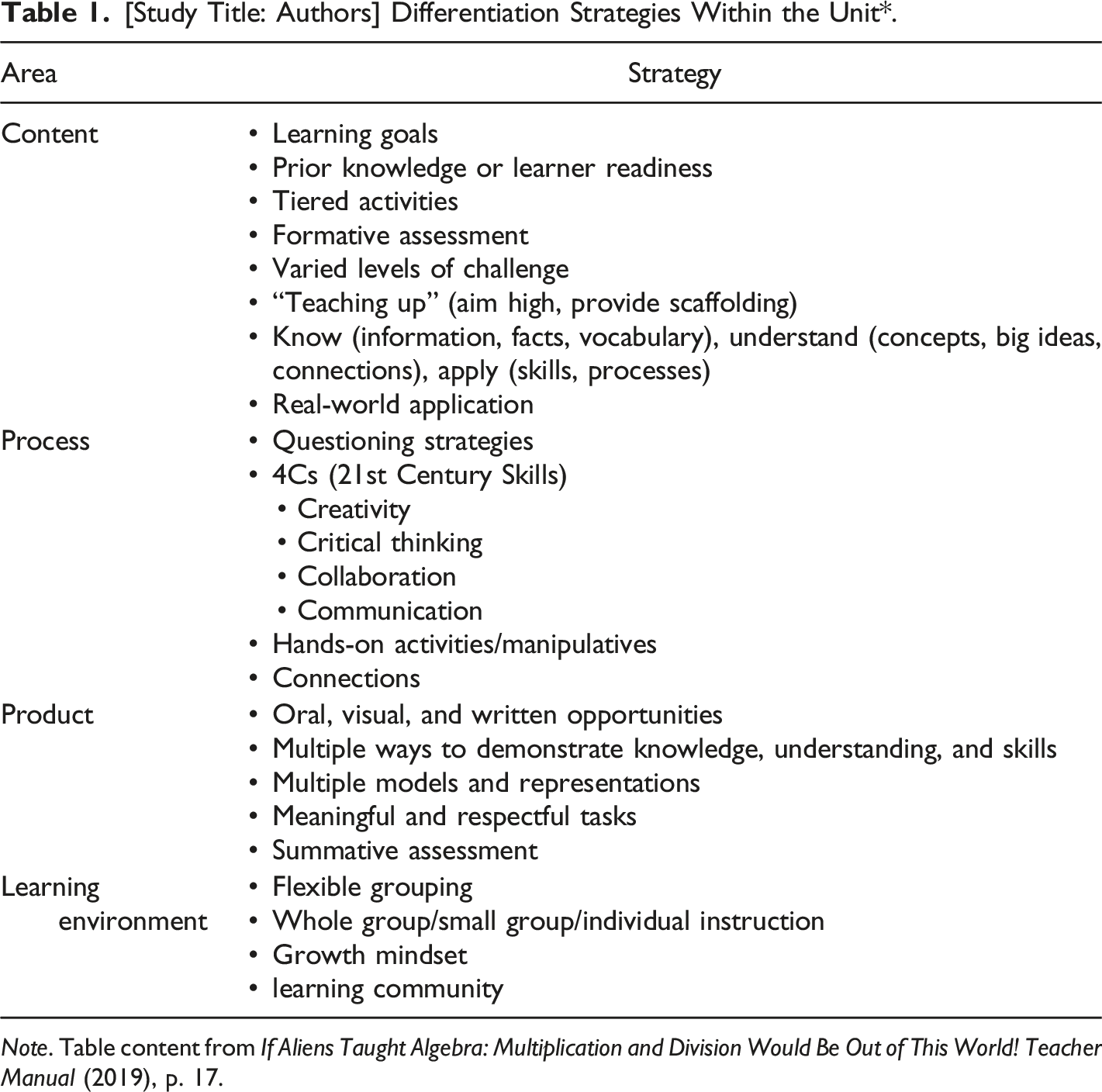
Note. Table content from If Aliens Taught Algebra: Multiplication and Division Would Be Out of This World! Teacher Manual (2019), p. 17.
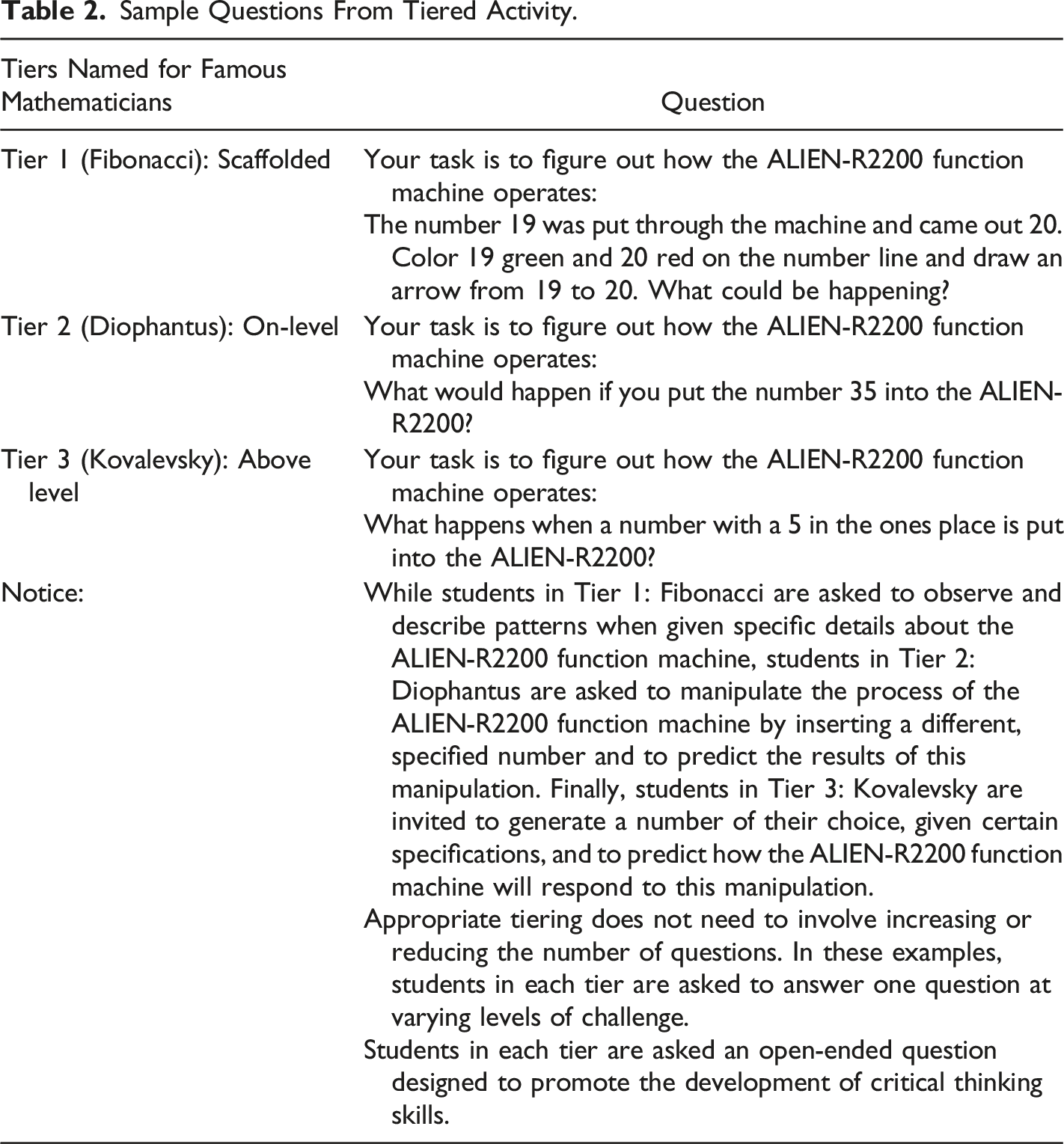
Sample Questions From Tiered Activity.
The mathematics unit was also infused with the 4Cs (i.e., creativity, collaboration, critical thinking, and communication; Battelle for Kids, 2019) and research-based mathematics standards published and promoted by the National Council of Teachers of Mathematics (NCTM, 2000), including the Common Core Mathematical Practices.
As previously mentioned, Davis and Krajcik’s (2005) educative curriculum materials model was utilized. Educative curriculum is designed to promote student learning; however, there are strategies that can be used to ensure it serves as a tool for teacher learning as well. For example, in the differentiation section of the teacher’s manual, the following information is provided: This mathematics unit presents differentiated content that will engage and challenge students appropriately. Most lessons are differentiated based on students’ readiness levels. The content presents greater complexity and goes into greater depth for students who are more familiar with the concepts. Throughout the unit, students will have many opportunities to work together in flexible groups. When grouping students, teachers will often do so based on readiness for that lesson (using the unit pretest as a guide). Teachers may also consider grouping students because they used different methods, which encourages students to focus on conceptual understanding. Groups throughout the unit should be flexible and purposeful to support prior knowledge or learner readiness. It is important that each group member is challenged to think during lessons. (Cole et al., 2019, pp. 17–18)
Participating teachers are provided this information in the teacher’s manual and it is further discussed in the professional development prior to implementing the unit (more information in the following section). Teachers then have the opportunity to put this strategy (i.e., flexible grouping with differentiated tasks) into practice. Finally, at the next professional learning session teachers can reflect on their experience with this strategy and how it supported student learning.
The study incorporated a curriculum designed to provide teachers with experience and understanding of differentiation, mathematical discourse, and tenets of talent development.
Professional Learning
To prepare teachers to implement the unit, they attended 2 days of professional learning. The first professional learning occurred before the implementation of the unit. The initial full-day session included learning about the rationale used in the development of the unit (e.g., gifted pedagogy, differentiated instruction/curriculum), exploring the structure of the unit, and participating in a lesson simulation. Teachers were provided time to explore the teacher manual and Student Mathematician Notebooks (i.e., student workbooks that included all tiered activities in one location). Teachers also learned about using a preassessment to flexibly group students by lesson topic and adjusting groups further based on teacher perceptions of learner readiness. The second session was held about halfway through the implementation of the unit; teachers were provided time to discuss their experiences implementing the unit, explored characteristics of gifted students, and learned about twice-exceptional students and culturally, linguistically, and economically diverse students.
Data Collection
Teachers were involved in several data collection tasks. They were asked to complete pre- and post-surveys on teacher beliefs. Teachers were also asked to allow the research team to observe one math lesson from the unit. At the conclusion of implementation, teachers were asked to complete a teacher log and to participate in an interview. This manuscript focuses on findings from teacher interviews, which are discussed in more detail in the following section.
Interviews
Teachers were asked to participate in an interview after the completion of the unit. The interviews were semistructured and lasted between 30 and 45 minutes. The research team asked teachers to share their reactions to implementing the math unit, including opinions about the math unit, student reactions to the unit, ability of the unit to challenge students and develop talent, and opinions about the predifferentiated and enriched approach. 1
Data Analysis
Teacher interviews were analyzed qualitatively in multiple phases. After the interviews were transcribed, they were uploaded to Dedoose, a qualitative coding software. To begin the analysis, the lead researcher read through all of the interview transcripts. The researcher then engaged in holistic coding, a preliminary, deductive coding method to section the interview data by interview questions (Saldaña, 2016). The interviews were reviewed by code before the researcher proceeded with the second phase of analysis, open coding.
Open coding (i.e., initial coding) is an inductive analysis procedure (Merriam & Tisdell, 2016; Saldaña, 2016). Open codes were assigned to chunks of data; these were designed to be representative of teacher comments. After the conclusion of open coding, axial coding began. The axial coding process involved the research linking several codes together to create an overarching category that was representative of the codes (Grbich, 2013). Finally, the researcher engaged in selective coding. During this process, the researcher completed numerous readings of teacher comments to determine which categories could be merged to become themes.
Trustworthiness
To establish trustworthiness of the qualitative analysis, the researchers attended to credibility, transferability, dependability, and confirmability. Credibility was established by having Authors 1 and 2 work independently and interdependently as they implemented the study and discussed emergent findings. Transferability was confirmed due to the nature of the participants in the study, who represented 17 schools from five different states spread across the county. To establish dependability, more than one researcher was used in each step of data collection, data analysis, and reporting. Authors 1 and 2 conducted interviews separately. While Author 1 conducted the primary analysis of the interview data, Author 2 reviewed the transcripts to confirm the coding and findings suggested by Author 1. In any case where there was a disagreement in coding or interpretation, Author 1 and Author 2 met to discuss the transcript in question before ultimately making a decision. Finally, the findings are directly based on responses from participants engaged in the study. To further establish confirmability, the authors’ reflexivity statements are provided below.
Reflexivity Statements
Author 1 is a recent Ph.D. graduate of the Department of Educational Psychology with a focus on gifted education and talent development. Prior experiences include 5 years of teaching, one year as an elementary general education teacher, and 4 years as a gifted teacher/gifted program coordinator.
Author 2 is a professor in the Department of Educational Psychology with a focus on gifted education and talent development. Background experiences include 11 years of teaching in elementary general education classrooms and as a gifted specialist with elementary and middle school students. Additional teaching experiences and research experiences are at the university level for more than 30 years. National implementation of research studies involved quantitative and qualitative methods based on specific grant-based research questions.
Author 3 is a doctoral student in the Department of Educational Psychology with a focus on gifted education and talent development. Prior experiences include education and training in secondary English language arts classrooms and special education classrooms, as well as 2 years of substitute teaching for students at all grade levels.
Author 4 is a doctoral student in the Department of Educational Psychology with a focus on creativity, gifted education, and talent development. Background experiences include 5 years working as an educational assistant in public elementary therapeutic classrooms.
Findings 2
Teachers were provided with examples of differentiation through the curriculum. After reviewing the teacher interviews in response to the research question: What are teachers’ perceptions of differentiation following implementation of a Grade 3 math unit on algebraic thinking, multiplication, and division? Several findings related to teachers’ perceptions of differentiation emerged. Implementing the curriculum enhanced teachers’ understanding of differentiation of content and the value of differentiation for their students. Further, teachers understood how to implement content differentiation. However, several barriers to implementing further differentiation of content in math or other subject areas persisted, including lack of resources and time.
Differentiation Is Valuable
Teachers reported participation in the study led to an understanding of differentiation and its value. Ms. Mason explained: I learned that I would tend to teach the lesson and then give everyone the same assignment whereas through . . . with the If Aliens Taught Algebra: Multiplication and Division Would Be Out of This World! unit I really did like how I was able to group the students according to the . . . [pretest] and then give them the work that was most effective for them, so they were just being challenged enough and everything wasn’t the same for each student. (Interview, Teacher 6547, Goddard Elementary, 6/4/20)
The tiered activities in the lessons were new for her, but she was able to see how differentiation of content was beneficial for her students.
Ms. Little shared a similar reaction to the tiered activities, “I think it’s great because every student just has different math concepts, different assumptions . . . so having it tiered like that allows them to work on their ability based on the topic” (Interview, Teacher 1921, Acorn Elementary, 5/22/20). Differentiating the content of the individual activities for her students allowed them to work at their own level.
The majority of teachers noted implementation of the curriculum illuminated a type of differentiation they had not used in the past. However, Ms. Phillips commented she had utilized differentiated activities before but had stopped, “In years past I have done it and I sort of have let go of it. Because of course it is a tremendous amount of work, but I think it is worth it” (Interview, Teacher 2822, Crest Ridge Elementary, 5/7/20). She further explained that she would begin offering differentiating activities in math again.
Teachers recognized differentiation of content was valuable and that it was something they should be utilizing in the classrooms. Having differentiated material readily available made it easier for teachers to meet students’ needs. Ms. Mason shared how she used this to meet her students’ needs: Sometimes I had the lower kids who scored low on the pretest and they breezed right through some of the easier lessons [even though they did not know the content on the pretest]. So, I was able to move them up to the middle [tier] or even the harder [tier]. (Interview, Teacher 6547, Goddard Elementary, 6/4/20)
Although pretest scores led the teacher to believe students should be placed in the lowest tier, she was able to shift the students to a more appropriate tiered activity after seeing students’ performance during the lesson.
Having the differentiated materials ready not only allowed teachers to easily differentiate for students but also allowed students to challenge themselves if they decided they were ready. Mr. Wood explained: I like that there was the potential for the kids to go [to a] higher or lower [tier]. I liked that . . . [if the students had finished] they can go up into the higher end [tier]. I got to see maybe the possible potential that they didn’t know they had and they’re not displaying all the time. (Interview, Teacher 4915, Oakwood Elementary, 6/4/20)
He further explained the benefit of having the differentiated materials prepared in advance stating, “If they have it, they’ll do it instead of asking” (Interview, Teacher 4915, Oakwood Elementary, 6/4/20). Having the materials readily available allowed his students to work at their level and provided insight into their abilities.
Overall, teachers reported that participating in the study helped them understand the value of differentiation and having differentiated materials. When teachers had the differentiated materials readily available and prepared for the students, they were able to meet students’ needs and work at their ability level without burdening the teacher with a search for additional resources.
Curriculum Can Support Teachers in Understanding Differentiation
Teachers realized differentiating content for students was important and many noted their experience with the curriculum led to this realization. Ms. Judd explained, “I think I will be changing my teaching because of this exposure. I think it can happen across the board in all math topics” (Interview, Teacher 4615, Oakwood Elementary, 6/5/20).
Ms. Fuller agreed; she had been differentiating content in language arts with tiered activities but planned to expand to math. She shared, “I was really doing that in literacy beforehand, but like I said, I want to incorporate the three levels into my independent [time] in math” (Interview, Teacher 5543, Rama Elementary, 4/9/20).
Additionally, teachers explained gaining an understanding of how to differentiate content for their learners. Ms. Minnow noted it needed to be “beneficial and valuable enrichment” (Interview, Teacher 5845, Sellers Elementary, 4/20/20). She elaborated on how the curriculum prompted her thinking: I need to provide extra for them because they [high-ability learners] do typically go through material faster than the other students. So, you definitely need to provide enrichment . . . . You know sometimes as teachers we get busy, but I think making it valuable. (Interview, Teacher 5845, Sellers Elementary, 4/20/20)
She said sometimes because she was busy, she just found an assignment for a specific student to do but recognized how important it was that these tasks were respectful of the learner’s needs.
Similarly, Ms. Brooklyn explained her knowledge of student learning changed in that she understood the importance of selecting differentiated tasks. She elaborated: It wasn’t always about giving themI think there is always a misconception about if there are higher learners you need to give them more work, but it’s not really about more work, it’s the depth of knowledge for the kids. (Interview, Teacher 5744, Mintage Elementary, 5/18/20)
She recognized the importance of the depth of knowledge for her students. She explained this came from “seeing all the differentiation laid out in front of me with one lesson definitely helped, too” (Interview, Teacher 5744, Mintage Elementary, 5/18/20).
In addition to realizing how important differentiation was for learners, teachers reported learning how to differentiate from implementing the curriculum. Ms. Mascena discussed why she typically does not differentiate. She shared: We have so much pressure to stick to a schedule of x amount of lessons a week. I think I concentrate more on the typically performing students and more of just making sure I complete the lessons rather than differentiating the lesson as much as I should . . . . But I think that the Thinking Like Mathematicians study showed me that it’s not that much of a stretch to differentiate. (Interview, Teacher 3324, Valley Center Elementary, 5/11/20)
The curriculum provided her with an example of differentiation that she believed was attainable: So, I think the Thinking Like Mathematicians study made me think about such simple ways I can differentiate. A lot of the time in the If Aliens Taught Algebra: Multiplication and Division Would Be Out of This World! unit it was more of just changing the numbers instead of working with five and three it was more like okay, let’s bump it up to 15 and 30 or 500 and 300. [I began] thinking about ways to differentiate without having to recreate the whole lesson. (Interview, Teacher 3324, Valley Center Elementary, 5/11/20)
Similarly, Ms. Adams, shared how she approached unit implementation: I was more apt to kind of like think deeper about differentiation and try to find the resources to help [students] work with, especially multiplication and things like that, that was brand new to them. So, I felt like it [participating in the study] was super helpful. (Interview, Teacher 1121, Acorn Elementary, 5/12/20)
The curriculum offered an example of effective differentiation through the tiered activities present in the Student Mathematicians Notebook. Coupled with the Teacher Manual, teachers gained experience with differentiation, which resulted in a better understanding of how to differentiate. For some teachers, this also resulted in a willingness to differentiate more in their own classrooms.
High-Ability Learners Need More Differentiation
Implementing the curriculum supported teachers’ understanding that differentiation was possible in their classroom, but also that their high-ability learners needed more differentiation. Throughout implementation, teachers were able to see how student engagement changed when provided with differentiated materials. Ms. Mascena shared: Just by putting them in [tiered] groups it is almost like they were living up to their potential. Whereas normally they would have just completed the work that was at grade level and I would say okay they understand it. I could see them [the students] starting to shine just because they were given more of a challenge. (Interview, Teacher 3324, Valley Center Elementary, 5/11/20)
Ms. Mascena noticed her students could work at a higher level when she differentiated and that she was able to see their potential. Ms. Kingsly reported a similar change in one of her students. She explained: I think the higher kids sometimes feel bored and that’s one of the problems with the student that I was talking about with the behavior problem. He wasn’t engaged; he just wasn’t having it. Even though he had that math brain [high math ability] in Second Grade it wasn’t fostered yet. (Interview, Teacher 3514, Forest Elementary, 2/25/20)
When her student was finally challenged through participating in the If Aliens Taught Algebra Multiplication and Division Would Be Out of This World! unit, she noticed he enjoyed math more and his ability was more prevalent.
Ms. Little agreed with Ms. Kingsly that some of her students were bored with regular curriculum, stating implementing the unit “really helped me because sometimes they [the students] get bored with the regular work and this gave them a chance to explore some higher thinking” (Interview, Teacher 1921, Acorn Elementary, 5/22/20).
Implementing the If Aliens Taught Algebra: Multiplication and Division Would Be Out of This World! unit helped teachers understand the importance of differentiation for student engagement and enjoyment.
Differentiation Is Important for Student Performance
The experience implementing the If Aliens Taught Algebra Multiplication and Division Would Be Out of This World! unit illuminated the importance of differentiation for student performance. Ms. Simpson summarized her understanding that “If you set the bar high, you’ll get more from the student” (Interview, Teacher 3424, Valley Center Elementary, 5/13/20).
Ms. Judd developed a similar understanding through implementing the curriculum. She explained: The If Aliens Taught Algebra: Multiplication and Division Would Be Out of This World!unit definitely made me think differently about all of my kids, not just the ones that I would have considered a gifted math student, but all of them. It made me open my eyes a little wider and say, you know what, let’s not pigeonhole kids here and offer everybody that wide experience. I’ve always believed that if you raise the bar to a certain level that’s where kids are going to reach to, so set it high and they surprise you. (Teacher 4615, Oakwood Elementary, 6/5/20)
Providing advanced work through the tiered activities to a broader group of students demonstrated improvement in student performance.
Ms. Cristian noticed her students were eager to challenge themselves and work at a higher level. Tiered lessons were identified by the names of famous mathematicians: Tier 1: Fibonacci (scaffolded); Tier 2 Diophantus (on-level); Tier 2 Kovalevsky (above level). She shared that students would: work at their level and then kind of push themselves for a challenge to go to the next higher level group whether they were in the low group or in the medium group which was kind of nice. So, towards the end for us they knew that it [the tiers] was more challenging so they liked feeling successful at completing the tasks that they were given and then you know, being willing to look for more challenging tasks. (Interview, Teacher 4515, Oakwood Elementary, 6/5/20)
Ms. Cristian’s students would finish their assigned tiered activity and then ask to work at the higher tier. Ms. Brooklyn had the same experience with her students who were assigned to the below-level and on-level tier. They often wanted to do the above-level tier and found that “they would do an excellent job” (Interview, Teacher 5744, Mintage Elementary, 5/18/20).
Providing differentiated opportunities for students positively affected student performance. One teacher found that opposed to assigning her students to the tiered activities or allowing students to move to a more challenging tiered activity after they finished their assigned work, she could allow students to select their own tiers based on the level of challenge they needed. Ms. Apple described her process: I also liked them being able to choose and kind of observe how reflective they could be in their own math work. Most of the time they did choose appropriately as far as what [tiered] group. I liked how maybe they would choose a certain area [tiered group] and then they would recognize themselves that you know “this is too challenging for me, I should be working in a different group” or “this isn’t challenging enough so I want to work in the Kovalevsky [Tier 3 highest] group.” (Interview, Teacher 4415, Oakwood Elementary, 6/5/20)
After participating in some lessons of the unit, students were able to select their own level of differentiation through the tiered activities provided in the unit. Teachers noticed that if the tiers were assigned to students or if students were selecting their own tier, the presence of differentiated activities made students want to work at higher levels.
Barriers to Differentiation
Although teachers recognized the benefits of differentiation and some teachers learned that differentiating in math was more accessible than in the past, many teachers explained that differentiation was difficult to implement. Teachers identified the primary challenges as the lack of available resources in their school districts and time.
Lack of Resources
Ms. Apple explained that for her, it is easier to work with students who need support reaching the grade level standard as opposed to those who have already met the standard. She shared: You know it’s easy to support a struggling mathematician. You know there is always a way to say go back to something or to get more concrete, but it’s not necessarily always easy to enrich your stronger mathematicians within what you’re currently doing, and I think that’s the trickiest part for me. I don’t necessarily want to go into the next grade and touch that material. I want to stay within the same concept but that’s always something that’s tricky to do as far as staying within the same concept. (Interview, Teacher 4415, Oakwood Elementary, 6/5/20)
She explained it was easy in the If Aliens Taught Algebra Multiplication and Division Would Be Out of This World! unit, but because the resources do not exist in the district curriculum it becomes challenging to support high-ability students. Ms. Rain agreed that the district curriculum is not set up for differentiation and does not provide the needed resources. She elaborated: If I did not have the If Aliens Taught Algebra Multiplication and Division Would Be Out of This World! unit this year I really don’t think that the three kids that I feel like will end up being [identified as gifted in math], I don’t think they would have had any challenging experience if I just did the [district curriculum]. I would still have to go and pull or something [challenging], but I just don’t feel there is a lot of that out there. (Interview, Teacher 6346, Springwoods Elementary, 5/7/20)
Although she would try to find differentiated materials for her students, she did not believe there were adequate materials available.
Even when teachers had access to district mathematics curriculum that was differentiated, teachers stated they did not always use it. Ms. Apple commented: We do have areas in our textbook where it says like for differentiation you can do this [strategy] as far as helping your struggling math students and [this strategy] as far as enriching, but I will say I don’t always use them. [However] I would always use the If Aliens Taught Algebra Multiplication and Division Would Be Out of This World! lessons because they were right there for you. They were set for you and it made it so much easier to differentiate and took out a lot of the planning piece as far as you know pulling that together, which I would have had to do with [the district curriculum] that we teach. (Interview, Teacher 4415, Oakwood Elementary, 6/5/20)
Although the district curriculum had suggestions for differentiating for students, it was not as easy to use as the If Aliens Taught Algebra Multiplication and Division Would Be Out of This World! unit, so the teacher used it less frequently.
Ms. Kingsly’s district curriculum offered reproducible differentiated activities; however, she does not frequently use them. She shared her opinion of the curriculum: [The district curriculum] has differentiated [activities] which you cycle along with the lesson, but I don’t use them very much. I just take the on-level worksheet and I will differentiate it because I noticed that [for] the intervention group, that worksheet is just too easy. . . . Whereas the challenging worksheet is way over their heads. (Interview, Teacher 3514, Forest Elementary, 2/25/20)
She described the difference in the differentiated activities offered in the If Aliens Taught Algebra Multiplication and Division Would Be Out of This World! unit explaining: I definitely like the If Aliens Taught Algebra Multiplication and Division Would Be Out of This World! unit and how that was all differentiated and it really did target the intervention group, it targeted the on-level [group], and then it provided some good higher order thinking [for the above-level group]. At first, the higher group had a hard time with it, but as soon as they kind of got in the hang of how to think and how to work together they were able to do those [activities]. Whereas I think the [district curriculum] worksheet is just like a worksheet and I don’t like to just pass out worksheets just for them to do worksheets. (Interview, Teacher 3514, Forest Elementary, 2/25/20)
Even when differentiated activities were offered in the district curriculum, teachers explained they did not frequently use them because the quality did not meet their needs or they were not easy to use. However, when they had differentiated resources like those offered in the If Aliens Taught Algebra Multiplication and Division Would Be Out of This World! unit they were able to easily differentiate for students.
Time
The other frequent barrier to differentiation for teachers was related to a lack of time. Ms. Mascena had previously noted how she learned that differentiation could be easy, but ultimately time acted as a barrier: I think when they say differentiate at different levels it feels really overwhelming because as someone who teaches five different subjects a day it’s like: “How could I possibly do this for every subject?” And that sounds awful because we should be meeting the needs of all the children, but I’ve got 24 kids in my class and some can’t read and some who are reading at above grade level. So, when you try to think about meeting everybody’s individual needs in every subject all day, I think that’s a little bit overwhelming. (Interview, Teacher 3324, Valley Center Elementary, 5/11/20)
She noted it is an area that she wants to continue to improve on, but the lack of time can be very overwhelming.
Ms. Daphne also described thinking about differentiating after participating in the Thinking Like Mathematicians: Challenging All Grade 3 Students study, but she noted the district had recently started a new math curriculum and she was “already kind of overwhelmed with all of the components [of the new district curriculum].” She further explained, “I definitely was thinking about it [differentiating] and wanting to find ways. Just ultimately the time [is a barrier]” (Interview, Teacher 1631, Waterlily Elementary, 5/21/20).
Ms. Donahue noted that she had been using differentiated groups in her math curriculum, but it would not be possible in other curriculum areas due to a lack of planning. She elaborated, “[the school year] is just too rushed and [there is] not nearly enough planning time for it [differentiation], but I mean it’s something I could really think about during summer vacation” (Interview, Teacher 2722, Crest Ridge Elementary, 5/7/20). Because of limited planning time during the school year, she would need to spend summer vacation planning and developing differentiated materials for other subjects.
Teachers reported a lack of pre-differentiated resources as a barrier. Ultimately, these resources would need to be created and there is not enough time. Ms. Lansing explained differentiated resources are “not something you can whip up” (Interview, Teacher 3023, Chrome Elementary, 5/14/20). Without time, teachers cannot effectively differentiate for their students.
Discussion
The present study examined postimplementation interviews to explore teachers’ perceptions of differentiation following the implementation of the predifferentiated, tiered, and enriched If Aliens Taught Algebra Multiplication and Division Would Be Out of This World! unit. The findings from this study indicated implementing the If Aliens Taught Algebra Multiplication and Division Would Be Out of This World! unit provided teachers with an understanding of the purpose and benefits of differentiation. Teachers reported they noticed a difference in student engagement when provided with differentiated work and that students met their “potential” when they worked at higher levels. Although teachers reported the benefits of differentiation during the interviews, few teachers felt confident they could consistently differentiate in their mathematics classroom due to a lack of resources and time to develop resources (Goodnough, 2010). Several key findings from this research are discussed in more detail in the following section.
Curriculum as a Professional Learning Opportunity
As previously noted, the If Aliens Taught Algebra Multiplication and Division Would Be Out of This World! unit was designed to be an educative curriculum (Davis & Krajcik, 2005) that promotes teacher professional learning. Teachers reported gaining a better understanding of the purpose of differentiation and how to differentiate. Specifically, teachers reported understanding why differentiation was important for their students and recognized differences in their students’ engagement when they used differentiated curriculum in math. Further, the act of teaching the curriculum over time provided teachers with examples of a method of providing differentiated content through tiered activities. The educative curriculum used in the study was able to aid in teacher understanding (Davis & Krajcik, 2005).
Designing curriculum to serve as a professional learning tool may be a promising practice to support teacher’s understanding of how to differentiate. A professional learning model, similar to the one used in the Thinking Like Mathematicians: Challenging All Grade 3 Students study that utilized two sessions and an educative curriculum, meets best practices for professional learning as it (a) promotes differentiation, (b) includes coaching and modeling, (c) provides practical implementation strategies, (d) emphasizes sustainability, and (e) makes explicit connections to the classroom (Gubbins et al., 2014; Gubbins & Hayden, 2020; Hunzicker, 2011; Plunkett & Kronborg, 2011; Wycoff et al., 2003).
Addressing Barriers to Differentiation
Although the professional learning and curriculum implementation supported teachers’ understanding of the purpose of differentiation and how to differentiate, teachers indicated there were barriers to incorporating more differentiation of content into their classroom. Similar to Goodnough’s 2010 study, teachers reported a challenge to be the availability of differentiated curriculum supports in the district and limited time to create resources. Even when teachers had access to district math curriculum that included content on differentiation, teachers noted it was not sufficient.
Limitations and Suggestions for Future Research
There are several limitations to this study, including the small sample of teachers that represented a limited number of states and school districts. In addition, teachers who were in the study voluntarily participated and may have been interested in implementing new math curriculum and improving their math practice. As relationships between teachers’ demographic characteristics and their perceptions of differentiation were not examined, an in-depth exploration of teachers’ lived experiences (e.g., using interpretative phenomenological analysis) could help replicate and clarify these findings. Future research is needed to replicate these findings and triangulate them with additional methodologies. Additionally, there were only 2 full-day professional learning sessions, and it would be useful for future research to examine teachers’ perceptions of differentiation following longer term professional learning. Finally, given that the study investigated differentiation specifically in mathematics, these findings may not be generalizable to instruction in other areas. Additional research is needed to assess whether similar patterns emerge in other subjects.
Implications and Conclusion
Use of a multi-session professional learning and educative curriculum can be successful in supporting teachers’ understanding of differentiated content and the purpose of differentiation. Teachers agreed there was value to differentiation and believed it was a positive aspect of the If Aliens Taught Algebra Multiplication and Division Would Be Out of This World! unit. However, this type of professional learning may not be enough to influence lasting teacher change and increases in differentiation in the classroom. Professional learning developers, coaches, and school districts must also provide time and comprehensive resources so teachers are able to effectively incorporate differentiated content into their instruction. Offering this support to teachers in heterogeneous classrooms is a necessary step to provide gifted and talented students with meaningful, developmentally appropriate learning opportunities.
Footnotes
Declaration of Conflicting Interests
The author(s) declared no potential conflicts of interest with respect to the research, authorship, and/or publication of this article.
Funding
The author(s) disclosed receipt of the following financial support for the research, authorship, and/or publication of this article: This work was supported by Jacob K. Javits Gifted and Talented Students Education Program, United States Department of Education PR/Award # S206A170023, Thinking Like Mathematicians: Challenging All Grade 3 Students.
