




Abstract
Differentiated instruction (DI) is an effective instructional strategy to maximize individual students’ abilities; in practice, however, its implementation appears to be problematic. To better understand teachers’ perspectives on DI and the effect different teaching contexts can have, we explored teachers’ interactive cognitions of DI in their regular lessons and in “talent lessons.” Four stimulated recall interviews were conducted with a sample of secondary school teachers (n = 4) in the Netherlands. We found that teachers’ interactive cognitions varied depending on the context. More specifically, it appeared that in the “talent lessons,” teachers focused more on small groups or on individual students than they did in the regular lessons. Also, regardless of context, teachers often take student characteristics into account, but how they do this varies among teachers. This study provides a valuable starting point for professional development trajectories and aimed to develop teachers’ implementation of DI while taking individual differences among teachers into account.
Differentiated instruction (DI) is a pedagogical approach to challenge each student to further develop their talents and abilities by taking the students’ individual learning needs into account (Brighton, 2003; Tomlinson et al., 2003). The large body of international research into DI has shown that it appears to be effective in maximizing students’ learning, though difficult to implement (Deunk et al., 2015; Graham et al., 2008; Janssen et al., 2016; Roiha, 2014; Tomlinson, 2005; Tomlinson et al., 2003). Teachers report to have problems with implementing DI because of several difficulties: They feel constrained by large class sizes (approximately 25 students), physical classroom settings, and a set curriculum (Janssen et al., 2016; Roiha, 2014). Consequently, little DI has been observed in teachers’ classroom practices (Deunk et al., 2015; Dutch Inspectorate of Education, 2016). Students with high abilities in certain subjects may not feel motivated to learn, and thus not achieve to their full potential (Tomlinson et al., 2003; Westenberg, 2011).
Most of the studies in this area use observations and semi-structured interviews to relate teachers’ knowledge and practices of DI (e.g., Graham et al., 2008; Roiha, 2014; Roy et al., 2013). Methods mainly focus on the more stable knowledge and beliefs the teachers have about teaching and DI (Meijer et al., 2002). To get a full grasp on the complex reality of classroom teaching and teachers’ knowledge regarding DI, it is important to also study this knowledge during teaching by focusing on teachers’ interactive cognitions (ICs; Meijer, 1999; Verloop, 1989). These ICs can be described as the (un)conscious cognitions that teachers have during their teaching and are influenced by the earlier mentioned more stable knowledge and beliefs about teaching (Meijer, 1999; Meijer et al., 2002; Verloop, 1989). In the context of DI, it is important to study these ICs, because these provide us a more detailed insight into how teachers engage in forms of DI by staying close to the teachers’ classroom practices (Stollman et al., 2019).
In this study, we explored the teacher perspective on DI by investigating teachers’ ICs of DI in different learning environments. Specifically, we studied the same teachers in their regular classroom environment and in an extracurricular environment, known as “talent lessons.” These talent lessons were provided in specific subjects to students who had previously demonstrated strong performance and interest in these subjects. Talent lessons were also distinct from regular lessons in that teachers did not have to follow a set curriculum, and they were encouraged to differentiate their instruction to further develop the students’ abilities. Our aim was to obtain a comprehensive view of teachers’ ICs of DI and to determine whether particular aspects of the two different learning environments (e.g., student population) are associated with differences in teachers’ ICs of DI. This understanding is fundamental to the design of professional development trajectories aimed to develop teachers’ competence to maximize the individual learning potential of their students.
Theoretical Background and Conceptual Framework
DI for High-Ability Students
As a consequence of increasing diversity in classrooms over the past few decades—for example, through inclusion of special needs and talented students—teachers of regular classrooms are required to (further) develop their ability to take different student needs into account, thereby helping every student to feel challenged to achieve to their fullest potential (Brighton, 2003). DI is a pedagogical approach that teachers can use to accomplish this goal. DI is a concept with its roots in gifted education (Brighton, 2003; Tomlinson et al., 2003) and can be defined as an approach to teaching in which teachers proactively modify curricula, teaching methods, resources, learning activities, and student products to address the diverse needs of individual students and small groups of students to maximize the learning opportunity for each student in a classroom. (Tomlinson et al., 2003, p. 121)
A specific group of students often left out when teachers differentiate their instructions are the high-ability or talented students (Reis & Boeve, 2009; Rubenstein et al., 2015). Teachers often apply convergent DI: A teacher chooses to set minimum goals that each student should reach and guides each student appropriately to these goals (Bosker & Doolaard, 2009; Deunk et al., 2015). High-ability students who have less difficulty reaching those minimum goals may consequently receive little attention from the teacher and are, thus, less stimulated and challenged to reach their full learning potential (Denessen, 2017; Deunk et al., 2015). The type of DI that typically does challenge high-ability students is divergent DI, which is also the ideal type of DI the teacher should aim for according to Tomlinson et al.’s (2003) definition of DI. In divergent DI, teachers aim to get as much out of every student as possible, meaning they pay equal attention to all students (including high-ability students). Although divergent DI seems the most ideal type of DI for high-ability students, convergent and divergent DI do not necessarily exclude each other; teachers can use a combination of both, where convergent DI is the base and divergent DI is used to challenge especially high-achieving students even more (Deunk et al., 2015).
Difficulty of Implementing DI
By differentiating instruction, teachers, together with their students, capitalize on their strengths and overcome their weaknesses (Corno, 2008), and therefore take their students’ individual learning needs into account (Smit & Humpert, 2012; Subban, 2006; Tomlinson et al., 2003). These learning needs can be typified by three student characteristics: (a) student readiness—students are best taught through their zones of proximal development; (b) student interest—when individual students’ interests are stimulated in instruction, their engagement is enhanced; and (c) student learning profile—the students’ preferred modes of learning (Tomlinson et al., 2003). In this definition of DI, also referred to as academic DI, there is mainly a focus on teachers adapting their instruction to a variety of student differences such as motivation, performance, and learning preferences (Severiens, 2014). Literature focusing on DI also mentions cultural DI, which can be considered similar to teaching for equity and focuses more on addressing students’ cultural backgrounds and creating equal status relationships (Cohen & Lotan, 1995; Severiens, 2014). In this article, we refer to Tomlinson et al.’s (2003) definition of academic DI.
In addition to detailing these pedagogical approaches of DI, the literature also makes a distinction between proactive and reactive DI. In proactive DI, teachers try to account for differences between students before the instruction takes place, whereas in reactive DI, teachers’ response to students’ needs is more ad hoc, as it occurs during teaching (Denessen & Douglas, 2015; Tomlinson et al., 2003). Although proactive DI is considered necessary for effective DI, this type of DI is considered more difficult by teachers: It requires planning time they often do not have (Janssen et al., 2013; Tomlinson et al., 2003). Reactive DI is thus a reality in teachers’ classroom practices even though it is not considered the most effective way to take students’ different learning needs into account (Denessen & Douglas, 2015).
Because of these different elements of DI, teachers experience difficulties with implementing it in their practice (Deunk et al., 2015). However, these difficulties have, to date, only been studied with interview, observational, and survey studies (Deunk et al., 2015; Graham et al., 2008; Roiha, 2014). These studies focused on relating teachers’ (reported) practices to the broad definition of DI and judged whether the quality of these practices was high enough to call it DI. The next logical step is a study that investigates what teachers do during teaching to challenge students with high abilities in certain subjects, why they do what they do, and how they take differences between students into account. To gain a more complete insight into how teachers take account of their students’ needs during their teaching, and hopefully gain more knowledge of how to help teachers improve their implementation of DI, we studied this interaction between teachers’ knowledge and practices: the teachers’ ICs (Meijer, 1999). More specifically, we focused on teachers’ ICs of DI for small groups or for individual students while (a) providing instruction, (b) offering help, (c) calling on students, and (d) giving assignments (Tomlinson et al., 2008).
Teachers’ ICs
In the literature, teachers’ ICs are considered part of teacher knowledge (Meijer, 1999; Verloop, 1989). Teacher knowledge relates to teachers’ actions while teaching and accounts for the complexity of interactive teaching and thinking in action (Munby et al., 2001). The concept of teacher knowledge is based on the idea that there is reciprocity between the whole of teachers’ cognitions and insights and their activities in the classroom and can be grouped in two elements: (a) teachers’ knowledge and beliefs and (b) teachers’ ICs (Meijer et al., 2002; Verloop et al., 2001). The first element can be considered the more normative knowledge and beliefs teachers have about their practice. What is referred to as ICs within teacher knowledge is the knowledge that is active in a teacher’s mind during classroom teaching (Verloop, 1989). This type of knowledge is specifically important in the context of using DI strategies. Although teachers should aim to plan their use of these strategies in advance as much as they can, students’ individual needs and interests often become apparent during classroom teaching, requiring teachers to recognize them and respond to them on the spot (Denessen & Douglas, 2015; Tomlinson et al., 2003).
In addition, by focusing on teachers’ ICs of DI, a more comprehensive view can be gained through different actions that teachers undertake to take students’ differences into account. The earlier referenced survey, interview, and observational studies focused on the more stable knowledge and beliefs that are part of teacher knowledge (e.g., Brighton, 2003; Meijer et al., 2002; Roiha, 2014). In such studies, more singular actions that teachers undertake to account for differences between students are easily overlooked, as they become part of a bigger whole. Focusing on teachers’ ICs means that we stay close to teachers’ actual practices and uncover the singular actions and the knowledge embedded in those actions (Meijer, 1999; Verloop, 1989).
The Current Study
Studying teachers’ ICs of DI allows us to get a more comprehensive view of the different ways teachers engage in DI (Stollman et al., 2019). To account for the contextually dependent constrictions and opportunities to practice DI, we studied these ICs in the current study in two different learning environments: (a) the regular classroom context and (b) an extracurricular “talent lessons” context. In the talent lessons, teachers had to teach only highly able students in their subject, and teachers had to design new lessons and materials. Teachers had the freedom to depart from the regular curriculum, and they had a more homogeneous student group, which can mean that differentiating instruction might be easier for them in these lessons (e.g., De Neve et al., 2015; Roiha, 2014).
The following research question guided our study:
Method
Participants
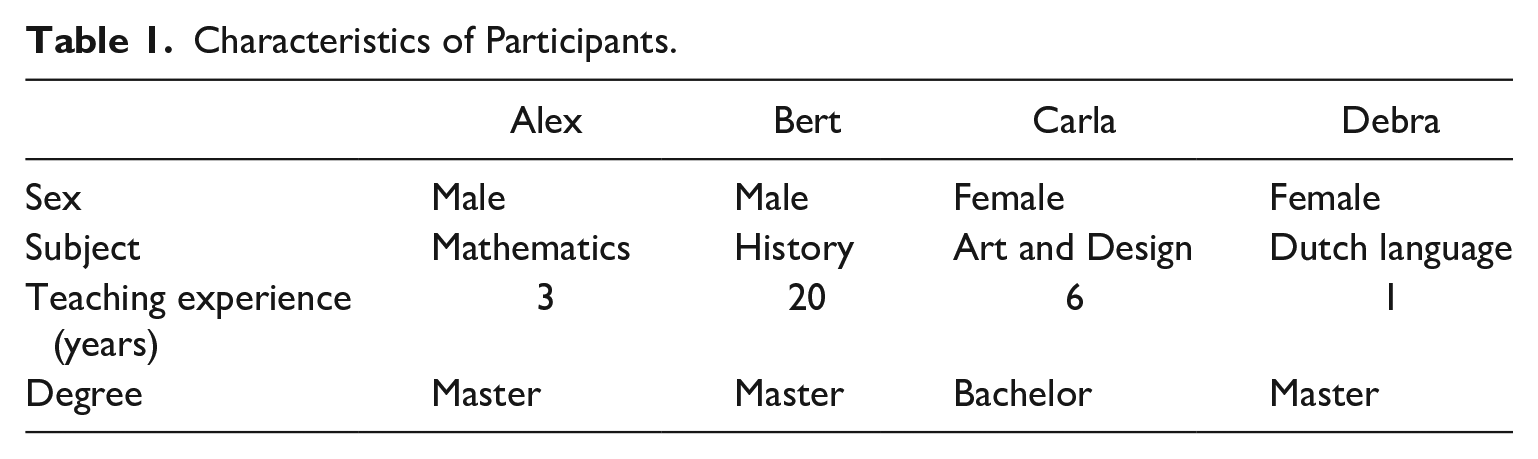
Eight first-grade 1 teachers (student age 12) of a secondary school for senior general secondary and pre-university education in an urban area in the Netherlands 2 were asked to participate in this study. The teachers were selected based on their subject clusters: science (e.g., biology, mathematics), language (e.g., Dutch language and literature, French), society (e.g., history, geography), and creative (e.g., art and design, drama). One teacher from each cluster was willing to participate. For the relevant characteristics of the participants, see Table 1.
Characteristics of Participants.
Context
Data were collected in a bilingual secondary school in the Netherlands. This school offers its language classes with Dutch as the primary language (Dutch is used in the French, German, Spanish, and Chinese lessons), whereas the other classes are taught in English. During the school year 2013–2014, the project GUTS (“Gedifferentieerd Uitdagen van Talent op School,” which is Dutch for “Differentiated Challenging of Talent in School”) took place in all first-grade classes of this school. All students participated in 10 talent lessons in three subjects they chose themselves. During Fall, they had two lessons in the first subject that they chose, four lessons in Winter in the second subject, and four lessons in Spring in the third subject. The aim of GUTS is in line with talent development literature, which suggests that opportunity and motivation are two central factors that can contribute to talent development (Reis & Boeve, 2009; Subotnik et al., 2011). The students chose the subjects based on two premises: (a) they had to be interested in the subject and (b) they had to achieve well in the subject. By providing all students the opportunity to spend more time on subjects they wanted to learn more about, these talent development lessons align with the concept of divergent DI (Bosker & Doolaard, 2009), as was the aim of this project. Aiming for divergent DI should provide greater motivation for students and improved achievement in the selected subjects, helping the talented students to maximize their learning potential (Dixon et al., 2014; Tomlinson et al., 2003). In GUTS, students were provided with opportunities to work more on their talents, and one goal was to increase their motivation by giving them choice. In addition, the hope was that increasing student motivation for these chosen subjects would also increase their motivation for school overall, or at least that their academic motivation would not decline, as is common at this age (McPhail et al., 2000).
The talent lessons, with a length of 100 minutes (2 lesson hours 3 ), all took place on Wednesday afternoons between November and June. These lessons did not have to parallel the regular curriculum, but the content had to be related to the subject matter from the regular curriculum. The teachers had to design new lessons that would be enriching and motivating for all students. To increase the likelihood that all students experienced the lessons as enriching and motivating, teachers were specifically requested to plan for DI in these lessons.
Procedure
Data collection
To investigate teachers’ ICs, stimulated recall interviews (SRIs) are commonly used (Meijer, 1999; Verloop, 1989). In studies of teacher planning, teachers’ ICs have often been investigated using think-out-loud protocols when they are planning their lessons. However, in think-out-loud protocols, teachers are asked to voice their thoughts while they have them during the performance of an activity (Meijer, 1999). When they are teaching, it is impossible for teachers to think out loud about what they are doing. SRIs solve this problem: Teachers’ lessons are recorded on video, and afterward, teachers are asked to reconstruct their thinking while they were teaching. The SRIs that were conducted for the current study took place in the mother tongue of the teachers (Alex in English, and Bert, Carla, and Debra in Dutch). All four participating teachers were observed twice while teaching—first during a talent lesson and second during a regular lesson, chosen together by the first author and the teacher. The observations were video recorded, and this video material was used to help the teachers to relive the lesson and think out loud about what they were thinking during a certain activity and why they were undertaking it. This served to elicit the teachers’ reasoning behind their activities, which could provide insight into their ICs (Meijer, 1999; Nguyen et al., 2013).
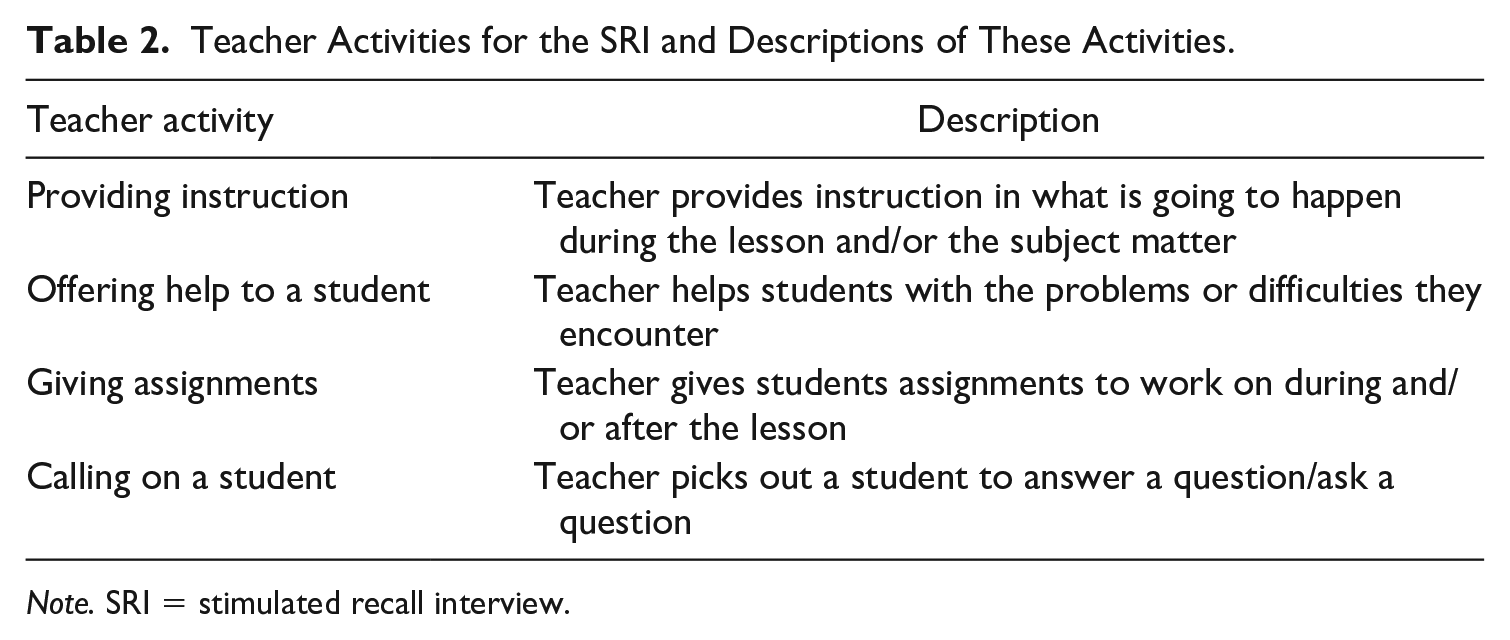
In many studies in which SRIs were used, teachers were shown whole videotaped lessons, and the teachers themselves paused the video when they were aware of having had a certain thought during an activity (Meijer, 1999; Verloop, 1989). As we were only interested in teacher knowledge of DI, we decided to show the teachers only those activities in which we expected they were using knowledge of students’ characteristics (Nguyen et al., 2013). This meant that the first author, who conducted the SRIs, selected clips from each videotaped lesson to discuss with the teachers. Each of the clips showed a teacher activity in one of the following categories: (a) providing instruction, (b) offering help, (c) giving assignments, and (d) calling on a student. The categories are explained in Table 2. We were specifically interested in teachers’ ICs during teacher–student interactions in the above-mentioned categories as these are common in teachers’ practice and likely to show up in both types of lessons. When watching the video clips afterward, it appeared that most teacher activities fell into one of these four categories.
Teacher Activities for the SRI and Descriptions of These Activities.
Note. SRI = stimulated recall interview.
In selecting the clips, we made sure that all teacher activities were discussed at least once in the SRIs. This would make a comparison of both environments and of the different teachers more feasible. Thus, four clips containing the four teacher activities were chosen. Further selection criteria for the video clips were quality (audibility and visibility) and best fit within the category. After each video clip, the teachers were asked what they were thinking during that particular activity, and what made them act in that way. To ensure the trustworthiness of the collected data, the interviews were all recorded on an audio recorder and afterward transcribed verbatim.
Data coding
The first step in coding the SRIs was coding the activities that were discussed in the interviews. In the transcripts of the interviews, the teacher activities were retraced and coded with the names of the categories in which they fell. In all interviews, talking about a certain activity triggered the teachers to also explain something about other activities that occurred during the lesson. These activities were also coded. It appeared that not all of these activities fell into the categories that were made up in advance. Therefore, a new category was added and named “checking up on a student,” now covering all activities in the collected data. The activities that fell into this category were teacher-initiated interactions where the teacher was walking around the classroom, looking at or asking about what and how the students were doing.
After coding the teaching behavior, teachers’ ICs were coded. A teacher’s reasoning behind an observed activity was considered an IC. If the teacher’s IC showed teacher knowledge of a student’s needs, a code with a student characteristic (readiness, interest, and/or learning profile) as described by Tomlinson et al. (2003) was added to the teacher activity code. Table 3 shows the student characteristic codes with their descriptions.
Codes of Teachers’ Interactive Cognitions of Student Characteristics and Their Descriptions.
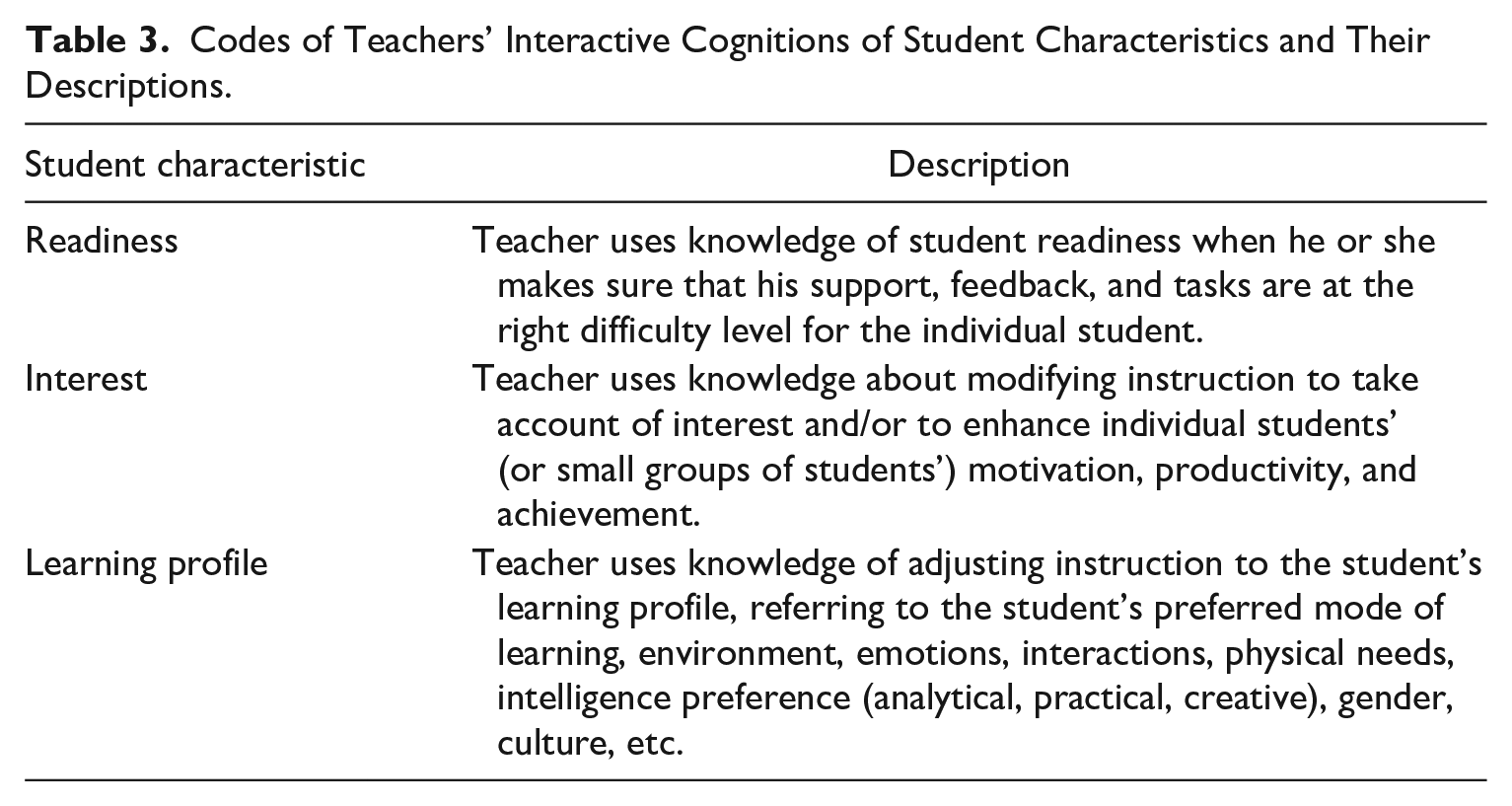
An example of a teacher’s IC with the student characteristic readiness is this quote from Carla (Art and Design): “[I explained it verbally, because] I want them to think for themselves, to form their own image . . . I know, if I give them examples, they will copy them, they will do exactly the same thing” (interaction category: offering help; student characteristic: readiness). We coded “readiness” for this quote, when the teacher argues that she wants the students to move forward from what they already can and do.
An example of a teacher’s IC without knowledge of DI is Alex (Mathematics), who explains the following after being asked about his reasons for telling the students what is going to happen during the lesson: I don’t do this every lesson. I mean, a routine is pretty well established, start the same way, do the same things, finish the same way. So, one day I do something a little bit different [and I tell them], like today. But when it is just a normal lesson [not], it’s what you can expect. (interaction category: providing instruction; student characteristic: none)
For this quote, no student characteristics were coded, as the teacher did not seem to take the students’ needs into account when choosing this way of starting the lesson.
Data analysis
After coding all cases, we conducted cross-case and within-case analyses. First, frequencies were determined by counting the numbers of the knowledge codes per teacher activity and lesson. Then, for the cross-case analysis, frequencies per teacher activity were compared across lesson types and across lesson types per teacher. Reliability was aimed at by using a member check; the teachers were asked by email whether they recognized themselves in the analyses and, if not, to comment on the data. To answer this question, they were provided with the lesson descriptions and quotes used in the current paper. In addition, the second author coded 75% of the interviews (six interviews), and this was compared with the coding of the first author. Cohen’s kappa was calculated (κ = .66) and through discussion of differences and similarities after calculation of kappa, the agreement was reached on all codes.
These analyses were supported by qualitative analyses. For this, a summary of every lesson was made for each teacher. In these summaries, we focused on results supplementing the cross- and within-case analyses based on the frequencies. It should, therefore, be noted that although the summaries are a good illustration of each lesson, more activities were undertaken by the teachers than are described.
Results
This section reports quantitative and qualitative comparisons of teacher knowledge during regular and GUTS lessons to answer the research question: What are teachers’ interactive cognitions of differentiated instruction in two different learning environments?
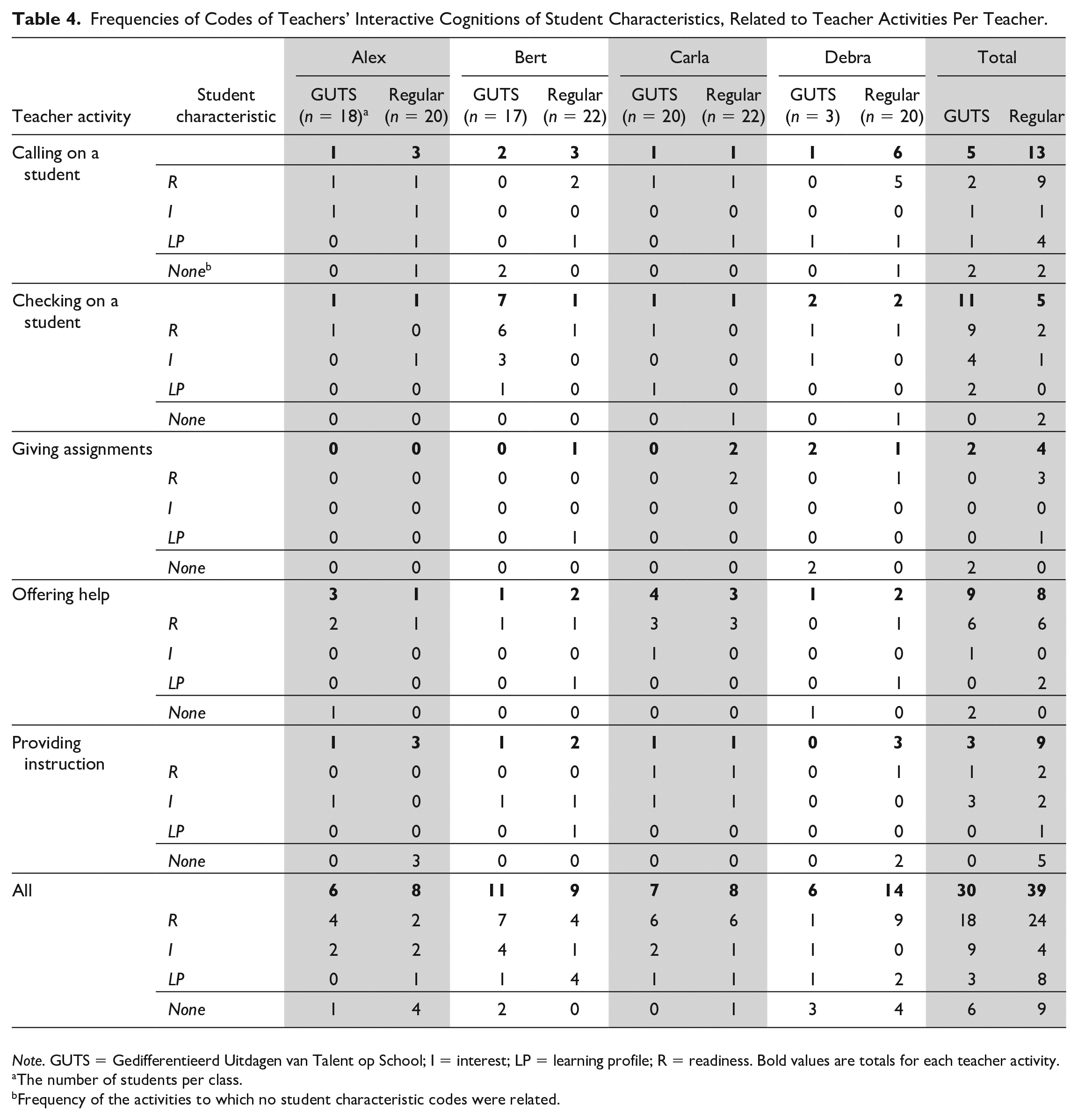
Table 4 shows the frequencies of each teacher activity discussed during the SRIs. It also provides the frequencies of the student characteristic codes readiness (R), interest (I), and learning profile (LP), reflecting the teacher knowledge evident in those teacher activities.
Frequencies of Codes of Teachers’ Interactive Cognitions of Student Characteristics, Related to Teacher Activities Per Teacher.
Note. GUTS = Gedifferentieerd Uitdagen van Talent op School; I = interest; LP = learning profile; R = readiness. Bold values are totals for each teacher activity.
The number of students per class.
Frequency of the activities to which no student characteristic codes were related.
In some instances, more than one student characteristic was coded in a teacher activity. Therefore, the sum of all frequencies of the student characteristic codes can outnumber the frequencies of the teacher activities. For example, in the two rightmost columns in Table 4, “calling on a student” was coded 5 times (GUTS), the student characteristic “readiness” twice, “interest” once, and “learning profile” once, and on two occasions no student characteristic codes were linked to a teacher activity.
The results presented in Table 4 show that the frequencies of almost all teacher activities for all teachers were equal for both types of lessons. Only two teachers had one or two activities, which varied depending on the learning environment. For Bert, “checking on a student” occurred more often during his GUTS lesson (n = 7) than in his regular lesson (n = 1). In the SRI after the GUTS lesson, Bert reasoned he found it easier to let the students work for themselves and to walk around the classroom in that lesson. In his regular lesson, he felt as though he had to stay on top of what the students were doing. Debra had substantial differences between her GUTS and regular lessons for “calling on a student” (GUTS n = 1, regular n = 6) and for “providing instruction” (GUTS n = 0, regular n = 3). Contrary to Bert, who perceived the way students had to work to be different in both classes, Debra believed this difference was related to the setup of both types of lessons and the number of students in each class. Debra explained she was more active in trying to account for differences in students’ readiness levels in her regular lesson, whereas she let students in her GUTS lesson work by themselves and ask questions if they had any.
To provide a more comprehensive view of the above findings, the qualitative results are presented next. For each teacher, we discuss their most prominent result from Table 4 and relate this to their lessons. All lessons that were discussed in the SRIs are summarized, and some quotes from the teachers that highlight how they spoke about student characteristics are used in these summaries to make the teachers’ ICs as concrete as possible.
Carla
Carla’s GUTS and regular lessons were similar with regard to the teacher activities and her knowledge of student characteristics (see Table 4).
Carla’s GUTS lesson started with brief instructions given to the students by her colleague. After this, the students got to work on their paintings. All students were given the same assignment for their painting: to copy a painting by Vincent van Gogh. The students got to choose themselves which painting to copy (student interest). Sometimes Carla walked up to students who made it clear they needed her help; as Carla explained in the SRI, she would then help them in a way she thought was most suitable for that particular student (student readiness). She also said in the interview that even if students did not have a question, she would still stop by them, as she knew that some of the students would have more trouble working than others (student readiness). For example,
I saw you doing something with him which I didn’t see you do with other students. I mean, there are times you take the paint brush out of the student’s hand, . . . and then you take over. But with him, you take over and then he paints himself, but you stay with him.
Because . . . I know that some know exactly what they are doing, what they have to do . . . . [but] I know that he will return to me after five minutes, so it’s better if I stay with him for a while, because I know he is like that, that he says, “I don’t know any more what I have to do, what do I do . . . ” . . . or asks others what they are supposed to do, and then I’d rather stay with him. (Student readiness)
During Carla’s regular lesson, she provided the instructions at the beginning of the lesson herself, as only one teacher was present. After the instructions, in which all students were given the same assignment, the students got to work on their individual projects; they got to choose themselves what picture they would do (student interest). The teacher explained in the SRI that although all students had the same assignment, she would align the assignment with student readiness, when a student had difficulties completing the assignment (student readiness). The reason she chose a challenging version was that she thought this class needed the challenge to stay motivated: Yes, because this class is very talkative, they’re really sharp, and well, I thought, . . . show me what you can do. . . . and they say, “yes miss, this is really easy” . . . Well, then bring it . . . and in the end it is great to see that when you give them an extra challenge, that they can do it that they also get that feeling “oh, okay, yeah I really can do it.” (Student interest and readiness)
In the interview, she also clarified that when students needed help, she would give it, like in the GUTS lesson, as she saw fit for the particular student she was helping (student readiness). However, simply walking over to a student to see how he was doing was something she did less frequently. In the SRI, she made it clear that not all students would find it fair if some students got more help than others when the assignment was for a grade. Nevertheless, as stated above, Carla tried to help individual students as much as possible in both types of lessons, when she thought it was needed.
Carla’s ICs regarding DI differed minimally across lesson types. In both types of lessons, Carla explained that she let students self-differentiate for their interests in the choice of the artwork they wanted to work on so that she could respond reactively to differences in student readiness. Her ICs differed in the way she reasoned about her responses to these student differences: In her GUTS lesson, she used her knowledge about the students to help them accordingly, regardless of whether there was a request for help or not; in her regular lesson, her responses were mostly ad hoc as she tended mostly to respond to students’ specific questions.
Debra
Debra’s results illustrate two prominent differences: (a) “calling on a student” (GUTS n = 6; regular n = 1) and (b) “providing instruction” (GUTS n = 3; regular n = 0). This contrasts the frequencies for “checking on a student” (GUTS n = 2; regular n = 2) and “offering help” (GUTS n = 1; regular n = 2; see Table 4). In her GUTS lesson, there were two teachers for only three students. Therefore, more opportunities for “checking on a student” and “offering help” could have been expected in the GUTS lessons. Debra’s explanation is illustrated below.
Debra taught the GUTS lessons together with a colleague, who started the whole-class instruction for the three students. The students were given instructions for the assignment central to the lesson at hand. All students were given the same assignment, one working alone and two together, but they were provided with a minimum set of rules: The students could choose their own subject and their own way of completing the assignment. Debra especially focused on the two girls working together, by looking from time to time at how they were doing. In the SRI, she explained that she let them work as much as possible on their own and only helped the girls when they asked for help: Yes, a teacher constantly watching you, you know, they also should have the opportunity to do their own thing and discuss stuff with each other, without me watching. Alone, they can give each other feedback, while if I sit there, they can’t really speak freely. (Student interest)
During Debra’s regular lesson, she instructed the students through direct instruction in a new subject and then let them work on assignments from the textbook. When Debra saw, as she said in the interview, that almost all students had completed one or two assignments, she would project the answers on the whiteboard to let them check their answers. An example of her approach: Sometimes I do it step-by-step; orthography is always convenient to project and this projecting always goes pretty fast. And because it is not a very difficult assignment, . . . they can do it themselves. But that first one I wanted to [discuss with them] as an example, because it is a completely new topic. But I thought, the rest they will see for themselves. (Student readiness)
A few answers were discussed during whole-class discussion. Debra explained that sometimes she let random students give the answer, and other times she called on students who were not paying attention despite needing the instruction (student readiness).
While Carla’s ICs for both contexts were similar, Debra’s ICs of differentiating instruction were different. In her GUTS lesson, Debra explained she would be less active herself in differentiating, thinking it would suit the students best to let them work and ask questions if necessary. In her regular lesson, she made more assumptions regarding students’ readiness levels and reasoned that these assumptions informed her way of calling on students.
Bert
Bert’s results indicate a sizable difference in the frequencies of “checking on a student” (GUTS n = 7; regular n = 1), and when doing this, he always used knowledge of student characteristics during the GUTS lesson. The knowledge he used most was knowledge of students’ readiness (n = 6; see Table 4). Bert’s regular lesson was mainly whole-class instruction; while in the GUTS lesson, small-group work was central, with Bert regularly checking on them.
Bert’s GUTS lesson started with a short recapitulation of the previous two GUTS lessons. Next, the students worked independently in groups of three or four who all had the same assignment, but they could decide on their own topic (students’ interest). During his walk around the classroom, Bert discovered that the students had trouble finding the right information. So, he gave the entire class more detailed instructions: But as I started to notice that it would be a long process, I thought I should give them more simple sources. I found History for Kids and while it was intended that they would read primary sources, this appeared to be too difficult. So, I also let them read secondary sources, . . ., and that did work, but it was too difficult anyway for some groups. (Student readiness)
The students continued to work in their groups, and Bert walked by the groups. He would help some groups more than others or in different ways. For example, he told one group exactly the same as he had first said in English, only then in Dutch, as Bert felt that the cause of their problem might have been the language barrier rather than the difficulty of the task at hand (student readiness and learning profile).
In his regular lesson, Bert spent the majority of time using whole-group instruction. He told a story about an important historical battle and certain impacts this had. He used this type of instruction because he feels most comfortable with it, he explained in the interview. Also, he said that some students have told him throughout the years that they find his lessons very interesting (student interest). The whole-class instruction started with a review of the previous lesson, and he let this flow into the subject matter of the current lesson. During his instruction, he sometimes asked students questions; Bert explained in the SRI that these questions were useful for checking whether they already knew anything about the subject, or for getting them to think about certain concepts (student readiness). When a student did not know the answer, he would adjust his response:
(video) So you ask, who lives in the south, then you point at someone. You don’t really get an answer, so you repeat the question [and let someone else answer]. Could you explain why you do it like that?
No, I do a lot of things, I just do something that seems suitable and then, yeah, because I think if someone like me clearly sees, that first student doesn’t know the answer. Yes, then I think I’m embarrassing her, I . . . (Student readiness)
Toward the end of the lesson, Bert gave the students an assignment. One student did not understand the assignment and the teacher used the same strategy as he used in his talent lesson: He explained the assignment in Dutch (student learning profile).
Bert’s ICs of DI appear similar to Carla’s; in his GUTS lesson Bert, like Carla uses his knowledge of students’ needs and responds to these. In the regular lesson, his ICs regarding DI were very ad hoc, which is also similar to Carla’s approach. He reasoned that he usually tried to account for students’ needs as a response to how the students answered his questions: If he found out they had difficulties, he knew to adjust his instruction according to what he knew about these specific difficulties. However, he indicated a whole-group focus, arguing that he accounted for differences in such a way that still benefited the entire class.
Alex
The most salient result for Alex occurred when “providing instruction” (GUTS n = 1; regular n = 3) with the use of knowledge characteristics (interest) during the GUTS lesson, but not during the regular lesson. Out of all student characteristics, it is apparent that during the GUTS lesson, he mostly used knowledge of the students’ readiness (n = 4; see Table 4). However, the way in which he answered students’ questions in the two lessons provides a different approach. In his GUTS lesson, he adjusted his way of answering to small groups and individual students. During his regular lesson, he mostly aimed to adjust his way of answering to the level of the whole class. Thus, while focusing in both lessons on student readiness, in his GUTS lesson, he was more focused on small groups and individual students, and in his regular lesson, he focused on the whole class.
Alex’s GUTS lesson was set up around a certain assignment the students had to complete. The teacher started the lesson with a short movie on the subject to get the class’ attention and then provided whole-class instruction in what they were about to do, to get them to think about what was expected of them. He thought students would like this approach more than simply telling them to be quiet and immediately listen to him explaining what they were about to do (student interest). Next, he asked them to set up and work in groups of four while he sat at his desk, available for student questions: What I want them to do is have as much independence as possible. And so I want to give them the space to figure things out, work together. If I’m constantly hovering there, telling them what they have to do, . . . they are just waiting for me to answer their question. (Student readiness)
When the students had questions, they would come up to his desk with them. How he answered a question depended partly on the student. During the SRI, he made clear that if he expected that the student should know the answer, or at least part of it, he would ask the student’s question back to let him answer his own question. He would also adjust his explanation or answer when he expected a student to have difficulty understanding it (student readiness).
During Alex’s regular lesson, he discussed a test the students took the previous week. He started with the distribution of the graded tests, during which he informed the students about their results. He explained in the SRI that his evaluation of the results did not only depend on the grade alone but also on his expectation of what grade the individual student should be able to get (student readiness). He discussed the test during whole-class instruction by letting students nominate questions from the test they would like to have explained. Every question was answered stepwise during this whole-class instruction; with each step, the students had a chance to answer these steps to get to the final answer. The teacher sometimes let the student who initially asked the question provide the answer, and sometimes asked a different, randomly chosen student: Well, so I just call random students, it keeps them paying attention, keeps them involved, [be]cause they might have an answer, or they might . . . especially in this class, it’s a very quiet class, they have a question, but they’re not going to put a hand up, so I just call them. (Student interest and learning profile)
Checking the test took most of the lesson. At the end, the students worked on their homework.
Alex’s ICs about taking student differences into account were similar across both types of lessons. He assumed that students would ask questions when they encountered difficulties. He reasoned that for his GUTS lesson, similarly to Debra, students should be able to “have a go at figuring it out for themselves” without the teacher watching. For the regular lesson, his ICs regarding DI were mostly focused on adjusting his own instruction ad hoc in response to students’ answers or questions. These ICs might have been related to the specific nature of the observed regular lesson (discussing a test).
Discussion
Teachers’ ICs
In this study, teachers’ ICs of DI were explored in two different contexts (regular and talent/GUTS lessons). More specifically, we focused on teachers’ ICs of student characteristics, that is, readiness, interest, and learning profile. We found that teachers’ ICs were focused on at least one student characteristic, mostly readiness, in their reasoning about how to approach the group of students or an individual student during teacher–student interactions. We were able to determine that teachers’ ICs indicated learner-centeredness in their provision of instruction, a typical characteristic of DI (Tomlinson et al., 2003). However, teachers’ ICs often reflected a focus on the whole class or large groups of students. This implies that, in practice, it is likely that not all their students felt consistently challenged to achieve their maximum potential, which limited their opportunities to develop their individual talents (Dixon et al., 2014; Reis & Boeve, 2009).
In addition, our focus on ICs adds to previous studies in which it was concluded that teachers have knowledge of DI but have trouble implementing it (e.g., Graham et al., 2008). The results of this study provided some insights into how teachers consider differences in student characteristics, and how this informs their instructional strategy decisions during teaching (Bosker & Doolaard, 2009; Meijer, 1999; Tomlinson, 2005).
Differences Between Learning Environments
The aim of this study was to explore the differences in teachers’ ICs across the two different learning environments. During the SRIs, it appeared that teachers’ ICs of student characteristics during the regular lessons did not differ much from the ICs during the talent/GUTS lessons (see Table 4). An identified difference focused on the student characteristics: During their regular lessons, the teachers mostly used their knowledge of the whole class, while in the GUTS environment, small group or individual student characteristics were more at the center of the teachers’ ICs. The focus on small group or individual students can be considered more exemplary of DI, than the focus on the whole group (Tomlinson et al., 2003). This underscores the aforementioned idea of the talent lessons providing an environment in which DI is possibly easier to achieve for teachers, as the group of students in this environment is less heterogeneous in terms of motivation for and achievement in the subject (Deunk et al., 2015; Tomlinson et al., 2003, 2008). In addition, another explanation might be the relatively high level of autonomy for teachers in designing their talent/GUTS lessons (De Neve et al., 2015), allowing them to design and conduct these lessons in accordance with their ICs about differentiated talent development. However, providing autonomy only helps when teachers feel efficacious to differentiate their instruction. In the findings, we noticed, for example, that for Debra, who felt quite uncertain in an environment with little structure and a small group of students, her ICs showed many similarities in both contexts.
The teachers in this study typically expressed ICs that reflected a focus on convergent DI in regular class lessons. This result is consistent with studies investigating teachers’ DI practices (Deunk et al., 2015). However, the talent/GUTS lessons appeared to provide teachers an environment in which to experiment more with divergent DI. The ICs expressed related to these lessons showed that the teacher–student interactions and the student characteristics teachers took into account were more often focused on individual students (Deunk et al., 2015). Teachers are more likely to provide students with more opportunities to further develop their talents during talent/GUTS lesson, if the teachers’ ICs align with their practices (Subotnik et al., 2011).
Implications and Future Directions
In this study, we explored teachers’ ICs of DI in two different in-school learning environments (regular and talent/GUTS) with SRIs. As there was no set curriculum for the talent/GUTS lessons and the student groups were more homogeneous, we assumed it might be easier for teachers to differentiate in those lessons (De Neve et al., 2015; Tomlinson et al., 2003, 2008). The results indeed pointed in that direction: Teachers expressed more ICs related to individual student characteristics in the talent/GUTS lessons, whereas they were more focused on whole-class characteristics in their regular lessons. In the talent lessons, students benefited because not only did they receive more individual attention but also their motivation was possibly enhanced as the teachers’ ICs focused more on students’ interest than in the regular lessons (Subotnik et al., 2011). Consequently, in the talent lessons, students were possibly more stimulated to further develop their abilities in the subject.
Although differences in teachers’ ICs might have been expected, based on the personal nature of these cognitions (Meijer, 1999; Verloop et al., 2001), these differences could imply that teachers’ readiness for differentiating instruction varied (Smit & Humpert, 2012). In the introduction, we argued that to increase student achievement, it is important to teach students based on their zones of proximal development (Tomlinson et al., 2003). In a future study, therefore, it would be useful to take into consideration the training they have received in DI. Also, an understanding of teachers’ beliefs is important (Meijer, 1999; Munby et al., 2001; Verloop et al., 2001). Beliefs are described in many studies as intertwined with and hard to distinguish from knowledge (Pajares, 1992). This is because beliefs are strong convictions, and the forming and change of these convictions is related to knowledge. Both knowledge and beliefs are important for teacher change (De Neve et al., 2015; Van Veen et al., 2010). Based on teachers’ previous experiences and beliefs, their zone of proximal development regarding DI could be mapped. Teachers’ individual needs and readiness levels should be taken into consideration when designing future professional development initiatives in the context of DI and talent development (Louws et al., 2017).
Conclusion
In this study, teachers’ reasoning and their consequential instructional decisions were shaped by their intentions to help different groups of students learn, rather than by what they think all students (as a uniform group) should learn. Students’ readiness often guided teachers in the evaluation of students’ knowledge and skills and adaption of instructional strategies. In addition, during talent development lessons, teachers focused even more on students’ individual differences guided by student readiness and interest. The context helped them feel as though they had more opportunities to actually help individual students in discrete ways.
Footnotes
Authors’ Note
Saskia Stollman is now at Eindhoven School of Education, Eindhoven University of Technology.
Jacobiene Meirink is now at NRO, Netherlands Initiative for Education Research, The Hague.
Declaration of Conflicting Interests
The authors declared no potential conflicts of interest with respect to the research, authorship, and/or publication of this article.
Funding
The authors disclosed receipt of the following financial support for the research and/or authorship of this article: This research was funded by the Dutch Ministry of Education, Culture and Science.
