



Abstract
Data-intensive methods have become vital for getting epistemic purchase on global socioecological issues. Yet these methods are never fully insulated against contestation precisely because they seek to represent things that are so large and complex. This article is about these contestations and what they reveal about knowledge politics, today. It focuses on the EAT-Lancet report and its Planetary Diet. By promising to have comprehensively mapped the interactions between food and human and environmental health, the EAT-Lancet Commission attracted a flood of contestations. The concept of the flood is introduced to explore what happens when political, cultural, and scientific interest in the complex, interconnected, and planetary ontology of ecological crisis encounters the epistemologies of data-intensive knowledge production. Building on the language of framing and overflowing, the article shows why complexity and planetarity have become so alluring in science communication strategies, and it interrogates the political economy that determines which representation–reality gaps get to become controversial. The contestations the EAT-Lancet report attracted arose, in part, because of conflicting understandings of complexity. Where the report depicted the food system as a romantic whole, those who challenged its findings did so by attesting to the food system's baroque irreducibility and the pervasiveness of context.
Keywords
Introduction
Scientists have been warning us for decades not just about each of these challenges [climate change, biodiversity, human health] but about how each is connected, and ultimately driving the others. To turn things around we need to find solutions that work for both people and planet … The EAT-Lancet Planetary Diet is a blueprint for a better future based on what we put on our plates every day. (Alec Baldwin speaking at the United Nations (2019) Special Session on Diets for the Future)
In 2019, a partnership between the nongovernmental organization EAT and the medical journal The Lancet published their Healthy Diets from Sustainable Food Systems report with the intention of intervening in this epistemic impasse. The life-saving and planet-saving Planetary Diet championed in the opening quotation represents the main output of their work. In this article, I focus on how the diet was calculated and communicated, and what the contestations it attracted tell us about knowledge politics, today. The diet was based on modeling work that integrated epidemiological data on the health outcomes of different dietary habits with upstream information about the environmental impacts of different foodstuffs (EAT-Lancet Commission 2019). The report was the first “universal and comprehensive synthesis to elucidate how to implement sustainable healthy eating patterns at scale for both consumption and production” (Rockström, Anker Stordalen, and Horton 2016, 2365). It recommended a diet low in meat and refined sugars, and high in whole grains, vegetables, legumes, and nuts.
Since its publication, the EAT-Lancet Report has gone on to inform research on dietary guidelines, health advice, trade tariffs, agricultural policy, and climate regulation (Tulloch et al. 2023). In policy circles, it has become the sixth most cited noneconomic research paper, ever (Singh Chawla 2024). The report, though, has had its detractors. Immediately following publication, controversies and contestations circulated around the EAT-Lancet Commission's failure to account for the specific iron needs of pregnant women and adolescent girls (Harcombe 2019); the bioavailability of key micronutrients in low-meat diets (Beal, Ortenzi, and Fanzo 2023); affordability (Hirvonen et al. 2020), and agronomic viability (Gupta et al. 2021) of the diet for people in the Global South.
In promising to have comprehensively represented the complex and planetary way food mediates between human and environmental futures, the EAT-Lancet Commission exposed its findings to a list, that it could never fully and permanently satisfy, of considerations that should have been included in its calculations. While STS scholars have long documented the contingent, partial, and contested ways scientific methods represent the environment (Bowker 2000), the proliferation of claims made about the Commission's calculative omissions speak to a novel type of disagreement. Building on Callon's ideas of framing and overflowing and STS engagements with context and complexity, I develop the notion of the flood to add to the scholarship on the knowledge politics of data (Machen and Nost 2021). The term draws attention to the gap between the EAT-Lancet Commission's claim of having fully mapped out the complex relationship between human and planetary health, and the sophisticated, though inherently finite, data models it used to make the food system tractable. It speaks to the discrepancy between the partial knowledge claims the Commission was making, and the suggestion that its planetary and romantic approach to complexity (Kwa 2002) had subsumed its empirical context (Asdal and Moser 2012). Those seeking to contest the model's omissions responded to the Commission's purported view-from-nowhere with their various views-from-somewhere (Jasanoff 2017). This, then, is the tension at the heart of the article: that the epistemic authority of the EAT-Lancet report was derived from the scale and complexity of its calculations at the same time as the scale and complexity of the global food system the report sought to represent gave so many points of entry for contestation.
The concept of the flood also draws attention to the political economy of environmental research and governance. This article traces how the controversies that followed the EAT-Lancet Report's publication were not evenly spread out among the infinitely long list of considerations that might arguably have fallen under the Commission's self-styled remit of mapping out the food–environment–health nexus. Instead, they mirrored long-standing disagreements about the role of meat and dairy in food systems transformation. Where the livestock sector and its advocates were able to query how the Commission calculated the Planetary Diet with reference to a series of metrological grievances (e.g., about how people's iron needs were calculated), there was no backlash about other factors the EAT-Lancet model failed to account for, like air quality. The flood of scientific controversies precipitated by the Report's partial representation of the food system inundated some aspects of the calculative frame while it glided over and left others unaffected.
The reason for this is that the investments (material, social, financial) needed to overflow a calculative frame are equal and opposite to the investments involved in its establishment (Callon and Law 2005). As the EAT-Lancet report was predicated on years of sophisticated modeling work, attempts to problematize its findings depended on the ability to replicate the Commission's modeling work, produce alternative models of a sustainable and healthy diet, and credibly claim that its Planetary Diet calculations ought to have been done differently. With its sizeable financial resources and decades’ worth of experience in contesting scientific representations of meat's epidemiological and environmental footprint (Morris and Jacquet 2024; Cusworth et al. 2023), the livestock sector was able to contest the EAT-Lancet's findings by footing the bill of these investments in a way that other groups who might otherwise have taken issue with the Commission's methods and/or findings could not. Here, the social context within which the EAT-Lancet report was launched clashed with the purported contextlessness of the report in a way that primed it for the ignition of livestock-related disagreements (Singleton 2012). There is, in other words, a political economy that determines who can prize open black-box representations of nature (Barry 2013), or, in the hydrological language of this article, who can direct the floodwater of contestation, where.
By attending to the controversies that did (and did not) overflow the EAT-Lancet frame, my aim in this article is to “critically interrogate how ways of seeing and engaging with nature… [which often originate] from the domains of science and technology, shape how the environment is construed and acted upon in social and political life” (Lövbrand et al. 2015, 213). I do so by extending this call to the “domains of science and technology” that explicitly seek to grapple with socioenvironmental issues in a planetary, holistic and integrative way. With a turn toward data-intensive methods in the creation of knowledge on complex and planetary issues, I wager that these overflows and floods are set to become recurring features in the navigation of social and environmental crises. I submit this paper as part of a political ecology of data (Nost and Goldstein 2022) and as a contribution to data infrastructure literacy (Gray, Gerlitz, and Bounegru 2018). My hope is that it offers practical tools for scholars grappling with diverse manifestations of the data-turn in environmental governance and research.
Methodologically, this article has been produced through interviews with individuals who fall into one or more of three groups: those involved with the EAT-Lancet report; those currently involved in producing the second EAT-Lancet report; and those working in the food–health–environment modeling space more generally. These interviews were solicited and conducted according to the CUREC ethics protocols of the University of Oxford, the institution through which the research was conducted. These primary data were complemented with ethnographic observation of several food systems modeling events (in Switzerland and the UK), with close reading of the EAT-Lancet report, with discourse analysis of its launch event, other media communications, and, most importantly, the controversies the report attracted. This last aspect was guided by a systemic review of the impacts of the EAT-Lancet report (Tulloch et al. 2023). Owing to requests for anonymity expressed by some interviewees, I narrate the paper through publicly available data located in reports, videos, and conference speeches.
The EAT-Lancet Commission and the Planetary Diet
The EAT-Lancet Report on Healthy Diets from Sustainable Food Systems was produced by the EAT-Lancet Commission on Food, Planet, and Health (The EAT-Lancet Commission 2019). It was launched at an event in Oslo on 17 January 2019, and was followed, a month later, by the full scientific publication entitled Food in the Anthropocene: the EAT-Lancet Commission on healthy diets from sustainable food systems (Willett et al. 2019). The report is the product of a collaboration between the not-for-profit EAT and The Lancet medical journal. It was produced by 37 authors who brought together expertise from across the disciplines of epidemiology, political science, life sciences, earth system science, climatology, and ecology.
As Professor Stollen, speaking at the 2019 launch event for the EAT-Lancet Report, explained: Global food production is the single largest human pressure on earth, threatening local ecosystems and the stability of earth itself. Everything is, of course, connected to everything else …. The stakes are high. It's about the future of our planet. The EAT-Lancet Commission will unravel the complex mechanics of the food system, and investigate the connections between diet, human health, and the state of the planet. (Rockström, Anker Stordalen, and Horton 2016, 2365)
With regard to human health, the Commission combined data on nutritional adequacy (how many calories and macronutrients human bodies need) with epidemiological and medical research into the health and mortality outcomes associated with different diets. This review encompassed “evidence from controlled feeding studies in humans with intermediate risk factors as outcomes, observational studies, and randomized trials” (Willett et al. 2019, 453), focusing on “diet-related obesity and diet-related noncommunicable diseases, including coronary heart disease, stroke, and diabetes” (Willett et al. 2019, 447). From this analysis, they produced a Healthy Reference Diet, whose improvements were quantified by estimating the number of deaths averted every year if it was universally consumed; the figure was placed at 10.8–11.6 million. These figures correlate to a 19–23.6 percent reduction in premature deaths from coronary heart disease, stroke, type-2 diabetes, site-specific cancers, and a combination of other diet-relevant disease outcomes.
The Healthy Diet is predicated on a standard 2,500 kcal per day. This corresponds to the average needs of a 30-year-old, 70 kg man or 60 kg women. The figure is slightly higher than the 2,370 kcal global average, but lower than the calorific intake of those in wealthier countries (e.g., 2,800 kcal/day for men in the United States). It is also higher than the 2,100 kcal/day figure used in most other analyses. The figure of 2,500 kcal per day was selected to allow for public health goals associated with increased physical activity (and thus increased calorific needs). While the Healthy Reference Diet saw similar/increased intakes of most nutrients (iron, zinc, folate, vitamin A), there was an associated drop in B12 and riboflavin (which are typically provided by meat and dairy products). For this reason, the Commission noted that the diet may need additional supplements to avoid deficiency risks.
With regard to the upstream environmental impacts of the food system, the Commission first set out to define an operating space within which the food system must limit itself. This aspect of the report was based on the planetary boundaries (PBs) framework developed by Johan Rockström, who was also one of the lead scientists at the EAT-Lancet Commission. The PBs framework divides world biophysical systems into nine major groupings. It specifies the metrics to be used as a proxy for the PBs, the “preindustrial Holocene” baseline, and the limits that must not be crossed lest the world be tipped into an unlivable state. By way of example, the PBs framework assesses the Biodiversity system in relation to the E/MSY metric (Extinctions per Million Species-Years, measuring how many things go extinct, how often). The PB framework set the Holocene baseline at 1 E/MSY, the PB at 10 E/MSY, the “upper end of the zone of increasing risk” at 100 E/MSY, and the current extinction rate at over 100 E/MSY (Richardson et al. 2023).
The PBs framework approaches the world as a set of interlinking biophysical systems and accounts for the impacts that one system can have on the others when those safe limits are breached (Steffen et al. 2015). Modeling these interactions allowed the Commission to attend to the complex feedback loops that dictate how the food system interfaces with the earth's various biophysical systems and cycles. The PBs framework takes the livable and self-regulating state of the earth during the Holocene period as a baseline to return to (Rockström 2015). It builds on long-standing ideas about the Earth System's finite capacity for self-regulation, like its finite carrying capacity (Daily and Ehrlich 1992) and the ecological limits to growth (Meadows et al. 1972). The principle of subsidiarity courses through the EAT-Lancet's usage of the PBs framework: that environmental problems be dealt with at the scale most salient to their biophysical operation, and that the vast coverage of the food system demands a planetary-scale analysis (see Beacham 2021 for discussion on planetary food systems).
The EAT-Lancet Commission gave recommendations for the portion of the total PBs that should be given over to the production of food to “decrease the risk of irreversible and potentially catastrophic shifts in the Earth system” (The EAT-Lancet Commission 2019, 15). When the Commission set out to generate healthy diets from sustainable food systems, these limits represent the environmental allowances beyond which the food system can no longer be considered sustainable. The Commission assigned large portions of the total PBs to the food system (8 out of a total 11 tons of phosphorus usage, for example) and, in the case of biodiversity loss, the full planetary budget of 10 E/MSY. Six of the nine Boundaries were considered (Figure 1).
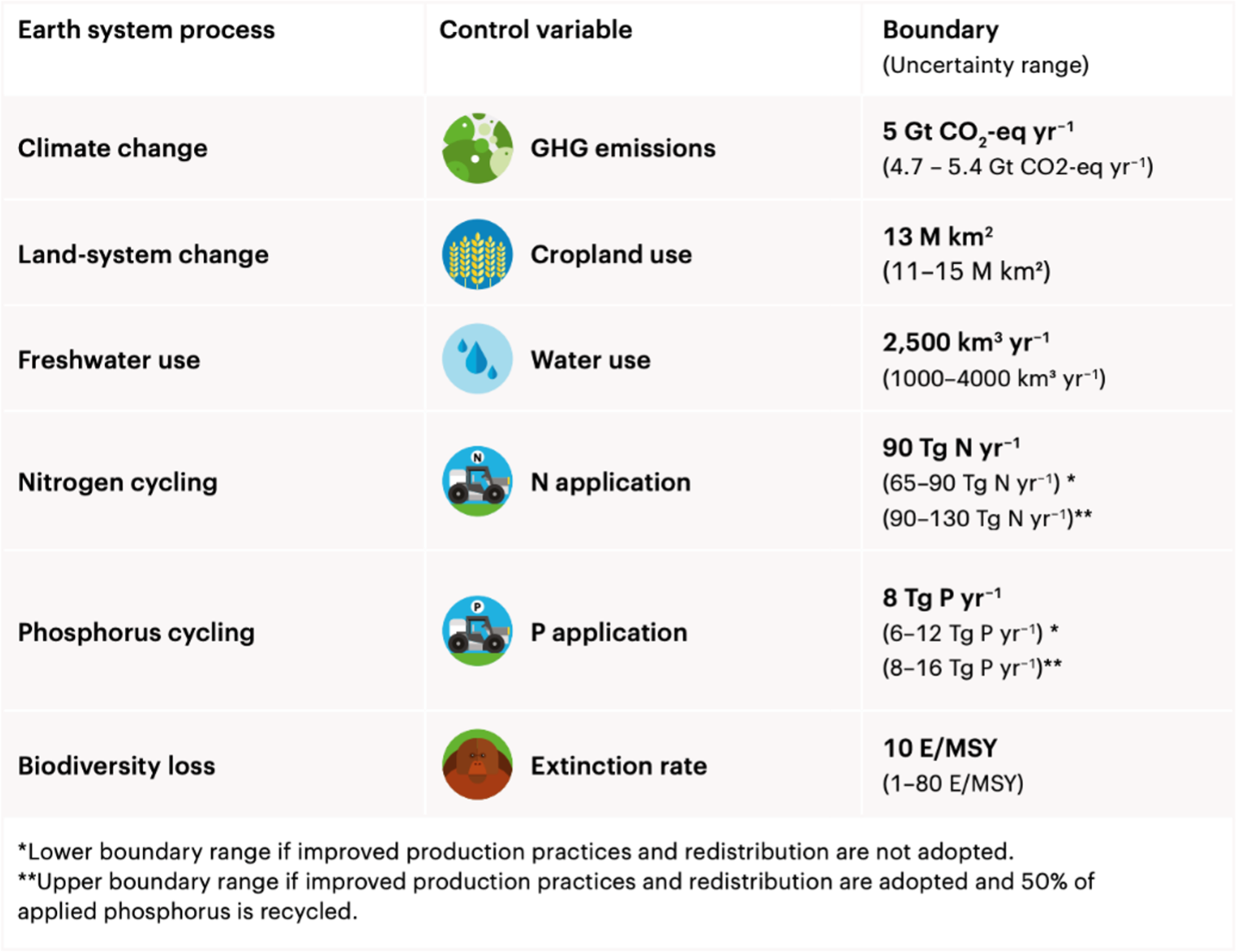
Planetary boundaries for a sustainable food system (the EAT-Lancet Commission 2019, 10).
With these limits set, the Commission then conducted its analysis of the environmental footprint of different foodstuffs to assess how a healthy diet could be contained within the food system's assigned portion of the PBs. These calculations were generated through the International Model for Policy Analysis of Agricultural Commodities and Trade (IMPACT), which is one of the most used models in food systems governance and research (Leblond and Trottier 2016; Cornilleau 2019). It contains a database aggregating meta-studies of the environmental footprint of different agricultural commodities as they are produced within different national territories. It models interactions between trade, regulation, and production. To reflect the Commission's focus on diet, the IMPACT model was reformulated to allow food demand (i.e., the Healthy Reference Diet) to be included as an input rather than have food production emerge as an output.
Integrating the IMPACT and PBs models allowed the Commissioners to make predictions about agricultural outputs and environmental outcomes associated with different dietary trends across a range of socioecological metrics. Approaching the food system as a planetary regime (Beacham 2021), they assessed how different dietary choices would shape what foodstuffs were being produced and where, what types of farm systems would predominate, the quantity of pesticides the food system would require, the scale of nutrient fertilizer applications it would need, the amount and type of greenhouse gases that would be produced, the types of food that would be made available, the quantity of fresh water it would need for irrigation, and so on.
When approaching a food system issue that the integrated IMPACT and PBs frameworks did not—in the eyes of the EAT-Lancet modelers—do a good enough job of representing, the team sought the input of other groups working in that area. For example, where the IMPACT and PBs frameworks had previously calculated the manufacture and flow of phosphorus through high-level data about fertilizer sales and production rates, the EAT-Lancet team wanted to understand how dietary changes would impact the phosphorus cycle in a more biophysical way (e.g., how different farm systems use and recycle phosphorus, and how different crops take up synthetic fertilizer applications). The EAT-Lancet modelers sought out experts from the phosphorus modeling community and bolted their work onto the Commission's IMPACT and PBs model: they parametrized the issue of phosphorus and outsourced it to the experts. The model that resulted was so complex that few in the team had a deep understanding of how each of its constituent modules worked. This was not seen to be a problem by those in the modeling team, but rather reflective of the complexity of the system being represented.
The two major strands of the EAT-Lancet Report—the quantification of a Healthy Reference Diet for humans, and the quantification of the environmental impacts of the food system—were then synthesized to produce the Planetary Diet, below (Figure 2).
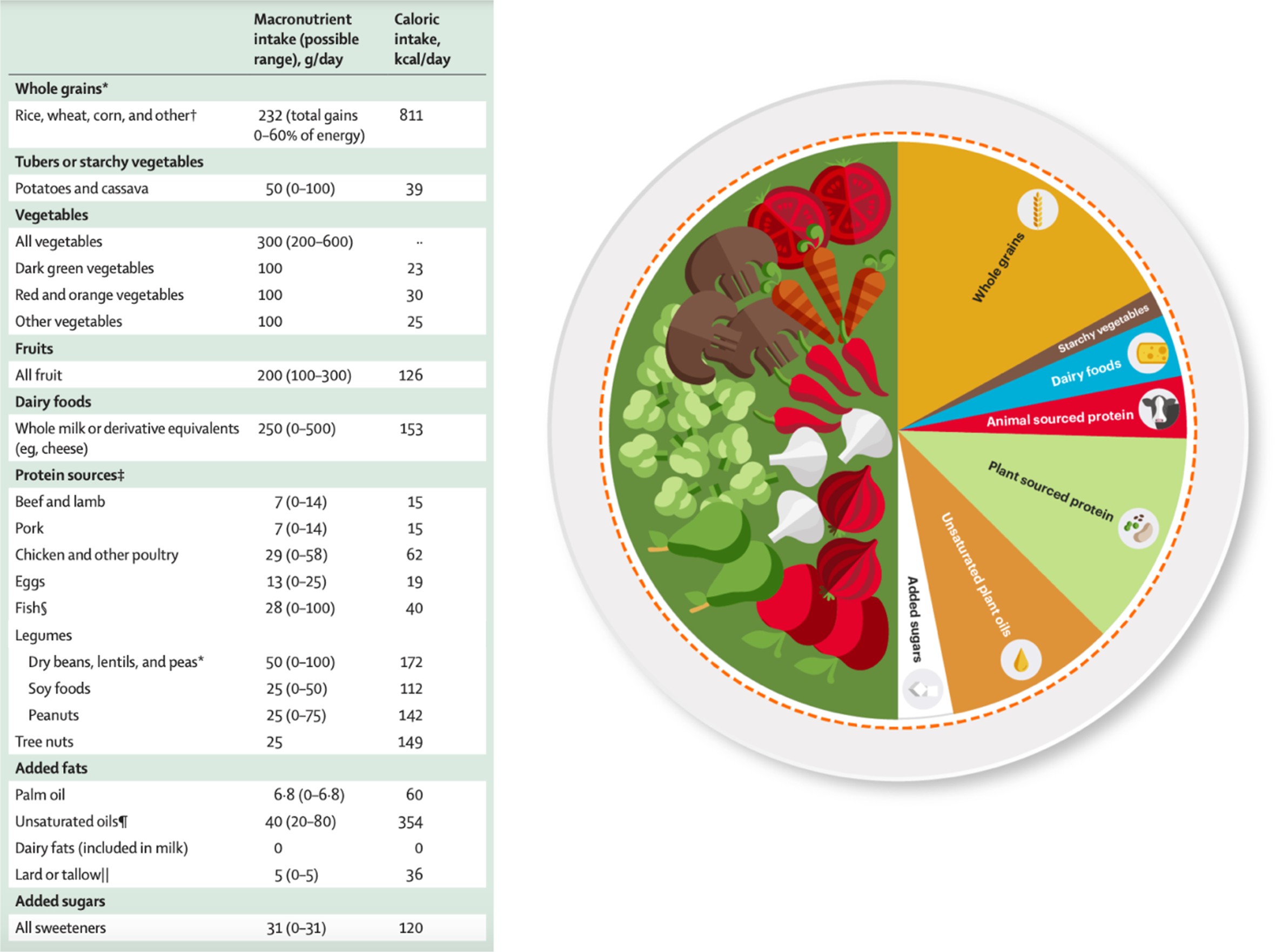
The EAT-Lancet Planetary Diet (The EAT-Lancet Commission 2019, 9).
The report approaches the global diet as a meso-level object that mediates between human and planetary health. It is vast and diffuse, and through it many different people, landscapes, and more-than-human actors are materially knotted together. Diets figure as a great interface between humans and planets (Mol 2021); an ethical (Cusworth 2023) and political fulcrum (Searle, Turnbull, and Oliver 2024; Turnbull and Oliver 2021) on which different metabolic dynamics hinge.
The EAT-Lancet report has had most significant uptake in the design of national and subnational dietary guidelines, and among those researching sustainable and healthy behaviors. Governmental departments and affiliated researchers have, for example, used the Planetary Diet to assess how far regional dietary trends are from the Planetary Diet, and how close policy mechanisms get to recommending and realizing the EAT-Lancet recommendations (Moberg et al. 2020). Such projects are designed to “tailor” the findings of the EAT-Lancet group for specific geographic, political, or personal contexts (Davies, Gibney, and O'Sullivan 2023). Initiatives such as these have helped the report become an extensively cited policy document, amassing over 11,700 citations in six years; 1 it continues to play an active part in sustainable and healthy food research and policy contexts (e.g., Chiriacò et al. 2025). In many senses, the report has been incredibly successful.
For some within the EAT-Lancet Commission, perhaps the best sign of success was the amount of negative traction generated by the report: a sign that it was impactful enough to be taken seriously by those who disagreed with its findings, methods, or potential food system impacts. While the 2019 report was deliberately designed to study the global food system and to generate insight for food system actors around the world, for example, it attracted criticism for being a Eurocentric product that overlooked the lived experiences of a large cohort of the world's eaters and food producers (Burnett et al. 2020). Such criticisms get to the heart of this paper's analysis and are explored in more detail, below.
The EAT-Lancet Calculative Frame
Before we get to these contestations, this section presents the EAT-Lancet Report and its associated modeling work in more abstracted terms. This will help understand the nature of the debate its publication sparked, allowing the paper to generate more generalizable insight into the knowledge politics surrounding the planetary and complex character of socioecological issues and the data-intensive research methods being used in their governance.
Calculative frames provide a basis for negotiation between separate legal entities. They establish “a boundary within which interactions … take place more or less independently of their surrounding context” (Callon 1998, 249). In environmental management contexts, frames allow messy things like ecosystems, populations, wetlands, rivers, and fields to be abstracted (Robertson 2012) and inserted into spreadsheets, credits, and graphs (Bowker 2000). This allows them (or, more accurately, representations of them) to be transported off-site, and entered into circuits of commodification, remuneration, and governance (Cusworth and Stanley 2025). They form the composite units on which promises of rational data-driven food systems governance are based (Montenegro de Wit and Canfield 2024).
The calculative frame of the EAT-Lancet Planetary Diet can be split into two main components: first it sorts, then it associates (Callon and Muniesa 2005). From the large finitude of objects entangled in the material web of the food system, only humans and planet are selected for representation in the EAT-Lancet calculative space. They are, in calculative framing terms, sorted: distilled out from the messy and material whole in a way that enables them to be understood. The sorting process is, more accurately, a process of exclusion. Fishing communities, the capital returns of agricultural chemical manufacturers, the operations of mining ventures, the walkability of footpaths and so on are all constitutive of the materiality of the food system, but they are not “taken into account” in the way that humans and planet are. They have not been sorted (i.e., arranged, considered, set apart from the whole), and so they are tacitly rendered external to the frame.
To make sense of the relationship between the objects selected (i.e., sorted) for representation, the EAT-Lancet's calculative frame also defines how they are associated. To calculate the Planetary Diet, the report specifies what planetary health means in upstream production terms (the six PBs encompassed in the report that define the sustainable operating space for the food system), and what human health means in epidemiological and metabolic terms (deaths avoided, nutritional adequacy, exposure to diet-related health outcomes). It is only once these terms have been defined that diets can be made sense of as a meso-level object that causally mediates between human and planetary health. In calculative framing terms, humans and planet are associated, in a highly demarcated and specified way, through diet. And so, while the food system provides an infinite number of material vectors through which the earth and its human inhabitants are connected, it is only through food's partial representation that the relationship it constitutes between humans and planet is made tractable.
A counterfactual might help make the point. If human health were defined as being dependent on the preservation of cultural heritage, then red meat, with its links to traditional pasture-fed husbandry, would likely have been given more room on the Planetary Diet plate. But it is only once the association between the objects of concern are defined (a partial subset of material totality whereby “human health” is taken to include dietary exposure to diabetes but exclude preservation of cultural heritage) that the calculative frame putters into life. The food system constitutes a material freeway that simply carries too much information, and a well parametrized calculative frame is needed to orchestrate the traffic.
Overflowing the EAT-Lancet Calculative Frame
In specifying what is salient for an exchange, frames also specify the things that are considered immaterial to the case. Disagreements about environmental issues can often be explained in terms of such exclusions. Contestations arise when something external to the frame (e.g., agricultural pollution) is argued to be relevant, or when the negative impact of the thing's exclusion becomes obvious (e.g., downstream biodiversity loss). In Callon's classic case of agricultural water pollution, local residents can petition to have the costs of the pollution internalized into the frame through taxation, or polluter-pays penalties. In such instances, the frame is said to have been “overflowed” (Callon and Law 2005; Callon 1998). Controversies (e.g., an algal blooming event) create “hot” situations that forge new publics and make frames malleable in a way that allows for their renegotiation (Donaldson et al. 2013). These often occur when interested parties are made aware of the contingency and partiality of a calculative frame, and when they are alerted to the availability of an alternative frame that better services their interests (Cusworth et al. 2023).
Irrespective of the sophistication of the data-intensive research used to complete the sorting and associating steps described above, the complexity and planetarity of the food system being abstracted is so vast that virtually anything may reasonably be argued to be relevant and worthy of calculative inclusion. Although the representations of the world produced through metrics and measurement have only ever been partial (Kula 1986), there is a discrepancy here that threatens to radically and visibly expand the gap between representation and reality.
For the EAT-Lancet Report, the calculative-partiality-as-site-of-contestation was more than just a theoretical chink in its epistemic armor. Although the report and its Planetary Diet received much positive coverage in the mainstream media and in academic debates, there were several sustained efforts to query its findings by recourse to its calculative frame (Tulloch et al. 2023). Different contestations variously sought to query the sorting and associating components of the EAT-Lancet Report. I now turn to these contestations.
Sorting: Overflowing the Frame With Objects of Concern
A first set of contestations was based on the affordability and geographic specificity of the EAT-Lancet Planetary Diet. Having quantified a healthy diet whose production for 10 billion people would not see the food system exceed its assigned portions of the PBs, it was argued that the Commission failed to consider the extent to which the diet was feasible in economic terms for different people around the world. By way of example, the Planetary Diet was calculated to cost between USD3–5 in rural India, compared to current outgoings of around USD1 per day. Depending on the season and variability in price and agricultural productivity, adherence to the diet would involve an extra USD2–4 on meat, poultry, legumes, and dairy (Gupta et al. 2021). These hikes were estimated to make the Planetary Diet unaffordable for up to 80 percent of India's population. Another study calculated that 57.2 percent of people in sub-Saharan Africa (502 million) would be priced out of the EAT-Lancet diet, while in South Asia the diet was estimated to be unaffordable for 38.4 percent (627 million) of the population (Hirvonen et al. 2020). Globally, the diet was estimated to be economically inaccessible for 1.6 billion people (Hirvonen et al. 2020).
There were also contestations about the cultural applicability of the Commission's findings: that however healthy and sustainable the EAT-Lancet Planetary Diet may be, if it is not applicable to local cultures and food availability contexts, then it will fail to have a meaningful impact on human and planetary health (Blackstone and Conrad 2020). Many argued that not enough thought was given to how the EAT-Lancet recommendations would land in different geographic and socioeconomic contexts (Tulloch et al. 2023; Steenson and Buttriss 2020). Both these cultural and economic arguments suggest that by ignoring issues of distribution and regional variation, the EAT-Lancet Commission failed to deliver globally just recommendations (Biesbroek et al. 2023; Béné et al. 2020).
Social equity arguments became prominent features in the discourse around the EAT-Lancet Report: that an elite cadre of scientists and modelers, mostly from the Global North, had made recommendations that were uninterested in the political agency and economic realities of those in the Global South (Kaiser 2021). The lack of transparency about the assumptions used in the report's modeling added to claims that the EAT-Lancet Commission had assumed for itself a planetary governance mandate predicated on black-box science (Zagmutt, Pouzou, and Costard 2019). Counter-mapping projects sought to “Ground Truth” the Planetary Diet by subjecting it to more spatially specific analysis focusing, for example, on the affordability of the diet in different regions and countries (Gupta et al. 2021).
In the language of calculative framing, these complaints suggest that by sorting the dietary relation between humans and planet, the EAT-Lancet Commission failed to produce insight for specific groups of people, particularly those who rely on subsistence farming systems, and those living in places where wages are low. A report that instead sorted the dietary relations between environmental health and specific groups of people in specific places would, they argue, have produced more meaningful, impactful, and just analysis. These commentators were wary of the way food models have tended to reproduce top-down developmental, technological, and economic solutions to distributional food system issues (Raymond 2020), and so sought to push back against the reinforcing relation between algorithmic data-driven analysis and hegemonic power (Machen and Nost 2021).
The complaint perfectly mirrors the criticisms leveled at the Anthropocene concept (Malm and Hornborg 2014): that its unit of analysis—the Anthropos species—offers too blunt a tool to grapple with the uneven responsibilities and harms associated with contemporary environmental collapse. The EAT-Lancet Commission was accused, in this same spirit, of flattening the bumpy worlds of eating, health, and farming in pursuit of a universal Planetary Diet for all people on an entire planet. Rather than talk of the Anthropocene, discussion should be in terms of an African Anthropocene (Hecht 2018) or an Asian Anthropocene (Chatterjee 2020); and rather than talk of a Planetary Diet, discussion should be directed at curating a healthy and sustainable diet for people in India (Gupta et al. 2021) or the Gambia (Ali et al. 2022). Articulated in the language of calculative frames, these controversies sought to problematize the commission's attempts to sort the food system relations between all humans across the entire planet rather than sort the dietary relations between the global environment and specific subsets of people.
Associating: Overflowing the Frame With Overlooked Relations
There were also concerns about the impacts the Planetary Diet would have on human health owing to overlooking the bioavailability of micronutrients in different foodstuffs (Beal, Ortenzi, and Fanzo 2023). The idea, here, is that plant-based diets contain high amounts of phytic acid that can compromise the human body's ability to assimilate calcium, zinc, and iron into the blood stream. By assuming consistent and moderate levels of the bioavailability of these micronutrients, it was argued that the high-phytate Planetary Diet would expose eaters to harmful health outcomes like blood clotting, skeletal development problems, and decline in cognitive functioning (Harcombe 2019; Young 2022). The conclusion reached by these authors is that if the metabolic issue of bioavailability was calculated in a more comprehensive way, then meat, with its highly bioavailable supply of iron and zinc, would have been given more room on the planetary plate. The problem is particularly acute, for these commentators, because the EAT-Lancet report “continue[s] to erroneously influence food policy decisions and international dietary guidelines” (Stanton 2024, 1).
More contentiously, it has been argued that the report's dietary advice bears a disquieting resemblance to status quo food advice (e.g., national nutritional recommendations) that do more for the profit margins of large agri-food interests than for the health of individual citizens (Ververk 2019). On these grounds, Leroy and Hite (2020) suggest that the metrics used to quantify the health outcomes of different dietary habits (e.g., bioavailability assumptions) reproduce a sensationalized animal/plant binary in food system debates that depict meat as the main food system driver of ill-health and environmental loss, and plants as the only salvation. These contestations have seen the EAT-Lancet Diet thrust to the frontlines of the culture wars where questions of personal choice, dietary agency, and environmental responsibility have become flash point issues (Sanford and Lorimer 2022). Some have pushed back against the Commission's findings by using different micronutrient and bioavailability metrics in counter-mapping studies to make more affirmative arguments for eggs (Mason 2023), pork (Drewnowski 2024), and fish and shellfish (Koehn, Leape and Allison 2023) in sustainable and healthy diets.
Rather than identify an object of concern that was problematically excluded from the sorting component of the EAT-Lancet calculative frame, the contestations around bioavailability, health, and micronutrients have problematized how the Commission associated the health of humans and planet through diet.
From Overflows to Floods
By seeking to grapple with the planetarity and complexity of the food system, the EAT-Lancet Commission exposed itself to an indefinite list of calculative considerations that it can never fully and permanently satisfy. As the food system is so big and so complex, so this reasoning goes, and as the EAT-Lancet Commission predicated the legitimacy of their findings on having comprehensively mapped out the diet–environment–health nexus, then why does X not appear to be an object of concern, or why does Y not appear in the way those objects of concern are associated with one another. To extend Callon's (1998) framing-overflowing model, this amounts to a potential flood: a deluge of claims predicated on the discrepancy between the colossal and distended scale of the materiality being represented, and the complex (though inherently finite) data-intensive methods the EAT-Lancet Commission used in their calculations.
I offer the notion of the flood to emphasize how growing interest in the planetary character of environmental problems (Mould 2023), in the complex way environmental dynamics interact with one another, and in the way those dynamics cut across the human and natural worlds (Chandler 2018) is creating an atmosphere in which a grievance can always be raised about the exclusion of some relevant factor. While previous generations of scientific controversies were limited to causes and consequences contained within highly demarcated spatiotemporal settings (Law 2003), the expansiveness of the food system is such that anything, anywhere, is arguably worth of calculative representation. This is not to imply that a totalizing, Borgesian model of the world would be either feasible or useful. As the COVID-19 pandemic recently highlighted, it is the utility and distributional consequences of models that are politically sensitive, rather than their partiality per se (Østebø and Henderson 2020). What the EAT-Lancet case reveals, instead, is the role that notions of planetarity and complexity have come to play in the production, communication, and performance of epistemically credible science—and how these things are reshaping contemporary knowledge politics. A little more empirical detail is needed to help make the case.
Contrary to the desires of some of the modeling team, the EAT-Lancet Planetary Diet was described as unified and singular, deprived of the caveats that might otherwise have been made about the certainty and precision of its recommendations. For example, where the report emphasized the precise weights of different food groups in its diet (e.g., 7 g/day of red meat), the modelers preferred to speak in terms of ranges (e.g., 0–14 g/day of red meat). Livestock sector publications and other cultural commentators skewered the report for recommending such precise and unrealistic portions, depicting meals featuring, for example, half rashers of bacon (Mroz and Painter 2023). The decision to downplay dietary ranges and foreground specific amounts was made late on in the report writing process, at the advice of a media agency brought in to help with the Commission's science communication strategy. The doubt implied in the existence of dietary ranges was, from their perspective, seen to undermine the Commission's claim to have mapped out the complex and planetary food–health–environment nexus. The frustration from some in the modeling team was that complaints about the cultural and economic adaptability of the diet could have been headed off were the Diet not presented in such prescriptive and singular terms.
Similarly, the modelers’ usage of socioeconomic pathways was also glossed over. These pathways emphasized that different dietary shifts would be needed to ensure the healthiness and sustainability of the food system, depending on factors unrelated to diet, like population growth, economic trends, trade, and energy transitions. By the time many of these details were made public in the full scientific write-up (published a month after the report was launched), the dye of public opinion had already been cast. Modelers’ hopes that their work would be used to present a menu of different social and political instruments to initiate public debate about food system solutions were not fully reflected in the report write-up process. A model designed to be a learning machine was pitched instead as a truth machine (Dorin and Joly 2020). Again, caveats to the Commission's calculations were seen to jeopardize its data-derived “promise of precision” messaging (Kuch, Kearnes, and Gulson 2020). Once again, the occlusion of the Commission's calculative process became its own source of contestation (e.g., Zagmutt, Pouzou, and Costard 2019).
The tensions over the presentation of the Commission's recommendations illustrate the character of controversies generated by the EAT-Lancet Report. In STS terms, they reveal the Commission's approach to context and complexity, and the novel type of overflow the concept of the flood is drawing attention to. Context speaks to the irreducibility of reality (Asdal and Moser 2012) and the science studies practice of “contexting” situates and socializes the knowledge produced by scientific actors (Law and Moser 2012). The idea here is that science cannot compress the richness of the world both due to the irreducibility of the world's context, and of the context that pervades the process of scientific knowledge production. The EAT-Lancet Commission's science communication strategy amounted to an implication that the model had subsumed its context: that its data-intensive methods and calculative coverage had unencumbered it from its social partialities, granting the model a “view from nowhere” (Jasanoff 2017). This context-free imaginary plays into a broader shift in the agricultural sector, where data are being framed as something capable of giving a value-free vantage point over the character of the food system and the interventions needed to mitigate against its harms (Montenegro de Wit and Canfield 2024). Yet the flood of contestations around meat, iron, and the global poor, amount to the inevitable pervasiveness of context: despite a communications strategy that suggested otherwise, the model's calculative frame always retained its context, in which certain things were/were not accounted for and through which certain food system futures were being advanced.
To put this in Kwa's (2002) typology, these contestations were the result of the Commission's implications that it had produced a romantic rather than a baroque version of complexity. Whereas baroque versions of complexity embrace the unexpectedness, variation, and instability that is encountered when looking down at increasingly detailed phenomena, romantic accounts seek to apprehend the whole by looking up (or from on high) at the overarching order of things. In speaking from its planetary vantage point, the communications strategy employed by the EAT-Lancet Commission implied that it had reproduced the food system as a romantic whole. Those arguing that the Planetary Diet failed to account for the needs of pregnant women or subsistence farmers in rural India—those seeking to reply to the model's view-from-nowhere with specific views-from-somewhere (Jasanoff 2017)—were attesting to the baroque variability of the food system's incoherent constituent elements (Law 2004). Here, the floodwater didn’t come from heavy precipitation so much as rising up from below.
That the notion of complexity has become desirable for those involved in science communication work is itself of interest. In previous STS engagements, complexity is discussed, debated, and calculated in intimate and professional environments. Debates about differing approaches to complexity unfold among aircraft design engineers (Law 2002) and between DNA researchers (Ackerman et al. 2015). In the case of EAT-Lancet, the notion of complexity (and particularly its naive-romantic variant) was relayed to a more general audience for strategic purposes. Namely, to invest the Planetary Diet with the epistemic authority it needed (at least according to some) to circulate broadly and freely.
Controversies have always been predicated on the partiality and contingency of scientific representations (Kula 1986). Still, the emergence of data-intensive analysis in environmental research has newly enabled scientific actors to suggest that they have comprehensively mapped out dynamics defined by their planetary coverage, their complexity, and the way they entangle human with environmental futures (Kloppenburg et al. 2022). Contrary to the performances that (somewhat successfully) sustained claims that the model had achieved totalizing calculative coverage, it was the inevitable pervasiveness of context, and the irreducibility of the baroque elements of the food system that helped catalyze the flood of overflows faced by the Commission. The idea of the flood, then, can be defined in the following way. It is the set of contestations that arise when the growing interest and concern about the complex, interconnected, and planetary ontology of socioecological crisis encounters the sophisticated, though inherently partial, epistemologies of scientific knowledge production.
Directing the Floodwater
As the recent history of natural disasters tell us (Congleton 2006), the biblical promise that a flood's coverage will be indiscriminate conceals a more complex and politically fraught reality. Namely, that legacies of wealth and power determine which bodies and landscapes are allowed to get inundated. In the case at hand, the flood of controversies sparked by the EAT-Lancet report did not evenly submerge the Planetary Diet and its calculative frame. In this final empirical section, I delve into the political economy of data-driven research to explain why. As we have seen, the various assaults on the legitimacy of the Planetary Diet on the basis of its sorting or associating processes clustered around certain themes: the justice consequences of the report, and its approach to meat, dairy, and livestock agriculture (Tulloch et al. 2023). I focus on this latter set of concerns partly because they were the most substantial assault made on the EAT-Lancet diet, and partly because they offer the most fruitful avenue for exploring an important aspect of how and why floodwater gathered in the way it did.
The publication of the EAT-Lancet report sparked its own Yes2Meat digital backlash that focused on the way the Commission calculated the role of meat and dairy in sustainable food system design (Garcia, Galaz, and Daume 2019). This reaction fed into what is, by now, a long history of the livestock sector's efforts to obscure public and political understanding of the environmental impacts of livestock farming (Morris and Jacquet 2024) by promoting metrics, measures, and models that minimize how the health and environmental impacts of meat and dairy are represented (Donnison and Murphy-Bokern 2024; Cusworth et al. 2023). Given that many of the references cited in the above sections were produced by researchers with funding and advisory relations to livestock industry bodies and businesses (Stanton 2024; Zagmutt, Pouzou, and Costard 2019; Biesbroek et al. 2023; Drewnowski 2024; Mason 2023; Leroy and Hite 2020; Koehn, Leape, and Allison 2023), these strategies have been extended to the EAT-Lancet Diet. They sit alongside the industry groups who rejected the report's models and metrics (and thus its findings) for more explicit lobbying reasons (e.g., FEFAC 2023; BMPA 2019).
The point to be drawn here is that the social and material investments needed to overflow a calculative frame are equal and opposite to those needed to make the frame credible and operational in the first place (Callon and Law 2005). In the case of the EAT-Lancet report, its Planetary Diet calculations were built on years of data-intensive analysis, such that its contestation became reserved for those with experience in food system and epidemiological modeling. As they have done in multiple related and recent examples (Morris and Jacquet 2024), the livestock sector was able to foot the bill of these social and material investments. They did so by funding research that burrowed into the data inputs and modeling components used by the Commission, and availing of their experience (e.g., Cusworth et al. 2022) in tracing the fault lines of plant–livestock contestations back to the finer metrological details of the report's calculative frame. The claim I am making here is not the simple one that vested interests necessarily undermine the good scientific insight of the complaints being raised. Rather, it is that the ability to raise complaints and have them be taken seriously depends on a series of investments (counter-mapping, prizing open the model's black-box, scrutinizing its methods, etc.) that, in the case of the EAT-Lancet Diet, the livestock sector was able to meet where other potentially aggrieved parties were not.
Other factors also shaped where the floodwater flowed beyond a simplistic political economic analysis of which actors had the social and scientific capital to overflow the frame. Many of those who raised complaints about the EAT-Lancet work did so without any conflicting interests (e.g., Beal, Ortenzi, and Fanzo 2023). These cases speak to a path-dependency of dietary dispute. Over the last two decades, scrutiny of the metrics that sway representations of livestock products’ healthiness and sustainability have become de rigueur in food system debates. The contestations surrounding the now-familiar food pyramids are a good example (LeBlanc 2019). These long-standing disagreements have provided a language and an intellectual repertoire from which commentators, even those without vested interests, were able to draw when discussing the EAT-Lancet report. For example, Ty Beal and colleagues, who published on the micronutrient shortfalls of the EAT-Lancet, have a longer history of studying issues of phytate and bioavailability in low-meat meat diets (Beal et al. 2017), meaning that their response to the EAT-Lancet diet tended toward those issues. The broader social context within which the EAT-Lancet report was launched was effectively primed for the ignition of livestock-related disagreements. Here, the livestock sector's epistemic and political power might fruitfully be understood as the accumulation of all those who articulate their claims through the means and methods inherited from the sector's legacy of food science research, rather than just those directly in its pay.
The point is best made by considering a scientific contestation that never was. Despite the fact that the lion's share of the EAT-Lancet contestations focused on the Commission's representation of the healthiness and sustainability of meat and dairy, there were omissions in the Planetary Diet calculations that were regarded as being more concerning by some of those within the Commission. The relation between upstream food production and air pollution is the best example. The agricultural sector has a major impact on ambient air quality, methane and ammonia exposure, and particulate matter, particularly in densely populated peri-urban areas (Springmann et al. 2023). Although some in the EAT-Lancet modeling team wanted to consider the issue in their work (falling, as it did, under the Commission's aim to comprehensively unravel the way the food systems formats human and planetary health) due to data limitations in lower-income countries, and due to publication time pressures, the extent to which diets might be reshaped to minimize air pollution health risks was not considered.
The air quality lobby (such as it is) made no effort to overflow the calculative frame of the EAT-Lancet frame in reference to these air quality omissions. This, despite the fact that agricultural methane and ammonia pollution exposes rural and peri-urban dwellers and farm workers to the health risks of poor air quality (Guthman 2019). The reason being that the food-air quality issue is relatively novel in food systems discourse and has neither commercial advocates nor coherent or concerned publics. By contrast, with a readily available repertoire of metrological disgruntlements, and with the sector's sizeable financial resources and long-earned experience in engaging in calculative contestations (Morris and Jacquet 2024; Cusworth et al. 2023), many of the commentators querying the EAT-Lancet calculative frame sought to do so in relation to the Commission's findings vis-à-vis meat and dairy. This amounts to a lock-in of the food system topics that are allowed or able to become controversial and, as a result, a perpetuation of the issues that fall under the radar of public interest. Some of these conclusions are food system manifestations of claims that have circulated in STS circles for some time. Firstly, that issues that are spatially or politically diffuse struggle to generate concerned publics (Moser and Dilling 2004). And second, that there is a political economy and path dependency that determines who can prize open a scientific black-box to critique the calculative frame it contains (Barry 2013).
What is new, though, are the factors (discussed over the previous sections) that are increasing the scale of investment required to overflow the frame: the growing scientific, social, and political engagement with the complexity and planetarity of environmental problems (Chandler 2014); and the attendant reliance on proprietary datasets and data-intensive modeling methods (Kloppenburg et al. 2022) for producing actionable environmental knowledge (Jasanoff 2017). The scale of material, social, and intellectual investments needed to produce credible insight into socioenvironmental issues against the backdrop of these two factors is equally hiking up the costs involved in overflowing the frame. This is creating a barrier to entry that, in the case of the EAT-Lancet Planetary Diet, the livestock sector, with its long history of overflowing the calculative frames of environmental research, has been able to meet. And so, while sociotechnical commitments to complexity and planetarity are inviting a potential flood of overflows, and just like in real life flooding disasters (Congleton 2006), there is a political economy (Nost and Goldstein 2022) and a historical-scientific context (Law and Moser 2012) that determines who can direct the floodwater, where.
Conclusion
The article has introduced the notion of the flood to explore what happens when political, cultural, and scientific interest in the complex, interconnected, and planetary ontology of ecological crisis encounters the sophisticated, though inherently finite, epistemologies of data-intensive knowledge production. It has shown why complexity and planetarity have become so alluring in science communication strategies, and it has attended to the political economy that determines which representation-reality gaps get to become controversial. We have seen how those who sought to problematize omissions in the EAT-Lancet's calculations did so by countering the model's view-from-nowhere with their various views-from-somewhere. These testimonies amount to the irreducibility of context being levied against the presumption of comprehensive calculative coverage.
The overarching aim of these investigations has been to assist in the delivery of the STS imperative to scrutinize the conditions and consequences of scientific knowledge production, particularly as those activities relating to the representation of socioenvironmental issues in political life. By focusing on the data-intensive research being conducted on phenomena like the food system, that are characterized by their diffusion, scale, and human–nature entanglement, the hope is to articulate this general empirical agenda in relation to the scientific and governance activities presently unfolding. Namely, the reliance of data-driven methods for gaining epistemic traction on complex and planetary problems.
Footnotes
Funding
The author disclosed receipt of the following financial support for the research, authorship, and/or publication of this article: This work was supported by the Wellcome Trust and European Research Council (Grant Nos. 205212/Z/16/Z, ERC DynamiTE 948964).
