



Abstract
Contemporary buildings of science and technology commonly aspire to break down boundaries between disciplines and expertise, seeking to stimulate interaction and exchange. Recent work within architectural studies has detailed how—through the design of incidental meeting areas, and open, shared laboratories and offices—these buildings intend to shape new collaborative technoscientific communities. Drawing upon an ethnographic study of the Graphene Engineering Innovation Centre (GEIC) at the University of Manchester in 2019, this article explores the attempts to form a collaborative community capable of translating academic knowledge into industrial products and processes. Eschewing social or technical deterministic framings, and beyond quick readings of architectural space which may conflate openness as a spatial quality with openness as a value or form of exchange, the article unpacks the spatial nature of dynamics of collaboration and seclusion which are played out in the GEIC. It demonstrates that the task of bringing heterogeneous and often competitive actors into relation with one another necessitates the creation of spatial practices and physical infrastructures which serve to arrange and reinforce boundaries, maintaining control over flows of information. This, I argue, gains new significance when considering the integration between universities and industry, with knowledge reframed as a valuable commercial asset.
Introduction
In December 2018, the University of Manchester's £60 million Graphene Engineering Innovation Centre (GEIC) opened its doors. Designed by Rafael Viñoly Architects, this was the second graphene-specialist facility to be built at the university after the £61 million National Graphene Institute (NGI) opened in 2015. The isolation of the single-atom-thick (“2D”) layer of carbon atoms, known as graphene, had been described over a decade earlier in a paper authored by University of Manchester professors Andre Geim and Kostya Novoselov (Novoselov et al. 2004), and the pair were awarded the Nobel Prize in Physics in 2010. Graphene was found to have astounding electrical and thermal conductivity, strength, and flexibility, and was therefore considered to have numerous future applications in a wide range of fields from electronics and energy storage devices to composite materials. Graphene also ushered in a new family of “2D materials” with their own unique properties and potential applications.
While the NGI, which has been the subject of recent work by Novoselov and Yaneva (2020), is intended as a platform to consolidate and enhance the University of Manchester's already growing academic expertise in 2D materials research, the GEIC is conceived as an interface between the university and industry to support the commercialization of graphene technologies. The center provides space for university-employed “applications teams,” composed of application engineers with a range of specialist expertise (often with experience in both academia and industry), and employees of private companies from a range of different industries. In its design and spatial arrangement, the GEIC follows many of the conventions of contemporary architectures of science and technology. Work within architectural studies and adjacent disciplines has outlined design trends in the twenty-first century laboratory building (Kaji-O’Grady and Smith 2019; Klonk 2016; Thrift 2006), attending to the strategies used to foster informal interactions among building users of a wide range of expertise, in the hope that disciplinary and practice boundaries will be overcome and new, innovative, interdisciplinary scientific collaborations will emerge. Although this literature has unpacked such architectural trends in detail, little work has explored how collaboration, interaction, and indeed separation and division, work in practice throughout these buildings.
This article argues that, in collaborative centers like the GEIC which bring together personnel from university and industry, the means of maintaining and modulating—as well as crossing—organizational and practice boundaries are necessary, and that these processes take on a new meaning through the facility's focus on industrial development and the creation of intellectual property (IP). Boundaries are often spatially and materially mediated, but not always in ways that can be read simply from architectural drawings. This article draws on a 5-month ethnographic study of the GEIC, undertaken in late 2019, as part of a broader project looking at the role of architecture and space in the University of Manchester's strategy to develop and commercialize graphene. The study involved participant observation of many of the shared spaces of the GEIC, semi-structured and walking interviews with users of the building (including university-employed applications team members, administrative staff, building management, executives, and employees of private companies using the building) as well as shadowing of staff. 1 The study took place less than a year after the building had officially opened, at a time when a number of organizations and “applications teams” were beginning to get to grips with the new facility. 2 Questions of how exactly engagement between the many participants within the building would occur were therefore brought to the forefront of users’ minds.
The article is divided into three sections. A short literature review describes questions of openness and division in laboratory practices, both within STS and in the literature on architectures of science. I then consider the growing entanglement of university and industry, and its impact on the activities of universities. In the second part, the article outlines the dynamics I encountered in the shared spaces of the GEIC research and development center during my ethnographic study. I focus on spaces where there was a perceived risk of uncontrolled flows of information, and practices which looked to rectify this risk, for example through the modification of space or behavior. Finally, drawing on recent work within STS on secrecy in science, I conclude that both architectural studies and STS should analyze the spatial and architectural dimensions of both secrecy and collaboration beyond quick readings of laboratory design. It will also reflect that, the GEIC, as an extreme example of university–industry engagement, may signal dynamics and considerations that increasingly become concerns for the design of other university facilities.
Architectures of Science and Technology
The ideals of Universalism and Communalism (“Communism”), articulated most clearly as two of Merton's (1973) four norms of science, seem to present secrecy and exclusivity as antithetical to the proper practice of science. According to this logic, the validity of scientific facts should not depend on who is making the claim (or where it is produced), and this knowledge should be disseminated openly and freely. Yet, in practice, dynamics of privacy and exclusion are deeply ingrained in the pursuit of scientific knowledge. Much academic work has highlighted factors promoting secrecy which are “internal” to science, such as scientists guarding findings prior to publication; and those “external” to science, such as the influence of church or state, and military or industry engagement (Resnik 2006; Hull 1985, 5). 3 Whether secrecy within scientific research is desirable is a matter of ongoing debate (Fernández Pinto 2020; La Follette 1985; Restivo 1986; Resnik 2006; Bok 1982). What is clear is that the communalism which Merton sought to identify with science by no means accurately reflects the day-to-day realities of scientists.
The more complex realities of how scientists share and cooperate (or do not) are captured in many of the influential laboratory ethnographies beginning in the 1970s (Knorr 1979; Knorr Cetina 1999; 1982; Latour and Woolgar 1986; Lynch 1985; Traweek 1988). Knorr Cetina (1982), for example, has described the “[o]scillations between conflict and cooperation” which occur through processes of negotiation within “resource-relationships” between participants in scientific inquiry (though not limited to scientists) (Knorr Cetina 1982, 122). The exact nature and form of collaborative structures may depend on scientific disciplines. Elsewhere, Knorr Cetina (1999, 171), contrasted the “erasure of the individual epistemic subject” in the communitarian structure of large experimental groups in High Energy Physics, to the individuating forces of Microbiology, in which competition, for example to become named author on papers, significantly influenced scientists’ behaviors. Traweek (1988), looking at the construction of networks within High Energy Physics, outlined the forces that serve to connect networks of laboratories and scientists, and the distinctions and divisions within these networks (including along the grounds of sub-discipline and gender).
While these ethnographies rarely engage in a deep analysis of architecture, some of these same dynamics (of inclusions and exclusions, interactions, and separation) have been explored through the historical venues in which scientific communities work and dwell. To Livingstone (2003, 18), the sites of scientific work are often: “constructed so as to restrain or promote certain interactions; in some cases entry is carefully controlled by formal or informal mechanisms of boundary maintenance.”
Boundaries may be physical, in the case of walls and doors, or may be produced through socialization within the site. “[U]nmarked in physical space,” the machine operators of Robert Boyle's seventeenth century laboratory, for example, despite occupying the same physical space, found themselves excluded from scientific communities of practice through boundaries “prominently displayed in the laboratory's mental cartography” (Livingstone 2003, 24). Similarly, historians Newman (1999) and Findlen (1999) used studies of historical building designs (Libavius's ideal Chemical house and the early modern museum respectively) to highlight the complex barriers and exclusions enacted throughout these spaces. Likewise, Jackson's (1999) analysis of the laboratory of nineteenth century physicist and manufacturer Joseph von Fraunhofer, situated within an old Benedictine monastery, recounted how visibility and secrecy could be mediated through the physical spaces of the monastery (and the culture of silence and privacy associated with them), allowing for secrets regarding the production of lenses to remain hidden while simultaneously gaining attention and recognition for the discoveries made within the laboratory.
In studies of contemporary buildings of science and technology, focus is often placed on interaction rather than division. Kaji-O’Grady and Smith (2019, 3–4) have characterized the twentieth century modernist laboratory as functional, narrow in disciplinary focus, and isolated (visually impermeable and with a lack of social amenities). These structures providing no engagement with the world outside were claimed by the authors to capture “a broader conceit: namely, the separation of science and society” (Kaji-O’Grady and Smith 2019, 4). In contrast, they argued that the twenty-first century has seen a new generation of laboratories, found across university and corporate campuses, which are typically designed around and sold on their ability to break down boundaries and inspire communication and collaboration. By incorporating restaurants and café's (Kaji-O’Grady 2018), informal or “incidental” meeting spaces in which scientists can bump into one another and spark spontaneous conversations (Venturi 1999), large atria, or quirky break-out spaces, the intention of producing communication is almost ubiquitous in laboratory design (Klonk 2016, 15). Attention to the relations between space and scientific communication and collaboration are not new. Rentetzi (2005, 305), for example, explored the design of Vienna's Radium Institute in the early twentieth century, arguing that: “the building's internal architectural arrangements made it possible to increase scientific collaboration and social interactions among scientists with a variety of expertise.” 4 Nevertheless, spaces dedicated to “informal” interaction are increasingly prevalent in the designs of new laboratory buildings (Rabe 2016), suggesting a renewed belief in the importance of collaboration and interaction shared by architects and their clients alike.
These new buildings are envisaged as inspiring a “buzz” within their walls, acting as what Thrift (2006, 292) described as “innovation incubators.” By bringing scientists from an array of disciplines into proximity, these buildings aspire to build new interdisciplinary relations. Thrift (2006, 293), focusing his analysis on biosciences buildings, outlines that: [v]ery often, they will place apparently unlike activities (such as computer laboratories and wet laboratories) side by side or have unorthodox office allocation schedules, all intended to stimulate interdisciplinarity.
In the same vein, Gieryn (2008, 800) described the aspiration of the Clark Center at Stanford to reduce “the drag once imposed by distances among research disciplines and by the sequestered rigidity of their workplaces” in pursuit of hastening the pace of innovation in the field of biomedical engineering. The transparency and openness of the center, he claims, serves to allow scientists to remain connected to the projects of others, which they may soon join as collaborative groups are reshuffled. “Nothing much is a secret at the Clark Center,” Gieryn (2008, 798) argues, “since there are no doors to close off your lab space from other scientists.” Extending their analysis across both university buildings and corporate workplaces, Allen and Henn (2007, 14) also analyze the “profound” role of physical space in enabling communication, and thus, they argue, innovation.
The assumption written into these designs appears to be that dissolving material and spatial boundaries, and encouraging chance and informal encounters, leads to the dissolution of disciplinary boundaries. The wall, the isolated building (serving a single department or school), and the enclosed office all become both material manifestations of disciplinary and practice boundaries, and simultaneously the spatial forms which contribute to their obduracy.
Work focusing on laboratory architecture often attempts to read scientific practices and philosophies through the analyses of spatial configurations. They generally do not have the same deep level of engagement with the practices found within the buildings as accounts in STS. Superficially, the focus on “informal” communication has some connection to early laboratory ethnographies in STS, which often described how scientists would talk or even gossip as ways of sharing and evaluating information, and socializing their communities (Knorr Cetina 1999; Latour and Woolgar 1986; Traweek 1988). However, these conversations do not equate to open exchange and served to reinforce divisions and reproduce boundaries (Traweek 1988, 122). The notion of collaboration working through the dissolution of practice boundaries also contrasts with accounts from history and philosophy of science, such as Galison's (1997) “Trading Zones,” highlighting the much more complex and partial nature of exchange. Galison described the Trading Zone as an epistemic (and sometimes also physical) space in which exchange between scientific subcultures can occur in an often-piecemeal fashion through which difference and separation are maintained. It should be noted, however, that Galison too pointed to the informal meeting places used by Fermilab scientists, such as offices, cafés and lounges, as locations where trading zones can occur (Galison 1997, 829).
The technical deterministic assumptions of many designers, often echoed in literature in architectural studies, arguably conflates openness as a spatial quality, with openness as a scientific value. This deterministic thinking has been critiqued within architectural studies. Brandt and Lonsway (2018) note that the idea that quirky, informal or collaborative workspaces (which they traced from the beanbags at Xerox's PARC facility in the 1970s) are effective in encouraging innovation has become an unquestioned “design fact,” and that such assumptions: offer a set of environmental contingencies that may have more to do with the design professions and their concerns than with their user's particular “thinking needs.” (Brandt and Lonsway 2018, 42–43)
In addition, Novoselov and Yaneva (2020, 211), describing the GEIC's sister building the NGI, argued that collaboration is mediated through various shared spaces and shared equipment both inside and outside of laboratories, rather than working solely through discursive interactions, and limited to spaces designed for communication.
Vast gaps can exist between the assumed or intended practices and dynamics, and the eventual use of the building. Louis Kahn's well-known Richards Medical Research Laboratories at the University of Pennsylvania offers a clear example of the disparity between the intended scientific user and the realized users.
5
A fundamental clash between the ethos of the architect and the scientists was described by Gutman (1989), who stated that Kahn had intended for the floors of the building to remain open and free from divisions, reflecting his own belief that scientific practice should be an open endeavor. Despite Kahn underplaying the extent of the problems with the original design (Gutman 1989, 122), even before the building opened, most of the floors had been subdivided, with the scientist-users of the building unwilling to work in the manner expected by the architect. The physician-researchers objected to the open studio because they preferred privacy….Instead of exhibiting the generous spirit and altruism with which Kahn aspired to endow it, the scientific enterprise is highly competitive. The average scientist does not like to reveal discoveries before his or her claims to authorship have been clearly acknowledged by colleagues. (Gutman 1989, 113)
In this analysis, there is a sharp distinction between the Richards Laboratories as a pure architectural concept, denoting how Kahn believed scientists should work, and the realized configuration of the building, which reflected how scientists actually worked.
6
The dynamics of “openness” and “privacy” are mapped neatly onto specific spatial configurations, and the latter had to supplant the former. However, such clear distinctions are not always so apparent. Kahn's design for the Salk Institute for Biological Studies in La Jolla, California expanded upon many of the ideals and innovations used in the Richards Laboratories and is considered much more successful. However, despite hopes that the scientists would “learn” to use the spaces as intended, elements of the design were unable to instill the forms of interaction which had been hoped for by architect and client, fostering seclusion instead (Leslie 2008, 215): An architectural plan intended to encourage communication and contemplation could just as easily foster insulation and isolation. From the beginning, almost no one sat in the courtyard.
Practices of science and technology (including collaboration and secrecy) therefore have a complex relation with the spaces in which scientists dwell. The intentions written into the design of laboratory facilities do not determine the actions of scientists and engineers, yet these practices are deeply spatial. While a number of studies have explored ethnographically, the mediation of science through laboratory architecture, (Novoselov and Yaneva 2020; Stephens, Atkinson and Glasner 2008; Yaneva 2022), including the enactment, negotiation, or dissolution of boundaries, few studies have explored the spatial dynamics of privacy and secrecy through such fine-grain analysis. Such dynamics, I will argue, gain particular significance when issues of IP and university–industry engagement are considered.
Reshuffling the Academic–Industrial Boundary
The increasing prevalence of self-consciously social laboratory architecture coincides with broader shifts within the academic landscape, in which academic knowledge and industrial exploitation become increasingly intertwined. While technological knowledge has historically not held the same normative expectations of “openness” as scientific knowledge (McMullin 1985, 15), in many disciplines the boundary between academic and industrial knowledge is becoming harder to draw (Nelson 1989, 238). Increasingly, the university is framed as a central component of innovation in the “knowledge-based economy” (Etzkowitz 2003; Leydesdorff 2010; Leydesdorff and Etzkowitz 1998) and has responded to pressures—for example, lack of government funding—and opportunities for seeking new resources through increased engagement with the market—for example through patenting activities (Berman 2012; Owen-Smith and Powell 2001; Rooksby and Pusser 2014). The term “Academic Capitalism” has been used to describe this deepening connection of academic research to industry and the embedding of market-logics into the university, intensifying in the 1970s and 1980s (Hackett 2014; 1990; Hoffman 2012; Slaughter and Leslie 1997; Slaughter and Rhoades 2004). This has resulted in a “convergence” of academia and industry, in which the codes, practices and norms of industry become embedded in university work (Kleinman and Vallas 2009). 7
This has a profound impact on the nature of academic work, influencing the questions scientists explore (Cooper 2009; Hoffman 2016; Evans 2010b), the ways and extent to which they share ideas (Evans 2010a), and embedding new regimes of value (not necessarily monetary) within academic work (Fochler 2016; Owen-Smith and Powell 2001). In certain fields (including nanoscience), scientists may themselves be expected to become more comfortable with moving within the world of industry, coming to embody a new “engineering-scientific self” (Daston and Galison 2010, 414). In turn, this impacts the kinds of spaces they inhabit: Relatively quickly, nanoscientist engineers began to live in different kinds of spaces, buildings more suited by their bleached wood, indirect lighting, and high-end furniture to the comings and goings of corporate planners, venture capitalists, and visiting politicians (Daston and Galison 2010, 398).
This environment, in which technology transfer emerges as a priority for research institutions, has also led to a proliferation of organizational structures at universities, including collaborative research centers (Acworth 2008; Berman 2012; Lam 2011), which look to promote exchange between academia and industry, commercialization of technologies and entrepreneurial activities of staff and students. However, very little has been written about the physical spaces where exchange between the university and industry occurs.
The remainder of this article will explore spaces and spatial practices which develop at the interface between academic and industrial knowledge production through a focus on the University of Manchester's GEIC, and the building which it occupies (officially called the Masdar Building, after the Abu Dhabi state-owned energy company which provided £30 million funding for the facility). The center occupies a peculiar position, specifically engaged with industrial research and development (rather than academic work), and containing representatives of both the university and industry partners. The following sections will explore how organizational boundaries of the various companies and university employees are negotiated through the physicality of the center's architecture.
Building Connections at the GEIC
In the wake of graphene's isolation, the University of Manchester marketed itself heavily as “the home of graphene.” The material was heralded as a British innovation (Department for Business, Energy and Industrial Strategy 2017, 64), and public funding for the material, including £38 million for the NGI, was discursively connected to claims that graphene would bring forth national and regional economic benefits (Robinson 2015). The planning of both the NGI and the GEIC were reported in local and national media with claims that Manchester could become the Silicon Valley of Graphene (Qureshi 2013; Williams 2016; Morrison 2016). This built an expectation that the university should play a significant role in the commercialization of graphene and 2D materials in a context in which, as argued by Nobel Laureate Andre Geim, universities are faced with increasing pressure to engage with commercial research & development, as business spending for R&D in the UK fell as a percentage of GDP (Peplow 2016). But it was also felt that graphene, and other 2D materials, held huge promise, and that there was great potential for the university to profit from its commercialization (interview with consultant, 2019). The GEIC was conceived as a vehicle through which this commercial potential could be unlocked in Manchester. The center is primarily concerned with translation (Latour 1987)—assembling networks of expertise and technical infrastructure necessary to develop technologies currently only produced and tested in tiny quantities in academic laboratories at “a scale that industry would recognize” (interview with executive 2, 2018).
Describing the University of Manchester's strategy for the commercialization of 2D materials, a university-based executive referred to a desire to foster “open innovation,” a term from business studies promoted by Chesbrough (2011, 38). The “openness” of open innovation does not equate to free exchange of information, but a move away from innovation occurring in R&D departments of large companies and denotes a dynamic where innovation occurs in collaboration with organizations of various sizes and expertise. For the executive, this meant bringing “the right people together to do things in a much more rapid way”’ including companies of a variety of sizes and industry focuses, engineers, and academic teams of multiple disciplines (interview with executive 2, 2018). In an informal conversation in the GEIC, one individual described the intention to foster an “entangled community” of academics and industry in Manchester (fieldwork notes, 2019). 8 The phrase loosely referred to the formal and informal networks of numerous participants, of various scientific and non-scientific, technical and non-technical backgrounds, coalescing around 2D material technologies in pursuit of their commercialization. The university aims to create what it refers to as a “critical mass” for graphene research and development in a vision that it brands “Graphene City” (Manchester: A Graphene City, n.d.). This ambition is useful in situating the aspirations of the GEIC. An internal document on the Graphene City concept stated that “[t]he community in the GEIC should be regarded as the prototype/embryonic community for Graphene City” (Internal Document 2019, 30). Both the Graphene City and the GEIC would comprise a range of services, including “business, technical, engineering and enabling services” collaborating with one another to shape and support new enterprises (Internal Document 2019, 30). This intent to foster a collaborative environment is written into both the center's organizational structure, and into the design of the center's building.
Organizations partner with the GEIC through a tiered system. Tier 1 partners sign a minimum of 3-year agreements with the university and rent their own card-accessed private laboratories where they station employees on the first floor of the building. 9 Tier 2 partners typically work for shorter periods of time, and generally on a narrower range of projects. Partners are mainly external companies, but could also be spin-out companies, scaling-up technologies developed at the university. A third category are affiliate partners, often consisting of supporting services such as IP attorneys and business consultants. Partners gain differing levels of access to the building. Both tier 1 and tier 2 partners conduct projects with “applications teams” (integrated by university-employed application engineers based in several specialist laboratories on the ground floor). It is intended that these projects would produce jointly owned IP, which the university could profit from (interview with GEIC management team members 1 and 2, 2019). The laboratory specialisms include graphene production; inks, formulations and coatings; composite materials; energy storage; graphene production; measurement and characterization; and membranes. On the first floor are private, card-accessed laboratories rented by tier 1 partners, and shared laboratories for tier 2 partners, along with some shared facilities including a kitchen and boardroom. The second floor contains two large open-plan offices in which both university and industry employees conduct paperwork and correspondence. The larger of the two offices was designated as the university staff office, and the smaller as the partners’ office. GEIC staff and tier 1 partners are provided with permanent seating, while other users use hot desks. These offices are accessible to everyone with access to the building, and while employees of the university and partners may spend much of their time within their laboratories, most building users would eventually journey up to the second-floor offices.
Although they are shared open-plan spaces, some mechanisms for enabling privacy are built into the offices. GEIC staff and tier 1 partners were provided with lockable drawers, and a series of private meeting rooms of various sizes are adjacent to the staff office, which could be booked out or used spontaneously. The design and access statement, written in support of the planning application for the building, describes the “combination of open and closed office spaces, encouraging collaboration whilst respecting confidentiality” (Rafael Viñoly Architects 2017, 28). This arrangement portrays a split between collaborative openness within shared offices, and private spaces; neither fully open (as the laboratory-studios of the Richards Laboratories were), nor fragmented and closed (as the Richards Laboratories became), the GEIC is designed to accommodate both. However, as has been described, the realities of practice in science and technology often escape such neat characterization. In the remainder of this article, I describe the attempts of various users of the building to negotiate its spaces, the concerns they raised, and their plans and expectations for the future of the center.
Observing the Community
The shared, open-plan office spaces appeared to be the logical place to witness the collaboration and communication so often associated with contemporary buildings of science and technology. 10 Indeed, informal conversations would regularly erupt throughout the offices and kitchens, particularly involving university staff. These conversations, involving groups congregating around desks, with others in the surrounding area floating in and out, tended to be largely concerned with non-technical topics, including the latest cricket results, and weekend plans. A few sofas, with coffee tables strewn with science and technology magazines, would sometimes serve as locations for relaxed meetings with visitors. But, at the point that my study took place, any “buzz” in the GEIC's shared spaces was centered predominantly around the university staff in the building, and conversations about technical details of projects were seemingly nonexistent in these spaces, or at least not expressed openly in my presence. The industry partner's office remained relatively bare throughout the months of my study, and no academics were visible in these spaces. Any hopes I had of witnessing the free exchange of technical knowledge appeared elusive. On a few occasions, an individual employed by the GEIC, finding that I was from the architecture department, struck up a conversation about a project related to the construction industry (fieldwork notes, 2019). But aside from these instances, as an outsider, despite my physical presence in the building granted by an access-card, I still found my access to much of the knowledge circulating through the networks of the building tightly controlled.
Several reasons explained the overrepresentation of university employees of the GEIC in these spaces. Firstly, it was made clear to me early on in my study that academics would not have significant presence in the space. Work of a purely academic nature was strictly forbidden in the GEIC, enforced by the funding of the center. 11 All projects undertaken in the facility must have a commercial output and be subject to Value Added Tax (VAT). This therefore excludes any publicly funded academic research, which, in the UK, is exempt from VAT. Some academics did have a presence within the GEIC so long as they were working on commercial projects. One academic with whom I spoke had a spin-out company located at the GEIC, scaling-up IP developed in one of the academic departments at the university, and collaborated with many of the partners in the building—having almost free reign of both the GEIC and academic facilities by embodying the identity of the academic-entrepreneur (interview with academic 3, 2020). Other academics would enter the GEIC in an advisory role, on an “invited” basis, with academics brought in to offer expertise on projects (interview with GEIC management team member 3, 2019), and occasionally the names of well-known academics could be seen on the laminated booking sheets on meeting room doors. Academic knowledge entered the facilities in various other ways, from IP licensed by the university (or background IP originating from other universities) to academic papers. Crucially, it was the applications teams, often experienced in both academia and industry, who were expected to bridge the gap between the two realms. 12 Some had studied in the academic schools of the university and retained both knowledge and networks from this previous experience (interview with applications team member 6, 2019, interview with applications team member 4, 2019). One applications team member working in an area without significant “pull” from industry also described informally exchanging materials produced on the GEIC's equipment with academics in order to gain feedback (interview with applications team member 4, 2019, walking interview with applications team member 4, 2019).
The lack of industry partners, on the other hand, could largely be attributed to the early stage of the GEIC's development, less than a year after it had officially opened. Three tier 1 partners had officially joined the GEIC at the start of my study (with others joining in the months that followed). Of these companies, two took up private laboratories while the third had decided against locating employees in the building (walking interview with GEIC management team member 1, 2019). 13 Collaborative projects were ongoing, and one university applications team member described how he had brought together two partners into a collaborative project with the university (interview with applications team member 8, 2019). Yet collaborations such as this appeared to be predicated on the mediation of university staff, rather than informal interaction. One employee of a partnering company mentioned that there had been occasions where informal networks had morphed into formal projects, but the precise nature of these collaborations, and who they were with, he kept closely guarded (interview with representative of tier 1 company 2, 2019).
While too early to witness the dynamics of the fully functioning facility, the study did come at a time in which various organizations and groups were beginning their move into the building, voicing their hopes and concerns for the facility and negotiating and modifying its spaces. Speculating on the future of these shared spaces, one member of the university administrative team stated that the relative emptiness of the offices was simply a temporary state which would one day give rise to a much livelier atmosphere. at the moment it looks very empty, but I imagine eventually for it to be quite a busy environment and probably quite loud…a bit like Wall Street. (interview with GEIC admin staff 1, 2019)
The imagery of Wall Street, though clearly evoking a very different context, is here used by this interviewee to convey an image of a highly corporate environment, involving exchange and interaction between many participants. Nevertheless, others seemed more cautious about the emergence of such an environment and the risks it might bring.
After conversations with GEIC staff, I discovered that one tier 1 company had, until recently, worked within one of the shared office spaces. However, once their private laboratory had been completed, the company had made the decision to divide a section of the laboratory's floorspace with screens and set up their own private office rather than use the shared space. This reconfiguration of the laboratory also blocked their computers and desks from view from the small windows embedded in the door to the room. An employee of the company explained this decision: We thought it was quite important to set up…our own team working space where you can go and just do [company] business—lock yourself away if you need to, but then you can have free conversations and you feel more relaxed in there. (Interview with representative of tier 1 company 2, 2019)
Rather than an impediment to free communication, walls and privacy were seen by the company as the precondition of open interaction. Communicating about company projects in open-plan spaces could risk confidential information being overheard by competitors.
14
This risk was not simply an issue of eavesdropping and verbal communication. An IP attorney, a representative of one of two IP Law firms associated with the center, noted the ease with which a piece of paper with confidential information could be taken from a desk, either “by accident, or on purpose” (interview with IP attorney 1, 2019). The spaces of the GEIC as they currently existed, even with lockable drawers and meeting rooms, encouraged particular practices of working (including clearing desks of all documents when leaving the space) which the company did not want to adhere to. It was only through modifying space, and retreating behind a card-accessed door over which the company had a high level of autonomy, that they felt they could develop working practices which mitigated the risk associated with being in a shared facility with competitors. The idea of informal conversations between users at the GEIC sparking new ideas and solutions to technical problems, in the context of knowledge as a valuable commodity, was viewed with suspicion by the company (who, as a tier 1 partner, would likely be contracted with the university for a minimum of 3 years). if you’re sat in the coffee room and someone has a great idea, and then you listen to it and you’re part of the conversation…then who owns that? (Interview with representative of tier 1 company 2, 2019)
The company was a subsidiary of a larger company, so reassuring their parent company that private information was secure within the GEIC was a significant concern. Holding tight control over what information was able to circulate among other users of the building was important to facilitate a constant flow of information between the subsidiary and headquarters. Regarding the potential for the company to become further embedded with the community at the GEIC, the employee was non-committal, stating that he was caught between “idealist” and “pessimist” in his outlook, simultaneously wanting a high level of engagement with the community at the GEIC and wanting to “lock ourselves away” (interview with representative of tier 1 company 2, 2019). The reality, he said, may be somewhere in between. He also suggested their engagement, rather than finding a stable middle ground between open and closed, may fluctuate between high levels of privacy and collaboration, depending on the projects being undertaken. The porosity of the boundary between the company and the rest of the facility could be modulated depending on circumstances. I had been told by others in the facility that on particular projects, individuals in the building may even be granted access to partners’ private laboratories. But the employee of the partnering company stated that in certain circumstances, his company may have to become extremely strict regarding access. the challenge is going to be once we start to build new facilities or specialist equipment [within the private laboratory]. Then we might end up going to a higher state of lockdown just because at that point…we’ll definitely need to control who comes in and out. (Interview with representative of tier 1 company 2, 2019)
As the company gained new customers, it would be their choice as to whether to bring in others in the GEIC to collaborate, or whether to simply use the facility as “a base” from which to conduct work in isolation (interview with representative of tier 1 company 2, 2019).
Not all users relied on this repurposing of space to mitigate the risk of losing control over flows of information. Another tier 1 partner in the building at the time of my study, again a subsidiary of a larger company, was located in the shared offices but noted similar concerns over privacy. The previous building they had been based in had afforded more privacy and isolation (interview with representatives of tier 1 company 1, 2019). This isolation had been traded for access to the expertise and technical facilities which the GEIC offered. Within the office space, the company would not talk about projects (interview with representatives of tier 1 company 1, 2019). They would use a quiet room adjacent to the partners’ office (but used mainly as a storage room during the months of my study) to conduct internal project discussions, or use meeting rooms to speak to clients.
Informal technical conversations were most easily conducted among members of the same organization. One member of the GEIC applications team remarked that, throughout the office, he was able to solve technical problems by drawing on the “bank of knowledge” amassed within the technical teams due to their wealth of expertise and experience (interview with applications team member 7, 2019). The interviewee did, however, note that conversations in open spaces must remain general, and in relation to methodological issues, avoiding specific details—an especially important consideration while one of the partnering companies had been located in the office (interview with applications team member 7, 2019). During this time, it had been particularly important to consider what could be heard by others in the office, and what could be seen (for example, displayed on computer screens). It was noted by another applications team member that such conversations about projects could become increasingly difficult the busier the office became (interview with applications team member 8, 2019). In these cases, it was not by modifying or appropriating features of the building that boundaries could be re-introduced, but through the ability to read the spaces in which discussions were occurring and modify behavior accordingly.
Cross-contamination, or the uncontrolled flow of information, risks breaking down the community when the issue of ownership of ideas becomes prominent. One IP attorney noted that, from a legal perspective, the leaking of IP could be detrimental, but it was also a concern from “a social perspective,” as the community in the GEIC could be damaged and “business would be less inclined to set up shop” in the center if there was a breakdown of “trust” in the security of the facility (interview with IP attorney 1, 2019). Another IP attorney for the facility commented that: if I was running a company, I would make sure that, if I was sending someone to work in a hot-desk collaboration area, that they knew jolly well what was secret and what wasn’t. (Interview with IP attorney 2, 2019)
The attorney had promised himself that, if he overheard people discussing something potentially confidential in the open space, he would go over and instruct them to move the conversation into a private space, although he noted that this situation had not yet occurred (interview with IP attorney 2, 2019). Privacy, boundaries, and the ability to exclude others from activities and spaces was not seen as a barrier to the formation of a community but was, in the context of the monetary value placed upon knowledge, what the ability to form a community was predicated upon. In the case of this attorney, the risk that a breakdown of trust posed to the community (and thus also his and his company's interest in this community) was considered sufficiently important that he took it upon himself to police the behavior.
The threat to the community posed by a loss of confidential information was well understood by the GEIC management. In an interview with members of the management team at the facility, I was told of the potential for “red” and “green” zones to be created: red zones where confidential conversations would be forbidden, and green zones where these conversations were appropriate (interview with GEIC management team members 1 and 2, 2019). Yet, during my time in the facility, such strict measures to delimit the kinds of interactions permissible throughout the building were not clearly directly implemented, for example through signage. Others with whom I spoke suggested a difficulty in proscribing a strict binary distinction between public and private conversations: it's sometimes difficult to do… you start having a technical discussion on one thing in a space that maybe is okay to have that discussion but it kind of evolves into another discussion—it can be difficult to police. (Interview with applications team member 8, 2019)
Additionally, it was not only IP (relating to, for example, the specific mixes of materials or processes used) which could be considered sensitive information. Companies may also want to keep the specific kinds of technology they were working on secret, in order to prevent competitors gaining insight into the markets they were targeting (interview with IP attorney 2, 2019).
For GEIC staff, rather than strict regulations determining what could be considered public and what could be considered private (and the spaces proscribed for each), it was the fact that the majority of people in the GEIC had “already been exposed to a commercial environment” and therefore had the awareness and self-discipline to avoid speaking about sensitive topics in spaces where they could be overheard (interview with applications team member 8, 2019). Nevertheless, I witnessed strategies deployed at the GEIC to ensure the issue of privacy was at the forefront of users’ minds, in order to encourage them to police their own behavior, internalizing the divisions between open and private knowledge. On a screen in the second-floor shared kitchen on which various notices were displayed, a message would appear, stating: “Confidentiality is [key], so keep it [zipped]” (Figure 1). The message served as a visual reminder that to maintain the community under construction at the GEIC, users must be mindful of their interactions throughout the facility. The many stories of projects spontaneously arising through conversations over lunch or coffee and leading to important breakthroughs, which the literature on buildings of science and technology is littered with, 15 was actively discouraged in the building. To alter the famous British Second World War propaganda campaign: Careless talk costs! Only in this context, leaking of sensitive secrets to competitors (not enemy combatants) could be paid through the loss of potentially valuable commercial secrets.
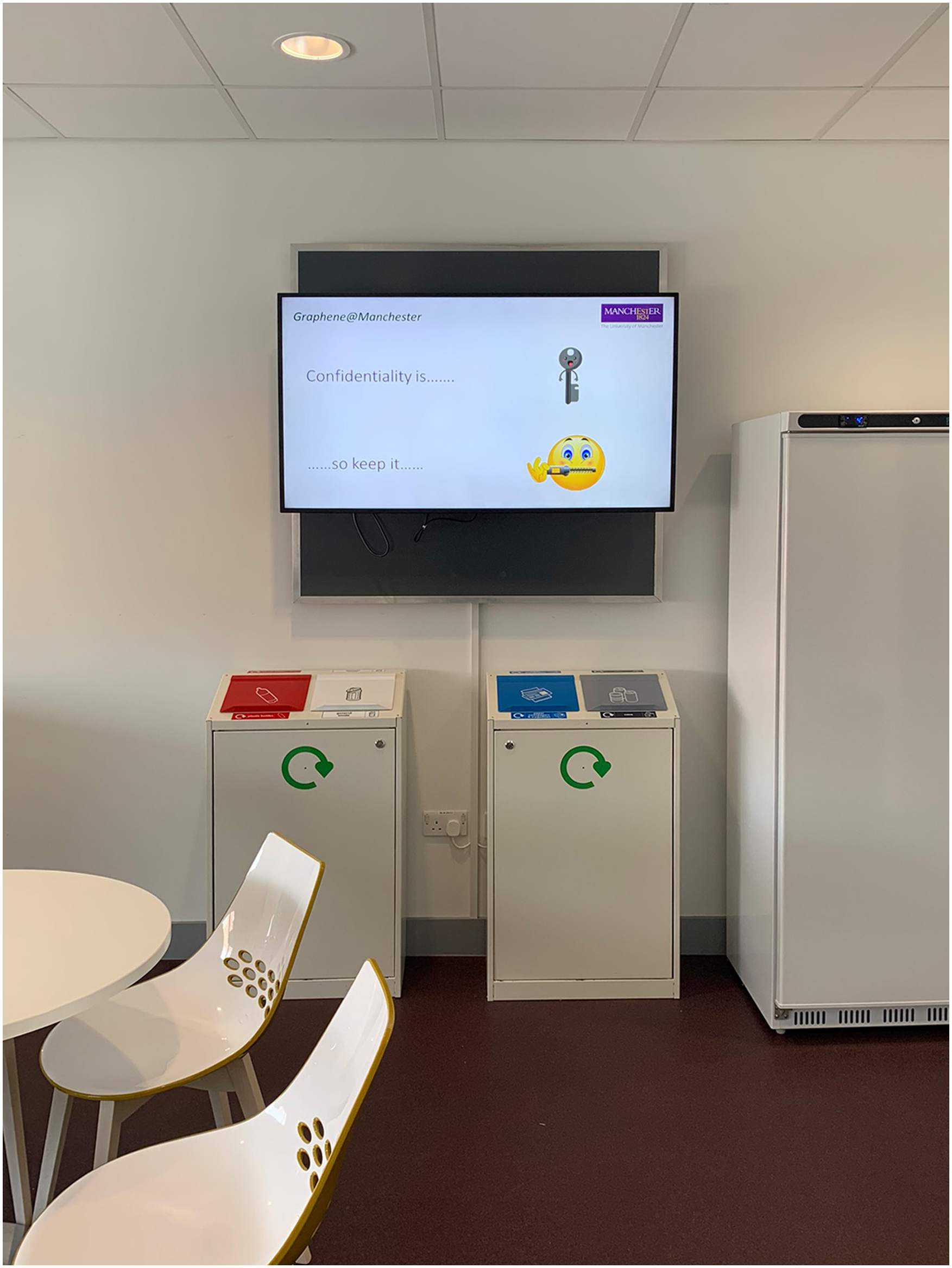
“Confidentiality is [key], so keep it [zipped].” Message displayed in the GEIC second floor kitchen. Source: Photo by the author.
Beyond the Office
Just as Novoselov and Yaneva (2020) argue that collaboration is mediated through the materiality of the entire building, not confined to spaces of communication, so too are the opportunities for the unwanted leaking of information across organizational boundaries in the GEIC. Within the shared laboratories, pieces of equipment, for example, would be utilized on projects with multiple companies. Rather than the cafés, open offices, and lounge spaces often associated with exchange of ideas and knowledge, these technical provisions could become unwitting meeting places, not for people, but for technical processes. The knowledge produced in the laboratory could leave traces: by leaving information in the form of data saved on the equipment, users could glean what the other users were working on from what had previously been done on the machine. Users therefore had to take measures to ensure that boundaries could be maintained through use of this equipment, despite them becoming embedded in the activities of multiple organizations. One applications team member explained that data would have to be saved without any process parameters and under “code words” or “benign sample names” which would hold meaning only to those involved in the project (interview with applications team member 4, 2019).
Similarly, the use of the shared laboratories on the first floor of the building, dedicated to tier 2 partners, must be organized to ensure the separation of partners working in similar areas to prevent them from “looking over each other's shoulders” (interview with GEIC management team members 1 and 2, 2019). This represented two dynamics pushing for quite different spatial configurations: on the one hand, logistically it would make sense to “group similar applications together,” but on the other hand the commercial pressures associated with the work of partners pushed for separate facilities to work on similar technologies (interview with GEIC management team member 3, 2019). The GEIC therefore was forced to work out how to “marry up the infrastructure needs with the commercial needs” (interview with GEIC management team member 3, 2019).
This was also a consideration for the creation of shared systems for logistics and safety. Management of the facility would need a high level of oversight, including accessing partners’ private laboratories in order to conduct maintenance and monitor safety. An inventory would also be required, documenting all the types and quantities of chemicals within the building. But while the management team required this high level of oversight, barriers would have to be built into the system to prevent companies accessing the inventories of other partners. The chemicals and materials used by a company could be enough to reveal insights into the activities of competitors (interview with GEIC management team member 3, 2019). Even when existing within the same infrastructure, sometimes working within the same walls, mechanisms had to be constructed to reproduce and maintain boundaries between users to ensure their autonomy.
The applications team members themselves, who would conduct projects with multiple partners, could become a potential source of leaked information if they used knowledge owned by one company in projects with another. While each project would contribute to the growth of expertise and experience in the building, the ability to ensure that IP was not disclosed to competitors was essential to prevent a major breakdown of trust in the facility. Here, again, humans are considered to pose the potential to leak information from one organization to another, no longer through careless talk but through the embodied technical knowledge they amass.
The GEIC would avoid collaborating with more than one company on projects with similar outcomes and applications. One applications team member stated that the center had already informed a prospective partner that a project would constitute a potential conflict of interest and asked the partners if they would be comfortable with this (interview with applications team member 8, 2019). He noted, though, such a situation would be neither in the university nor the partners’ best interest and may result in a situation where a virtual “wall” would need to be built within applications teams. This barrier separating information within an organization, though common in “the commercial world,” would be “difficult to maintain” (interview with applications team member 8, 2019). At the GEIC in a different laboratory, another applications team member stated that the team in the lab was currently working on two similar projects with different companies, causing them to divide their team in two, and avoid discussing the projects internally (interview with applications team member 1, 2019). In this case it was deemed permissible because both projects were small and neither were “likely to actually generate any IP” (interview with applications team member 1, 2019).
Again, one applications team member stated in an interview that it was an almost inherent knowledge accrued through experience in industry, a “feel for what is…IP important within a project,” which allowed them to navigate these issues (interview with applications team member 4, 2019). Such embodied experience allowed them to internalize the boundaries between usable and unusable information (a skill which might not come as naturally to an academic). The applications team member added that, within the world of industry this was commonplace: I know stuff from my first job [in industry after his PhD] that I know I can’t use here because I know that it's patent-protected…it would be very useful, but I can’t touch it. (Interview with applications team member 4, 2019)
The intensification of interactions, brought about by bringing individuals and organizations into physical proximity and within shared infrastructures meant that this embodied knowledge, along with self and group discipline, became the precondition for the functioning of the center. This was complicated further by the fact that employees of the GEIC may be recruited in the future by companies, recognizing their expertise and having formed connections with them in projects (interview with GEIC management team member 2, 2019), complicating the line between collaborator and competitor. 16 A member of the management team noted that, while this may be a novel problem for the university, “the GEIC, as a commercial entity, has to learn to deal with that” (interview with GEIC management team member 2, 2019).
Conclusion: Practicing Secrecy
In Georg Simmel's (1906, 462) account of secrecy and secret societies, he famously argued that all relationships between people or groups are “characterized by the ratio of secrecy that is involved.” Simmel's analysis captures the capacity for restricted knowledge to shape and hold together groups of individuals, witnessed most strongly in the secret society where the “always perceptible and always to-be-guarded pathos of the secret” (Simmel 1906, 484) requires protection from outsiders. He emphasizes the division between knowledge and concealment, claiming that the secret secures “the possibility of a second world alongside of the obvious world” (Simmel 1906, 462). Yet recent work within STS has looked to complicate such rigid distinctions between what is included and what is excluded by secrecy. Brian Balmer (2016, 14) highlights the “fluid and negotiable” boundaries between secrecy and openness. Drawing on Hilgartner's (2000, 162n49) technologies of secrecy—the “devices, practices, and systems used to enclose information or limit the observational power of audiences”—Balmer (2016, 14) highlights the mundane, ambiguous and often spatial nature of secrecy as it is enacted, continuously contributing to the “production of multiple worlds.”
In the GEIC, the boundaries which restricted flows of information formed intricate and shifting topographies which were produced throughout the architecture and physical infrastructure of the facility. The GEIC's complex economies of secrecy allowed for an array of participants to be brought in relation and physical proximity with one another, while also producing and reproducing distinctions between them.
In this article, I have focused on the ongoing spatial and material mediation of contradictory dynamics of engagement and secrecy throughout the GEIC, and the emergence of specific spatial practices to enact divisions and boundaries, even within shared space. Walls, locked doors, open-plan spaces and shared laboratories could variously become embedded as practices of both openness and secrecy. Yet space and the materiality of the facility, while not determining the forms of togetherness which emerged, were also not passive. The community-in-development emerged through and with the physicality of the building: space became modified, and users of the building were forced to modify and police their behavior within particular spaces to ensure that information was kept strictly within the permitted networks.
This article contributes to the literature both within STS and architectural studies on buildings of science and technology, detailing an example of how such buildings matter in the formation and maintenance of technoscientific networks. Through this work, I suggest that both fields should take seriously the role of architecture and space beyond “quick” readings of architectural forms (Yaneva 2017) which may too readily equate “openness” and “separation” as spatial characteristics, with open exchange and secrecy as practices. This article also explored the under-researched area of the spatial dimensions of the deepening entanglement of academic institutions and industrial exploitation. The unique position of the GEIC, as a university facility which strictly accommodates industrial scale-up rather than academic work, offers an opportunity to explore how the spatial practices of producing both moments of collaboration and division are reformulated in the context of academic capitalism. Seen in an extreme form at the GEIC, similar considerations may increasingly become a broader concern for the design and operation of science and technology buildings at universities as they deepen their engagement with industry, and as universities are increasingly expected to take up R&D activities. In a context in which what matters is developing not only knowledge, but ownable, profitable know-how, producing the means to separate gains new significance.
Footnotes
Acknowledgements
I would like to express my gratitude to the two anonymous peer reviewers for their constructive comments. My thanks also go to the GEIC for their time and participation in the research. I am also deeply appreciative of Albena Yaneva and Stephen Walker for their comments on drafts of this article, and Leandro Minuchin and Albena Yaneva for their support and supervision during my PhD. I would finally like to thank colleagues within Manchester Architectural Research Group (MARG) for their advice and helpful discussions. This research was funded as part of my PhD, supported by the Transformation North West Doctoral Training Programme, part of the NWCDTP.
Funding
The author disclosed receipt of the following financial support for the research, authorship, and/or publication of this article: This work was supported by the NWCDTP Transformation North West PhD programme, part of the Arts and Humanities Research Council.
