




Abstract
This article analyzes how journal business models are built on variations of an attention cycle. In this cycle, measured attention in the form of bibliometric indicators becomes a key asset that can be converted into readership and submissions, which in turn may generate financial resources. Our article illustrates this in the context of the Chinese publication system, where varying attention cycles coexist. In the Chinese state-run system, measured attention can be converted into public support, as well as increased subscription and submission revenue. Opportunities to assetize and convert attention and financial resources differ radically between English-language journals operating under Chinese control, China-based journals operating with international publishers, or Chinese-language journals. Using data from qualitative interviews with Chinese editors and publishers, we demonstrate how this conceptualization helps reveal crucial differences between these journals as well as the specificity of the Chinese publishing system. In addition, we propose the attention cycle as an analytical tool to study publication systems in other contexts.
Introduction
Editors and the editorial work they perform are essential to keeping the scientific record robust and trustworthy. Editors are widely recognized as the gatekeepers of scholarly publishing, but their tasks are notably complex. Editors can also be planners, brokers or facilitators, curators, and sometimes all of these at the same time (Noel 2022). Journals are not only platforms for publishing scientific results; they are an extension of collaborative knowledge communities. Editors share a prosaic concern that journals need resources: there is an economy of publishing. With the emergence of commercial interests in scholarly publishing (Fyfe et al. 2017), the focus has shifted from community-managed publications to scientific communication as a business venture, with new players and a distinctive resource structure (Mabe 2009), including the pursuit of profits in the competitive academic publishing market. While journals require support from academic communities through submissions, reviews, and readership, their editorial operations depend on financial concerns beyond those communities.
The commercialization of scholarly publishing is therefore reshaping editors’ concerns. Scaled-up commercial publishers now have product lines and brand extension strategies, such as deploying the symbolic capital of a prestigious journal to spin off other related journals (Khelfaoui and Gingras 2020, 2022). At the largest global publishers (Larivière, Haustein and Mongeon 2015), the editorial process itself is subject to business logics, with long procedural chains, highly specialized division of labor, and standardized practices (Horbach and Halffman 2020). Innovative editorial processes, such as new peer review procedures and publishing technologies, or public concerns over open science, require journals to accommodate a mix of community and commercial concerns to preserve their place in scholarly communication.
Since resources are limited and journals are many, researchers, publishers, and even governments need to decide which journals deserve investment in light of journal performance. Yet journal “performance” is not easily assessed. Valued qualities in journals vary, and deciding which journal is worthy of attention (whether investment or community support) is complex. Indicators of worth simplify and rationalize this process. Indicators such as citations or the Journal Impact Factor (JIF) become tokens of performance offered to support such decisions. Visibility and attention are key ingredients of these indicators, both measuring journal exposure and promising attention to its authors, fueling their use in career and research assessment (Rijcke et al. 2016). Specialist knowledge communities may have local quality assessments based on close familiarity with a journal, but beyond their horizon, bibliometric indicators have become the benchmark to measure journal performance (Haustein and Larivière 2015).
The availability of these indicators is not self-evident. Their measurement importantly requires an underlying digital bibliometric infrastructure that makes measurement possible and manageable. A variety of bibliometric databases, journal rankings, and journal lists have proliferated across different countries and languages (Huang et al. 2021; Pölönen et al. 2021; Wang, Halffman and Zhang 2023). Most noteworthy and authoritative are the Web of Science, including its embedded metrics, and the Scopus database. The provision and management of these data infrastructures is now itself an opportunity for business development (Baas et al. 2020).
This study first offers a framework for analyzing the economy of attention that journals participate in and its cycles. It does this through the example of China-based journals. Given the vital role of Chinese science in the global scholarly communication landscape and the tremendous growth of scientific publications from China (Clarivate 2023; Springer Nature 2024), the operation of Chinese journal publishers and editors is remarkably invisible in the international debate on publishing futures. The editors’ role in the context of Chinese science publishing, with its specific political economy, remains under-researched, both in terms of editors’ publishing practices in an administrative organizational structure and in regard to how journals operate as a commercial entity.
The methodology section describes our analytical method to categorize China-based journals along two dimensions into three groups, to investigate how editors and journals generate attention and turn attention into assets in the Chinese publication system. We conclude with the specificities of the journal attention economy in China and discuss the use of the journal attention cycle as an analytical tool in other contexts. This helps understand how editors cope with changing external demands and pressures of Chinese and international evaluative regimes, and the differences between Chinese journals with national and international orientations.
Theoretical Framework
The Journal Attention Economy
Our concept of an attention cycle is based on Latour and Woolgar's credibility cycle, through which research is transformed into rewards that can generate further research resources (Latour and Woolgar 1986; Hessels et al. 2019). Similar to the credibility cycle, the attention cycle helps map how journals earn attention through efforts to generate citations and reputation, which can subsequently be assetized (Birch 2017) in order to develop the journal. Journals’ “attention cycle” differs from the credibility cycle, however, as it focuses on how a journal acts as an entity in the scholarly publishing context, instead of an individual researcher or a collective performing research. It similarly contrasts with publication cycle models, which take the perspective of papers’ trajectories from research to publication and uptake (Björk 2005).
Journals operate in an economy that converts published information into attention and subsequently into financial resources. 1 Journals are forums in which knowledge claims are publicly legitimated, debated, and developed, requiring the acknowledgment and attention of knowledge communities. This setting also helps researchers to claim priority of scientific results, establish intellectual importance and future research priorities, and generate academic credit (Merton 1973; Csiszar 2018). Apart from the intrinsic value of knowledge, journals are also assessed by different actors in terms of the attention they can provide: by authors (assessing career advantages, attention potential, acceptance chances), by reviewers and editorial board members (peer prestige and recognition), by publishers (potential business value), and in governmental or organizational evaluation regimes (as indicators of research quality). These are the drivers for journals, as organizational entities, to generate and assemble different kinds of attention.
The attention that journals generate is positioned in sociotechnical configurations—across epistemic cultures, research evaluation, and policy contexts—in which engaged actors and material infrastructures are shifting the meaning and value of journals’ attention (Jablonsky, Karppi and Seaver 2022). Particularly in the context of the overwhelming expansion of science publishing (Citton 2017, 2), capturing readers’ attention becomes key, even when journal subscriptions are not necessarily the main source of income.
Quantified Attention
Attention itself does not count and is of itself not countable. This leaves drivers of rationalization, such as business management or state administration, eager for indicators of attention, creating a rationale for metrics like citations, citation-based indicators, and readership counts. Such indicators allow incomparable entities to become comparable and commeasurable, amenable to “rational” administration and decision-making, which supports both the construction of markets (Callon and Muniesa 2005) and the operation of public and professional valuation regimes (Fochler 2016; Schimanski and Alperin 2018). Woven into valuation regimes, attention indicators become performative: for all intents and purposes, they are attention, attention redefined, attention to the extent it matters (Espeland and Sauder 2007). Similarly, in Franck's (2002, 19) analysis of celebrity scientists in the academic attention economy, attention accumulates and eventually translates into a form of “mental capital,” namely reputation: “Scientific reputation is to scientific information as financial assets are to real capital.”
For both scientists and journals, measurable, accumulated attention comes in the form of countable publications and citations. “Celebrity” journals transform their existing public profile also through branding, as in the Nature portfolio, but even there these indicators continue to operate. The environment in which journals operate has been organized as a market, but a very specific market. In this market, doing attention (Pedersen, Albris and Seaver 2021), that is acts of attention (reading, downloading, citing), is registered as bibliometric indicators in bibliographic data infrastructures and read as signs of value. Attention differs from prestige. Since citations have no systematic positive or negative markers, they can be signs of approval, disapproval, or mere tokenism, although negative citations are relatively rare (Bordignon 2020). Especially as attention indicators get gamed, they may divert from what research communities consider prestigious.
Assetization of Attention
In scientific publishing, attention is not a fleeting resource, but a resource that accumulates, at least over a period of several years. For example, the Journal Impact Factor is not the result of sudden publicity, but an expression of attention through accumulated citations to articles published in the last two years. Attention gathered by a set of articles and expressed in such an indicator becomes, specifically, an intangible asset: an immaterial resource generating recurrent earnings (Birch 2017, 2020) and a measure of a journal's value as a capital good (Franck 2002).
This accumulation into an asset has therefore only been possible through the massive data infrastructures of bibliographic databases and the datafication of academic publishing and evaluation (Krüger and Petersohn 2022), which have proliferated over the past decades. The specificities of such infrastructures, including citation databases, altmetric data aggregators, persistent identifiers, evaluative software tools, and the growing content and functionalities of bibliometric infrastructure, influence the production and assessment of attention in journals’ valuation processes. Currently, these digitalized infrastructures are increasingly run by data companies that also own publishing companies. These specific techno-economic arrangements and logics of journal operation underpin the transformation of attention into virtual assets.
Assetization of attention into quantitative indicators is an affordance of the formidable data infrastructures that certify what counts as a proper journal, store references from publications, relate them to uniquely identified entities (authors, organizations, research fields, journals), and package them into universalizing tokens such as the JIF. Subsequently, these tokens get advertised in and mobilized by journals to draw in potential publications, submission fees, or funding allocation. From this perspective, a publishing house is the production facility that accommodates the conversion of attention into earnings, coagulated around the journal brand.
There are different ways in which attention converts into earnings and the possibilities vary between research governance models. For journals operating in a commercial publishing logic, publishers’ investments attempt to convert attention into subscription fees, or Article Processing Charges (APCs) in an open access publishing model. Journals in China are state-controlled and managed, operating in an administrative logic rather than a market of commercial publishers (Wang, Halffman and Zwart 2021). For these journals, attention provides leverage to get recognition from sponsors and state financial supporters, rather than publishing firms. Nevertheless, investment in state-sponsored journals is also guided by indicators of “quality.” For example, China's public funding journal list is an attempt to reallocate both attention and money, by attracting high-quality publications to its own journals and redistributing public funds respectively. Despite different conversion possibilities, for journals operating in both logics, accumulated attention can generate resources to develop the journal.
Thus, the economy of journal publishing can be understood as an attention cycle, turning attention into measurable attention, and then turning the asset of measured attention into resources used to generate more attention. The resources, the attention-generating options, the measures, and how these can be deployed as assets in the attention economy, vary with the valuation regimes in which authors, editors, publishers, and research organizations assess journals. This cyclic and self-reproducing dynamic is at the core of running a journal economy, as depicted in Figure 1.
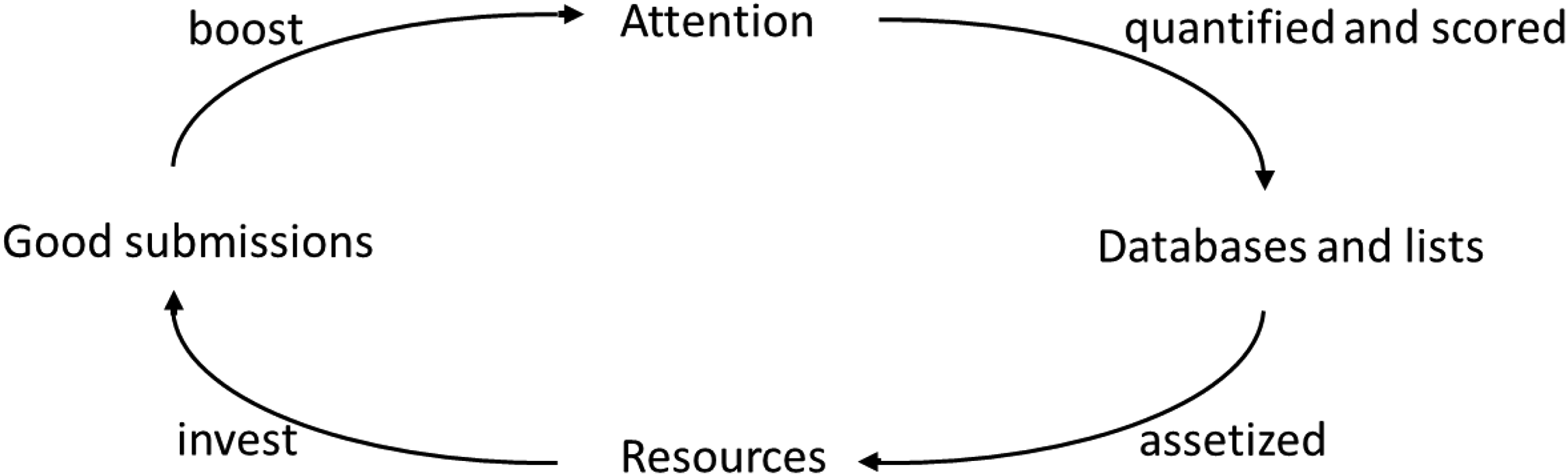
Schematic journal attention cycle.
Methods
Data Gathering
Our analysis is based on qualitative interviews with Chinese editors and publishers. Access to these respondents is extremely difficult. After 100 unresponsive interview requests, we had to rely on personal networks and introductions, and Chinese social media (e.g., joining editors’ WeChat groups or official WeChat accounts regarding scientific publishing), using also recommendations by respondents as further introductions. This allowed us to obtain 26 interviews across science, technology, engineering, and mathematics (STEM) fields. While this snowballing may involve bias, there is no other way to feasibly access Chinese scholarly communication professionals in a reasonable time frame.
Interview respondents worked for prestigious and established medical and science publishers, as well as upcoming new journals. Our interview questions focused on how these editors articulated and understood journal quality, how quality measures were imposed on them by others, and how quality measures informed journal management decisions (see Supplemental Materials for the full interview guide). All the interviews were conducted in Chinese and lasted between 58 and 136 min. They were transcribed by Jing Wang and analyzed in Atlas.ti using a bottom-up coding process, with the initial coding categorizations based on the interview topics and journals’ drive to survive, to improve, and to get recognized. References to specific interviewees are anonymized (see Table 1 in Supplemental Materials).
In Chinese, the corresponding terms for “attention” are 关注 (Guan Zhu) and 注意力 (Zhu Yi Li) among others. These terms are normally value-free words and refer to human attention. However, attention in the scholarly publishing economy gets assigned (desirable) values and is incorporated in (academic and policy) discourses and practices to turn engaged actors’ attention into desirable products or tokens. Words used in current discourse are: 国际影响力 (international impact), 国际化 (internationalization), 高质量 (high quality), 高水平 (highly qualified), 一流 (first-class), and 卓越 (excellent). Engaged actors include funders, policymakers, research institutions, researchers, publishers, and journals.
Analytical Method: A Focus on Multiple Journal Models in China
The Chinese scientific publication system has specific features, with a state-controlled and managed system, multiple layers of regulators and sponsors, and a journal license system granting the legal right to publish in China (for more details, see Wang, Halffman and Zwart 2021). All scientific journals in China require “sponsors” at higher administrative levels, such as academic societies and associations, research institutions, state publishing houses, government agencies, or other public agencies. Journals also require a journal license from the state, a China Number (CN), besides the International Standard Serial Number (ISSN), although some journals now operate outside of the administrative system that requires a CN. Scientific journals in China are published by academies, universities, associations or government agencies, rather than by an oligopoly of commercial publishers, even though cooperation with big international publishing houses is on the rise (Wang, Halffman and Zwart 2021). This centralized administrative management that allocates resources while keeping journals public and publishers deconcentrated, is in sharp contrast with the international publishing system, in which most international publishers operate as commercial entities with clear marketing strategies, a highly specialized division of labor, and a long procedural production chain (Horbach and Halffman 2020), under conditions of market concentration (Larivière, Haustein and Mongeon 2015). The state-led, administrative funding of journals in China shapes what the asset of a high JIF can be used for: to get listed among the journals qualifying for administrative support, rather than demonstrating direct commercial potential.
However, there is also significant variation in Chinese journal operating models. Scientific journals in China can be categorized based on two dimensions. The first is language, separating China-based journals published in English from those in Chinese. The second divides Chinese journals between those with a China Number (CN), published by Chinese public research institutions in either English or Chinese; and those without a CN number, published by international commercial publishers, almost exclusively in English.
These two divisions lead to three groups of journals. We list some random examples of journals in each group in Table 2 of the Supplemental Materials.
2
English CN journals: publicly owned English-language journals with a CN number; English non-CN journals: commercial English-language journals without a CN number, but with a base in China; Chinese CN journals: publicly owned, domestic, Chinese-language journals with a CN number.
These different sets of journals deal with different operating conditions, including different pressures on resources and scientific support, as well as different modes of demonstrating “quality.” English CN journals integrate international publishing standards and competitive pressures with administrative management by the Chinese state, with financial support conditional upon administrative evaluation and policy goals. Such goals include priority research areas to support national strategic targets. These journals compete with international journals for submissions and attention while relying on public resources and their particular allocation logic.
In contrast, English non-CN journals operate in the international commercial publishing logic. Although sponsored by their Chinese public research institutions or self-funded through subscriptions or APCs, not all intend to get state recognition and support. These journals resemble and emulate international commercial or society journals. They include a growing number of open access journals, created in strong partnerships with international publishers (CAST and STM 2022), attracting attention very similarly to—and in competition with— international journals.
Chinese CN journals preserve the Chinese publishing tradition, in which administrative procedures set the conditions for the activities of publishers and editors. In this state-controlled governance mechanism, editors and publishers face particular challenges and high pressures to cope with current changes in scholarly publishing without a clear policy framework and stable financial support, with low policy priority.
While this policy differentiation has profoundly shaped the ability of the different journal sets to attract resources, this categorization hides further characteristics that shape individual journal opportunities. These include open access status, disciplinary background, size, or journal age. While such characteristics do affect the details of accumulation and resource conversion, we will restrict the analysis to the three main categories to highlight how attention cycles vary between different regimes, which we will now analyze for each step in the cycle.
Findings
Measurable Attention: Attention That Counts
In order to compete for the scarcity of attention in the information abundance era, the first requirement for journals is to get visibility in the relevant scientific community. Journals need to be on scientists’ radar when looking for articles to read and cite, or when selecting outlets for their research papers. A major step to achieve a journal's visibility is to get “listed” in relevant abstract and citation databases. The next step for journals is to amplify visibility and attention by scoring well in various journal rankings and lists. These databases, rankings, and lists help journals make potential attention measurable and countable, which enables them to accumulate “visibility” and perform “quality” in a measurable sense. To become an asset, attention needs to be accounted through bibliographic data infrastructures, and to be accounted a journal needs to be listed.
Getting Listed in International Databases
Getting journals listed in the Web of Science (WoS) is a prime objective for international as well as many Chinese journals. WoS not only allows readers to find articles, increasing attention for published work, but also to demonstrate journal importance, attracting submissions and subscriptions. In fact, getting listed itself is already an asset: inclusion in databases is advertised on journal web pages, with the implicit promise that publications and their citations will also be measured and stored. Only after the journal has entered WoS for two years can it receive a Journal Impact Factor (JIF), which a journal may then attempt to boost. Although WoS arrived in China relatively late, it has established an important position as a quality standard and its indicators play an important role in domestic journal assessments and lists (Zhang and Sivertsen 2020; Huang et al. 2021; Kulczycki et al. 2022). WoS and its Journal Citation Reports (JCR) are Clarivate products that now occupy an unshakeable dominant position in China. Several of our respondents (R1, R6, R7, R8, R9, R13, R17), confirmed the importance of getting into WoS, increasing their journals’ JIF, and improving the journals’ position in (or across) the JCR Quartiles. For the quality and quantity of submissions, there is a big difference between before and after being included in WoS … I think the most important journal metric recognized in the scholarly publishing industry is still WoS and its JCR report. The high impact factor is still crucially relevant for a journal. (R17)
However, a JCR listing is not equally achievable for English- and Chinese-language journals. Around the 1990s, when the Science Citation Index had just entered China and needed to get attention from Chinese academia, it was possible and even “pretty easy” for some Chinese-language journals to get accepted into the database (R4, R5, R6). Currently, getting listed in WoS is perceived as unachievable for Chinese-language journals, discouraging them from even trying (R4, R16).
There are international databases other than WoS to make journals visible, and others specifically relevant for China. Additional international databases mentioned by our respondents included Scopus, Directory of Open Access Journals (DOAJ), Engineering Index (EI), PubMed and MEDLINE for medical journals, and Chemical Abstracts Service (CA) for chemical journals
Getting Listed in Local Infrastructures
In parallel, local indexing and measurement infrastructures have been developed by Chinese agencies. These infrastructures particularly matter to Chinese-language journals and have been used widely to present and evaluate journal performance. Among these, the key databases and journal lists noted by the respondents include the Chinese Science Citation Database (CSCD), the Key Magazine of China Technology (CSTPCD), the Chinese Core Journals Directory from Peking University Library, and the China National Knowledge Infrastructure (CNKI). Tangible and countable inclusion criteria for these journal lists have become the lens through which Chinese-language journals understand and construct “quality.” The quality of a journal is related to what kind of high-quality research is published in this journal. We … study suggested [inclusion] indicators, such as whether the published research is supported by grants, whether there are significant authors, and whether there are international collaborations. (R8)
Except for citations, there are other, local indicators that encourage editors to generate particular kinds of attention in order to perform better in such rankings and lists. In the Chinese context, the JIF is therefore not the only form of assetized attention. 3
In terms of the inclusion criteria of CSTPCD, the Funding–Paper Ratio, referring to the proportion of articles supported by specific grants, is one of the inclusion criteria that stresses local characteristics in contrast to international databases. It is generally considered to represent new trends and excellent research, which CSTPCD considers more representative of academic journal quality than the impact indicators (R7).
This accounting system is not just some other way to express scientific quality in general but actually reflects how notions of quality are infused with national policy goals. For those scholars who have received major national funds … it means that the research directions of these projects are valued by the state in their fields, so papers of these funds must have a big readership and will be cited a lot. (R2)
Administrative resource allocation for journals in Chinese requires domestic quality accounting. However, the impact factor in Chinese journal databases is generally low, preventing differentiation between journals. Hence improving the metrics of Chinese bibliographic databases does not lead to more resources for Chinese language journals (R6).
More valued are qualitative journal assessments, such as expert peer review and the profile assessment of editorial teams, particularly for getting into lists, rankings, or databases. In this kind of assessment, the reputation of scientists on the editorial board and the status of journal sponsors also play a role in journal selection. When selecting journals for inclusion in domestic core databases, some will also consider how many academicians [members of the Chinese Academy of Sciences or the Academy of Engineering] are [in] the editorial board … Anyway, when being assessed to get listed, the background of your sponsors and whether you have academicians to endorse your journal, these factors will provide the journal with certain advantages. (R8)
Other respondents (R3, R15) also criticized the partiality of the journal assessment agency, which favors journals sponsored by its parent administrative unit, which is considered unfair to other sponsors’ journals.
CNKI is the most important China-based database for Chinese journals and publications (Wang 2019; Huang et al. 2021). It is specifically relevant for Chinese-language journals to get into CNKI to make journals and their publications visible, as it allows Chinese researchers or policymakers access to thousands of outlets. Editors use the CNKI data, for example, citations and article download counts, to present “good” performance, to highlight possible publishing priorities to the Editor in Chief and editorial board, or to discuss trendy topics for future publishing directions, guiding efforts to attract more submissions and also in applying for journal funding or projects (R6).
In the Chinese administrative logic, there is another funding list that matters to all groups of journals. This funding list is created by the Chinese Scientific Journal Excellence Action Plan (Excellent Journal Funding List). This Plan is a national project to grant state financial support to high-quality domestic journals for further improvement. Journals in this funding list have been recognized as high-quality and of good reputation in national science policies, and researchers have been encouraged to publish more in such listed journals. This list makes efforts to direct attention and visibility to funded journals and makes their attention count in evaluation policy. In terms of the selection criteria for a journal to be included in this list, the JIF is a significant resource for English-language journals to get in. Ranking in key Chinese databases is the entry card for Chinese-language journals (Wang, Halffman and Zhang 2023).
“Ceiling Effect” for Chinese-Language Journals
The measured attention journals generated from the various databases, rankings, and lists do not count equally in all research evaluation systems. Chinese-language journals are not as highly valued as WoS-ranked English-language journals in the Chinese scientific evaluation system. This results in a “ceiling effect,” where editors feel they are unable to improve their journal's scores in evaluation processes, disregarding actual quality improvements. This actually discourages editors’ quality improvement efforts, particularly for multidisciplinary university journals.
4
With the increased importance of WoS rankings, these journals have been marginalized. To be honest, maintaining and improving the quality of a journal cannot be done by our personal enthusiasm alone, and we have little incentive to do so. For example, our journal has been included in various core databases in China and is now on the Excellent Journal Funding List. However, in our university's overall evaluation, publications indexed in these domestic databases and lists cannot score in its evaluation. Our university only recognizes WoS publications, but nothing else. (R16)
The journal assessment criteria of these databases, rankings, and lists play a role in shaping editors’ and publishers’ efforts, as well as decisions about what kinds of articles to publish in which journals. The valuation regimes that structure what kind of visibility counts, or is even countable in the first place, differ for the three journal groups.
Assetization: Getting Resources
Once journals have visibility and attention that counts, what can journals do with these? Journals turn attention that counts into assets, that is: attention is accumulated in a listing or indicator that can subsequently be used to obtain or increase resources. Contrary to resources, these assets are not depleted by use but can be used to generate more resources. Just as the process of generating attention, this assetization works differently for the different groups of journals we distinguished. We will describe three different sources of finance, which are accessible in different degrees to the three different groups of journals.
The first funding source for Chinese journals consists of the journal's sponsors. These sponsors need to support journals’ regular operating costs and personnel. However, this sponsorship is not equally generous for the three journal categories.
Sponsor investment aims depend on national policies and sponsors’ specific considerations in relation to journal and institutional evaluation mechanisms. For example, English-language journals have lately been endorsed by national policy (CAST 2019). With a policy focus on international visibility and competitiveness, academic societies and research institutions have invested massively in new English-language journals and the improvement of old ones (CAST and STM 2022). Newly launched open-access journals, available exclusively in English through a partnership with international publishers, largely depend on institutional subsidies, with high-level financial support from the public or state sources. These so-called Diamond Open Access journals normally get generous financial support to realize immediate free access for readers, and during the first three years, APCs are waived. This significant investment aims to attract authors, maximize readership and visibility, and accelerate the accumulation of citations, which in turn helps these journals to get indexed quickly in the main international databases (such as WoS and Scopus) and get a JIF. There are further administrative mechanisms behind journal resource allocation. If universities think the journals can contribute to their disciplinary and academic development, they might be willing to invest in journals. In addition, investment is worthwhile if journals can help a university score in the national discipline assessment. In this sense, the journal can be a strategic tool to help universities and research institutions perform well in the national evaluation system. Scoring well in the right attention-counting databases is therefore not only important for the journal but also for its sponsors. Our university had a very good performance in the STEM Journal Excellence Action Plan, and many journals have been selected in the Excellent Journal Funding List. From this point of view, our university leadership also attaches great importance to our journals. We are relying on the strengths of our university's disciplines to develop our journals. The research directions of our advantageous fields are unique and top-notch in China. So we only do what we are good at, and this also allows us to compete with the top universities. (R15)
Sponsorship of Chinese-language journals is usually not as extensive as of English-language ones. Funding and personnel allocation to Chinese-language journals relies on attention and recognition from their institutional leadership, which means these journals have to operate under unstable resource conditions.
The second funding source is journals’ own revenue, which varies sharply across different types of journals. For English-language journals operating in partnership with international publishers, it is not always clear to what extent the journals share revenue with their publishers. In principle, these journals will get a share of the revenue from the publisher, either in a subscription model or open access model. However, this revenue share from international publishers is very small and some journals do not receive a financial return in the early stages of their co-operation. Our seven journals collaborate with [redacted publisher name]. We had a pre-agreement on profit sharing and signed a confidentiality agreement. Our journals have adopted a hybrid OA [Open Access] model, where we choose some good articles to publish in OA format. In terms of the revenue share we get, it is actually very small. (R14) [redacted different publisher name] takes the vast majority, while our journals only take a very small portion. As far as I understand it, the way big international publishers sign up for cooperation is very unequal and it is super hard to negotiate with this. Honestly speaking, our Chinese-language journals co-operate with CNKI, and the profit sharing between us is relatively equal. (R5)
For Chinese-language scientific journals, there is no online subscription model or open access model to generate APC revenue comparable to the practice of international journals. Journal sales are mostly in the form of sales of printed copies, which usually generate only a trivial income. However, Chinese-language journals have alternative ways to earn income, by charging page fees to authors, and copyright fees to database providers. The academic database providers supply digital and online services to Chinese-language journals, including online accessibility, readability, and downloadability of their articles, as well as the likelihood that they will be cited. The default money flow in Chinese-language journals involves two processes: authors pay journals to publish, and readers pay database providers such as CNKI to get access. When authors want to publish in Chinese-language journals, normally they have to pay page fees to journals. In an attempt to create more visibility for their publications, journals establish agreements with database providers to make their publications accessible online, in return for copyright acquired from authors. Thus, when readers want to get access to these publications, they either get access through university library subscriptions or pay for the databases individually. Part of this money then flows back to the journal.
Thus, Chinese journals have two sources of income they generate themselves: page fees and copyright fees. However, copyright fees are not high, because the biggest database provider began to issue “exclusive licenses” for the journal's publication copyright since 2006. This ensures a quasi-monopoly position in the database market and ensures low copyright prices. Hence, page fees tend to be the more important source of income for Chinese-language journals to sustain their normal editorial process. Our journal charges page fees because we have to consider income and survival issues. We normally need to consider a reasonable publishing standard to ensure a certain number of articles are published, which allows us to generate enough income to survive and cover the costs of our editorial office. (R6)
For journals with a CN number, the number of pages is specified during the application for the CN number. Thus, such journals cannot publish more than the fixed pages agreed upon when the journal was established. In this sense, journals cannot publish more pages (more articles) to generate more revenue. Moreover, top English CN journals are normally reluctant to publish more for fear that it may result in lowering the Journal Impact Factor, with subsequent risks of failing to achieve the requirements of national journal funding evaluation.
The third funding source is the attractive financial support provided to journals by the Chinese Scientific Journal Excellence Action Plan, allocated by governmental agencies. These funding opportunities are also unevenly distributed among English- and Chinese-language journals, prioritizing English CN journals with a good performance in WoS, i.e., with high JIF and a good position in JCR Quartiles. The Plan therefore offers these journals an opportunity to capitalize on WoS-accounted citations.
This funding is hard to use because it imposes strict administrative assessments, setting high goals for funded journals. For emerging English-language journals without CN numbers, there are some opportunities to apply for funding from the Action Plan that includes the provision of a CN number. Yet the tough and complex administrative assessment, performed by multiple government agencies, discourages journals from applying. If a journal enters into these funding programs, the funders will assess the impact factor of the journal. The contracts signed between the funders and the journals are mainly in the form of impact factor or journal ranking in the Journal Citation Report within 5 years. Just as an example, they will require either the impact factor going from 5 to 20, or the ranking place from the top 30 percent to the top 10 percent. These funding contracts are usually in this form. (R1)
Chinese-language CN journals generally consider funding from the Plan too competitive, because it does not grant them the same extensive financial support the English-language journals get, and because funding is limited to specific research fields. There are one third of English CN journals that have obtained the largest share of such journal funding, and only 100 of 4,500 Chinese-language journals got the remaining share, which are also limited to certain fields. (R3)
The financial resources obtained from either of these three sources are subsequently used by journals to invest in the further development of staff facilities, for advertising possibilities, to hire staff, to improve office support, or to develop journal marketing. We will now turn to this next step of the attention cycle.
Attracting Attention: Getting Good Papers and More Citations
After the asset of measured attention is converted into resources, journals can then invest these resources to attract “good” papers and thus generate more attention. They can hire staff and invest in infrastructure (e.g., a better website, manuscript management system, social media management, cooperating with international journal platforms, hosting and attending conferences, and so on) to make the journal more attractive for authors to submit their work to.
In our discussion, we refer to “good papers” in an emic sense, as submissions that our respondents, editors of China-based journals, consider to be good. The strategies to get good papers and more citations are not dissimilar among different groups of journals, although they target different audiences and face different challenges. Respondents mentioned many possible ways to work on getting good papers, including getting well-known authors, “hotspot papers” (papers on trending topics), high-quality reviewers, rapid publishing, and social media promotion, which are seen as means to attract high-quality submissions, which in turn are expected to boost attention. We discuss some of these strategies in more detail below.
Networks with “Good” Authors
Our respondents suggest that it is crucial to network with “good” authors: highly cited researchers and scientists with awards or nominations who can endorse the quality of publications and, consequently, the quality of the journal. If they are associated with influential authors, journals can attract more attention from the research community. This means the possibility of more citations, and more citations will guarantee a higher impact factor. Similarly, having influential and reputable authors publish in your journal may attract more submissions from other scholars. In this way, journals can capitalize on authors’ reputation and impact to generate attention.
For English-language journals, inviting review papers or Special Issues from well-known scientists is a common practice to get more citations (Repiso et al. 2021), so editors invest a lot of effort in searching for potential authors and inviting their papers. In addition, inviting highly cited authors for high-level submissions is another approach taken by respondents to lift the visibility and citation counts of their journals. Author selection tends to be subject to strict criteria. “Highly cited authors” normally means authors who have a high h-index or authors with highly cited papers in the Essential Science Indicators (R2, R8, R17), or who are members of the National Academy of Sciences from their respective countries (R1).
In addition, especially if journals aim for a high impact factor, they will set up strict criteria for screening submissions: We set three criteria to screen submissions. The first condition is the impact factor. The academic level of submissions must exceed the level of articles we want the journal to achieve. The second is that the results presented in submissions must be universal, because we are a comprehensive [multidisciplinary] journal, and many of our readers and reviewers are interdisciplinary. The results presented in submissions must have generality and exert influence in multiple fields. The third condition we consider is whether the submissions will have the potential to attract readers, for example we estimate whether submissions can reach citation counts of more than 30 within two years. After going through these three criteria, I can filter out basically 90 percent of submissions. (R8)
Yet inviting the right papers is not an easy task. Journal editors have to invest time and energy to find suitably qualified authors, or use the Editor in Chief's reputation or personal network to drive contributions. They also have to attend conferences in relevant research fields or visit research groups and laboratories to follow new results and maintain networks. For nascent journals, networking with good scientists can be challenging because such journals lack an impact factor or have only a low impact factor to attract authors. Publications in such journals cannot score in performance evaluation systems like promotion, graduation, or grant application, making these journals less attractive to authors, especially those with well-established reputations, requiring extra effort and passion to persuade authors (R1, R5, R17, R23).
Related to the identification of prominent authors, editors also work to identify trendy research topics. Journals try to use hot topics to grab attention from their readership and generate measured attention. We must find hot, cutting-edge, mainstream articles to publish based on the most important breakthroughs in science and technology in each discipline of the journal, so that scholars will pay attention to your journal. This is why we only invite highly cited authors, because their articles have many citations and readers, so their research topics must be hot topics. (R8)
Some journals not only chase hot topics, but avoid publishing on unpopular topics to optimize citations in the journal impact factor formula (R8).
Publishing Speed and Review Quality
In line with previous research on international publishers (Horbach and Halffman 2020), the importance of publishing speed was stressed by several respondents working in English-language journals. A quick review and publishing service is regarded as valuable to compete with other open access journals, expected to attract especially Chinese authors. Some high-profile journals aim to compete with internationally renowned journals for priority publication of major scientific discoveries, prioritizing and advertising faster review and publishing (R1, R7, R9, R10, R11, R16). Fast review and publishing services are very attractive to authors. Even though your journal is good, there is always a long delay in getting the articles published, which is very discouraging for the authors. (R1) More pragmatically, research groups are always in need of published research results for finalized funding or research projects, or for PhD graduation within the group. In these researchers’ daily routine, review and publishing speed is always a critical factor. (R17)
Interestingly, although international journals increasingly struggle to engage or even hire good reviewers to attract good submissions, this was not a prominent concern for our interviewees.
Among the additional attention-boosting practices respondents sporadically mentioned are attempts based on social media campaigns, organizing conferences or seminars, setting up projects and awards, developing a better manuscript submission and management system, a better-designed journal website, or publishing ethics guidelines.
Although the three different groups of journals employ similar strategies to attract good papers, their readership is different, leading to different challenges. English-language journals not only address Chinese audiences, but they also seek to be visible to international audiences. Obtaining submissions from international authors is a major challenge for China-based English journals. Alternatively, Chinese-language journals mainly target local, Chinese research communities. These journals usually have a relatively stable community and know what kinds of audience and authors they can or cannot reach. Hence, for these journals, good papers usually consider the local relevance of disciplinary development, national societal issues, and local traditions and histories.
Discussion and Conclusion
Through the lens of three groups of journals in China, we demonstrated that the economy of journal publishing can be understood as an attention cycle that revolves around four elements: attention, databases, resources, and good submissions. For journals to be visible to their research communities, attracting attention from authors and readers is essential. Such attention needs to be quantified and measured in the relevant databases for journals to obtain accessibility and recognition. Databases accumulate the measured attention into a value indicator—an asset that journals can use to acquire resources. The next step is the economic valuation of measured attention, either as revenue potential for commercial publishers or financial support through public funding. This can subsequently be used to improve material facilities or personnel capacity, to attract more and higher quality submissions. These “good submissions” and publications will ultimately boost the next round of attention-capturing. The attention cycle depicted in Figure 1 can serve as an analytical tool to observe and analyze these processes.
In the configuration of current scientific publishing, indicators produced by databases are not assets in and of themselves: they only become assets in the specific political economy of scientific publishing, as it has been constructed in this specific historic junction. Publishers and governments, through direct investment in journals and through research evaluation policies, create the opportunity for journals to convert measured attention into resource streams, adding to the potential JIF to be converted into library subscriptions, its original purpose. A high JIF is an asset as long as researchers need high-JIF publications, or as long as a publisher or public agency uses the JIF to allocate resources. To assetize attention, a journal needs access to bibliographic databases and funding infrastructures.
The dynamics and mechanisms that keep the cycle running are similar for most journals at a general level. However, on a more detailed level, possibilities vary substantially between different types of journals in China: for English-language journals, measured attention in WoS can be used to generate not only subscription fees and APCs, but also state funding. English non-CN journals have a similar operating logic, although they are less affected by the administrative management logic of state support, and instead tend to engage with the commercial logic of the international publishers they might be affiliated with. For Chinese-language journals, attention is mostly measured and valued in local databases and rankings that involve expert assessment. Although WoS indicators carry a lot of weight, these are out of reach for most Chinese language journals. Options for Chinese-language journals to get this measured attention assetized into resources are more restricted, and they may even run into a funding ceiling. Hence, different groups of journals value differently measured attention in diverse ways.
For every newly established journal, the attention cycle needs to be set in motion, noting that different journals use different strategies. Some may use initial (state) funding to create a Diamond Open Access model in the journal's first years of existence, allowing free publication and access, to use the “good submissions” part of the cycle as an entry point. 5 Journals that are created as spin-offs from reputable brands take the “attention” phase as an entry point, as with Nature-branded journals (Khelfaoui and Gingras 2022; Noel 2022).
In the case of China, the parallel existence of different valuation regimes dominated by either a state administrative or international market logic, creates different options for journals, depending on whether they publish in Chinese or in English, and whether they have a domestic or international orientation. Our study shows how “markets” in this journal economy are constructed by markers of worth, database indicators that revolve around the central value of attention. Although other assessment criteria are in use, like alignment with national research priorities, quantified attention afforded by competing databases dominates Chinese valuation regimes. How and where attention is measured varies depending on the priorities of the valuation regime, such as profit, national concerns, or concerns of research organizations and their research communities.
We demonstrated how the conceptualization of the “journal attention cycle” can be used to understand journal operations in China. Our study of the attention cycle in the context of Chinese administrative evaluation regimes offers a revealing contrast to international developments, demonstrating that attention indicators are not just tied to oligopolistic publishing corporations. While our current analysis is based on the specificities of the Chinese context, our findings contribute to understanding other state-organized publishing and evaluation models elsewhere, which must take into account other relevant historical and socio-economic features.
In addition to our analysis of journal publishing in China, we suggest that the conceptual tool of the attention cycle can be applied to analyze journal and publisher business models in other contexts, including international scientific publishing. Here too, we distinguish different business models. Some prestigious publishers capitalize on their prestige brands, while mega-journals such as PLOS One go for volume over high selectivity by keeping the acceptance rate high, to remain attractive and get attention. The administrative logic of the Chinese scholarly communication system offers an interesting contrast to commercial publishing and may provide inspiration for alternative models. The journal attention cycle may be a productive tool for future research to compare current journal business models under different valuation regimes, to analyze implications of new publishing technologies or peer review procedures, or to reflect on how valuation regimes can avoid market concentration or accommodate transparency and equity.
Supplemental Material
sj-docx-1-sth-10.1177_01622439251322530 - Supplemental material for The Journal Attention Cycle: Indicators as Assets in the Chinese Scientific Publishing Economy
Supplemental material, sj-docx-1-sth-10.1177_01622439251322530 for The Journal Attention Cycle: Indicators as Assets in the Chinese Scientific Publishing Economy by Jing Wang, Willem Halffman, and Serge P.J.M. Horbach in Science, Technology, & Human Values
Footnotes
Acknowledgments
We are highly grateful and appreciate the contributions from Hub Zwart and Yuehong (Helen) Zhang, which were essential in completing our study. We wish to thank our Research Quality Team for helpful suggestions to improve our text. We also thank our respondents for their participation and insightful views, as well as the editors and reviewers for their comments that improved our manuscript.
Funding
The authors disclosed receipt of the following financial support for the research, authorship, and/or publication of this article: This work was supported by the China Scholarship Council, grant number No. 201804910617.

Supplemental Material
Supplemental material for this article is available online.
Notes
Author Biographies
References
Supplementary Material
Please find the following supplemental material available below.
For Open Access articles published under a Creative Commons License, all supplemental material carries the same license as the article it is associated with.
For non-Open Access articles published, all supplemental material carries a non-exclusive license, and permission requests for re-use of supplemental material or any part of supplemental material shall be sent directly to the copyright owner as specified in the copyright notice associated with the article.
