



Abstract
Following the Brexit referendum, the United Kingdom's Department for Food, Environment and Rural Affairs (Defra) began to "co-design" a new agri-environment policy for England with stakeholders: the environmental land management (ELM) scheme. ELM is the cornerstone of the most far-reaching agricultural policy reforms undertaken in the UK since the Second World War. This article provides the first empirically grounded assessment of the ELM co-design process. It uses a framework developed by science and technology studies (STS) scholars to help remake participation along constructivist lines to show where, how and why the co-design process was constrained by sociotechnical systems and constitutional relations between citizens, science and the state. Our analysis shows that while STS-informed interventions can help make government-orchestrated participation more experimental, reflexive, anticipatory and responsible, remaking it along constructivist lines requires a new constitutional moment in which major changes are made to the arrangement of epistemic and political authority. With the popularity of co-design rising with governments across the world, our article is relevant to a broad international readership wanting to know more about how co-design fares in the context of large-scale systemic transformations.
Introduction
The benefits of public engagement in policymaking are widely recognized, especially in areas where science and innovation play a key role. In the United Kingdom (UK), for example, the Sciencewise public engagement programme was launched in 2004 in response to the public's "crisis of trust" in science and expertise (HoL 2000). To date, it has sponsored over 50 public dialogues, enabling the UK government to incorporate public views on science and technology innovations into policymaking. In 2012 the government endorsed "Open Policy Making" (HM Government 2012), which committed policymakers to engage with citizens in novel ways to develop more inclusive and legitimate policies and solutions (Blomkamp 2018). "Co-production" and "co-design" approaches figure large here, accompanied by a vast body of literature on "best practices" and "lessons learned," or what Turnout et al. (2020, 15) have called "check-lists of factors and conditions for success." Yet government-orchestrated participation still struggles to include marginalized groups and people, and to accommodate non-mainstream views (Hurley et al. 2022; Turnhout et al. 2020). The reasons for these challenges have occupied science and technology studies (STS) scholars for decades.
On the one hand, STS research has found that institutional learning is hampered by political arrangements, action-orientated timetables, and taken-for-granted institutional practices that are "locked into place through decades of unexamined rule-following, discursive inertia and uncritical habits of thought" (Jasanoff 2002, 378–379). On the other hand, participation in government initiatives (i.e., government-orchestrated participation) is contingent upon the terms of those in power, which results in the pre-determination of the political and epistemic functions and identities of participants, and the pre-definition of problems to be addressed and solutions preferred (Wynne 2007). These factors affect how participation can unfold and the direction it can take.
Co-productionist work in STS has also emphasized the performative nature of participation and shown how both the subjects (participants) and objects (knowledges) of participation are interdependently and mutually co-produced. This means that the roles and identities of participants in engagement processes do not pre-exist them but emerge in response to how problems are defined, engagement is structured, and participation is envisioned (Bridel 2023; Chilvers and Kearnes 2016, 2020; Pallett and Chilvers 2013; Tsouvalis and Waterton 2012). While a rich and informative literature has emerged on co-production and co-design over the years, there are still gaps in STS on how to make government-orchestrated participation more "reflexive, experimental, anticipatory and responsible" (Chilvers and Kearnes 2020, 347). Yet this kind of participation is essential for creating trusting relationships in policy co-production and for building of socially responsive and responsible science and innovation.
Our article seeks to address these gaps, thereby contributing to an important strand of work in STS that has largely found a home in this journal (see Bridel 2023; Chilvers and Kearnes 2020; Fiorino 1990; Wynne 1991). Combining interviews with insights gleaned from the collaborative participation of members of our team embedded within the policy-making unit responsible for implementing elements of a new agricultural policy, we also provide new insights on how co-design is constrained when orchestrated by government. This collaborative research endeavor and the insights it generated are relevant to long-standing discussions in STS about the importance of "a long-term, open-ended involvement by STS" to make policymaking more democratic (Hackett et al. 2008; Wynne 2007, 499). Although long recognized, Chilvers and Kearnes (2020, 349) have found that most of the knowledge gained about constructionist participation in STS has remained confined within its analytical-interpretive tradition, which is why they think static or "residual realist" assumptions about participation, democracy and the public still prevail.1
However, our experience of STS-oriented interventions in the UK Department for Environment, Food and Rural Affairs (Defra) co-design process suggests that there are limits to the impacts such interventions can have when democratic participation is hampered by durable constitutional relations, political and bureaucratic systems and their cultures (Jasanoff 2002). Exactly how these factors shape the co-production of publics and matters of concern in policymaking, how they impact actors and their knowledge, and how knowledge claims gain legitimacy remain ill-understood (Bridel 2023). To address these issues, Bridel suggests that we broaden the concept of "civic epistemologies" to encompass not just the culturally specific ways in which societies assess evidence (see Jasanoff 2005), but also the epistemic acts through which constitutional relations are performed, both by marginalized and authoritative actors in society. This can show "how constitutional relations shape the coproduction of actors and knowledge outcomes in participatory processes" (Bridel 2023, 940). Attending to civic epistemologies requires analyzing how co-production is connected to epistemic norms of negotiation within the democratic setting in which participation unfolds, and the role played by political cultures and constitutional relations between citizens, science, and the state in shaping civic epistemologies. Therefore, our analysis contributes to STS and to transition studies, which have been criticized for insufficiently considering political issues such as agency, power, and relations between institutional actors and individuals (Duygan, Stauffacher and Meylan 2019; Fuenfschilling and Truffer 2016).
In the sections below, we provide background information about our case study of co-design and explain the relevance of our STS-informed assessment to a broad international readership. We outline Chilvers and Kearne'’s (2020) framework and approach to participation which informed the design of our study and our policy-oriented interventions and which we used to structure the discussion of our findings; we explain our methodology; present our findings; and in the final section, outline lessons learnt that can help improve government-orchestrated co-design. To fundamentally turn participation around in this context, we conclude, would require a new constitutional moment to make it truly reflexive, experimental, anticipatory and responsible.
Background to ELM Co-Design
In 2018, the UK Government promised to deliver a Green Brexit (Gove 2018), taking the UK's departure from the European Union (EU) as an opportunity to develop a "greener" agricultural policy via environmental land management (ELM). ELM sits at the heart of England's "transition to sustainable farming" (Defra 2018). It also provides the mechanism through which the government will remunerate farmers and land managers to produce environmental "public goods" following a Natural Capital Approach (NCA), which involves identifying natural capital assets and the services they provide, and placing an economic value on them. Public goods can include, among others, clean air, clean and plentiful water, and thriving plants and wildlife. "Greening" agriculture was central to the Government's strategy of meeting its environmental objectives. Broad farmer participation in the new ELM schemes, 2 co-designed with farmers as part of ELM, was an essential part of the reforms (Defra 2018; HM Government 2018; NAO 2021a). In 2021, it was estimated that at least 70 percent of all farmers in England would need to participate in these schemes for this plan to succeed (Marshall and Mills-Sheehy 2021) and Defra sought to enroll 82,500 holdings in ELM by 2028 (NAO 2019a). However, when inviting farmers to participate in trialing one of the key planks of ELM, the Sustainable Farming Incentive (SFI), only 2,178 from an eligible population of around 44,000 (5 percent) came forward in early 2021. By May 2022, only 873 were piloting it (Defra 2022), raising grave concerns within the government (NAO 2021a, 44).
ELM's success depends on profound changes in institutional, technological, organizational, political and socio-cultural dimensions of farming. It is likely to have significant impacts on farms, and ripple effects in many other areas. When the UK departed from the EU, around 42 percent of English farms made no money over and above the financial support they received from the Common Agricultural Policy (CAP) (NAO 2019b). By 2028, the Government announced these payments would be gone. Farmers struggling to make ends meet were advised to either join Defra's ELM schemes to supplement their income, sign up for a new "exit scheme," or find other sources of income (Defra 2021a). The dire potential consequences of this stance were highlighted in a 2021 study warning that farm business numbers in England could decline by as much as 20 percent by 2030 as a direct result of phasing out of existing support (Clarke 2021). This bleak picture and the Government's reliance on farmers to keep its environmental commitments put the onus on Defra to develop ELM schemes that farmers and land managers found attractive to join and easy to implement. It was chiefly for this reason that Defra was tasked by the Government to co-design ELM with farmers (Stewart et al. 2019).
Our analysis of the early years of ELM co-design provides unique insights into the complex dynamics at play in this government-orchestrated participatory effort aimed at national policy development. There are many democratic governments today using approaches like co-production and co-design to incorporate stakeholder perspectives. However, these efforts tend to be small-scale and tightly focused. There is, therefore, much interest in England's efforts to co-design ELM, and our findings speak to this wider audience.
Methodology
In 2020, Chilvers and Kearnes developed a framework to incorporate conceptual and analytical insights from co-productionist-orientated work on participation in STS structured around four interrelated pathways: forging reflexive participatory practices; ecologizing participation; bringing about responsible democratic innovations; and reconstituting participation
Forging reflexive participatory practices involves considering the framing effects that participatory efforts have on participants, issues, and formats of participation; attending to issues like emergence, inclusion/exclusion, and resistance; and anticipating uncertainties and the publics that participation produces and publicizes (Chilvers and Kearnes 2020, 367). Ecologizing participation is about considering diversities of participation and their connections to wider issue spaces and systems; inequalities and exclusions within these systems; and interrelations between different forms of participation. To develop responsible democratic innovations their future (unintended) consequences and ordering effects on science, democracy, and society must be explored, including their assumptions, purposes, and politics. While the first three pathways consider participation as an object of analysis, this last one situates participation within wider sociotechnical systems and constitutional relations between citizens, science, and the state. Pathway four is key to remaking participation (Chilvers and Kearnes 2020, 364) and involves making interventions that are aimed at reconstituting participation as relational, co-produced and materially embedded. To help with these, Chilvers and Kearnes (2020, 367) provide a table with "sensitizing questions" that can be asked to help imbue institutional and system actors with the sensibilities and dispositions they need to practice participation in more reflexive, responsible ways. They raise awareness around objects, subjects, and models of participation; uncertainty; diverse collectives of participation and their interactions with wider issues and systems; future implications and effects of participatory efforts; and the systemic stabilities and distributed agencies of participation. Their purpose is to put into question residual realist assumptions (Chilvers and Kearnes 2020, 349) like those commonly made about "the public." Here, research has found that where the public is conceived as static, ready-made, and with fixed views and behaviours, participation tends to result in the design of fixed policy futures and predefined policy options (Mahony, Newman and Barnett 2010). A co-productionist perspective of publics, on the other hand, would lead to very different forms of engagement and policy outcomes.
We used this framework to structure our approach to our case study and the presentation of its findings. We summarize the criteria associated with each pathway in a text box at the beginning of the sections where we assess ELM co-design. The data from the case study are drawn from a mix of interviews and collaborative participation with Defra stakeholders and policy-makers involved in ELM co-design. 3 We interviewed 18 institutional stakeholders and 11 civil servants (including two from Scotland and one from Wales) about their experiences of ELM co-design. Some of the semi-structured questions were designed with civil servants to help improve the process. Research team members also worked with the ELM team from the start, undertaking STS-informed interventions, which ranged from providing research-based evidence to improve ELM co-design, to assisting the ELM team with the development of best principles and practices of co-design. One team member was on secondment to Defra and together with another one, sat on Defra's transdisciplinary Expert Panel on "Social Science Evidence for Improving Agri-Environment Outcomes" (2018–2021). Interactions with Defra occurred in a highly political space, giving rise to difficult questions about positionality and responsibility. Keen attention had to be paid to reflexivity as the policy outcomes desired by Defra were not necessarily those of research team members. The potential for negative outcomes of the policy, such as its effects on farmers' mental health and well-being, was cause for grave concern. We attended to this by, for example, obtaining extra funding for studying how Defra could make sure that farmers less able/willing to participate in ELM co-design were not excluded from the process (Hurley et al. 2022). Results from this project were added to Defra's evidence base and led to concrete improvements in ELM co-design, making the process more reflexive and inclusive.
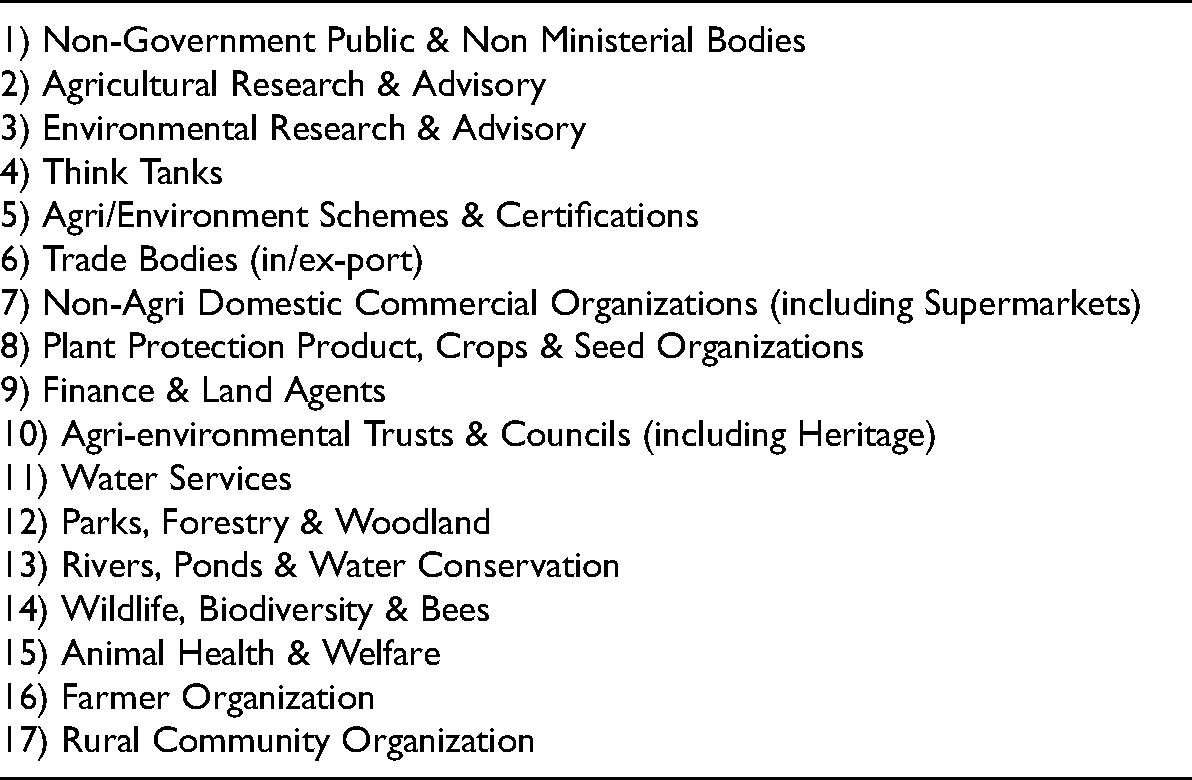
All interviews were held online due to COVID-19 and recorded and transcribed with written permission from the participants. Institutional stakeholders were identified through a mapping exercise conducted in 2019, which combined a broad review of agricultural stakeholders with a review of respondents to Defra's (2018) consultation on the future of farming, Health and Harmony. This initial mapping generated over 200 entries, which were narrowed down using exclusion criteria. 4 Organizations with vested interests or links to ELM, agriculture, and/or the broader agriculture industry (food system actors, food producers/processors, representative organizations, retailers, etc.) were included, as were organizations whose primary activities (work, interests, and/or policy activities) were directly related to or impacted by ELM. The organizations remaining were assigned to seventeen categories (see Appendix 1). Eighteen interviews with stakeholders from each category were secured, except from the Water Services and Animal Health area. Fourteen stakeholders were members of Defra's Strategic Engagement Group, a key mechanism of ELM co-design. Of the civil servants 5 interviewed, eight were from England (six from Defra's ELM team), and three from the devolved administrations (two from Scotland, and one from Wales. Representatives from Northern Ireland were unable to participate due to the country lacking a government at the time). Interviews with the devolved administrations were undertaken to grasp their understanding and operationalization of public engagement in the context of post-Brexit agricultural policy development. Interviews with ELM team members were facilitated by their team leader. The data were inductively coded, manually and using QSR NVivo 11. Most of the findings presented here are based on views expressed by more than one respondent. To preserve their anonymity, quotes are referenced with an S for stakeholder or CS for civil servant, followed by an assigned identification number. Written consent to quote from interviews was obtained from all respondents.
Constitutional Relations Around ELM Co-Design
The move to increase public engagement in policymaking in England was a response to the loss of public trust in science advice and regulatory policy (HoL 2000; UKRI, British Science Association 2024), prompted in part by events such as the Bovine Spongiform Encephalopathy (BSE) outbreak in 1996, and the Foot and Mouth Disease crisis in 2001. In their aftermath, Defra began to experiment with new methods of public engagement, including a climate summit in 2007, a citizen dialogue on Bovine tuberculosis in 2013, and public consultations held on social media ("Citizen Space"). However, these novel approaches to public engagement, together with Defra's more preferred methods of questionnaires and focus groups, are not direct citizen engagement in policy development. The department's commitment to ELM co-design in 2018, therefore, marked a significant step-change in its approach. These endeavors were situated within a broader government commitment to open policy making (OPM).
The UK Government endorsed Open Policy Making in 2012 (HM Government 2012), when "openness" was seen as the key to improving policy performance and meeting citizens’ "rising expectations" of their role in policy development across member states of the inter-governmental Organisation for Economic Co-operation and Development (OECD 2009, 21). It obliged UK civil servants to undertake innovative, collaborative policy development with citizensat a time when Whitehall's political and economic elites were widely known to decide "what counts as valid knowledge in the formulation of policies" (Exley 2021, 452). By introducing Open Policy Making, the House of Commons (HoC) hoped, a new epistemic contract would be established between citizens and the state that would establish citizens as a "valued partner" in the relationship (HoC 2013, 3). Read in this light, the endorsement of Open Policy Making in 2012 could be described as a "constitutional moment" during which the basic rules of political practice were rewritten, and epistemic and political authorities were reconfigured in response to contestations over the meaning of democracy (Jasanoff 2003).
The "co-design" approach underpinning ELM has its origins in the Swedish design discipline of the 1970s, from where it found its way into the private sector innovation industry. Here, in the spirit of "democratization," it was used to involve workers in the development of user-friendly work processes. Co-design soon gained popularity in the public sector, where it was seen as an effective, democratic, and innovative form of public engagement that could foster feelings of involvement, ownership, and shared understanding (Bradwell and Marr 2008; Ceschin and Gaziulusoy 2016; Cooper 2019). As a result, policy design experts became highly sought-after by governments, including in the UK, where they have come to play an important role both in the Cabinet Office's Behavioural Insights Unit (established in 2010) and the Policy Lab (established in 2014), which were both modelled on Nordic organizations such as MindLab and Sitra.
Historically, however, co-design was only used in relatively small-scale settings and not for national policymaking. Research conducted in Ireland and New Zealand to establish its potential for this has found that co-design was hampered at this level both by the policy innovation system and the lack of expertise of civil servants in how to use it (O’Rafferty, DeEyto and Lewis 2016; Blomkamp 2018). Urquhart et al. (2023) suggest that co-design requires: building trust between policymakers and stakeholders, including harder-to-reach groups, identifying tangible options, overcoming traditional ways of making policy, and investing enough time and resources.
Beginnings: ELM Co-Design 2018 to 2020
The Government's promise to co-design ELM with stakeholders was made in the 25 Year Environment Plan, a comprehensive plan for England's natural environment published by Defra to achieve the UK Government's goal of leaving "our environment in a better state than we found it," published in 2018. Here it was stated that Defra would "work with all of those who shape our land to design our future policy" (HM Government 2018, 25). Defra (2018) argued that as policy-users knew best what they needed from the new policy, their involvement in its development was essential for its chances of success.
Defra is a large ministerial department overseen by the Secretary of State for Environment and responsible for safeguarding the UK's natural environment, supporting the food and farming industry, and sustaining the rural economy. Its portfolio is correspondingly wide-ranging. In 2019, Defra consisted of the central department known as Core Defra, the wider Defra Group, and the still wider Defra family33 delivery bodies in total (NAO 2019b). There were 55 work streams across seven policy areas, of which the Future Farming and Countryside Programme, to which ELM co-design belonged, was one. The ELM team had less than ten members of staff in 2018; by 2021, this number had risen to 169 (NAO 2021b). During the period of our study (2018 to 2020), Defra's consultation and co-design activities included: online public consultations on the Government's proposed new ELM system (February to May 2018; February to July 2020, but paused between 9 April and 25 June 2020 due to COVID-19); policy roundtables and regional events; an Environment, Food and Rural Affairs (EFRA) Select Committee public inquiry into ELM in 2020; three rounds of workshops across England with farmers participating in initiatives supported by the Government's Countryside Stewardship Facilitation Fund; workshops across England with members of Young Farmers’ Clubs; and regular Strategic Engagement Group meetings (this group was put together by Defra and had around 40 invited members in 2020, allocated to six different thematic groups). Defra also held eight webinars with farmers and 76 tests and trials involving over 3,000 selected farmers, some of whom collaborated with industry and NGO representatives.
In the early years, ELM co-design was significantly affected by protracted Brexit negotiations, a national election, and the COVID-19 pandemic. These reduced the availability of essential policy details, prevented information-sharing, increased staff turnover, made in-person co-design activities at times impossible, and affected communication with stakeholders. Below, drawing on our interview data, we consider whether ELM co-design forged reflexive participatory practices; ecologized participation; and constituted a responsible democratic innovation. We then reflect on how the process sits within wider sociotechnical systems and constitutional relations.
Forging Reflexive Participatory Practices
An important aim for this criterion is to make participation more inclusive and open to public issues that run the danger of being sidelined. However, as we show below, the participatory formats used by Defra during the early years of ELM co-design failed to achieve this goal, making it particularly difficult for harder-to-reach farmers to participate in ELM co-design. Reflexivity in a co-design process should not only be given consideration during the implementation phase. What takes place before co-design begins also has serious consequences for how it unfolds. In the case of ELM, neither the object of Defra's co-design process, the new ELM schemes, nor the vision for England's agricultural transition were framed with agricultural stakeholders. Instead, stakeholders were first confronted with them in the Government's 2018 Health and Harmony consultation document: Following the "agricultural transition," a new environmental land management system will be the cornerstone of our agricultural policy in England. The system will help us to deliver our manifesto commitment….Farming is crucial to achieving the goals set out in our…25-Year Environment Plan. …16. Our new environmental land management system will be underpinned by natural capital principles. (Defra 2018, 8; emphasis added).
"Pre-framing" in this way locks participants into existing premises and assumptions of techno-scientific ways of thinking and de-politicizes matters of public concern (Mouffe 2005; Tsouvalis 2016; 2019; Wynne 2007). The Health and Harmony consultation advanced a very specific socio-technical imaginary (STI) (Jasanoff 2015) of farming that set the stage for ELM co-design in a way that led participants in our study to claim that Defra was "not co-designing with people," and that the whole process was "very top-down" and not "democratic" (S2).
The Health and Harmony document strongly advocated a techno-market fix (Levidow and Raman 2020) to the environmental degradation caused by agriculture, largely blamed on the EU: "The environmental damage we have suffered while inside the Common Agricultural Policy has been significant.… [O]utside the EU the possibilities for healthy growth are all the greater. The proposals in this paper set out a range of possible paths to a brighter future for farming" (Defra 2018, 5). These paths included the one under which basic payments made to farmers under the CAP—essential to the survival of many—would be phased out and the path under which they would be remunerated to produce "environmental public goods" upon joining one or more of the new ELM schemes. These farming futures were clearly laid out in the Health and Harmony consultation document, setting the terms for the "conversation," as Gove (2018) called it, that farmers and agri-environment stakeholders were now invited to join, which limited the potential for forging reflexive participatory practices from the start.
The Health and Harmony consultation document was a product of the broader constitutional relations and sociotechnical systems within which it was created, including inter alia: representative democracy; industrialized agriculture, EU agricultural politics; Brexit exceptionalism; and international trade. These factors restrained the process in ways that led to ten agri-environment stakeholders publicly contesting Defra's framing of ELM in a White Paper titled "Our vision for a Sustainable Food and Farming Scheme" (SFFS 2020, emphasis added). Here, food production alongside environmental public goods took center stage, reasserting an essential objective of farming that many of our respondents felt was "missing from the discussion of ‘public goods'” (S6).
ELM co-design also failed to be reflexive about its subjects, models and formats of participation. As a result, the process was not properly ecologized (see below) and many publics were prevented from participating in it. Regarding harder-to-reach stakeholders, one of our respondents strongly felt that Defra needed to put more effort into understanding "how these groups are working and what is relevant to them" (S5). To help with this, our research team obtained funding for a study on "harder to reach" farmers and identified a potentially large, heterogeneous group of farmers that Defra had excluded from ELM co-design (Hurley et al. 2020). In response to our recommendations, Defra worked on removing practical, attitudinal, and personal barriers to engagement. It set up a network of local convenors whose role was to act as a "human interface" between farmers and Defra by reaching out to farmers at local, in-person, events (White et al. 2021). Defra also established a forum for "farmers only," a "safe space" where they could interact with Defra. Finally, it provided digital assistance and training on digital tools to avoid digital exclusion from co-design activities. 6 Although challenges with engaging hard-to-reach farmers remain, Defra was open to changing its practice in response to our STS-oriented intervention. That shift was made possible by the evidence we provided, and the trusting relationships we built with ELM team members and policymakers in Defra during our long-term engagement with the department.
Ecologizing Participation
Given that ELM is central to a sustainability transition, ecologizing participation is essential. Agricultural policy has countless distributional objectives linked to the environment, food security, and public health. It addresses issues where agriculture is part both of the problem and the solution: environmental degradation, climate change, biodiversity loss, among others. As a result, it evolves in a highly political space crowded with stakeholders. For Defra to ecologize the process properly, it should have paid close attention to other relevant participatory processes and collectives with different perspectives on agri-environment policy and farming. Activities like farming-related protests, campaigns, and lobbying could have informed the co-design process, as could relevant academic research. To achieve this, however, would have required time, reflexivity, expertise, and adequate resources—all of which were in short supply. In a recent study, the failure of the Government to achieve Open Policy Making has been blamed on resource and staff cuts made in the civil service since the 1990s (Exley 2021). Our study confirmed that between 2018 and 2020, ELM co-design was negatively affected by resource scarcity and exceptionally high staff turnover, in part caused by the COVID-19 pandemic. As a result, the process remained tightly controlled by Defra, narrowly defined, and open only to carefully selected stakeholders. It is not surprising, therefore, that our respondents identified stakeholders that were underrepresented or absent from ELM co-design, including: farmers (S3, S5, S10); the poultry board (S5, S12); the pig sector (S12); the dairy industry (S5); horticulture (S5); other sectors (air, soil, water) (S10); ethnic minority groups (S7) and all UK citizens (S7).
It is disconcerting to find "farmers" on this list. However, Defra has long struggled with farmer engagement. Defra's Agricultural Transition Plan (Defra 2020) listed Defra gaining farmers’ trust as a top priority for successful ELM co-design and implementation. However, Defra made little progress, and in 2021 the National Audit Office doubted whether the department could achieve the target participation levels in ELM (NAO 2021a).
Respondents observed that "farming affects the food we eat and the environment, it affects all UK citizens" (S7). They strongly felt that Defra needed to "think beyond the market level to the larger level, e.g., food security, artisan food, [and] food tourism" (S6). The authors of the SFFS (2020, 3) White Paper similarly advised the Government not to develop ELM as a "self-contained silo" but to ensure it addressed "supply chain fairness, food security, and international trade." One of our interviewees thought that the "public goods" approach of ELM would change the "look and feel of the countryside" to such an extent that it demanded "a focus group or a Citizens’ Jury…to check whether ELM is actually going to deliver what people value in the countryside" (S18). These comments and concerns show that Defra had not sufficiently thought about and implemented strategies to ecologize participation in ELM co-design. This finding is supported by calls made elsewhere for the "politicization" of agriculture, embroiled as it is in issues giving rise to environmental, animal welfare, sustainability, and other ethical concerns (Feindt et al. 2020). The view that Defra's understanding of "the interconnectedness of farming" (S5) was insufficient was widely shared, and concern was expressed that if environmentalists were not brought on board, ELM was going to be ineffective (S18).
Some stakeholders had wanted to participate in Defra's Stakeholder Engagement Group but were prevented from doing so. For example, a representative from the Pesticide Action Network explained that they had wanted to join the group but were told they could not because the farming and food alliance Sustain was on it (S7). According to this respondent, during the early years of ELM co-design there definitely was "a hierarchy of stakeholder engagement that has rather upset some people" (S7). A study of stakeholder perceptions of the legitimacy of ELM policy as a driver of England's post-Brexit agricultural transition generated similar findings (De Boon, Sandström and Rose 2022, 7). De Boon et al. found that although some ELM co-design activities were open to all, most of them were targeted toward specific stakeholders and based on selection procedures. The majority of De Boon et al.'s respondents thought the ELM engagement process had not been equal for all, and there had been disagreements over who exerted the most influence over the process: farming organizations or environmental organizations. Social stakeholders seemed to unanimously agree that their influence was the least. Furthermore, some stakeholders received information earlier than others, and not everyone was included in all the conversations held, or could only join them at a late stage. Findings in our study echoed remarks from respondents in the study noting that important stakeholders were missing from ELM co-design, including individual farmers, minority interest groups, and the general public (De Boon, Sandström and Rose 2022, 7).
Such power dynamics, their effects, and how to overcome them need to be seriously addressed to make government-orchestrated policy co-design in general and ELM co-design in particular more reflexive and inclusive. Although it is difficult to involve all relevant actors in a participatory effort, questions like who is invited to take part and who is not, or who might resist getting involved and why, require careful consideration (Chilvers and Kearnes 2020, 358). Examples of the latter, in ELM co-design, were the poultry and horticultural sectors, which one respondent thought were absent because they received "no Government support," could not see where they fitted into the scheme, and did not "want the Government to tell them what to do" (S5). Apart from attending to these questions, the practicalities of ecologizing participation at this level of complexity urgently require further research.
Responsible Democratic Innovations
The introduction of the new ELM policy caused grave concerns among many about the future of farming and the countryside, not least due to the policy's "public goods approach," based on a Natural Capital Approach (NCA). One of our respondents thought the NCA required "a whole new mindset" (S15) among farmers, and implementing it, another suggested, would not "just tinker at the edges and change what we’ve got today, it's about changing our [farmer's] future. [How do] food security, food productivity, and environmental delivery of goods fit within a farming system? … [How can] farms deliver all the goals that government and society want…while remaining survivable, sustainable businesses?" (S16)
These questions—about the survivability of farm businesses and the future consequences of the NCA and ELM public goods approach—raise questions about ELM co-design as a responsible democratic undertaking. Above we have shown that the ELM co-design process fell short on reflexivity and ecologizing participation, which in turn had implications for responsible democratic innovation. Here we focus on two illustrative issues, both of which involve inadequate attention being paid by Defra in the co-design process to anticipating potential consequences of the innovations, technologies and practices that ELMs advocated and supported. The first concerns the NCA, which respondents considered not just to require a "whole new mindset" among farmers but could completely change the future of farming. The second concerns the survivability of farm businesses. Both these issues were given inadequate consideration as part of ELM co-design, which, after all, as respondents seemed to think, was about achieving the goals of "the government" and "society."
Where did ELM co-design fall short of being a responsible democratic innovation in regard to the NCA? The NCA chosen by the Government to underpin ELM policy has given rise to many concerns, and not just among farmers and land managers. It advocates monetizing benefits that the natural environment provides and that enable our survival on this planet. Helping to look after these benefits and helping to deliver them on their farms for a fee is the key aim of a public goods approach. Thinking about "Nature" in this way and trying to implement the approach requires changing how Nature is commonly conceptualized, perceived and understood. It requires new methods of calculation and quantification, the innovation of new scientific approaches and technologies that can help us put a value on Nature's "goods and services." Thinking further, the NCA is likely to lead to a new politics of Nature, and a new economy where its "goods and services" can be traded and exchanged. In short, the NCA is likely to have significant systemic impacts. However, to date these have remained underexplored within ELM policy.
Economists have also questioned whether the data available on many relevant types of "natural capital" are sufficient to inform "real policy debates…such as climate change mitigation or food security" (Cohen, Hepburn and Teytelboym 2018, 24). This concern was echoed by a respondent in our study who asked whether it was even possible to put a price tag "on clean air, carbon, biodiversity, and flood mitigation" (S15).
Ignoring these broader concerns, Defra failed to properly ecologize the ELM co-design process. Instead, it narrowly focused on what achieving this particular "object" of participation would look like in ELM co-design. It commissioned an ELM test and trials programme in 2018 which explored implementing the NCA, and planned to use these findings to design its ELM scheme pilots. By the time of our study, seventy-six tests and trials were underway. They involved over 3,000 selected farmers, some of whom collaborated with industry and NGO representatives. One finding from the test and trials scheme was that farmers were often unsure about the practical benefits and application of the NCA and asked for clearer guidance on how the approach related to their business model. They required more information about the money they would receive for delivering public goods, which was not readily available. Many experimented with new tools and methodologies that would help them identify and measure natural capital, for example, natural capital mapping and ecosystem services assessment. The findings from these experiments led to the insight that the complexity of measuring and accounting for natural capital could be a barrier to implementation (Defra 2021b). Focusing chiefly on questions such as these, Defra failed to listen to broader concerns and debates around the NCA (e.g., see Büscher, Dressler and Fletcher 2014), undermining ELM's credentials as a socially responsible democratic innovation that anticipates its future consequences.
Another area where Defra failed to consider consequences was in relation to the large number of farmers that ELM could put out of business (see above and Clarke 2021; EFRA 2021; NAO 2019a: 2021a). Dominant post-Brexit Socio-Technical Imaginaries for agriculture project the sector as highly efficient, growth-oriented, productive, and innovation-dependent; where surplus labour has no place (Gove 2018). Defra's "exit scheme" forms part of this vision. Consequently, the Government spent little time reflecting on the social and personal hardships that its new ELM policy could bring, or on the negative consequences it could have for rural communities or society at large (Younker and Radunovich 2021). Such consequences should have been anticipated and debated before key policy decisions on ELM policy were taken. However, instead, ELM policy gave farmers the impression that they had a say in how their future would be shaped when its general direction had already been sealed (see NAO 2021b and EFRA 2021).
Reconstituting Participation
ELM co-design has taken place amid complex sociotechnical systems and constitutional relations. These have impacted the process in numerous ways. First, England's political system made co-design principles difficult to implement. As one ELM team member explained, doing co-design was difficult "in a representative democratic systemI can do all the most wonderful co-design in the world…but then I could have a minister who doesn't agree" (CS3). Co-design requires that decision-making power is devolved to participants (Del Gaudio et al. 2018). However, ELM team members could only "involve people in the ideas formation process; taking joint decisions and designing something together is impossible" (CS3). Stakeholders knew that co-design presented "a real issue for Defra because…they need Ministerial sign-off for everything" (S8). Amid such constitutional relations, co-design cannot achieve its democratizing potential.
Second, government bureaucracy hindered ELM co-design. ELM team members required the approval of the stakeholder engagement team for all their activities, which created "an extra hurdle in the co-design process" (CS6). Stakeholders thought that "structural problems and the governance structure of the ELM team really affected its ability to make genuine progress" (S2). This corroborates the view of professional designers who found that design-led engagement in Government was totally "at odds with prevailing organisational cultures and practices" (Kimbell and Bailey 2017, 219).
Third, ELM co-design was hampered by government secrecy. Respondents described how Defra was constantly "worried about confidentiality and leaks" (S8), which made it impossible for ELM team members to "share as much with [stakeholders] as they want(ed)" (S4). All Stakeholder Engagement Group members had to sign confidentiality agreements, which prevented those from representative bodies from doing their "normal job of obtaining feedback [from members]" (S5). This was a lost opportunity for Defra to obtain a broader range of views through these channels. Gradually, government secrecy undermined stakeholders' trust in Defra and hindered progress, leading to members of Defra's Stakeholder Engagement Group publicly venting their frustration (Aglionby 2020; Kay 2020).
Fourth, structural constraints like budgets, timeframes, staff capacity, staff turnover, and government recruitment practices all negatively impacted ELM co-design: "The biggest problem," we were told, was "how the Government structures its recruitment across the different government departments; no one is in an area of specialism" (S11). Respondents knew that "Defra staff are not trained in participation" (S3), and worried about their expertise "to genuinely undertake co-design" (S2). The researcher on secondment to Defra introduced the ELM team to best co-design principles and practices as established in the social sciences (Tsouvalis and Little 2019). However, as this initially tiny team rapidly expanded to a membership of more than 100 people by early 2019, with high staff-turnover, co-design failed to become a well-embedded element of the ELM policy development process.
Finally, Defra's institutional culture hindered co-design. Civil servants observed that making co-design work in Defra would require a "massive culture change" and "buy-in from the policy areas" (CS1). Defra's attitude to co-design was described as mixed, with many of its employees being described as "skeptical" of the approach (CS2). As policymakers continue to prefer scientific, quantitative, and economic data over evidence produced through qualitative and interpretive approaches, such alternative perspectives will continue to struggle to be heard (Watson et al. 2020).
Discussion and Conclusion
In this article, we have used Chilvers and Kearnes's participation framework to structure and interpret qualitative data gathered about the UK Department for Food, Environment and Rural Affairs ELM co-design process as it unfolded between 2018 and 2020. Co-design is increasingly relied on by Governments around the world to tackle complex, intractable problems faced by society (Cooper 2019). Co-design done well can enable the joint exploration of problems and solutions and their potential risks, generate a sense of shared purpose, commitment and responsibility, and enable the successful implementation of innovative policy designs (Bradwell and Marr 2008; Stewart et al. 2019). In the context of government-orchestrated participation, however, co-design struggles.
Our experience of participating in Defra's ELM co-design process and empirical study of ELM co-design leads us to conclude that STS-oriented interventions in government-orchestrated participation are insufficient to turn participation around at a fundamental level. Our collaboration with Defra did make ELM co-design more inclusive, user-friendly, experimental, and—at the level of the ELM team—reflexive. However, the political system in place held back participatory policy design, preventing sharing of decision-making power and responsibility. The key parameters of the policy had been predetermined before the co-design process even began. The Government had decided what problems it wanted the new ELM policy to address (the environmental degradation caused by farming); what the preferred solutions to these problems were (phasing out Basic Payments and remunerating farmers for the production of environmental "public goods," following the NCA on which ELM policy was based); and who they wanted to be involved in the ELM co-design process (farmers and agri-environmental stakeholders). All of these were non-negotiable elements of ELM (Defra 2018). In line with our findings, a study carried out by De Boon, Sandström and Rose (2022) showed that Defra's pre-definition of the problems ELM should tackle and the goals of the scheme were questioned by many stakeholders, undermining the policy's perceived legitimacy.
So, what lessons can we draw from ELM co-design to inform future experiments with co-design? And what would it take to turn government-orchestrated participation around at a fundamental level in England? A well-known and often reiterated general recommendation for improving government-led co-design is that the process needs to be carefully planned with a broad range of stakeholders before the process starts, fully involving them in agenda and goal setting. The process also needs to be well-resourced, allocated plenty of time and be fully embedded within the policy innovation system (Blomkamp 2018; O’Rafferty, DeEyto and Lewis 2016). Reflexive consideration of who should participate in the co-design process is essential and needs to be ongoing, and strategies need to be put in place for addressing conflicts and differences of vision. Governments also need to be honest about how "open" and democratic they are able and willing to be, thereby avoiding giving participants false hope about the weight of their voice.
An important issue that has received less attention in studies of government-orchestrated co-design is that of scale, with Blomkamp (2018, 737) noting that considerable uncertainty remains as to whether "co-design can feasibly leap from designing programmes and services to developing and implementing public policies." ELM co-design is at the national scale. The policy and its schemes need to work in varied geographical areas and farming contexts (e.g., on small family-owned farms and large corporate farms). This makes ELM policy a useful case study for future investigations of the role of scale in co-design. There is also a place here for more comparative studies of how co-design fares in different countries and in the context of different political systems.
In a representative democracy, ceding control to co-design participants is challenging, which inevitably limits the democratizing potential of the ELM approach. It is also important to acknowledge the impact that broader contextual factors can have: in our case study, the COVID-19 pandemic, Brexit negotiations, and a national election all made a contested policy change even more highly politicized, exacerbating Government secrecy and high-staff turnover. However, even taking all these factors into account, there are more deep-seated problems with government-orchestrated co-design in England.
There is limited evidence to suggest that the UK government's endorsement of Open Policy Making in 2012 was a "constitutional moment" that resulted in a new epistemic contract between the state and its citizens, elevating them to the status of "valued partner" in policymaking (HoC 2013, 3). There is no evidence of reconfigured systemic and constitutional stabilities in citizens' favour. While our data do not enable us to interrogate why this opportunity was missed, a recent study on whether Open Policy Making had made UK policymaking more open suggests that austerity was integral to the ideological basis on which "openness" in the UK was conceived, fundamentally limiting its potential (Exley 2021). It seems unlikely given this unpropitious context that STS-orientated interventions in government-orchestrated participation will achieve their goals. A precondition of success is a new constitutional moment during which the meaning of democracy and how it should be realized are publicly renegotiated, which currently seems out of reach, and suggests that co-productionist experiments are symbolically performative rather than genuine.
Footnotes
Acknowledgements
This project was funded by the UK's Economic and Social Research Council, "Agri-Environmental Governance Post-Brexit: Coproduction of policy frameworks" (ES/S007830/1). The authors would like to thank the anonymous referees and the editors for their constructive and helpful comments, Defra for allowing us access, and all our collaborators and participants for their generosity in giving us their time and thoughts.
Declaration of Conflicting Interests
The author declared no potential conflicts of interest with respect to the research, authorship and/or publication of this article.
Funding
The authors disclosed receipt of the following financial support for the research, authorship and/or publication of this article: This work was supported by the Economic and Social Research Council (grant number 157084).

Notes
Author biographies
Appendix 1: Organizations from which interviewees for the study of ELM co-design were selected
| 1) Non-Government Public & Non Ministerial Bodies |
| 2) Agricultural Research & Advisory |
| 3) Environmental Research & Advisory |
| 4) Think Tanks |
| 5) Agri/Environment Schemes & Certifications |
| 6) Trade Bodies (in/ex-port) |
| 7) Non-Agri Domestic Commercial Organizations (including Supermarkets) |
| 8) Plant Protection Product, Crops & Seed Organizations |
| 9) Finance & Land Agents |
| 10) Agri-environmental Trusts & Councils (including Heritage) |
| 11) Water Services |
| 12) Parks, Forestry & Woodland |
| 13) Rivers, Ponds & Water Conservation |
| 14) Wildlife, Biodiversity & Bees |
| 15) Animal Health & Welfare |
| 16) Farmer Organization |
| 17) Rural Community Organization |