



Abstract
In Australia, some Indigenous and non-Indigenous scientists, health workers, psychologists, and others have identified a resonance between epigenetics and Indigenous scholarship on intergenerational trauma. Epigenetics is a postgenomic science that seeks to demonstrate how environments can “get under the skin” to shape health outcomes by altering gene expression. Intergenerational trauma is a similar concept, as it describes how past harms such as colonial policies can make themselves felt in the present. Using ethnographic data from interviews with researchers across Australia and observations from scientific conferences, this article critically examines how the normative tools of epigenetic studies are increasingly positioned by scientists as the route to a valuable form of evidence for addressing intergenerational trauma and health injustice. Through the frame of “colonial unknowing,” we argue that the settler state functions by valuing certain forms of evidence of trauma over others; namely, epigenetics is positioned as offering objective scientific evidence seen as more valuable than narrative testimony and evidence rooted in Indigenous ontologies, thereby displacing prior knowledges of how trauma is embodied and enrolling communities into conditions of perpetual rediscovery. While many participants reject epigenetic knowledge production outright for this reason, we explore how others strategically engage with it in the present while simultaneously challenging its growing epistemic power and future promise.
Introduction
Over the last 10-15 years, Indigenous and non-Indigenous scientists, researchers, and health workers have identified a resonance between the scientific field of environmental epigenetics and Indigenous scholarship on intergenerational trauma. In Australia, the National Aboriginal Community Controlled Health Organisation (NACCHO) has cited epigenetics as a field of interest, while links between intergenerational trauma and epigenetics have been made in media articles from Indigenous-owned publications such as IndigenousX (Murrap-Stewart 2021; NACCHO 2013). Settler colonization in Australia, as elsewhere, has centered sexual and reproductive violence as a key technology, separating Indigenous families and targeting Indigenous kinship systems for destruction to aid the expansion of settlers and settler ways of life. Early forms of violence on the frontier shifted through the nineteenth- and early-twentieth-centuries into a more targeted legal infrastructure through a range of laws, ordinances, and administrative directives that sought to regulate reproduction between Indigenous people and settlers, and manage the lives of so-called “half-caste” children, employing measures including Aboriginal protection boards, missions, and a system of exemptions. This legal architecture facilitated formal policies of forcible child removal, within a broader context of forced assimilation and systemic racism. 1 The children subject to these forced removal policies are collectively known as the Stolen Generations.
These policies continue to have lasting impacts on Aboriginal and Torres Strait Islander peoples, compounded by the ongoing nature of settler coloniality in Australia. The concept of intergenerational trauma has become prevalent in Indigenous health spaces as one means to reckon with the legacies of these policies. For example, the development of the Social and Emotional Well-being (SEWB) model in Aboriginal community-controlled health services in the 1990s, the establishment of organizations such as the Healing Foundation and the First 1,000 Days Australia program, and the work of Indigenous theorists such as Judy Atkinson's influential 2002 text Trauma Trails, have all contributed to a landscape in which the concept of intergenerational trauma plays an increasingly central role in understandings of Indigenous health in Australia.
Epigenetics is increasingly positioned in health, policy, and advocacy fields as a useful resource for Indigenous health equity, partly because it resonates with Indigenous ways of knowing. Because epigenetics recognizes the impact of context and social environments on health, some researchers believe it to have an affinity with Indigenous understandings of health and disease, where concepts of the body and environment are more relational than in Western concepts of health (Arabena, Panozzo and Ritte 2016; Warin et al. 2023). Although genetics has long been critiqued as hostile to the agency and personhood of Indigenous peoples worldwide, epigenetics is increasingly positioned in strikingly different terms—as resonant with Indigenous ways of knowing and as a key body of “evidence” of colonial violence and trauma. 2 In this article, we explore how non-Indigenous researchers place value on epigenetic knowledge production as an epistemic environment (Valdez 2022, 8-9) of influence, and how they navigate their desire to study the complexities of Indigenous health and social worlds while restricted by the parameters of lab science protocols and research design. Further, we turn to interviews and participant observation with Aboriginal medical doctors to explore how they utilize epigenetic knowledge while also challenging the epistemic power and singularity that some scientists place on epigenetic knowledge in contrast to other ways of knowing intergenerational trauma and healing.
Interest in epigenetics has developed rapidly over the past two decades. It emerges from the broader field of postgenomics, where understandings of genetics as “fixed” or “set” have been challenged. Recent scientific research in postgenomics has embraced the notion that the body is in fact “coalesced inseparably with environmental forces (macro and micro) from the moment of conception on throughout life” (Lock 2015, 163). For the biological sciences, acknowledging that bodies exist in context and are differently impacted by those contexts is something of a conceptual shift. For feminist scholars and social scientists, this is not a groundbreaking development. However, in the context of twentieth- and twenty-first-century genomics, it does represent a scientific and popular cultural shift in thinking, as the genome was previously thought to be “set in stone” and unmalleable. As such, many social scientists have embraced postgenomics as a field of scientific research and a generative model of embodiment because of its apparent deconstruction of long-held binaries—body/society, nature/nurture, inside/outside (Rapp 2018; Roberts 2017, 594). Other social scientists have identified in epigenetics an opportunity for “new forms of collaborative biosocial knowledge practices” (Kenney and Muller 2017, 23).
Social scientific enthusiasm for epigenetics as dismantling binaries emerges in the context of the ontological turn in anthropology and Science and Technology Studies (STS) (Sismondo 2015; Woolgar and Lezaun 2015). The acknowledgement of multiple ontologies and multiple incommensurable worlds characteristic of the ontological turn has become an important part of anthropology and STS in recent years, allowing social theory to move beyond social constructionism and toward “taking different worlds seriously” (Pickering 2017, 135). Another hallmark of the ontological turn is the recognition that Western worlds center a dominant ontology rooted in dualism (Viveiros de Castro 2004). As such, many social scientists have become newly concerned with dismantling dualist thinking and allowing space for multiplicity in their work. However, as Métis anthropologist Zoe Todd (2016, 4) makes clear in her piece titled “‘Ontology’ is just another word for colonialism,” positioning the ontological turn as novel can erase Indigenous thinkers and theories. Reflecting on Bruno Latour's description of the climate as a “matter of common cosmopolitical concern” at a conference in the United Kingdom, Todd (2016, 8) writes, “here we were celebrating and worshipping a European thinker for ‘discovering,’ or newly articulating by drawing on a European intellectual heritage, what many an Indigenous thinker around the world could have told you for millennia: the climate is a common organizing force!”
This “‘aha’ ontological moment” (Todd 2016, 8) could just as easily be replaced by an epigenetics-inspired revelation: social environments have an impact on and are not separate from human bodies! In both instances, the “trendy and dominant Ontological Turn” (Todd 2016, 7) risks positioning the nature/culture binary as a universal problem to which Euro-American scholars provide answers, erasing the theories and nonbinary ontologies of Indigenous peoples worldwide. Due to deeply inscribed hierarchies within academia, it is possible for this erasure to continue, and for the Euro-Western academy to “advance and consume arguments that parallel discourses in Indigenous contexts without explicitly nodding to them, or by minimally nodding to Indigenous intellectual and political players” (Todd 2016, 9). Palyku writer Ambelin Kwaymullina (2020, 26) describes this approach as a habit of non-Indigenous “discoverers,” who “treat Indigenous lives, cultures, histories, joy and pain, as their source material or their lightbulb moment.” As we argue here, this dynamic is occurring with the discourse of epigenetics—scientists and social scientists have begun to nod to Indigenous knowledge in discussions of epigenetics, but rarely go beyond when it comes to developing epigenetic studies, including epigenetic studies focused on Indigenous health and well-being in Australia and elsewhere. This “nod” most often happens through a reference to the “parallel discourse” of intergenerational trauma.
The Study
Over the course of 2020-21, while travel within and between cities in Australia was restricted due to public health measures associated with the COVID-19 pandemic, Byrne and Keaney conducted a largely online ethnography of the uptake of epigenetic knowledge in Indigenous health contexts in Australia. This study involved twenty-one qualitative interviews via Zoom with lab scientists, psychologists, social workers, medical doctors, and other professionals who engage with epigenetics, intergenerational trauma, and/or Indigenous health in their work, alongside participant observation at relevant scientific conferences and workshops (one in person, two held online). Our interview participants were highly skilled in their fields, oftentimes leading large research grants and working in well-resourced labs across major cities in Australia.
Given that this was a collaborative project, human research ethics approval was received at both universities at which the authors worked. After receiving ethical approval, the authors began contacting potential participants via email. Participants who we did not know prior to the study nevertheless responded eagerly to our emails, likely because epigenetics is a field of growing public interest, with many researchers regularly participating in public-facing work. We also employed a chain of referral method that aided recruitment through participants' own networks. The study is informed by a prior pilot study undertaken by our senior research collaborators, which established a preliminary evidence base for further grant-funded research in the area (Warin, Kowal and Meloni 2020). In this article, we draw briefly on data from that pilot study alongside the more extensive study that we subsequently led. The study focuses on the Australian context, due to the understudied nature of epigenetic discourses in Australia, and the specificities of Australian settler colonialism and subsequent Indigenous health frameworks, as discussed above.
Of the interview participants, nine were Aboriginal and/or Torres Strait Islander and the remaining twelve were non-Indigenous. We located ourselves as non-Indigenous settler researchers during each interview discussion, as part of tracing the broader colonial politics of knowledge production that we interrogate in this article. Each semi-structured interview lasted between 40 and 80 minutes. In addition, participant observation took the form of one or both authors attending conferences or workshops at which epigenetics, emerging trends in the field, and/or applications in Indigenous health were likely to be discussed. Largely attending conferences online, we participated as audience members in panels and paper presentations, and took ethnographic notes. Some of these conferences directed us to potential interview participants, and vice versa.
We began recruiting for this project just as COVID-19 was first appearing in Australia, and as state borders were being closed—a practice described as putting up “hard borders.” We initially hoped that more of our data collection would proceed in person, but these hard borders made interstate travel impossible, and state-level lockdowns also prevented us from conducting in-person interviews and ethnography even with participants residing in our respective states or working at our universities. While initially concerned about having to rely on Zoom, we found that our participants were agreeable to participating in an approximately one-hour-long Zoom interview, despite being themselves pressed for time, adapting to rapidly changing work-from-home conditions, and with many integrating caring responsibilities into their paid work lives. These pressures were likely augmented for participants who were primary carers to children, and/or navigating precarious employment conditions, as were a few of our participants who were in fixed-term research or research administration roles. As many of our participants also worked in health research or health services roles involving work with community members, the significant emotional burden of the pandemic was likely intensified. Nonetheless, participants were eager to participate in Zoom interviews in a way that may not have been as likely had we asked to conduct interviews in person, or to visit their labs for an entire week. At times, a discussion of the pandemic and different public health measures in our respective states became a cathartic fixture at the outset of Zoom calls.
Throughout the data collection period, Byrne was based on Kaurna country in Adelaide, and Keaney was based on Gadigal country in Sydney. Using Zoom allowed the authors to collaborate more directly than anticipated, affording a system of co-interviewing. For all but two interviews, both Byrne and Keaney would log onto the Zoom call with the participant. Having three people in the Zoom room gave the interviews a conversational feel, as opposed to a direct question/response dynamic, and allowed the authors to interrogate their findings, interpretations, and lines of questioning with one another, adding an iterative component to the interview process.
Following the data collection phase, all interviews were transcribed and analyzed collectively and reflexively, with key themes “‘inductively’ generated” (Mason 2017). In this vein, the methodological approach employed in this project positions qualitative interviews and participant observation as iterative, as situated methods of knowledge creation between researchers and participants. Knowledge is implicitly understood here as emerging from situated interactions, with data generated organically, and researchers' lines of inquiry shifting in conversation with each situated research encounter (Mason 2017). Key themes inductively identified in the research include epigenetic enthusiasm or hype; circular temporalities in epigenetic and Indigenous knowledge frameworks; the legacy of genomic science in Indigenous communities; and the complex challenges of translating epigenetic knowledge to laboratory studies and meaningful, culturally sensitive health responses (for discussion of some of these themes, see Keaney et al. 2023; Warin et al. 2023).
In this article, we focus on one key theme that was particularly salient across our data collection: the tension between epigenetic science as an alluring form of knowledge with high public and policy traction, and longstanding ways of knowing and addressing the impacts of colonialism through the framework of intergenerational trauma. Participants were offered the choice of being referred to with pseudonyms or their full names for the purposes of publication, and both options were taken up. Offering participants this choice was motivated by the broader ethical framework of our study, of balancing privacy with the capacity for participants to share their thoughts freely alongside the correct attribution of intellectual labor and insights. Providing the option for participants to have their interview contributions cited with their full names is part of an Indigenous data sovereignty approach, which is particularly important in a settler colonial context marked by the violent appropriation of Indigenous knowledge and bodies in the service of colonial authority (Walter and Carroll 2020).
Operationalizing Intergenerational Trauma: Events and Small Chemicals
As an increasingly popular discourse for grappling with the legacies of colonial harm, as demonstrated in our study, epigenetic science operationalizes the notion of intergenerational trauma in particular ways (NACCHO 2013). The concept of intergenerational trauma encapsulates how past harms from colonization and resulting racist policies have long-standing, intergenerational, and ongoing impacts on the lives and health of Indigenous peoples. Since the development of the SEWB framework by Indigenous scholars from the early 2000s, intergenerational trauma has become a key intervention in Australia, and has shifted thinking and policy responses around how past harms make themselves known in the present (see Atkinson 2002; Dudgeon, Milroy and Walker 2010). More recently, the established role of intergenerational trauma as a concept has been critical to the popular uptake of epigenetics, often presented as providing a molecular explanation for how intergenerational trauma is transmitted between generations, seen for example in the title of popular science articles such as “How Parents' Trauma Leaves Biological Traces in Children” (Yehuda 2022).
As a concept and paradigm for understanding health, intergenerational trauma has some resonance with environmental epigenetics in that it ties social environments to bodies across generations. The strong knowledge base around intergenerational trauma among Indigenous communities and health services is often presented as a basis for engagements with epigenetics. For example, in interviews with researchers who work in Indigenous health in Australia as part of a pilot project for the current study, participants said that “Aboriginal peoples have known for years” that past injustices are embodied collectively and passed on through generations, and that epigenetics is “consistent with Indigenous knowledge systems” (Warin, Kowal and Meloni 2020, 94). One of our participants, an Aboriginal doctor, concurred: discussing how quickly a group of incarcerated Aboriginal men connected to the concept of epigenetics, he described that “honestly, the older guys got it. I was trying to explain, basically, epigenetics and transgenerational trauma and ACEs [Adverse Childhood Experiences] and stuff like that in a pretty rough kind of way. They understood it really fast…I think it fits consistently with Aboriginal approaches” (Interview 12).
This framing of epigenetics as building on a long conceptual trajectory of intergenerational trauma was also echoed by some participants who are non-Indigenous scientists. One participant, a white geneticist, described the importance of acknowledging prior understandings of intergenerational trauma when devising epigenetic studies: Really, we have to be humble and say the ideas have already come before us, we're just offering a mechanism of how to measure it, or one way to measure it. Of course, you could measure it by measuring someone's well-being, physical or psychological or spiritual. But epigenetics just offers a way to (a) understand the mechanisms, and (b) to actually measure it if we know where to measure. (Interview 4)
This participant positions epigenetics as part of a longer tradition of assessing and measuring the effects of intergenerational trauma. Emphasizing the importance of humility as an ethical practice for non-Indigenous scientists, he recognizes the deep knowledge Aboriginal people hold about the deleterious impacts of racism and colonialism on environments and bodies. Yet, the initial positioning of epigenetics as one among diverse measurements of well-being—physical, psychological, spiritual—begins to slip into a hierarchy, with the word “actually” positioning epigenetics as a more legitimate or strategic form of measurement. This slippage highlights the growing legitimacy and political efficacy afforded to molecular and genetic evidence in discussions of the impacts of historical violence. The notion of epigenetic studies as generating more persuasive evidence was also echoed by another white participant, a psychologist with significant experience working on trauma and post-traumatic stress in both therapeutic contexts and epigenetics-informed studies. For her, epigenetic studies might be part of the “hard data” needed to back up anecdotal and narrative accounts of the embodied effects of trauma. She described her collaborative work on trauma with geneticists, saying: I have to tell you, nothing I have found has remotely surprised me, but now I can say, hey, that CpG site tells me this. I can see the methylation or the expression from epigenetics that confirms what we already knew. People have known these things for many, many years but science…holds a place where people would go, “Oh, I can see it.” If I can see those brainwaves, if I can see the data around epigenetic expression then it must be true. (Interview 18)
For this participant, the development of an epigenetic evidence base serves the aim of providing visual depictions and “hard data” that she understands as holding more value when agitating for better policy responses. She elaborated, “For me it's just providing images of something that others have known for a lot longer than any of us have been around. You won't surprise any First Nations people with the things that you find about their people.”
While intergenerational trauma and epigenetics are frequently positioned as corollary terms in such interviews, and at times employed as synonyms, their parameters and strategic efficacy vary significantly in different enactments. In order to achieve the more legitimate measurements that epigenetic studies are seen to confer, intergenerational trauma first has to be operationalized as an object of scientific inquiry. As the geneticist quoted above explained, the efficacy of epigenetics is strategic: “If we get some molecular evidence there as well to kind of back us up, that stress can get under the skin and literally change the genes.” For him, the molecular evidence assembled through epigenetic studies may provide indisputable truth for policymakers: “I think it's a concept maybe that will help again for policy, that we say, well, this is not just all in someone's mind. It's literally small chemicals running around the body that are actually triggered by that stress and changing the genes” (Interview 4). The epigenetic study as it is imagined here does not simply attest to the impacts of intergenerational trauma; rather, it operationalizes and re-invents trauma through a range of scientific protocols and experimental procedures that imagine it as “small chemicals” produced by stress, “running around” in a body distinguished from them.
Reductionism is a crucial fixture of the experimental protocols and scientific imaginings through which intergenerational trauma is made into data points to be studied. STS scholars such as Lappé (2018), Penkler (2022), and Lappé, Fahey and Hein (2024) have highlighted the tendency of DOHaD (Developmental Origins of Health and Disease) and epigenetic research to reduce and bind what counts as the environment when operationalizing complex social contexts in scientific studies. Lappé (2018, 700) conducted an ethnography in a laboratory in the United States that used model organisms to examine the impacts of “early-life adversity” on mental health behaviors later in life. As she writes, the researchers in this lab both “acknowledge the impacts of experience on the body, but simultaneously limit what kinds of experiences can matter in the production of epigenetic knowledge.” In order for epigenetic studies to “document the molecular materiality of experience” she writes, “the complexities of social life are…purposefully constrained” (Lappé 2018, 710, original emphasis).
At times, reductionism is bound up with scientific protocols as well as pragmatic considerations in institutional research contexts. For example, in Penkler's (2022, 6) interview-based study of two large DOHaD institutes in Europe, researchers reflected on how the interventions used in their cohort studies were often simpler than ideal, due to considerations of cost and pragmatics, along with the conventions of the life sciences. Of this study, Penkler (2022, 8) writes that, like all life sciences, DOHaD (the broader field of which environmental epigenetics is a part) “needs to be reductionist in order to articulate, and thus bring into being, its research objects. The question, then, becomes what is reduced how, and with what effects.”
In both Penkler and Lappé's field sites, the what is early-life adversity, and the how is monitoring individual pregnant people or mothers and modifying their behaviors. In our study, reductionism is at play in the translation of long histories of colonial violence and intergenerational trauma into experimental conditions. Here, the what is the trauma and entangled adverse health experiences resulting from decades of colonial violence. The how is the monitoring of Aboriginal bodies and the imagining of trauma through particular bodily sites and temporal horizons. In the words of the participant quoted above, trauma is enacted as “small chemicals”—a microscopic, molecular optic from which to reduce the complexity of colonial violence into a “visible” object to be studied.
The reduction of intergenerational trauma into epigenetic markers was further evident at the 2019 “Developmental Origins of Health and Disease” World Congress Conference, where Byrne conducted participant observation as part of the broader ethnographic study. The slide pictured in Figure 1 was shared by a settler Canadian researcher. It depicts their plan to translate their work on rats and stress exposure to human populations who have experienced trauma (represented in the slide by the happy white mother and her baby). Examples of trauma events and resulting traumatized populations spotlighted by the researcher include the 1998 Quebec Ice Storm, the 2011 Queensland Floods, and the colonial histories of Residential Schools in Canada and the Stolen Generations in Australia. Here, the complex and ongoing history of colonization in Australia is translated into the trauma event of the Stolen Generations. The Stolen Generations was conceptualized in this research presentation as a single bounded trauma “event” equivalent to phenomena such as a major flood event, despite the fact that it not only occurred over decades, but that the removal of Aboriginal children from their homes and families also continues today at staggering rates (SNAICC 2023, 18).
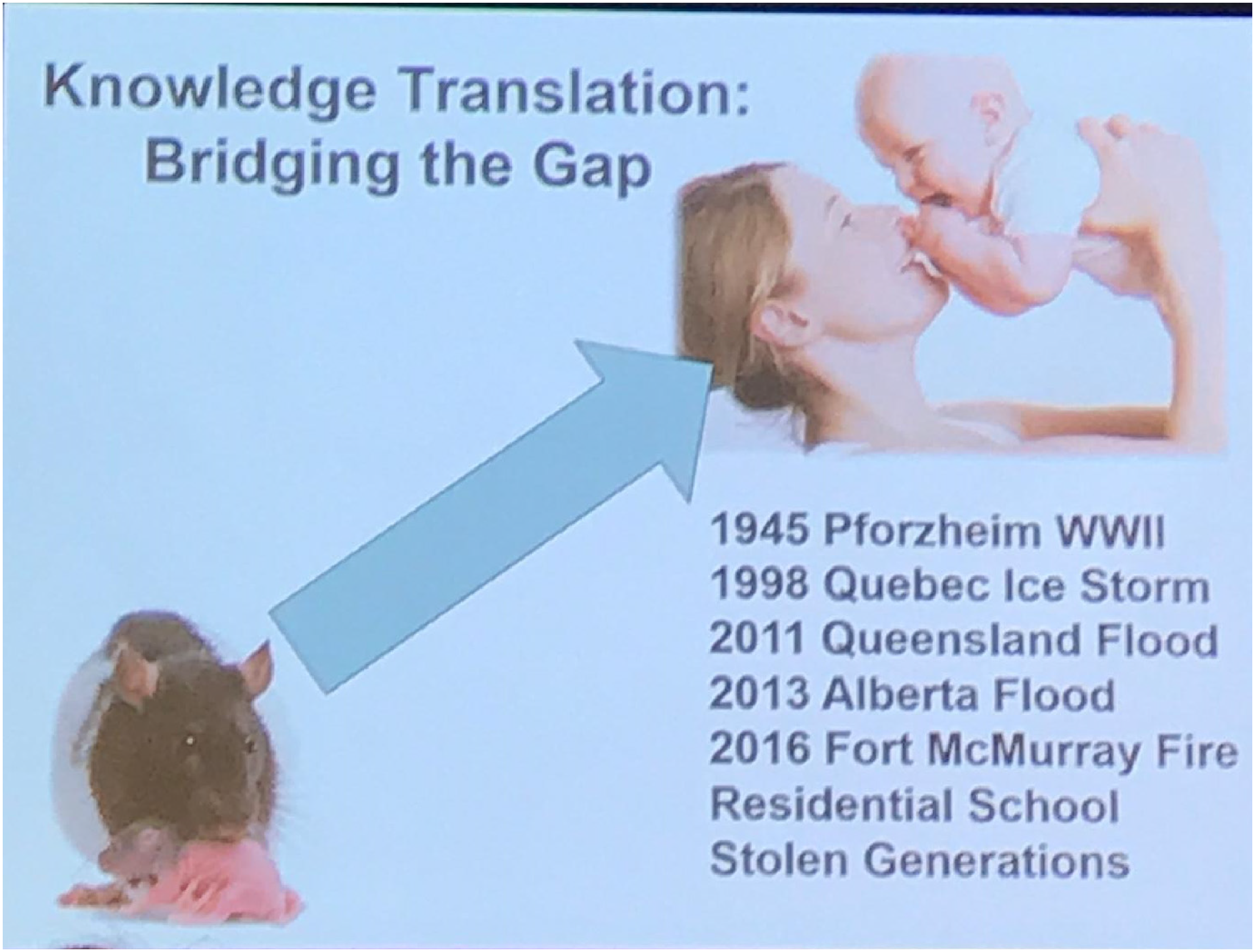
Image of conference slide presented at the Developmental Origins of Health and Disease World Congress, Melbourne 2019.
The reduction of colonial violence to a single event to be studied is embedded in the scientific methods employed by scientists researching epigenetics. Another non-Indigenous scientist who works on epigenetics and post-traumatic stress disorder in Vietnam War Veterans discussed the issue of how to measure trauma using the metaphor of “clean” outcomes. When asked why they worked with Veterans, they explained: Because it's like a trauma that can be clearly identified. So, lots of people work on PTSD, but it's not a defined trauma. So obviously the fewer variables you have, the cleaner outcomes you're going to see. So, yeah, obviously what I'd like to look at is Indigenous trauma and Stolen Generation.
3
But if you can just look at one type of trauma, it definitely helps, I think, with the analysis later on down the track. (Interview 2)
During another interview, a non-Indigenous scientist described their work with paramedics and paramedic students. Their team conducts a large cohort study on how the acute trauma that paramedics and paramedic students are exposed to may change their epigenome. This scientist also noted their interest in working with Indigenous populations, and expressed some concern about how to measure trauma in such a population. They then asserted that “obviously when we look at the different populations, the types of stressors that we're looking at would change, but in the end we think stress is stress is stress, which means means it should not matter” (Interview 21). Another participant, a non-Indigenous scientist and stress researcher, remarked that in research with different populations, including First Nations peoples, “it's culturally a very specific environment, but the brain biology is the brain biology” (Interview 16). For scientists who are concerned with measuring stress at a molecular level, “stress is stress is stress” expresses the necessary reductionism required to achieve consistent and translatable scientific outcomes. But what is being obscured in this reductionist operation? How is the specificity and irreducibility of settler colonialism in Australia, the place from which we write, obscured in the hope of a translatable, universal molecular model of stress?
In creating equivalences that see colonial violence enacted as a temporally bounded exposure, a truism of settler colonial studies is upended. In a canonical work, Australian historian Wolfe (2006) theorized settler colonialism not as an event—an instantiating act of invasion and land seizure—but as a structure of relations that embeds white possession and dissolves Indigenous sovereignty and connection to land at every level. The reductionist methods of epigenetic studies may only be able to construct settler colonialism as a singular trauma event. To study something as complexly embedded as ongoing settler-colonial trauma, epigenetic studies would need to reduce and flatten trauma into something discrete and measurable, something with a beginning and an end. Epigenetics, as a theory, provides a biosocial opportunity to elaborate more processual and open-ended models of personhood and the inter-relation of biology, psyche, and trauma (Blackman 2016). Yet, when translated to experimental conditions, epigenetics often reinforces tired nature/culture bifurcations through the “more molecularized conceptions of the body and embodiment” that take center stage (Blackman 2016, 269). Landecker and Panofsky (2013, 341) refer to this phenomenon as a tendency to “ontologically flatten” whichever complex conditions the life sciences are attempting to represent. In our study, the complex legacies and reverberations of colonization are enacted through “small chemicals” and singular exposure events.
Epigenetics as Colonial Unknowing
While often motivated by social justice-oriented goals of addressing health inequity, the desire of some scientists to locate trauma through epigenetics can reduce and flatten the embodied experience of trauma in a settler colonial state. Kolopenuk (2020, 3) and other Indigenous scholars have demonstrated how modern sciences and technologies often work “in tandem (and, at times, in tension) with other institutionalized fields, [and] operate through power relations that tend to rescript Indigenous peoples' knowledges of their existence as peoples.” Similarly, epigenetics risks rescripting Indigenous peoples' embodied knowledge of trauma by reducing intergenerational trauma to discrete exposures that facilitate “clean outcomes” in scientific studies. While epigenetics is routinely positioned as a synonym for intergenerational trauma—a method of scientific validation for what Indigenous and other marginalized communities already know—in practice, epigenetics does not just uncover or validate; it reassembles trauma, transmission, and its subjects.
The broad-scale scientific and popular enthusiasm for epigenetic knowledge, we argue, risks displacing heterogeneous ways of knowing intergenerational trauma, in a dynamic of “colonial unknowing.” As Vimalassery, Pegues, and Goldstein (2016, 2) argue, colonial unknowing is concerned with the ways in which certain states and systems rely on a “colonial insistence on epistemic mastery and refusal of heterogeneous ways of knowing otherwise.” As part of this “epistemic mastery,” some forms of knowledge are privileged while others are rendered unintelligible. In the repeated scientific narrative that epigenetic modalities present more objective or valuable information about Indigenous bodies and histories, other understandings of how colonial violence becomes embodied may be rendered less valuable or legible.
A central question when exploring the dynamic of colonial unknowing is for whom “new” knowledge about trauma is seen to be useful. Among the participants interviewed for this study, epigenetics is overwhelmingly positioned as useful for policymakers and governments—implicitly non-Indigenous—who might be better convinced of the harms of intergenerational trauma if confronted with molecular evidence. When the white scientist quoted earlier states that “You won't surprise any First Nations people with the things that you find about their people,” she highlights a central assumption of the epigenetic studies of the kind she and others want to conduct: these studies are geared toward creating evidence for non-Indigenous publics and power brokers. Yet such a call for new knowledge minimizes pre-existing accounts of intergenerational trauma as not sufficient to drive change. Ruha Benjamin (2022, 34, emphasis in original) offers an example of this with regard to the increasing number of studies on telomere length and aging among African American populations: “Who exactly needs convincing that racism and other stressors are deadly? Whose skepticism requires that we pour more time and resources into pinpointing exactly how it erodes our fuckin' telomeres?” Here, non-molecular accounts of intergenerational trauma and racism become illegible, justifying calls for further (bioscientific/genetic) research into trauma to satisfy the “curative promise of discovery/rediscovery” central to colonial governance (Vimalassery, Hu Pegues and Goldstein 2016, 2). Similarly, Stoler's (2016, 133) writing on “colonial aphasia” in France describes the ways that histories of imperialism “repeatedly come in and out of focus, [and have] more than once been represented as ‘forgotten’ and then rediscovered.”
Epigenetic studies of trauma can be understood as a form of knowledge production that appeals to this “willful ignorance” of colonial states (Vimalassery, Hu Pegues and Goldstein 2016, 1). Attempting to make “trauma” or “early-life adversity” intelligible in the terms of an epigenetic study obscures the ways in which the colonial state continues to exist through its very refusal to know. The desire for additional measurement of the impacts of intergenerational trauma on Indigenous bodies, at a deeper molecular level, gains traction through an appeal to colonial unknowing—“reinscrib[ing] the colonial regimes of knowledge/power” that are intrinsically linked with projects of recognition and visibility in a settler-colonial context (Vimalassery, Hu Pegues and Goldstein 2016).
One of our participants, the epigeneticist quoted earlier in this article, recognized the risk of perpetual rediscovery in relation to his research. As he said, “One of the dangers, of course, is the idea of rediscovery of a concept. So, in a way, it could be an insult to say, oh yeah, we know that it's real stuff that you're talking about here, you're not just telling us this, we're adding a molecular explanation” (Interview 4). Ultimately, though, the potential strategic efficacy of epigenetic studies—the persuasive power of “hard” biological data—is worth the risk for many life scientists and geneticists. Like this participant, many feel this risk can be managed in relation to the broader goals of social justice that such knowledge production serves for them. Colonial unknowing is manifest in this very remaking of narrative accounts into biological data, where remaking does not simply repeat, but also rescripts and obscures, the lived realities of colonial violence.
The promise that better evidence of colonial trauma may lead to social change is limited insofar as it leaves uncritiqued the broader colonial epistemology by which Indigenous bodies are known. Munanjahli and South Sea Islander theorist Chelsea Watego highlights this in her reflection on her degree in Indigenous health. As she writes, “In my desire to correct the record, I naively thought that if I just produced the evidence base on their terms in their house, then maybe things could change” (Watego 2021, 36). Later she writes, “[But] time and time again, I was proven wrong—not via the evidence base I provided, but the strategy of thinking it was all a matter of evidence. Such a strategy was premised upon the idea that the coloniser just didn't know, and that if they heard our account or saw the evidence, they would accept it and act accordingly” (Watego 2021, 67). By using the phrase “in their house,” Watego draws on the work of Black feminist theorist Audre Lorde of the mid-1980s. In a now classic text for feminist theory, which explores the continual denial by white women of racialized difference in US feminism, Lorde (1984, 110) asked, “what does it mean when the tools of a racist patriarchy are used to examine the fruits of that same patriarchy? It means that only the most narrow perimeters of change are possible and allowable.” She urges, instead, for a more radical overturning of the very terms of knowing about the lives of racialized peoples. “The master's tools,” she writes, “will never dismantle the master's house. They may allow us to temporarily beat him at his own game, but they will never enable us to bring about genuine change. And this fact is only threatening to those women who still define the master's house as their only source of support” (Lorde 1984, 112).
The “master's tools” may be both the epistemologies of knowing racialized existence, and the research objects and questions centered. As Watego writes, the evidence base she was taught to produce in her public health studies centered on measuring and surveilling the “ailing Black body” (Watego 2021, 37). She reminds us that it is not just the tools that are limited, but the research questions they serve as well. If scientific research questions are predicated on capturing, measuring, and surveilling the ailing Black body, the capacity of those findings to enable change will always be narrow because they are calibrated to colonial frames of “Black dysfunction and supposed white benevolence” (Watego 2021, 207). Benjamin (2022, 35) refers to the constant production of scientific data as the “datafication of justice,” and cautions that it can be used by states as a stalling tactic to avoid acting on the root causes of inequity. A paradigmatic Australian example is the “Closing the Gap” strategy, which since its inception has been a process of constant data collection that has been “dressed up as strategy” (Watego 2021; see also Watego and Singh 2020). Further, in the context of epigenetics, studies calibrated to measure the intergenerational legacy of colonial trauma through molecular frames risk reinscribing a notion of Indigenous bodies as irreversibly harmed (for a discussion of the risks of biological essentialism in epigenetics, see Keaney et al. 2023; Warin, Kowal and Meloni 2020).
In a settler colony like Australia, the master's tools are those of epistemic mastery, continually defining which knowledge counts as “evidence, proof, or possibility” and which problematics are of central concern (Vimalassery, Hu Pegues and Goldstein 2016, 2). The case for epigenetic science as a more persuasive evidence base can thus be viewed as a master's tools argument. While the policy and popular appeal of biological data is the basis for present-day epigenetic enthusiasm, these data do not simply add a deeper layer to understandings of colonial legacy; they rescript how those legacies are apprehended, and by whom. Among our participants, and especially white scientists within academic institutions, the mobilization of epigenetic knowledge often props up frames of ignorance and rediscovery. Yet such a mobilization is not inherent to the framework of epigenetics itself, but rather dependent on how it is enacted, by whom, and the channels of reductionism employed. As we explore in the following section, the cautious engagement of epigenetics by Aboriginal scientists and doctors offers one alternative.
Epigenetics as Trojan Horse
At another conference, in a series of sessions on DOHaD and Indigenous health, an Aboriginal medical doctor and researcher gave a presentation on epigenetics that included a slide depicting precision medicine (including epigenetics) as “reductionism gone mad.” They put up another slide with a graphic of a funnel with a double helix sitting at the smallest part of the funnel (the point of the V). This was a visual representation of how genomics flattens and magnifies until the entire context, history, and complexity of social and human life is fixed at the gene. They then showed another slide on which the funnel had become an hourglass: there was an opening of the V, with a question mark alongside it. The following is an excerpt from a talk by the same researcher in 2020, which Byrne also attended, and which used the same graphic and slide. The researcher began joking about “the omics of everything:” Your genomics, your epigenomics, your transcriptomics, your metabolomics…I'm just gonna make up some stuff—we've now got the Indigenomics. We're gonna Indigenize genomics. Why? Because we [Indigenous people] can recapitulate the whole. We've always understood what it means to be broader than the small tiny pieces that make us up. Who's gonna do that for us? We're gonna understand the sub-molecular understandings of how our body works—who's gonna understand how this operates within an ecosystem? Aboriginal people can help you.
Here, the reductionist issues with epigenomics and post-genomics more broadly are acknowledged and critiqued (“reductionism gone mad”). However, the researcher did not reject epigenetics, and instead suggested a “trojan horse” approach by contending that Aboriginal people can wield such knowledge to push back against reductionism—they can open the funnel back out. Writing on the research stream of “precision public health” or PPH, Martha Kenny and Laura Mamo (2020, 192) report on the use of a similar aspirational metaphor: “PPH, when fully realised, will ‘telescope down’ into the genome, microbiome and epigenetic profiles of individuals and then ‘telescope back out’ to look at family, community and larger social/environmental contexts.” In both contexts, the intention to telescope back out to the larger social context is positioned as an antidote to reductionism. In the Aboriginal researcher's talk, it is positioned not only as a necessary step to counter reductionism, but one in which Indigenous peoples are well versed, hence “Aboriginal people can help you.” If epigenetic studies are designed and communicated in ways that counter reductionism, as this researcher suggests, could epigenetics allow us to temporarily beat the master at his own game, to extend Lorde's metaphor?
Another interview participant, an Aboriginal doctor who had extensive experience engaging with policymakers, highlighted the question of timescales. In our interview he said, “I don't think epigenetics has really been picked up a lot in policy, et cetera, yet. I mean I don't think it's going to be that—I don't think governments particularly like long-term kind of solutions and these kinds of approaches” (Interview 12). This doctor talked about epigenetics as something that can make a difference, not necessarily through scientific studies, but as a framework for reshaping health policy and programs. For example, he described how his own research and interest in environmental epigenetics, toxic stress, allostatic loads, and the ACEs study helped him to reorient the programs being offered at an Aboriginal Medical Service. He said, So, look, the hard thing here was like, you know, I was a senior medical officer there, and so I was running quite a few doctors and specialists and a whole lot of RNs (Registered Nurses), a big antenatal program. But what I did there—and honestly, most people there didn't know what I was talking about. So, it wasn't a matter of convincing anybody. It was just a matter of reshaping things. So, what ended up there was that we kind of had a very big early childhood kind of antenatal approach. It was much bigger than the chronic disease and everything else, you know. So, it looked a bit out of whack in that sense, but that was the way that I wanted it to go. So, in some ways you just kind of design programs around people. They might not know exactly that they're involved, but they're involved. It's sometimes easier to do that than trying to convince everybody about doing things a certain way. (Interview 12)
Existing scientific knowledge about potential epigenetic mechanisms and the importance of early life was sufficient for this doctor to make important changes to the Aboriginal Medical Service, even though “most people there didn't know what I was talking about.” Important here is his further comment that he was not invested in convincing anybody; his commitment was much more pragmatic. Does this represent a push against colonial unknowing? Watego (2021, 210) writes about Black subjectivity through the prism of survival: “it is a survival that demands we re-arm ourselves not with new knowledge, but the old knowledges grounded in our ways of knowing, being and doing.” Similarly to Watego, the senior medical officer is not trying to convince anyone of epigenetic “facts,” nor is he advocating for more research studies. Rather, he is employing such science in dialogue with pre-existing Indigenous and biomedical knowledge, motivated by what he knows to be conducive to survival.
For Audre Lorde (1984, 112), the notion of minimal change when using the master's tools is only frightening to people “who still define the master's house as their only source of support.” This illuminates a key difference in relation to our diverse participants' orientations to epigenetic knowledge as something which can bring about change. Those whose “source of support” is primarily the lab, the scientific research community, or the university, seem most enthusiastic about the potential of epigenetics. This includes many of the white geneticists and scientists referenced throughout this article. By contrast, those whose sources of support come from health services, lived experience of intergenerational trauma, and/or Indigenous community engagement seem to take a more pragmatic or strategic approach to what epigenetics could do for Indigenous peoples, and how. In previous work, we have described how many Indigenous researchers and health workers forge a postcolonial postgenomics by weaving epigenetic theories with Indigenous ontologies, to emphasize the circular temporalities and expansive notions of personhood that characterize both knowledge traditions (Warin et al. 2023). The trojan horse approach considered here represents another strategy by which Indigenous researchers engage epigenetics to the ends of survivance, twisting the logic of rediscovery to focus on application, and continually telescoping out to broader environments and ongoing racism.
Conclusion
This article has explored the complexities that arise through a scientific desire to capture complexity itself. As an increasingly popular prism through which to view intergenerational trauma among Indigenous communities, epigenetics operationalizes the complex social histories and embodied experiences of trauma through particular optics, methods, and temporalities. Namely, the trauma of colonization is imagined through a molecular prism, as “small chemicals” and within a bounded temporality of “events” that can be studied. Such reductionism has implications for the accuracy of epigenetic studies, and also for the broader discourse of trauma and colonial violence, and for strategies of redress. The turn to epigenetic knowledge production does not simply offer a more accurate form of testimony to trauma; such a narrative, increasingly pervasive, masks the productive force of epigenetics as remaking accounts of colonial violence through biological and molecular means. In this sense, current epigenetic enthusiasm in Australia is enrolled in a process of colonial unknowing, by displacing prior heterogeneous understandings of how trauma is embodied. By contrast, the practices of some Aboriginal medical doctors represent one alternative—a trojan horse strategy that seeks to wield epigenetic knowledge strategically, braiding it with established knowledges and healing practices to maintain a focus on Indigenous accounts of survival.
Footnotes
Acknowledgments
This research was funded by an Australian Research Council Discovery Project grant (DP190102071). The broader project was overseen by an Indigenous-led Advisory Committee, and we acknowledge their invaluable contributions. We also acknowledge the Chief Investigators on the broader research project on which this article draws: Megan Warin, Emma Kowal, and Maurizio Meloni. The empirical study received ethics approval from the Deakin University Human Research Ethics Committee (project number 2020-262) and the University of Adelaide Human Research Ethics Committee (project number 2020-086).
Declaration of Conflicting Interests
The authors declared no potential conflicts of interest with respect to the research, authorship, and/or publication of this article.
Funding
The authors disclosed receipt of the following financial support for the research, authorship, and/or publication of this article: This work was supported by the Australian Research Council (grant number DP190102071).
