



Abstract
This paper proposes an investigation of how enacting infrastructure is intertwined with historically specific processes of constructing the public, which necessitates a focus on the co-production of public problems and the public, and the establishment of infrastructural connections. Intervening in the context where reflexive planning and design methodologies are deployed to implement urban regeneration through public engagement (what I call “designerly intervention”), this paper investigates what type of collectivity is constituted as infrastructural publics by designerly interventions and what forms of rights they can have. Drawing on ethnographic accounts of urban regeneration in Seoul, it shows how designerly interventions mobilize residents as possessing a novel form of expertise, as “resident-experts” who can design a sustainable city, problematizing the renewal of the worn-out infrastructure as how to stimulate the resilience of a city. This results in an infrastructural connection that focuses on immediate results and the ordinary scale of urban regeneration, which enacts the rights of the public as city-users’ rights, namely not as rights protected by law but as a practical capacity that infrastructural devices in everyday life provide. This paper explores how designerly interventions invoke an experimental approach that opens up the normative questions of public engagement with planning.
Urban infrastructure and public engagement have become objects of inquiry for analyzing city dwellers’ lived experiences of their right to the cities they live in. Science and technology studies (STS) and urban studies scholars have investigated how the technical aspects of urban infrastructure have eroded the material foundation of city dwellers’ rights. Worn-out public infrastructure hinders disadvantaged groups from accessing critical urban services, neglecting urban dwellers’ rights to the city (Nikhil 2017; Von Schnitzler 2016; Winner 1980). Infrastructure has become a techno-political issue that has brought the contested relationship between experts and the public to scholarly attention. As government agencies hire experts to reconceptualize urban infrastructure to deal with problems that have excluded social groups, scholars call for public participation in planning to represent citizens’ voices in urban regeneration (Lauria and Slotterback 2020). Scholars and community leaders have identified various forms of technocracy in planners’ practices as obstacles to public participation (Lane 2005).
This study aimed to develop a different approach to the analysis of the entanglement between public engagement and infrastructure. Previous studies have often drawn on the well-established idioms of democracy—including notions such as “inclusion” and “deliberation”—to investigate infrastructure where the mundane practices of experts and technical design become entangled with public participation (Marres 2007; Chilvers and Kearnes 2020). This somewhat uncritical deployment of democratic idioms results in the ontological assumption that the public is a pre-given entity that is potentially antagonistic to experts and external to participatory processes designed through a notion of inclusion (Chilvers and Kearnes 2020). This assumption hinders studies from acknowledging how the historically specific processes of constructing infrastructure are intertwined with the formation of publics. The subjectivities, voices, and sociality of publics are not prefigured but emergent through interactions between experts, laypeople, and artifacts that enact infrastructure (Collier, Mizes and Von Schnitzler 2016; Marres 2013).
This study identifies how urban infrastructure projects enact the public through the interplay between the co-production of public problems and the public, and the establishment of infrastructural connections. Worn-out urban infrastructure is articulated as a public problem through the mediation of participatory practices and expertise, which brings into being “a concerned public” that engages in solving those problems (Barry 2013, 95). This results in (re)designing infrastructure that fashions the spatiality and temporality of material flows, based on which collectives gather to form the public. The political forms of public participation and the material effects they give rise to depend on how laypeople and experts become intertwined through historically distinctive techniques, and what forms of infrastructure their interconnections enact. Hence, one must recognize the historical specificity of the problematization of urban infrastructure and the relationship between the public and experts. The recognition encourages us not to stabilize normative views of democratic participation uncritically, but to experiment with material settings for alternative forms of “deliberation” and “participation.”
To substantiate this claim, I investigate what I call “designerly intervention,” which reshapes the relationship between experts and laypeople in renewing urban infrastructure. 1 I speak of designerly intervention to denote design techniques in a broad sense, which planners and designers deploy to make urban planning/design human-centered, inclusive, and participatory (Koo 2024). These techniques enroll residents in reflexive design processes for urban infrastructure based on cooperation between experts and laypeople. I assess the material effects of public engagement mediated by these techniques beyond its presumed normative values. To this end, I explore the agency, techniques, and assumptions of designerly interventions, and the infrastructural changes triggered by designerly interventions. Specifically, I explore the following questions: (i) What type of collectivity is constituted as “the public” by designerly interventions that articulate specific infrastructural problems as public concerns, and (ii) What forms of rights can publics have through infrastructural transformation triggered by designerly interventions?
The following sections explore the processes through which designerly intervention renews urban infrastructure, by providing an ethnographic account of urban regeneration (Maeul-making) in Seoul, South Korea. First, exploring scholarly works on infrastructure and public engagement with science and technology, I develop a conceptual frame regarding the interconnectedness between enacting infrastructure and constructing its public. Next, I identify the co-production of public problems and the public in Maeul-making. When the renewal of the worn-out infrastructure in low-income neighborhoods is problematized as requiring designerly interventions that stimulate the resilience of a sustainable city, residents are mobilized as possessing a novel form of expertise, as “resident-experts” who build a sustainable city based on combining their lived experiences and designerly techniques. Lastly, I reveal that Maeul-making establishes an infrastructural connection that focuses on immediate results and the ordinary scale of projects. This temporality and spatiality fashioned resident-experts as specific infrastructural publics: users/designers of a city.
Building Public Infrastructure, Enacting Infrastructural Publics
STS scholars have been concerned with the interrelationship between the public and science/technology, conceptualizing two models of science communication: the Public Understanding of Science (PUS) and Public Engagement with Science and Technology (PEST). Observing “the deficient scientific knowledge of a reluctant public” as a problem to be solved (Jones 2014, 27), PUS aimed to improve the public's scientific literacy through public outreach with the belief that more advanced knowledge from the public would make them trust scientists and their expertise. However, especially in the late 1990s-2000’s in the UK and Europe, where participatory governance encouraged public engagement with science and technology policies (Thorpe and Gregory 2010), a critique of the PUS model has emerged that points to its deficit model and one-way communication between scientists and the audience. Laypeople have increasingly proposed lay expertise and participated as scientific citizens. Consequently, the paradigmatic science communication model has transitioned from PUS to PEST, which emphasizes public engagement in science and technology to stimulate multi-way dialogue between the public and scientific experts (Stilgoe, Lock and Wilsdon 2014). Public engagement with science materializes democratic ideals in science and technology by recognizing laypeople's capacity to reflect on science and technology, which calls into question hierarchical boundaries between scientists and the public.
Similarly, urban studies have suggested democratic participation in planning as a meant to address conflict between citizens and planners (Arnstein 1969). Studies have identified that technocratic planners alienate citizens from planning through information asymmetry, the absence of a genuinely participatory planning process, and the neoliberal depoliticization of participation (Lauria and Slotterback 2020; Quick and Feldman 2011; Metzger, Allmendinger and Oosterlynck 2015). If the possibility of tokenism can be avoided by a democratic process, participatory planning can make the planning process reflexive, deliberative, and inclusive to avoid technocracy in planning. Alternative planning models (e.g., “advocacy” and “communicative”) have been proposed to reflect the voices of the public in planning (Lane 2005).
Nevertheless, STS and urban studies scholars have often not fully explored the implication of public engagement because of what Chilvers and Kearnes (2020) call “residual realist” assumptions about democracy and the public, i.e., the public as a pre-given collective of individuals who can autonomously communicate in participatory events. In this view, democracy mainly involves questions about representing the public (e.g., building inclusive processes to represent the diversity of the public). However, several issues remain unresolved. The residual realist orientation separates the normative model of democracy and the public from the material mediations and socio-technical practices that make public participation possible (Barry 2002; Marres 2007). It fails to recognize the formation of the public and the articulation of public problems through socio-technical practices in a material setting (Callon 2004; Marres 2013). Separating the public from the material dimension of politics narrows the practical implications of public engagement. Understanding democratic politics as disjointed from artifacts and technology, residual realists consider how experts can threaten the normative values of democracy as their sophisticated expertise would alienate laypeople from participation processes. 2 Thus, studies following this position have explored the expert/layperson division, promoting public engagement as a means through which experts become more attentive to social and ethical values (Stilgoe, Lock and Wilsdon 2014). However, experts and their technologies are intimate components of normative models of democracy in the first place as they make forms of participatory, inclusive, and deliberative practice workable (Asaro 2000). What is needed is to ask what form of expertise is involved in actualizing public participation and what material effects on the social fabric that the entanglement of experts and the public gives rise to rather than expecting public participation to correct experts’ neglect of social values.
An investigation into urban infrastructure could contribute to both STS and urban studies by deconstructing residual realistic assumptions. Two processes of enacting infrastructure and the public are noteworthy: the co-production of public problems and the public and the enactment of infrastructural connections. First, worn-out public infrastructure, what Marres (2005; 2007) might call “issues,” becomes a public problem with the formation of a public that engages with such articulation (Barry 2013; Stilgoe, Lock and Wilsdon 2014). 3 Public participation in this process is performed with and mediated by expertise in a broad sense, namely, a “network connecting together actors, devices, concepts, and institutional and spatial arrangements” (Eyal 2013, 877; Chilvers and Kearnes 2020). Expertise provides city dwellers affected by malfunctioning infrastructure with socio-technical tools to articulate infrastructural problems as a public affair, i.e., what purpose infrastructure should serve and how infrastructure should be renewed for the objective. The renewal of infrastructure as a public problem and its publics are co-produced; city dwellers claim their rights based on technically articulated issues regarding infrastructure, making themselves a specific kind of public.
Second, the enactment of infrastructural connections, “built networks that facilitate the flow of goods, people, or ideas, and allow for their exchange,” contributes to the formation of the public (Larkin 2013, 328). This focus on enacting infrastructure is different from technological determinism, as the stake is not the societal effects of urban infrastructure but practices of enacting infrastructure; how community members become connected to the decision-making process (Collier, Mizes and Von Schnitzler 2016); how worldviews, norms, and cultural assumptions are engineered into the design of infrastructure (Bowker and Star 1999; Lampland and Star 2009; Von Schnitzler 2016); and how the technical details of infrastructure and expertise are contested in articulating public purposes (Barry 2001; Redfield 2016). These socio-technical practices of enacting infrastructure gather collectives by fashioning the materiality, spatiality, and temporality that make heterogeneous and dispersed actors specifically interconnected (Collier, Mizes and Von Schnitzler 2016).
Mitchell (2002) and Scott (1999) documented that the paradigmatic model of building infrastructure and enacting its public in the twentieth century was the material mediation of public infrastructure between a rational planner and a homogeneous population. With strong support from state powers, technocratic experts followed the rational planner model, which imposed a top-down plan on a messy reality. They built massive infrastructures of transportation, public hygiene, and security deemed beneficial to “the public” across the nation—more precisely, the construction of infrastructure materially brought into being the public as a homogeneous population manageable by infrastructural connections.
This model has recently been in crisis. Neoliberal officials investigate the inefficiency of public infrastructure to pursue austerity policies (Collier 2011). Community members lament planners who are indifferent to local life and their monolithic infrastructure renewal (Nikhil 2017). Progressive politics require alternative forms of expertise that address sustainability issues, such as climate change and unplanned urbanization (Sennett et al. 2018). In this context, planning and design practitioners draw on “design as a form of new expertise” (not just expertise related to the aesthetic quality of artifacts) to replace the model of rational planners envisioning a nation's macro-objectives (Koo 2024; cf. De Laet and Mol 2000). Acknowledging their lack of knowledge to control sophisticated urban processes, designerly intervention practitioners mobilize an assortment of collaborative research techniques, which rearticulate the democratic vision of participatory planning as an internal technical element of building infrastructure and making infrastructure work. Here, the diversity of the population and laypeople's tacit knowledge become crucial not as a democratic ideal but as a technical means to building infrastructure: “diversity of public interest is being taken into account in infrastructure planning, which…summon relevant publics into being” (ibid). The infrastructural transformation led by these designerly interventions fashions a specific apparatus from material flows, temporality, and spatiality, contrasting with the nation's massive infrastructure. Designerly intervention indicates that infrastructure is “conceptualized differently, promoted by different agencies, and articulated through novel technological and collective relations” (Collier, Mizes and Von Schnitzler 2016).
Examining designerly interventions can contribute to the study of public engagement with science and technology, and STS-oriented studies of urban infrastructure. When planners solicit public participation in infrastructure planning, it is worth adopting an experimental approach to public engagement to identify its material implications (Chilvers and Kearnes 2020; Marres 2013). It is crucial to avoid calling for more citizen participation with the unquestioned assumption that it will further democratic ideals. Rather, we need to investigate what normative questions the specific interactions of laypeople and experts articulate as public issues, and what forms of urban infrastructure are built to cope with such articulations.
Maeul-Making
When preeminent civic activist Park Won-soon was elected Mayor of Seoul in 2011, popular politics took over the Seoul government. In his inauguration speech, Mayor Park (2018) asserted that city governance would build a “community where seniors are respected, children are well cared for, and women and men are treated equally,” aiming at “restoring the city's ecological health and protecting the basic rights of citizens, as well as providing universal welfare.” However, the emphasis on popular politics does not reflect the mistrust of experts. The Seoul government implemented various social policies with “Maeul-making,” which coordinates the collaboration between residents and planners/designers.
Although Maeul (마을) can be directly translated into English as “village,” its meaning encompassed cooperative communities and small human settlements in the past. This multi-layered meaning indicates the project's participatory and small-scale nature. Maeul-making began in the late 1990s when residents formed voluntary associations (Maeul-communities) to solve problems in their respective neighborhoods. Praising the Maeul-community's participatory qualities, Mayor Park's government institutionalized Maeul-making and experimented with various projects to bring Maeul-communities into city governance. In 2015, the Seoul government incorporated Maeul-making into Seoul's Urban Regeneration, a city-wide regeneration project, deploying it in urban planning and design to devise alternative city models and infrastructure. To emphasize the participatory and ordinary-scale characteristics of urban regeneration embodied in Maeul, I use the term “Maeul-making” to indicate both community-building projects in city governance, and Seoul's Urban Regeneration project more broadly.
Maeul-making proposes “human-centered infrastructure improvement and community restoration” (Yoo 2020, 21). It aims to deliver critical social services in deteriorating neighborhoods by regenerating worn-out built environments and revitalizing communities, preventing gentrification and the displacement of residents that accompanies massive urban renewal. For example, an anchor facility is a key built environment Maeul-making creates in a project site, designed through the collaboration of residents and planners/designers to provide social services urgently needed in a particular area. The forms the anchor facility can take in Maeul-making vary depending on how residents and experts generate joint ideas, and what existing properties in the neighborhood they can utilize.
While local officers are involved in all Maeul-making procedures, the agency is heterogeneous. Maeul-making was directed by a local regeneration center built in the neighborhoods where projects took place, to situate knowledge-production and the urban design process as close as possible to specific situations. An urban planning expert was usually assigned as the center executive, while the director was recruited from personnel with a broader background. Alongside these two directing positions, NGOs and Maeul-community activists were appointed as coordinators to manage the details of Maeul-making implementation. Upon request from these coordinators, social enterprise owners, consultants, philanthropists, and artists participated in Maeul-making.
Ultimately, residents are the protagonists of Maeul-making; the Seoul government constructed experimental facilities called living labs in the real-time setting of everyday life to guarantee residents’ participation in Maeul-making. Inclusive design techniques have been deployed to stimulate cooperation among urban planners, consultants, officers, and residents in living laboratories; for instance, cooperative ideation of infrastructural changes and collaborative business and design proposal development. Furthermore, a living lab provides diverse pedagogical settings to empower residents to establish social enterprises that manage anchor facilities. These programs and techniques sought to cast residents as “resident-experts,” a new type of expert who led Maeul-making based on their tacit knowledge and lived experiences of the neighborhood.
Tracing Designerly Interventions
I analyze the case of Sinwol-dong to trace designerly interventions in Seoul. A dong is comparable to a ward, in this case a neighborhood located in the west of Seoul where 14,578 residents reside. Maeul-making in this area has progressed since 2019, so I could observe real-time transformations during my fieldwork from March 2020 to September 2021. I am engaged in an ethnographic mixed-methods study. First, planning documents, educational materials for officers and residents, publicity materials promoting design solutions, and public hearing materials were collected through archival research at the Seoul Metropolitan Library. Design literature, urban regeneration masterplans, guidelines, and business proposals were also gathered to situate Sinwol-dong in a broader context.
Second, I conducted participant observations of the Sinsam Living Lab (SLL) and local regeneration center by participating in a certification program, business model development program, and community meetings from September 2020 to July 2021. The certification program encouraged residents to become resident-experts, with professors and graduate students in urban planning and education teaching residents advanced research techniques. Twelve residents participated in the basic class of the program, which lasted for two hours weekly for seven weeks. Six of them also took part in the four-week advanced class. The certificate program was held once during the 2020–21 period. Certified resident-experts were expected to merge their lived experiences of Sinwol-dong with designerly tools to discover hidden urban problems and devise solutions. The goals of business model development programs are more specific. Residents developed a business model collaborating with social enterprises and consultants, drawing on inclusive methodologies and available resources in Sinwol-dong. About six or seven residents and three consultants met weekly in the business model classes, which usually lasted two hours. Based on the resultant business model, residents would establish and run a Community Regeneration Corporation (CRC) to manage infrastructure, providing residents with services needed in Sinwol-dong, from childcare to crime prevention. 4
The progressive politics implementing Maeul-making experimented with the opportunities for designerly interventions to execute the democratic ideal, using inclusive techniques to overcome the division between layperson and expert. This allows social actors external to professional networks (social entrepreneurs, community activists, and residents) to intervene in urban regeneration. I interviewed two groups of research participants: (1) 14 experts in designerly interventions (urban designers, officers, and consultants); and (2) 21 city dwellers (residents, social entrepreneurs, and community activists). Snowball sampling was used to recruit the research subjects. Through the help of community activists, I developed rapport with members of resident organizations and local urban regeneration coordinators. Rapport helped me approach the potential research participants. I first interviewed coordinators and directors at the local regeneration center from June to October 2020. While participating in two programs in the SSL and several Maeul-making workshops, I was acquainted with residents who helped me conduct interviews with participants from May to August 2021. I also interviewed consultants and urban designers involved in the SLL in August 2021.
I first read through all the data, including interview scripts, field notes, and archival data to classify them into three processes: the initial conceptualization of Maeul-making, interactions in SLL, and residents’ appropriation of Maeul. I organized the sequences of enacting Maeul-making based on this classification. I analyzed the sequenced empirical processes of Maeul-making, drawing on two research themes: the co-production of public problems and the public, and the establishment of infrastructural connections. Each theme allows me to analyze organized data about social networks, devices, and ideas regarding Maeul-making with analytic terms as follows: how designerly interventions problematize the worn-out infrastructure and constitute residents as legitimate actors of regeneration; and what types of infrastructural connections designerly intervention constructed.
A Sustainable City and Resident-Experts
During fieldwork, I observed diverse participants in Maeul-making, from officers to residents, repeatedly referring to the imperative “with residents” at workshops, public hearings, and everyday conversations. The ubiquity of “with residents” denoted how the infrastructural transformation was articulated as a problem that required public participation. In Sinwol-dong, there were a host of problems caused by the rusty infrastructure constructed following the development plan of the 1970s (from worn-out housing to noise originating from an airport built close by). Residents’ suffering indicates a crisis in tabula rasa urbanism that considers the role of planners as imposing order on a city, perceiving the urban space as a blank slate (Sennett et al. 2018). After the demise of the Korean War in the 1960s, the government struggled with the absence of urbanization, leading officials to adopt blank-slate urbanism.
Maeul-making practitioners refused to follow tabula rasa urbanism. As Jung (2019), an urban designer engaging in Maeul-making, wrote, they considered a city as a living system that expands or deteriorates through complex environmental interactions. This conception emphasizes the sustainability of the city that comes up with responses to diverse risks, from environmental hazards to epidemic threats—namely, its “resilience.” As rational planners cannot devise solutions to this tremendous risk, they should draw upon the spontaneous capability and circulation within a city. Maeul-making practitioners have a specific technique to facilitate the city's resilience: nudging city dwellers to participate in the work of such spontaneous mechanisms in the city. To borrow Jung's (2019, 45) analogy, urban planners and designers needed to encourage residents the way we need to “stimulate blood circulation in a living system for its survival.”
The phrase “with residents” was based on this understanding of the sustainable city. Similar to conceptions of user participation articulated in the field of participatory design, Maeul-making practitioners asserted that knowledge production in Maeul-making requires public participation (Asaro 2000). The complex and spontaneous nature of cities makes obtaining a bird's-eye view of them, the epistemological position of tabula rasa urbanism, challenging (Yoo 2020). As one consultant said in the workshop, “Please do not rely on me. I don’t know much about the problems in this neighborhood.” Public issues of making Seoul sustainable require the formation of a collectivity that can cope with them.
The Birth of Resident-Experts (주민전문가)
When Maeul-making practitioners called upon public participation, they aimed at more than encompassing underrepresented people in planning and design: they were summoning a public that enacted the resilience of a sustainable city. A collectivity that copes with infrastructural problems articulated with “the resilience of a sustainable city,” namely, problems of how to arrange cultural/material resources and residents’ capacity within the neighborhood to stimulate spontaneous problem-solving processes was not prefigured. Maeul-making needed to construct residents as resident-experts who possess a novel form of expertise relevant to the sustainable city.
Resident-experts contrasted with the myth of “individual innovators” (Callon 2004). Their participation was mediated by networks of artifacts, spatial arrangements, and the mundane activities of heterogeneous actors. The principal technique in this mediation is the establishment of the Sinsam Living Lab. Drawing on participatory design principles, Maeul-making practitioners considered “a technology success” to depend on “successive redesigns informed by user reactions” (Asaro 2000, 277). When conceiving residents as the users of Sinwol-dong, it is crucial to build the SLL in the real-life environment of Sinwol-dong. Rather than relying on “events” such as “special interviews or meetings to learn about” residents’ reactions to Maeul-making (Asaro 2000, 270), the SLL aimed to render the urban design process immersed in real-time situations where residents and experts would consistently interact to diagnose problems specific to Sinwol-dong and produce infrastructural solutions.
The SLL established socio-technical arrangements to construct an openness to heterogeneous actors who rarely participated in implementing urban policies. As an apparatus similar to what Callon (2004) called a “hybrid forum,” it built “a complex ecology of knowledge producers” to solve urban problems with multidisciplinary perspectives (Collier, Mizes and Von Schnitzler 2016). The administrative office signed a Memorandum of Agreement with the Convergence Regeneration Research Group (CRRG), a group of graduate students and professors who regularly visited Sinwol-dong to share everyday experiences with residents. The SLL invited consultants to hold workshops and training programs for residents, leading to an influx of other participants in Maeul-making, such as young artists and social entrepreneurs. Built with transparent glass walls, the design of the SLL allowed local community members to observe the interactions of participants engaged in Maeul-making. The SLL deployed public boards on which residents could freely post problems they experienced in Sinwol-dong to help residents make their issues public and develop a sense of community with Maeul-making practitioners (Figure 1). Residents were expected to participate in this ecology of knowledge producers in the SLL and to principally shape innovation there, drawing on their local knowledge.
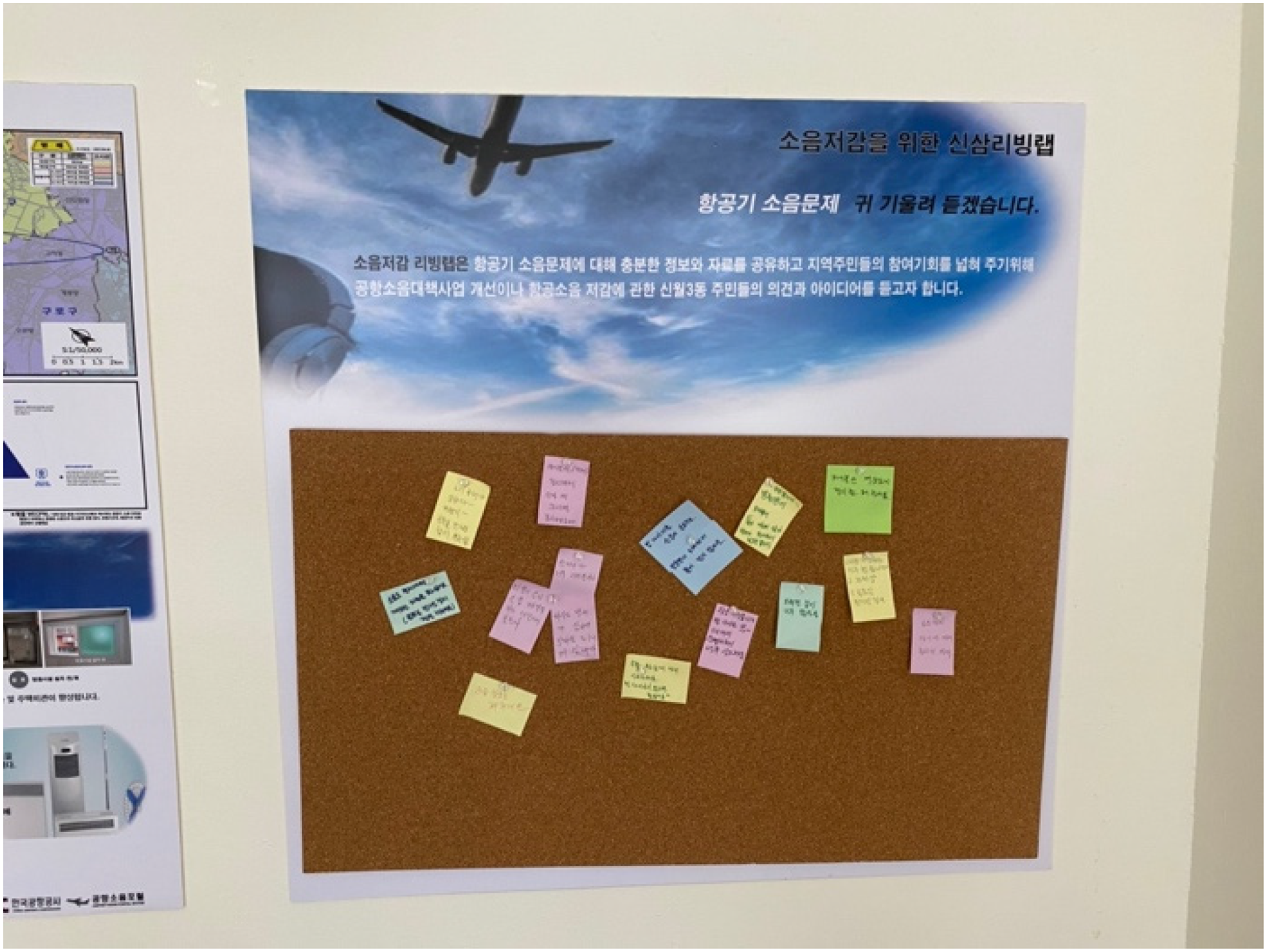
The board at Sinsam Living Lab (SLL).
The forms of experts’ practices have changed from established, top-down methods of planning. Criticizing the disembodied masculinity of rational planners in the past, an urban planner engaged in Maeul-making described designers’ practices as a “mother's sensitive hand” (interview, April 2021). Calling themselves not educators but “facilitators,” Maeul-making practitioners in SLL performed gendered affective labor, from emotional support to encouraging guidance, to constitute resident-experts. Facilitators were prudent not to stop brainstorming conversations between residents or to correct suggestions made by participants. They supported passive participants to prevent discussions between them from becoming one-sided and to keep design thinking at the SSL sensitive to opinions from Sinwol-dong. Practitioners suggest that only when residents hope to “be able to make it themselves” will the alteration of the worn-out infrastructure of Sinwol-dong be possible. The daily affective labor of designerly intervention, the mother's sensitive hands, was fostering a climate where residents felt they could make changes.
Empowering Resident-Experts
Researchers in the field of design studies have discussed the pitfalls of participatory design projects, including the exploitation of local knowledge or expert-centered framing of projects (Costanza-Chock 2020). To avoid such dangers, what mattered most for the affective labor of making resident-experts was to develop residents’ self-efficacy and capacity to define Maeul-making on their terms. For instance, in a meeting at the SLL, a woman confessed to hiding that she was a resident of Sinwol-dong because it signified poverty. She continued: “I have accepted that, but I am determined to do it differently now.” The symbolic value of Sinwol-dong would improve with infrastructural changes in Maeul-making that require her active participation. Officers, planners, and designers stopped perceiving residents as needy and asked her for valuable contributions to Maeul-making with respect. When she articulated her hope that resident-driven changes would make resident-experts proud of being residents of Sinwol-dong, most participants showed sympathy and were emotionally uplifted.
This self-efficacy based on Maeul-making's affective dimension is the painstaking achievement of designerly interventions. The major task was to orient residents suffering from underdevelopment to the potential of becoming experts who could enact the resilience of a sustainable city. When I attended a workshop, the residents voiced how Maeul-making should change Sinwol-dong. The challenge was that residents commented not as cooperative community members but as victims damaged by governmental policies. They complained about the physical harm caused by noise from an airport near Sinwol-dong, built against their wishes. Residents also asserted that there had been no change in Sinwol-dong's landscape for several decades, perceiving this monotonous scenery as proof of the Seoul government's indifference to the neighborhood.
Transforming this resentment of residents as victims into the self-efficacy of resident-experts required multi-layered framing devices to prompt residents’ affection for Sinwol-dong. First, the Maeul-making practitioners narrated alternative interpretations of Sinwol-dong's alleys. These alleys, which seemed worn out at first glance, maintained the organic characteristics of the community because their dynamic structure emerged from autonomous interactions between residents beyond formal urban planning. Maeul-making pamphlets depict the culture of alleys as resources to develop infrastructure in the new economy of city branding, which would attract tourists, and the vitality of local alleys would bring public and private investments into Sinwol-dong's infrastructure. The ultimate goal of “an economy based on alleys” was to design a sustainable city, which would replace the tabula rasa development model with the regeneration of resources accumulated in alleys (Jung 2019).
Second, the Maeul-making project utilized the SLL as the archive of Sinwol-dong, especially the alleys of this underdeveloped area. Residents were asked to fuse their tacit knowledge of Sinwol-dong with designerly tools to become resident-experts capable of archiving stories/memories of alleys. With “mothers’ sensitive hands,” professors and researchers from CRRG taught residents archiving techniques and research methods, including photography, writing, in-depth interviews, drawing, and mapping tools (See Figure 2). The establishment of the SLL as an archiving lab enabled diagnosing urban problems in Sinwol-dong and developing designerly solutions to address them, considering how complex interactions in alleys became entangled with these problems. The SLL was especially beneficial in helping residents conduct the material and affective deliberation of seeing the past of Sinwol-dong differently and devising the future through archival materials. For example, Maeul-making held a photography exhibition with the help of young artists to foster a sense of community among residents, and develop a collective imagination of Sinwol-dong's changing features.
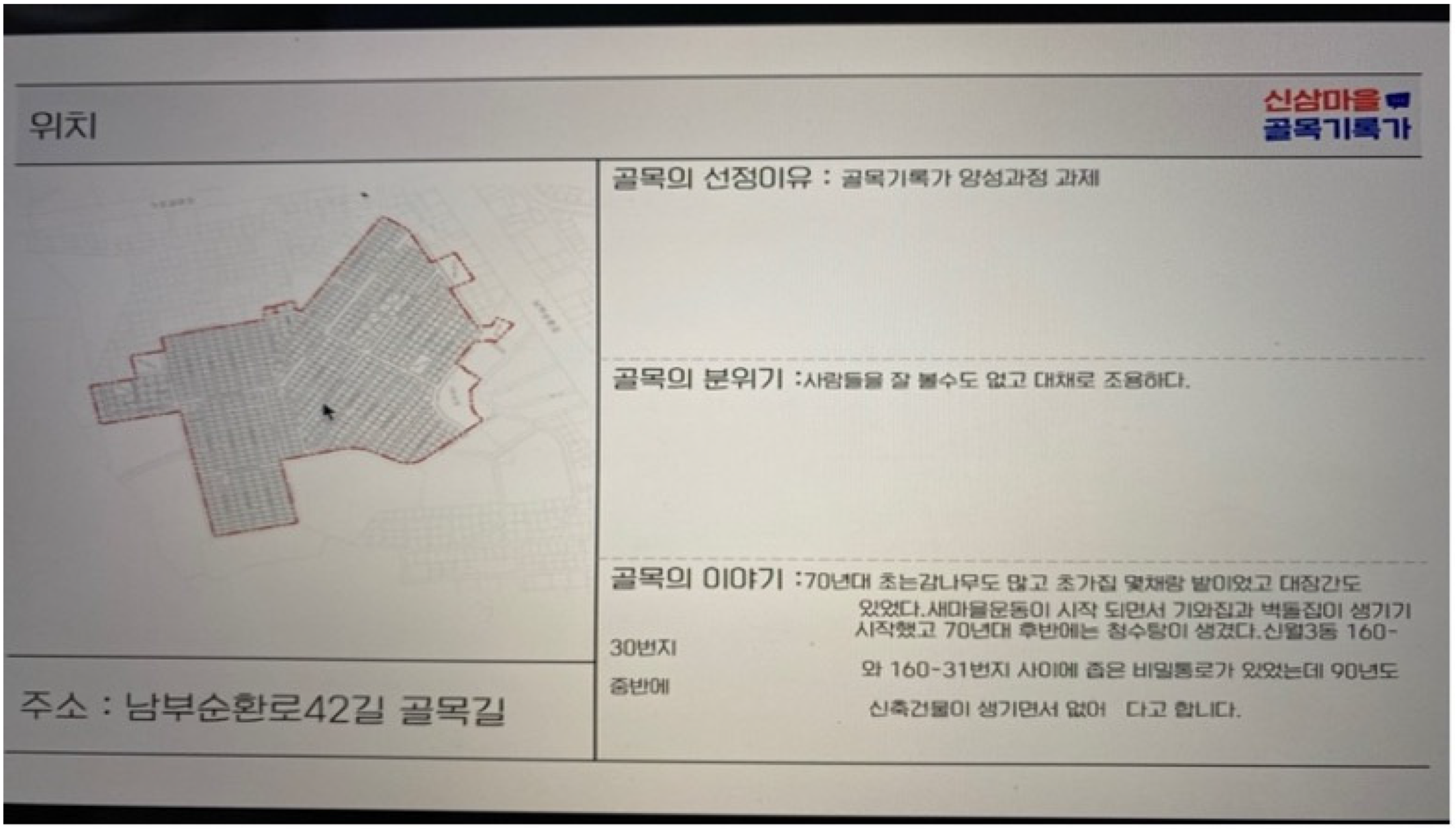
The research about alleys.
In sum, the affective labor of making resident-experts in the SLL was more than designing inclusive planning processes, showing how community members affected by worn-out infrastructure formed a political collectivity, “a public,” to engage with planning, articulated the underdevelopment of their neighborhoods as public concerns, and designed novel urban systems on their terms (for the affective dimensions of public engagement, see Selin et al. 2017).
Users of a City
Rusty infrastructure was problematized as an issue that required the emergence of resident-experts, as infrastructural connections enacted by Maeul-making became ordinary in terms of their spatiality and temporality: Maeul-making practitioners focus on designing infrastructural connections that meet the immediate needs of daily urban spaces. In a public hearing I attended, an urban planner clarified how this ordinariness of infrastructural connections related to the rights of the public: the task of Maeul-making is to “make sure that residents exercise a city as a capacity.” The rights of the public may not be rights protected by law, but a practical capacity that Maeul provides. Maeul-making re-articulates the rights of the public as city-users’ rights.
City-Users’ Rights
An example of city-users’ rights is how Maeul-making practitioners renewed the built environment in Sinwol-dong to guarantee residents’ security rights. Sinwol-dong has a high density of security cameras managed by the District Control Center for Closed-Circuit Television (DCCT), and many seniors stay in the neighborhood during the daytime. Despite these factors contributing to a safer environment, residents were concerned about frequent incidents related to juvenile delinquents or intoxicated individuals. A couple of environmental interventions were implemented to improve natural surveillance. The new playground design replaced the benches with jogging tracks to increase the number of visitors. Floral-decorated chairs were installed on the street to allow seniors to spend more time outside (Figure 3). In addition, streetlamps lit LED signs on the streets to inform pedestrians of a mobile app; when threatened by a stranger, residents could activate the app to ask the DCCT for real-time monitoring and, if needed, dispatch police. These ordinary devices were meant to meet residents’ immediate needs for social security by eliciting behavioral changes in pedestrians, residents, officers, and delinquents.
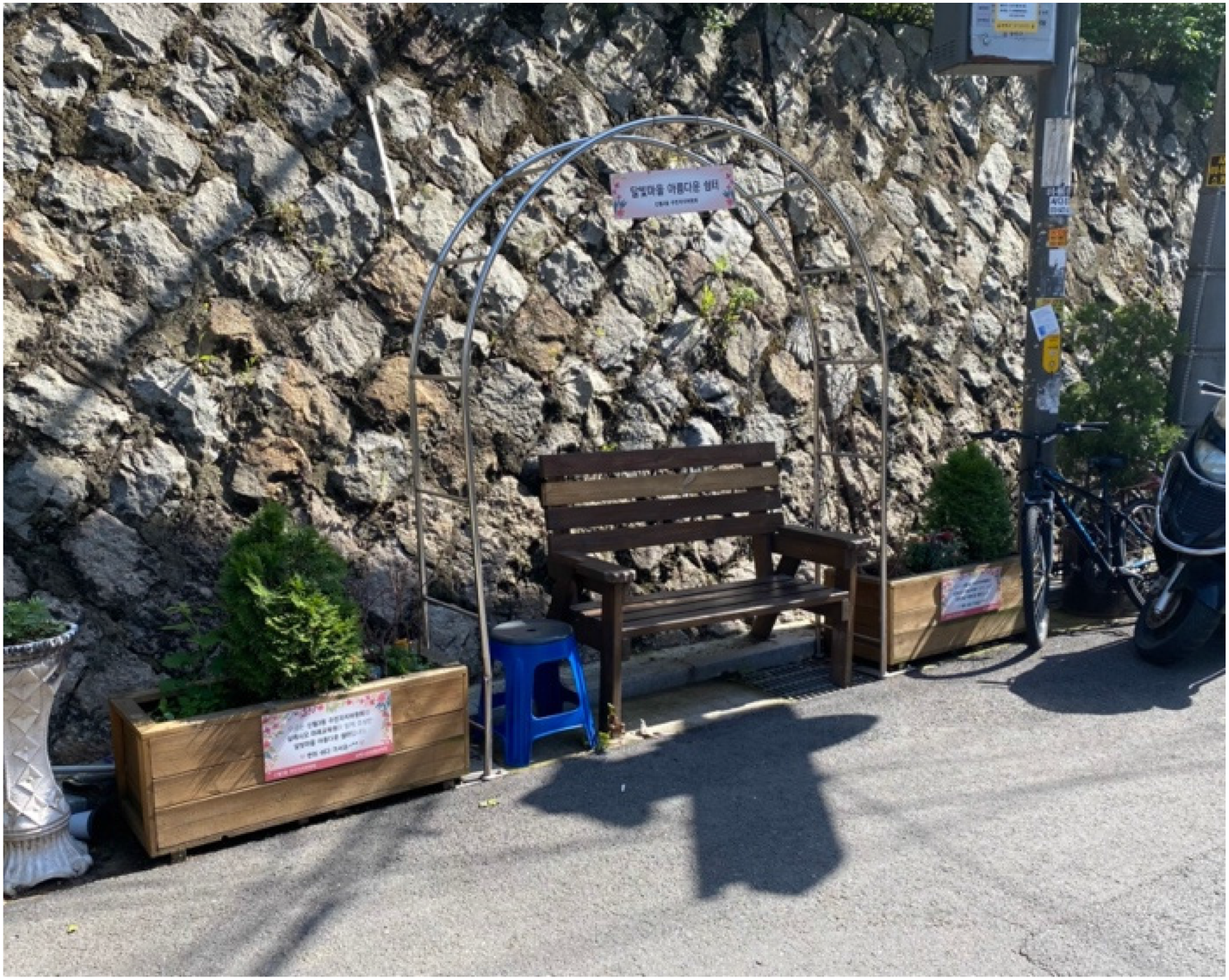
Floral chairs.
I conceptualize ordinary things in Maeul-making (e.g., jogging tracks, floral chairs, streetlamps, mobile apps) as “middle-range devices” because they mediate between everyday behaviors and the performance of large infrastructures. The well-established infrastructure for safety (e.g., the security camera system) can work only with residents’ behaviors mediated by middle-range devices (e.g., natural surveillance of seniors sitting on a floral chair or pedestrians activating a mobile app), which would make the massive infrastructure functional in everyday life. Following the human-centered design ideal, Maeul-making practitioners intervened not in mere technicalities of infrastructure but in the interplay between everyday behaviors and infrastructure. The function of middle-range devices was to stimulate the “blood circulation of the city,” i.e., to elicit user behaviors that would make infrastructural circuits work.
The performative capacity of middle-range devices is related to their design. As ANT and Foucauldian-oriented studies have discussed, the innovation of technologies does not just respond to existing needs but also configures their users as having specific interests and identities (Akrich and Latour 1992; Von Schnitzler 2016). The design of middle-range devices (re)configures their users by devising the possibility of activities supported by them (“affordance” in design terminology, see Norman 1988). Designers script “the user's possible actions” by interweaving the design of devices with assumptions and anticipations about the user, which delimit their possible actions (Akrich 1992, 61; Woolgar 1990). Design becomes a techno-political terrain in which designers and users negotiate cultural assumptions, social values, and aspirations inscribed in the design of artifacts (Cross 2013).
Resident-Experts as Designers/Users
Maeul-making practitioners implemented small projects targeting the immediate outcomes of middle-range devices in everyday life, which was contrary to massive infrastructure construction aimed at future structural effects. They launched certificate programs to equip residents with an entrepreneurial culture and help them run CRCs to manage small projects. 5 This participatory measure contributes to improving the capacity of middle-range devices. The configuration of users of middle-range devices was a time-consuming process that went through a long confrontation between “projected users” and “real users” (Akrich 1992). Thus, the hybrid role of resident-expert was beneficial; in their practice, “use and design merge,” so “any designer is a user and vice-versa” in Maeul-making (Callon 2004, 9; Redfield 2016). Resident-experts, as users/designers of infrastructure in Maeul, render more efficient the initial design process and successive redesign process based on feedback from everyday life. They can contribute to creating middle-range devices that meet the immediate needs of everyday life.
Small projects in Maeul-making started with resident-experts identifying problems on their terms (see Figure 4). In business model development programs at SLL, the main problems discussed were economic deterioration and worn-out housing properties. While many properties in Sinwol-dong were worn out, constructing buildings of more than ten stories was prohibited because the airport was two kilometers away. Residents discussed how historically, low-income families displaced by urban renewal settled in Sinwol-dong, where opportunities for economic development have been restricted. Resident-experts identified the spatial, material, and human resources (e.g., accessible public transport and a vast range of mutual aid efforts) they could mobilize to solve these problems. The temporality of Maeul-making stayed in the immediate present as resident-experts developed a business model based on available resources, aiming at instant effects rather than the greater objectives that would require gigantic planning projects in the future.
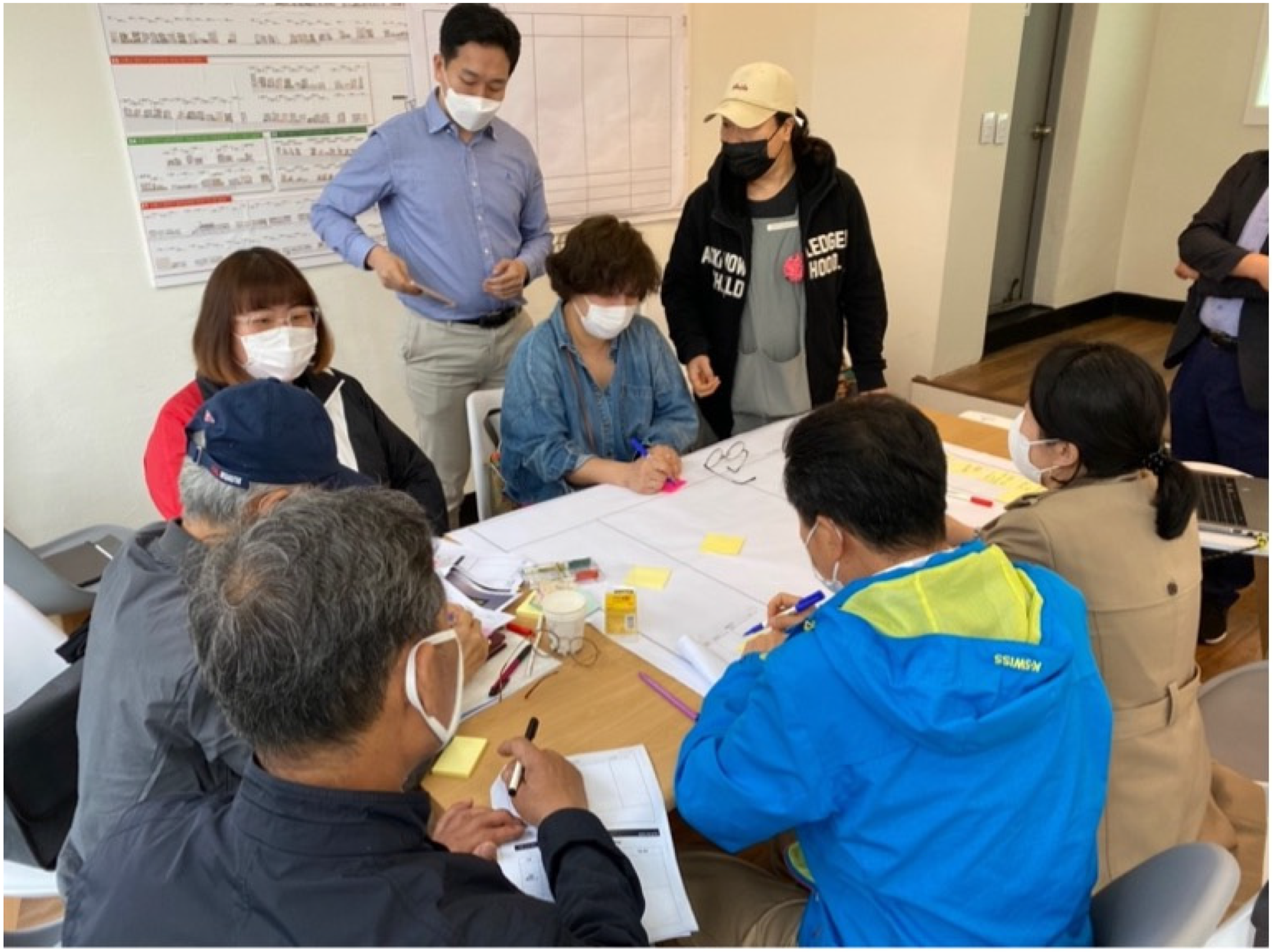
Articulating problems.
The next step was to frame the problems and resources discerned in terms of the individuals’ adaptive behaviors toward the environment. Consultants encouraged participants to focus not on built environments but on the behavioral patterns and affection that residents attached to them. The airport caused noise, but it attracted visitors who wanted to take a picture of the background of flying airplanes; business owners in Sinwol-dong could benefit from this. Similarly, when the old bathhouse was closed, a discussion ensued on remodeling strategies to achieve immediate results. To capture behavioral patterns related to this longstanding building, resident-experts conducted in-depth interviews with neighbors to explore the tacit function of the old bathhouse as a public space, and archived the memories of residents regarding the warm atmosphere and emotional interactions it facilitated.
Finally, resident-experts participated in designing middle-range devices and configuring their users simultaneously, based on their understanding of how behavioral patterns and environments became intertwined. During the business model development process, a photo booth in the rooftop café of a remodeled bathhouse was devised. What mattered was the articulation of target users for devices. Small projects began with consumer analyses, including qualitative and statistical analyses. When the district office began remodeling the bathhouse into a community café, a consultant emphasized that customers would not come there just to get a cup of coffee or hang out with their companions. Their visits should be encouraged by redesigning the unused property to efficiently support behavioral patterns, thus solving users’ problems: parents in a double-income family would be satisfied if they could work while community members in the café would keep an eye on their children; visitors would be happy to photograph flying airplanes in the background. Consultants and resident-experts developed a proposal for a photo booth on the rooftop of a remodeled building that preserved the warm atmosphere of the bathhouse, and used flying airplanes as a spectacular background for pictures. The photo booth could elicit behaviors of users that could render the old infrastructures working for a burgeoning “economy based on alleys.”
Frictions
The infrastructural changes of Maeul-making are not frictionless. Frictions originate from the same conjuncture that triggered public engagement with designerly interventions, i.e., the improbability of rational planners creating order and the weakening of the nation-state's role in constructing massive infrastructure for public benefit. As Redfield (2016) points out, designerly techniques were the means progressive politics relied on for the common good after losing confidence in their capacity to devise alternative futures through revolution. Designerly intervention practitioners drew on these techniques to “mobilize laypersons as participants in a reflexive design process in response to feedback from everyday life,” which helped them to “implement an interactive way of problem-solving” without a fixed conception of utopia (Koo 2024, 301).
The first friction in Maeul-making is related to an elective affinity between entrepreneurial culture and the worldview embedded in the middle-range devices of Maeul-making—a sustainable city as a field of environmental/designerly interventions in human behavior. This understanding of a sustainable city focuses on how daily behavioral changes elicited by middle-range devices stimulate positive circulation that contributes to the city's resilience. When this emphasis on everyday behavioral change resulted in the proliferation of small-scale projects that aimed at immediate and testable outcomes (Yoo 2020), the terminology of entrepreneurial culture (e.g., testbed, consumer feedback) invaded small-scale projects, which muddied the normative question of why Seoul should reform established infrastructure with middle-range devices.
For instance, as a mobile application for safe and clean environments was distributed in Sinwol-dong, Maeul-making practitioners encountered challenges because seniors were not familiar with smartphone use. The application requires users to log in to document noise levels and report concerns about safe environments. Here, mobile applications and smartphones have acquired political capacity, enabling residents’ environmental participation through voluntary monitoring of everyday urban life (Gabrys 2016; Marres 2013). However, as seniors could not log in themselves, resident-experts had to visit them to log in on their behalf. When questioned about the value of this formal act, the project manager depicted Sinwol-dong as “a testbed.” By accumulating data on success and failure, practitioners can design similar projects better next time. Maeul-making fosters an entrepreneurial culture without necessarily achieving its social objectives.
Penetration of entrepreneurial culture was also observed in the SLL. When a participant in the business model development program mentioned that youth in Sinwol-dong did not show interest in their projects, the business consultant responded with jargon: “Great, you are talking about user segmentation!” After that point, the woman stopped talking and became less confident as the discussion continued. There was a shared belief that for the immediate effects of Maeul-making to be appreciated, residents needed to be equipped with designerly techniques that framed their concerns as testable and feasible problems. One Maeul-making coordinator confessed the potential dissonance between designerly ideas of a sustainable city and the participatory democratic ideal of Maeul-making. While he thought practitioners should wait longer for residents to define their concerns, he had no choice but to ask consultants to educate residents to implement small-scale projects (Interview, July 2021). Maeul-making practitioners were aware of the pitfalls of accepting entrepreneurial culture but had difficulty avoiding it due to the absence of a structural transformation planned by the state with a clear picture of a just future.
This unsolved dilemma in progressive politics caused a second friction in Maeul-making. As Sinwol-dong's underdevelopment originated from the development policies of the 1970s, massive urban renewal was required to bring businesses and urban infrastructure to this neighborhood. This was unrealistic, because the real estate market was not interested in Sinwol-dong; the Seoul government could not respond to residents’ demands for the improvement of built environments such as housing or retail infrastructure. In the first place, Mayor Park initiated Maeul-making as an alternative model of urban regeneration that would address residents’ difficulties in low-income districts without displacing them (Lee 2016). However, the establishment of infrastructure to which residents aspired cannot be guaranteed by the behavioral changes elicited by Maeul-making; it requires more.
In this situation, public engagement enabled by Maeul-making encountered external and internal obstacles. Conservative politicians and the media have caricatured Maeul-making since its inception. When Oh Se-Hoon, from a right-wing party, was elected Mayor of Seoul in 2021 after the sudden death of Mayor Park, he reduced the scope of Maeul-making and its associated budget, asserting the need to implement mega urban renewal projects instead. Although initiated Maeul-making are ongoing, the implementation of future projects is in limbo. Internally, there were others who did not fully appreciate the value of Maeul-making. For example, the elderly who had lived in Sinwol-dong for a long time perceived that the affective experiences of becoming resident-experts were for young people who would eventually leave Sinwol-dong, obtaining self-confidence from Maeul-making. An elderly participant moaned: “Sinwol-dong couldn’t be like other urban regeneration sites” (Interview, June 2021). Insofar as Maeul-making cannot connect public engagement with structural transformation, how to respond to this poignant comment remains unclear in designerly intervention.
Conclusion
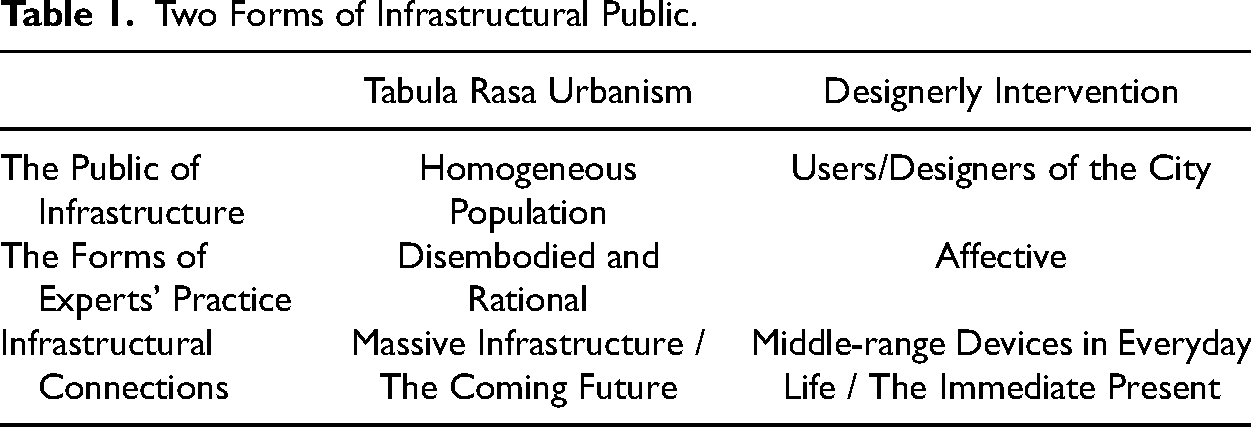
To investigate the gathering of collectivity intertwined with the infrastructural transformation of Maeul-making, I have identified the new formation of publics, how socio-technical processes of enacting infrastructure in designerly interventions brought into being resident-experts as users/designers of the city. To recognize the specificity of designerly interventions, I have differentiated Maeul-making from the tabula rasa urbanism of the 20th century in terms of the co-production of public problems and their publics and the establishment of infrastructural connections (See Table 1).
Two Forms of Infrastructural Public.
While scholars have often used the term “community-led” to depict participatory projects akin to Maeul-making, I avoid using the concept of community to explore the socio-technical processes of public engagement enabled by designerly interventions. The phrase “community-led” implies that planning and design should facilitate the participation of prefigured community members who already form an association based on shared experiences. This concept of community often results in the “residual realist” discussion on how to reflect the voices of community members affected by infrastructure through inclusive planning. It is a valuable effort but it separates ontologically the formation of collectivity from material things and expertise. In contrast, I discuss that the creation of resident-experts requires a socio-technical network of humans and material things, including heterogeneous actors, technical artifacts, and design ideas, which did not belong to local neighborhoods before Maeul-making. Future research on reflexive methodologies in planning and design may need to focus on an assortment of ordinary actions, mundane technical tools, and material settings entailed in constructing publics and building their capacities to solve local issues, instead of evaluating whether established design procedures rightly represent the presumed existence of community members.
My analysis of resident-experts in Maeul-making contributes to updating the Deweyan understanding of the public presented by Marres (2007). Marres deconstructs the usual suspicion that technological issues related to material things lead to technocracy by discouraging the public's democratic participation. For Marres (2005, 213), Dewey's work elucidates how such complex issues “spark” the constitution of the public and their involvement with technological problems: when existing institutions and social groups fail to settle the issues, “actors who are affected by human actions, but who do not have direct influence on those actions…must get organised into a public.” Marres argues that empirical artifacts (e.g., eco-houses and ecological kettles) become the means for public participation.
Marres seems to conceptualize the public as recipients of material things and technologies, implying that the public participates in technological issues because they do not have direct influence on those issues. If this is the case, the model may need to be updated. First, we have observed the public engaging in designing technological devices, so they have direct influence on the issues “sparking” their association. When resident-experts engaged with Maeul-making as users/designers of a city instead of remaining the recipients of urban infrastructure, they came to have resources to influence the worn-out infrastructure affecting them. Second, when Marres observes empirical artifacts becoming the field of public participation, Marres does not pay full attention to the material conditions that make user participation through devices a historically specific form of material participation in politics. The public as users of artifacts and technologies are not given; it is necessary to trace how publics become users who take material devices as a means to engage with complex issues through an empirical, technological analysis. I have explored how infrastructural connections of Maeul-making, which materialize immediate temporality and ordinary spatiality, construct resident-experts as the users of a city to present the establishment of infrastructural connections as an empirical and epistemological point to conduct such an analysis.
Finally, the frictions in Maeul-making highlight the need for an experimental approach to public engagement in enacting infrastructure to explore its practical implications (Marres 2013). The point of being experimental is to leave open possible ways to delineate different forms of “deliberation” and “participation” to make democracy workable in urban planning and have it realize material effects on urban fabrics, rather than getting by with normative views of democratic participation. The experimental ethos raises the following questions: What are the material settings for public participation when people participate in technological issues? What forms of participation do these material conditions make possible? What material effects do these specific forms of participation have? This approach identifies whose and what problems laypeople's participation could address through specific forms of infrastructure (Lemke 2021; Suchman 2011). It interprets the participatory design process as “multi-vocal” to assess its potential to implement the process of commoning, as well as to detect the sources of potentially discriminatory effects, implicit or hidden in technical details of the infrastructure (Asaro 2000).
I do not advocate an experimental approach as an alternative form of democracy to deliberative democracy. I propose expanding the uses of participation and deliberation by considering how different types of technological settings make different forms of deliberative practices possible, and what material effects these diverse democratic practices have. A city's democracy requires an experimental approach and deliberative practices simultaneously. If an ideal of deliberative democracy stimulates urban planning to be open to laypeople's participation, an experimental ethos makes urban planning/design consistently (re)evaluate the material condition of such public engagement.
This experimental ethos helps us break away from asking whether Maeul-making guarantees genuine public participation, or the elective affinity between entrepreneurial culture and designerly interventions spoils such a possibility. Instead, it leads to experimenting with Maeul's infrastructural connections to prevent the recurrence of friction in Maeul-making. If designerly intervention facilitates a unique and potentially promising form of public engagement with planning, the infrastructural connections of Maeul-making (aimed at immediate results and the ordinary scale), limit the possibility for resident-experts to generate further material effects. However, it is crucial to note that the combination of designerly intervention and such infrastructural networks is not unchangeable. Designerly intervention may have required a longer project to build mutual trust between residents and planners/designers. Improving the performance of middle-range devices could require iterative practices of redesigning and tinkering based on long-term evaluation and large-scale installation. These different material settings for designerly intervention may orient the participation of resident-experts toward avoiding entrepreneurial culture and targeting structural justice. As such, public engagement in Maeul-making provides a starting point for experiments with different infrastructural connections to let public participation work for alternative resource sharing and democracy in Seoul, and other cities around the world.
Footnotes
Acknowledgments
My gratitude goes to all the research participants and their generosity. Martha Lampland and three reviewers of Science, Technology, & Human Values provided invaluable feedback, for which I am thankful. I thank audiences at the American Sociological Association Annual Meeting in 2022, where I presented an earlier version of this paper. Lastly, I would love to express my deep gratitude to Sungeun Kim for providing great assistance.
Declaration of Conflicting Interests
The author(s) declared no potential conflicts of interest with respect to the research, authorship, and/or publication of this article.
Funding
The author received no financial support for the research, authorship, and/or publication of this article.
