



Abstract
This paper explores how climate finance approaches and logics, particularly around scale, manifest in local climate technologies in Fiji. Through multi-sited fieldwork, the paper explores experiences around three climate related infrastructures: a biomass plant in Nadroga; a diesel-solar community hybrid system in Island X; and a seawall in Levuka, Ovalua. Each represent a key aspect of Fiji's climate-related infrastructural targets. Through explorations at these sites, the paper argues that climate finance logics prioritise large scale technologies and “scalability” projects, that is, projects which seek to expand without changing their basic elements. In response, the paper aims to create scholarly space for considering alternatives around climate finance's projects. The paper embeds these considerations of climate finance alternatives within its conceptual framework of “loving technologies.” Loving technologies is a product of the interplay of Pacific theory, postcolonial and feminist technoscience with the Fijian experiences of climate finance explored in this paper. The loving technologies approach highlights the validity small-scale infrastructure as having potential to be intimate, relational, making a difference in lives, communities, and futures. Despite their small scale, they can make an impact on bigger scales, and can chart alternative pathways of progress.
Introduction
Fiji is already experiencing the effects of climate change, including extreme weather events, loss of agricultural land (Nand, Bardsley and Suh 2023), and rising sea levels (Sabūnas et al. 2020). In response, Fiji and its Pacific neighbors have taken a leadership role in climate change mitigation, in part by setting ambitious renewable energy targets (Michalena, Kouloumpis and Hills 2018). These twin realities mean that Fiji has significant adaptation and mitigation infrastructural needs, to which climate finance has presented a wholesale response. In the Pacific context, climate finance may come from a variety of sources including bilateral and multilateral development aid, private investment or designated climate funds such as the Green Climate Fund. The financial obligations attached to climate finance are varied: for example, one participant of this study noted that key originators of climate finance in the Pacific were increasingly preferring to offer climate finance as loans as opposed to grants. Key priorities of climate finance include funding coastal protection infrastructures and renewable energy (Fouad et al. 2021). In part due to “the cultural power of money in our understanding of the world, climate finance signifies extensive action” (Bracking 2021, 256). Yet the benefits of climate finance are increasingly contested, including critique of the potential for climate finance to reinscribe (neo)colonial dynamics (Bracking 2021; Khan et al. 2019; Navarro 2022; Perry 2021).
The definitional boundaries of climate finance are exceedingly broad and continue to be contested. 1 Scholarly work has sought to tie it to particular relational dynamics, for example, some interpretations of climate finance see it necessarily flowing from the Global North to the South (Pickering et al. 2015). This is linked to the idea that climate finance is the result of moral responsibilities, often derived from principles of climate justice (Sayegh 2018). One view is that if climate finance is meant to operationalize even a thin notion of North–South climate justice, debt finance arguably falls outside the normative function and thus scope of climate finance (Sayegh 2018). Yet debt finance is increasingly present in purported climate finance, including through sovereign debt through bond projects, as well as commercial and concessional loans for climate projects. Despite uncertain definitional boundaries of climate finance, systemic critique highlights an increasingly coherent climate finance logic or worldview (Bracking 2021; Perry 2021). These critiques contend that climate finance extracts value out of climate change and withholds its benefits from those rendered most vulnerable by the climate crisis and its impacts. The geographer Keston Perry (2021, 362), for example, argues that “finance operates as an entanglement of power relations accruing rent from climate devastation and untethered from specific broad development aims that may be democratically determined.”
To ground these systemic critiques of climate finance, I begin by asking how do climate finance approaches and logics manifest locally in climate technologies in Fiji? I argue that these logics prioritize large-scale technologies and “scalability” projects, that is, projects which seek to expand without changing their basic elements (Tsing 2012). Scalability prioritizes precision, homogeneity, and expansion, and in doing so erases heterogeneity and diversity. Scalability also valorizes large scales. Scale may be present in the sheer size or capacity of the infrastructure, or in less visible overarching financial structures governing the infrastructure. Preference for large-scale infrastructure and large-scale climate finance is linked to perceived progress on high level, national climate goals, though this perception may be illusory, as I go on to illustrate. The dominance of scalability projects and preferences for large-scale finance constrain infrastructures in various ways, including displacing relationality and diversity in various forms, such as Fijians’ differentiated energy needs.
Beyond highlighting climate finance's seemingly banal modalities and logics, including its preferences for scalability, the creation of scholarly space for considering alternatives is a critical agenda. In recognizing alternatives emerging from the debris of climate finance scalability projects, I develop the conceptual framework of “loving technologies” as a worldview or ontology. Given the present and unfairly experienced climate crisis, loving technologies recognizes the overarching need for climate technologies to be loving, to reflect empathy (loloma), to be valued and loved by those who surround and rely on them, and to be able to make a difference in intimate spaces, such as the community and the household. As such, the loving technologies approach represents a break from financialized technofixes, engaging muddier areas of emotion (Gibson-Graham 2006) or even grief (Lennon 2020).
Loving technologies is an ontological project, woven together through the interplay of Pacific theory, postcolonial and feminist technoscience, and the Fijian experiences of climate finance documented in this article. It is fundamentally partial and playful (Haraway 1988), encouraging further interventions and imaginings around climate-related technologies, beyond my focus on scalability. The notion of love has echoed from many disparate contributions from postcolonial STS, feminist technoscience and Pacific studies. This paper weaves some of these together with empirics from the Fijian case studies, and in doing so frames love in the explicit context of technological relations. In doing so, it calls for recognizing love as a pathway toward making material differences in contexts of ecological crisis. This illumination of critical and hopeful synergies between postcolonial STS, feminist technoscience and Pacific ontologies represents an important contribution to the field of STS.
To develop these conceptual points, the article utilizes and contributes empirical material from three climate infrastructures in Fiji: a biomass plant in Nadroga, Viti Levu; a hybrid mini-grid in Island X; and a seawall in Levuka, Ovalau. 2 These three infrastructures are all manifestations of high-level global and national climate goals. The first is a large-scale renewable energy generation project, articulated as key to meeting Fiji's ambitious carbon mitigation targets. Increased use of biomass and waste-to-energy generation is the dominant component of Fiji's mitigation strategy in its energy sector (Fiji and GGGI 2017). The second, a hybrid mini-grid, is a small rural electrification system. Fiji faces challenges in supplying electricity across remote island geographies (Dornan 2011), and in its 2017–2030 Roadmap commits to working toward a goal of 100 percent electrification (Fiji and GGGI 2017). The final case study, a seawall, is an iteration of coastal protection which has been a significant infrastructural challenge for Fiji. Significant amounts of finance are deployed in seawall construction in Fiji, even though scholars argue that they are largely ineffective (Nunn 2000). Each infrastructure is a product of a different climate finance arrangement, ranging from bilateral aid to combinations of private investment, philanthropy, and donor-funding.
Climate Finance Logics: Empire, Scalability and Scale
Conceptually, this paper engages two approaches as it moves through the sites in Fiji. Firstly, it highlights the ways dominant logics of climate finance have manifested in its infrastructures. Secondly, by following the debris of deteriorating infrastructure projects, it aims to recognize emerging alternative ontologies that may lead to materially better futures.
Critical interventions on climate finance are increasingly highlighting climate finance logics, relations and materialities. Scholars argue that climate finance perpetuates inequalities that map onto colonial relations, in the context of carbon markets (Navarro 2022), the climate finance development complex (Khan et al. 2019) and climate finance's regulatory discourses (Anantharajah 2021). Critical interventions also highlight that climate finance extracts value from racialized areas through debt and other means (Bracking 2021; Perry 2021). Pacific literature also evidences the dominance of certain knowledges in the deployment of climate infrastructure. For example, studies note that governance of renewable energy projects often fails to contextualize these projects within local knowledges. In particular, secular constructions of renewable energy displace spiritual understandings of the technologies, resulting in community disengagement (Michalena and Hills 2018). This is problematic given the salience of non-secular understandings of climate crisis, and indeed Christianity plays an important role in Pacific constructions of climate change, including Christian framings on climate mobilities (Fair 2019; Fache, Fair and Kempf 2020; Fair 2018; Kempf 2020).
My own intervention follows on from this body of literature and explores how climate finance logics are mobilized through its technologies and infrastructures as products of Empire. Vaai et al. (2017, 18) describe Empire as institutions that outsource their polices, regulations and models as a universal truth, which reflects important critiques of key climate finance organizations by (Sauls 2019). The connotations of expansion inherent in Empire particularly resonate with climate finance's preoccupation with scalability projects.
Scalability projects are rooted in this colonial context. As anthropologist Anna Tsing (2012) describes, tracing the origins of scalability projects to colonial plantations, scalability is a key way of stabilizing project components and minimizing diversity to allow for perpetual expansion. Scalability can have a homogenizing effect: “disguising divisions by blocking our ability to notice the heterogeneity of the world; by its design scalability allows us to see only uniform blocks, ready for further expansion” (Tsing 2012, 505). While scalability as a logic is a layered concept reflecting a reverence for precision, control, homogeneity and expansion, this paper also highlights its cruder elements. Scalability, in a literal sense, is about size, the obsession with the big: big sums of money in donor transferences, big seawalls to stop big swells, a big reliable powerplant that never fails.
Climate finance has prioritized large-scale finance. In the context of local private sectors in Fiji, small and medium-sized enterprises have struggled to access finance (Anantharajah 2019). Disbursements to large international intermediaries are prioritized over national and regional organizations in the context of the Green Climate Fund, a UN-sanctioned fund helping developing countries reduce their greenhouse gas emissions (Chaudhury 2020). Scale is a particularly salient discourse in the Pacific, where it has been weaponized to embed logics of neo-colonial dependence (Hau'ofa 1994); climate finance arrives in the Pacific as part of this legacy. In a landmark essay, Pacific scholar Epeli Hau'ofa (1994) highlights that the limiting narratives of scale centered on the smallness of the Pacific may be displaced through a relational lens. Another way Hau'ofa (1994) can be read is to recognize the development complex and indeed the colonizer's preoccupation with the “big.”
How do we make visible the logics of scalability embedded in climate finance's technologies? For one, this paper explores three ruptured, or less than functional, infrastructure sites, which offer unique opportunities for visibility (Mahanty et al. 2023; Star 1999). As argued by Tsing (2012, 506): “Scalability spreads—and yet it is constantly abandoned, leaving ruins. We need a nonscalability theory that pays attention to the mounting pile of ruins that scalability leaves behind.” In these cases, rupture aids in making visible hidden logics of scalability. Critically, in engaging the ruins of scalability we can also see the emergence of alternatives.
Alternatives: Loving Technologies
Given the displacement of heterogeneity inherent in scalability projects, it is necessary to generate discussions surrounding alternatives. Drawing on a recursive process between the fieldwork and theory, I put forward the idea of “loving technologies” as a composite theoretical model that serves as an alternative to dominant climate finance technical understandings. First and foremost, the notion of love or loloma in technologies emerged from the field. The importance of loloma, a practiced empathy (Naisilisili 2012), is a clear theme in technological relations in Fiji.
Secondly, “love” speaks to an ontological practice of situating the researcher. For example, in the targeted use of “love” to describe relations with and assessment of the Zimbabwe bush pump, De Laet and Mol (2000) identify it as a model of “doing” normativity, an inclusive one that draws in the researcher and reader too. Indeed “love” can be an ontological basis for research methodologies. Gibson-Graham argue that love as an orienting positioning to the world allows for a type of openness that is necessary in recognizing diverse economies. Love provides a critical ontological alternative to “masterful knowing or melancholy or moralistic detachment” (Gibson-Graham 2006, 6); which is common in research grappling with climate change. This aligns with the notion of loloma in Pacific research, particularly regarding the situation of the researcher. As the researcher, I am able to express empathy, my positionalities, normative values, and feelings in relation to the research context (Naisilisili 2012, 83). Put differently, the love in “loving” technologies speaks to the conscious, normative pursuit of hopeful futures, which connects other environmental interventions in STS (Ballestero 2019; Boyer 2021; Haraway 2019).
Thirdly, loving technologies respond to climate finance's attraction to what is big in the form of large-scale infrastructures, and expansive profits. By contrast, loving technologies demands space and recognition for the small-scale. Visvanathan (2008), for example, discusses the smaller scale use of biomass in India. He highlights that biomass is seen as a relegated technology, falling outside a sterilized image of the industrial and the modern. Yet biomass should be seen as an embodiment of civil society, of resistance and democracy. Part of the liberatory power of this technology is indeed its small scale, its ability to reach intimate spaces. Loving technologies argues that small-scale technologies can have big impacts, as described by De Laet and Mol (2000, 237): “a small device in some ways, in other ways it encompasses an entire state.”
Lastly, “love” speaks to a particular silence in the literature on climate finance and its infrastructure. For instance, energy infrastructures are most commonly understood in energy studies as “pre-discursive”—“an apolitical biophysical phenomenon governed by the laws of thermodynamics, existing irrespective of human culture” (Lennon 2020, 19); or as dissociated from the knowledge systems that ground them (Visvanathan 2008). Put differently, energy is repeatedly reduced to the technical (Howe 2019). “Love” is the conscious acknowledgement of the expansive meanings of climate-related infrastructures in communities and individual lives as emotional, spiritual and intimate. In contrast to scalability projects, loving technologies also encompass diversity: loving technologies respond to, rather than collapse, diversity.
Multi-Sited Journeys Following Insubstantial Objects: Examining Climate Finance Through its Material Infrastructures
The STS prioritization of native knowledge production sites translates well to the use of multi-sited fieldwork, which is responsive to the “unwieldy” objects of inquiry (Henne 2017), in this case climate finance. Climate finance is often conceptualized in the abstract, and is deployed and negotiated from the Global North, though ultimately destined for the Global South. Its material infrastructures, such as seawalls or energy infrastructures, come to being in local settings. Put differently, climate finance transcends and moves between scales of analysis. The responsive nature of multi-sited fieldwork is particularly adapted to examining processes that do not “map neatly on to global, national or local levels” (Henne 2017, 98). Here, both the international quality of climate finance and its localized materialities, play out at the local sites.
The sites explored in this article are located in Viti Levu, Ovalau; and Island X, a small, rural island. Interviews and participant observation also occurred in Suva, as well as in boardrooms and offices in Sydney and Canberra, Australia. Although the purpose of this paper is not to trace the flows of finance, it follows the diverse spaces climate finance inhabits in order to capture the material and epistemic struggles that surround it. Participants were chosen because of their current or past involvement in climate finance and climate infrastructure. Given the close-knit group working in climate finance and infrastructure, recruitment primarily occurred through the snowball technique. The research was partly funded by an Australian government climate finance project, which assisted with access to key climate finance stakeholders in Fiji. In some cases, the research led to collaborations with participants, such as policy dialogues. This study draws on ethnographic data from 79 interviews and field observations, complemented by a detailed analysis of government and development documents, including policy roadmaps, consultant reports, regulations, media, and articles on renewable energy and climate finance in Fiji. I spent six cumulative months in the field in Fiji (between August 2018 and March 2020) and in Australia. 3
Talanoa is a cultural discursive practice recognized in certain Pacific states (including Fiji) that is also used as a research methodology (Farrelly and Nabobo-Baba 2014). While there are many different understandings of Talanoa, it can be understood in conjunction with love as an ontological standpoint. It requires the researcher to approach the research openly, without a theoretical agenda, with a shared emotionality and a strong sense of empathy (Farrelly and Nabobo-Baba 2014). As such, participants were approached openly, without set agendas, hoping to be led primarily by their expertise.
The significance of the three sites explored in this article emerged from triangulation across interviews and reports. Empirically, these infrastructures all represent critical aspects of Fiji's national climate adaptation and mitigation goals (Fiji and GGGI 2017). Conceptually, these sites provide rich cases in part because they were less than functional or ruptured during the research. As articulated by Star (1999, 382), “this breakdown became the basis for a much more detailed understanding of the relational nature of infrastructure.” Furthermore, a focus on ruptured infrastructure has particular connections with the scalar focus of the paper. This multi-sited approach explores how climate finance's logics may be reproduced across infrastructures.
This article explores climate finance from the location of its material adaptation and mitigation infrastructures for several reasons. Firstly, calls for climate finance often follow directly from quantifications of infrastructural gaps for adaptation (Fouad et al. 2021) and mitigation (Fiji and GGGI 2017). More critically, much of the knowledge production around climate finance is based on innovative financial approaches and products such as “blended finance, transition bonds and sustainability bonds” (Bracking 2021, 272). Yet as Bracking (2021, 272) argues, “they will make up the (non) signifiers, firewalls and black boxes….But they have very little substance, and certainly no high science.” Drawing on this growing critique of the illusory nature of various forms of climate finance (Watt 2021), this article seeks to ground itself in the classically material: infrastructures.
Biomass Plant in Nadroga
In Nadroga, Fiji, the Nabou Biomass Plant stood at odds with the verdant vegetation characteristic of Viti Levu's western coastline. If the Nabou Green Energy Limited power plant were functional, perhaps its physical visibility would be lessened. Perhaps it would have appeared less in the media (Wanshika 2021); it would have been an accepted part of the landscape; it might have quietly gone on to provide Nadi, Fiji's third largest city, with the projected 12 MW of electricity. The intended fuel was an invasive species: the African tulip (Spathodea campanulata). The Green Industrial Management Company Ltd (GIMCO), a South Korean investment company, selected biomass as the generation source for this plant in line with Fiji's technological preferences (GIMCO 2022). Historically, Fiji's energy mix has relied on hydropower. The difficulty of including renewable energies like solar and wind in Fiji's generation mix, despite policy plans to do so, is largely because of the stochastic nature of these sources. Local energy sector stakeholders raised concerns that utility technicians had limited experience in managing “intermittent” sources on the grid, preferring “24/7” sources of energy. Given these preferences, it is perhaps unsurprising that Fiji's first Independent Power Producer (IPP) was projected to be biomass. Yet at the time of fieldwork, Nabou remained non-functional due to the inability to extract enough plant material to burn.
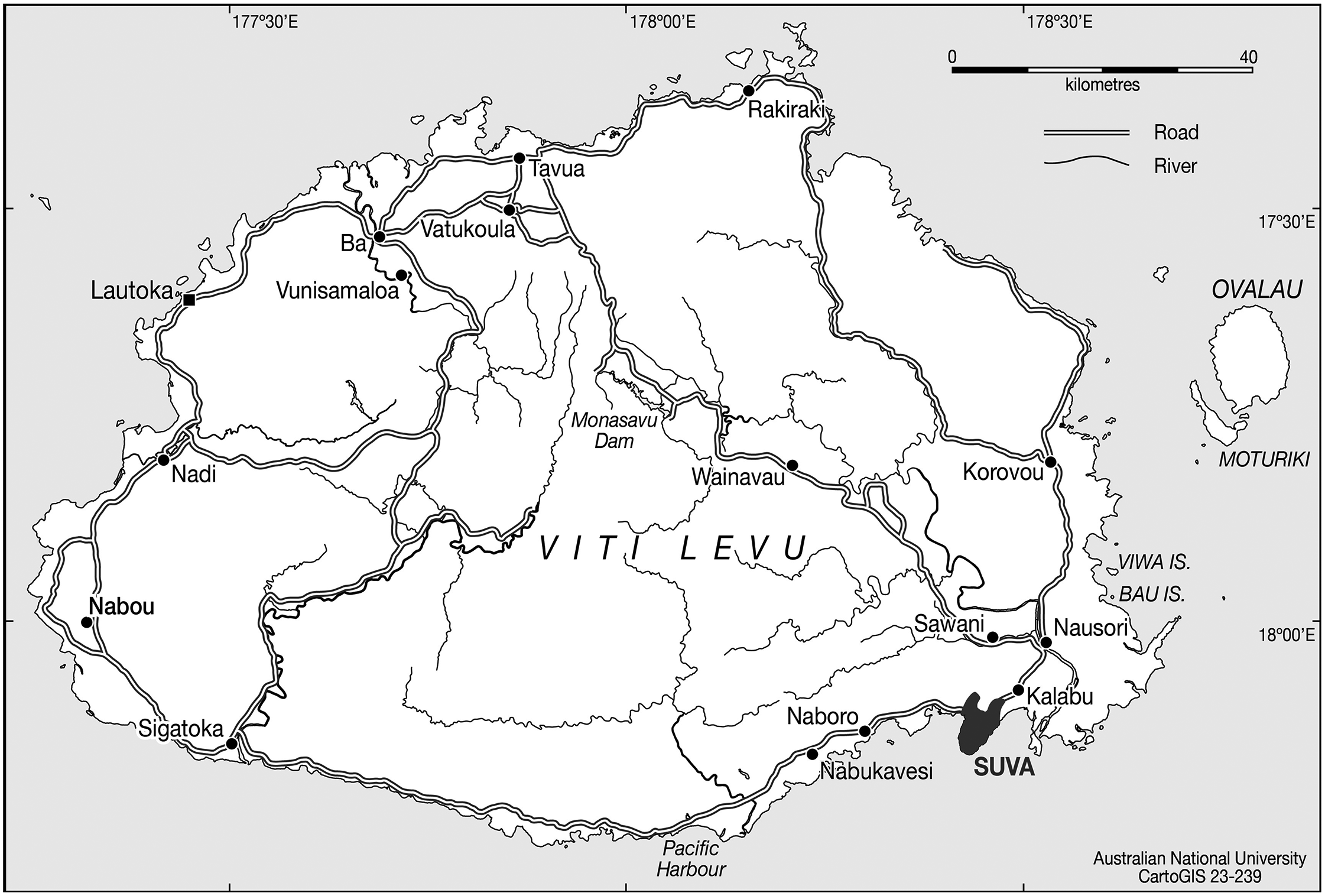
Viti Levu, Fiji. Map provided by CartoGIS Services, Scholastic Information Services, the Australian National University. Used with permission.
Nabou was developed to create 200 jobs and have a lifecycle of 25 years (GIMCO 2022). Put differently, Nabou was meant have a big impact. Yet, the FJD90 million plant initiated in 2017 is closed, and it is said that FJD45,000 in rent remain unpaid to the landowners in Nadroga (Elbourne Ilaitia Ravuwai 2020; Nasiko 2017). Scale emerges as a critical issue here. Nabou was a high-profile development, in part due to its status as the utility's first Independent Power Producer (IPP). Scale is revealed as a critical consideration for potential developers, requiring larger-scale developments to deliver the requisite financial returns. Indeed, the need for scale is often justified by the risk–return rhetoric: scale of potential profits must overwhelm risks for developers. Yet when we engage with the non-functional plant, we can see risk transferred onto the community. This non-functional large-scale project heavily impacted the community in the form of broken promises of employment and broken relationships with landowners.
Conceived as an exemplar of synergy between Fiji's goals for renewable generation and increased private investment in the energy sector (Fiji and GGGI 2017), the Nabou plant had potential to end the nation's reliance on imported diesel. Leveraging large flows of private investment is an articulated goal of climate finance (Prasad et al. 2022). Nabou was an IPP project, run by Korean companies GIMCO Korea Limited, GS Power Company Limited, and Mirae Asset Daewoo Limited, the financier (Chambers 2019). Given the financial risk profile, further finance was sought from Korea. The 12 MW biomass plant aimed to power 40,000 households (GIMCO 2022).
In the dominant logic of climate finance, big infrastructures are synonymous with progress. In the scale of generation, and indeed in the scale of finance, we can see Nabou as the manifestation of high-level ambitions. Its effect on the local community in its non-functionality is correspondingly significant. This is key in the way that large-scale infrastructures are linked to progress and national goals. As noted by Visvanathan (2008, 2167) in his discussion of small-scale biomass in India: “nuclear or large dams are state-oriented, while biomass speaks the language of civil society.” In this context, in contrast to Nabou, biomass is small-scale, corresponding to household needs rather than national goals. Yet within the loving technologies framework, despite this relegation in national technological visions, small scale technologies have the potential to make profound impacts. De Laet and Mol (2000) argue that in transforming local communities in Zimbabwe through relationships with life-giving infrastructure, the intimate bush pump also transformed the state.
In applying this to the Fijian context, biomass could similarly be a meaningful technology. The displacement of fossil fuels is a powerful idea: it delinks Fiji from international oil markets and centers local resources. Further, using an invasive species, a colonial legacy, to fuel the plant could have been a unique counter to the notion of linear development. Yet Nabou, partly due to scale, represents a vastly different technofuture. In Fiji, scale is emerging as a driver of climate finance inequity (Anantharajah and Setyowati 2022). Arguably, the enormity of Fiji's technological and infrastructural goals renders big solutions (namely large-scale finance and infrastructures) attractive, yet the experience of Nabou asks us to examine the futures that are foreclosed by climate finance's preoccupation with scale. The loving technologies approach asserts that it is worth revisiting the futures that could materialize from technologies at different scales.
Despite acknowledging the importance of fuel supply in the success of biomass plants (GIMCO 2022), Nabou ultimately ruptured due to “feedstock” issues. One consultant highlighted the root of Nabou's dysfunction: A biomass plant by this Korean company, a private company near Sigatoka….they didn’t do a proper feasibility study and they had the technology, like the burners and all that, but they didn’t know where the feedstock was coming from. As such there were problems with the supply chain and then there was little to be done. It's still shut, I think. They have been approaching the community to see if they can harvest the African tulip plant. But the issue with that is, the worry [is] how will you extract these from the other trees that are not invasive species. Look around, they are in among all these other trees… And they say we plant the trees back. But how long will it take for them to mature?
In Nabou, relationships with the communities involved were inadequate, as were the relationships with the nonhuman African tulip. It was treated as a resource to be stabilized as opposed to a relationship that must be cultivated (Tsing 2012). The dark side of this relational breakdown is highlighted by a business leader from a neighboring community cautioning that the demand for African tulip may lead to the cultivation of the invasive species: And essentially this is encouraging a form of monoculture too. And you are paid by tonne—and it's instant money.
Hybrid Mini-Grid in Island X
Island X was a key site for a rural electrification project funded by climate finance. The mini-grid installed was part of a broader energy cooperative plan that received initial funding from philanthropic sources. Island X remained entirely un-electrified until 2019, when the hybrid mini-grid was installed, intending to supply electricity to the approximately forty households in the community. From Island X, an industrial center in one of Fiji's larger islands is visible. This industrial center was a key site of the colonial economy, housing one of the Colonial Sugar Refinery's (CSR) largest mills. In speaking about the unique vulnerabilities of Island X, one NGO officer highlighted that the island was settled by migrating workers who had relocated there to work at the CSR wharf. To this day, the community of Island X are predominantly reliant on fishing and diving for their income.
There are clear benefits to Island X's new infrastructure. In contrast to Nabou, one is its ability to be repaired. On the day of my visit, the autostart function on the generator was not working. This meant the generator had to be manually started to charge the batteries if/when there was not enough solar power to keep them charged, or the loads were too high. So the operator had to be on his toes monitoring the system very frequently to keep it operational; and if he doesn’t, the batteries will degrade within months rather than years, and the system will stop functioning altogether.
The vigilance of the operator at Island X is particularly necessary when the system comes under stress when loads are too high, which an external technician explained “occurred quite frequently given the system was undersized.” Developers were constrained by financial parameters in scaling the system. This situation of a system that is undersize for community needs further troubles our interrogations of scale: Island X highlights the ramifications when infrastructure is too small or inadequate. For the community of Island X, it became clear that the system would not support community freezers—a significant blow. Many young men in this community work as divers, diving for lobster at night. Without a freezer, they sell their catch to middlemen at the wharfs, who then sell the lobsters for a much higher price at the hotels. The ability to power a freezer would have opened up wider opportunities for the community.
Yet one reason for the undersized infrastructure in Island X was its position in a broader financial scalability project. The financial and thus technical parameters of the mini-grid were predetermined by the need to standardize Island X's systems, as one part of a larger program. One way climate finance may scale electrification projects is to attempt to stabilize electrification levels. Aiming for relatively consistent levels of electrification across rural communities appeals to certain conceptions of equality, and is also attractive in terms of financial and logistical practicality. In Island X, standardization fundamentally reduced the scope for diversity in energy needs across communities: “by its design, scalability allows us to see only uniform blocks, ready for further expansion” (Tsing 2012, 505). Interviews with financial sector stakeholders reveal little interest in financing small projects; for projects to be viable, they must be embedded into a larger financial structure, or stabilized. As noted by one participant in the financial sector: But a lot of projects are small. So you either need a warehouse facility to bundle them together, or you need a cookie-cutter mold to project planning and delivery.
One way climate finance may scale electrification projects is to attempt to stabilize electrification levels. Aiming for relatively consistent levels of electrification across rural communities indeed appeals to certain conceptions of equality, and is also attractive in terms of financial and logistical practicality. Nonetheless, “the differences matter—in ecologies, economies, species, lives” (Haraway 2016, 29). A loving technologies approach centers the need for change, and for flexibility to respond to an infinite range of diversity in communities. Understanding and engaging this diversity is a key part of loloma or love in technology (Naisilisili 2012). In the case of Island X, it would require the salience of the lobster in local economies to affect technical design of the mini-grid.
Another means of stabilization is the electrified/unelectrified binary. For example, a study in Vunivao, Vanua Levu (Fiji's second largest island) on the rollout of a novel rural electrification project scheme shows that the initiative was marred by frequent power outages. In this community, the average length of the longest power outage was 497.19 days (Dornan 2011). Here the functional distinction between electrified and unelectrified is blurred. Indeed, in the electrification program in Island X, communities were only deemed eligible for this program if they were completely unelectrified. In the case of Island X, although they received a level of energy that fell short of what was needed to enliven a transformation, Island X's new status as “electrified” reduces its visibility, and potentially removes it from consideration for future programs. The aspirations of this community are lost in the electrification binary, and this may have material effects on Island X's ability to benefit from climate finance and infrastructure development. Again, this means of stabilization erases the vast diversity that exists in energy needs and experiences.
Island X is a cautionary tale against uncritically accepting the small as an automatic feature of loving technology. In this case, small or more specifically too small, manifests as an act of deprivation as opposed to love. Comparably, as noted by Tsing (2012, 509), “nonscalability is by no means better than scalability just by being nonscalable.” The goal of loving technologies is not to romanticize small-scale technologies, which often fall outside of climate finance interest, but to recognize their possibility in enacting more loving futures.
The electrification of Island X came significantly after that of the industrial town, despite being only a few minutes away by boat. Island X remained unlit, while the lights of the neighboring island have been visible to the community for decades (Anantharajah 2021). These politics of visibility and invisibility are rooted in colonial histories. Yet this question of visibility is complicated by the geographic scales of Fiji. As noted previously, where rupture of an energy system occurs on a remote island, this may remain “invisible” to technical experts for years due to the challenges of energy governance over remote, archipelagic jurisdictions (Anantharajah 2019). The matter of visibility in Island X can be contrasted with the previous case in Nabou. Due to the scale of Nabou in terms of its generation capacity as well as its central location, Nabou was highly visible in its rupture. For many rural energy systems, rupture is invisible to the government, and affected communities may wait a long time for repair. Repair requests from local residents are not actioned promptly because the energy department of is overstretched.
This is a challenge for loving technologies. How can intimate, small-scale technologies remain visible, especially across scales? One way is by acknowledging their power: potential for transformation, not just of communities but also of nations. In centering diversity and non-scalability, a key part of loving technologies is hope for the emergence of unexpected, brighter futures. As with the lobster divers, communities are making their own plans, envisioning their own futures. Island X exemplifies the fact that if climate finance was to be remade using a loving technologies approach, it would not allow its scalar fantasies to displace the visions of the communities it purports to help.
Seawall in Ovalau
The final climate-related infrastructure is a seawall in Levuka, which was substantially financed by bilateral aid (Embassy of Japan in the Republic of Fiji Islands 2004). The town of Levuka, the former colonial capital of Fiji, is located on the island of Ovalau, in the Lomaiviti archipelago. The town, once a hub of European trade, missions, and whaling is now much quieter; the main source of employment for its residents is now PAFCO, a tuna processing plant.
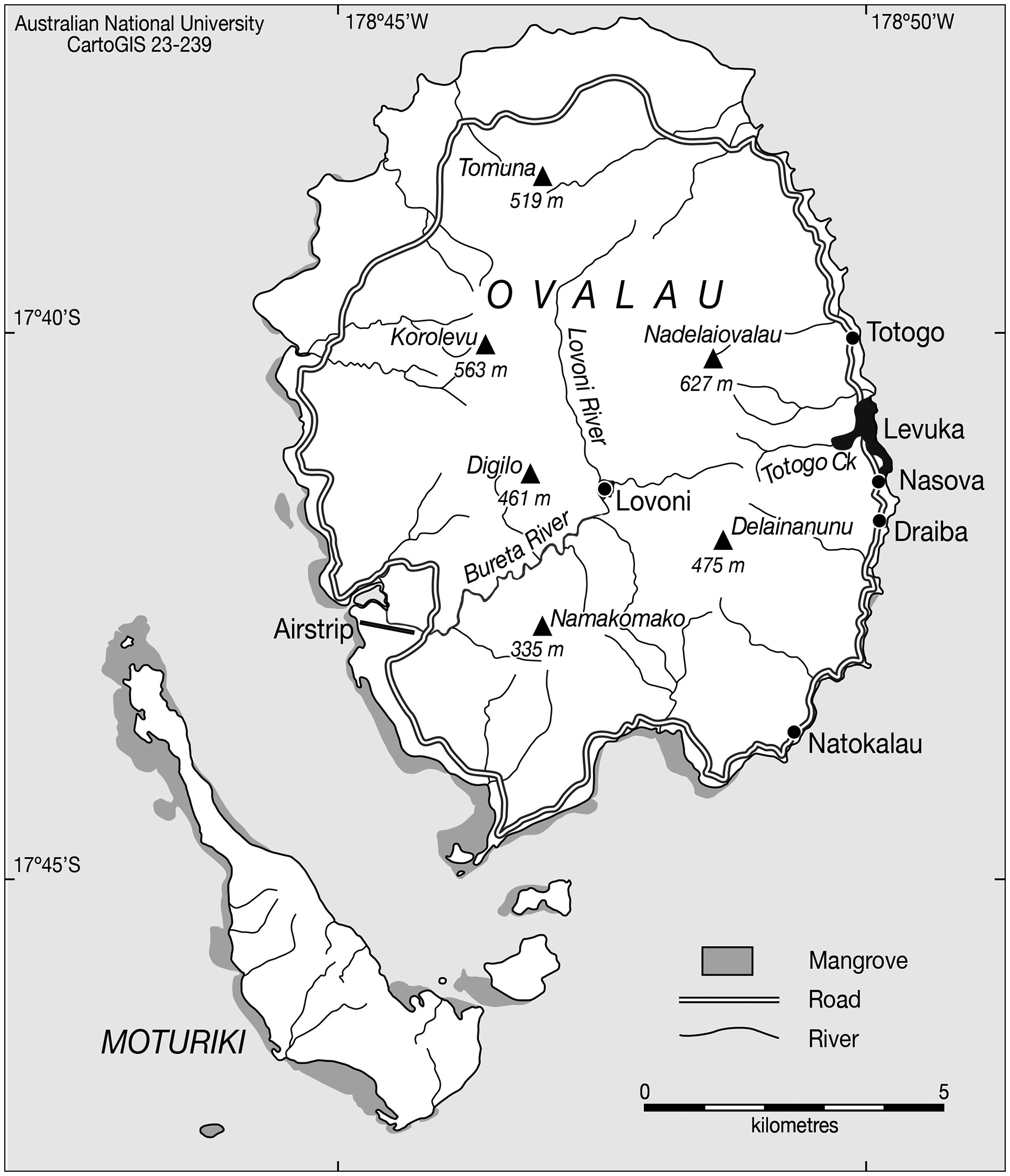
Map of Ovalau, Fiji. Map provided by CartoGIS Services, Scholastic Information Services, the Australian National University. Used with permission.
The town, and indeed the entire Island of Ovalau, is largely protected by a seawall, partially financed by development aid in 2003 to improve the seawall and road (Embassy of Japan in the Republic of Fiji Islands 2004). As Nunn's (2000) work on coastal erosion highlights, the town of Levuka has a long history of seawalls. Prior to colonization, it is likely the flats in front of the town were occupied by mangroves. Levuka's first seawall was built in the nineteenth century to protect the Catholic church, erected on reclaimed land. Later, a new seawall would be constructed to protect Levuka's road, which follows the seafront (Nunn 2000). During Levuka's tenure as the colonial capital of Fiji, the British invested significantly in its infrastructure, particularly seawalls and roads. These would not be long-term concerns for the Empire, however, so when capital status was shifted to Suva in 1882, Levuka's development was neglected (Harrison 2004, 351). Levuka is comparable with Island X in this way: the colonial relations of both determined their inclusion or exclusion in the scalability projects of electrification and coastal protection. This case study reflects Tsing's (2012, 510) scalability narrative as linked with the European colonial modus operandi of the 15th through to 17th centuries. The lesson for climate finance is that scalability projects and their logics are situated in longer colonial histories. Given this context, it is unsurprising that such logics may birth various inequalities, including the actual power imbalance experienced in Island X.
As a further example, Nunn (2000, 35) notes that government intervention in constructing seawalls in Ovalau tends to prioritize threatened communities near roads: communities with “circuminsular road running along their fronts must have considered themselves fortunate when the government decided that this required protecting, and built seawalls.” Yet Nunn (2000) also notes that this infrastructural attention is ultimately harmful, leading to the loss of sandy beaches and the smothering of reefs. Why then do seawalls endure as the technical solution? In part it is arguably the very fact that they require significant outlays of climate finance. Given the cultural power of money, the large-scale nature of this development appears as a robust solution (Bracking 2021). There is also the allure of precision (Tsing 2012): seawalls offer a sterile, hard infrastructural response to rising sea levels, that in principle at least require little ongoing care. In a separate site, one participant running a mangrove project as an alternative to seawalls notes the enduring popularity of the seawall, despite poor results: We are cultivating a mangrove nursery. There are 3,000 seedings at the moment. The opposite community cut their mangroves and are building seawalls—why? Because mangroves smell.
By contrast, since colonial departure in 1882 the seawalls of Levuka have been in a constant state of disrepair, a ruin of this particular scalability project. During my field visit in 2018, various sections of the Levuka seawall had crumbled down. In certain zones, this occurred just a few years after construction. During the site visit there was no funding available for repairs.
In Levuka, however, the fix was not provided by climate finance; rather, it meant a constant process of repair using whatever was at hand. The community, managed by a key leader, would repurpose waste (the disused aluminum packing crates from the tuna processing plant) to patch vulnerable sections of the seawall. The community leader walked the lengths of the seawall, pointing out weak spots, recent repairs, and sites where they would gather rocks. This ability to “read the gaps” is reflective of a particular love, or empathy (Anantharajah and Naisilisili 2023; Naisilisili 2012). As noted by a community leader: We do it ourselves. The leftover bins from PAFCO—we fill with soil from the creek. Here there are small rocks used. There's no protection from the reef. So [it] just gets buffeted by the waves.
At the end of the visit to Ovalau, I stood on the repaired wall with the community leader, looking out to sea. “Where is it coming from?” He asked rhetorically, his voice choked with emotion. Climate infrastructure can be sites of profound grief, often existing alongside resilient hope. In a way, the seawall, reconstructed many times, a mix of the ruins of empire and the love of the community, is a manifestation of this.
Conclusion
Conquerors come, conquerors go, the ocean remains, mother only to her children. This mother has a big heart though; she adopts anyone who loves her…The world of Oceania is neither tiny nor deficient in resources. It was so only as a condition of the colonial confinement that lasted less than a century in a history of millennia (Hau'ofa 1993, 155–56).
The sites also reveal that climate finance enacts scalability projects which seek to reduce diversity or render diversity invisible. Take for example the failed attempts to stabilize Nabou's rogue agent, the African tulip. Further, the unique energy needs and subsequent aspirations of the community are also erased by inflexible financial parameters, determined by the overarching need for a project to have a certain scale in order to be funded.
Empire grounds climate finance logics and materialities. Not only does Empire resonate with climate finance's innate need for scale and expansion, but also in the situated experiences at each site. In Nabou, the African tulip (introduced during the colonial period, and now an invasive species) almost offered Fiji the potential to delink from reliance on international fossil fuels. The arrival of infrastructure at Island X, and Ovalau was determined by relevance to the colony. Island X starkly long lay outside the development afforded to the nearby colonial hub. Levuka's ongoing relationship with its seawall began with its first colonial iteration, following the removal of mangroves.
This paper has put forth the notion of loving technologies, a playful synergy between contributions from Pacific theory, postcolonial STS, feminist technoscience, and the Fijian empirics. This contribution actively designates a space for climate finance and climate infrastructural alternatives, outside Empire (Vaai and Casimira 2017).
So how can climate finance logics of scale be reconstructed in this alternative space of loving technologies? The loving technologies approach highlights the validity and importance of small-scale infrastructures. Small-scale technologies are intimate and have the potential to make a difference in lives, communities, and futures. Despite their small scale, they can make a difference on bigger scales, and can chart democratic, alternative pathways of progress. Thus, this paper calls for climate finance to rapidly disaggregate sums, making available small-scale finance.
Loving technologies centers scales that allow for repair and reconfiguration. Part of this involves close relationships surrounding infrastructures. Scale can sometimes erase or displace relationality, as was the case in Nabou. For larger scale projects, it is important that climate finance factors in the scale and diversity of the relational work needed. Moreover, climate finance should create openings for reconfiguration. This may involve funds budgeted for future assessments of energy upgrades at community sites, such as Island X. In reimagining climate finance, we must rupture the image of smooth, large, flows of finance, and instead find openings for small-scale, differential, and messy disbursements.
Loving technologies may not emerge de novo, but emerge out of the ruins of scalability projects and colony, as is the case in Levuka. Climate finance must begin to reckon with the ruins of its scalability projects, considering how it might support new life to bloom in this space.
Lastly, and perhaps most importantly, at the three Fijian sites we see that the creation of loving technologies is not the result of climate finance's interventions. Experiences of climate finance dysfunction and limitation become “a praxis of creative possibilities” (Visvanathan 2008). Loving technologies occur in a space of devotion, grief, and indeed love. Climate finance must change its modalities of scale for it to reach and make a difference in the communities it purportedly aims to reach. Moreover, hope, technologies, and solutions exist and persist outside of climate finance.
Fiji's experiences are not representative across the Global South or even the Pacific. But these experiences are situated knowledge that speaks to the nature of climate finance: situated knowledge “generates local knowledge from which can be derived [a] unique understanding of causal processes and mechanisms that respect their situated complexity” (Bazeley 2013, 410). Future interventions might engage other logics of climate finance and climate infrastructural development, such as its temporalities, the salience of debt, or its preference for centralization. This article calls out to others seeking to inhabit hopeful spaces, like loving technologies. Given what is at stake for communities already in the thralls of ecological crisis, we need more hopeful, more loving technological responses to replace those that reproduce Empire.
Footnotes
Acknowledgements
I would like to acknowledge the collegiality and generosity of the School of Government, Development and International Affairs at The University of the South Pacific, who supported me as a visiting scholar while I conducted this research. I am also deeply grateful to the stakeholders whose perspectives informed this research. I am very thankful to Henne, Cleland, Conway-Lamb, Egan, Alver, and McSwiney for their comments.
Declaration of Conflicting Interests
The author declared no potential conflicts of interest with respect to the research, authorship, and/or publication of this article.
Funding
The author disclosed receipt of the following financial support for the research, authorship, and/or publication of this article: This work was supported by the Department of Foreign Affairs and Trade, Australian Government,
