



Abstract
Vertical farming is an emerging urban food growth proposal that has gained considerable attention for its ability to be space-efficient, independent of outside weather conditions, and to address a dismal agricultural system and ecoclimatic crises. VF is also a field riddled with debates on the unsustainability and high (energy) costs of a highly automated, indoor growth system that produces only a small range of perishable food. This paper explores arguments, visions, and internal disagreements among scientists, engineers, consultants, and entrepreneurs who form a heterogeneous, elite group of sociotechnical vanguards that popularize not yet widely accepted vanguard visions of future urban food production. It demonstrates that for the dominant vertical farm vanguard vision, a majority of vanguards borrow popular concepts and imaginaries from other sectors: containment of plant growth, cleanliness, the capability to feed the world, and the land-sparing narrative. The findings suggest three dimensions that add to the theorization of vanguard visions: the central role of mobilized problem-scripts; internal disagreements that indicate the contingency of vanguard visions and the existence of fringe visions; and that disagreements can reveal caveat politics, where a technical system, like VF, is not seen as the solution, but one of many.
Keywords
Introduction
In 2011, emeritus professor of public health and microbiology Dickson Despommier published a book titled The Vertical Farm: Feeding the World in the 21st Century which proposed that plants could be grown in the interior of tall city buildings within highly automated, water-based (hydroponic) systems independent of external conditions, including sunlight, soil, and weather (pp. 3-5). The book grew out of Despommier’s university class, where he speculated with his students what it would take to grow food consumed in New York within the city’s borders. The urban, weather-independent food production response to climate change and eco-crises, it seemed, was born—in the form of a high-precision solution.
What initially sounded like a utopian idea has since attracted billions in Silicon Valley venture capital—US$4.16 billion by 2022, with a whopping US$27.42 billion in 2030 expected by ag-tech entrepreneurs (Fortune Business Insights 2023) 1 —as well as the attention of policymakers and nonprofit actors (Kuljanic 2022; Kurnik 2022). Concurrently, vertical farming (VF) is an ambiguous concept and a field riddled with debates on the unsustainably high labor and energy costs of producing a small range of microgreens and herbs, “yuppie chow” (Guthman 2003), for a small range of upper-class urban consumers (Broad 2020; Cox and van Tassel 2010; Goodman and Minner 2019, 170). A common response to these critiques has been that as a set of highly automated, continually improving technologies, vertical farms are fit to face a dismal agricultural system, ecoclimatic crises (Despommier 2011), and a pandemic (Earley 2020; Newman and Fraser 2021). Although proponents of VF state it is not the silver bullet, they argue it “could be part of the solution” (Dent n.d., 8; see also Besthorn 2013, 198) to these pressing issues.
In this paper, I analyze how a controversial urban food concept has grown into a timely high-tech solution to contemporary issues of food production and ecoclimatic crises. I begin by asking why VF is so ambiguous and contested, what arguments and visions are mobilized by proponents, which ones succeed and why, and what can be deduced for broader discussions on futuristic imaginaries and the implementation of technological fixes. Addressing these questions is to say that VF proponents—entrepreneurs, investors, consultants, researchers, engineers, urban food advocates, and so on—are a heterogeneous, elite group of what Hilgartner (2015, 34; 2017) calls sociotechnical vanguards who define and realize “sociotechnical visions of the future that have yet to be accepted by wider collectives”; in this case, what food to grow and eat in cities around the world. These so-called vanguard visions are often fleeting and derive their conceptual power from high-tech templates, concepts, and more well-known sociotechnical imaginaries that sociotechnical vanguards borrow from other fields. Importantly, sociotechnical vanguards are not a homogenous group: they share partially aligned visions and often compete with each other (Hilgartner 2017, 27).
In the case discussed here, I demonstrate that containment, cleanliness, the capability to feed the world, and a land-sparing narrative form popular cultural concepts to foster a dominant vanguard vision of VF as an aesthetically slick, automated, indoor-controlled urban food production system. While VF remains a highly disputed proposal, 2 I turn to less studied internal disagreements among VF vanguards, whose analysis contributes to the theorizing of vanguard visions in three ways: first, problem-scripts play an equally central role in vanguard visions as mobilized high-tech templates; second, by attending to internal disagreements rather than shared visions (see Hilgartner 2015, 34), I delineate dominant and fringe vanguard visions and show that the line between sociotechnical vanguards and outside critics can blur when critiques are shared; and third, these disagreements also reveal what I call caveat politics, where proponents of VF see it as one solution among many, which may, in fact, absolve them from the responsibility to tackle the complexity of agri-food and ecoclimatic problems.
This article builds on work in science and technology studies (STS), anthropology, and critical agri-food studies on futuristic discourses of technoscience (Gugganig et al. 2023; Günel 2019; Rajan 2006) and contributes to the slow-growing scholarship on vanguard visions (Delvenne 2017; Flegal and Gupta 2018; Trauttmansdorff and Felt 2023) as well as VF/digital urban agriculture (Bomford 2023; Broad 2020; Carolan 2020a). Empirical data stem from a European communication and research project titled “Cultivating Engagement: A Citizen Participation Forum on Vertical Farming” conducted with an industry and science communication partner in 2017-2018. 3 This project sought, first, to develop public engagement formats on an emerging food production system, which led to the design and implementation of a digital tool for museum visitors (Waller and Gugganig 2021). Second, to move beyond dominant VF depictions in commercial publicity, the project aimed to understand internal debates and disagreements primarily among scientists and engineers. This paper discusses disagreements among those who were committed to, but frank about the limits of VF, and external critics of this sector. Interviewees resided primarily in Europe and North America and included scientists, engineers, business consultants, industry entrepreneurs, a food safety expert, and a journalist. These individuals are, therefore, not representative of the wider VF sector, and the analysis in this paper is limited to the Global North, highlighting the need for further work in the Global South context.
In terms of methods, together with colleagues, I collected data (field notes, social media analyses) at events, organized workshops and public events at museums across four European countries and conducted fifty-five semi-structured, qualitative interviews. Interviewees were recruited using snowball sampling through online searches based on vertical/indoor farming and horticultural expertise. This article is based on twenty-seven interviews, personal field notes, as well as online news and posts analyzed through open coding in the software MAXQDA (version 2020 and 2022). 4 Interviews were conducted primarily online, with a few taking place in person. All interviewees signed consent forms and were sent an earlier manuscript for feedback, leaving them the option to be named or remain anonymous (see Table A1 for a list). 5
The article begins with a brief overview of relevant scholarship on digital urban agriculture and futuristic visions of technoscientific systems. It then proceeds with an empirical section on VF and an elaboration of VF as a vanguard vision. The conclusion offers input for research on futuristic visions in agri-food and other high-tech fields.
Theorizing Agri-food Futures
Digital (Urban) Agriculture
In recent years, the growing digitization of food and agriculture led agri-food scholars to study how the rush to big data has transformed these sectors while exacerbating capitalist logics and organization (Bronson and Knezevic 2016; Carolan 2017; Hackfort 2021). This body of work traces the paradigm of precision agriculture since the 1990s, when farm machines were first fitted with sensors to collect data for increased efficiency (Wolf and Buttel 1996). These are now combined with remote sensing data, such as for autosteer tractors, which has led to widespread agricultural data extraction among industry actors, often heralded as the era of digital agriculture, smart farming, or Agriculture 4.0 (Bronson and Sengers 2022; Klerkx and Rose 2020). As venture capitalists, governments and international organizations intensify investment (Eastwood et al. 2017), scholars also point to the discursive power of futuristic visions, imaginaries, and mobilized cultural scripts that legitimate increased automation and digitization of agri-food sectors (Bryant and Higgins 2021; Duncan et al. 2021; Lajoie-O’Malley et al. 2020). Indeed, as sociologist Michael Carolan (2020b, 2) asserts, agriculture is “inherently futured” in that anticipatory actions and capitalist imaginaries, like the imperative to increase global food production, realize certain food futures while sidelining others.
Whereas most digital agriculture technologies relate to outdoor applications, a subset consists of technical systems for controlled environment agriculture in (peri-)urban settings, what Carolan (2020a) calls digital urban agriculture. This includes VF, which is generally understood as the cultivation of plants on multiple levels in greenhouses or closed systems, the latter also referred to as indoor farming, 6 though indoor and VF are often used interchangeably. In a widely cited book, Despommier (2011) defines VF as a high-tech indoor system where plants grow on stacked, soil-less (often hydroponic) panels under LEDs, with exact control of temperature, air circulation, CO2, humidity, and nutrients. Compared to (lower tech) urban agriculture initiatives, digital urban agriculture requires immense capital for infrastructure, technologies, labor, and energy (Carolan 2020a) despite claims that increased automation will reduce labor costs. 7 An oft-declared “challenge” in the indoor/VF sector is how to drive down operational costs, which dictate what kinds of crops are grown (Benke and Tomkins 2017): perishable leafy greens, herbs, and vegetables that can quickly generate a high market price to satisfy venture capitalists’ expected return of investment.
The idea of a space- and water-efficient system independent of weather, climate, and pesticides has attracted much criticism for its simplistic depiction of the current agricultural system, leaving open questions about energy costs, feasibility across scale, and the high number of bankruptcies (Baraniuk 2023; Butturini and Marcelis 2020, 85; Pinstrup-Andersen 2018, 234). Disagreements and a lack of public data - on the economic feasibility, energy efficiency, and returns on investment - prevail (Harbick and Albright 2016; Marston 2022; van Delden et al. 2021). In the words of a VF entrepreneur, “the industry is selling a dream and not the honest reality” of effective costs (quoted in Sykes 2017, emphasis added). A growing group of critical scholars has likewise begun studying indoor controlled/vertical agriculture with regard to claimed labor diversification (Besthorn 2013; Goodman and Minner 2019), consumer acceptance (Broad, Marschall, and Ezzeddine 2022), commercial publicity (Waller and Gugganig 2021), techno-local foods out-of-season yet in-place (Broad 2020; Carolan 2022), land-sparing claims (Bomford 2023), and its contribution to gentrification and massive capital needs (Carolan 2020a).
Futuristic Solutions, Futuristic Problems
More than two decades ago, Tsing (2000, 118) argued that start-ups need to “dramatize their dreams in order to attract the capital they need” because “[i]n speculative enterprises, profit must be imagined before it can be extracted.” STS scholars and anthropologists have since studied how promissory future visions get baked into national policies, philanthropic global health programs, or entrepreneurial urban planning, which, in turn, foster techno-optimistic institutions, norms, and political goals (Günel 2019; Jasanoff and Kim 2009; Rajan 2006). The popular STS concept of sociotechnical imaginaries delineates envisioned scientific or technological endeavors to achieve desirable futures that are collectively shared among diverse actors (Jasanoff and Kim 2015, 4). Critical agri-food scholars have employed this concept to study visions of gene editing in future agriculture (Bain, Lindberg, and Selfa 2020), neo-Malthusian paradigms in agricultural global governance (Lajoie-O’Malley et al. 2020), precision agriculture as a viable tool for financial elites (Duncan et al. 2021), or agribusiness imaginaries of islands as laboratories (Gugganig 2021).
The concept of sociotechnical imaginaries is fitting in these cases because it describes dominant visions that have already reached a deeper level of acceptance among diverse collectives. But what about domains where this is not (yet) the case? Stephen Hilgartner (2015) elaborated along the then-novel field of synthetic biology how scientists and others cultivate vanguard visions by borrowing cultural templates, scripts, metaphors, and imaginaries from other fields; the language of codes, programming, or building blocks from internet and communication technologies (ICT) and start-up culture. To legitimate synthetic biology, he argues, the vision of a few needs to be integrated into the existing imaginations and cultural templates of the many, which is an ongoing and partial process in which actors promote incompletely aligned visions (Hilgartner 2015, 35). Those advancing such visions are members of a relatively small, yet partially aligned elite of self-proclaimed pioneers—sociotechnical vanguards—who “formulate and act intentionally to realize particular sociotechnical visions of the future” (Hilgartner 2015, 34). Their vanguard visions may turn into more long durée sociotechnical imaginaries if they gain wider acceptance and experience institutionalization (Hilgartner 2017). Compared to scholarship on sociotechnical imaginaries, there have been far fewer analyses of more volatile vanguard visions, though exceptions include studies of solar geoengineering (Flegal and Gupta 2018), no-till farming (Delvenne 2017), and transnational dataveillance (Trauttmansdorff and Felt 2023).
Central to any future vision is how actors frame a problem and what (technical) solutions they imagine can fix it; for example, entrepreneurs’ claims that the agricultural “digital revolution” will solve global hunger (Giles and Stead 2022). But there is nothing natural about the way people define problems (Hilgartner and Bosk 1988). The growing trend of “grand challenges” exemplifies how such problem-scripts have come to dictate science and policy agendas (Kaldewey 2018) and have become a key ingredient in agri-tech pitches made by start-up companies, particularly in the United States (Fairbairn, Kish, and Guthman 2022). Just as a robot collecting health data from fruit trees “becomes much more impactful when framed as part of a pressing battle to feed a growing world population” (ibid., 8), not-yet widespread pollinator robots become more legitimate when framed by the imminent decline of bee populations (Nimmo 2022, 431). As philosophers argue in the case of VF, the larger and more hyperbolic problems are imagined, the fewer operations will succeed in solving them (Borghini, Piras, and Serini 2020, 4). Conversely, if the problem is framed narrowly, such as production and labor costs, it can legitimate increasing indoor agriculture automation (Carolan 2020a). In this way, problem framings not only set the context but have significant agency in making specific technologies a plausible solution.
Defining VF
When starting to research VF in 2017, the preponderance of futuristic depictions online (e.g., through architectural renderings as opposed to images of VF in practice) suggested a need to better understand what VF is for its proponents.
In spring 2018, Vienna hosted the first vertical farm conference in German-speaking countries, called skyberries. 8 Organized by the local research institute and consultancy vertical farm institute (vfi), its founder Daniel Podmirseg started his opening speech with a laundry list of planetary problems: the need to grow more food from finite resources, agriculture’s contribution to climate change, and growing pesticide use, to name a few. The conference proceeded with talks on a variety of topics: LED indoor lighting, winter off-grid outdoor tunnels, and the Vertical Harvest VF for employees with disabilities. There was also a presentation by Saskia Sassen on urban financialization as well as our rather speculative public engagement workshop related to our communication and research project (Waller and Gugganig 2021). The conference finished with the so-called “Skyberries Award” which, to the surprise of many, went to a school program featuring an open-facing wall - of nonedible plants.
The breadth of topics was somewhat unexpected. It contrasted with other VF events I had attended, which advocated the rather firm high-tech and indoor farming definition advanced in Despommier’s book (2011; see above). Henry Gordon-Smith, CEO of the indoor/vertical farm business consultancy Agritecture and former student of Despommier, shared in our interview that, distinct from his teacher’s focus on skyscrapers, he understands VF as a three-dimensional spatially open concept that, for instance, also includes rooftop farms. Architect Podmirseg conceives of VF as an architectural integration into existing buildings, which seeks to reduce otherwise wasted energy. The fact that VF was interpreted so widely is related to the heterogeneous actors drawn to it, from entrepreneurs, investors, researchers, and architects to urban food advocates. Many agriculture and horticulture scientists interviewed for this research viewed VF as primarily a marketing term, preferring other terms instead, like controlled environment agriculture. While some saw it as an industry worth millions of dollars, for others, it was a “ridiculous” amateur proposal based on little knowledge of energy use and plant growth as plant scientist Stan Cox said in our interview. Similarly, in an online article, Gordon-Smith makes a critical assessment of the industry, where the “hyped marketing and greenwashing” poses no less than “the greatest cultural threat to vertical farming” (2023, n.a.).
The words of the VF entrepreneur cited earlier, that VF is a dream-making machine (quoted by Sykes 2017), contains a grain of truth: at public events, in informal conversations and interviews, there was a common understanding that Despommier’s The Vertical Farm instigated this nascent industry, although more as a visionary account of urban food production than a technical manual. In our interview, Despommier likened his idea to Leonardo Da Vinci’s desire to fly: So, here is a great thinker that has these ideas and he makes elegant drawings and he even builds models and then the idea just sits, right? So, who said it would be a good idea to grow food in buildings? I did not. No, someone else said that. I do not know who it was but whoever said it no one listened. So, I was really, really lucky to have that idea arise at a time when people were becoming afraid that we were disrupting natural systems to the point of endangering the entire earth through agriculture, and once we realized that, this was an easy sell. All you had to do was mention the words “vertical farm,” and everybody got it.
Vanguard Visions of VF
VF proponents, consisting of scientists, consultants, venture capital investors, entrepreneurs, and engineers can be understood as sociotechnical vanguards that like to “fashion themselves as part of an avant-garde, riding and also driving a wave of change but competing with one another at the same time” (Hilgartner 2017, 27). To facilitate plausibility, sociotechnical vanguards draw on various scripts, epistemologies, and imaginaries that lead to impartially shared visions, as in the case of synthetic biology, where some evoke intellectual property positions, and others promote biohacking visions (Hilgartner 2015, 42). In the case of VF, Despommier and others like to mobilize industry 4.0 metaphors (Le Hoang 2018). Beside Hilgartner’s focus on partially shared visions, attending closer to “unshared visions,” internal disagreements among vertical farm vanguards reveals that certain ideas (and definitions) of VF are more dominant. Since outside critics were also interviewed, it is pertinent to clarify that a vertical farm vanguard may also be someone who shares outside critiques, while still promoting VF. Conversely, outside critics are not vertical farm vanguards, as they do not actively draw on existing cultural templates and imaginaries to promote VF, though, of course, this boundary is not firm (see also Fringe Visions of VF section).
Mobilizing Sterile Cleanliness and Containment
In December 2017, start-up owner and head of the nonprofit platform Association for Vertical Farming Maximilian Lössl gave a talk at the Technical University Munich to present his Plantcube, a cubical vertical farm for growing lettuce and herbs at home. His projected images of slick, sterile kitchen settings reflected the dominant aesthetics of VF I recognized from online sources and other presentations or what elsewhere is referred to as an aesthetic of “biosafety labs” (quoted in Carolan 2020a, 54). While the audience seemed rather skeptical that such systems would be able to address food security, the speaker quickly pointed to its advantages as a controlled system that is “clinical, efficient, and local” (Field note 171213).
His depiction reflected references to automated cleanliness that came up in several interviews, including with a San Francisco-based start-up owner: Having machine learning algorithms and artificial intelligence telling us how to grow better and faster. Having harvest automated. All of these things have relied on human eyes or hands. And removing the human eyes or hands—or at least, drastically reducing the need for them will really save a lot of money. It will make things a lot cleaner…. Basically, we are trying to have a closed environment where humans will not enter. We will only have our robot moving the plants around in the area. (JB, IV 181029)
These vertical farm vanguards aspire to virtues and discourses of sterile cleanliness that have historically grown and manifested in agri-food settings and high-tech fields. In the early twentieth century, US scientists’ concerns over communicable diseases brought about a “visual hygiene of modernism” that materialized in sleek, cleanable surfaces in people’s homes, reflecting a biopolitics of purity, health, and progress (Bobrow-Strain 2008, 24). While industrial food marketers prided themselves on producing hygienically clean food untouched by human hands (Bobrow-Strain 2008, 34; Levenstein 2003, 188), agricultural manufacturers and researchers of late propagate a similar discourse of farms without farmers, where the framing of arduous farming legitimates automation (Asseng and Asche 2019; Baur and Iles 2023; Carolan 2020b). More readily, vertical farm vanguards share templates of hygienical, human-void cleanliness from the “‘clean’ spaces of laboratories and technoscience” in cellular agriculture (Sexton, Tara, and Lorimer, 2019, 63) to produce “clean” meat (Jönsson 2016, 742).
In descriptions of VF systems, the notion of sterile cleanliness is closely tied to this laboratorial containment. While one could argue that vertical farms are merely stacked, highly automated greenhouses, interviewees referenced outer space more often than horticulture. As professor of horticulture and controlled environment agriculture Neil Mattson shared in our interview, this is not unrelated to the fact that the professional communities of VF and horticulture only sporadically overlap, because the former originates in high-tech, venture capital circles. Indeed, space science served as a key R&D site for enclosed food production systems in the 1990s (Wheeler 2017) and has since developed alongside research for controlled indoor farming (Vermeulen et al. 2020). A research associate of the European Space Agency MELiSSA project (Micro-Ecological Life Support System Alternative), who works on controlled growth settings, posed in our interview: [S]hould we use our wastewater to grow food? Most people would say no, why? Because we have fertilizer, and so on. Then you would say: should astronauts on Mars use their waste to grow food? Everybody would most certainly say yes. (EN2, IV, 180213)
The COVID-19 pandemic further legitimated containment as a control mechanism in high-tech agri-food circles (Reisman 2021, 921). For instance, the CEO of the vertical farm Plenty explained an increase in venture capital totaling US$500 million by stating in an online article: “Plenty’s controlled and resilient farms and local distribution made it easy for us to scale quickly, even during the pandemic, demonstrating that our indoor, vertical farm flourishes under environmental pressures [i.e., 2020 Californian wildfires]” (quoted in Earley 2020). Here, fencing off a virus echoes attempts at fencing off pests or inconvenient climatic conditions. Similar to how the significance of robots collecting fruit trees’ health data increases when paired with feeding a growing population (Fairbairn, Kish, and Guthman 2022, 8), a contained technical system grows in legitimation when juxtaposed with “unruly” outdoor problems. 9 Arguably, controlled growth systems did not succeed despite but because of a pandemic and environmental pressures.
However, materially controlled growth systems cannot ward off a fire, or an internal viral outbreak, which is generally omitted in this vanguard vision pushed by scientists (Newman and Fraser 2021). On a much more fundamental level, weed growth, algae, and insects are not uncommon, as food safety expert Sarah Taber confirmed in our interview, and was consistent with my own observations in some growth systems I had visited. As plant scientist Stan Cox shared in our interview: No matter how well you think you have the greenhouse sealed up so that they cannot get it, once one aphid gets in there, because they reproduce asexually, that one aphid can pump out an overwhelming population of aphids, whereas, out in the field, their natural enemies would be there and keep them under control. (IV, 180122)
As STS scholars have shown, containment is a key twentieth-century sociotechnical imaginary of controlling (biosafety) risk, with the laboratory being the locus that “holds together” modernist-scientist ideas of enclosure (Jasanoff and Kim 2009; Latour and Woolgar 2013; Schoot and Mather 2021). Containment is a (bio)political practice of world-making that allows certain life forms to flourish over others (Hawkins and Paxton 2019). Although containment technologies do not always capture viruses or diseases due to their “incontinence” (Sofia 2000, 192), interviews conducted for this research confirmed that they succeed in perpetuating capitalist-intensive production systems (Schoot and Mather 2021)—and with them, related visions. As sociotechnical vanguards rely on well-entrenched sociotechnical imaginaries (Hilgartner 2015), vertical farm vanguards mobilize containment and the virtue of sterility to foster a dominant vanguard vision of VF as a highly technical, enclosed, clinically sterile, lab-like plant growth system. Importantly, making controlled plant growth plausible works because it discursively fences off—and concurrently depends on—problems that share attributes of extremity: be it lack of oxygen in outer space, an earthly climate wreaking havoc, urban gentrification, a wildfire, or a global raging virus.
Mobilizing Problem-scripts: Feeding the World, and the Hostility of Farming and Nature
Dominant vertical farm vanguard visions in the Global North derive their conceptual power not merely from borrowed technical concepts but also from the mantra-like reference of specific problem-scripts. Presentations like those at the skyberries conference, news reporting, and academic publications cannot do without a prefacing laundry list of planetary-scale problems. Indeed, half of Despommier’s (2011) book is concerned with problems of the current food system, from CO2 emissions to high inputs to long hauls, and the dismal planetary stage ranging from climate change to population growth. Exemplary is also Philips’s video from 2015, which starts with an image of planet Earth, subsequently zooming into a city and a vertical farm, with accommodating dramatic music and the following narrative: By 2050…—2.5 billion more people on earth—80 percent living in cities—70 percent more food needed—The dilemma…—We already use 80 percent of our cultivated land—How do we feed tomorrow’s cities?—It’s time…to do things differently…. Taste the new green [pink LED lighting stacked panels]—Innovation You Philips. (Philips 2015, emphasis added)
10
This problem-script is also a source of controversy among vertical farm vanguards. Plant pathologist and VF researcher Paul Gauthier stated in our interview: “You hear everywhere vertical farming will feed the world. You hear that all the time. It is purely marketing. There is no scientific data behind it, and it is totally unrealistic” (IV, 180131). Several interviewed proponents and critical observers of VF questioned this claim when plants have to be sold at a premium price, often to luxury restaurants (AR2; Cox; Pantaleo). When addressing his skeptical audience at the Munich talk mentioned above, the head of the Association for Vertical Farming Lössl admitted that indoor farmed plants have become a lifestyle product rather than a means to feed the world (Field note 171213).
Food and nutritional quality were other frequently raised concerns among scientists. As hydroponics researcher Rolf Morgenstern explained in our interview: The narrative that I’ve learned to hate goes like this: global agriculture has the following problems: sinking agricultural areas, desertification, humus is degrading, we have erosion and blah blah blah…. And then it is framed like this: Yes, aquaponic and vertical farming have the following properties: Super space-saving, super water-saving and blah blah blah, and then the conclusion: That’s why this is the future of agriculture. And I always think: The two have nothing to do with each other. With aquaponic and hydroponics we don’t produce the products that we produce in agriculture. So, in the literature and in all reporting, no distinction is made between agriculture and horticulture…. We can make tomatoes and lettuce relatively well, and I don’t feed the world with that.
By pointing to the conflation of two food production sectors, these researchers question the claim that vertical farms can “feed the world” for fundamentally mismatching technical solutions to food security problems (see also Guthman and Butler 2023). This ignores the skewed statistic underlying the incessantly mobilized narrative of feeding 9 billion by 2050, which does not include fruits and vegetables (Tomlinson 2013, 82-83). This problem-script originated in a 2006 FAO report, which has since trickled down to policy (2013), news media, and digital agri-tech proposals (Fairbairn, Kish, and Guthman 2022, 7; Giles and Stead 2022), again, including lab meat (Baker 2021; Jönsson 2016, 735) or alternative proteins (Sexton, Tara, and Lorimer, 2019, 49; Sweet 2019). It is a neo-Malthusian problem-script that vertical farm vanguards from the Global North copy and paste into their vision of vertical farms feeding the world without providing much context.
Another popular problem-script in dominant vertical farm vanguard visions is the depiction of outdoor agriculture and nature as hostile, inefficient, and/or a “lost cause.” It is so pervasive that it can become both cause and justification, as the following advertisement for container indoor farming illustrates: Engineered to overcome challenges experienced by traditional agriculture production, such as extreme weather conditions, pests, short growing seasons, and environmental limitations, container farms hold the potential to grow food in regions where traditional farming is faced with uncompromising limitations. (Cultivatd 2023, emphasis added)
The interviewees allude to the contested “land-sparing” hypothesis of intensifying agricultural production in some areas to spare others for biodiversity conservation. It has roots in the Borlaug hypothesis postulating increased growth of food using fewer resources—which also featured in Podmirseg’s conference opening referenced earlier. Both these hypotheses ignore specific local needs and (land) conditions, which crops are grown, and what exact land areas are “saved” (see Angelsen and Kaimowitz 2001). Loconto and colleagues (2020) argue that the land-sparing model is a sociotechnical imaginary that, since the mid-2000s, moved from science to policy and industry to such an extent that it now fundamentally shapes sustainability standards. The land-sparing hypothesis rests on the equally contested truism that land is scarce (Mehta 2010) and is particularly popular in VF circles because “one can build up rather than out and render land scarcity obsolete” (Bomford 2023). Sociotechnical vanguards borrow this widely shared sociotechnical imaginary of land sparing to make VF plausible.
At events, informal conversations, and in interviews, people often corrected assumptions that VF would solve planetary-scale problems, quickly clarifying that it is only one of many solutions (Dent n.d., 8). To many, VF is: a gateway toward tackling this future challenge [of feeding the world]. (Gordon-Smith, consultant, IV, 180201) a nascent industry which is not going to save the world, but it’s going to be a supplemental answer to a part of the challenges that modern agriculture brings. (Pantaleo, consultant, IV, 180215) truly not the silver bullet for all climate disasters, but it is part of a larger framework and solution for the food system. (Eisenberg, journalist, IV, 180115)
Fringe Visions of VF
Sociotechnical vanguards compete with each other, and advance partial visions of VF, with only some having the potential to proliferate more widely as sociotechnical imaginaries (Hilgartner 2017, 27). 13 In the formulation and cultivation of vanguard visions, similar dynamics are observable, where some proliferate more than others.
As is evident by now, the dominant vanguard vision of VF as an aesthetically slick, sterile indoor-controlled food production system was not shared by all. What became evident during research was that proponents (vanguards) and critical observers of VF shared points of criticism, thus blurring the line between these groups. For instance, concerns shared by respondents iterated arguments made by agri-food scholars that “smart” digital farming technologies inevitably generate new problems while trying to solve others (Fraser 2022; Miles 2019). When interviewees highlighted critiques of what is missing in the dominant understanding—vanguard vision—of VF, they related to existing alternative models and trends, thereby suggesting other, more fringe visions.
First, a lack of open-access technology was a common issue among interviewees. Entrepreneur Marco Tidona, food agent Taber, and an engineer (EN2) observed an anxious attitude in the nascent industry, where entrepreneurs are reluctant to exchange experiences or data. While investors feed the VF hype, which eventually fosters technology development, for Tidona and the engineer, the resulting IP system stifles technology development and innovation. The need for open technical innovation was also raised by a professor of sustainable agriculture who envisioned more hybrid settings where technologies for indoor settings are applied to outdoor small-scale farms (AR5). Community-facing projects like plus.farm, which offers simple indoor/hydroponic growth systems to hobby growers or nonprofits, 14 show promises of democratizing a sector where IP is carefully guarded. Similar to some synthetic biology vanguards, both fringe vanguards and critics of VF draw inspiration from the open-source movement (Hilgartner 2015, 43). Yet, they do so primarily in their critique, and not (yet) by mobilizing open-source concepts and imaginaries as part of what could be called an open-access fringe vision of VF.
Second, regarding expertise, food safety expert Taber elaborated in our interview: There are actually some ready-made experts out there who have been doing greenhouses for decades, but because they have had decades of experience running very tight greenhouse operations they expect to be paid very, very well, and Silicon Valley does not want to do that. Because in Silicon Valley’s universe, you are either a programmer or you are a robot.
Third, gender and race were also raised by people interviewed for this research. One engineer criticized VF (in the Global North) as an overwhelmingly male, white industry, and said that the few women who do exist are hindered from expressing their opinions and rarely get promoted (EN1). 16 For instance, vertical farm consultant Penny McBride only realized in the course of our interview that her clients were almost exclusively men. Similar to business consultant Gordon-Smith, Taber explained that running a big facility “is really more about networking and who you know than it is about your skills.” Taber adds that in the United States, “if you are a white dude, it is just a lot easier to have those friends [in investment].” Poignantly, the indoor farm brokerage Cultivatd advertises its expertise on LinkedIn with the faces of four young, white men. 17 The racial bias can also be observed in the location of vertical farms. Indoor agriculture business consultants Gordon-Smith and Lanes stated that vertical farms are economically more feasible in cheaper places, like Detroit, rather than in San Francisco. What form of gentrification do vertical farms contribute to, as they map onto white, upper-class neighborhoods housing consumers (Broad, Marschall, and Ezzeddine 2022, 422) on the one hand, and black, lower-class neighborhoods housing cheap labor on the other? This needs further research (see Carolan 2020a, 57). Overall, racial and gender diversity mainly takes the form of critique, yet VF as a workspace for people with disabilities has gradually become a more visible, albeit fringe vision of VF. 18
The VF sector in the Global North is dominated by white male sociotechnical vanguards (Money Where Our Mouths Are 2019; Nees 2019), who have the technical know-how to “hire” robots over horticultural experts and the venture and cultural capital to network in the right circles. What tends to not (yet) make it into the dominant vanguard vision is horticulture expertise, open-access innovation, diversity, and inclusivity. Arguably, these more or less emergent fringe visions are less visible due to their irrelevance to the life-giving, tech-biased machinery of venture capitalists. Further, these fringe visions may also not (yet) be more dominant because fringe vanguards do not as readily borrow widely shared popular scripts, templates, or sociotechnical imaginaries from other sectors, such as containment or the “feeding-the-world” narrative in dominant vanguard visions.
Conclusion
VF is ambiguous and contested. It moved from a marketing term of urban high-tech food production to a concept variously associated with cultivating plants in or within closed systems. It is a sector defined by bankruptcies, and a growing multibillion-dollar industry. The dominant vision of an aesthetically slick, highly automated, sterile indoor-controlled urban food production system continues to draw massive amounts of (venture) capital and is starting to garner significant public and policy interest. While critics of VF (rightly) question its economic viability, energy efficiency, and relevance to sustainability transitions, they may not grasp that such garish high-tech proposals operate under different logics. Though many vertical farms do not materialize for economic reasons, they are not failures per se, because they still perpetuate visions and mobilize resources for future investment (see Günel 2019).
This article describes diverse actors across industry, investment, and research that can be understood as what Hilgartner describes as an elite, heterogeneous group of sociotechnical vanguards who foster vanguard visions of niche innovations that—unlike more widely shared sociotechnical imaginaries (Jasanoff and Kim 2015)—“have yet to be accepted by wider collectives” (Hilgartner 2015, 34). As is characteristic for vanguard visions, vertical farm vanguards in the Global North borrow conceptual templates, scripts, and imaginaries from other high-tech settings, such as containment from outer space and biosecurity settings, paired with the well-entrenched western-scientific concept of sterile cleanliness drawn from other agri-food-tech proposals, such as clean meat. Adding to the theorization of vanguard visions, I discuss three more dimensions in this paper:
First, alongside more technical scripts, metaphors, and epistemologies, borrowed problem-scripts play a central role in vanguard visions of VF. Most prominently, vertical farm vanguards in the Global North affirm the need to feed a growing population, and often portray agriculture and nature as arduous or hostile, in imagery derived from other agri-tech/high-tech and policy sectors. The dominant vanguard vision of VF is, thus, defined in a mutual sense, where problem-scripts legitimate contained, sterile, highly automated plant growth in the same way that contained, sterile plant growth legitimates these problem-scripts. Just as the technical system itself, problem-scripts gain sufficient steam as part of performative, sociotechnical vanguard visions that become fuel for innovation, technical development, and promissory futures (see Rajan 2006). They can develop such an appeal that it is irrespective of whether vanguards—investors, start-up owners, scientists, and so on—actually believe that vertical farms will feed the world or spare land for conservation efforts. It also speaks to the conceptual power of vanguard visions that such contradictions do not seem to invalidate VF, in part because some vertical farm vanguards acknowledge their existence. This leads me to the second dimension:
Extending Hilgartner’s observation that sociotechnical vanguards cultivate partially shared visions, I pay closer attention to their internal disagreements over what constitutes VF and what problems the sector is capable of solving. While VF continues to be highly criticized (Baraniuk 2023; Bomford 2023), it is crucial to attend to competing visions to better understand how and why these visions manifest, potentially as more robust sociotechnical imaginaries that animate future investment. The dominant vanguard vision of VF is supported by the life-giving machinery of venture capitalism, and increasingly, that of governments and nongovernmental organizations (Kuljanic 2022; Kurnik 2022). Yet other, fringe visions exist, too. These are in large part defined by interlocutors’ critiques of what is missing in dominant (visions of) vertical farms: plant/farming expertise, open-access technology innovations, and fostering socially, racially, and gender-inclusive spaces. It is arguable that these fringe visions have not (yet) become more dominant because their vanguards—or what I call fringe vanguards—do not as readily borrow popular scripts, templates, or sociotechnical imaginaries from other sectors. This paper also shows that the line between vertical farm vanguards and critical outside observers is blurry, as many vanguards share the same points of criticism, suggesting further research on the internal diversity of sociotechnical vanguards. More research is also needed to understand VF in the context of the Global South—for example, Global South actors or to what extent Global North vertical farm visions of feeding the world mean feeding the Global South—and on how VF contributes to the gentrification of racially coded neighborhoods (see Broad, Marschall, and Ezzeddine 2022; Carolan 2020a).
Third, internal disagreements and (technical) uncertainties also point to how actors align technological solutions with grand problems. VF is not a typical case of a technological fix that frames problems as being at “manageable levels” (Scott 2011, 209). Rather, echoing scholarship on visions of technical systems performing promissory futures (Günel 2019; Nimmo 2022; Rajan 2006), vertical farm vanguards perform what I call caveat politics, which refers to their humble acknowledgment that a technical system, like VF, is one among many solutions, and the rendering of problems as almost manageable. This partial correlation of VF with problems—a dismal agricultural system, feeding the world, and so on—is an instance of performative politics, which may absolve sociotechnical vanguards from facing the complexities of such problems, with scripts readily borrowed from other settings.
I therefore invite scholars to analyze vanguard visions of other speculative (agri-food) high-tech propositions, what role mobilized problem-scripts play, the diversity of sociotechnical and fringe vanguards, why certain visions advance more than others, and what kinds of caveat politics may discursively empower not-quite technological fixes.
Footnotes
Appendix
Interviewees per Sector and Country at the time of conducted interview, Anonymized If Not Otherwise Specified.
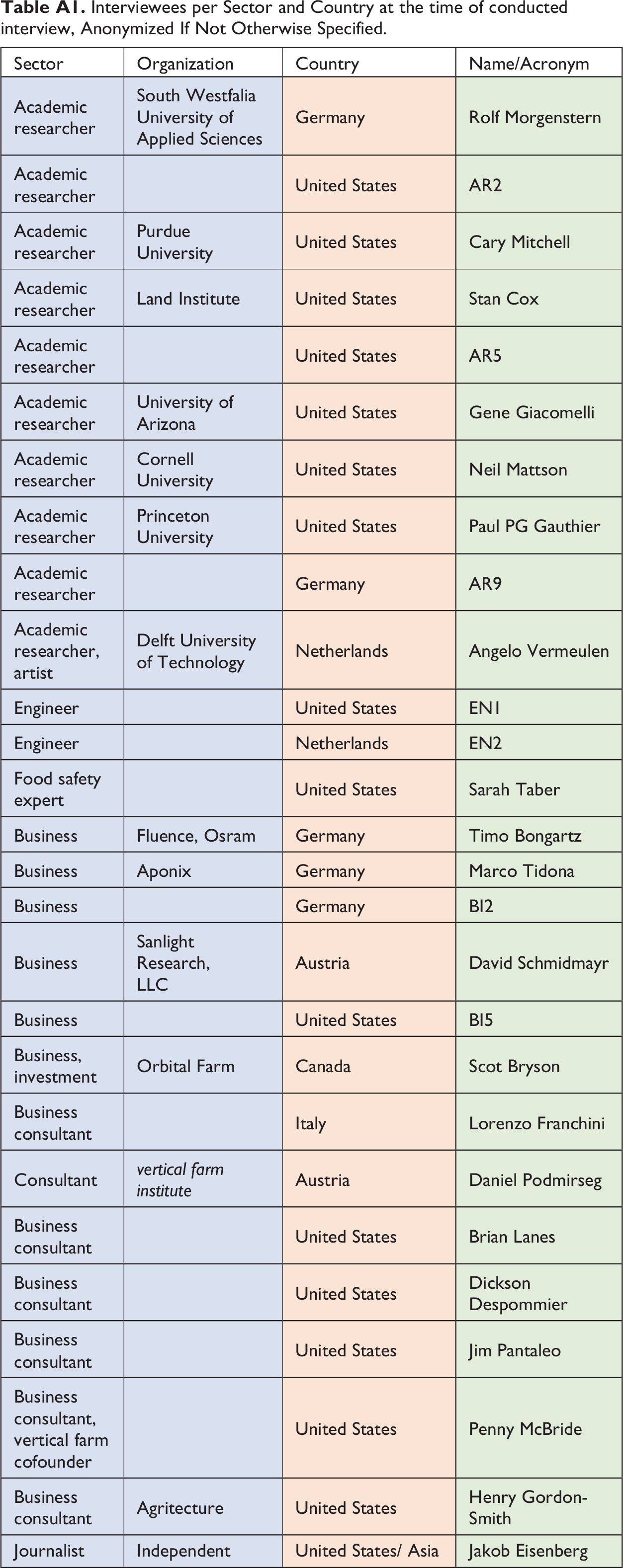
| Sector | Organization | Country | Name/Acronym |
|---|---|---|---|
| Academic researcher | South Westfalia University of Applied Sciences | Germany | Rolf Morgenstern |
| Academic researcher | United States | AR2 | |
| Academic researcher | Purdue University | United States | Cary Mitchell |
| Academic researcher | Land Institute | United States | Stan Cox |
| Academic researcher | United States | AR5 | |
| Academic researcher | University of Arizona | United States | Gene Giacomelli |
| Academic researcher | Cornell University | United States | Neil Mattson |
| Academic researcher | Princeton University | United States | Paul PG Gauthier |
| Academic researcher | Germany | AR9 | |
| Academic researcher, artist | Delft University of Technology | Netherlands | Angelo Vermeulen |
| Engineer | United States | EN1 | |
| Engineer | Netherlands | EN2 | |
| Food safety expert | United States | Sarah Taber | |
| Business | Fluence, Osram | Germany | Timo Bongartz |
| Business | Aponix | Germany | Marco Tidona |
| Business | Germany | BI2 | |
| Business | Sanlight Research, LLC | Austria | David Schmidmayr |
| Business | United States | BI5 | |
| Business, investment | Orbital Farm | Canada | Scot Bryson |
| Business consultant | Italy | Lorenzo Franchini | |
| Consultant | vertical farm institute | Austria | Daniel Podmirseg |
| Business consultant | United States | Brian Lanes | |
| Business consultant | United States | Dickson Despommier | |
| Business consultant | United States | Jim Pantaleo | |
| Business consultant, vertical farm cofounder | United States | Penny McBride | |
| Business consultant | Agritecture | United States | Henry Gordon-Smith |
| Journalist | Independent | United States/ Asia | Jakob Eisenberg |
Acknowledgments
I thank all interviewees for their time as well as Daniel Podmirseg for inviting us to present at their vfi Conference and Summer School. I also want to thank my colleague Laurie Waller and Martina So¨ll; our student assistants Franziska Nees, Melissa Balding, and Thong Le Hoang; and our project partners Vera Costee, Tessa Naus, Sophie Hieke, Jane Liu, and Camila Massri. Many thanks also go to Sebastian Pfotenhauer for offering advice throughout the project as well as to Kelly Bronson, Michael Penkler, the ISPP research team at the TU Munich, the STSFAN workshop participants, and the two anonymous reviewers for their valuable feedback.
Declaration of Conflicting Interests
The author(s) declared no potential conflicts of interest with respect to the research, authorship, and/or publication of this article.
Funding
The author(s) disclosed receipt of the following financial support for the research and/or authorship of this article: The project “Cultivating Engagement: A Citizen Participation Forum on Vertical Farming” was funded by EIT Food, the European Institute of Innovation & Technology for Food, which is a body of the European Commission.
