



Abstract
Digital models have become key sites of biological practice and science policy. This paper examines efforts to craft a digital salmon model for metabolic research. It traces the data configurations of feed, food, and health in Norway’s bioeconomy aspirations—from cell culture studies in the lab to an integrated digital repository and public health nutrition trials in schools. A response to policy calls for more sustainable aquaculture, digital models become lynchpins for intensified data sourcing. I describe how datafication and digital model integration enact a particular mode of management, focused on profitability and human preferences, when optimizing fish feed to sustainability goals. Integrating molecular biology and mathematical functions, digital modeling promotes the idea of a prediction machine for preemptive optimization of feed and food across settings. Yet, unforeseen disruptions to aquaculture, for instance, by algae and lice, expose the complexity of marine food webs and the limitations of digital models. Even while in the making, the digital fish model becomes performative and shapes knowledge practices much beyond the lab. As knowledge infrastructures, models participate in the remaking of metabolic relations, recalibrating decision-making, while feeding back into and co-shaping the very entities and environments they were crafted to investigate.
Introduction
Digital platforms are mediating laboratory life as much as industrial production and everyday interactions. This paper examines how emergent digital models and their ecologies 1 reassemble knowledges and practices in and beyond the life sciences. Taking its point of departure from the case of a digital fish model and its salient data formations, this article contributes to studies of digitalization in biology and pertinent shifts in feed, food, and health research. My first encounter with the “Digital Salmon” project was online, through a short clip that featured the digital model as a problem solver, a move toward more sustainability in salmon aquaculture. 2 The clip explained how industrial aquaculture has long been working on turning salmon, a carnivorous fish of prey feeding on other fish, into almost a vegetarian: aquaculture operators use soy-based feed purchased on the global market, with added fish oil and medication (because soy causes inflammation in salmon), but, as the clip posited, scientists now work on modifications toward more sustainability, using cutting-edge techniques in digital biology and genomics. Initiators of the Digital Salmon successfully pitched the project as “a comprehensive, computer-encoded representation of our growing knowledge of salmon biology” (Omholt, Gjuvsland, and Vik 2013, 81). The Digital Salmon project has been a part of the publicly funded Centre for Digital Life Norway 3 and seeks to develop a digital platform for modeling and optimization in order to improve environmental sustainability in aquaculture, for example, by studying how locally sourced feed affects the salmon body.
The Centre for Digital Life Norway was aimed at facilitating convergence between scientific disciplines through transdisciplinary collaborations with the goal of “innovation in bio-based solutions to societal challenges” (Centre for Digital Life Norway 2021, 8). Interestingly, ideas of convergence between biology and information science predate these developments in systems biology and digitalization. Late twentieth-century genomics strived to realize cybernetic visions of merging biology and information science and materialized these conceptual analogies between genes and information. DNA sequencing techniques and the Human Genome Project literally enacted biological materials as code and information (Kay 2000). Second-generation sequencing and data-centric approaches have expanded these routines of biology, generating new molecular inventories and concepts such as the proteome, transcriptome, and metabolome databases (Trujillo, Davis, and Milner 2006).
Today’s digital platforms and data practices in the biosciences extend molecular sequence inventories beyond DNA (Waterton 2010; Leonelli 2016). Digital practices are shaped by and have transformed collecting and classification in botany and zoology, as well as more broadly in taxonomy and biodiversity studies (Ellis, Waterton, and Wynne 2010; Strasser 2019; Nadim 2021; Douglas-Jones 2021). In biology, datafication occurs through heterogeneous procedures at different scales across a broad range of laboratory and field settings. Recent conceptualizations of datafication have attended to the ubiquitous, continued production and use of data flows as well as “user perceptions, practices, and imaginaries” (Flensburg and Lomborg 2021). Within STS, processes of datafication have been studied for various fields and sites, including the datafication of health (Hoeyer, Bauer, and Pickersgill 2019) and the datafication of nature (Nadim 2021). System biology’s digital platforms assemble and converge data from different sources, generated in heterogeneous settings. Donna Haraway (1987, 465) notes in her Cyborg Manifesto that, with technoscientific biology, “all heterogeneity can be submitted to disassembly, reassembly, investment, and exchange.” This paper examines such disassembling and reassembling during the crafting of digital models, and how models in the making mediate knowledges and practices. In doing so, I also attend to what escapes or exceeds digital renderings and preemptive reasoning and what remains unaccounted for in the datafication of metabolic relations.
Different from traditional bench work in the laboratory and biochemistry’s “experimental systems” and “epistemic things” (Rheinberger 1997), digital platforms in systems biology give rise to blended and distributed research configurations. STS scholars have proposed several concepts to come to terms with digitally mediated epistemic things and their hybrid and distributed character. These include inquiries into the circulation of “bioinformation” (Parry and Greenhough 2017), emergent “biodigital publics” (O’Riordan 2013), “digital specters and phantom objects” (Ebeling 2016), as well as “data shadows” (Leonelli, Rappert, and Davies 2017). Models, in different forms and shapes, play a critical role in scientific practices, from developing theories to shaping interventions in the world (Morgan and Morrison 1999). Science studies scholars have distinguished between theoretical models of ideas, and practical, often haptic models such as anatomical wax casts or croquet ball models that “people grasped with their hands” (de Chadarevian and Hopwood 2004, 2). Yet, digital models may raise different questions about knowledge infrastructures, already well-known in information systems studies of cooperative practices (Star and Ruhleder 1996).
Inspired by ethnographies of infrastructure, this paper diffracts biodigital models as emergent orderings, together with their apparatus of observation and configurations for action (Star 1999; Barad 2007). Work on the development of knowledge infrastructures is closely connected to science policy and government agendas, which have prioritized aquaculture research for the bioeconomy (Asdal et al. 2021; Birch and Tyfield 2013). Policy calls for science-based decision-making across different sectors, from economic policy to biomedicine, where they establish anticipatory regimes and redistribution of accountability (Adams, Murphy, and Clarke 2009; Amelang and Bauer 2019; Tvedten 2022). Here, seeing like a model fish takes a cue from “Seeing Like a State” (Scott 1997), specifically its analysis of high modernism and its retreat to easily controllable model cities, model villages, and model farms. My analysis of model vision joins studies such as “Seeing Like a Rover” (Vertesi 2014) that focuses on a digital apparatus of observation and “Seeing Like a Research Project” (Biruk 2012) that describes how projects transform social realities into research data in formats that suit evidence-based reasoning. Building on work in Science and Technology Studies (STS) on the “performativity of modeling” initially developed for economic models (MacKenzie, Muniesa, and Siu 2007; Muniesa, Millo, and Callon 2007; Bauer 2013), I inquire into the ways in which emergent digital models make scientists, policymakers, and publics see and act in the world in particular ways.
This paper sets out to follow the datafication processes from the “wet lab” of cell cultures and the “dry lab” of mathematical modeling to food trials in nutritional epidemiology, and it examines the material and digital extractions performed at each site. I trace processes of extraction beginning in the laboratory’s salmon cell culture work and following them into datafied settings of feed, food, and health. I describe the chains of extraction and optimizations in and beyond the lab, such as in distributed repositories and in nutrition interventions set up as health promotion work in Norwegian primary schools. This paper shows how data extracted from different experimental settings enroll both fish and humans into calculative infrastructures for preemptive optimization. I study digital models and their associated databases as knowledge infrastructures—as relational and always in the making (Bowker et al. 2010), attending both to the flexible mobility of digital models and unexpected disruptions of model-based optimizations. I describe the forms of knowing and acting that the digital extractions afford, given that salmon has become part of the techno-social remaking of metabolic relations in Norway’s bioeconomy aspirations. This paper examines the crafting of a digital “prediction machine and its libraries” 4 and how they drive and mediate data extraction and reassembling in scientific knowledge-making for the governance of feed, food, and health.
Metabolic Relations and the Bioeconomy
For this analysis I conceptualize metabolic relations as an STS heuristic to follow the complex connections and transformations of fish, feed, and health. This enables a close examination of emergent versions and politics of nature, labor, and biocapital (Swyngedouw and Heynen 2003). Kaushik Sunder Rajan (2012) broadened political ecology toward the coproduction of life and capital in twenty-first-century genomic biotechnology, analyzing how capital appropriates life, not only in genomic technologies but in bioeconomy and science policy. Interestingly, the notions of “social metabolism” and “social interchange” in Marx’s theorizing of production and circulation (Marx 1894, 195, 588) were informed by Liebig’s (1843) Animal Chemistry. Physiology and Pathology. In his foundational textbook of agricultural chemistry and animal physiology, Liebig developed a material approach to nutrition grounded in the chemistry of intake and metabolism, which was often taken up in economics and political philosophy at the time. Marx used the concept of societal metabolism to theorize circulation and exchange relations, drawing inspiration from “scientific models of life as a constant transformation of matter” (Landecker 2011, 171).
Twenty-first-century digital modeling, omics technologies, and systems biology have transformed what studies of metabolism are about and added new metrics, much beyond balance sheets and calories. With genome association studies, gene expression profiling, and metabolomics, scientific research into metabolism have intensified (Landecker 2013a; 2013b). New data on metabolism build on already existing practices—as cell culturing or as established information storage and classifications. Scientific practices enact and reassemble metabolic relations through changing alignments of new techniques and legacy infrastructures. STS scholars have further developed the concept of metabolic relations to analyze the material politics of foot and mouth disease in Britain, focusing on the contested practice of boiling pigswill (Law and Mol 2008). The concept has helped to examine how established ways of recycling food waste clash with regulatory measures to prevent animal-borne diseases.
For this paper on how digital models frame, modify, and reassemble metabolism in salmon aquaculture, I draw on the concept of metabolic relations to further examine the materiality of feed. Studying the distributed sites of digitally enhanced metabolic optimization requires moving beyond the epistemologies of nutrition science to examine “eating as complex doing” (Abrahamsson et al. 2015). Like Callon and Muniesa (2005) showed for economic modeling and markets, calculative devices extract and reassemble in the model, while they are ingesting and digesting “the economic.” Starting from this understanding of model performativity, this paper asks how digital models extract, transform, and digest—metabolize—data for specific modes of seeing and acting in the world.
During a site visit, one of our interlocutors working on bioeconomy projects gestured to the fjord view from their office buildings, pointing out that “it is all there…right next to us—we just need to use it” (Field notes 2018). I combine this notion of “next to,” the idea of proximal extractions and the concept of “eating next to” as developed by Serres (1982, 7), to examine metabolic relations in Norway’s global aquaculture industry including parasitic alignments, niches, incorporations, coexistences, and interruptions. Serres ponders who feeds off what table 5 —a question that invites us to think about metabolism beyond organisms or species, as a more-than-human condition. 6 Describing digitally enhanced metabolic relations with the analytic concept of “eating next to” helps to stay with ongoing transformations, ingestions, and reassembling within aquaculture food webs.
To address the ongoing digitally mediated infrastructuring of feed, food, and health in industrial aquaculture, this paper delves into practices of extraction for metabolic research. It follows the extended webs of salmon feed and salmon meat as human food to understand how these are known and managed. Such an inquiry into the metabolic relations of fish feed and fish as food attends to the material practices that reassemble tools, molecules, fish, and people within specific regulatory regimes (Landecker 2010). The empirical materials analyzed here originate from social science projects about the public good in digital life sciences, associated with Digital Life Norway and its research on Responsible Research and Innovation. As a project team, we studied published documents, research papers, websites, and blogs, and we conducted about ten joint site visits combined with observations as well as interviews and informal conversations with life scientists, especially on data extractions and on the relations between digital modeling and experimental practice in metabolic research. 7 Doing this work, STS observers of the digital model in the making are situated in certain metabolic relations as well: as an analyst, I engaged in watching, taking in, ingesting, and “writing next to,” likewise feeding off and metabolizing my observations.
The next sections describe how the digital fish model emerges from the labor of both material and digital extraction. I analyze how digital modeling and data sourcing recombine molecular-level and societal experimentation across salmon biology, nutrition science, and industrial aquaculture. I conclude with what exceeds the digital model and enters uninvited into the observed fish-feed-food assemblages, disturbing both aquaculture and the prediction machine.
Locating the Metabolic Assemblage: Norwegian Fish Extractions
Fish extractions have a long history and are intertwined with taxonomic inventories in ichthyology and chemistry. Before salmon became a large export product in the last five years, the Atlantic cod shaped Norway’s economy and culture for centuries (Asdal 2015). Indeed, a Norwegian fish extract, cod liver oil, made a stunning biomedical career in both Scandinavia and North America during the 1920s and 1930s (Myklebust 2017). Marketed as a health enhancer, cod liver oil was promoted and exported from the late nineteenth century, when Norwegian chemist Möller (1895) published a widely read book called Cod Liver Oil and Chemistry featuring a 100-page prelude on “Norwegian Cod-Liver Oil” in a 500-page comprehensive textbook on organic chemistry. Combining the export of a Norwegian product and introducing organic chemistry as a new subdiscipline promoted cod liver oil as a science-based health product to the North American market.
Cod had been the key species in Norway’s traditional fisheries for centuries, when salmon underwent a particular and intensified domestication in the 1970s (Law and Lien 2013; Lien 2015). Today, salmon aquaculture comes with a large supply infrastructure, hardware facilities, maintenance services, logistics, and sales industries. Norwegian companies specializing in breeding, supply, maintenance, or feed have also been involved in aquaculture booms elsewhere, notably in Chile and Canada. Life scientists describe salmon as particularly flexible and adaptive because salmon by nature already “live a ‘double life’” (Gillard et al. 2018, 2). The double life refers to their development in freshwater, journey to the salt water of the ocean, and return to the freshwater to reproduce, which require highly adaptive physiology. Current research combines adaptation experiments and salmon genetics to engineer salmon meat as a source of protein and omega-3 fatty acids for human consumers. Moreover, aquaculture research and product marketing have featured salmon as the most efficient and sustainable form of all animal protein (Hobæk forthcoming).
Policymakers and local media often use slogans such as “salmon is the new oil” and “data is the new oil” (Sunde 2019; Skogli et al. 2019, 4) when discussing how to sustain Norway’s financial wealth beyond the oil era. From 2016, the Norwegian Research Council allocated public funding to the Centre for Digital Life Norway. In a “hub and nodes” setup, the Centre pursued a transdisciplinary agenda and included work on “Responsible Research and Innovation,” which enabled social science projects like the one that informed this paper (Aasheim 2020; Delgado and Åm 2018). Digital Life Norway’s many projects include the Digital Salmon discussed in this article, along with projects on the use of biological materials as opportunities for sustainable economic growth. In many of these projects, scientists found themselves directly addressing policy calls to provide solutions for Norway’s bioeconomy aspirations (RCN 2014; Centre for Digital Life Norway 2020). To work toward the envisioned convergence and the new bioeconomy, further projects were initiated to study enzyme systems capable of breaking down lignin, so salmon feed could be made from local resources including waste from wood industries and seagrass (Centre for Digital Life Norway 2022). To examine the emergent metabolic relations further, I focus on the material settings that produce data—the “materials and methods” and laboratory extractions—in cell culturing (Landecker 2010).
One place to learn about the experimentalized salmon is the Department of Animal and Aquacultural Sciences at the Norwegian University of Life Sciences (NMBU), located at Husdyrfagbygningen, a building previously dedicated to research on production animals. NMBU scientists were instrumental in initiating the Digital Salmon project, obtaining funding through Digital Life Norway and hosting the project in their department. This place had been part of Norway’s Agricultural College founded in the mid-nineteenth century, and at the building’s main entrance, there is a memorial to Christian Wriedt, a geneticist of farm animals, with a bronze statue of a bull on the top. Just next to the memorial, a sign pointing to “CIGene” marks the department’s twenty-first-century role within Norway’s national genomics infrastructure: one wing of the building houses the Centre for Integrative Genetics established in 2003. The broadening of the department’s name from production animal research to animal and aquacultural sciences reflects that salmon aquaculture is set to play a major role in the institute’s research portfolio. Connecting both cell culture studies, genomics and mathematical modeling, these labs contribute cutting-edge research to fundamental biology, including salmon genomics and evolution (Lien et al. 2016). The salmon lab’s procedures provide insight into how digitalization builds on the production of data.
Chains of Extraction: Fish Liver Cells In Vitro
To gain a better understanding of extraction procedures in the laboratory, we joined scientists going about their biweekly routines of sampling at the experimental aquaculture plant (Figure 1). For the study of how salmon cells, in their lipid metabolism, react to alterations, experimentalists need a controlled system of liver cell cultures to test whether concentrations of beneficial omega-3 changed depending on the feed composition. The procedure for making liver slices for these experiments begins with fetching the fish from the nearby experimental aquaculture plant on the campus. “Sampling!” We are entering the quiet building housing the experimental aquaculture plant. After taking off our street shoes and putting on uncontaminated shoes, we pass through another door and down a corridor with doors on both sides, entering a room with several tanks placed side by side. The biologists open one, catch four salmon with a net and place them into a bucket lined with a black plastic bag filled with fresh water. We learn that these are small fish, one-year-old, when salmon still live in fresh water. Salmon lay their eggs at the same place; every year they swim back against river currents to where they came from. In this experimental plant, salmon are confined to roundabouts, swimming against engineered currents within the tank. (Field notes, October 2017) Steps of salmon liver extraction performed by scientists in the course of routine sampling in Ås, 2018. Source: Photographs by the author.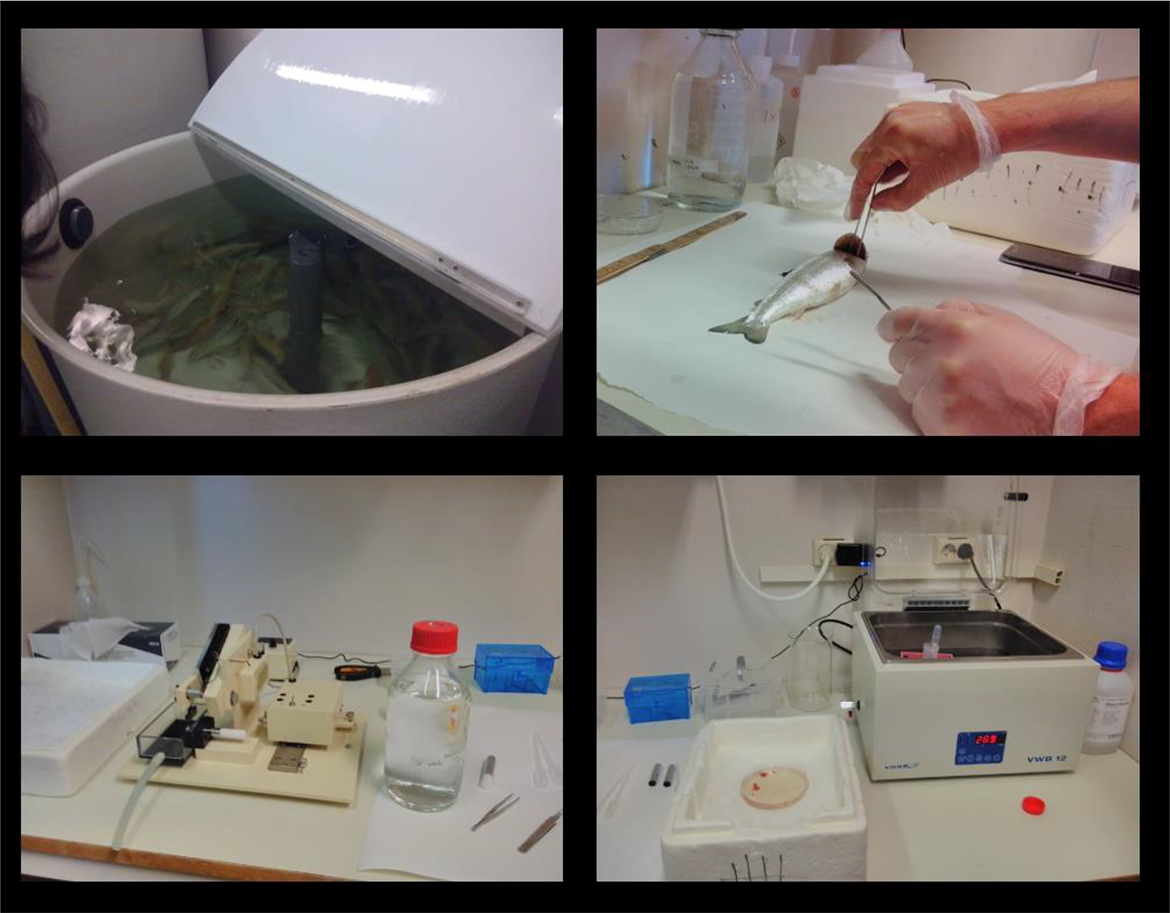
Next was setting up and preparing the liver for the slicing procedure: placing the liver pieces in a small metal tube, adding a chemical which turned their texture into a transparent, more rigid, and gel-like state. Now it could be put into the microtome, which cut it into ultrathin slices, with the slices falling in a solution in a dish just next to the microtome. From here, they were immediately collected and placed on ice. As a next step, the thin red slices were put on a bright red cell culture medium in a Petri dish. The phenol red color is a pH indicator, changing color when the cultures turn acidic (due to bacteria or the passage of time), at which point the culture medium needs to be replaced. The growth medium consisted of minerals, sugars, fetal bovine serum, and antibiotics. These extracts form an abstracted environment—the salmon cells we sampled and extracted fed on the fetal bovine serum, a globally marketed standard piece of lab equipment produced from cows in beef industry slaughterhouses. 8 The actual experiment in this multispecies arrangement was about adding to the Petri dish different substances present in plant-based feed, for example, soy. Mapping the pertinent metabolic processes in these cultured liver cells, using chromatographic systems combined with mass spectrometry, researchers were then able to analyze the composition of fatty acids in these experiments with cultured liver cells and compile lipid profiles.
Experiments in cultured liver cells complemented other feeding trials in freshwater and seawater, diet switch experiments, and alternating fish oil and vegetable oil (Jin et al. 2021). In these studies, scientists established controlled, experimental environments they could manipulate for single parameters and measure effects on lipid metabolism in the salmon body at cellular, biochemical, and genome expression levels. During our conversations, experimentalists doing this cell culturing work emphasized their attachment to the lab’s material procedures and the importance of working with the actual living materials. 9 Growing salmon liver cells for feeding experiments is groundwork that, at first glance, has little to do with things digital. But this groundwork feeds data onward—through the Excel table we observed—to the mathematical equations, stored in the model’s organ libraries. When carrying out commissioned experiments for mathematical modelers, experimentalists stressed the auxiliary roles of digital infrastructures to their practices, firmly grounded in interacting with responsive biological matter.
Aligning Salmon Extractions with Human Biomedicine: Feed and Food In Silico
Compared to a visit to the wet lab, the dry lab of mathematical modeling, its databases, computational in silico experiments, and algorithms were more difficult to encounter. The content of digital models is often invisible or distributed—yet a long tradition in mathematical modeling and theoretical biology informs the content of what is stored in digital repositories. Responding to questions about what the work on modeling meant in practice, our interlocutors wrote mathematical formulas and sketched graphs on the whiteboard, explaining the differential equations they used to characterize metabolic processes. These sets of equations make up the very engine room of the prediction machine that helps researchers simulate experiments. They inform mechanistic models of associations between feed components and outcome parameters, such as omega-3 content in fish meat.
Compiling datasets for statistical estimations and rendering them into respective formats are prerequisites for prediction. In digital biology, researchers act as data curators when stockpiling state-of-the-art knowledge on metabolic cycles for Digital Salmon’s virtual libraries. They commit to developing digital biology infrastructures based on shared computational “ontologies” (Schuurman and Leszczynski 2008). As public-access platforms, these digital hubs are about sharing tools and data; a modular organization allows different compartments and digital tools to be plugged in. This involves standardized practices of annotation, interlinking with and contributing to existing infrastructures. The salmon lipid metabolism researchers in Norway connected their experiments and sequencing work to the European Infrastructure for Systems Biology (ENSEMBL) 10 and the National Center for Biotechnology Information (NCBI)’s RefSeq. 11 In these repositories, data sources for protein sequence involve other multispecies platforms—including other fish species, such as the model organism zebra fish (Danio rerio, long established in neuroscience)—but also the two most researched mammals in the life sciences: the mouse and the human.
Interestingly, in crafting the Digital Salmon hub on fish organ systems, layer by layer, researchers drew inspiration from data repositories of human biomedicine: The Human Physiome Project 12 uses “computational modelling to analyze integrative biological functions” and collates “bibliographic information at the cell, tissue, organ and organ system levels” (Hunter, Robbins, and Noble 2002, 1). The Virtual Human Project is a digitized physiological and anatomical human model 13 which is widely used in medical teaching. Aimed at strengthening the integrative capacity of physiology, as opposed to the Human Genome Project solely focused on sequence (Hunter, Robbins, and Noble 2002), researchers draw on these databases as templates for information integration. Organized in modular compartments, such repositories host equations (“translations of biological understandings into mathematical language”), 14 software, and datasets for different vertebrates. Here, contrary to common animal models in biomedicine, infrastructures of human biomedicine function as a model for a fish. Salmon liver libraries were modeled on human biomedicine, closely entangling human and salmon research infrastructures.
Following policy calls for industrial innovation in the strategic initiative “Digital Life—Convergence for Innovation” (RCN 2014), scientists studying metabolism found themselves working with industry stakeholders and commercially motivated questions about salmon growth, medication, meat color, or resistance to parasites and viruses. Digital hubs for salmon research target the highly adaptive “phenotypic plasticity [of salmon’s] salt-tolerance, coloration, behavior, growth rate, and metabolism” (Gillard et al. 2018, 1-2). Combining concepts and data from different disciplines, researchers in Norway enact salmon as malleable according to consumers’ preferences and participate in aquaculture research to attract or keep funding for their projects: Patterned on similar endeavours in human biomedicine, a Digital Salmon would encompass an ensemble of mathematical descriptions of salmon physiology, combining mathematics, high-dimensional data analysis, computer science and highly advanced measurement technology with genomics and experimental biology into a concerted whole. The development of such a quantitative framework by merging life sciences, mathematical sciences and engineering would be highly instrumental in adapting salmon to new and sustainable feeds without sacrificing product quality.…In addition, it would contribute strongly to the visibility of Norwegian biological research at the international research frontier while providing the foundation for a new biotechnological industry. (Omholt, Gjuvsland, and Vik 2013, 82)
Digital models and their libraries of codes, equations, and mechanisms necessarily need to connect back to laboratory work to remain meaningful. Our conversations with scientists who worked on projects of the Centre for Digital Life Norway reflected the active feedback relations between the wet lab and the dry lab of bioinformatics: experimentalists we talked to emphasized the unique value of directly working with living cells, while theoretical biologists pointed out that mathematical modeling can facilitate more targeted experiments and increase the efficiency of lab work. Mathematical modelers need lab scientists to test their predictions by means of experimental verification with actual biological material. This positions the lab as an extended test bed of model predictions, where the lab in and by itself no longer is the sole epistemic center in the life sciences. Rather, it becomes an auxiliary place that feeds data into a comprehensive digital model—the main target and purpose of experimental work. Scientists conceived of the relation between theoretical modeling and the bench as an iterative process, quite similar to statistical iteration procedures, toward better approximations. Even when striving toward convergence, experimentalists and modelers still remain different communities of practice, with the former focused on working closely with responsive biological matter and the latter organizing their efforts around infrastructures for mathematical modeling and predictions.
Initiators employed by Digital Life Norway envisioned the Digital Salmon as a “virtual meeting place for scientists interested in how fish feed affects the life and quality of the fish” (Eikenes 2018). Pitching the Digital Salmon as eventually enabling “artificial (marine) intelligence” (Eikenes 2018), the ambition was to bring to work a prediction-active, performative “data double” (Douglas-Jones 2021). Here, this data double was even casted as a “digital twin”—a real-time, continuously optimized model representation, originally used for technical systems (Korenhof, Giesbers, and Sanderse 2023), and now gaining prominence through artificial intelligence (AI) research. Featuring the Digital Salmon as one of those “digital twins,” as AI would have it, also contributes to the very performativity of the model: its capacity to become an open hub for mechanistic knowledges, data, and tools—from molecule to organism and population—pushes its mobility and potential across scales. The model’s data hub function enables researchers to pitch the digital model as a prediction machine, which will support decision-making for simultaneous optimization regarding sustainable feed composition in salmon aquaculture, products rich in omega-3 for enhanced human health, and profitability. As Ribes et al. (2019) have pointed out, computing’s logic of domains affords a particular mode of problem-solving, which features in instances of experimental research, software formalization, and as an organizing principle in science policy. The Digital Salmon envisions its data integration and predictive decision tools not only for salmon feed but extending to human food characteristics, biomedical databases, and datafied consumers.
Trialing Fish as Food: Optimizing Human Performance
Marketed to human consumers, farmed salmon is advertised as high-protein meat that is also beneficial to cognitive development. While salmon feed is optimized to maintain its beneficial omega-3, nutrition scientists study human intake for better cognitive capacities. Nutrition recommendations in Norway especially have emphasized the health benefits of a diet rich in fish, including for meals in schools and kindergartens. 16 The goal of basing health promotion on scientific evidence, as in evidence-based public health, has fueled the urge for ever more data across sectors (Hoeyer, Bauer, and Pickersgill 2019). Evidence-based health promotion in educational settings drives specific modes of data generation in formats suitable to statistical hypothesis testing. These formats include state-of-the-art epidemiological study designs (such as intervention trials, a version of a randomized trial) to comply with the demands of evidence-based medicine in nutritional epidemiology. 17
In the spring 2015, hundreds of children and teenagers in thirteen kindergartens and eight lower undergraduate schools in the city of Bergen consumed controlled “trial lunches” (Handeland et al. 2017; Øyen et al. 2018). Both trials aimed to generate data that would allow a quantification of fatty dish meals in relation to children’s “cognitive function” and “attention performance.” In the school trial, teenagers (aged fourteen to fifteen years), in three groups, consumed either fatty fish (mackerel, salmon, herring) or meat, or a nutritional supplement of omega-3 in fish oil capsules added to their habitual lunches for twelve weeks (Handeland et al. 2017).
Let’s take a closer look at the kindergarten trial on fish as food and how the group of scientists from several Norwegian research institutions worked together to operationalize the trial. The kindergarten intervention lasted for six weeks, with two trial arms of fish or meat meals (Øyen et al. 2018). The paper describes the enrollment procedures as follows: Seventeen out of the total 250 kindergartens in Bergen municipality were invited, and 13 agreed to participate. Invitations were sent out to kindergartens in different districts to ensure participants with different socioeconomic status. Children 4-6 years old, with sufficient understanding of the Norwegian language to undergo cognitive testing, and whose caregivers had sufficient language skills to answer online questionnaires in Norwegian, were included. Exclusion criteria were any known food allergies. Children were randomly assigned in a 1:1 ratio to receive lunch meals with either fatty fish or meat, stratified on gender. A blinded researcher generated independent allocation sequences and the randomization lists for each kindergarten, using Microsoft Excel. Another researcher controlled the randomization procedure. (Øyen et al. 2018, 2)
At the level of study design, mathematical functions, and data practices, these trials linked fish meals and omega-3 intake directly to cognitive performance. Here, omega-3 became the key parameter optimized across sites—in salmon feed research in the lab as well as in nutrition studies. These human intervention trials recombined metabolic studies with cognitive outcomes in educational settings. They bring together ways of seeing and making decisions based on datafication. Optimizing omega-3 takes place in distributed locations, from metabolic research in wet and dry labs on sustainable and cheap feed for cultured salmon to nutrition and health promotion in kindergartens and schools.
The data extraction protocols for the trials combined modules from nutritional epidemiology and psychological testing, but also included biomarker studies aimed at direct biological proof in human subjects. Researchers sought consent to add biomedical components such as blood, urine, and hair samples for later biomarker studies to validate results and assess the intake of pollutants associated with increased fish consumption. Publications would later remain cautious about the findings: comparing the intervention arms, the teens’ study found only a small effect on attention performance in the group that ate fish compared to the meat and fish oil groups (Handeland et al. 2017). While much labor went into shielding the study from disturbances through inclusion criteria, experimental subjects bring to the table their own preferences and tactics. Authors report compliance issues matter-of-factly, like as “dislike of the food” (Handeland et al. 2017, 4), rendering some results inconclusive. The study found no effect on the Wechsler score, but considering dietary compliance, a beneficial effect of fatty fish on cognitive scores was reported for the preschool trial. Upon publication of results researchers also talked to the press—and the local newspaper readily printed the headline “Lots of fatty fish lets children think faster.” 19
The optimizations based on Digital Salmon research described earlier mostly focus on modifying fish feed. By contrast, these nutrition studies work on humans and “co-experimentalize” them along with the research on fish. They enroll educational institutions, children, and parents into similar modes of data production and decision-making. When testing to what extent eating fish rich in omega-3 can speed up cognitive abilities, such extended human–fish assemblages also balance beneficial effects against the uptake of pollutants (Kvestad et al. 2018). Organized around statistical techniques and categorizations, these knowledge practices enroll and habituate public institutions and citizens to calculative routines when navigating dilemmas and preemptive optimization. Connecting public health messages on fish and fish oil with human brain development, these studies contribute to routinizing metabolic and cognitive optimizing from early on in school and kindergarten settings.
Hence, schools become experimental environments and real-time data sources for evaluating the effects of fish meals on cognitive performance metrics. Together, salmon science and public health work on fish and humans, co-optimizing farmed salmon and human performance for what is conceived as public health and consequently the public good. In this way, “seeing like an intervention trial” for human neuro-enhancement and “seeing like a digital model” to optimize salmon feed for omega-3 content become infrastructurally aligned. Intervention trials are forms of data extraction in social settings—they a more than a source of data because they feed back through scientific databases into digital repositories of omega-3 knowledges and their metabolic effects. Scientists have branded this digital model as a device to integrate distributed knowledges drawn from salmon metabolomics, physiology, and public health; these are aligned with science policy visions of a preemptive knowledge base for “both more science and more profit” (Omholt, Gjuvsland, and Vik 2013, 81). In health policymaking, intervention trials realign educational systems and public health policies with the bioeconomy—both of which are users and producers of science on feed, food, and health.
These series of fish intervention trials in kindergartens and schools—supported by the Norwegian Research Council, like Digital Life Norway—show how science policy fosters convergence and collaboration between private and public sectors. In line with journal requirements for disclosure, authors acknowledge in their peer-reviewed publications the Norwegian Seafood Research Fund, Marine Harvest A/S, Lerøy A/S, and Pelagia A/S, and state that funding sources had no influence on research design. While the ethical procedures of intervention trials and inclusion criteria are interesting in their own right, this analysis remains focused on the infrastructuring these evaluative practices bring to policymaking. Independently of their results, trials have an impact beyond what they test—whether eating fish enhances cognitive abilities, for instance—because they are an exercise in public demonstration regarding the possibilities of optimizing performance and the means to do so in institutions like kindergartens and schools.
Techno-Solutions, Interrupted: The Ocean’s Multispecies Others
Digital models recombine more than just knowledge on metabolism, biochemical mechanisms, digital tools, and data. They carry on specific formats and assumptions, amplifying them performatively across scientific practices, policymaking, and evidence-based health promotion in educational settings. In view of industry funding, scientists deliberately adhere to those techniques and study designs as scientifically sound formats and uncontroversial modes of implementing evidence-based decision-making. Maintained and stabilized as best available science, these digital hubs pool knowledge from distributed sources and proliferate the platform’s modes of data structuring and categorizing. Both pertinent visions of “artificial (marine) intelligence” (Eikenes 2018) and the intensified data sourcing from various sites for an all-encompassing integration into one digital model recalls the “engulfing of intelligence in the pleasure of the homogeneous” once formulated by Michel Serres (1982, 4). Yet these visions of model integration do not go unchallenged or uninterrupted.
Practices of extraction—in Norwegian aquaculture as in digital models—do not always go smoothly. They face sudden interruptions, such as an “attack by toxic algae” in May 2019, when news agencies reported an “algal attack” on salmon aquaculture plants in northern Norway with 2.5 million salmon “suffocated due to lack of air.” 20 Local and national media depicted the sudden episode with shock; quantifications of damage followed estimating that 10,000 tons of dead salmon amounted to a loss of NOK 10 million (about US$1 million) to the local salmon industry. Algal attacks had resulted in economic damage in the 1980s and 1990s, alongside other disruptors like sea lice, referred to as “the single greatest threat to the development of sustainable salmonid farming,” and bringing about “economic losses, animal welfare issues, and threats to wild salmon” (CIGene 2020). Human responses to such multispecies interruptions have included chemicals, pesticides, and antibiotics, but also the introduction of lumpfish and wrasse as “cleaner fish”—species that eat sea lice off the salmon skin. 21
The case of aquaculture shows how model-controlled and highly monitored farm ecologies can get interrupted despite applying standards for minimum space per fish, antibiotics, chemicals, and cleaner fish to manage unwanted others, like sea lice, bacteria, and viruses. In Serres’s terms, these multispecies others are “feeding from the same table” within the aquaculture plant and its niches. Proposed solutions to issues such as escaping fish, the release of chemicals into the ocean, and coastal interruptions to aquaculture production are worked upon as a step in the direction of the post-oil Norwegian economy. Proposed solutions redress, drawing on the post-oil economy, the Norwegian experience with offshore oil platforms. This was then branded as a competitive advantage—this time for developing yet larger offshore aquaculture plants. Other aquaculture developers, in view of available engineering and metabolic data for aquaculture optimization to ensure more fully controlled conditions, proposed moving fish away from the sea to onshore plants (Martin et al. 2021). Some Norwegian entrepreneurs have been working on “bluehouses” (Grunwald 2020): indoor plants on top of freshwater and salty aquifers in southern Florida, mimicking the entire lifecycle of the salmon.
As to salmon parasites and algal bloom, relocating aquaculture onshore promises to solve the problem through containment. This is one way of preemptively attuning aquaculture to an optimized model, stripping aquaculture off its marine ecologies and unaccounted or unpredictable others. Here, the dry lab of informatics was expected to help sustainability engineers to design compartments that can completely control input and output—isolated from ocean habitats and its multispecies, others not factored into the model. Moving aquaculture plants away from the ocean and into onshore containers transforms ecologies into more controllable units, which resonates with the miniaturization strategies of model farms in Seeing Like a State (Scott 1997). For aquaculture, indeed, this technofix implies separating fish from the sea.
Coda: Model Performativity and Extractive Metabolic Relations
This paper has described processes of extraction that mobilize data into digitally mediated, preemptive optimization in the field of the salmon bioeconomy. Digital models work not just in a representational mode, they are performative in the sense that they actively assemble, push for integration, accelerate, advance, transfer, and generalize specific ways of knowing and acting—in and beyond the lab. They uphold and performatively shape research practices across domains, scales, and sites from data-collecting to decision-taking. In the Digital Salmon project, curated digital interfaces between the wet lab and mathematical models extract and assemble data in modular ways, affording ever more integration and data mining. As Mackenzie (2015, 431) notes, data mining entails generalization in a double sense: it can be mobilized across domains, but it is also an internal part of prediction—in the Norwegian case I describe, it channels decision-making for optimizing salmon feed. With such an integrated knowledge infrastructure, validated tools and variegated plug-in modules can recombine fast and across domains in the envisioned prediction machine. Problem-solving in this sense fuels expectations of technoscientific shortcuts toward “optimal” fish feed for cultured salmon that is more sustainable and locally sourced, while keeping profitability and human health benefits. In this sense, the Digital Salmon is part of the techno-social remaking of metabolic relations toward the envisioned new bioeconomy.
With prediction machines in action, modular components draw in—and “ingest”—modules and data from different settings including public health, education, and organization development. Moreover, digital models are hungry for more data—they necessitate input, call for more data sourcing, and pitch expectations as “marine artificial intelligence.” Once established as knowledge infrastructure and in use, an integrated digital model may become an exclusive and authoritative statistical testing platform consulted for decision-making. As such, it demands more input on external factors, calculative modules, and components, and hence more data extraction to improve the predictions. It is specifically through preemptive implementation and reliance on prediction infrastructures that models become performative. These models are referred to and consulted by professionals seeking to make decisions across a range of fields, from innovation in salmon feed to food in kindergartens. Models often acquire agency just by their existence, even if in a preliminary version that can be built upon, drawn into optimization, and incorporated into further considerations, such as cost-benefit analysis and decision-taking. With such data-ingesting platforms, data-intense biology is different from previous modes of models (de Chadarevian and Hopwood 2004) in its proliferation and mobility across domains and sectors.
Datafication and integrative modeling calibrate and narrow down toward specific solutions—organized around making salmon a profitable vegetarian fish, feeding more sustainably on local fish feed, while catering to food products high in omega 3 content and marketed as enhancing human cognitive performance. As predictive machines, digital models fuel more than promissory visions: they also habituate our senses to the idea of “real-time” actualizations that account for the past through indicators and metrics that would translate into optimized futures. Hence, digital models shape knowledge practices well beyond the wet lab and the dry lab: they recalibrate ways of knowing and the mindsets of scientists and citizens as to decision-making. Together with omics techniques, this has supported and transformed, at the very level of infrastructure, what (salmon) biology is about, including how species, evolution, development, ecology, and environments are conceptualized. Similar to what STS scholars who studied economic modeling (Callon 2007) have described, models conceived of as decision aids, portray metabolism in a particular way—models co-shape the very entities they were supposed to study empirically.
The digital is neither just enhancement, technical infrastructure, nor a catalyst for scientific knowledge production—instead, as Rogers (2017) notes, digital techniques align offline and online in particular ways. Data-intense methods, molecular nutritional epidemiology, postgenomics, and systems biology have shifted research into metabolism. As part of an emerging bioeconomy, metabolic relations take shape in relation to government investments in digitalization and the tradition of animal production biology. Yet interestingly, many models of the Digital Salmon project were modeled on already existing infrastructures in human biomedicine.
The study of metabolic relations—including interruptions to ecologies—helps us to understand what digital extractions can add, amplify, leave behind, or exclude from the chains of extraction. Eating and metabolizing—and also digital modeling—are about relational extractions, biochemical processing, incorporating, reassembling, and transforming what is already there. Digitally enhanced fish optimization not only brings marine commons into new chains of extraction and valorization but also resets the conditions for nutrition recommendations in the welfare state, now guided by marketable health benefits. Serres’s (1982, 7) broader conceptual understanding of “eating next to” has helped in attending to those multispecies relations: while humans feed on optimized salmon, salmon are adapting to the mainly vegetarian feed offered in their human-managed industrial habitats, lice feed on the salmon, and cleaner fish feed on the lice. These feeding relations bring into relief the extreme conditions in some techno-ecologies: as lice thrive on salmon farms geared to cultivate a vegetarian salmon and to serve optimized salmon meat for human consumption, these food webs and parasitic relationships are afforded by highly engineered environments of the aquaculture plant. The prediction machine enacts a datafied version of the bioeconomy as part of a larger problem of “anthropo-econo-centrism” (Schrader 2012, 84). Here, attention to the disturbances by unaccounted others from the sea may help us decenter and reimagine these accounts otherwise, perhaps toward living with and co-aligning with (and in) ecosystems.
Tracing the processes of extraction and mobilizations of cells and data has rendered visible a specific performativity in the dreams of convergence, extractive practices, and prediction-based optimization in Norway’s bioeconomy aspiration. Digital models, elusive as they are, work as epistemic hubs—lynchpins to data flows, techniques, cells, data, equations, mechanisms, and researchers, STS scholars included. Disruptions to model-based engineering by unaccounted others from the sea remind us of the limits of integration. Understanding how the modular fish remodels the world—and makes us see it—can help analysts rethink human–animal relations, for instance, reconceptualize multispecies metabolic relations in a postgrowth mode (Pansera and Fressoli 2021) or through notions of hospitality and conviviality. At stake in salmon aquaculture is whether the digitally enhanced “blue revolution” of the bioeconomy will repeat in the ocean the violence of the twentieth-century “green revolution” in agriculture. Or if, reconceptualized, such models could potentially be realigned as allies toward recuperation. Eating next to—as well as observing and writing next to—the ongoing digital infrastructuring of metabolic relations must attend to these frictions.
Footnotes
Acknowledgments
I would like to thank Ana Delgado, the ReDig project, and our interlocutors from several of Digital Life Norway’s projects and labs for the joint site visits and workshops held between 2017 and 2019. Many thanks to my STS colleagues at the TIK Centre for Technology, Innovation and Culture and the participants in the Hamarøy workshop “The Good Economy,” organized by Tone Huse and Kristin Asdal, where I first presented a draft for this paper—in particular, Bård Hobæk for discussions on salmon feed. I thank the audiences of two public workshops at Norway’s Technical Museum as well as Vololona Rabiharisoa, Anne Kveim Lie and all participants of the panel “Beyond One Health” at the PAST Centre’s “Multiplicities” Conference at Tomsk State University in May 2019. Thank-you to the anonymous reviewers, to Courtney Addison and Carolina Caliaba from the editorial collective of this journal for their helpful feedback along the way.
Declaration of Conflicting Interests
The author(s) declared no potential conflicts of interest with respect to the research, authorship, and/or publication of this article.
Funding
The author(s) disclosed receipt of the following financial support for the research, authorship, and/or publication of this article: This work was supported by the Norwegian Research Council project “Responsibility as an Integral Component of Digital Research Practices in Bio-and Nanotechnology” (Grant 239002/O70). It has benefited from discussions on digital twins and modeling within the Norwegian Centre for Artificial Intelligence Innovation (SFI NorwAI, Grant 309834), as well as the historical work on the Wechsler tests conducted as part of the project “Historicizing Intelligence: Tests, Metrics and the Shaping of Contemporary Society” (SAMKUL Grant 315381).
