



Abstract
This paper presents a heuristic tool aiming at bringing the multiple dimensions of interdisciplinarity (ID) and transdisciplinarity (TD) into direct conversation for researchers, funders, and policymakers. These societal actors have divergent conceptions, definitions, and practices of ID and TD that can be fruitfully put into dialogue to prosecute successful projects and programs. We anchor our study on the concept of “knowledge regime” and its three components (ideologies and myths, shared beliefs and practices, and imaginaries and values) to develop a comprehensive view of the heterogeneous understandings of ID and TD that goes beyond the cognitive dimension. Founded on a qualitative methodology, we designed a heuristic tool to disentangle this heterogeneity and bridge the different understandings in a comparable way. Through a semi-structured dialogue, users of the tool discuss ten questions that guide reflections on understandings of ID and TD used in projects, funding programs, and policy processes and their implications to reveal differences and increase mutual understanding. The findings offer details on the tool and systematize insights from those users who tested it in different contexts. We conclude by discussing the contribution this heuristic tool makes when considering ID and TD as knowledge regimes in the scientific and policy domains.
Keywords
Introduction
Interdisciplinarity (ID) and transdisciplinarity (TD) are multidimensional and entail a heterogeneity of practices, values, institutionalizing processes, imaginaries, and programmatic approaches (Barry, Born, and Weszkalnys 2008). Although this recognition has long been discussed in the literature, few approaches have sought to put this plurality at the center of attention (Graff 2016). The urgent policy call for more and better interdisciplinary research (IDR) and transdisciplinary research (TDR) demands revisiting this heterogeneity to determine how it hinders or helps the efficacy of ID/TD 1 in research and their funding (British Academy 2021; Wen et al. 2020).
Given that numerous articles begin with a definition of these terms, we propose a heuristic tool for presenting the different understandings in a comparable way, here by analyzing key definitions and explaining the implications of different conceptualizations. We see disentanglement as a necessary first step either to attune different discourses on ID/TD in academia and policy or to intentionally work with a range of different understandings.
In the policy literature on IDR/TDR, the terms interdisciplinarity and transdisciplinarity are usually employed very generally and do not acknowledge the nuances in practices or between countries (Graf 2019; Stamm 2019). In contrast, long-running and ongoing discussions on ID/TD are present in the academic literature while offering different understandings of these terms used in different contexts (Callard and Fitzgerald 2015; Lyall 2019). The disconnection between these discourses—academic and policy—remains an overlooked area, both in science and technology studies (STS) and in the interdisciplinary and transdisciplinary bodies of knowledge. This gap exacerbates other related problems, such as the discussion on how to develop effective policies and fund IDR/TDR (Vienni-Baptista et al. 2022). At the same time, a growing body of critical studies on the dynamics of IDR/TDR highlights the challenges that ID and TD imply, showing how these need to be urgently addressed (Barry, Born, and Weszkalnys 2008; Bruce et al. 2004; Lyall et al. 2013).
The current paper addresses the following question: How can we disentangle the different discourses about ID and TD in academia and policy to find the pathways between them? This paper presents a heuristic tool aiming at disentangling the multiple dimensions of ID and TD by opening a space for dialogue among researchers, funders, and/or policymakers. A second related aim is to provide evidence regarding the application of the tool. We report on unpublished findings from the project “Shaping Interdisciplinary Practices in Europe” (SHAPE-ID), which was conducted to find new means for the integration of the arts, humanities, and social sciences (AHSS) in IDR and TDR. 2
The tool is founded on previous STS work focused on processes of knowledge co-production underpinned by the promulgation of socio-technical imaginaries (Jasanoff and Kim 2007, 1), structuring institutions, people, and values (Felt et al. 2013; Griffin, Kalman, and Bränström-Ohman 2013; Smolka, Fisher, and Hausstein 2020). We anchored our study on the concept of “knowledge regime” (Felt et al. 2016) to develop a comprehensive view of the heterogeneous understandings of ID/TD beyond the cognitive dimension. Knowledge regimes allow us to elaborate a heuristic that grasps the multiple interrelated dimensions of ID and TD (see Table 1).
The paper is organized as follows: First, we present the rationale that justifies our approach to ID/TD. After elaborating on our methods, we describe how we identified the heuristic tool and how we refined it by testing a prototype. We discuss the results in light of the rationale as a way to show how the heuristic tool is embedded into the notion of knowledge regimes. Finally, we draw conclusions that open lines for future research.
Rationale
Academic and Policy Discourses of ID and TD
ID and TD are not universal—or universally shared—concepts. The definition used in each case depends on the knowledge community that applies it, and how they express the diverse goals that researchers pursue (Lyall 2019; td-net 2020). The purpose here is not to dwell on definitions but rather to put into value the heterogeneity of understandings of ID and TD. Therefore, in this section, we do not arrive at a single definition; instead, we offer insights that describe the constellation of understandings and serve as pillars for our heuristic tool.
In recent decades, ID/TD turned out to be an ideal types of collaborative research that can effectively deal with complex problems in science and society (Frickel, Albert, and Prainsack 2016). The matrix of values, institutions, resources, and political realities that such an image forms determines how a problem can be formulated, perceived, and implemented (Jacob and Hellstrom 1996). Occasionally, the simplification of images of IDR/TDR implies ignoring the messiness in which collaborative practices are commonly embedded (Nowotny 2017). The multiple definitions of ID/TD are usually seen as delegitimizing the potential of IDR and TDR (Von Wehrden et al. 2019).
In the academic discourse, ID and TD denote a spectrum of experience (Lyall 2019) and are usually defined as contested terms (Klein 2014). Most definitions of ID/TD focus on characterizing the knowledge produced and how disciplines interact in IDR/TDR (e.g., Aboelela et al. 2007; Barry, Born, and Weszkalnys 2008; Klein 2005). The differences between academic fields regarding methodologies and output modalities are obvious, but differences also exist between universities (some universities invest much more time and resources to support IDR/TDR than others) and between countries (some have developed IDR/TDR policies at the national level, while others are less advanced in this area) (Spaapen et al. 2020). Contextual differences between research fields, institutions, and countries greatly influence the potential for successful IDR/TDR, showing that heterogeneity must be considered to fully understand the impact these might have (Mäki 2016; Lyall 2019; Pohl 2010).
Definitions conceive integration of different methods and perspectives as the main process leading to successful IDR/TDR (e.g., National Academy of Sciences [NAS], N. A. O. E., and Institute of Medicine 2005), which entails a synthesis or interrelation of different pieces of knowledge, perspectives, interests, conflicts, and approaches toward a problem and its potential solutions, fostering mutual respect and accessibility to knowledge (Pohl et al. 2021). In terms of dimensions, the academic discourse mainly refers to why, when, and where of ID and TD (see Table 1). In the academic discourse, these dimensions are usually included as subsidiary conditions for IDR/TDR (Vienni-Baptista et al. 2020b). In general, definitions of ID/TD are characterized by an ongoing process of negotiation among disciplines, participants, and institutions (Klein 2005; td-net 2020).
Most of the definitions we studied specify the participants of the knowledge production process. Their roles differ according to their understanding of IDR or TDR (Vienni-Baptista et al. 2022). For instance, authors explaining TDR processes have elaborated much more sophisticated classifications of societal actors and their roles than scholars interested in IDR (e.g., Duncan, Robson-Williams, and Edwards 2020; Hoffmann, Pohl, and Hering 2017). Some authors agree that it is critical for the success of interdisciplinary and transdisciplinary projects to have people on a team who are experienced in IDR/TDR and who can clarify core, shared terminology at the beginning of a project while also agreeing on measures to assess an appropriate level of integration (Bammer et al. 2020; Hoffmann et al. 2022).
In the policy discourse, ID/TD are loosely defined with interchangeable meanings (Graf 2019). In Europe, the need to address a common definition of ID/TD in research-funding programs is seen as the tailored response to achieving more IDR/TDR (Reiter-Pázmándy 2021). Although some scholars have discussed the need for new policy agendas and plans (Krull 2004; Palma Conceição et al. 2020), the policy literature in Europe offers few links to academic discourse. This stream of literature focuses on the dimension of what is ID/TD, with a prescriptive, top-down approach toward the topic. For example, Horizon 2020 topics have indicated that research should be carried out according to expected impacts. This exacerbates the problems of contested definitions of ID/TD, lending further weight to the implicit model of IDR/TDR as a means of solving societal challenges, missions, or problems. In addition, it discourages cumulative learning between science and policy because it favors only one understanding of IDR/TDR, leaving out other definitions (Vienni-Baptista et al. 2022).
This generally means that funding bodies apply existing tacit knowledge—imaginaries—in the management of IDR/TDR while finding it difficult to embed new developments of ID/TD into respective programs (Fletcher, Lyall, and Wallace 2021). Although significant policy attention has been paid to funding IDR/TDR (Kania and Bucksch 2020; Stamm 2019) in recent decades, important differences persist because IDR/TDR is trapped in a mismatch between encouraging discourses and relatively inflexible research funding practices (Weingart 2000). This reinforces a misalignment in expectations toward the potential of IDR/TDR, causing both discourses to remain rhetorical (Pregerning 2006).
Connecting Discourses through the Concept of Knowledge Regimes
Differences between the academic and policy discourses on ID/TD require a joint effort to build bridges between worldviews. To address this problem, we followed Felt et al. (2013, 2016) in considering ID/TD as “knowledge regimes” in their own right. A regime refers to heterogeneous assemblages of three components (Felt. et al. 2016, 5): (i) ideologies and myths guiding interdisciplinary and transdisciplinary knowledge production, here also with accompanying prescriptions for producing and validating knowledge; (ii) institutions and their institutional logics (i.e., shared beliefs and practices, broader imaginaries, and values embedded in knowledge generation); and (iii) researchers, research partners, and societal actors who govern research. A regime entails symbolic values, contradictions, and expectations (Felt 2009) around, in this case, collaborative practices.
This framework helps advance the discussion on understandings of ID and TD by encompassing careful investigation of the intertwinements of imaginaries, expectations, and values in IDR/TDR (Felt et al. 2016; Fitzgerald et al. 2014; Lengwiler 2006; Rabinow and Bennett 2012). The concept of knowledge regime makes visible how researchers, funders, and policymakers shape discourses by imprinting the tensions at play when deciding how to identify ID and TD (Bleiklie and Byrkjeflot 2002). Consequently, academic and policy discourses can be inconsistent, disorganized, and sustained in fragmented worldviews, showing ambiguities in values and interests in relation to IDR/TDR (Swan et al. 2010). Thus, our heuristic tool enriches the discussion by considering new dimensions not included in previous attempts to disentangle definitions of ID and TD (e.g., Aboelela et al. 2007; Von Wehrden et al. 2019).
By considering ID and TD as knowledge regimes, we acknowledge that there is a two-way development of steadily stronger inter-relationships and mutual influences between the scientific and policy domains that affect both discourses (Bleiklie and Byrkjeflot 2002). These dialectical dynamics in scientific and policy practices show divergent constructions of time frames and spaces of knowledge production (Felt 2017; Swan et al. 2010).
In exploring the dynamics between academic and policy discourses, Swan et al. (2010) identified a comingling of logics, where well-established modes of operating coexist with more collaborative and interactive ways of working. These logics entail that scientists, funders, and policymakers work together in different settings, share roles, or have jobs embedded in both scientific and policy domains. Examples include (a) the consolidation of boundary organizations where different scientific and societal actors work on joint problem framing or (b) the roles that knowledge brokers play in collaborative research when contributing to the integration process (Duncan, Robson-Williams, and Edwards 2020; Edwards and Meagher 2020; Hoffmann et al. 2022).
These examples drive progress by “artfully mobilizing” contradicting perspectives and values regarding knowledge (Swan et al. 2010). For instance, the most commonly quoted definition of IDR is offered by the NAS, showing its relevance in the policy and scientific domains. ID is “a mode of research…that integrates information, data, techniques, tools, perspectives, concepts, and/or theories from two or more disciplines…to advance fundamental understanding or to solve problems whose solutions are beyond the scope of a single…area of research practice” (NAS, N. A. O. E., and Institute of Medicine 2005, 2).
In Europe, a recent study interviewed funders and policymakers who confirmed that developing methods jointly with researchers helped build shared strategies to avoid obstacles in IDR/TDR (Spaapen et al. 2020). We argue that individual and collective reflexivity are a means for mobilizing commitments to deep collaboration, networking, and mutual learning among different societal actors (Mitchell, Cordell, and Fam 2015; Rinkus et al. 2021). This requires methods to help bridge these logics and disentangle scientific and policy discourses on ID/TD. Based on this recognized demand (Spaapen et al. 2020), we develop a heuristic tool anchored in STS concepts to find pathways between academic and policy discourses to expand the potentials of collaborative research.
Materials and Methods
Our methodology followed the principles of argumentative heuristics, of turning familiar concepts into unfamiliar ones (Abbot 2004). “Heuristics are cognitive procedures that can be expressed as rules one reasons in accordance with” (Chow 2015, 2000). Argumentative heuristics help both scientific and societal actors solve problems (Huutoniemi 2014). The design of a heuristic tool implies two stages (following Hukkinen and Huutoniemi 2014): (i) identification and (ii) refinement. Below, we describe the data collection and data analysis methods applied in the identification and refinement stages.
Identification of Heuristics
The identification of heuristics refers to various cognitive tools that can be used to integrate knowledge originating in different traditions and practices so that it becomes useful for tackling different societal challenges. Identification of heuristics draws on cognitive tools of knowledge integration, which include the various methodologies of analogical alignment. These range from the identification of simple metaphors to complex blends of metaphors. (Hukkinen and Huutoniemi 2014, 185)
Data Collection
For phases 1 and 2 of the meta-ethnography, we conducted a literature query. We defined seven sets of key words and combined them to form complex search strings: (i) interdisciplinar/transdisciplinar, (ii) research, (iii) policy; (iv) integration, (v) understandings, (vi) factors, and (vii) success/failure (Wciślik et al. 2020a). 3 Strings were used to search Web of Science (WOS), Scopus, and JSTOR from 1990 to 2021. The resulting dataset consisted of 5,060 records (containing the author, abstract, title, key words, and tags; Wciślik et al. 2020b). This study also employed expansive search techniques, which involved forward and backward citation tracking of all included publications; citation alerts were included up to August 2021. The literature search results were downloaded into Endnote bibliographic software and screened against eligibility criteria (Appendix 1 shows the inclusion and exclusion criteria).
After removing duplicates, we selected articles based on titles and abstracts. From these 942 records, two researchers performed parallel independent assessments of the titles and abstracts (Vienni-Baptista et al. 2020a). A total of 112 records from the academic literature were selected for content analysis, together with 93 from the policy literature (see Vienni-Baptista et al. 2020a, for further details).
Data Analysis
Phase 3 comprised the repeated reading of full publications and noting of concepts using grounded theory (Corbin and Strauss 1998) by one team member who recorded her analysis in NVivo version 12. Table 1 shows an extract of the codebook.
Relations between the Concept of Knowledge Regimes and Dimensions of ID and TD (Extract of the Codebook Used in the Study).
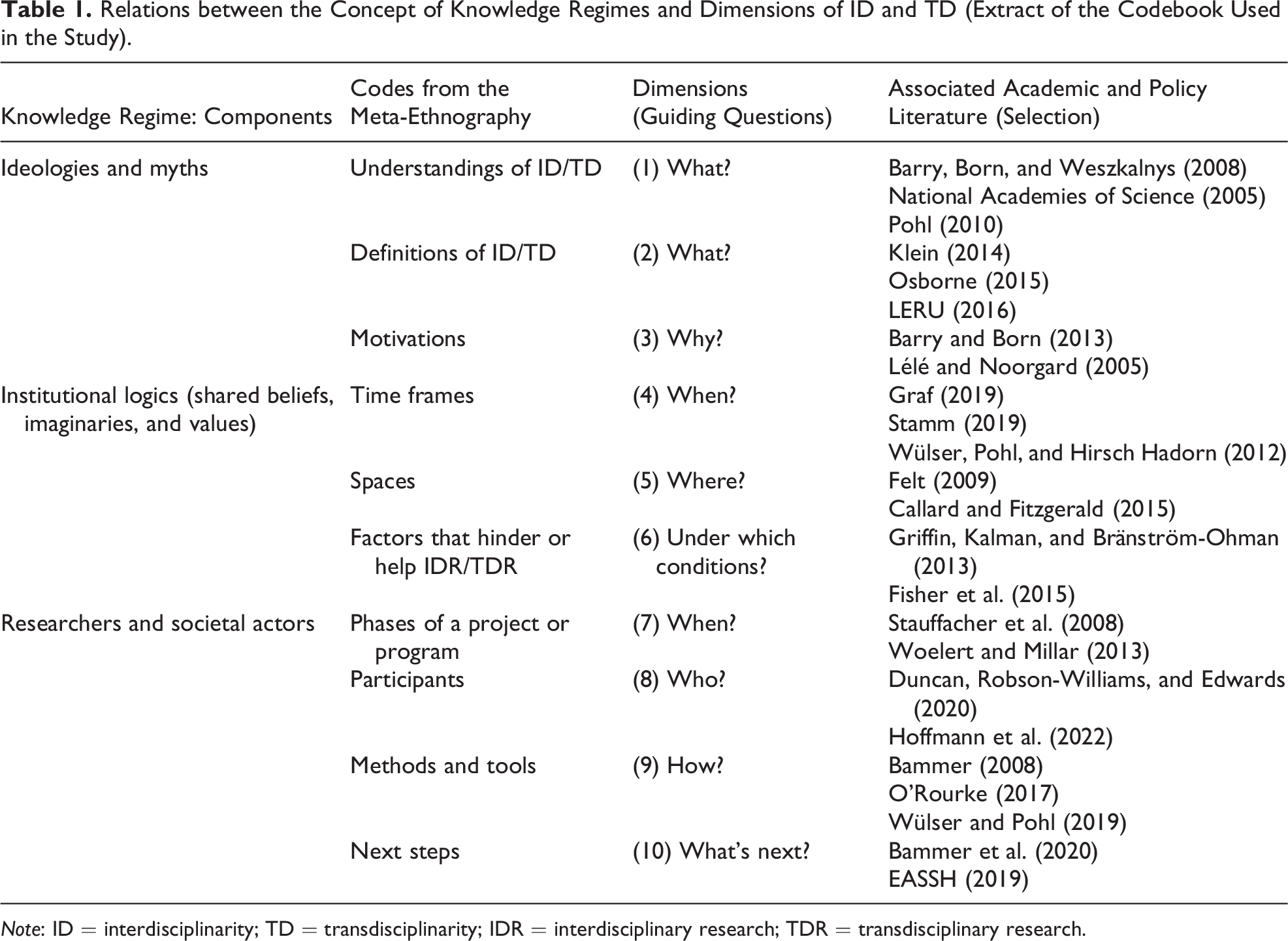
Note: ID = interdisciplinarity; TD = transdisciplinarity; IDR = interdisciplinary research; TDR = transdisciplinary research.
During phase 4, we compared data collected for each code across documents from the academic and policy literatures and determined their relationships (Noblit and Hare 1988). We initially built six qualitative dimensions accounting for the relationships and main questions related to ID/TD (Vienni-Baptista et al. 2020a). Because these dimensions represent a means to integrate academic and policy discourses on ID/TD, we decided to use them as the foundations for the heuristic tool. At least two of the following six dimensions were present in each analyzed record: (i) What? (referring to understandings of ID and TD), (ii) Who? (inquiring about the actors who develop or contribute to IDR/TDR), (iii) How? (focusing on methods for IDR/TDR), (iv) Why? (specifying motivations for undertaking or supporting IDR/TDR), (v) When? (considering the time and timing dedicated to IDR/TDR), and (vi) Where? (identifying the spaces for IDR/TDR).
In phase 5, we performed a comparison of the concepts classified according to dimensions (i) to (vi). We applied the principles from categorical thinking (Freeman 2017) to identify nuances or missing dimensions from phase 4. Using the three components of the concept of a knowledge regime (Felt et al. 2016), we reorganized our data into an overarching map of relations and further specified the six qualitative dimensions (i to vi) to build ten guiding questions; these questions comprise the initial pillars of the heuristic tool (Table 1). In phases 6 and 7, we designed a prototype of the tool.
Refinement of the Heuristic Tool
Refinement is a way of improving the cognitive appeal and optimality of the heuristics identified in the first stage (Hukkinen and Huutoniemi 2014). After elaborating on the first prototype of our tool (phases 6 and 7), we refined it based on the insights from different stakeholders.
Data Collection
During 2020 and 2022, we tested the tool and systematized the insights from the following: (i) Two workshops with PhD students and early career researchers with mixed disciplinary backgrounds. (ii) A master class with researchers, funders, and research managers at the Center for Interdisciplinarity (Michigan State University, United States). (iii) Semi-structured interviews with National Contact Points in Switzerland and Germany. (iv) Consultations with researchers, policymakers, and members of the expert panel of the SHAPE-ID project. (v) Presentations at three scientific conferences.
We designed indicative categories to guide the participant observation, semi-structured interviews, and consultations based on the concept of knowledge regime and on the ten guiding questions of the heuristic tool (see Appendix 2 for a detailed list of the categories). 4
During the workshops and master class (i and ii), participants were invited to test the tool on one ongoing or planned project or program of their interest. They received a template of the tool with the ten guiding questions and prompts (see Figure 1). One of the authors explained each question before dividing the audience into small teams. The discussion was self-facilitated in small groups, and major topics were then shared in the plenary. Participants were asked to comment on the potential and limits of the heuristics, and why the tool did or did not work for them.
Similarly, at conferences (v), because of time constraints, attendees were exposed to the heuristics, but only some steps were tested, depending on session participants’ interest. Participant observation consisted of accounts and descriptions of the settings and the issues discussed and reflected upon by stakeholders. These were written in the form of field notes (Emerson, Fretz, and Shaw 2001).
Nine semi-structured interviews (iii) were conducted by one of the authors to explore in-depth issues related to funding and policymaking (Sherman Heyl 2001). The consultations (iv) took a similar format, using the same categories, but they focused on the suitability of the prompts composing the tool.
Data Analysis
All observations and interviews were transcribed into text files for storage and analysis (Schreier 2014). Grounded theory was used to analyze the data collected (Charmaz and Mitchell 2001). The analytical process was achieved through several iterative phases of coding and induction (Charmaz 2014). Through this process, we refined the categories in Table 1 and elaborated on the guiding questions used as prompts for each dimension (see Figure 1). As a result, tests reinforced the dimensions elaborated from the meta-ethnography. We added new prompts for each guiding question using records from the academic or policy literatures while collecting insights from practice, which were integrated as examples to the heuristics. In the next section, we present the final version of our tool.
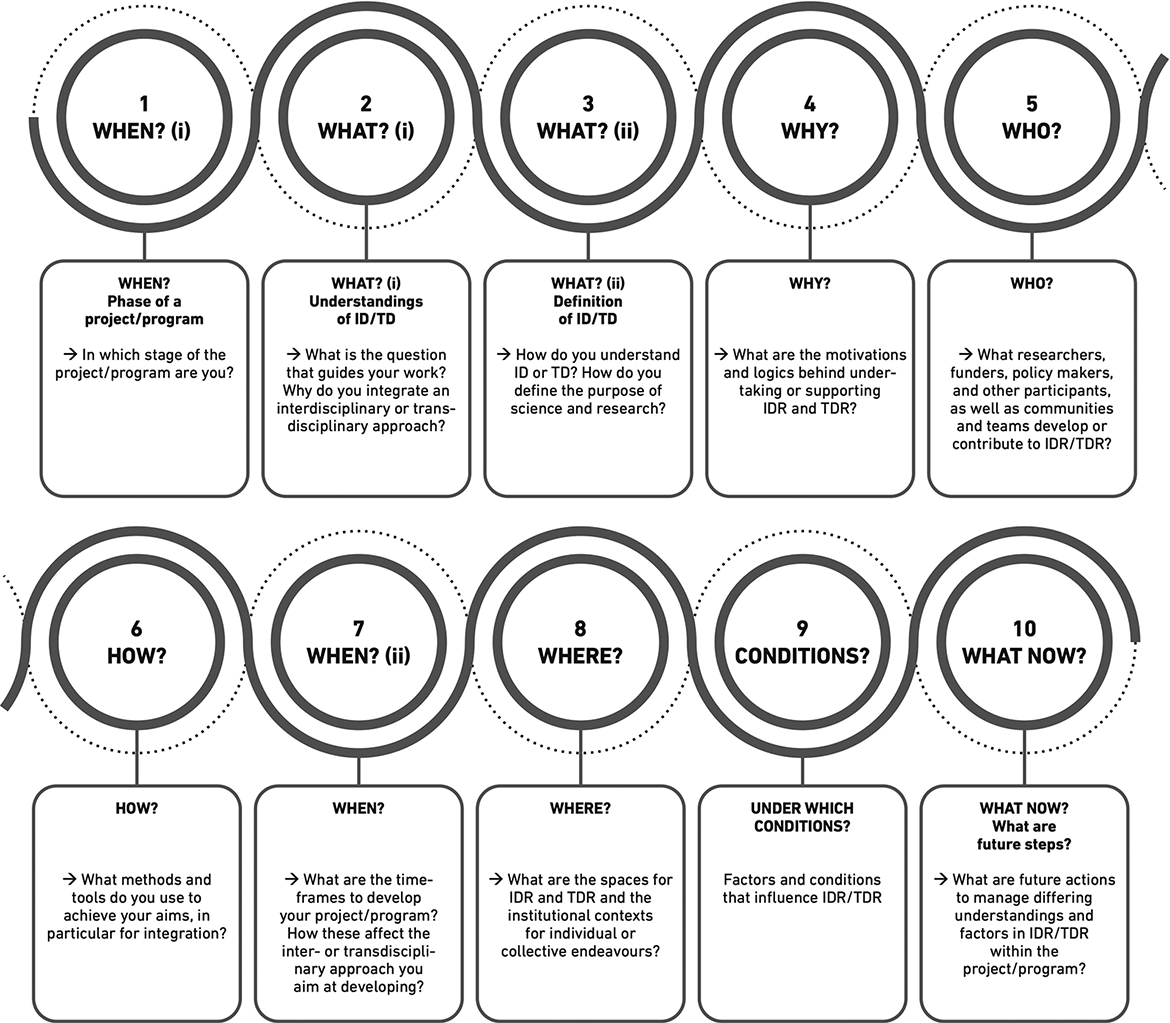
A heuristic tool for disentangling understandings of interdisciplinarity and transdisciplinarity.
Findings
The heuristic tool consists of ten guiding questions and prompts. Through a semi-structured dialogue, the questions guide reflections on understandings of ID/TD used in projects, funding programs, and policy processes and their implications (O’Rourke, Hall, and Laursen 2021) to reveal differences and increase mutual understanding (Fischer et al. 2015). Figure 1 and Table 2 show the final version of the heuristic tool. In a workshop of between two to four hours long, users were invited to discuss their perceptions within a group by approaching the following questions:
How can we navigate across different understandings of ID/TD? (Guiding questions 1-8)
Which factors negatively impact IDR/TDR, and which have a positive impact? (Guiding question 9)
How can definitions of ID/TD be enriched? (Guiding question 10)
Guiding Questions and Prompts to Disentangle Understandings of ID and TD.
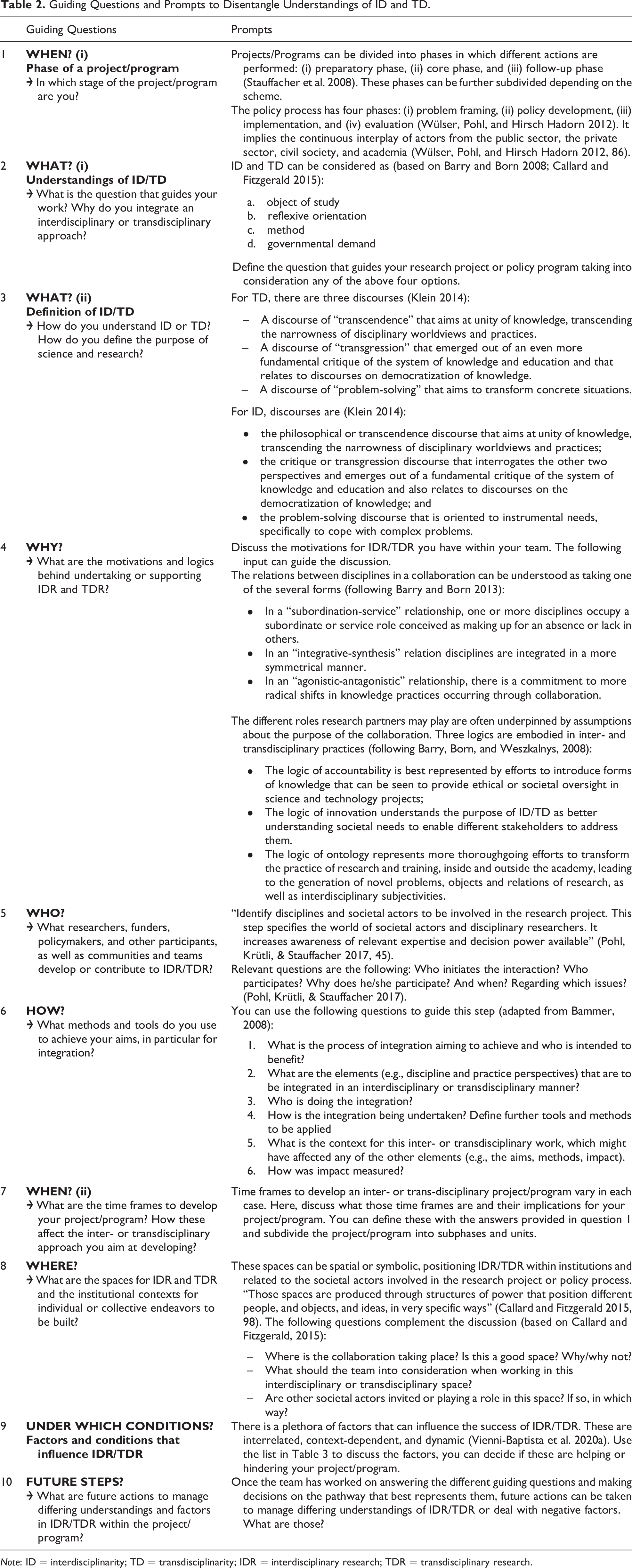
Note: ID = interdisciplinarity; TD = transdisciplinarity; IDR = interdisciplinary research; TDR = transdisciplinary research.
The tool provides (a) a written synthesis of the approaches to and understandings of ID/TD that the team represents and (b) a map to relate the different understandings of ID/TD with those factors influencing IDR/TDR. As the output, teams can synthesize and write on a flip chart the main lessons from the discussion using the template shown in Figure 1.
In what follows, we describe the rationale behind each guiding question and elaborate on insights from the users who tested the tool. To illustrate how the tool has been adapted to specific circumstances during the tests, but also to demonstrate how to use it in a beneficial way, in what follows we present further details of each prompt.
1. WHEN? (i)
This question asks users to clarify in what research or policy phase a project or program is. The tool uses ideal typical phases that can be subdivided. It is relevant because it helps users decide on which phase they will concentrate on the following questions while outlining other features of the project/program. This contributes to aligning goals among users working together, but also in asserting that all users have enough information on the project/program.
Researchers who tested the tool argued that they might define ID or TD differently in different phases of the research process. For this reason, they discovered that applying the tool throughout a project may help them clarify these differences and better plan the next steps (Interview 2, 2020). Some users found it useful to add further information to answer guiding question 1, such as funding or milestones per phase. In contrast, funders considered it useful for the problem framing and policy development phases. The last phase—evaluation—should use the same definition as in previous phases and account for it (Interview 5, 2020).
2. WHAT? (i)
This task focuses on defining the questions that guide the research project or policy program. It is complemented with a reflection of the purposes users pursue when embarking on an inter- or transdisciplinary project/program. Barry, Born, and Weszkalnys (2008) point out that IDR/TDR can be considered as (a) objects of study, (b) reflexive orientations, (c) methods, or (d) governmental demands. These categories helped align the expectations in the team, making visible if more than one goal was to be accomplished by the project/program.
During the tests, this question demanded considerable time from the tool’s users. The researchers acknowledged that they simultaneously understand ID/TD as a method and a reflexive orientation, implying more than one question guiding the research project. In these cases, the next guiding questions needed to address both understandings (Interviews 3 and 7, 2020). In addition, they argued that certain goal formulations should be left open to be discussed in the following questions (Interview 7, 2020).
3. WHAT? (ii)
This question revolves around the different discourses on ID/TD; it entails reflecting on discourses on ID/TD not usually conceptualized as such in a research process or policy cycle. Although the tool provides a specific prompt to use for discussion, researchers and funders embarked on an exchange that accounted for other streams to be included (e.g., those by Osborne (2015) or Nicolescu (2012) were mentioned during the workshops), probing into the fact that this question requires a considerable amount of time to arrive at a consensus if teams have already identified differences when deciding on question 2.
According to the tool’s users, these definitions helped them better frame the goals and purposes of a project/program they envisioned. In practice, combining questions 2 and 3 helped clarify the underlying assumptions on the definitions of ID/TD.
4. WHY?
This task focuses on the motivations and worldview(s) for carrying out IDR/TDR. Its foundation rests on the type of relations between disciplines in a collaboration (following Barry and Born 2013), which would depend on the responses given by users to guiding questions 1-3. Interestingly, funders and policymakers mentioned that they had experienced similar relations in their working environments, which helped them reflect on IDR/TDR from a different perspective, that is, embedded in asymmetrical power relations (Interviews 1, 5, and 7, 2020). This relates to the second component of the concept of a knowledge regime. Similar to the findings obtained at the European level (Spaapen et al. 2020), researchers using the tool made visible the power imbalances reproduced in those discourses supporting or promoting IDR/TDR.
The logics of ID/TD (following Barry, Born, and Weszkalnys 2008) constitute the second prompt for this guiding question, accounting for personal and collective motivations to perform or support IDR/TDR. Although the tools provide different theoretical prompts, several workshop participants acknowledged their usefulness and were curious to explore further resources on their own; they confirmed that this heuristics can be adapted and malleable to change and revision.
5. WHO?
This step specifies the constellation of scientific and societal actors, communities, and disciplines involved in a project/program. “It increases awareness of relevant expertise and decision power available” (Pohl, Krütli, and Stauffacher 2017, 45). While testing the tool, the users decided to include other complementary methods to work on this task. In one case, they conducted an actor constellation by following the example of Pohl, Krütli, and Stauffacher (2017). This was self-facilitated and offered an ideal environment for observing the challenges of implementing the heuristic tool in a brief time slot. In addition, some tool users reflected on marginalized actors who might not be participating in a research process but do influence it (Interview 8, 2021).
6. HOW?
The heuristic tool does not provide a definition of the term integration because we preferred users to explore this concept and the methods applied in each project. During the workshops and conference presentations, one author clarified the term integration, if the participants asked for it. The prompts for this task proved to be useful for elaborating on the main features of the understanding of integration.
Funders and policymakers found it difficult to use the prompts because these were not fully aligned to a policy cycle (Wülser, Pohl, and Hirsch Hadorn, 2012). They saw the prompts as a means to open up a reflective process on the type and depth of integration in IDR/TDR (Interview 2, 2020). The final set of questions included in the tool (see Table 2) is aimed at offering these users a concise overview of the type of decisions researchers need to make when embarking on collaborative and integrative research processes.
7. WHEN? (ii)
The focus is on time frames and how these affect the interdisciplinary or transdisciplinary approach taken in the interdisciplinary or transdisciplinary collaboration. The participants exchanged on time frames and spaces in IDR/TDR as the main components of a knowledge regime (Felt 2017), even though those elements are rarely taken into consideration when designing interdisciplinary or transdisciplinary processes. Not surprisingly, the tests showed that researchers were not used to reflecting on how to better develop time frames that are adequate to IDR/TDR (Interview 1, 2021). Researchers agreed that the logic that organizes research into “work packages” (Felt 2017) does not leave room for more flexible time frames needed for building common ground or understanding different perspectives in collaborative settings. The aim is for users of the tool to collect ideas on how to readapt and reframe time and space in IDR/TDR.
8. WHERE?
The task focuses on identifying the spaces IDR/TDR has within institutions and in relation to the actors involved in a research project or policy process. The aim of this task is for users to reflect on what the prefix “inter-” or “trans-” means in terms of the intervals of time and between spatial settings (following Callard and Fitzgerald 2015). Different physical or symbolic spaces can influence the roles assigned to different disciplines. Power relations, for instance, can act as a facilitator for disciplinary integration or, on the contrary, define more instrumental roles for lower status disciplines (Balmer et al. 2015). The users acknowledged a substantial need to rethink the spaces in relation to time frames in IDR/TDR and how they mutually influenced each other (Interview 8, 2021).
During the workshops, we provided some questions to guide the discussion on spaces for collaboration. Researchers came back to the discussion on the asymmetrical relationships between fields of knowledge and how these influence the spaces in which IDR/TDR are performed. For example, when the arts participated in IDR/TDR, researchers acknowledged that the spatial dimension changed because of the interventions and new dimensions of collaborative practice (Interview 5, 2021).
9. Under which conditions?
A plethora of conditions influence the success of IDR/TDR. These are interrelated, context-dependent, and dynamic, paralleling the plurality in definitions of IDR/TDR. The factors that hinder or help IDR/TDR were further elaborated on by users of the tool, here by using Table 3 as a first prompt. In most of the cases, contextual conditions were identified as the main factors that influence IDR/TDR (Interviews 1, 4, and 7, 2020). For funders and policymakers, the rich list of factors was a potentially useful tool for project evaluation. In addition, they discussed what a call including such a list would look like (Interviews 1 and 7, 2020). In the tests that we ran with researchers, the list was found to fit its purposes in the sense that the prompts were comprehensive. None of the users indicated that new categories needed to be included. Reflecting on how to transform hindering factors into positive pathways to IDR/TDR was challenging, but it provided new insights for ongoing projects (Interview 9, 2021).
Factors That Help or Hinder Interdisciplinary Research/Transdisciplinary Research.
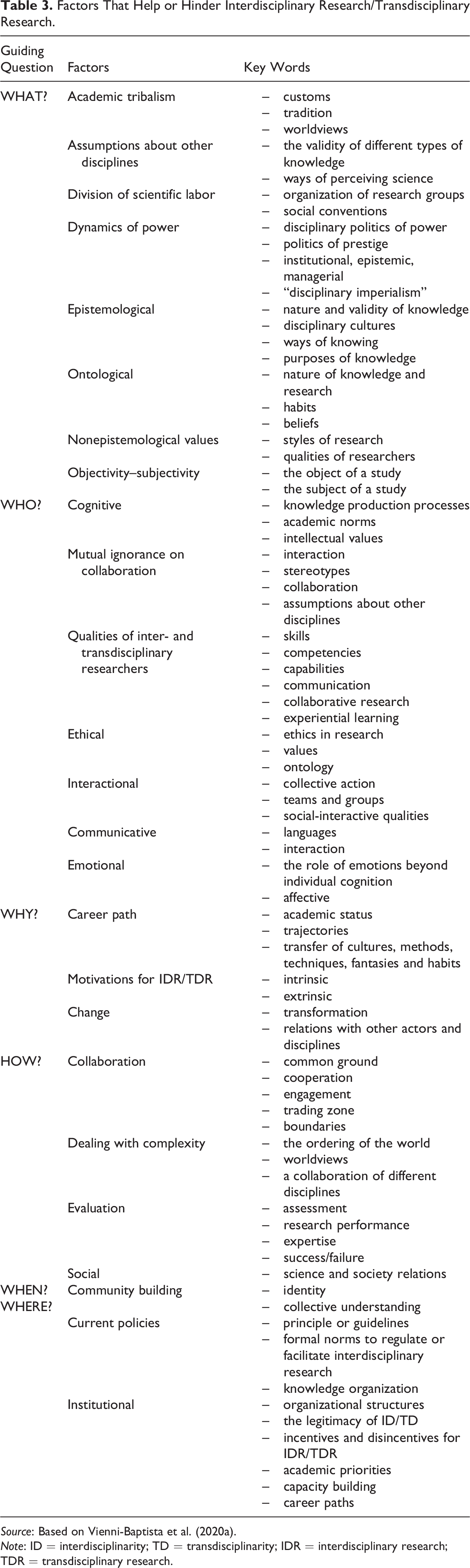
Source: Based on Vienni-Baptista et al. (2020a).
Note: ID = interdisciplinarity; TD = transdisciplinarity; IDR = interdisciplinary research; TDR = transdisciplinary research.
10. What are the future steps?
Once the team has worked on answering the guiding questions and decided on a pathway that best represents them, future actions can be taken to manage varying understandings of IDR/TDR or to deal with negative factors. This sheds light on how to overcome obstacles and misalignments, that is, how different scientific and societal actors understand and define the terms ID and TD. Misalignments arouse due to the different purposes of IDR/TDR, which creates different expectations from different actors when participating in these kinds of projects (Interviews 3 and 4, 2020).
Discussion
ID and TD have become an important contemporary context for scientific knowledge production and innovation (Hillersdal et al. 2020). However, ID/TD do not achieve their full potential because they still are poorly understood and supported (Bruce et al. 2004). The pervasive disconnection between academic and policy discourses on ID/TD (Stamm 2019) is one of its causes. To overcome instrumentality and disconnection, heterogeneous understandings of ID/TD should be used to promote them in research and funding as a core value of collaborative research (Vienni-Baptista et al. 2022).
To this end, we consider ID/TD as knowledge regimes to enrich the discussion on their understandings and explore how values are articulated, mobilized, and practiced in research and funding (Griffin, Kalman, and Bränström-Ohman 2013). In this way, we contribute to strengthening the productive interactions between science and policy (Muhonen, Benneworth, and Olmos-Peñuela 2020) by building a heuristic tool to make ID/TD more available to researchers, funders, and policymakers.
The concept of knowledge regime comprises three elements that contribute to broaden the discussion on the discourses on ID and TD by:
(i) Disentangling ideologies and myths guiding interdisciplinary and transdisciplinary knowledge production, here jointly with prescriptions for producing and validating knowledge.
In a relatively short period of time, this tool allowed users to have a comprehensive overview of the different dimensions of ID/TD, along with how these influence spheres of action in projects/programs. Our tool implies that no universal definition is valid, opening a co-productive space in which policymakers, funders, and/or researchers can elaborate on new common understandings of ID/TD. In this process, users can identify and overcome “fake collaborations” (Dai 2020) by jointly sharing motivations and imaginaries to pursue ID/TD.
By discussing guiding questions 1-8, users learned ways to navigate different understandings of ID/TD (such as the discourses of ID/TD in question 3 or the motivations in question 4). Prescriptions on how to (co-)produce knowledge were made visible when researchers and funders jointly experimented with the tool.
The principles of heuristics were deemed relevant to substantiate the tool to the particular contexts of application during the tests (Pohl 2014). In addition, the tool adapted to users’ goals, offering possibilities to add new tools or resources when necessary, as shown in the examples provided in question 5. It can also complement others that have different focuses (e.g., Crowley and O’Rourke 2021).
(ii) Discussing institutions and their institutional logics (i.e., shared beliefs and practices, imaginaries, and values embedded in knowledge generation according to Felt et al. [2016]) and their implications.
When using this heuristic tool with dialogue and reflexivity (Crowley and O’Rourke 2021), interdisciplinary and transdisciplinary teams and funders coped with the different types of disconcertments that ID/TD imply (Smolka, Fisher, and Hausstein 2020). We observed how our tool helped users identify power asymmetries (Viseu 2015) in institutional logics by discussing questions 4, 5, and 8.
In this case, heuristics provided “‘shortcuts’ toward more sustainable paths of action” by “simplifying conflicting views and complicated procedures” (Hukkinen and Huutoniemi 2014, 185). We organized these dimensions into a simple, flexible structure that does not define ID/TD rigidly; instead, the tool is grounded in the “guiding questions” and factors that influence IDR/TDR to support the development of narratives and (new) understandings.
(iii) Rethinking symbolic values, contradictions and expectations (Felt 2009) around, in this case, the collaborative practices performed by researchers, research partners, and societal actors who govern research.
The tool provided empirical knowledge on how researchers negotiate their understandings of ID/TD when constrained by what funders and policymakers want, what institutions expect, and what researchers want to learn from their studies and the social transformations they envision (Hillersdal et al. 2020). With this knowledge, the notes and maps obtained from applying the tool offered a comprehensive overview to users and, in some cases, identified institutional spheres in which action is needed. For instance, interviewed funders kept a record of the time frames discussed with researchers because these were useful to rethink schemes to support flexibility in funding schemes, following similar conclusions by Fletcher, Lyall, and Wallace (2021).
In addition, we have contributed to the current demand for methods and tools for IDR/TDR (Bammer et al. 2020; O’Rourke 2017). During the refinement phase, we found the tool to fulfill several criteria of one such toolbox: (1) it was easy to handle and intellectually challenging; (2) it helped in developing a shared understanding or identifying consensus or dissent; and (3) it allowed for the joint production of knowledge among users belonging to different thought collectives (Pohl and Wülser 2019).
According to our study, this tool could be utilized by researchers, funders, and policymakers in the following ways:
Researchers (when submitting a proposal): The written output can be added to a proposal to clearly state the definition(s) of ID/TD being used by a team. Research teams can work together to delineate common definitions before a project begins, enhancing shared understandings and awareness of the implications of ID/TD in their research. This tool can also be applied in further stages of the research process as an orientation for action.
Funders: The set of questions can be included in research-funding programs to ask researchers to clearly define ID/TD used in their proposals. This can help funders find the right reviewers in the evaluation process.
Policymakers: Using this tool in a policy-making process (in any of its phases) adds clarity and awareness about the definitions used in policy instruments and programs, allowing them to work with more nuanced definitions.
Jointly by researchers, funders, and policymakers: Used in workshops or joint activities, this tool creates a coproductive space to discuss different understandings of ID/TD. This can assess already known definitions and coproduce new understandings that better suit particular research and policy needs.
The current study has one limitation worth noting. We tested the tool mostly with researchers and/or funders. Policymakers were interviewed, and only few engaged in the tests. Nevertheless, insights from this target group referred to all guiding questions, allowing to assess the tool’s usefulness. Tests provided richer outputs when different actors participate simultaneously.
Conclusion
We have advocated for a plural understanding of research and funding, accounting for nuances and contextuality (td-net 2020). Policy and funding systems may profit from applying the tool and including rigorous interdisciplinary and transdisciplinary work (Lyall and Fletcher 2013; Schneider et al. 2019). In this sense, our paper helps counter dubious behaviors (Conroy 2020) indirectly promoted by funders using disciplinary-based criteria (Strathern 2004) or idiosyncratic definitions and unclear understandings of ID/TD (Lindvig and Hillersdal 2019). As the tool is grounded on the concept of knowledge regimes, definitions of ID/TD are enriched through three dimensions, providing an added value to the discussion in terms of ideologies, institutions, and actors.
Our tool could become an orientation for IDR/TDR funding and policy. Additional research to apply our tool in new contexts will be performed in upcoming years in the Swiss context. 5 This opportunity will provide evidence on how to build greater trust among researchers, funders, and policymakers through long-term, sustained, and participatory dialogue (Budtz Pedersen 2014; Spaapen et al. 2020). If tools such as the one we elaborate on here are useful for this purpose, scientific and societal actors will benefit from more and better IDR/TDR.
Footnotes
Appendix 1
Literature search results were downloaded into Endnote bibliographic software and screened against eligibility criteria:
Appendix 2: Categories for Participant Observation and Questions in Semi-structured Interviews
These were developed in relation to the theoretical framework of the study, that is, (i) the three components of the concept of knowledge regime and (ii) guiding questions from the heuristic tool.
Acknowledgments
The authors gratefully acknowledge the support from SHAPE-ID partners in several phases of the research. We specially thank participants of the workshops and interviewees and Dr. Jack Spaapen and Prof. Dr. Michael O’Rourke for relevant comments, time, and generosity to discuss these topics with us.
Declaration of Conflicting Interests
The author(s) declared no potential conflicts of interest with respect to the research, authorship, and/or publication of this article.
Funding
The author(s) disclosed receipt of the following financial support for the research, authorship, and/or publication of this article: Horizon 2020 Framework Programme (822705).
