



Abstract
The welfare of society and the relationship between people and the natural environment are all directly impacted by engineering work, and codes of ethics are central to the profession. Yet many engineers struggle to incorporate these principles into their daily work because such codes typically emphasize professional conduct without reflecting on the role of engineering within such complex social and environmental systems. In this paper, we propose a human rights–based approach to engineering anchored in five core principles of distributive justice, broad participation, explicit consideration of duty-bearers, accountability for all actors involved, and indivisibility of rights. This is a new paradigm that draws on universal principles to shape individual ethical obligations and the norms of the profession to prevent risk, enhance access to the benefits of technology, and redress social and environmental harms resulting from engineered products or processes. This paradigm could transform both university education and professional practice by harmonizing existing engineering ethics with core human rights obligations to respect, protect, and fulfill human rights.
Introduction
Engineering, by definition, applies science and mathematics to adapt and transform matter and energy, ostensibly for the benefit of people and the planet. A common underlying assumption is that engineers’ work can contribute to enhancing public welfare. Yet technological developments central to the field are not traditionally accompanied by holistic analyses of their potential impact on humans or the environment (Bugliarello 1991). Instead, science and engineering innovations are often pursued solely because of their potential to “advance knowledge,” without considering a priori the environmental or human contexts in which they are developed or whether there are any implicit biases in their design. A predictable result is that the potential to disrupt or impact human societies and individuals becomes apparent only after those technologies are already established.
Engineering design does not take place in a vacuum (Leydens and Lucena 2014; National Academy of Engineering (NAE) 2017b): it occurs within sociotechnical systems that are themselves bounded by environmental constraints. Social change poses new challenges to engineering, and the field of engineering itself influences the development of society in an endogenous relationship. Modern engineering has also been an integral driver of unprecedented anthropocentric change in the natural environment (Zalasiewicz et al. 2010). But are engineering professionals aware of these dynamics? Are engineering students trained to think critically about ethical principles regarding human welfare and the implications of their activities for natural systems? Would engineers be able to realize these principles if they become conscious of their role in society?
Professional bodies and other engineering institutions, such as the US National Center for Science and Civic Engagement and the US NAE, have all worked to promote “social good” and help engineers become more aware of the impact of engineering on people and the environment, the unintended consequences of technology, and the disorientating impacts of technology (National Research Council 2009). These efforts were animated by general principles of social welfare, not by concrete and measurable standards that offer proven mechanisms for mitigating risk and ensuring equitable access to the benefits of science at global and local levels. Similarly, although most engineering codes agree to hold paramount the safety, health, and welfare of the public (Harris, Pritchard, and Rabins 2009), there is still significant ambiguity in interpreting who the public is or what public welfare might mean or the types of hierarchies that affect such outcomes.
Research on engineering education in the United States (Cech 2014), in particular, demonstrates that learning objectives pertaining to ethics and public welfare actually decline significantly as engineering students move through their undergraduate education (typically over four years). So, while institutions such as the NAE encourage professionals to address social and environmental sustainability, many engineers still struggle to see connections between their work and societal issues such as social exclusion, poverty, and hunger. Furthermore, after the Second World War, engineers became more aware of their social responsibilities and the social impact of their work (see Mitcham 2009), and the early twenty-first century saw growing recognition that the scale of anthropocentric-driven environmental change is exacerbating inequality and precarity.
The “Engineering for Human Rights” framework explored in this paper helps translate this emerging awareness and realization into actionable items and provides standards for accountability across engineering fields, projects, 1 and design processes. As both a pedagogical approach and research orientation, this paradigm centers on human dignity grounded in the fundamental principles of universality, indivisibility, and equity. Our work starts from the assumption that grounding engineering in human rights theory and standards can enhance engineers’ ability to enact socially and environmentally responsive technological solutions that advance human dignity (see also Buchanan 2001). Human rights–based frameworks have the advantage of being grounded in moral claims that are backed up by international legal obligations (Land and Aronson 2018). The framework we develop in this paper straddles all arenas of engineering practice: from engineering education, through certification and ethics training in practice, to developments at the frontiers of basic science (Hunt and MacNaughton 2006). This framework could contribute to practical efforts to evaluate the impact of engineering in society as well as promote new human-centered and environmentally centered design paradigms.
We define Engineering for Human Rights as a paradigm that draws on a universal set of principles to shape individual ethical obligations and the norms of the profession to mitigate risk, enhance access to the benefits of technology, and redress harms resulting from engineered products or processes. In the following sections, we offer an overview of core human rights, ethics, and related concepts linked to engineering practice. We then explore five fundamental principles central to our proposed new paradigm. We conclude by illustrating how these five principles can be translated into engineering practice.
Our aim is to motivate students and educators to explore the new paradigm of engineering introduced in this paper, but to do so while seeking to “apply these criteria with the epistemic humility—recognizing that our way of knowing is not the only way of knowing—and relationality with which they are presented and intended” (Riley 2018, in Leydens and Lucena 2018).
Core Human Rights Concepts Associated with Engineering
Put very simply, a human right is a claim by someone, on someone, for something essential to human dignity. For more than a half century, the United Nations’ (UN) Universal Declaration of Human Rights (UDHR) has served as a globally recognized standard that succinctly outlines the most essential rights. These have been translated into law and institutional practice through courts, commissions, and other monitoring bodies worldwide. Rights concepts are also central to corporate codes of conduct, professional standards, and individual people’s efforts to protect and promote social and environmental protections at the grassroots level.
Despite some criticism of the UDHR, human rights transcend particular political philosophies and are more precise than generalized notions of social justice. Instead, human rights rely on the concepts of human dignity, equality, and nondiscrimination. These concepts or pillars of human rights are relevant to engineering in multiple ways. For instance, an engineer needs to determine whether their projects result in discriminatory outcomes: are particular groups excluded from receiving benefits from the project (e.g., is a transportation project designed without having the needs of people with disabilities in mind)? The engineer thus needs to consider different levels of access to the outputs created through their work (e.g., are new medical devices designed with special consideration for how their costs may affect equal access to health?).
Engineers are integrally involved in creating scientific and technical processes across multiple industries and research sectors; those industrial activities, in turn, have significant environmental implications both ongoing and yet indeterminate. 2 We thus suggest that four key principles shape the relation between technology and human rights. First is the principle (central to the Universal Declaration of Human Rights) that all people have the intrinsic right to benefit from the advancement of science. Human rights theory has continued to evolve to acknowledge that the right to benefit is bounded by the rights of future generations and the rights of nature itself. Second is the principle that access to technology itself is instrumental to realizing other rights. Third, independent of whether rights are fully realized, access to technology can enhance the efficiency and scope of the distribution of human rights, or impede it. Fourth, because human rights and engineering are both constantly evolving, future adaptation (beyond current limits) is essential because new technologies will impact rights in unknown ways.
Engineering for human rights reflects the intrinsic and instrumental roles of technology (i.e., access to technology for its own sake and access to technology as an enabler of other forms development). Some rights are justified by being “intrinsic” to our humanity (i.e., they are integral to ensuring human dignity in and of themselves, such as the right to physical integrity). Instrumental rights, by contrast, make a contribution toward the achievement of other rights, for example, the right to property enables a person to ensure her right to a decent standard of living (DesJardins and McCall 2014). Thinking about these distinctions in relation to engineering, we could argue that the intrinsic right to physical integrity hinges on the structural integrity of buildings that civil engineers design and inspect routinely. In the absence of structural integrity, our right to physical safety would be violated. By contrast, instrumental rights such as the right of access to technology (such as high-speed internet access) are integral to fulfilling other primary rights, such as the right to education. Similarly, the right to vote is integral to exercising our political rights—so cybersecurity measures that safeguard voting integrity play an instrumental role in realizing political rights.
Just as many types of engineers may be involved in developing voting security measures (electrical engineers, systems engineers, and computer hardware and software designers), different instrumental rights compound upon one another and are inter-related. For instance, a new technology in farming created by engineers can lead to a reduction in food shortages in rural areas, thus instrumentally impacting the potential fulfilment of the right to food. Similarly, engineers involved in ensuring the integrity of water and sanitation systems (Wyndham and Harris 2014) or those who design adaptive technologies for shoring up food and water security amid climate change are integral to realizing multiple rights. 3
New technologies are being developed continuously and rapidly, and their impact on human rights is constantly evolving. For instance, if the right to freedom of expression is to be upheld today, the right to freedom of expression on the internet would need to be protected too—especially since the Universal Declaration of Human Rights (Article 19) states that “Everyone has the right to freedom of opinion and expression…and to seek, receive and impart information and ideas through any media and regardless of frontiers.” While the drafters of the Declaration in 1948 could not have envisioned the internet as being central to modern communications, this technological vehicle is reshaping notions of rights and risks (Land 2013; Kaye 2018).
Given engineers’ central role in creating and designing new technologies, the paradigm of engineering for human rights equips students and professionals alike to grapple with the ramifications of these technologies—both positive and negative. The relationship between technology and human rights is complex because any technological developments carry a set of preexisting normative values and morals that shape their impacts on society as well as the natural environment. In some instances, new technologies are a catalyst for increasing inequality and power imbalances that affect vulnerable populations (Cozzens and Thakur 2014; Land and Aronson 2018). For example, computer algorithms could disadvantage minority groups’ access to health because of implicit racial biases in health assessment score calculations as shown by Obermeyer et al. (2019).
The human rights system and corresponding theories are not without critics—particularly when it comes to determining what a universal right is or is not (e.g., Sen 1999). Some worry that because human rights could be interpreted varyingly across cultures, a form of “weak relativism” could hamper enforcement (Good 2010). The challenge is thus to align research and business practices in engineering with the core principles of human rights. Cultural adaptation does not absolve duty-bearers of their basic human rights obligations. And professional ethics standards encumber engineers with added responsibility to safeguard rights even in culturally complex settings, such as global supply chains or transnational research and business ventures.
Human rights have been also criticized as human-centered and not considering the environment. However, while the modern post–Second World War legal regime of human rights was by definition centered on human dignity, an “ontological turn” in the early 2000s brought a realignment that includes decentering the anthropocentric nature of human rights in the interest of safeguarding the rights of nature. Environmental rights literature (Düwell and Bos 2016; Hiskes 2008) is grounded in the notion of shared intergenerational risk. It entailed shifting human rights discussions beyond an individual, anthropocentric concept of dignity toward a concept of system-wide justice tethered to natural limits. Newer work from the United States and the Global South points to the ongoing struggle of environmental movements to challenge the contradictions between environmental protection and social justice (Kashwan 2018), with an explicit focus on strategic litigation related to climate change (Rodríguez-Garavito forthcoming).
A human rights–based approach to engineering builds on the foundations of such dynamic scholarship in the field of human rights and environmental justice. Rather than uncritically adopting the human rights theory and corresponding laws and institutions, engineering for human rights moves scholarship and teaching in a pragmatic direction. This complements sociotechnical systems discussions constructively by adding concrete human rights laws, institutions, metrics, and networks that can be marshaled to tackle the climate crisis while promoting well-being and equity.
Engineering Ethics
Engineering reflects and is constrained by context-specific demands and social need; it is, therefore, a socially constructed profession that both shapes and is shaped by its contexts (Baillie 2009). Most engineering professional organizations developed during the nineteenth century (such as the Institution of Civil Engineers in the United Kingdom), but it was not until the early twentieth century that codes of ethics were developed (Luegenbiehl and Clancy 2017). 4 Progressive engineers have invoked the potential of actors in this field as change agents in both engineering practice and education. 5 Yet, in contrast to other disciplines, such as medicine or law, the ethical ends of engineering are not integral to the profession itself (Mitcham 2009, as cited by Dias 2020). If a medical practitioner’s goal is to promote health, and a lawyer’s goal is to promote justice, engineering’s aims and ends are not as uniform; indeed, they are still defined by dominant forces such as governments or businesses. Therefore, we argue that awareness of the context and complexities of engineering decision-making is key to moving beyond the narrow view of engineers as simply problem solvers (Downey 2015), and valorizing their capacity to identify problematic ethical outcomes (see Lynch and Kline 2000), and make power structures visible (Smith and Lucena 2020).
Ethics in engineering can be viewed from two perspectives: one focuses on the impact that the profession as a whole has on society (macro-ethics), and the other on the conduct of practicing engineers as individual agents (micro-ethics). Engineering ethics is thus defined as a systematic analysis of morality and decisions in the field of engineering—as well as the moral conduct involved in the development of technologies (Martin and Schinzinger 2009; see also Ladd 1985). Engineers’ ethics are linked to specific norms of conduct for “responsible” engineers; normative ethics at this level are reflected in codes of conduct aimed at shaping engineers’ obligations and responsibilities in relation to the public, the client or employer, and other engineers (Zandvoort, Van De Poel, and Brumsen 2000). Although these “professional ethics” are useful when operationalized in codes of conduct and industry guidelines, their narrowness often diverts attention from macro-ethical issues, such as the role of engineering in society and the effects of the profession on the public interest (Ladd 1985), including in relation to the natural environment. The ethics taught in engineering schools in the United States and Europe has tended to conflate the two perspectives, with discussions dominated by engineers’ ethics (Basart and Serra 2013; Herkert 2001).
The development of guiding ethical principles in engineering is relatively recent, dating back to the first half of the twentieth century (Luegenbiehl and Clancy 2017; Martin and Schinzinger 2009) and has mostly focused on micro-ethics. In the United States, the field has focused mainly on engineers’ obligations toward their employers, emphasizing values such as loyalty, obedience, and competence, among others. After the Second World War, engineering ethics broadened somewhat to include social considerations, with a growing awareness that engineers have obligations to people other than their employers (Zandvoort, Van De Poel, and Brumsen 2000). As a result, public safety, air pollution, and sustainability all came to be within the remit of engineers’ responsibilities.
However, a review of engineering codes conducted by the NAE (2017b) across multiple industries and economic sectors reveals a dearth of measurable environmental and societal benchmarks. Only a third of the codes reviewed explicitly mention environmental sustainability or the environment, despite the centrality of both to public health and safety (NAE 2017b). Not a single contemporary industry or sectoral code discusses global issues such as poverty in relation to engineering (Catalano 2014). Most engineering ethics codes focus on “negative” duties (i.e., the obligation to protect from harm) rather than the affirmative responsibility to promote rights through engineering practice. Harris et al. (2009) state that nearly 80 percent of the codes on file with the National Society of Professional Engineers (NSPE) emphasize “negative” duties. Of the remaining 20 percent that emphasize “positive” action, the framing is in terms of “aspirational ethics” enacted either through the efforts of the “good engineer” (e.g., through organizations such as Engineers without Borders) or through more general “standard aspirational work” (e.g., manufacturing technologies that reduce pollutants).
Addressing macro-ethical issues in engineering requires the adoption of holistic perspectives beyond what current codes of conduct provide. Moral thinking is often guided by ethical theories grounded in utilitarianism which inform cost–benefit approaches at the core of engineering design (Catalano 2014; Manion 2002). Utilitarianism, however, has two main shortcomings: first, the difficulty of accurately valuing human life; and second, the challenge of meting out distributive justice across people or generations (Manion 2002; Vesilind and Gunn 1998). Inter-generational justice is particularly relevant when considering the long-term environmental and social impact of engineered processes or substances and resource consumption on future generations (see Hiskes 2008, for a discussion of human rights and inter-generational justice).
Two additional problems arise here for the definition of ethics in engineering. First, moral theories (e.g., utilitarian, deontological ethics) rely on philosophical assumptions that could be questioned. Second, a code-by-code approach lacks the moral standing of an overarching framework to shape the role of engineers in society (Ladd 1985) because codes themselves are narrowly conceived (Martin and Schinzinger 2009). Codes vary in strength and scope across professional societies, thus introducing a risky degree of relativism across disciplines and contexts.
Codes of conduct in engineering worldwide continue to evolve as demonstrated by the increased inclusion of principles of fairness and nondiscrimination (see, e.g., ASCE’s Canon 8 and NSPE’s Section III.1.f.). We argue that the human rights–based framework offers a rubric for interpreting ethics at individual and collective levels, across human and environmental domains, with a wide geographical reach. Tackling macro-ethical issues effectively (both professional and social; see Herkert 2001) 6 requires the adoption of a comprehensive alternative that goes beyond discussions of philosophical foundations of the field and is legible across different schools of thought and applicable to multiple challenges. Engineering design and practice are integrally related in a causal sense (both positively and negatively) to a range of phenomena, from intellectual property regimes, multilingual influences, and cultural diversity to national security and cost–benefit constraints (NAE 2004). Engineering for human rights offers a useful framework for exploring these issues.
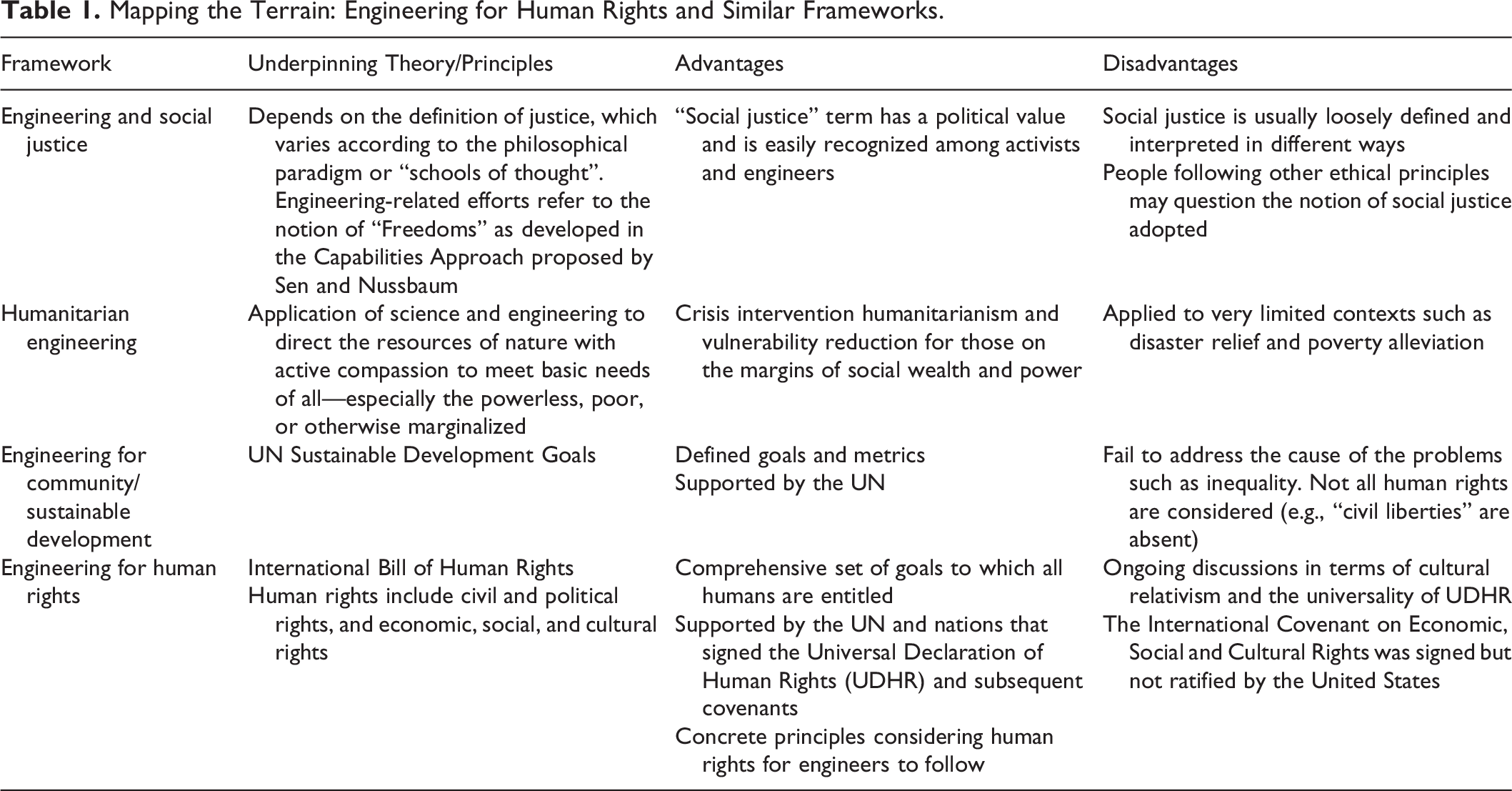
That said, several approaches to using engineering as a tool for social good already exist, including “social justice engineering,” “humanitarian engineering,” and “Socially Responsible Engineering.” 7 In addition, some engineers and firms have embraced the notion of “sustainable development” as a framework for ethical action. We recap these alternatives briefly below while pointing out some limitations. None are as universal or generalizable as a human rights–based approach to engineering, but each is complementary to our new paradigm as summarized in Table 1.
Social Justice Engineering
Engineers play a pivotal role in designing processes and products that shape patterns of resource distribution, both directly and indirectly. At their best, these processes can increase equity in the distribution of opportunities and resources while also reducing imposed risks and harm to impacted communities (Leydens and Lucena 2014). Efforts to incorporate social justice frameworks into engineering include Riley (2008) and Leydens and Lucena (2018, 15), who take the capabilities approach as the core component of their engineering for social justice framework, which is focused on actions that “strive to enhance human capabilities (ends) [and] reduce imposed risks and harms (means) among agentic citizens.” Oosterlaken (2009), in particular, argues that human capabilities provide a framework more appealing than human rights because of their functionalistic orientation and concreteness. 8
Rather than posing these as rival frameworks, we view human rights and human capabilities are inherently dynamic and deeply intertwined. In Sen’s (2005, 163) words, “the two concepts—human rights and capabilities—go well with each other, so long as we do not try to subsume either entirely within the other.” They are similar in the sense that both share a commitment to freedom and dignity of all individuals and just social arrangements (Fukuda-Parr 2011). The engineering for human rights approach takes capabilities as instrumental to 9 the enjoyment of human rights. The human rights framework grounds norms in relationships of obligation and entitlement at the same time as it yokes technological development to processes of decision-making about how to design and distribute resources in ways that enable people to live with dignity individually and in relation to one another and the natural world.
Humanitarian Engineering
This approach centers on using the tools and approaches of the engineering profession in situations of crisis intervention and extreme vulnerability, such as war and postconflict settings, or in the wake of natural disasters (Mitcham and Muñoz 2010; Moskal and Gosink 2007). The people most affected by this approach to engineering are those on the outer margins of social wealth and power. Dedicated humanitarian engineering and similar programs have emerged throughout the United States, most prominently at the Colorado School of Mines and Oregon State University.
Although the humanitarian movement evolved over time, from work related to the International Committee of the Red Cross/Red Crescent in the 1800s to work embracing sustainability in the 2000s (Muñoz and Mitcham 2012), its overall scope continues to be limited to the most basic needs and specific communities under a narrow set of problems and interventions. Some, such as Frederick Cuny, have called for both disaster relief and development jointly to improve people’s lives beyond the status quo (Mitcham and Muñoz 2010). One key strength of humanitarian engineering is that it deals with the application of technical knowledge to real-world problems, and it has the potential to be guided by UDHR principles that relate not only to individual rights but also to community rights.
Sustainable Development
Sustainable development has been on the international agenda for more than four decades, beginning with the UN Conference on the Human Environment and the publication of “The Limits of Growth,” both in 1972 (Sachs 2015). There was limited crossover between the development and human rights agendas until the emergence of the Human Rights Approach to Development in the 1990s (Fukuda-Parr 2013). The ideas surrounding sustainable development reached a significant milestone in 1992 with the “Earth Summit” in Brazil and Agenda 21. Ten major conferences have since set priorities and standards for sustainable development. Two were key for engineering: The Millennium Summit in 2000 with its Millennium Development Goals (MDGs); and the Rio+20 Conference in 2012, which drove the emergence of the UN Sustainable Development Goals (SDGs). Both the MDGs and SDGs significantly overlap with economic and social rights, and the shift toward a rights-based framework for development in the SDGs has helped move policymakers’ focus from the economy to people (Fukuda-Parr 2013).
The engineering community has responded to the call for sustainable development in two main ways: (i) through public statements recognizing the problem targeted by sustainable development and pledging action on the part of engineers; and (ii) by developing technological innovations and inventions (Manion 2002). Desha et al. (2019) also describe efforts by international engineering organizations (International Engineering Alliance and the World Federation of Engineering Organizations) to incorporate sustainability into their international engineering benchmark standards. Those authors highlight that sustainability initiatives around the world, although informed by different levels of engineering focus, have contributed to bringing awareness and appreciation of engineering knowledge and skillsets for sustainability (Desha et al. 2019; see also Ramírez-Mendoza et al. 2020; Kopnina 2018; Tranquillo 2018; Brunell 2019).
Despite their promise as a tool for tackling poverty, the SDGs are legally nonbinding and are prone both to measurement constraints and the risk of an “à la carte” approach by governments and companies alike (Winkler and Williams 2017). Engineers thus have a key role to play in developing innovative measures and indicators to account for human rights not explicitly addressed in the SDGs, or those goals that are difficult to quantify, such as the overriding principle of “leaving no one behind,” which is central to the human rights framework.
Social Inclusion
Another approach attempting to link engineering with more socially conscious and ethical outcomes has been the sociological concepts of social inclusion and exclusion. Essentially social inclusion describes ways to include groups and individuals in society, especially those who have historically not been able to take part in various aspects of society. Social inclusion is defined in terms of (i) the process of improving the terms for individuals and groups to take part in society and (ii) the process of improving the ability, opportunity, and dignity of those who are disadvantaged in society because of their identity (The World Bank 2019). Social exclusion, on the other hand, is defined as multidimensional (economic, political, social, and cultural) processes driven by unbalanced power dynamics that result in unequal access to resources, capabilities, and rights (World Health Organization 2019). Both social inclusion and exclusion are terms that have gained traction in academic fields (social sciences and neighboring fields) since the 1990s and have gained significance in both developed and developing nations (Das et al. 2013).
Although engineers would be expected to be fully involved in work toward inclusion, this has not been the case until recently. For example, the Australian Social Inclusion Board (2012) and Social Exclusion Unit (2003) emphasize the role that infrastructure, transport, and related services have in mitigating exclusion—domains that are directly influenced by engineering. Similarly, the concept of “universal design,” which is increasingly central to teaching and engineering design, stipulates that products and environments must be “usable by all people, to the greatest extent possible, without the need for adaptation or specialized design” (Mace 1985, as cited in Health and Places Initiative 2015).
Despite these advances, defining and measuring social inclusion/exclusion remain a significant challenge (UN Department of Economic and Social Affairs 2016) because both terms are limited to describing only some types of engineering outcomes that clearly affect the inclusion or exclusion of people and groups. These terms are not as well equipped to describe the complexity—or multiple types of impact engineering projects may have. There is much more to being socially conscious and ethical for engineers than can be described by the limited conceptual inclusion/exclusion binary. For instance, how to explain the myriad ways engineering affects cybersecurity (which in turn affects privacy)? If one could use that technology but not understand or edit it, would this count as exclusion? Would only coders count as being included? Should access to the internet be promoted, and if not, how would inclusion/exclusion address such complicated scenarios with overlapping concerns?
Previous Efforts to Incorporate Human Rights into Engineering Education
Previous efforts to incorporate human rights education into engineering curricula include Bielefeldt (2019), who suggests that human rights professional education remains concentrated in social work, health sciences, and teacher education. Lynch (2004) similarly argues that human rights and corresponding responsibilities could become central to reforms of engineering education: at present, liberal arts and humanities courses taught within the engineering curricula are limited or incomplete, which impacts students’ understanding of ethical ideas and professional ethics. Given the increasingly transnational nature of engineering practice, Hoole and Hoole (2002) have argued that human rights content should be integrated within curricula to broaden students’ knowledge beyond domestic law, through case-based work.
These changes in pedagogy are emblematic of a wider shift that Graham (2018) has identified through a survey of the world’s best engineering programs: the role, responsibilities, and ethics of engineers in society are increasingly central to such programs. Universities such as Purdue University (EPICS), University of California (CARES), Baylor University, and the University of Dayton (ETHOS) provide opportunities for minors and educational experiences that aim to bring societal impacts (Mitcham and Muñoz 2010). At the University of Connecticut, students earning a Bachelor of Science in engineering can double-major with a Bachelor of Arts in human rights or complete a human rights minor or may matriculate through a new Multidisciplinary Engineering degree with a specialization in human rights. The work presented herein could be used to complement theoretical discussions and similar practical efforts to advance engineering education in ethics, sustainability, and equity.
In the next section, we explain how human rights as an ethical and practical set of norms and standards have gained traction and had a substantial policy impact from the mid-twentieth century, fueling the development of our engineering for human rights paradigm. The core concepts central to human rights (such as human dignity, nondiscrimination, and equality) are more precise than a simple inclusion/exclusion dichotomy and more universal and comprehensive than the other approaches discussed above. Therefore, this effort is more aligned with discussions in science and technology studies (STS; cf. Downey 2015), which call for opening up engineering formation, for example, through Liberal Studies in Engineering.
Mapping the Terrain: Engineering for Human Rights and Similar Frameworks.
A Proposed Framework for Engineering for Human Rights
The NAE (NAE) has outlined “Grand Challenges for the 21st Century” (NAE 2017a), many of which directly touch upon issues integral to human rights, including access to health, access to food, and privacy. However, the Grand Challenges do not fully represent the role of engineering in society. As Cech (2012) has argued, this framework was defined by a set of experts who were mainly from corporate and research institutions, and mostly male—this imbalanced representation could have skewed the selection of both problems and solutions toward those of postindustrial (and wealthy) societies. Cech also notes that the Grand Challenges framework fails to acknowledge that engineering itself has contributed to some of the challenges (such as nuclear and biological weapons development), thus perpetuating uncritical technology development. The framework separates the technical from social, political, and cultural domains, reflecting both a notion of technical/social dualism and technological determinism (Cech 2012). In that view, current and future Grand Challenges need complementary frameworks, including human rights–based approaches, for their capacity to examine some of the more fundamental problems behind the Grand Challenges.
Engineers must do more than simply discern the extent to which their work influences society. Engineers must also understand and frame their duties, obligations, and responsibilities to society. From a human rights perspective, this means translating normative standards and obligations of human rights treaties and conventions into actions and evidence-based measures for implementing those human rights (OHCHR 2012; Wyndham and Harris 2014). When an engineer creates a design, they will follow normative commitments influenced by community values, constitutional precepts, and individual morals (Land and Aronson 2018). A human rights–based approach to engineering complements these normative values by centering human rights principles within the design, monitoring, and evaluation activity central to the field. It focuses in part on setting concrete, minimum standards (Nickel 2007) based on human rights. In practical terms, the human rights approach not only prevents harm to people (negative rights) but also promotes the fulfillment of economic and social rights (positive rights) by establishing a minimum floor for social or environmental protection. It extends the “Protect, Respect, Remedy” framework of the UN Guiding Principles on Business and Human Rights, or “Ruggie Principles,” by applying them explicitly to engineering practice.
The framework outlined in Figure 1 situates a range of core engineering duties, including actions to prevent harm (preventive approach), actions to remedy harm when it occurs (restorative approach), and actions to fulfill human rights (proactive approach). The preventive approach aims to avoid or lessen adverse impacts on the rights of people or the natural environment as a direct or indirect consequence of engineering projects and developments. Critically, most engineering projects do not explicitly aim to improve human rights; instead, they seek to develop and apply technology to solve societal issues that are implicitly associated with human rights, but with potentially unintended or unforeseen consequences on people and the environment.
Engineers from several disciplines are familiar with the preventive approach. Existing processes that fit under this approach include Environmental Impact Assessments (EIAs), regulated in the United States by the US National Environmental Policy Act (NEPA) or globally by the UN Environment Programme. EIAs are tools for estimating the potential consequences of human activities on the environment and for crafting ways to minimize, mitigate, or compensate for those impacts (Abaza, Bisset, and Sadler 2004). EIAs are similar to Social Impact Assessments and also parallel Human Rights Impact Assessments (HRIAs), which are increasingly common across multiple fields. Based on qualitative and quantitative methods, HRIAs measure the effects of policies and programs on human rights (Nordic Trust Fund and the World Bank 2013). Legal frameworks undergirding this approach include the US Civil Rights Act of 1964 and US Executive Order 12,898 on Environmental Justice in Minority Populations and Low-Income Populations. Finally, in uncertain scenarios, engineering professionals can consider a precautionary approach, as defined in principle 15 of the Rio Declaration, to minimize negative project outcomes.
The restorative approach encourages engineers to take action to remediate or directly address human rights violations. Engineers have been involved in efforts of this type, for example, by participating in forensic work to uncover the use of chemical weapons or to analyze geospatial images to determine where mass human rights violations are unfolding in real time (Wyndham and Harris 2014). Engineers have also carried out impact analyses under environmental remediation laws such as the Comprehensive Environmental Response, Compensation, and Liability Act (CERCLA) or US Superfund of 1980. CERCLA was enacted in the wake of environmental poisoning at Love Canal, New York (Gong 2010), where a residential neighborhood was authorized for development atop a contaminated landfill in the Niagara Falls area.
Remediation projects are integral to the restorative approach and include engineers as central players as occurred at Eagle Rock Lake in New Mexico following contamination from mining operations (US EPA 2015). Other examples include the Technical Assistance for Brownfields Program coordinated through the University of Connecticut, in which teams of student engineers evaluate former industrial sites for redevelopment and eventual public/private use. It is worth noting that in the United States, approximately 22 percent of the population lives within a three-mile ratio of a Superfund remedial site (US EPA 2017; 2020), with racial minority populations disproportionately impacted (28 percent of all minorities in the United States). In another example, structural engineers played a leading role in improving safety and worker rights through the Bangladesh Accord on Factory and Fire Safety, a multi-stakeholder initiative in one of the world’s largest export garment industries. These types of initiatives are significant because they address the risks of industrial development and help safeguard human rights over the long term.
Finally, the proactive approach engages engineers in preempting problems and fulfilling rights when developing and implementing various technologies, for example, by devising a manufacturing supply chain that eliminates the risk of child labor among foreign suppliers, creating industrial processes to minimize resource extraction from endangered areas, or creating systems for managing community-level access to water and sanitation that build on mechanisms for ensuring equitable distribution up front.
Indeed, engineers with explicit knowledge of human rights can expand the scope of their assessments to cover a broader range of stakeholders and areas of impact. For example, engineers planning the development of a pipeline through the Amazon should consider the United Nations Declaration on the Rights of Indigenous Peoples (UNDRIP, Article 10), which mandates that “Indigenous peoples shall not be forcibly removed from their lands or territories.” Similarly, designers of new technologies, such as autonomous vehicles, should take into consideration the mobility needs of people with disabilities, as stated in Article 20 of the Convention on the Rights of Persons with Disabilities. The synergies of a human rights–based approach with other development agendas and practices in engineering thus help center the social contract of the engineering profession.
Regrettably, scholarly discussions and practical promotion of engineering ethics have not always dovetailed with the extensive literature in STS (Van de Poel and Van Gorp 2006). We seek to integrate human rights with engineering theory and practice precisely because of the synergies we identify with STS discussions on the internal reasoning of engineering design and technological development. Although human rights frameworks may not be as well recognized in the profession and or yet fully accepted, they nevertheless offer engineering philosophers critical insights into human dignity or the nature of obligations by duty-bearers, while also remaining legible to engineering practitioners (i.e., as basic normative frameworks). Given the increasingly complex social and environmental challenges facing engineers, professional codes of ethics or simple moral reasoning may be insufficient to fully address potential problems of technological development (Lynch and Kline 2000).
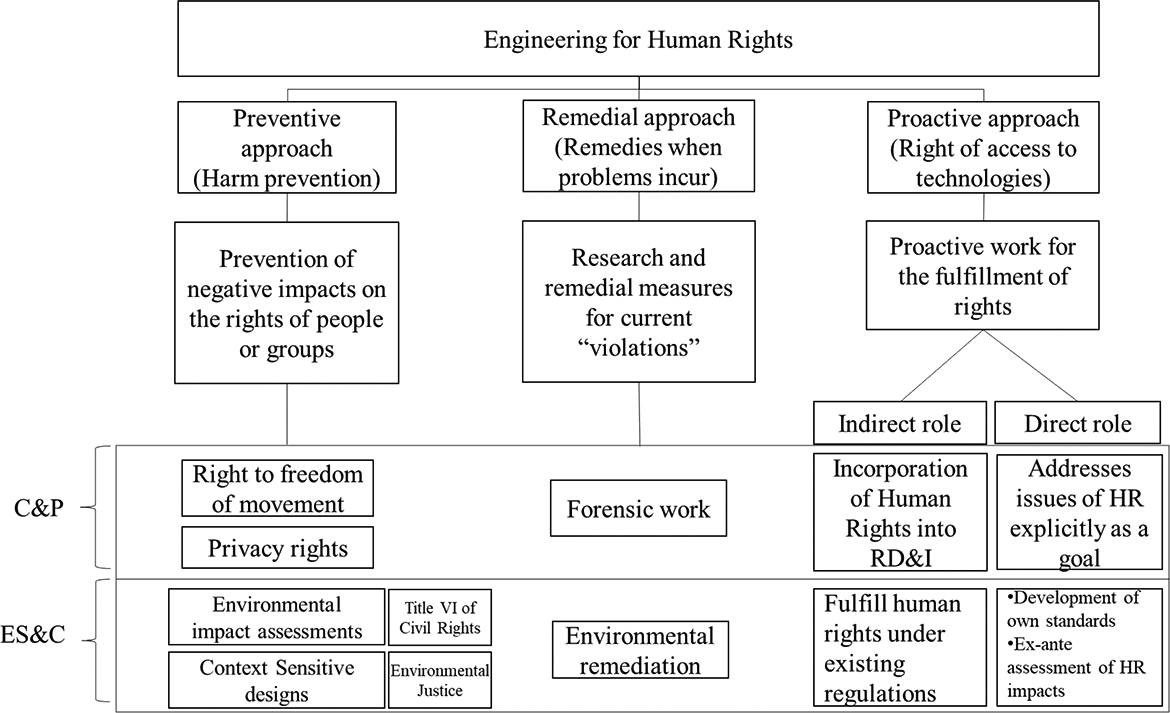
A proposed framework of Engineering for Human Rights. Right to freedom of movement refers to the right to liberty of movement and freedom to choose his residence (UDHR 1948, Article 13). For example, an engineering construction project cannot force migrant workers to stay in the country against their will. Privacy rights refers to Article 12: “no one shall be subjected to arbitrary interference with his privacy, family, home or correspondence” (UDHR 1948). C&P: civil and political rights; ES&C: economic, social, and cultural rights; RD&I: research, development, and implementation of projects and technologies; and HR: human rights.
The Engineering for Human Rights framework presented in this paper reinforces human rights–based approaches to development (UNDP 2019). Human rights–based approaches (HRBA) reaffirm the importance of economic, social, and cultural rights to achieving development, and frame poverty and inequality as human rights violations (Sano and Hansen 2006). People- and poverty-centered agendas influenced by HRBA, such as the SDGs, overlap with core economic and social rights, and contain stronger human rights language (Fukuda-Parr 2013). They are increasingly embraced by the engineering community, especially the SDGs (see UNESCO 2021). The following is our synthesis of the key principles that set the engineering for human rights paradigm at the center of the profession’s platform for teaching, research, and the practice of engineering in business, government, and other settings.
Five Principles of Engineering for Human Rights
Distributive justice. This principle captures the equity implications of engineering work in terms of the negative impacts, benefits, and risks across population groups and inter-generationally. Engineers must keep in mind that their work confers advantages and harm differentially across various segments of society, both now and in the future, which can harm the most vulnerable groups. Everyone in a community has a claim to the benefits of an engineering project. All sections of society must be considered in the impact assessment for any given project to ensure no disproportionate advantages are conferred upon one part of society over another. Particularly when considering uncertain future scenarios, the engineer should foreground concepts of resilience, vulnerability, and risk assessments in relation to both current and future generations.
Participation. Members of society have the right to participate in designing, constructing, maintaining, and/or operating engineering processes. The specific requirements for public involvement will vary across engineering disciplines and depend on specific projects or even the type of funding used. Regardless of such differences, participation is key to accounting for public interest(s) and impact(s). For example, the National Environmental Policy Act (NEPA) is a US environmental law directing projects that use Federal funding (or that require Federal approval) to engage the public throughout the project development phase and to consider public input before final decisions are made (US DOT 2012). In the United States, all executive branches of the federal government must implement NEPA. Engineering disciplines not regulated by this type of law are still subject to moral obligations toward the public interest (which is usually embodied in codes of ethics).
Consideration of duty-bearers. The state and other duty-bearers are responsible for the observance of human rights (United Nations Sustainable Development Group 2003). There are multiple “duty-bearers” with roles to play in implementing human rights (Fukuda-Parr, Lawson-Remer, and Randolph 2015; Sen 2004), and engineers are among them. By adopting a holistic approach, the engineer not only considers their core set of duties (to their employer, to the profession, and to society—see Manion 2002) but also becomes a duty-bearer jointly with policymakers, planners, and other professionals involved in engineering “system design.” Engineers can promote the development of and access to technology, as well as an obligation to use them responsibly. Engineers can play a key role in integrating corporate policy and social policies into their work environments.
Accountability. Engineers who are aware of their impact(s) on society should carry out evidence-based monitoring and implementation of human rights in the context of their work. This ongoing feedback is essential to ensuring accountability for both anticipated and unanticipated outcomes. All actors, including representatives of state and private agencies along with engineers and community members, must become aware that people are entitled to a set of rights that correspond to established targets and benchmark points. Creating accountability processes within engineering and technology development activity can be challenging, because technological developments occur in different phases across different teams. Traditional methods for ensuring accountability in human rights such as “naming and shaming” are not always possible or applicable (Land and Aronson 2018). As project development progresses and designs are streamlined for efficiency and accountability, tools such as life cycle assessments should be paired with mechanisms for human rights measurement and stakeholder involvement.
Indivisibility of rights. While rights may differ in scope and content, all rights are indivisible, interdependent, and interrelated (Vienna Declaration and Programme of Action on Human Rights, adopted 1993) and should be promoted as such. Engineers must take a comprehensive perspective when analyzing the potential impact of their work on society and the environment. Some forms of engineering may be more associated with particular types of rights impacts (such as chemical engineering and the right to health, or civil engineering and the right to housing), but engineers should consider potential synergies among rights when determining how their work will help or hinder rights enjoyment. By making the indivisibility of rights paramount, engineering as a profession can be equipped to avoid unintended consequences.
These five interrelated core principles can guide the work of individual engineers and the field more generally. Impact studies of engineering projects can be framed as core human rights principles to protect people from the harm of unintended consequences, to ensure greater levels of shared benefits, and to design effective remedies if and when problems occur.
For instance, a proposed highway project must be assessed with reference to the rights of people using the highways and living along the planned path, where the distributive justice principle calls for ensuring that those living on either side are not cut off from key resources such as schools, shopping areas, public transportation hubs, parks, or green spaces, for example. Similarly, the participation principle assigns designers the responsibility of engaging community members early in the design process, aligning with procedural justice. The consideration of duty-bearers requires engineers to think beyond the “problem-solver” mindset (i.e., focusing on technical problems only) by instead making them responsible for considering the context in which the designs are embedded. Accountability means creating or realigning metrics to more fully assess and mete out the project’s benefits, like improved access to jobs for everyone impacted or ensuring that no forced/child labor is used in the construction of the project.
Lastly, indivisibility calls for analyzing and reporting the project’s varied impacts on other human rights to ensure that the improvements in users’ travel time do not block other communities’ access to educational facilities, for example. By carrying out impact studies with explicit human rights criteria integrated into the cost–benefit matrix, we are in a position to remedy harm more precisely and effectively—in the process creating more ethical engineering practice.
Translating the Principles into Practice
Our five principles of engineering for human rights can be applied in everyday work by grafting them onto into engineering codes of ethics and practicing them in routine professional activity. However, making this shift will require training that many engineers do not yet have. We lay out below thirteen applied principles to guide the work of engineers to align with human rights principles. Land and Aronson (2018) suggested that a human rights–based approach to technology could draw both on human rights law and practice to guide technology design. Our applied principles use our five engineering for human rights principles to interpret the existing moral and ethical obligations of engineers. While rights have multiple dimensions, some rights may be weighted more toward one dimension than another—such as positive rights–based principles (e.g., access to housing and universal design for socially excluded groups) or negative rights–based principles (e.g., protection from discrimination against any member of a group). But rights are interdependent and not tradeable. Engineers have an obligation to ensure that engineering systems and designs do not exacerbate existing racial, gender, ethnic, or religious inequalities, and they should seek to redress past harms. For example, there is ample evidence that the construction of highways passing through urban centers in the United States has contributed to urban segregation. Using the preventive approach from our five principles, engineers should make sure that future projects do not lead to such segregation. Employing a remedial approach, they can work to mitigate the impacts of older projects by reconnecting city neighborhoods whenever possible. Engineers must ensure that engineered systems and processes are resilient to climatic extremes. Climate change impacts are global but affect the most vulnerable communities the most (e.g., people with disabilities and aging populations). Engineers need to make their engineering designs and processes accessible for persons with disabilities. Even in localities where accessibility is not required by law, engineers should strive to make their designs accessible for all persons. The end goal of any engineering design or process should be to improve the lives of users while not adversely affecting the well-being of other people or the natural environment in ways that significantly degrade their quality of life or that of future generations. Engineers should be cognizant of the impacts of their designs on all impacted stakeholders. For example, the construction of offshore wind farms may be environmentally beneficial overall, but engineers should mitigate the negative impacts of the project on people who rely on offshore fisheries for their livelihood. Engineers must ensure that their engineering designs and systems promote safe living and working conditions and are obliged to notify public officials if they identify unsafe conditions for any group in society, because human rights are universal. This obligation is critical even when speaking out will bring financial or reputational harm to the engineer’s employer or outrage from the public. Engineers should incorporate risk assessment in all designs to reduce human exposure to harmful impacts (e.g., toxic chemicals or pathogens). When engineers design a new product or process, they should ensure that the materials the customer is exposed to will not lead to an undue health risk. For example, although Bisphenol A is useful for producing many plastics, it can pose a health risk to humans, so alternative products should be explored or engineered. Engineers should consider the entire lifecycle of products and processes to ensure adequate end-of-life reuse or disposal that may affect adequate standards of living for vulnerable communities now and in the future. Engineers should conduct a lifecycle assessment that can pinpoint areas for improvement and prompt recycling or reduction of materials to minimize overall environmental impact. Engineers need to ensure that all voices in society are adequately represented in the design, construction, maintenance, use, and operation of engineered products or processes. To do so, engineers should present their projects or products to a wide range of audiences to gather feedback to minimize harm and broaden access. They should concentrate on the most vulnerable populations and those that will be most impacted. Examples include work focused on universal design, context-sensitive design, and equitable design. Engineers should seek to expand access to technologies and alleviate the conditions that perpetuate poverty and social exclusion, so as to improve standards of living, especially for vulnerable groups. Engineers have an obligation to use their skills and knowledge to ensure that the principles of universality, interdependence, and nondiscrimination apply to marginalized individuals and groups. Engineers should consider and aim to improve intrinsic political, civil, and economic rights of all persons, including freedoms of assembly and expression, while ensuring that such platforms seek to promote civil discourse among stakeholders and duty-bearers. Engineers should set targets and concrete benchmarks for ensuring that their work contributes to the fulfillment of civil and political rights, as well as the progressive realization of economic, social, and cultural rights. Examples include efforts to generate indicators of the progressive realization of economic, social, and cultural rights (Fukuda-Parr et al. 2015). Engineers should adopt holistic approaches reflective of the interdependent and indivisible nature of rights and of the fact they apply to everyone “regardless of race, sex, nationality, ethnicity, language, religion, or any other status” (Universal Declaration of Human Rights 1948). Engineers should create feedback mechanisms that enable community members affected by a given project or technology to be heard and submit complaints regarding rights violations and also more generally to be in a position to partner with state and corporate actors responsible for such projects. This feedback loop promotes empowerment and enhances the overall agency of community members, for example, through the use of appropriate technology (see Frey et al. 2012, in the context of Duchity, Haiti).
Conclusion
The emergence of engineering for human rights as a framework for engineering practice reflects the convergence of two trends. First, engineers and engineering organizations are gaining awareness of the extent and unevenness of their impact on society and the natural environment. Second, the necessity and urgency of evidence-based measures, monitoring, and accountability for human rights have burgeoned since the 1990s (see Gibney and Haschke 2020). The human rights perspective is significant because it incorporates the idea of social good as an objective, as well as specific norms and parameters based on international law and human rights practice.
A human rights–based approach to engineering is a new paradigm for the twenty-first century that frames ethical principles engineers can use both to understand their role in society and to translate aspirations for social and environmental good into projects with tangible outcomes. Given the emergence of new technologies driven in part by engineers themselves, there is a pressing need for systematic analysis of the potential consequences of such change over time. Engineers should be aware that the positive and negative impacts of technology are not equally distributed within society; instead, distribution skews in favor of existing power imbalances. Furthermore, a retrospective analysis of engineering work can help identify implicit and explicit biases in the design, implementation, and maintenance of technology. 10
The human rights–based approach to engineering proposed in this article has three broad advantages over alternative approaches: it allows for a more comprehensive set of goals, it incorporates existing ethical approaches currently used by engineers (which are valid for the engineering accreditation processes), and it provides a new avenue for innovation. This paradigm is grounded in a universal set of principles that both shape individual ethical obligations and influence the norms of the profession in order to prevent risk, enhance access to the benefits of technology, and redress harms resulting from engineered products or processes. Grounded in our five fundamental principles (distributive justice, broad participation, explicit consideration of duty-bearers, accountability for all actors involved, and indivisibility of rights), engineering for human rights offers significant synergies with literatures such as STS and existing policy frameworks (e.g., engineering for social justice) but moves beyond them in ways that could transform professional education, practice, and impact.
Footnotes
Declaration of Conflicting Interests
The author(s) declared no potential conflicts of interest with respect to the research, authorship, and/or publication of this article.
Funding
The author(s) received no financial support for the research, authorship, and/or publication of this article.
