



Abstract
This article draws on long-term engagement with the Human Brain Project (HBP), one of the Future and Emerging Technology Flagship Initiatives funded by the European Commission to address EU “grand challenges” of understanding the human brain and applying these insights to brain-inspired technology development. Based on participant observation and interviews with researchers and project administrators, our findings suggest that the formal infrastructure built to facilitate and structure collaboration within large-scale interdisciplinary research projects can be in tension with the ways researchers collaborate. While much of the literature on infrastructure focuses on top-down, formal infrastructural design, we also pay attention to the informal, bottom-up infrastructural assemblage involved in large-scale interdisciplinary collaborations. This brings into question how scientists and science funders navigate the tensions and interactions between formal and informal infrastructure, rendering certain kinds of collaboration and knowledge (in)visible.
Introduction
To stimulate the hoped-for ground-breaking science that will address societal “grand challenges,” science policy makers and research funding bodies increasingly stress the need to create wide interdisciplinary networks of researchers and durable research infrastructures. While interdisciplinary collaboration and research infrastructures have each been separately explored in STS, this article explores the implications of collaboration becoming a prime goal of international research infrastructure projects. Drawing on more than six years of full-time engagement with the Human Brain Project (HBP), we argue that formal infrastructure built to facilitate, structure, and measure collaboration within large-scale interdisciplinary research projects is often in tension with the way researchers collaborate, revealing the existence of informal collaborative infrastructures alongside and intertwined with formal infrastructures of collaboration.
The HBP is one of the two Future and Emerging Technology Flagship Initiatives funded by the European Commission (EC) from 2013 to 2023. It is a uniquely large multidisciplinary collaborative project set to address the grand challenge of understanding the human brain and apply these insights to brain-inspired technology development. To this end, the HBP assembled more than five hundred scientists from a hundred institutions in twenty European countries to jointly build and deliver EBRAINS, a shared digital research infrastructure for neuroscience, computing, and brain-related medicine. This digital infrastructure provides certain services to facilitate collaboration among researchers, ranging from curated databases for neuroscience and medical data and software, to access to 3D animal and human brain atlases, as well as the provision of high-performance computing for large-scale modeling and simulation. As a research consortium aiming to create a research infrastructure to foster interdisciplinary collaborations, the HBP is especially suited as a case study to explore the relationships and dynamics between collaboration and infrastructure in large-scale science.
In the EU context, research infrastructures are defined as “facilities that provide resources and services for research communities to conduct research and foster innovation” (EC n.d.). This framing focuses on the scientific equipment or instruments, databases, and/or computing systems and communication networks that make up research infrastructures. Social and historical studies of infrastructure, however, have tended to focus on the social and political networks and structures that enable the development, running, and maintenance of an infrastructure, bringing to the fore the nontechnical dimensions and decisions involved in building, regulating, managing, and using them (Bowker et al. 2010; Edwards et al. 2013; Edwards 2019; Kornberger at al. 2019; Larkin 2013; Lee et al. 2006; Simone 2004; Star 1999). The HBP research infrastructure, specifically, is a knowledge infrastructure—a network of people, artifacts, and institutions that generate, share, and maintain knowledge about the human and natural worlds (Bowker 2016; Edwards et al. 2013; Karasti et al. 2016). We agree that infrastructures are “complex, adaptive sociotechnical systems,” made up of technical and social agents and components (from buildings and software to standards and organizations), as well as “human individuals” who develop, maintain, and use these infrastructures (Edwards in Kornberger et al. 2019, 356).
Yet attention to the human and social dimensions of infrastructure often focuses on formally organized knowledge production and maintenance. Erickson and Sawyer (2019) have noted that “infrastructures are not always large-scale systems, but sometimes rather mundane structures set into place by individuals to accomplish their quotidian goals” (p. 331). In order to pay attention to the informal, distributed, and collaborative forms of infrastructural organization, they propose to think of what they call “the contemporary knowledge worker” as an “infrastructural bricoleur” (Erickson and Sawyer 2019, 321-22). Knowledge workers draw on a “bricolage of material, mental, social and cultural resources to adapt to seamful situations and advance accordingly” (Erickson and Sawyer 2019, 324). The knowledge workers in our study—scientists and engineers contributing to the HBP—similarly behaved as infrastructural bricoleurs in their daily work, bringing together various tools and techniques out of convenience and necessity in order to grow and sustain the human collaborations underpinning their research.
In this article, we attend to formal as well as bottom-up, tacit, and informal practices to describe how scientists and engineers draw on an assemblage of tools in large-scale interdisciplinary collaborations. Infrastructure has often been explored as a formal technology of the state, working against or at odds with more informal systems and structures that citizens may have already developed for transportation, labor, or utilities (Larkin 2013). Formal infrastructures are often disconnected from people’s everyday practices and do not acknowledge already existing forms of cooperation. Of course, the categories of formality and informality are not fixed or mutually exclusive: people move between formal and informal activities and arrangements (McFarlane 2012). In the case of the HBP, our research demonstrates that scientists and engineers frequently rely on an informal, bricolage infrastructure to collaborate, but that these forms of collaboration are not always embedded in the formal HBP research infrastructure, which is meant to facilitate and organize collaborations within and outside of the project. This brings into question how scientists, management, and science funders navigate the tensions and interactions between formal and informal infrastructure, rendering certain kinds of collaboration and knowledge (in)visible.
Formal and Informal Infrastructures of Collaboration
Interdisciplinary collaboration and research infrastructures are well-explored topics in STS. So too has the role of collaborative networks in building and sustaining research infrastructures. What has been little studied, however, is whether and how research infrastructures foster and support interdisciplinary collaboration. In this paper, we bring into conversation the literature on formal and informal research collaboration with the literature on formal and informal infrastructure more broadly—which so far have been treated separately. This interdisciplinary conceptual orientation is important to understand the challenges presented by large-scale collaborations that both produce and require large-scale infrastructure.
Our study draws from different bodies of scholarship, coming from different research fields. First, we draw from the literature on research infrastructures in social and historical studies of science. Second, we draw on collaborative and interdisciplinary research situated across interdisciplinary studies, science and technology studies, policy studies, and the sociology of organizations and of work. We pay special attention to studies of international research collaboration that emphasize the formal and informal dimensions of such collaborations. Finally, we draw on literature in development studies and urban studies that focuses on informal and formal infrastructures.
Formal and Informal Collaboration
Over the past two decades, studies have paid attention to various aspects of international research collaborations such as the rather recent phenomenon of global research cooperation between industrialized countries (Georghiou 1998), how geographically distributed researchers establish and run collaborative cyberinfrastructure projects (Lee, Dourish, and Mark 2006), the resilience of international research collaborations over time (Ulnicane 2015), their evaluation (Rogers and Bozeman 2001), their drivers (Engels and Ruschenburg 2008), and more.
Despite their varied topics, these studies consistently distinguish between formal and informal collaborations and emphasize the importance of their dynamics. For instance, Georghiou (1998) examined how formalized global cooperation started catching up with informal bottom-up global cooperation and the relations between the two forms of cooperation. Rogers and Bozeman (2001) analyzed the interplay of formal and informal elements of collaboration which they conceptualized as a superior alternative unit of evaluation to the research project. The formal/informal distinction may be present even when authors do not make explicit use of it. For example, in their study of a distributed cyberinfrastructure project, Lee, Dourish, and Mark (2006) discuss how personal networks (i.e., informal means of collaboration) augment collaboration across the project. These become part of its human infrastructure by adding to its more traditional organizational structures like working groups (i.e., the formal collaborative infrastructure).
The most ambitious and detailed articulation of formal and informal means of collaboration, and of their respective roles in the expanding international collaborative research landscape, comes from Ulnicane (2015, 2021). Ulnicane has built a midrange theoretical process model of long-term international collaboration based on multiple in-depth case studies and drawing from a diverse range of methods and data sources to analyze the “emergence, trust and motives [of international collaboration]…complementarities between formal and informal collaboration,…thematic and organizational continuity and renewal,…and the virtuous circle of reinforcing results and feedback loops” (Ulnicane 2015, 440). Ulnicane’s theoretical approach is especially pertinent for our study because it articulates the potential complementarities, and thus respective contributions, of both formal and informal collaborations. Her study takes a long view going beyond the fixed-term project as unit of analysis in order to capture “long-term collaborations maintained beyond fixed-term projects” (Ulnicane 2015, 435). More recently, Ulnicane uses her theoretical model to investigate self-organization versus steering in international research collaborations to show that in successful collaborations, the two can reinforce each other, allowing collaborations to grow in the long term (Ulnicane 2021).
Against the backdrop of scientific and political factors pushing the intensification of international research collaborations (Chou and Ulnicane 2015; Wagner, Park, and Leydesdorff 2015), our empirical study adds to these discussions and bridges with the infrastructure studies corpus by showing how enacting collaboration can become a prime goal of international research infrastructure projects. In the process, we show how formal infrastructures of collaboration interact with existing informal collaborative infrastructures.
Formal and Informal Infrastructure
Many studies on infrastructure begin their analysis with Star’s (1999) assertion that infrastructures only “become visible on breakdown” (p. 380). Ethnographically studying infrastructures, Star (1999) suggests, entails surfacing, or revealing, the invisible labor involved in building and maintaining them (p. 385). In this vein, Lee, Dourish, and Mark (2006) argue that there is often a human infrastructure that underpins large-scale distributed collaboration in “big science” projects. Their study goes beyond making visible the social groups underlying infrastructures and argues that these groups are themselves an infrastructure.
In urban and development studies, references to a human infrastructure usually occur when formal infrastructure fails to provide for people, and an informal infrastructure emerges in its place. For instance, Simone (2004) talks about “people as infrastructure” when describing how residents in Johannesburg engage in dispersed economic practices in the absence or failure of regional and global governance. In the case of the HBP, informal mechanisms of collaboration do not necessarily result from a failure or absence of governance. It is nonetheless a useful perspective for examining how sweeping changes in the HBP’s objectives and organization (which we discuss further on) affected its formal infrastructure and how the informal collaborative infrastructure responded to these changes. In particular, it highlights that moments of infrastructural disruption are privileged opportunities for capturing the existence of informal infrastructures and their interplay with formal infrastructures.
We draw on literature about formal and informal infrastructure to help explain how formalized mechanisms in the HBP designed to facilitate collaboration often bypassed existing informal mechanisms. In a study on infrastructure and urban density in Mumbai, McFarlane (2012, 103) shows how “new bureaucratic institutions do not embed into informality because they are seen as cumbersome, time-intensive, and out-of-touch with people’s everyday worlds, perhaps because they bypass forms of authority and cooperation that people already use.” However, McFarlane demonstrates that new institutions can become embedded into informal infrastructure through bricolage. Bricolage, he argues, blurs the lines between formal and informal, one embedding into the other or resisting it in a dynamic, everchanging reconfiguration. For McFarlane, bricolage is how formal and informal infrastructure come together in tension-filled ways. This perspective can add to Erickson and Sawyer’s (2019) notion of infrastructural bricolage that helps us consider how bricolage may result from informal practices intersecting and interacting with the formal infrastructure of large sociotechnical systems. In the case of the HBP, we see both notions of bricolage at work: as a bricolage of tools, both formal and informal, as well as the overarching bricolage structure of how scientists are collaborating. Our research suggests that scientists and engineers frequently rely on an informal infrastructure to collaborate, and this form of collaboration only sometimes becomes embedded in and becomes visible through the formal HBP research infrastructure, which is meant to facilitate and organize collaborations within and outside of the project.
There are limits to extrapolating work that has been conducted in Mumbai and Johannesburg onto a completely different environment and context such as neuroscience laboratories in Europe, because the stakes are very different. The consequences of a breakdown of an essential service infrastructure, such as sanitation in India, is not comparable to a breakdown of digital research infrastructure in Germany. And yet this literature helps us make the argument that formal infrastructure “from above” often overlooks informal collaborations and infrastructure that people build and maintain, and helps to highlight that formal and informal infrastructures can intersect and shape one another in ways that render some ways of doing and thinking visible or invisible.
Method
This article is based on research conducted continuously between 2014 and 2020 by the Foresight Lab at King’s College London. More specifically, it draws on participant observation of meetings between scientists, engineers, and project administrators; a total of eighteen interviews with infrastructure users and developers; and analysis of HBP and EC documents relating to community building, collaboration, and infrastructure development conducted in 2017-2019.
Our methodology is unconventional because the research was conducted when we were both embedded social scientists, employed full-time by the HBP in its “Ethics and Society” subproject. Collaboration and community-building were not research topics for our “work package” deliverables, save for a short period in 2015 when we redirected our planned foresight work for future neuroscience toward addressing possibilities, issues, and practicalities in collaborative neuroscience (Changeux et al. 2016, 7-14; Rose et al. 2015b). Otherwise, between 2014 and 2016, our main objective was to conduct foresight work to identify and evaluate potential social and ethical implications of new knowledge and technologies developed by the HBP (Changeux et al. 2016, 7; Rose et al. 2015a; Rose et al. 2016). Between 2016 and 2018, we worked on developing a framework for understanding dual use and misuse issues that go beyond the dualistic military/civilian applications of neuroscience research and neurotechnologies (Aicardi et al. 2021; Mahfoud et al. 2018). And later between 2018 and 2020, we worked on the ethical implications of brain-inspired computing and Artificial Intelligence (AI), as well as the clinical translation of computational brain models (Burton et al. 2021; Ethics & Society et al. 2021).
However, through participation in HBP scientific workshops and conversations with scientists and engineers in the HBP, we found the need to pay attention to how collaborations were being initiated and conducted in the project. The HBP is an unprecedented large-scale project involving more than 500 scientists and engineers in more than 100 institutions across Europe. This presents unique challenges to the management of the collaborations necessary to achieve its scientific goals. As such, it is an experiment in large-scale collaborations and in the development of infrastructure to create, monitor, and measure those very collaborations.
The importance of studying and fostering collaboration in this unique context was recognized by scientists, engineers, and members of the Ethics and Society subproject. This shared interest led to the organization of a workshop on “Building a Neuroscience Community: Community Modelling and Data Repositories” in June 2015 at the Fondation Brocher, which brought together scientists and engineers from across the HBP (Rose, Aicardi, and Reinsborough 2015). The findings from the workshop were developed by the two co-authors into a proposal to conduct a case study on community building and collaboration in the HBP. This case study forms the basis of this paper. Interviewees were selected to represent various levels of expertise ranging from experimental neuroscientists to computational neuroscientists, to hardware developers and project administrators. We specifically selected key actors in conducting and/or fostering interdisciplinary collaboration within and beyond the HBP. Our selection process was guided by knowledge developed over more than six years of full-time engagement by both authors in the HBP.
The questions posed to participants aimed to establish their views about differences between collaboration in science and in engineering; what they considered to be good collaborations and the features that made them so; whether collaboration required specific skills and forms of expertise; how participants became involved in various HBP collaborations; how participants organized and managed their collaborations; and how they evaluated the tools and instruments that the HBP provides for collaboration. We conducted a thematic analysis and used inductive coding to identify themes. The overarching themes we identified through this process were a distinction between formal and informal infrastructure by the research participants, as well as their concerns about the visibility or invisibility of collaborations in the HBP.
Developing Scientific Collaborations
Although the HBP was presented as a ten-year project ending in 2023, it has been funded as four successive phases by the EC, with each phase as a distinct project from an administrative perspective. 1 This “sliced” funding structure underpins regular adjustments to the objectives and organization of the project. One particularly sweeping adjustment occurred in 2015-2016 between the first and second phases of the HBP, which has since significantly shaped its direction.
In 2014, just ten months after the project was launched, more than 800 neuroscientists across Europe and the United States signed an open letter expressing concerns about the scientific feasibility of the project, and about its governance. 2 These concerns were addressed in the EC’s first annual review of the HBP early 2015, resulting in prescriptive recommendations to its leadership. One major recommendation focused on developing closer collaboration between different groups of scientists and infrastructure developers within the project and on building a user community within and outside of the HBP that would help develop and use the different infrastructural services. The second main recommendation was to transform the loosely interconnected infrastructural services into an integrated research infrastructure. These recommendations served to ensure the achievements of the HBP would not be an isolated program of research but would endure beyond the lifetime of the project itself, representing a durable contribution to the European research and innovation landscape. This was a recurring discussion between the HBP leadership and the EC throughout 2016-2020, geared toward the application by the HBP to the European Strategy Forum on Research Infrastructures (ESFRI). If successful—as it has since become 3 —this could help give the HBP continuity and financial support from participating EU member states, and further enact close continuing international collaboration between many of the national research institutions involved in the HBP. To apply for ESFRI funding, the HBP needed to demonstrate that it had a growing community, which prompted the development of various Key Performance Indicators (KPIs) and tools to engineer, monitor, and record user numbers and collaborations through the developing infrastructure.
Successful research collaborations often begin as smaller groups and, over time, grow through the development of collaborative working practices (Ankeny and Leonelli 2016). Indeed, both research policy studies and studies of interdisciplinarity highlight the long temporality of interdisciplinary collaboration, ill-suited to the rather short-term focus of research projects. Nonetheless, short-term projects remain the main funding, reporting and evaluation unit in research. Some research policy studies argue for units of analysis that go beyond the fixed-term project because “it does not take into account such important aspects of longer-term collaborations as: pre-existing relationships of the scientists and organisations involved (Defazio, Lockett, and Wright 2009; Genuth, Chompalov, and Shrum 2000), informal collaboration (Georghiou 1998), and repeated interactions and intellectual relationships (Porac et al. 2004)” (Ulnicane 2015, 435). The project focus may be “most convenient because it matches bureaucratic accounting schemes,” but it belies “actual work practices” (Rogers and Bozeman 2001, 24). Meanwhile, studies of interdisciplinary collaborations have repeatedly highlighted that it takes time to develop and work on longer time cycles (Barry 2007; Bridle et al. 2013; Cuevas-Garcia 2015; Shanken 2005).
The HBP itself was born from the coming together of smaller preexisting scientific collaborations in Europe that had developed shared methods, resources, and skills over time. 4 These collaborations have remained in the HBP, and we suggest that they are part of the informal infrastructure that supports continuing and developing collaborations in the project. Yet these longer-standing communities were exactly what many critics of the project maintained would stand in the way of developing the open and inclusive scientific communities required for a European big science project (Mahfoud 2021). While the longer-standing collaborations were crucial for establishing the legitimacy of the project for the EC funders, thereby demonstrating the likelihood of continuing and robust collaborations necessary to achieve the aims of the project, they also needed to ensure that the HBP itself added value to neuroscience research by developing novel research and collaborations.
Following the 2015 EC technical review and its recommendations, the co-design projects (CDPs) were introduced by the EC and HBP project management to promote intra-project collaborations. The aim of the CDPs was to find synergies between research groups across the scientific and infrastructural parts of the HBP and thus to implement a user-led design approach to building the HBP infrastructure. In so doing, they aimed at de-siloing the HBP by fostering multidisciplinary collaborations across the project. Following a process of ideas generation, thematic group discussions, selection, and planning, five CDPs came into existence at the start of the second phase of the HBP in 2016. They varied in their level of success, but they were successful enough overall that they continued into the following phases, with the addition of three more CDPs. However, many of these CDPs emerged out of already-existing collaborations that predated the HBP.
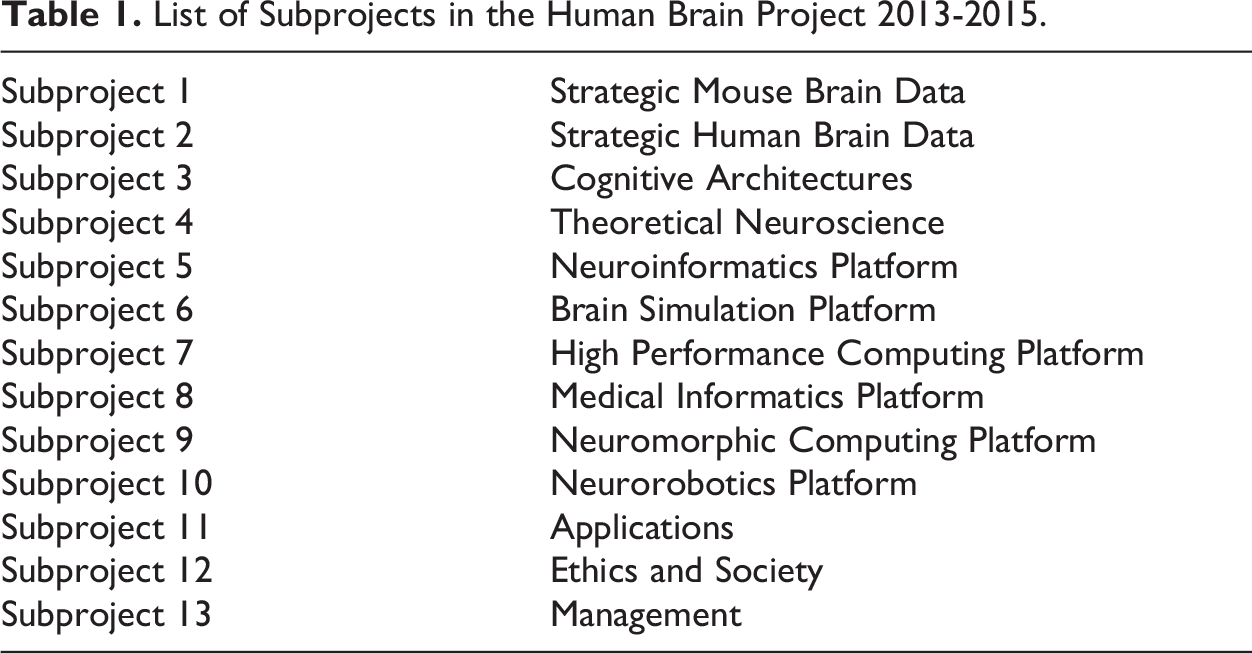
The HBP was initially organized into thirteen subprojects (Table 1). The subprojects were initially the bureaucratic mechanism through which the project was governed, but it became clear that researchers were simply continuing work they had started before the HBP. This is unsurprising in view of the well-established pre-existing collaborative networks present in the HBP, and it aligns with Ulnicane’s findings that “when the project partners have a history of repeated interactions and intellectual relationships, a new project is just a funding mechanism to continue their already productive and routinized collaboration on their common research topic” (Ulnicane 2015, 443). As an HBP researcher said: CDPs came in [the second phase of the HBP], through a disruptive intervention by the EU [which] began to realize that the governance that they were setting up in terms of [subprojects] was not working because people just kept doing whatever they were doing before with no collaboration across subprojects. The EC realized that, and they tried to force collaboration between subprojects. This was the reason for creating the CDPs—they were supposed to be projects that were involving different groups from different subprojects. However, they did this without giving the CDPs any money so again people were trying to figure out how to keep doing whatever they were doing before.
List of Subprojects in the Human Brain Project 2013-2015.
The CDPs were perceived by HBP researchers as another bureaucratic mechanism to both enforce and assess new collaborations within the project. Yet as the excerpt above implies, these often served to reinforce existing collaborative networks. A computational neuroscientist we spoke with explained how the CDPs as a mechanism of/for collaboration supported preexisting collaborations: CDPs are intended to be these transversal, cross-disciplinary mechanisms and I guess for me, because of my existing collaborations, I was already part of existing informal transversal linkages between subprojects. Being involved in three subprojects with a lot of overlapping, in itself, has been one of the transversal mechanisms…. In many cases, people had worked together previously and so in those cases [the CDPs] possibly weren’t essential but they did help to focus resources and attention on certain topics and, in a sense, gave people a structure and an excuse to collaborate more closely together. But I think, maybe, some of those collaborations would have happened anyway.
The HBP’s long-term funding commitment was partly designed to allow research communities to develop over the ten-year time frame, despite this being somewhat hindered by the two-year funding slices structure. Preexisting communities were vital to the success of collaborations we describe in this article, yet informal collaborations and their associated informal infrastructure can reinforce existing power dynamics and exclusionary boundaries. Informal collaborations that rely on existing infrastructures and networks often do not allow for new voices to be added in the way that formal collaborative structures might. Steered, formal collaboration allows for renewal and expansion (Ulnicane 2021). The 2014 HBP controversy highlighted the exclusionary nature of the informal networks that predated the HBP and ensuing reforms to the governance of the project put in place new mechanisms (such as the CDPs) to bring in new people into the project. There is a tension, then, between needing slow-growing communities to develop over time to become the basis of larger-scale projects and how long-standing communities can become exclusionary to new communities of researchers.
Building Collaborative Spaces
If the HBP was to become a research infrastructure, seamlessly delivering different but interconnected services (from data to models to computing time), these needed to be accessible to users through a common portal. The Collaboratory was envisioned as a digital space where researchers could access these different services, interact with users from within and outside the HBP, and collaborate on different research problems in this digital laboratory setting. Initially only open to HBP researchers, external researchers could only gain access to the Collaboratory by application or invitation.
The Collaboratory achieved varying degrees of acceptance even among HBP users. For one modeler in the HBP, the Collaboratory was helpful for internal collaboration because of the embedded Jupyter Notebooks, an open-source web application that enables creating and sharing code, equations, visualizations, and text: The Collaboratory, I think, has been quite valuable, in particular the shared documents, even if people…ended up using just Google Docs, just because it was…more powerful and reliable. That might change now with this Collaboratory [2.0] and the better live editing tools they have there. Probably the main benefit of the Collaboratory for my work has been the Jupyter Notebooks and providing this…service I think has…been very valuable for internal collaboration. So if you want to demonstrate something technical to someone, the easiest way is to create a Jupyter Notebook, write down the code and it embeds all the figures and results in there and then you say, okay, look at this, and then they can…see how to do it and adapt it for their own needs and so forth. So, for me, probably the Jupyter Notebooks have been the key tool for collaboration.
By contrast, other HBP modelers who work with researchers external to the project have not found the Collaboratory helpful: The Collaboratory never came to such a point that it was really helpful. We…tried to use it for teaching, such as at HBP schools, but we could not use it for teaching at university because then people need to get access, and this was complicated. It did not have the flexibility we wished it to have…it was never a place where you could together develop or further develop a project.
While the formal HBP infrastructure was initially intended mainly to serve the internal HBP community of researchers, providing standardized data and computing tools to support neuroscience research, the effects of the 2014 controversy and 2015 review shifted the project’s priorities to make the broader neuroscientific community (however broadly and ill-defined that category was) as the primary user. Moving infrastructure building to the forefront of the HBP’s objectives had major implications for the project. The HBP now had to think past the end of its funding in 2023 to address questions about how to ensure the sustainability of the distributed, networked research infrastructure that would be its main legacy. This also meant that the HBP had to start thinking about who might constitute its potential user communities beyond HBP collaborators, and beyond the end of the HBP. Moreover, this enduring Research Infrastructure that the HBP was to become, catering for the broadest possible user base, no longer had a well-identified and delimited scientific goal. As a result, HBP researchers were increasingly unclear about the nature of the interdisciplinary research that they were to engage in. One neuroscientist put it this way: The scope of the project changed. Every time there was a problem with the governance the scope of the project changed—from science and ICT to a research infrastructure…basically from a research project and ICT project to a research infrastructure in its general form, without any specific scientific role and without any specific innovation role.
For members continuing previous collaborations, much interaction took place online, over email, in what they called “virtual space.” However, our interviewees recognized that physical meetings were also needed. This is a finding that complements what many other social scientists, such as Lee, Dourish, and Mark (2006), have reported about the rise of digital technologies for collaboration. Annual summits helped balance between virtual and physical spaces of collaboration. The HBP summits are three-day gatherings in different European cities where members of all the subprojects come together to share ongoing work and participate in plenaries and parallel meetings. These annual summits help synchronize asynchronous research timelines across the project. As part of the summits, each subproject holds formal annual collaboration meetings, which have also become a part of the informal infrastructure of collaboration—a space to meet new people and pursue informal research interests during coffee breaks and over lunch. Our interviewees felt there is a need for more HBP-wide meetings but acknowledged the economic cost and the carbon cost of EC projects, and the importance of ensuring that meetings were not redundant.
The need to collaborate at the project-wide scale, without enough dedicated resources to do so outside of the summits, meant that other parts of the HBP began to take on the role of creating physical spaces for collaboration. One of these is the European Institute for Theoretical Neuroscience (EITN), based at the French National Centre for Scientific Research in Paris, which aims “to serve as an incubator of ideas and foster the exchange of ideas between theoreticians and experimentalists, inside and outside the HBP” (Fregnac et al. 2018a, 3) through workshops, a visitor program, and for a time between 2014 and 2018, through co-supervised postdocs (Fregnac and Destexhe 2016; Fregnac et al. 2018a; Fregnac et al. 2018b; Destexhe and Messier 2020). The EITN provided a free space in the center of Paris for organizing workshops of around twenty-five participants. One downside was the exorbitant price of accommodation in Paris. Still, many research groups in the HBP used the EITN facilities to bring together experimentalists and theoreticians from across and outside the HBP.
Another HBP instrument that was somewhat repurposed into creating physical spaces for collaboration is the HBP Education Program. Then based in the Management subproject, the HBP Education Program organizes online courses, summer schools, and student-led conferences. A senior researcher explained to us how to circumvent the obstacle of the HBP providing very little travel money for physical meetings, his lab used the HBP Education Program’s support to develop collaborations with researchers outside the HBP. This shows how components of the formal infrastructure were sometimes appropriated and repurposed to create informal meeting spaces—another instance of infrastructural bricolage (McFarlane 2012).
An advantage of the EITN and education meetings was that they provided a space where researchers could feel somewhat protected from the permanent gaze of the HBP’s evaluators—a friendly space where they could exchange ideas informally, which is important for the growth of interdisciplinary communities (Aicardi 2014). This stood in contrast to the rise of project management tools to facilitate and monitor collaborations, which we discuss next.
Infrastructural Accountability and Invisibility
After the major change of governance and overall direction of the HBP in 2015, the HBP’s main project management tool (called EMDESK) was considered insufficient to support and monitor the heightened level of coordination and collaboration demanded by the EC project officers and reviewers. In order to show that more collaborations were happening across the HBP and that the management had a grip on coordinating, organizing, and directing the Project, it was felt that a finer-grained parcellation of the work was necessary. Each Task was now to be split into a number of elementary “components.” Components were to be associated together into “workflows” through links of “dependencies,” constituting “use cases” that would lead the infrastructure’s design. This particular work planning and management model was explicitly inspired by modeling approaches used in information systems design and software engineering, such as the Unified Modeling Language. As such, this specific parcellation of work was familiar to computer scientists and engineers whose work in the HBP was also the most easily translatable into this modeling approach. This was not so much the case for many other researchers and their tasks. Yet from late 2015, all the HBP’s planning and monitoring was required to follow this model.
The custom-built software provided by the Management subproject to capture this modeling work was known as the Project Lifecycle App (PLA). Initially a small application for limited internal use, it was first coded by a nonprogrammer in the Project’s Coordination Office (PCO), with the aim of demonstrating that the HBP’s management had both knowledge and control over what was going on in the Project. The visualizations of interconnections provided by the PLA pleased both the HBP management and its external governance. These rendered a peculiar interpretation of collaboration visible, wilted down to upstream/downstream dependencies between the products of HBP’s work chunks. The PLA never reached a satisfactory level of user-friendliness and created much ill will across the HBP for its lack of usability, slowness, instability, and also for its underlying model, which was poorly suited to certain parts of the HBP’s work. Some worried that this could eventually discriminate in favor of certain disciplinary contributions against others that were less amenable to its modeling approach. But there were other concerns.
The PLA was initially presented as a tool that would make collaborations happen by making their potentiality visible, and hence would foster a lively HBP community. Technological solutionism (Morozov 2013) was thus used to address a largely social question. But it was always unclear how this visibility would be used for reporting purposes. Some thought it could enhance both communication and reporting, but PLA skeptics argued they were not prepared to crystallize their unfolding collaborative work in this way, because it was often in an early and tentative stage of development. They were concerned that it would not just make it visible to EC project officers and reviewers, but that it would also become subject to accountability in the form of fixed targets and time frames. The PLA was intended to help enable HBP researchers to identify potential collaborators within the HBP and to catalyze the development of an interdisciplinary research community. Technological tools such as the PLA were always unlikely to achieve these objectives on their own. And once they became tools for monitoring and evaluation, their potential to enhance genuine researcher-led collaboration was greatly reduced.
As bureaucratic mechanisms, structures like the CDPs and the PLA form an infrastructure that offers the tools needed for neuroscientists to digitally collaborate, that introduces new collaborations in order to demonstrate the added value of the project itself, and/or formalizes existing collaborations in the project (many of which predate the HBP). It is well-known that top-down driven infrastructures (scientific and otherwise) often fail to integrate into informal mechanisms of cooperation because they do not attend to the specificities of how people work together (Larkin 2013; McFarlane 2012). In the case of the HBP, the formal infrastructure of collaboration did introduce new institutional members to the HBP but, as we discuss above, it was partly intended to hold scientists accountable to their promises and commitments. Our interviews with new members suggest that the formal infrastructure did not do a great deal to start new collaborations, but it did render existing collaborations visible. So while the formal infrastructure rendered some informal collaborations visible, other informal collaborations remained invisible because of the bureaucratic labor required to record their collaborative work.
As explained earlier, the CDPs and the PLA were key formal infrastructural components introduced to frame the HBP in the language of user-led design, which sought to make the HBP more visibly collaborative in response to reviewers’ recommendations, and in order to get the next phase of funding approved by the EC. For example, a member of the neuroinformatics team told us: It was clear that to build the [brain] atlas, you have to connect many subprojects anyway. These links were already somewhere in the work plan in the form of dependencies between different task outputs, or deliverables, or whatever. But these were, at that point, not formalized. They were mentioned in task descriptions, but they were not really visible on the surface. We then started to actually draft these documents and proposals to say “okay, if we have co-design projects, we can make that clearly visible.”
While the EC and the HBP management were pushing to encourage collaborations within and outside of the project through the CDP structure and make them visible through enhanced formal mechanisms such as the PLA and dedicated regular reporting, which came in addition to already existing reporting, there was little incentive for researchers to do the extra work. In the interviews we conducted, there was reflection on whether the bureaucratic labor involved in formalizing the collaborations and making them visible through the CDP structure, for example, was worth the effort. The CDP, for me, it was really a lot of work, a lot of paperwork. It turns out that the CDPs, they do not provide any additional funding, but they are just another structure defined on the same resources. So, in the end, I ended up basically writing twice the amount of reports…I suggested that we simply do not continue the CDP because most of the goals were reached…and because of the reporting to be honest. Then it received a very good assessment in the review…and the reviewers specifically asked to continue the CDP. I was saying “well it will continue anyway; the question is if it formally continues and I have to write all these reports.” So, it was actually in practice never a question of doing the work. That would have happened either way. It was the question of having it formally visible.
The benefit of formalizing the collaborations, of naming them, did not help with the allocation of resources but did help to build a research community. This allowed the researchers allocated time to meet at physical meetings, which were financially covered by the HBP. One researcher told us: Maybe it is good to have [the collaboration] formalized. Having reports and having slots for talking at the summits and so on, has a certain value of making it stronger and bringing people closer together. I was just really thinking I have built a strong enough network in HBP to just continue doing it. I don’t need the formal definition, but clearly having the formal definition, it helps because then it has a name and it is a more formal commitment of people.
The availability of physical meetings resulting from formalizing existing collaborations helped to balance against the burden of enacting visibility. Yet this requirement of visibility and accountability to those involved in managing the HBP did not work in the reverse direction. In line with the findings in the Horizon Europe “Report on the results of the online consultation and the European Research & Innovation days event” (EC 2019), researchers often complained about the opacity of decision-making processes, of communication within HBP, and procedures implemented by HBP’s leadership. These were tied into complaints about increasingly layered and inconsistent reporting tools, often imposed by the EC. The asymmetry between expected and enforced transparency and visibility on the side of the researchers and the lack of reciprocation from managerial instances was a source of ongoing concern for researchers in the HBP, and indeed this shows why informal and “invisible” collaborations have become so important in enabling the kinds of human and social relations that constitute the indispensable informal infrastructure of large and distributed scientific projects.
Conclusion
While there has been a consistent expectation from, and effort by, the EC and the HBP management to render all collaborative work within the project visible for reporting, assessment, and also communication, the decision-making around whose knowledge, tools, and technologies would become durable through the EBRAINS infrastructure remained opaque. In this article, we have discussed the tensions and interactions between the formal and informal infrastructures of collaboration in the HBP. The interviews we conducted highlighted the coexistence of a formal infrastructure whose design has evolved from being user-led by internal HBP users to being primarily targeted at external users.
The formal infrastructure has co-existed with an informal bricolage infrastructure that researchers and engineers in the HBP are using to collaborate—a parallel, informal, infrastructural patchwork that often goes unnoticed by HBP management and EC project officers and reviewers. In some cases, the informal infrastructure is facilitating the development of the official HBP infrastructure and expanding the membership of the project beyond the existing communities that launched it. However, in some cases, the tools that have been put in place by the EC or by the HBP management to underpin a formal infrastructure are actually perceived by scientists and engineers within and outside of the project as hindering collaboration.
In the HBP as elsewhere, informal infrastructures are not always coherent or coordinated, but are haphazard assemblages, made by a diverse range of people and by tools that have been tinkered with. One consequence of not recognizing the key role of this bricolage infrastructure within the HBP is that some of the formal infrastructure pieces benefit collaboration, some hinder it, some are appropriated in unexpected ways, and their interlinked influences are not appreciated or even considered when some pieces are removed, altered, or new ones introduced.
Edwards (2019) analyses three mechanisms of infrastructural invisibility. First, the physical aspects of infrastructure that are often deliberately hidden (like sewer systems or electrical cabling). Second, the perceptual mechanism of habituation, the fact that we just stop noticing their existence. Third, infrastructure becomes embedded in the habits and skills of individuals in a process Edwards calls “infrastructuration” (p. 358).
Our work highlights another mechanism of infrastructural invisibility: when formal infrastructures become a means of selectively rendering in/visible informal means of collaboration. We identify a tension between the development of infrastructures of collaboration as a bureaucratic form of accountability and visibility, and the bureaucratic labor involved in enacting this visibility—which in itself can fail to see the very collaborations it is meant to monitor and/or enforce.
It is also important to question the desirability of collaboration becoming a prime goal for a research infrastructure building project, which aligns with critiques of how interdisciplinarity can become the end goal rather than the means of conducting research (Callard and Fitzgerald 2015; Lyall 2019). As a research collaboration aimed at creating a research infrastructure that will foster the growth of interdisciplinary collaborations, the HBP presents a form of explicit recursiveness, a sort of end game where collaboration becomes both a normative means and end to build research infrastructure. In this article, we have shown how and why different forms of collaboration may be differentially accounted for in the formal HBP research infrastructure, as well as how elements of formal HBP research infrastructure are differentially appropriated and embedded in the informal bricolage infrastructure.
As the HBP formal infrastructure continues to develop and becomes incorporated into larger EC frameworks such as ESFRI, it will be important to continue to explore the (evolving) relationship between the formal and informal infrastructures of collaboration and what forms of knowledge will be made durable. It remains an open question whether the research infrastructure of the HBP will, in the long-term, offer the required facilities to grow its research and innovation communities in a way that respects existing informal collaborations while also ensuring a more inclusive membership and governance.
Footnotes
Acknowledgments
The information and views set out in this article are those of the authors and do not claim to reflect the official opinion of the Human Brain Project or of the European Commission. First and foremost, we would like to thank the scientists, engineers, and administrators in the HBP who took the time to speak with us about their experiences of interdisciplinary collaboration. Early findings for this article were presented in an internal report to the HBP in March 2020. Thanks to members of the HBP for their comments on this report—and especially to our collaborators in the HBP Foresight Lab, Nikolas Rose, our lead and mentor, and Saheli Datta Burton. The first draft of this article was presented at the workshop: “From Multidisciplinary Collaborations to Interdisciplinary Communities,” organized by Christine Aicardi and Niki Vermeulen at King’s College London on January 16-17, 2020. We would like to thank the participants of the workshop for so many helpful comments and suggestions which have made it into the present article. These include Arleen Salles, Benjamin Blackwell, Gail Davies, Felicity Callard, Stephen Hilgartner, Jongheon Kim, Soraya de Chadarevian, Hallam Stevens, Ed Hackett, Andi Hess, Des Fitzgerald, Scott Frickel, and Mathieu Albert. Special thanks go to Niki Vermeulen and Inga Ulnicane for detailed comments on subsequent drafts. We would also like to thank the following participants of the Annual Science and Technology Studies Workshop at the University of Essex who provided valuable comments and suggestions for revisions as we were finalizing the draft for submission to Science, Technology, & Human Values (ST&HV): Linsey McGoey, Michael Halewood, Nick Allum, and Shaul Bar-Haim. Finally, thanks to the ST&HV editors and its anonymous reviewers for their constructive engagement and suggestions for revision and to Carolina Caliaba for her invaluable editorial support.
Declaration of Conflicting Interests
The author(s) declared no potential conflicts of interest with respect to the research, authorship, and/or publication of this article.
Funding
The author(s) disclosed receipt of the following financial support for the research, authorship, and/or publication of this article: Horizon 2020 Framework Program (720270 and 785907).
