



Abstract
What sounds and noises does a future building make? How do architectural acousticians listen to a building in the making? How do you measure something that is not yet there? What is the epistemological status of approximations? Following the listening practices of acousticians as they measure a future experience of sound through a mock-up and of noise through an incomplete simulation, this article explores the challenge of fixing sound and noise as elusive objects of knowledge. Based on an ethnography of a building project, we see how architectural acousticians rely on what they call “approximations,” both the inscriptions and inscriptive work used to give traces of reality to future lived experiences of sound and noise that they hope “would be” there. Bringing together sound studies, ethnographies of architectural practice and science and technology studies accounts of inscription practices, the article argues for attention to be placed on the ephemera of knowledge and design practices, which allows analytic focus to remain upstream between the possible and the actual. Situated within the practices of the acousticians, we can witness some of the ways that sound and noise take shape within a building project, grosso modo.
Keywords
On their own, I can grasp neither the flat and simple existence of the physical—in any case, concretely given—thing without its halo of appeals for an accomplishment; nor the pure virtuality of that accomplishment without the confused givens that sketch it and call for it in the concrete. But in the experience of making, I grasp the gradual metamorphosis of the one into the other, I see how that virtual existence is transformed, little by little, into a concrete existence. (Souriau 2015, 225)
Introduction: Unknown Unknowns
In the summer of 2018, a building project is on trial. Sitting around a large oval table in Manchester’s Town Hall, representatives for the building project have come to “regretfully” make a case for more money. The building has now exceeded their initial forecasted budget. Addressing the Resources and Governance Scrutiny Committee, which oversees the city’s projects, one of them speaks artfully of the “bespoke” nature of the building: there are no precedents to compare, no models to follow. They could not know in advance. The central cost, he continues, comes from a specific source: the “very high acoustic standard” expected for a “cutting edge” theater and performance space. The “acoustics,” he bemoans, was not foreseeable as the building is “too complex with too many unknowns.”
Unconvinced, a councilor interjects: the bespoke nature of the design holds, but how could acoustics be a problem? There is already a “track record of acoustically insulated buildings in Manchester, and yet, there are new costs?” Is acoustics not, she seems to be saying, a modern science? Are sound and noise not, fundamentally, predictable matters of fact? How could they be “unknown unknowns”?
This councilor’s disbelief draws us into the central questions of this article. What sounds or noises does a building in the making make? How and through what means are they able to listen to something that is not there yet? While the challenge of fixing sound and noise into objects of knowledge has been well documented in science and technology studies (STS) informed sound studies (Sterne 2003; Bjsterveld 2008; Peterson 2021), there has been little focus on architectural acoustics, the majority of which have been historical (Thompson 2008; Jasper 2019; Tkaczyk and Weinzierl 2019; Clarke 2021). Building off these historical accounts, this article is an ethnographic account of the practices of architectural acousticians as they attempt to listen to a future building. First, we will follow them as they measure the future lived experience of sound through a mock-up in their laboratory, and second, how an incomplete simulation helps them visualize noise (as a sensory experience) that leaks out of the building. Through both scenes, the article suggests that they listen to the future building through “approximations,” inscriptions that gives traces of reality to future lived experiences that they hope would be there. Informed by sound studies, ethnographies of architectural practice and STS accounts of inscription practices, this article reflects on the status and role of approximations within design practices and describes the problem of fixing sound and noise as something thinglike, of giving it traces of reality.
The argument draws from a larger multi-sited ethnography of a building project currently under construction in Manchester in the United Kingdom. While fieldwork had lasted from September 2017 to June 2019, this article emerges from observations and interviews with acousticians over several weeks in June 2018. The building-to-be, called Factory and designed by the architectural firm Office for Metropolitan Architecture (OMA), is promised to be a flexible arts and culture building, while also carrying the weight of being a political and economic vehicle for developing the North of England as part of the Northern Powerhouse scheme. For a future cultural building seeking to host varied kinds of performances, situated within an ongoing regeneration project for the neighborhood, next to commercial and residential buildings, acoustics is a central constraint, both inside, in terms of quality and noise transmission between rooms, and outside, in terms of noise leaks. As a result, the architectural acousticians play an important role in the design team. And yet, they are not designing. Instead, one acoustician explains that they do “verification…the final calculation…to verify that it’s okay.” Acousticians test to see whether the design meets the acoustic requirements set by the city council, the architects, and within UK regulations. In a way, they tell me, they only say “yes” or “no” to see whether the building works within a particular “soundscape.” 1 Hence, the challenge: to verify that which is in the process of being made.
Here is what the building looks like at the moment of writing in early 2021 (Figure 1).
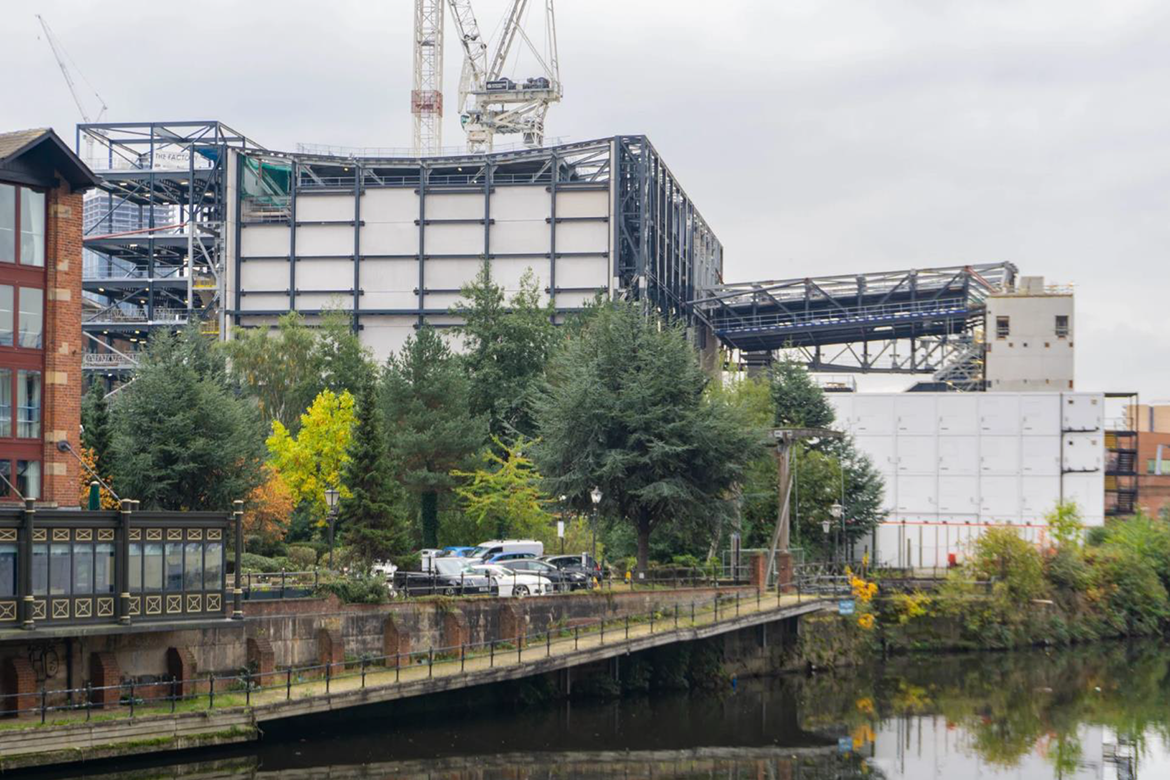
The incomplete Factory under construction. Source: Author.
While the larger research project follows the making of Factory from various sites of practice, this paper describes two ways that architectural acousticians work on the building based on fieldwork I conducted within their office. 2 As a result, the focus is narrowly on exploring acousticians at work as a practice that blurs the boundaries between science and design. In addition, the focus of the article is to get a little closer to how acousticians know the building through the way it sounds and the challenges of verifying something in the making.
There Is More Than Meets the Ear: STS, Sound, Inscriptions
One morning in June 2018, I found myself in the office of the acousticians. A small, discreet, and unassuming building, seemingly hidden at a quiet edge of a university in the Netherlands. It is a stark contrast to the large, bright architects’ and engineers’ offices in the middle of the cities that I had previously visited. Here, in the university, we seem to be much closer to the concerns of physics and acoustics than those of architecture and design.
Upon entering the office, the first thing you notice is how messy it is (Figure 2). There is stuff everywhere, piled perilously, not only construction materials, pieces of wood, concrete blocks, half-built equipment, old devices, piles of documents, binders, textbooks, plans with colored dilatation lines, and reports, but also the clangs and shouts of construction workers, the breeaam breeaaaam of bass leaking out of offices, and the hushes and sh-sh-shes of the workers and acousticians. There are also a variety of devices: anechoic chambers, accelerometers, Geofilms, auralizations, televisions screens, laptops, and a laboratory that occupies a large portion of the office. All of this, it seems, to capture sound. To fix it, make it thinglike. And yet, capturing sound is tricky. As one acoustician told me, it is often eerily described as “black magic.”
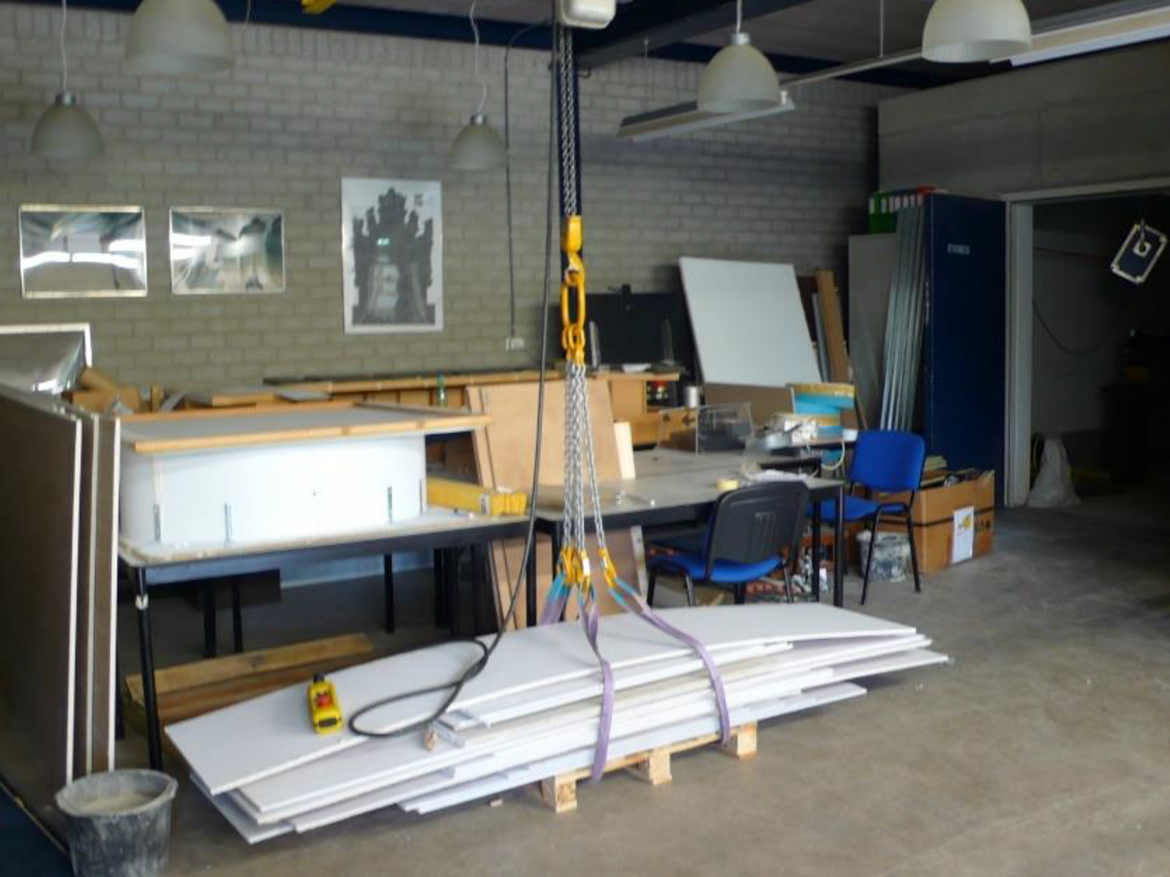
Construction materials piled up in the acousticians’ office. Source: Author.
The idea that sound—and noise—is not a natural, ready-made object out there to be discovered, to be immersed within, or even an object at all has been extensively argued in sound studies scholarship influenced by STS since the late 1990s. 3 As Pinch and Bijsterveld (2004) write, what STS contributes to this interdisciplinary field is “a focus on the materiality of sound, its embeddedness not only in history, society, and culture, but also in science and technology and its machines and ways of knowing and interacting” (p. 436). 4 In her history of architectural acoustics, Emily Thompson (2008) has shown how the idea of an object of sound, a “modern sound” that can be abstracted from its material conditions, reproduced, fixed, and commodified, is historically contingent upon the development of modern acoustic principles, building materials, and sound technologies and techniques. Similarly, as Sterne (2003) observes, sound reproduction technologies became possible through the isolation, objectification, and abstraction of hearing as a mechanical function, the “tympanic function,” in the scientific interest in hearing and otology in the eighteen and nineteenth centuries. In ethnographic accounts, whether in the music production studio (Porcello 2004), the built environment (Cardoso 2019; Peterson 2021), or in a submarine underwater (Helmreich 2008), the experience of sound and noise is described as inextricable from the technologies, documents, instruments, and discourses through which they take shape and can be felt. Peterson (2021), in her ethnography of airport noise, notes that rather than being ascribed as an identifiable, discrete thing, noise is atmospheric and elusive 5 ; it takes shape between perception and inscription, as both a particular sensory experience of annoyance and a general, dispersed object of inscription. While sound and noise may not leave physical traces in the world, they nevertheless need something, a body, a recording device, a document, some material, for it to exist. 6
Clearly, then, to understand how architectural acousticians listen to a future building, and how the building’s sound and noise become known, the techniques in which it is given physical traces are of importance. This focus on traces resonates with STS accounts of scientific practices that have focused on what can be called “the problem of fixation” (Ricœur 1973). Myriad studies have explored the role that representations, documents, media, and other “inscription devices” (Latour and Woolgar 1986; Lynch and Woolgar 1990; Coopmans, Vertesi, Lynch, Woolgar 2014) play in not only the production of scientific knowledge but in the shaping of scientific facts: of holding together particular realities, of making visible what remains invisible, of simplifying what is too complex, or of managing chance and governing risk. Through these studies of epistemology and ontology in practice, they have shown how the material world is shaped within socio-material practices, how it is transformed into a world of signs (Law 2004) and given a trace-like existence.
However, this constructivist claim of these STS accounts does not have the same purchase in the office of the architectural acousticians. As STS-informed ethnographic accounts of architectural practices (Murphy 2004; Yaneva 2009; Houdart and Minato 2009; Farías and Wilkie 2016; Yarrow 2019) have shown, the referential adequacy of inscriptions is different in architectural and design practices. There are different felicity conditions, a different “directionality” between the things inscribed and their inscriptions (Henderson 1991, 455). Physical models, for instance, gather a variety of conditions, constraints, and concerns that all together do not refer to some initial thing but afford a (partial) view of a future building (Yaneva 2005). The configuration of gesture, talk, and drawing in design team meetings allow architects to imagine things in the world otherwise by “purposefully seeing things as if they were something else” to augment reality (Murphy 2004, 269); and digital models allow architects to detach themselves from what is given to activate possibilities latent within it (Yarrow 2019). There are no ordered chains of inscriptions in architectural practices then, but a jumble of representations, images, models, sketches, and renderings that loosely hang together without a preestablished common referent, but one in the making (Houdart and Chihiro 2009). There is a different problem of fixation. It is not about holding something constant through a series of transformations (Latour 1999) but a problem of negotiating between the possible and the actual, the new and what is given. As a form making process of bringing a new artifact into existence, architectural practices unfold capacities (Domínguez Rubio and Fogué 2015; Farías and Wilkie 2016) that lay dormant and slowly give tangible forms to potentialities that begin to take shape as something thinglike.
And yet it is not clear where architectural acousticians stand? Are they designers or scientists? What is the role of inscriptions in their practices? The rest of this article is interested in exploring this challenge that architectural acousticians face: how they listen to and measure something that is in the making.
Approximation I: A Measurement, a Mock-up and What “Would Be” There
Here is Joanna (Figure 3). 7 While she sits in front of her laptop near the laboratory, around her, a sound resonates: rrrrrrRRRRRRRRRrrrrrrrr. A strange sound that rings out again and again. Above her, a television is mounted on the wall with a view into the laboratory. Through the television I can see a worker, Jan, inside the room, while around us there is hammering, drilling, and clangs of metal that fall on the floor. Unperturbed, Joanna writes in her notebook. She looks up and invites me over. She is conducting a test, she explains. Some measurements.
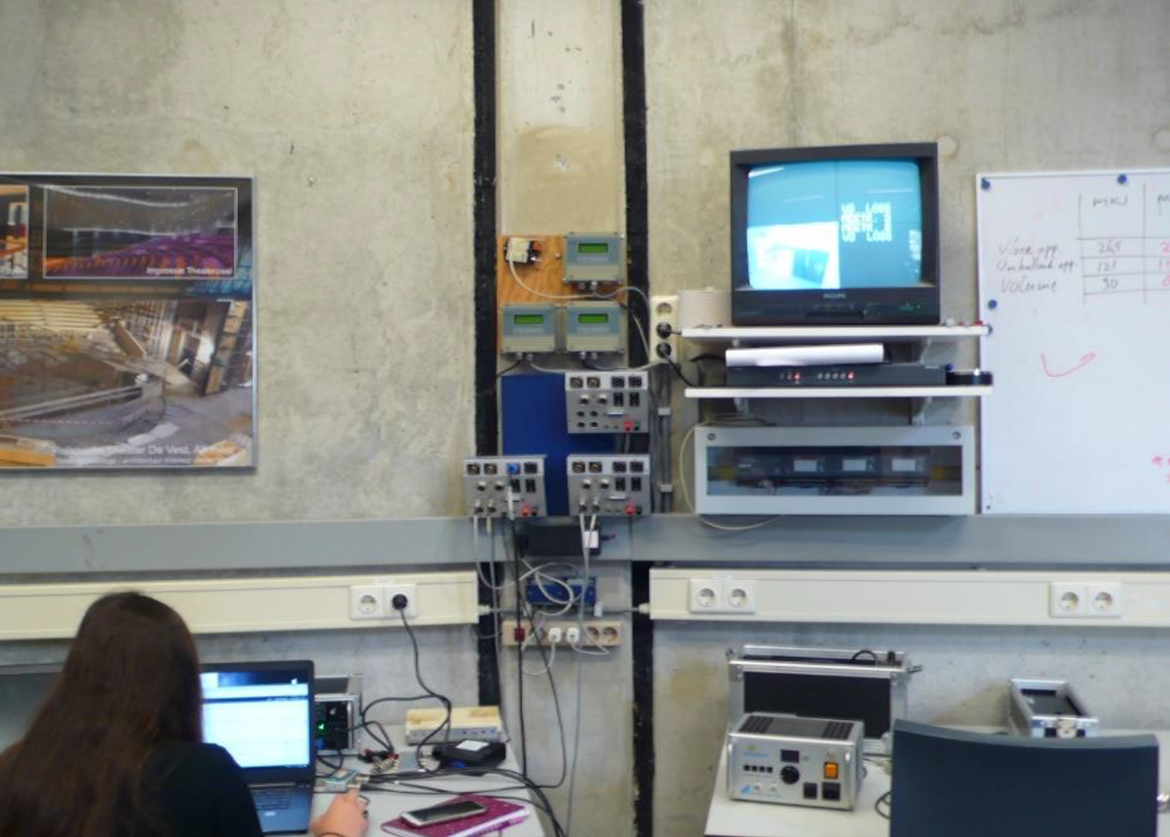
Joanna conducting a measurement. Source: Author.
And yet, of what?
I follow her into the room that was visible on the television. Inside, the worker is reassembling a black panel on the floor. A wooden rectangular frame with black spongy material over the top and mineral wool stuffed inside. There was a discrepancy in the first test, Joanna tells me, due to a gap. Gaps tend to be disastrous because sounds have the tendency to escape through them, but in this case, the problem is that there is not enough of a gap. Gaps can also be useful for containment: small spaces between walls that can hold sound waves. In this case, the gap, which is supposed to contain noises, did not work. Something is amiss. It does not correspond to Joanna’s expectations, and now they need to rearrange the panel to accommodate for it.
First, Joanna and Jan take it apart. Putting on gloves to protect from the scratchy wool, they pull off the duct tape that had kept the black sponge-like material over top of the wool and attached to the wooden frame and that also minimizes any other holes for the sound to travel through. With utility knives, the wool is cut into smaller pieces and stuffed within the wooden frame. Foam is then added to simulate the gap underneath the panel. Once the panel is put back together, Joanna ensures that the rotating microphone in the center of the room and two speakers are put into their correct positions. She refers to a methodology that she has printed out. Above, the microphones hang two curved wooden sheets from the ceiling. These wooden sheets are there to approximate the reverberating qualities of the room. The microphone, the speakers, and the wooden sheets are material representations of three central aspects of room acoustics: sound production, propagation, and reception. 8 The mock-up room within the laboratory is set up to replicate the acoustic conditions of a future office space within Factory. Even though the mock-up barely corresponds to the architectural drawings, and the panel (which would be a ceiling panel in the building) lies on the floor, it does not matter. The aim is to get close to the future room’s acoustic behavior to approximate how it sounds.
Once everything is in place, we leave the laboratory and go back into the other room behind the television screen and Joanna’s laptop. She checks the screen to make sure that everything is in place. And with the press of a button on her laptop keyboard, the test begins. That alien sound rings out. It is what is called a sweep sound, a broadband noise that passes through frequencies relative to what the human ear can perceive, a frequency range of around 40 Hz to 4000 Hz. 9 These are the frequencies that the standard human ear can hear and perceive. It starts quiet, low, and slowly becomes louder, higher pitched. As this happens on the television screen, nothing visibly occurs inside the room except for the microphone that rotates. However, Joanna’s attention is elsewhere: she keeps her eye on her laptop screen as the results come in. Clearly, something is happening. Numbers and a curvy line instantaneously inscribe what is happening. It follows the sound that resonates in the room, reflects off the wooden sheets, absorbed by the panel, its energy turning into heat, and the remainder collected by the microphone. Joanna watches this process through her laptop. The whole test takes twenty seconds. Once it is done, she goes back in to rearrange the position of the microphone. There is then a second and third microphone arrangement to test how the sound is received. The sound sweeps through the room again and again.
In addition to her notebook, everything is saved on her laptop through the software Dirac. Dirac is central to the experiment: it sends out the “sweep sound” through the speakers, captures the sound as it goes through the microphone, and calculates what has been captured by deconvolving it, that is, a process of simplification that detaches what has been recorded (including all the audio interferences and complexities generated during the measurement) from the original sounds in order to arrive at the object measured. From this measured object—a deconvolved sound—the software also produces a series of averages over the three microphone positions for each frequency in the sweep sound. As Joanna explains, these are measurements of the “average value for the reverberation time,” that is, the amount of time it takes for a room’s sound level to decrease by 60 dB. This is sound decay. 10 “From that time,” she continues, “you can, according to the dimensions of the room, define how absorptive the material is. So yes, that’s what we provide: different absorption values for a frequency range.” In other words, it is not a measurement of sound in general but a measurement of the absorption coefficient of the mineral wool in relation to the dimensions and the reflective quality of the proposed design of the room. The acousticians measure a specific arrangement of materials, a mock-up or simulation of the future building’s acoustic behavior. Or as Joanna tells me, the mock-up measurement aims to “create the same, more or less, situation that would be in reality.”
But what did she see on her laptop that was not visible through the television screen? What is this reality that would be there, more or less? As a series of averages, the measurement of the sound hardly refers to any distinct object, and yet possesses for them a thinglike quality. Moreover, how does the sparse setup of the mock-up correspond to the future room when it hardly resembles it? There are wooden reflectors, a mineral wool panel, a sweep sound, speakers, and a microphone. The measurement itself follows the ISO standard (ISO 354), which sets out the methodology, the correct dimensions of the panel, the ideal surface, and the steps to follow. The ceiling panel on the floor is not the actual panel, but approximates the information provided by the manufacturer. The sound is a standard sweep sound. The Dirac software sends out the sound, deconvolutes, disambiguates, calculates, and averages the data. The laboratory room itself is standardized. Everything is preset. A whole “hinterland” (Law 2004, 28) of standards, techniques, and instruments; an ensemble of “hearing equipment” (Sterne 2015, 70) through which they can listen to the building. In the same way that the “scientific gaze” relies on a configuration of standardized instruments, equipment, and techniques to see and discipline the object under study (Lynch 1985), as a distributed way of seeing (Goodwin 1995), we could say that architectural acousticians rely on this setup for a lived experience of sound to appear thinglike and for a distributed ear that can listen in to it.
But something else manifests there. Something that was not visible through the television screen. Something that Joanna watched from her laptop. There was another room within the room. If the first room was the mock-up in the laboratory, an approximation that “more or less” corresponded to the future room, the second room was what was being approximated: the future experience of the sound in the building or the acoustic behavior of a particular arrangement of materials that would be there. This is the room whose acoustic behavior Joanna was measuring, which was only visible through her laptop as a simplified “deconvolution,” averages that Dirac calculates. This is what the mock-up in the laboratory allows to manifest. It is not something that is visibly there but is a sound effect conjured through the laboratory, the mock-up, and captured through the software. A future condition of the building. In the same way that foam models provide architects partial views onto a future building (Yaneva 2005), or how molecular models enable a phenomenological and haptic experience of invisible molecules (Francœur 2000), the mock-up makes the future experience of sound measurable, knowable. It affords the chance to measure and listen to sounds in a room that would be there as if the building was already built.
And yet, this experience of sound does not quite exist. It is something in-between, a proximity. Precision is important in setting up the mock-up in following the methodology and assembling the ceiling panel, yet the mock-up only “more or less” corresponds to the situation that would be there, says Joanna. It is not a representation of what already exists but an approximation, a drawing near to a future experience of sound. An experience that hangs together in the vague mode or tonality of the future conditional; acousticians measure the experience of sound as if it would be there. 11 Souriau (2015), in his discussion of modes of existence, has a felicitous term for this: “mock-existences” or “counterfeits” (p. 154). Something that is not quite real but has the status of a real thing. Something that is thinglike. There is a rough correspondence between the mock-up, the room that would be there, and the experience of sound within it. One that helps them verify, to draw a relationship between the mock-up and the situation that would be there in reality, more or less. Within this approximation, the sound of the building begins to take on a tangible form that exists in proximity, as an approximation between the laboratory and the future building that allows them to say yes, it works, at least for the time being.
While approximations help them navigate the gap between the laboratory and the site, between design and construction, sometimes they also need to measure what is immeasurable. Sometimes, they need to work with information that is not settled yet, aspects of the building still in the making within other worlds of the design team. Sometimes, they need to do some guesswork.
Approximation II: Guesswork and a Noise Simulation
“You have to imagine,” Lucas, another acoustician, tells me: “63 Hz is about 7 meters long. That’s two stories of a building. That’s one wave. There is something of that size moving around.” Sixty-three hertz is the noise limit criterion for low frequency noise set by the Manchester City Council (2022), the point at which sound becomes noise around the building. Lucas continues to explain: “It also means that if you have an obstruction, like a cup, this big wave of 7 meters just goes around the cup. While the small wave, at a high frequency, is easily bounced away or stopped by a 2-meter screen. The funny thing is that even this 7-meter wave can fit through a small hole. That’s the strange thing about sound.” These low frequency waves elude how objects tend to be thought—they touch us without being seen; they are shapeshifters that can bend, twist, and squeeze.
These strange things are also important, they tell me, because they speak in large part for the noise leaks of the building. They are tell-tales both for the material build-up of the building, its thickness, and for how well it would fit within the surrounding soundscape. How much it would affect the everyday lives of those who live nearby: “We need to be able to contain for instance 100 dB at 63 Hz. That’s like a Metallica bass player going mental and yet people in the next-door residential tower [being] able to sleep with their window open and not hear anything over 27 dB.” One way to learn about this relationship is by capturing the amount of low frequency sounds—these 63 Hz waves—that leak out of the building and become “noise.”
And yet, noise is not easy to define. For instance, textbooks tell us that noise is typically understood as unwanted sound. It is not just a certain level of loudness, but a sound that is qualified as “annoying” (Parkin et al. 1979, 156). And this is the challenge for acousticians who want to measure it: “annoyance is a difficult property to measure objectively—it is related to but not identical with loudness. Two noises may be equally loud, but not equally annoying” (Lawrence 1970, 59). The same sound may be acceptable during the day but annoying at night. Sounds become noises in different circumstances. Noise is not any identifiable and determinate thing in itself (Peterson 2021) but a perceived property of sound, an incorporeal surface effect that resists being a self-same thing.
In other words, noise is sound that has become annoying—and annoyance disturbs any claim to fix what noise is. Peterson (2021) writes about the difficulties that acoustic engineers face when measuring noise, showing how annoyance as an indeterminate affect constitutes a “dynamic friction” between the inscriptions they rely on and the perceptions that they cannot quite represent—and contain—through metrics. “Metrics,” Peterson (2021) notes, “meant to stabilize (or bracket) annoyance are often accompanied by discussion of its [noise’s annoyance] instability, its vagueness, its fuzziness…. At once descriptive and prescriptive, their standardization is deemed necessary for regulation,…widening, rather than closing, a gap between perception and inscription” (p. 52). And while acoustic engineers often side-step such challenges, annoyance nevertheless “hangs on the side of graphs; pushes into sentences, explanations, and definitions” (p. 52). Noise is somewhere between perception and inscription: either an objective measurement undone by particular sensory experiences or an elusive and particular subjective impression that metrics try to generalize and make sense of.
So how are architectural acousticians to measure the noise of the future building? If noise is somewhere between perception and inscription, how do acousticians take an account of its perception, its sensory experience, when there is neither anyone to experience it nor any building to make noise?
Sitting around a computer with Elma, another acoustician, one morning, she shows me a simulation model she has run to do this. The model itself is generated through a software called Geomilieu. A software that calculates, analyses, and simulates the environmental impact of noise. In the simulation, the building is a visually nondescript rendering surrounded by other colorful volumes that indicate future buildings in the neighborhood (Figure 4). There are only colored planes and lines along the facades that indicate a specific sound level value. Visual exactness—it seems—is not important. 12
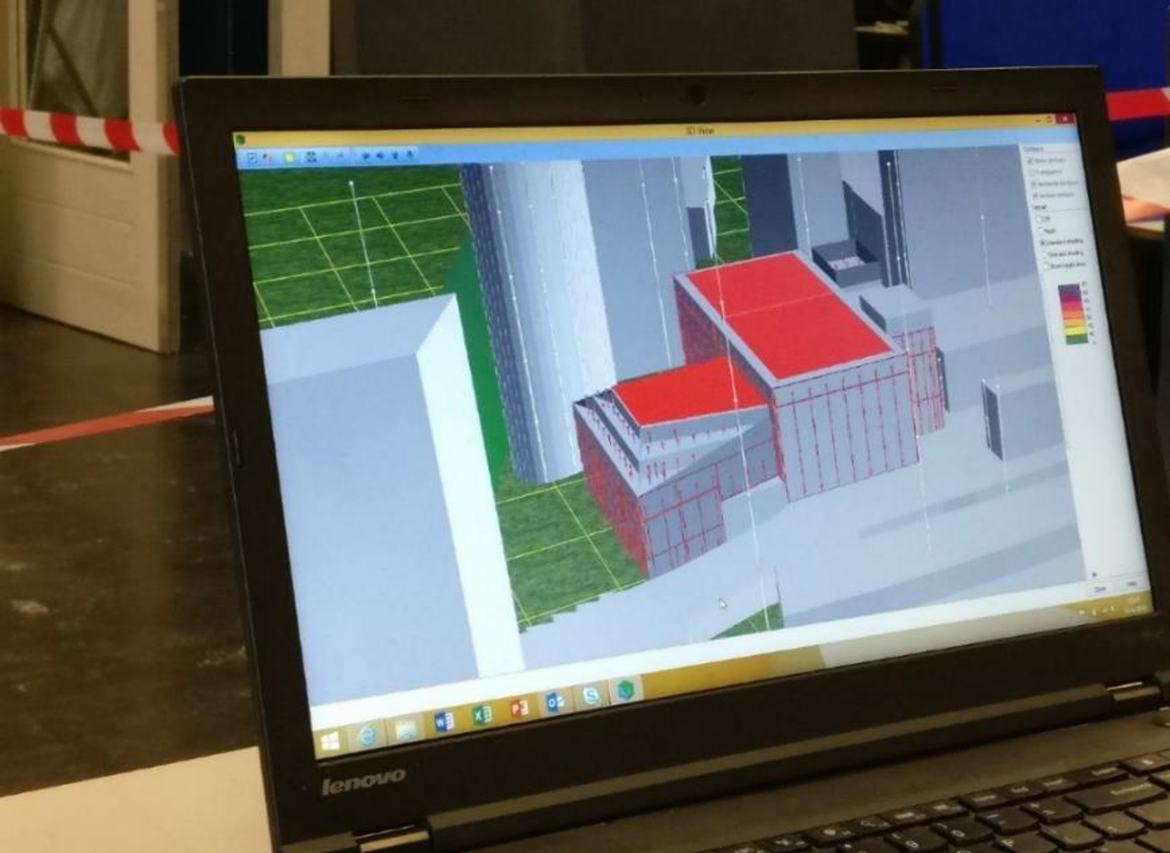
A simulation of Factory leaking noise. Source: Author.
The first step in measuring the noise the future Factory building makes, she explains, is “to interpret the buildings that will surround the future building in order to see which are sensitive to noise.” This sensitivity, she explains, is not an absolute but is tied to the type of building and its use: “there are always variations of buildings that you do or do not take into account.” Not every building is sensitive to noise to the same degree. Residential buildings, for instance, have a different level of sensitivity than office buildings: they are more sensitive because noise affects those who live there more, and there is a greater chance that, in those residential buildings, sound becomes noise. In the simulation, these buildings then become “sound receptors,” they receive and are sensitive to sound. More specifically, to simulate the sensory experience of noise these surrounding buildings become human ears in terms of allowable sound levels. This sensitivity is tied to what is perceivable by the standard human ear. Through the simulation, the built environment is given a tympanic function (Sterne 2003). The surrounding buildings in the simulation become proxies for the missing sensory experience of noise.
The sound source—the future building—also needs to be calculated. This is the second step. These sources are the sound levels of the building in relation to the activities, the arrangements of materials, the mechanical equipment, and the program of the building. Elma adds up all the sound levels produced inside the building, which builds up from room to room and from activity to activity. She also adds up the insulation values of all the walls and facades, which are set against the sound levels of the activities. A table is then generated, showing the sound levels that leak into the surrounding buildings. The table is organized according to different categories: different parts of the facades of the buildings, at different heights, during the day and in the evening, and across a range of different days and evenings (e.g., from day 31 to day 8,000). An average sound level is given, and through it, the building slowly fills up with sound, reverberating, absorbing, reflecting, and leaking as noise into the built environment.
To make these calculations, she relies on data about the designs, materials, and equipment from the other design team members. For instance, to know how much noise will be emitted from the chillers on the roof, the mechanical, electrical, and plumbing (MEP) engineers need to supply data about the specifications of those chillers; to know how much sound will be generated by the sound system equipment, the theater design consultants need to provide detailed equipment specifications. It is a challenge, however, to measure something that is in the process of being made. As Elma notes, “you have to make decisions, you get information, but it’s not always complete. There are things you do not know about the building structure, about the facade, so you have to always make estimates.” There are always “corrections,” “assumptions,” and “approximations,” so the inputs for the simulation are always—to her frustration—incomplete.
In general, as Sundberg (2007) explains, “simulations employ a generative mechanism to imitate the dynamic behavior of the underlying process that the simulations aim to represent” (p. 4113). For acousticians, simulations aim to represent the dynamic behavior of the building making sound to observe whether it is too noisy, whether it becomes annoying. As with all simulations, Elma points out, “what we do is a very simplified version of reality,” a modest attempt to “see if it is OK.” It is not supposed to be an accurate representation. Instead, as noted in different contexts (Sismondo 1999; Sundberg 2007; Loukissas 2012; Turkle 2009), simulations have a pragmatic task. For architectural acousticians, it is to distort the system being represented by simplifying the complexities of noise, by translating the qualitative problem of noise into a quantitative solution represented by the colors in the simulation.
Moreover, the simulation, here, functions like a “virtual laboratory” (Sundberg 2007, 4114) that allows them to observe the behavior of the building within an acoustic world. Simplified in the sense that the simulation affords approximations of how the building acoustically behaves by allowing them to insert the building into a stabilized and standard acoustic litmus test, a kind of Galilean world view (Lynch 1988, 169). Yet this worldview is incomplete, and missing data and other non-acoustical factors that are important for noise to be noise. As a result, the sensory experience of noise in the simulation will not be the same as that of those in, as Elma says, “the field.” As a result, these non-acoustical factors that cannot fit into the quantitative dimensions of the simulation have to be read into it by Elma.
And yet simulations are more than a laboratory and a worldview, as Sundberg (2007) notes, because simulations “can also themselves be studied the same way as natural systems are studied in empirical research” (p. 4114). Elma’s simulation then is not functioning as a kind of window through which to witness noise out there; it constitutes the object to be witnessed. In other words, for the acousticians, the simulation collapses the distinction between an object and its representation. Akin to nanoimaging, as historian Lorraine Daston (2014) notes, “the image is the presentation, the working object of science”; they simultaneously “make and make visible, present and represent all at once” (p. 321). The simulation stands in for the noisemaking building as if it were already constructed.
If simulations can be studied in the same way as physical systems, here, for Elma, the physical system is not only dynamic, but somewhat unknown: both the non-acoustical factors that cannot fit into the worldview of the simulation, but also the physical system that is incomplete. Hence her frustration, which stems less from the concern of how well the simulation corresponds to a preexisting reality or of what goes missing in the simplifications of the simulation, but due to the incomplete and constantly changing physical system that she seeks to model. While the software, the parameters, the regulations, and physical theories of acoustics—the worldview—may be complete, that which is to be known through the simulation is not. How to verify and simulate a physical system that is incomplete and in the making? Unlike the bodies of mediate auscultation (Lachmund 1999; Rice 2010) or car engines for mechanics (Bijsterveld 2018), or the noise of airplanes (Peterson 2021), the noise of the building remains “in the making,” provisional and incomplete. Others have pointed out that simulations function as approximations of a complex reality (Winsberg 1999), whereas Elma’s frustration points us to an aspect of simulation in design: it is not just a simplification of a complex system—it also involves guesswork, estimates that fill in what is missing. It is an inscription that works insofar as it is interpreted. Like noise, the simulation itself sits at the threshold of inscription and perception, a mixture of precision and hopeful suggestions (Peirce 1929; Clarke 2015) that operate at the edges of the certain. This work allows her to hold onto the ideals of impartiality and objectivity while also being partial (in both senses). In the same way that noise eludes attempts to fix it with quantitative certainty, noise in the simulation is approximated as a mixture of instincts, anticipations, and interpretations alongside the regulations, software, parameters, and given data. While the mock-up allows them to approximate what “would be” there, the simulation is an approximation: not just because it is a simplification, but because it involves some guesswork, to account for what cannot fit into the worldview of the simulation. In this way, noise is not calculated as an object, but approximated as thinglike—and thus measurable, more or less.
Conclusion: Listening to a Building, grosso modo
Let’s return to the city councilor’s disbelief. How could the sounds and noises of the building not be known? Implicit within this disbelief is an understanding that acoustics is a modern science grounded in ideals of exactitude, certainty, and precision (Wise 1995). For the councilor, the modern science of architectural acoustics has moved from “the world of approximation to the universe of precision” (Alexandre Koyré cited in Schaffer 2015, 345). Acousticians can lift the veil of Pythagoras to locate, quantify, and measure sounds and noises with mathematical and geometrical precision. Yet this article suggests the contrary is true that, as the acousticians reminded me, any certainty will only be gained on day 1, the first day of its operation—after the design has been realized, after it has been built, after the first performances. In the process of the building project, there are myriad modifications, re-dos, rough drafts, frustrations, and hopeful hypotheses within a world of approximation.
This article followed architectural acousticians as they attempted to listen to a building in the making through a mock-up measurement and a simulation, which foregrounds an epistemological challenge in design: the challenge of giving traces of reality to a future lived experience—of sound and noise—that—they hope—would be there in the end. In other words, this article has shown how acousticians give what is missing a thinglike existence through the work of approximation, which allows them to measure and verify what is elusive and in the making. I have emphasized the epistemological importance that approximate knowledge has within design practices insofar as it allows them to remain upstream from actualization and not reach closure too quickly. This has important implications across the design team. If they reach closure too quickly, it will constrain what the other members of the design team can do. If the architectural design is too detailed for instance, the structural engineers or acousticians could be wary of asking for any adjustments that will affect those designs. There is, in a way, an economy of design within the collaborative nature of the building project. This also shows that approximations as inscriptions act somewhat like “social glue” (Henderson 1991), but with a different kind of adhesive. Not just to “conscript” but to allow them to be in proximity. It is thus a careful way to share a problem in design without disturbing others, a way to verify without closure.
But what does it mean to approximate? Is approximation, following some philosophers of science (Cartwright and Nordby 1983; Weston 1992), a piecemeal and iterative process through which a reality is asymptotically approached? Or does it represent a deficit of being? This article has argued for another way. The approximate does not lack being but overflows with it. Like Jullien’s (2012) theory of the sketch, the approximate carries the “powers of the virtual” and reminds us “that the work is always in advance of itself and does not coincide with its being” (p. 61). The mock-up refers to an experience of sound that would be there; the simulation evokes a soundscape in a broader field of possibilities that remains mutable. Rather than fixing sound and noise as objects with certainty, they are rough drafts that give them a thinglike existence. Traces of reality that, however, vague, inchoate, hypothetical, and approximate afford acousticians a chance to listen to the future building.
Approximations in design also indicate another logic of inscriptive activity. If scientific inscriptions hold some thing constant by gathering its traces into other forms (Latour and Woolgar 1986), approximations give traces to an experience that is missing to give it some thinglike form. This article, thus, adds to STS accounts of design and engineering practices that have shown how inscriptions have a different logic in design (Henderson 1991; Houdart and Minato 2009; Yaneva 2009). While scale models are devices for gaining new knowledge by scaling up and down, of seeing more and less at once (Yaneva 2005) and flexible sketches organize a variety of practitioners together (Henderson 1991), approximations are devices that help them know not more and less, but more or less; as inscriptions they draw things near but not quite together (Latour 1990).
Approximation and guesswork are also ways of knowing in and through uncertainty. On the one hand, it is a category of what Clarke (2015) calls “anticipation work,” invisible labor that often goes unnoticed behind the more visible certainties associated with particular achievements. On the other hand, approximation is part of the “ambulatory” nature of design processes. Many studies of architectural practice have demonstrated that this dimension is often obscured in accounts of architecture that prioritize the product over the process (Houdart and Minato 2009; Yaneva 2009; Farías and Wilkie 2016; Yarrow 2019). Following James (1979), approximation can be understood as a hesitant way of knowing that happens in “zones of formative processes” on a “dynamic belt of quivering uncertainty, the line where past and future meet” (p. 192), a way of knowing not based on certainty or exactness but to be heard in the tone of the nearby, the proximate, the more or less. It is with this in mind that James (1987) describes knowing as a practice that “only works from next to next so as to bridge [the epistemological gulf], fully or approximately” (pp. 916-17). But this also highlights that knowing is without guarantee: as James (1968) writes, “with both feet off the ground into and towards a world of which we trust the other parts to meet our jump” (p. 239). A way of knowing in a world “in the making.” This is a reminder that it can also fail, that the other parts may not be there to meet us, that the sound may not be there in the end, that the building may not perform as they had planned, and that there is a fundamental “errability” (Souriau 2015, 228) in knowledge and design practices, and a question of trust—not only for one’s own approximations but for the others who will continue and add to them.
So, how do you listen to a building in the making? 13 What is the thinglike reality that approximations enact within design (Law 2004)? The sketches, drafts, mock-ups, models, simulations, and the other ephemeral artifacts of design that pile up in acousticians’ offices do not evoke completed things, but those that are in the making, that “partially exist” (Latour 1999) and require others—and sometimes also guesswork—to complete them. What would be there, hopefully, but may never fully come into existence. As architectural acousticians not only have to know what is elusive but also in the making, this article has argued that approximations are not the measure of objects that already exist, or of what enacts a whole object into being, but draws near to and roughly enacts, gives traces to, sounds and noises that would be there—grosso modo.
Footnotes
Acknowledgments
I would like to thank the architectural acousticians who kindly let me spend time with them and for their patience and generosity during this research. I hope that this article somewhat approximates how they understand their own work and does not betray it too much. I would also like to thank Albena Yaneva for her guidance and feedback on the first version of this article as it has emerged from my PhD dissertation research at the University of Manchester. This article has moreover benefited from the feedback of friends and colleagues as well as the two anonymous reviewers and the editors whose insights and labor have greatly improved it. Of course, all errors are strictly my own.
Declaration of Conflicting Interests
The author(s) declared no potential conflicts of interest with respect to the research, authorship, and/or publication of this article.
Funding
The author(s) received no financial support for the research, authorship, and/or publication of this article.
