



Abstract
Assisted reproductive technology (ART) is a global market engaging a variety of local moral economies where the construction of the demand–supply relationship takes different forms through the operation of the politics of value. This paper analyzes how the market–culture relationship works in different settings, showing how power and resources determine what value will, or will not, accrue from that relationship. A commodity’s potential economic value can only be realized through the operation of the market if its cultural status is seen to be legitimate. At the same time, local moral economies and their associated social orders are potentially susceptible to the destabilizing implications of new commodities. The formal or informal organization of power relationships in the market–culture interaction can enable potential value to become manifest and tangible over time or block its path. The interaction is steered through national institutional sources of cultural authority embedded in state and religion, where the visible contest in the politics of value is conducted. Increasingly, that interaction finds its expression in transnational institutions of governance where the struggle for control of the cultural agenda reflects the global nature of the ART market.
Keywords
Introduction
As a dynamic global market, assisted reproductive technology (ART) engages numerous moral economies that differ widely in the cultural value and legitimation they ascribe to particular ART commodities. As a result, the ART demand–supply relationship assumes different forms in different cultural locales, and the economic value of local markets is a product of these differences. Importantly, that relationship is not static. New ART commodities emerge with novel cultural implications and fresh cultural values that may challenge established legitimations of particular commodity markets or anticipate new ones. As these changes occur in market commodities or cultures, they require a change in the relationship between the two domains to ensure a continued synergy between market operation and legitimating cultural values. Importantly, such change, or its absence, is the result of the power relationships that govern the demand–supply relationship through the rule systems prescribed by the values of the local moral economy. And it is politics that, through the formal or informal organization of these power relationships in the market–culture interaction, enable the potential economic value of the market to become manifest and tangible over time or block its path. How does the politics of value achieve this?
The character of the global ART market and its local moral economies complicates the operation of the politics of value. The ART commodity market is large, global, and profitable with an estimated value in 2017 of USD 21 billion and a growth rate of 10 percent (Grand View Research 2019). Since the first baby was born through in vitro fertilization (IVF) in 1978, the number conceived by ART now exceeds four million and approaches 0.1 percent of the world’s population (Faddy, Gosden, and Gosden 2018). Clinical demand driven by the core social function of reproduction is constant and increasing. The most comprehensive global study of infertility using household data from 277 demographic and reproductive health surveys estimated that 48.5 million couples worldwide were unable to have a child after five years (Mascarenhas et al. 2012). This is, however, a fairly conservative definition of infertility and other studies, defining it as the inability of a couple to conceive after one year of regular, unprotected intercourse, suggest 70–80 million couples worldwide (Boivin et al. 2007) and 10–15 percent of couples (McLaren 2012; See also Rutstein and Shah 2004).
The supply side, meanwhile, is equally dynamic and regularly enhanced by new cutting-edge health technologies. Culturally, the ART supply embraces a variety of techniques and products that naturally activate important values concerning the status of the physical components of the human body involved in reproduction (gametes, embryo, womb) and the social structures involved in reproduction (family, marriage, motherhood, fatherhood, inheritance, preferred gender of child). Inevitably, the global distribution of moral economies provides a wide range of modes of ART commodity legitimation closely linked to dominant forms of social power. At the same time, the institutional authorities of state or religion in these cultural locales may or may not intervene to support or oppose one set of values over another, and the nature of their intervention may change over time. The result is a global mosaic of ART markets where the politics of value plays a central and continuous role.
In analyzing the operation of the politics of value in the ART market, the paper adopts a comparative international approach, drawing on material from both the Global South and the Global North to illustrate the interaction of market and culture in contrasting geographical and institutional domains of religious and secular values. It begins with the power relationship among demand, supply, and culture. How is demand constructed, what is the formative contribution of culture to this process, and how do forms of socially embedded power act to determine the value accorded the demand? What is the impact of culture on the ART supply? How does culture use its power to frame that supply in ways that attribute value to some types of supply but not to others? Second, as the demand for and supply of ART commodities interact, what are the implications for the engagement between the operation of the commodity economy of ART products, on the one hand, and the moral economy of ART values, on the other? Given that these two economies are continually evolving, what forms of institutional authority are employed to govern both the evolution itself and the changing relationship between the commodity and moral economies that may accompany it? Finally, to what extent does the operation of the politics of value result in the redistribution of the balance of power between commodity markets and local cultures?
Demand, Supply, and the Politics of Value
Markets exist because cultural values give moral status and meaning to a perceived individual need and to the commodity that is able to respond to that need. The expression of both demand and supply is thus a function of a cultural context, so that markets can be described as “culturally embedded” and “an extension of culture” (Storr 2010, 204, 205). Propelling the dynamic of the market are individual choices made within culturally acceptable definitions of demand and supply. In this context, what is meant by culture is the approach adopted by Geertz, for whom “Our ideas, our values, our acts, even our emotions are…cultural products—products manufactured, indeed, out of tendencies, capacities and dispositions with which we are born, but manufactured nonetheless” (Geertz 1973, 50), creating meaning, shaping preferences, and providing incentives in often unconscious fashion. Importantly, culture is dynamic and constitutes “an active process of meaning making and contestation over definition, including itself” (Street 1993, 2). As Wright (1998, 8) observes, culture is political because it involves the operation of power in the use and contestation of concepts, the definition and framing of their context, the restricting of alternative ways of thinking about them, and the ways their meanings are rendered authoritative and durable. For Storr (2013), culture can be seen as a constitution, a set of rules, within which individuals operate and interact with one another (p. 54). That cultural power determines how a market operates and ensures that demand “emerges as a function of a variety of social practices and classifications, rather than as a mysterious emanation of human needs” rendering consumption “eminently social, relational, and active rather than private, atomic, or passive” (Appadurai 1988, 30, 31).
Reproduction is a core social practice often linked to the survival and development of a social group. In this context, infertility, the physical inability to conform to this social practice, comes to be defined as a problem that a society or individual should address, and the demand for ART is defined as the natural expression of a social need. However, local moral worlds vary considerably in the values they bring to bear in their definition of the problem, its acceptable mode of expression, and the solutions that can be legitimately adopted. Islam, for example, “considers procreation to be one of the most important pillars of society; thus, the duty of each Muslim is to reproduce and ensure the perpetuity of his or her social group” (Inhorn and Tremayne 2012, 2): a duty that is to be carried out only in the context of marriage, family, and the kinship system, the exclusive vehicle in Islam for procreation, lineage, and inheritance. Providing cultural authority for the duty and its delivery are the Quran and the hadiths (the record of the words, actions, and silent approval of Muhammad), the source of a supporting system of religious values explaining, supporting, legitimating, and protecting both the goal of procreation itself and the particular social arrangements within which it is to be realized (Nahdi and Sulistiyowati 2017). At the other end of the moral continuum are secular societies where reproduction is seen not so much as a social duty but rather as an individual right. Here, the values of consumer choice are likely to hold sway in the context of social structures where marriage is less highly valued, certainly not obligatory for procreation to take place, and the gender roles in reproduction are also a matter of choice rather than one of social prescription (Mamo 2007). Between these two examples are a range of value positions associated with religions, such as Hinduism and Buddhism, where the importance of reproduction is recognized but where the specification of the supporting social structures is less precise than in the case of Islam and the flexibility of the legitimating cultural values are more evident (Sarojini, Marwah, and Shenoi 2011; Qiao and Feng 2014). Christianity, meanwhile, offers varied cultural guidance on both acceptable modes of reproduction and required social frameworks, with Catholicism highly rigorous in its pronouncements but the numerous forms of Protestantism much less categorical (Bonaccorso 2008).
The global demand for ART solutions to infertility thus emerges in contrasting cultural contexts that legitimize different embedded formulations of social power and, through the operation of these power configurations, different forms of demand. As Gurtin, Inhorn, and Tremayne (2015) observe, “the social meanings of infertility are always the discursive product of a hegemonic cultural system” (p. 3138), and such meanings act to reinforce the social hierarchies, structures, and role divisions (particularly those of gender) that define them. From this synergy is born the politics of demand value through the application of social power to endow positive cultural value to some types of ART demand and negative value to others. In societies where reproduction is highly valued, social stigma reinforces and magnifies demand through the attribution of negative social value to the inability to reproduce. Where large families are the norm, as in Africa, for example, the application of this negative value produces what Cui (2010) terms “the agony of infertility.” Women “unable to bear children are rejected by their husbands and ostracized by society, often living as outcasts and perceived as inferior and useless” (Lunenfeld and van Steirteghem 2004, 321). Similarly, in Indonesia, infertility is stigmatized as a “curse,” often linked to psychological crisis, social isolation, and violence (Bennett et al. 2012). In many Muslim countries, the effect of social stigma on the demand for ART is enhanced by the cultural proscription of a possible alternative solution to infertility: Islamic scriptures explicitly forbid the adoption of children. Infertile Muslim couples may foster an orphaned child, but permanent adoption is disallowed in family law in the vast majority of Muslim countries (Gurtin, Inhorn, and Tremayne 2015, 3141).
The power at work in defining and controlling demand for ART in these kinds of cases is that of the patriarchal society, often supported by religious values such as those of Islam. Responsibility for infertility is disproportionately relegated to women, reinterpreting the objective demand produced by clinical need in a manner concordant with the society’s structures of social power. Involuntary childlessness can be caused by a variety of physiologically male or female factors ranging from low sperm count to azoospermia in men, and premature ovarian failure to blocked fallopian tubes in women. But despite the fact that male-factor infertility accounts for about 50 percent of all cases, globally most of the social responsibility for infertility is imposed on women and most of the ART demand constructed in terms of solutions to female fertility problems (Inhorn and Van Balen 2002). For men in patriarchal societies, the social stigma of infertility acts in precisely the opposite direction to that of women, evoking notions of impotency and emasculation to suppress the articulation of need and reduce the ART demand from men (Inhorn 2004, 2005). In combination, these two mechanisms of cultural power produce a highly gendered global demand for ART technologies largely geared to the causes of female infertility with men treated as “the second sex” in ART practices and discourses (Inhorn et al. 2009).
The cultural translation of different types of clinical need into socially valued forms of ART demand is sensitive to the nature of the ART commodity supply that can itself stimulate a cultural response and help define the demand–supply relationship. This approach to commodities builds on the work on commodification by feminist scholars in medical anthropology and science and technology studies who have documented how “bodily commodification”—namely, the packaging and selling of gametes and other body parts for the purposes of reproduction and medical research—has become the vehicle for a global consumer market (Kroløkke, Foss, and Pant 2012; Scheper-Hughes 2005). In part, this emphasis on commodity production was the result of a concern with contrasting gift economies and commodification (Waldby and Mitchell 2006). Although this literature deals with the social context in terms of the impact of commodification on core constructs such as kinship and motherhood (Kopytoff 2004; Kroløkke, Foss, and Sandoval 2010), it does not fully elaborate how that context shapes, or does not shape, the emergence of legitimate commodities. As Hoeyer (2007) argues in his critique of the hypothesis of commodification, “To consider commoditization as a process means to empirically investigate the ways biogenetic substances, at various points, move in and out of a commodity state” to enable them to travel as “products” and not as persons (p. 329). This view accords with Birch’s approach to “assetization,” the transformation of something into a revenue-generating and tradable resource, where he maintains that commodification needs to be situated in the context of “the social practices and processes of valuation in the bio-economy, which are characterized by an active, ongoing, and performative management of value” (Birch 2017, 462; See also Birch 2015). In Birch’s case, the focus is on how “value is constituted primarily by the social practices of the political economic actors who configure the financial value and valuation of firms” (p. 462). This paper focuses on how value is constituted through the social and cultural practices and power alignments that govern the demand-supply relationship in the commodity economy: the politics of value.
In the case of ART, the commodities include, but are not limited to, intrauterine insemination (IUI), IVF and embryo transfer, intracytoplasmic sperm injection (ICSI), gamete intrafallopian transfer, zygote intra fallopian transfer, tubal embryo transfer, gamete and embryo cryopreservation, oocyte and embryo donation, and gestational surrogacy. Broadly speaking, the response is organized around a culture’s view of the status of key elements in the physical and social processes of reproduction. For religious cultures such as Catholicism the status of the human embryo in reproduction is absolute; for others, it is negotiable. Equally, for religious cultures such as those of Islam the role of the family is essential, while for others it is optional. These kinds of value positions influence or determine what forms of demand–supply relationship are culturally valued and what not, and therefore what kinds of ART markets can legitimately exist within their cultural jurisdictions. Sallam and Sallam (2016) have summarized the effect of this application of the politics of value in terms of the relationship among a range of religious cultures and types of ART commodity in the Table 1 below (see also Gurtin, Inhorn, and Tremayne 2015: table 165.1 for a parallel exercise on Shia and Sunni countries and secular Turkey). Although religions clearly are not the only form of transnational cultural influence in the ART market, they are a significant source of value reference for the 91 percent of the world’s population shaped by religious affiliation and the often formal nature of their value articulation provides useful material for the explication of this paper’s argument (Pew Research Centre 2015).
Religious Culture and ART Commodity Relationship.
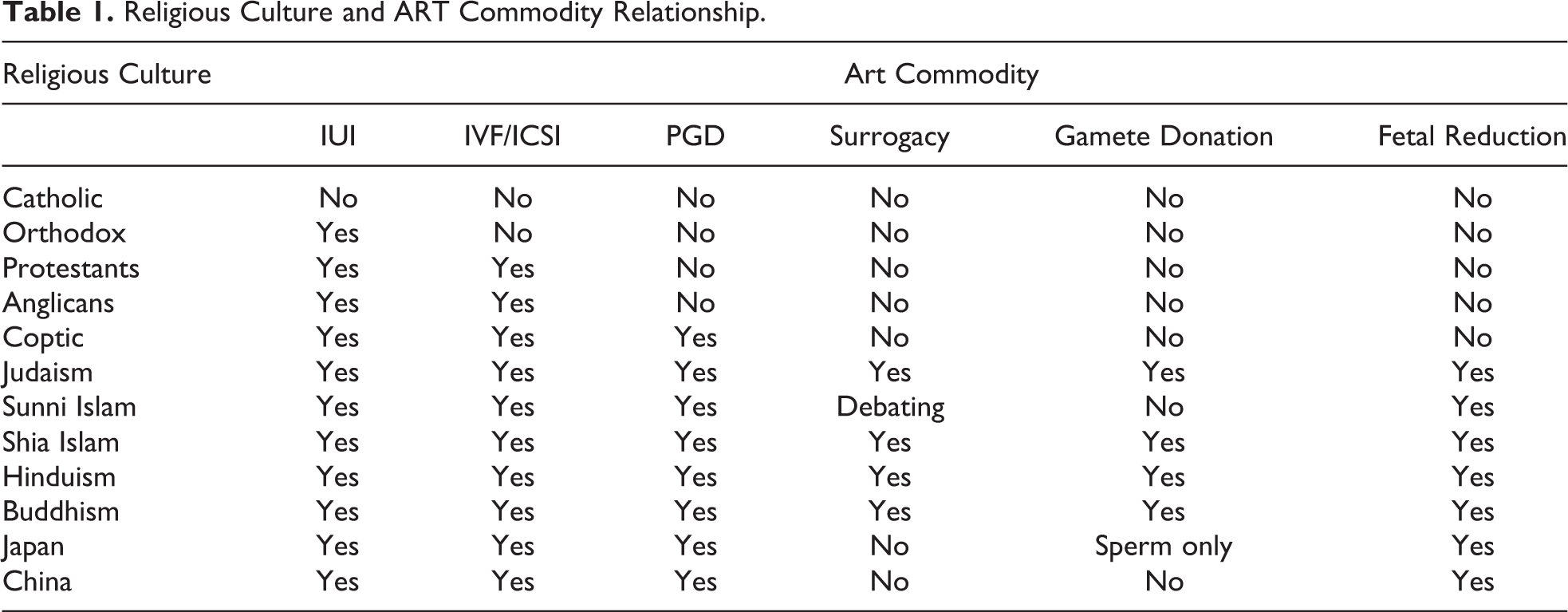
Each cell in this religious culture–commodity matrix constitutes a potential market where the demand–supply relationship is either culturally valued (“Yes”) or not valued (“No”). As is discussed in the next section, the extent to which these values are implemented and impact on the ART market is dependent on their degree of incorporation in the institutional rule systems of state or religion, but they provide the starting point for the analysis. As is immediately apparent, the most comprehensive potential market restriction is advanced by Catholicism. Here, the formal dogma of the Church asserts that the moral status of both human embryo and family is absolute and the physical and the social are also indissolubly joined. Pope Francis has to an extent reframed these principles in his Amoris Laetitia (Joy of Love) (Pope Francis 2016; which brings together the results of the two Synods on the family convoked by Pope Francis in 2014 and 2015—US Conference of Catholic Bishops 2015) to allow for their sympathetic and flexible interpretation, but their essential message and import remains unchanged. Regarding the embryo he asserts: “Each child has a place in God’s heart from all eternity; once he or she is conceived, the Creator’s eternal dream comes true. Let us pause to think of the great value of that embryo from the moment of conception” (Pope Francis 2016, 128). And on ART he is disapproving of “the technological revolution in the field of human procreation [which] has introduced the ability to manipulate the reproductive act, making it independent of the sexual relationship between men and women. In this way, human life and parenthood have become modular and separable realities, subject mainly to the wishes of individuals or couples” (Pope Francis 2016, 45) thus challenging the central role of the family.
Compare this with the position of Sunni Islam which gives marriage but not the embryo an absolute status in reproduction: it permits IVF using eggs from the wife and the sperm of the husband, and the transfer of the fertilized embryos back to the uterus of the same wife. The embryo may be manipulated within the social confines of a marriage but no third party should intrude into the marital functions of sex and procreation through the donation of sperm, eggs, embryos, or a uterus (as in surrogacy; Inhorn 2008, 35). Rather less categorical and more complex is the cultural guidance of Shia Islam, where debate regarding the values that should govern the demand for ARTs is vibrant and at least partly a reflection of its less hierarchical approach to cultural authority, as discussed further below. In Shia-dominated Iran and Lebanon, there is continuing discussion of issues such as whether gamete donation without bodily contact truly constitutes zina or adultery; and whether the husband of an infertile woman needs to arrange a temporary marriage (mut’a—condoned in Shia but condemned in Sunni Islam) with the egg donor and then release her from the marriage immediately after the embryo transfer in order to avoid adultery (zina; Inhorn 2007; Tremayne 2009).
Such debates illustrate the capacity of the ART supply side to challenge not only the hegemonic discourse of a particular culture but also the social structures which that discourse legitimizes. The politics of value then takes on a dynamic quality as the market–culture relationship becomes politically interactive. If fresh values and modes of cultural understanding become part of the reproduction discourse, prompted by the opportunities to remedy infertility offered by new technologies, assumptions regarding the delivery of reproduction through embedded forms of social power may be questioned. In Islam, the cultural symbiosis among parenthood, marriage, kinship, lineage, and inheritance means that revision of one element in that sequence, such as parenthood through third-party gamete donation or surrogacy, is likely to affect the others because the system is designed to be rigid and strong (Inhorn 2006). Where cultural flexibility is introduced, as in Shia Iran and Lebanon, implications arise for potential ART consumers in neighboring Sunni states. With the supply of ART donor technologies now widely available in both Shia Iran and Lebanon, the power of the Sunni Muslim ban on third-party donation is being weakened across the Middle East, with some infertile Sunni Muslim couples prepared to reexamine their anti-donation moral position in order to “save their marriages” and engage in clandestine “reproductive tourism” across state borders to more liberal Shia regulatory regimes by means of what for them is the ART black market (Inhorn 2008, 42; see also Inhorn 2009). This market works across the ancient Islamic schism between Shia and Sunni, characterized by historic rivalry between the two sects, fractious religious and political competition, and periodic military confrontation. Its activities result in Sunni culture being challenged by the ability of the ART market supply to appeal directly to its reproduction consumers resulting in “Shia gametes finding their way into Sunni bodies” through IVF and gamete donation despite the severe cultural antipathy between their respective owners (Inhorn 2008, 42).
In similar fashion, but in the quite different cultural context of secular Western societies, Strathern’s work has shown how the supply of new ART commodities has the potential to stimulate a demand that also challenges hegemonic understandings of relatedness and kinship (Strathern 1992). ARTs and their associated access to third parties allow the “natural” relationship between the biology of reproduction and traditional notions of family and kinship to be ideologically reformulated, so that the nature of parenthood is seen as a matter of consumer choice and the role of society as facilitating that choice and perhaps ensuring the quality of the product. The dominant norm of heterosexual parenthood and marriage is destabilized when a given society accords legitimacy to the reproductive demands from nonmarried couples, single women and men, lesbians, and gay men for donor insemination and gestational surrogacy (Cadoret 2008). As its culture responds to opportunities offered by ART, value is reassigned and social power redistributed. Motherhood is deconstructed from a unified biological and social entity into a plethora of genetic, birth, adoptive, and surrogate maternities each with its own ART commodity, or sets of commodities, designed to enable its realization (Thompson 1998). And in the secular consumer society, there is no stigma attached to the transnational exercise of choice through the global fertility market. In this cultural domain, global reproductive tourism is presented not only as possible but also as rational, reinforcing through its activities the normality of the cultural adjustment made by a society and demonstrating how the commodity market can both cause and consolidate political value (Inhorn and Patrizio 2012).
Constructing Political Value: The Institutional Sources of Authority
The politics of value are defined by the mutual abilities of cultures to shape the demand–supply relationship and of commodity markets to reshape the cultural context in which they operate. Power is at work to confirm or redistribute cultural and social values and legitimate or deny commodity value. But what political factors help determine the balance of power between culture and markets, given that neither cultures nor commodities are static entities but evolving over time? Undoubtedly, local moral worlds form part of a global moral economy where exchange is commonplace and values traded to achieve a workable compromise, just as commodities are traded to achieve a profitable outcome (Salter and Salter 2007). But both moral and commodity economies conduct their activities within authority structures that frame the rules, or choose not to frame the rules, governing their engagement. It is here that the politics of value in the ART market may take on institutional form.
North explains how “the institutional structure reflects the accumulated beliefs of society over time” so that “there is an intimate relationship between belief systems and the institutional framework,” arguing that culture determines the direction institutions take and the rules they propagate about how economic activity should be conducted (North 2005, 49). There is, then, the question of which institutions of state and society, if any, engage in the governance of ART? In its 2019 survey of its 107 member states, the International Federation of Fertility Societies (IFFS) found that 64 percent of states had statutory regulation on the conduct of the ART market (rising to 87 percent if guidelines were included) with large regulatory divergence between states reflecting their varied cultural identities (IFFS 2019, 9). So local moral economies may find their cultural values translated into institutional rule form or they may not, particularly in developing countries with limited governance capacity where informal rule systems predominate. Even where state institutions provide rule frameworks, these may be challenged by unresolved cultural tensions in society and the changing balance of power between competing ART interests. In the United States, federal regulation of ART is limited in its unifying effect, with individual US states adopting a plethora of contrasting permissive and restrictive measures on the ART market, each a reflection of the dominant cultural view of the status of the human embryo within particular state jurisdictions (Frith and Blyth 2014). ART commodities legitimized in one state may be illegal in another. Such is the intensity of this conflicted dimension of the politics of value that it has been described as a “culture war” (Hunter 1994), with the institutions of religion significant players on both sides of the cultural divide (Hoffman and Johnson 2005; McConkey 2001; see also Mulkay 1997 on a parallel, if less intense, United Kingdom debate).
Religious institutions vary in the extent to which they can influence the politics of ART value through their provision of an authoritative cultural view of the regulation of the ART market, which the institutions of the state feel obliged to accept and implement through statutory guidance. Several aspects of religious power are at work in this domain. Much depends on how far organized religion has been able to maintain a relationship with the state in the face of the increasing secularization of societies and the support for new ART commodities that this entails. In Western states, the Catholic Church has long fought a rearguard action against the expansion of the ART market, particularly with regard to the majority of ART commodities where the status of the human embryo is an issue. It has had limited success in setting the cultural terms of the ART debate in states such as Italy, Austria, and Poland where its relationship with the state is most secure (Hennig 2020; Minkenberg 2002). Allied to this is Catholicism’s ability to call on a population’s support: Fink identified a clear relationship between the proportion of Catholics in a European country and restrictive embryo research policies (Fink 2005). However, this relationship does not always hold. Instructively, in Ireland, the decline of the moral authority of the Catholic Church and its ability to control the ART policy agenda have been accompanied, and partly caused, by the rise of secularism as an organized and compelling political force (Allison 2016; McDonnell and Allison 2006; Inglis 1998). Ireland’s experience shows in microcosm, and in unusually dramatic form, the weakening of religion’s power across Europe to act as a source of authority for the values that should govern the ART market in the face of secular consumerism (Salter and Salter 2007, table 2). Only in Italy, the home of the Catholic Church where the religion–state nexus is strongest, has national policy making moved to a more conservative position with the implementation of the 2004 Assisted Fertility Act (Inhorn 2010).
In contrast to the Western experience, the institutional politics of ART value in Asia has taken a quite different form. Here, the resurgence of Islam1 demonstrates how an institutional alliance between religion and state can support local moral economies capable of resisting or channeling the ART demands of an expanding middle-class sensitive to the breadth of the ART supply. And in contrast to the Western experience, in the case of Islam, it is generally religion rather than the state that acts as the dominant cultural authority in that relationship and so it is to institutional divergences within that authority to which we should look for insights into how the ART market operates in Muslim countries. Of the twenty-two Middle Eastern nations, for example, only six countries (Algeria, Iran, Israel, Tunisia, Turkey, and the UAE) have enacted assisted reproduction legislation (Jones et al. 2011). Egypt, Jordan, and Saudi Arabia—the first three Sunni Muslim countries to open IVF clinics—have never passed assisted reproduction legislation. Instead, as Inhorn (2008) puts it, it is the “strong religion/weak state” reality that has led to “two clear patterns of ART practice which follow the growing Sunni/Shia sectarian divide” (p. 34). Given that ARTs are used to produce offspring for infertile couples, their governance within “sharia” (Islamic religious law) comes under the aegis of Islamic family law in both Sunni and Shia states where the ART rules promulgated through “fatwa” (authoritative rulings by senior Islamic clerics or scholars) define the cultural limits of acceptable ART commodity use for both clinicians and patients. Bioethical and professional codes are backed up with sanctions such as clinic closure and confiscation of profits (Gurtin, Inhorn, and Tremayne 2015, 3143). However, while these codes are both uniform and regularly enforced in Sunni states, the institutional character of the cultural authority structure in Shia dominated states allows more flexibility and choice for the ART consumer, as was mentioned earlier. Here, Shia scholars are reluctant to engage in the formal collective deliberations based on scriptural sources that characterize the Sunni approach and instead prefer an individualistic practice of “ijtihad” (independent reasoning) leading to a greater diversity of cultural authorities and opinions. In the case of third-party donation, this had led to Shia doctors and patients in Iran having a greater degree of agency and control over clinical practices and more independent understandings of what constitutes kinship and relatedness (Clarke 2007). Such discursive openness on the part of the institutions of cultural authority in Iran is not neutral in its effects but rather socially destabilizing to an extent, illustrating the ability of the commodity market to impact on a society’s culture while at the same time being defined by it (Tremayne 2012).
The institutional politics of value determines not only what values should govern the commodity market but also how the relationship between commodity and moral economies changes over time—new commodity legitimations produced or old ones removed. As new ART commodities have been generated and fresh social possibilities have been created, so there has been a demand in moral economies for the means to govern these possibilities either through the adaptation of existing values or the creation of new ones. What Williams (1978) termed “emergence” has become a feature of the ART discourse as “new meanings and values, new practices, new relationships and kinds of relationship…are continually being created” (p. 123). Such a governance demand is also a political opportunity in the sense that an authority is required to pronounce not only on what values should be applied to the governance of the new commodity but also, if new or adapted values are needed, how they should be produced. To put it another way, who should govern the production of the cultural values that govern the commodity market? Are the existing cultural authorities within a jurisdiction sufficiently epistemically adroit to retain their grip on its moral economy or is there an opportunity for a new player to gain political advantage through its cultural expertise?
In Western secular societies, the political opportunity has been seized by bioethics, which, following the rapid expansion in new health technologies in the 1970s, has become the primary institutional authority at national and international levels for cultural reflection and decision making on the market suitability or otherwise of these types of commodities (Jonsen 1998). Born of medical science’s need for new modes of legitimation for its processes and products, bioethics has proved itself to be epistemically adroit and politically useful in managing the tension between the market potential of medical science and its cultural locale. Its authority derives from its claim to be neutral and objective through its use of a supra-cultural method incorporating “tools for measurement that transcend culture” (Bosk 1999, 63). Precisely what this method is and how it is applied in different Western states has evolved and diversified over time to incorporate contributions from disciplines ranging from moral philosophy and law, through feminism and theology, to medical science and medical ethics (Camporesi 2017; Salter and Jones 2005: see Tables 2 and 3). Originally conceived as an exercise in the enunciation and application of a set of what were seen as “universal ethical principles” (variously defined; Hedgecoe 2004, 125), bioethics sought to establish standardized rules that could enable the translation of different moral positions into a common metric capable of facilitating, usually on a cost–benefit basis, choices and decisions. For this method to operate efficiently, it had to enable a system capable of commensuration (the discarding of information), predictability, and calculability: the characteristics of a currency (Evans 2000; see also Clouser and Gert 1990). Then through its control of “the common coin of moral discourse” (Jonsen 1998, 333), bioethics would be able to dominate the framing of the production of governance knowledge in the Western moral economies of new health technologies and, in consequence, gain the ability to shape the activities of the commodity markets that such moral economies deem legitimate.
To an extent, this neat equation, though true of the early stages of bioethics development, has been challenged by its subsequent diversification and internal competition regarding its core principles and disciplines (Engelhardt, Iltis, and Carpenter 2012; Iltis 2016). Indeed, Franklin has gone so far as to argue that ethical oversight in the biosciences now belongs to a multiplicity of actors rather than being the exclusive domain of bioethics (Franklin 2019). Nonetheless, it remains the claim of much of bioethics that “ethics expertise cannot be improvised, and that ethicists are better placed than non-experts, that is, they are at an ‘epistemic advantage’, when discussing the normative questions raised by biotechnologies, biomedicine and the life sciences” (Camporesi and Cavaliere 2021, 2). Here, the claim to authority rests not on the use of particular universal principles but rather on “the adoption of different analytical lenses [that] can illuminate morally salient features of a case, or of a practice, which would go unnoticed otherwise” (Camporesi 2017, 179). As a result, bioethical reflection can “help unravel some of the assumptions and value judgments that we make in the context of some of the current practices of externalization and responsibilization of reproduction” (Camporesi 2017, 180). The ability to dissect and organize the understanding of “value pluralism” then endows bioethics with the right, and perhaps the duty, to claim its “epistemic advantage” in contributing to the governance decisions that flow from this exercise (Cavaliere 2017; see Camporesi and Cavaliere 2021). As bioethics has evolved, so the character of its political ambition has become more nuanced.
The institutional manifestation of the bioethics mission to act as a global moral arbiter is apparent in national bioethics committees, international committees such as the International Bioethics Committees and the European Group on Ethics in Science and New Technologies, and a global network of bioethicists working through organizations such as the Council for International Organizations of Medical Sciences (CIOMS), the Human Genome Organization, the International Society of Bioethics, the World Medical Association, and the World Health Organization. In Western societies—and despite, or because of, its reflexive turn—bioethics has enjoyed considerable success in influencing the values that should guide the production of new health technologies in ways that enhance the capacity of medical science to innovate and commodify (Salter and Jones 2005). In stem cell research and development, for example, there has been a consistent global shift across nation states, initiated by bioethics, toward more permissive regulation and away from policies that constrain the development of stem cell products due to concerns about the status of the human embryo (Salter 2007; Salter and Salter 2007, 571-74). Rapidly gaining political experience and expanding its influence, the bioethical enterprise has steadily improved its skills and capacity to link “bureaucracy—committees, institutional regulations, and finely tuned language—with claims to moral stature” (Rosenberg 1999, 38). States wishing to engage the health technology market routinely find themselves receiving Western bioethical advice on the processes of normative reflection that should be used to steer their regulatory affairs. In China, for example, the domestic epistemic community of bioethicists engaged in lengthy debate and negotiation with international bioethicists, primarily from the United States, on the values that should govern stem cell science and innovation, eventually producing policy guidance remarkably similar to the international consensus in this domain (Salter and Qiu 2009). Propelled by bioethics, the global moral economy asserted itself as the arbiter of inter-moral economy relationships.
Not all local moral economies are so susceptible to the transnational ambitions of Western bioethics. Islam, for example, has proved much less pliable and much more prepared to assert its cultural power to protect what it sees as its moral terrain and its commodity market. Here, the politics of ART value are directly informed by competing modes of moral economy organization and epistemic power. Like bioethics, Islam has its national institutions and transnational networks designed to act as the vehicles for its cultural authority. Unlike those of bioethics, these institutions are embedded in the sociopolitical fabric of Muslim states and draw on the established tenets and authority of the Quran and the hadiths. Any conversation about the ethics of ART has to be conducted through the religious courts and the good offices of religious leaders and scholars, a process which may, as we have seen in the case of Shia Iran, produce a range of opinions—but always within the confines of established Islamic principles: “Islamic bioethics” is necessarily an extension of sharia (Chamsi-Pasha and Albar 2015, 108. See also Alaro 2012). Also different is the epistemic method whereby ethical conclusions are reached and a new value position established. For a given health technology, Western bioethics applies reason and empirical findings through a set of principles or the explication and balancing of rival moral positions. In Islam, “bioethical deliberation is inseparable from the religion itself, which emphasizes continuities between body and mind, between the material, and spiritual realms and between ethics and jurisprudence” (Chamsi-Pasha and Albar 2013, 9). Unsurprisingly, differences of method in the evolution of moral economies produce different results. For Islam, the value of duty to family, kinship, and community has a prior status to that of the value of individual autonomy prized by Western bioethics and clear implications for the legitimacy of particular ART commodities.
In the international institutional politics of ART value, Western bioethics finds it difficult to penetrate or unravel Islam’s integrated moral economy rooted as it is in Islam’s institutions of religion, state, and historic social practice. The several branches of Islam are well aware of the ambition of Western bioethics and that as a transnational moral economy Islam must continue to develop and respond to new health technologies through the sponsorship of international institutions and networks in order to retain its cultural authority and control of the commodity markets of medical science within its jurisdictions. As early as 1980, only two years after the first IVF birth in England, and six years before the opening of Egypt’s first IVF center, the Grand Sheikh of Egypt’s religious university, Al Azhar, issued the first fatwa on medically assisted reproduction—one that has proved to be authoritative and enduring in all its main points (Inhorn 2008, 34-35). In 1981, the First International Conference of Islamic Medicine was held in Kuwait with the International Organization for Islamic Medicine (IOSM), the primary transnational institutional vehicle for the exchange of views in Islam on ART and other health technologies, founded in 1984. International conferences organized by IOSM, such as the “Bioethics and human reproduction in the Muslim world” meeting in Cairo in 1991, brought together Islamic scholars from numerous countries with the aim of sharing and formulating bioethical positions (Nahdi and Sulistiyowati 2017, 84). Similarly, in 1997, the IOMS conference in Casablanca produced a five-point bioethical declaration that included recommendations to prevent human cloning and to prohibit all situations in which a third-party compromises a marital relationship through the donation of reproductive material (Moosa 2003). Authoritative codification of the principles that should be used to guide the continuing debates came with the Islamic code of medical ethics (1981) issued following the Kuwait conference and the International Islamic code for medical and health ethics (2004) issued following the Eighth IOSM conference in Cairo. It is important to note that the latter was produced in collaboration with the Eastern Mediterranean Regional Office of the World Health Organization (WHO-EMRO), the Islamic Educational, Scientific and Cultural Organization, and the CIOMS (Al-Awadi 2004: foreword). The political effect, and probable intent, was to link the burgeoning moral economy of Islam with established and non-Muslim international institutions tasked with facilitating global ethical discourse, thus improving Islam’s international status, bargaining position, and ability to protect its commodity markets.
Conclusions
As Storr (2013) has observed “Market interactions are culturally constructed” (p. 31). But the question is how. This paper has explored the process of construction in the case of the global ART market by analyzing the continuing mobilization of cultural and social power in the engagement between commodity and moral economies. From this engagement flows a politics of value where economic, social, and cultural values are constantly interacting. The demand–supply relationship of the ART commodity economy is constructed, maintained, and, if necessary, adjusted through continuities or changes in the local moral economies providing the means for its legitimation. At one point, a moral economy may have the ascendancy through its capacity to define demand in a clear and unequivocal manner. At another, changes in the supply side of the commodity economy may cause a reflexive tremor within a moral economy and a reordering of cultural value, modes of legitimation, and supporting social structures. Depending on the nature of the social and institutional order, some moral economies, such as those of Islam, are sufficiently stable to guide the cultural impact of new ART commodities through established value channels. Others, such as the secular moral economies of the West, find themselves responding to new ART commodities with cultural and social changes, often facilitated by the “impartial” contribution of bioethics.
Throughout these activities, power (and the struggle for power) shapes and determines the allocation of economic and cultural value and confirms or challenges the existing social order. No moral economy is politically neutral and no commodity economy politically passive. Their interaction is steered through national institutional sources of cultural authority embedded in state and religion wherein the visible contest in the politics of value is conducted. Increasingly, that interaction finds its expression in transnational institutions of governance where the struggle for control of the cultural agenda reflects the global nature of the ART market. Here, the expertise and secular authority of bioethics engages with that of organized religions, such as Islam and Catholicism, in the pursuit of cultural competitive advantage in the global ART moral economy. As political actors, cultural authorities are naturally ambitious in their pursuit of the power to determine the value framework that guides the market, protective of those commodity markets already within their jurisdictions, and interested in the future governance of new commodities that may challenge the social basis of their power. When competition between moral economies is combined with the ability of medical science to produce new ART commodities, the continuity and dynamism of the politics of value are assured.
Footnotes
Acknowledgments
The author is grateful for the comments of the two referees and for the contribution of the editors to the integrity of the text.
Declaration of Conflicting Interests
The author(s) declared no potential conflicts of interest with respect to the research, authorship, and/or publication of this article.
Funding
The author(s) received no financial support for the research, authorship, and/or publication of this article.
