



Abstract
Despite widespread acceptance that their emissions accelerate climate change and its disastrous ecological effects, new fossil fuel extraction projects continue apace, further entrenching fossil fuel dependence, and thereby enacting particular climate futures. In this article, we examine how this is occurring in the case of a proposed onshore shale gas “fracking” industry in the remote Northern Territory of Australia, drawing on policy and legal documents and interviews with an enunciatory community of scientists, lawyers, activists, and policy makers to illustrate what we call “divisible governance.” Divisible governance—enacted through technical maneuvers of temporal and jurisdictional risk fragmentation—not only facilitates the piecemeal entrenchment of unsustainable extraction but also sustains ignorance on the part of this enunciatory community and the wider public about the impacts of such extraction and the manner in which it is both facilitated and regulated. Such governance regimes, we suggest, create felicitous conditions for governments to defer, forestall, or eliminate their accountability while regulating their way further and further into catastrophic climate change. Countering divisible governance begins, we suggest, by mapping the connections that it fragments.
Introduction
On December 17, 2020, Australia’s Minister for Resources, Water and Northern Australia announced that the right-wing federal Commonwealth government would provide AU$50 million to gas companies to stimulate shale gas drilling in the “Beetaloo Basin” of the Northern Territory (NT; see Figure 1). The Minister described this remote region as “the hottest play on the planet” harboring globally significant gas reserves deep underground (The Hon Keith Pitt 2020). While the cash injection was framed as a measure to stimulate employment and investment in a region persistently framed as underdeveloped, it was also part of a broader government agenda that insisted Australia’s recovery from the ravages of the COVID-19 pandemic would be “gas-fired” (Morrison 2020). Australia had recently entered an economic recession for the first time in almost three decades while also overtaking Qatar as the largest gas exporter in the world, and the federal government sought to capitalize by publicizing this “play” as purportedly worth “[AU]$36.8 billion over the next 20 years” and able to generate 6,000 jobs by 2040. In their bipartisan enthusiasm for this “gas-fired” future, neither the federal minister nor other political boosters noted that the Beetaloo is the sovereign territory of several Aboriginal groups who have expressed opposition to having their land exploited in this way.
While “the Beetaloo” is avowedly to be a bulwark of Australia’s economic recovery, the methods used to extract its gas reserves are a new proposition in Australia. 1 This resource extraction involves the contentious practice of horizontal hydraulic fracturing or “fracking.” In an engineering feat, the fracking process pumps water, sand, and a small but toxic mix of chemicals vertically underground through a drilled well-bore up to 4 kilometers deep. At its final depth, this well directs the chemical cocktail in multiple directions to enable horizontal fracturing or cracking of shale rock to release the gas trapped inside. These techniques have courted controversy in the United States 2 and other countries around the world because of their association with impacts including contamination of water, seismic activity, landscape transformation, pressure on transport infrastructure, and human health impacts. If developed, the Beetaloo Basin would likely be the first of Australia’s shale gas reserves accessed using these techniques.
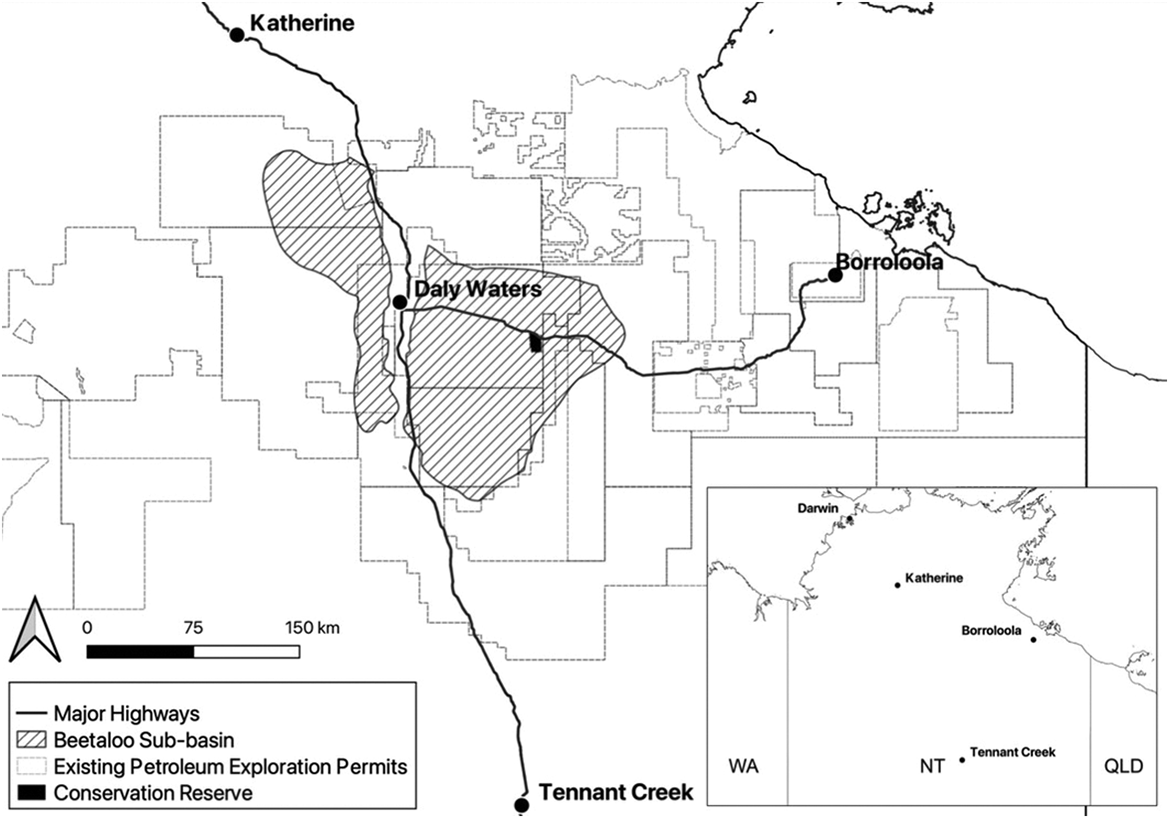
Map of the Beetaloo Basin showing approved petroleum exploration permits.
Fracking’s local impacts are, however, arguably overshadowed by its climatic risks. For example, if the Beetaloo gas field reaches the production phase (after current exploration), its life-cycle greenhouse gas emissions are estimated to increase Australia’s emissions by between 4.5 percent and 22 percent according to different official estimates (Scientific Inquiry into Hydraulic Fracturing in the Northern Territory [SIHFNT] 2018, 227; Bardon 2020). This would likely thwart Australia’s chances of meeting its international emissions reduction commitments under the 2016 Paris Agreement and, beyond that, increase the risk of catastrophic climate change impacts in a country already experiencing increased bushfires, heat waves, droughts, and cyclones. Many analysts suggest these amplifying hazards will disproportionately affect vulnerable populations and remote regions such as the NT. Further, experience in the United States and elsewhere shows that, despite industry claims that fracking increases a nation or region’s energy independence, it typically deepens economic dependence on fossil fuels (Mitchell 2013; Szolucha 2021). Once enmeshed in new contexts such as the NT, fracking will both accelerate climate disaster and likely be economically intractable.
The recent discursive framing of the Beetaloo as “the hottest play” is crafted to make its development seem both promissory and predetermined (see Kirsch 2014; Szolucha 2021). On reflection, the political components for such a framing had been constructed years earlier. Following public controversy about fracking, in 2016, the left-wing NT government imposed a moratorium and convened a scientific inquiry helmed by a multidisciplinary panel of experts (“the Inquiry”) which, eighteen months later, released its final report (see Figure 2). In this foundational document, published in March 2018, the panel parsed the environmental, social, cultural, and economic risks posed by fracking and made 135 recommendations to mitigate these risks drawing on specialized fields of expertise such as law, engineering, hydrogeology, geochemistry, anthropology, and economics. Its conclusion was that if all recommendations were applied, “not only should the risks associated with an onshore shale gas industry be minimized to an acceptable level, in some instances, they can be avoided altogether” (SIHFNT 2018, 60). A month after the report’s release, the moratorium was lifted on the basis that every recommendation would be wholly implemented.
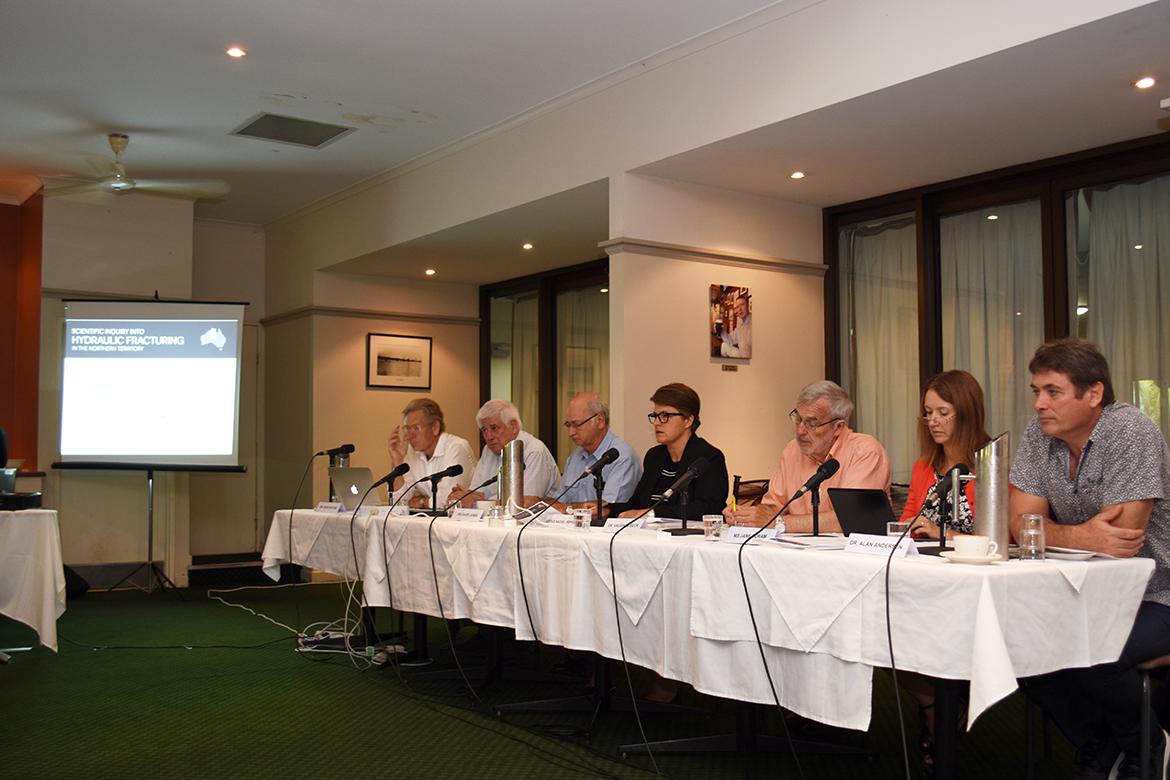
Photo of the Inquiry’s Katherine public hearing in 2017.
We focus on this technopolitical underpinning—the Inquiry and the implementation of its recommendations—to interrogate how extractive activities such as fracking are rationalized in new frontiers despite widespread acknowledgment that they will accelerate environmental damage, climate change, and their impacts. Drawing upon a critical review of relevant legal and policy documents, as well as interviews with ten key actors within the “enunciatory community” (Fortun 2001) of scientists, lawyers, activists, and policymakers engaged in the paradoxes of fracking regulation, we draw attention to the “divisible governance” of fracking in the NT. 3 Divisible governance involves the fragmentation of environmental risks between temporal and jurisdictional categories, allowing interested state and nonstate actors to superficially appear to protect the environment while actually deferring, forestalling, or eliminating their accountability for the consequences of extractivism. Divisible governance therefore works not only to facilitate the piecemeal entrenchment of extractive projects, including those that will accelerate climate change, but also to sustain ignorance on the part of the public about both the impacts of extraction and its faltering regulation. Divisible governance thus enacts particular futures that subsume and eliminate alternative configurations (see Appel 2019; Ballestero 2019; Brooks 2017; Michael 2017). While for the NT this means the sedimentation of a “gas-fired” future as its seemingly inevitable destiny, we argue that much can be achieved in such contexts to surface their contingent foundations and catastrophic impacts. One strategy, as this paper shows, requires mapping the connections that divisible governance fragments.
Divisible Governance: Risk, Jurisdiction, and Time
Our interviews with those professionally engaged in fracking’s regulation were vital to understanding the emergent positions, logics, and realities of this context (Fortun 2001, 13). Did they see it as a foregone conclusion, for example, that the Inquiry would present fracking as safe? One environmental lawyer involved in the Inquiry told us that the narrow terms of reference did not permit an examination of “whether this is the kind of industry you’d want to have underpinning your economy…as we shift massively to renewables and in the climate crisis.” Capturing the Inquiry’s logic and the wider governance regime, they added that “if you view fracking as an industrialized process, which carries with it risk, I think you can regulate your way around a lot of that stuff. I think you can reduce substantially the risk of this process along with many others” (ENV1). 4 Just so, approaching fracking as an object of regulation necessarily means framing it in terms of discrete risks that can be managed and mitigated through categories established by regulatory science. For the last fifty years, the latter has been the keystone of most state environmental governance regimes’ epistemic authority (Demortain 2020). The central role of scientific methods in identifying and solving complex environmental problems is so normalized as to have become “an obligatory point of passage for environmental discussion and policy making” (Lidskog and Sundqvist 2018, 310). As Science and Technology (STS) scholars have demonstrated (e.g., Murphy 2008; Verran 2011), these methods and the governance regimes that utilize them work by dividing complex environments into categories of analysis, enabling “the piecemeal enumeration of ecologies as entities” that can then be monitored, modeled, and governed (Neale 2019, 405).
The divisibility of environments is similarly the “earmark of scientific justification” in risk governance regimes (Winickoff 2015, 173; Wynne 2002). This divisibility enables, for example, the spatiotemporally distributed impacts of fracking to be split into categories such as “water,” split again into subcategories of “water quantity,” “surface and groundwater quality,” and “aquatic ecosystems and biodiversity,” then divided finally into discrete enumerable threats such as “unacceptable groundwater contamination from leaky production wells.” Only when environments have been so parsed, can they be assessed, using universal standards of risk assessment and measures adopted to mitigate impacts to an acceptable level (or not)? Taken to its logical conclusion, these technoscientific practices of fragmentation have produced what Murphy (2008) calls the “molecularization of life,” where risks to entities including human bodies have become scientifically legible at the molecular level via the identification of multiple individualized and low-level accretions of synthetic chemicals existing within them.
Of course, these individuated risks bear little resemblance to the original place or thing said to be “at risk,” be it aquifer, wetland, ecosystem, or some other entity. The value of a category such as “unacceptable groundwater contamination from leaky production wells” is precisely that it is not place-specific. Such universalism is what is needed to ensure that the regulatory system functions as such, removing “all detail about the nature of the thing or action” so that, as Bowker (2008, 109) explains in relation to biodiversity governance, “what is left is the smooth surface of a coin or note, with a quantitative value attached to it.” Risk assessment is thus an abstracted portable package of technologies that can be easily transplanted to ever-expanding contexts. The apparent universalism of risk is what permitted the Inquiry, for instance, to import expertise from other places—including the Marcellus Shale region of the United States—about how to mitigate risks to groundwater caused by faulty production wells in the NT. “The calculus of risk exemplifies a kind of ethics without morality,” Beck (1992, 99) asserts, “the mathematical ethics of the technological age” (also O’Malley 2009).
As feminist STS scholars have demonstrated (e.g., Haraway 1997), categories of risk are not disinterested or objective facts but are rather products of social, material, and textual practices imbued with hegemonic power relations. Risk assessment is a product of the dominance of Western, typically masculine and White, capitalist industrial modes of production, themselves premised on the elision or elimination of other situated ways of knowing and being. Demonstrably, the enumeration and divisibility of risk very rarely arrests these dominant extractive configurations of the world but instead provides methods for managing the ambiguity inherent in modernity’s hazards (e.g., Demortain 2020; Shafiee 2020), a social compact which attempts to make “the incalculable calculable” (Beck 1992, 100). “Science will tell you that fracking can occur with all the appropriate regulatory activities,” to quote an interviewee previously from an NT government department (GOV3). Fragmenting complex processes, like fracking in the NT, into discrete objects of regulatory risk management is a proven technique to render the controversial into the conventional and thereby render the inexistent into the emergent and then the inevitable.
The hegemony of risk assessment in contemporary environmental governance regimes can be understood as being produced through the development of regulatory science and a corresponding legal regime “in the same breath” (Winickoff 2015, 175; Jasanoff 2004). It is jurisdiction, the core technology of this latter regime, that enables the political work of authorizing certain risks and their scientific regulation (Winickoff 2015, 174). Jurisdiction is a device that bestows legal authority on the state and its institutions (be they the courts, the parliament, the executive or other entities) to judge or act in a defined field of responsibility. It is a “hidden architecture” that is the “organizing principle behind the distribution of state power” (Kahn 2017, 5-6). The practice of jurisdiction sets the limits of legal classification, defining matters such as who is responsible for a particular risk. 5 While this classificatory practice may seem a rational “anti-politics machine” (Valverde 2015, 84), effacing political decisions as technical solutions, this is too simple a diagnosis. The trick of jurisdiction is to make incommensurate legal orders and their distinct logics and categories seem to “coexist without a great deal of overt conflict” (Valverde 2009, 141).
We contend here that gas fracking reveals how, as a practice, environmental risk governance in Western capitalist societies is itself becoming “fracked,” in that it is fragmented jurisdictionally and temporally. Examining the case of gas fracking in the NT, jurisdiction is fragmented in three principal ways, the first being that jurisdiction to authorize and regulate is split between different political levels or scales. In regards to fracking in the Beetaloo, this split is between local (NT), federal (Commonwealth), and international (seen in international law norms and treaties, such as the Paris Agreement) scales. Second, jurisdiction is split into different governing laws at the same scale. Within the NT’s law-making jurisdiction, for example, there is separate legislation governing water management, petroleum operations, and environmental assessment. Third, there is fragmentation within the different government actors tasked with implementing these laws: jurisdiction is split between parliaments and ministers and between government departments with their own distinct cultures, influences, and practices (Lea 2021).
Environmental governance regimes also construct time in particular ways. The temporal bias is toward project authorization, when a combination of different regulatory jurisdictions interlock to apply pressure on the grant of development tenure, water licenses, environmental impact assessment processes, development approvals, and finance and sales agreements (Howey 2020). As the legal scholar Benjamin Richardson (2017, 285) argues, internationally environmental regulators have been victims of “the cult of speed,” pressured by political and economic elites to abbreviate any processes that may delay economic development. The time aperture of project authorization can vary from a few months to many years in Australia. This period may seem unduly lengthy, particularly to governments bound by electoral cycles and proponents captured by a capitalist conception of time as money. Yet, just to remind us of time’s constructed character, this is a short period compared to other human and inhuman timescales. The shale rocks in the Beetaloo Basin are the world’s oldest to be accessed for extraction. They were formed 1.5 billion years ago in the pre-Cambrian age when a steaming bacteria-filled sea covered the region. “Complex” forms of life were still a billion years away.
A brief interruption (in deep geological time), fracking in the Beetaloo, is also currently in the midst of a lengthy interregnum (in capitalist time). The project authorization process, which commenced with the first exploration titles granted in the mid-2000s and since traversed the twists and turns of the moratorium and the Inquiry, will finish if and when final production approvals are granted. The temporal aperture of project authorization is not a single event but is itself splintered or fragmented. To take a key example, which we will return to, there is a temporal split between “exploration” and “production” approvals in the NT. Since exploration is assessed to have less significant environmental impacts than production, according to the framework used by the Inquiry, many of the recommended reforms do not have to be completed until production approvals are granted. In the meantime, the industry can advance in a piecemeal fashion, by obtaining one approval at a time, for discrete exploration activities such as drilling monitoring bores, constructing well pads, or drilling and “testing” fracturing wells. “Exploration” builds a milieu of infrastructures and approvals in which gas is produced and “production” is therefore underway avant la lettre.
In divisible governance, as we call it, categories and subcategories of risk are almost endlessly divided—shuffled in and out of jurisdictions, reordered in and out of times—to ensure extraction proceeds. In the following sections, we consider how the techno-legal maneuvers of divisible governance reinforce each other and enact particular futures, focusing on the recommendations of the Inquiry and the perspectives of the enunciatory community of fracking regulation elicited in the wake of the Inquiry. The variety of bureaucrats, politicians, activists, lawyers, gas industry employees, and scientists who have emerged to co-constitute the field of fracking’s regulation are not a “community,” as they lack a shared identity, or an “epistemic community” (Haas 1992), as they do not have common epistemes or ideas of truth. Rather they are an enunciatory community, as theorized by Fortun (2001, 11-13; also Fortun and Fortun 2005), in that they are internally “fissured” but united by a shared double bind, bringing “into play both new and entrenched ways of engaging the world.” The double bind emerges from their shared commitment to the Inquiry’s implementation and thereby the creation of fracking as a novel regulated industry; each is, on the one hand, bound to the Inquiry’s ideals of comprehensive risk governance and, on the other hand, attuned to the diverse reasons these ideals cannot actually render fracking “safe.”
Just so, we argue that this community is enjoined in the constitution of divisible governance in this context. Consultants advising energy companies, environmentalist organizations rallying against mining impacts, Aboriginal statutory bodies seeking to protect stakeholder interests, and government departments seeking to ensure compliance or maximize investment are, among others, all caught in the gravity of the Inquiry and the “enunciation” or refinement of an inexistent fracking industry into an established one. All are bound to an emergent situation—the proposed onshore gas industry in the NT—which they contribute to and also wish were otherwise (in divergent ways). In the following section, we explore this situation by first explaining how the Inquiry established its political and legal conditions. We then examine two key categories of risk identified by the Inquiry: the risk of excessive greenhouse gases that would contribute to climate change, and the risk to local groundwater aquifers which sustain human life in the NT. Divisible governance, we conclude, is an exercise in future-making in which resource extraction is entrenched and other possible futures are excluded (Michael 2017).
The NT, the Inquiry, and “the Hottest Play”
Located in the continent’s hot north, the NT is Australia’s most sparsely populated jurisdiction with one sixth of its landmass holding one hundredth of its population. The bulk of the Territory’s 230,000 residents—and nearly all of its non-Indigenous population—live in the major centers of Darwin, Alice Springs, Katherine, and Tennant Creek. Compared to the rest of the nation, the NT is also distinctive in terms of its large Indigenous population and Indigenous land estate. Roughly 30 percent of NT residents identify as Indigenous, compared with approximately 3 percent nationally, and half of its landmass is owned as freehold by Indigenous people under the Aboriginal Land Rights (Northern Territory) Act 1976 (Cth), where most Indigenous residential communities are located; much of the remainder of the NT is also subject to other Indigenous rights and interests. Since Indigenous land rights have to fit in the “cracks” left over from settler legal dispossession (Strelein 2009), their relative abundance in the NT illustrates the lack of purchase non-Indigenous people and their development schemes have had here. Alongside the forces of colonialism and extractivism, the combination of geographical extent, sparse population, and large Indigenous minority and estate have helped ensured that, ever since the NT was confected into a colony over 150 years ago, the region has been persistently subject to attempts to “develop” it out of fiscal dependence on Commonwealth funding (Lea 2008).
Historically, one of the largest obstacles for schemes to expand the NT’s population or develop its natural resources has been its tropical and desert climates. Anthropogenic climate change is projected to only exacerbate these obstacles and produce significant impacts as early as 2030, with extreme impacts by 2070, including more severe cyclones, increased droughts, changed fire regimes, more erratic rainfall, and extreme temperatures. By 2090, the NT’s capital, Darwin, will likely experience more than 300 days per year of temperatures over 35°C (Webb and Hennessey 2015), creating a severe heat stress hazard. In fact, the NT’s experience of climate change impacts is already startling. Its three principal ecosystems, the savannas and coastal mangroves of the tropics in the “Top End” and the arid zone interior of Central Australia, have been classified by some scientists as “collapsing” (Bergstrom et al. 2021). Climate change will intensify existing entrenched inequalities in housing, health, infrastructure, and employment, with impacts felt disproportionately by Indigenous people and lands in northern Australia (Green, Jackson, and Morrison 2009). The NT’s own Environment Minister, Eva Lawler, acknowledged recently that the Territory may become uninhabitable for humans if global emissions continue on current trajectories (Roberts 2019).
It is within this slowly disastrous context that the NT Government announced in April 2018 that it would lift a moratorium on onshore fracking on the basis of the Inquiry’s report. The moratorium had been imposed following an election commitment by the incoming left-wing Labor administration in 2016, which seized upon the political opportunity of this new industry’s domestic and international unpopularity. At the time the moratorium was imposed, the NT’s fracking industry was in a nascent state with very few wells drilled. Nonetheless, the NT Government remained desperately in need of new employment and taxation opportunities and applications for exploration licenses blanketed most of its land mass, with gas companies particularly excited about the potential of what lay deep underneath the Beetaloo Basin, 600 kilometers into its arid interior. The moratorium only temporarily dampened the fervor for exploration. As one former government employee stated in an interview: “[w]hen a government faces a really, really difficult issue, what they need to do often is call an inquiry, let the inquiry call a report, and say, ‘we’re just doing what that report says’” (GOV2). According to this individual, the Inquiry was intended to cool a “hot situation” (Callon 1998), outsourcing the resolution of an exceedingly complex political problem itself deemed “beyond the scope of understanding of most ordinary people because it’s just not part and parcel of their world” (GOV2).
The terms of reference for the Inquiry were deliberately circumscribed. Narrowly “scientific,” it was designed to “identify and assess the risks of the industry and advise the government whether they could be mitigated to an acceptable level by appropriate recommended safeguards” (SIHFNT 2018, 12). The “morality of a new gas industry” (ENV1) was not up for discussion, though the Inquiry’s final report conceded that, based on its consultations, “the overwhelming consensus was that hydraulic fracturing for onshore shale gas in the NT is not safe, is not trusted, and is not wanted” (SIHFNT 2018, 6). Nonetheless, these concerns were not within its remit, and while the Inquiry’s justification for proceeding with the industry avowedly rested only on scientific risk assessment, the Inquiry was as much a legal probe as a scientific one. “The real story,” according to the former government employee (GOV2), was that “it’s actually a legal inquiry because it’s looking at issues on a sort of a case-by-case basis or an issue-by-issue basis.” From this perspective, the primary task of the Inquiry was to itemize and rank individual risks, and then match them to the correct jurisdictional and temporal phase to appropriately mitigate that risk to an “acceptable” level. If a particular law was found to be deficient, then the Inquiry recommended it be changed before a particular temporal marker (generally either prior to the grant of further exploration approvals, or further production approvals). According to this same person, this legitimized the Inquiry as much as its scientific findings. “It’s only when the law runs under the surface,” they stated, “[that] there’s something actually functioning properly.”
In March 2018, the Inquiry finally proposed 135 recommendations to mitigate the risks of fracking to an acceptable level, presenting them as an “all or nothing” proposition (GOV2). The logic appeared to be that once all risks were individually itemized, assessed, and mitigated to an acceptable level, then the practice as a whole was safe. When the NT Government duly lifted the moratorium, one regulator explained, the Inquiry’s recommendations became “the yardstick” (GOV2) for judgment, assuming both a regulatory and moral normative force that distilled the issue “into a simple sort of framework for people to…think about and judge whether a government or an industry or environmental groups are behaving reasonably” (GOV2). A large enunciatory community has subsequently been drawn into the Inquiry’s overwhelming gravity and its litany of recommendations. Bureaucrats have been employed across multiple government departments, an implementation plan with strict timelines for key “deliverables” is reported against on a public website, multiple pieces of legislation have been enacted and regulations promulgated, scientific baseline and pilot studies have been commissioned, and gas companies have engaged consultants to ensure that key regulatory documents comply with new codes of practice and legislative requirements. From outside the system, activists and concerned members of the public have applied consistent pressure to ensure that each recommendation is followed closely. Each of these groups are thoroughly enmeshed in the logics and minutiae of the most complex set of regulatory reforms in the Territory’s history, interpreting temporal and jurisdictional fragments and shaping fracking’s realization as regulated risks.
Maneuvering Climate Risk
We pivot now to the effect of divisible governance on a specific key set of risks assessed by the Inquiry: the risks associated with excessive greenhouse gas emissions being produced by an onshore shale gas industry. The gas industry contributes, in several ways, to emissions. It releases carbon dioxide and methane when combusted as an energy source or in industrial processes, via “fugitive emissions” during extraction and from the deliberate flaring and venting of gas from processing facilities. Globally, the energy sector (including electricity, heat, and transport) contributes around three quarters of total emissions. Australia has one of the highest per capita rates of emissions in the world and is also one of the largest fossil fuel exporters in the world. Although industry lobbyists often note Australia contributes only 1.4 percent of global emissions, its carbon footprint would be lifted to around 5 percent if its exported emissions were included (Climate Analytics 2019, 2). Climate politics in Australia has been polarized for decades due in part to the perceived reliance of the national economy on fossil fuel use and export; botched attempts to introduce national climate policies have been integral in ending the administrations of three recent prime ministers (Nature 2018), and the current administration refuses to plan for an end to coal mining. 6
When the Inquiry was first convened in 2016, community concern was focused on the risk of contamination to water rather than climate risks (see Cementing Groundwater Risk section). Nonetheless, the risks posed by fracking’s emissions profile gained prominence as the Inquiry progressed and, following pressure by environmental groups, it ultimately split the risk of “excessive greenhouse gas emissions” between “upstream” (extraction, processing, transport, and distribution of gas) and “downstream” (combustion or use of that gas for industrial, commercial, or domestic uses) temporalities. To mitigate upstream impacts, the Inquiry recommended a suite of measures be implemented prior to the grant of any further exploration approvals, including that the NT legislatively embed new US performance standards 7 and that a code of practice be developed and implemented for the monitoring, detection, and reporting of methane emissions from any onshore shale gas fields. As these standards were already tested elsewhere, their integration into the NT regulatory framework was treated as a simple matter of copying and pasting others’ words.
But the Inquiry’s recommendations to mitigate life cycle emissions—which include downstream emissions—have subsequently proven far more difficult to address. According to the Inquiry, emissions from a new onshore gas field across a range of production scenarios would contribute between 4.5 percent and 6.6 percent of Australia’s total annual emissions. This risk was deemed “unacceptable.” To mitigate this risk, the Inquiry recommended that both NT and federal governments “seek to ensure that there is no net increase in the life cycle greenhouse gas emissions emitted in Australia from any onshore shale gas produced in the NT;” in other words, any emissions would need to be “fully offset” with identified emissions abatements and reductions (SIHFNT 2018, 239). The Inquiry did not provide answers to how this could be achieved, but implicitly accepted that it would not be possible to achieve this presently or locally, suggesting anticipated futures initiatives in other parts of Australia such as the increased deployment of renewable energy and carbon capture and storage technologies (see Kuch 2017).
This recommendation thus presented a jurisdictional problem. The Inquiry had been established by the NT Government but its implementation required the collaboration of other jurisdictions, in particular the Commonwealth Government, which has been widely criticized as a “regressive force” on climate action (Burck et al. 2020, 23). More troublingly, it appeared that the Inquiry may have set an impossible task. Internal advice from the Commonwealth’s own Department of the Environment and Energy stated that emissions from the Beetaloo “may be difficult to offset” would impact the nation’s plans to meet its Paris Agreement commitments, and could be more than four times larger than the Inquiry’s estimation, reaching closer to 22 percent of Australia’s current annual emissions (Bardon 2020). Critically, though, and unlike other recommendations, the Inquiry gave no date or time limit for the Beetaloo emissions to be “fully offset.” It deferred these anticipated but unrealized emissions to predicted but unrealized solutions “elsewhen or elsewhere” (Anderson 2010, 783).
Today, it is not possible to gauge how negotiations about such emissions offsets are progressing. According to a government website, in May 2021, the implementation of this recommendation was “25 percent complete,” with intergovernmental discussions “ongoing” and “various studies commissioned” to investigate options. Repeated requests by the authors under the federal Freedom of Information Act 1983 (Cth) for details of the energy and reduction agreement being negotiated between the Commonwealth and NT were repeatedly refused, including because disclosure was deemed to be not “in the public interest.” In August 2021, Commonwealth Government representatives stated at a parliamentary inquiry that agreement negotiations “are still ongoing” and have no time frame for conclusion (SCEC 2021, 90). By comparison, the Commonwealth Government has been more forthcoming with information about its stimulus for fracking the Beetaloo. As well as the AU$50 million transfer to gas companies announced in December 2020, the Commonwealth has also funded an AU$28.3 million “strategic basin plan” for the field, and contributed AU$8.4 million for environmental baseline studies as part of its vision for Australia’s “gas-fired” future (The Hon Angus Taylor and the Hon Keith Pitt 2020). The Inquiry’s jurisdictional pivot to the Commonwealth has ensnared the NT within this future.
Here, we can see divisible governance at work. The risks associated with greenhouse gas emissions were dissected by the Inquiry, then assessed, and recommendations made. The recommendations were then split temporally: the measures to mitigate localized upstream risks were to be implemented prior to the grant of further exploration approvals, whereas the catastrophic climate risk associated with the downstream emissions were to be dealt with at some undetermined future time through some undefined set of agreements and regulations. 8 In parallel, the Inquiry split jurisdictional responsibility for the risks and their mitigation, implicating a federal government in the resolution of “the biggest risk of all.” This same federal government is evidently both intent on accelerating gas production and avoiding defining its liabilities for production’s consequences.
Our interviewees from within fracking’s enunciatory community were bound in these maneuvers of divisible governance, and the kinds of futures they produced, in different ways. For example, industry proponents suggested that the jurisdictional and temporal fragmentation of emissions risks was appropriate, however, when pressed further, their sanctioning of the logic of divisible governance concealed their disagreement with the requirement to offset lifecycle emissions. One such interviewee conceded that there definitely “needs to be ways of minimizing…[upstream] emissions from the operation” but asserted that, because gas provides “cleaner” energy than coal, its downstream emissions are always implicitly offset (IND1). Another industry interviewee, a scientist who consults for gas companies, would not be drawn on the practicalities of mitigating life cycle emissions, emphasizing the credentials of gas as a “bridge” to renewable energy (see Howarth 2014): “I’m totally all for natural gas as a transition gas. I quite like that and I think it’s the way to go to transition from out of oil and gas and into renewables” (IND2). Alternately, a recent NT Government employee asserted that measuring emissions on a state-wide or territory basis led to “perverse outcomes” and only a “national policy” led by the federal government was appropriate to managing emissions (GOV2). This might be difficult, he admitted, before insisting that “a place like the Northern Territory is too small, to be able to create the sort of emission savings on a case-by-case basis.”
Meanwhile, deferring action on fracking’s most serious risk indefinitely, and to another jurisdiction, rankled other interlocutors. As many noted, exploration activities could proceed in the meantime, with each well drilled incrementally increasing the climate risks of Beetaloo gas and the inevitability that the industry will proceed, despite the apparent impossibility of its achieving net zero emissions. One activist heavily engaged in the Inquiry’s implementation suggested to us that the deferral of offset requirements and the implication of the Commonwealth in achieving them made the industry a “fait accompli” (ENV3). “Unfortunately,” they said, “what I think is the more likely scenario is that the industry will be supported to proceed, but the climate emissions and the abatement elements of the recommendations will be papered over.” Making the federal government jurisdictionally responsible for offsetting measures provided the NT with an easy excuse, they argued, meaning it was able to say “‘we’ve spoken to the feds [about offsetting]…and we’re waiting for a reply.’ Well, I don’t think the reply is going to come.” From this perspective, we see how—conveniently for industry and government actors intent on its development—the jurisdictional and temporal splitting of the Beetaloo’s climate risks obscure accountability for mitigating them.
Yet such risk fragmentation has also been utilized by environmental groups to their advantage, looking for a “gotcha moment” (GOV1) or scandal as one government regulator explained. They noted that while there was a perception that there was “no particular hope” of the Commonwealth “neutralizing” emissions, this provided a rallying point for activists who saw the 135 recommendations as 135 hurdles to help stop the gas industry, rather than mechanisms for improving environmental regulation in the Territory. For such activists, this interviewee said, “it’s not about working out a way of doing this industry safely because under that particular belief the whole thing is inherently insanely unsafe because it’s contributing to a huge catastrophic problem” (GOV1). While they conceded that “there’s a very rational basis for saying we want to keep [gas] in the ground and if we can stop it here then we can sleep at night,” they also expressed frustration that “there’s no cheering as [regulators] get these conditions through and done properly. It’s the opposite. It’s like another hurdle’s been completed, we’re that much closer to doomsday” (GOV1). The Inquiry’s presentation of the recommendations as an “all-or-nothing proposition” was thereby expedient for both activists and industry; failures in implementation impugned the legitimacy of an entire regulatory regime they deemed suspect.
Beck (1992) suggests that risk assessment frameworks have difficulty dealing with large-scale ecological hazards that transcend spatial and temporal boundaries of localized action, including the threat of climate change. Risk calculus requires defined categories and limits and can easily be “under-estimated, compared out of existence or made anonymous causally and legally” when bounded poorly (Beck 1992, 105; also O’Malley 2009; Lakoff 2017). Despite the growing knowledge that we are exceeding planetary boundaries, and that risk logic is inadequate to address this existential threat, divisible governance persists as the primary way to manage all environmental threats, including global ones. The Inquiry used common risk paradigms to deal (somewhat awkwardly) with the worldwide threat of climate change by recommending that the Beetaloo’s life cycle emissions simply be “fully offset.” However, the Inquiry also divided time and jurisdiction to minimize the likelihood of this outcome, demonstrating a key deception of divisible governance: it appears to be reducing environmental harms by attending to risks that are specific, local and technical, while legitimizing the acceleration of those harms on a global scale.
Cementing Groundwater Risk
During the Inquiry, the environmental issue that most captured the public’s imagination was groundwater contamination, as Indigenous groups, activists, and pastoralists mobilized around a unifying “water is life” theme (see Figure 3). Since aquifers supply 90 percent of water for human consumptive use in the NT, and this reliance is strongest in Indigenous communities, aquifer contamination poses an existential threat, but it is also a more localized risk than emissions and thus more amenable to the Inquiry’s risk assessment framework. The Inquiry identified a number of potential pathways by which groundwater might become “unacceptably” contaminated by fracking, such as, for example, through “leakage of either hydraulic fracturing fluid, flowback or produced water, or methane from operating or abandoned wells” (SIHFNT 2018, 145). Put another way, aquifers could become contaminated when fracking wells fail and become a pathway for aquifer pollution. Such a possibility has become a reality in the United States, where well failure has been a frequent cause of drinking water contamination (Kinchy 2020). In the Marcellus shale region, the point-of-origin for much technical guidance used for fracking in the NT, the percentage of unconventional shale gas wells showing a loss of structural integrity was estimated at approximately 6 percent between 2000 and 2008, with over 100 cases of aquifer contamination between 2005 and 2014 (Jackson 2014).
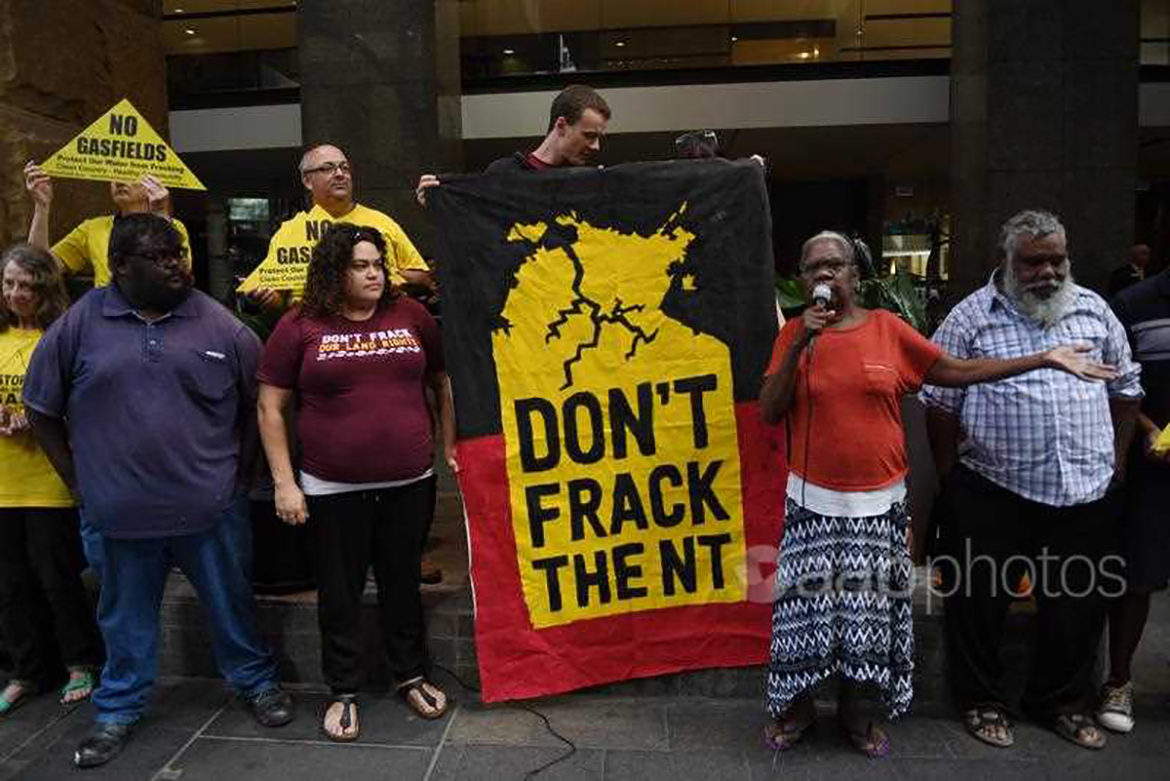
Protesters rally outside Origin Energy’s annual general meeting in Sydney, October 18, 2017.
Per the Inquiry, the principal technical remedies were a monitoring program and US-developed techniques to ensure the integrity of the well during construction, operations, and decommissioning (SIHFNT 2018, 147). To these ends, The Code of Practice: Onshore Petroleum Activities in the Northern Territory (“the Code”) was produced and deployed prior to the grant of further exploration approvals, comprising 120 pages of dense and cryptic technical engineering requirements referring to other standards that also run to hundreds of pages. 9 Amid this complexity, one everyday material in particular—cement—is present to seemingly resolve the many uncertainties of groundwater pollution, appearing over 230 times and across the fracking process. During well construction, for instance, cement is first pumped vertically down to seal the gap between the well’s steel casing and the drilled hole and, at the end of a well’s fracking life, cement is poured in to create a plug. In abstract, cement is conceived as an impermeable seal isolating the well from the surrounding rock and aquifers, however, in practice, faulty cementing and casing cause most well integrity problems (Jackson 2014). Cement deteriorates over time, shrinking, cracking, or seeping. Both the 2010 Deepwater Horizon oil spill disaster in the Gulf of Mexico and the 2009 Montarra oil spill in the Timor Sea, off the NT coast, were caused by cementing failures. Despite the spectacular testimony of these disasters, and others, to the limits of cement, some industry analysts continue to insist that you just need “a good cement job” to avoid all groundwater impacts from fracking (Conca 2012; see Bond 2013). Cement is used, materially and metaphorically, to seemingly “fix” fracking’s groundwater risks.
The Code is not the only mechanism recommended by the Inquiry to manage groundwater risks. Among the Inquiry’s 26 recommendations relating to safeguarding water, and in accordance with the logic of divisible governance, there were further fragmentations of gas-fired risks across different jurisdictional and temporal layers. Most significantly, the Inquiry noted uncertainty regarding NT water systems and insufficient information on “the nature of the deeper groundwater systems” or baseline data to properly assess the impacts on groundwater and surface water (SIHFNT 2018, 112), and so it recommended comprehensive baseline studies. 10 Yet, per the Inquiry, these studies do not need to be completed until the “production” phase, meaning the drilling and fracturing of multiple wells has been permitted to proceed across multiple sites under the aegis of “exploration,” compromising the very possibility of “baselines” in areas covered by the twenty-one (to date) separate approved Environmental Management Plans (EMPs; see Kinchy 2020). While EMPs are open for “public comment” for a few weeks, they take months to prepare and be approved by the regulator and each one is hundreds of pages long. Fracking’s enunciatory community is thereby embroiled in year-round paperfare (Lea, Howey, and O’Brien 2018), draining resources of both poorly funded environmental groups engaged in “cut and copy” (IND2) submissions and also gas companies implicated in successive “very long, drawn-out [EMP] approval process[es]” (IND1).
Moreover, while resources and attention are diverted to the piecemeal approval process—described by one interviewee as “mucking around in the weeds” (GOV3)—exploration is intervening in an unknown baseline. One environmental activist described the temporal split between recommendations as “an entirely political decision” (ENV2). There was an unacceptable incongruence, they explained, between the Inquiry’s assertion that the risks of fracking could be acceptably mitigated, and its concurrent admission that, in the activist’s words, “there’s a whole lot of information missing we don’t know about, and while we try and find out all that information you can just…start the exploration activities anyway” (ENV2). An interviewee from an Aboriginal statutory authority suggested that the baseline studies were always “much more focused on the timeframes, especially those that are bound around industry’s timelines to want to get production commenced…as opposed to science” (GOV5). The temporal split adopted by the Inquiry has a number of other consequences for the integrity and utility of the baselines, beyond their being compromised before-the-fact as they will come after drilling. First, this split heightens the risk that the baselines will become contentious and be deployed to deflect any claims that fracking activities cause environmental impacts (Kinchy 2020). Second, deferring baseline studies enhances the likelihood of the industry proceeding. As one government regulator put it, if the baseline studies increase the risk profile of fracking to an “unacceptable” level, as per the Inquiry’s risk matrix, “the companies will just go ‘no’ and that’s it” (GOV3). They were confident that politically powerful gas companies would successfully dispute baseline assessments, if necessary, as they would be even more powerful once baselines eventually emerged.
In addition to the postponement of baseline studies, key documents governing the management of groundwater risks through cement and other means are deferred through jurisdictional fragmentation, this time between different NT government actors at the same scale. As required by the Code, the detail of how the gas companies actually propose to manage well integrity—through cement and other materials—is contained in gas companies’ well operation management plans (WOMPS). However, unlike EMPs (which are subject to public comment and approval by the Environment Minister), WOMPs are not publicly available in either draft or final form. Additionally, the assessment and approval of WOMPs is provided by a different pro-industry government department. 11 The regulatory jurisdiction for managing well operations has been split, such that the documents the NT Government’s own Environmental Protection Agency (NT EPA 2020, 7) describes as the “key information required to ensure safe operation and well integrity is maintained” are removed from view. The “cement jobs” crucial to the safeguarding of precious groundwater are themselves sealed away within one government department, sealed off from the scrutiny of interested publics or even other government agents.
While itself valorizing transparency—the Inquiry stated that “transparent decision-making by an accountable regulator is the cornerstone of a trusted and efficient regulatory regime” (SIHFNT 2018, 431)—the resulting situation enshrines considerable ignorance about fracking’s potential groundwater impacts and the mechanisms to mitigate these impacts. Through jurisdictional and temporal fragmentation of risk, divisible governance both governs and sustains ignorance about the gas industry’s operations and its likely impacts while fracking gains traction with each passing approval (see Babidge 2019).
Conclusion
In May 2021, the International Energy Agency (2021) announced that, in order for the world to avoid catastrophic climate change, a “total transformation of the energy systems that underpin our economies” would be needed. As “seismic shifts” in energy economics in Australia and globally mean that renewables may already provide a cheaper source of new electricity than gas (Climate Council of Australia 2020), the Agency asserted that no new fossil fuel projects should be approved from 2021. Instead of moving away from fossil fuels, however, both the NT and Commonwealth governments have urgently doubled down on their “gas-fired” futures. In the 2020 NT election, the incumbent left-wing Labor administration prevailed against a range of left and right-wing rivals, some of whom opposed the development of a fracking industry. This result, the federal Minister for Resources declared, was “a mandate to develop these gas resources” (Macdonald-Smith 2020). Subsequently, in 2021, thirteen new wells were approved and the Commonwealth announced further support for exploratory drilling in the Beetaloo. Even if the NT Government wanted to retreat from fracking, the current administration and its successors have limited autonomy due to its unfolding fiscal crisis and its long-term reliance on federal funding, putting it in a position to be leveraged by others. Thus, an AU$260 million increase in funding to the NT from the Commonwealth in April 2018 was unsurprisingly linked to the lifting of the NT’s fracking moratorium two days earlier. Reflecting on these events, one of our interlocutors described the NT as “a colony of a colony” (ENV3).
Renewed pressure to facilitate an onshore gas industry before it becomes uneconomic (itself a form of temporal fracture that focuses on the economic present, rather than future) increases the likelihood that the implementation of the Inquiry recommendations may be further eroded and compromised. This was already a risk, as our expert interviewees reminded us. One environmental activist simply described the prospect that the NT was capable of best practice gas regulation as “utopian” (ENV1). A government regulator similarly said that “it doesn’t matter what’s on the piece of paper, if you don’t have people capable of actually regulating and implementing it” (GOV2). Even the Inquiry recognized that the “the failure by the Government to implement the regulatory reforms was itself a risk” (SIHFNT 2018, 7). At the time of writing, more than three years after the Inquiry’s conclusion, fewer than half of its recommendations have been implemented, with the path for achieving some of the more challenging recommendations—including offsetting life cycle emissions—still opaque if not actually secret or nonexistent. Recently, the time frames for completing the baseline studies of groundwater, human health, terrestrial and aquatic biodiversity, and other factors have been arbitrarily truncated to eighteen months, down from the three to five years recommended by the Inquiry, to ensure an accelerated transition to gas production by the end of 2022.
Yet such doubts do not typically halt the trajectory that divisible governance sustains; there is rarely any opportunity or desire for policy makers to pause and consider how it “all works cohesively” (ENV2), let alone withdraw. If such forms and processes that enable “abstraction, decontextualization, and standardization” are one of the conditions of possibility for contemporary capitalism, as anthropologist Hannah Appel (2019, 2-3) argues, divisible governance would seem to be an important strategy for sustaining such forms and processes in the face of pervasive and thorough criticism. Under the cover of intricate regulatory compliance, it draws every concerned actor into its gravity, their attention pulled toward its maze of forms and processes and seemingly endless technical rules. The grave impacts of resource extraction are slowly rendered “acceptable” while unacceptable risks—those that might prevent a particular form of extraction—are shuffled in and out of jurisdictions and temporalities, filtered through complex or secret procedures until their fragments become benign. Through divisible governance, the ostensibly apolitical and scientific techno-maneuvers of risk assessment and mitigation reinforce each other to enact particular futures and subsume or suppress other possible imaginaries. In the NT, every piecemeal exploration approval, every legislative amendment, every study commissioned, every box ticked in the list of Inquiry recommendations to be implemented, entrenches fracking’s alleged inevitability.
To hope or advocate for more effective regulation and its implementation in governing complex environmental issues is not the same as conceding there is no alternative to divisible governance. The contingencies, deceptions, and contradictions inherent in divisible governance, including how it sustains ignorance about the operations and impacts of extraction while asserting its regulatory transparency, are strategic and typically hidden from both the enunciatory community and publics involved in its enactment. To attack divisible governance on its own terms is to be drawn into its gravity—its logic of finer and finer technical distinctions encoded in subclauses and appendixes—and so our humble suggestion to others is to seek to map the connections that divisible governance fragments. Attend to the connections, between leaky wells, spongy aquifers, and permeable humans, or connections between material methane emissions and undefined prospective offsets. In cases where the overall risks of an industry such as fossil fuel extraction appear to be severe, if not catastrophic, close attention to its strategic separations and partitions can surface impossible logics and absurd schemes; felicitous conditions for governments to defer inconvenient impacts to elsewhere and elsewhen while regulating their way further and further into climate change. Once alive to it, divisible governance can be discerned elsewhere: the piecemeal advance of monocrops and associated deforestation by agribusiness companies (e.g., Hetherington 2020), the assessment and approval of large-scale mining projects (e.g., Kirsch 2014), and the allocation and trade of water rights in increasingly parched landscapes (e.g., Ballestero 2019; Brooks 2017; Shafiee 2020). In these cases, too, jurisdictionally and temporally fragmented risks and impacts always appear more benign than the obscured cumulative whole. Mapping such severe and catastrophic risks provides critical opportunities to renarrate situations of divisible governance, to reveal them as commitments to disaster rather than responsible regulation.
Footnotes
Acknowledgments
Our thanks to Abby Kinchy for helpful comments that sharpened the focus of this article. Also, our thanks and appreciation to the interviewees who have been both generous and courageous in giving their time and attention to this research project.
Declaration of Conflicting Interests
The author(s) declared no potential conflicts of interest with respect to the research, authorship, and/or publication of this article.
Funding
The author(s) disclosed receipt of the following financial support for the research, authorship, and/or publication of this article: Research for this article was partially funded by an Australian Research Council Discovery Early Career Researcher Award (DE190100233).
