



Abstract
In view of persistent global inequalities in scientific knowledge production with clear centers and peripheries, this paper examines a lingering concern for many scientists in the Global South: why is it, at times, so hard to have scientific insights from the South recognized? This paper addresses this big question from within a long-term field immersion in a Ugandan–Australian scientific collaboration in molecular biology. I show how disciplinary hierarchies of value affect the distribution of labor between Uganda and Australia and thematize the role of place and its affective atmospheres that texture the quotidian scientific work in this project. Unsurprisingly, they tend to devalue Ugandan sites and contributions, and turn Uganda into a rather unlikely site for new insights to emerge. However, in spite of doing devalued and outsourced “menial” labor such as fieldwork, Ugandan biologists’ fieldwork involves affective encounters with their experimental banana plants that thereby become differently thinkable. The paper argues that attending to affective atmospheres that infuse research sites offers clues about scientists’ position in global hierarchies and at the same time can help make room for insights that emanate from unexpected places.
July 2015. An agricultural research laboratory in central Uganda. The curtains are closed and the electrical lights are off. The small room is dark apart from three white lab coats swirling back and forth, moving items from a square workbench in the center of the room to a metal cabinet at one of the walls. Pipettes, pipette tips, a box of latex gloves, tube racks, paper towels, and other utensils disappear in the cabinet. “You see, that’s what it’s like! We are already behind schedule but now we have to wait till power returns,” Dr. Muyinga, the senior research scientist, sighs, “then at least let us see how our bananas are doing.” Glad to escape the stuffiness and stench of chemicals in the lab, Dr. Muyinga’s two research assistants and I follow him into the plantation.
A bit later in the field. We climb across the small mounds of mulch around every experimental banana plant, which crunch and subside with every step. Dr. Muyinga echoes a sentiment that is often expressed across Uganda, namely, how pleasant it is to be in a banana plantation, where it is shady and the wind rustles through the banana leaves! When I first started doing fieldwork in Uganda, Dr. Muyinga and his team were busy testing all banana plants from their field trial (see Figure 1). Testing involved collecting plant samples from the field and then applying a several hour-long protocol in the lab to extract the DNA from them. The banana plants had been genetically transformed, that is, Ugandan scientists had inserted a gene and promoter combination that increased the expression of beta-carotene in the fruit as a measure against vitamin A deficiency. This project is part of a larger collaboration, directed by an internationally acclaimed expert of banana biotech in Australia, who received a large grant from the Bill and Melinda Gates Foundation in 2005. Researchers from Australia had provided the protocol, “the technology” (the lab infrastructure and the gene insert) and other logistical support. They also trained Dr. Muyinga, who had just completed his PhD at the Australian lab, along with several other Ugandan researchers who are now working for this project in Uganda. The agricultural research institute where the molecular work is done is under the auspices of the Ugandan Ministry of Agriculture; most other projects here are rather agronomic in their orientation. The vitamin-enriched or “biofortified” banana (matooke) is a special project due to its length, its technical equipment, and the ways in which it merges scientific sophistication and the goal of contributing to public health through an agricultural product—a transgenic micronutrient-enriched banana that can be grown by Ugandan farmers across the country.
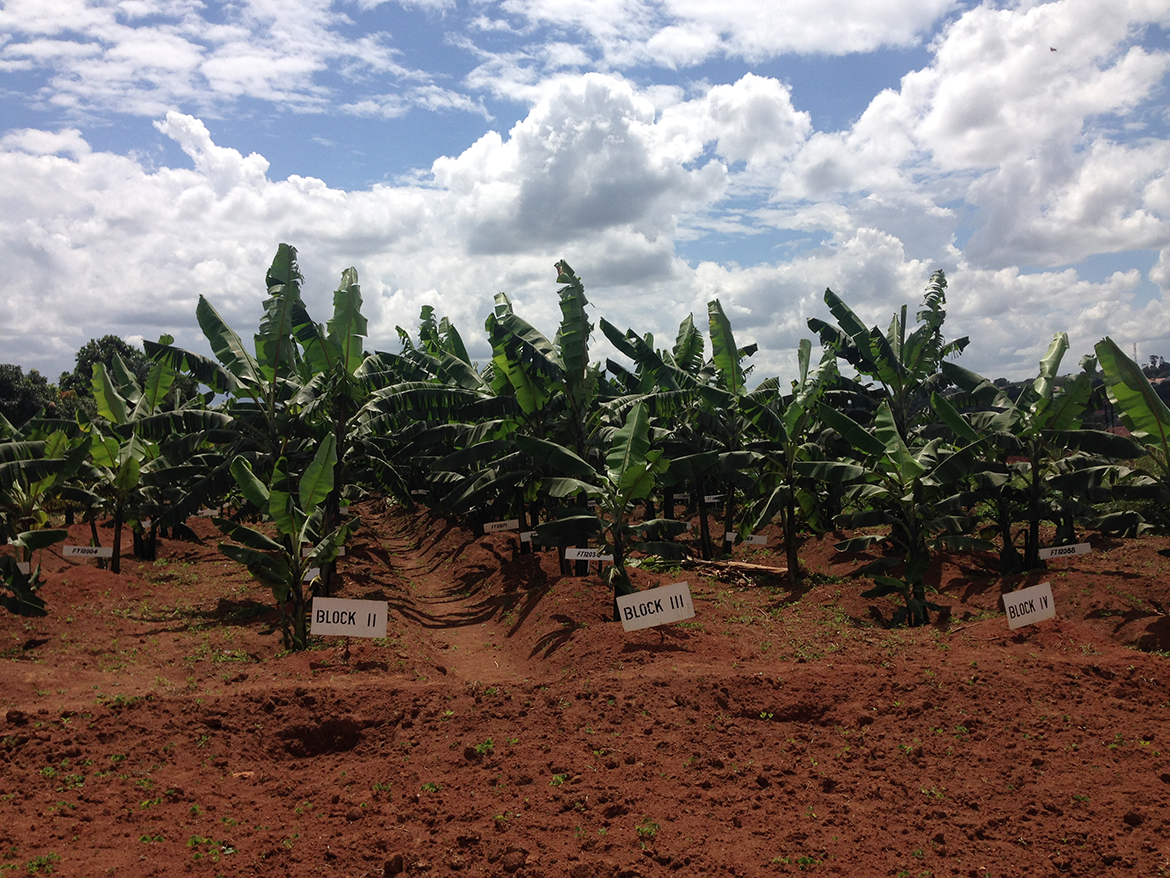
The Ugandan trial field of genetically modified bananas, July 2015. Source: S. Calkins.
Material conditions of the research facilities in Uganda and Australia matter here, as do scientists’ senses of different places. Most biologists whom I accompanied to the trial field, where they were growing transgenic banana plants, like Dr. Muyinga loved the field atmosphere and took the work to be enjoyable and light. Gardeners had to perform the harder labors of removing sprouting suckers and weeding, while scientists oversaw the trial, took samples, and observed the plants. These biologists appreciated fieldwork for its “lightness” but it is not highly valued in the lab-based discipline of molecular biology. In contrast to the lightness and casualness of the field, Ugandan biologists associated lab work with “seriousness”—after all scientific protocols had to be followed with exaction.
Qualifications of work being “light” or “serious” texture quotidian scientific practices in visceral ways and affect what it feels like for scientists and what sense of possibility they make out for their intellectual work. This paper asks a big question, namely, why is it sometimes so difficult for scientists in the Global South to have their findings and knowledge recognized? I use evidence collected during a total of sixteen month of ethnographic fieldwork in this Ugandan–Australian scientific collaboration to begin to answer this question. 1
One part of the story are material inequalities between places and especially the often crumbling research infrastructures in the Global South (for instance, Tousignant 2013; Droney 2014; Ureta 2020; Calkins 2021). This paper also draws attention to such inequalities but additionally foregrounds subtler hierarchies that unfold between different places and affect the distribution of labor. Sometimes scientists I interacted with directly mentioned what they thought about certain types of work and their prospects of making a distinct contribution to science. At other times, valuations could be better captured at the level of affect—as atmospheres of excitement, boredom, seriousness, or playfulness that infuse certain places and types of work. Seen from Uganda, it is not only the material equipment at a given place but also the broader values and affective atmospheres that mark places and affect how scientists feel about the work they do. In the case at hand, this results in turning Ugandan laboratories and trial fields into rather unlikely places for new knowledge to emerge.
But devalued places can still offer surprising insights. I show that new thinking about banana plants emerges from affective encounters between Ugandan biologists and their experimental plants in the field trial. Such conceptual innovations however become backgrounded in a lab-focused epistemic culture and become an unnoticed leftover. This paper draws attention to such devalued and hidden excesses of research that allow questioning entrenched hierarchies of scientific work and work places.
What made me think much about the role of place was the fact that Ugandan biologists were not only constantly comparing their own lab unfavorably to the Australian partner lab but they were also constantly moving between lab and field, where moods and atmospheres of work changed dramatically at times. On many days, as part of my ethnographic research, I was moving between lab and field trial myself, assisting molecular biologists in harvesting banana bunches, collecting leaf and fruit samples from the field trial, extracting DNA from plant leaves and fruits, or analyzing the beta-carotene contents of harvested fruits. What further struck me was how these molecular biologists have to account for the ways in which individual plants grow in a particular place while their laboratory-based experimental culture is based on an ethos of placelessness and professional detachment.
This paper begins by outlining the importance of place and the particularities of two places—laboratories and trial fields—for the work that occurs in them. I then discuss the distribution of labor between the Ugandan and Australian lab, a place where routine testing is being done and a place where the entire experiment comes together, and examine how affective atmospheres shape biologists’ assessments of their work as being boring, important, or exciting. In the following section, I show though the Ugandan field trial is doubly devalued—located in Uganda and then in a more unruly space than a controlled lab—it is a site from which new thinking about experimental plants emerges. The last section compares forms of thinking about plants in Australia and Uganda and speculates about the possibilities that making place for plants and thinking with them could yield. Finally, I suggest that more attention to affective atmospheres can be used to explore latent possibilities in everyday scientific work and foreground insights from unexpected places.
A Sense of Place: The Lab and the Field
The story I want to tell here is about new insights and new moral and political possibilities that emerge from a Ugandan research institute. Due to fixed schemes of value and the distribution of labor between Uganda and Australia, these insights however have some trouble moving into the outside world. It is a long-standing insight in the social studies of science that all evidence or facts are entangled with the places where they were produced, and clearly some places are better stages from where contributions to a body of scientific knowledge can be made (Merton 1968; Haraway 1988; Latour 1993; Frumkin 2003). And it’s not surprising given long-standing relations of geopolitical inequality that insights from African sites don’t travel easily (Tilley 2011; Abraham 2006).
Present-day scientific inequalities map onto long racist histories that denied Africans the credit for scientific work, de-emphasized their contributions, and devalued them as mere “menial work” (Geissler et al. 2016, 250; Lachenal 2011, 377). Today, just like the Ugandan–Australian science collaboration I examine, North–South scientific collaborative projects are typically directed by principal investigators from wealthy countries that receive the funds and set the agenda, whereas institutions in the Global South typically are junior partners, consigned to “applied” or data collection work (Crane 2013; Lachenal 2015, 10; Geissler et al. 2016, 250; Okeke 2018). While important work along those lines exposed the disturbing infrastructural inequalities between science in the Global North and South (Tousignant 2013; Droney 2014; Ureta 2020; Okeke 2020; Calkins 2021), this paper attends to finer grained differences in the valuation of place and labor within Uganda as well as between Uganda and Australia.
To answer why in this case Ugandan researchers face such difficulties in producing original insights, this paper draws attention to an additional layer of quotidian experience, what one could call “affective atmospheres” (Anderson 2009; Stewart 2011; Gandy 2017; Riedel 2019). I mean, what is felt, sensed, and also reproduced by scientists in the places they pass through as they go about their quotidian tasks. My emphasis is mainly on Ugandan scientists who divide their time between greenhouses, trial fields and laboratories in ways that differ from their Australian counterparts and are rather untypical for their lab-focused discipline (cf. Fox Keller 1983). Scientists often conveyed a sense of these affective atmospheres in words, in the ways in which they express their feelings, desires, and aspirations about their work, but also in how they moved their bodies and touched their research materials (see Myers 2015b). Affective atmospheres are important, though notoriously diffuse and hard to pinpoint (Anderson 2009), because they offer clues about how discipline-specific valuations are experienced and how different places are commonly inhabited. However, atmospheres aren’t “inert context but they are a force field in which people find themselves” (Stewart 2011, 452). Still, they can involve attunement to imagined and potential ways of doing things differently. I show what latent potentialities emerge in a devalued place—a Ugandan field trial—where Ugandan biologists handle their experimental plants and unexpected affective dynamics unfold.
Importantly, masculinist ideals of discovery research are central to this project in molecular biology and affect the valuation and hierarchization of different places. The laboratory, and particularly the one in Australia, is still the iconic site of scientific discovery. The laboratory is known as a device for knowledge production that brackets place and isolates objects from their surroundings (Shapin and Shaffer 1985). The laboratory was built on the exclusion of women and today still is infused with a masculine scientific ethos, geared toward discovery and exploration, where heroic scientific progress can be brought about (Shapin 1988; Haraway 1997, 23, 28; Subramaniam 2014). Important features of this imagined placeless lab are its seclusion, the invisibility and detachment of the scientist, and the reliance on proper procedure which ensures the consistent quality of experimental results (Shapin 1984; Shapin and Schaffer 1985; Haraway 1997; Kohler 2002). While we know that the placeless lab is a fiction, this description could nonetheless be more or less true for how the Australian lab sees itself and works internationally in the field of molecular biology. The Ugandan lab by contrast is much more unstable. Like other labs in the Global South (Tousignant 2018; Ureta 2020), it is a site of improvisation and it suffers from frequent water, power and other shortages (Calkins 2021). When researchers who had traveled abroad had to improvise, they told me what they “actually” would have to do, what would happen in “a real lab,” or “at the Australian lab.” These contrasts scientists draw underline the difficulties of establishing the generic features of labs and draw attention to them as tangible places that unfold their own affective dynamics. 2
Though molecular biology relies mainly on the laboratory to produce knowledge, this project also hinges on field trials to determine how laboratory-created banana plants grow in soil. The bananas grow in six consecutively planted field trials on a plot just behind the greenhouses outside the biotech lab. Field trials have a long history at this formerly colonial experimental station, where the British in the 1930s setup a range of agricultural experiments on cotton and coffee growing. The field trial here is a scientized version of the field. Importantly, “the field” here does not refer to “the wild” or undomesticated as in botany or ecology, another typically male space of discovery and bioprospection. Rather, the field trial refers to the field as it typically is ploughed by local farmers, that is, a zone where nature has been domesticated through cultivation. In this project, the field trial specifically mimics the low-tech and low-input methods of small farmers in Uganda but it also includes laboratory-like elements, like restricted access, having controls and so-called guard rows of conventional plants around experimental plants (Henke 2000).
Importantly, the field trial is much closer to the uncontrollable forces of “nature” than the lab (Henke 2000). It is its greater proximity to “nature” and natural reproductive processes that may also explain its association with the feminine as opposed to the highly cultured and controlled space of the lab. 3 The field trial is described as open, unpredictable, a place of variability and particularity (Kohler 2002, 6, 7). The particularities of place are not evacuated from the field trial like in a lab but have to be accounted for, that is, the prevalence of other species, topography, climate, toxins, and nutrients in the soil or the exposure to wind and sun light that shape plant growth (Henke 2000, 484).
A sense of place matters in another way too in Uganda. A deep familiarity with and appreciation for matooke (cooking bananas) runs through molecular biologists’ everyday work routines. Most Ugandans love bananas and pride themselves for having the world’s highest per capita consumption of bananas—plants that in central Uganda were historically associated with the female realm of reproduction and were mainly cultivated by women (Stephens 2013, 66, 69). While such place-based and cultural attachments are reflected in much scientific work, lab and field trial differ in their generic models in how far they account for such particularities of place: where the lab is universalizing, cultured and masculine, the field trial is rather particularizing, closer to nature and feminine, and this affects how scientists experience such places. The next section details how lab work is often experienced, but additionally flags material differences and the distribution of labor between Uganda and Australia.
Testing and Experimenting in Uganda and Australia
The small dark lab lies in the middle of the long corridor in the biotech lab between two larger light-flooded rooms, where researchers and lab technicians perform molecular work for different foreign-funded projects on Ugandan staple crops (see Figure 2). Dr. Muyinga and his team are working on their genetically modified bananas with high beta-carotene levels. This room is dark to prevent the light-sensitive beta-carotene, a substance human bodies can convert into vitamin A, from degrading during analysis. Dr. Muyinga, a tall and “serious” scientist in his mid-forties, is the senior research scientist in the biofortification project, a molecular biologist by training. When I first met him, he was still adjusting himself to Uganda after three luxurious years of PhD research in Australia, where he noted wistfully, research materials were always on stock and made for smooth workflows.
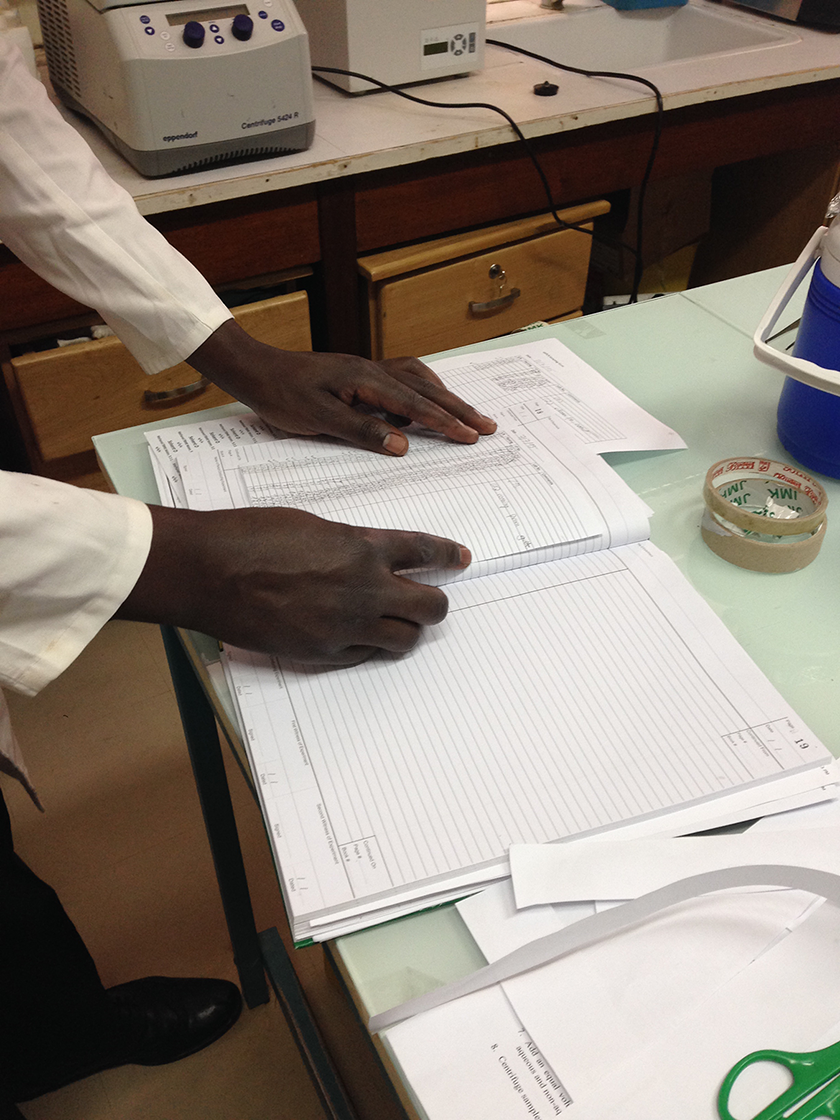
Lab work in the small dark lab, August 2015.
Apart from occasional frustrations with power outages, missing spare parts, and lab supplies, Dr. Muyinga could nonetheless seamlessly carry on research in Uganda, given that he already was familiar with the experimental procedures from Australia. 4 Similar experimental procedures and protocols are carried out in molecular biology labs anywhere in the world (Rheinberger 1992; Knorr-Cetina 1999). Molecular biology relies mostly on manual work at laboratory benches that is both lengthy and repetitive (Knorr-Cetina 1999, 36, 83-85). Dr. Muyinga and his assistants often sighed, grew uncomfortable in their posture, rubbed their eyes and backs under their lab coats after sitting for hours at the fume hood in the darkened lab. “Of course, it gets tedious when you’re always doing the same thing,” Dr. Muyinga said as he and his assistants were processing and analyzing hundreds of leaf samples from the trial field, “you tire out.” When I spent two months in the Australian partner lab in 2017, I noticed that researchers there, who in part applied the same protocols as their Ugandan partners, were complaining even more about the dullness of their benchwork. One postdoc, a cross-fit-aficionado whose headphones regularly blasted heavy metal music during benchwork, whined while finishing a DNA extraction: “I’m so bored I’ll die of depression.” Postdocs who worked on their own samples at the lab bench joked that their professors had said the monotonous lab work would be character-building but all it did was leave them drained and brain-dead at the end of the day. In the Australian lab, researchers also regularly noted that there wasn’t much for me to see that day. They were concerned I would get bored watching the same procedure over and over again and discussed among themselves who was doing something interesting and who I should therefore hang out with that day. There clearly was little appreciation for the monotony of daily routines.
A reason for this might be that in the Australian lab, monotonous routines were often followed by moments of excitement, when the results of seemingly endless rows of tests came together and results were assembled. When I was in Australia, where additional tests were done due to new available technologies that were missing in Uganda, the analysis of a first generation of all Ugandan bananas from the field trial was about to be finished and there was an air of excitement about seeing these intermediate results. This had aspects of open-ended discovery research that however made the everyday benchwork seem all the more so lackluster. “I spent 40 percent of my time doing work a technician could easily do. That’s not the best way of putting a postdoc to work,” one Australian postdoc complained as he hunched listlessly over his tray of samples. He expressed the view that many molecular biologists share, namely, that the ordinary benchwork does not need much expertise, given that it is performed according to highly standardized protocols.
This postdoc was highlighting a difference that with reference to molecular biology was often discussed as the difference between experimentation and testing. Accordingly, experimentation is understood as open-ended and explorative, geared to the production of “answers to questions we’re still unable to ask” (Rheinberger 1992, 25 [my translation]). Experimentation requires and encompasses testing. Testing by contrast is considered the demoted and repetitive application of standardized procedures that is epistemically locked in, reduced to dis/confirming preconceived hypothesis (Rheinberger 1992, 25; see also Hacking 1992, 58; Rheinberger and Hagner 1993). A simple PCR test is an example for testing at this lab. The test can detect the presence of the inserted gene sequence in the banana genomes but only indicate “yes” or “no” for this single variable; it doesn’t yield unexpected insights as any “true experiment” must (Rheinberger 1992, 4; 1995, 110). 5
In this project in molecular biology, testing is an everyday activity both in Uganda and in Australia and one that usually occurs in an atmosphere of boredom and listlessness. The research and the overall experiment are being led in Australia, where moments of excitement can also infuse the lab. This means that scientific labor between Uganda and Australia is organized in such a way that the results of test rows will be assembled in Australia and credit and inventiveness are attributed to the partner in the Global North. The Australian principal investigator told me during a conversation in his office that in Uganda “they have no room and resources for experimental structures. They cannot handle that yet.” So, this project relied on them transferring what they call “their pipeline” to Uganda. That is, everything needed to carry out the project-specific molecular work—the testing—like the scientific protocols, techniques, new fridges, centrifuges, and other devices. Testing, in this case applying the scientific protocols and carrying out the procedures, is considered easy enough—or devoid of its own intellectual contributions (cf. Shapin 1989)—that it can even be performed in places like Uganda, where research infrastructures are unstable and laboratories lack international certification.
Rheinberger’s distinction remains a useful heuristic to understand how different types of scientific work are valued in this project and affect researchers’ assessments of their work. In view of the high value placed on experimentation, both the Ugandan and the Australian molecular biologists burned for those moments of open-ended discovery research and tended to consider the quotidian closed-in tests they were performing as necessary but uninteresting, as merely mechanically affirming preconceived assumptions. However, as the Australian PI noted, Uganda at present doesn’t have the capacity for experimentation. Ugandan researchers are physically disconnected from those rather rare moments of exciting discovery research that happened in Australia and reduced them to “only” testing in the lab. Working in a lab atmosphere that lacks excitement and rather concentrates on tedious manual work shapes Ugandan scientists’ understandings about what they can contribute to science from their lab.
Writing about colonial science, Geissler and colleagues (2016, 157) noted the particularly narrow manual taskscapes that Kenyan science collaborators were assigned. However, this is not true for Ugandan biologists on this transnational project. For sure, they also perform repetitive and tedious benchwork but in view of the proximity of the trial field and the frequent trips between lab and field, they perform a broader set of tasks than their Australian counterparts—though not in the lab. “Fieldwork,” however, is not a type of work that is valued highly by molecular biologists. Working in the trial fields is not actually considered “science” but rather something that can be outsourced to gardeners and agronomists. The next section shows that practices at devalued sites like field trials can nonetheless yield new insights that extend beyond the project’s scientific framing.
Encountering Plants in the Field
During my first period of fieldwork in summer 2015, two confined trial fields had been planted (see Figure 3). One early morning, Dr. Muyinga, his research assistant John, and I prepare to go to the field to collect banana leaves for lab analysis. We gather together all utensils for cutting and wrapping plant samples: a Styrofoam box with liquid nitrogen to shock-freeze and preserve the samples, disposable gloves to avoid contaminating them, blades, aluminum foil, a list of numbered plants, and a pen. We then pass the guarded gate, sign the guestbook, and enter the field. The first trial field of beta-carotene biofortified bananas was planted in August 2014. Plants meanwhile have grown to about two meters, more than one hundred bananas planted in five neat rows.
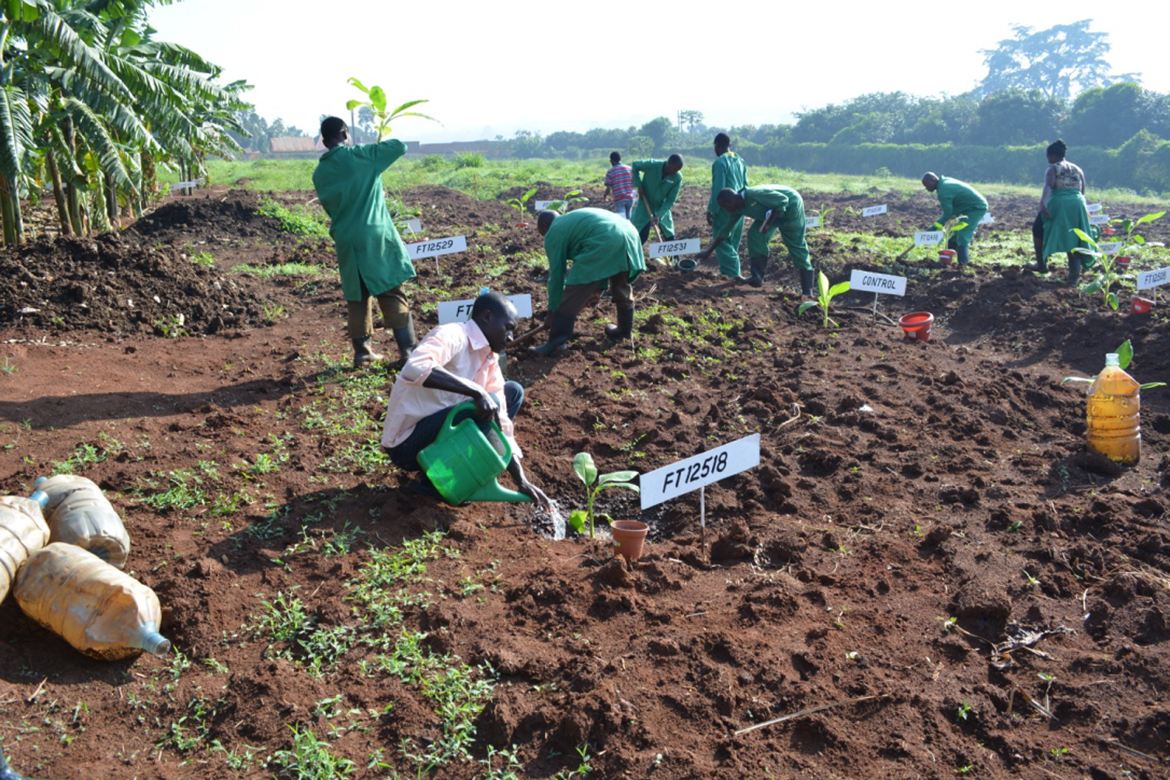
Planting an extension of the field trial, August 2017.
We agree on a system of sampling and start with the first plant in the first row on the left side of the field. As I’m unfamiliar with handling banana plants, Dr. Muyinga puts me in charge of the list and making sure that we stick to the agreed sequence of sampling. Our mission is to search for the so-called cigar leaf coming out of the top of the plant’s stem. The cigar leaf is the youngest leaf, still tightly coiled up, and whitish-green because it has not seen the sun (see Figure 4). It provides the best DNA yield in the lab, Dr. Muyinga explains.
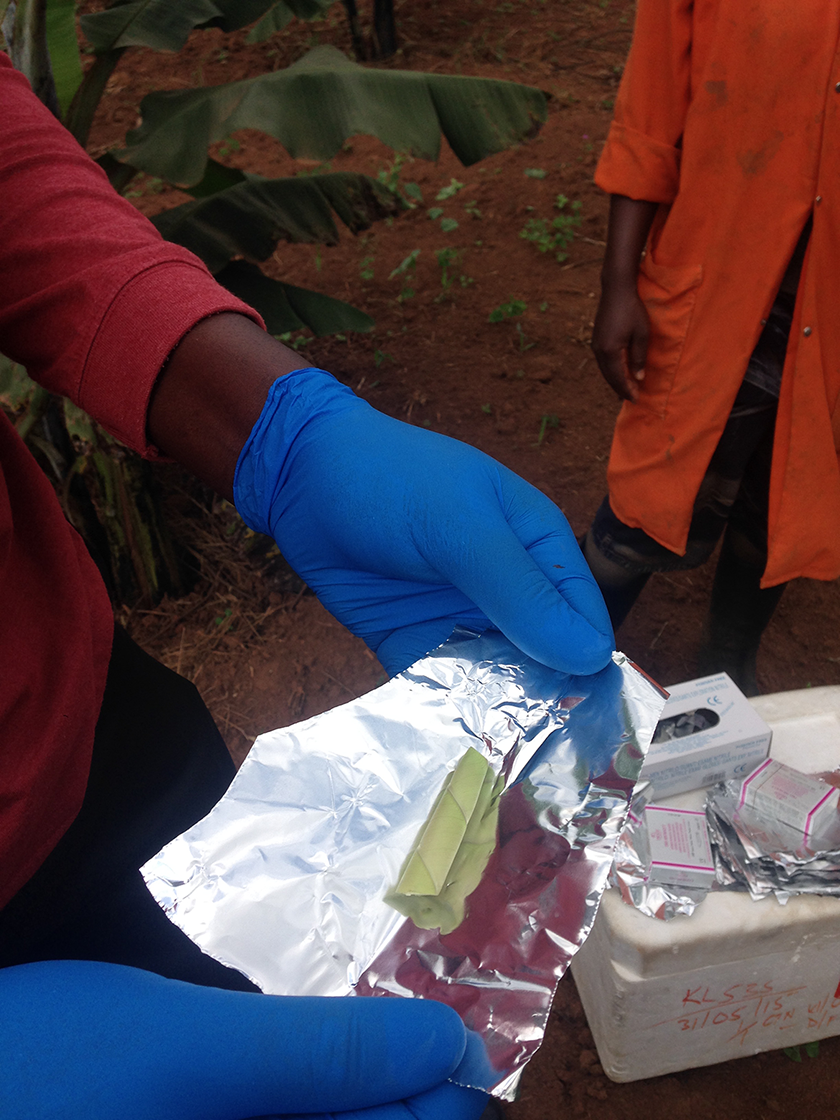
A cutting of the cigar leaf for lab analysis, June 2015.
We reach a plant with a visible cigar leaf and John tries hard but fails to reach it. The plant has grown too tall and the leaf is still too far down in the banana’s stem. Proceeding risks harming the plant too much, Dr. Muyinga and John agree, after John almost broke the stem to Dr. Muyinga’s consternation. Instead of the desired cigar leaf, John tears off a part of a young, green leaf close to the stem’s top, mumbling, “This is DNA too” and hands it to Dr. Muyinga. Dr. Muyinga inspects the torn leaf, frowns and scolds, “eh, we are doing molecular work here, John!” He means they only need small pieces. “The plant will regenerate,” John retorts. But Dr. Muyinga doesn’t let this pass. Annoyed, he instructs his assistant to stop needlessly harming the plant and use the blade to make small precise cuts, while tightly rolling the leaf sample into aluminum foil and then quickly dropping it into the liquid nitrogen-filled box. 6
A few days later, Dr. Muyinga, the agronomist Mr. Lumbuye, and I are taking leaf samples from the second trial field that was planted in early 2015. Plants are still shorter than in the first field, roughly about a meter high, and they are exposed to the sun without shade. A few experimental plants have withered. Dr. Muyinga and Mr. Lumbuye inspect the color and shape of the banana leaves and take photos, trying to identify signs of disease, discussing the out-off season heat, and documenting the trial numbers of plants that had died. While we collect leaf samples for analysis, Dr. Muyinga turns to a plant, brushes over the rim of its leaves, and apologizes playfully while cutting a leaf, “Sorry dia [Ug. English for dear], we need to cause you a little pain,” or a few plants down the row, “Oh my friend, don’t mind us!” or “Sorry, sorry to make you bleed.” As we pass through the planting, we detect a plant with a large broken leaf. Dr. Muyinga exclaims in jest: “Oh no, a leaf is broken! It should be crying!” and Mr. Lumbuye laughingly confirms that it must be crying for its mother. We eventually reach a plant that is notably shorter than the others, only half a meter, but it seemed to not have grown since it was planted. Dr. Muyinga inspects what he calls “the stunted one” carefully and decides: “We’ll leave it. It’s struggling so hard to grow.” We do not collect a sample from it.
A seasoned researcher at the institute, trained as an agronomist, who however doesn’t work on the banana, repeatedly made fun of this fuss about plants in the biofortification project. He told me that evidently project members had mistaken banana plants for babies that needed milk when everyone in Uganda knows the banana plant is strong and hard to kill. This researcher taunted a type of motherly care toward plants in the field that he felt was misplaced due to the sturdiness of the plant. 7 Every child in Uganda knows that to harvest a bunch of bananas, you can’t be squeamish but have to use the machete to cut down the stem and use the hoe to hack off competing suckers. But this researcher no doubt also felt uncomfortable, even a bit ashamed, of the affective regard for plants that this research team expressed. “This is a serious business,” he told me scoffingly. I believe he wanted to make sure that I as an observer didn’t fail to see the institute’s scientific mission. After all, though this trial mimicked a simple family garden in terms of the methods of cultivation, it was still a field trial—a controlled space of science, and in his view, this too called for researchers’ detachment.
I wish I would have had the readiness of mind to reassure this researcher of the mundane fact that even highly standardized and codified scientific practice is always underwritten by affective dynamics that emerge in daily lab work (Myers 2015b; see Sharp 2018, 35–75, for the case of lab animals). And it is very common for those working closely with plants, like scientists, breeders, gardeners, and farmers, to “feel for” their plants and to conceive of them caringly as babies or children. 8 A famous example is the Nobel-prize-winning biologist Barbara McClintock who through her studies developed “a feeling for the organism” (Fox Keller 1983)—this meant an ability to read the expressions of maize plants and anticipate their patterns of growth. She placed attention on plant individuality—on knowing all plants in the field trial intimately from when they were seedlings (Fox Keller 1983, 198). Similarly, working alongside plant biologists who studied the vegetal sensorium, Myers (2015a, 59) observed their attunement to plants, their needs, and their rhythms and described this as “plantification” or vegetalization. This vegetalization of humans often occurs alongside the anthropomorphization of plants (Myers 2015a; Degnen 2009, 164). These examples suggest that the care and attention that banana plants receive in this project weren’t out of the ordinary—even if they were criticized as “too feminine for science.”
More importantly, these affective interspecies encounters in the trial field also enabled thinking the banana plant in ways that are rather unfamiliar in Uganda (remember there it is the epitome of sturdiness and vitality)—namely, as soft, vulnerable, and idiosyncratic beings that are in a sensitive dialogue with their surroundings. While Dr. Muyinga ascribed human sensibilities to plants by claiming they cried or bled, were struggling or feeling pain, his thinking also recursively bent toward the plant. Cutting the plant was necessary for laboratory examination, yet he felt for the plants and anticipated their response, knowing that cutting causes them stress and inhibits their growth. However, this was not some form of “pure love” for plants like Archambault (2016) described for young Mozambican men who felt their vegetal relationships were purer than romantic relationships; Dr. Muyinga and his colleagues took this proposition to be silly when I discussed it with them. Rather he explained that harming a plant too much sets off biochemical processes in the plant that can interfere with the expression of beta-carotene. In other words, plants respond to touch biochemically and harming them too much puts the goal of identifying high-beta-carotene plants at peril. He therefore tried to keep the stress as small as possible across all plants. By instructing John to make small precise cuts, he was in fact aiming to standardize and control their interference with the way plants normally grow in family gardens. This is a pragmatic and instrumental approach to plants in line with scientific principles. But adherence to scientific principles does not preclude simultaneous affective relations to banana plants. And an attentiveness to their needs and rhythms was evident in researchers’ actions and words. Dr. Muyinga after all avoided sampling the stunted plant.
Writing about human–animal relationships, Despret (2013, 70; 2004) argued that scientists often entangle themselves in their objects of study but instead of clouding their vision, this can allow them to cultivate a curiosity and sensitivity to another being’s forms of expression. How to approach another being on terms closer to its own is especially challenging when this being is a plant, given that plants do not communicate in ways that are immediately accessible to humans. In this setting plant’s responses become legible in the height of beta-carotene levels. Yet, I learned from Ugandan biologists that banana plants as sessile beings also express themselves and their personalities through growth (see also Marder 2013, 74, 75).
Growing high, tall or crooked, remaining stunted, having a strong thick stem that can support a large bunch, or suckers that grow farther away from the stem or in strange directions, Ugandan biologists see all of these as distinctive traits of individual plants. During fieldwork in November 2016, Mr. Lumbuye pointed out a plant where the banana fruit did not grow in the usual shape of a bunch but appeared in pairs strangely aligned. “Look at this strange plant!” he pulled down the banana flower to show me and ran his fingers across the strangely aligned pairs. “Likely the inserted plasmid (of DNA) interrupted an important gene in this one,” he concluded. Researchers also individualized plants by referring to some of them as being stubborn, misbehaving, being weak, strong, or happy. By observing plant growth in the trial field, researchers were able to relate to plants in their individuality and understood their capacity to thrive as emanating from a plant’s unique and idiosyncratic personality. This is remarkable when we consider that these plants were cloned and are genetically nearly identical.
The field trial as a place is infused with an atmosphere of playfulness and curiosity that allows these new forms of thinking about banana plants and their unique personalities to emerge. This atmosphere only unfolded in the field, where plants were growing, and not in the greenhouses or labs, where scientists were handling molecular extracts, plant embryos, and shoots or newly potted plants. I often assisted researchers and gardeners potting plants on a large table under a porch, outside one of the three greenhouses. Potting means putting banana plants that were grown in tubes on nutrient media into soil for the first time. This work is called weaning, again using a metaphor associated with female reproduction (see Figure 5). As the master’s student Zahara noted, this means taking them from the cozy moisture and temperature-controlled lab environment, where they are constantly observed, hand-picked, “fed with nutrient media like babies on mother’s milk,” and releasing them so they have to feed themselves. These small plants were then placed in the greenhouse to allow them to grow to about a meter of height before planting them in the field. It was not until these plants were planted in the field trial that their individual traits and characteristics could come to the fore in ways that were legible to Ugandan biologists.
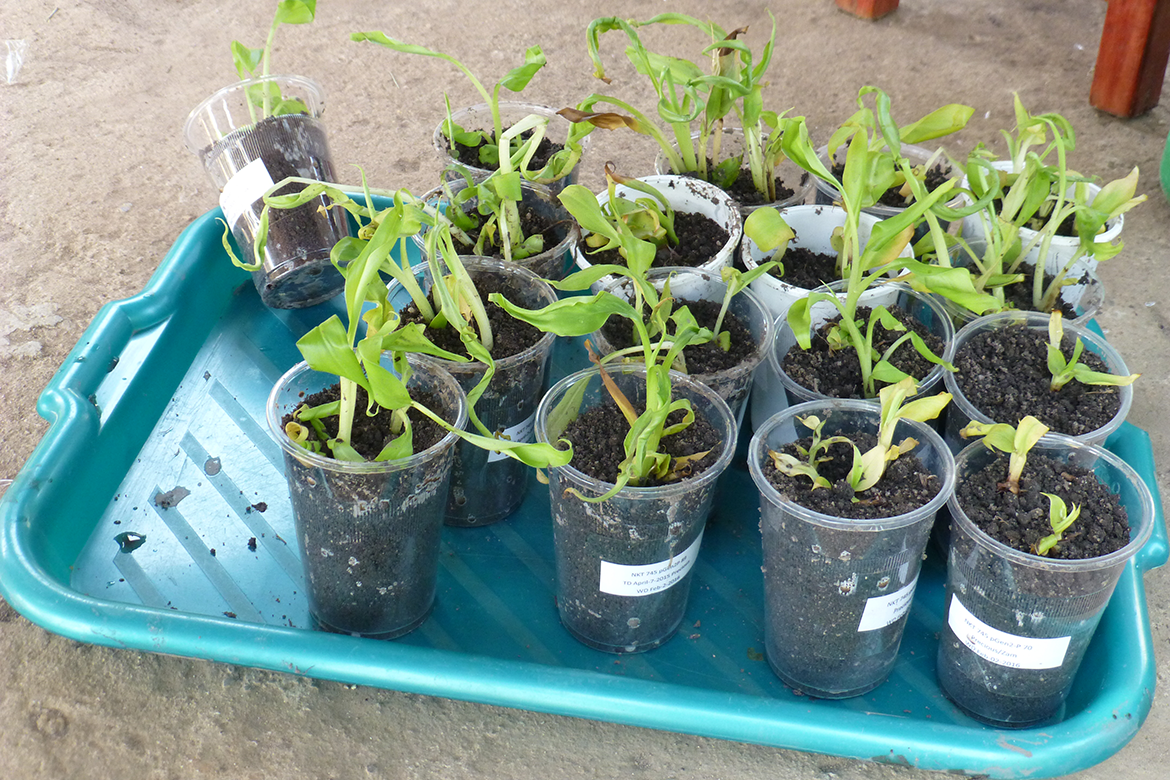
Freshly weaned banana plants, February 2016.
The field trial invites every plant to make its own experiment in the world. Success in the field trial is ascribed to the individual plant’s capacity. It does not directly hinge on environmental factors but these are needed to distill the plant’s personality. This robust form of handling and thinking with banana plants is tied to the place from where it emerged: a trial field in Uganda, where the banana is both mundane and beloved. I suggested that the field trial as a place is infused with a different affective atmosphere than the lab. As a place, it is marked as feminine and subject to “natural processes” and thus is far from the highly cultured lab, where new disciplinary knowledge emerges. This feminization of the field trial is further supported by the affective dimensions of biologists’ labor, their tender care for their experimental plants in the field and the associations they forge with female reproductive processes, childcare, physical intimacy, and emotions. The ways in which such affective layers of practice and care are muted and neglected in the accounts, protocols and coda of science proper indicate their devaluation (Despret 2004; Puig de la Bellacasa 2011). The next section compares plant thinking in Australia and Uganda and speculates with the conceptual possibilities that emanate from Ugandan thinking about plants.
Making Place for Plant Thinking
Plant difference and individuality hardly figured in the repetitive lab procedures I observed, neither in Uganda nor in Australia. Testing in the lab subjected all plant samples to a standardized treatment through which differences in the sample are detected. While there was much banter in both labs, I did not see this extend to the work on plants or plant extracts. In Uganda, in particular, scientists rather did their lab work with seriousness, a quality Subramaniam (2014) associated with the masculine scientific culture (p. 194). Being “serious” was a quality that was always emphasized in mundane conversations, who was a serious scientist, who had failed in spite of being serious, who wasn’t serious enough, and so on. Yet, even “the most serious scientist” at times had trouble carrying out the protocols to extract DNA or to measure beta-carotene levels from banana fruits (see Figure 6). When Dr. Muyinga’s samples didn’t yield the expected results, he always referred to them as behaving “strangely” or “stubbornly.” He and other researchers usually reckoned technical errors were behind the misbehaving samples, such as pipetting errors or having mislabeled a sample—nothing that could be attributed to plants themselves. 9
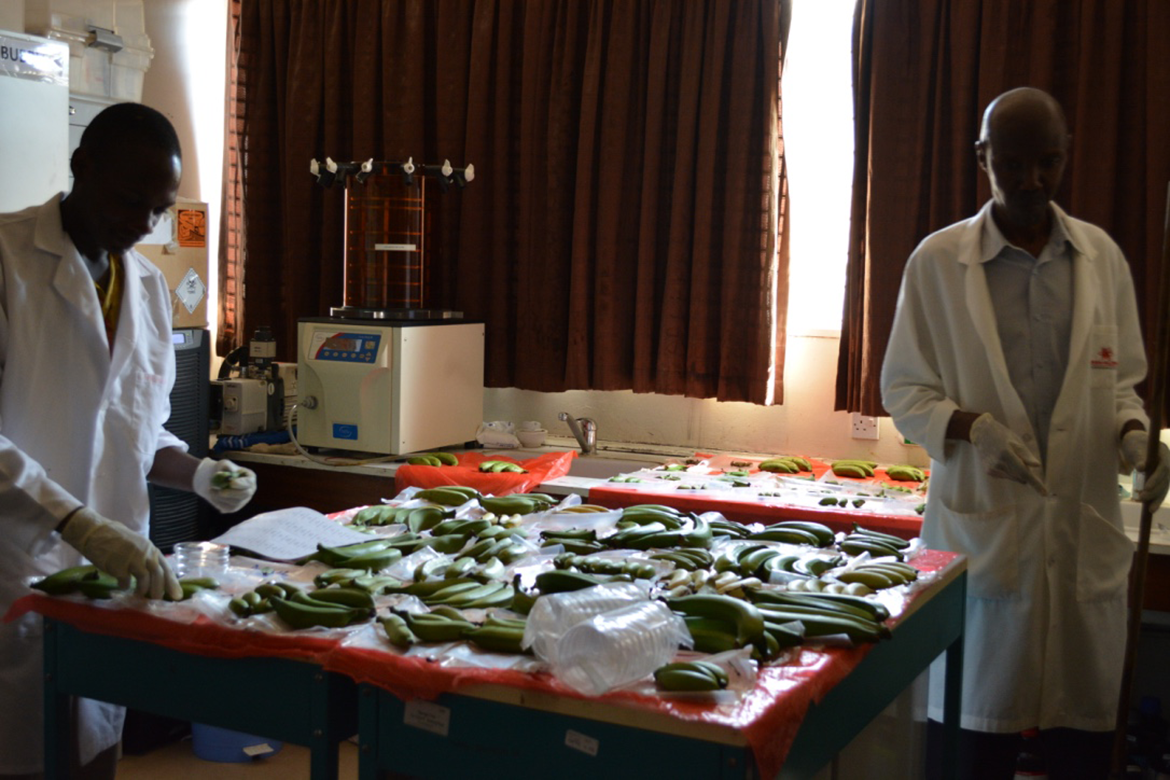
Preparing harvested bananas for lab analysis, September 2017. Source: S. Calkins.
What Ugandan scientists did however make out in the lab were differences or family resemblances between plant cultivars. 10 One afternoon in the tissue culture lab, Dr. Muyinga reflected on why the hybrid cultivar M9 and the Nakitembe, a favored variety for cooking in central Uganda, could be genetically modified while an earlier effort with a different popular cultivar, called Nakinyika, had failed: “It was too difficult to get cell lines…. They misbehaved and we had too many negatives.” Nakinyika, in other words, was a stubborn kind; it liked neither attempts to clone it nor did it respond well to genetic transformation. The lab assistant Zahara was busy at a lab bench next to us, cleaning Nakitembe embryos and moving them with tweezers onto petri dishes with fresh nutrient media. She added, “But now M9 is also misbehaving. It’s beginning to fail us. All year we tried getting more M9 cell lines but we’re struggling.” Nakitembe by contrast was never so fussy, they assured me. I discussed this with Tracy, “only” a lab technician at the Australian university but someone who knows nearly everything about generating bananas embryos and plants from cells in the tissue culture lab since she started out nearly twenty years ago. 11 Due to her unique expertise, she had herself been to the Ugandan lab several times to help manage problems with their tissue culture procedures and noted that there was a high risk for contamination. However, Tracy added that sometimes one had the right precautions and procedures in place, but “sometimes banana cells just don’t want to work. They just don’t do the work you want them to do.”
Some samples and cultivars resist the lab procedures they are subjected to—in Uganda, this was specifically so in the tissue culture lab, where plants were cloned and generated. In Australia, thinking about plants took a different form altogether. During a longer conversation, the Australian PI noted that nowadays they think much about plants in relation to the environment. To underline this, he mentioned that his lab even had an epigenetic-inspired project on the de-methylation of the banana. This means the project is focused on the importance of environmental factors (as opposed to genetic codes) in shaping how banana plants developed specific traits. 12 But this environmental thinking is largely theoretical: his lab is not actually in close contact with banana plants in the field. Unlike their Ugandan partners, whose quotidian taskscapes took them into the field trial where they are working hands on, the Australian scientists are hundreds of kilometers away from their university trial field in Northern Queensland. The trial field in Australia is not only smaller than the Ugandan one but growing the experimental crops is also completely outsourced to agronomists and gardeners. While the actual plant care in Uganda is also done by gardeners, Ugandan researchers oversee their work and guide it, and they pick their own samples. But recent advances in the field of epigenetics that highlight the importance of environmental factors mattered little for their daily work. In the Australian lab, the environment emerged as a concept, as a more or less placeless abstraction that could be translated into a few variables and could be reintroduced into a scientific model. In Uganda by contrast, the environment had never disappeared from biologists’ research. It denoted a familiar, open, often hostile outside that affects plant growth in a place and may require “motherly” tending. This Ugandan notion of the environment predates and continues alongside the renewed environmental interest kicked off by epigenetics.
In the gardens and greenhouses Ugandan biologists’ handling of plants involved tactile, sensory, often caring engagements with living organisms that are vital to plant growth and are as central to the project’s success as lab work but still typically get backgrounded in molecular biology (Knorr-Cetina 1999, 95, 96). To count as science, it seems that especially “feminine” types of affect that emerged in the field trial have to be contained. Yet, in Barbara McClintock’s case (Fox Keller 1983; see also Despret 2004), fieldwork and intimate knowledge of plants were not only part of her idiosyncratic style but also what spurred her on to new discoveries. Similarly, a possibility of conceptual innovation emerges from the affective encounter involved in the actual handling of plants in the trial field, in developing a special feel for the organism in its environment, and in the possibility touching and reciprocally being touched (Haraway 2008).
Can it happen that insights and knowledge from this Ugandan research institute are recognized? It seems unlikely in view of the hierarchies of knowledge production in this scientific discipline that tend to complicate contributions both from African sites in general and from field trials in particular. These are also understandings that many Ugandan molecular biologists have expressed in conversations. At a local workshop on biodiversity and biotechnology in July 2015, John, a Europe-trained postdoctoral researcher turned to his Ugandan colleagues, saying, “we need to realize that we are being hoodwinked to do work here in which there is no merit and no money…. There is real fear (among donors) that Africa will overtake them. There is a politics to it—we need to find our own projects and our own questions and not be handed the leftovers.” His colleagues agreed emphatically but pointed at how funding is organized internationally, how only institutions from the North are trusted to succeed in science, and how this implicates them into uneven scientific collaborations that often outsource menial tasks to them and keep them busy with data collection instead of discovery. There was a clear sense that cards were stacked against them.
Yet, in the spirit of “assembling neglected things,” I hold onto the possibility (Puig de la Bellacasa 2011). The biotech lab at Kawanda is not the typical molecular biology lab; it doesn’t produce papers as output (Latour and Woolgar 1986) but rather unprocessed data, devoid of its field contexts, that it sends to its partner lab in Australia. At the Australian lab, these data are put together to build knowledge about a new genomic intervention in bananas and its effects on human health. It is right to wonder whether it matters that Ugandan scientists handle plants in ways that allow thinking them and their environments differently when the outcome that counts is evidence about the benefits of beta-carotene-enriched bananas for human health. But it’s good to remember that many discoveries in the sciences were serendipitous collaterals (Merton and Barber 2011). Of course, the insights about plant personality in the field are the project’s weeds, unintended things that crop up and proliferate but—who knows?—may eventually overgrow the project. It is in and of itself interesting to devote attention to plants—beings that are so different from us, that are rooted in a place and often backgrounded in human life. This project in molecular biology allows conceiving banana plants—plants about which there is a rich archive of thought in Uganda—with great complexity, sensitivity, and nuance, as beings that often have to bend to human ideas yet still pursue their own projects in the world (Marder 2013; Calkins 2019). Theoretically plants confound the scientific framing; as “metaphysical weeds” they grow in between and blur established categories of field and lab, of person and thing (Marder 2013: 90). Furthermore, realizing that such rich thinking about banana plants and their environment emerges from a devalued place also allows seeing that more than mere menial work is being done in Uganda.
Devoting attention to differences between places of research draws attention to the valuation of both places and labor occurring in them. The masculine ethos of discovery in molecular biology prizes high-quality lab experiments and those rare moments when new findings are assembled—in this project, this happened in Australia. This same ethos of discovery devalues everyday testing procedures as closed-in routines both in Australia and in Uganda and creates an atmosphere of boredom and tediousness. In the Ugandan case, researchers not only work on closed-in testing routines in the lab but additionally in places like the field trial that seem less rational and intellectual than the lab. Overall, Ugandans perform more hands-on and feminine tasks than their Australian collaborators. However, the field trial opens this space for off-script intimacy and affective encounters with the experimental plants that in turn enrich our and conventional Ugandan understandings of banana plants and their expressiveness.
The inequalities between the heroic, masculine places of high science and their devalued, closer-to-nature and feminized counterparts in the Global South are critical to the project’s success. From a feminist perspective, it appears as no coincidence that both mundane lab work and vital care work for plants are devalued in a transnational research project. Just like the capitalist system feeds on the silent labors of the domestic community, and especially women’s labor, for its reproduction (Meillassoux 1981), the placeless lab of technoscience seems to feed on a base of hidden local, place-based entanglements that it purges for ideological purposes (Latour and Woolgar 1986). It remains hard to move beyond these deeply entrenched disciplinary hierarchies that also affectively infuse different places in this research project and curb expectations about what one can contribute to the scientific enterprise from Uganda.
Conclusions
Working in a decapacitated Chilean lab, Ureta (2020) recently argued that scientists there did not so much contribute new insights to science but rather developed an entirely new type of science, a “ruination science” that is more flexible, improvised and attuned to surprise and curiosity than conventional science and additionally bears lessons for all of us in dealing with increasingly blasted anthropocenic landscapes (see also Tousignant 2018). A similar hopeful argument could be made about the quotidian struggles at this Ugandan lab but I am convinced the Ugandan scientists I got to know would reject this idea in no unclear terms. Many conversations convinced me that they don’t want to practice a “ruination science” or an “African science” (Droney 2014; Mavhunga 2017). They rather want to participate in the international enterprise of molecular biology from where they are placed—and, importantly, not only as producers of raw data.
This remains difficult in view of hierarchies between the Australian and the Ugandan lab, which are reinforced by gendered evaluations of the lab and the field, resulting in a devaluation of African field knowledge. Attending to place here involved attending not only to material equipment and geopolitical location but also to the moods or affective atmospheres that infuse these places, such as atmospheres of boredom, seriousness, excitement, or playfulness. These have a strong bearing on the ways in which scientists go about their work, what they considered a finding, and when and where they expect to find it. Such affective dimensions of scientific work give us an indication about how one’s position in the scientific system is experienced. They are important but often overlooked elements in puzzling together a response to the question how one can or why one does not feel able to contribute new scientific insights from sites such as this Ugandan research institute.
However, thinking about affective atmospheres as both a field of forces and a space of potentiality (Stewart 2011, 452) draws attention not only to the power of long entrenched hierarchies of scientific value but also to the latent possibilities for scientific innovation that reside in devalued places. The work on banana plants in the field trial draws attention to affective dimensions of quotidian scientific work routines, affects that typically are ignored or even cause embarrassment due to the ethos of detachment in science and their association with the feminized sphere of care and reproduction. However, it was the affective encounters in the field that enabled conceiving of banana plants in unfamiliar terms—as fragile, vulnerable, and dependent beings that express their unique capacities and personalities and are in a dialogue with their environments.
Thinking with the capacious but ignored insights of Ugandan plant experts allows us to reflect on the continuing masculinist normative commitments of science that devalue plants along with the labors and affects of Ugandan scientists. While I argued that feminized African field knowledge is not recognized as central to the larger endeavor, we can still ask whether this type of caring for and thinking with bananas has a distinct potential of its own—potentials that aren’t simply reducible to the larger scientific framing? For now, we can only speculate. Disciplined to ignore and dismiss the field and its playfulness, there was little curiosity or interest among Ugandan biologists in taking these insights any further or developing new research question from them. This underscores what feminist scholarship highlighted as a need to “re-affect science” as part of a strategy to pursue diversity in science and knowledge politics (Puig de la Bellacasa 2011, 97; see also Haraway 2008; Subramaniam 2014; Myers 2015b; Sharp 2018).
But even beyond a specific original finding from the South, making place for plants, caring for and playfully engaging with them, as these Ugandan scientists do, in and of itself yields types of knowledge that enrich human life. Plants are central to human survival but usually are relegated to the background of human- and animal-centered existence, even as plant life faces unprecedented extinction (IPBES 2019). The banana—a central food security crop in East Africa—counts among the vulnerable crops. This only underlines the importance of learning from such rich plant expertise that is closely attuned to individual growth and plant expression. Maybe here we can make out the contours of a decolonial biological science yet to come—one that would pursue concerns central to the lives of East African people and their wider ecologies, and one that would value plants along with the labors and affects of African scientists. For now, the experimental banana plants invite a nice metaphor for growing with and against larger structures: they owe their existence to homogenizing practices in laboratories and they depend on being planted in the field to make their mark in the world, but there they still pursue their own projects in the world, growing undefined and idiosyncratically in their own ways.
Footnotes
Acknowledgments
The ethnographic fieldwork on which this paper is based was funded by the Max Planck Society. I’m grateful to the Ugandan scientists on this project as well as the Ugandan and Australian principal investigators for enabling and supporting my research over the years. Many thanks to Uli Beisel, Marc Böckler, Luisa Reis De Castro, Susan Erikson, Mara Erlenmaier, Wenzel Geissler, Manjari Mahajan, Sophie Mik, Richard Rottenburg, Rene Umlauf, and Tyler Zoanni for their comments and suggestions. This paper also benefited much from audiences at the NYU science studies working group, the Oslo African Anthropology seminar, and the “Technologies & Global South” lecture series at the University of Frankfurt. I’m further grateful to participants of the AAA panel on “testing as world-making” and the workshop on “testing, measuring and accounting” in Berlin, who commented on an earlier version of this paper, two anonymous reviewers, and the journal’s editors for their comments and suggestions.
Declaration of Conflicting Interests
The author(s) declared no potential conflicts of interest with respect to the research, authorship, and/or publication of this article.
Funding
The author(s) received no financial support for the research, authorship, and/or publication of this article.
