



Abstract
Recent efforts to involve digital technologies and renewables in the electricity grid have placed users at center stage in the legitimation of energy transitions. This move has been paralleled by an emphasis on users and energy practices in social studies of energy related to science and technology studies. This article builds on an eighteen-month Living Lab exploration of energy practices with smart electricity users in Bergen, Norway. We make two interrelated arguments. First, energy production and distribution in Norway and elsewhere is shifting toward greater automation of tasks, possibly bypassing the “active user” concept. Energy sector practices are evolving from simply extracting natural resources (Extraction 1.0) toward extraction of users’ behavioral data (Extraction 2.0), and privacy thus emerges as a key component in the stabilization of energy systems. Second, we reflect on displacements of the roles and possibilities of users (or “energy citizens”) thereby enabled, especially their normative (political and regulatory) aspects. We propose that conceptualization of energy practices be supported by the concept of regimes of engagement from pragmatist sociology. Relatedly, we argue that market, civic, ecological, and industrial regimes are being actively merged through digital innovation and what we call the techno-epistemic network of smart electricity.
Smart grids mark a new development on the path towards greater consumer empowerment, greater integration of renewable energy sources into the grid and higher energy efficiency and make a considerable contribution to reducing greenhouse gas emissions and to job creation and technological development.
Major research, innovation, and policy programs are now dedicated specifically to citizen-centric energy transitions and included in intensively networked efforts across institutional, technological, and national boundaries. Examples from Europe include the European Innovation Partnership on Smart Cities and Communities (https://eu-smartcities.eu/clusters/3/description), the trans-European innovation hub JPI Urban Europe, and the Smart Energy European Technology Platform. Norway replicates these efforts through national initiatives such as the Norwegian Smart Grid Centre and a number of pilot and demonstration projects that make coordinated efforts to foster and expedite smart energy developments and increase consumer flexibility.
The heavy policy emphasis on users has also impacted social sciences and humanities (SSH) energy research oriented toward social and behavioral aspects (Heiskanen and Matschoss 2016; Verbong, Beemsterboer, and Sengers 2013), making SSH researchers cocreators of knowledge about smart energy transitions (cf. Sovacool et al. 2020). Parts of this research are quite instrumentally oriented and aim at energy efficiency (Lund et al. 2017) through behavioral economics (Bager and Mundeca 2017), computer programming (Intille 2002), gamification, or the cocreative experimental spaces of innovation and knowledge like demonstration projects (Bulkeley and Castàn Broto 2013). Science and technology studies (STS) and social studies of energy (Horta 2018; Skjølsvold, Ryghaug, and Berker 2015; Sovacool et al. 2020; Strengers 2013) have pointed to the shortcomings of such approaches and their intrinsic deficit models (Irwin and Wynne 1996; Oudshoorn and Pinch 2003; Wynne 1992; 1996) of energy users (Nyborg and Røpke 2013; Ryghaug, Skjølsvold, and Heidenreich 2018; Throndsen and Ryghaug 2015). Users are commonly expected to fall in line and regarded as being in deficit when their everyday practices and meanings differ from idealized, technology-centric prescriptions. This critique of deficit models includes the mechanisms and sites for broader involvement where real-time experiments with energy practices play out, such as Living Labs (Hyysalo, Jensen, and Oudshoorn 2016). We link this analysis to the larger conceptual debate over social aspects of energy digitalization, highlighting that the current shift to smart electricity is also an example of extractive creep, which enables a quantum leap in extracting more and more information about and exerting greater control over users. Ironically, this may render them rule-taking consumers (Sareen and Rommetveit 2019) by limiting their space for public engagement, although (as we argue) this outcome is not inevitable.
In this article, we engage with this practice- and decision-making nexus, describing aspects of ongoing Norwegian energy transformations through reports from an urban living lab in Bergen that is part of a European project (JPI Urban Europe). 1 The Bergen Living Lab (BLL) involved forty-six households over approximately eighteen months and took place alongside Norway’s official smart meter rollout. The project involved installing energy monitors at each participant’s home followed by iterative discussions of participants’ smart energy practices, including their entanglements with rights and the politics of energy.
Our article reflects critically on some of the leading approaches to the user acceptability and public legitimacy of smart electricity. Although user studies and studies of energy practices have yielded valuable results, we argue for the need to further highlight normative (including political and regulatory) dimensions. Drawing on pragmatic theories of regimes of engagement (Boltanski and Thévenot 2006; Thévenot 2001, 2009), we elicit the close entanglements between ways of engaging with material and social worlds and ways of valuing and justifying developments that include normative and political dimensions. We follow the distinction Thévenot (2001) draws between levels of intervention and justification, stretching from the familiar through planned strategic action to various modes of public justifications; we focus on those belonging to the civic, industrial, ecological, and market worlds. We highlight how networked innovation processes and official policies symbolically and materially prefigure and condition the critical repositories available to the publics engaged in energy transitions and how citizens and users engage with energy transitions.
Insofar as the question is one of public engagement, we agree with the arguments of Skjølsvold et al. (2018) and Sovacool et al. (2020) that perspectives should be developed beyond a focus on single sites and events to incorporate multiple sites of intervention in energy transitions. To this end, we use our concept of a techno-epistemic network (Ballo 2015; Rommetveit, Van Dijk, and Gunnarsdóttir 2015; 2020) to refer to organized and networked efforts by institutional actors and to forms of technical and regulatory expertise. This can be seen as an extension of Boltanski and Chiapello’s (2007) concept of networked regimes, which was developed for managerial and corporate contexts but is here seen to intensify and deepen by also incorporating and merging smart technologies with everyday ecologies and political agendas.
Subsection 1.1 describes the evolution of (smart) electricity in Norway as the historically and publicly layered evolution of energy practices and meanings: from Extraction 1.0 to Extraction 2.0. Following that, we situate our research at the intersection of theoretical debates on energy use and regimes of engagement and introduce the case study in these terms. Next, an analytical account of the BLL case study focuses on (i) plug-and-play technicalities, (ii) energy practices, and (iii) political economy. Finally, the concluding discussion reflects on the implications of Extraction 2.0 for Norway’s smart grid and for social studies of users in energy transition, along with the need for greater inclusion of normative dimensions.
From Extraction 1.0 to Extraction 2.0
Energy use is measured through infrastructure, and questions of energy access and monitoring are inextricably linked with questions of control and surveillance (Sareen, Thomson, et al. 2020). Historically, most energy sectors are top-down bureaucracies, often state monopolies, with many having undergone privatization and decentralization in recent decades. Control, however, has changed hands largely on the supply side, between public and private utilities and multiple levels of government. Only in rare cases of citizen involvement have public empowerment and “taking back control” come to the fore. These instances feature taut contestation and uneven topographies of power—there is no citizen control without conflict with other actors who cling to profitable positions (Cumbers and Becker 2018). Digitalization can thus be read as the latest trend that affords possibilities of shifts in control and must be understood as situated within the complex and historically layered power field (Sareen, Saltelli, and Rommetveit 2020). It is in this sense that we broach extraction—at first Extraction 1.0—in Norway’s transitioning, rapidly digitalizing energy sector.
At the core of twentieth-century Norwegian societal and institutional development was the extraction and development of Norway’s rich hydroelectric resources (Angell and Brekke 2011), and their close connection relations to local democracy in the early 1900s (Sejersted 1999). Until World War II, hydroelectric developments were mainly undertaken at the municipal level to cover local energy needs and those of ascendant industries located close to power plants (chemicals, metals, etc.), typically in western Norway’s fjords. The postwar period ushered in state-led developments through the creation of a national grid and state companies, regulatory institutions, and oversight (Angell and Brekke 2011). Throughout the twentieth century, developments were successfully incorporated into egulatory and political institutions and included numerous actors and considerations, such as local interests and natural conservation. Renewables entered the story alongside rising global concerns over biodiversity loss and climate change (Angell and Brekke 2011).
Despite occasional escalated contestation between development and environmental protection, a general consensus on the main goals underpinned Norway’s hydroelectric policies. In the 1980s and 1990s, however, cracks appeared as Norway became an early promoter of the liberalization of energy markets. The creation of a Nordic energy market was predicated on the realization that “the great development projects are over” and on overcapacity of energy production (Högselius and Kaijser 2007). This was simultaneous with increasing integration into Nordic and European energy markets (Silvast 2017). The contemporary landscape of Norwegian power production and distribution consists of a large number of distribution service operators (DSOs) 2 that together constitute a regulated monopoly and numerous small hydroelectric utilities with high degrees of public, primarily municipal ownership. However, corporate shareholding, including foreign ownership, has expanded of late.
The drive for energy efficiency emerged during the late 1970s 3 in the form of technical and economic measures and simple changes in energy behavior. It intensified with integration into the Nordic market and grid digitalization. Smart electricity developments are being overlaid on earlier stages of natural resource extraction and ensuing expansion into Nordic and European markets. The national regulator states that, “new technology and new market solutions can provide the basis for more active participation and better insight into electricity consumption” (The Norwegian Water Resources and Energy Directorate 2016). In this sense, the engineers have returned but are now software and hardware developers who work closely with market actors to create new digital energy markets.
Through the inclusion of novel technologies such as smart meters, machine learning, and a centralized data hub (ElHub; https://elhub.no), households and consumers themselves have become (re)sources for extraction of behavioral data and surveillance. This indicates the intensification of a networked regime (Boltanski and Chiapello 2007) aimed at innovation (Rommetveit, Van Dijk, and Gunnarsdóttir 2020) across industrial and market regimes of engagement (cf. Ballo 2015; Boltanski and Thévenot 2006) that perform displacements of sites, meanings, and forms of authority and expertise. This networked innovation now extends into the everyday material worlds of people’s homes, through distributed, user-specific sensing infrastructure in the form of smart meters that enable Extraction 2.0. As Zuboff (2018) argues, this materially enabled yet dematerialized form of extraction combines expanding data infrastructures with the relentless spirit of neoliberalism. We pursue its specific consequences in the electricity sector, which in Norway is responsible for an extraordinary share of domestic energy use. This is also likely to be increasingly the case elsewhere as countries electrify and decarbonize more and more sectors, simultaneously digitalizing and coupling them.
Ordering and Legitimating in Networked Innovation
Our account engages with those parts of the STS and social studies of energy literature that acknowledge the performative role of deficit models in smart energy transitions (cf. Irwin and Wynne 1996; Wynne 1992; 1996). Although diverse, they point to asymmetries between innovators and policymakers on the one hand and users and citizens on the other. These asymmetries are reproduced in the major representations and imaginations of users and of energy practices. We define certain key terms below.
User representations: The study of users and user representations has a long tradition in STS. Early studies pointed to prefiguration and scripting (Akrich 1992) by developers, seeing the technology-user connection as relational. Subsequent scholarship included domestication (Lie and Sørensen 1996) and users’ creative adaptations (Oudshoorn and Pinch 2003), including discrepancies between user perspectives and developer scripts. The role of intermediaries in innovation, especially prominent in ICT, was emphasized (Stewart and Williams 2005). Hyysalo, Jensen, and Oudshoorn (2016) expound on changing involvement strategies and enhanced user involvement in innovation and product development, while Silvast et al. (2018) describe how layered innovation and organization in energy infrastructures deploy different user representations to coordinate across sites, times, and scales.
Energy practices: A second line of scholarship applies practice theory (Schatzki, Cetina, and von Savigny 2001) to energy practices (Shove 2003). A major aim here is to establish alternative accounts of “what energy is for” (cf. Shove and Walker 2014), with practices critically pitted against systems-based models from econometrics and behaviorism centered on individual choice (Horta 2018). This brings to light the multifarious structures of energy practices, which often diverge from economic and behaviorist models (Shove 2003). Practice theory can explain why users respond poorly to such models and can trigger reflexive responses from energy producers and grid operators for better education of users. Thus, Strengers (2013) points to the persistence of Resource Man: “the gendered, technologically minded, information-oriented and economically rational consumer of the Smart Utopia” (p. 36). Strengers’s conception overlaps with insights from user studies, specifically the relational character of the concept of the user. This resembles how publics have been described as codependent on sociotechnical imaginaries (Jasanoff and Kim 2015; Rommetveit and Wynne 2017).
Crucially, we note a research lacuna concerning citizens and users’ sense of legitimacy or rightness as part of the process. We extend the above perspectives by highlighting how users’ understandings, valuations, and appeals to legitimacy intertwine with their concrete engagements with smart energy technologies and policies. These developments have clear real-world impacts on issues like equity, inclusion, and sustainability (Sovacool et al. 2021), as was exemplified by the introduction of smart meters in the Netherlands (Hoenkamp, Huitema, and de Moor van-Vugt 2011). In 2008, a legislative proposal to introduce smart meters in Dutch homes was forwarded by standardization authorities and the Ministry of Economic Affairs. Consumer and privacy advocates responded critically, labeling the proposal a violation of personal privacy. Human rights lawyers asserted that the initiative constituted a breach of Article 8 of the European Convention on Human Rights. Parliamentarians, lawyers, and the media joined the mobilization, resulting in the withdrawal of the policy initiative. The case triggered regulatory changes at a European level to introduce privacy impact assessments and privacy by design (Van Dijk, Gellert, and Rommetveit 2016) into the operation of smart electricity grids. Thus, Dutch consumers earned the ability to opt out, enhanced data protection measures, and better user interfaces (Hoenkamp, Huitema, and de Moor van-Vugt 2011); that is, Dutch smart energy practices were rerouted and remade through civil society, assessments by human rights lawyers, the Dutch parliament, and the European Commission.
These legal and institutional dimensions effected a displacement of engagement and justification that, we claim, remains insufficiently accounted for in existing research. We include the concept of regimes of engagement (Thévenot 2009) to capture the diverse ways in which energy users make sense of and deliberate about energy. Furthermore, we argue that such regimes are reconfigured, mediated, and prefigured by powerful institutions, technologies, and innovation actors. We include here our concept of techno-epistemic networks to account for certain key ways in which such prefiguration plays out.
Following Boltanski and Thévenot (2006), a regime is grounded in actors’ capacities for critique and justification and embedded in everyday practice. This is an influential understanding of regimes in STS scholarship (Latour 1998, 2004) and is distinct from other notions of sociotechnical regimes that have gained prominence in energy transition research over the past decade (e.g., Sadowski and Levenda 2020; Skjølsvold, Ryghaug, and Berker 2015). These are compatible notions that differ in their analytical focus. Central to the purpose of this article is how the regimes extend across actors’ engagements with the world, where one mode of engagement is nested within the other (Thévenot 2001). At one level, this ranges from intimate and familiar ways of being and doing (dwelling, being at home) through instrumentally oriented planning and strategy that encompass setting goals and selecting the means to achieve them to fairly abstract regimes of justification that enable equivalences to be made between different things, rendering possible public legitimation and justification. According to Boltanski and Thévenot (2006), there are six such regimes of public justification: inspired, domestic, civic, opinion, market, and industrial. A full account of the regimes is beyond the scope of this article (but see Ballo and Rommetveit Forthcoming), and all six regimes could be characterized as bearing on our case. Here, however, we emphasize the civic regime, whose worth resides in arguments about the public and collective good (including fundamental rights), the market regime, whose mode of valuation is grounded in price, and the industrial regime, whose main order of worth is based on productivity and efficiency. And, as we now outline, there is the question of a further (networked) regime that was not included in Boltanski and Thévenot’s original account.
If we consider the smart meter (and its derivative simulator relied upon for this research, the submeter), we have a clear instantiation of a material and technological artifact that intervenes across all the above levels of human agency: it disrupts and reconfigures familiar relations and patterns within a household, it triggers renewed planning efforts, and it is deeply entangled in various regimes of justification or orders of worth. These are furthermore embedded within market, legal, and industrial agendas, as the Dutch experience clearly demonstrated. Conceptually, this is no different in Norway, although specific developments play out differently. Our concept of techno-epistemic network enters here as a reconfiguration of regimes of engagement through the material agency of the smart meter. This agency is not a neutrally emerging technology but is shaped by powerful actors in the spheres of governance, innovation, and engineering.
The main characteristic of this network is how it mobilizes sources of knowledge and authority for the sake of overall societal purpose, in this case the digitalization of the energy grid and consequent merger with energy markets. In terms of participants’ responses, we trace the displacements effected by such large-scale networking as a shifting space of possibility. The broader significance of the techno-epistemic network is to enable this shift from Extraction 1.0 to Extraction 2.0, to move energy practices from analog to digital and data-driven. This shift displaces forms of expertise and technological mediation and increasingly centers on automation and third-party market creation aimed at extracting users’ behavioral data, which is arguably a version of surveillance capitalism in the making (Zuboff 2018). It will be interesting to further analyze the character of this network as possibly extending Latour’s discovery of a seventh regime based in ecology (Latour 1998) and the networked regime of business management (Boltanski and Chiapello 2007). The techno-epistemic network displays characteristics from both but is identical to neither: it is justified as environmental—but never comes close to Latour’s ecological benchmarks—and extends Boltanski and Chiapello’s networked regime by building markets into material infrastructures and living ecologies.
Such theoretical qualification will have to wait, however. Here, our main point is that this agency is already at work, stretching deep into living ecologies and prefiguring and reconfiguring practices and pragmatic regimes. In Exploring Pragmatic Regimes of Engagement in a Living Lab section, we introduce our empirical case in terms of pragmatic regimes of engagement.
Exploring Pragmatic Regimes of Engagement in a Living Lab
Urban living laboratories (“living labs”) are spaces for “real-life” experimentation with climate change adaptation and mitigation, urban sustainability, and resilience (Bulkeley and Castàn Broto 2013). Their open-ended character is highlighted in the academic literature (Hyysalo and Hakkarainen 2014), including coproduction with “issues of consumption, behavior and lifestyles” (Voytenko et al. 2016, 46). STS scholars question whether living labs extend beyond demonstration projects (Skjølsvold and Ryghaug 2015), whether they accelerate or slow down thinking and participation (Farias 2017), and whether they open up or close off spaces for engagement (Stirling 2008). In constructing the BLL, we tried to account for all these insights and for the normative aspects described above.
The goal of the BLL was not average representation but gaining insights from people situated at the boundaries of the smart electricity techno-epistemic network. We extended invitations to people with (expert and lay) knowledge about smart electricity and environmental issues; to some extent, then, these were early adopters (cf. Schick and Gad 2015). 4 Participation came from most parts of the Bergen metropolitan area. 5 We also organized a steering group to guide recruitment and consultation that included representatives from environmental organizations, Bergen University College, the Municipality of Bergen, the main energy and grid company of western Norway (BKK), and small renewables enterprises.
The participatory stage lasted for eighteen months. Forty-six households received energy monitors 6 to install in their fuse boxes and connect to BLL’s customized online platform. This generated household energy use metrics, including visuals for smartphones and tablets. It was linked to an analytics platform for comparison with other participants and simple gamification elements. We conducted three rounds of focus groups, extending open invitations to all participants in coordination with the project’s steering group. Each focus group had approximately ten participants, with the second and third rounds featuring two sets of discussions for a total of five sessions. Participants overlapped across the three rounds, with some repetition, allowing for both continuity and novelty in each session. Each focus group followed a three-fold thematic structure reflected in the empirical subsections: first, users’ experiences with the technology as it entered their homes; second, users’ energy practices, and third, the broader political landscape of smart electricity developments. In keeping with our pragmatist approach, each meeting was recorded, transcribed, and coded in broad accordance with the pragmatic regimes: familiarity, strategic planning, and modes of justification (mainly industrial, civic, market, and ecological; Boltanski and Thévenot 2006; Thévenot 2001; cf. Latour 2004). This ordering tracked participants’ imaginative and material explorations of smart electricity as part of their everyday activities and energy practices.
Findings and Analysis
Getting Familiar with the Technology?
The home is the paradigm of a regime of familiarity, depending on an “accustomed dependency with a neighborhood of things and people” and “a careful tuning with a nearby environment” (Thévenot 2001, 77). Such tuning of things, practices, and attachments is characterized more by care than by planning or purposeful action and is grounded in “dwelling” (Heidegger 1978) and a “sense of home” (Ballo and Rommetveit forthcoming). Introductions of new technologies into everyday life have been described as disrupting this familiarity, triggering a process of creative adaptation and domestication (Hargreaves, Nye, and Burgess 2010; 2013; Lie and Sørensen 1996).
Such disruption is not merely negative; smart home technologies point toward certain futures that several participants wanted to engage pro-actively with, seeing disruption as part of normal development. One stated: “this development of smart homes, I think it is the future in a way, and from the point of view of personal experience I think it is very interesting.” Like all Nordic countries, infrastructure and services in Norway are generally high quality, and people take pride in being part of modern societies where things keep improving (Lie and Sørensen 1996). Another participant saw smart home developments as a foregone conclusion: It is clear that the technology will just increase.…If we are not paying attention now, I feel like I will lose that information and the control of my own life.…If we are not paying attention to that technology, I feel like we lose the autonomy to have an opinion
Smappee’s visualization of its submeter (see Figure 1) is an instantiation of a “plug-and-play” imaginary. It creates popular smart grid imaginations promoted by supply-side actors (Sovacool et al. 2021), according to which keeping up should be fun, easy, and user-friendly. We saw this reflected among our participants, especially in the early stages, and expressed in the visualization elements of the app: “there’s something about this form of visualization; it becomes almost game-like and so could do something for motivation.” Participants saw this as potentially useful, both to transcend ecological moralizing producing shame and bad consciousness (the ecological regime) and to increase energy efficiency and improve cost-savings (the economic regime).
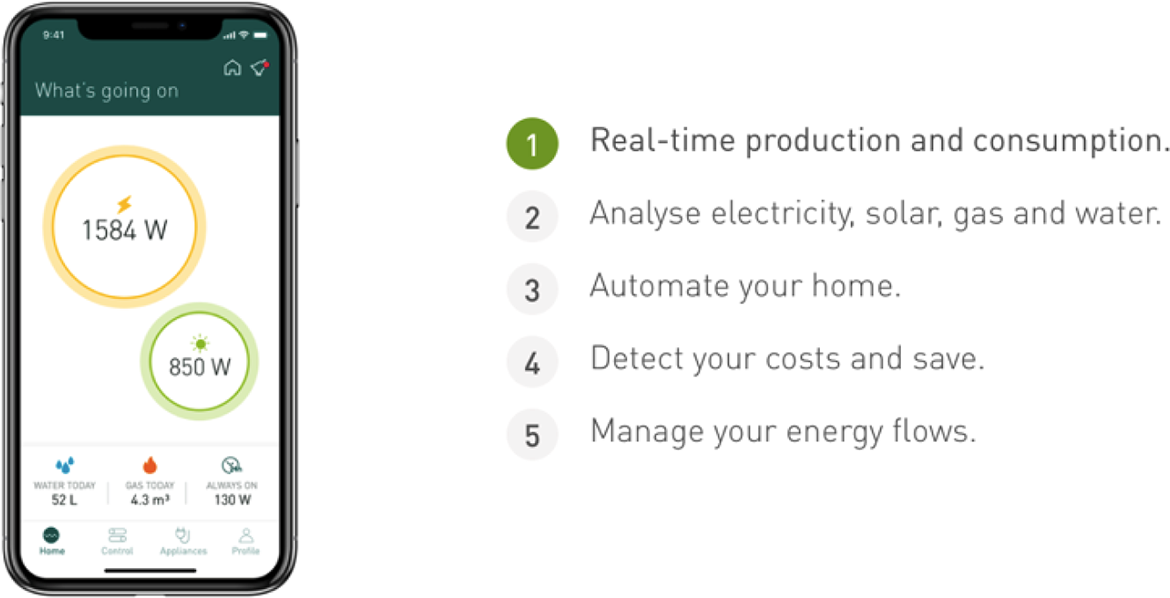
The plug-and-play imagery of the energy submeter. Source: smappee.com.
This was supposed to work through device-level granular visualization of real-time energy usage but led to disappointments because real-world deployment often proved difficult. The problems occurred in two stages: the first was during energy monitor installation, which often required project-financed assistance by an electrician. Participants experienced problems with fuse boxes too far from the home Wi-Fi router and with identifying cables to hook up the monitor’s sensors. This proved most difficult with old fuse boxes, and one participant even rebuilt theirs. Second, the device had to be “taught” how to recognize (through machine learning) household appliances, which also proved difficult, as illustrated by this exchange:
I had detected the underfloor heating cables in the hallway and the heating cables in the bathroom. And the stove in the kitchen. But…after a while I found out that it wasn’t quite like that, it was…now it was off on the wall (switch), but then it was on in the app.
Are they separate circuits? Could it be reacting to one and not the other?
I don’t know.
Some managed better than others, but the sense of difficulty was widespread and demotivating: “discovering the right things in the house has been difficult.…I lost inspiration to really try again.” The energy monitor thus led to estrangement with regard to both reducing household energy use and the plug-and-play imaginaries of smart electricity. The energy monitor did work, however, for some better than others, especially for solar prosumer households. Despite these difficulties, participants continued referring to the technology as part of future smart homes (presupposing improvement and reconfiguration). Nevertheless, such estrangement almost by definition triggered a search for a diagnosis or solution, indicating the close interrelations of familiarity with a regime of planning or “normal functioning” (Thévenot 2009). This became evident as we approached the topic of energy practices.
Energy Practices: Automating the Comfort Zone?
Even when the monitor worked well, determining its impact on energy practices was not straightforward. This was partly due to many participants being exceptionally interested in energy efficiency. As one stated, “actually getting info about all the power units, in my case, there would not be any changes…but now I am perhaps above average proven on energy consumption in the first place.” Among prosumer participants, energy-saving was detectable from January 2018 to February 2019 (Table 1).
Bergen Living Lab Prosumers’ Energy Profiles, January–February 2018 and January–February 2019.
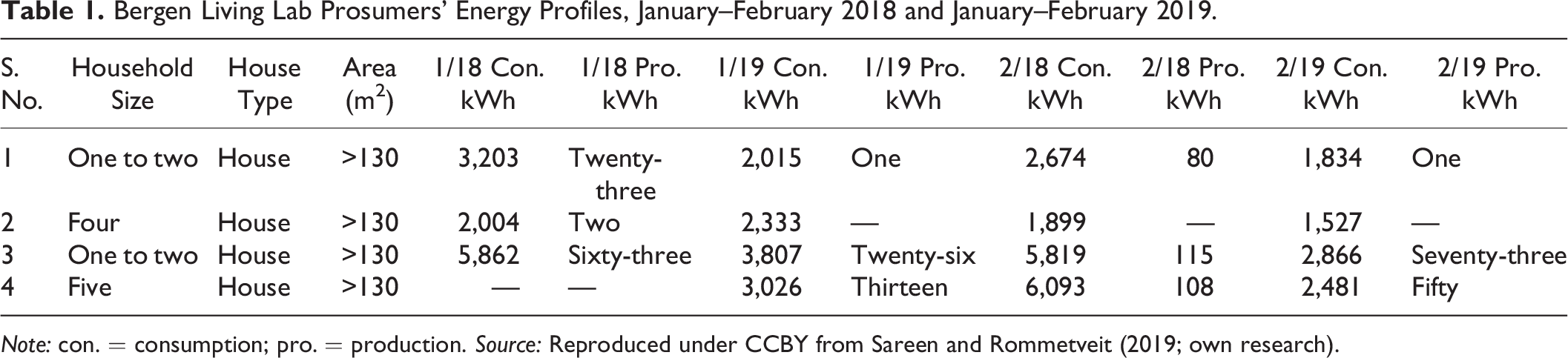
Note: con. = consumption; pro. = production. Source: Reproduced under CCBY from Sareen and Rommetveit (2019; own research).
Yet, no similar trend was detectable among “ordinary” participants, among whom two main arguments stood out. The first relates to the specific cultural, climatic, and energy realities of the Norwegian setting and the maintenance of high levels of comfort. The second relates to awareness and economy of attention.
With regard to the first, Shove (2003) has shown that energy usage is intimately connected to a sense of comfort and convenience. This is even more true for Norway’s long, dark, and cold winters. Furthermore, energy in Norway is relatively cheap due to abundant hydroelectric power. The argument that low energy prices lead to higher consumption goes back to mid-1970s planning documents (Angell and Brekke 2011, 45). A related image of consumers as “pampered” is part of Norway’s smart electricity discourse (Ballo 2015). This idea appeared in our focus groups as “the comfort zone”: “It is, as you say, that comfort zone. It is more important to us Norwegians.” The comfort zone was invoked in relation to services such as lighting (“we do not really have a culture of turning off the lights”) and heating:
7
“To me the comfort zone is really important. When I installed the heating pump, I had a completely different temperature in the mornings.” It was described as evolving and partly adjustable: It is actually possible to raise the comfort zone…it can go up and down according to circumstance. We had a different comfort zone in the 1950s than today. It increases as we take it to the next step, so then we set a new standard. And the same with the next development.
Levels of attention, awareness, and interest were unevenly distributed. One person within a household might retain interest, but this person could be overruled or simply ignored by others (“when you are the only one out of four who thinks that way, you are overruled quite quickly”) or even become an in-house energy tyrant: “You have controlling parents around who will lock their kids up for a week because they showered for too long.” This supports empirical findings from practice studies that show how household dynamics limit the potential for various deficit models, as smart energy technologies encounter preexisting fabrics of domestic practices, values, and meanings (Hargreaves, Nye, and Burgess 2010; Shove and Walker 2014; Strengers 2013).
Participants described a drop in interest in monitoring energy after some weeks, a finding confirmed by previous user studies (e.g., Naus et al. 2015). In a follow-up questionnaire, ten of the twelve replied that their energy monitoring app usage was “initially active, then diminishing”; only two said it remained “relatively constant over time” (see Sareen and Rommetveit 2019 for further details). Correlated with the technical difficulties above, this indicates that the “energy-aware user” enacting active forms of energy citizenship (Devine-Wright 2007; Ryghaug, Skjølsvold, and Heidenreich 2018) largely failed to materialize in our BLL.
One participant explained how It’s a bit like doing a back-up. If you have to do it yourself…you will remember every day for the first week, then you do it only once a week the first three weeks, and suddenly six weeks have passed, and your computer breaks down.
Politics: Engaging and Blocking the Extracted Public?
A near consensus emerged that automation is simply bound to occur. At the level of collective imagination, certain futures seemed determined, whereas others had been preempted. Automated measurements of electricity consumption are now formally enabled through official smart meters in all Nordic countries (Silvast et al. 2018). Shortly after our focus groups were carried out, the national central hub ElHub came online in 2019, marking the culmination of smart grid enablement in Norway. Its main functions are to deliver continuous readings and calculations of all production and consumption in Norway and to facilitate coordination among grid operators and energy providers, including similar data hubs in Sweden, Denmark, and Finland (Silvast 2017). It enables an “integrated market” all the way down to the retail level, including access for what are known as third parties, conditional on users’ acceptance. Elhub provides an overview of approximately 664 validated “actors” as of February 2020 who can access this granular, dynamic data: energy companies, grid operators, end users, and third parties whose typical task is to deliver energy advice and facilitate energy-saving measures (ElHub 2019). 8
One such service provider was the Swedish company Tibber, which was mentioned several times during focus group discussions. Its Pulse monitor works similarly to the Smappee energy monitor but without the need for sensors connected to electricity cables; it is plugged directly into the home area network or HAN port of the new smart meter fuse boxes and thus (per our participants) operates more reliably. Here, “the energy market” has morphed into an entirely digital format, as Tibber actually replaces one’s power supplier with an app that acts autonomously to buy, control, and save energy. 9 It effects a merger between digital technologies and markets (cf. Silvast 2017), centering on demand response, energy efficiency, and energy-saving services through the layering of physical and virtual infrastructure. The Norwegian techno-epistemic network, then, merges the industrial and market regimes of engagement, with energy engagement enabled and configured within the algorithmic space of a smartphone app. Since the smart meter is also a central enabling technology for the Internet of Things, this market expands as more and more smart household appliances come online. One participant related that “they have loads of integration to all kinds of things…for instance, my heater can be hooked right into Tibber.” Because smart electricity enables two-way energy transactions and communications, this is the materialization of energy markets as surveillance capitalism (Zuboff 2018), thriving on the commodification and marketization of behavioral and household data (cf. Sareen, Saltelli, and Rommetveit 2020).
The above contradicts the imaginary of an actively engaged user; rather, participants’ expectations locked in nicely with the requisites of surveillance capitalism. But this does not mean that participants agreed with this reality; as seen above, it also signifies resignation in the face of forces that are difficult if not impossible to influence: “I’m absolutely certain that this is coming, eventually, at least for washing machines and all such.…Whether you want it to or not. So I am most concerned about being able to say no to this, to keep control of the data.” Matters of energy management that cannot realistically be dealt with at the household level were rerouted to different sites and scales (Sareen and Rommetveit 2019). The ability to decline participation shifted the level of argumentation toward a civic regime that, as in the Netherlands, would enable and protect such engagement. In the remainder of this section, we reflect on issues of trust, privacy, and the politics of energy as they pertain to a civic regime of engagement. This includes how the articulation of these issues is blocked by a lack of institutional mechanisms for engagement, effectively creating an obstacle model of public issues (Rommetveit and Wynne 2017).
As in other countries, resistance has emerged in Norway to the rollout of smart meters. The national movement Stopp smartmålerne 10 (“stop smart meters”) claims privacy, health, and energy sovereignty as its main issues. Unlike the Dutch case, the Norwegian movement has thus far failed to effect any political or regulatory changes. People refusing to let the grid operator into their house to install the smart meter risk being prosecuted with fines, jail (for up to a year), or disconnection from the grid. Privacy concerns are not recognized as reasons for opting out, and the only legally valid way out is to obtain a declaration about radiation sensitivity from one’s general practitioner. This has led to pushback from those doctors, who do not want the problem dumped on them. They argue that the question of radiation sensitivity cannot be dealt with in scientifically adequate ways and that the Norwegian health authorities themselves have concluded that no risk from radiation exists. Thus, the main available civic justification for opting out runs through a rather idiosyncratic medicalization of the problem rather than through the fundamental rights that are so prized in Norway and its EU neighbors.
Concomitantly, we found few indications that participants trust the grid operators or energy companies responsible for the rollout of smart meters; rather, since the grid is a regulated monopoly that offers users few possibilities for opting out, users have limited options and must be seen as acting under conditions of what Wynne (1992) has called virtual, or “as-if,” trust. One quipped, “I don’t trust the system, it’s like a black-box.…We produce electricity and then we buy it back. It’s a free market principle and real capitalism—it’s not the environment driving this. So I feel like there’s two different lines of arguments there.” In spite of this criticism, several participants argued that they would trust market actors more, since at least then they would have the ability to choose. This distrust, combined with the expression of faith in the free-market promise of choice, has implications for future digitalization and energy policies and the extent to which they lean on market regimes. The above quote was explicitly linked with the possibility of greater exchanges of (clean) energy with other European countries. Several participants argued that such exchanges are necessary since the climate system is global and there is no use in Norwegians alone enjoying clean electricity: “We have just one world and one climate. It doesn’t help if we go all green, if coal power is fired up right next door.” Others argued for Norway to retain energy sovereignty and stop its ever-closer integration with Europe through transnational electricity cables and markets. These two positions signify a deep rupture in Norwegian political culture between those who favor deeper integration with the EU and those who adamantly oppose it. This was recently exacerbated by the Norwegian Parliament’s adoption of the EU’s third energy package and the decision to join ACER, the European Union Agency for the Cooperation of Energy Regulators.
Although this entrenched controversy cannot be addressed here, the distrust cuts across positions. It targets energy companies, grid operators, and national and European authorities and pertains to the lack of privacy and transparency about everything from pricing to personal data to the sources of energy. The image of energy sources and markets as black boxes was persistent throughout the BLL. Whereas strong popular sentiments would argue for stronger civic regimes of engagement, in reality, a civic regime such as the legality of energy markets is strongly predicated upon the features of a network monopoly. Beyond the bare minimum, or ostensibly a notch higher in the Dutch case, legality in the Norwegian case never extends to an ability to opt out that is based on fundamental rights.
From Energy Use to Stabilized Regimes of Engagement
In this article, we began by noting the strong focus on users and user engagement in legitimating the transition to smart energy. This emphasis is to a large extent replicated and sometimes contested in the flourishing scholarly literature on users, energy practices, cocreation, and living labs. Within the STS-relevant parts of this literature, we noted a dual tendency: first, accounts of users and energy practices have tended toward greater complexity, taking into account the increasingly composite, dispersed, and networked innovation environments through which smart energy is realized. Second, we have argued that normative and regulatory elements are not sufficiently considered or accommodated. Extending the import of arguments within user and practice studies, it becomes necessary to attend to the kinds of argumentative registers available to citizens, users, and publics in engaging with main technological and policy agendas.
Perhaps, the greatest challenge for a focus on users is the inherent shift toward automation and delegation to third parties of the main tasks that relate to energy monitoring and efficiency. This tendency was, as we saw, confirmed and to some extent supported by our participants, most of whom were not willing to do all the technical work and constant monitoring required for more and better energy sustainability. This necessitates a deemphasis on the role of users and opens the field of play to new actors, such as Internet of Things deployers, innovative energy utilities, and suppliers that build out new offerings such as smart charging applications and smartphone applications for cosharing of revenues derived from energy flexibility. The latter possibility indicates the prospective emergence of contestation and further reconfiguration of “passive consumer” roles, something for which our participants, especially the more tech-savvy among them, clearly expressed an appetite. On a related note, system innovations like ElHub enable not only intermediaries such as Tibber but also the emergence of a whole new ecosystem of ICTs, with interactive energy use and data extraction built on their back.
If the sites of intervention and regulation are displaced (Sareen and Rommetveit 2019) as denoted by the shift from Extraction 1.0 to Extraction 2.0, so must the efforts to keep up with the politics and the citizens’ rights perspectives. This is also where our notion of a networked regime of engagement comes to the fore, since it accommodates a shift of perspective toward more rights-based and public-argumentative interactions aimed at the institutional anchoring of smart energy transitions. While our participants confirmed and (to some extent) encouraged the shift toward automation, this did not imply a lack of concern for the normative implications of this displacement. Indeed, this concern was demonstrated by reference to distrust in institutions, privacy, and the politics of energy. Interest in these topics was just as high as in issues relating to energy practices and navigating technical problems; indeed, it was in many cases more intense.
However, this interest is hampered by a lack of regimes of engagement; that is, institutions and networks through which that interest could be channeled. Such critical engagement has been preempted by an incipient techno-epistemic network: regulatory interventions that have been ongoing since the 1990s have more recently been bolstered by meanings revealed through the technologies themselves. Most participants saw smart electricity and automation as fated, as bound to occur. As we have seen, this apparent inevitability is inscribed into all the regimes described here, from familiarity to overall justification. The existing civic regime is restricted to propping up the monopoly of certain actors and favoring the increased mergers of technology and markets. Here, the contrast with the Dutch case is illustrative; it was the coordinated effort to intervene in the regulatory and standard-setting process at an early stage that ensured a somewhat expanded regime of engagement. This kind of public feedback has not been realized in the Norwegian case. Users, whose data are now among the resources being extracted, have been too slow, dispersed, and nonstrategic to establish the necessary channels for engagement. The rapidly digitalizing energy sector displays a preset orientation anchored in the interests of well-networked industrial actors.
What the stabilization of Extraction 2.0 regimes of engagement does not accomplish—in stark contrast with the opening quote that epitomizes the hyped-up promise of digitalization for European energy transitions—is empowering citizens as users and decision-makers who can autonomously and cooperatively redesign energy futures. Based on the evidence so far, the outcomes of digitalization (and its implications for user engagement) remain predicated on how the dominant players drive sectoral trajectories in line with their objectives, oriented toward a blend of commercial and national interests, with market and industry modes of justification in the driver’s seat. Norway’s digitalized electric grid is emerging in the manner of a sophisticated techno-epistemic network that is perpetuating business-as-usual outcomes within closely connected data infrastructures. A central element of this assemblage is the strategic deployment of user representations that constrains dispersed user agency and wider publics even as it strengthens the position of dominant sectoral actors.
Supplemental Material
Supplemental Material, sj-pdf-1-sth-10.1177_01622439211052867 - Extracting Users: Regimes of Engagement in Norwegian Smart Electricity Transition
Supplemental Material, sj-pdf-1-sth-10.1177_01622439211052867 for Extracting Users: Regimes of Engagement in Norwegian Smart Electricity Transition by Kjetil Rommetveit, Ingrid Foss Ballo and Siddharth Sareen in Science, Technology, & Human Values
Footnotes
Acknowledgments
The authors thank the participants in the Bergen Living Lab, the Norwegian Research Council, and our previous colleagues in the PARENT project.
Declaration of Conflicting Interests
The author(s) declared no potential conflicts of interest with respect to the research, authorship, and/or publication of this article.
Funding
The author(s) disclosed receipt of the following financial support for the research, authorship, and/or publication of this article: This research was funded by the Norwegian Research Council under the joint program ERA-Net CoFound, Smart Cities and Communities, grant agreement 646453.

Supplemental Material
The supplemental material for this article is available online.
Notes
References
Supplementary Material
Please find the following supplemental material available below.
For Open Access articles published under a Creative Commons License, all supplemental material carries the same license as the article it is associated with.
For non-Open Access articles published, all supplemental material carries a non-exclusive license, and permission requests for re-use of supplemental material or any part of supplemental material shall be sent directly to the copyright owner as specified in the copyright notice associated with the article.
