



Abstract
This paper provides an empirical analysis of an initiative to establish a Community of Practice on citizen engagement at the European Commission’s (EC) Joint Research Centre (JRC). This initiative is one of the more recent attempts to institutionally stabilize citizen engagement in policy-making processes within the EC; such attempts are visible, for instance, in the political agenda of Ursula von der Leyen, whose sixth priority is a “new push for European democracy.” Drawing on science and technology studies literature, this paper directs attention to models of participation and democracy visible in particular engagement activities and to the overarching rationales for engagement. We explore the sociomaterial engagement collectives that emerge in the practices and accounts of actors involved in establishing this CoP and show how these engagement collectives at the supra-national research service JRC are co-constitutive with the wider institutional settings and cultural–political configurations of the EC.
Keywords
Introduction
Calls for more and better involvement of citizens in the policy-making processes of the European Commission (EC) are “a la mode.” In his inaugural guidelines back in 2014, former EC President Jean-Claude Juncker called for a “deepening” of dialogue between society and European institutions, aiming to be “a President of social dialogue.” For the 2019-2024 legislature, President Ursula von der Leyen set as sixth political priority, a “new push for European democracy.”
This renewed interest of the EC builds on previous debates about how to best involve citizens in policy-making processes. Back in 2001, a White Paper on European governance laid out a set of principles for good governance: openness, participation, accountability, effectiveness, and coherence, highlighting that “participation crucially depends on central governments following an inclusive approach when developing and implementing EU policies” (CEC 2001, 8). At that time, some European legislation on environment, health, and safety had already provisions to grant more agency to European publics. 1 The way in which citizens are designated in these legal documents determines both who is entitled to participate and what is expected from these engagements. For example, Article 14 of the Directive 2000/60/EC refers to a “concerned public” and “users” and Directive 2012/18/EC in Articles 14 and 15 talks about “the public concerned.” In this context, the EC has been setting up mechanisms of consultation with citizens to contribute to its legislation process, which mainly occurs through online tools such as Have your say 2 and Consultation. 3
The EC has through the past decades promoted research on the relations between science, society, and policy with dedicated research funding programs. Directorate-General (DG) for Research and Innovation science and society programs have been resonating with evolving understandings and framings of citizen engagement in science, science governance, and the development of “evidence” for policy-making. The relationship-narrative implicit in these programs has shifted quite a bit, which is reflected in the changing prepositions of the program titles: science and, in and with society.
These attempts to develop and institutionally stabilize citizen engagement approaches within EC policy-making mechanisms recently gained renewed traction. This interest also manifests in the establishment of a Community of Practice (CoP) on citizen engagement and deliberative democracy (CEDD CoP) at the EC’s Joint Research Centre (JRC) 4 in 2018. Within the JRC and EC ecology, a CoP is one of several knowledge management tools (see Figure 1). Beyond the EC, the CoP facilitates partnering with different organizations to address common challenges about a particular topic. The aims of the CEDD CoP are to map, build capacity, innovate, and implement citizen engagement at all stages of the EU policy cycle, from design through to implementation and evaluation. As such, this initiative is also indicative of discourses and imaginations about participatory democracy within the EC.
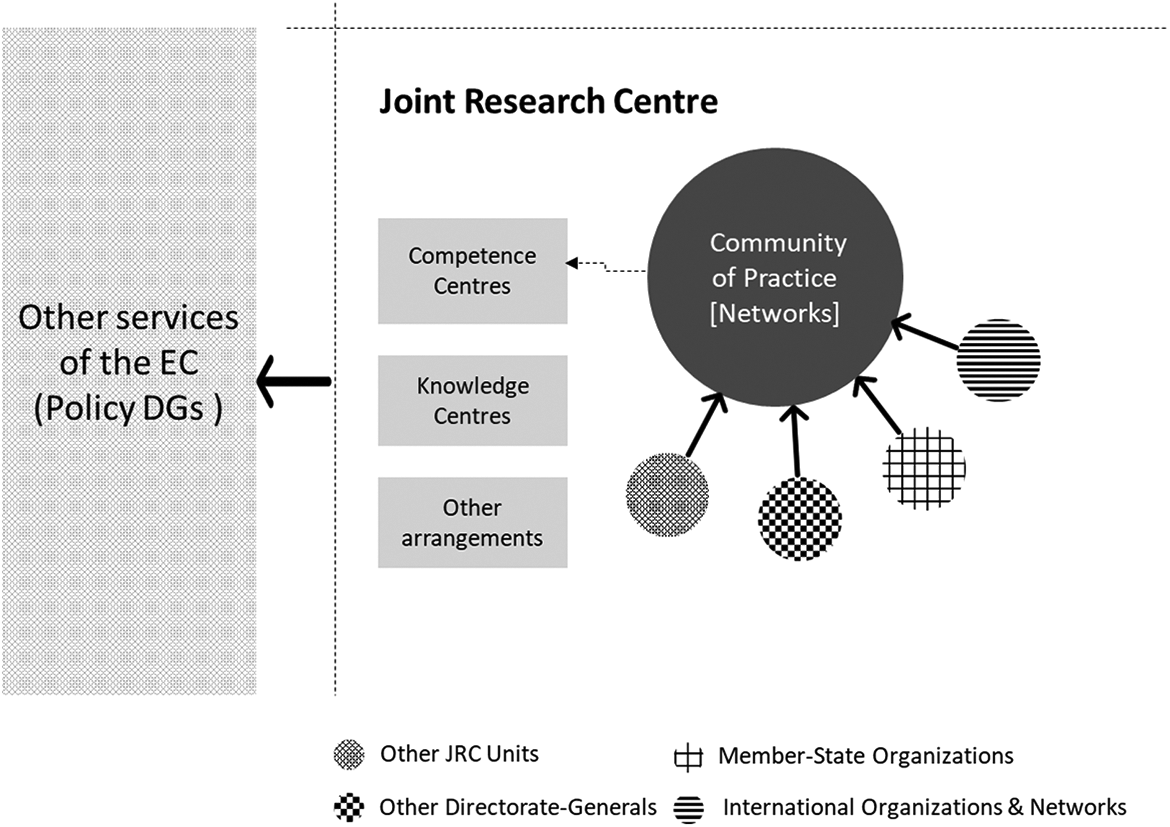
Institutional arrangements at the Joint Research Centre (JRC).
From a science and technology studies (STS) perspective, the CEDD CoP provides a fascinating case to explore how different models of engagement have been guiding the design and implementation of JRC engagement activities. This paper is interested in the models of participation and democracy that become visible in how the actors involved talk about various engagement activities, the identities and subject positions that are constructed, and in the rationales for engagement in the policy-making process. We ask how different models or imaginations are circulating and how they are co-constitutive with institutionalized orderings and broader constitutional stabilities (Chilvers, Pallett, and Hargreaves 2018) in this “boundary institution” (Guimarães Pereira and Saltelli 2017) at the interface between science, policy, and public(s). Applying a co-productionist approach (Chilvers and Kearnes 2015; Jasanoff 2004), we explore different engagement collectives and practices that are co-produced with the negotiations surrounding the JRC’s initiative to establish this CoP.
Engagement at the Science–Policy Interface
Current attempts to constructively integrate citizens into policy-making and the governance of technoscience can be traced back to debates about the public understanding of science in the mid-1980s, when UK science policymakers faced a crisis in which support from the so-called public for science seemed to decrease. The assumption then was that the reason for this lack of support was that the public suffered from a cognitive deficit and did not understand scientific facts. This model of science–society relations was sharply criticized as a “deficit model” (Wynne 1992). In response to this criticism, new forms of relations have emerged aiming to enable democratic participation in techno-scientific controversies and decision-making processes. 5
A particular interest in this strand of literature is the issue of engagement and participation at the so-called science–policy interface (Benessia et al. 2016). Scholars argue that an ever-closer entanglement of science and society together with the complexity of control call for the development and promotion of modes of democratic deliberation (Rommetveit and Wynne 2017). In addition, organizations operating in the science–policy interface are facing novel challenges related to issues of uncertainty, ambiguity, risk, and ignorance (Stirling 2008; Kovacic 2018) and previous models of governance and organization at the science–policy interface are no longer considered adequate. The idea of speaking truth to power (Wildavsky 1979)—still guiding much of the work done in such organizations—is criticized for neglecting the political nature of knowledge production and circulation. Furthermore, the increasing interest in “technologies of participation” (Soneryd 2016) both on national and supra-national levels has led scholars to treat this growing interest itself as a an object for empirical investigation and to explore how engagement practices “travel” and get “translated” in the process (Soneryd 2016; Soneryd and Amelung 2016; Laurent 2016).
Several authors have addressed potentials and challenges of engagement practices at the science–policy interface (Guimarães Pereira and Funtowicz 2009; Laurent 2016; Guimarães Pereira and Saltelli 2017). One of the central arguments in this debate is that scientific knowledge is necessary but not sufficient for addressing contemporary challenges and that contributions from heterogeneous actors are necessary to produce valid and robust knowledge (Pellizzoni 2001; Nowotny 2003). This is expected to contribute to better ways of organizational learning and reflexivity (Stilgoe 2018). Integrating new kinds of actors comes with a fundamental reconceptualization of the roles and subject positions they can assume (Marres 2007). Work in this line of research strives to move beyond an understanding of engagement as a tool for learning about citizens’ opinions and perceptions or for educating an “imagined public” (Rommetveit and Wynne 2017) about certain political or technological options. The strength of engagement in this account is that it can function as a “technology of humility” for the use of scientific knowledge in decision-making (Jasanoff 2003; Stirling 2008).
There is, however, a “politics of co-production” (Turnhout et al. 2020) to such deliberative formats for governance and decision-making at the science–policy interface. To start with, deliberative modes of engagement often come with an implied preference for finding a consensus since they need to prove their effectiveness. They are hardly ever spaces for disagreement and conflict (Mohr 2011). Therefore, there is a risk that engagement is used to gain trust for predetermined choices or for preventing alternative opinions from surfacing (Wynne 2006; Turnhout, Van Bommel, and Aarts 2010). Furthermore, citizens often tend to be employed mainly “as an embodiment of values, ethics, morals that add a subjective dimension to the objective business of determining risks or scientific facts” (Michael 2012, 530). Related to that point, the ability to participate is not evenly distributed within society and it is therefore not surprising that engagement exercises tend to have a bias toward the cultural elite (Felt and Fochler 2010). Also, criteria for what counts as “usable” knowledge are often predetermined by policymakers. This in turn shapes relations and interactions in science–policy interfaces (Kowalczewska and Behagel 2019). Furthermore, particular areas of technoscience can be reified as more important than others by being deemed worthy of engagement efforts (Nordmann 2007; Stilgoe, Lock, and Wilsdon 2014). Finally, recruitment processes have been criticized for being obscure and nontransparent, meaning that it is not clear who is doing the recruitment and on what grounds (Turnhout, Van Bommel, and Aarts 2010). In this sense, they risk foreclosing more active forms of citizenship, such as protests or grassroots movements (Callon and Rabeharisoa 2003).
While there are a lot of insightful studies of different engagement exercises and intriguing work on the pitfalls and problems with methodologies and conceptualizations of engagement, there is less work on questions of how and why particular models of engagement prevail. This paper aims to contribute to this debate by studying the institutional and cultural conditions for the perpetuation of certain implicit models of engagement that have also been found in other institutions.
Engagement Collectives and Ecologies of Participation
This paper is situated within a body of work that applies a co-productionist understanding of participation and engagement. Chilvers and Kearnes conceptualize engagement exercises as contingent and heterogeneous collectives of human and non-human actors, devices, settings, theories, social science methods, public participants, procedures and other artefacts. (Chilvers and Kearnes 2015, 13)
The elements in this quote are regarded as interwoven and mutually constitutive, which means that particular publics are not separate from the particular engagement “tools” through which they are selected and discussed—hence it is useful to think about these as heterogeneous sociomaterial collectives. Furthermore, engagement from such a relational, co-productionist perspective focuses on how engagement and participation is practiced as a part of technopolitical orderings and as such are enacted together with particular material institutional configurations, scientific knowledge claims, objects, issues at stake, subject positions, and (collective) identities as well as particular normativities (Chilvers, Pallett, and Hargreaves 2018; Marres 2007).
Such a relational understanding cannot stop at singular engagement events highlighting their specificity. The connections between different engagement collectives need to be carved out: An ecological conception of participation suggests that is not possible to properly understand any one collective of participation without understanding its relational interdependence with other collective participatory practices, technologies of participation, spaces of negotiation and the cultural-political settings in which they become established. (Chilvers and Kearnes 2015, 52)
This focus on what Chilvers and Kearnes call “ecologies” stresses the importance of staying attentive to the relation between different engagement collectives and how they become part of “wider spaces of participation” and “constitutional stabilities” (Chilvers, Pallett, and Hargreaves 2018). These notions point to relations between different engagement collectives and institutional settings, processes of standardization, or certain issue spaces while directing attention to the policies, infrastructures, and sociotechnical imaginaries with which engagement practices co-emerge.
The main task when applying such an understanding of engagement then is to zoom in on the multiplicity and distinctiveness of different approaches and practices while staying sensitive to how they are embedded in a broader ecology of participation and co-produced with scientific, political, moral, and social orderings. A co-productionist understanding of engagement aims “to document the specific sites and institutional configurations in which participatory practices cohere and are rendered authoritative” (Chilvers and Kearnes 2015, 53). For the purpose of this paper, this means that an analysis of engagement practices at the EC’s JRC needs to stay attentive to the particular institutional configurations and the constitutional stabilities with which such collectives and practices co-emerge while also being mindful of how models of engagement circulate and how they get “translated and transformed” (Soneryd 2016, 146).
In this paper, we thus focus on different practices, collectives, and meanings of engagement and their translations in the supra-national setting of a EC science for policy service. We do so by asking the following questions: Which socio-material engagement collectives become visible through the accounts of actors involved in the CEDD CoP? Which models of participation are co-produced with these collectives? What subject positions, technoscientific issues, and objects emerge? How are these engagement collectives co-constitutive with the institutional settings and cultural-political configurations at the JRC and beyond? How are the rationales for and purposes of engagement framed? What are the main narratives about publics and their role in the policy-making process?
Methods
This paper presents the case of a so-called CoP on citizen engagement and deliberative democracy at the JRC, which is aiming at bringing together different engagement activities that are currently dispersed across services. 6 The objective of this CoP is to map different practices, services, and Member State organizations; build a network; and develop guidance for conducting engagement projects in a collaborative manner at the JRC and at other services of the EC.
The analysis presented in this paper builds on twenty-two interviews conducted with twenty-five JRC researchers and managers connected to the CEDD CoP. Nineteen of those interviews were done with a single interviewee, three of the interviews were conducted with two interviewees at once. Where possible, two interviewers (the authors of this paper) conducted the interviews together. The interviews lasted between fifty and hundred minutes, were audio recorded and transcribed. The selection of participants was done through a combination of approaching actors involved in the CEDD CoP and searching the JRC internal project database for relevant projects.
We conducted the interviews following an active approach (Holstein and Gubrium 1995), which means that we were aiming at creating a space for reflexive discussion of engagement activities at the JRC and within the EC. The interviews were designed to enable an open conversation about the participants’ experiences with trying to setup and conduct engagement activities with institutions of the EC and beyond. We also wanted to prompt reflections on the overall purpose of different forms of citizen engagement in this institutional setting. We were not so much interested in “true” statements or opinions of our interview partners, but rather in the “cultural frameworks they had available to think about a problem” (Lamont and Swidler 2014, 161). This approach is well suited for an ecological analysis since it sensitizes us to our interviewees’ awareness of their own position in relation to other JRC groups methodologically and socially speaking but also in regard to a particular ethos. The interviews were thus used to probe practices of identity and boundary work. To that end, we prepared an interview guide that consisted of three broad sections: first, we wanted to know about the interviewees’ academic background, research interests, and responsibilities at the JRC. The second section of the interview addressed concrete engagement activities the interviewees were conducting, their relations to broader policy issues, collaborations, successes, failures, and challenges. The final block focused on the broader topic of engagement activities within the institutional setting of the JRC and the EC.
In addition to conducting the interviews, we also organized (and participated in) meetings of the CEDD CoP and took extensive field notes. In contrast to the interviews, the meetings—in which researchers and management personnel participated—provided us with insights into the broader aims of this initiative from a managerial perspective. The settings of these meetings allowed for observing interactive sense-making, in particular, they gave us an opportunity to observe which arguments tend to be stable and which ones tend to be contested.
The data were coded and analyzed by the authors of this paper. The coding structure was developed on the basis of the interview guide and the conceptual framework presented above. A framework matrix (Srivastava and Thomson 2009) was then used to structure, compare, and contrast the findings between individual interviewees, their relevant engagement initiatives and relative positions within these projects and the institutional structure of the JRC. This framework was further developed in an iterative manner during the process of analysis.
Results and Analysis
In the empirical part of the paper, we explore how participants in the CEDD CoP talk about and make sense of their own engagement activities. After outlining four engagement collectives, we look at the rationales and imagined purposes of engagement to address the wider spaces of participation with which the different engagement collectives and practices are co-produced.
Engagement Collectives and Practices
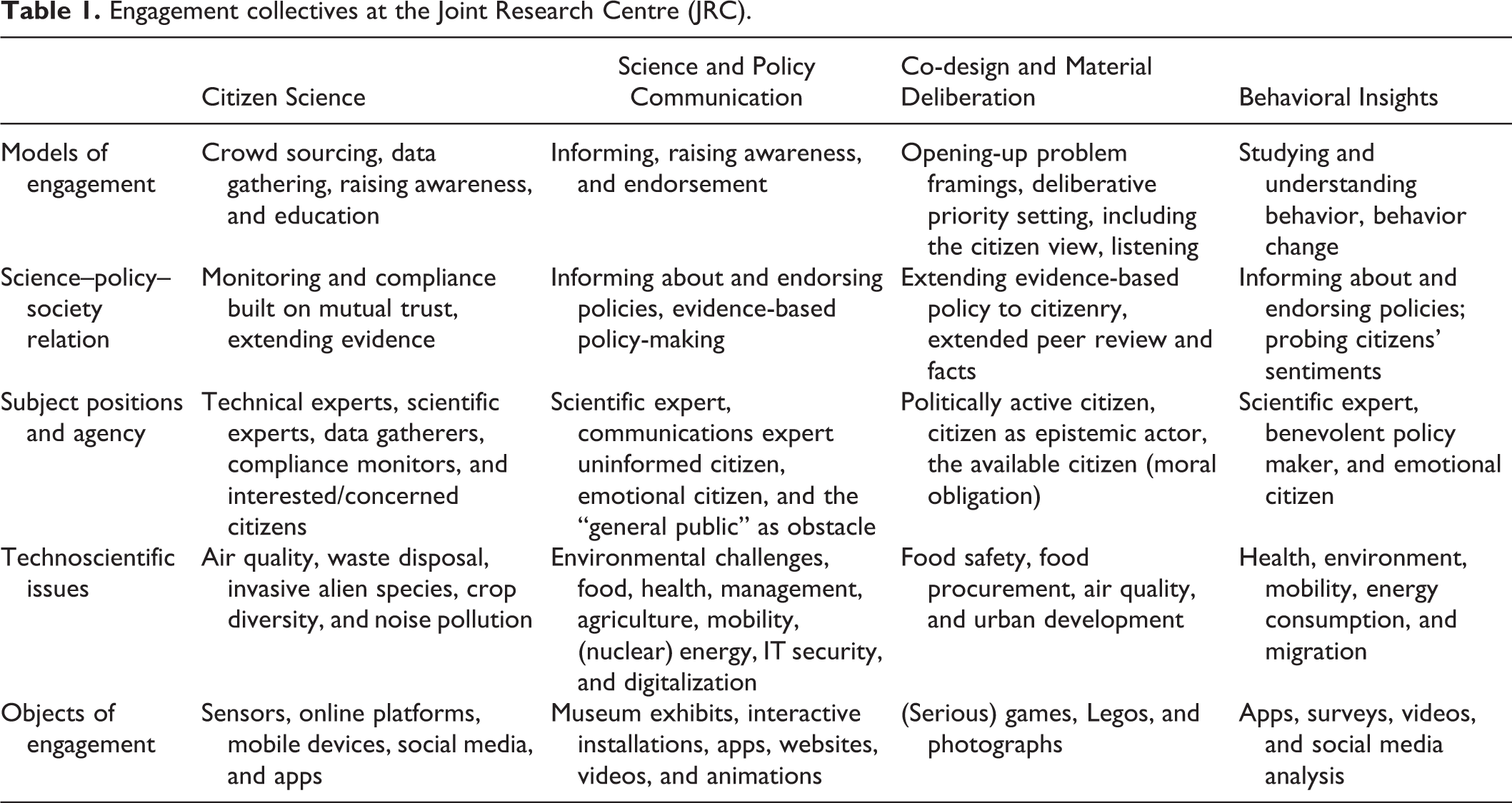
In what follows, we will briefly outline different engagement collectives and their relation to each other in a wider JRC ecology of participation. This means describing the implicit models of engagement together with ideas about science–policy–society relations as well as references to subject positions, forms of agency, and the technoscientific issues addressed. We grouped the JRC engagement activities into four broader collectives: a collective revolving around different versions of citizen science; a collective devoted to variants of science communication; another collective that builds on ideas of engagement through material deliberation and co-design; and finally, an engagement collective that is aimed at understanding and influencing citizens’ behavior (see Table 1).
Engagement collectives at the Joint Research Centre (JRC).
In terms of actors and research groups involved as well as regarding the number of different projects, the citizen science collective is one of the more expansive engagement collectives at the JRC. It involves a broad range of disciplines and spans across a broad range of issues weaving together several models of engagement and various subject positions, being well connected to external organizations such as the European Citizen Science Association. 7 Citizen science projects currently running at the JRC cover issues like air quality and pollution, invasive species, or crop diversity. Apart from that, an infrastructure for citizen science data collection has been built. 8
When interviewees talk about citizen science, the implicit model of engagement is mostly one of crowd sourcing. Citizen scientists are used to gather data that would otherwise not be available. This resonates with the classic idea of citizen science as developed in the Cornell Lab of Ornithology.
9
Citizens in this collective are ascribed the role of data providers, a workforce contributing to the scientific endeavor: So, early detection is of utmost importance, because you need to spot something at first arrival; this is the aim. And official surveillance can put some resources available, but cannot cover an entire territory, which is run by tourists traffic and so on. So, that’s why a citizen can spot something in a small area, which is not covered by an official surveillance. So, the early detection is key to implement eradication measures. (I_08: 218)
The advantage here is clearly that citizens can provide information about places that could not be covered otherwise; plus, they can do it in real time. In addition to support data gathering, citizens are also imagined to become part of the collective through monitoring the compliance of Member States with EU regulations, for example, in regard to waste and pollution: Citizens can report on environment complaints that there is either waste dumped somewhere or a certain river is polluted. We can try to trace back pollutants and these kinds of things. (I_16: 71)
A central element in the citizen science collectives are the devices used for generating data. One project at the JRC is dedicated to the production and validation of low-cost sensor methods. This, in the accounts of our interviewees, has two main positive effects: first, it allows for a more evidence-based debate about issues of pollution and second, if “the citizen himself is measuring air quality, he will understand a bit more where high pollution is and where low pollution is” (I_03: 58). Education and endorsement through which interested citizens get in touch with EU legislation and are enabled to better understand what the EU is doing (for them) are woven into stories about citizen science. Strasser et al. (2019) point to a similar translation of citizen science as educating on a transnational European level in the context of the SOCIENTIZE expert group.
At the time of our interviews, another initiative was taking shape at the JRC, which focuses on developing museum exhibitions together with interested museums in Europe, such as the Museum für Naturkunde Berlin and the Museo Nazionale della Scienza e della Tecnologia Leonardo Da Vinci in Milan. This initiative is bringing together communications experts from the JRC with European science museums with the aim to develop a common exhibition. This exhibition is supposed to address topics relevant to the JRC and to EC policy-making and involves actors working on JRC science communication activities such as, for example, the JRC Visitors’ Centre and all the activities related to it. In the negotiations about this museums project and in our interviews with actors attached to it, a different engagement collective stood out, which is guided by notions of informing and raising awareness; we refer to it as the science and policy communication collective.
While communication is put front and center, proponents of the museums-initiative are very careful in stressing that they are not interested in one-way communication: First of all, there is us trying to get the message across to citizens who are involved that we are interested in what they are thinking. (…) There are two fruits coming out. One is us understanding what citizens think and the other is getting citizens to understand that we in the EU are interested in what they think. (I_23: 215)
This quote of one of the main actors behind the JRC museums initiative nicely shows the model of engagement and the double-meaning of understanding that is employed here. Exhibitions are built as a way of communicating messages in a direct way while dialogue means ways of giving feedback about how the message was received. This idea of informing citizens very often is combined with the objective of better explaining what the EU does “why there is an EU, what it is for and how it works” (I_23: 415).
The implicit premise here is that people are critical of the EU mainly because they are not aware of all the (science-based) EU policies that are already affecting their daily lives in a positive way. This is also visible in the so-called Globe, a visualization device situated at the JRC Visitors’ Centre that is used to show “globe stories.” These stories, as one interviewee states, are supposed to increase the acceptance of the EU and its policies among its citizens. The perceived deficit in this engagement collective is one of not being able to effectively communicate all the benefits and achievements of EU policies. This is partly explained by a lack of skills on the side of the researchers: We can stay engaged with the top scientists and stay engaged with the world of policy and politics, but we can also try and speak more directly to the public. That is the other thing about the museums thing. I hope it is giving some of our people an opportunity to develop their skills in direct communication to the ordinary public. (I_23: 440)
These are rather traditional subject positions then (cf. Horst 2013): the citizen who needs to be informed about both the EU policies and the science and research done at the JRC supporting these policies. On the other hand, there is the technical or scientific expert, who knows about these things but lacks the skill to properly explain them to nonexperts. In between, there is the communications or engagement expert who is responsible for creating spaces and teaching skills for dialogue to take place.
This collective is rather different from what we call the material deliberation collective,
10
whose approaches include futuring tours, citizen science as co-design, and so-called innovation camps for agenda setting. These approaches are used in a way that moves engagement away from discursive methodologies and aims at inviting participants to experience the worlds they inhabit through exploring material and/or metaphoric spaces. The subject positions presented in those approaches are mostly presented as a critique of the implicit idea of the “neutral good citizen” (I_12: 1023): I was remembering, there’s this expression that I use frequently when I discuss citizen engagement. The idea of the good savage, I adopted in particular. The idea of the neutral good citizen that has no ground, was never touched by corruption or Westernisation. I think when…inside the JRC, a lot of us are guilty of that. (I_12: 1021)
Both the idea of an apolitical citizen and of the citizen as a “panacea” (I_12: 1060) or “remedy” (I_12: 1061) are dismissed together with the strategic use of engagement to legitimate a prechoen path of policy development: So, we have this really troubling issue, which is genomics or AI or whatever, nuclear decommissioning Let’s just use citizens, who justify whatever we are doing. (I_12: 1061)
In contrast, this collective sees itself as wanting to “listen” (I_18: 505) and to “hear” (I_09: 1243). In that sense, citizens are framed as epistemic actors with a certain kind of expertise. This expertise mostly takes on the form of what has been called experiential or local knowledge. This sometimes gets framed as a way to counteract developments of disenfranchisement of being out of “tune” (I_18: 533).
Engagement is framed as small scale, local, explicitly normative, and political and centered on concrete controversies. 11 This is described as a contrast to a general preference for consensus and to ideas of a “general European public” present in much of the engagement work of the JRC and the EC.
Finally, there is an engagement collective that focuses on what is referred to as behavioral insights.
12
This collective relies on surveys, focus groups and workshops but also on the analysis of social media and the use of apps. Projects cover issues as diverse as health and physical activity, pollution and environment, mobility, energy consumption, or migration. The distinctive characteristic is not so much the set of methods applied or the topics that are addressed but the conceptual underpinnings. The main interest is to understand how citizens think and how this relates to their behavior, what and whose behavior would need to change and why: Understanding how people behave and what they are thinking about things is going to be a crucial issue to get policies right in the future. (I_23: 228)
Ultimately, projects that can be situated within this collective are interested in how policies can be designed to change behaviors: We have a social biking project going on at the moment in Berlin, and now, they are expanding it to other cities, which is good. We need incentives to get people to do more physical activity. It is behavioral psychology. (I_10: 261)
This framing of behavior change also overlaps with other collectives such as the citizen science collective. Thus, behaviorist approaches do not rely on a particular set of tools but rather on how these are applied and how they are co-constitutive with a particular set of objectives and subject positions. Specifically, the model of engagement is one of understanding and observing combined with imaginations of informing citizens and endorsing EC policies. The engagement model characterizing this collective sustains the idea that researchers together with policymakers appear as the experts who know what is best for society and that the challenge is to make citizens act accordingly.
Why Does Engagement Look Like It Looks at the JRC?
After outlining different engagement collectives, this part of the paper asks why certain collectives become more authoritative than others and how this is related to the wider spaces of engagement, in particular, the institutional configurations and dynamics through which they emerge. In this section, we go beyond the engagement collectives and practices at the JRC to explore their institutional context. Even if the interviewees do not always explicitly articulate citizen engagement at the JRC as framed by the institutional culture and identity, their thoughtful reflections about their work show that there is awareness that the relationship with various publics is co-constitutive with the institutional setting in which they emerge.
Populism and losing the public
One of the main institutional rationales we encountered in our conversations with colleagues from the JRC circles around a perceived legitimacy crisis. This crisis is described as a threat to the survival of the European Union. Interviewees would talk about engagement as “part of ensuring its [the EU’s] future existence” (I_25: 612) and situate the CEDD CoP “at the heart of the future of the EU” (I_04: 520). This sense of an existential crisis is then related to issues of trust and the lack thereof: I am not exaggerating. Everybody speaks about trust in the EU, but there is a serious need to find ways of making that happen. (I_04: 520)
Colleagues at the JRC, mostly personnel in management functions, talk a lot about counteracting populism. Accounts of a legitimacy crisis, alienation, or disconnect are woven together with stories about populism and post truth: I think also in society and in the Commission, you start realizing that, that we are losing the public. I think that’s all this populist part. I think there’s a disconnection between this previous idea that you know, a politician is someone you trust and maybe then people had an idea that we don’t trust you really, but at least you do more or less your job. (I_19: 682)
The feeling of a loss expressed here pervades the interviews in various ways: it can concern a loss of trust in the European project, in politics as a profession or in scientific evidence as such. Especially, the latter presumes a model of governance through expertise and facts and in doing so rehearses a “technologized view of democracy” (Soneryd 2016, 154). Interviewees, however, do not talk about how the crisis might be one about the legitimacy or accuracy of this model.
STS scholars have pointed to different models of trust (Wynne 2006; Irwin 2006). For our interviewees, trust mostly seems to describe a relation in which citizens almost blindly trust that scientific and technical experts know what they are doing. Hardly ever has it been articulated as a denominator for a set of rules and procedures that would allow for some form of accountability.
The quote below suggests that the main purpose of engagement is to function as sort of a silver bullet for solving a perceived fundamental crisis of trust. There is a genuine concern that if we do not succeed in reaching out to citizens, the European project as such might be in danger. If we do not manage to understand the real concerns of citizens and address them in an efficient and effective manner, the distance between the Commission and citizens will increase. This could heavily influence our efficiency in implementing our policy, because there is no buy-in. (I_04: 304)
Solving the crisis can be achieved through reaching out to citizens, which means understanding concerns and act to address them. And crucially, reaching out is supposed to create buy-in on the side of the citizens. In a similar manner, in one meeting on the CEDD CoP, a high-level JRC official said in that the main goal was to “bring back the trust of the citizens in the EU,” which is supposed to happen by improving efforts to “make our policies their policies.” What is referred to as “deeper” (I_04: 293) forms of engagement in these conversations is expected to lead to a more trusting relation of citizens to the EU or the EC. It is thus no surprise that against this background, engagement easily gets framed in terms of endorsement or buy-in. This particular translation of engagement as a means of building agreement or consensus has been stressed by Irwin and Horst when they talk about engagement exercises that focus on education, understanding, and agreement (Irwin and Horst 2016) and is also reminiscent of what has been described as “acceptance politics” (Barben 2010; Meyer 2017).
Impact, identity work, and institutional culture
The JRC’s website describes the institution primarily via its relation to the European Union and the EC: it is referred to either as the “EU Science Hub” or “The European Commission’s science and knowledge service.”
13
The role of the JRC is to “provide independent scientific advice and support to EU policy.”
14
While this seems quite straightforward, there is some residual ambiguity in the narrative identity and boundary work (Gieryn 1983; Laurent 2016) of our colleagues. As a consequence, the relation of the JRC to European publics is mostly mediated through its relation to other EC services and the European Parliament. Despite its clear mandate, the JRC’s strategic role is reflected upon by some of the interviewees when talking about citizen engagement needs. For example, one of our colleagues talks about participating in so-called strategy exercises: And I contribute also to those strategy exercises, which was again very informative, to understand and…to better understand what is the role of the JRC within the European Commission, and what the potentials are to…for the JRC to do interesting work as part of policy-making. (I_15: 18)
This quote showcases a figure of argumentation that we came across frequently in our conversations. For the work of this colleague, it’s important to understand the role of the JRC. This understanding is gained in interactions with the policy DGs. The work of the JRC is thereby framed as part of policy-making. In that sense, there is this institutional necessity to have some sort of formalized mandate for particular ways of working. This mandate is not always completely explicit, so there is always room for negotiation in terms of what the actual mandate is. The JRC’s mandate is to deliver evidence for policy-making, which in turn guarantees its legitimacy and justifies its existence. For our colleagues, impact of their work is a central issue. Impact is primarily understood in terms of a relation to the policy DGs. One interview, for example, describes a series of events at the European Parliament as “just ka-boom in terms of impact for us, in terms of what I see now, for my work directly as recognition interest by EU parliamentarians or people related to the European Parliament” (I_07: 590).
These intra-EC relations need to be carefully managed. It does not suffice to establish working relationships with policy DGs. Additionally, it is important to have political buy-in as one middle-management colleague explains: However, the risk is that you have the people, but you do not have the people that are close to policy-making. You have people that are supportive of the idea, but they are not the ones that are working directly with policy. I tell you this, because each time, I talk to the head of unit about modification of the policy, but our customer does not want these types of things. This is the normal reaction. Our customer is not interested. This is not the priority. (I_01: 530)
This suggests that the identity work by JRC colleagues and different research groups within the JRC depends on this impact in terms of recognition by a policy DG. It is through these relations that the work of our interviewees gains justification as one of them points out: Resources are becoming scarce, so you need to show that you have impact. If you don’t have impact, unless you’re a fundamental researcher, which that’s like exploratory research or whatever, I think there are still some elements in that. And [the Director General] is open to that too, to a certain percentage. So, he sees that need that you can develop freely your ideas and keep thinking and dreaming, but the majority of the work is just the policy impact. (I_19: 704)
What is interesting especially in this quote is the tension between regimes of impact and ideas of independent research still present in the accounts of our interviewees. Stories about freedom and autonomy are still very much a part of narrative construction of institutional identity, but they need to be carefully balanced with ideals of service to both DGs and some variation of the European public.
Hence, the important thing about this ongoing identity work is that the way in which engagement activities can be imagined are mediated through their institutional setting, that is, the relationships between groups at the JRC and other EC services. The activities and methods for engagement that are being developed are usually politically framed from the outset. This is not necessarily a problem, if this is practiced as co-constitution of issues, publics, and politics (Marres 2007). However, when the problem that needs to be solved through citizen, engagement is very much translated as reaching out to citizens, regaining their trust and by doing so dealing with a perceived rise of populism and anti-EU sentiment, this reasoning might not be sufficient.
Together with the mission of the JRC to be a “science and knowledge service” in which research groups need to have an impact on policy to justify their activities, this can very easily lead to a narrow range of activities that can get recognition. Success of engagements thus tends to get translated as reaching a seeming consensus instead of providing experimental spaces for controversy or contesting power relations (Soneryd and Amelung 2016; Konopásek, Soneryd, and Svačina 2018). The current political priorities of the EC seem to recognize that other types of involvement are desirable (see, e.g., the Conference on the Future of Europe 15 or the engagement of citizens on EU Missions 16 ).
Conclusion
In this paper, we set out to explore different practices, collectives, and meanings of engagement and their translations in the supra-national setting of an EC research service. We wanted to better understand the institutional mechanisms that contribute to stabilizing certain forms of participation and engagement while marginalizing others. For doing so, we used the case of a Community of Practice on citizen engagement and deliberative democracy at the Joint Research Centre. As the EC’s “science and knowledge service” the JRC is a good site to explore ongoing developments and shifts in meanings and practices of engagement in the EC. We have argued that a promising way to analytically approach efforts to establish and consolidate citizen engagement at the EC’s JRC is to look at them as “engagement collectives” embedded within “wider spaces of participation” (Chilvers and Kearnes 2015). This perspective allowed us to go beyond a mere description of different tools and to look at overarching rationales and implicit models of engagement, ideas about science–policy–society relations and the imagined roles and agencies of experts and citizens as well as at the issues addressed and the objects of engagement. Applying this co-productionist approach directed our attention to the institutional settings and the cultural–political configurations with which such collectives and practices co-emerge. We distinguished four broader engagement collectives, which we labeled citizen science, science and policy communication, co-design and material deliberation, and behavioral insights. 17
We show how multiple and diverse models of engagement circulate across different collectives at the JRC and within the EC with its multiple relations to national and regional actors. Crucially, certain engagement models and practices become more dominant than others through institutionalized interactions mediated by ideas about impact and usefulness. The heterogeneity of engagement collectives and practices easily gets narrowed down to an imagined overarching purpose of getting EC policies “closer” to the citizens. In the case of this CoP, we observe subtle pushes toward a technologized view of democracy (Soneryd 2016) with a preference for “formalized mechanisms of voicing” (Michael 2012) focusing on creating consensus with regards to often preexisting policy issues (Macnaghten and Chilvers 2014; Ockwell 2008). At the same time, selection mechanisms of participants tend to stress the importance of representativity rather than self-selection around certain issues.
This is also a consequence of broader constitutional relations that build on legislation and policy papers, which tend to stabilize deeply ingrained imaginaries about the purposes, subject positions, methods, and expected outcomes of engagement practices, rehearsing certain relations between science, policy, and society (Smallman 2020). When interviewees make statements about the perceived objective of citizen engagement arguing that such activities need to be “part of ensuring its [the EU’s] future existence,” they perpetuate collectively shared ideas that contribute to the fact that certain types of engagement easily get translated as endorsement of particular policies. These findings resonates with work by Krabbenborg and Mulder (2015) on upstream engagement on nanotechnology and their argument about the power of institutionally stabilized rationales, repertoires, practices, and roles in shaping modes of engagement.
As mentioned earlier, there is reason to be optimistic about recent developments at a European policy level to better integrate engagement practices and to engage in collective experimentation with deliberative democracy. It remains important, however, to empirically investigate this growing interest and to stay attentive to the multiple translations that happen when engagement models and practices travel from national to supra-national levels and within different organizational entities on these levels (Soneryd 2016; Soneryd and Amelung 2016; Laurent 2016). This is a necessary condition for building mutually trusting relations that allow for opening up problem framings, contestation and conflict. Crucially, this entails paying critical attention to the institutionally ingrained imaginaries and repertoires—that is, the wider spaces of engagement and constitutional stabilities (Chilvers, Pallett, and Hargreaves 2018)—and to how they contribute to the particular translation of engagement practices and collectives.
Footnotes
Acknowledgments
We want to thank our colleagues from the European Commission’s Joint Research Centre who have devoted their time to us and shared their expertise and experience in interviews, focus group discussions and workshops. Furthermore, we would like to express our gratitude to the anonymous reviewers for their constructive feedback that has helped to considerably improve this paper.
Declaration of Conflicting Interests
The author(s) declared no potential conflicts of interest with respect to the research, authorship, and/or publication of this article.
Funding
The author(s) received no financial support for the research, authorship, and/or publication of this article.
