



Abstract
Federal lobster fishing area (LFA) boundaries are part of the infrastructure controlling the temporal and spatial scale of lobster fishing in Atlantic Canada. Changes in the materiality of fishing and accompanying challenges to normative orders affecting access rules have together destabilized the spatial boundaries of LFAs. Changes in lobster distribution, gear innovations to fish in deeper waters, legal maneuverings over licensing, and competition with aquaculture for marine space all challenge LFA boundaries, which changes the distribution of fishing industry benefits and disrupts long-standing local values. Federal managers of the fishery struggle to deal with new assemblages of technology and law and how they interact with marine space. Examining the technology/legal pluralism nexus and their relationship with administrative lines in the water exposes how both affect more-than-human-spatial assemblages.
Introduction
In 2016, “foreign buyers” placed advertisements in local Nova Scotia newspapers enticing fishermen to sell their lobster licenses (CBC Online News 2016). Both local fishermen and the Canadian Independent Fish Harvesters Federation (CIFHF) labeled this strategy as “brazen and illegal” since the federal “owner-operator” regulation restricts fishing licenses to independent fishermen, thereby blocking large corporations from gaining total control over the most lucrative Atlantic Canadian fishery. But foreign corporations are not alone in seeking to control lobster licenses: struggles over federal licensing policy are also linked to changes to both lobster distribution and fishing technology that together challenge local community values (CIFHF 2016). The resulting situation is undercutting local normative orders, introducing mercantile law to reorganize access rights to the fishery, and threatening the long-standing federal regulation of lobster fishing areas (LFAs). In what follows we demonstrate how legal pluralism plays a vital role in the enactment of the politics of space and how mercantile contract law challenges state fisheries regulations and local normative orders. Further, we show that expanding the theoretical toolbox to include the connection between relational space and legal pluralism enables better understanding of the effects of both on fishing spaces.
Relational Space and Legal Pluralism
Two theoretical trends in geography explore relational space with some commonalities and some differences: actor–network theory (ANT; Murdock 1998; Law 2004a; Latour 2005) and assemblage (Allen 2011; Bear 2013, 2017). Common features include rejecting predetermined hierarchical scale and Euclidean space (Howitt 2001; Bear and Eden 2008; Jones et al. 2016), tracing heterogeneous networks (Edwards 2003; Massey 2005), viewing space as assembled through more-than-human relations (Braun 2005; Panelli 2010; Bear 2017), exploring how “acting at a distance” links near and far (Legg 2009; Featherstone 2011), questioning how power operates across space (Massey 1999; Swyngedouw 2000; St. Martin 2001; Jasanoff 2008; Allen 2011; McCann 2011; Woodward, Jones, and Marston 2012; Larkin 2013; Campling and Colás 2018), and theorizing the role of materiality (Latour 2000, 2002; Li 2014, Turner 2016; Turner and Wiber 2020). But while ANT draws attention to the ways in which assemblages stabilize and cohere across spaces, assemblage draws greater attention to the fluidity and potential for ruptures through changing affective relations that produce sociomaterial assemblages (Müller and Schurr 2016; Turner 2016; Marres 2020). The difference is reflected in core concepts. ANT focuses on enrollment, two Ls intermediaries, and translation (Law 2004b; Latour 2005), assemblage on (de)territorialization, smoothness, and striation (Bear 2013; Müller and Schurr 2016). However, as Müller and Schurr (2016) note, there are possibilities for cross-fertilization, especially if one asks about the role of law in such relations (see von Benda-Beckmann, von Benda-Beckmann, and Griffiths 2009; Braverman et al. 2013).
While legal geography has explored how space is enacted through law (Braverman et al. 2013; Blomley 2016), few have recognized that “legal pluralism deserves a central position in the analysis of law and space” (von Benda-Beckmann and von Benda-Beckmann 2009, 3; see also Bartel 2017; Robinson and Graham 2018). In fisheries, as in other natural resources, governance regimes use Euclidean space to fix spatial relations and scalar jurisdictions (Foucault 1991). But attending to different sources of law alerts us to the complex entanglements that Campling and Colás (2018, 5) call “variegated, overlapping and plural legal geographies.” In this case, global mercantile law (Teubner 1996) entangles with state fisheries regulations and both challenge the “living law” (Nelken 2008) found within fishing communities. Drawing on ANT and assemblage helps to expose the diverse values that underpin these different normative orders. ANT helps to explain how technology (re)stabilizes human material relations and how that may relate to moral and normative standards in the distribution of fishing rights. While local rules, federal regulations and enforcement promote stability over time, ANT traces out enrollment, two Ls into those stabilized networks as well as any translations that may affect their stability. Assemblage concepts of (de)territorialization, meanwhile, illuminate how the lines in the water which separate federal LFA do not fit with the interests/desires of some actants.
LFA boundaries can be viewed as powerful actants (Latour 2005) that control the space and timing of fishing activity (cf. St. Martin and Hall-Arber 2008; Wiber 2014). While they have their source in state law, they sustain local values such as the adjacency principle, where fishermen have priority access to resources adjacent to their harbors. Along with licenses, gear limits, stock assessments, trap tags, and enforcement boats, they are part of a system operating in the background to regulate the interactions between lobster stocks, fishing gear, fishermen, and fish markets. Assemblage thinking points to the relational and constructed nature of Euclidean space in such marine environments (Bear and Eden 2008; Bear 2013; Steinberg and Peters 2015; Peters and Steinberg 2019) and considers how novel desires undermine existing ocean boundaries in favor of new ones. Marres (2012) builds on ANT perspectives, as well as Lippmann ([1922] 1997) and Dewey ([1922] 1997), to argue that the entanglement of material objects with issues and actors generate new public challenges, in which actors are affected by the harmful consequences of new practices and actions but are not a part of the community addressing the problem.
Cross-fertilization between ANT, assemblage, and legal pluralism alerts us to the social, political, and normative implications of new technologies and of (de)territorialization (see Latour 2002, 248; Turner 2016; von Benda-Beckmann and von Benda-Beckmann 2009). We highlight these normative dimensions, that is, what is good, right, just, or ethical under changing human uses of marine space? The current federal lobster fishery regulation is justified both through fair distribution of benefits and resource conservation. But as LFA boundaries are challenged by bigger boats and new types of gear, so too are the normative dimensions of fisheries management, especially as relates to who should benefit from exploiting natural resources (Howitt 2001; Gibson-Graham and Roelvink 2009; Gibson-Graham 2011; Larsen and Johnson 2016). Some fishermen push for a wide distribution of benefits in order to sustain coastal communities, while others value sector efficiency, competitiveness, and neoliberal individualism (see right side of Figure 1). These conflicting value stances figure in public debates (Pinkerton 1989; Pinkerton and Edwards 2009; Bavington 2010; Pinkerton and Silver 2011; Silver 2013; Barnett and Eakin 2015; Foley, Mather, and Neis 2015), often tangled with the rhetoric of “modernity” and the intersection of local and global normative orders (Swyngedouw 2000; Edwards 2003; Misa 2003; Oseland, Haarstad, and Fløysand 2011; Head and Gibson 2012; Berliner, Legrain, and Van de Port 2013). Examining these debates using ANT and assemblage allows us to explore how the resulting conflict affects human environment relations (see also Barnett, Messenger, and Wiber 2017) and what Delaney (2010, 25) has called the socio-spatio-legal phenomenon of nomospheric strategies.
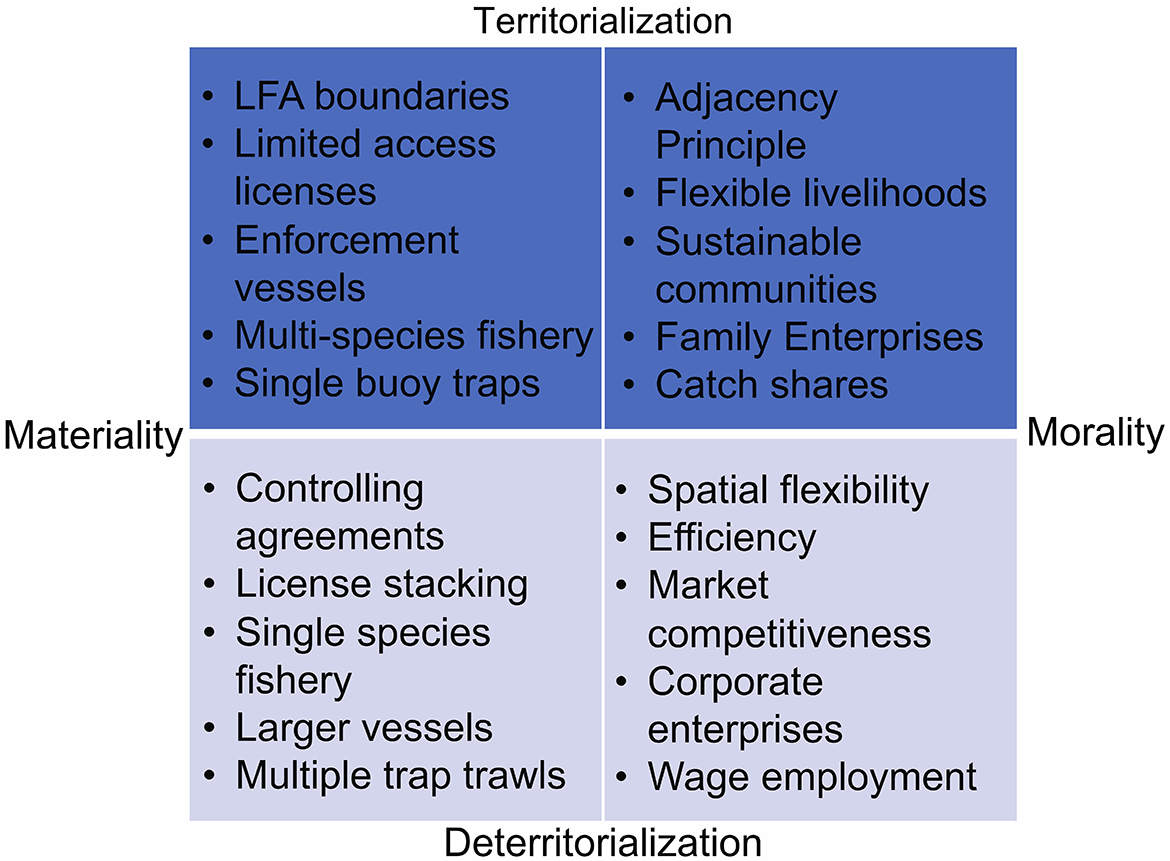
Interacting material and moral elements in the assemblage of space in the lobster fishery.
We begin by discussing how LFA boundaries in Atlantic Canada were enacted, stabilized, and contested in the past, then turn to how they are now being undermined through the actions of various actors in the fishery and through changes in the character of the space itself (Murdock 1998). We next consider the normative dimension of spatial arrangements and discuss how complex spatial arrangements are transformative, especially at the normative level. We conclude with a discussion of how theory cross-fertilization strengthens our analysis of relational space and of normative change.
Methods
This paper relies on research conducted in the Canadian Maritimes by both authors. One author participated in eight separate multidisciplinary research networks involving the fishing industry, academe, and government between 2000 and 2020. These projects followed a participatory action research approach (see Wiber et al. 2009). All projects focused on problems identified by fishing organizations and included research in support of community-based fisheries management, integrated harbor management, identifying and mitigating marine risk including marine debris and the impact of aquaculture on commercial species, and oil spill tracking and the impact of climate change. The second author collected data between 2012 and 2017 in Southwest Nova Scotia and Southwest New Brunswick through collaborations with three of these research networks. Each project addressed natural and social science research problems identified by fishing communities. Methods used to address these problems included archival research into the minutes of boards tasked with stock assessment and advice, stock management plans, landings data, and court cases involving fishing access rights; participant observation on fishing boats (eighteen trips); 104 semistructured interviews; thirteen focus groups; and eleven roundtable discussions. Together, these data sets offer a longitudinal perspective. For fishermen, access to fishing grounds and fair distribution of fish resources have remained key issues, and both authors have observed the debates and discussed problems with fishermen and regulators in multiple settings.
Territorialization: Enacted, Contested
Leitner and Miller (2007) draw attention to “bordering practices,” relations of inclusion and exclusion, and regulation of processes and capacities within bounded spaces, including processes of capital accumulation (Harvey 2003; Massey 2005; Glassman 2006; Bear 2017; Campling and Colás 2018; Muniesa 2020). The state engages in “a wide range of regulatory practices relating to resource allocation, authorization, legitimation and signification” (Leitner and Miller 2007, 119). With respect to LFA boundaries, and the timing and scale of fishing operations, state regulations were crafted with and for particular networks. Networks have stabilized at the LFA level, with family enterprises, port clusters, and commercial fish stock advisory boards all highly linked to formal spaces. But some assemblages have recently formed around spaces of resistance and negotiation.
Viewing bounded spaces as enacted through networks and contested through association and translation draws attention to motivations, values, and affect. Following Latour (2000), we see both materiality and normativity as under-theorized, especially in what Campling and Colás (2018) call “terraqueous territoriality.” Latour (2000) notes how the Berlin key requires coresidents “to conform to a strict collective discipline” (p. 17) with regard to the timing of access to their building, a morality enforced through material means. LFA boundaries also oblige fishermen to conform to a collective discipline in terms of territorial access. But just as filing down the Berlin key gives residents more discretionary power, fishermen and corporate processors have found ways to challenge the LFA boundaries.
Enacted and Embedded Territories
In Eastern Canada, the inshore, multispecies (groundfish, lobster, scallop, and shrimp), fishery is based on small, often family-based enterprises operating boats of less than 13.7 meters in length, making day trips from homeports (Wiber, Young, and Wilson 2012). Given the 1980s groundfish stock decline, lobster became the most important commercial species, with 103,917 metric tons landed in 2019, leading to a landed value of CA$1.6 billion for the Canadian Atlantic provinces (see https://www.dfo-mpo.gc.ca/stats/commercial/sea-maritimes-eng.htm, last accessed April 15, 2021). Steneck et al. (2011) call dependence on lobster a “gilded trap,” as fishermen’s livelihoods are vulnerable when that value declines as after the 2008 financial crises (Barnett and Eakin 2015).
As Acheson (1988) documents, local strategies exist for protecting the adjacency principle for those ports clustered in a geographical area (see also Brewer 2012; Foley, Mather, and Neis 2015). Until recently, fishermen operated small boats with less powerful engines and the fishery was practiced both close to shore and to the home port. These fishing practices and technological limitations required local knowledge, passed down between generations, and allowed for good observation of colleague practice and for enforcement of community values.
Government control was often introduced in the name of improved livelihoods. In 1899, for example, a Royal Commission investigated marketing problems for lobster and recommended dividing the Canadian fishery into six districts with variable seasons to reduce market gluts and improve fishermen incomes (Prince 1899). These districts were established in 1910 and the current LFA boundaries were drawn in 1986 (Lawton et al. 1999, 48), and subsequently enforced with federal Department of Fisheries and Oceans (DFO) patrol boats. The federal lines dividing LFAs, however, largely respect the historical right of adjacency access to fishing space that fishermen view as a moral right. Within communities, access to fishing grounds continues to be justified through family history, with present-day fishermen being descendants of or married into fishing families. Fishermen often support LFA lines by reporting those who fish outside the LFA lines or outside regular fishing seasons, enhancing DFO capability to regulate a vast area of ocean space. Thus, LFAs regulate fishermen’s behavior spatially, temporally (Wiber 2014), socially (relations with other humans), and ecologically (interactions with marine organisms).
Over time, however, governing this fishery has come to rely on at least three levels including community, state, and international. First, given a history of governing their own grounds, fishermen demand a collective voice in how their LFA is managed (Acheson 1988; Kearney et al. 2007; Brewer 2012; Barnett, Messenger, and Wiber 2017). LFA advisory boards, with elected port representatives from each port in the LFA, meet with the DFO, discuss stock assessments and market conditions, and advise on potential changes to regulations. The minutes of these boards illustrate how often community and national agendas clash, as DFO bureaucrats and local representatives argue over stock assessments and licensing infringements. Increasingly, corporate actors now play a role on these advisory boards.
Second, broad social and conservation objectives justify regulation by the state. In 1981, entry to the fishery was limited in two ways. A fishing license became a nontransferable “privilege,” limited to applicants considered “bona fide fishermen,” that is, to those who fished full time and for the majority of their household income (Bodiguel 2002). This simultaneously protected fishermen’s access and undercut the way households previously relied on a mixed livelihood of woodlots, farming, and fishing. New licensing also limited fishing territory by setting up areas for which species-specific licenses were granted. Boat licenses and tags attached to the lobster traps both indicate the spatial boundaries of the lobsterman’s rights.
Third, certification schemes such as the Marine Stewardship Council (MSC) have recently demanded international environmental standards set by third parties in order to access markets, creating MSC “client groups” that extend across federal fishing boundaries (Foley 2013; Foley and McCay 2014). And increasingly, international corporations operate in the fishing sector under what Teubner (1996) calls Lex Mercatoria, or the transnational law of economic transactions. Each of these layers of normative ordering add to the regulatory complexity of the fishing endeavor, especially as they are not always well integrated one with the other or with the technological transformations being experienced in the fishery.
Contested Territories
Government striation of fishing space based on Euclidean concepts was always in some conflict with the smoothness of relational space (Bear 2013). LFA boundaries are contested, generate conflict between communities, and are not adapted to changing species distribution or to MSC certification zones. For example, fishermen from harbors on either side of the line that divides LFA 33 and LFA 34 (see Figure 2) argue over historical access to the most productive lobster bottom (Barnett and Anderies 2014). Similar conflicts led to a buffer zone (LFA 37) between LFA 36 and LFA 38, in which fishermen from both LFAs can fish (see Figure 2). In 2013, when conflict over this shared zone escalated, interviews clarified that the dispute was actually linked to new gear and fishing practices and to the growing salmonid aquaculture industry, which has displaced fishermen from nearshore fishing grounds (Wiber, Young, and Wilson 2012; Chang, Coombs, and Page 2014). As one fisherman put it, “originally the boats weren’t big enough to give [LFA 38] any trouble or vice versa. But now they are all running into each other all the time and what was merely a [LFA 36 area] became quite crowded” (Interview, March 4, 2013).
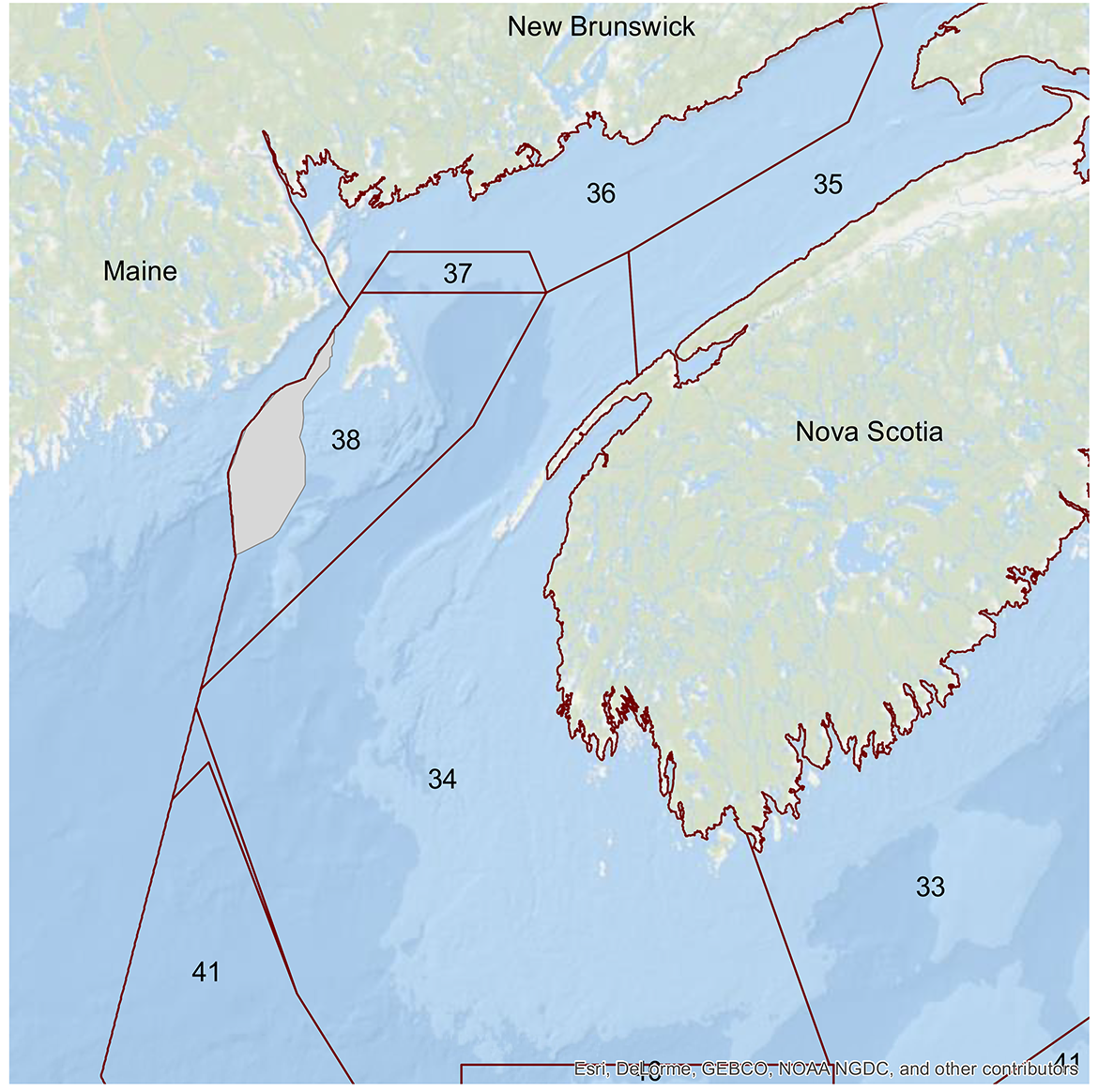
Map of Southwest Nova Scotia and Southwest New Brunswick, including the gray zone and numbered lobster fishing areas. Source: Fisheries and Oceans Canada.
The backstory to this change involves a decline in groundfish, an associated expansion of lobster stocks, and lobster landings that regularly increased over a decade. Lobster distribution change has been dramatic (Mills et al. 2013; Wahle et al. 2015; Poloczanska et al. 2016). One fisherman reported: “where we fish now, you couldn’t catch a lobster years ago…and now, that’s where everybody is fishing…you gotta go off farther” (Interview, June 25, 2012). In response, fishermen invested capital into larger boats, bigger engines, and new on-board computers, all of which allowed them to fish further from shore and to set ten or more traps on long trawl lines. This in turn created new competition over previously underutilized ocean space. One consequence was less support for community regulation and monitoring of fishing practice.
Transformations over time also resulted in LFAs that are not standard in terms of number of licenses, annual days of fishing, territorial space, and number and quality of lobster (see Figure 2). As of 2016, LFA 35 has ninety-five licenses, LFA 36 has 177, and LFA 38 has 136. The different productivity across LFAs can be estimated from landings per license. When averaged across 2009-2015, the annual landings in million tons (mt) per license for each LFA were the following: LFA 34 = 23.6 mt, LFA 35 = 31.66 mt, LFA 36 = 13.92 mt, and LFA 38 = 22.06 mt. The difference in landings between LFA 36 and LFA 35 is 17.74 mt, a difference of annual revenue of between CA$119,000–CA$238,000 (with average prices ranging from CA$3 to CA$6/lb). Fishermen who feel disadvantaged often call for change, but the DFO is understandably reluctant to change the existing spatial and temporal system, as any change to boundaries is likely to be highly disputed.
While federal fisheries policy stabilized LFA boundaries around normative concepts of livelihood sustainability and fair distribution of benefits, the above problems have always represented possibilities for destabilizing fishing space. In the next section, we examine how changing fishing practices and licensing irregularities are deterritorializing LFAs.
Deterritorialization through Translation
The four quadrants in Figure 1 help to frame (de)territorialization. While DFO regulation maintains the LFA boundaries and associated material and value dimensions (top two quadrants, Figure 1), deterritorialization has been enhanced recently by both material and normative (values) transformations (bottom two quadrants, Figure 1).
As lobster stocks have expanded into deeper waters, lobster fishermen have followed them, with bigger boats, stronger engines, and multiple traps per line (bottom left quadrant, Figure 1). But this has often required financing from the processing sector. Using GPS and other wheelhouse technology, fishermen can dispense with local knowledge obtained from older fishermen and theoretically fish anywhere. One fisherman commented: What it took me twenty-six years to learn, the bottom, my son learned it in a week. Everything that I knew and more, because the new machinery gives you 3D bottom imagery. Those kids are more aggressive, they’ve got better stuff to work with, and they don’t mind putting the time in. (Interview, June 27, 2012)
Another set of pressures comes from license transferability and the introduction of controlling or trust agreements, where processing corporations lend fishermen the capital to invest in larger boats, licenses, and gear in return for control over the fishing effort. Together with the stacking of multiple licenses on a single boat, these changes have resulted in the ability to both cross LFA boundaries and increase corporate control of the fishery (bottom left quadrant, Figure 1). Those involved in these agreements justify them by reference to the need for spatial flexibility, higher efficiency, and competitiveness (lower right quadrant, Figure 1). As with the person who filed down the Berlin key (Latour 2000, 17), the LFA infrastructure has increasingly become something to work around. On-the-water conflict over space is increasing. Barnett, Messenger, and Wiber (2017) deal with these developments in detail. We briefly explore how these changes challenge LFA boundaries and the values and moral considerations attached to them.
To discuss developments in licensing, the ANT concept of translation is useful. Callon (1986) viewed translation as a four-step process of problematization, interessement, enrollment, two Ls and mobilization. During the first phase, problematization, actors specify the problem, the knowledge required to address it, and what actors are needed to facilitate a network in response. As actors build the network, they must attract others to play specific roles by convincing them that they can achieve their own goals through networking. This is interessement. Successful negotiation leads to enrollment, two Ls as participants accept assigned roles and participate in the network. Mobilization is successful when others external to the network operate in such a way as to support it.
We illustrate these four steps below and use them to explain how the courts have accepted challenges to DFO licensing policy. Under federal fisheries regulation, licenses are de jure nontransferable and cannot be sold or transferred to others, thus the illegality of controlling agreements. However, various DFO buyback programs, designed to reduce pressure on commercial stocks, “established licenses as marketable items in the fishermen’s mind” (Bodiguel 2002, 275). Over time, those who wanted to sell or buy licenses raised questions about licensing provisions and regulatory practices (problematization; Sinha 1999). They assembled support to challenge the regulations and found quasi-legal ways to translate nontransferable licenses into property. For example, under the regulations, an existing license holder could request that their license be reissued to facilitate transfers between generations within a family. But this also enabled cash-strapped fishermen with a valid lobster fishing license to sign a contract that placed that license under the control of a corporation in exchange for payment (interessement). The result has been a tension between the frequent transfer of beneficial interests under contract law, and the DFO position that licenses are nontransferable privileges (Wiber and Kearney 1996). Meanwhile, aging fishermen who wanted to sell and young fishermen who wanted to buy licenses found this challenge to licensing policy useful (enrollment).
Given the rising value of licenses, financial institutions sought clarity as to whether licenses could serve as collateral for loans. While the DFO continues to consider licenses as the property of the crown (Bodiguel 2002), the 2008 Saulnier decision at the Supreme Court of Canada ( Saulnier v. Royal bank of Canada, 3 S.C.R. 166, SCC 58. 2008) undercut this position. In that appeal case, a license-holder asked the court to overturn an earlier court decision that would allow his bank to claim his license after he went bankrupt. The appeal was dismissed, with the court ruling that a license was a form of property (see https://scc-csc.lexum.com/scc-csc/scc-csc/en/item/6231/index.do, accessed June 30, 2017). In effect, the courts supported the free movement of licenses between interested parties (mobilization). While the DFO subsequently strengthened the owner-operator regulation, effective limits on “under-table” contractual agreements have been elusive (Bodiguel 2002; Barnett and Eakin 2015). It has been estimated that as many as 10–15 percent of licenses in Southwest Nova Scotia alone were subject to controlling agreements (CBC Online News 2016). These agreements enabled capital investors to turn owner-operator boats into “floating platforms of production” (Campling and Colás 2018, 15), via contracts which transferred the “beneficial interest” in the license to investors, allowing them the legal autonomy to circumvent state law. Such translation also enabled increased fishing effort and territorial access. It remains to be seen whether recent legislative attempts to curb controlling agreements will have the desired effect (Barnett, Messenger, and Wiber 2017).
Why do fishermen enroll in this translation? Many fishermen point to the “aging out” of the current group of license holders. Given their self-employed status and lack of retirement benefits, entering into contractual agreements with processors allows them to obtain a price for their license that far exceeds the value in their boats and gear. There are two problems with this. First, young men who hope to buy licenses and enter the fishery cannot compete with the high prices offered by the corporate investors. Second, corporate investors do not come from fishing communities and fishing organizations and communities view every transfer of a license to an outsider as a loss of community access to their economic mainstay. Such licenses rarely make their way back into the community after being contracted out.
Given high license costs, many young men find capital to buy licenses, boats and gear by signing contractual controlling or trust agreements with fish buyers and processors. As one fisherman explained: “trust agreements affect the shares of catch [I can] make. While trust agreements are different for each boat, the one I work on takes 47 percent, and the captain and crew must pay expenses except for gear…the crew pay off the boat, and the average [left over] is about 12.5 percent” (Interview, May 29, 2012). Under normal circumstances, a captain would take a small boat share to pay down the debt on their boat and license purchase, leaving the larger share to be divided among the captain and crew. On some corporate-controlled boats, however, crew shares have been eliminated, and captain and crew receive set salaries and fish where and when directed, mimicking the exploitive at-sea labor regime in shipping outlined by Campling and Colás (2021). Within communities, these changes have begun to erode the value of the adjacency principle and of attachment between fishermen and place. Such contractual agreements contravene DFO owner-operator policy, which on the east coast of Canada has maintained the independent, inshore fishery, in sharp contrast with the west coast where concentration of fishing rights in corporate hands has been extreme (Pinkerton and Edwards 2009). Fishermen are well aware of this east-west contrast but also recognize that without controlling agreements, new entry of young fishermen will be difficult.
These developments have generated tension and conflict both within and between fishing communities. Complaining that they have lost too many licenses to fishermen from LFA 34, LFA 38 fishermen set adrift LFA 34 vessels in November 2012 and barricaded government offices, leading to a temporary freeze of license transfers for ten LFA 34 boats (CBC Online News 2015). LFA 38 fishermen also lobbied for stricter enforcement of the residency clause that supports the adjacency principle by requiring that fishermen live in the port out of which they fish. Many expressed fear that the normative dimension of their fisheries had been destabilized, such that owner-operator policy, the adjacency principle, household livelihood, and coastal communities were threatened. Such disputes create intense debate within local, regional, and national fishermen’s association meetings, and between the DFO and such organizations with respect to license stacking and controlling agreements.
Since 2020, more conflict has emerged as aboriginal communities began fishing lobster out of season in order to assert their rights, recognized in the Constitution and affirmed in a 1999 Supreme Court decision (Coates 2000). Their objective is to manage their own lobster fishery with a separate set of spatial and seasonal rules (CBC Online News 2020). Taken together, these deterritorializing processes are actively reassembling the material relations with respect to the LFAs and the normative values they represent.
Discussion
As with other work examining relational geography in ocean spaces (St. Martin 2001; Perry and Ommer 2003; Sepez et al. 2006; St. Martin and Hall-Arber 2008; Bear 2013), our case illustrates and expands recent theoretical developments. LFA boundaries were originally enacted in support of the adjacency principle, market maximization, and as a means toward the fair distribution of fishing benefits across families and communities, something that fishermen generally valued. Fishermen accessed the fishery through family and succeeded due to community knowledge transfer between generations. Family and community “spaces of prescription” (Murdock 1998) were further stabilized when the federal government implemented licensing, LFA boundaries, regulations around trap limits, and opening and closing seasons. Territorialization through LFA boundaries has been an integral part of this regulation. That territorialization is now being challenged under recent changes both in materiality and normativity that increase the geographical reach of some fishing enterprises and test the accepted values around human-technology-space interactions, opening up “spaces of negotiation.”
Networks are (re)assembled at different levels (community, LFAs, region, and international) and each network relates in different ways to the LFA boundaries. Federal government agents attempt to eliminate controlling agreements, but actors have gone to court to defend them. Regional marketing actors promote season change to ensure high-quality catches despite warming waters. Local lobster advisory boards and fishing associations try to protect the adjacency principle and owner-operator policy. And corporate enterprises and interested fishermen sign contracts that assemble larger boats, wheelhouse technology, and more gear (Viljanen 2020). These different levels all play a role in LFA (de)territorialization. For example, LFAs are affected by “bordering practices,” creating what Bear (2013) calls “striated spaces,” as when the DFO resists changes to a single LFA boundary or to fishing seasons, despite changing patterns of species distribution, climate change, and markets. DFO striation flows from consideration of how changes in one LFA would affect many others. Other bordering practices take place at the community level, when communities try to protect their fishing grounds from other fishermen or from aquaculture operations. The various contractual strategies of agents and networks acting at these different levels affect the size of fishing operation (owner-operator vs. corporate) and the scale of geographic space they can fish. This finding is consistent with Viljanen’s (2020) argument that the power of contract resides in the sociomaterial assemblages that contracts are capable of creating and sustaining. What we add to this argument is the recognition of legal pluralism—international corporate practices around contracts do not always align with state regulations. When individual fishermen sell their licenses by arranging contracts with corporate entities, the allocation of the resources and distribution of benefits are tipped away from one size (single owners) toward another (corporate enterprises). The subsequent political debates involve many levels (local, state, and international) and challenge the boundaries or the conditions attached to boundaries that may limit or enhance the size of individual fishing enterprises. And significant power differentials affect patterns of inclusion and exclusion (stacking licenses, fishing in multiple LFAs, and market certification), economic clout (controlling agreements), processes (market access, setting market prices), and capacities (increasing lobster landings) within bounded spaces (Massey 2005, 152). We agree with Massey’s (2005, 181) question for academic research and practice when she asks what type of globalization do we want and what kinds of places should it generate?
This case study also illustrates how technologies and normativity are indissolubly mingled (Latour 2002). As fishing technologies change, with bigger boats fishing farther away from shore, the values and community monitoring attached to the adjacency principle come under pressure, and normative change follows, including legal challenges to the owner-operator policy. License stacking and controlling agreements, while increasing fishing enterprise flexibility under conditions of rapid change, are transforming the distribution of benefits. They may also be challenging human–lobster interactions as larger boats fishing intensively in deeper waters leave lobster few refuges. All this together is challenging how multiple actants engage within relational space.
Conclusion
Recent spatial relations in the lobster fishing industry illustrate the complexity of enacting stable relational realities in changing times. The assemblage of LFA lines in the water, fishing technology, fishing behavior, and fishing regulation is “reassembling” into some new relationship, making everyone nervous. The LFA boundary is implicated in this reassembly as it plays a role in the materiality and normativity of human relations. Under new material relations, fisheries governance is increasingly confronted with a series of geographical questions. What scale of ocean territory is it appropriate to grant to fishing enterprises? At what geographic level should fishing rights be theorized (household, community, region, or ecological habitat)? What scale of fishing enterprise is appropriate for the inshore fishery?
Given changes in boat and gear technology, lobster migration northward, and diverse aboriginal community claimants, should LFA boundaries be abandoned, with the history and values that they represent? Should fishermen with bigger, more powerful boats be allowed to follow the lobster north and fish in territory for which they have no adjacency claim? Under what social, economic, or ecological conditions should it be acceptable to modify boundaries? Should some fishing communities lose historic access to valuable stocks because individuals within those communities sell to the highest bidder? Addressing these questions will have significant implications for human–environment interactions as the nomosphere unfolds in Atlantic fisheries.
Spatial and temporal problems plague efforts to address these problems. We need to better understand the processes that link levels of social organization, including individuals, households, markets, and governments, to geographic space making and to normative understandings. At the individual level, with changing values, the morality of various patterns of behavior is challenged, under the influence of changes in lobster distribution, larger boats, new wheelhouse computing, and innovations in gear. At the household level, family history in fishing is now less important than controlling agreements in regulating access to the fishery. At the LFA level, corporate investors sit on LFA lobster advisory boards alongside fishermen but promote quite different agendas and values, sometimes with the support of DFO officials. In Atlantic Canada, these processes of assemblage involve many who argue that flexibility of the industry must be preserved, even at the expense of coastal community survival. On the other hand, others argue that there are ways to resist the apparent inevitability of modernity through corporatization (Foley, Mather, and Neis 2015). The legal arena has played a vital role in how the “politics of space is enacted” but sources of law vary, and legal pluralism arises when mercantile contract law challenges state fisheries regulations and local normative orders. We have drawn on ANT and assemblage to explore the diverse values and resulting practices that underpin different normative orders. We demonstrate how those practices (controlling agreements and the impact on licensing, failure to enforce the adjacency principle and owner-operator policy, and community fears about survival) mediate the relations between one LFA and another as well as between LFAs and federal regulators. In the process, we examine how (de)territorialization is enacted with respect to lobster fishing boundaries and the role of different normative orders in these processes. The future stability of any enactment is an open political and normative question. Given this analysis, we further argue that we can build a better tool kit for understanding relational space by integrating concepts from legal pluralism, ANT, and assemblage.
Footnotes
Authors’ Note
Allain Barnett is now affiliated with Natural Resources, Canada. This paper does not necessarily reflect the opinions or views of the Government of Canada.
Acknowledgments
We gratefully acknowledge the Social Sciences and Humanities Council of Canada for funding in support of this research. We also thank Bertram Turner, coeditor on this special issue, as well as the Science, Technology, & Human Values editors and the anonymous reviewers, all of whom have contributed much to the final product.
Declaration of Conflicting Interests
The author(s) declared no potential conflicts of interest with respect to the research, authorship, and/or publication of this article.
Funding
The author(s) disclosed receipt of the following financial support for the research, authorship, and/or publication of this article: Social Sciences and Humanities Council of Canada.
