



Abstract
Our paper contributes to Science, Technology and Society (STS) scholarship on the practices and technologies of containment. We build on existing work in STS that has analyzed containment as a performative sociotechnical system that generates and sustains new realities, new systems, and new relationships. Our contribution draws from the problem of containment in salmon aquaculture. The stakes for containing salmon are very high. Farmed salmon escapes are environmentally damaging to ecosystems and wild salmon populations, and they put additional pressure on an industry that has a very poor environmental record. We consider in detail Newfoundland and Labrador’s “Code of Containment” that works to keep farmed salmon in cages and prevent them from escaping into the wild. Through our analysis of the Code, we argue that containment is not only about holding inside. It is also about holding together, an obsolete meaning of the term “to contain.” We add to STS scholarship by arguing that containment and its associated Code in Newfoundland holds together a large scale, industrial aquaculture sector that tolerates persistent farmed salmon escapes into the wild from ocean-based cages. We conclude by examining the broader implications of our analysis for STS scholarship on the practices and technologies of containment.
Introduction
Our paper is about the practices and technologies of containment. Through an analysis of salmon aquaculture, our aim is to contribute to existing STS scholarship on containment by “opening up” containment for detailed inquiry and critical analysis (Sofia 2000; Lezaun, Muniesa, and Vikkelsø 2013; Hawkins, Potter, and Race 2015; Burch 2019; Hawkins and Paxton 2019; Kenner, Mirzaei, and Spackman 2019; Frow 2020). For salmon aquaculture, the importance of containment—of containing farmed salmon in nets that are suspended in the ocean—cannot be overstated. Consider, for example, the events surrounding the release of more than 260,000 farmed Atlantic salmon in 2017 from a farm off the coast of Washington State following the collapse of an ocean-based net pen. Since farmed Atlantic salmon are not native to the Pacific Ocean, the escape of these fish was described as an “environmental spill” (Flatt and Ryan 2017). The company blamed high tides for the collapse of the net structure, but an official report found gross negligence on the part of Cooke, the Canadian multinational fishing company that operated the facility (Lee, Windrope, and Murphy 2018). The mass escape of farmed salmon in Washington State paved the way for bans on new licenses for farming Atlantic salmon and the phasing out of existing licenses by 2025. The loss of farmed salmon from ocean net pens has occurred elsewhere including in Canada, Norway, Scotland, and Chile, where escapes are regarded as a significant environmental threat to existing wild species and broader marine ecologies (Glover et al. 2017). For the global salmon aquaculture industry containment is a high stakes challenge.
Our aim in this paper is to add to STS scholarship on containment and its effects through the case of salmon aquaculture in the Canadian province of Newfoundland and Labrador (NR). While containment is widely understood as a sociotechnical practice that involves confining or restraining, STS scholarship has emphasized what containment does beyond containing (e.g., Lezaun, Muniesa, and Vikkelsø 2013; Lezaun and Porter 2015; Burch 2019; Hawkins and Paxton 2019). Our contribution to this rich vein of STS scholarship on containment is to revive an obsolete meaning of the term “to contain,” understood as holding together. The Oxford English Dictionary (OED) separates the verb “to contain” into two large groups. The first group consists of meanings that are familiar in the contemporary context, that is, “to have in it, to hold; to comprise, enclose.” The second large group, according to the OED, is obsolete and refers to containment as “holding together” (OED Online 2019). Our argument is that containment practices and technologies hold together a large scale, industrial aquaculture sector characterized by persistent farmed salmon escapes into the wild from ocean-based cages. In emphasizing the role of containment as “holding together,” we engage with and draw on broader STS interventions that have considered how things and worlds are made to hang together (see, e.g., Mol and Law 2004; Mol 2016) or fall apart (Felt 2017).
The attachment site for our analysis is the Atlantic salmon industry on the island of Newfoundland, Canada. The industry is based in the Coast of Bays, a relatively remote region of the island that is home to around 7,000 people including a First Nations group. The farmed salmon sector has grown rapidly in the last decade, reaching over 25,000 metric tons in the late 2010s (NL 2016b). Salmon aquaculture is concentrated in the hands of two very large international companies and they provide employment to several hundred men and women involved in direct production and in fish processing. The growth of salmon aquaculture has been hailed as a key sector for the economic and social sustainability of a province and a region that was hit very hard by the collapse of groundfish stocks in the early 1990s. Indeed, an often-articulated argument is that without aquaculture, the local economy of this relatively remote region would collapse leading to significant outmigration (Mayer 2020). Criticisms of the salmon industry, particularly those focused on its negative environmental impact, are strongly contested by industry and the provincial government, who point to the important economic and social impact that salmon production has had on the South Coast of the island of Newfoundland.
We begin the paper by exploring STS scholarship on containment in order to situate our own intervention in the field. We then introduce Newfoundland’s Code of Containment for salmon and examine its operation through three registers: framing, monitoring, and improving. We conclude by examining the broader implications of our analysis for STS scholarship on the practices and technologies of containment. Our research is based on a detailed analysis of published and unpublished papers on the Code of Containment, minutes of the Code of Containment Liaison Committee, and face-to-face interviews with Liaison Committee members and other key informants in the province’s salmon aquaculture sector conducted by the lead author in 2019.
Containment beyond Containing
What does containment do beyond confining and restraining? Recent STS scholarship on containment provides some important insights. Lezaun, Muniesa, and Vikkelsø (2013), for example, have examined the effects of various social and cultural “contained” experiments conducted during the 1930s and 1940s. The aim of these experiments was to simulate social problems in confined spaces as a way of better understanding their dynamics. Yet these experiments were much more than simplified versions of reality. Instead, as Lezaun, Muniesa, and Vikkelsø (2013, 280) argue, what is important was “their capacity to produce social reality in a particularly demonstrative and explicit form.” The term “provocative containment” is proposed as a way of conceptualizing how these staged experiments play a role in the realization of particular realities. Hawkins and Paxton (2019) have extended the concept of provocative containment to critically analyze a remarkable conservation project in Australia. The project involves the use of a lengthy predator fence to preserve a specific animal species. Rather than simply enclosing and conserving, their argument is that this is a “device for intervening in life and provoking new natures” (Hawkins and Paxton 2019, 1010).
This work on provocative containment emphasizes the way in which containment generates new worlds and new realities. STS-informed work on containment has also emphasized the role of containment technologies in helping to sustain systems of capitalist commodity production, which in turn generate new relationships between humans and things. The technologies that have been analyzed often seem mundane and include the humble potato chip package (Kenner, Mirzaei, and Spackman 2019) and plastic bottles for water (Hawkins, Potter, and Race 2015). Yet these technologies of containment are crucial in transforming relations between people and objects. The sealed packages that contain potatoes have far reaching implications in terms of how they “(re)arrange not only the potato but also potato chip eaters in ways that contribute and shape the environment of the Anthropocene” (Kenner, Mirzaei, and Spackman 2019, 156). Similarly, plastic bottles do more than simply contain water. As Hawkins, Potter, and Race (2015, 3) argue, the bottled water container is both pragmatic and potent: “It has not simply allowed water to be distributed and consumed in different ways, it has also made it possible for new forms of economic life to emerge around this essential liquid.”
STS-inspired research on attempts to secure livestock from disease has provided key additional insights into what containment does beyond containing. While the typical response to disease outbreaks by animal health authorities involves attempts to contain viruses and their hosts, the literature on biosecurity has emphasized its broader effects (as well as its inevitable failure). Drawing on the impact of avian influenza in Egypt, Bingham and Hinchlife (2008) show how approaches to disease management that favor containment are also used to promote particular types of large scale and capital-intensive production units and to justify the attacks on backyard farming operations. In this way, disease management guided by containment is used to reshape livestock production systems. Yet as Allen and Lavau (2015) have shown, shifting production to intense confined production systems that promise to contain diseases is not necessarily more secure: on the contrary, it is far more likely to amplify the risk of disease outbreaks in intense, confined livestock systems.
STS-informed scholarship has focused on what containment technologies and practices do. Yet a key concern in this research is what containment practices fail to do, which is to successfully contain. For Sofia (2000), this is the “incontinence” of containment, while for Cons (2020), it is the “seepage” that always follows attempts to contain. The pipeline infrastructures that move crude oil from sites of extraction to sites for processing provide a stark illustration of the effect of containment technologies that regularly leak. Pipeline companies stress the reliability of their pipeline infrastructures (Barry 2013), but oil spills are a common and regular occurrence with significant impacts on ecologies and human populations. In the Standing Rock protests against the Dakota Access Pipeline, the problem of oil leakages from pipelines was driven by the clear understanding by protestors that “every oil pipeline leaks,” and the potential impact of these leaks on the land and sources of water for human consumption (cited in Estes 2019, 44). The impact of inevitable leaks from the Dakota Access Pipeline is dire for existing and future generations, and they threaten the sovereignty of Standing Rock.
Many of the regulations that govern containment infrastructures tolerate incontinence and seepage. Containment can be “good enough containment” as was evident in Galison and Moss’ celebrated documentary on nuclear waste (Weichselbraun 2018). In the case of industrial toxicants, “acceptable” seepage is determined by thresholds and the estimated impact of toxicants on the human body (Liboiron, Tironi, and Calvillo 2018; Burch 2019). This approach to the regulation of toxicants allows them to continue to be released into the environment, negatively impacting human health, while at the same time meeting regulatory measures associated with containment. If containment allows leakage and excess, with environmental and human harms, it points to the way in which the breaches that are tolerated allow one system to continue but may cause harm elsewhere (Liboiron, Tironi, and Calvillo 2018). It also raises critical questions about how to address the contaminated landscapes that result from containment systems that tolerate seepage and leaks and require perpetual care (Beckett and Keeling 2019).
Our brief review of what is a large body of STS-inspired scholarship exposes containment as a deeply political set of practices and technologies. A key concern is the biopolitical effects of containment, which allow some lives to be fostered but others are damaged or made killable. Indeed, if containment is a dynamic process of world making, as Hawkins and Paxon (2019) suggest, key questions that follow include: who is authoring these worlds, whose lives are fostered, and whose lives are suppressed (also see Liboiron, Tironi, and Calvillo 2018)? In this paper, our aim is to build on these insights by stressing what containment holds together, for which there are equally important political implications. What are the socioecological effects of containment when they help hold together a particular system of farming salmon in a remote region of Newfoundland?
The Code of Containment
Newfoundland and Labrador’s Code of Containment (hereafter “the Code”) is a complex set of regulations and obligations for the province’s farmed salmon industry. The Code was introduced in the late 1990s to allow operators to bring in salmonids that were non-native but were far superior to local strains of fish in terms of their performance and growth in a caged environment. Prior to the Code, federal and provincial regulators, as well as angling interests, had been opposed to bringing in non-native species of salmon and trout for the aquaculture industry. Non-native farmed species that escape their cages posed a threat to wild species of salmon and trout. But with the Code, these new farmed fish strains were permitted and a significant biological obstacle was overcome allowing the local aquaculture industry to grow and develop rapidly. The Code is also important in the contemporary context given the province’s aim to massively increase the scale of salmon production (NL 2017b). The Code ensures the “effective containment of fish,” which is widely considered to be “a fundamental aspect of good management practice” (NL 2014b, 4). Indeed, the Code is presented as the “cornerstone of the province’s commitment to responsible and sustainable development” (NL 2014b, 4). In this way, the Code was central to the development of the industry in the late 1990s and is paving the way for its further growth and expansion in the contemporary context (Mayer 2017). Newfoundland’s Code of Containment has always been about more than just keeping fish in cages: the contemporary aquaculture industry is co-constituted with the Code.
The Newfoundland and Labrador provincial Department of Fisheries, Forestry, and Agriculture (DFFA), which is responsible for aquaculture in the province, publishes annual reports that document compliance to the Code, escapes that have happened in the previous year, and potential reviews of and changes to the Code. These reports are reviewed in the annual meeting of the Code of Containment Aquaculture Liaison Committee. Federal and provincial departments responsible for oceans and aquaculture chair the Committee and the stakeholders include representatives of industry, angling associations, fisheries unions, a mayor representing coastal communities connected to salmon aquaculture, and one Indigenous First Nation rightsholder. Having established the context and the general operation of the Code, we now shift to examine its effects through three modes: framing, monitoring, and improving containment.
Framing Containment
The mode of framing holds containment together as a specific problem, with specific solutions that in turn limit how the problem of containment can be addressed. The framing of containment is achieved principally through the workings of the Code’s liaison committee. This is a committee made up of provincial and government representatives, who act as chairs of the committee, and several different stakeholders linked to salmon aquaculture. It is, in other words, a forum for public engagement on the question of the containment of farmed salmon. In analyzing the work of the liaison committee in framing containment, we draw on recent STS scholarship that is concerned with the materials and devices of public participation (Marres and Lezaun 2011). The focus of this work is on how the material settings and devices that constitute public engagement shape and determine how and to what extent the public is engaged. Lama and Tironi (2019) have recently explored this approach to participation in the aftermath of a disastrous earthquake that affected Chile in 2010. Their argument is that public engagement enacts a public and thus has an ontological impact: “publics are crafted into being within the experimental setting of participation” (Lama and Tironi 2019, 2). Significantly for our argument, they also show how public engagement is not just about participation: it can also involve the allocation of responsibilities for those who are brought into these processes (Wynne 2007; Lama and Tironi 2019). These insights on how public participation opens up but also constrains and limits how stakeholders act are directly relevant to the Code’s liaison committee and represent an important way in which the Code frames containment.
The roles and responsibilities of liaison committee members are made explicit in the Code’s Terms of Reference (NL n.d.). Members of the committee are tasked with “monitor[ing] the effectiveness of the Code of Containment and communicat[ing] this to stakeholders”; they are given the responsibility of seeking “input/recommendations from stakeholders on improving and increasing the effectiveness of the Code of Containment”; and they are asked to recommend technical and regulatory improvements to the Code (NL n.d., 1-2). All committee members are also asked to “work cooperatively towards improvement of the containment of farmed salmonids while respecting others’ opinions” (NL n.d., 2). For stakeholders, these roles and responsibilities mean that their focus is on finding ways to improve the Code while at the same time acting as knowledge brokers between the Code and the broader community of stakeholders they represent.
The liaison committee of the Code operates as a setting for public participation. Yet the terms of reference prescribe and constrain how these groups are allowed to participate, and their roles are tightly defined. In this way, the materials and devices of the Code’s liaison committee act to “constrain, inform and constitute political or ethical involvement” (Marres and Lezaun 2011, 490). Our interviews with several former members of the Code’s liaison committee provide additional insights into how this happens in practice.
Our first example is from a former mayor representing the various communities on the south coast of Newfoundland linked to salmon aquaculture. In an interview, he explained his role on the liaison committee relative to other members: There were a lot of folks there with a background that was directly related [to containment], whether that would be provincially or federally or industry as well as government folks that were specialists with more of a science background, whereas I was more of a community liaison role from that perspective. Less technical than everyone else. (Interview) My role, in the sense of a stakeholder was not involved in the science aspects, or the regulatory side of it, it was to ensure communities are aware of these issues and of course from the point of view of the information I would give, it would be more limited, more for me to understand what steps they are taking to ensure an industry is [putting] safeguards in place to make sure an industry operates in the most environmentally sound practices, and the Code of Containment Committee was a part of that, and reducing escapees and impacts to the environment and to other aspects of the region. (Interview)
A second committee member we interviewed provided a different way in which the liaison committee frames what can be discussed at committee meetings. This stakeholder represented wild capture fishery interests, and we asked him whether there were underlying tensions during the committee meetings, particularly given that his constituency is often opposed to salmon aquaculture. In response he argued that while underlying tensions might exist, the liaison committee was not the right venue to raise these concerns. This research participant may have been influenced by one of the key terms of reference for the committee, which states that committee members must “[w]ork cooperatively towards improvement of the containment of farmed salmonids while respecting others’ opinions” (NL n.d., 2). Raising questions about salmon aquaculture and its potential environmental impacts on wild fish would have clashed with the terms of reference where committee members were asked to “work cooperatively.”
A third member of the committee we interviewed represented the angling community in the form of the Salmonid Council of Newfoundland and Labrador (SCNL), which has often articulated their concern over the impact of farmed escapes on wild salmon populations. This member was generally skeptical that their role on the liaison committee was substantive or productive: “We are there, but we are there probably more as an observer than anything else.” He was also cynical about the overall impact of the Code, suggesting that it had no impact on reducing the number of farmed escapes, while at the same time casting doubt on the integrity of the committee itself: The sense that I have of the Code of Containment and the Code of Containment Committee is that it provides a forum, largely for the industry and the government to talk to each other and to put their best face, or whatever face they want on what’s happening in the industry. But as a means to prevent loss of containment, it is not effective. It hasn’t been effective. And it hasn’t been effective in other jurisdictions either. If you talk to people in New Brunswick and other parts of the world, you know, these codes,…It’s like the code of honor amongst thieves. That’s the way I view it. (Interview)
Monitoring Containment
The Code requires that aquaculture companies follow a detailed set of guidelines aimed at preventing salmon from escaping into the wild. These guidelines are not voluntary. On the contrary, they require that license holders follow a set of prescribed practices that will minimize the chances that fish will escape their cages. The cage infrastructure that aquaculture companies use, for example, must meet the standards of design, construction, and proper installation outlined in the Code. In order to ensure that companies follow these guidelines, the Code ensures that the government is able to monitor containment through an extensive set of reporting and auditing provisions. Ensuring that companies meet the Code’s guidelines is important to the NL government: containment is considered to be “a fundamental aspect of good management practice” and it is linked to international guidelines for accepted risk management approved by the North Atlantic Salmon Conservation Organization (NL 2014b). It is also the basis on which the province hopes to expand the industry sustainably, creating jobs and wealth in remote coastal communities in Newfoundland (NL 2017b).
The Code requires that companies conduct regular inspections of the nets, the cage structure, and its moorings. Since most of the net is below the surface, assessing the net structure requires the use of divers who are able to check for wear or net failures. Companies are required to conduct these diver-led surveys every 90 days. Nets that are older than three years require more frequent inspections and more complex stress tests to ensure that they are effective in containing salmon. The Code also outlines the responsibilities of provincial regulators who are required to conduct audits of farms every six months (NL 2014b). The audits include evidence of proper record keeping and adherence to the requirements for nets, cages, and moorings (Figure 1).
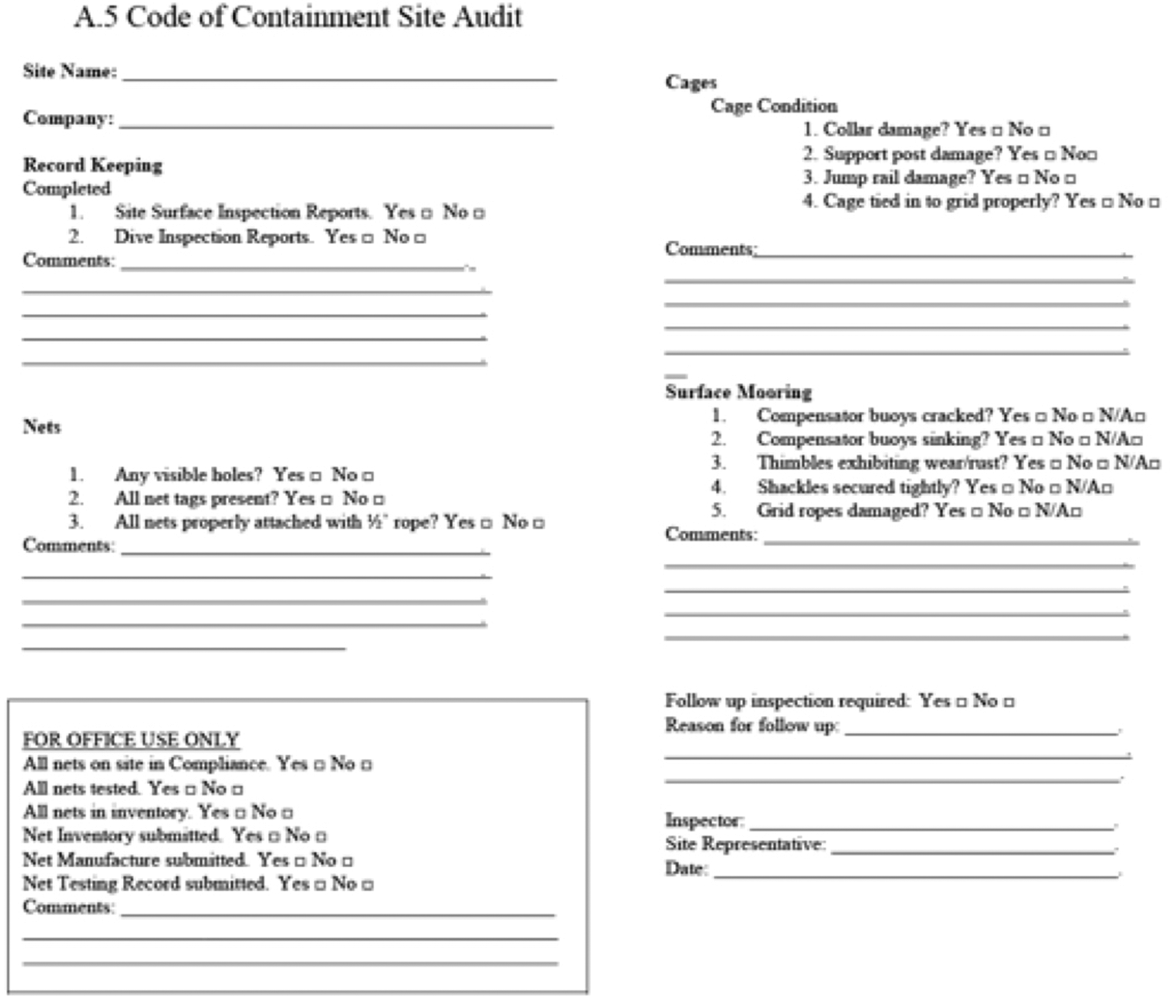
Code of containment site audit form. Source: NL (2014b).
Monitoring containment also involves an annual “inventory reconciliation” that provides numbers of fish in cages at the beginning and at the end of the year. All producers are required to submit cage level data on the numbers of fish stocked, mortalities, removals, and escapes per cage (NL 2014b). The result is a spreadsheet by cage of the number of fish present at the beginning of the year, the number of fish put into the net pen in that year, and the numbers that were removed, either as mortalities, as commodities-to-be, as escapes, or for other reasons (Figure 2). In the publicly available annual compliance report for the Code, these allow for calculations and presentations on the number of fish in all of the province’s sea-based cages, and for conclusions like this: “Industry was fully compliant with this section of the Code [inventory reconciliation]. Industry wide, the inventory reconciliation covered a starting number of 9,733,932 salmonids and ended with 8,422,965” (NL 2019, 3).
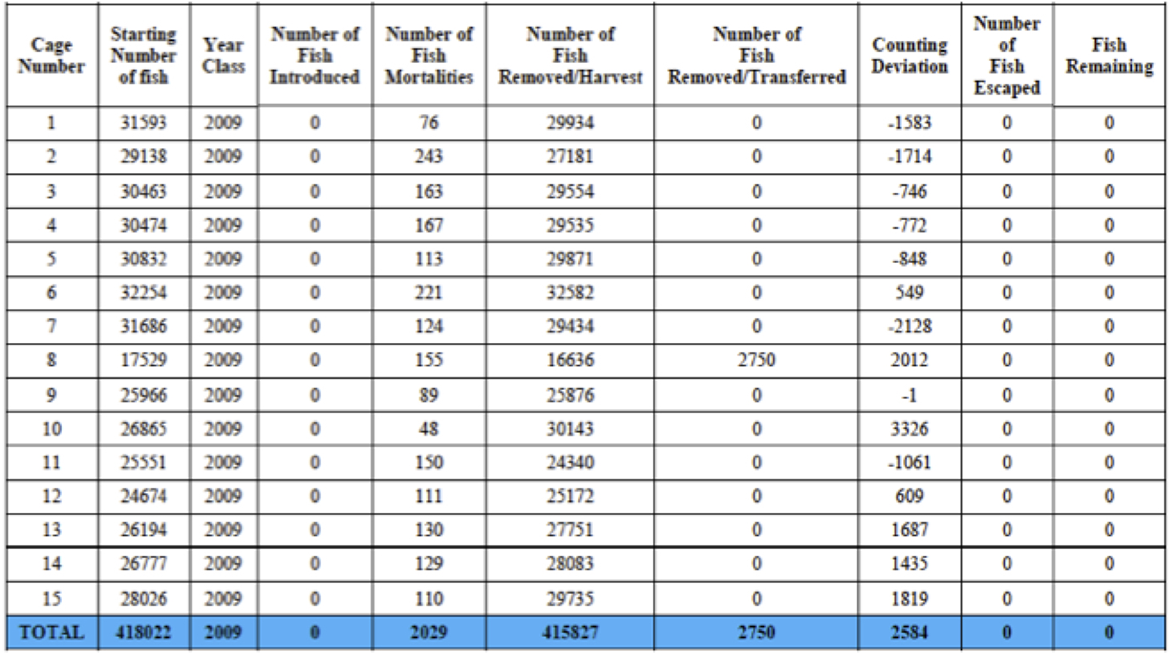
An example of inventory reconciliation spreadsheet. Source: NL (2012).
The monitoring of containment through the Code follows closely what Shore and Wright (2015) have called the “audit culture.” The audit culture refers to the spread of the principles and practices of modern accounting beyond financial regulation to diverse contexts and situations. Auditing aquaculture companies and collecting data on fish numbers generates tables that look like profit and loss statements, and include accounting terms like “shrinkage” and “reconciliation,” all of which suggest the influence of an audit culture on the Code. Scholarship on the audit culture has explored its widely varying social and political effects (Shore and Wright 2015). One these effects, which seems particularly relevant to our case, is the way that audits “hail into existence” the object that they measure. In this way, the Code’s role of monitoring through audits, spreadsheets, and regular inspections helps to bring containment into existence, making it an object that is governed and managed. While the Code may help “hail” containment into existence, monitoring containment is not quite as certain as the tables suggest.
The inventory reconciliation tables that are generated for farmed salmon in Newfoundland provide precise figures on the number of fish in cages across the industry. These tables, full of numbers, no doubt “exert a seductive power” (Shore and Wright 2015, 430), giving the inventory reconciliation process a sense of accuracy and objectivity. The tables and the aura of certainty that they present may also strengthen the province’s case that it is effectively monitoring aquaculture companies on containment. There are, however, several important uncertainties in how the numbers are collected and calculated. The table itself has a column called “counting deviations,” which was well over 3,000 fish for a single cage (Figure 2). Provincial regulators acknowledge these counting deviations, but they argue that these are due to counting errors and outdated technologies that do not allow farmers to accurately count fish in cages. Significantly, these counting errors do not end up as “fish escapes” in the tables even though federal regulators have raised the concern that these deviations may reflect what they call “leakages” or “unreported small-scale chronic losses of stock by escape” (Bridger, Frederiksson, and Jensen 2015, 5).
The existence of “chronic losses” has become more important in the context of a recent redefinition of what officially constitutes a significant escape of farmed salmon in Newfoundland. Until recently, a significant escape requiring formal reporting involved 100 or more fish leaving the cage. Yet a recent amendment approved through the Code’s liaison committee has now changed this number from 100 fish to only 1 fish. In other words, containment fails when a single fish escapes from a salmon cage. While the change draws additional attention to what are called chronic losses, it also reveals that breaches in containment are neither stable nor self-evident. Indeed, the different words that are used in different situations in the wake of a containment failure––“trickle,” “leakage,” “chronic loss,” “escape incident”—suggest that failures to contain are indeterminate and situated (also see Lien 2015).
The Code is involved in monitoring containment, but monitoring the failure to contain is distributed beyond the Code. When aquaculture workers and divers find holes in nets caused by storms or by predators like seals, they may suspect that some farmed salmon have escaped into the wild. These suspicions of escapes may be strengthened via additional observations including seeing that fish in the cages are eating less than before, possibly because their numbers have dwindled. But this is not always the case: caged fish may lose their appetite for a number of different reasons related to health or environmental stresses. The failure to contain is also monitored by people living and working in the vicinity of aquaculture sites who see salmon in the wild that they suspect are from farms. Salmon that escape their cages tend to behave differently in the ocean, jumping out of the water frequently, presumably in search of feed. In other cases, recreational anglers have caught salmon in rivers that they suspect originate from farms. Unlike the wild salmon they are used to catching, farmed salmon have distinctive physical features including, according to one of our research participants, a thicker and deeper body relative to length, fin wear from ropes in salmon cages, and smaller gill covers. While these physical differences are suggestive of salmon escaping cages, there is also extensive scientific work underway in Newfoundland that is has focused on monitoring containment, its failures, and its environmental effects. Following the escape of over 20,000 salmon in 2013 in Newfoundland, federal fisheries scientists have been testing the genetic profiles of fish in rivers close to where the cage collapsed. The team of scientists conducting this research found evidence of genetic introgression in wild salmon in 17 of the 18 rivers they sampled. Indeed, as many as a quarter of the fish sampled were considered to be “hybrids” containing both wild and farmed salmon genes (Wringe et al. 2018).
These examples show how the failure to contain salmon involves “sensing” techniques and practices that are beyond the formal systems for monitoring breaches in the nets (Ballestero 2019; Gabrys 2019). They also reflect the limits of conventional systems that monitor containment and its failure (Gabrys 2019). But when escapes are reported, the Code again becomes relevant. Companies are required to report the escape of salmon from cages to federal officials within twenty-four hours of the event. Federal authorities are involved in this process because salmon that leave their cages shift from being a responsibility of the province of Newfoundland and Labrador to being regulated by the Canadian government through the Department of Fisheries and Oceans. Indeed, farmed salmon that are found outside of a cage are, strictly speaking, considered to be wild and therefore protected under federal fisheries legislation. Recapturing escaped salmon, if permitted, is strictly controlled by the Code and depends on a number of issues including the “the life history stage of the escaped fish, the time of year, incident-specific factors, and conservation objectives for wild fish populations” (NL 2014b, 35). If recapturing is sanctioned, there are regulations for gear, how to deal with bycatch, and having a disposal plan for the recaptured fish.
Monitoring containment through the Code brings containment into existence as a practice and a policy that is closely governed and managed. Yet governing containment and the inevitable breaches that happen is uncertain, situated, and indeterminate. Monitoring containment is distributed beyond the Code and involves sensing practices by individuals beyond the code who find evidence of containment failures. Escape events do not, somewhat paradoxically, render the Code irrelevant or raise questions about its efficacy. Instead, the machinery of the Code is brought into action in the context of escapes to regulate the potential for recapturing salmon that have left their cages. In the next section, we explore the mode of improvement, which helps to explain how the Code can exist in spite of ongoing escapes of farmed salmon.
Improving Containment
No one believes that farmed salmon can be contained in cages in the open ocean and that escapes can be eliminated. MOWI (2018, 147), the world’s largest salmon aquaculture company, says that its objective is “zero escapes,” but it notes that there is “no simple solution to help us achieve this goal.” In our interviews with local aquaculture experts, we heard that the “goal of zero escapes, though laudable, is unachievable, because, right now, it is technologically impossible to eliminate all breaches of containment systems” (Interview). If salmon escapes are inevitable, how can a Code of Containment, and its infrastructure for monitoring and auditing containment, be justified? Part of the answer to this lies in the Code’s commitment to improvement, our third mode of doing containment.
Li’s (2007) The Will to Improve provides a nuanced and carefully theorized approach to the question of improvement. While the focus is on rural development projects in Indonesia, her argument about improvement, which draws on Foucault’s theory of governmentality, has wider purchase. The idea of improvement helps us to account for the apparent paradox of a Code that exists to contain salmon yet continually fails to achieve this goal. In particularly it is Li’s (2007, 1) argument about the “parasitic relationship between [development] and its own shortcomings and failures” that is so relevant to our analysis of the Code. We develop our argument by suggesting that improvement it is “hard wired” into the Code itself and that the Code’s existence depends on ongoing failures of containment in salmon aquaculture.
The idea of improvement features prominently in the way the Code is designed and operates. One of the Code’s objectives is to be “forward-looking” to continually look for improvements in its efforts to contain salmon. As a way of providing evidence of its commitment to improvement, the Newfoundland and Labrador provincial government noted in 2017 that “significant changes” to the Code were proposed and implemented in 2013 and 2014 (NL 2017a). Several of these changes were proposed and later approved through the Code’s liaison committee, which is also tasked with improving containment. The terms of reference for the members who assemble annually include “improving and increasing the effectiveness of the Code of Containment,” and “work[ing] cooperatively towards improvement of the containment of farmed salmonids” (NL n.d., 1-2). The Code itself, then, is committed to continual improvement.
Improvements to the Code are also introduced in response to officials identifying vulnerabilities to containment in salmon production. One of our research participants, who had been involved in the Code for over a decade, described his role as being “responsible for tinkering with the Code.” He went on to say: The challenge with net pen aquaculture is: you got a commitment from the industry to make continuous improvements, because the market demands it. So, the idea is, to come up with a framework, a way in which you can get the industry to learn faster. So, to develop technology, or if it is operating procedures, whatever it is…where are the weak links, adjust the weak links, continually improve performance. (Interview)
While improvements to the Code may be implemented in response to vulnerabilities and weak links in salmon production, improvements also happen in response to containment failures. In this sense, although the Code declares itself to be “forward looking,” its logic is better described as reactive, which in turn provides new targets for improvement. In 2013, a year of significant salmon escapes in Newfoundland, new provisions were added to the process for “reporting and assessing the causes of escapes” (NL 2016a, 4). One of these provisions was a new requirement that companies submit a detailed report on escape events. The purpose of the report was so that regulators could “determine if the incident(s) require new amendments to the Code or the adoption of other management strategies to prevent such incidents from happening again” (NL 2016a, 43). The Code is activated when something goes wrong and it is subsequently used as an opportunity for further improvement to reduce the likelihood of future escapes. Breaches of containment are not moments to criticize the Code but are instead transformed into opportunities for improvement through the Code’s machinery of reporting, auditing, and amending regulations.
The Code’s status as a policy does not seem to be affected or challenged by the number or scale of escapes. When, in 2013, over 20,000 salmon escaped a cage situated on the South Coast of Newfoundland, it was simply listed in the compliance report together with two other smaller scale escapes in the same year:
There were three instances of escapes in 2013:
20,500—An uncommonly high tide combined with a storm even caused a cage to submerge allowing for the escape of fish through the bird net.
300—A harvesting misstep where a brail net let go causing a spill.
5,693—A hole was tore in a net while moving it to a wharf for harvest.
(NL 2014a, 19)
In other salmon producing regions, large scale escapes of salmon have led to out-of-the-ordinary responses by regulators. We opened the paper by mentioning the Washington State escape in 2017 that has resulted in the phasing out Atlantic salmon farming in that US state. In other salmon producing regions, salmon escapes are highly publicized and are used to challenge an industry that has a poor environmental record. In Newfoundland, when escapes are reported, industry and regulators make recourse to the Code. This was the response by the director of the Newfoundland Aquaculture Industry Association (NAIA) when he was asked in a radio interview in 2017 to answer a question about salmon escapes in the province: So, we have a Code of Containment Committee…. And to this year to date we have no reported escapes at all. And over the last number of years, we have had very, very few. I think it was probably less than 10 salmon maybe, two years ago. So, we are doing very, very well. We have invested tens and tens, if not hundreds of millions of dollars in refining the equipment that we use, and we are always looking for ways to improving innovation and technology that we employ. (Simms 2017, p.1).
Conclusion: Containment Worlds in Salmon Aquaculture
In this paper, we have explored containment as a multilayered set of practices and technologies that generate effects beyond containing. We contribute to a body of scholarship in STS that has shown how containment technologies are neither neutral nor self-evident, they can enhance some systems while damaging others, they support efforts to construct hopeful or secure imagined futures, and they are implicated in the building of new ecologies. We build on this existing field of scholarship on containment that is beginning to explore what containment does beyond enclosing, however unsuccessfully. Our focus was the Code of Containment that is used in Newfoundland and Labrador to address the problem of farmed salmon escaping their ocean-based cages. Through a detailed analysis of the different practices that are related to this Code, we articulated three different modes through which containment is done: framing, monitoring, and improving. The three modes might be interpreted as chapters in a story. Containment is framed, then it is monitored, and then it is improved. However, these modes happen simultaneously and work in concert. The question is: what do they do together? Here is our answer: what they do in concert is more than helping to hold something inside, however unsuccessfully. The work they do also holds something together. Containment practices hold together an industry and a particular way of producing a capitalist commodity, farmed salmon; it sustains an industry that is able to deflect criticism when inevitable breaches of containment happen; it helps to demonstrate good governance and good farming practices for an industry that is facing mounting environmental concerns about the impact of escapes; and finally, it holds together an industry that provides some employment to people living on the South Coast of the island of Newfoundland. In this way, containment practices help to hold together the South Coast of the island of Newfoundland.
For STS scholarship on containment, our work points to two broader lines of inquiry. First, it raises the question of how the diverse practices and technologies that attempt to contain—while allowing for leakage and seepage—are changing. Consider, for example, Lezaun and Porter’s (2015) recent work on the genetic modification of mosquitoes to contain the human pathogens they carry including for malaria and dengue infections. These genetically modified mosquitoes are rendered incapable of transmitting disease and, rather than requiring containment, they become active agents in new and emerging strategies of disease eradication. Of interest, of course, is the impact of this shift on approaches to containment. Lezaun and Porter’s (2015) analysis provides key insights into this issue by exploring the complex and diverse impacts for disease management that follow from genetically modified animals that are protected by intellectual property rights and are positioned as key players in disease eradication. In salmon aquaculture, similar changes are underway with the development of “triploid” farmed salmon varieties that are generally unable to reproduce if they escape from the confines of cage. Rather than being active agents, as is the case with Lezaun and Porter’s (2015) mosquitoes, these salmon are rendered sterile and their agency in posing a threat to wild salmon is diminished. The effects of these shifts on containment practices and technology are important ongoing areas of inquiry for STS scholars.
Second, our central contribution to the scholarship on containment has been to offer the idea of containment as a practice and technology that “holds together.” For STS scholarship, the political challenge that follows is to examine who benefits from what is being held together, and what harms are done to those humans and nonhumans that are burdened with enduring the effects of seepage. In other words, who and what derives benefit from particular configurations that are held together through containment? And more importantly, given the inevitable seepage that follows, who and what is harmed by containment technologies that always fail?
Footnotes
Acknowledgments
We would like to thank two anonymous reviewers for their very helpful comments and suggestions on an earlier version of this paper, and the editorial guidance by Edward Hackett and Katie Vann. An earlier version of this paper was presented at the STSFAN (STS Food and Agriculture Network) workshop series. We are most grateful for all of the comments provided by the readers and participants of the workshop. We are also grateful to Alex Zahara, Caitlynn Beckett, Mario Blaser, Arn Keeling, and Sarah Martin for their comments and suggestions on earlier versions of this paper.
Declaration of Conflicting Interests
The author(s) declared no potential conflicts of interest with respect to the research, authorship, and/or publication of this article.
Funding
The author(s) disclosed receipt of the following financial support for the research, authorship, and/or publication of this article: Research funding was provided by the Ocean Frontier Institute, through an award from the Canada First Research Excellence Fund.
