



Abstract
The recent expansion of online genetic-genealogical networks has been hailed as a development that could break racial taboos in the United States by providing irrefutable evidence of the myriad historical and genetic links—many originating in slavery—connecting white and black families. These predictions are countered, however, by a scholarly literature on “white ignorance,” defined as an active historical project that works to prevent privileged groups from apprehending their links to, and positionality within, systems of racial oppression. This paper mobilizes concepts from the fields of agnotology and epistemic ethics to assess how far genetic-genealogical technologies can contribute to redressing racialized epistemic inequities between slave and slaveholder descendants, by inducing the latter to respond to the former’s kinship claims and give access to data that could help reconstruct their linked family histories. Drawing on ethnographic and interview data that foreground the experiences of African American genealogists, the study outlines the structural and affective dimensions that have converged to enable white ignorance regarding genealogies of slavery and discusses ethical and technical solutions proposed by genealogical practitioners to redress the racialized power dynamics that continue to condition access to, and public acceptance of, family history knowledge relating to slavery.
Keywords
A scandal arose in April 2015, after a series of leaked emails uncovered the news that Hollywood superstar Ben Affleck had tried to censor his appearance the previous October on the popular American genealogy series Finding Your Roots to hide the finding that one of his ancestors was a slaveholder. Deleted scenes, subsequently released by Public Broadcasting Service (PBS), showed Affleck learning from the show’s presenter, Henry Louis Gates, Jr., that his third great-grandfather owned twenty-five slaves, apparently placing him among the “elite” of Southern slaveholders. Affleck responded: “God. It gives me kind of a sagging feeling to see, uh, a biological relationship to that. But, you know, there it is, part of our history” (McDonald 2015). Following the leak, Affleck (2015) apologized in a post on Facebook, stating: I didn’t want any television show about my family to include a guy who owned slaves. I was embarrassed. The very thought left a bad taste in my mouth.…I regret my initial thoughts that the issue of slavery not be included in the story. We deserve neither credit nor blame for our ancestors and the degree of interest in this story suggests that we are, as a nation, still grappling with the terrible legacy of slavery. It is an examination well worth continuing.
In her 1999 essay, “Refusing Information,” Strathern (1999) proposed that the centrality of biological relatedness to Euro-American notions of kinship means that individuals raised in these cultures are often “wary of the information that comes to them” regarding their biological ancestry, since “knowing about one’s kin is also knowing something about oneself—if one has no option but to deal with the information it is also true that one has no option over the relationships” (pp. 69, 77). As Affleck and Obeidallah’s reactions indicate, for many white Americans today, evidence of a family relationship to slavery is an example of potentially damaging kinship information that ideally one “[does] not wish to know” (Strathern 1999, 69), or which, once known, must be kept private at all costs. Nonetheless, the systemic concealing of data that could link white Americans to slavery has broader consequences in a society where many pre-emancipation genealogical records remain in the private collections of old slaveholding families, creating obstacles for descendants of the enslaved to access these data and reconstruct their own family histories.
In recent years, the rapid expansion of online genealogical networks and the popularity of commercial DNA ancestry testing have been hailed as developments that could foster increasing interracial dialogue on slavery and its afterlives, by providing irrefutable evidence of the myriad historical and biological links (many originating in slavery) connecting white and black Americans (e.g., Gates 2014). However, such predictions rely on the idea that ignorance of slavery constitutes a passive absence of knowledge that can be remedied with “hard” genetic-genealogical evidence. This assumption is contradicted by a scholarly literature on “white ignorance,” defined as an active historical project that works to prevent broad sections of society from apprehending their own links to, and positions within, structures of racial oppression (past and present), thereby perpetuating and naturalizing systems of white supremacy (C. W. Mills 2007). In this paper, I mobilize concepts from agnotology (Proctor 2008)—in particular, studies of racialized epistemologies of ignorance (Sullivan and Tuana 2007)—and discussions on epistemic ethics (Fricker 2007; Medina 2013) to explore how systemic and strategic forms of ignorance can empower white individuals, consciously or unconsciously, to avoid receiving information that links them genealogically to slavery, even at a time of increasing online sharing of genetic-genealogical data. In addition, I ask how far, and in what ways, genetic-genealogical practices could contribute to dismantling structures of racialized epistemic inequity, which I define as a situation in which one group’s refusal to acknowledge their imbrication in oppressive societal systems impinges on the ability of another group to pursue processes of truth-telling and self-healing regarding their collective experiences of oppression within these systems.
I begin by outlining the structural and affective dimensions that have converged to enable white ignorance regarding genealogies of slavery, while simultaneously obstructing black individuals from accessing information about their ancestry dating to the period of slavery. I then draw on ethnographic and interview data gathered among an African American genealogy group in 2014 to demonstrate how the social effects and “political geographies” (Proctor 2008, 6) of this systemic white ignorance become tangible through attempts to connect and exchange data with “genetic cousins” via DNA relative-matching technologies. Finally, I discuss some ethical and technical solutions proposed by genealogical practitioners to address the racialized power dynamics that continue to condition access to, and public acceptance of, family history knowledge relating to slavery.
Silence and Power
In the wake of the Civil War and emancipation, African Americans who had lived through slavery were divided in their opinions about the benefits of remembering, versus forgetting, this dark period in their collective history, with many preferring to avoid facing “a past they could never come to terms with” (Blight 2003, 311). Nearly a century later, though, the Civil Rights Movement propelled a shift in attitudes as new generations began to actively seek information about their family origins in, and beyond, slavery (Rushdy 2001). Haley’s (1976) best-selling genealogical saga Roots and its accompanying television miniseries were fundamental in catalyzing this culture change, showing that it was possible to gather extensive oral and documentary data about genealogies rooted in slavery, and potentially even to recover one’s African origins.
The popularization of genealogical research among African Americans during this period did much to revert the shame and stigma attached to the idea of “having slave ancestry.” Yet there remain significant methodological challenges to reconstructing the lives and identities of the enslaved: the enforced illiteracy of the majority of enslaved individuals, meaning that few left written accounts of their own lives; the frequent covert sexual relations between white slaveholding men and enslaved women, which hinder the reliable identification of paternal lineages; the replacement of African personal names upon arrival in the American colonies; the prohibition on the use of surnames among the enslaved; and the sometimes unpredictable adoption of new surnames following emancipation, among other issues (Blockson and Fry 1991, 3-4). There are also various structural factors that impede black genealogists’ access to these historical data: for instance, many important genealogical archives prior to emancipation are still kept by the descendants of slaveholders and may not be available for consultation without their permission. Even public archivists may be unwilling to yield documentation about slavery: some black genealogists report being erroneously informed that the archives they were seeking had been destroyed or misplaced, when custodians sensed that sensitive information about “miscegenation” involving prominent white families was at stake (Pinderhughes 1998, 118, 123).
The attempts by black genealogists to shed light on their ancestors’ lives and identities tug at the veil of silence that has been drawn over histories of slavery in white families. For many white Americans, the processes of forgetting and selective remembering about slavery began in the immediate aftermath of the Civil War, as white authors romanticized the institution, depicting it as beneficial to Africans and their descendants (Blight 2003, 221-25). While genealogy has grown exponentially in popularity among African Americans and Euro-Americans alike since the 1970s, this has not led to a similarly widespread reckoning with the histories of slavery among the latter. Those who have attempted to interrogate their families’ connections to slavery typically find themselves facing a wall of silence. Edward Ball, a descendant of a large slaveholding family from South Carolina, has described how his father used to joke that there were “five things we don’t talk about in the Ball family. Religion, sex, death, money, and the Negroes” (Ball 1998, 7). While writing his book Slaves in the Family, Ball found that one the most difficult subjects to broach with his white relatives was that of the sexual relations between his slaveholding ancestors and the people they enslaved, something most denied having occurred (Ball 1998, 58).
Historically, this fiction was propped up by colonial laws governing the inheritance of slave status, which dictated that any child of an “Englishman” and a “Negro woman” would not receive the condition of the father, as English common law dictated, but that of the mother (Harris 1993, 1719). Since the enslaved were treated above all as property, the mixed-race children of slaveholders were rarely recognized as kin by their white fathers, who instead regarded them as a “free” addition to their workforce, to be further exploited. The “de-kinning” (Fonseca 2011) effects of slavery were gradually compounded by the United States’ racial doctrine of hypodescent, colloquially known as the “one-drop rule,” which continued into the 20th century, dictating that anyone with any known African ancestry should be categorized as “Negro” or “colored” and therefore nonwhite (F. J. Davis 1991, 5). The eugenic belief that black “blood” indelibly tainted lines of descent helped pull a veil over the considerable European ancestry shared by many in this category, solidifying the ideology that blacks and whites belonged to biologically distinct “races.” The color line (Figure 1)—not a “natural” biological division but a product of the racialized social and legal management of sexual reproduction (Bonniol 1992)—served as a buffer that empowered former slaveholding families to turn a blind eye to their biological links with the enslaved.
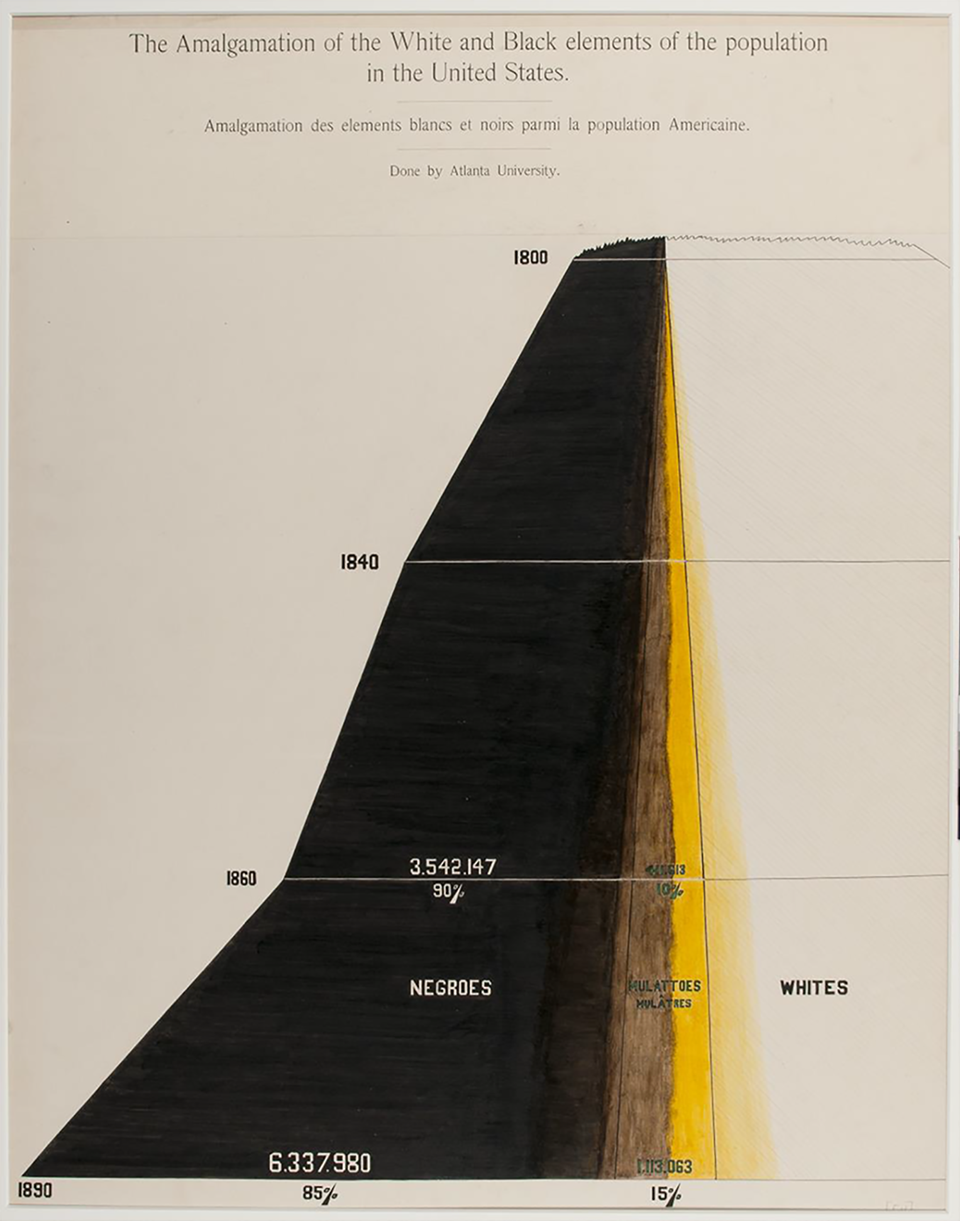
“The Amalgamation of the Black and White Elements”: Diagram produced by W. E. B. Du Bois and students from Atlanta University (ca. 1900). The “color line” is represented by the solid line between “whites” and “mulattoes,” with the shading to the right of the line representing individuals of African ancestry who “passed for white,” indicating that in reality, the line was socially constructed and permeable. It should be noted that since the diagram’s authors used phenotype (“color”) as a proxy for genetic mixture (“amalgamation”) between two ostensibly distinct groups (“Negroes” and “whites”), the graph appears to underestimate the extent of genetic kinship among formerly enslaved and slaveholding classes, limiting it roughly to the intermediate group labeled “mulattoes.” Source: Daniel Murray Collection, US Library of Congress (Public Domain).
For C. W. Mills (2007), the historical accumulation of positive and deflective discourses around white involvement in slavery has created a state of collective “delusion” or “amnesia,” which is difficult to escape for those who experience the world from a position of white privilege. Nonetheless, at a time when black genealogists are increasingly attempting to excavate family histories of slavery, the persistence of white ignorance about these topics can best be understood as the result of cognitive strategies of resistance, deployed consciously or unconsciously in the aims of “avoiding or delaying harm, and preserving a sense of self” (Bailey 2007, 77). Those who know themselves to be slaveholder descendants may hear evidence of the widespread racial violence perpetrated under slavery, but continue to believe that their ancestors were “good” masters, and thus feel exempt from scrutinizing their family histories. Another strategy can be to diminish or disbelieve the claims of descendants of the enslaved. In Slavery’s Descendants, a recent work that compiles testimonies from descendants of slaveholders and the enslaved, Shannon LaNier describes how he grew up listening to oral histories about his maternal family’s ancestral links to Thomas Jefferson and Sally Hemings, an enslaved woman long rumored to have borne children by Jefferson. LaNier recalls his first-grade teacher berating him for “telling lies” after he announced to his classmates that he was a ninth-generation descendant of the American president (Ford and Strauss 2019, 9).
The refusal to accept black people’s testimonies regarding slavery is an example of what Fricker (2007) has called “testimonial injustice,” in which a form of identity prejudice “causes a hearer to give a deflated level of credibility to a speaker’s word” (p. 1). For Fricker, the systemic dismissal and ignoring of the capacity of African Americans as epistemic agents stems from a racialized and structurally rooted power relationship, which can take the form of “one party or parties effectively controlling what another party does—preventing them, for instance, from conveying knowledge” (Fricker 2007, 28). The concept of racialized epistemic inequity I wish to develop here is linked to Fricker’s thesis of “epistemic injustice,” in that it describes a situation in which the capacity of descendants of the enslaved to shed light on their family histories, and have these genealogical narratives heard and believed, is contingent on the willingness of descendants of slaveholders to acknowledge their mutually intertwined histories and give access to data that could publicly validate these links. Far from simply being a “family matter,” this problem holds relevance for broader antiracist struggles and social justice issues, since engaging with the claims of descendants of the enslaved—and, for instance, accepting the existence of shared kinship links rooted in slavery—logically requires slaveholder descendants to confront evidence that contradicts the foundational myths of whiteness (as equated to racial purity, historical innocence, moral goodness, and so on). For C. W. Mills (2007), these are necessary first steps for individuals to break free of white ignorance, thereby becoming capable of apprehending the realities of systemic racism and white supremacy, and examining their own racial and moral positionality in relation to these structures of oppression. In the next section, I demonstrate how these structural and strategic forms of ignorance can be made visible through the experiences of African American genealogists who have tried to connect with white relatives through DNA relative-matching tools.
The Genetic Turn in African American Genealogy
In 2014, I conducted a series of interviews with members of an African American Special Interest Group (henceforth AASIG) in the Washington, DC area, many of whom were attempting to reconstruct family lines obscured by slavery. I visited the group at their regular meeting place: a small library equipped with PCs and microfilm readers, annexed to a Church of Jesus Christ of Latter-day Saints. The first day I walked in, five of the group members were already sat at computers, chatting amicably and going about their research. As a young, white British researcher, I had expected my presence might be met with suspicion. On the contrary, the group welcomed me warmly, introduced themselves, and told me I was welcome to stay and ask questions.
That first morning, my attention was drawn to a wall display on family quilts, which had been put up for Black History Month. Gradually, different members got up to show me their handiwork, pointing out photos of their grandparents, family crests, maps of the United States and Africa, lyrics from spirituals, broken chain motifs, and cowry shells. The display was interwoven with the words “freedom” and “liberty,” and it seemed emblematic of the themes that motivate many African Americans to research their family histories. Whereas genealogy has often been dismissed by conventional historians (and nongenealogists) as the work of self-indulgent amateurs who lack the skill and rigor of “real” historical research, feminist scholarship has highlighted the diversity and multiplicity of meanings practitioners attribute to genealogical research. Genealogy can be simultaneously “a practice of self-meaning and self-making” (Nash 2008, 17); a form of care for the dead (Cannell 2011); a “work of connecting past and present kin with purposeful narrative” (Nelson 2016, 71); and a set of techniques and findings that habitually disrupt, rather than confirm, our assumptions about the past (Evans 2011, 51). For their part, some AASIG members saw genealogy as “what we owe to our ancestors”: a way of preserving the memories of older relatives who had marked their lives and of learning about the ancestors who had shaped their lives in turn. Others were trying to “repair ruptures in our family narratives” by solving long-standing family mysteries: the identity of an unknown great-grandparent, the circumstances surrounding the untimely death of an older relative, and the location of the unmarked burial place of their enslaved ancestors. While each member was driven by a specific set of aims and questions, their work shared a common concern with uncovering truths about pasts that were all too often inflected by violence and injustice and shrouded in silence and myth. Genealogy therefore had a healing and reparative function: as one AASIG member told me, “slavery broke identity, but you can get it back and mend it.”
Far from lacking the abilities of professional historians, many of the members had accumulated decades of research experience and were continuing to develop diverse techniques to verify the results of their painstaking inquiries. DNA relative matching was one such approach used by several of the AASIG members. While studies of DNA ancestry-testing practices among African Americans have predominantly focused on genetic “ethnicity” and admixture analyses (Nelson 2016; Abel forthcoming), comparatively little attention has been given to DNA relative-matching tools, which many black genealogists regard as valuable for validating or refuting elements of their histories (for instance, based on oral lore) that they have not been able to substantiate through documentary evidence. In general, the AASIG members mentioned two main types of DNA relative-matching technologies. The first were uniparental DNA tests (Y-chromosome [Y-DNA] or mitochondrial DNA [mtDNA] analyses): parts of the genome that are inherited patrilineally and matrilineally, respectively, each tracing a single lineage in a person’s genealogy. Similar to conventional paternity analyses, these tests allow genealogists to verify an ancestral biological relationship by comparing the DNA lineages of two or more living descendants. One of the landmark uses of this technique was, in fact, a 1998 study that validated the existence of a genealogical relationship linking descendants of Sally Hemings to a male member of the Jefferson family (Foster et al. 1998; D. S. Davis 2004).
The second technology is based on autosomal DNA analysis, a technique that surveys hundreds of thousands of DNA markers (single-nucleotide polymorphisms) across the genome. In comparison to the uniparental method, autosomal relative-matching tools have the advantage of drawing on a sampling of the genetic inheritance we receive from all recent direct biological ancestors, rather than two specific lineages, and can therefore be used to test a wider range of ancestral relationships. These analyses use algorithms to detect and compare shared segments of DNA among customers’ samples within a company’s database. The total number and length of DNA segments shared between two customers are used to estimate how they are related genealogically. Due to the effects of genetic recombination from one generation to the next, long, unbroken segments indicate a closer genealogical relationship (i.e., fewer episodes of recombination) and shorter fragments a more distant relationship. Companies with access to customers’ genealogical data often include an additional step, cross-referencing the genetic results by searching for matching ancestor profiles among users’ online family trees. Results are delivered through an online portal in the form of a list (see Figure 2), ordered from the closest to the most distantly related (usually to a maximum range of “sixth cousins”).
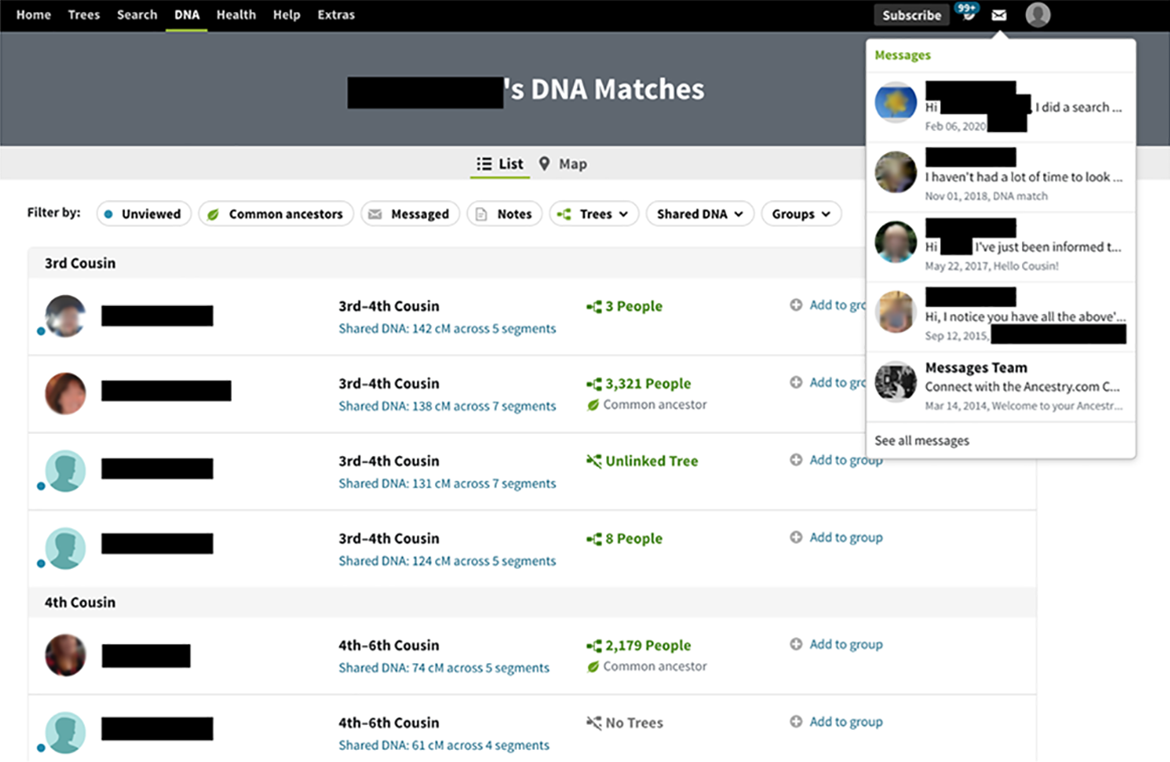
Example list of DNA matches and instant messaging service, AncestryDNA. Source: https://www.ancestry.com, downloaded on January 2021.
The AASIG members shared numerous examples of how DNA relative-matching tools had helped their research. Some were methodically collecting uniparental DNA data from potential living relatives and testing for matches in the hopes of reconstructing the kinship networks of ancestors separated from their families generations ago, for instance, through slave auctions and plantation sales or during the Civil War or Great Migrations of the early 20th century. Others were working through the lists of autosomal genetic matches, contacting “DNA cousins” via direct messages and working with those who responded to identify their common ancestor. Many had been matched to other African American genealogists, who became friends and cousins through this collaborative kinship work. According to Frank—a retired engineer who began researching his ancestry in the early 1960s—finding a DNA match with another African American who came from a similar part of the country could be considered familiar terrain: “you know you have a common experience—you know that you have been through the same things. You are part of the family, you have a common heritage.”
Yet, the genealogists explained that their research obliged them to look at all relationships, including their links to families who enslaved their ancestors. In this respect, genealogy can lead African Americans to confront forms of secret keeping and strategic ignorance (Bailey 2007) practiced not only by slaveholders but also by ancestors who experienced enslavement—perhaps in an attempt to preserve their own dignity or protect future generations from carrying the burden of knowledge about the violence they experienced. Several AASIG members recalled that few of their older relatives would ever speak about the past, including slavery. To this day, certain topics—in particular, the interracial sexual relationships that occurred under slavery—remain taboo. As Ellen, an ex-federal government worker, originally from South Carolina, told me: “a lot of [African Americans] don’t want to accept the fact that there were all kinds of relations going on, and…your grandmother, your great-grandfather may have had some European blood.” Uncovering evidence of these relations, and coming face-to-face with documents in which their ancestors were listed as “property for sale,” never ceased to be painful and emotionally affecting for the genealogists. Yet, in Ellen’s words, it also made them understand that “all kinds of relationships existed through slavery.” Making more people aware of this truth, she believed, was one of the potential benefits of DNA testing for US society: “it will be able to…show actual proof of our connections to the descendants of other slaveowners.…Sometimes they don’t necessarily want to accept that, but DNA will prove it.”
DNA Does Not Lie
Ellen’s claim seemed to have been borne out in spectacular fashion in the experience of Nancy, a retired electronics technician who had been studying her family’s history for over five decades. For many years, Nancy had oriented her genealogical investigations using the names and locations she recalled from her grandmother’s childhood stories. Her searches had brought to light some illustrious black ancestors, including a man credited with writing the popular spiritual “Go Down Moses,” and a distant relation to Harriet Tubman. Nancy also recalled her grandmother speaking of the family’s connection to some eminent white ancestors, and her insistence that their family was distantly related to Mary Stuart, Queen of Scots. Nancy, though, had never discovered the precise connection and was unsure of the story’s authenticity.
By the early 2000s, Nancy had begun to build her family tree on Ancestry.com. At this point, she had managed to trace certain branches of her genealogy back to the 1600s to the early years of British colonial settlement in Maryland. When Ancestry began trialing its new DNA product, Nancy was offered a free test. A few weeks after submitting her DNA sample, she received a message from another client, who had been linked to Nancy via the DNA matches feature and believed she had identified their common ancestor. After accepting the invitation to link the two genealogies online, Nancy began to see whole new lineages appearing on her family tree, including some branches bearing the surnames of French and British noble families and others extending back as far as the 10th century. Describing that moment, Nancy said: “and bam! It hit me!…All these royal families start popping out, and I’m going, ‘oh my God, [my grandmother] was right! Who in the name of God told her all this information?’ Well, I don’t know, but she knew the information.”
Nancy saw her DNA results as a powerful vindication of her grandmother’s stories. A crucial point in her narrative was her description of how the lineages had appeared on her online tree after she accepted the match with the other customer. Alongside the new branches and names came other details, family crests and coats of arms uploaded by other genealogists. These were a source of particular pride to Nancy, who explained, “at one time I was kind of a little skeptic to show people my family tree, but now I’m so proud to show it because I have all of these coats of arms, and I remember…we made up a coat of arms in school, but if I’d have known that I had a coat of arms, as close as it was, I would have took that!”
As well as supporting her grandmother’s assertion that the family had royal British roots, Nancy said the test had allowed her to piece together connections to numerous iconic white American families known for their deeds in the Revolutionary War and the founding of the nation. These links were substantiated by inquiries with other genealogists in her DNA match list, who sent copies of personal records as proof. Acquiring documentation was crucial to Nancy, who explained: “everything that I have, I try to document, because I don’t want anybody coming up and saying ‘this is not happening,’ but now with the DNA I can present it and say ‘DNA does not lie.’”
Nancy’s comments underline how forms of epistemic injustice (Fricker 2007) can operate within slave-descendant families, causing members to doubt the validity of family lore. Genealogists, in general, are trained to be suspicious of “the Gospel According to Aunt Lizzie” (E. S. Mills and Mills 1984, 38), regarding oral traditions as impressionistic at best, until their claims can be validated by firm (usually written) evidence—a condition that descendants of the enslaved cannot always fulfill. Nancy portrayed her DNA test as a powerful tool for reverting this injustice, in turn unlocking other forms of historical evidence that could convince herself, and others, of the truth of her grandmother’s testimony.
The Power of Relations versus Power Relations
Nonetheless, not everyone Nancy had contacted through her DNA matches was as keen to acknowledge their shared roots. Nancy told me she had been in touch with people “on both sides” of her genealogy—meaning both black and white relatives—and when I asked whether all of them were receptive to her messages, she replied: “some of them respond and some are happy to, and some of them just don’t—once they find out that you’re African American they don’t want anything to do with you.…I guess what happens is they’re a little afraid. This is something new. This is breaking new ground. But, and like they shouldn’t be, because we’re all one family anyway.”
The experience of DNA matches not replying to messages is a bugbear for many genetic genealogists (Collier 2018). Some of the AASIG members admitted they were guilty of this themselves—for instance, one genealogist told me that she had received several messages via her 23andMe account but had not responded because she felt she had no useful information to share at that point. Nonetheless, the frequency of this experience with regard to white test-takers hints at a silence that is not merely incidental but systemic. Frank, too, had mixed success with trying to contact white Americans in his DNA match list. Some ceased responding to messages once the topic of slavery came up. Others, Frank suspected, simply did not reply to members whom they believed to be African American. He explained that it is sometimes possible to guess test-takers’ ethnic or racial backgrounds from looking at their online profiles, which can include photographs of users or their uniparental haplogroup information. Anyone with rudimentary knowledge of genetic genealogical principles will recognize, for example, that a lineage belonging to mtDNA haplogroup L indicates the person has African matrilineal origins. When I asked Frank why he thought some white test-takers might not respond to messages from African Americans, he replied: “a lot of the Caucasian [users] may have had African DNA someplace along their family line, they don’t want to have that made public…they [want to] maintain the image of being 100 percent Caucasian.”
Frank’s assertion accurately fits the behaviors described by Panofsky and Donovan (2019) in their study of reactions to DNA admixture results among members of an online white nationalist forum, Stormfront. The researchers found that non-European (in particular African) genetic ancestries posed a serious dilemma for Stormfront members, who used numerous strategies to try and diminish the credibility of such results. Yet not all those who refuse to engage with African American DNA matches can be white nationalists. Another possibility is that some come from families in which it is known or suspected that a light-skinned black ancestor “passed for white,” a risky and socially costly process that effectively involved cutting ties with one’s black kin, and living with the fear of being discovered as “not white.” Even today, confronting these secrets may be seen as too painful and divisive for such families to contemplate (Kennedy 2001).
Conversely, there is evidence that among liberal-minded whites the idea of discovering some “nonwhite” ancestry is increasingly perceived as a way of adding “spice” to a racial identity that many experience as “dull” or undesirable. In their interviews with DNA admixture test-takers, Roth and Ivemark (2018) encountered participants who originally identified as white but who used their DNA data to embrace a new black identity—although they did not necessarily share this knowledge among all relatives and acquaintances. Rather than provoking new forms of racial consciousness and self-reflection, Roth and Ivemark see admixture tests as presenting some white test-takers with an “opportunity to internalize a costless exoticism without having to experience the social consequences of visible, embodied nonwhiteness” (Roth and Ivemark 2018, 175). “In this way,” they conclude, “genetic ancestry testing can reinforce race privilege amongst those who already experience it” (Roth and Ivemark 2018, 178).
The desirability of “nonwhite” DNA admixture proportions for some white individuals may lie in the fact that these data are sold by faceless companies, usually without historical contextualization and can therefore be tried on at will without invoking ties to an embodied ethnic community. Genetic relative matching is different, because it brings users into contact with individuals who may seek to understand the exact nature of their genealogical connection: when did it arise, by whom, and how? As Frank suggested, for some white test-takers, the least risky option may be to simply not engage with those they assume are black, to avoid addressing these uncomfortable questions. In some cases, however, systemic ignorance toward histories of slavery and processes of racialization can prevent individuals from even regarding these matches as genuine: hence, some black genealogists report white test-takers responding to their messages, only to say, “I just don’t see how we can be related because I am white” (Collier 2018). Building on Fricker’s (2007) theory of epistemic injustice, Medina (2013) has argued that inhabiting positions of structural power (e.g., whiteness) often leads individuals into behaviors of epistemic laziness: it affords the privilege of “not needing to know” about histories of racism and injustice. In turn, this epistemic laziness draws its power from broader projects of ignorance, rooted in forms of systemic closed-mindedness: a “needing not to know” that acts as a defense mechanism to preserve privilege. These responses can therefore be seen as proof of the historical efficacy of the color line as a project for concealing interracial kinship links rooted in slavery, by turning these into “blind spots…not just areas of epistemic neglect, but areas of an intense but negative cognitive attention, areas of epistemic hiding—experiences, perspectives, or aspects of social life that require an enormous amount of effort to be hidden and ignored” (Medina 2013, 34). Read through the lens of US racial logic, these genetic matches become a paradox—more readily accepted as a technical fault than as “true” kinship information.
Genealogy as Affective Labor
Despite these obstacles, a small but increasing number of white and slaveholder-descendant individuals are choosing to connect in different ways with African American genealogists. One of the first people I interviewed for my study was Bernice Bennett, a member of the AASIG who responded to an announcement I posted on social media in 2012. One of the most remarkable experiences of Bennett’s own research was when a white slaveholder-descendant genealogist contacted her in 2004 to provide access to key documents that allowed Bennett to trace the lives and identities of her great-great-grandparents (Bennett 2012a, 2012b; MyHeritage 2021). Since then, Bennett has authored two books about her own genealogical research, and she is the host of a BlogTalkRadio show, “Research at the National Archives and Beyond,” in which she regularly interviews expert historians and genealogists about the challenges of researching genealogies linked to slavery.
In a recent episode, Cheri Hudson Passey—a white genealogist descended from a slaveholding family—described her decision to publish online the names of individuals enslaved by her ancestors in the hope that they would be found by black genealogists researching their family histories (Bennett 2020). Hudson Passey has also taken the step of publicly adding the names of enslaved individuals who were fathered by white relatives to her online family tree—something she said she is aware many other slaveholder descendants prefer not to do out of embarrassment or fear that they may be approached by descendants of the enslaved in pursuit of reparations (Bennett’s response: “no—[we] want the records!”). In their conversation, Bennett and Hudson Passey outlined the delicacy and affective labor required to navigate these interactions: while some slaveholder descendants may feel gratified by the sense of being able to “reconnect” and “give back” to the families of those wronged by their ancestors, for their part descendants of the enslaved may not wish to (re)establish an active kinship relationship and may resent being made to feel indebted for the “gift” of access to their ancestors’ records. Uploading documents to dedicated open-access online repositories such as AfriGeneas 1 was one solution suggested by Bennett, which can help level the epistemic inequities between slave and slaveholder descendants without reproducing this power dynamic. Similarly, to this end, initiatives like the Beyond Kin Project (BKP) 2 offer instructions for genealogists to gather and digitize slaveholding family archives, so that these data can be added to publicly accessible online genealogical trees. The BKP’s founders (Donna Cox Baker, a white genealogist descended from a slaveholding family, and Frazine K. Taylor, an African American genealogist) clarify that this work need not be exclusively relegated to the descendants of slaveholders: volunteers are encouraged to “adopt” a plantation archive, as a way of contributing to this collaborative effort to piece together the lives of the enslaved.
At various points in the interview, Hudson Passey described how her personal feelings of “outrage,” “disbelief,” and “embarrassment” at finding lists of the names of people enslaved by her ancestors were counteracted by the “joy…of finding a document that I could share with people” and her conviction that “as a genealogist, I want the truth out about my family tree.” Truth-telling and knowledge-sharing are crucial to the ethos of genealogical research communities and can potentially act as an antidote to the paralyzing feelings of shame that can otherwise lead white individuals to cover up their slaveholding links, as in Affleck’s case. For this reason, genetic and genealogical techniques have been espoused by antiracist organizations as methods for fostering interracial dialogues around histories of slavery, in which all voices are heard equally. One such organization, Coming to the Table (CTTT), was founded in 2006 by a group of slave and slaveholder descendants, including DNA-matched descendants of Sally Hemings and Thomas Jefferson. It consists of a nationwide network of groups that meets regularly “for truth-telling, building relationships, healing, and taking action to dismantle inequitable systems and structures based on ‘race.’” 3 One of CTTT’s central missions is to provide forums for discussions among “linked descendants”—people connected through slavery and its legacies, who are “related through ownership, kinship or violence.” 4 This broad definition of relatedness—which is similar to the “beyond kin” concept mobilized by the BKP—takes into account not only bonds of blood but also ties of place and experience forged by slavery. The word “linked” thus defies the racializing logic of the color line, conveying a sense of a common origin and history that demands mutual recognition and continuing bonds of obligation, of the kind usually reserved for kin. In this sense, regardless of one’s genetic ancestry, slavery can rightly be seen as “the family secret of America” (Rushdy 2001, 2), whose legacies and memories should not be borne exclusively by those who identify as descendants of the enslaved. As Jill Strauss, an expert in conflict resolution who has worked with CTTT since 2014, explains: “in our conversations, we want to move beyond guilt, shame, and blame to imagine possibilities that could break open the many facets of our national story, acknowledge each other’s respective truth(s), and heal. Perhaps we can even find a collective meaning in our shared legacy” (Ford and Strauss 2019, 227).
Concluding Remarks: Toward the Refusal of Ignorance
In his foundational essay on agnotology, Proctor (2008) noted that “ignorance, like knowledge, has a political geography, prompting us to ask: Who knows not? And why not? Where is there ignorance and why?” (p. 6). In this article, I have explored what happens when the spread of online genetic-genealogical networks encroaches on political geographies of ignorance cultivated historically to preserve systems of white supremacy by obscuring white family links to the economic exploitation and racial and sexual violence of slavery. In particular, I asked whether genetic-genealogical techniques could help revert the racialized epistemic inequities between slave and slaveholder descendants, by inducing the latter to respond to the former’s kinship claims and give access to genealogical data that could help reconstruct the linkages between their family histories.
In my interviews with the AASIG members, I repeatedly heard the claim that genetic testing would force white individuals to recognize these shared genealogies because “DNA does not lie.” Yet, as Aas (2006) has signaled, the clues encoded in DNA cannot speak for themselves: translating genetic codes into social truths requires contextual knowledge, and such processes can be frustrated by historically constructed regimes of ignorance whose aim has been to produce racial schisms between people who would otherwise be understood as biological kin. While DNA admixture tests have the potential to belie myths of “racial purity,” and genetic relative matches can reveal lateral biological kinship links omitted from family lore, this knowledge must be excavated and extracted against the grain of what we think we know—and what we have preferred not to know—about slavery.
Moreover, those who assert the power of DNA technologies to uncover even the best-kept family secrets may fail to anticipate the resilience of white ignorance as a mechanism for preserving privilege. The most effective avoidance strategy is not taking a DNA test, which is likely the recourse of many families who are aware of their slaveholding past and prefer not to make it public. For those who do use these technologies, there remain numerous ways to avoid receiving unwelcome kinship knowledge—from not replying to DNA matches to doubting the veracity of the genetic data. There is also a danger that existing epistemic inequities may be reproduced rather than leveled out by these networks. In the past seven years, numerous DNA ancestry-testing companies have changed their privacy policies so that clients are now required to opt in to these services, a decision one company described as supporting “customer choice and empowerment through data” (Estes 2014). This is a thorny issue, and there are clearly important cases to be made for strengthening customers’ rights to data control and privacy. Nevertheless, the “opt-in” clauses have been criticized by genealogists and adoptee rights advocates, who argue that whereas the previous privacy setting favored (or even enforced) openness and data-sharing, this new adjustment requires individuals who may unknowingly hold key genealogical knowledge to actively choose to share their genetic profiles in order for seekers of this knowledge to benefit from it. As Cowley (2016) has argued in an analogous discussion about the “right to know” in genetic testing for medical conditions, the power differential between those requesting and withholding genetic information means that such decisions may not simply be thought of as free, individual choices, but necessarily invoke moral questions of one’s responsibility toward other people who stand to be affected by this knowledge. With regard to the present discussion, privileging the customer’s personal privacy by allowing them by default not to share kinship information with other users is likely to perpetuate current epistemic inequities between slave and slaveholder descendants.
Yet DNA testing, of course, is not the only gateway to genealogical knowledge about slavery. The creation of online repositories and data digitizing projects are also helping make slaveholding archives more freely accessible without the need for direct interactions between slave and slaveholder descendants. At the same time, I have underlined in this paper that challenging white ignorance requires more than technological solutions. The obstacles to white individuals acknowledging their possible genealogical connections to histories of slavery, or to recognizing their complicity, more broadly, in contemporary systems of racial oppression, include intense affective reactions of shame and fear about how this information might be seen to reflect on one’s personal character. These reactions are rooted in powerful racial fictions about the inherent goodness and innocence of whiteness, which require broader, sustained cultural work to dismantle, of the kind undertaken by racial healing projects like CTTT. Meanwhile, the experiences of genealogists (including both slave and slaveholder descendants) who have decided to make public their family connections to slavery suggest that a communal ethos that underscores the moral and social value of data-sharing—whether envisaged as a “gift” to other like-minded genealogists or more specifically as a form of reparation for past injustices—can be an important aid for refusing ignorance.
Footnotes
Acknowledgments
I would like to express my sincere thanks to Nancy, Frank, Ellen, Bernice, and the other members of the African American Special Interest Group for sharing their valuable insights and research experiences with me. An early version of this paper was presented at the workshop “The ‘Good Society’ in the Genomic Body? Ethics and Politics of Emerging Technologies for Human Identification,” organized by Helena Machado and Matthias Wienroth with support from the EXCHANGE project. The paper benefited greatly from the generous comments and suggestions of the workshop participants, as well as from additional feedback by Rafaela Granja, Bernice Bennett, and two anonymous peer reviewers. I would also like to thank Katie Vann and the editorial team at ST&HV for their help and guidance during the publication of the manuscript.
Declaration of Conflicting Interests
The author(s) declared no potential conflicts of interest with respect to the research, authorship, and/or publication of this article.
Funding
The author(s) disclosed receipt of the following financial support for the research, authorship, and/or publication of this article: The fieldwork for this study was carried out through the EUROTAST project, a Marie Skłodowska-Curie International Training Network, funded by the European Union under the Seventh Framework Programme (grant no. 290344). This article was developed through the CitiGen project, which received support from Humanities in the European Research Area under the European Union’s Horizon 2020 research and innovation program (grant no. 649307). I received additional funding during the final writing stage through the British Academy’s Postdoctoral Fellowship program.
