



Abstract
While recent science and technology studies literature focuses on “projectification” and its felt tensions for researchers, a surprising scarcity of empirical work addresses experiences at the “other end,” such as funding bodies often held “responsible” for tensions encountered by researchers. Actors in funding bodies experience similar tensions, however. While projectification necessitates predictability and individual project objectives, research funding is also increasingly organized in networks promoting local experimentation. Moreover, funding bodies are part of a system of accountability in which investments are legitimized politically in often reductionist ways. We argue for the salience of more detailed empirical investigations into the work of funding bodies as they navigate these tensions. We apply a dramaturgical perspective to investigate the “staging work” of program committees responsible for the management of funded programs, identifying three forms of staging work: setting the scene, temporal narration, and signifying success. All come with discursive, material, and symbolic dimensions. We develop the notion “adaptive coherence” to show how the program committee sought to maintain the coherence of the overall program despite continuous risks of fragmentation due to projectification, local experimentation, and divergence in interests. “Adaptive coherence” proves productive in incorporating the temporal and spatial dimensions of staging work in networked contexts.
Introduction
The governance of science has historically been a topic of interest in the field of science and technology studies (STS) (Mirowski 2018; Holloway 2015). Recent work centered on the ubiquity of the “project” as the “basic organizing principle” (Felt 2017) of science governance, with increasing emphasis on the effects of this “projectification” on the lived realities of researchers (Penkler, Felder, and Felt 2020). Considering that the project format is not merely a technical organizational tool, but […] “challenges and reshapes research practices and ideals” (Ylijoki 2016, 7), various scholars investigated emerging tensions between the predictability and instrumental orientation of projects and notions more traditionally associated with science, such as academic freedom, creativity, uncertainty, and indeterminacy (Torka 2018; Fowler, Lindahl, and Sköld 2015).
Although the effects of projectification as a preferred mode of science governance have been well studied from the perspective of researchers (Torka 2018; Fowler, Lindahl, and Sköld 2015; Felt 2017; Sigl 2016; Fochler, Felt, and Müller 2016; Bal 2017; Rushforth, Franssen, and de Rijcke 2019), there has been a surprising scarcity of empirical work in STS that addresses the experiences at the “other end” of the spectrum, such as the funding bodies often held “responsible” for the tensions encountered by researchers. While existing literature in science policy studies does examine the position of research councils and funding agencies, most of this work approaches such agencies from principal–agent theory that works from an assumption of rational choice (Guston, 2001; Braun and Guston 2003) or provides a more abstract framework to conceptualize the institutionalization of science–government relations (Van der Meulen 1998).
While the consequences and tensions of projectification for researchers are scrutinized, the role of funding agencies is thus often taken for granted or only analyzed in an abstract way, without empirical attention to particular processes of sense-making “in action” (Shove 2003). If any, the role of funding agencies is implicitly presented as the cause of tensions experienced by researchers. This paucity of empirical work into the concrete activities and actions of funding agencies is surprising, as one could argue that actors in funding agencies are likely to experience tensions that are at least partially similar to researchers working in institutional settings with conflicting demands (cf. Parker and Crona 2012; Moellers 2016). Indeed, literature that addresses the projectification of policy and the public sector in more general terms discusses tensions comparable to those of researchers at the level of program development and funding. Examples include the tension between delegating responsibility for policy outcomes from the national policy level to regional and local levels of implementation while striving to remain in control of program development, and the tension between reducing complexity and clarifying concrete program outcomes while maintaining capacity and flexibility to work within collaborative structures and coordinate policy development (Hodgson et al. 2019).
While the trend of projectification necessitates predictability and operationalization of individual project objectives, research funding is also increasingly organized in terms of networked programs and collective consortia that promote local experimentation and deviation from planned objectives as a raison d’être for innovation (Sabel and Zeitlin 2012; Provan and Kenis 2008; Currie, Finn, and Martin 2007; Martin, Currie, and Finn 2008). This tension between predictability of individual research projects and collective experimentation 1 in networks is further aggravated by the fact that funding agencies are part of a broader system of accountability in which investments in research programs have to be evaluated and legitimized politically in rigorous and often reductionist ways (Dahler-Larsen 2011; Power 1997). These tensions between predictability and experimentation have also been highlighted in studies investigating the political dimensions of policy experiments (Nair and Howlett 2016), the strategic use of pilot programs and their evaluations in policy (Ettelt, Mays, and Allen 2015), and the dynamic and complex interactions between policy objectives, pilot programs, and local implementers (as the broadly formulated goals of pilot programs become susceptible to emerging interest coalitions at the regional level; Bailey et al. 2017).
We contend that a key site where the tensions between projectification, experimentation, and evaluation play out is at the level of operational governance where actors are made responsible for the management of funded programs, such as program committees. These committees are key actors in science governance, yet remain empirically understudied. In this paper, we therefore argue for the salience of a more detailed empirical investigation of the work conducted by such program committees as they seek to navigate these tensions. The focus on projects (“projectification”) and on networks allowing for variation and experimentation both harbor substantive risks of fragmentation and disintegration of research programs. Simultaneously, the political context of evaluation and legitimation requires programs to maintain coherence and a unified image. Navigating this tension becomes more complicated when taking into account that program committees do not act as impersonal “cogs in the wheels” of a bureaucratic New Public Management machinery but instead need to manage shifting network coalitions (Jones 2018), program goals changing over time (Broer, Bal, and Pickersgill 2017), and divergent program interpretations of various stakeholders with diverging political interests (Broer, Bal, and Pickersgill 2017; Bailey et al. 2017; Shove 2003). Maintaining the coherence of an overall program while avoiding fragmentation and disintegration of the program’s overall goals is therefore a substantive, ongoing task.
In this article, we empirically analyze the work of a transdisciplinary program committee faced with this ongoing task. The program committee we investigated was in charge of the operational governance of one of the largest health research and improvement programs in the Netherlands (€ 80 million), running for a period of eight years (ZonMw 2008). Health research funding in the Netherlands is increasingly organized in local networks with significant room for experimentation, an idea that is often in tension with the simultaneous realities of projectification and rigorous evaluation based on predefined, overall goals (Zuiderent-Jerak et al. 2009; Broer, Bal, and Pickersgill 2017). Many research and improvement programs therefore operate on a fine line between enabling local translations of program goals to specific audiences and simultaneously projecting an image of coherence (Stoopendaal and Bal 2013; Wehrens and Bal 2012). Walking this fine line is far from easy. When giving too much room to local stakeholders, programs risk fragmentation and loss of a publicly recognizable face. When too little room is given, local stakeholders are likely to object to top-down management and uniformity (cf. Torka 2018; Fowler, Lindahl, and Sköld 2015).
We argue that an empirical investigation of the work of program committees reveals how legitimacy and coherence of the overall program are created despite the continuous risk of fragmentation due to projectification, local experimentation, and divergence in stakeholder interests. We draw on the dramaturgical perspective developed by Goffman ([1959] 1971). Using metaphors from theater, Goffman analyzes how individuals create a credible “unified” performance in the eyes of others. Applying his analysis to research and improvement programs in health care, this study provides new insights into how program committees deliberately engage in staging work, that is, determining the main characters in the play, creating a narrative, and mobilizing strategic symbols (cf. Hajer and Versteeg 2005). A dramaturgical analysis allows us to recognize that the coherence of research and improvement programs is not pregiven but discursively enacted: the program becomes credible and coherent through staging work.
In this article, we first describe the added value of a dramaturgical perspective, building on earlier dramaturgical work in STS and interpretative policy studies. After describing our methodological approach, we provide an empirical analysis of the different types of staging work the program committee performed and discuss their effects. We then coin the notion of “adaptive coherence” to explore the temporal and spatial dimensions of staging work. In the discussion, we connect our analysis to broader theoretical discussions on staging work and reflect upon the broader analytical productivity of “adaptive coherence.”
A Dramaturgical Analysis of Staging Work
The work of Erving Goffman has been key in the development of a dramaturgical analysis of social interactions. In The Presentation of the Self in Everyday Life ([1959] 1971), Goffman uses metaphors from theater to guide his analysis of how people present themselves to others in a credible way. In enacting a performance, individuals switch between “the frontstage” where they create an idealized (or professionalized) self to an audience and “the backstage” where they can relax their social façade (Goffman [1959] 1971; Næss, Fjær, and Vabø 2016). Access to the backstage is controlled in order to avoid members of the audience hearing or seeing forms of uncontrolled communication and behavior that could contradict public performance. While Goffman’s original analysis was confined to the physical boundaries of a building or plant, his dramaturgical perspective has been extended to include issues of governance, for example, in relation to the interactions between citizens and officials in city commission proceedings (Futrell 1999) and the role of executive boards in the governance of patient safety (Freeman et al. 2016).
In STS, Goffman’s dramaturgical vocabulary has been utilized to empirically analyze the work of various “boundary organizations” acting as intermediaries between science and policy, internally negotiating different demands while remaining accountable to all stakeholders (Guston 1999, 2001). Such work has been productive in analyzing how science advisory organizations are entangled with policy makers in “boundary configurations” (Van Egmond and Bal 2011), how they are able to maintain scientific authority in a politicized context (Hilgartner 2000; Bijker, Bal, and Hendriks 2009), and how actors involved in such settings strategically enact the classic trope of “science speaking truth to power” to enhance the legitimacy of their work (Wehrens, Bekker, and Bal 2011).
While the dramaturgical concepts developed by Goffman have been put to use most effectively in detailed in situ analyses of performance and staging within particular, relatively delineated contexts (whether these be physical buildings, executive boards, commission proceedings, or advisory organizations), remarkably less analytical attention has been focused on putting these insights to use in relation to multistakeholder interactions in governance networks. 2 A notable exception is the work of Hajer and Versteeg (2005), which also poses the question of how coherence is possible in such networks. We postulate that enacting a coherent performance of an entire program spread across space (multiple regional networks developing their own projects and ideas) and time (as a program developed and delivered within a particular temporal horizon) leads to a different set of considerations compared to maintaining such a coherent performance individually. In order for programs to be considered successful, however, such coherence is a prerequisite. While many evaluation studies take coherence as a given—evaluation assumes coherence because the goal is to come to a judgment about the program as a whole—we argue that program coherence is instead the outcome of continuous work requiring ongoing maintenance. Even though the program is part of a particular “call” for funding, different organizations participate with their own ideas and agenda, and the research projects and network infrastructures that are funded are not necessarily viewed as part of an overall program by local network partners.
Our empirical analysis therefore focuses on understanding how the program committee—as key actor in the operational governance of such programs—seeks to enact and maintain a sense of program coherence despite the continuous risk of fragmentation due to projectification, local experimentation, and divergence in stakeholder interests. We argue that the committee does this by conducting staging work, which we conceptualize as the discursive, material, and symbolic activities that are employed to create and maintain a favorable and coherent impression of the overall program. We argue that staging work in this context acquires a temporal and spatial dimension that is less explicitly considered in traditional dramaturgical analyses. We develop the notion of “adaptive coherence” as a way to incorporate these temporal and spatial dimensions of staging work.
In our analysis of the staging work of the program committee, we build on several tropes of previous dramaturgical work. Our analysis is informed by the interpretative research tradition in the policy sciences via its focus on processes of meaning-making as part of the “impression management” in program governance (Yanow 2006). Building on this, we conceptualize the work and activities of the program committee in producing and coordinating a coherent performance as an exercise in collective sense-making (cf. Rhodes 2007). Moreover, we follow previous STS scholars who argue against viewing front stage performances as problematic attempts at “window-dressing” but instead highlight the crucial and productive role of coordination work between the front and back stage in meeting multiple requirements, such as scientific quality and policy relevance (cf. Bijker, Bal, and Hendriks 2009; Hilgartner 2000). In line with this more “constructive” take on performance management, we conceptualize the crafting of a coherent narrative as a way of “caring for” the program (cf. Davies and Horst 2015). Understanding program governance as a form of care, or “attentive experimentation” (Mol, Moser, and Pols 2010, 13), allows us to move away from a technicist understanding of program governance as a rational, bureaucratic exercise.
Our analysis investigates the different forms of staging work the program committee engages in, the consequences of these forms of staging work, and the conditions under which staging work can be considered “successful.”
Method
Our analysis is based on qualitative research of the National Program of Elderly Care (NPEC: 2008–2016). The NPEC was funded through the Ministry of Health, Welfare and Sports, who commissioned the Netherlands Organisation for Health Research and Development (ZonMw in Dutch) to further monitor and manage progress. As part of the program, eight regional networks were established with various stakeholders in each network (medical research departments, elderly associations, regional care and welfare organizations, and patient associations).
A national, transdisciplinary program committee was established by the funding body to oversee the operational governance of the program. Figure 1 provides a schematic overview of the program.
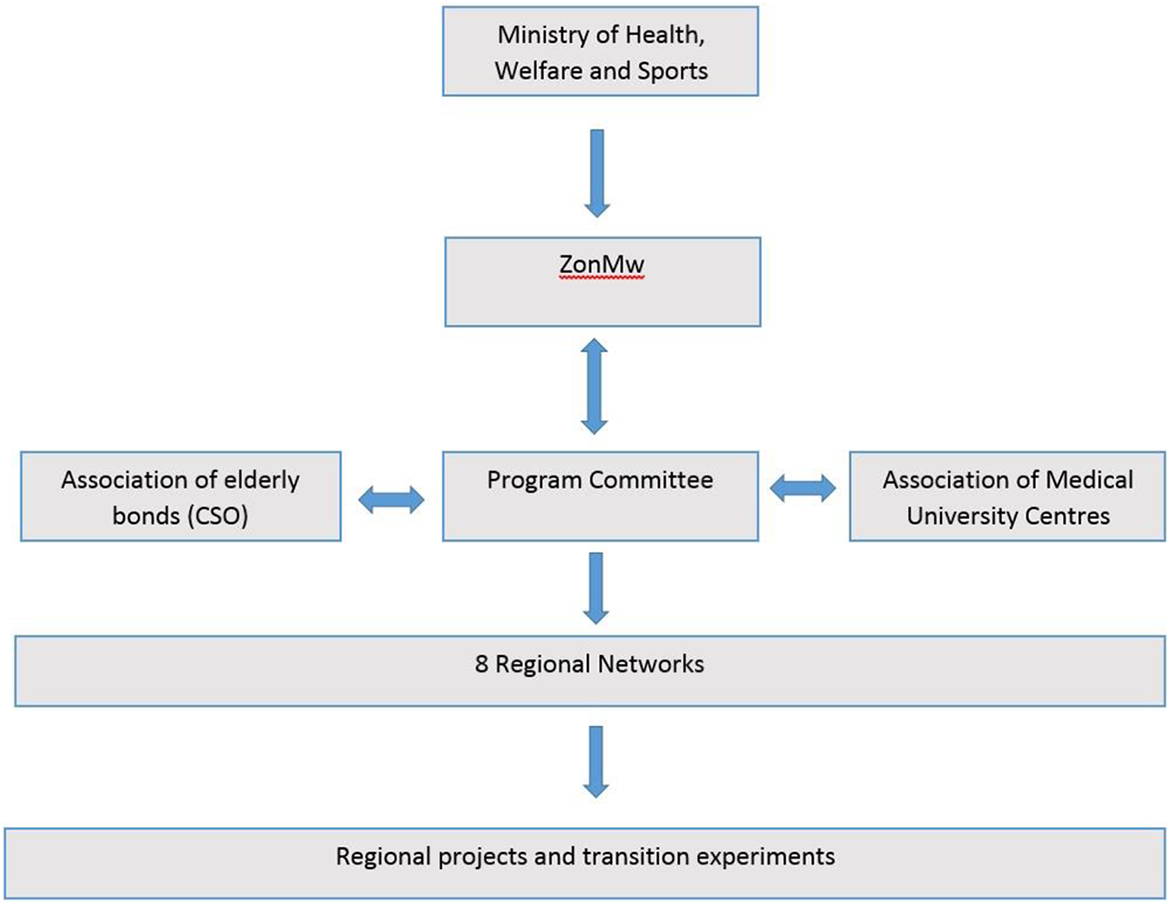
Schematic overview of the National Program of Elderly Care.
The program committee had a crucial yet complicated role in the overall program. It acted as a liaison between the funding organization (whom it represented), the Ministry (to whom it was accountable in the end), and the regional networks (for whom it served as first contact point and mediator). The committee also exchanged ideas with an association of elderly organizations and the Association of Medical University Centers, both important stakeholders in the overall program.
The committee consisted of fifteen to twenty members (numbers differed slightly over the eight-year course of the program) with expertise in research, policy, and health care (ranging from retired medical professors to key stakeholders of elderly associations). They shared a high public profile and large network. The program committee met about eight times a year and had a broad mandate, which included developing evaluation criteria for projects funded in different calls during the program, monitoring developments in the eight regional networks, conducting yearly site visits, streamlining communication, and keeping track of the overall program.
We were commissioned by ZonMw to evaluate the NPEC. We conducted fifty-three semistructured interviews with sixty-three respondents (50–150 minutes per interview, 90 minutes average). We interviewed different stakeholders, both on national and regional levels. On the national level, respondents included program committee members, representatives of elderly associations and medical associations, and national policy makers at the Ministry of Health and the funding agency. The program committee comprised actors from different backgrounds—medical researchers, elderly representatives, actors from the domain of welfare, policy makers, and liaisons from the funding agency. On the regional level, we interviewed at least three actors in each regional network: the network leader, the coordinator, researchers, and one or more members of the target group panels. All interviews were transcribed verbatim. A more detailed methodological account can be found in Wehrens et al. (2017).
As researchers officially involved in the program evaluation, we had access to the large digital archive of the funding agency, containing thousands of documents. We were allowed to study the documentation related to NPEC and the activities of the program committee. Surprised by the extent and the meticulous character of this documentation, we focused on the role of such detailed and ongoing documentation in managing a complex and diversified program like the NPEC. We systematically explored the archive in order to identify key documents, such as program texts, progress reports of networks, newsletters about NPEC, vision documents, preparatory documents for conferences, and minutes of meetings of the program committee. Documents were analyzed with regard to how particular messages were crafted, specific narratives enacted, and particular events staged.
We used the notion of “staging work” as a “sensitizing concept” to interpret the material (Blumer 1954). Based on the analysis, we inductively subcoded three different forms of staging work: “setting the scene,” “temporal narration,” and “signifying success.” The data analysis is further strengthened by data triangulation of documents with interview transcripts. The data analysis was conducted by the first two researchers and discussed among all authors.
Results: Different Forms of Staging Work
Adapting Goffman’s framework, we use the notion of “staging work” to analyze the program committee’s activities in enacting program coherence, while it is continuously at risk of fragmentation into a plethora of unconnected localized activities and projects. As our analysis shows, staging work not only has a discursive but also a material and symbolic dimension. In the next sections, we outline three forms of staging work: setting the scene, temporal narration, and signifying success. In text box 1, we summarize the overall “narrative” of the program, providing an overview of the development and changes made in the program’s direction along the way. This narrative also points out some of the key tensions that played out in the program.
The nation-wide program of the NPEC was commissioned by the Ministry of Health, Welfare, and Sport and ran from 2008 to 2016. The main objective of the NPEC was to promote proactive, integrated healthcare for older adults with complex healthcare needs through regional networks of care providers. All parties involved in (health)care for older adults were welcome to participate in these networks. Networks could apply for a grant to fund projects aimed to improve the quality of care within their region.
A large part of the program budget was used to fund transition experiments aimed to reorganise care in a more integrated matter. These were explicitly meant to move beyond the boundaries of existing legislation and funding. At the same time, various ‘traditional’ siloed funding rounds for research were organized over the course of the program. This allowed research groups to apply for the funding of particular research projects that were envisaged to fit into the overall program aims. Given the high amount of political pressure exerted on the funding agency in the early days of the program to set-up regional networks quickly and to get projects off the ground in a rapid speed (a certain percentage of the budget needed to be attributed in the first year), the first years of the program saw University Medical Centres (UMCs) taking the lead in the development of regional networks and in terms of setting the agenda for research (as they had more capacity for writing proposals). As a consequence, however, many submitted research proposals were driven from a similar medical perspective (e.g. focusing on early detection of medical problems or on validating a particular instrument for measuring ‘frailty’) without including broader lifestyle and welfare issues. The political pressure to quickly start with the program thus led to a range of similar projects in different regions.
The involvement of older adults was also an important aspect of the program. Their problems and wishes had to be the point of departure. Older adults were both regionally and nationally involved in discussions about new projects. On a national level, they were represented in the program committee and in regular strategic meetings between the program committee, the association of medical centres and the association of elderly bonds. On a regional level, a prerequisite to be eligible for funding was the set-up of target group panels in each regional network. Given the heavy time-pressure, the UMCs were made responsible for the development of networks and, consequentially, the set-up of the target group panels. Despite their formal role, many target group representatives increasingly criticized their lack of true involvement as they experienced that their perspective was used instrumentally. Such feelings of exclusion were further strengthened because research proposals initiated bottom-up by target group panels were often not funded by the funding body, which struggled to align these ideas with the accepted procedures of using scientific evaluation criteria to assess the worth of proposals and base funding decisions on this (cf. Oldenhof & Wehrens 2018).
As the program was characterized as a learning program, this provided some flexibility to incorporate gradual changes in focus. In practice, three major changes took place during the program. First, the NPEC more explicitly promoted a stronger connection between care and welfare, deviating from the more medical focus at the start of the program. Second, the implementation and dissemination of best-practices became a more explicit concern, especially when the original time-period of four years was extended with another four years. It gradually became clear that the original time-period would be too short to evaluate the experiments and implement their results in elderly care. Third, during the program there were increased attempts to empower older adults involved in the program via additional training and education projects.
Setting the Scene
The first form of staging work can be labeled setting the scene, referring to the work conducted by the program committee to create a particular context for NPEC as a program to thrive. This was done by prestructuring meetings, identifying symbols, rehearsing particular scripts, and engaging in “stake building” with various potential program partners. Setting the scene is thus a form of staging work that addresses the preparatory work in organizing meetings, symposia and conferences, and especially highlights how such meetings are prestructured, symbolically signified, and meticulously rehearsed. The overall goal of this form of staging work is to avoid a perception of the program as amounting to nothing more than a scattered number of unconnected projects and initiatives.
Symbolic signification
A first aspect of “setting the scene” becomes visible in various activities of symbolic signification: the use of specific symbols or symbolic performances meant to put the spotlight on elements considered to be vitally important to the program. A vivid example of this can be seen in the official program “kick-off,” which involved the symbolic “hand-over” of an 80 million euros check by the former state secretary of the Ministry of Health, Welfare, and Sports (Figure 2).
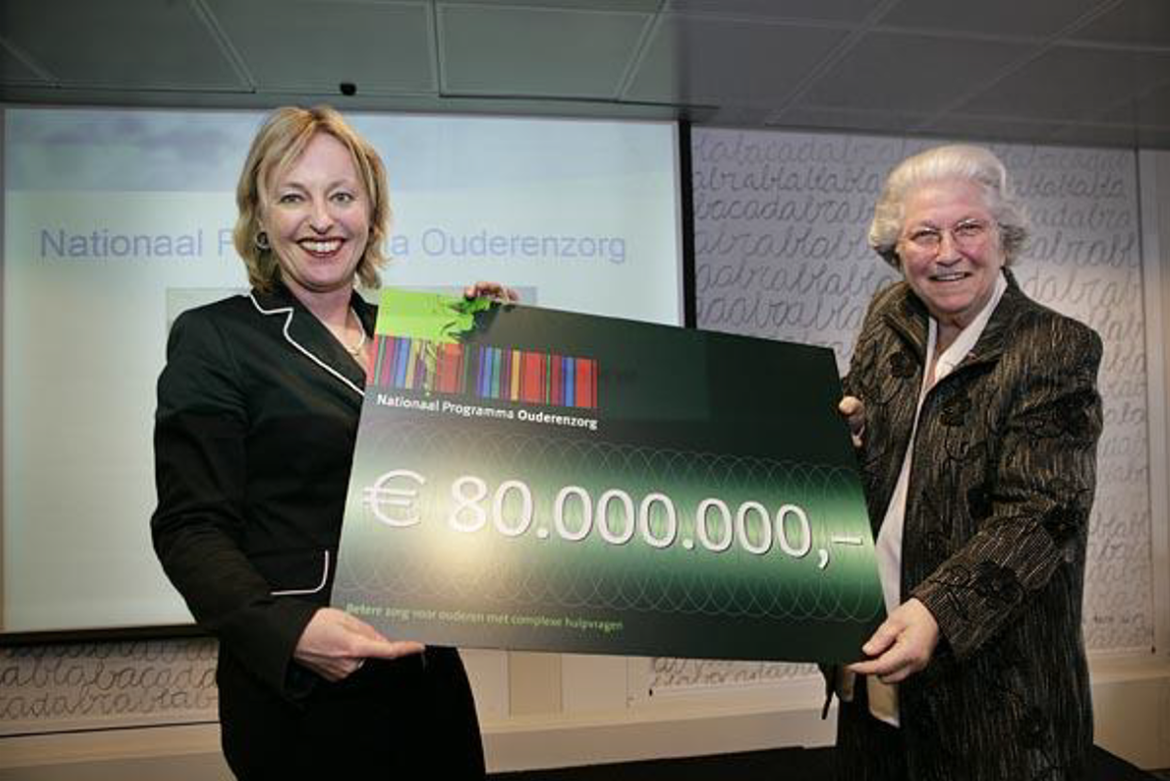
Official kick-off meeting of the NPEC, hand-over of check.
Importantly, the check was handed over to a key representative of older persons in the program committee. As a former politician herself, she enjoyed a high level of respect. In the accompanying speech of the deputy minister, she was described as the “personification of all older persons.” This performance signifies the importance of the perspectives of older persons in the program through symbolically entrusting a representative of this group with the overall program budget. Symbolic signification of this kind was continuously worked on by the program committee. Many of the presentations, information leaflets, and lay-friendly booklets about the program were laced with pictures of positive and vital older persons (Figure 3).

Image of older person representing a participant in a client focus group.
The activities of symbolic signification are also publicly enacted on the “front stage.” This becomes clear from the positioning of older persons at the first row during a large, national conference aimed to showcase the main achievements of the program: 8 older persons from the [regional] networks need to be seated at the first row! Please make sure that they are accompanied to this reserved position when they enter the plenary conference room. […] Please approach the network coordinators to remind them that “their” older person needs to be seated on the first row! (Source: internal preparatory document for NPEC conference)
Rehearsing a performance: Meeting minutiae
A second aspect of “setting the scene” becomes visible in the program committee’s preparation work for meetings. Meeting minutiae refer to the careful and highly detailed preparations of meetings in order to enable a smooth and coherent presentation of the program. Such preparations happened with attentive precision and detailed rehearsals about what aspects of the program should be emphasized or avoided.
This form of staging work became evident in many communication documents developed by the program committee. For instance, one document details the four goals that should be achieved with a national conference: to showcase current and future achievements, to involve and inform external target groups about the results and products, to create commitment with national associations for the implementation and dissemination of the program’s results, and to enthuse potential users to become engaged (Source: Communication and engagement plan, 2013). Another example is the concrete rehearsal of potential critical questions about the program in order to be able to answer such potential questions smoothly during the public performance. An internal communication document, for instance, mentions several critical questions about the program’s relevance and results, such as: “What did you do with the 80 million euros?” and “What does my ninety-two-year-old mother notice from the NPEC?” Especially the rehearsal for the first question is revealing, as this points to an implicit concern of the program committee that the amount of funding for the overall program is considered to be disproportionate in the light of the fragmented set of research projects conducted in different regional networks. The need to “keep the program together” and avoid a public perception of a range of unconnected projects and initiatives is thus related to the relatively high overall budget and the risk of a potential decrease in public and political legitimacy when the results of the individual projects are perceived to not “add up” to validate the financial investments done. The document also details answers that can be given to these questions, including examples and links to relevant websites and booklets.
In their preparations, the program committee often utilized additional expertise from communication agencies or used particular communication and PR tools.
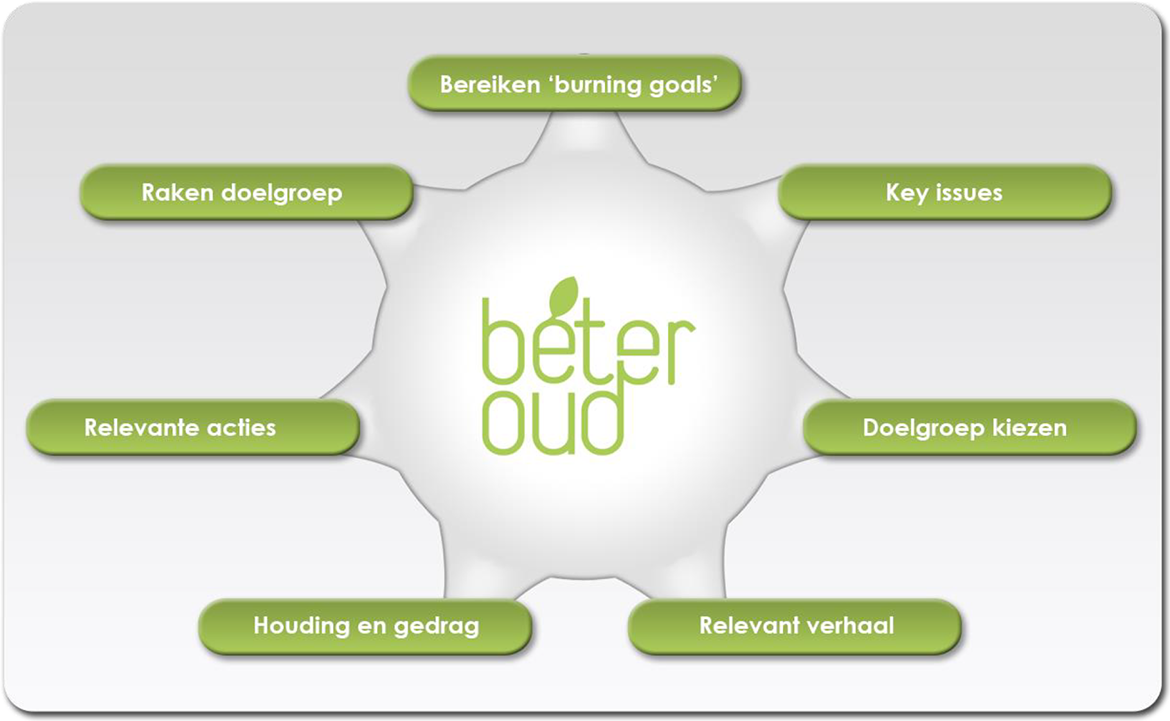
The narrative cycle (Source: Development of central storyline, consultancy firm).
Figure 4 depicts an instrument (the “narrative cycle”) that is used in preparing the “central story” to be told about the program. The instrument discursively divides the complexity and diversity of the overall program into neatly delineated boxes (“burning goals,” “key issues,” “target audience,” “relevant story,” “attitude and behavior,” “relevant actions,” and “affecting the target group”). These are designed to provide the user of the instrument (i.e., program committee members) with a grip on the program’s goals and offers concrete guidance in how to discursively and symbolically “capture” these.
“Stake building”
The third aspect of “setting the scene” is stake building or the detailed attention and heightened sensitivity the program committee maintains in mobilizing key stakeholders and tailoring the program to their specific interests. This is done by extensively mapping all potential stakeholders of the program, anticipating their perspective toward the program, detailing individualized strategies to convince them of the “worth” of the program, and trying to create a “positive vibe” and sense of urgency around the program. Again, communication tools and PR tools are utilized (Figure 5).
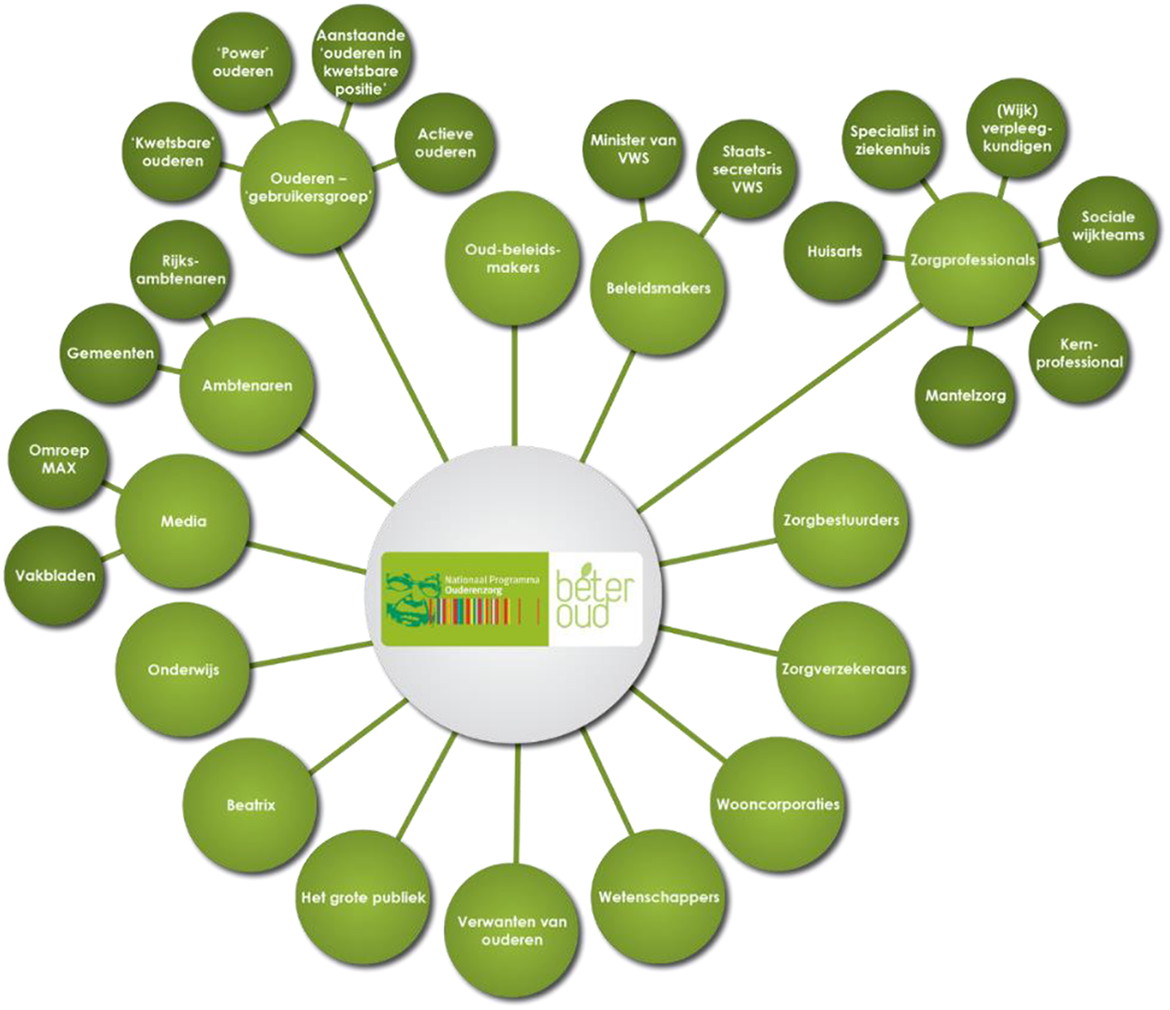
Network analysis tool (Source: Development of central storyline, consultancy firm).
The stakeholder map is introduced with the phrase “whose support do we have to gain?” For each of the stakeholders, the program committee answered a particular set of questions to tailor the program to the different positions of these actors. Examples of questions are as follows: what is [the stakeholder’s] standpoint/agenda/purpose? How do they relate to the achievements of NPEC? What can be their contribution in dissemination and implementation? (Source: Revised plan of action stakeholder analysis NPEC). These examples signify that the program committee is well aware of the work needed to “seduce” these stakeholders into embracing the program. It is also a way of enacting the worth of the program as a whole while drawing strategically on examples of individual projects.
Temporal Narration
A second form of staging work conducted by the program committee can be labeled temporal narration, that is, (re-)writing a temporal narrative in which NPEC occupies a “natural” position in a time line. We identify three closely intertwined elements in “temporal narration”: repositioning the past, prioritizing the present, and positioning the future.
Repositioning the past
Repositioning the past is a form of historical “contexting” (cf. Asdal and Moser 2012) in which the program committee gradually emphasizes the historical “context” of the program as an explanation for some difficulties, such as the experienced lack of scientific value of the overall program as many of the funded transition experiments did not lead to statistically significant improvements of elderly care. By developing a “we came from far” narrative, a “plot” was introduced about how the field of elderly care made significant steps in the years the program ran, showing on the basis of scientific (i.e., biomedical) evidence what works and what doesn’t work, while simultaneously emphasizing that the ambitious goals of the program take time: Look, what is important in evaluating this program is that this [historical] context is forgotten. In [the period during the start of the program] the whole field of elderly research was practically…I won’t say non-existent, but very much a neglected child. […] That does play an important role! […] So, in that regard there was not much infrastructure that enabled the development of research. (Interview program committee member)
Prioritizing the present
Discursively repositioning the historical context of the program is closely aligned with a second element in temporal narration: prioritizing the present. The historical narrative leads to a recognition that while much has been achieved, the present is the crucial period to make sure these achievements are not lost. Much metaphoric work was conducted in this regard; documents and respondents refer to securing the “legacy” and reaping the “harvest” of the program. These metaphors reinforce the historical narrative (much has already been done) and connect this with the need to extend the program in order not to lose what has been developed and to truly reap the benefits of all this work (Figure 6).
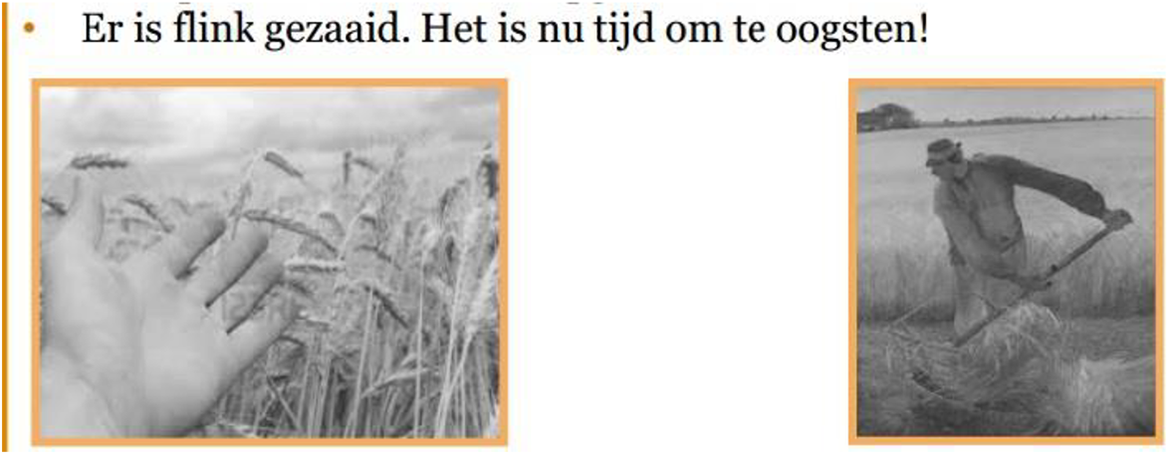
Metaphor about “reaping” the program’s results (Source: “The harvest of the NPEC,” document prepared by consultancy firm as part of assignment by funding agency).
The “harvest” metaphor is used in numerous documents. Other metaphors employed in this regard are “securing the dowry” and “not disturbing the social movement” (that was started with the program). These signal similar but slightly different aspects: whereas “securing the dowry” implies an unambiguous gain that is in danger (and action is needed to prevent this), “not disturbing the movement” invokes a sense of fragility, in which the program is presented as in a critical state of development in need of careful further nourishment (i.e., funding) in order to bloom. Importantly, both metaphors also tie into the importance of current decisions (i.e., prolonging the program) in order to reach expected goals and benefits.
Positioning the future
The third related element in temporal narration is positioning the future. This concerns invoking future imaginaries and presenting the program as the road toward a bright future.
In these discursive efforts, the NPEC gradually became more and more framed as a program for all older persons instead of the narrower category of frail older adults. The program also increasingly becomes positioned as general repository of good practices in elderly care. To this end, the program committee developed a web-based platform (“Ageing Better”) in which all kinds of improvement trajectories (not just NPEC projects) for elderly care could be located. Furthermore, the program gradually became presented not (only) as a research and development program but as a broader social movement aiming for a “paradigm shift” in how (vulnerable) older persons are perceived in society: The NPEC is about [establishing] a joint movement of renewal. It is about working on a regional level towards a reorganization of care for older persons with complex conditions, starting from the needs of older persons themselves, not held back by existing regulation, optimally using the strengths and opportunities within the different domains […]. This calls for more than merely substantive or scientific knowledge, this calls for decision-making authority, leadership and transition and process management. (Source: Interim score NPEC, letter to state secretary)
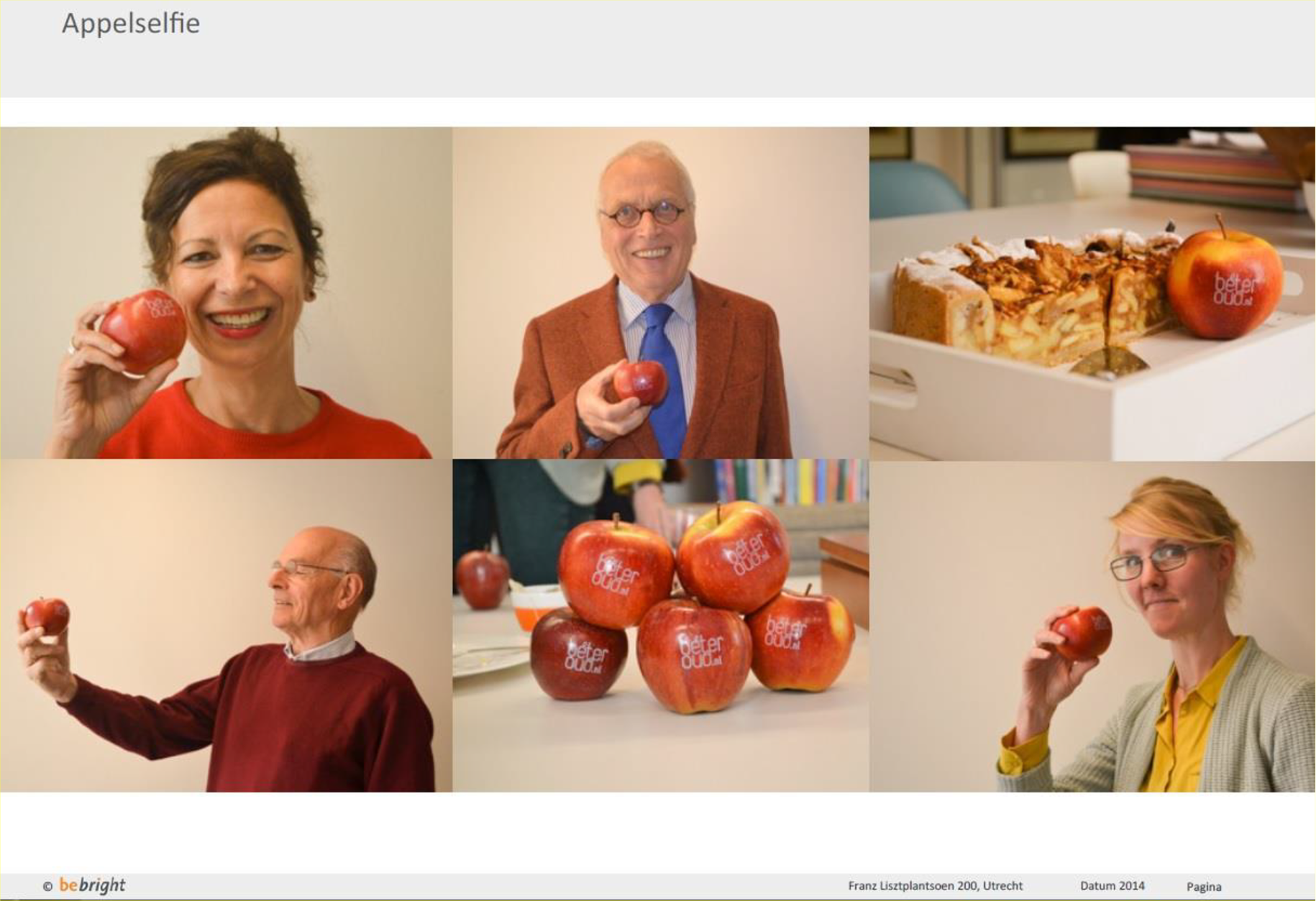
“Ageing Better” apples to raise awareness of change agenda (Source: Document “The apples of Ageing Better”).
The apples attempt to signify the broader agenda of the program and come with an invitation to organizations and associations to “eat an apple” with the ambassadors (i.e., to become involved in the social movement and paradigm shift).
The attempt to achieve a paradigm shift is also presented in terms of a utopian perspective (“spot at the horizon”) in which the NPEC as a whole—notwithstanding the variety and sometimes overlap in funded projects and initiatives in the different regional networks—is discursively reframed as a first step in a much broader future change agenda for elderly care. This was not a trivial thought experiment; the program committee devoted time and money in attempts to develop this agenda and actively sought support from strategic stakeholders to get this agenda embedded in the Dutch health system.
The NPEC thus became discursively positioned as a unique program that functions as a first step toward a completely reinvigorated elderly care in the future (“elderly care 2.0”). The consultancy firm also helped in visualizing this process, again through the use of metaphors (Figure 8).
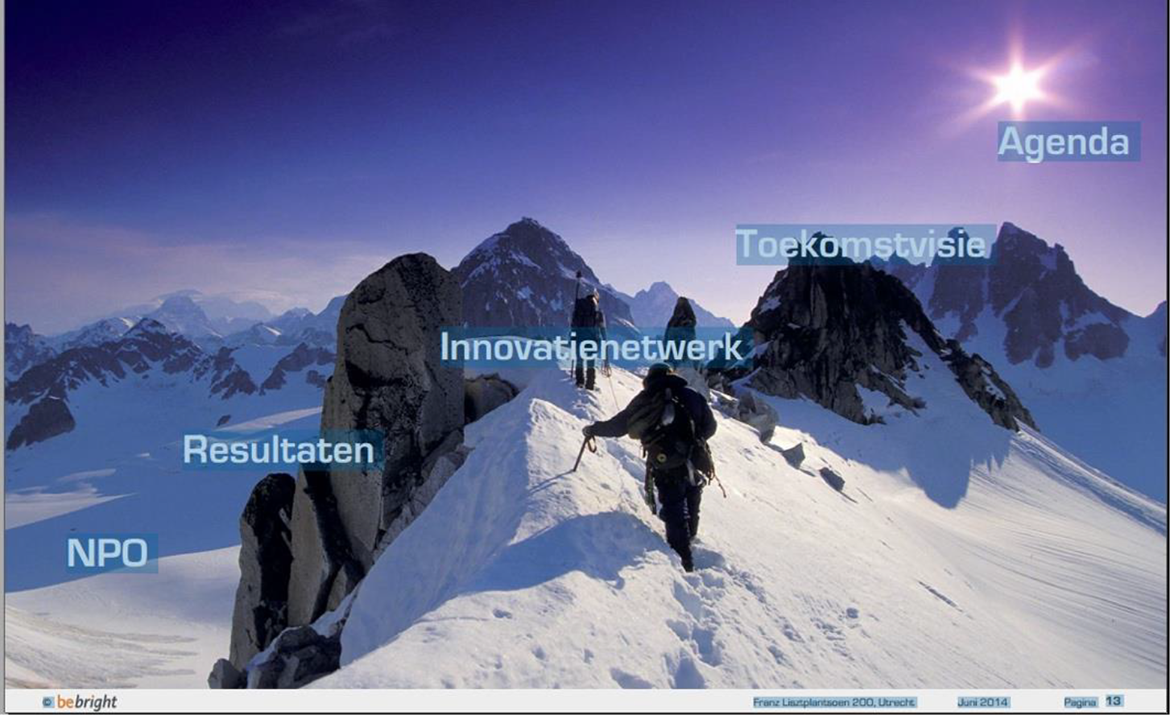
The NPEC as first step toward a bright future for elderly care, visual representation.
The metaphor employed here is that of a “hiking expedition,” signaling not only the deep “valley” that apparently symbolizes the state of elderly care and research at the start of the program but also the progression that has been made and the important steps toward the bright future that still need to be taken (although most hard work appears to be done).
Signifying Success
A third form of staging work relates to how the program committee signifies the success of the program to various audiences. Originally, the success of the overall program was predominantly defined in the scientific terms of quantifiable health improvements (i.e., statistically significant results). This focus emerged from the influential range of decisions made in the first year of the program, leading to a strategically central position of the University Medical Centers (UMCs) and a range of transition experiments with a predominantly medical orientation toward measuring effectiveness of interventions and instruments. As the projects and experiments reached their end, such effects turned out hard to measure. If the success of the projects continued to be measured according to this standard, the overall program would risk being categorized as failure, especially given the amount of money spent. Thus, the program committee increasingly sought alternative ways in which the program’s value could be captured.
Diversifying “worth”
As a first aspect of “signifying success,” the program committee sought to diversify “worth.” Already during the first years of the program, many network participants and older persons pointed to positive experiences with the program and its projects (e.g., increased participation and collaboration) that were not adequately captured in quantitative outcome measures.
3
The program committee sought to incorporate these different values in their narratives of the program’s “success”: The most important achievement of the NPEC so far is the introduction of a new way of working: collaboration in regional networks, above domains like care, welfare and living, in dialogue with older persons and with attention for efficiency. This answers the needs of older persons who want to be in charge, expect tailored care and integration of care, welfare and living. (Source: Vision on future-proof elderly care)
Placing “crown jewels” in the spotlights
As a second aspect of “signifying success,” the program committee labeled several projects “crown jewels” that deserved the spotlight as best practices. These “crown jewels” were perceived as highly successful not because they showed significant results (hardly any projects did), but mostly because professionals and older persons were highly enthusiastic about them. In official documents and presentations, these “crown jewels” were frequently mentioned, leading to the relative neglect of many other projects. This aspect did, however, result in a more coherent overall image of the program as the wide variety of projects and initiatives in the different regions became backgrounded while a handful of projects was rendered synonymous to the overall worth of the program because of their high visibility and consistent use as “best practice.” To scale-up and implement the “crown jewel” projects in other regions, the funding agency organized “learning committees” that would help other regions in translating and adapting these projects to their own environments.
Successful “Staging Work”: Adaptive Coherence
The previous sections outlined three forms of staging work conducted by the program committee as a substantive, ongoing task to maintain an overall image of program coherence while avoiding fragmentation of the program’s overall goals (i.e., the program as a whole losing recognizability and disintegrating into a plethora of unconnected local activities and projects). This section teases out in more detail the consequences of staging work and ties this specifically to the risks of fragmentation.
When can we consider staging work to be successful? We argue that successful staging work achieves adaptive coherence, that is, the performance of a program that is able to tailor to interests of network partners, while simultaneously maintaining a recognizable whole spatially (across sites) and temporally (over time). This implies that we view (program) coherence as an outcome of continuous work instead of assuming that such program coherence is given. When not carefully maintained and meticulously articulated, program coherence risks disintegration. As we described in the analysis above, the overall program is continuously at risk of fragmentation: the variety of regional networks and research-driven projects can make it hard to find a common thread that links all the initiatives together, which could lead to a public perception of the program as amounting to nothing more than a scattered number of unconnected projects and initiatives whose overall results do not “add up” sufficiently to warrant the disproportionate financial investments made. Consequentially, unsuccessful staging work is likely to end in fragmentation.
Our analysis highlights two examples of staging work that contributed to adaptive coherence. First, the enactment of a particular temporal narrative turned out convincing to most stakeholders. This can be explained through the consistency and persistence with which this temporal narrative was enacted at various locations and in various documents, while allowing space for various actors to interpret this narrative in their own terms and for their own purposes. Thus, the plot line that depicted the domain of elderly care and research as highly underdeveloped at the start of the program (and consequentially positioned the experiments and projects in the program as pioneering work) served not only the agenda of the funding agency but also the agenda of the researchers involved, as it allowed them to account for the disappointing scientific results. The work of temporal narration thus helped to build adaptive coherence in the sense that the program maintained a recognizable whole temporally (as an attempt at pioneering in an underdeveloped domain) and spatially (pioneering is what all regional networks share).
A second example of successful staging work leading to adaptive coherence is in the engagement of new stakeholders that embrace the broadening of the original program toward a more general repository of good practices in elderly care. Although the program officially ended in 2016, the website www.beteroud.nl has been taken up by new stakeholders, such as Movisie (a national knowledge institute in the social domain) and Vilans (the national Centre of Expertise for Long-term Care). It also incorporates a much broader range of initiatives, including a database of interventions and learning communities. At the same time, the platform retains coherence with past achievements and original goals of the NPEC (NPEC being explicitly mentioned as a precursor of the platform). The link between program and platform has been symbolically reaffirmed via a press conference in which the Deputy Minister hands over the care for the achievements of the program to the platform: Stakeholders unite in Ageing Better to improve quality of life of elderly. (Source: Press release Ageing Better, November 30, 2016) The National Program for Elderly Care of ZonMw continues in the consortium Ageing Better. Multiple organizations from the sectors of housing, welfare and care have committed themselves to the consortium Ageing Better. With this the stakeholders continue the movement that was started by the NPEC. […] Deputy Minister Martin van Rijn of the Ministry of Health, Welfare and Sports today accompanied the festive transferal during the conference “A new generation of elderly (care).” (Source: Press release Ageing Better, November 30, 2016)
Limits to Staging Work
There are also limits to what can be achieved with staging work. First, attempts at staging work were limited by counter-narratives of regional stakeholders. One prominent counter-narrative was developed by critical older persons who were active in regional networks. They questioned the focus of the program, arguing that the main goals were too much about research as opposed to improving elderly care (Interview member of target group panel). Although the program committee managed to gradually shift this perspective, they could not prevent the distancing of some elderly networks and associations that either rejected further involvement entirely or chose to operate at arm’s length from the program on their own terms. This example shows how coherence is fragile and can result in partial fragmentation as some stakeholders refuse to be incorporated in the staging work of the program committee and withdraw from the program.
Another example of staging work with limited effects relates to the utopian perspective in which the NPEC was repositioned as a first step toward a reinvigorated elderly care. Notions of “paradigm shift” and “elderly care 2.0” did not stick with various other stakeholders; the University Medical Centers were reluctant to embrace such terminology and preferred to continue positioning the program as a range of projects and experiments from which much could be learned about (in)effective interventions. This not only clashed with the learning approach toward experimentation of the program committee (see previous endnote) but also with its attempt to create coherence. Furthermore, the program committee’s work in building a strategic coalition that could embrace this future change agenda turned out to be cumbersome as key actors were reluctant in expressing strategic commitment to this general future goal: The Ministry is really withdrawing its hands [from the NPEC]. And in my understanding that is because […] they also sense […] that the NPEC is a potentially harmful project for the Ministry, because it involved a lot of money. It did not live up to the high expectations of many. And so it is not the first thing with which you would want to go on-stage, as Ministry. […] But we thought it was extremely important for the administrative coalition that the Ministry would back it up. Because if they back it up, then the [national associations] would subscribe as well. But in that phase […] they were a bit conspicuous by their absence and my judgment is that this has to do with the Ministry not being keen to appreciate nationally the word NPEC. (Interview consultancy firm)
Discussion
Much recent STS work on science governance has centered on the notion of “projectification,” with detailed empirical attention for the alignments and misalignments experienced by researchers and research groups (Penkler, Felder, and Felt 2020; Ylijoki 2016; Torka 2018; Fowler, Lindahl, and Sköld 2015). Surprisingly, while the consequences and tensions of projectification for researchers are scrutinized, the role of funding agencies is either overlooked or taken for granted, even though experiences are likely to be at least partially similar (cf. Parker and Crona 2012; Moellers 2016).
This article applied a dramaturgical perspective to empirically investigate the “staging work” of a program committee—responsible for the operational governance of a major research funding program in the Netherlands—to deal with the risks of projectification, such as fragmentation. We have identified three forms of staging work: “setting the scene,” “temporal narration,” and “signifying success.” All come with discursive, material, and symbolic dimensions. We have also developed the notion of “adaptive coherence” to incorporate the temporal and spatial dimensions of staging work in this networked context in order to show how the program committee sought to maintain the coherence of the overall program despite the continuous risk of fragmentation due to projectification, local experimentation, and divergence in stakeholder interests.
In the discussion, we connect our analysis to broader theoretical discussions on staging work and reflect upon the broader analytical productivity of “adaptive coherence.” In relation to discussions on staging and reputation management, it is not hard to imagine how the preceding analysis could be read in skeptical terms, interpreting the program committee’s staging work as micro-managing expectations and being overly concerned with appearance. Recent literature on reputation management also seems to support a more skeptical reading, as it emphasizes the “insidious” and “deceitful” aspects of staging work (Hood 2010). Such work seems to view staging work as attempts at “window dressing” or “reputation management” (cf. Hilgartner 2004).
While we do not want to downplay the strategic and political elements of staging work, we argue for a less critical reading. Based on our analysis, we posit that crafting a coherent program narrative through staging work can be more productively viewed as a way of “caring for” the program (cf. Davies and Horst 2015). Members of the committee took care in crafting the public image of the program, connecting this to a wide variety of activities and stakeholders, and attempted to keep the theme of care for (vulnerable) older persons on the agenda as a “matter of concern” (cf. Latour 2004). Interpreting staging work as a way of “caring for” the program includes a variant of what Felt (2016) has called “temporal care work”: researchers’ attempts to create a sense of cohesion in individual academic lives, academic work, and epistemic practices. Our analysis showed how “temporal narration” can be understood as a form of “temporal care work” on a program level, as this form of staging work similarly helped the program committee produce and maintain a sense of cohesion. This conceptualization of staging work moves beyond staging work as “empty” window dressing (cf. Bijker, Bal, and Hendriks 2009; Wehrens, Bekker, and Bal 2011) and is able to capture the more fine grained, tacit, and productive aspects of sense-making activities in political and evaluative settings.
In our analysis, we have developed the notion of “adaptive coherence” to incorporate the temporal and spatial dimensions of staging work. While the dramaturgical concepts developed by Goffman have been put to use most effectively in detailed in situ analyses of performance within particular, relatively delineated contexts (Goffman [1959] 1971; Futrell 1999; Freeman et al. 2016; Næss, Fjær, and Vabø 2016), this work downplays the temporal and spatial dimension that staging work acquires in contexts of multistakeholder interactions in governance networks (Hajer and Versteeg 2005).
Again, one might be tempted to develop a skeptical reading of “adaptive coherence” as symptomatic for more structural problems associated with science governance. In relation to much of the projectification literature, the notion of “adaptive coherence” as an indicator of “successful” staging work could raise questions about the extent to which this notion points toward a fruitful solution to mitigate some of the negative effects of projectification or whether it should be interpreted instead as symptomatic of these problems (Torka 2018; Fowler, Lindahl, and Sköld 2015; Felt 2017; Sigl 2016; Fochler, Felt, and Müller 2016; Rushforth, Franssen, and de Rijcke 2019). This question resonates with some of Felt’s (2017) earlier formulated critiques on how work-arounds and “skilfully negotiated micro-solutions” (p. 54) or “playing the indicator game” (Bal 2017) ultimately serve as a form of “subversive compliance” (p. 61) that keeps intact problematic temporal structures. This reading would problematize the achievement of “adaptive coherence” as an ultimately unsatisfactory “work-around” or attempt at “muddling through” (Lindblom 1959) that fails to engage with the more structural problems projectification gives rise to.
While we agree that more structural problems and temporal misalignments triggered by projectification deserve careful consideration, we also argue that “adaptive coherence” amounts to more than being merely symptomatic of projectification. Adaptive coherence is not only about finding ways to work within a setting that is characterized, among other things, by projectification. Instead, many examples of staging work also highlighted how the program committee attempted to move beyond projectification, for instance, by emphasizing other values in the overall program that together formed more than the sum of individual projects, trying to incorporate new actors and stakeholders in the program, highlighting common ground, and facilitating mutual learning and knowledge sharing through learning communities and platforms. As such, our analysis highlights the continuous and often meticulous ways the program committee worked to build and maintain a favorable impression of the program, make sense of changes and decisions in the course of the program, and develop a narrative that weaves together different initiatives over time and in different places.
We postulate that the notion of “adaptive coherence” is likely to have much broader analytical salience. This notion is particularly useful to capture the temporal and spatial dimensions of staging work in contexts that are not delineated by factory walls or organizational boundaries. One particularly fruitful trajectory could be to use the notion to investigate the highly visible and “staged” political responses to the COVID-19 pandemic (cf. Bal et al. 2020; Van Dooren and Noordegraaf 2020). The global crisis requires decision-making under intense time-pressure and high amounts of uncertainty, with contrasting forms of expertise and counter-frames being ever present. The notion of adaptive coherence could be useful as a sensitizing concept to analyze how policy makers try to build and maintain legitimacy in such contexts, with particular attention to the temporal (i.e., the ways such actors “weave together” past decisions, present insights, and future scenarios) and spatial dimensions (creating universal standards and responses across national boundaries). We therefore hope that the notion can offer a productive new line of inquiry for researchers utilizing dramaturgical insights.
Footnotes
Acknowledgments
We would like to thank the healthcare governance group at ESHPM for their constructive criticisms. Particular thanks go to Annemiek Stoopendaal for her detailed and valuable feedback. We also like to thank the organizers and participants of the “Social Studies of Politics” panel at 4 S 2017 for their input. In addition, we are grateful to the program committee of the National Program of Elderly Care for allowing access to the “backstage” documents that formed the empirical basis of this analysis. Finally, we appreciate the detailed comments and suggestions of the anonymous reviewers and the editorial support, which greatly helped improve the article.
Declaration of Conflicting Interests
The author(s) declared no potential conflicts of interest with respect to the research, authorship, and/or publication of this article.
Funding
The author(s) disclosed receipt of the following financial support for the research, authorship, and/or publication of this article: This work was supported by the Netherlands Organisation for Health Research and Development (Grant No. 633300004).
