



Abstract
The media have become an important arena where struggles over the symbolic legitimacy of expert authority take place and where scientific experts increasingly have to compete for public recognition. The rise of authoritarian and populist leaders in many countries and the growing importance of social media have fueled criticism against scientific institutions and individual researchers. This paper discusses the new hidden forms of suppression and self-censorship regarding scientists’ roles as public experts. It is based on two web surveys conducted among Finnish researchers in 2015 and 2017. We focus on answers to the open-ended questions in these surveys, where respondents reflect upon issues of freedom of expression and the feedback they receive in public arenas. Building on previous research on suppression, “research silencing,” and the “chilling effect,” we discuss the connection between freedom of expression and freedom of inquiry. We make a distinction between four forms of suppression: political and economic control, organizational control, control between rival academics, and control from publics. Moreover, we make explicit and discuss the means, motives, and practices of suppression within each of these four forms.
Introduction
National and international surveys on public attitudes show that public appreciation and trust in scientific institutions has remained constant throughout the 2000s (e.g., National Science Foundation 2018; Ipsos Castell et al. 2014; Finnish Science Barometer 2019). However, there have been some recent signs of increasing public criticism toward science and scientific experts in the public arena. This has been well manifested in research pertaining to climate change, vaccinations, genetically modified foods and stem cell research, or nutrition and diet. In the humanities and social sciences in particular, multiculturalism and immigration or sex and gender researchers occasionally receive aggressive public criticism and vilification.
Although scientists have traditionally been suppressed by authoritarian governments, pressure against active and visible scientists from industrial lobbies, political parties, think tanks, diverse political activists, groups, and ordinary citizens has increased. George W. Bush’s presidency (2001–2009) represented a new era where environmental research was now under attack (Cole 2005, 2017; Shulman 2007; Resnik 2008). In Canada, environmental researchers faced similar problems under Stephen Harper’s government (2006–2015). The freedom of expression for those working in state research institutions was significantly restricted (e.g., Magnuson-Ford and Gibbs 2014; Amend and Barney 2016; Evans Ogden 2016; Barnett and Wiber 2019). Similar worries were raised after Donald Trump was elected in 2016. In spring 2017, the March for Science gathered nearly 1 million people who marched in 600 cities around the world (Ross et al. 2018).
Columbia University’s Silencing Science Tracker website gathers data from “action that has the effect of restricting or prohibiting scientific research, education, or discussion, or the publication or use of scientific information” (Columbia Law School 2019). The website contains data about government censorship, the self-censorship of scientists, research cuts and the cancellation of existing grants, the destruction of data and the restriction of publication, and the misrepresentation or dismissal of scientific research in policy-making. Scholars at Risk, an international organization, monitors violations of academic freedom and freedom of expression around the world (e.g., Scholars at Risk 2018; Cole 2017).
In the last decade, restricting researchers from public expression has become more common across the globe. The rise of authoritarian populism (Norris and Inglehart 2019) has fueled this phenomenon in Europe and across the world. As scientists and experts become the objects of political attack and vilification, this means that the “spaces for critical inquiry are shrinking” (Grimm and Saliba 2017, 43). Because the world of academia is largely funded by the state, universities and researchers are particularly vulnerable to this development (Butler 2017, 857).
This article aims to provide an analytical framework for the various forms of suppression that scientists endure, especially in their roles as experts in the public arena. We make a distinction between four forms of hidden suppression: political and economic control, organizational control, control between rival academics, and control from the publics.
We illustrate these types of suppression with data from two surveys our researchers administered in Finland in 2015 and 2017 and through interviews conducted in 2018 and 2019. We concentrated on open-ended survey questions, wherein respondents were asked to reflect upon issues of freedom of expression and the feedback they had received in the public arena. Building on previous research about the suppression of research, research silencing, and the chilling effect, we discuss the connection between freedom of expression and freedom of inquiry.
Discussion on political and economic control has become more common in studies about researchers’ freedom of inquiry and expression (e.g., Martin 2001; Kuehn 2004; Resnik 2008; Magnuson-Ford and Gibbs 2014; Delborne 2016). Fewer studies have investigated mutual silencing or suppression between researchers and how these factors represent horizontal control (e.g., Moran 1998; Martin 1999; Delborne 2016; Hoepner 2017).
Further, although aggressive feedback from ordinary citizens and the lay public that is intended to intimidate scientists has been sometimes discussed—with investigations into activists who rally against animal experimentation (e.g., Matfield 2002) or GMO experiments (e.g., Kuntz 2012)—these factors have yet to be assessed in detail.
Analytical Perspective: The Suppression and Silencing of Researchers
Robert Kuehn has defined suppression as something that “seeks to prevent the creation of certain unwelcome data or theories or, alternatively, to deter or block the dissemination of unwelcome data or theories that already exist” (Kuehn 2004, 335). This can be achieved through publication restrictions or legal sanctions. Politically or economically strong players in society have the ability to enact such censorship. It is rarely used to silence particular researchers and is generally directed at preventing the disclosure of a single piece of information or series of research results (Martin 2001; Delborne 2016).
Thus, direct censorship is neither the only nor most common way to control researchers. For example, efforts can also be made to limit researchers’ freedoms of science and expression through complaints, vilification, or the refusal of funding, career opportunities, or employment (e.g., Moran 1998; Martin 1999, 2001; Hoepner 2017). In his analysis of the different targets of scientific suppression, Delborne (2016) distinguished between ideas and topics, data and results, and scientists and scientific fields. At the level of ideas and topics, certain research topics may be avoided when they are considered too controversial. Manipulating, confiscating, or silencing data or results can involve cases where organizations or sponsors refuse data access or when results and data are manipulated or misrepresented. Publicly undermining scientists’ credibility and reputations are typical strategies that are deployed during suppression. Further, the legitimacy of entire research fields is sometimes questioned in public debates. Claims about scientific misconduct are also occasionally used for these purposes (Lewandowsky et al. 2016).
The desired result of such efforts is self-censorship: the researchers remain silent in fear of the negative consequences of career, reputation, and coping (Martin 2001; Kempner 2008; Lewandowsky et al. 2016; Hoepner 2017). Self-censoring actions can be conceptualized as a “chilling effect” that severely affects a researcher’s career and working conditions (e.g., Kempner 2008). In particular, researchers who adopt advocacy positions in public debate run the risk of being targeted by the government, large corporations, think tanks, or activist groups (Lewandowsky et al. 2016; Martin 2017).
These attempts to control scientists’ actions do not always surface outside of the scientific arena. As an example, scientific dissent and disciplinary disputes sometimes involve attempts to silence other researchers by means that do not include conventional scientific discussion or criticism (Moran 1998; Martin 1999; Delborne 2016). This is perhaps most common in research fields and subjects that involve political and ideological controversies or which otherwise have clear social dimensions (Martin 1999).
Yet it is important to note that not all kinds of contestations and critique can be considered as suppression or silencing of researchers although the aim would be to rebuke claims or views presented by a researcher. To illustrate, some researchers may legitimately contest specific claims by pointing out methodological errors or problems or by indicating flaws in their reasoning or argumentation. Because preventing misconduct within science is clearly important, it is critical that researchers report ethical violations, such as data fabrication and falsification, so that the sciences are internally regulated. Nevertheless, mutual control can become problematic when the limits of legitimate critique and contestation are exceeded and the attempts at criticism are motivated by goals to undermine the credibility of other researchers rather than to critically engage with specific claims or arguments (e.g., Martin 1999). Moreover, while a legitimate critique of scientific misconduct can help to maintain integrity within scientific research, it is worth noting that powerful actors outside of academia can issue scientific misconduct charges to suppress and silence scientists. In these cases, the charges are often made-up and not intended to maintain scientific integrity. Misconduct charges typically initiate a formalized process, which can threaten and burden the credibility of the researcher who has been charged (e.g., Kuehn 2004; Lewandowsky et al. 2016; Lewandowsky and Bishop 2016).
Background
In Finland, science, technology, and higher education have been relatively unified and primarily driven by experts. When compared to these types of projects in many other European countries, they have also been subjected to little critical public debate (Väliverronen 2004; Setälä and Väliverronen 2011). Finland has consistently worked to project its image and reputation as internationally advanced knowledge society.
Like in many other countries, market-driven elements have been implemented in Finnish universities and higher education institutions (Aarrevaara, Dobson, and Elander 2009; Tuunainen and Knuuttila 2009) and the development of a national innovation system has been encouraged. Universities and state research institutes are regarded as nodes within innovation networks (Ylijoki and Ursin 2013). Thus, academic capitalism and the commodification of academic research (e.g., Hackett 1990; Radder 2010; Krimsky 2003; Fochler 2016; Birch 2020) have shaped academic organizations and academic work so that “(s)cientists’ alienation, dissatisfaction with research, and eroding conditions of employment” (Hackett 2014, 635) have become major concerns. In particular, the introduction of the Universities Act in 2010 strengthened the rise of new public management in Finnish universities. This has since encouraged the adoption of top-down, quasi-entrepreneurial policies in management and communication activities at state research institutes (Karvonen 2011, 173).
Further, a more hierarchical leadership was introduced to Finnish universities, with the new Universities Act of 2009, which weakened the traditional forms of self-governance (Kekkonen 2014). In a comparative of measuring of academic freedom in the European Union states published in 2007, Finland ranked first (Karran 2007). However, in a similar analysis published in 2017, Finland’s ranking had dropped to fifteenth (Karran, Beiter, and Appiagyei-Atua 2017). One on the main reasons for this change, according to the study, was the adoption of the “new public management” ideology and the new streamlined decision-making processes (Karran, Beiter, and Appiagyei-Atua 2017, 230).
The results of the present study’s surveys reflected these changes in Finnish higher education. The 2017 survey specifically revealed increasing criticism toward the center-right government that was established in the summer of 2015. Following the parliamentary election of 2015, a coalition government was formed that consisted of Finland’s three largest center-right parties: the Centre Party, the National Coalition, and the Finns Party. This was the first time that the right-wing populist Finns Party participated in the Finnish government.
Before Finland’s government was established, the country struggled with poor economic performance due to economic stagnation after the Eurozone debt crisis. The government addressed these problems with cuts to government spending and reduced labor costs. One controversial measure that the government enforced included major cuts in public spending on education and research (Kangas and Kalliomaa-Puha 2017). This was unusual due to the successful background of the Finnish education system, which had historically been a source of pride for the country. Further, this criticism was fueled by sarcastic public commentary by Prime Minister Juha Sipilä (the Centre Party) against “sundry academics” 1 and Finance Minister Alexander Stubb’s (the National Coalition) incendiary comment about the “three-month-vacations of the whiny university professors.” Discontent with the government further caused public demonstrations by academics and a one-day strike at the University of Helsinki in 2018.
Over the past ten years, the debate about researchers’ freedoms of expression has occasionally emerged. The most visible event occurred in the summer of 2010, when a number of researchers working in the Technical Research Centre of Finland VTT accused the research institute’s leadership of silencing its researchers. VTT is a state research institute that operates under the mandate of the Ministry of Employment and the Economy. Different views on peat, nuclear power, and biofuels were at the heart of the dispute. One of the researchers had received a written warning after appearing as an expert before the Parliament’s Commerce Committee when it was deliberating the construction of new nuclear power stations. Another researcher was forbidden from sending an opinion piece about using peat in energy production to the largest daily newspaper Helsingin Sanomat.
The dispute was raised by researchers after the government had introduced its “green tax reform,” which would tax energy sources according to their emissions. Although researchers tend to equate peat with fossil fuels, the study by VTT’s leadership proposed tax on coal but not peat. In 2011, the Parliamentary Ombudsman investigated the matter and commented on the violation of the researchers’ freedoms of expression. According to the Ombudsman, 2 “freedom of expression is also a matter for the official and the employee of a state institution.” The Ombudsman remarked that VTT researchers have “freedom of science and research protected by the Constitution.”
A few years later, the Finnish media began to publish stories about emerging and aggressive feedback that included death threats toward scientists who researched immigration, multiculturalism, and racism. In spring 2013, Helsingin Sanomat published a wide-ranging story called “This is how mouths are shut” (Nieminen 2013) that was based on a small survey of researchers. Many of the researchers who were interviewed for the story chose to remain anonymous because they “did not want more hate mail.” This aggressive feedback against scientists and public experts was often connected to the supporters and leaders of the populist Finns Party.
After this debate, the Committee for Public Information in Finland, which worked under the Ministry of Education, surveyed researchers for their feedback about their public roles as experts. The survey was conducted as an online questionnaire in 2015 and was repeated in 2017. One of the current paper’s authors was involved in creating the questionnaire.
Data and Methodology
The data for this article came from the two aforementioned online surveys. The first questionnaire resulted in the collection of 525 responses, of which 350 were fully answered. The second survey received 255 full responses in 2017. In the following qualitative analysis, we focus on the scientists’ written responses to the open-ended questions from the surveys. Both surveys included twelve items where the respondents were asked to comment on the questions with their own words. The lengths of these responses varied from a few words to ten sentences. The total volume of written material for these responses was approximately fifty pages. The written responses provided relatively broad and versatile data on how researchers define the roots and causes of this phenomenon.
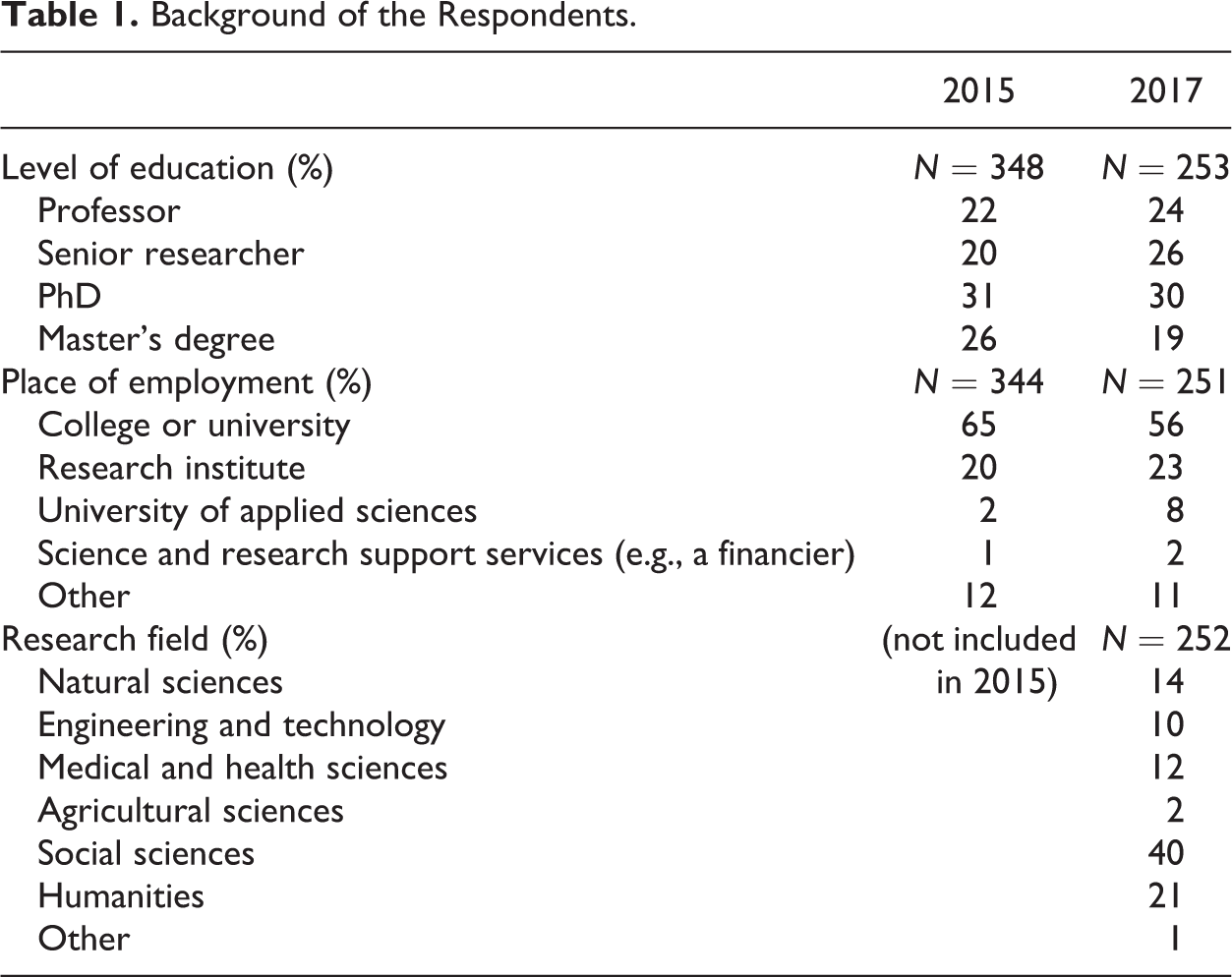
Since these surveys were conducted as open web surveys, they were not statistically representative. Nonetheless, they provided relevant information about this phenomenon, which has been studied little in the past. Over 60 percent of the surveys’ respondents worked in universities, and more than 20 percent of them worked in state research institutes (Table 1). In addition, almost 80 percent of the respondents were professors, senior researchers, or PhDs. Social scientists and those working in the humanities were overrepresented in the survey.
Background of the Respondents.
Around 40 percent of the respondents claimed that they had never received disturbing feedback and harassment when appearing in public, and another 40 percent stated that they had received this kind of feedback rarely. Around 20 percent of the respondents had experienced negative feedback and harassment occasionally, and 2 percent to 3 percent of the respondents had received these types of responses often (Figure 1). The most common types of disturbing feedback that the respondents reported included “inappropriate criticism made purely with the intention to insult,” “degradation and abuse,” “threats with the intent to damage reputation,” “silencing,” and “hate speech” (Figure 1).
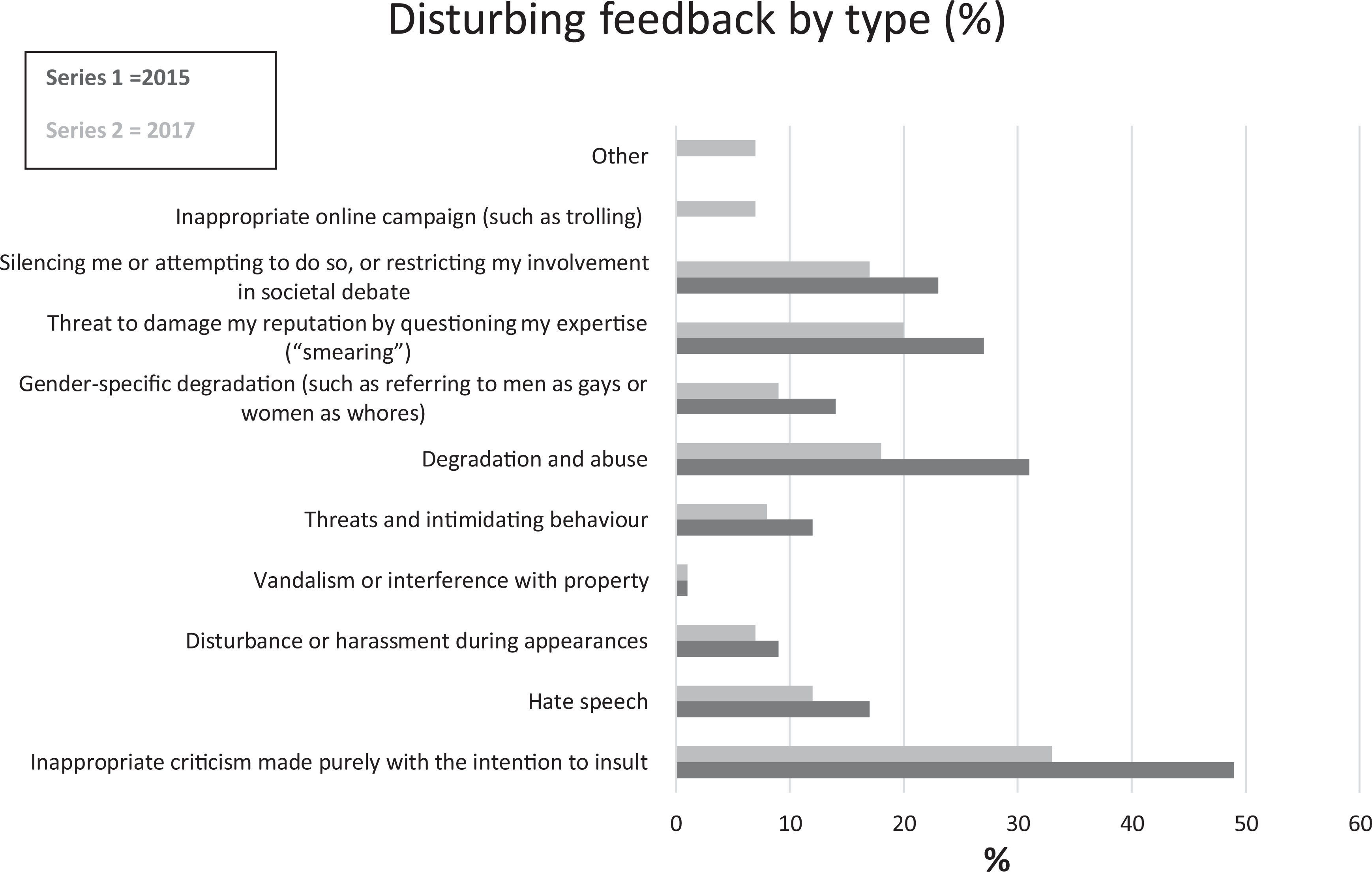
Type of disturbing feedback received by the respondents.
The primary open-ended questions from the data included the following: (20) “What types of inappropriate feedback have you experienced?”; (22) “From whom have you received inappropriate feedback?”; (41) “Evaluate the current state of freedom of speech for researchers. How do you think it has changed in the last two years?”; (42) “If you think the state of freedom of speech for researchers has changed, which factors have contributed to the change?”; and (43) “Your comments.” The citations were identified with the respondents’ numbers, the questions’ numbers, and the years in which the surveys were conducted.
We focused primarily on those respondents who had personally experienced incidents of aggressive feedback, threats, and suppression. Further, we complemented this survey data with ten in-depth interviews with environmental researchers. These researchers had been employed or otherwise engaged in government science and were able to provide insight into attempts at influence or suppression that were based on their own experiences. Although these interviews are reported and analyzed in detail elsewhere (Saikkonen and Väliverronen 2020), the current study used them to illustrate some of the key mechanisms involved in political, economic, and organizational control in state research institutes. Further, we verified some of the most extreme cases where researches had been suppressed and intimidated from public sources. Nevertheless, the present research primarily dealt with researchers accounts of the threats they perceived to their freedoms of expression and inquiry.
The first observation from the material was that scientists’ reflections about freedom of expression were often associated with academic freedom and freedom of inquiry. Thus, we concluded it would not be meaningful to consider issues related to freedom of expression without first connecting them to the wider context of freedom of inquiry research practices, and publishing.
In our qualitative analysis of the written responses to the surveys, we focused on analyzing the experiences of researchers by focusing on the contents of their responses (e.g., Hsieh and Shannon 2005; Silverman 2015) and classifying different forms and levels of suppression. We also analyzed the practices, motives, and methods for silencing that the researchers described in their responses; we did not specify how these threats to the respondents may have actually been realized.
Four Forms of Control and Suppression
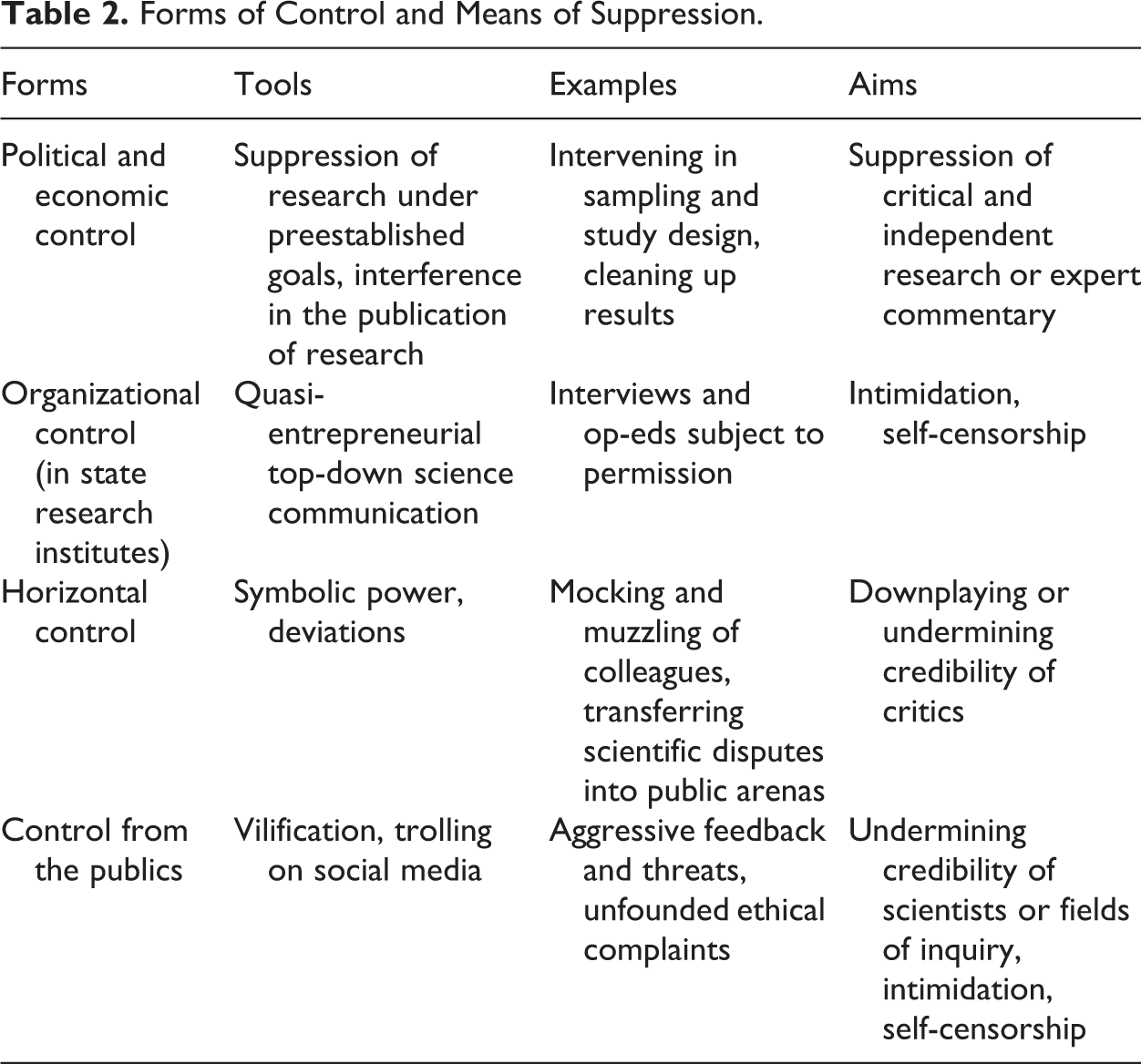
Based on the surveys and open-ended questions, where researchers reflected upon their experiences with excessive control, aggressive feedback, vilification, and the state of freedom of expression, we outlined four forms of control and suppression that can cause researchers to self-censor. We distinguished between political and economic control, organizational control (in state research institutes), mutual control between researchers, and control from the lay public (Table 2). Further, we analyzed different tools, aims, and examples of control and suppression.
Forms of Control and Means of Suppression.
Political and Economic Control
The economic and political control of research manifests in several ways, which in turn affect how these issues limit researchers’ freedoms of inquiry and expression. The most common of these mechanisms is defined priorities for research funding. In these cases, research is directed to serve companies’ interests in product development or the political goals of governments and ministries. This issue is primarily related to the freedom of science and its boundaries. Further, we identified cases in which research funders attempted to “sanitize” the results or perspectives they consider to be inappropriate for research reports or press conferences. Some of the respondents felt they had to censor critical comments so that they would not jeopardize their own positions or future funding opportunities.
In science and technology studies, the close interplay between companies, businesses, and universities has been defined by the concept of the entrepreneurial university (Etzkowitz 2003; Tuunainen 2013). The entrepreneurial university transforms universities and research so that research and development seamlessly work together. By including the state as a catalyst for business–university collaboration, it is possible to discuss the triple helix of research (Etzkowitz 2002): that industries and companies influence the steering of academic research funding more directly than financed or commissioned research (Etzkowitz and Leydesdorff 2000). At the same time, companies’ interests in knowledge can be internalized as guiding principles in research funding alongside scientific interests and standards (Benner and Sandström 2000).
Some respondents expressed concerns about limitations to freedom of inquiry that arose from the conflict between scientific and industrial interests. The following passages reflect both the growing role that companies play in defining financial priorities and, more specifically, the exclusion of critical research on sensitive issues: Now the major (largest) part of university funding comes from the big industry. Representatives of large companies sit as chairmen of university boards. They also influence the technological research funding by Tekes
3
and the Academy of Finland. Thus, the firewall of research funding leaks. (113/41/2015) […] Studies of biology and medical biology that conflict with the interests of the chemical industry are generating pressure and intimidation on researchers. (109/41/2015) I have been silenced in a public seminar because I presented unpleasant research results, which cast the aims of the government program in a bad light. Officials took care not to mention the results in the final report because the results would have directly highlighted the impact of the government’s policy on increasing inequality in society. (2/43/2017) In our commissioned research project, the commissioner’s representative interfered with both the entire study and the publication because I did not let him influence the sample. Instead of random sampling, we should have made a “comfort sample.” (1/22/2017)
During the present study’s interviews, a social scientist with over twenty years of experience performing environmental research for a state research institute connected these problems to major changes in the funding system and a lack of competence in the ministries’ commissioned research: Well, before the money went straight to the research institute. But now it is based on competition, and they make this kind of projects or programs where they want recommendations for very big political decisions in a short time span […] and I would say that in this kind of new funding scheme, something I would call commissioning competence or commissioning ethics has not been developed […]. And I think this is something where we would need some guidelines from a research ethical committee or something, or at least we need a discussion about the rules of the game.
Organizational Control
In my opinion, research institutes are restricting the freedom of expression of researchers excessively nowadays because they are afraid of losing customers because of the opinions presented by individual researchers. (30/41/2015)
Historically, freedom has been narrower for those working in state research institutions than for university researchers. Nevertheless, although researchers at state research institutes in Finland have traditionally enjoyed the right to debate in public without the permission of their employers, there have been recent situations where control over public speaking has become more stringent.
Finnish state research institutes are owned and run by ministries, and their primary responsibilities are to output research into specific topics, produce knowledge, and support decision-making (Late 2014, 19). Thus, while state research institutes play a significant role in the Finnish innovation system, they are unique in their organization, funding, and autonomy.
In 2010, the government funding budget covered 54 percent of the state research institutes’ total research expenditure (p. 28). However, the Finnish government made significant changes to the structure and research funding of state research institutes in 2013. Being subject to mergers, the number of state research institutes fell from eighteen to twelve, and the institutes became more heavily dependent on competitive, external funding. The research institutes were encouraged to increase their collaboration with universities, industries, and other social actors. Further, when research institutes became more dependent on external funding, they were required to accommodate more to the needs of the ministries, industries, and other financiers who commissioned their research.
As an example, VTT, a state-owned technical research center, was said to have adopted a quasi-entrepreneurial policy in its operations and communications. According to Karvonen (2011, 173), who investigated the 2010 case, “Communication is a strategic activity, and every member of the organization should internalize the house strategy so that all staff communicate the same basic message in harmony as a choir.”
As noted in previous studies, concrete examples of ways to limit the freedom of expression in researchers who work in state-owned research institutes include the following: silencing politically sensitive issues, controlling researchers’ media contacts, licensing interviews, monitoring or prohibiting interviews, reviewing interview questions in advance, or retrospectively checking responses to interview questions (Magnuson-Ford and Gibbs 2014). These control mechanisms emphasize that the positions of researchers in state research institutes differ from those of university researchers. The freedom of expression of the researcher is essentially linked to the employer. For example, in state research institutes, the researcher is not a purely academic form of life, but also an official and thus a representative of the host organization and s/he is bound by the same kind of official duty as other government officials. (82/42/2017) The biggest constraint on the employer is that, for example, a state institution can have just one view on one thing. (92/41/2015)
We outlined two types of organizational control mechanisms that individual researchers encounter. The first involves the downward movement of politically or economically motivated control within an organization. The second mechanism comprises streamlined public commentary that is devised by the representatives of a research institute to control participation in public debate.
Some respondents felt that the researchers’ opinions and speeches were excessively controlled by certain research institutes. These actions are justified by the institutes’ efforts to retain customers or so that they can appear politically correct toward leading politicians and administrators. At least the VTT does not seem to have improved its practices over the past few years. Researchers in university seem to be in a better position. (30/41/2015) Ostensibly, the situation [surrounding freedom of expression] seems to be good, but in reality, it is not, at least for researchers working in state research institutes. Fear of the end of funding after communicating politically unpleasant results is a real concern that many talented researchers are serious about and thus are afraid to open their mouths. Silencing occurs by threatening with warnings, the end of funding, layoff, etc. (111/41/2015) But so, weird cases as well, so for example we had a big project led by me […] with a really big group [of researchers from different institutions]. And there was a steering group, according to normal principles, in which there were companies and [a research funder]. And we had […] with the group of researchers drafted the press release of the final report. Then we had, with the steering group and all of us […] we had agreed that it will be published. And that this is the press release of the project. Then, according to our organizational protocol then [at the state research institute], I send it to the management of our public communications and to my own managers to be reviewed and accepted, and it gets rejected. You are not allowed to publish this [is the message to us from the management]. This is way too negative. This is harmful to our [research institute’s] economic activity. We have also been instructed in our facility to respond consistently to certain “hot” topics and, where possible, to direct queries to specific persons in the organization. I do not feel that this practice was formed in our institution in order to restrict freedom of expression, but I can imagine situations when this could actually happen. (168/41/2015)
Mutual Control between Researchers
The academic community has traditionally focused on how research can be guided by top-down political and economic objectives or how freedom of inquiry and freedom of expression can be limited by organizational control. Power among researchers can also be a source of censorship or self-censorship. However, because critical debate is an essential part of the academic tradition and peer review has been institutionalized within publication practices, all critical feedback from researchers cannot be viewed as a threat to freedom of speech.
Mutual control can become an issue when researchers are actively discouraged from challenging paradigmatic ways of thinking or prevented from providing scientifically valid but different research results that challenge the generally accepted consensus and dominant paradigms of a research field (Moran 1998; Martin 1999; Delborne 2008; Hoepner 2017). This kind of mutual control between researchers can be problematic, especially when researchers in powerful positions seek to silence their critics within the scientific community rather than to defend their views with science. Some of the present study’s respondents described how researchers can be controlled in both the scientific and public arenas: […] Some emeritus professors practice regular derogation and mockery of younger researchers through Facebook. So, they are blatantly exploiting their dominance. (54/41/2015) In politically topical areas, pressure on [having a] unified opinion is very strong, and pressure from colleagues and researchers representing the mainstream can be mentally violent and distressing. (123/41/2015) Absolutely inappropriate action: the discussion was carried out on non-scientific media about things that should have been dealt with within the scientific community and publications. This was probably done because the arguments would not have gone through in the scientific community. (3/33/2017)
Scientists’ attempts to silence dissimilar perspectives and to work against scientific dissent are common, especially during discussions of socially and politically controversial subjects (Martin 1999; Delborne 2016; Hoepner 2017). Earlier, we named this kind of power horizontal control. It is also worth noting that the aforementioned examples primarily refer to the asymmetric relationships between researchers, wherein professors in dominant positions control younger researchers when they challenge prevailing views. Nonetheless, because academic organizations generally lack the formal hierarchies that are typical of other organizations, horizontal control remains relevant to these cases. Although contestation in academic communities revolves around symbolic capital (Bourdieu 1991), its accumulation, and the struggle to collect it, it remains difficult to separate normal academic battles and criticism from abuses of power. We attempted to expand our analysis by presenting the experiences of young researchers who have been caught in the middle of power struggles.
Control from the Publics
In the history of science, the situation is novel in the sense that the threat of freedom of expression now comes mainly from individuals and not from the authorities. (55/41/2015)
The last decades of intensive criticism toward the deficit model and the new ways of fostering dialogue and public engagement have made it clear that it is important that citizens and the lay public have the right to “talk back to science.” As important as this development has been, there exists the need to analyze some of its potentially negative side effects, which can include hate mail and the vilification of researchers and experts who make commentary about politically sensitive topics in the media.
The aggressive feedback and harassment that researchers face in the public arena has garnered more recent discussion between researchers and the media. Threats, stigmatization, and public shaming stifle freedom of expression, especially when the results lead researchers to self-censor, avoid sensitive topics, or withdraw from public debate (Kempner 2008; Lewandowsky et al. 2016). Nevertheless, although scientists and research organizations often find it annoying or threatening, it is worth noting that critical views and feedback from citizens can play a constructive role in discussions about scientific issues (e.g., Welsh and Wynne 2013; Hess 2015). For these reasons, it is analytically important to distinguish criticism on the part of citizens or civic movements from deliberate harassment that seeks to silence researchers.
This form of control makes it possible for ordinary people to deliberately silence and influence the activities of scientists who can make powerful and knowledgeable claims in public discussions as experts. Stories about citizens’ feedback, which several researchers perceived to be disturbing or even threatening, repeatedly emerged from the present studies’ surveys: I have been to this discussion from time to time on Facebook when ordinary people raise the subject up. Based on their discussions, many colleagues remain silent about their research in the public because of fear of harassment […]. (22/41/2015) Harassment reduces freedom of speech. Many scientists or other experts in my field have refused giving interviews and requests to come to public seminars to talk because of the fear of attacks. (176/41/2015) My commentary in the newspaper led to a troll campaign (in social media). (2/24/2017) I have received aggressive feedback in social media from time to time. A more serious case was a claim of scientific
4
misconduct concerning my dissertation. It was just harassment, and the intention was to silence me and my research topic. The accusation was found unjustified, but altogether the case was not small potatoes. (16/20/2017)
More importantly, negative feedback about some research topics can affect the willingness of researchers to engage in public debate and diminish their general willingness to explore these sensitive topics. Thus, restrictions to freedom of speech are also likely to diminish freedom of inquiry. The researchers remain silent on their own self-defense. It is becoming impossible to get young researchers involved in some sensitive topics because they know they will receive negative public feedback, even if these topics are socially very important. (46/42/2017) Researchers themselves could also think of their own contribution to the rise of this phenomenon. Often, it feels that the public outrage is primarily directed at the political opinions presented by the researcher (or attitudes) wrapped around the curtain of scientific expertise. (50/43/2017)
Concluding Remarks
This article investigated the hidden forms of suppression that scientists encounter as public experts. It fulfilled this objective by analyzing scientists’ written responses to open-ended questions in two surveys conducted in Finland in 2015 and 2017. Based on this analysis, we aimed to provide a novel analytical framework for recognizing and studying possible threats to researchers’ freedoms of expression. This framework complements and extends existing investigations that have elaborated and classified targets of scientific suppression (Delborne 2016). Moreover, we identified different mechanisms and power structures that contribute to the suppression of scientists as public experts, particularly during politically sensitive discussions. The identification and analyses of these mechanisms and power structures also contributed information about the practices and ways in which scientists are silenced (e.g., Moran 1998; Martin 1999, 2001; Kuehn 2004; Hoepner 2017).
Our findings also demonstrated how increasing defining of financial priorities and steering of research by political and industrial actors can have a constraining and excluding effect on research. This study therefore also contributes to the literature on the commodification of science (e.g., Hackett 1990; Radder 2010; Krimsky 2003; Hackett 2014; Fochler 2016; Birch 2020) by indicating and providing perspective to the restrictive effects of commodification on freedom of inquiry and expression of scientists specifically. Inquiry into this can be considered important to better understand the issue of how commodification of science affects scientists’ freedom of inquiry and expression, alongside its other commerzialing effects over science and research institutions.
The results of this analysis and the increasing concerns of academic freedom partly reflect the unpopularity of the center-right government (2015–2019) among Finnish academics. Main reason for this mistrust, besides austerity measures affecting research and education and disparaging commentaries from the cabinet ministers, was the increasing political influence of the Finns Party, which had cultivated anti-immigration and anti-intellectual sentiment in Finland. Numerous academics had blamed the leaders of the Finns Party for favoring racism and hate speech. After 2019 parliamentary elections, the new center-left government lead by Social Democrats patched the cuts to research and education and promised to restore trust on knowledge and expertise. Further, universities and other academic institutions have adopted new policies and guidelines to tackle harassment and hate speech against researchers. However, the problems with excessive political and economic control in state research institutes seem to persist (Saikkonen and Väliverronen 2020), thus reflecting the increasing commercialization of research and the rise of promotional culture in communicating science (Väliverronen 2021).
According to some respondents who worked in state research institutes, increasingly hierarchical and streamlined scientific communication can limit individual researchers in their capacity to communicate their research and expertise in public. Further, public shaming, aggressive feedback, and unfounded claims of scientific misconduct that are made to silence particular researchers can truly threaten academic freedom and freedom of expression.
We took the experiences the scientists related in their written responses at face value and did not investigate their levels of justification in detail. Threats to the freedom of expression that are more or less well-grounded can impact the future behaviors and public activities of researchers. Thus, the current analysis focused on the practices and mechanisms that can limit researchers’ freedoms of expression. The analysis revealed that in the public arena, freedom of inquiry, scientific publishing, and freedom of expression are connected in several ways.
Politically or economically motivated, top-down social control is the best known and most recognized form of limiting researchers’ freedoms of expression. Interestingly, our data highlighted how political and economic control trickles down in state research institutions to regulate individual researchers. Over the last ten years, major changes to the organization and funding of governmental research in Finland have resulted in the development of quasi-entrepreneurial and hierarchical practices in the scientific communication of certain institutes. These practices threaten researchers’ freedoms of expression and were discussed in our interviews with environmental researchers who worked in governmental science.
Particularly female researchers who dealt with politically sensitive topics seemed to confront aggressive and sexually motivated commentary in their public appearances. In some cases, reported in the survey, there are indications that this was not just coming from individual and often anonymous citizens but was sometimes part of more or less organized and crowd-sourced trolling campaign in social media. Many respondents also saw it as a source of self-censorship. It emerged from the material that negative feedback on some research topics not only affected the willingness of researchers to engage in public debate as such but also contributed to the general willingness to start exploring such topics. Thus, restrictions on freedom of speech are also likely to reduce academic freedom. Moreover, some of the current study’s respondents noted how fabricated ethical complaints of scientific misconduct can be used for similar purposes. As a practice, this reflects how the legitimate tools of regulation within science have become weaponized (Lewandowsky and Bishop 2016).
We believe that this analysis will broaden the understanding of the relationship between researchers’ freedoms of expression. It is also our hope that this analysis will assist in the development of tools that can tackle and prevent the repercussions of these various forms of social control. The study’s surveys clearly illustrated that researchers are often left alone with these problems and without the support of their working communities. The surveys also revealed that research organizations often lack the instructions or procedures to address these issues effectively.
Footnotes
Acknowledgments
The authors would like to thank The Committee for Public Information in Finland for their help with the surveys, and the anonymous reviewers of this journal for their constructive comments.
Declaration of Conflicting Interests
The author(s) declared no potential conflicts of interest with respect to the research, authorship, and/or publication of this article.
Funding
The author(s) disclosed receipt of the following financial support for the research and/or authorship of this article: The authors would like to thank the Kone Foundation and the Academy of Finland for supporting this research.
