



Abstract
As part of current energy transitions in the Global North, households have begun adopting renewable energy technologies, such as heat pumps and solar power systems, in significant numbers. These changes give rise to the following question: how are technology and gender configured when new technologies enter everyday life? Based upon ethnographic fieldwork on interactions between households, technologies, and technicians and interviews with sales technicians, installers, and service mechanics, I demonstrate how both stable and fragile variants of renewable energy technologies are enacted during prepurchase consultations and postpurchase installations, respectively. I employ science and technology studies scholarship, feminist ethics, and repair and maintenance studies—captured through the analytical lens of care—to analyze how technicians mobilize and tinker with gendered affection, knowledge, and action in households to effectuate adoption of renewable energy technologies. I clarify how, in this process, openings are created to configure both hegemonic and heterogeneous gender–technology relations. Finally, I advance discussion beyond gender issues by arguing that acknowledging the role of maintainability and the repair of user–technology relations in current energy transitions opens pathways not only for exploring gender in new and exciting ways in relation to technology but technician–user relationships as well.
Introduction
As part of current energy transitions in the Global North, households have begun adopting renewable energy technologies, such as heat pumps and solar power systems, in significant numbers. These changes give rise to the question, how are technology and gender configured when new technologies enter and become “stabilized” in everyday life (Cockburn and Ormrod 1993; MacKenzie and Wajcman 1999; Wajcman 2007)? Feminist-inspired science and technology studies (STS) reveal dichotomous thinking prevalent in engineering cultures that spawns a gendered distinction between the technical and the social, and prioritization of male users in design practices (Oudshoorn, Rommes, and Stienstra 2004; Oudshoorn and Pinch 2003). However, Wendy Faulkner demonstrates that how gendering occurs in engineering practices is more complex than conventionally assumed (Faulkner 2000, 89; 2007). A useful way into this complexity, She argues, is to focus on the situated labor of “technician engineers,” who work directly on or with a technology and its users. Faulkner’s call resonates with recent actor–network theory (ANT) studies that examine maintenance and repair work. These studies foreground often-neglected aspects of sociomaterial ordering processes by focusing on material disruptions and the hands-on work needed to maintain order, understood as fragile rather than stable (Denis, Mongili, and Pontille 2016; Denis and Pontille 2020; Crooks 2019; Sormani, Bovet, and Strebel 2019). This focus on material fragility establishes opportunities for new explorations of gender–technology relations as part of the ongoing work of adapting technologies to specific situations and vice versa: work that has been formulated as a “care of things” (Denis and Pontille 2015; see also Mol, Moser, and Pols 2010).
Based upon ethnographic fieldwork on (1) interactions among households, technologies, and technicians and (2) interviews with sales technicians, installers, and service mechanics, I demonstrate how both stable and fragile variants of renewable energy technologies are enacted during prepurchase consultations and postpurchase installations, respectively. Sales technicians tasked with distributing technologies among households commonly grasp that “the technology” sparks interest among prospective users, notably men, due to an alignment of technology and masculinity (see also Lohan and Faulkner 2004) and thus forsake diversity among both technologies and masculinities (Lerman, Oldenziel, and Mohun 2003). However, technicians responsible for installing these technologies rarely envision the user as an individual but rather as a household: a home and its occupants entangled in a sociomaterial network of domestic routines. Household routines—showering, cleaning, and relaxing—need to become integrated into these technologies to ensure a durable installation. If a household fails to take care of, say, a heat pump, the heat pump subsequently fails to take care of the household (by providing thermal comfort). Acknowledging this “precarious infrastructure of usership” (Sánchez Criado et al. 2014, 712) forces us to ask: how do technicians ensure that users, as one of my interlocutors stated, “adopt a device”?
This article furthers discussions of gender–technology relations by probing maintenance work that generally remains overlooked. I employ STS scholarship, feminist ethics, and repair and maintenance studies—captured through the analytical lens of care—to analyze how technicians mobilize and tinker with gendered affection, knowledge, and action in households to effectuate adoption of renewable energy technologies. I clarify how, in this process, openings are created to configure both hegemonic and heterogeneous gender–technology relations (Faulkner 2000; Lagesen 2012). I thus advance discussion beyond gender issues in relation to (1) maintainability in maintenance and repair studies, (2) relational repair as part of user configuration in STS, and (3) symmetrical technician–user relationships in engineering studies.
Technology Adoption: Gender, Maintenance, and Care
There is a rich tradition of feminism-inspired studies that address how technologies are distributed to users and how this concomitantly shapes gender (Cockburn and Ormrod 1993; MacKenzie and Wajcman 1999; Wajcman 2007). These studies demonstrate how difficult it is to design technologies that do not change shape, use, or value when distributed to users across sociomaterial ordering networks, such as technological education and research, development and design, manufacturing, and retailing (Eriksson-Zetterquist 2007). Moreover, these studies emphasize the key role engineers play in these networks and show how engineering cultures are rife with hegemonic masculinities (Oudshoorn, Rommes, and Stienstra 2004) such that what is and is not considered “technology” is gendered (see also Light 1999; McGaw 2003).
Notably, Faulkner (2000, 2007) in her research on engineering workplace cultures illustrates how even ostensibly technical roles have social elements embedded inextricably within them. Faulkner (2007, 331) thus argues for a less “technicist” and more sociotechnical understanding of engineering practices that foreground “heterogeneous” genders—so that technician engineers draw upon various mixes of (stereotypical) masculine and feminine roles and identities. In foregrounding heterogeneous genders, she demonstrates how technician engineers tinker with boundaries associated with hegemonic masculinities (“the technical”) or emphasized femininities (“the social”; see also Connell and Messerschmidt 2005). Faulkner’s call for exploring heterogenous genders in engineering studies resonates with Lagesen’s (2012) recent appeal to render gender more dynamic in STS. Lagesen argues that, in early studies, gender remains somewhat of a black box, and there is a lack of concern with how it is constructed. She therefore proposes analyzing the role of technology in the doing of gender by exploring different ways of relating to technologies, drawing upon insights from ANT.
ANT reveals that doings of all sorts are effected by performances distributed across heterogeneous networks of sociomaterial entities (Latour [1993] 2000; Moser and Law 1999; Mol 2002). For instance, in a study on learning to use a wheelchair, Winance (2006, 67) shows how relations between the wheelchair and the user do not simply emerge but demand strenuous and ongoing work—a “process of adjustment”—that makes those relations possible, while simultaneously shaping the user, the device, and their worlds. In the emerging field of repair and maintenance studies (Henke 2000; De Laet and Mol 2000; Jackson 2014; Denis and Pontille 2020), processes of adjustment are understood as “deeply inscribed in a logic of care that starts from decay and vulnerability” (Denis, Mongili, and Pontille 2016, 8). This corresponds to what Fisher and Tronto (1990, 35-46), in their foundational work on feminist ethics, describe as taking care of, which implies responsibility for caring activities, time spent, and explicit knowledge of situations. It involves the endless, practical interfering with one’s living environment in order to sustain it (Mol, Moser, and Pols 2010; Denis and Pontille 2015). Fisher and Tronto also describe a second variant of care—caring about, which involves orientation toward something in which affection and knowledge play an important role but not necessarily practical action (Puig de la Bellacasa 2011; Martin, Myers, and Viseu 2015). Both variants are part of the constant work needed to sustain fragile modes of ordering (Graham and Thrift 2007). However, the distinction between them is topical, as it pervades current debates in repair and maintenance studies on material fragility by foregrounding different variants of care.
In this article, I operationalize maintenance as work that involves affection, knowledge, and action and entails both taking care of and caring about technologies. I examine how adoption of renewable energy technologies occurs in households—heavily gendered sociomaterial networks (see Cowan 1983)—by considering how affection, knowledge, and action are deployed and interpellated, by whom, and with what aim. A focus on care—who cares how, when, and for what—allows me to introduce questions concerning gender–technology relations into maintenance and repair studies. My aim is not to describe whole household networks but rather to concentrate on the relations among technicians, renewable energy technologies, and prospective users—what Orr (1996, 7) in his critical ethnography on photocopier service technicians calls the “triangular relationship of service.” Technicians share with users and technologies the responsibility for bringing into existence, maintaining, and repairing usership conditions that must be “in place” for a technology to function. Studies of the installation of telecare technologies in households reveal the “particular relational, technical, and contractual work” involved in solving and anticipating ongoing problems (Sánchez Criado et al. 2014, 711). I also detail how technicians—safeguarding the everyday infrastructure of usership—employ gendered affection, knowledge, and action with respect to technologies and users, which they progressively acquire with each purchase and installation (see also Offenberger and Nentwich 2009).
Empirical Focus and Methods
This article presents empirical findings gathered as part of two research projects that focused upon decision-making related to renewable energy technologies in households in the Netherlands. I conducted fieldwork over the course of twenty-seven months (January 2016-April 2018), combining (1) participant observation in consultations, technical audits, and energy fairs, (2) focus group interviews with technicians, and (3) document analysis of marketing materials.
During the research period, I visited seven energy fairs, where I observed how renewable energy technologies were showcased and the technicians staffing stalls engaged with prospective users and myself. Over the course of five months, I “shadowed” three technicians during eleven consultations and nine postinstallation audits. Each consultation or audit lasted ninety minutes on average, depending upon the type of technology and architectural properties of the house in question. The technicians, educated as engineers and thirty-five to fifty years of age, represented an energy service company that sold solar power systems, heat pumps, and insulation technologies. The company was a research partner in both projects and offered me the opportunity to shadow its technicians. I engaged in informal conversations with them in transit between household visits. As part of these conversations, we reflected upon the advice they had given and household members’ questions and responses. When necessary, I prompted them with concerns male or prospective female users raised in order to invite the technicians to reflect upon gendered issues. In total, these conversations lasted around four hours. I took extensive notes throughout with the objective of producing “thick description” (Geertz [1973] 2003).
Purposive sampling (Bryman 2012) of households the technicians serviced was not possible. For privacy reasons, the company could not share clients’ personal information with me, and I could not preselect household types. In an attempt to visit as many two-partner households as possible, I accompanied technicians during holiday periods (after Christmas and around Easter), which increased the likelihood of observing two-partner households in which both partners were home during our visit. A company employee informed households beforehand about the research project and asked permission for me, “a researcher,” to accompany the technician. In two cases, permission was denied. In total, we visited twenty predominantly high-educated, middle-class households of people living in privately owned dwellings—ten heterosexual couples with children, seven heterosexual couples without children, and three single adults (one childless man, one father, one mother). Since the couples all identified as heterosexual, the dynamics I observed likely made stereotypical, heterosexual gendering more salient than in other types of households, for example, in same-sex households.
Various studies indicate that technicians working in installation form a “community of practice” (Wade, Hitchings, and Shipworth 2016) with shared identities, experiential knowledge, and social learning processes. Orr (1996) demonstrates that storytelling forms an important medium for sharing collective, experiential knowledge among technicians. To prompt storytelling, a colleague and I conducted two semistructured, ninety-minute focus group interviews with six technicians thirty to sixty years of age, seeking to learn from technicians’ talk-based interactions how they enacted gender when distributing renewable energy technologies to households. One focus group consisted of two sales technicians, an installer and a service mechanic, representing one of the Netherlands’ largest energy service firms (1,500 employees); the second included technicians from a small, local installation firm (twenty-five employees). Technicians working in small firms tend to have multiple jobs—sales, installation, maintenance, and repair—while in large energy service companies, sales technicians are responsible for consultations; installers perform installations, and service mechanics conduct maintenance and undertake repairs.
My research included studying the marketing materials technicians brought to consultations, including graphic manuals and marketing brochures of renewable energy technologies (from Hitachi, Honeywell, Nefit, and Radson; see Image 1). I thus familiarized myself with these technologies’ operations and their distinct components and how companies and technicians in consultations and at energy fairs marketed them.
Configuring Gender and Technology during Consultations and Installations
Hegemonic Gender: Caring about Stable Devices
The purchase of renewable energy technologies entailed an extensive decision-making process (De Wilde 2019). During consultations, technicians were keenly aware that these technologies were not, in the words of Tom, a senior technician at a large energy service firm, “a casual purchase”: Mind you, we’re not selling sugar…. A boiler or heat pump is about the most expensive domestic device you can buy…. It must do its job for at least fifteen years…. So, people commit to it and they want to feel good about it.

Marketing brochure for heat pumps from Radson.
First, the technicians involved in the study knew from experience that prospective male users were affectively inclined toward renewable energy technologies due to their technical features (see Kleif and Faulkner 2003; Mellström 2004). Prospective female users, by contrast, had to become oriented toward these technologies despite their technical features. A woman’s commitment, however, was key. Technicians pinpointing the actual moment of purchase during consultations qualified it as the moment “when the woman comes on board.” As Tom explained during a focus group interview: If you manage to win a woman’s trust, then the device—heat pump, central heating boiler or solar power system—will be adopted…. She might initially not have been interested, but eventually she’s the one who decides.
During fieldwork, I noticed technicians creating settings that encouraged conversations about main components, specialized high-tech features, and the technical rationale for renewable energy technologies. Attending an energy information fair in a provincial town, I observed a typical scene, as follows: Browsing through the stalls, I recognized a conventional setup: a round of tables on which the distinct components of different solar power systems were spread out [see image 2]. Spotless and new, the photovoltaic panels, solar inverters, and boilers presented themselves in their shiny armor. I paused at a stall for solar power systems. A man in his seventies, Mr. Hintham, approached the stall and the technician standing there. Mr. Hintham told the technician that he had tried to purchase a solar power system for his condominium. Alas, the purchase failed due to his fellow homeowners’ mistrust of the system’s country of production, China. In reaction, the technician opened his briefcase and pulled out a sheet advertising photovoltaic panels from Germany. He referenced the widely accepted notion in the Netherlands of German gründlichkeit [thoroughness]. This sparked Mr. Hintham’s interest, who then shared another obstacle he’d encountered. His wife considered inverters large and ugly. She did not want them hanging in “her kitchen.” The technician told him that nowadays inverters were smaller and that “there are even inverters in the neutral color, ecru, on the market.” He explained that wives who accompany their husbands to energy fairs were pleasantly surprised to discover that these were also an option. Then, in an effort to sustain homosocial bonding over the technicalities of the solar power system, the technician reassured Mr. Hintham, “It remains a technological device of course. It’s not a piece of art.” Mr. Hintham laughed because, indeed, that is what he tried to communicate to his wife. Thus far, to no avail. The technician continued, “But this particular inverter”—he pointed to one on the table—“this one is really the Ferrari among inverters.” He then started to talk in detail about the inverter’s features while showing it to Mr. Hintham.
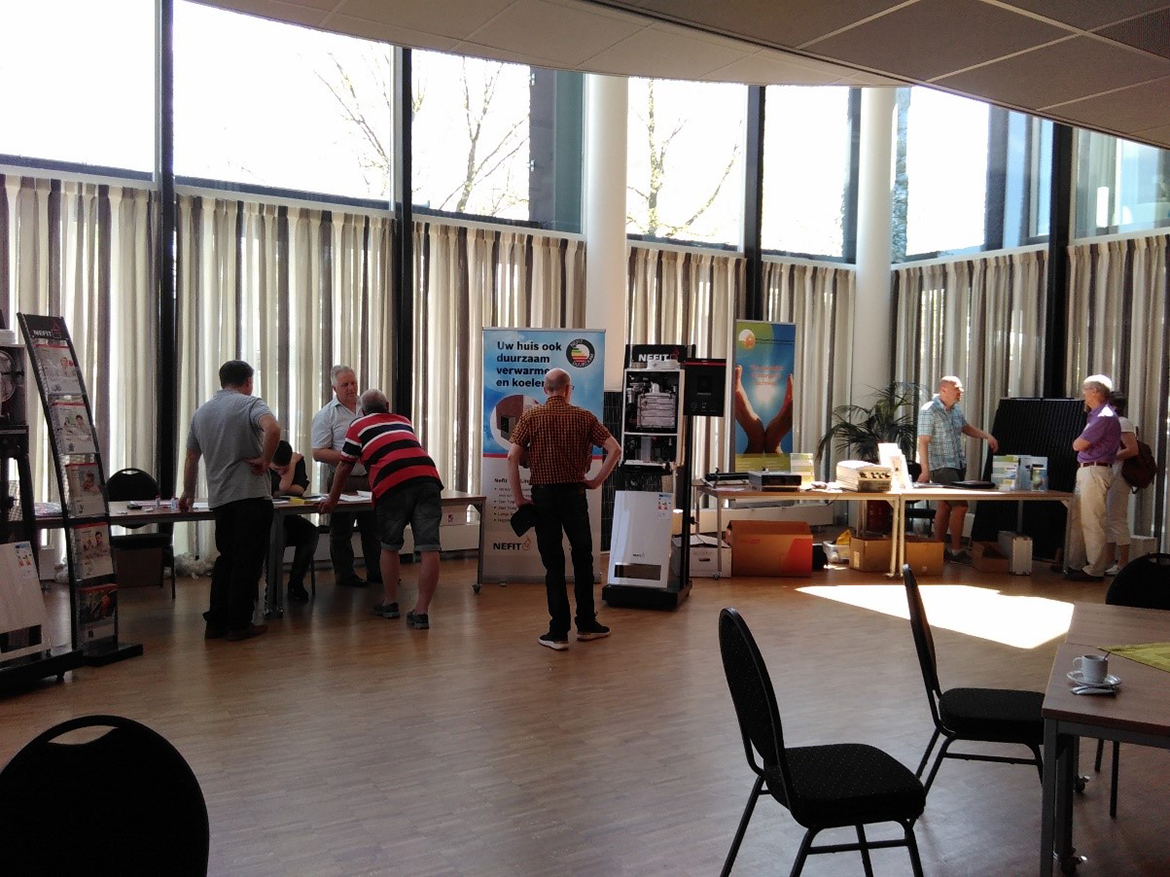
Energy fair setup in a neighborhood center in the Netherlands.
The above example demonstrates how the technician configured a solar power system as stable. The reference to Germany as a reliable country for technology, the use of a luxury-car metaphor, and the modular language exemplified homosocial bonding over technical rationality, allowing both men to constitute a hegemonic masculinity based upon technology (Mellström 2004). At the same time, the technician and Mr. Hintham enacted a heteronormative conception of gender—“her kitchen,” “his technology”—that essentializes female–male differences.
The tenacity of this conventional gender–technology relationship became extremely apparent in situations where prospective female users asked probing questions about renewable energy technologies that, subsequently, did not result in heterosocial bonding between the technicians and women. I noticed this dynamic during my first day shadowing Bram, a technician in his thirties working for a small energy service company: One chilly spring day, Bram and I arrived at a pretty terraced house from the 1920s. Here lived Mrs. and Mr. Groen, a couple in their fifties interested in installing floor insulation and a solar power system. Upon entering, I noticed that it felt rather cold inside. Bram directly targeted Mrs. Groen about her concern that the floor was too cold. He joked: “Once the floor insulation is installed, you won’t need those slippers anymore.” She laughed. It is the same joke Bram made during an earlier consultation with a single, middle-aged mom and it sparked the same reaction, laughter. When the conversation turned to the solar power system, Bram shifted his attention to Mr. Groen, assuming he was the one interested. He asked Mr. Groen about their electricity use, the presence of boilers in the house, the location of the meter board, and how many fuses it held. Mr. Groen looked somewhat surprised. It was actually Mrs. Groen who had been considering a solar power system. She quickly intervened, answering Bram’s questions in detail. She then took over the conversation with “a technical question about shade” and asked about the necessity of power optimizers. She had read that, due to shade, the whole system might malfunction, was that right? Seemingly caught off guard, Bram switched his attention back to Mrs. Groen—also physically moving his chair somewhat to face her—and explained they did not need these because there were no shadows on their roof. However, if she was interested in maximum system output, blue photovoltaic panels were the best option. Anticipating feminine concerns regarding aesthetics, he emphasized that these were less beautiful than black panels, in vogue among female customers. Mrs. Groen reacted instantly, saying that, obviously, she wanted the most efficient panels regardless of how these may look as the whole system was quite a financial investment. Mr. Groen, following her lead, nodded in agreement. When Bram and I were back in his car, he said, releasing a sigh, “Well, that doesn’t happen often!” as if to reassure me, and perhaps himself, the situation we just witnessed was an unusual one. One deviating from the norm.
Second, technicians also induced commitment among users by inviting prospective female users into an affective engagement with renewable energy technologies, namely by means of their sensory qualities (as Bram’s joke about warm feet illustrates). For example, when senior technician, Simon explained that a man can talk for an hour about how a boiler and a heat pump cofunction, he emphasized that “women ask questions later on,” about different topics than those men raise: She asks: “Will I still be able to warm our towels on the radiator?” “Will I still be able to get hot water fast?” Those are comfort-related questions. I anticipate those questions and talk about the possibility of installing a close-in boiler in the kitchen so that there is instant hot and boiling water or about connecting towel radiators to the boiler so that even at today’s temperature [20 °C], women are able to dry and warm their towels. I have engaged in several consultations where men told me, “Just install it here, around the corner,” while women say: “No way! I don’t want to hear that thing,” or “I don’t want our neighbors to hear it.” Sound has an impact because heat pumps really generate sound and you have to take that into account. I once consulted a couple who wanted an outdoor heat pump. I told them, “I wouldn’t do that because the device really makes noise. I don’t know about your neighborly relations at the moment but these will become chilly…. And the sound will be annoying to you as well.” But the husband insisted so then I said, “The only solution is to install a cap on the pump; you won’t see or hear it and it can still be here.” That solution would have meant significant financial investment. It would have been quite invasive with drilling holes in the concrete floor and so his wife cut me off. Apparently, her husband had told her something like, “For no more than 5000 euros we’ll be able to have heat pump installed on our façade.” “Yes,” I told them, “and you’ll have tension with your neighbors, just so you know.”
Thus, during their consultations, technicians enacted renewable energy technologies as stable devices that merited affectively charged attention, caring about (Puig de la Bellacasa 2011; Martin, Myers, and Viseu 2015; cf. Fisher and Tronto 1990): technologically advanced, bestowing benefits upon prospective users in terms of comfort, and thus worth purchasing. In this process, sales technicians inscribed gender into these devices (Berg and Lie 1995) and turned them into a powerful resource for reproducing, and stabilizing, conventional gender–technology relations (Cockburn and Ormrod 1993; MacKenzie and Wajcman 1999; Wajcman 2007). Even when prospective female users actively tried to subvert conventional gender–technology relations, technicians continued to reify stereotyped, heterosexual notions of masculinity and femininity as conveying reliability was key to these consultations. However, when hegemonic genders threatened to destabilize a technology as part of everyday usership, liaising between technicians and prospective female users pointed to cracks in these constructs. I explore this further in the next section by focusing on installation practices, which foreground maintenance and repair.
Heterogeneous Gender: Taking Care of Fragile Installations
During renewable energy technology installations, household routines took center stage as users needed to partially assume “taking care of” the installation. Service contracts were included by default with purchases. This ensured monitoring, annual servicing, and incidental repairs by service mechanics. Yet, devices had to be used properly to function for their designated life spans. Below, I provide two examples of how technicians assured household members’ commitment to installed devices.
First, technicians installing renewable energy technologies emphasized the devices’ needs and vulnerabilities, introducing female household members as protagonists in their stories. During a focus group interview, Simon, the senior technician, explained: A heat pump, for instance, needs a bit of care. It needs some fine-tuning after it has been installed. And when you make those return visits, women really pay attention.
A conversation between a mechanic and a retired couple, Mrs. and Mr. De Klein, during a fieldwork visit to repair a solar power system installation illustrates how cleaning was deemed necessary maintenance work, while also qualified as a feminine practice: By chance Mrs. De Klein’s cousin, an electrician, had checked the recently installed solar power system during her birthday party and noticed an incorrectly placed wire. The service mechanic who came to repair this examined the meter box and determined that the wire was indeed incorrectly installed, causing electricity to flow even when the master switch was off. Mrs. De Klein expressed concern, “Your colleague really didn’t do his job correctly, did he?” She wanted to know how this could have happened and if it was dangerous. The mechanic patiently explained the electrical workings of the solar panel installation and circuit breaker. Mr. De Klein joined the conversation. The service mechanic continued to carefully explain the solar power system’s ins and outs. He pointed out that the inverter needed no maintenance, but the photovoltaic panels did. Then, with both spouses listening and without Mrs. De Klein having prompted it, he specifically addressed her. “Ideally, you’ll clean them once every two years or so. You can use a sponge you use for cleaning your windows.” Mrs. De Klein responded, somewhat amused: “Surely you don’t expect me or my husband to climb on the roof!” Not giving in, the mechanic answered, “Then, perhaps you can ask your window cleaner?” After an afternoon consulting households in a provincial town, Frank, a senior technician, drove me to the train station. During our last household visit, about a boiler, a husband had wittily referred to his wife as “the technician at home” as she spoke in detail about their former boiler. Apparently, the outlet valve had been replaced the previous year because it had overflowed and calcified and she did not want that to happen again. In the future, she emphasized she wanted to connect the warm water heater in the kitchen to the new boiler because she noticed it might need replacing. She wanted to know what Frank thought. He gave elaborate advice. In the car I recalled her husband’s joke. Frank responded that women monitor households in terms of what devices need renewal and retrofitting: “Most probably, she is the primary user of that boiler, so she’s the one I need to talk to.” That she becomes the “domestic technician” occurs naturally. So, the floor feels cold. I have a heat pump at home and I don’t mind putting on a sweater and thick socks because the floor temperature remains below your physiological temperature…. [But] we’ve had numerous complaints from women with cold feet after a heat pump has been installed [because] comfort is really a feminine concern.
Second, technicians assured commitment to fragile installations from households by actively educating household members about the workings of renewable energy systems. They emphasized that usership is difficult to anticipate as it is subject to each household’s changing needs. Things can thus go awry at any moment. As fragility is not clearly identifiable with easily visible symptoms, technicians’ instrumental knowledge is required. Technicians tried to partially outsource this responsibility by sensitizing female users to the mechanical, electrical, or digital operations of technologies. As Midas explained during a focus group interview: Well, if something doesn’t work, then, initially, the man might call. However, at some point, the woman adopts the device as well and she dares to call us. Like, “My husband arranged this or that, but it leaks,” or something similar. Then I start to explain how the device really works. I notice it at home as well. My wife doesn’t understand any of it. She’ll say, “All those technical aspects, that is your job, I trust you blindly.” Nine out of ten times men are also interested in the app which comes with, let’s say, a new thermostat. They’re probably only interested so they can show it off at a birthday party…. Women might not be interested initially. But it often happens that I take my time and explain how the entire system, the thermostat, the app functions, with the woman present as well. The man might not take the time or he might say [to her]: “Don’t bother, you won’t understand.” But she should know. It is important in terms of follow-up care and service. With malfunctions women are mostly at home…but they’re not instantly engaged with a machine’s technical aspects…they often express technicalities in terms of complaining about being cold.…If I am servicing their boiler, I try to explain very clearly what is wrong and why they need a new boiler…. I also ask them to come along and join me because I can explain while downstairs but if I take them upstairs [where the boiler is often located in Dutch single-family dwellings] and show them…they learn much quicker.
Thus, during installations, technicians turned their attention to female household members and made them responsible for taking care of a fragile infrastructure of usership (Denis and Pontille 2015; Denis, Mongili, and Pontille 2016; cf. Fisher and Tronto 1990). This allowed for doing gender differently. As comfort-enhancing equipment, a renewable energy technology was no longer solely defined by its high-tech components or technical requirements but by mundane indicators of sensoriality. As the situated practices of ensuring thermal comfort, creating an aesthetically pleasing living environment, and cleaning house were qualified as feminine, technicians folded these situated actions into the technology by engaging with them. At the same time, technicians actively involved female users in installations by helping them overcome any barriers to any instrumental knowledge. This enacted maintenance work as a joint agency, highly dependent on female users adopting the technology, technicians continually adapting their experiential knowledge, and female users coming to understand technicians’ vocabulary while adopting the technology.
On Maintainability and Repairing User–Technology Relations
Technicians ensure users’ adoption of renewable energy technologies by enacting them as stable consumer devices and fragile household installations, respectively, during consultations and installations. Both these enactments emerge from mobilizing a “care of things” (Denis and Pontille 2015) and configuring gender–technology relations. However, my inquiry reaches beyond gender issues, likewise concerning (1) maintainability in maintenance and repair studies, (2) relational repair as part of user configuration in STS, and (3) symmetrical technician–user relationships in engineering studies.
First, maintenance and repair studies use the analytical concept of care to foreground an often-overlooked dimension of materiality, namely, its fragile state. These studies evidence a concern for “maintainability” (Denis and Pontille 2015, 338)—that is, objects’ capacity to be maintained—and enact objects as emerging, fragile entities in need of care (through which stability may be momentarily reached). Most studies acknowledge a relationship of dependency between an object’s stabilized and vulnerable variants. As Denis and Pontille (2015) argue: The vulnerable version, enacted by maintenance work, is entirely oriented toward the success of its stabilized version. This relationship bears witness to a sequential process wherein the designers’ version prevails and constantly frames the work of maintenance employees. (p. 359)
Second, focusing on household technologies’ maintainability offers an opportunity to further reflect upon “user configuration” (Akrich 1992; Oudshoorn and Pinch 2003; Oudshoorn, Rommes, and Stienstra 2004). This classic STS approach highlights how technological development is inseparable from its context of use and calls for integrating context into design practices. My findings exemplify that the complex adjustments of “situated action” (Suchman et al. 1999; Suchman 2007) are key to relations among technology, users, and technicians. In the context of maintenance, technicians establish alliances with female users—qualified as “domestic technicians.” Henke (2019, 260) represents these careful user configurations as “relational repair,” arguing (2000, 57) that repair is not at “the margins of order, waiting to be deployed if something goes wrong” but involves the constant adaptation of users to their sociomaterial environment to sustain order. Which relationships technicians repair shifts with the situated practice of use: they may be a woman’s engagement with a heat pump, a masculine love for high-tech features, or a conventional marriage in which a husband belittles his wife’s (technical) abilities. Thus, repair of user–technology relations does not restore order to a predesignated format, rather it enables sociomaterial transformations if necessary—opening both users and technologies up for ongoing modification. Annual servicing, therefore, only partly accommodates maintenance. Proper maintenance demands that users’ affection, knowledge, and action towards a heat pump or solar power system can be constantly repaired as well (see also Hyysalo 2004; Pols and Moser 2009). As relational repair is key to the context of the use of renewable technologies, it should be integrated into STS approaches toward user configuration as part of energy transitions.
Third, the importance of relational repair in maintenance work requires a renegotiation of power in technician–user relationships. Just as gendering in engineering practices is not as binary as it may appear, technician–user relationships are likewise multifaceted. Traditionally, studies present technicians as mediators who participate in framing users’ activities and describe the alignment processes through which users are transformed, sometimes even disciplined (Owen, Mitchell, and Gouldson 2014; Wade, Shipworth, and Hitchings 2017). My findings elucidate a more symmetrical relationship that emerges during and after renewable energy technology installations. In order to understand, tackle, and, if necessary, intervene in the “precarious infrastructure of usership” (Sánchez Criado et al. 2014, 712), technicians constantly adapt their experiential knowledge based upon female users’ situated knowledge of household routines. Technicians consequently produce knowledge of the technology-in-use with users. This insight confirms observations in repair work ethnographies (Sormani, Bovet, and Strebel 2019), which clarify how, in distributing maintenance work, the interpellated actor shifts across a “triangular relationship of service” (Orr 1996, 7). In the process, knowledge becomes “an interactional effect rather than a property inherent to a given worker” (Henke 2000, 61), and technicians’ orientations to users and technologies likewise change. It would therefore be fitting to acknowledge users and their situated knowledge as formative to what engineering studies commonly term technicians’ “community of practice” (Wade, Hitchings, and Shipworth 2016; cf. Lave 1991).
Acknowledging the role of home maintenance in current energy transitions opens pathways not only for exploring gender in new and exciting ways in relation to technology (Lagesen 2012) but technician–user relationships as well. The scale of these transitions rivals early twentieth-century experiments with electricity generation and plumbing. Those eventually created more housework for women (Cowan 1983). The current energy transitions across the Global North may result in something close to gender parity if guided by care distributed over renewable energy technologies, technicians, and users.
Footnotes
Acknowledgments
Many thanks to the technicians and households who taught me about the work involved in adopting renewable energy technologies. The insightful, constructive comments of the reviewers have helped a lot in rethinking the argument for which I am grateful as well as for Katie Vann and Ed Hackett’s guidance through the review process. Also, a word of thanks to Thomas Franssen, Francisca Grommé, and Annemarie Mol for engaging with the argument presented in this paper. Finally, Helen Faller has edited the paper with the utmost care.
Declaration of Conflicting Interests
The author(s) declared no potential conflicts of interest with respect to the research, authorship, and/or publication of this article.
Funding
The author(s) disclosed receipt of the following financial support for the research, authorship, and/or publication of this article: This work was supported by the Netherlands Enterprise Agency (RVO; grant number TESE116314).
