



Abstract
The ability to quantify the relationship between the ocean and the atmosphere is an enduring challenge for global-scale science. This paper analyzes the World Ocean Circulation Experiment (WOCE, 1990–2002), an international oceanographic program that aimed to provide data for decadal-scale climate modeling and for the first time produce a “snapshot” of ocean circulation against which future change could be measured. WOCE was an ambitious project that drew on extensive international collaboration and emerging technologies that continue to play a significant role in how the global environment is known and governed. However, a main outcome of WOCE was an encounter with ocean variability: the notion that the ocean is governed not by the circular currents shown in the popular “conveyor-belt” diagram but by eddies, filaments, jets, and other nonlinear forces. This paper suggests the concept of “productive limits” as an analytic for understanding how ocean variability both prompted new forms of knowledge and the development of a global knowledge infrastructure that is contingent, uneven, and fully entwined with geopolitical dynamics.
Introduction
Uniting sea and sky, the ocean-atmosphere system is essential to notions of a planetary-scale environment that underpin contemporary environmental change science and politics. Along with climatology, oceanography has been privileged among ways of knowing this vast and complex system. As the end of the twentieth century approached, the future of oceanography seemed to be both literally and figuratively on the horizon; a new satellite had been launched to measure sea surface height, allowing scientists to see and measure ocean surface currents across the globe, and a global-scale system of unmanned ocean sensors that would continuously measure a range of ocean properties was newly within the range of technical possibility (Lamy 2018). But the future was also coming too fast: a changing climate was calling for these developments more rapidly than they could emerge. A series of concerns—ozone depletion, acid rain, nuclear winter, and anthropogenic climate change—raised the specter of oceanic catastrophe (Edwards 2010). In its vast complexity, its physical inhospitality to human bodies and most technologies, and in our ever-greater realization of its central role in phenomena like international shipping, food systems, weather, and climate, the ocean poses immense and urgent challenges to our systems of knowledge. As the need to model the global climate became clearer as a new millennium approached, “the ocean was the 800-pound gorilla in the room” (Oceanographer 1 [US], interview, April 2014).
In this paper, I draw on interviews with scientists and document analysis to unpack the World Ocean Circulation Experiment (WOCE), an international project in physical oceanography, which took place from 1990 to 2002. 1 This project, costing between $US 0.5 and 1.5 billion, entailed a complex and wide-ranging program of data collection for modeling and establishing a baseline understanding of ocean characteristics against which future changes could be compared (Thompson et al. 2001; Gould 2002, 86). WOCE enrolled a diverse set of human and nonhuman actors, seeking to gather observational data in order to generate a baseline state of the ocean’s physical characteristics for climate change modeling and monitoring. This entailed large-scale international cooperation in collecting, processing, and sharing ocean data, and this effort, combined with the emergence of new technologies such as satellite altimetry, led to a large and highly significant data set that is still used widely today. Yet, during WOCE, the ocean that scientists encountered appeared highly variable, intensifying notions of the ocean’s unpredictability and volatility.
As Colebrook (2014) writes, the “indispensable concept” (p. 10) of a global climate requires a “radical alteration of knowledge and affect” (p. 11). Although we are surrounded with representations of the Earth as a globe, and of the ocean as a global system, in our everyday lives, global environments are not self-evident. No one has unmediated, embodied experience of global systems and how they change; as Paul Edwards (2010, 4) puts it, “no one lives in a ‘global’ climate.” Field sciences—among them oceanography—chiefly aim to transcend the localities they study, finding “ways to make knowledge claims at higher scales” (Vetter 2010, 2). Moreover, knowledge of planetary systems is the achievement of what Edwards (2010) has called a global knowledge infrastructure. Knowing global environments is thus both the result of specific, contingent, material encounters, and of knowledge infrastructures, or “enduring, widely shared, sociotechnical systems[s]” (Edwards 2010, 17; see also Camprubí and Lehmann 2018). To understand how planetary environmental systems come to be understood as such, we must attend to both the embodied entanglements of world-making and how these encounters and their results are made legible and durable. As Mahony and Hulme (2018, 405) state, we must “consider the links between the constitutive spaces of science and the spaces which science constructs as epistemic categories.” In the context of this study, the ways in which the ocean-atmosphere system is studied can tell us about the politics and practices of the planetary scale.
As a project of global knowledge, WOCE is indicative of a wider struggle in oceanographic science to make planetary-scale knowledge about the ocean and produce a “reliable witness” to changing seas (Latour 2012). Scholars of science and technology show that global knowledge always relies upon uneven local encounters embedded in particular historical and geographical contexts, as well as embodied everyday engagements with the technologies and practices of knowledge production. And yet, the spaces in which global knowledge is made, that is, the links among knowledge, politics, and aesthetics of the global scale, are still underexplored (Lehman 2020; Helmreich 2019; Jasanoff 2004; Miller, 2004a). Moreover, global or planetary knowledge is often treated as a monolithic and omniscient institution, presented as a kind of foil against which other forms of knowledge that are seen as more partial, responsive, flexible, and even ethical are transposed (e.g., Hulme 2010; Castree 2015). Following calls to analyze the spatiality of science, this paper sheds light on the scale-defying processes and specific spatial practices that make planetary knowledge (Finnegan 2008; Mahony and Hulme 2018). I adopt a co-productionist approach to ask how “micro- and macro-categories, actors, and dynamics connect up,” such that global knowledge infrastructures “simultaneously reconfigure their ideas, their institutional forms, and the cognitive and social landscapes they inhabit” (Miller 2004a, 48; Jasanoff 2004).
More precisely, this paper reveals some of the technological, historical, and geographical contexts of Western understandings of the ocean and atmosphere together, a key part of contemporary attempts not only to know the ocean but also to model the climate as one planetary system. 2 The desire or imperative on the part of science to know the ocean and atmosphere as one dynamic system is tied to widespread efforts to think the systematicity of the planet in the Anthropocene (Latour 2017; Lorimer 2017; Stengers 2015). Complex systems science, which by now underwrites contemporary thought on a wide variety of modern processes, has sought to understand the self-organizing nature of socioenvironmental systems, characterized by scale-independent mechanisms of interacting feedback loops, bifurcations, and attractors, among others (see, e.g., Clarke and Hansen 2009; Holling 2001; Miller 2004b). In recent decades, scholars have historicized systems thinking and, in part, indicated how their roots in cybernetics and information theory embroil these logics in Cold War politics of surveillance, control, and mastery over planned worlds and imagined futures (e.g., Edwards 1997; Hayles 1999; Mirowski 2002; Pickering 2010; Wolfe 1998). At the same time, several authors point out systems theory’s novel and influential approaches to a gamut of topics, including the development of the ecosystem concept (e.g., Edwards 2010; Hayles 1999). Moreover, broadly speaking, systems-theoretical ideas and images of the globe have conjoined to produce a notion of a planetary environment that underpins much of contemporary environmental politics and global change science (Lövbrand, Stripple, and Wyman 2009).
Overall, this exploration of WOCE reveals what I call the productive limits that constitute Western knowledge of the planet’s systemic character. The concept of productive limits builds on studies of knowledge infrastructures (and infrastructures more generally) that analyze not simply the development, concretization, and stabilization of infrastructures but also their multiplicities, seams, and heterogeneities (e.g., Benson 2012; Beuret 2017; Howe et al. 2016; Vertesi 2014). It also contributes to a literature that theorizes the complex relationships between uncertainty, fact, and unknowability in scientific knowledge production and the worlds that scientific practice makes. This literature takes neither scientific knowledge nor its failures as absolute but rather seeks more nuanced conceptions of laws, facts, and their constraints; to explain a world “whose laws are plotted and pieced” (Cartwright 1999, 2). Productive limits are gaps, inconsistencies, and even “failures” that, paradoxically, both produce new knowledge and generate a scientific and infrastructural apparatus to deal with them, thus making worlds in a way that is of interest to scholars of science and technology. In contrast to some previous studies on uncertainty and the limits of scientific knowledge, my notion of productive limits resolutely demands attention to both scientific knowledge and its infrastructures together, shedding the “bifocal conception of science” that holds apart universal knowledge from the concrete places and practices from which it emerges (Latour 2017, 127). Moreover, I take “infrastructures” to mean not simply instruments, data stores, and institutional arrangements but the complex of social, political, and economic relations that sustain them. Therefore, the notion of productive limits fully integrates scientific knowledge production with the broader conditions in which knowledge and uncertainty are coproduced (Jasanoff 2004).
I analyze the encounter with ocean variability during WOCE as engendering productive limits to planetary knowledge about the ocean and its relation to Earth systems dynamics. Although WOCE is frequently heralded in the oceanographic community as a great success, the project’s findings unsettled conventional understandings of the ocean. In particular, the discovery of the extent of ocean variability called into question any notion of a “mean ocean state,” or an ocean-atmosphere system at equilibrium, and vastly complicated the popular “conveyor-belt diagram” of ocean circulation. Ultimately, I argue that the encounter with ocean variability during WOCE suggested limits to oceanographic knowledge, but that these limits have in fact produced a global knowledge infrastructure in a particular geopolitical configuration. This analysis advances robust understandings of the politics and practices of planetary systems science. It is also relevant to a broader effort to cultivate new conceptions of, and relations with, uncertainty, unknowability, and the notion of limits to knowledge.
A Global Project for Estimating the World Ocean
WOCE is a paradigmatic project of global-scale technoscience. Its overarching goal was to obtain a global, quantified “picture” of ocean circulation such that climate predictions on the decadal scale could be made (Thompson et al. 2001). Although global ocean circulation had been estimated through rather piecemeal projects in the past, WOCE marked the most comprehensive project yet to undertake these measurements at a global scale and with the level of numerical precision to make them useful to emerging climate models. Throughout WOCE, the production of global knowledge about the ocean-atmosphere system was uneven, heterogeneous, and contingent, not simply in who planned and executed it but also in the methods undertaken to do so. Moreover, attempts to create a global knowledge infrastructure for ocean monitoring must contend profoundly with depth and volume, two defining characteristics of ocean space (Steinberg and Peters 2015).
At the project’s outset, the WOCE leadership team, consisting primarily of scientists from the US, Europe, Russia, and Japan, drew up a detailed science plan; essentially a “wish list” of data to be collected (WOCE Project Manager, interview, February 2014). Two main types of programs were delineated: repeat hydrography and process studies. Repeat hydrography consists primarily of sections, or a series of stations along prescribed lines of latitude or longitude, at which certain data (usually temperature, salinity, dissolved oxygen, and others) are collected at various depths. This strategy of data collection aimed at a global “snapshot” of ocean circulation, in part to provide baseline data for future studies. Process studies entail more intensive measurements taken on a smaller scale, aiming to improve understanding of specific ocean mechanisms such as gyre formation or air-sea fluxes that can then be generalized across broader and different locations. Hydrographic and process studies often require different sampling technologies; for example, process studies are more likely to use moorings, while repeat hydrography relies primarily on ship-based measurements. In both methods, the ocean is simultaneously encountered as depth and surface, “as a set of fixed locations but also as an ungraspable space that is continually being reproduced by mobile molecules” (Steinberg and Peters 2015, 252). While the initial WOCE plans called for ambitious programs of both repeat hydrography and process studies, financial difficulties ensued and global scale measurements, that is, the repeat hydrography program, were eventually prioritized over the program of process studies (Oceanographer 1 [US], interview, April 2014; see also Ocean Studies Board 1999). Figure 1 shows the global survey of WOCE, while Figure 2 shows stations that were occupied repeatedly and areas of intensive study.
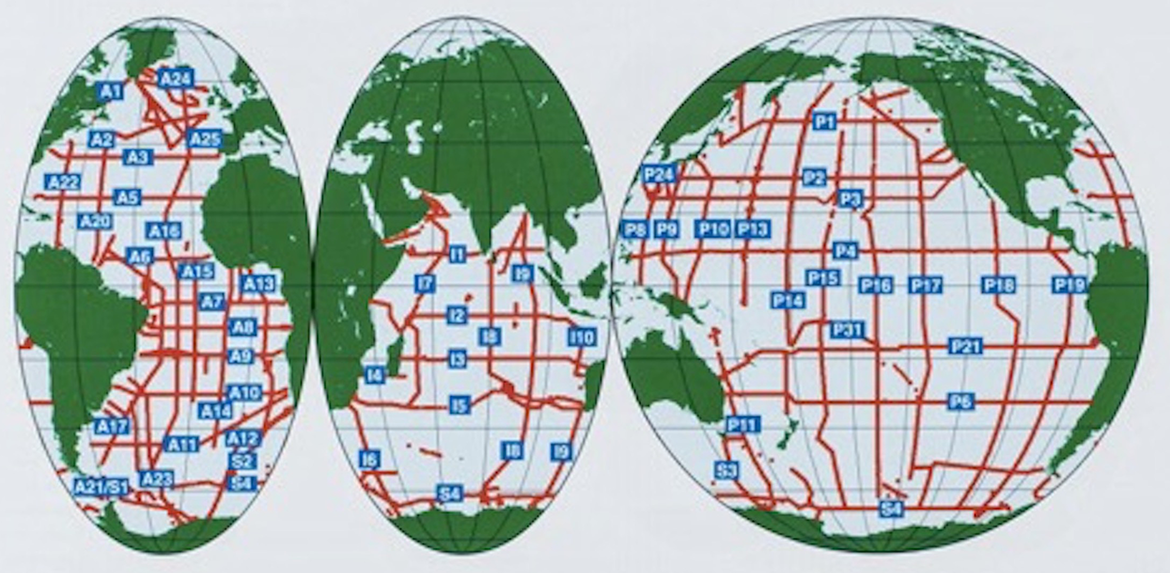
WOCE one-time survey lines. Source: WOCE Southern Ocean Atlas. Reproduced with permission.
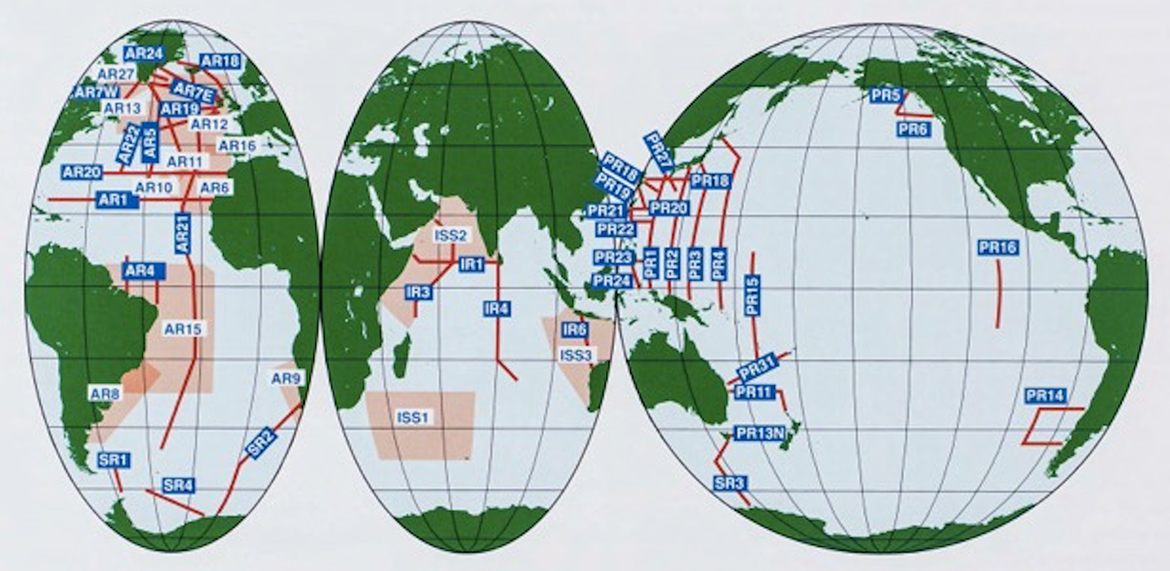
WOCE repeat hydrography study lines. Shading indicates areas of intense study. Source: WOCE Southern Ocean Atlas. Reproduced with permission.
WOCE’s ship-based program was augmented by observations from other in situ instruments and from new satellites; the geography of measuring the sea extended to the sky. The US/French designated altimetric satellite TOPEX/Poseidon was launched at the outset of WOCE, and the program also benefited from, among others, Europe’s ERS-1 satellite and Japan’s ADEOS mission (Lamy 2018). As satellites can only measure the ocean’s surface, a range of additional technologies were marshaled for WOCE, in addition to ship-based sampling. Some of these technologies were fixed in place, such as ocean moorings, while others were mobile. Some were autonomous, while some required scientists to operate. The diversity of these technologies shows the difficulty of contending with the ocean’s physical properties on a global scale. 3 Many of these technologies, especially the autonomous and semi-autonomous sensors, are recent ancestors of the sensing networks that play key roles in contemporary ocean monitoring (see e.g., Gabrys 2016; Helmreich 2019; Lehman 2018).
Participating scientists were responsible for collecting the data and reporting it to the WOCE Data Assembly Centers. WOCE had significantly higher standards for both data collection and reporting than most previous projects in global oceanography (Fofonoff 1992). The project’s staff scientist was tasked with reminding the investigators of their obligation to report data in a timely and open fashion (WOCE Project Manager, interview, February 2014). Data Assembly Centers staff were also tasked with a high degree of quality control, toward which they took measures both before and after data collection. As the project’s staff scientist explained: The different data types all had their own specifications, and that was a deliberate policy to reduce the uncertainties due to poor data quality. […] So every single bit of data, every profile, and every segment in a time series was examined visually by a human being who knew what they were doing, so we could flag data […] And that was a massive challenge, and also that was another example of cooperation. (interview, February 2014)
Encountering Ocean Variability
The terms in which scientists speak of the project’s overarching aims point to the degree to which the ocean was unknown prior to WOCE and consequently to the complexity and necessity of the questions it sought to answer. As one oceanographer who worked on the project stated, “[WOCE] was driven by, basically there was a question about what actually is the ocean circulation like? You know, how strong is the Gulf Stream, really? And at that time, we still only had vague numbers on that” (Oceanographer 2 [US], interview, April 2014). The project’s manager identified similar concerns: “You know, you have typically kind of a cartoon picture in your mind of what the general ocean circulation looks like. And we just didn’t know what the current, heat transport of these sections really was” (interview, February 2014).
To understand the significance of WOCE to the global infrastructure that makes the ocean-atmosphere knowable, we might begin by thinking with a diagram: the “conveyor-belt” heuristic of ocean circulation. The deep sea was once thought to be stagnant and devoid of interest to humans (Rozwadowski 2005). Currents and tides, basic elements of ocean circulation, became of interest to oceanographers as the scientific perspective became the main way by which oceans were known. This transformation took place in the nineteenth century, perhaps most exemplified by the Challenger expeditions of 1872–1876 (Reidy and Rozwadowski 2014). Yet it was not until the postwar period that international collaborations, such as the International Geophysical Year, began to obtain a clearer picture of global-scale ocean circulation (Lehman 2020). Decades prior to the advent of ocean-atmosphere modeling capabilities, scientists began to call the ocean the “flywheel” of the climate system (e.g., Bretherton 1982; McGowan and Field 2002; Sullivan 1961). In other words, the ocean is believed to act as a “governor on climate variability” through its motion and slow release of energy and other properties (McGowan and Field 2002, 9). While the ocean’s impact on climate has long been suggested, the extent and mechanisms of this relationship have been relatively underexplored. As eminent oceanographer Walter Munk (2002, 135) wrote, “the oceans are the principal reservoir for the storage of CO2, of heat and of ignorance.”
In the years preceding WOCE, global ocean circulation and its role in climate was summarized by geochemist Wallace Broecker’s (1987) “conveyor-belt diagram,” which first appeared in the November 1987 issue of the popular science magazine Natural History and soon after became the logo for the Global Change Research Initiative (GCRI; Figure 3; see also Broeker 1991). The use of the conveyor-belt diagram as the logo for the GCRI suggested that “changes in the Atlantic’s thermohaline circulation were responsible for the abrupt and large climatic changes experienced by the North Atlantic basin during the last glacial period” and thus emphasized the emerging concern that “complex interconnections among the elements of our Earth’s climate system will greatly complicate our task of predicting the consequences of global pollution” (Broeker 1991, 79). Thermohaline circulation refers to ocean circulation caused by heat and salt differentials, rather than surface winds or ocean bathymetry, and is the primary mechanism of interest, particularly when it comes to climate. The conveyor-belt diagram illustrates the ocean’s role in climate by showing how currents distribute warm and cool waters around the globe. The diagram, still produced in oceanography textbooks and popular science media, conveys a picture of ocean circulation as moving sinuously around the globe, cyclical with regard both to deep-shallow current patterns and to global surface extent; the diagram “implies that if one were to inject a tracer substance into one of the conveyor’s segments it would travel around the loop as a neat package eventually returning to its starting point” (Broeker 1991, 79).
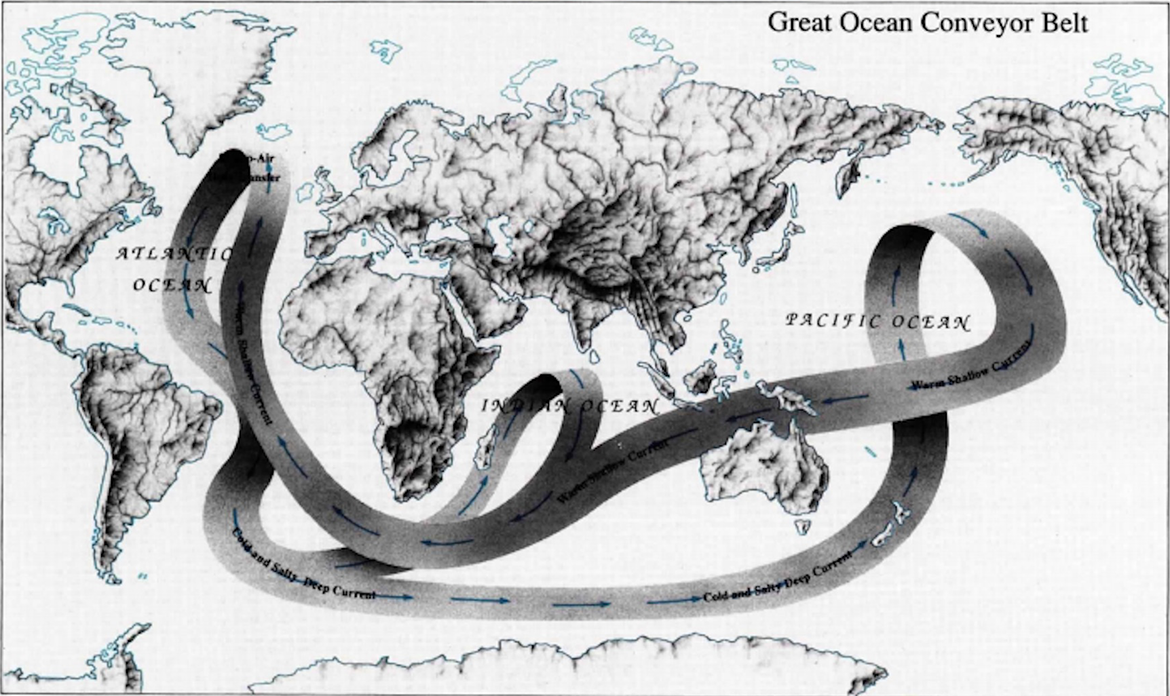
Wallace Broeker’s conveyor belt diagram (illustration by Joe Le Monnier for Natural History Magazine, 1978). Reproduced with permission.
The popularity of the conveyor-belt diagram belied scientific debate about its accuracy in characterizing global ocean circulation. Even at the time of the diagram’s publication, Broeker (1991) acknowledged that it is a rough approximation, stating that the diagram’s suggestion of the ocean’s simple circularity was in fact its “main problem,” and that different circulation “loops” and mixing processes surely exist (p. 79). This view was informed by the results of the Mid-ocean Dynamics Experiment (MODE), an American–Soviet collaboration undertaken in 1973 to understand mesoscale features by American and Soviet scientists, independently and in collaboration, using a new generation of current meters and drifting buoys (Oceanographer 3 [South Africa], interview, October 2014; see also Wunsch 1999; Stammer and Böning 1992). MODE “provided conclusive evidence of the existence of mid-ocean eddies and serve[d] as the basis for future experiments,” such as the Tropical Ocean Global Atmosphere Program (The MODE Group 1978, 859). Due to the advances of the MODE and related projects, “[oceanographers became] aware that the oceans were as variable as the atmosphere. Before that, the view was that the oceans were rather sluggish, slow-moving and passive in a sense” (Oceanographer 4 [UK], interview, February 2014). New satellites corroborated this evolving image, showing the widespread presence of eddies, in contrast to the smooth loops of the conveyor-belt diagram. These mid-ocean mesoscale eddies lacked unifying characteristics, appearing to vary so greatly that oceanographers wrote of “new animals for the eddy zoo” (Richards and Gould 1996, 63). Lack of systematic and frequent ocean sampling had missed crucial eddy formations: “Incredible as it may seem, for one hundred years this dominant component of ocean circulation had slipped through the coarse grid of traditional sampling” (Munk 2002, 137).
During WOCE, scientists were faced with an image of ocean circulation that was far more complex than even the critics of the conveyor-belt model had anticipated. The data obtained from satellites and other new or improved forms of sampling began to suggest that eddies were not (only) deviations from the mean ocean circulation but in fact were formative features of the state of the ocean at any given time. In other words, ocean circulation is characterized less by the steady flows of the conveyor-belt heuristic and more by swirling, fluctuating, meandering features that follow the laws of chaos and complexity rather than linear calculation. These eddies and related features indicate complex mixing between vertical layers of water, which has profound influence on how the ocean interacts with the atmosphere (Wunsch 1999). Hence, WOCE scientists were forced to grapple with this newly complex view of ocean circulation, as the first and largest attempt to understand the ocean in dynamical terms on a global scale.
Particularly challenging was the imperative to model the ocean to contend with this massive complexity. To quantify global ocean circulation in order to run models that can predict future change, one must obtain mean or average values (or parameters) for factors such as momentum, transport, volume, and others. In other words, models ultimately require some approximation of the average state of the ocean, and how and when the ocean diverges from the average. This is especially important for understanding climate change: baselines are needed to determine whether and how it is changing, and on what scales. Understandings of the ocean as governed by the nonlinear dynamics of mid-ocean eddies greatly complicated this endeavor. The physical conditions of the ocean already make measuring it difficult, and observational data are thus scarce. These difficulties are compounded by challenges around how and when one should measure an entity that is always changing. A strategy of annual sampling cannot capture seasonal variability, whereas more frequent measurement might miss long-term changes and might generate data in excess of existing computational capacity. Furthermore, because of the scarcity of ocean observations, scientists have treated ocean data that were gathered over long time frames as simultaneously collected (Oceanographer 5 [US], interview, April 2014; see also Wunsch 1992). In fact, it has been suggested that it is not even possible to conceive of a mean state of ocean circulation (Wunsch 1992).
The WOCE encounter with ocean variability can be understood as an encounter with the potential limits of planetary-scale knowledge. This clearly marks an epistemic limit; it may not be possible to know the ocean on a planetary scale. It also marks an infrastructural limit; even if such knowledge is possible, what vast, global infrastructure would be sufficient for quantifying it? These limits, however, do not necessarily block or curtail scientific activity; rather, attention to WOCE and its aftermath shows that they have been productive of scientific thought as well as world-making ocean sensing practices. Edwards (2010, 9) follows other scholars of infrastructure to explain that “because infrastructure is big, layered, and complex, and because it means different things locally, it is never changed from above. Changes require time, negotiation, and adjustment with other aspects of the systems involved.” The unevenness of the changes in the development of the global ocean knowledge infrastructure following WOCE is enmeshed with global environmental politics more broadly.
WOCE and the Global Oceanographic Infrastructure
In order to understand WOCE as a productive limit for global oceanographic knowledge, we must first better understand how it was both situated in and productive of networks of global oceanographic expertise. The concept of the ocean as characterized by variability “drives one to expensive observational and modeling strategies involving synoptic pictures of the entire global ocean” (Wunsch 1999, 13235; see also Lehman 2016). Thus, although WOCE provided valuable baseline data for evaluating climate change, ocean variability continues to be a topic that places great demands on oceanographic research worldwide. While WOCE suggested that ocean variability is a limit to oceanographic knowledge, this limit has produced a global knowledge infrastructure whose development, like other infrastructures, “is marked by struggle” (Edwards 2010, 12). But going beyond the work of Edwards, we can see that this global knowledge infrastructure does not simply create knowledge or even stabilize a certain image of the ocean. It is a world-making apparatus in other ways as well, coproducing a global oceanographic community and advancing a particular knowledge agenda.
From the outset of WOCE, the uncertainty about the large-scale dynamics of the world ocean called for an international approach, and the collaborative nature of the project was emphasized in interviews and official documents. Among the oceanographic community, WOCE is frequently celebrated as having achieved ambitious scientific goals and successfully undertaking a perhaps-unprecedented project of collaboration. As the project manager said, [Prior to WOCE] individual experiments had been done, [but] they were all sort of analyzed individually, and there wasn’t this sort of coherent global effort to come up with a very large picture with everybody sort of contributing to it. I mean, it was hugely ambitious, I think, […] to get the cooperation of an entire international community. It’s fantastic, an amazing thing to do, I think, and something that hasn’t been repeated, and I don’t know if it ever will be repeated. (interview, February 2014)
WOCE received support from the Special Committee for Oceanographic Research to finance the international project office (IPO) in the UK and to fund workshops and meetings. The funding for the research had to come from the participating nations’ science budgets (WOCE Project Manager, interview, February 2014; SCOR Representative, interview, October 2014). Nations designated scientific funds for participation in WOCE for various reasons, as discussed in more detail below. Yet the statements of those closely involved with WOCE are indicative of the complex interplay of international collaboration and top-down management that characterized WOCE from the start. While in hindsight (or even at the time) WOCE seems like a natural or even inevitable development in oceanographic science, its extent and success were due in no small part to the championing of its early advocates, most of whom were located in prestigious oceanographic institutes in Europe and the United States. Exceptional among these was Carl Wunsch, then of the Woods Hole Oceanographic Institute; one oceanographer even joked with me that the WOCE acronym most accurately stands for “Wunsch’s Own Circulation Experiment” (Oceanographer 3 [South Africa], interview, October 2014). Another put it somewhat more generously: “Carl was remarkable because he was sort of the, in a sense the political leader of this thing […] And at the same time he was doing all this wonderful science” (Oceanographer 2 [US], interview, April 2014). Wunsch was able to mobilize a small but influential network of collaborators to launch WOCE as a project of the new World Climate Change Research Program. The influence of this small group of European and North American oceanographers also set a precedent for WOCE to be led from established centers of oceanographic research. As WOCE expanded its international purview, decision-making became somewhat more democratic, although it would continue to be led by the Scientific Steering Group, composed mainly of members from hegemonic oceanographic science centers. The machinations of WOCE are counter-indicative of a view of global knowledge infrastructures as evenly distributed, apolitical nodes through which data freely flow.
Despite the postproject laudatory language, WOCE had numerous complications. Some of them had to do with the phenomenon of study itself; certain segments of the hydrographic program, especially in the Southern Ocean, proved difficult to execute due to the remoteness and rough seas (Oceanographer 4 [UK], interview, February 2014). Other problems had distinctly geopolitical and technopolitical dimensions. The years preceding and encompassing WOCE bore witness to global transitions that affected the oceanographic program. For example, the collapse of the Soviet Union led to the withdrawal of many Soviet scientists and their advanced fleet of research vessels (Oceanographer 4 [UK], February 2014). Worldwide economic recession between the planning and implementation phases of WOCE also necessitated significant adjustments to the program (Oceanographer 4 [UK], February 2014). And while new communication technologies such as email and electronic file sharing improved international coordination, they did not make exchange seamless. For example, despite a significant amount of communication between the directors of South Africa’s WOCE program and the IPO in 1990–1991, just a few years later, there was much confusion as to whether any WOCE cruises had been executed, and the status and location of the resulting data (WOCE Project Manager, interview, February 2014). The field program was extended from five to seven years in part to contend with some of these challenges.
The geography of WOCE shows that global knowledge infrastructures are not simply distributed unevenly throughout the globe but are also tied to specific geopolitical events and ideologies. Moreover, the connections that make global data, in Edwards’ (2010) words, are themselves uneven and require coordination and maintenance, especially under dynamic understandings of the ocean that seem to call for more continuous and global monitoring. These efforts not only shape scientific views of the ocean but also what counts as global ocean research, setting priorities for international oceanography and reinforcing global economic and political regimes of ocean governance. In this sense, I build here on coproductionist approaches to show that not only is “scientific knowledge […] constituted by social practices” but also that social, economic, and political regimes are influenced by scientific knowledge activities, and not just the “facts” that result (Jasanoff 2004, 19).
By analyzing the configurations of global oceanography in the wake of WOCE, we can see that productive limits do not simply result in new and extended infrastructures but entrench political and social inequalities. The international ambit of WOCE has already been revealed to be unevenly distributed, with power located in a few centers. But the encounter with ocean variability, and the limits to oceanographic knowledge that it revealed, also produced further unevenness, rather than simply extending global networks. This occurred precisely through the promotion of a certain kind of global-scale oceanographic research in response to the challenges of ocean variability as they were encountered by the networks of expertise discussed above. In the administrative and conceptual organization of oceanographic science, a division is frequently made between coastal and “open-ocean” research. Coastal oceanography focuses mainly on concerns regarding fisheries, coastal tourism, and the pollution and health of coastal ecosystems, and it is frequently subject to local or national governance as it occurs mainly in territorial waters. Coastal research is most often prioritized by nations without large budgets for scientific research (Oceanographer 6 [South Africa], interview, November 2014). Open-ocean research occurs mainly in international waters or the high seas and therefore often requires greater international coordination on the diplomatic level. Open-ocean research is usually concerned with macro- and mesoscale dynamics, such as ocean circulation, eddy formation, and current transport. However, many of these dynamics, such as eddy formation and other kinds of variability, have impacts at and across a variety of scales; in the United States, this is acknowledged by recent increased emphasis on cross-scalar studies at the level of the National Science Foundation (NSF Officer, interview, August 2014). Ocean variability might even have greater impacts in coastal environments because the seabed geology, landmass influence, and local weather patterns compound the complexity (Oceanographer 7 [South Africa], interview, February 2016). Further, “global oceanography” could also be defined as regarding issues faced by coastal communities across the globe. However, this has not been the case.
The open-ocean research community coheres around nation-states that invest capital in oceanography; national income is a large contributing factor and frequently a condition of possibility. During WOCE national investment in oceanography and geographic range and extent of oceanographic surveys were directly related. National programs with significant historical investment in oceanography also pioneered technologies and data reporting strategies. Countries with smaller budgets, however, emphasized the need for project activities to demonstrate national benefits and to include training and capacity building for their scientists. Furthermore, for these countries project activities were carried out as part of normal operations, requiring simply added data reporting and sometimes new technological investments, in contrast to wealthier nations that undertook more intensified cruise programs. 4 Accordingly, nations with fewer oceanographic resources tended to work on their own coasts or nearby oceans while countries with larger budgets and hence research vessels capable of being at sea for many days, ranged more widely over the globe. And as the most significant collaborator, the US program “went everywhere, yeah. Anywhere” (WOCE Project Manager, interview, February 2014).
But investment in oceanography is a function of territorial power, not just wealth or expertise. Countries with larger areas of marine jurisdiction, such as exclusive economic zones (EEZs), and greater international responsibility for providing marine meteorological data, are more likely to be invested in global-scale research projects, while countries with smaller EEZs and fewer international obligations are frequently more concerned with coastal issues such as fishing, tourism, and coastal degradation (Oceanographer 6 [South Africa], interview, November 2014). For example, the only country on the African continent with responsibilities for marine meteorological forecasts (due to their participation in the Antarctic Treaty) is South Africa; thus, it was the only African country to participate in WOCE (Oceanographer 6 [South Africa], interview, November 2014).
Moreover, WOCE contributed to iterative cycles of expertise and investment. Patterns of responsibility and reputation for oceanographic research are of course self-reproducing: countries with reputations for excellent global oceanography are asked to be scientific and monitoring partners and are better able to benefit from their marine resources. Likewise, WOCE provided the initial funding impetus for many national programs that have continued to develop, such as the US’s studies on air-sea fluxes (Oceanographer 1 [US], interview, April 2014). In addition, the project created a framework for the reinvigoration of participating oceanographic programs, such as the refurbishment of research vessels and development of new float technologies (Oceanographer 4 [UK], interview, April 2014; Oceanographer 5 [US], interview, April 2014). When it came to the ships, this was no small undertaking; at least three major research vessels were “chopped in half, lengthened, given longer endurance, bigger scientific party; really equipped [for] the century” (Oceanographer 4 [UK], interview, April 2014).
This discussion of the aftermath of WOCE shows how the encounter with ocean variability can be understood as not simply suggesting a limit to oceanographic knowledge but also as demanding a response. Thus, this limit is productive, engendering a particular configuration of global science, coproduced by social, political, and material forces. WOCE shows indeed that “the resolution of any significantly new problems in science is seen as requiring situated and specific (re)structurings of social order, without which scientific authority itself would be put in jeopardy” (Jasanoff 2004, 31). Yet, the “problem” of ocean variability and its relationship to the very systematicity of the Earth should be considered as the posing of a potential limit without clear resolution: it may not be possible to know something so fundamental as the mean state of the ocean. In other words, it may not be achievable to move from knowledge of the ocean’s capacities to the estimates of its regular activities that are required for accurate climate modeling (Cartwright 1999). At the same time, productive limits should not be understood as producing something entirely new. WOCE shows that the “social order” of the global oceanographic community, and global ocean governance, is iterative and recursive even as it attempts to deal with the “new problem,” or productive limit, of ocean variability.
Conclusion: Variability, Productive Limits, and Planetary Systems
WOCE marks a departure in planetary oceanographic knowledge from the steady, self-regulating world ocean of the sinuous, connected loops of the conveyor-belt diagram. But the limit to planetary knowledge suggested by the encounter with ocean variability during WOCE is more than a suggestion of ocean’s unknowability or of the contingency of global-scale knowledge. Although scientists themselves recognize that “scientific reliability is situated, bound to the constraints of its production” (Stengers 2011, 9), even approximations and estimations suggest that a “mirror model” might be possible given enough data. WOCE challenges this assumption, showing that increased data led not to a straightforwardly more accurate picture of the ocean but rather to fundamental uncertainty about how the ocean operates.
As a result of WOCE, scientists came to understand ocean circulation as characterized by eddies, jets, filaments, and other rapidly changing mesoscale features rather than mostly by big, slow currents; in other words, the ocean was discovered to be much more variable than previously suspected, and this variability has profound consequences for exchanges of heat with the atmosphere. This new understanding of the significance of ocean variability posed a problem for conventional ways of knowing and modeling the ocean especially in relation to the atmosphere at the very moment when doing so was becoming increasingly urgent. Thus, reading WOCE for its productive limits may not challenge the notion that science creates truths about the world but may instead prompt a different understanding of the nature of the truths that are created. Scientific knowledge is not simply partial, situated, and coproduced; it is shaped through affective encounters with material forces, perhaps along the lines of Ruddick’s (2010) argument that “thought emerges through the violence of the encounter––not recognition or joy, but when one is forced to think” (p. 36; see also Pickering 1995). The scientific thinker, then, is not so much objective and distanced as confused, conflicted, even sometimes adrift.
In her writing on systems-theory informed views of the Earth as a bounded, self-referential, cohesive entity, Colebrook (2012, 39) advocates doing away with such “whole-Earth” images and on the contrary searching for and nurturing “forces that resist recuperation, incorporation and comprehension—forces that operate beyond intentionality and synthesis.” Reading WOCE for its productive limits shows that these forces may be found within systems dynamics themselves (see also Braun 2015; Nelson 2014). The elements of ocean variability impact systemic relations between the ocean and atmosphere, but they do not lend themselves to a notion of self-healing interconnectedness. Moreover, it cannot be said that the ocean exhibits great variability but returns over time to a steady state; despite the ocean’s role as a regulator of climate, the most advanced scientific methods cannot determine over what timescales this holds true. In fact, studies suggest that on long time scales, the ocean is highly unstable and drives instability in the ocean-atmosphere system and thus for life on Earth.
To fully understand the implications of this uncertainty, however, the notion of productive limits insists that the results of global-scale science and the conditions under which it is executed be considered together. Productive limits, as I have employed the term here, is useful because it recognizes the potential of the ocean to be fundamentally unknowable to Western science, but it does not allow scholars of science and technology to stop at this material intractability. Along with understanding the limitations of science in its modern form to address complex questions, we also have to reckon with the ways in which science has defined the questions we ask, as well as the questions we believe can, should, and must be asked. In this way, we can continue to challenge the “bifocal conception of science” that holds apart universal knowledge from the concrete places and practices from which it emerges (Latour 2017, 127). This is all the more important given the enormous knowledge infrastructures and increasing explanatory power of planetary scientific knowledge. A major task for scholars of science and technology is to engage with the power of these knowledge structures, while seeking to cultivate new relations to what can be known, and to limits in all of their productive ambiguities.
Footnotes
Acknowledgments
The author would especially like to thank the scientists who generously shared their time and expertise to be interviewed for this project. Thanks also to the librarians and archivists at the National Oceanography Library at the National Oceanography Centre Southampton and to the Marine Research Institute at the University of Cape Town for supporting this research. Thank you to Bruce Braun, Wilko Hardenberg, Etienne Benson, and members of the Geographies of Life research cluster at Durham University, in addition to two anonymous reviewers and the editorial staff of Science, Technology, & Human Values, for providing insightful feedback on previous drafts of this paper. Any errors are the fault of the author.
Declaration of Conflicting Interests
The author(s) declared no potential conflicts of interest with respect to the research, authorship, and/or publication of this article.
Funding
The author(s) received no financial support for the research, authorship, and/or publication of this article.
