



Abstract
Retrofit is a rising area of concern for Science and Technology Studies (STS) scholars of infrastructure. This paper sits at the junction between applied and theoretical approaches by using STS to support interventions in urban infrastructure systems and expand STS critique of retrofit. It discusses findings from a multidisciplinary project piloting retrofit possibilities to positively impact the way water, energy, and food resources were consumed in a London housing estate. Through qualitative research, we found that residents were making social and material interventions in infrastructure systems to manage the way resources were consumed at home, driven by a commonly held motivation to avoid wastefulness. We then mapped the social and material factors that helped or hindered these individual ambitions and used them to inform our codesign process. We found it helpful to think of the residents as an infrastructural community; a group of residents that share a material connection that can help mobilize collective action on shared consumption. We suggest this concept is useful for interventions and critiques of infrastructure retrofit, particularly in cities in the Global North where retrofit programs aim to rescale national systems to neighborhood levels. The concept highlights the possibilities for participation that emerge from bottom-up retrofit.
Keywords
Introduction
The bath in Hellene’s 1 flat is a source of concern to her. Hellene is a social tenant in an inner-city housing estate and her flat, like the majority, comes with a bath but not a shower. Hellene explains that when her children were young, they would happily share a bath but now her teenager refuses and demands her own bath water. Hellene feels a shower would be less wasteful but lacks the space and means to add one. She also faces the slight disincentive that, as a tenant, she may have to reverse any material changes she makes inside her flat if she moves out. As a consequence, after her son has bathed, Hellene has to watch hot water disappear into London’s overburdened sewer system before refilling the bath with more hot water for her teenager. Although she is not on a metered supply and faces no economic penalty, she said she found it “depressing to see it go up and then down.” Hellene’s concern about the bath and her child’s bathing habits is not about the impact on the household budget but rather the impact of her household on the city’s water resources.
Hellene’s experience relates to an area of current policy intervention: improving the resource efficiency of household hardware and habits to improve urban sustainability. Such ambition is particularly the case in cities like London with its aging infrastructure, increasing demand and aspirations for a zero waste, and low-carbon future (Greater London Authority 2017). In line with other cities, City Hall is looking at how utilities supplying resources to homes can be made more efficient and, in particular, how residents can act on the demand for resources. Large-scale retrofitting is taking place to upgrade water, gas, and electricity networks with smart technologies that allow the home to become a more predictable and manageable element in the network. Retrofitting to “decarbonize, digitalize, and decentralize” national systems is pursued under the assumption that the path to resource efficiency lies in creating incentivized consumers. Hellene’s concern suggests there are other pathways for infrastructural efficiencies that make use of the affective quality of infrastructure and the other subjectivities it enlivens beyond that of “consumer.” As Hellene’s bath is drawn into the urban infrastructural network, it becomes a target for policy intervention but it is also the material with which she can participate in urban sustainability, as Marres (2012) has argued. This makes it a site to explore an emerging area of STS research “object-centered engagement” as articulated by Lezaun et al. (2016, 205) and we argue, a useful tool in understanding and engaging with retrofit.
Experimenting materially to participate in “sustainable transition” has been identified by Lezaun et al. (2016, 197) as an “emerging nexus of research, theory and practice in STS.” In postindustrial societies like the UK, government, industry, academia and publics are forming hybrid groups and tinkering with the fabric of cities to produce evidence, knowledge, or action in the name of sustainability. Lezaun et al. (2016) identify such experiments in participation as central to two areas of STS scholarship: the role of the experiment in producing scientific knowledge and experimentation with methods to support engagement and public understanding of science by STS practitioners. The project discussed in this paper sits at this junction of theory and practice. It presents a case study of infrastructure retrofit as a technical intervention guided by a critical theoretical investigation. The study worked in partnership with a residents’ group to pilot small scale technologies that could be retrofitted in an urban housing estate to reduce resource use.
In this journal, Howe et al. (2016) identify retrofit as an under-researched but key area for infrastructure studies. Retrofit makes seemingly solid infrastructure malleable and in doing so creates opportunities for residents and researchers alike to produce new infrastructural arrangements guided by critique rather than national, technical, or commercial priorities. Retrofit produces a particular type of infrastructural context in a city like London. It is driven from the top by national targets, utilities subject to central government regulation, and profit-seeking industry. At the same time, retrofit is an issue that mobilizes from the bottom as individuals and local groups remake their environment and intervene in relations of production and consumption and experiment with alternative circulations of resources. It is therefore a useful site to examine the interplay between the normative framing of material participation and alternative logics that are created through infrastructural intervention.
Our project focused on water, energy, and food (WEF) applying a “WEF nexus” normative framework but embedded within a “material participation” approach (Marres 2012; Lezaun, Marres, and Tironi 2016). This explores how technologies and appliances, the tendrils of infrastructure in our homes that we use to consume resources, have explicitly become the materials through which we participate in public life and produce societal change (Marres 2012). Lezaun et al. (2016) argue for deeper understanding of the normative agendas shaping our interpretation and use of the materiality of our homes, but also to prospect for other knowledge and values contained and enlivened through experimental tinkering with this normatively laden materiality. We created a picture of domestic resource management built from residents’ own knowledge and values. Through this, we found that “wastefulness” rather than “efficiency” was a key trope in residents’ interpretation of resource consumption. It motivated residents to experiment with the infrastructure in their homes and in their housing estate. 2 We also found that as consumption was adjusted to the local infrastructure supplying resources, it became a way to construct an ethical consuming self and delineated a series of “others” who were connected to the same the system but did not consume in the same way. This prompted us to explore the residents as a community of infrastructure and investigate where to make an intervention that could work with this sociomaterial community.
Retrofit and Remaking Infrastructure
In the face of climate change, infrastructures supplying resources like WEF are increasingly scrutinized by governments, industry, and the academe to understand the resource intensity of consumption they enable and how this may be altered. Large-scale retrofit of the urban built environment is a priority for states in the Global North to meet emissions targets and ensure the continued liveability of their cities. In the UK, the focus is in on “deep retrofitting” and involves three key areas: improve building fabric through insulation and better glazing, reduce consumption through more efficient (digitally managed) appliances and people’s usage, and decarbonize the power supply through renewable, often local generation (Boardman 2007). The latest advice from the UK’s Committee on Climate Change is to include water efficiency and green infrastructure along with energy retrofits in order to not just reduce emissions, but begin the project of adapting to life in a changed climate of heat waves and flooding (Holmes et al. 2019, 9-13).
The three areas of retrofit target different material objects and parts of the built environment, consequently implicating different but overlapping sets of policies, technologies, and social archetypes. Fabric retrofit requires the participation of building owners, occupants, and the construction industry incentivized through market mechanisms, or where the market fails, mobilized by utilities or local authorities under central government requirements (Mallaburn and Eyre 2014). Digitalizing the infrastructure through the roll out of smart metering technology is mandatory for energy suppliers and optional for water utilities. It focuses on the contractual relationship between suppliers and their consumers and enables demand management programs that have been described by Van Vliet (2016; see also Van Vliet, Chapells, and Shove 2005) as turning customers into comanagers of resources, who work with utilities to deliver efficiency savings. Decentralizing infrastructure and the shift toward local networks that balance supply and demand involves new actors like technology companies. It also means that local authorities and community groups are moving into the utility sector, alongside the incumbent industries exploring new models and partnerships for creating and distributing resources locally.
The current status of retrofit in UK cities, then, is that it is happening across sectors and across scales provoking a very diverse array of innovation and experimentation. It is altering traditional infrastructural categories of producer and consumer. It is redistributing responsibilities and opportunities across private, public, and not-for-profit sectors. As Hodson and Marvin (2016, 270) summarize, “retrofitting at city scale is a hetergeneous endeavour.” Despite the heterogeneity of retrofit activity, a unifying discourse is that retrofitting to improve resource efficiency creates so many associated benefits that it is a win-win situation, as Knox (2018) has aptly argued. She suggests that an earlier logic of sacrifice—that one needs to cut down to create something new—has given way to one where no sacrifice is required. Efficient resource use lies in one’s own best interest. Furthermore, consuming inefficiently “constitutes transgressive behaviour in the face of financial reasoning” (Knox 2018, 122). Such a perspective can be seen in some accounts of reasons why retrofit is not happening fast enough to deliver on national targets, listing common market barriers such as a low prioritization by building owners, a fragmented construction sector and supply chains, and limited finance (cf. Palmer et al. 2018; Holmes et al. 2019; Intergovernmental Panel on Climate Change 2019), all of which inhibit the retrofitting of the context within which the climate crisis can be alleviated. The neoliberal framing is a dominant narrative, particularly in government analyses given their reliance on the market to deliver retrofit, but it is not the only one. Other values and priorities can radicalize the infrastructural tendrils in people’s homes and galvanize action.
Marres’s (2012, 118) work on material participation has highlighted the way that materiality reproduces normative agendas, but she also draws attention to the differences between “discurscive understandings” of a material’s politics and its “empirical politics.” By focusing on empirical examples, it becomes clear how experimental the politics of materiality is, both in form and content. The dominant discourse associated with retrofit activity may be neoliberal, but the empirical activities may not reproduce this discourse and may open up new forms of collaboration and value. Marres’s (2012, 205) argument for “reframing participation as something done with things” is a way to consider community-led infrastructural experiments such as local food growing projects, community energy systems, or rain gardens providing sustainable urban drainage. These types of interventions can deliver on retrofit targets by producing system-level benefits such as reducing the carbon intensity of grid electricity, reducing flooding or water treatment need. However, participation may also create new forms of local economy through ethical consumption, generating local income or employment, or finding ways to create local redistribution mechanisms.
Rescaling infrastructure is an ambivalent process. It can be interpreted as evidence of “Splintering Urbanism” and the loss of universal access as an organizing ideal (Graham and Marvin 2001). Critical research on neighborhood scale infrastructural experiments demonstrates that social benefits are produced at different geographic scales and within different time scales, while also unevenly encumbering different groups with risks, exclusions, or other negatives. Researchers question which communities are served by these initiatives with concern that they benefit better off and better resourced socioeconomic groups (Catney et al. 2013). Other research has argued that the label “community” obscures uneven power relationships produced in projects where an external developer works with a community group (Walker and Devine-Wright 2008) and ignores local contests over which “community” gets to define the use of local resources (Armstrong and Bulkeley 2014).
Our approach was to consider the way that rescaling infrastructure relies on an existing material connection between groups of urban residents. The drive to decentralize pursued within urban sustainability policy delineates groups of people who share key parts of infrastructure, such as a secondary electricity substation or a drainage network. These urban neighbors may not know one another or hold values in common and yet their individual actions can be aggregated to provide system-level services. Thinking of these groups as residents who share a material connection that may or may not align with how they identify with location or interest-based groups may prove useful and relevant. Our project experimented with this connection. We were interested in exploring the possibilities that are opened up when the shared materiality is brought to mind, not through a utility-led market offer or through a power cut or collapse, but through an invitation to experiment and intervene as a “community of infrastructure.” Rather than establish a set of technical or market opportunities for retrofit, we felt this approach could “test the capacity of objects, as well as subjects, to render wider issues relevant, above and beyond already-established problem definitions” (Lezaun, Marres, and Tironi 2016, 206).
The project discussed in this paper was funded by the UK’s Engineering and Physical Sciences Research Council to promote innovation in design and manufacturing. The project was framed as a response to the WEF nexus research and policy agenda. The WEF nexus is a normative framework that looks across WEF systems to find cross-sectoral efficiencies and improve resilience. It is a research framework that promises to bridge disciplines and sectors to create applicable and impactful interventions but has been criticized for ignoring power relations between “sectors, disciplines, and forms of legitimate knowledge” (Cairns and Krzywoszynska 2016, 169). The urge to find integrated “nexus” solutions tends toward a depoliticized managerial process and the dominance of technical and market solutions that overlook social and ecological impacts (de Grenade et al. 2016). Its cross-sectoral solutions struggle to be applied in urban contexts, where incumbencies and path dependencies limit the potential to remake infrastructures (Romero-Lankao, McPhearson, and Davidson 2017).
Guided by an interest in material participation, this project took a different approach. We examined the interplay among water–energy–food consumption but focused on understanding residents’ own interpretations and aspirations for how these resources could be managed and the role that the materiality of their housing estate played in shaping these perceptions. We discussed with households the way they used WEF, but also the small oddities that unsettled the residents’ usual habits or caused them to think things could be altered or improved. We took this approach to design interventions that acknowledged the distribution of agency and were in line with residents’ own ambitions for less resource intense consumption.
The exploration of residents’ position within WEF nexus infrastructures and practices was the second of six stages of a codesign process, intended to operationalize a form of “object-centered engagement” into an engineering project lifecycle (Lezaun, Marres, and Tironi 2016). The six stages are (1) Setting Aims, (2) Characterizing Communities, (3) Requirement Capture, (4) Evaluating Options, (5) Detailed Design, and (6) Evaluation. The detailed characterization of community experience, expectations, and values related to WEF infrastructure are reported in this paper and provided the foundation for working with communities to define requirements for retrofitting WEF infrastructure to reduce resource and environmental impacts and enhance community value. Once the requirements were agreed, the research and design team identified options for meeting those requirements, which were further evaluated by the community, resulting in rainwater harvesting being selected as the retrofit option for detailed design. The characterization and analysis of infrastructural experiences and everyday resource-dependent practices were undertaken as the starting point for bottom-up intervention in sociotechnical systems, using a codesign process, which in turn was grounded in critical accounts of infrastructure and engineering design. Following residents’ own priorities, we focus on water and energy. Food, although included in the research, is not covered in any depth in this paper.
Case Study
The first step was to find a group that would be willing and able to participate in the research project; pursuing what Stirling (2008) describes as a “substantive” rationale for public participation. We felt that engaging a group of residents would lead to a substantively different outcome than if we designed an infrastructure intervention without them. Furthermore, our project was open to any form of technical or social intervention across the three sectors (WEF). Nonetheless in being a pilot study, we were also instrumentalist in our need to find and work with a group of people who could experiment with their local infrastructure (see Delgado, Kjølberg, and Wickson [2011] for a discussion on overlapping rationales). We approached three types of groups working on food, water, and energy issues in London: public sector and nongovernmental organization intermediaries working with communities, community groups directly, and social landlords. With each group we discussed the project and made an assessment on the extent they could participate in terms of aligning with the project time frame, level of infrastructure retrofit, and institutional support. Through this process, we developed a research relationship with a resident-led housing organization that facilitated our contact with residents living in one of their housing estates in South London. The estate had been undergoing some major repair works, and the refurbishment of their district heating system. From our perspective, residents had already had their infrastructural connections brought to their attention, which could perhaps encourage recruitment to the project and offer scope for interventions.
The second step was to understand the potential to make interventions. As discussed earlier, retrofit implicates different groups of people in different ways, depending on their relationship to the material systems in their home and the relationships with suppliers it creates. Understanding the evolving history of the infrastructure in Meakin Estate was a necessary starting point. We carried out interviews with the management body, the maintenance staff and residents, and reviewed the tenant handbook in order to understand what and why different systems had been installed and who had responsibility for maintaining them. The technical history of the Meakin Estate is characteristic of interwar social housing estates in inner-city London. The housing estate has three buildings and 123 flats ranging from one- to four-bedroom flats and was built in the 1930s. It was completely refurbished in the 1970s, when a district heating system supplying heating and hot water replaced the open fires in each home. It is now owned by Southwark Council but has been managed by the Leathermarket Joint Management Board (the JMB) since 1996. The JMB is a resident-managed housing organization with a board that is elected by and includes residents. It is responsible for estate maintenance. Water is provided by Thames Water under a contract with Southwark Council and, at the time of research, residents contributed toward the rates through their service charges. 3 Energy is mixed. Heating and hot water are still provided by the district heating scheme, which is owned by Southwark Council and managed by the JMB. The costs are rated and are included in the rent for social tenants but added to leaseholders’ service charges. Electricity is supplied to individual households by commercial energy companies and some flats have individual gas supplies for cooking. The flats are predominantly local authority owned and rented to social tenants, but approximately one third are owned privately and social tenants have the right to buy.
Differences in tenure affect the material configuration of kitchens and bathrooms, which are key in affecting how WEF are consumed at home. Baths and toilets are provided as standard by the local authority. For social tenants (who rent from the local authority), these are maintained by the JMB; for private tenants, they are maintained by the landlords, while owner-occupiers are responsible for their own. Some private owners have put in showers, while social tenants can apply to have showers put in for health or mobility reasons. They can also pay for their own internal works but may have to remove any alterations when they leave the property. Social tenants provide and install their own kitchen appliances, while private tenants and owners may rent or buy the appliances with the flat or install their own. All radiators and heating infrastructure inside homes are owned by Southwark and maintained by the JMB regardless of tenure. Some parts of the WEF nexus can therefore be managed by individual households in contract with suppliers (gas for cooking, electricity for light, media, cooking and storing food), but water and thermal energy (the majority of energy consumed in UK homes) are unmetered. These resources need to be managed through governance bodies such as the Tenant and Residents’ Association and the JMB who consult with leaseholders and social tenants. Residents were therefore bound up in a number of different infrastructural relations, with a diverse range of material options and interventions they could make to these systems in their homes and access to a number of subject positions from consumer, to political subject providing options to act on their household consumption via the infrastructure connections in their homes.
The next stage in the research was to explore how residents themselves understood and acted in these infrastructural arrangements to manage their consumption. We recruited 11 households for qualitative research that covered the range of tenancies of the estate and included a diversity of ethnicities and household sizes as well as being located in different parts of the estate, and therefore connected to different bits of its infrastructure (Table 1). The qualitative research had four elements: an initial semistructured interview on consumption in the home, a home tour and WEF resource diary, and a final semistructured interview on possible alternative infrastructural arrangements. All notes and interview transcripts were imported into NVivo (Nvivo for Mac Version 11) and coded using a combined deductive and inductive approach. Two key themes emerged: a sense of wastefulness and strategies taken to overcome this, which are discussed in the following section.
A Sense of Wastefulness and Mitigation Strategies
Wastefulness was an issue that came up regularly. Dodsworth and Walford (2018) point out that waste is a common trope used to describe the uncertain era of postindustrialism with neo-liberal capitalism described as laying waste to classes of people and types of spaces. The “waster” is a common pejorative label they point out (Dodsworth and Walford 2018, 4, cited in Knox [2018]). However, their argument is that such sweeping narratives of epochal change eliminate the possibility for agency and exclude the everyday actions and negotiations through which social change happen. In Meakin Estate, core concerns were about the bath and the heating. Hellene’s concerns about the water used by her children were shared by parents in four other households. Gram-Hanssen (2007) argues for teenage bathing habits to be understood as a project of identity creation symptomatic of late modernity, however the picture in Meakin points less to self-conscious washing practices than to negotiating shared living space and making do with the materiality of one’s home, the estate and its infrastructure. For Georgina and Flo, the source of concern was the technical system providing the hot water. The old communal heating system meant they had to run the water for a long time for it to get hot enough to bathe, wasting the cold water in the process. “Unnecessarily running it—we waste it!” explained Georgina and said she wanted to measure it to show the JMB how much was being wasted. In this case, having a bath was considered a normal, not particularly wasteful, activity but the material circumstances of the old heating system meant they felt they were using an abnormal level of water and that the JMB had a responsibility to intervene.
Recruited Participants and Some Sociomaterial Characteristics.
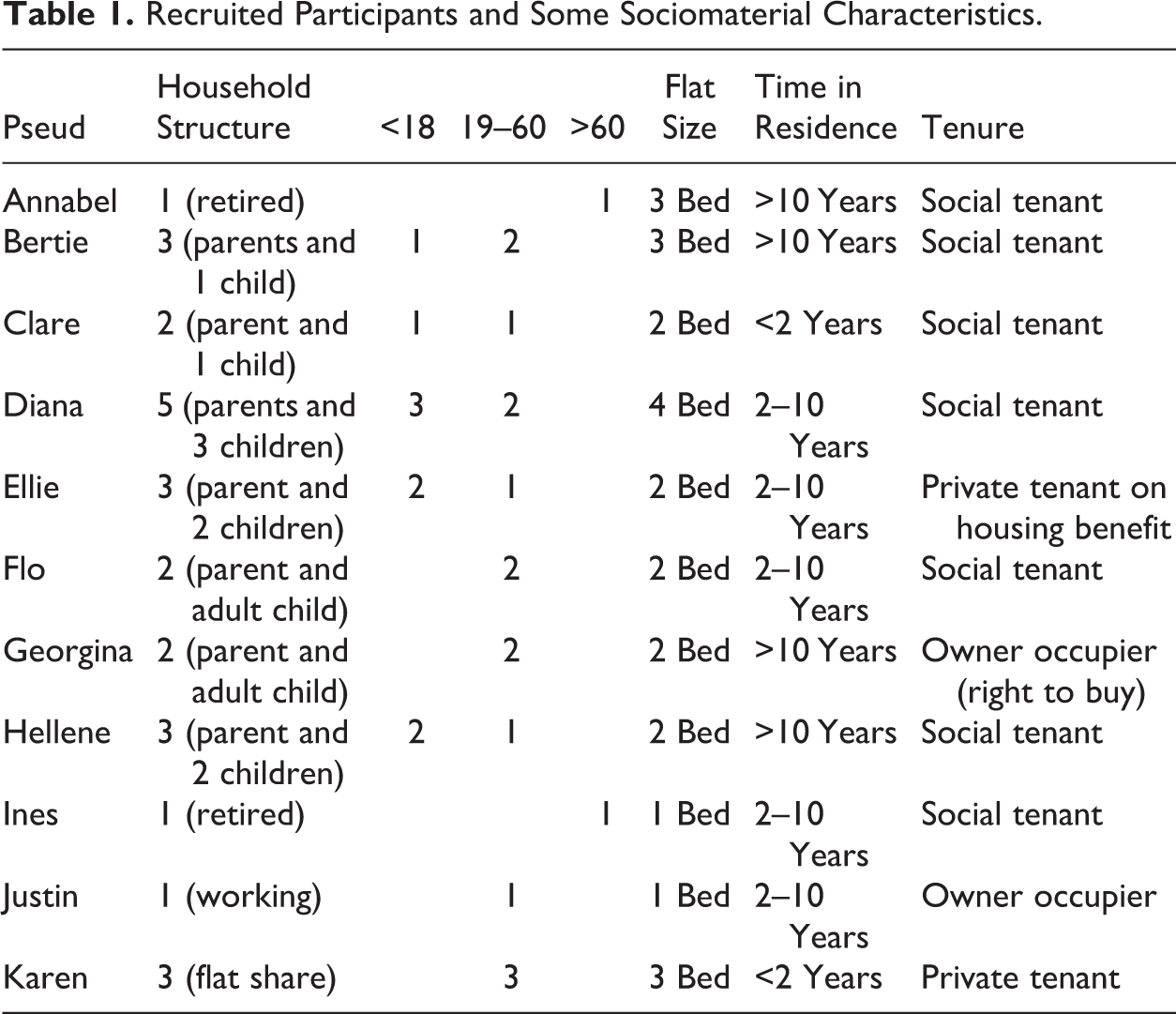
The central heating, provided by the same communal infrastructure that supplied sanitary hot water to kitchens and bathrooms, also caused concerns of wastefulness and provoked both adaptation and frustration. The system did not have room thermostats or thermostatic radiator valves, which meant residents’ options for adjusting the heating in their rooms were limited to turning their radiators on and off or opening and shutting the windows. As with water, there was no individual economic incentive to monitor and reduce the amount of heating, nonetheless three interviewees discussed turning their radiators off to avoid wasting the heat. For example, Karen rented a room in a flat privately and paid her rent directly to her landlord, which included a fixed cost for heating and hot water. She explained that she always turned the radiators off when leaving the house, even when popping to the shop. She also sometimes turned them off when she was in because she liked to have the windows open for fresh air and “would feel bad about wasting heat.” Other residents discussed switching off radiators to avoid waste. Georgina explained that she turned her radiators on between three and five in the evenings but otherwise kept them off as her maisonette was warm enough. However, she was also concerned that others on the estate did not take this care. She explained her actions that’s because I have time, because I am here in the house and I am older and I think with reason, but some people with families, worried about the work, don’t think about it. And they leave it [on].
Heating and bathing prompted residents to intervene and alter the infrastructural arrangements. Bertie, Clare, Ellie, and Flo all discussed their habit of bucket/sink washing rather than having a bath every day, attributing this to either cultural or generational habits. Their reasons were primarily because it was quicker and easier than running a bath but happened also to be less resource intense. Clare explained she had grown up with this habit. “My family does it, I think it’s an African thing. For me, it’s very quick to use that to get ready. If I had a shower, I wouldn’t need it.” Other residents discussed their mitigation strategies as part of a conscious effort to reduce resource consumption. Justin, who expressed strong environmentalist values and who had experienced water scarcity in his childhood, lived in a part of the estate where the cold-water pipe was poorly insulated. This meant that if the water had been standing, the first run would be hot. As a result, he filled his filter jug with this heated water, which meant it could cool down and he was able to still drink it rather than run it down the drain while waiting for the cold to flow. In Diana’s household, they used the first run of the heated water to wash up, thereby making use of both the water and the energy. These accounts show there is an economy to people’s use of resources that is not dictated by economic motivations, but a sense of pragmatism and avoiding wastefulness. It is one that also recognizes synergies across the WEF nexus as, for example, Diana’s effort to put unexpected heat to work.
Electric light proved to be another area for adaptive mitigation. Justin and Ines mentioned they did not switch on their lights in the evening because the outdoor light spilled into their flat at night. This meant that what they considered standard practice (using one’s own lights in one’s home) was not carried out. For Justin, this was motivated by trying to reduce electricity consumed on the estate. He felt the external lights were wasteful and therefore was compelled to take action himself. For Ines, who had placed more emphasis on financial savings and on homeliness rather than environmentalism when discussing resource use, not using lights was more to do with a sense of coziness. She liked the level of light the outside lights provided in her flat.
From wonky heating systems, lighting overspill, and teenage bathing indulgences, these diverse comments about wastefulness show how social factors and the material context shape the resource intensity of consumption. However, the comments also demonstrate residents’ struggles to rationalize and accept the resulting resource intensity. Within this context residents had deployed a variety of strategies to avoid wasting water, lighting, or heating. Some residents focused on their own actions and resources, while others looked beyond their homes to the management body or alternative technologies. A “resource-managing” self was evident in some of the residents’ explanations, but the agency of this subject was often constrained within the context of the home. Constraints included norms within and between generations, household finances, the material configuration of technical systems inside and outside the home, and the efficiency of those systems. We needed to understand these constraints for our subsequent codesign project to help us identify interventions that could work with residents’ ethics of consumption and their interpretations of agency.
Identifying Interventions
To understand residents’ interpretations of the factors that affected their domestic WEF consumption and to identify where we might make infrastructural interventions, we coded the data to reflect the distribution of agency across social structures, bodies, and materialities. We used a combined deductive and inductive approach, imposing nexus codes on the data set (WEF) and inducing codes that characterized attitudes and experiences of managing resources.
We used this method to identify what Stirling (2015) has called “leverage points,” which were specific to the neighborhood in terms of scale, values, and experiences of the group. While some residents were able to act on what they felt was wasteful, they also showed the problems of achieving an active subject position within the specific context of an inner-city housing estate.
Participants discussed the material interventions they made, such as using buckets or water jugs, to adapt the generic or faulty provision to their specific requirements. Some of the other factors listed in Table 2 were also recruited in the struggle to consume according to household norms. Two participants mentioned their landlords’ refusal to act on things like a dripping tap. The management body was recognized as being a potential agent of change, but one that was limited by resources (Justin) and by interest (Georgina). There were also some discussions of the dynamics between people, both within households and between them, which meant it was hard to recruit these actors into household resource management. For example, there appeared a problem that “other” people didn’t act as one did, which caused a problem in the shared systems providing water and energy. As Georgina mentioned above, she felt coresidents at different life stages were likely to have less time to pay attention to conserving heat. Justin mentioned tenure differences, suggesting that social renters, who did not face the same economic incentives as leaseholders, were perhaps more likely to waste. For Hellene, the issue was a lack of awareness. Discussing recycling, she explained that her family were active recyclers, but others sometimes put normal waste in the recycling and she worried this would contaminate everyone’s recycling. “It’s not going to be accepted, is it?” she explained, “It just feels a bit disappointing that some people are using the wrong bins.”
Codes Describing Factors Affecting Water–Energy–Food Consumption at Home.
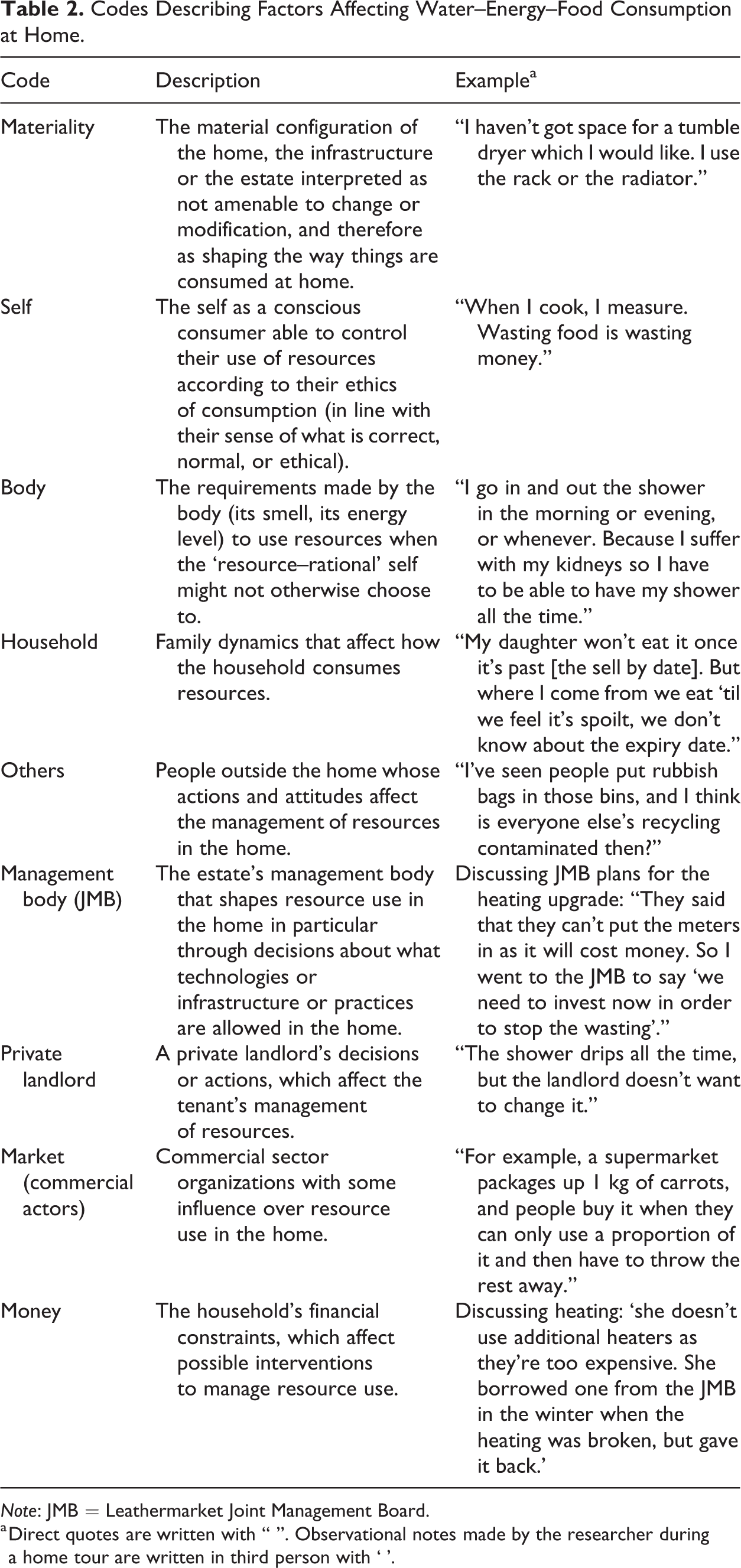
Note: JMB = Leathermarket Joint Management Board.
a Direct quotes are written with “ ”. Observational notes made by the researcher during a home tour are written in third person with ‘ ’.
Codesigning Infrastructure Retrofit
In the codesign process with Meakin residents we used these results specifically to outline the local infrastructures and potential interventions. 4 (The heating system was scheduled for refurbishment and therefore outside the scope of our intervention.) We ran workshops that were open to other residents not involved in the initial qualitative research and used tangible examples of strategies that had been used by residents to act on their consumption. We devised workshop activities that facilitated discussions about how the “other” was delineated from those whose consumption habits were “like mine.” We discussed issues such as coresidents who ignored the rules and social conventions, those at different life stages who had different priorities or time demands, and the differences between tenure. These facilitated discussions about the divisions between people who are connected to the same system. We acknowledged the material intransigencies of the inherited infrastructure and the routes open through different governance groups such as the family, the tenants and residents’ association, the management body, and the local council and utilities. The point was to explore the kinds of issues and dynamics that critical scholarship on neighborhood infrastructure raise; who gets to define what a resource is and how it should be managed.
Water was the main concern for the residents and even though the communal system was scheduled for an upgrade in the coming months, water was something the group wanted to act on collectively. Through this process, residents and researchers outlined a design for a rainwater harvesting system for the estate to provide a low-energy source of water and alleviate pressure on the local, overburdened sewerage infrastructure. A demonstration rainwater harvesting system was installed on the estate, providing water to the communal gardens. This supported residents’ own sentiments about taking action on water waste while also being simple and inexpensive to fit into the estate’s material structures; a rainwater downpipe was retrofitted with a tank and hose, enabling residents to use water. The rainwater harvesting system also fitted into the institutional structures of the estate. It was under the management of the TRA and used on their communal gardens. The codesign process therefore worked with the material and social systems in the estate to retrofit the infrastructure.
Working with Infrastructural Communities
Through this pilot study, we were able to explore a way of carrying out a “material participation” approach to retrofit within a context of urban infrastructural renewal. Retrofit aims to remake cities in more resource-conscious and resilient ways, and in doing so places a normative agenda onto domestic materiality. We took the approach of understanding how the materiality of infrastructure networks was already being used in ways that may not align with the normative agenda of resource efficiency. This enabled us to pilot tools to engage groups with technical knowledge driving forward retrofit, but also to learn about what issues were salient for the local group and what interventions could address them. This approach was used to support our subsequent codesign process, but it also raises some points for critical reflection on retrofit. In particular, we interpreted the group as a community of infrastructure, an interpretation that allows us to bring more critical scholarship on infrastructure into the area of retrofit.
Critical studies of infrastructure have shown that its affective quality prompts people to reflect on possible futures and their roles in creating these. As Knox (2017, 368) describes, people’s experiences of infrastructure are “capable of energizing politics, mobilizing bodies, and bringing about future forms of change.” In our case, the infrastructure in Meakin Estate circulated meanings and experiences among the colocated residents and provoked innovative mitigation strategies. As residents tinkered with the material systems in their homes or lobbied their management body for example, they recognized the difficulty of delineating the infrastructure and drawing divisions between one’s own home and consumption, and one’s neighbors. Consequently, the infrastructure became the material through which residents constructed a rational or ethical consuming self and imagined alternative ways of resource provisioning. However, it was also the material through which divisions were created among the group of connected residents, as the ethical consuming self failed to recognize the same ethically motivated consumption among others. We found that these “others” were construed as groups with different values, but also fell into established categories such as groups at different life stages and groups with different tenure. Despite this, we were able to instrumentalize the material connection and the shared concerns over water it produced in order to create a simple technical intervention. In sum, we coupled the affective quality of infrastructure to a codesign process in order to intervene and as a result ended with a decentralized source of water for communal use.
In our case, we were working with a group of residents who were motivated by a range of conservation ethics that were not necessarily related to financial reasoning or environmentalism, but which aligned with individual, culturally informed perceptions on the need to avoid wastefulness. Their experience as an infrastructural community meant that they recognized the difficulty of achieving a position of individual agency over resource consumption and they were open to the idea of experimenting with communal consumption. We created an intervention that was about rescaling infrastructure. We attached the tank to a downpipe and created a storage asset within the system boundaries of the estate’s wastewater system that could be used to reduce storm runoff into the combined sewer and provide a new source of nonpotable water supply. In this way, our intervention was infrastructural from an engineering perspective of infrastructure as the system of pipes and wires that enable the circulation of resources. Rainwater harvesting decentralizes water resource and surface water management, providing additional capacity beyond the centralized systems that are under strain from population growth and environmental change. The intersections between decentralized and centralized technical systems are central in strategies and designs to retrofit sustainable urban infrastructures. The tank was also infrastructural from a sociotechnical perspective in that it altered the nature of the water and the organizations responsible for it. Our tank displaced the potable water used to water the shared gardens and by diverting rainwater before it entered the sewer it prevented it from immediately becoming wastewater under the utility’s management. It gave a different governance body (the Tenants’ and Residents’ Association) a new resource and asset to use (rainwater collected in a water tank).
Shifting responsibility for water from a utility to a community group raises the issue of “infrastructural poverty and privilege” (Howe et al. 2015, 5). As the “modern infrastructural ideal” is replaced with more bespoke service provision, certain groups will be positively and negatively affected either by market failure to include those who are “hard to reach” or conversely by groups of residents creating their own infrastructural systems, defecting from national grids for example. In our case, the rainwater harvesting system had the potential to generate value for the local residents in the form of a “free” source of water, while also generating value for the broader wastewater system by delaying excess runoff. However, by focusing on the empirical experiences, we can see the intervention was not produced in a spirit of disruption to capture a new source of value for the residents, but because residents were mitigating system inefficiencies, counteracting technical faults, and responding to a sense that wastefulness needed to be tackled.
The “infrastructural community” offers a way to explore this ambivalence. It highlights the material connection that residents’ share and the potential this offers for retrofit, while not relying on residents to identify as a community with shared values or resources. The concept of an infrastructural community is useful for analyzing the ability to reconfigure path dependencies created by incumbent infrastructure systems supplying resources within urban contexts. This is because infrastructure connections may split communities of place; people in one block had different issues with the same pipes and wires as those used in a neighboring block and responded with different strategies. Additionally, infrastructure connections do not always align with communities of interest and, in our case, created fault lines and tensions within our connected groups of residents along lines such as tenure and life stage. Nonetheless, the material connection helped determine a group of households and provided a means to discuss possibilities for changing the way water circulated in the estate. This included acknowledging social equity and capacity issues that can be missed in more top down, technocratic assessments of how retrofit can bring domestic consumption in line with infrastructure system priorities. We instrumentalized this connection and encouraged a group to coalesce around infrastructural change and work together to partially change the way water circulated on the estate.
In a small way, this intervention disrupted the infrastructure status quo. In a UK urban context, retrofitting is led through a market framework and draws on evidence about the win-win situations that are opened up by investing in resource efficiency. This creates a highly normative infrastructural context where relationships are contractual and identities inscribed; retrofit policies and market mechanisms are designed either for consumers or for social landlords or owner occupiers. The difficulty in delivering retrofit at the scale and pace required to meet national targets has given rise to broad recognition that retrofit is a sociotechnical issue and that policies and technologies need to engage with people in ways that acknowledge their lived reality (cf. Lowe, Chiu, and Oreszczyn 2017). However, critical scholarship on infrastructure goes beyond the call for more complex understandings of the social in a sociotechnical system to problematizing the very concept of infrastructure itself. Simone’s (2004) articulation of “people as infrastructure” offers a useful lens. Generated in the very different urban context of downtown Johannesburg, Simone (2004, 419) points to residents’ needs to generate “concrete acts and contexts of social collaboration” and these collaborations do not take the form of “modulated transactions among discrete population groups.” By looking for communities of infrastructure within the normative materiality of inner-city London, it is possible to find both an urge and opportunity to act and collaboratively produce retrofit interventions. Such communities of infrastructure are sites for empirical exploration of “material participation” which opens up the nature of retrofit problems and solutions rather than prefiguring them as archetypes of known issues. From this perspective infrastructure is no longer understood as a sociotechnical system, instead infrastructure becomes the people and their material connection.
Conclusion
Corsín Jiménez (2014) argues for understanding “the agential work of infrastructures as a source (an open source) of possibilities in their own right” (p. 343, emphasis in original). We share his enthusiasm for an open source urbanism and his interpretation of infrastructure as a process that enables experimentation in city life. However, retrofit demands a particular research perspective, because it looks to work with people, technologies, and governance arrangements already in situ and explore what comes next; can these infrastructural relations evolve to enable less resource intense living? The emerging area of STS research on “object-centred engagement” offers a way into retrofit that is both applied and critical (Lezaun, Marres, and Tironi 2016, 205). In a UK context, national scale systems are being retrofitted to enable decentralization in pursuit of less-resource intense living. For cities like London, retrofitting can be a way to create small scale decentralized infrastructure systems that deliver local, low carbon WEF. This promise is being pursued by state and market actors, who look to retrofit to change the way that resources are consumed at home and are building a normative agenda in which efficient consumption is an individual household’s own best interest. This study took a different approach, foregrounding residents’ own strategies and values, which affected how they used resources such as water at home. It showed that when stepping across the threshold into someone’s home, a core concern was wastefulness and the urge to avoid it. This idea was expressed by participants who had very different lifestyles, were at different stages of life, had different incomes, and held different priorities and options for provisioning their homes and whose life experiences had given them different understandings of resource scarcity and their own role in resource use. Waste is a common trope to describe contemporary capitalism (Dodsworth and Walford 2018), but for residents in this estate, it did not connote a nostalgia for older and better times, instead it motivated action as residents tried to intervene and reduce waste.
The idea of wastefulness prefigured a resource rational subject and our research approach aimed to identify factors that supported and undermined this subject position. We used the lens of distributed agency to see how people assessed the potential for action and change, which included assessing where to make individual social or material interventions, and where recruiting other actors helped. We looked at the existing social power or material intransigencies that inhibited individual or collective action and resisted change. We were able to use these findings to start a codesign process and identify an intervention for a communal water tank that aligned with residents’ own interpretations and priorities for action. We have presented our methods to contribute to other researchers interested in understanding context-specific opportunities for neighborhood scale retrofit. However, the case also provided an opportunity to bring critical scholarship on infrastructure into the issues of urban retrofit. We started with a sociotechnical perspective on infrastructure that combines the engineering perspective of infrastructure as the pipes and wires that allow for the circulation of resources with an understanding that these cannot be separated from the social systems of finance, law, and politics that make specific infrastructural systems operate in a given context. However, following Simone’s (2004) idea of “people as infrastructure,” we have developed the idea of the “infrastructural community.” This recognizes the people who are materially connected as part of the infrastructural system and looks at people’s will to cooperate to collectively manage consumption. This offers a way to think through the possibilities for material participation in the production of less resource intense urban life that is not defined by the normative agenda of resource efficiency. The fact that Meakin Estate residents shared downpipes and drains, communal lighting and heating, and walls and roofs meant they had a material connection with which to experiment in the production of less resource intense city life.
Footnotes
Author’s Note
Rob Comber is now affiliated with KTH Royal Institute of Technology in Stockholm, Sweden.
Acknowledgments
The authors would like to thank the residents of Meakin Estate for their participation in the project and staff at Leathermarket JMB. We would like to thank Kat Austen, Jun Matsushita, and Alex Shure at iilab who were key members of the research project and codesign process. We are also grateful for the anonymous reviewers’ comments and feedback, which have improved this paper.
Declaration of Conflicting Interests
The author(s) declared no potential conflicts of interest with respect to the research, authorship, and/or publication of this article.
Funding
The author(s) disclosed receipt of the following financial support for the research, authorship, and/or publication of this article: This work was supported by the Engineering and Physical Sciences Research Council (Grant Number EP/N005902/1).
