



Abstract
Participation is an important but little understood concept in science and innovation. While participation promises the production of new knowledge, social justice, and economic growth, little research has been done on its contribution to innovation processes at the group level. The concept of imaginaries can provide a window into these processes. Adopting a micro-sociological perspective, we examined the interplay between imaginaries of participation and group development within a long-term ethnographic observation study of an initiative, Energy Avant-garde, as it pursued the development of a decentralized, self-contained, and entirely renewable energy system in one German region. We scaled down the macrolevel concept of imaginaries to the group level. We found that group imaginaries are a resource for bringing order to a group and that a group is a resource for creating, operationalizing, revising, and sustaining imaginaries. We describe a “failure-through-success” story: while imaginaries initially promoted group cohesion, creativity, and productivity, in later stages, these effects were impeded by group dynamics. We therefore distinguish between process imaginaries and outcome imaginaries and conclude that, inherently, participation must be managed and employed at the appropriate stages to make valuable contributions.
Keywords
Introduction
Responsible Research and Innovation (RRI) implies that societal actors (researchers, citizens, policy makers, business, third sector organizations, etc.) work together during the whole research and innovation process in order to better align both the process and its outcomes with the values, needs, and expectations of society. (European Commission; https://ec.europa.eu/programmes/horizon2020/en/h2020-section/responsible-research-innovation [last accessed March 1, 2017])
The examination of imaginaries is regarded by various authors as a crucial component of participation in innovation processes, which can provide a window into the functioning of such practices of co-creation (Welsh and Wynne 2013; Saille 2014; Felt et al. 2016; Marris 2014; Moore 2018; Pfotenhauer and Jasanoff 2017a, 2017b). According to Felt et al. (2016), “societal values, norms, and concerns enter the research process through the dense deployment of tacit collective imaginations (…). These imaginations describe attainable futures and prescribe the images of futures that should be attained” (p. 754; see also Jasanoff and Kim 2015). Imaginaries convey tacit rules of social interaction and serve as exemplars of how participation should be undertaken within heterogeneous innovation settings (Jasanoff and Kim 2015).
While imaginaries that address underlying social and political complexities are necessary for the implementation of new technologies (Moore 2013), scholars have devoted little attention to interplay between imaginaries and group development and on how different forms and interpretations of participation might evolve during knowledge co-creation by heterogeneous groups.
We focus on groups, because, at a time when problems are becoming increasingly complex, groups are gaining in importance. Combining the diverse expertise of heterogeneous groups is the key to finding solutions to multidimensional grand challenges such as climate change (Gibbons 2011; Rhoten and Pfirman 2007). Research suggests that interdisciplinary groups have a particular potential to generate unique discoveries and radical innovation (Hackett and Parker 2016a, 2016b). Science policy increasingly supports such settings, yet, for trans- and interdisciplinary settings to be successful, there are many prerequisites (Donina, Seeber, and Paleari 2017; Rhoten and Parker 2004; The National Academies 2005; British Academy 2016; Leahey, Beckman, and Stanko 2016).
Research on group development has to date focused on communication and interaction patterns, norms, rules, conflicts, leadership processes, and emotions (Tuckman 2001; Mills 1967) but has neglected imaginaries as tacit collective imaginations of an attainable future. Universalistic models of group development have not taken into account the influence of imaginaries, which are especially relevant in innovation processes (Pfotenhauer and Jasanoff 2017a). In this sense, imaginaries capture local, cultural, and temporal aspects, which are essential within heterogeneous groups. The connection between imaginaries and group development might tell us how innovation processes could be better managed within these groups and how they might be scaled up to have a larger impact in society. Hence, we focus on one highly innovative area, the renewable energy sector.
We conducted a long-term ethnographic study of a participatory initiative, Energy Avant-garde, which sought to develop a decentralized renewable energy system in a region in Germany. Tidwell and Smith (2015) and Moore (2013, 2018) examined the effects of imaginaries in fields such as energy policy. Moore explores the complexity of locally and globally connected energy systems (the DESERTEC project, founded in 2009, Desertec Foundation) as sociotechnical fields that combine technical aspects with issues of justice, activism, norms and values, regulation and political frameworks. The field of energy systems is thus especially suitable for examining complex participatory practices in innovation processes. Generally, these practices have been found to lead to the development of more implementable technologies (Moore and Hackett 2016; Saille 2014).
This article contributes to the existing literature by linking the development of imaginaries to group processes and by introducing the concept of group imaginaries. Whereas research has traditionally conceptualized groups as stable, static, and closed (Kozlowski 2015; McGrath, Arrow, and Berdahl 2000), we propose a dynamic perspective that allows us to study the complexity and multilevel nature of group behavior. Imaginaries can influence group formation and support goal attainment, group cohesion, and creativity. At the same time, imaginaries are shaped by group development. This article advances the concept of imaginaries by making a distinction between process and outcome imaginaries.
We conclude with what we call “failure through success”: imaginaries can unleash different effects in different phases of group processes. Initially successful group imaginaries can impede goal achievement in later phases. We therefore suggest that the process of goal achievement might be very complex and require management to make a valuable contribution.
Theoretical Background
The purpose of this article is to integrate two hitherto disparate literature strands: science and technology studies (STS) and literature on group processes.
Imaginaries of Participation
We take the concept of sociotechnical imaginaries (Jasanoff and Kim 2015) as a theoretical starting point for examining the role of participatory processes in group development. They are defined as “collectively held, institutionally stabilized, and publicly performed visions of desirable futures, animated by shared understandings of forms of social life and social order attainable through, and supportive of, advances in science and technology” (Jasanoff and Kim 2015, 4). They are “collective, durable, capable of being performed; yet they are also temporally situated and culturally particular” (Jasanoff and Kim 2015, 19).
Such imaginaries play a crucial role in energy policy because they show how different nations envision their future and the risks associated with this future (Jasanoff and Kim 2013). Studying energy transitions can hence reveal conflicting imaginaries associated with changes in sociotechnical infrastructure as there are many different actors involved (Moore 2013, 2018; Moore and Hackett 2016; Canzler et al. 2017b).
In this sense, imaginaries of participation may be particularly important in energy policy and reflect recent developments in the public and policy discourse (Welsh and Wynne 2013; Saille 2014; Felt et al. 2016; Marris 2014). Participation is associated with more RRI (European Commission 2009; Organization for Economic Cooperation and Development 2015), thus creating an imaginary of participation encompassing better and more democratic innovation processes.
By adopting a symmetrical STS approach, we assume that imaginaries and innovation are coproduced and culturally embedded (Pfotenhauer and Jasanoff 2017a). We hence suggest that participation in innovation processes is “part of a collectively held imaginary of sociotechnical progress” (Pfotenhauer and Jasanoff 2017a, 786).
Various authors have devoted their attention to the value of imaginaries in participation (Welsh and Wynne 2013; Saille 2014; Felt et al. 2016). Welsh and Wynne (2013) describe how scientific imaginaries of the public and public imaginaries of science lead to different institutional settings of participation and influence how it is framed within science. Two such imaginaries recently came into being: one of an “uninvited” public who expresses social and political concerns reaching beyond institutionally defined risks and another one that understands the public as a threat to the innovative capability of science and technology (Hess 2014; Marris 2014). In keeping with these developments, de Saille (2014) suggests the term “unruly public” as part of the sociotechnical imaginary of critical, hindering voices that nonetheless does not exclude the public “as a whole” (Saille 2014, 99).
Still, the concept of imaginaries of participation must be further specified to see how the process of coproduction is enabled at the group level. Referring to Jasanoff and Kim (2015), we examine how practices of collective imagination can produce consensus and might be capable of absorbing internal tensions within collectives (Jasanoff and Kim 2015, 27). In contrast to the notion of a national imaginary, we conceptualize group imaginaries as being akin to Moore’s (2018) concept of a sociotechnical vision (p. 21), that is, they are a specific plan for a group to promote a certain sociotechnical idea. We assume group members’ different sociotechnical visions are bound together through a group imaginary. We employ this specific understanding of the imaginary concept in order to show how a heterogeneous group can, despite very different interests, find common grounds for collaboration.
Heterogeneous Innovation Settings and Small Groups
This conceptualization of imaginaries allows us to scale down the concept from the macrolevel (Jasanoff 2004; Jasanoff and Kim 2015) to the group level and connect it to group research theory. Groups are defined as a collection of individuals who frequently interact with each other, share a feeling of belonging, and collaborate in order to achieve common goals (Hackman 2012). While sociological research has studied small groups since the 1950s (Bales 1950), this research stream is currently being transformed (Fine 2014).
From the early era of research on the topic, the study of small groups was considered to be especially fruitful because they are a “special case for a more general type of system, the social system” (Mills 1967, 2). Small groups are currently attracting more attention, as they are regarded as key sites that represent collective action, especially in the context of social change (Collins 1998; Summers-Effler 2010; Farrell 2001; Rochon 1998; Corte 2013; Burke and Stets 2009). Through them, scholars are able to identify macroscale dynamics on the microlevel (Stolte et al. 2001). A strand of sociological and psychological research suggests that small groups can conduct highly innovative research (Hackett and Parker 2016a; Mullins and Mullins 1973; Bennett, Gadlin, and Levine-Finley 2010; Gläser, Laudel, and Lettkemann 2016). Their group creativity benefits from the presence of four components: the resources, context, energy (emotion), and the management of ambivalence or tensions (Hackett and Parker 2016b).
The role of imaginaries in such settings, however, has received little attention thus far. Referring to Mills (1967), who regarded groups as feedback systems, imaginaries can be defined as a crucial component of a group’s consciousness as an “awareness of itself” (Mills 1967, 19). We argue that imaginaries are important means of self-reflection. We regard group imaginaries as a self-concept in which groups envision themselves as a collective that will arrive at an agreed-upon plan that will guide the group’s behavior and goals. This approach represents a paradigm shift from analyzing linear cause–effect relationships toward describing the group’s evolution over time by studying dynamic properties such as variability, trajectories, and cyclical fluctuation (Kozlowski 2015, 272). In this sense, groups are “complex, adaptive, and dynamic systems” “embedded in a hierarchy of levels and characterized by multiple, bidirectional and nonlinear causal relations” (McGrath, Arrow, and Berdahl 2000, 98).
Research on group development typically builds on the life cycle model, in which groups go through a sequence of “storming, forming, norming, and performing” (Tuckman 2001; Tuckman and Jensen 1977, 419). Project groups in research and development have been found to reach peak productivity after three years (Katz and Allen 1982). In our case, the imaginary was a powerful resource that brought order to group processes. Contrary to the predictions of the life cycle model, this allowed for a peak of productivity at the very beginning of group development and led to group split-up before entering the “performing” stage.
Energy Avant-garde: The Case
The German government’s act phasing out of nuclear power by 2022 (Knopf et al. 2014), passed in response to the Fukushima meltdown of 2011, gave rise to a national “energy transition.” Within this transition, national power companies are increasingly reorienting toward renewable energies. While this process is characterized by high levels of uncertainty, some such companies choose to collaborate with other organizations, both within and outside of the energy industry. One such collaboration was the subject of this study. When it was first introduced in the Anhalt-Bitterfeld-Wittenberg region in Germany in 2013, the vision of Energy Avant-garde was that the region should become the flagship for the energy transition by developing a self-contained and renewable energy system (see Figure 1; http://www.energieavantgarde.de [last accessed March 1, 2017]).
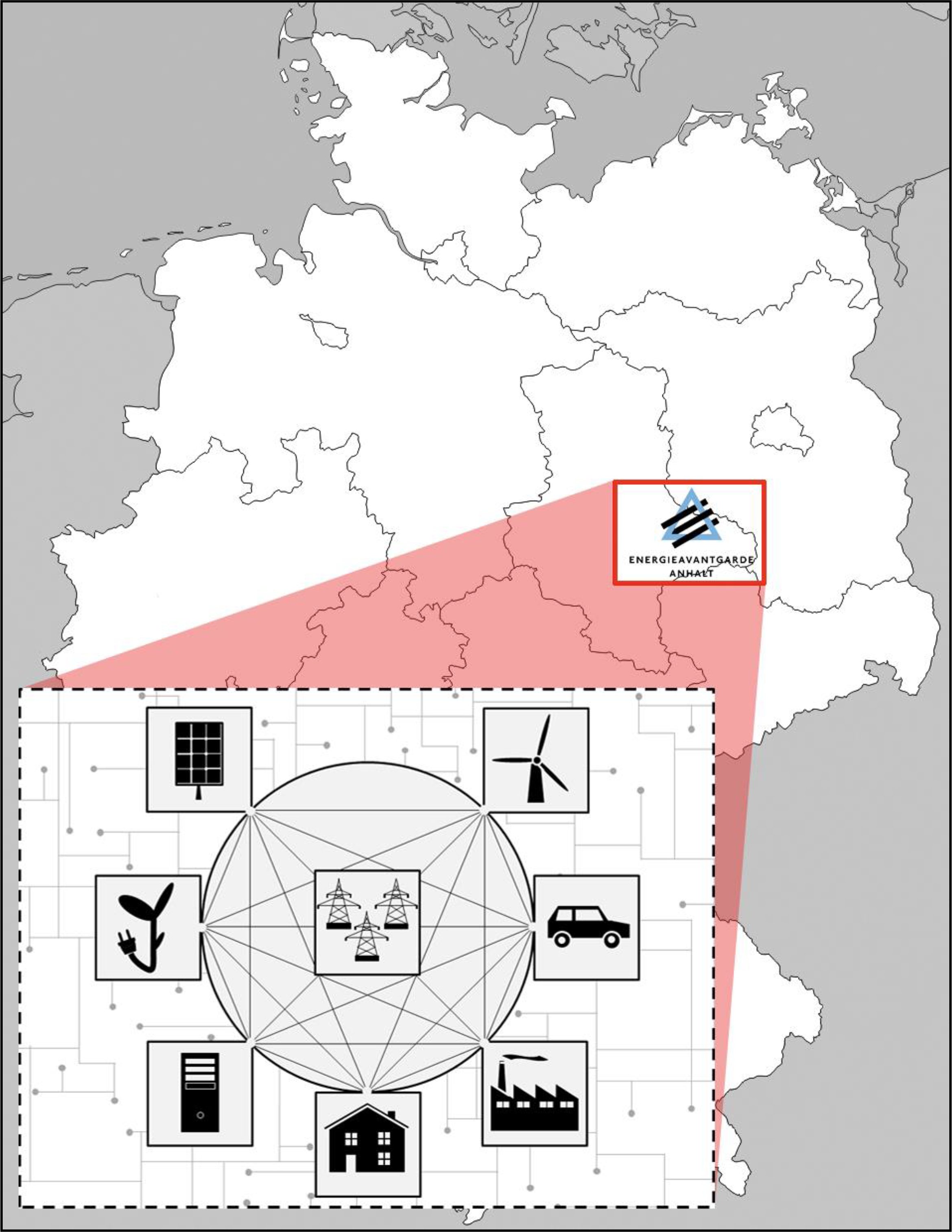
Area and vision of the initiative.
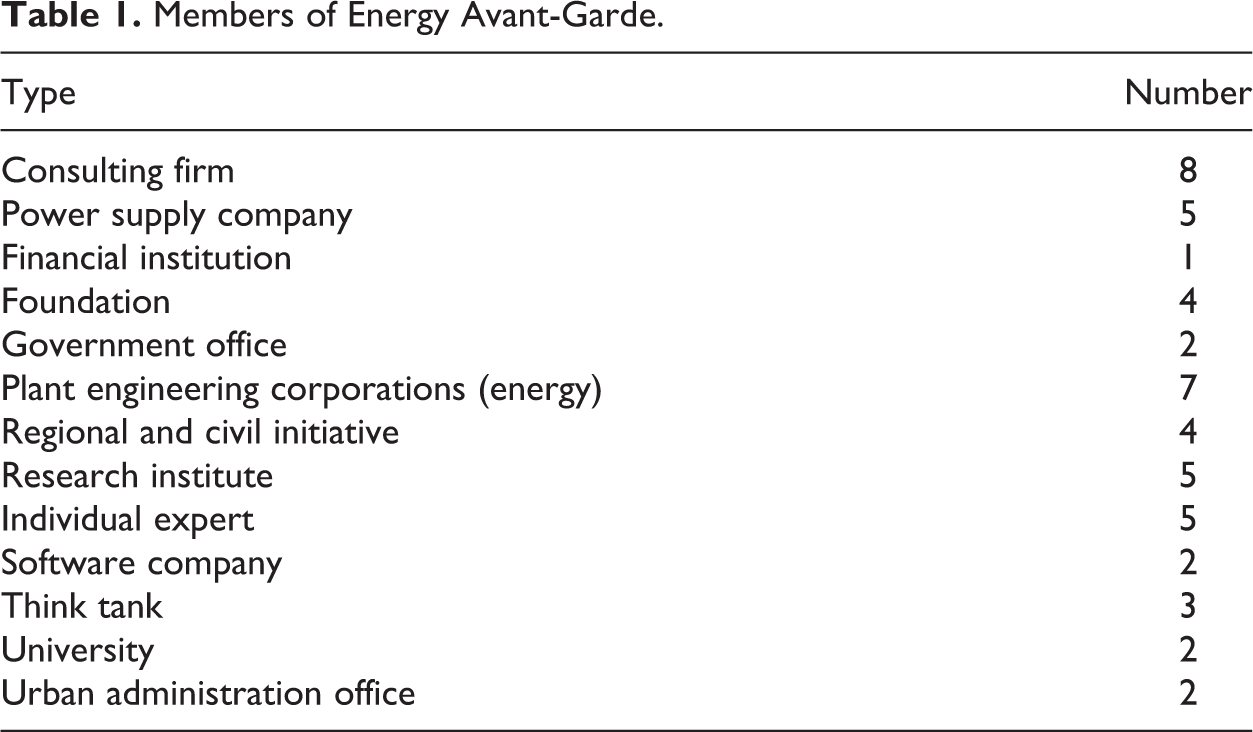
This revolutionary, bottom-up, large-scale innovation initiative constitutes a unique case for two reasons. First, it is quite likely to provide new insights into participatory innovation due to its “reversal” of the dominant strategy: from the outset, its members have included a wide variety of stakeholders (see Table 1) who have engaged in loosely coordinated activities in pursuit of grand, vaguely defined goals. In contrast, participatory projects typically begin with focused targets, follow comparatively detailed plans of their achievement, and open only toward the conclusion (Bonaccorsi 2016). Second, the initiative pursues decentralization of a historically centralized energy system (Canzler et al. 2017a) within one region, a development in keeping with the observation that the greater public involvement on the decentral level leads to greater public willingness to support the energy transition (Wille 2017).
Members of Energy Avant-Garde.
The region is a part of Saxony-Anhalt, a federal state in the South-East of Germany, formerly a part of East Germany. Throughout the entire twentieth century, coal exports were the state’s primary source of income. In 2007, it began exporting renewable energies and currently occupies a leading position in the energy transition by satisfying 53.9 percent of its own electricity needs and 16.5 percent of its overall energy needs through three energy types: 58 percent wind, 26 percent biomass, and 13 percent solar. The state also produces 77 percent of the country’s bioethanol and 10 percent of its biogas (http://www.investieren-in-sachsen-anhalt.de [last accessed March 1, 2017]).
The transition, however, has been anything but smooth. In order to guarantee a stable supply, the use of coal remains necessary in the winter (Höhne 2017).The introduction of an entirely new power system necessitates the development of equally original funding strategies, supply chains, and consumption patterns.
Method
We examined Energy Avant-garde in progress, primarily through participant observation (Jorgensen 2015; Spradley 1980), between April 2014 and October 2016. To this end, we observed four workshops, to which we were granted full access. Each workshop lasted from one to seven days, and the sessions often continued late into the evening. Together, they resulted in eighty hours of audio records and our field notes on informal conversations. Two-and-a-half years was a sufficiently long period to allow us to closely and thoroughly study our case as well as to observe its long-term development.
The number of members of Energy Avant-garde varied during the period of our observation. While it was a small initiative in 2014, it grew rapidly. By 2016, fifty organizations had joined the initiative, with every participating organization nominating one representative. Most of the group members had attended a higher education institution, the share of male representatives was about 75 percent, and the average age of members was about forty-five years. The group was highly diverse with regard to disciplines (engineering, social sciences, law, arts) and sectors (public sector and private sector). The citizens who would eventually use the regionally produced energy were represented by small citizens’ initiatives. Membership was granted on the basis of self-selection, as the initiative openly invited new members (in the region) to join.
The workshops took place every six months, with participant numbers ranging from thirty to sixty and different group compositions. They were organized in different locations, mostly in the region of Anhalt, but also on the German coast (Gut Siggen). Usually, group members met in plenary sessions; for some sessions, the initiative was divided into smaller units.
We co-organized the first workshop in Gut Siggen since the initiative hardly had any resources. This helped to immediately build trust bonds with the initiative members, which enabled us to get full first-hand access to all discussions and critical information. We also organized the fourth workshop where we discussed the results of our research with the initiative members. We thus became embedded researchers in the setting. This setting was especially insight-provoking as it enabled us to validate our research results. The other two workshops were organized by the management of the initiative.
Transcripts of these recordings were qualitatively examined through frame analysis (Goffman 1974), which is “the process whereby communicators act—consciously or not—to construct a point of view that encourages the facts of a given situation to be viewed in a particular manner […]. Frames act to define problems, diagnose causes, make moral judgments, and suggest remedies” and “are central organizing ideas within a narrative account of an issue or event” (Kuypers 2009, 182).
Our approach was a suitable one for investigating group dynamics (Kozlowski and Bell 2013). Our goals were to determine how different interests, approaches to problem-solving, and problem definition were framed and how shared values and patterns of interpretation were constructed (Bohnsack 2010, 2014). Data were collected at multiple levels of analysis that enabled the identification of different patterns of group stability, change, and breakup. In order to analyze dynamic group development, we placed particular focus on the discussions about leadership (Mansilla, Lamont, and Sato 2015; Parker and Hackett 2012; Stokols et al. 2008), decision-making styles (Chompalov, Genuth, and Shrum 2002), group dynamics, collaborative engagement (Felt et al. 2016), individual motivation, interdisciplinary interaction (Parker and Hackett 2012), and inter- and intragroup conflicts (Pruitt and Kim 2004).
We grouped our findings according to four interdependent dimensions. Mansilla, Lamont, and Sato (2015) defined the emotional, cognitive, and interactional dimensions as relevant for group processes. Relying on Felt et al., we added a fourth perspective: the structural level. Special attention was paid to narratives (Hawes 1991) and metaphors (Schein 2010) to identify both individual and collective interpretative frames. We also included other relevant information such as details from the initiative’s website, grant proposals, and protocols of the meetings.
Results: Innovation in Phases and the Imaginary of Participation
We closely observed development and dynamic changes focusing on the coevolution of the group and the imaginary. In a case as complex as energy transition, determining success and its criteria may pose a particular challenge. In the following chapters, we define success in terms of how the group itself defined goals and whether they were achieved or not.
Creation of the Imaginary: “The Spirit of Gut Siggen” (April 2014-January 2015)
The creation of the group imaginary of participation took place in the first phase and was strongly facilitated by configuring events at the interactional level. Energy Avant-garde was first introduced in April 2014 by four different organizations loosely collaborating on smaller projects (structural level). Momentum was generated when we organized the first workshop in April 2014, in which thirty regional and national actors spent a week developing an outline of a grant proposal in the picturesque farmhouse of Gut Siggen at the Baltic Sea.
The workshop location provided a particular setting, referred to by Parker and Hackett (2012) as “island time,” which “strengthens group bonds, motivates productivity, catalyzes creativity, and builds emotional commitment to the group’s ideas, fostering a culture of receptivity and originality, while quieting skepticism and criticism” (Parker and Hackett 2012, 28). Island time had strong effects at the emotional level: this might explain why the group was highly cohesive at this point and characterized by an open and motivating work atmosphere despite wide-ranging differences in interest.
These positive group dynamics promoted the development of a shared imaginary of open participation, which reflected that of transformative innovation: the project was regarded as a pilot case for an “energy region” in which solutions for climate change are implemented in vivo and also as an opportunity for future pan-European and international collaboration. This imaginary grew very powerful because participants believed they were ultimately changing the region and the world for the better.
The core innovative element of this grassroots initiative was the vision of a renewable, decentral, and self-contained energy supply system that would achieve not only economic but social and environmental benefits. Such a system would entail a variety of new responsibilities and strategies on the regional level including energy marketplaces, prosumer involvement, and smart grids. The choice of the name “Avant-garde” indicates that, rather than a solely technological innovation, participants regarded the transition as a profound societal transformation that welcomed individuals from all backgrounds to participate:
Open participation was the core component of the developed group imaginary because members believed that opening the initiative to all interested stakeholders would promote both the project’s success and democratic processes in the region generally:
Unanimous in their vision, participants’ opinions about more specific, attainable goals and implementation strategies were at least as diverse as their own backgrounds. Inspired by these opinions, the discussion focused on such questions as: to what degree can locally produced, renewable energies satisfy the energy needs of a region? What might the limits of the decentralized supply be, not only from technical and economic standpoints but also societally and culturally? To what degree might consumers be willing to contribute to the establishment of the new system?
Accordingly, participants’ interests were highly diverse as well: some were concerned with funding or business models and others were interested in new technical solutions or major cultural transformations. In this regard, not only did the imaginary of open participation exert a strong influence on participants’ perceptions, it created common ground for collaboration and intellectual openness. Similarly to symbols that enable organized group action, the imaginary created meanings that were shared by all members and thus promoted communication: it appealed to the emotional dimension, unleashing “collective excitement” and “joy in collaboration” (Mansilla, Lamont, and Sato 2015, 18) and created an atmosphere of letting go of traditional mind-sets. The following sequence of a group discussion reflects this process.
The imaginary created a feeling of being part of a novel, exciting project with a regional and potentially global impact. It created its own narrative, referred to as the “spirit of Gut Siggen” and symbolizing this stage’s ordering forces. This narrative was often mentioned in subsequent workshops.
Sustaining the Imaginary: Tensions Increase (January 2015-October 2015)
The group was exposed to a formalization process due to the success of the imaginary of open participation. At the structural level, the need to produce outcomes increased. Institutionalization took place in January 2015 with the founding of a nonprofit association. That same year, an administrative office was opened and a governance structure established, consisting of a managing director, managing board, advisory committee, and management team. External funding facilitated the group development process, but at the same time, it strengthened the top-down forces in the group.
The second workshop took place in July 2015 in a town called Lubast. Its goal was to develop a more detailed strategy.
The initial imaginary of open participation included a democratic governance style. After the funding organization joined the initiative and the formal governance was established, the necessity for project management increased. The funding agent and some other participants expressed the necessity for a more hierarchical decision-making. The conflicts increased as they continued to insist on setting clear goals, while other participants continued to prioritize autonomy and openness.
Due to its high level of abstraction, the imaginary could no longer bring order to the group. Because the imaginary of participation did not support the group in attaining its goals, an alternative imaginary of expert participation began to develop and led to further disagreements in the group. The management director, originally elected because of his high standing in the region, continued to exercise a democratic, socioemotional leadership style and advocate for the initial imaginary. Rather than to influence the group or provide detailed explanations, he tried to balance tensions by keeping the relationships friendly and leaving it to the group to find consensus. These choices ultimately impeded decision-making, (Burke 1967; Blake and Mouton 1964) while a task leader would have been necessary to advance the project at this stage.
The division of labor caused by the funding somewhat reduced the initial enthusiasm and motivation (emotional level). As the power structure changed, so did participants’ roles to include different levels of involvement and responsibility. The attitudes of “mine and yours” increasingly replaced the sense of trust, collegiality, and shared ownership. The funding decreased some of the initial intrinsic motivation. Furthermore, no funds were allocated for certain necessary tasks such as the development of technological solutions, which led the feeling of injustice thus reducing the sense of shared ownership and identification with the project among some participants.
In keeping with the imaginary of open participation, new members were constantly invited to join the initiative or give feedback, resulting in high group fluidity and thus its decreased productivity: while involving new actors at the cost of impeded routinization might be beneficial in the innovation process, a certain amount of stability within the group is necessary for integrating new knowledge and developing a shared identity and language (Shinn 2005).
Upon the introduction of an institutional structure (Weber and Winckelmann 2009 [1921]), the heterogeneity within the group and the lack of functional leadership and group identity inhibited the process. The initial imaginary lost some of its power in which the same mechanisms that used to promote motivation, group cohesion, and the sense of identification now inhibited these effects. The imaginary worked as an abstraction and guided the process but lost force when process as an end in itself gave way to the need to produce outcomes. We found that success at the abstract level of commitment to participation set the stage for a crisis and put the group at risk, similar to the findings of Parker and Hackett (2012). Our results underline the importance of clearly differentiating between “process imaginaries,” which are able to guide group processes and foster constructive group dynamics, and “outcome imaginaries,” which are apt to produce concrete group outcomes.
While institutionalization was achieved, the implementation of particular subprojects and the involvement of other local organizations were not. Therefore, the next critical juncture was not crossed and the phase resulted in a crisis.
Conflicting Imaginaries: Crisis (November 2015-March 2016)
In this phase, the group oscillated between the two competing imaginaries. Tensions between the two positions resulted in increasing negative emotions and decreasing involvement within the group (emotional level). The imaginaries of open and expert participation continued to conflict with one another with regard to organization, leadership, and project management, thus hindering achievement of the goals as well as group creativity and productivity.
The managing director advocated for “keeping it open,” while simultaneously refusing to assume a more formal leadership role (structural and interactional level). The crisis reached a crescendo when internal members and the funding organization began to communicate their discontent with the actual outcomes of the lab. As the following sequence of a group discussion shows, the group divided into two conflicting parties. One subgroup defended the process imaginary; the other group promoted a new outcome imaginary.
Participants were disappointed about the degree of public involvement even though much effort was spend to that effect. This goal was not fully realized because of the difficulty to clearly communicate the lab’s goals, desirable outcomes, and unique features.
Division Due to a Lack of a New Imaginary (April 2016-December 2016)
In response to the abovementioned disordering forces, the board first tried to save the Energy Avant-garde by producing concrete outcomes. In the third workshop in July 2016, the board urged participants to “defining clear goals” and “achieve visible results” (protocols 12 and 13), and everybody had to name a “game changer” for the energy transition.
In informal conversations, there were expressions of frustration about the current situation. There was a more open and free spirit of creativity in the beginning workshops, especially in “Gut Siggen,” one member told us. The atmosphere was characterized by an overly structured organizational approach that aimed to produce concrete outputs (protocol 13).
In an attempt to preserve the lab, it was reorganized by the board in the fall of 2016. Leadership that was characterized as too “easy going” was equated with “no leadership at all” (protocol 12). The authority of the managing director was questioned in several workshops, as the following sequence shows:
While the new imaginary gained importance, it did not embrace all of the different interests and visions to the same degree that the initial imaginary once had. The group was not able to create a new powerful and integrating imaginary. The advocates of open participation continued to promote their visions in the region, while advocates of expert participation proceeded to the national level (epistemic and emotional level).
Conclusion and Further Research
While studies of transformative, heterogeneous innovation settings on the group level are scarce, the Energy Avant-garde provides a particularly interesting case. Because its setting was very open, complex, and loosely defined, the ways of achieving its goals were not immediately obvious. This setting was a particularly suitable one for studying groups as complex systems. Our findings suggest that such contexts can particularly benefit from imaginaries that promote common goals while allowing for flexibility.
We focused on the dynamic interaction between group development and the construction of imaginaries by looking at different outcomes (productivity, decision-making, motivation). We have argued that the imaginary is a resource for structuring group processes, and a group is a resource for creating, operationalizing, sustaining, and revising an imaginary. Imaginaries and groups are coproduced (Jasanoff 2004). Cohesive, creative, and productive groups have effective imaginaries and follow their paths consciously and subconsciously. The case’s “story,” as told in the previous sections, can be regarded as that of “failing through success,” which often takes place within paradoxical group dynamic processes (Parker and Hackett 2012).
In this sense, group imaginaries unleash positive and negative effects. They bind together different interests and identities and promote a common vision, fueling creativity and positive emotions and thus supporting the achievement of the greater project’s goals. Just as paradigms act as (implicit) exemplars for conducting research (Kuhn 1996), imaginaries can substitute for tacit rules and instructions by setting desirable standards and defining permissible behaviors. They can provide exemplars for participation and strongly influence individual cognition, group dynamics, and governance styles as well as project development and outcomes. Imaginaries can also be used as subtle but strong means of leadership because they influence the cognitive, emotional, interactional, and structural level.
In our case, the imaginary of open participation was the first to develop and at its strongest in early phases when it promoted motivation, creativity, identification, and positive emotions such as trust, respect, and recognition. Contrary to the well-established “life cycle” model proposed by Tuckman and Jensen (1977), group performance was higher at the outset and decreased with time. The imaginary was supported and shaped by the group and this facilitated group cohesion as well as common ground and a sense of direction (see Figure 2). In the later phases, lower levels of group cohesion, performance, and creativity were observed. Due to a crisis, the group never reached the “performing” stage.
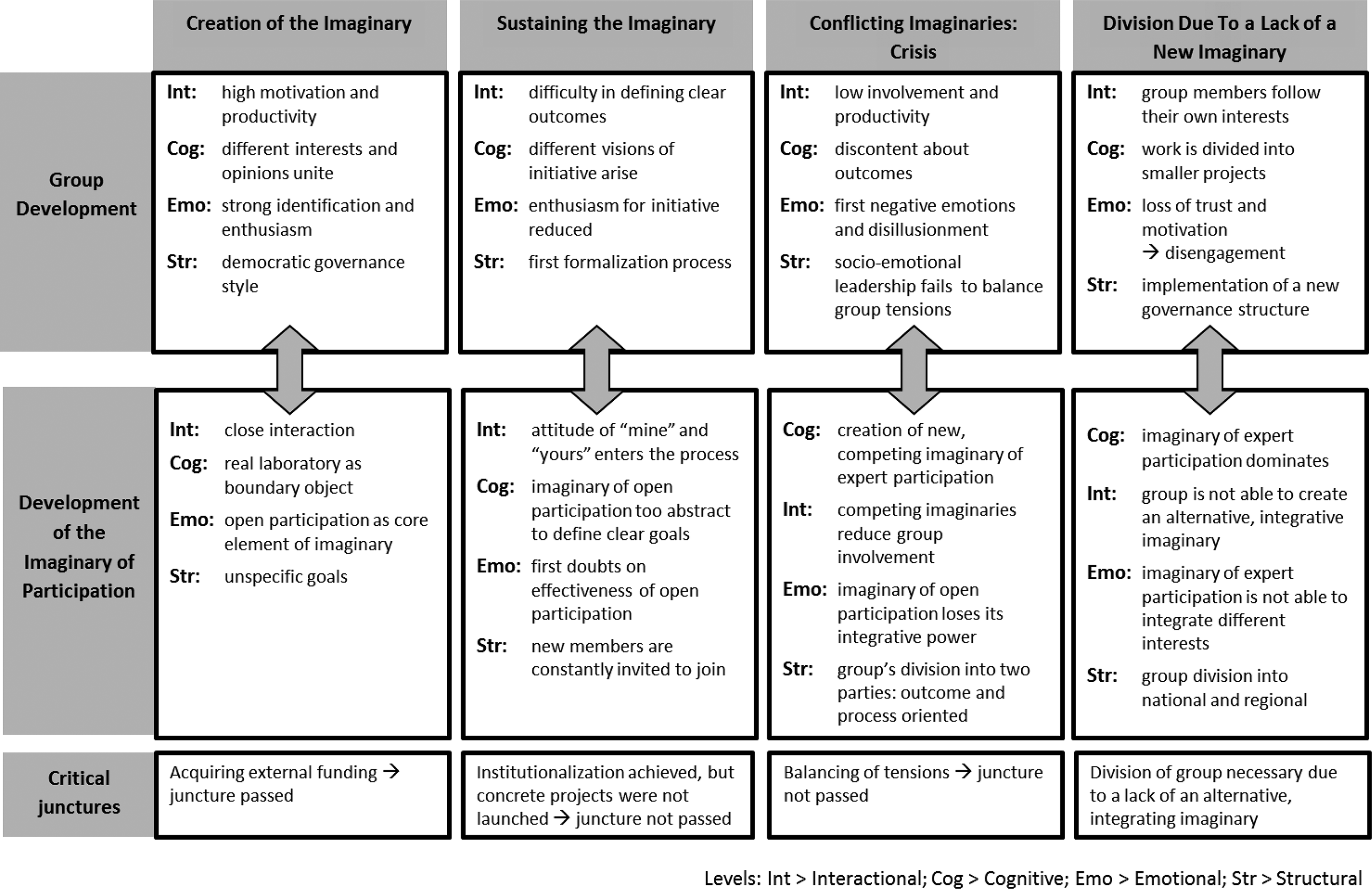
Development of imaginary of participation and group development.
We therefore argue that imaginaries are not sufficient to carry a group project to development and fruition and that the imaginary of open participation is a particular type of imaginary with limited scope: it works as an abstraction and as a guide to a process but loses force when a process as an end in itself becomes subordinate to the need to produce outcomes. We propose a differentiated understanding of imaginaries of participation and distinguish between process imaginaries and outcome imaginaries. Process and outcome imaginaries have different purposes and different amounts of power at different stages of a group’s work. Process imaginaries are important in early stages of group development, especially in innovation processes (forming and storming), when ideation, conceptualization, exploration, and iterative knowledge construction are crucial. Process imaginaries offer orientation and support goal attainment when a clear structure is not yet established. They can provide a clear collective goal and enable productive problem framing. In later stages of the process, outcome imaginaries are more relevant; this is when the focus is put on the implementation of ideas and the development of products and services. In our case, the imaginary of open participation served as an effective process imaginary but failed to serve as an outcome imaginary. In this sense, the group lacked ambivalence management and was unable to shift from an open and imagining mode to the more constrained and productive mode centering on what is possible with available resources at present. Leadership that could have supported this shift was not in place. This process negatively affected the most important components of group creativity: resources, context, and energy.
Leaders have to manage different group imaginaries carefully. In doing so, they should always consider the dynamics: while a purely socioemotional leadership style might be more beneficial at the outset, a more task-oriented style with some socioemotional elements might be necessary later. In our case, the task-oriented style replaced socioemotional leadership rather than complementing it, which then led to further problems. Imaginaries of participation can be powerful for bringing different groups together and fostering innovation, but these settings must be managed and supported by suitable leadership strategies.
Footnotes
Acknowledgments
We especially thank the reviewers and the editor for their helpful comments on this paper. We would also like to thank Dagmar Simon, Andreas Knie, and Franziska Engels for discussing earlier versions of this manuscript. We further appreciate Anna Elnikova’s, Tim Weihrauch’s, and Karina Rosa Frank’s assistance in background research for this paper.
Declaration of Conflicting Interests
The author(s) declared no potential conflicts of interest with respect to the research, authorship, and/or publication of this article.
Funding
The author(s) disclosed receipt of the following financial support for the research, authorship, and/or publication of this article: This research was conducted at the “Science Policy Studies” research group at the WZB Berlin Social Science Center as part of the project “New Spaces for Collaboration between Science and Practice in the Social and Spatial Sciences,” which was funded by the Federal Ministry of Education and Research in Germany (Support Code 03FO16005E).