



Abstract
This article examines the evolution of peer review and the modern editorial processes of scholarly journals by analyzing a novel data set derived from the Royal Society’s archives and covering 1865-1965, that is, the historical period in which refereeing (not yet known as peer review) became firmly established. Our analysis reveals how the Royal Society’s editorial processes coped with both an increasing reliance on refereeing and a growth in submissions, while maintaining collective responsibility and minimizing research waste. By engaging more of its fellows in editorial activity, the society was able to establish an equilibrium of number of submissions per reviewer that was relatively stable over time. Nevertheless, our analysis shows that the distribution of editorial work was significantly uneven. Our findings reveal interesting parallels with current concerns about the scale and distribution of peer review work and suggest the strategic importance of the management of the editorial process to achieve a creative mix of community commitment and professional responsibility that is essential in contemporary journals.
Introduction
According to recent estimates, about 2.5 million articles are published each year in academic journals across the world, with numbers growing about 3 percent a year (Ware and Mabe 2015; Publons 2018). At the heart of the contemporary system of academic publishing lies the process of peer review, which has become a central mechanism in establishing the credibility of scholarly journals and the reliability of scientific knowledge claims (Siler and Strang 2017; Tennant et al. 2017; Moxham and Fyfe 2018; Grimaldo, Marušić, and Squazzoni 2018; Horbach and Halffman 2018). The growing prominence of peer review in advising both editorial and grant-making decisions has led to increasing scrutiny of the process in recent decades. It has been variously accused of being inefficient (Broad and Wade 1982; Smith 2010), subject to bias (Lee et al. 2013; Cohen et al. 2016), and requiring a volume of volunteer academic labor that may be impossible to sustain in the long run (Fox, Albert, and Vines 2017; Zaharie and Seeber 2018).
A key concern about the sustainability of peer review has been the expansion of the scientific enterprise: though individual publication rate has not increased in a century (Fanelli and Larivière 2016), the expansion in researcher numbers and the increasing importance of publications and citations for academic career and recognition have led to a growing need for reviewing (Edwards and Roy 2016; Kovanis et al. 2017). For biomedical sciences alone, it has been estimated that about 70 million hours are spent on reviewing every year on a mostly voluntary basis by already-busy researchers (Kovanis et al. 2016). The internationalization of research, coupled with improvements in communication technology, has allowed the work of reviewing to be shared internationally, but the distribution is not equitable (Mulligan, Hall, and Raphael 2013; Jubb 2016). Although the expansion in authorship is a global phenomenon, the majority of the labor of reviewing appears to be undertaken by researchers in the global North (Warne 2016; Publons 2018).
Furthermore, the proliferation of scholarly journals, their disembeddedness from the scientific community, and the opacity of their governance and control mechanisms, which have been mostly privatized under what Fochler (2016) called “epistemic capitalism,” have raised concern about the lack of shared responsibility and accountability of scholarly journals (Bilder, Lin, and Neylon 2015; Fyfe et al. 2017). In this perspective, the gatekeeping function of editors (Crane 1967), which is reinforced by shared editorial management practices, such as those of Committee on Publication Ethic (COPE) and International Committee of Medical Journal Editors (ICMJE), consists of prerogatives over academic recognition and “creative agency” on knowledge standards that would limit creativity and innovation (Broadhead and Rist 1976; Strang and Siler 2015; Teele and Thelen 2017).
These concerns undermine the credibility of scientific claims, call for reconsideration of complex mechanisms that lie behind peer review and editorial processes, and increase requests for transparency and accountability (Fitzpatrick 2010; Frodeman and Briggle 2012).
Here, we analyze a novel historical data set that allows us to investigate the evolution of peer review practice, the distribution of work, and the management of the editorial process during an earlier period of scientific expansion. Our data come from the archives of the Royal Society, London, and cover the period 1865-1965. The Royal Society is the publisher of the world’s longest-running scientific journal, the Philosophical Transactions, founded in 1665 (Fyfe, McDougall-Waters, and Moxham 2015). Written referees’ reports have been part of its editorial process since 1832 (Csiszar 2016, 2018; Moxham and Fyfe 2018). A vast amount of information about the editorial process survives in manuscript in the London archive, but this is the first time a digitized data set has been available for analysis. Unfortunately, the data set does not include the full text of the reports themselves, which are not currently available in machine-readable form.
The period available for analysis begins in 1865. At this time, refereeing was a well-established practice at the Royal Society and some similar societies (Newman 2019), but it was rarely used by nonsociety journals or any journal where speed of publication was prioritized (Clarke 2015; Clarke and Mussell 2015; Baldwin 2015). By 1965, the practice of reviewing had become much more widespread among scholarly journals, including those published by new players in the market such as Pergamon and Elsevier. Our analysis ends just before the neologism “peer review” came into use and before “peer review” came to be seen as an essential element for all academically rigorous publishing (Baldwin 2017, 2018; Batagelj, Ferligoj, and Squazzoni 2017).
Rewinding the tape is key to understanding the current situation. It turns out that such phenomena as the growth in submissions, an increased expectation of reviewing, the involvement of multiple reviewers, a need for a greater number of reviewers, and an unequal distribution of workload among reviewers are not new to the world of journal editing. Examining the historical trends in these phenomena sheds light on the constraints and possibilities for current innovations.
The editorial processes we examine at the Royal Society were firmly embedded in a community of scholars: they depended upon the participation of the elected members of the society (known as Fellows). The Society’s collective responsibility for the journals had, since the mid-eighteenth century, driven the creation of particular organizational structures for editorial decision-making (including committees and referees). But, by the early twentieth century, relying on a limited pool of expert reviewers would make it challenging for the Society’s editorial processes to cope with the ambition of sending an increasing proportion of an expanding number of research papers to reviewers.
Few journals today are so deeply embedded in a community of scholars. Thanks to the growth of international research communities and digital communications technologies, editors can rely upon a large pool of anonymous, distant, and internationally dispersed peer reviewers who are personally unknown to each other, and have little in common but their shared research expertise and standards (Lamont 2009). The apparent loss of a sense of community commitment, and of group accountability in academic judgment, has become a theme in current debates on the evolution of scholarly communication (Pontille and Torny 2014, 2015; Tennant et al. 2017). Analyzing the editorial implications of the link between journals and the society that organized them encourages us to reflect on pros and cons of the community (dis)embeddedness of modern scholarly journals (Kean 2009).
This community commitment to academic judgment has often been lost in contemporary journals, a victim to the dispersed and distant nature of modern peer review, in which anonymity has been newly lauded (Pontille and Torny 2014). However, our analysis shows a community-based editorial process struggling with scale. Embedding journals in responsible and accountable communities while keeping pace with the increasing complexity of scholarly communication patterns is the true puzzle of the modern times.
The Royal Society Editorial Data Set
Our data set comprises five-year samples covering 1865–1965, transcribed from a series of handwritten ledgers held in the Royal Society’s archives, known as the “Register of Papers” (see Figure 1).
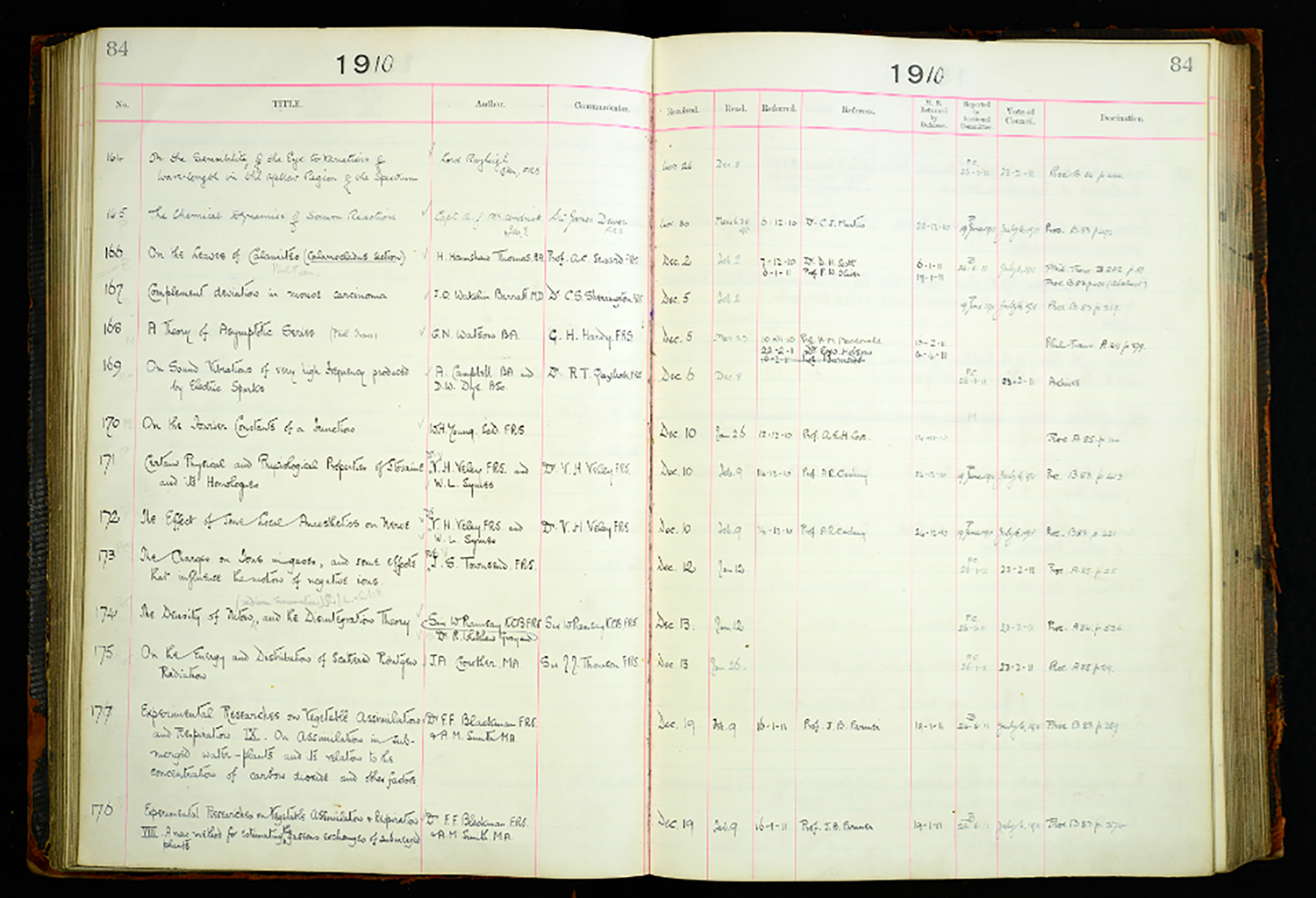
The register of papers, November 26–December 19, 1910 (Royal Society MS/423). Editorial decisions are listed in the far-right column: as well as papers published in the A and B series of both Philosophical Transactions and Proceedings, one paper was sent (unpublished) to the Society’s archive.
The data set contains 6,665 records of submitted manuscripts, of which 787 (11.8 percent) went on to be published in Philosophical Transactions, 5,214 (78.2 percent) were published in the Society’s Proceedings, and 665 (10 percent) were not published by the Society (these were either withdrawn by the author, deposited unpublished in the Society’s archive, or rejected).
The Transactions is the Society’s oldest journal and carried lengthy and well-illustrated papers. Since 1887, it has been issued in two series, A and B (for physical and biological sciences), but has otherwise remained a broad, generalist journal. The Proceedings was created in 1831, initially to publish abstracts of Transactions papers but soon also short articles that were deemed of less significance or originality than those in Transactions. Proceedings came out more frequently than Transactions and carried shorter articles. By the end of the nineteenth century, it had become a research journal in its own right and was divided into its own A and B series in 1905. By the 1920s, Proceedings had become the Society’s main research outlet, still carrying shorter articles and appearing more frequently than the Transactions.
The manuscripts in the data set were submitted by 3,716 unique authors, and the editorial work involved 1,015 unique referees, as well as the Society’s Secretaries (who acted as editors in chief) and those Fellows of the Society who served on editorial committees.
The Royal Society’s historical editorial processes differed in some key ways from the processes we are familiar with today (see Figure 2). Papers were submitted to the Society, not to specific journals.
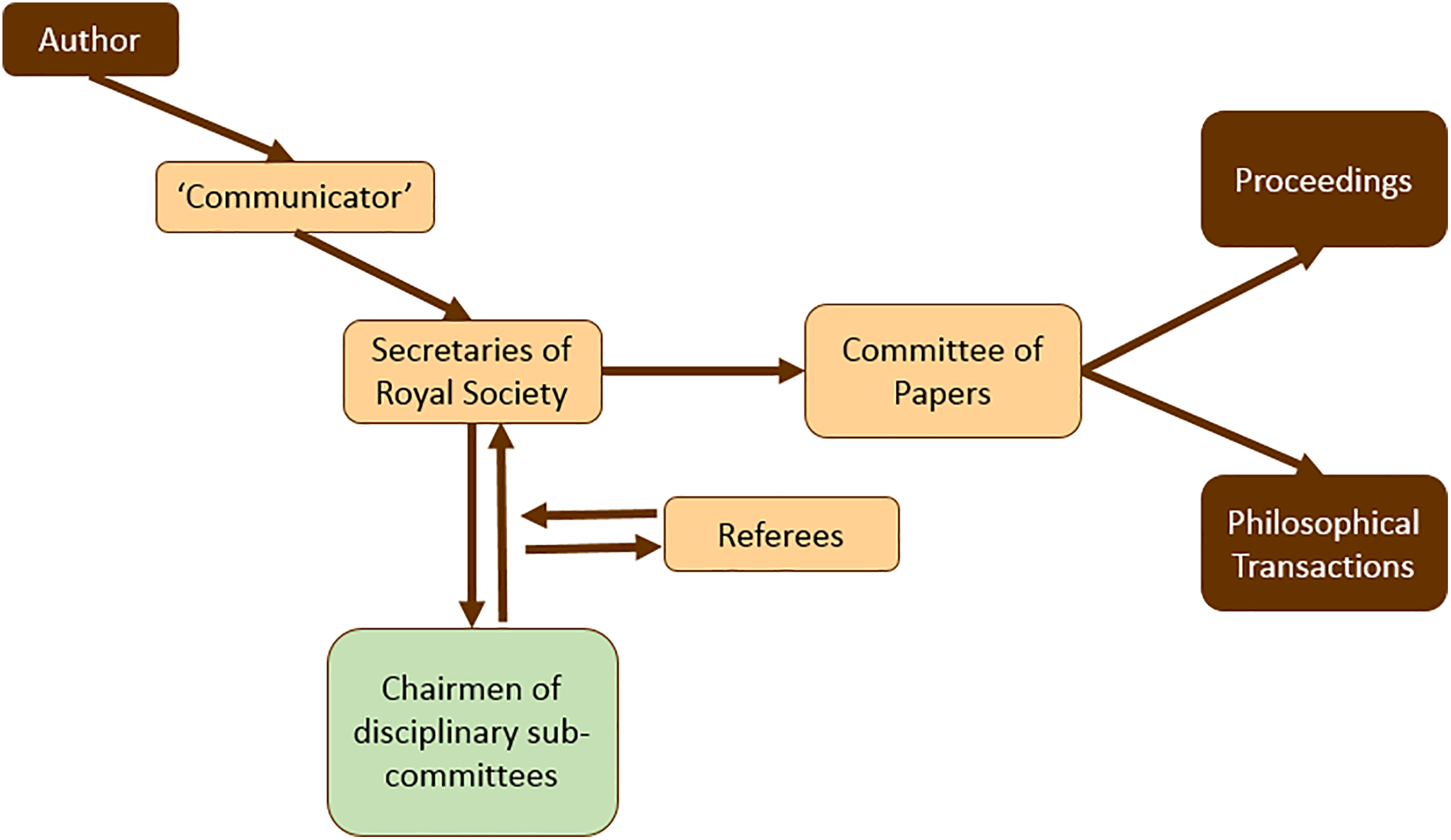
The Royal Society editorial process. The central elements of this system had been in place since 1752, the use of referees for Transactions papers was formalized in 1832, and a new layer of disciplinary subcommittees (in green) was added in 1896, to cope with the increasing specialization of research. The number of referees could be 0, 1, or 2, but occasionally 3 or more; the single copy of the original manuscript was sent to referees in turn by postal mail. By the early twentieth century, the Committee of Papers usually rubber-stamped the recommendations put forward by the relevant secretary and subcommittee chairman.
Throughout the period we examine here, Fellows of the Royal Society had a privileged role in the running of the journals. Manuscripts could only be submitted to the Society by a Fellow, though a Fellow could “communicate” a manuscript for a nonmember. Referees, with just a handful of exceptions, were always Fellows. All members of the Society’s editorial committees were Fellows. We may envision the journals as being run by (and partly for) a club (Potts et al. 2017), dominated by white, British men from the middle and professional classes. The first few women were admitted in 1945 (Fyfe and Røstvik 2018; Røstvik and Fyfe 2018).
The involvement of Fellows had two significant consequences for the editorial process. First, decision-making was in the hands of scientists whose research achievements had been recognized by their election as Fellows. Second, decision-making was being done by a community whose few hundred members knew each other and, a fortiori, knew the editorial team. Through the weekly research meetings of the Society (on Thursdays, in London), the annual social events, and their service on the various committees, Fellows were socialized to common values, standards, and norms (Squazzoni, Bravo, and Takács 2013), though the effectiveness of this must have reduced during the twentieth century as increasing geographical diversity (and academic duties) made it more difficult to get all the Fellows together regularly.
The prestige of the Royal Society’s journals was a means to defend and maintain the prestige of the society. Fellows therefore had reputational incentives to support the Society’s journals and a moral obligation to contribute to the editorial process (Baverstock, Blackburn, and Iskandrarova 2015). Moxham and Fyfe (2018) have demonstrated that the evolution of refereeing practices at the Society was a means of establishing collective editorial responsibility and avoiding the risks of relying on single individuals as editors of journals that were tightly linked to institutional reputation.
The socialization of the Fellows facilitated the construction and implementation of community-based standards for “publishable research” and academic merit (Pontille and Torny 2015), in the absence of explicit criteria for evaluation. For instance, in the 1880s, referees had been asked for “your opinion as regards its eligibility for publication in the Philosophical Transactions”; what counted as “eligibility” was assumed to be tacitly understood (e.g., Referee report, February 16, 1883, RR/9/171). Two decades later, referees were told that papers in the Transactions should “mark a distinct step in the advancement of Natural Knowledge” (e.g., Referee report, June 21, 1901, RR/15/2/7), and from 1914, referees were asked to look for “approved merit” in papers for both Transactions and Proceedings. The definition of “approved merit” would have been socially constructed within the Fellowship; and it is no coincidence that it was in the mid-1960s––as refereeing became more widely used outside learned societies––that both the US-based Council of Biology Editors and the UK conference of editors hosted by the Royal Society called for explicit criteria for accepting or rejecting papers (e.g., RS CMB/150, November 2, 1964).
Results
Our data set reveals three key drivers of change in the editorial work done by the Fellows of the Royal Society over the period 1865–1965: the growing use of refereeing as part of the editorial process, the need to deal with a growing number of submissions, and the need to deal with a growing number of submissions from nonmembers of the Society.
The Growth of Refereeing
Figure 3 reveals the changing patterns in the use of referees over the period. Figure 3A shows that typical practice in the late nineteenth century had been to send papers either to two referees or to none at all, but that during the early twentieth century, most papers came to be sent to at least one referee and a small number were sent to three or more referees. In other words, refereeing came to be used more widely within the Society’s editorial processes.
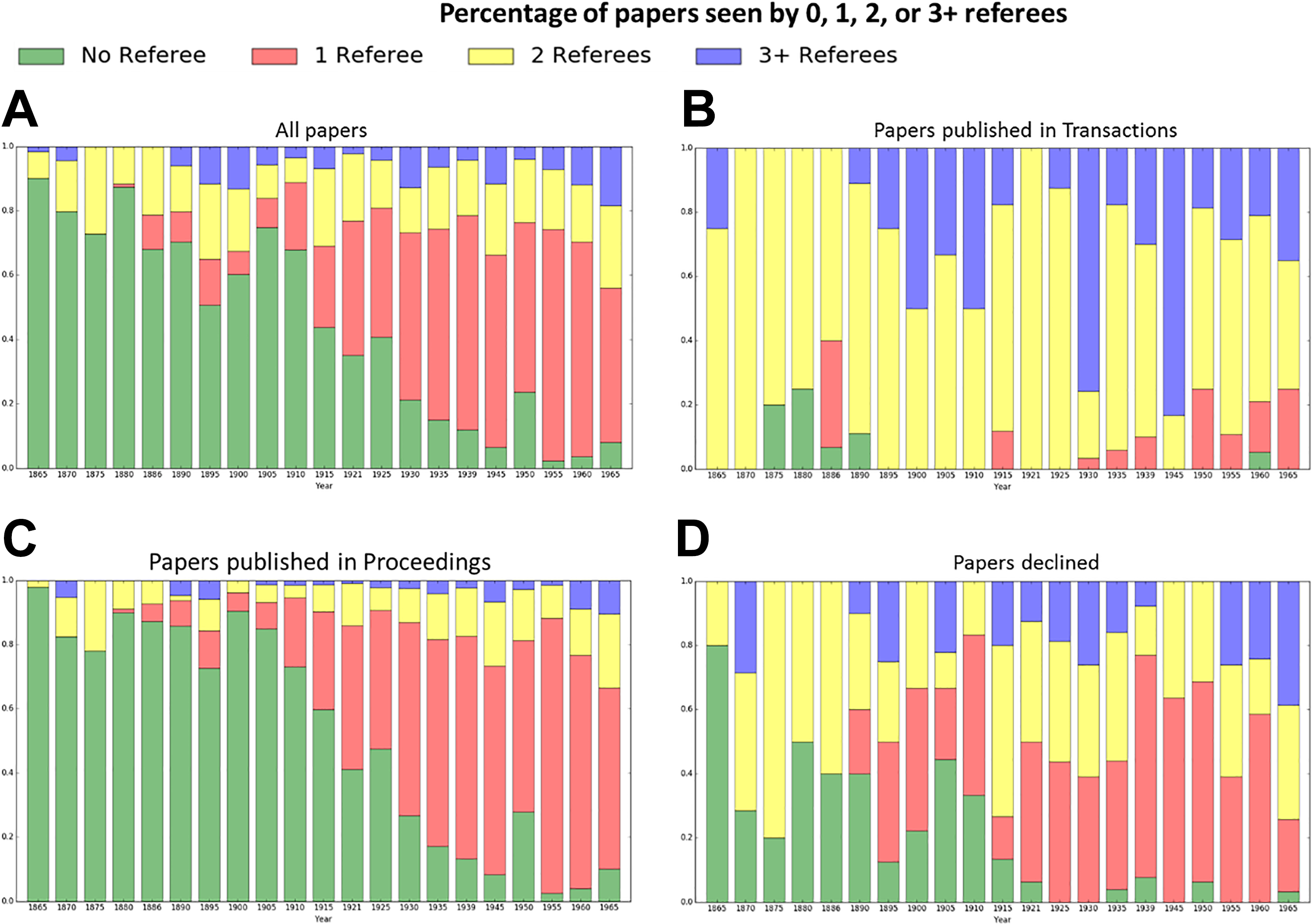
The changing patterns in the use of referees at the Royal Society, 1865–1965. Percentage of papers seen by 0, 1, 2, or 3+ referees (green, red, yellow, and blue) for (A) all submitted manuscripts, (B) manuscripts that were ultimately published in Transactions, (C) manuscripts that were ultimately published in Proceedings, and (D) manuscripts that ended up unpublished (withdrawn by author, deposited in archive, or rejected).
Figure 3B and C reveals that the significant change was in the treatment of manuscripts accepted for Proceedings, not Transactions. Refereeing had originally been introduced for manuscripts being considered for Transactions, and these lengthy manuscripts were typically considered by two referees throughout the period. There was a small but growing tendency to consult a third referee. As Figure 3C shows, papers published in Proceedings were, initially, rarely seen by referees at all (those that went to two referees were probably being considered for Transactions, but did not make the cut), but between roughly 1900 and 1930, the norm shifted to one referee.
Refereeing was not the only way in which the Society’s fellows were involved in constructing collective responsibility for editorial decisions. As Figure 2 showed, all manuscripts accepted for publication had successfully navigated the gate-keeping function created by the insistence that they must be communicated via a Fellow of the Society; and all had been examined by at least one senior member of the Society (usually two, after 1896) and also considered by the Society’s editorial committee. Consulting referees had originally been a means of ensuring detailed scrutiny of lengthy (and costly) papers, and it brought specialist subject expertise, but it had not been regarded as necessary for the shorter papers in Proceedings during the nineteenth century (Moxham and Fyfe 2018).
Our data show how that attitude to refereeing changed in the early twentieth century, as consulting at least one referee came to be seen as necessary for all papers published in the Society’s journals. The fact that this shift occurred during the period in which Moxham and Fyfe (2018) have identified increased criticism of the refereeing process is intriguing. Those criticisms, focusing on the undeniable delays to publication and allegations of potential bias, may have been a public manifestation of unease with the silent changes in editorial policy. The subsequent widespread acceptance of refereeing, in its later incarnation as “peer review,” suggests that the Royal Society was not alone in placing a new value on the use of referees in the first half of the twentieth century.
The manuscripts that were ultimately not published by the Society are shown in Figure 3D. It should be remembered that declining to publish a paper that had been authored or communicated by a Fellow of the Society required the confidence to overturn the opinion of a fellow member and, thus, the willingness to risk insulting a fellow member. For this reason, “rejection” was in fact in many cases a negotiated withdrawal by the author. Our data suggest that in the late nineteenth century, the Society’s Secretary (de facto editor) frequently negotiated such withdrawals on his own authority (equivalent to a modern desk reject), only occasionally seeking advice from referees. This suggests his confidence in dealing with submissions from the entire field of science, and his willingness, usually, to overrule the Fellow who communicated this paper. When he did ask referees, it was usually two. Having the opinion of two expert Fellows may have given the Secretary the intellectual grounds, as well as moral support, for papers with difficult personal circumstances. By the twentieth century, the expansion of refereeing also meant fewer desk rejects; declined papers had typically been seen by at least one referee.
A Growing Number of Submissions, Especially from Outsiders
The greater use of refereeing seen in Figure 3C and D coincided with a substantial growth in submissions to the Society’s journals, as Figure 4A makes clear. This was a time of sustained growth in science more generally, due to the establishment of many new universities in the late nineteenth century, increasing amounts of state support for scientific research and the emergence of industrial research (Cardwell 1972; Shapin 2008).
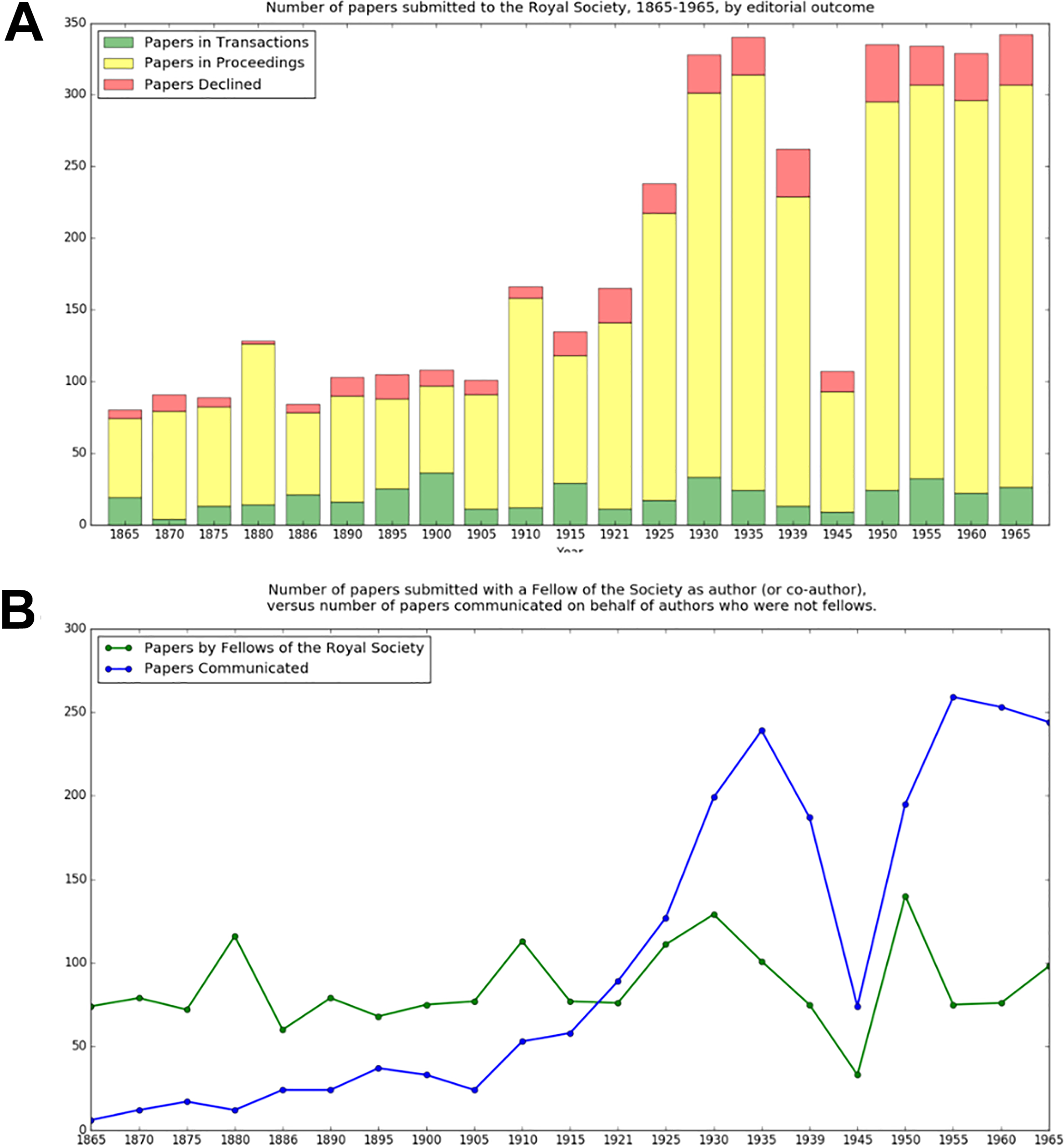
(A) Number of papers submitted to the Royal Society, 1865–1965, by editorial outcome. (B) Number of papers submitted with a Fellow of the Society as author (or coauthor) versus number of papers communicated on behalf of authors who were not fellows.
The rate of growth of global scientific publications in the nineteenth and early twentieth century has been estimated at about 2-3 percent per year, with a transition to an even faster growth rate (about 8 percent) around World War II (WW2; Bornmann and Mutz 2015). The Society’s experience of growth shows a slightly different chronology, with a roughly fourfold increase in papers submitted between 1865 and 1935 (2 percent per year) followed not by growth but by a plateau into the 1960s (ignoring the effect of the war). This suggests that the postwar expansion of scientific publication was taking place somewhere other than at the Royal Society. This is consistent with what is known about the expansion of the new, specialized, faster-publishing journals launched by commercial competitors (Fyfe et al. 2017).
Nonetheless, until the late 1930s, the Royal Society journals were experiencing a year-on-year growth in submissions that was broadly reflective of wider trends. The rest of this paper is concerned with how the society’s distinctive editorial processes—particularly, the use of referees—coped with that growth.
Figure 4B draws our attention to an important feature of the growth of submissions at the Royal Society: the post-1890 increase was largely due to a fivefold increase in manuscripts submitted by nonmembers. This was a significant shift for the editorial processes of the Society, for they had originally evolved in a context in which around two-thirds of the papers being evaluated were authored by members of the club that was doing the evaluation. The proportion of manuscripts by nonmembers had been increasing through the late nineteenth century; but in the twentieth century, they would massively outstrip those authored by Fellows.
This transformation was a direct consequence of the fact that the Society did not grow in size to keep up with the scientific community in the early twentieth century. In the 1860s, the 650 fellows of the Society had represented the mainstream of British science, including most of the active men of science in Britain over the age of forty years. But by remaining small (indeed, falling to around 450 Fellows in the 1930s), the Society came to represent the elite of British science rather than the majority. The pages of its journals were far more representative of contemporary science than the roll call of its fellowship, but the imbalance would create an editorial problem because it was the fellowship that risked being overwhelmed by the burden of editorial and refereeing responsibilities.
Discussion of the Effects on Editorial Work
The growth in submissions might have been expected to lead to a higher rejection rate, which is today often considered as the supreme signal of a journal’s quality (Macdonald and Kam 2007). However, as the red section of the stacked bar graph in Figure 4A shows, this did not happen: the proportion of unpublished papers remained between 8.5 percent and 13.5 percent for the whole period, with a steady 10–11 percent after WW2, which is half the mean rate in contemporary physics and biology journals (Zuckerman and Merton 1971), probably showing a high level of consensus within its membership (Hargens 1988). This meant that the Society was publishing more papers per year, and this commitment to the circulation of knowledge (including the free circulation of many copies of the journals, Fyfe 2019) posed severe financial problems for the Society. These problems were already apparent by the 1890s (Fyfe 2015), yet the Society did not impose hard page limits per issue, or insist on higher rejection rates.
The low rejection rate indicates that the Society’s initial gatekeeping process was still doing a good job. The requirement that manuscripts be communicated by Fellows meant that all papers under consideration were either (co)authored by a researcher with a solid track record in research or had been vouched for by such a person. This prescreening of manuscripts removed the majority of the weak or unsuitable papers and sustained an expectation that most papers received by the Society would be worthy of publication. There is, however, archival evidence for some concerns about this process from the 1930s onward: some feared that few referees were brave enough to critique a paper communicated by someone eminent and others feared that the fellows who communicated papers were not screening them carefully enough (Fyfe 2018a).
The growth in papers published by the Society was absorbed by the newer journal, Proceedings, with Transactions remaining roughly the same size throughout this period. Proceedings had initially been seen as a less prestigious option than Transactions, but the fact that it came out more frequently made it increasingly attractive to authors by the early twentieth century. The growing importance of Proceedings to the Society and its authors helps to explain why its editorial process became more complex (by the increasing use of referees, Figure 3C) in the early twentieth century.
Dealing with all these submissions meant a growth in editorial work. As Figure 5A shows, more submissions and more use of refereeing led to an increased number of referee reports needing to be written each year. This was particularly notable in the early twentieth century: whereas the Society’s secretaries had solicited around 100 referee reports per year in the late nineteenth century, they needed four times that many by the 1930s.
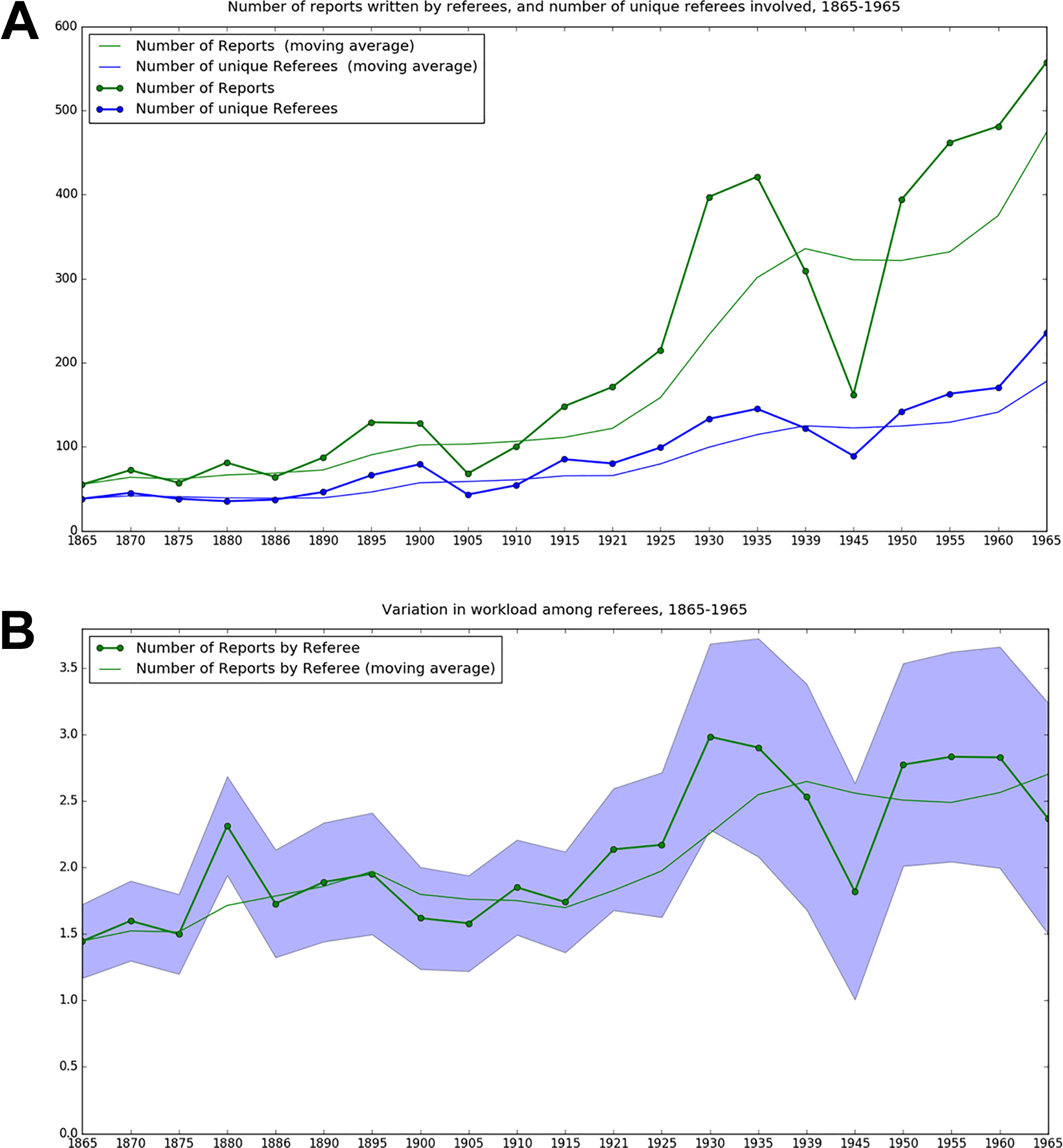
(A) Number of reports written by referees, and number of unique referees involved, 1865–1965. (B) Variation in workload among referees, 1865–1965, showing for each sample year the mean number of reports per referee, the moving average, and the 90 percent confidence level interval.
To get those reports written, the Society’s secretaries needed to identify and persuade fellows of the Society to act as referees. In the 1860s and 1870s, long-serving secretary George Gabriel Stokes had done this largely single-handedly, helped by his reputation for seeming to know everyone in British science (Baldwin 2014). The specialization of research made it more difficult for subsequent secretaries to select referees across the entire field of (either) biological or physical sciences. From the 1890s, the two secretaries were each assisted by half a dozen new discipline-based committees of fellows, whose networks and expertise helped them recommend appropriate fellows to act as referees.
Unsurprisingly, as Figure 5A shows, more Fellows became involved in writing such reports. George Stokes had relied on around 50 fellows each year, but by the 1930s, around 140 fellows acted each year. This growth is not as great as the growth in submissions, which meant that the mean number of reports written by each referee per year (Figure 5B) increased slightly: from about 1.5 to about 2.5 reports per year, with most of the growth after 1900. However, the mean disguises a significant variation in how much refereeing individual fellows undertook. Most only wrote one report per year (if any!), but a few did vastly more. In the 1870s and 1880s, the most active fellows wrote eight or nine reports a year, but by the mid-twentieth century, a handful of fellows were writing more than sixteen reports a year.
Thus, we must consider the distribution of refereeing work. Figure 6A makes clear that, although more fellows did become involved in refereeing work during the twentieth century (in the 1880s, about 8 percent of fellows were involved, growing to about 30 percent by the 1930s), it was still only a minority of the total pool of fellows. With no retirement age, some Fellows were presumably too elderly to take on this responsibility; and a few may have lived too far distant for sufficiently rapid response (although we have excluded the “Foreign Members” from this figure). But even so, it is clear that the Society’s officers either chose not to, or found themselves unable to, involve more of the fellows in editorial work.
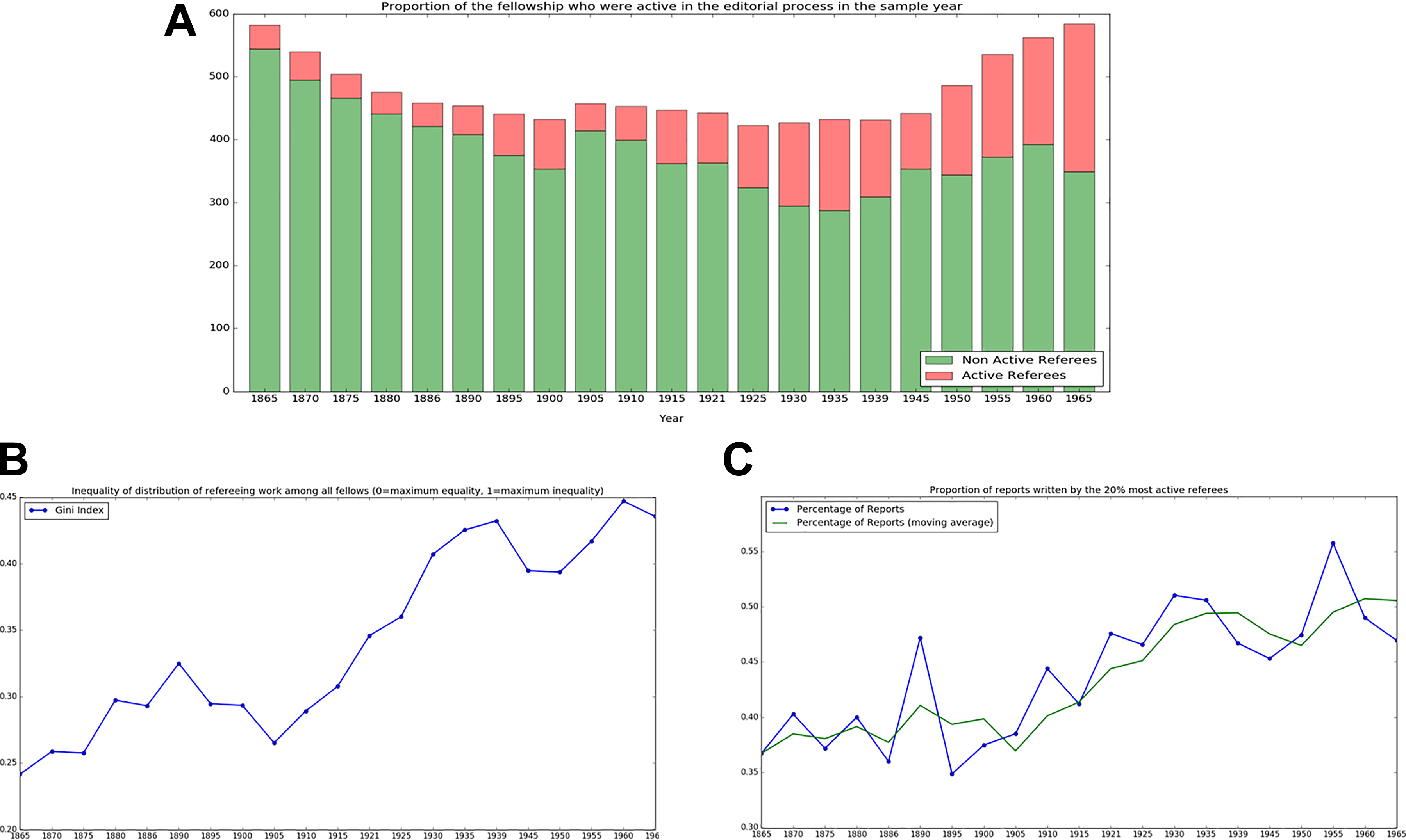
Distribution of editorial work among the fellowship, 1865–1965. (A) Proportion of the fellowship (excluding Foreign members and Royal members) who were active in the editorial process in the sample year. Active is defined as “at least 1 referee report.” (B) Inequality of distribution of refereeing work among all fellows (0 = maximum equality, 1 = maximum inequality). The inequality is measured using the Gini Index. (C) Proportion of reports written by the most active 20 percent of referees.
There is little archival evidence about how or why fellows were asked to referee. Letters from the secretary inviting referees often made reference to the fellow’s relevant expertise, but this source offers little assistance for why other fellows were not asked. It is possible that certain fellows were known to be unreliable; and it is certainly possible that some were too busy. By the 1950s, the “Register of Papers” starts to record a small but noticeable number of referees who had been asked, but “declined” to report.
Figure 6B and C offers two indications of the distribution of workload. Figure 6B is a measure of the inequality of the distribution using the Gini Index. It shows that, since the start of the twentieth century, the distribution of the refereeing load became significantly more unequal (rising from about 0.24 to almost 0.45).
Figure 6C shows the contribution made by the most active 20 percent of referees in each year. That active group of fellows took on proportionately more of the work over time, rising from about 37 percent of all reports in the late nineteenth century to about 50 percent of all reports in the mid-twentieth century. Moreover, members of that group wrote on average 3.1 reports in 1865, but 6.5 reports in 1965. Thus, despite more fellows being involved in editorial work, most were only occasional referees, and a relatively small number of particularly active fellows were becoming increasingly influential in decision-making.
For members of that group, however, refereeing was coming to be seen as a burden, with one Fellow complaining in 1950: “For mercy’s sake, don’t send me any more papers to referee for a long time!…If I get much more heavy refereeing like this, it is goodbye to any chance of doing real scientific work myself” (N. K. Adam, quoted in Røstvik 2016). By the mid-twentieth century, Fellows were having to juggle their commitment to the Royal Society with requests for refereeing work from other societies (and gradually, from commercial publishers too), as well as trying to fit all that voluntary work around the growing demands of their jobs as university academics.
Conclusions
Our findings show the pros and cons of community-based editorial processes in the age of handwritten and typed letters, weekly meetings, and print-on-paper publication. Having the editorial process so closely embedded in a society helped to organize the editorial process around journals and established a sense of collective responsibility for the journals and their contents. The prescreening role of the fellows who acted as communicators helped to outsource some evaluation work prior to what we now name the editorial process. Involving fellows as communicators, referees, and committee members allowed the distribution of risk in uncertain decisions among accountable fellows. This was only possible because fellows were socialized to certain community values, and for many of them, this included doing their best to protect the prestige of their society through their commitment in the editorial process of its journals.
The significant challenge was the growth of submissions from outside the society. In the nineteenth century, most editorial decisions were being made by fellows about fellows; but after c.1900, most editorial decisions were being made by fellows about nonfellows. What began as “peer” evaluation had changed into something else: being accepted for publication signified acceptance by representatives of an elite national learned body of judges. The growth of external submissions also had consequences for the motivation of fellows who engaged in editorial processes. Reviewing and editorial work used to be an activity that was clearly for the benefit of the club to which one belonged; but by the twentieth century, it had become something that was for the benefit of a wider, more dispersed, less clearly identified community. The Society’s inability to expand the group of “active fellows” to keep the workload better distributed suggests that the benefits to members of editorial work were no longer sufficiently clear, amid the many other responsibilities competing for their time.
The historical example of learned society publishing, including that of the Royal Society, has long been used to support calls for academics to take back the control of research journals (Harnad 1995; Fyfe et al. 2017; Tennant et al. 2017). Looking at the past should provoke reflection among those seeking to use digital communications technologies to create virtual communities aiming to self-organize editorial work, refereeing, and publication (e.g., Tennant et al. 2017), in order to recreate collegial dialogue and judgment (Hirschauer 2010), rather than distant trilateral negotiations between authors, referees, and editors (Myers 1985). Questions remain about how best to organize those communities and how to motivate members to carry out voluntary work, while keeping the pace of the complexity of the editorial work and increasing requests for responsibility and accountability (Fitzpatrick 2010).
Embedding journals in responsible and accountable communities is in our opinion essential but not sufficient. First, the complex ecology of entities composing the scholarly communication landscape, including universities, media conglomerates, and learned society publishers, needs synergistic relations to explore these innovations more systematically (Squazzoni, Marušić, and Grimaldo 2017). Much more so than mid-nineteenth-century Fellows of the Royal Society, individual researchers now routinely engage with multiple scholarly communities and publishing organizations and may have to prioritize different interests in those different contexts. Unfortunately, competition and predation often prevail between these entities because their incentives, rewards, and priorities are misaligned (Edwards and Roy 2016; Bianchi et al. 2018).
Second, responsibility and accountability require organizational processes that are often difficult to put in place outside conventional frameworks. But the hierarchies and role structures that are part of community embeddedness can also nurture old-boy-ism and implicit bias (or “group think”), and they encourage intellectual conservatism over innovation (Sigelman and Whicker 1987; Travis and Collins 1991). For instance, the decision of the Proceedings of the National Academy of Science in 2009 to revoke the National Academy members’ privilege of contributing and communicating manuscripts was intended to avoid members exploiting their position and subverting peer review (Kean 2009).
The embeddedness of the Royal Society’s own journals has been gradually loosened since the 1960s: reforms in 1968 allowed the secretary editors to look beyond the Fellowship to find referees and another set of reforms in 1990 removed the requirement for all papers to pass the scrutiny of a Fellow before being submitted to the editorial process. Expanding the pool of referees was a pragmatic response to the problems of workload, while the introduction of a “direct submission” route was a successful attempt to attract a larger and wider pool of submissions, by (belatedly) addressing the failure of the Royal Society journals to reflect the international expansion in scientific research since c.1950. It was only in the 2010s that the Society, now highly conscious of the diversity and inclusion agenda, recast its revised editorial practices as demonstrating a commitment to the intellectual and moral value of involving a wider diversity of people and perspectives in the evaluation of research (Fyfe 2018b). But the result is that, though the journal editors continue to be Fellows, the close links between the journals and the fellowship have largely disappeared.
To conclude, balancing the advantages of embedding journals within communities, with the drawbacks of a close community, remains a challenge. On the one hand, research hyperspecialization and the increasing multidisciplinarity of scientific collaboration have created a context in which community identities and boundaries are blurred and constantly changing. On the other hand, academic hypercompetition and the diffusion of perverse “publish or perish” incentives tend to transform the social embeddedness of academics only as a means to ensure publications, citations, and individual achievements.
Footnotes
Authors’ Note
Pierpaolo Dondio is now affiliated with School of Computer Science, Technological University Dublin, Ireland.
Acknowledgments
We thank the staff in the library and publishing teams at the Royal Society for their generous assistance and some PEERE members for comments and suggestions on a preliminary version of this paper.
Declaration of Conflicting Interests
The author(s) declared no potential conflicts of interest with respect to the research, authorship, and/or publication of this article.
Funding
The author(s) disclosed receipt of the following financial support for the research, authorship, and/or publication of this article: Our collaboration was supported by the COST Action TD1306 “New Frontiers of Peer Review” (PEERE). The historical research for this paper was supported by the UK Arts & Humanities Research Council, grant AH/K001841, “Publishing the Philosophical Transactions, 1665-2015.”
