




Abstract
Recent advances in electronics miniaturization have led to the development of low-power, low-cost, point-of-care ultrasound scanners. Low-cost systems employing simple bi-level pulse generation devices need only utilize binary phase modulated coded excitations to significantly improve sensitivity; however the performance of complementary codes in the presence of nonlinear harmonic distortion has not been thoroughly investigated. Through simulation, it was found that nonlinear propagation media with little attenuative properties can significantly deteriorate the Peak Sidelobe Level (PSL) performance of complementary Golay coded pulse compression, resulting in PSL levels of −62 dB using nonlinear acoustics theory contrasted with −198 dB in the linear case. Simulations of 96 complementary pairs revealed that some pairs are more robust to sidelobe degradation from nonlinear harmonic distortion than others, up to a maximum PSL difference of 17 dB between the best and worst performing codes. It is recommended that users consider the effects of nonlinear harmonic distortion when implementing binary phase modulated complementary Golay coded excitations.
Introduction
Recent developments in the miniaturization of electronic hardware and computer processing have had a profound impact on medical imaging in the 21st century. Although most ultrasound scanners found in a human medical context today are cart-based, handheld and low-power point-of-care ultrasound scanners have the potential to revolutionize the availability of ultrasonic imaging across the world. Key areas of innovation for ultrasound system design include improvements to power consumption and battery life, form factor and portability, and cost.1,2
Battery-operated ultrasound scanner design consequently focuses on improving sensitivity without sacrificing efficiency and cost. Advanced imaging techniques requiring high computational load such as Plane Wave imaging or Synthetic Transmit Aperture imaging, or even increasing number of hardware receive channels to increase sensitivity, can have a direct impact on efficiency and cost, therefore other methods of improving sensitivity should be examined.
Pulse compression has been used in a wide range of technologies from it’s conception in radar imaging through to telecommunications and ultrasonic imaging, which first saw successful implementation in diagnostic ultrasound machines in the 1990s 3 and grew in popularity as ultrasound scanners reached the Mechanical Index (MI) limit imposed by regulatory bodies.
Pulse compression using binary phase coded excitations are of particular interest to low-power, low-cost ultrasound scanner design as binary codes only require simple bi-level pulse generation architectures, rather than LFM “chirp” imaging which requires costly and complex multilevel pulser hardware.
4
One binary phase coded excitation scheme of note uses the Golay complementary sequences, consisting a pair of equal length codes with autocorrelation functions which sum to produce a central peak of
Every aspect of pulse compression using binary phase coded excitations must therefore be optimized to gain the most performance for low-power, low-cost ultrasound systems.
There has, to date, been very little research into the interaction of complementary Golay codes with nonlinear acoustics theory. A seminal paper covering pulse compression for ultrasonic imaging reviewed the use of both Golay and Chirp coded excitations in detail for ultrasound scanners. 4 Although an extremely informative paper, issues surrounding nonlinear propagation and attenuation were only briefly investigated. Simulations of Golay codes propagating through linear and nonlinear media, with B/A of 0 and 8 respectively, were compared across a range of attenuation values and authors found that, although the sidelobes of binary phase codes increase due to harmonic distortion, sidelobe levels reduced as attenuation increased. This indicated that frequency dependent attenuation was aiding the reduction of harmonics in Golay codes, thus maintaining satisfactory complementary summation.
However, ultrasound in medical settings rarely travels through homogenous tissue. Anatomical heterogeneities present propagation media of varying acoustic properties, for example, the skin layer, fat, muscle, and fluid-filled regions as in obstetric imaging. As such, the degree of attenuation cannot be guaranteed.
Therefore the robustness of Golay sidelobe cancelation in nonlinear propagation media can be better understood by first ignoring attenuative effects and considering in isolation the impact of nonlinear harmonic distortion.
This paper will examine in simulation the impact of nonlinear harmonic distortion on the sidelobe cancelation performance of complementary Golay codes. Some background knowledge pertinent to this article will be presented, followed by a description of the model used to simulate acoustic propagation. Harmonic distortion of Golay codes will be investigated and compared using Peak Sidelobe Level (PSL), followed by an analysis of 96 simulated complementary sequences.
Pulse Compression
Sets of binary codes exist which are suitable for constructing coded excitations, whereby the symbols of each code can be represented by
Two commonly used sets of binary sequences suitable for pulse compression in ultrasound are Barker sequences and Golay complementary sequences. For the purposes of this research, we will consider only Golay complementary sequences.
Golay Coded Excitation
Transmission, decode, and summation steps of the binary complementary series devised by Golay 5 are well described in literature.4,8
The convolution stage of pulse compression is implemented as a matched filter, with the template constructed via the time-reversal of the transmitted coded excitation. Note that the matched filter result generates peaks at points of partial correlation symmetrically around the mainlobe. These sidelobes are an artifact of the correlation process and can appear as weak peaks on either side of the mainlobe after envelope detection.
If not adequately minimized, the axial resolution of a system using pulse compression imaging will be significantly reduced: high amplitude sidelobes would mask mainlobe echoes from nearby weakly echogenic, and potentially significant, targets. 9 The aim of good pulse compression implementation, therefore, is to transmit sequences which give a mainlobe at the point of maximum correlation and sidelobes close to zero at all other points.
The final stage of pulse compression using Golay codes is complementary summation, whereby the mainlobes are reinforced to provide a single peak at
Impact of Nonlinearity on Pulse Compression
Nonlinear variations between pressure and density in propagation media cause waveform compressional and rarefactional pressure components to travel at different speeds, altering the amplitude, shape, and spectra of the propagating waveform. The peak compression components of the waveform accelerate toward π / 2
The decoding matched filter extracts a known signal which has been distorted by some linear process, such as additive white noise, however the harmonic distortion created by nonlinearities nonlinear propagation media will logically cause the receiving matched filter template to be suboptimal, as the positive and negative portions of the waveform travel toward and away from the zero crossing, respectively.
Various metrics have been proposed as indicators of nonlinearity, and, although no single metric is best placed to represent all facets of nonlinear propagation,
11
the Spectral Index (
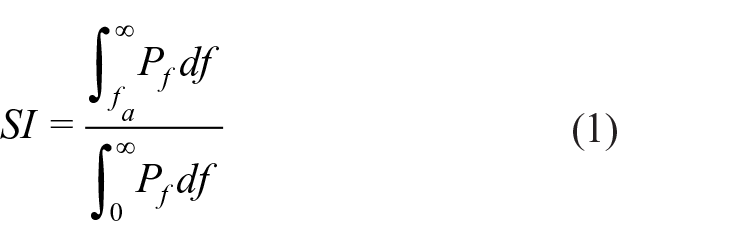
Where
K-Wave Simulation
The k-Wave toolbox for MATLAB can be used to assess nonlinearity through different media. The tool iteratively solves coupled first-order acoustic equations in one, two, and three dimensions, a more efficient method than solving the equations using finite element methods. For a detailed description and experimental validation of the k-Wave toolbox, see Treeby and Cox, 13 Treeby et al., 14 and Martin et al. 15
The simulation is designed as a 2D
Material Properties of Water @ 20ºC.
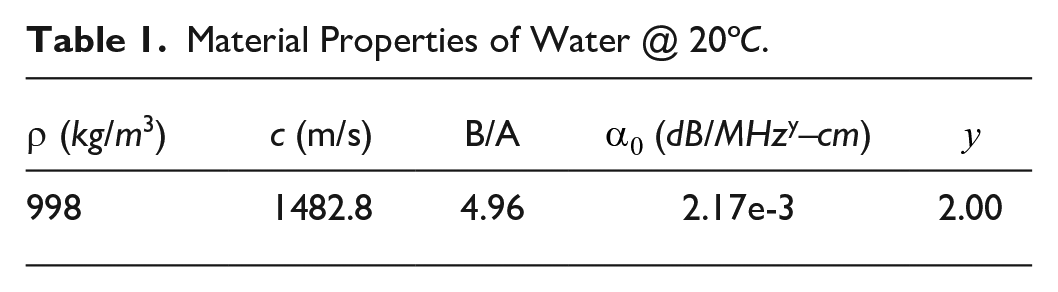
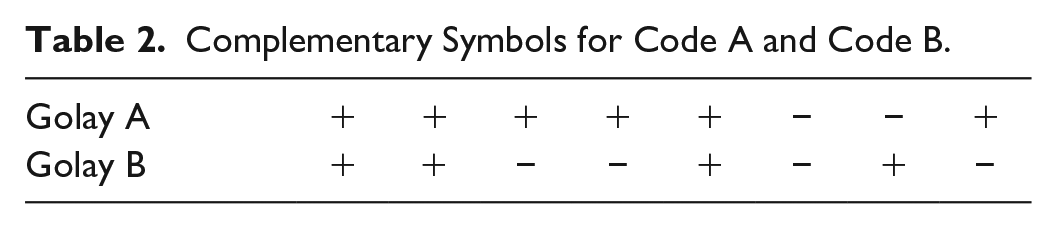
The input source signal is designed to mimic the limited bandwidth of a typical ultrasound transducer. Transmissions are first defined as a square wave pulse train to imitate the behavior of bi-level pulsers used in conventional ultrasound systems and modulated according to Golay codes, for example, given in Table 2 generated by the MATLAB code presented in Trots et al.
8
Transmissions are then filtered through a 512-tap bandpass FIR filter with center frequency of 1 MHz and 85% fractional bandwidth, resulting waveforms are given in Figure 1. A final non-causal filtering step is included, as recommended by the k-Wave documentation to eliminate high frequencies from the transmit signal that are not supported by the grid, before the input signal is amplified by a source pressure of
Complementary Symbols for Code A and Code B.
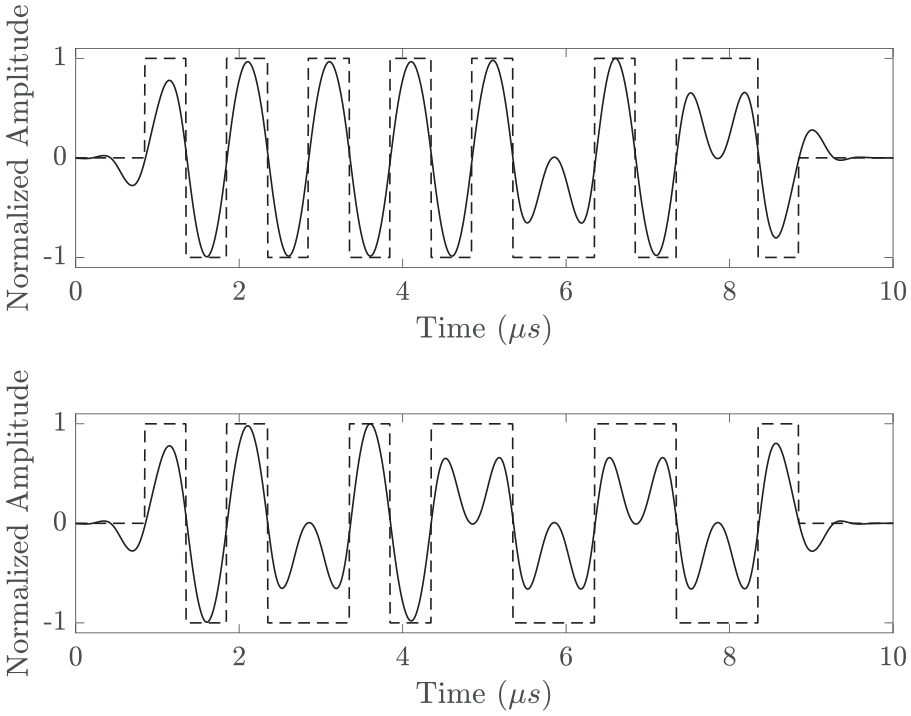
Phase-modulated 1 MHz square wave codes (dashed) and transmitted result after 85% fractional bandwidth bandpass filter (solid) for Golay (a) and (b) top and bottom respectively.
The B/A parameter of nonlinearity can be omitted when defining the medium properties in k-Wave to allow investigation only of linear propagation. Simulations of complementary pairs are conducted for both nonlinear and linear cases, represented in all plots by a solid line and dashed line respectively.
Simulations are performed using the optimized C++ program, providing an order of magnitude speed increase when run on an NVIDIA CUDA-enabled GPU. The following simulations are performed on a Windows Server with an Intel Xeon Silver 4214 CPU @ 2.20 GHz processor, 32 GB RAM, and an NVIDIA Quadro P2000 GPU with 5 GB GDDR5 memory.
Decoding is performed with a matched filter using the time-reversal of the square wave signals shown in dashed lines in Figure 1 as the template, with number of coefficients equal to the length of the transmitted pulse at the temporal sampling rate.
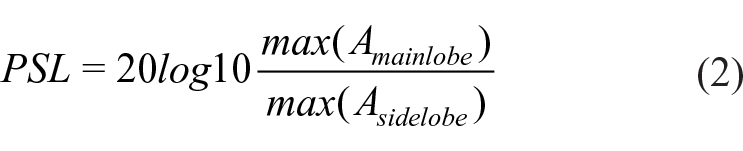
Sidelobe cancelation performance is quantified by the Peak Sidelobe Level (PSL), defined as the ratio of the peak mainlobe to that of the peak sidelobe in decibels, given in (2):
Results
Consistent with both the theory and simulation of a conventional sinusoid, Golay waveforms prior to decoding become distorted in both the peak compression and rarefaction phases throughout the propagation distance.
The differences between the time-domain view of linear and nonlinear codes are not as prominent after decoding, proving the effectiveness of the matched filter.
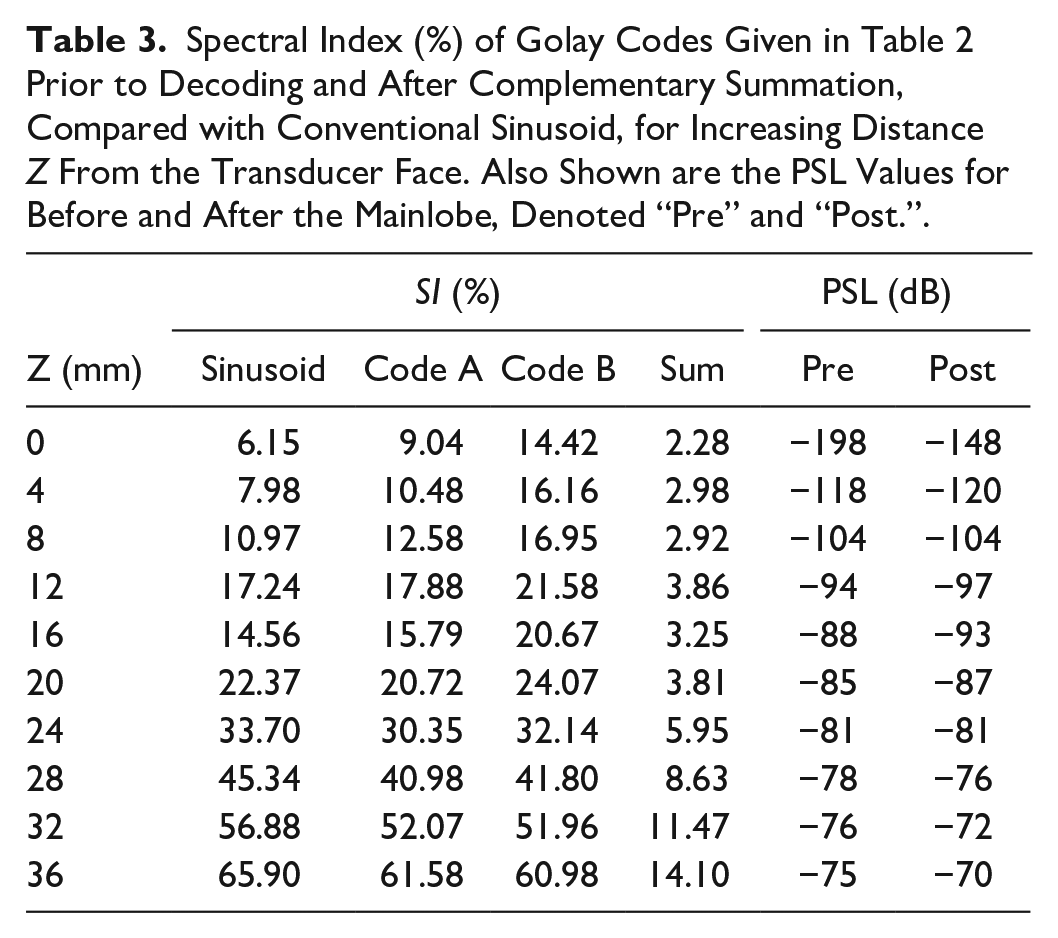
Table 3 compares the
Spectral Index (%) of Golay Codes Given in Table 2 Prior to Decoding and After Complementary Summation, Compared with Conventional Sinusoid, for Increasing Distance
The evolution of sidelobes with increasing
PSL values nearest to and furthest from the transducer face for values of
Normalized and dB plots of the complementary sum at
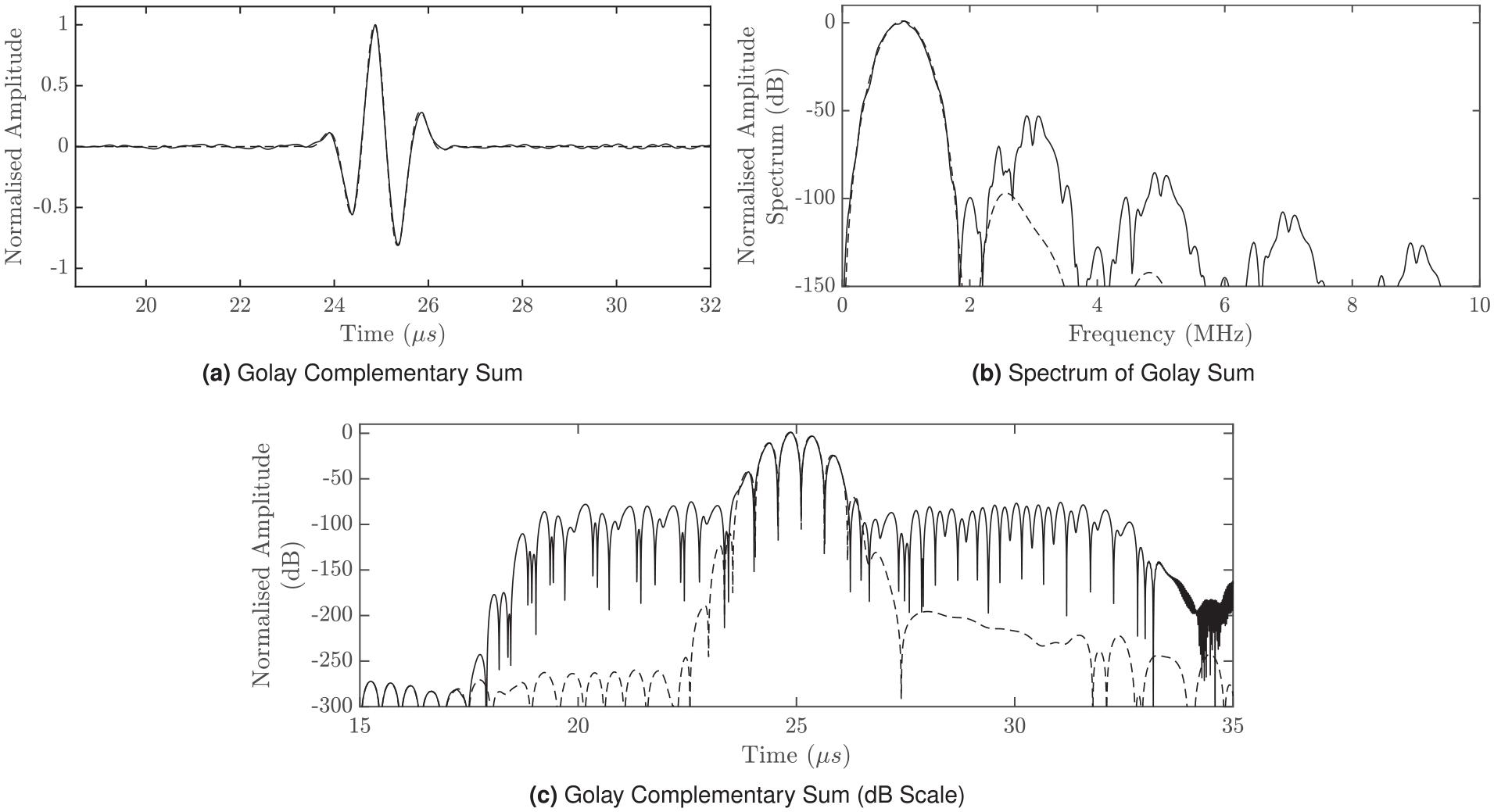
Complementary summation of decoded Golay codes recorded at 28 mm from the transducer face with nonlinear and linear cases represented by the solid and dashed lines respectively. 2(a) shows the final pulse compressed waveform, with notable sidelobes on either side of the mainlobe. 2(b) shows the corresponding spectrum. 2(c) shows a dB plot of the complementary summation waveform, where a significant difference can be seen between the nonlinear and linear cases. (a) Golay Complementary Sum, (b) Spectrum of Golay Sum, and (c) Golay Complementary Sum (dB Scale).
As seen in Table 3, the notably lower
Simulations are repeated with a range of 96 different algorithmically-generated complementary pairs 8 to assess their relative performance.
Box plots of PSL against
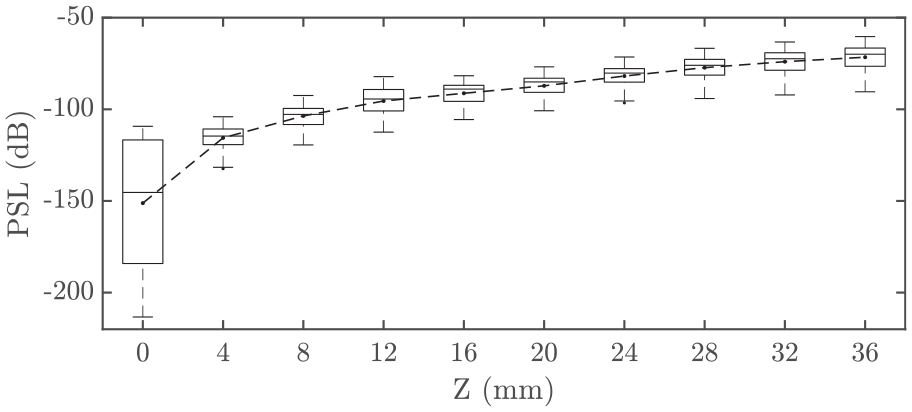
Box plots of PSL against Z for 96 Golay complementary pairs for the nonlinear case, with mean PSL result depicted by the dashed line.
Sidelobe levels are widely distributed at the transducer face, however the inter-quartile range rapidly narrows at
It is well known that Golay swap sets exist, whereby a Golay code can be inverted and/or reversed to yield a new complementary pair. Two such swap sets were identified within the 96 simulated codes, notated hereafter for brevity in hexadecimal, and given in Table 4. Codes within the swap set exhibit different PSL values in the presence of nonlinearity. The nonlinear case shows significant variation on either side of the mainlobe. By selecting Code B
Comparison of PSLs Before and After the Mainlobe for Golay Swap Sets Notated in Hexadecimal Recorded at Z = 36mm, Denoted as “Pre” and “Post” Respectively.
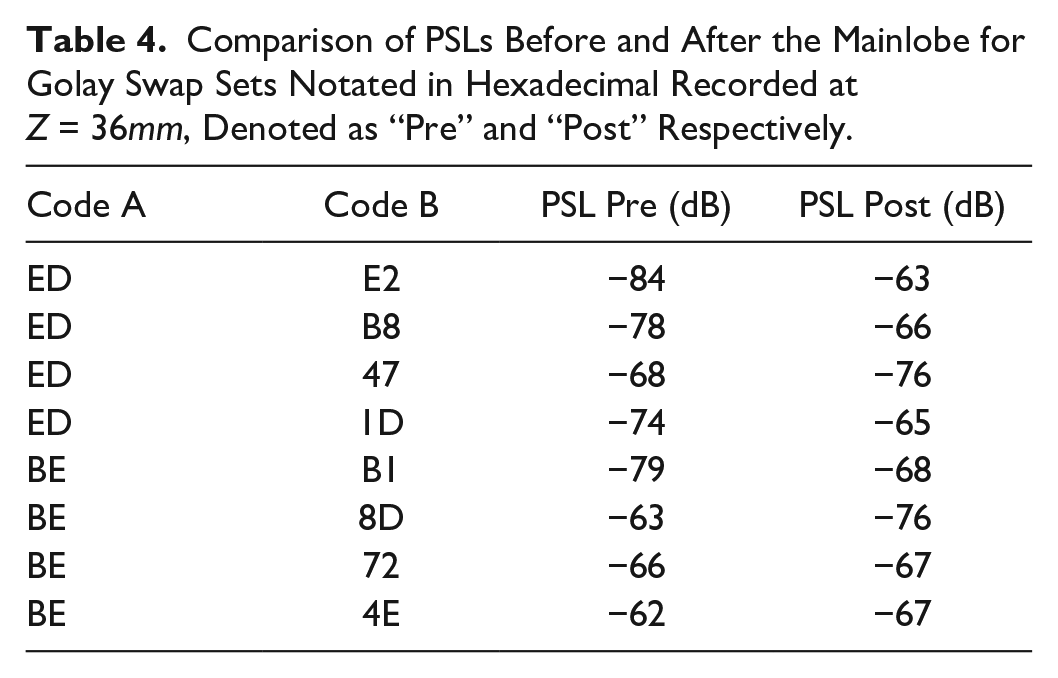
Complementary pairs were sorted in order of their PSL performance for both before and after the mainlobe at
Code Pairs Notated in Hexadecimal with Highest and Lowest PSLs Before and After the Mainlobe Recorded at Z = 36mm, Denoted as “Pre” and “Post” Respectively.
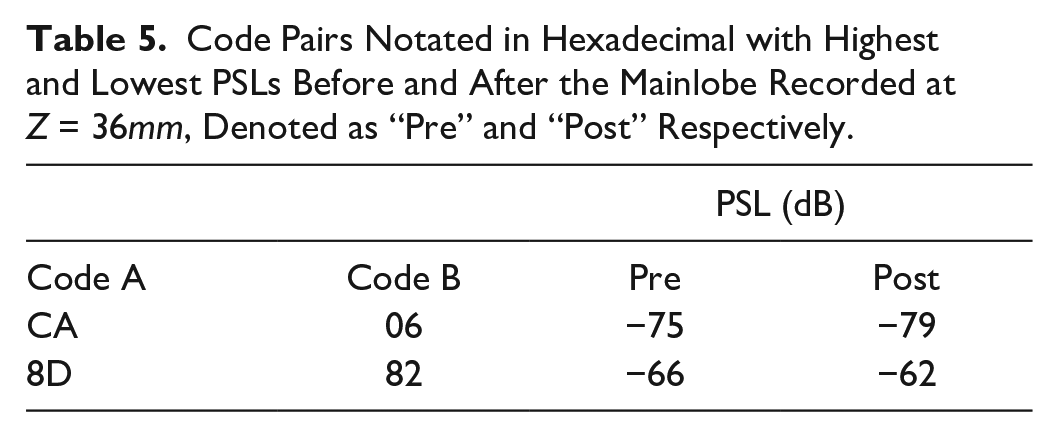
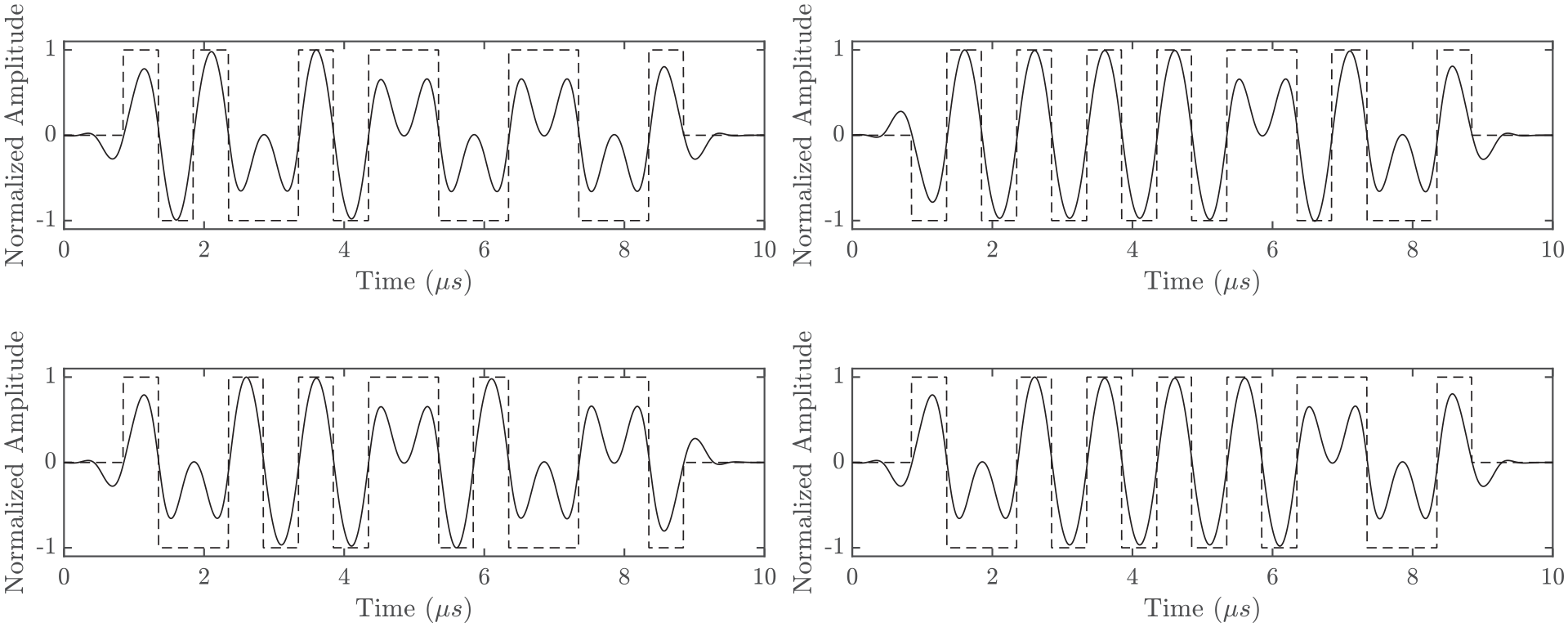
Source waveforms Code A = CA and Code B = 06 (top left & top right respectively) and Code A = 8D and Code B = 82 (bottom left & bottom right respectively). Where the source waveform and square wave pulse trains are represented by the solid and dashed lines respectively.
Discussion
Simulations presented here reveal that sidelobe levels of complementary pairs deteriorate in the presence of nonlinear harmonic distortion, with PSLs found to be significantly higher in the nonlinear case than that of the linear case. Previous work determined that this would have little effect in materials with high frequency dependent attenuation properties, however it must be acknowledged that this is not the case in all materials, be it anatomical or otherwise.
Significant harmonic distortion was observed throughout the propagation of phase modulated Golay codes in simulation. Although decoding led to a marked reduction in harmonic content, final complementary summation revealed significant sidelobe levels, indicating that the matched filter using the template of an ideal code was not optimal. PSL rose from, on average,
Although the average PSL of
An investigation into 96 complementary pairs revealed that some codes perform significantly better than others. A trade-off clearly exists between PSL performance on either side of the mainlobe. Golay swap sets exhibited such behavior, with code pairs within a swap set giving better PSL performance prior to the mainlobe rather than afterward. Of all 96 simulated codes, the codes with the lowest and highest combined PSLs at
The reason why some complementary pairs result in lower PSLs than others is understandably of significant importance. The number of
Notably the level of all even harmonics is far reduced after decoding due to the convolution theorem. The frequency response of each matched filter exhibits stopbands at even harmonics with complex passbands at odd harmonics. Further investigation into the interaction of this complicated frequency response with nonlinear Golay waveforms is clearly valuable but outwith the scope of this paper.
The asymmetry metric
The above results confirm that harmonic distortion can negatively impact the PSL performance of complementary Golay codes, but note the ideal conditions used to generate high SI.
The acoustic shock equation 12 :
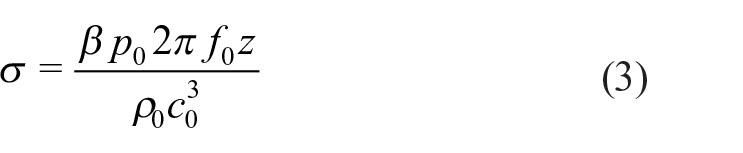
dictates that the formation of shock is proportional to the material coefficient of nonlinearity β, transmitted source pressure
The source pressure of
It is therefore unlikely that complementary Golay codes would develop high sidelobe levels in medical diagnostic ultrasound imaging as a result of nonlinear harmonic distortion.
Although the results presented here are only a result of simulation data, it is worth noting that the k-Wave simulation toolbox has been verified as accurate with experimental data and that the number of observations presented here are easier obtained in simulation than experimentally. Further, the above simulations make use of “turning off” nonlinear acoustics physics which is of course not possible experimentally.
Conclusion
The goal of this article was to examine sidelobe degradation of complementary Golay coded excitations in the presence of nonlinear harmonic distortion, which was achieved by simulating the propagation of the complementary transmissions in water with both linear and nonlinear acoustics theory using the k-Wave toolbox for MATLAB.
Previous authors have shown that frequency dependent attenuation in homogenous media can sufficiently attenuate harmonic distortion of complementary codes, thus maintaining satisfactory summation. 4 However, the simulation results presented here confirm that propagation through water, and therefore other materials with very little frequency dependent attenuation properties, can lead to increased sidelobe levels. Whilst the harmonic distortion observed in this paper originates from the nonlinear relationship between pressure and density in tissue and fluids, the results are applicable regardless of the source of nonlinearity; distortion may arise from multiple sources in the imaging chain between signal generation to matched filter reception.
These findings demonstrate that sidelobe performance of complementary Golay codes will degrade in the presence of nonlinear harmonic distortion, but that the safety limits on medical diagnostic ultrasound imaging will prevent such artifacts from appearing in clinical B-Mode imaging. These findings may, however, have implications for other areas of ultrasonic systems, such as NDT.
It is recommended that system designers aiming to extract the maximum performance of ultrasound devices using pulse compression with complementary codes must consider that nonlinear harmonic distortion can degrade PSL performance, and that proper selection of Golay codes which give desirable cancelation properties should be used.
Readers should also be aware that these results have implications for not only ultrasonic devices in nonlinear propagation media, but to other technologies where sources of nonlinearity can distort transmitted complementary codes.
Future research can build on these observations with simulations approximating anatomical structures with varying nonlinear materials, experimental validation with hydrophones, and also determining why some complementary Golay codes perform better in the presence of nonlinear harmonic distortion than others.
Footnotes
Declaration of Conflicting Interests
The author(s) declared no potential conflicts of interest with respect to the research, authorship, and/or publication of this article.
Funding
The author(s) received no financial support for the research, authorship, and/or publication of this article.
