



Abstract
Context:
Justice-centered science education has come about as a means to challenge the often ahistorical and acultural nature of traditional science teaching and learning to address the social, political, and scientific ways science can be used to (re)produce, but also address, (in)justice.
Despite these efforts, the complex emotional, physical, and moral dimensions of engaging in justice-centered practices are under-conceptualized, especially for youth living in areas historically and contemporarily affected by social, political, and environmental change. More specifically, there remains one injustice that has gone largely unexplored in the science education literature: trauma.
Purpose of Study:
When we consider the historic and contemporary racist paradigms of the scientific discipline and how that has bled into science teaching and learning, coupled with rates of multiple, intersecting forms of trauma—including those that are the result of science and schooling—the need for trauma-informed science learning becomes abundantly evident. In this conceptual article, we present a framework for trauma-informed science (TIS) as a critical pedagogical approach that builds upon and extends trauma-informed and justice-centered science literature to situate trauma, healing and well-being as an integral part of justice. We argue that this framework can support educators in constructing science learning experiences that center the healing and well-being of their students as a practice of justice.
Research Design:
We use the cell, the most basic unit of life, and its organelles, each of which performs a specialized function, as metaphors to conceptualize TIS as a foundational building block of justice-centered science. Just as a cell could not survive without all its organelles working together, the principles of TIS work in conjunction to help teachers reimagine the political and pedagogical ways in which they approach justice-centered science teaching. TIS is made up of six principles: (1) engage in justice-centered science practice; (2) focus on the role of race, racism, and other systems of domination; (3) center love as praxis and protection; (4) ground learning in safety, dignity, and belonging; (5) attune to emotionality and embodiment; and (6) situate healing as an active and ongoing process
Conclusion:
Because of the historical and contemporary ways that science, scientific enterprise, and science education have been used to perpetrate and justify trauma, coupled with rising rates of childhood trauma, there is a moral and pedagogical imperative that makes science education a ripe place to address trauma and center healing. We offer TIS not as a simple instructional shift or a pedagogical add-on, but as a fundamentally different pedagogical, epistemological, and political approach to the practice of justice-centered science teaching to support life-giving and life-affirming science learning experiences. Ultimately, we argue that we cannot say we are working toward justice-centered science education and classrooms if we remain unwilling to center the healing and well-being of students, families, and communities.
Keywords
Background
Over the last two decades, the field of science education has begun to more critically consider the impact of investigating power, justice, and other sociopolitical phenomena in science teaching and learning. In an effort to take more critical approaches to science education, scholars and practitioners have turned to justice-centered science pedagogies (Davis & Schaeffer, 2019; Luehmann, 2022; Morales-Doyle, 2017), which seek to address the social, political, and scientific ways that science can be used to (re)produce, but also address, (in)justice. In other words, justice-centered science instruction serves as a means to speak to the often apolitical, ahistorical, and acultural nature of traditional science learning and instead attune to these elements to attend to multiple forms of knowledge (Bang & Medin, 2010), situate learning within larger justice movements (Philip & Azevedo, 2017), and challenge inequity through science teaching and learning (Morales-Doyle, 2017). Collectively, this pedagogical framing points toward the need to acknowledge and value the lived experiences and narratives of youth, specifically marginalized youth, to promote social justice science education (Tzou et al., 2010; Upadhyay, 2010). Despite concerted efforts to situate justice in science education, the complex emotional, physical, and moral aspects of phenomena that come with justice-centered teaching are significantly underconceptualized. This is especially true for youth living in areas historically and contemporarily affected by social, political, and environmental change (Tzou et al., 2010). More specifically, there remains one injustice that has gone largely unexplored in the science education literature: trauma.
Presently, research indicates that at least two thirds of children have experienced trauma by the age of 16 (Substance Abuse and Mental Health Services Administration, 2024). Although this statistic is alarmingly high, it inaptly relegates trauma to an event and does not account for the ways in which systemic social toxicities such as racism, sexism, poverty, other forms of oppression, and subsequent microaggressions, constitute forms of trauma (Nadal, 2018). When we understand trauma as a protective embodied response to harm and social toxins that threaten our well-being (Menakem, 2017), it is clear that the trauma young people in general, and young People of Color specifically, experience is more pervasive than current research can approximate. This posits trauma as not only a public health crisis but also one of the greatest inequities and injustices currently being experienced by children. In response, there has been burgeoning research in the field of education over the last decade on social-emotional learning and trauma-informed pedagogies and practices (e.g., Alvarez, 2020; Camangian & Cariaga, 2021; Hannegan-Martinez, 2019, 2023; Simmons, 2021; Venet, 2021). There has also been a growing effort to examine what trauma-informed and healing-centered pedagogies look like in praxis across different grade levels and content areas (e.g., Dutro & Pacheco, 2022; Kokka, 2019). Although this scholarship has made important contributions to the nascent field of trauma-informed education, there is one content area notably missing from this body of work: science education.
In this conceptual article, we—a science education researcher and former science teacher (Symone), and trauma and healing education researcher and former English teacher (Sharim)—have come together to develop a framework for trauma-informed science (TIS), a needed and necessary practice for the future direction of the science education field. Together, we build on and extend trauma-informed literature and justice-centered science education research to provide a rationale and framework for TIS. Grounded in data from both our work and the literature, this framework is a step toward a future of science teaching that situates trauma, healing, and well-being as an integral part of justice. When we consider the historic and contemporary racist paradigms of the discipline and how that has bled into science teaching and learning, coupled with rates of multiple, intersecting forms of trauma—including those that are the result of science and schooling—the need for TIS learning becomes abundantly evident. To advance these efforts, it is essential that the science education community (re)conceptualize our understanding of what trauma is, its impacts, and what it means to engage in trauma-informed praxis. In this article, we present an argument for the need for TIS education in justice-centered science learning by exploring what trauma is and how it intersects with science and science education. Finally, we provide a conceptual framework for TIS as a first step toward extending justice-centered teaching and learning.
Science Education, Trauma, and Educational Justice
We begin this article by defining trauma and its impacts, and then examine the historical and contemporary ways that science and science education have served as sites of trauma, particularly for minoritized people. We then review the significant contributions of justice-centered science research, positing trauma-informed science as necessary for advancing its research and praxis.
Part 1: Trauma, Science, and Science Education
Defining Trauma
Trauma is often described as an event or series of events that overwhelm the nervous system and lead individuals and communities to feelings of helplessness, powerlessness, and despair (National Child Traumatic Stress Network, n.d.). However, when synthesizing existing research in the fields of public health, social epidemiology, psychiatry, psychotherapy, ethnic studies, women of color feminisms, and education, trauma is best defined and understood as an inherently protective physiological response to harm and danger (e.g., Haines, 2019; Menakem, 2017). This distinction in the definitions of trauma is profoundly important because it challenges us to center the body, recognizing that trauma is not an event; rather, trauma is how our bodies respond to that event. This perspective pushes back on damage-centered narratives (Tuck, 2009) that pathologize trauma and instead recognizes it as a normal, healthy, and wise response to unsafe and unjust conditions (Hannegan-Martinez & Cariaga, 2023).
Trauma, otherwise understood as a psychic and physiological injury, can be experienced in a myriad of ways: in an acute moment, over time, historically, corrosively, individually, or collectively (e.g., Herman, 1997; Menakem, 2017; Van der Kolk, 2014). In moments when we are confronted with the threat of injury, our nervous systems become overwhelmed, and “pathways between our frontal lobes and limbic system become extremely tenuous” (Van Der Kolk, 2014, p. 64), causing a traffic jam in our amygdala—the part of our brain where we release hormones such as cortisol and adrenaline—increasing our heart rate and preparing our body for what we now understand as our most natural survival responses: fight, flee, freeze, and fawn. These constrictive responses help us to navigate and survive danger, and are considered healthy, as long as we are able to complete the stress cycle after the danger has passed.
When we are unsuccessful, or only partially successful, in protecting ourselves against the trauma or unable to metabolize it, trauma can become stories in our bodies, brains, behaviors, emotions, and spirits. When trauma is unresolved, unmetabolized, or prolonged, it can have negative and potentially long-lasting impacts on the body and brain (Herman, 1997; Menakem, 2017; Perry, 2007; Van Der Kolk, 2014). Moreover, untreated trauma can stunt emotional and intellectual development—developmental trauma (Van Der Kolk, 2014)—and contribute to factors such as a hyperactive stress drive (Perry, 2007; Van Der Kolk, 2014). Menakem (2017) explained these behaviors as an embedded trauma response, stating that “the trauma gets stuck in the body—and stays stuck there until it is addressed” (p. 7). Some of these embedded responses are known as posttraumatic stress disorder, complex posttraumatic stress disorder, race-based traumatic stress, intergenerational trauma, and post traumatic slave syndrome (Leary, 2005). This response is particularly dangerous because the continual release of cortisol and adrenalin can result in toxic stress and have dire implications for long-term health outcomes (Harris, 2018): “a whole range of physical symptoms, including fibromyalgia, chronic fatigue, and other autoimmune diseases” (Van Der Kolk, 2014, p. 53).
As mentioned in the introduction, a significant part of our definition of trauma is that all trauma is systemic, and all of these injuries and unhealed wounds are “violations that occur frequently and across many communities [and] show us that there is something happening in the social and economic fabric that actually supports, or allows for their occurrence” (Haines, 2019, p. 84). In line with Indigenous scholars, we see all systems of oppression stemming from colonialism as root causes of trauma (Duran, 2006), and we understand trauma as something that is being continuously legislated (Hannegan-Martinez, 2025). Understanding trauma as systemic creates a necessity for us to examine how the fields—or systems—of science and science education, taught through colonial schooling institutions, have served as metaphorical and literal sites of trauma.
Extraction, Science, and Trauma
When we consider Szostkowski and Upadhyay’s (2019) idea of “looking forward by looking back,” the necessity of trauma-informed science education becomes clear. Historically, modern science and, consequently, science education are grounded in colonialism. Science historians have long argued that “in the late eighteenth and nineteenth centuries the rule of law was identified with scientific method and the pursuit of knowledge of the natural world became, for the West, part of statecraft, a means of extending empire” (Whitt, 2009, p. 211). Through biocolonialism, European scientists “discovered” agricultural and medicinal knowledge and resources—stolen from Indigenous peoples—and privatized the information as intellectual property (Whitt, 1998). The extractive processes that have built the foundation of what have become accepted “truths” of science knowledge gave no credit to Indigenous intellectual property, which Western science positioned as “discovered knowledge” and rarely, if ever, addressed the historic harm that communities of color have faced as a result of scientific enterprise and advancement.
Scientific racism, or
a historical pattern of ideologies that generate pseudo-scientific racist beliefs . . . that perpetually influences racial bias and discrimination in science and research . . . and promote[s] false scientific beliefs in which dominant racial and ethnic groups are perceived as being superior (Bonham, 2025),
has a long and fraught history not only in the United States, but globally. Eugenics, or a series of “scientific theories” that used race-based scientific “evidence” to “improve” the genetic quality of populations, began in the late 19th century and was used to reinforce racialized social hierarchies and systemic oppression across the globe. Such ideologies influenced Nazi genocide in Germany (Stern, 2016) and the forced sterilization of low-income and disabled Indigenous and Black women to “protect and improve” societal “fitness” (Prather et al., 2018). Distinct, but connected, the theory of social Darwinism in the United States emerged as an extension of Darwin’s theory of natural selection and historically and contemporarily manifests itself in public health and education by framing poverty, health disparities, and other such results of colonial expansion as individual failings and choices rather than consequences of structural and institutional racism and inequality (Robinson, 2020). Collectively, these ideologies have caused significant trauma, scientific distrust, and neoliberal narratives that ignore the trail of harm, violence, and trauma that scientific advancement has left in its wake in Communities of Color.
Racism and anti-Blackness have been the foundation on which major scientific advancements have been built. “Poster children” of scientific misconduct, unethical practice, and the mistreatment of Black people can be seen in the cases of Henrietta Lacks and the Tuskegee Syphilis Study. Henrietta Lacks, a Black woman, had her cervical cells harvested without her knowledge or consent to generate human cells that never died (Skloot, 2017). HeLa cells, as they are called, continue to be used to help scientists understand cell growth, create vaccines, and make many other scientific advancements, and they continue to generate millions of dollars in revenue from discoveries each year. Henrietta’s family, however, did not discover that her cells were being used for scientific research for many years, and they have never been compensated for these discoveries. The Tuskegee Syphilis Study is another example of scientific advancement at the harm and trauma of Black people. Black men who did not consent to be participants were used essentially as lab rats to study the progression of untreated syphilis. Not only were some of these men not told they had syphilis, but when penicillin became a widely available treatment, researchers actively withheld the drug to study the effects of the untreated disease over time (Freimuth et al., 2001). Other examples of scientific racism include medical devices and measurements, such as lung function machines, kidney function measurements, and IQ tests, having built-in “race corrections” (Wright et al., 2022), and devices such as pulse oximeters failing to address the interactions between melanin and light, leading to incorrect readings of Black and Brown individuals (Cabanas et al., 2022). These examples, we argue, have led to historical and intergenerational trauma, causing Black and Brown communities to be rightfully weary of scientific advancements (Scharff et al., 2010).
Contemporarily, numerous examples of environmental racism and racial capitalism have come to the national spotlight. For example, the water crisis in Flint, Michigan, and the poisoning of Flint’s majority-Black residents through lead-contaminated water is both an ethical and sociopolitical issue; the health and lives of Flint’s residents were devalued and viewed as disposable in favor of economic stability (C. Campbell et al., 2016; Pulido, 2016). On the Native lands of the Standing Rock Sioux Tribe, the building of the Dakota Access Pipeline to transfer crude oil, which posed a credible threat to Indigenous cultural heritage and water quality, was prioritized instead of problematized. With little concern for environmental and cultural harm or for the rights and concerns of the Indigenous community, oil tycoons positioned economic wealth over human and more-than human life (Whyte, 2017), contributing to an ongoing history of intergenerational land-based traumas (Jadallah, 2025).
Collectively, these few examples of systemic, scientific, and environmental racism demonstrate the historical and contemporary ways that communities of color have been forced to endure trauma in the name of scientific and technological advancement for hundreds of years. Although these cases are often discussed as matters of “ethical and moral” issues in science education spaces, if we want to truly put forward social justice narratives, there is a need to go past the acknowledgement of harm and consider how this harm is actually experienced and metabolized in the bodies of Black and Brown people in ways that contribute to ongoing trauma. Postracial narratives that position scientific harm as historical ignore the ways that our communities continue to suffer trauma at the hand of the scientific enterprise. This enterprise is further carried out through the field of science education, thus necessitating science educators to consider the ways they teach about the sociohistorical and sociopolitical aspects of science.
Science Education and Trauma
How students learn and experience science through design, pedagogy, and instruction has significant consequences for the ways that science classrooms can(not) serve as spaces that perpetuate harm. Existing research has demonstrated that traditional science education is inherently built on a number of injustices, including anti-Blackness (Morton et al., 2022), forced deculturalization and assimilation to Eurocentric ideologies and epistemologies (Morton & Nkrumah, 2021; Rosa & Mensah, 2021; Spring, 2022), and ableism (Annamma et al., 2018; Freedman & Ferri, 2017; Yoon, 2019); rooted in systems of oppression that position marginalized individuals as “other” (Bang et al., 2013; Tran & Guzey, 2024); and used to advance the political, social, and economic goals and status quo of white men (Morales-Doyle & Gutstein, 2019). Each of these injustices serves as a form of “harm (be it systemic, physical, epistemological, or symbolic) [that] is occurring to students’ ongoing experience in STEM in the name of social orders of schooling” (National Academies of Sciences, Engineering, and Medicine, 2024, p. 523) and contribute to traumatic experiences in science education.
For example, research in Indigenous science teaching and learning has long noted the ways in which schools have been sites of intergenerational trauma (Tzou et al., 2024) that ignore everyday ways of knowing, doing, and being. Science education historically “tends to ignore its own cultural socialization process” (McGinty & Bang, 2016, p. 472), positioning Indigenous knowledge as cultural rather than scientific, and consequently subordinate to Western and Eurocentric knowledge. Such practices force students to assimilate to Western ways of knowing through “post-colonial discourses of white power and control over People of Color via forcing the internalization of Western science knowledge” (Le & Matias, 2019, p. 22; Ryan, 2008).
Black STEM scholars support these assertions, noting how anti-Blackness in science leads to suffering in ways that affect the social, emotional, psychological, and physical well-being of Black bodies (Cedillo, 2018). Anti-Blackness, they state, is an ongoing form of harm and oppression in K–12 science education, with researchers noting the ways that Black students experience science as “violent given the ideologies and practices of science teachers and the undergirding culture of the learning itself” (Morton et al., 2022, p. 137). Further, they postulate how science practices decenter, erase, and diminish Black thought in science, “white washing the field and centering anti-Black epistemologies” (p. 137). Their research notes that even attempts at equitable approaches to science pedagogy and practice can and will “perpetuate violences against Black bodies and contribute to Black suffering” (p. 141) if we do not attend to anti-Black racism and oppression.
Research at the intersections of race, disability, and science education has provided evidence as to how ableism creates compounding marginalization of disabled students of color (Annamma et al., 2018; Yoon, 2019). Ableist norms lead to rigid participation expectations, deficit-based language, and exclusionary practices (Freedman & Ferri, 2017), privileging able-bodied students and “obscuring the social and cultural production of disability and the privileging of certain bodily formations” (F. Campbell, 2005, para. 28). Often, this leads to the isolation of disabled students—especially those with both physical and learning disabilities—preventing them from engaging in meaningful and affirming learning opportunities. Freedman and Ferri (2017) argued that political and social categories, such as racism and ableism, have become deeply embedded in science education over time, and there is a need to attend to the ways in which such categorizations contribute to trauma in science learning.
While critical and justice-centered perspectives in science education, as further discussed in the next section, have come about as means to address these intersecting and compounding forms of harm, they have yet to explore how these harms, by definition, constitute forms of trauma that have the potential to negatively impact the well-being of students. In what follows, we explore the important advancement of justice-centered science education research and practice, and reify the need to center trauma-informed pedagogies as foundational to justice.
Part 2: Extending Justice-Centered Science Through Trauma-Informed Teaching
Justice-centered science has been conceptualized to address the value-neutral and objective nature of traditional science learning by attending to multiple forms of knowledge (Bang & Medin, 2010), situating learning within larger justice movements (Philip & Azevedo, 2017), and challenging inequity through science teaching and learning (Morales-Doyle, 2017). Collectively, this pedagogical framing points toward the need to acknowledge and value the lived experiences and narratives of youth, specifically marginalized youth, to promote social justice science education (Tzou et al., 2010; Upadhyay, 2010). Scholars such as Daniel Morales-Doyle (2017, 2024) drew on Gloria Ladson-Billings’s (1995) culturally relevant pedagogy to implement justice-centered science pedagogy to situate science as a means to address systemic issues of sexism, genderism, race, racism, and economic mistreatment in order to build students’ critical consciousness and promote social transformation. Davis and Schaeffer (2019) argued that these pedagogical practices support students in investigating issues that are of communal and personal importance and prompt students to use science to transform their contexts. Schneckel and colleagues (2019) posited critical science agency—or combining scientific knowledge and practices with other forms of experience to address injustices in students’ lives and communities—as a powerful mechanism to promote justice-centered experiences. Critical science agency involves developing and engaging students’ science and community expertise to encourage them to take action against community injustices. Jointly, these conceptualizations of justice-centered learning note the significance of students examining the physical and spatial; social; political; economic; and ethical and moral dimensions of socioscientific injustices. Tools such as the Justice-Centered Design Matrix have further been developed to actualize justice-centered pedagogy in practice and guide educators in using a critical sociopolitical lens when designing science materials to make visible the social, political, and culturally sustaining aspects of the discipline to support creating more just futures (Gyles et al., 2026).
Much of the current research around critical, justice-centered learning focuses on how place-based learning, through investigations of community injustices, can promote meaningfulness and engagement by connecting learning to students’ lived experiences (Adams et al., 2014; Brkich, 2014; Buxton, 2010) and building their critical consciousness (Freire, 1970). Despite science education researchers arguing for the positive effects of critical perspectives in science teaching and learning that dismantle post-racial narratives in science, there is still a concern as to how “critical science education might function in ways that unintentionally compromise children’s socioemotional well-being” (Davis & Schaeffer, 2019, p. 386). For example, research in environmental science education has suggested that critical social justice learning experiences that address socioscientific environmental issues can lead to feelings of ecophobia, or fearfulness about environmental issues (Davis & Schaeffer, 2019; Sobel, 1996; Strife, 2012); ecoanxiety, or distress of anxiety caused by deteriorating environmental conditions (Coffey et al., 2021; Usher et al., 2019); or trauma (Evans, 2023). Scholars have found that when learning about historical or contemporary community injustices, students can find it “personally unsettling” (Davis & Schaeffer, 2019) and express environmental concern through anger, sadness, fear, and pessimistic views of the future (Strife, 2012). In my (Symone) own work engaging Black and Latinx students in a community-based science curriculum (Clark et al. 2024; Gyles, 2024a; Gyles & Clark, 2024), I similarly found that students expressed feelings of fear, sadness, and helplessness when engaging in a justice-centered science curriculum about socioscientific injustices (Gyles, 2024b).
Despite justice-centered teaching and learning being situated to support students in connecting science to their everyday lives and experiences, these practices do not always attend to the ways in which these investigations can be traumatic for students and promote disengagement—what we would consider a trauma response—because this approach serves as an embodied reaction to discussing community and cultural harm. Although we recognize and uplift the work that justice-centered science frameworks have done to acknowledge the historical and ongoing collective and systemic harm science has caused for communities of color, there remains a limited understanding as to how this harm manifests as trauma and how this manifestation intersects with students’ experiences engaging in science learning.
Work at the intersection of trauma and STEM education is preliminary but not new. Researchers in STEM learning, broadly, have worked to make an argument for the need for trauma and healing-informed learning across theoretical and conceptual understandings, including equity in science as a moral issue (Szostkowski & Upadhyay, 2019), trauma-informed teaching in math and science (Roman et al., 2021, citing Carello, 2018), healing-informed social justice mathematics (Kokka, 2019), and trauma-informed environmental education (Evans, 2023). Each of these works has made important contributions to the field in terms recognizing the need to empower students with agency to transform their worlds, while also providing spaces of healing, trust, and care. Across these studies, however, trauma and healing are not positioned as an integrated and continual practice of justice-centered teaching and instruction; rather, they are an “add-on” after learning, in response to a singular event, or situated to support students to “succeed within an educational setting, and [are] less about healing the individual and social causes of trauma” (Evans, 2023, p. 88).
Collectively, each of these conceptualizations of trauma-informed teaching in STEM has individual elements that we find essential to engaging in trauma-informed science learning. These conceptualizations, however, lack an intersectional lens that (1) recognizes science, as a discipline, and science education, as a learning space, as sites of trauma, (2) views all trauma as political and systemic, (3) recognizes the inherent colonial, racist, and anti-Black foundation of science teaching and learning, (4) views trauma as an embodied response rather than a singular event, and (5) attends to the importance of healing in learning. While these studies have laid the groundwork to enable understanding of what a trauma-informed science framework in justice-centered learning could look like, there is no work, to our knowledge, that views trauma-informed teaching through an intersectional and interdisciplinary lens or provides a framework for trauma and healing-informed learning as justice-centered science praxis. Morales-Doyle (2024) noted that “ideology informs every decision about what we teach in science class. Our cultures, our values, and our politics shape what we consider to be worthwhile for our limited time with students” (p. 6). We expand on this by noting that these ideologies inform not only what we teach, but also how and why we teach it. As such, in the following pages of this article, we provide a framework for trauma-informed, justice-centered science learning.
A Framework for Trauma-Informed Science
Trauma, as defined earlier, is an embodied physiological response that serves as a form of protection from harm and danger (Haines, 2019; Menakem, 2017). Therefore, when considering what it means to address trauma, it is essential that we center the body. When we approach the body scientifically, we understand that all bodies are made of cells—the most basic unit of life and the building blocks of all living things. Within each cell are multiple organelles, each of which is a specialized structure that performs a specific task. Together, the organelles help the cell not only to function, but to thrive. These functions are numerous, from providing structural support to turning nutrients into energy. When our bodies are under attack, or experiencing trauma, cells trigger a protective response that we internally and externally demonstrate as stress, anxiety, or even fear. Although at times, we may see these responses as negative, it is our body's way of protecting us and keeping us safe. In other words, the life processes of the cell mirror what happens to our larger body when we experience dysregulation, and they also illuminate how we address and work toward regulation, or homeostasis. Thus, for this article, we draw on the cell—literally and metaphorically—to conceptualize a trauma-informed science framework (Figure 1).
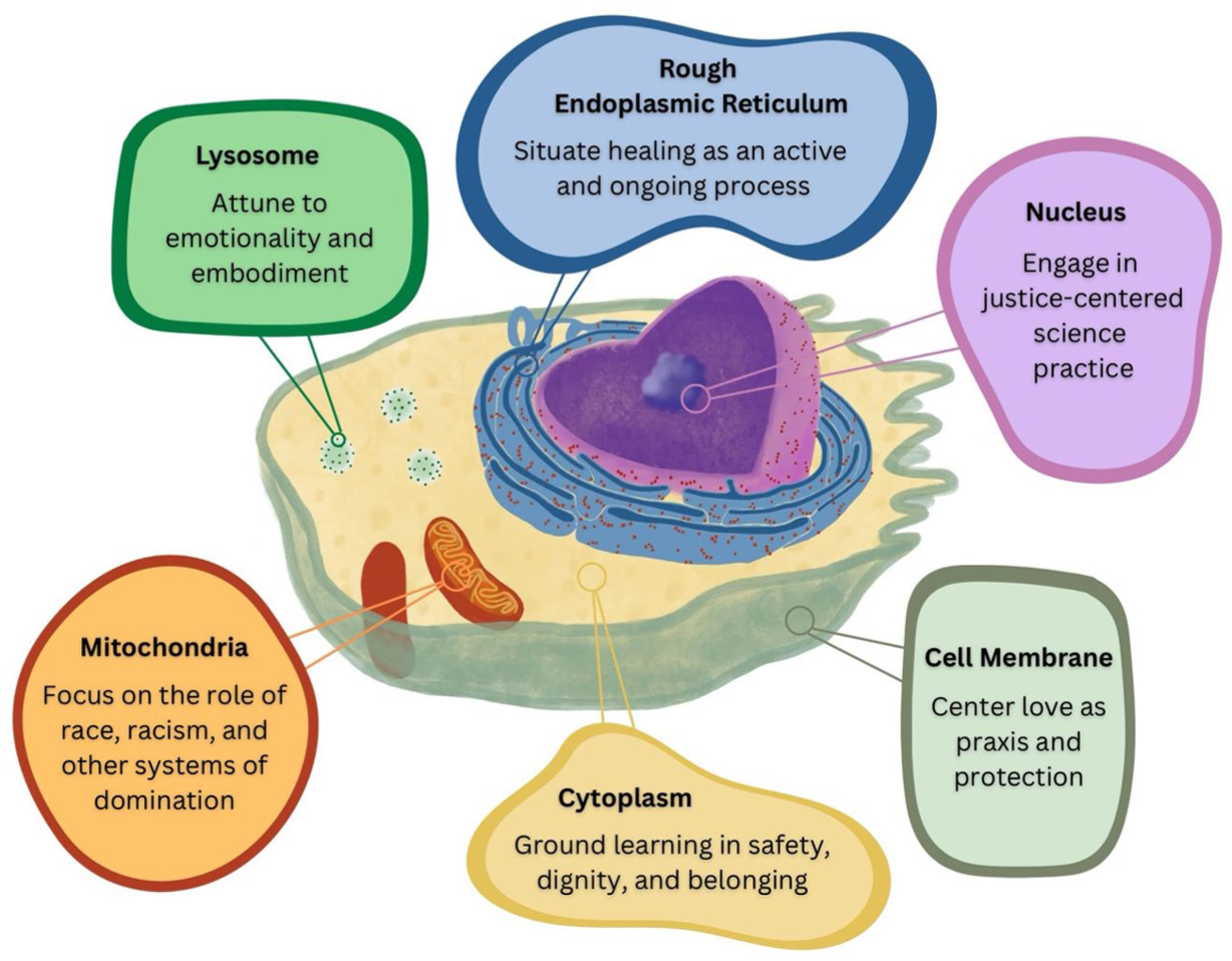
Diagram of trauma-informed science cell.
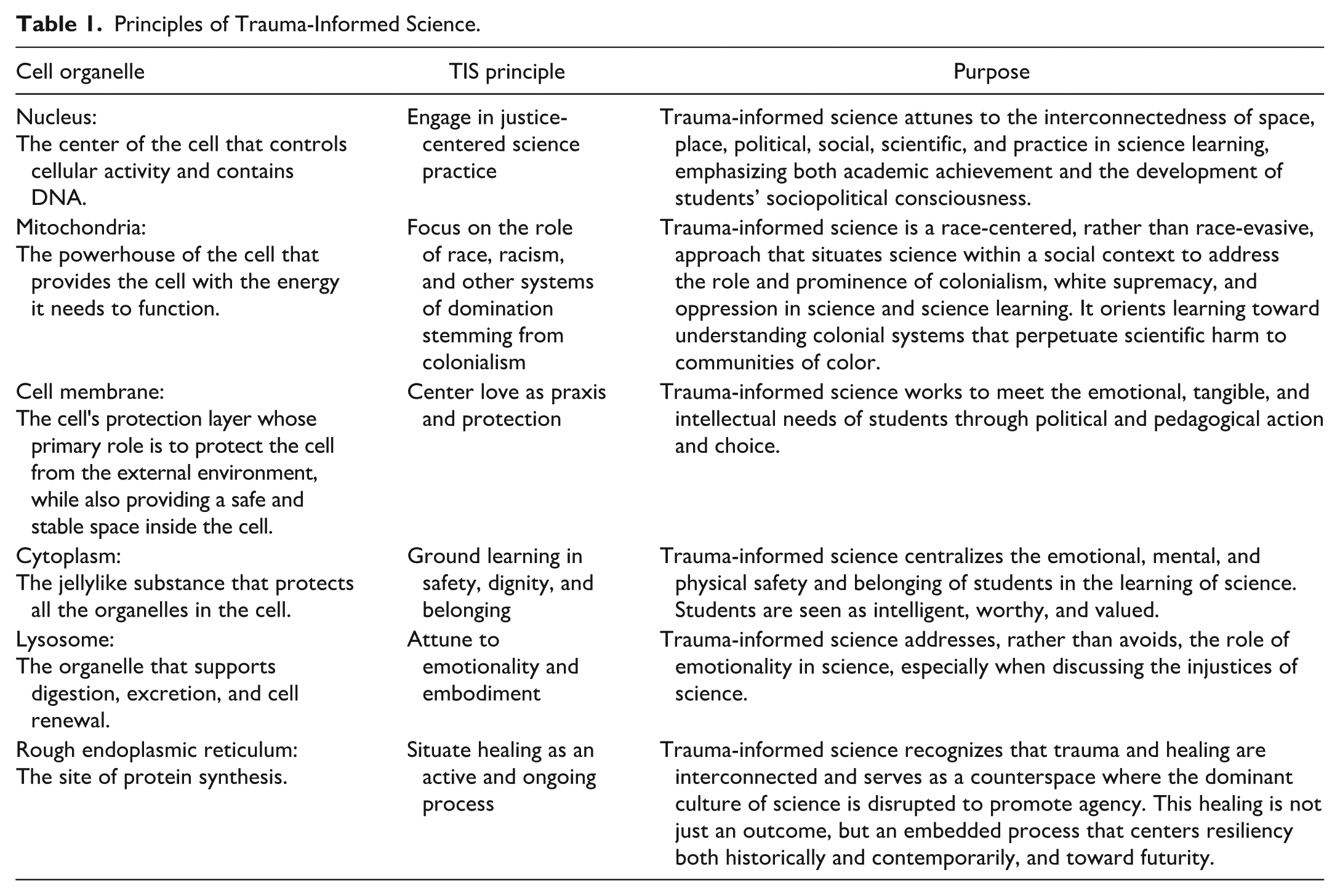
In alignment with the language of cells, we present TIS as a foundational building block of justice-centered science as we postulate that there can be no justice without attuning to students holistically. TIS is not a set of additional instructional or pedagogical approaches that teachers must adopt; instead, it is a fundamentally different way to approach the practice of science teaching, specifically justice-centered science teaching. The framework itself is the cell, the foundational block that we argue justice-centered science must be built from. Within this cell are the organelles, or the principles of TIS, all of which have their own function but exist in relationship with one another to help the cell function. Just as a cell could not survive without all organelles working together, the principles of TIS work in conjunction to help teachers reimagine the political and pedagogical ways in which they approach justice-centered science teaching. Table 1 presents our TIS framework. Column 1 names the cell organelle and provides a description of each organelle’s function to support cellular activity. Column 2 names the associated TIS principle, or the pedagogical approach that supports justice-oriented science. Column 3 provides a description of the TIS principle and how it supports a trauma-informed approach to science teaching and learning. Following Table 1, we provide an in-depth description of each organelle and a TIS in action example, where we provide a short description of TIS practices that a teacher could engage in.
Principles of Trauma-Informed Science.
Nucleus: Engage in Justice-Centered Science Practice
The nucleus is the center of the cell. It controls all cell activity and contains DNA. Within the DNA, we find genetic material that supports the development, growth, reproduction, and function of living organisms. The principle engage in justice-centered science practice is the nucleus of our framework. It is the foundation of TIS and holds the practices of this pedagogical approach at its core. As such, TIS centralizes asset-based approaches to science teaching and learning that challenge hegemonic and homogeneous understandings of disciplinary content and ways of knowing, being, and doing. This approach seeks to create renewal in science by affirming, valuing, and using students’ intersectional identities, cultures, knowledge, and brilliance as sources for learning. Within this practice, TIS creates spaces for students to critically examine the underlying assumptions and values of Western science, including power relations that position certain knowledge as more valued and valuable. Collectively, these practices challenge normalized notions of homogeneity and power in science, center student identities and deeply rooted complex knowledge as essential to learning, and position youth as transformative intellectuals who are capable of imagining and creating change (Morales-Doyle, 2017). To engage in justice-centered science, teachers must reimagine the ways in which their pedagogical practices and curricular materials position students as knowledge producers, center cultural competence, and develop critical consciousness and academic achievement. In this way, teachers who engage in TIS make a commitment to seeing students as brilliant beings who are capable of creating change.
Mitochondria: Focus on the Role of Race, Racism, and Other Systems of Domination
The mitochondria is the powerhouse of the cell. It gives the cell its energy to carry out biochemical reactions that support its function. The principle focus on the role of race, racism, and other systems of domination is the mitochondria of our framework. The energy of TIS is grounded in recognizing the role of colonialism and settler colonialism in bounding our current understanding of the scientific discipline and what we consider to be “fact.” This includes not only acknowledging the extractive nature of science, but investigating the nuances of what has been co-opted and positioned as truth and certainty. In doing this, TIS attends to power and historicity, or “cultural perceptions of the past, the principles, experiences, and values that shape these perceptions, and how historicized practices, tools, and information continually and consequently shape the present and future” (Learning in Places, 2021). More specifically, TIS attends to how historicity and power have been used to position white communities as dominant over communities of color, as well as shaped access to and distribution of resources that stem from scientific advancement. To this end, TIS attends to the social construction of race and the compounding effects of institutional and systemic racism, moving beyond situating instances as individual racist experiences and toward understanding systems of oppression that are grounded in politicized ideas of race and racism. Consequently, the TIS framework recognizes that in order to radically imagine new ways that we can use science to support and benefit Communities of Color, we must first confront the ways in which it has been used to harm. In centering race, racism, and other systems of domination, teachers reflect and make space to challenge the historical foundations of scientific concepts, support heterogeneity in teaching and learning, and explicitly attune to colonialism in teaching.
Cell Membrane: Love as Praxis and Protection
The cell membrane is responsible for the protection of the cell—it shields the cell from external threats and stressors while also providing a safe and stable environment inside the cell. In this way, the cell membrane can be envisioned as our classroom container (Weller, 2015). The function of the cell membrane aligns with the principle of love as praxis and protection. Scholars across fields such as psychology, psychotherapy, and epidemiology have argued that loving relationships are fundamental to the process of healing, serving to increase resiliency and as a protective barrier to further threats of harm (Hannegan-Martinez & Griffin, 2024; Perry, 2007; Siegel & Solomon, 2003). Similarly, in the field of education, scholars have argued that caring and loving relationships are integral to a transformative learning experience (Howard, 2002; Jackson et al., 2014; Lane, 2018; Lyiscott, 2019; Noddings, 1984; Valenzuela, 1999), and, more recently, research has begun to specifically discuss the role of love as a practice for metabolizing and healing trauma within classroom spaces (Cariaga, 2018; Hannegan-Martinez, 2019). It is important to note that across these fields, love is more than emotion or affect. Within TIS, we draw on the definition of love as “a political praxis (intention, action, reflection) of cultivating interdependence for the purpose of individual and collective survival, sustainability, well-being, wholeness, and joy” (Hannegan-Martinez, 2020, p. 154), that requires attunement to our four realms of being—the tangible, emotional, spiritual, and intellectual—and is practiced with self, peers, community, and the world. Given the vast amounts of childhood trauma, we argue that love is foundational to a justice-centered and trauma-informed science education. To create a loving classroom container, teachers must consider in what ways the curriculum, essential questions, texts, pedagogical practices, assignments, and classroom spaces support young people in developing more loving relationships to themselves, each other, and their communities.
Cytoplasm: Ground Learning in Safety, Dignity, and Belonging
The cytoplasm is the jellylike substance that protects every single organelle within the cell. In a way, its existence allows every organelle to perform its function. We liken this to the most foundational tenets of trauma-informed teaching: safety, dignity, and belonging (Haines, 2019). “Safety” refers to how we understand, assess, and respond to the material, physical, emotional, relational, and spiritual needs of the people we are in community with. Within TIS, it means that if we are committed to creating safe learning spaces, we must acknowledge the very real threats to safety—some of which have been laid out in this article (e.g., oppression and harmful science practices)—and make space for the feelings that accompany those threats. Dignity is a belief in (y)our inherent value and worthiness, something that oppression and trauma often steal. Within TIS, we see dignity as a commitment to creating classroom spaces where every child believes that they are worthy exactly as they are and that they are integral to our classroom ecosystem (Yang, 2009). For many, this requires closely examining the punitive processes we participate in and the curriculum we design, many of which remove or exclude students from our ecosystem and lead to a lack of belonging (e.g., Morton et al., 2022). Safety and dignity work alongside belonging, which refers to our inherent and innate need to feel like we are a part of something larger than ourselves (people, communities, spaces, our social fabric). In many ways, belonging is about loving and being loved (Haines, 2019). We name love as the cell membrane within TIS, and we include it in the cytoplasm as well because we believe that more love is never a bad thing, and it is an important part of protection internally and externally. Ultimately, we position safety, dignity, and belonging as the cytoplasm because they are the protection and must both cover and undergird everything we do.
Lysosome: Attune to Emotionality and Embodiment
The lysosome is the organelle that supports digestion, excretion, and cell renewal—all processes necessary for the health and longevity of a cell. We liken the lysosome to what trauma-informed and somatic researchers and practitioners refer to as attunement to emotionality and embodiment. In TIS, we understand emotions as neither good nor bad, but as valuable information. Rather than perpetuate false notions of objectivity in science instruction, within TIS, we recognize the range of emotions that science learning can evoke for students, and we create space to express and reflect on those emotions, as well as reflect on what needs those emotions might be illuminating. For example, the emotion of anger or rage might be communicating a frustration with accessibility or relevance, a grief in reference to the nature of the content or that this method of science learning has been kept from them. Making space for emotion enables teachers and students to work together to better meet student needs. In line with honoring emotion, we recognize the need to center the body as a practice of trauma-informed science. Because trauma happens in the body (Menakem, 2017), we can be neither trauma-informed nor healing-centered without centering the body in our pedagogy and praxis (Cariaga, 2021). Embodiment literally allows for the metabolization of emotions (i.e., digestion, excretion, and cell renewal) necessary for a return to homeostasis. Within TIS, embodiment can take many forms and should allow students means and mechanisms to express their emotions through action. For example, teachers can engage in interdisciplinary practices that include the visual arts to engage the body in learning, such as drawing, dance, and storytelling. Teachers can also focus on creating spaces for critical reflection through community circles, cogen groups (Emdin, 2016), or other activities that support intentional dialogue to bridge content and emotionality.
Rough Endoplasmic Reticulum: Situate Healing as an Active and Ongoing Process
The rough endoplasmic reticulum is the site of protein synthesis, or the process of making proteins. Proteins are the building blocks of cells and help the cell to maintain homeostasis, or internal balance. The principle situate healing as an active and ongoing process is the rough endoplasmic reticulum of our framework. Healing is a synthesis—a never-ending, ongoing process. In science, communities are working to heal from both the historic harms of the enterprise on their ancestors and contemporary harms in their daily lives. Science education can, and should, be a space that works toward this healing. Szostkowski and Upadhyay (2019) noted, “Achieving equity demands a disruption to the dominant form of social reproduction. We think that disruption should be accompanied by an effort to heal” (p. 350). In TIS, we believe that a commitment to healing is a disruption to dominant forms of social injustice, and, by creating spaces of agency, autonomy, and resilience, healing becomes a collective and embedded process. This process, however, not only focuses on healing in the present and future but also brings light to the ways that Communities of Color have been resilient, thrived, and healed despite oppression and extraction. As an ongoing process, healing in TIS works toward liberation through collective action, supporting individual and communal homeostasis. It recognizes that healing is not individualistic, but reached with and through community. Healing in TIS can take the form of developing intentional counterspaces that centralize belonging, empathy, solidarity, understanding, and self and collective care. This includes teachers engaging in reflective activities and actions that focus learning on helping students imagine and engage community change, positioning students as decision-makers in teaching and learning, and recognizing the role of their own moral stances in science (Szostkowski & Upadhyay, 2019) and how they do or do not support collective healing.
Envisioning TIS in Action: An Example
As we position trauma-informed science as a praxis lens, it is important to know that there is no one way to engage. We do, however, wish to provide a practical, not prescriptive, example of what engaging in TIS could look like and how the TIS principles can work in relation to one another to support justice-centered learning. In high school physics, for example, thermodynamics and energy transfer are Next Generation Science Standards that teachers must address. An educator who uses a TIS-informed lens could engage in the following practices: (1) lead students through generating data visualizations (models) of energy transfer in their local community, focusing on how urban heat islands are created; (2) have students compare and contrast redlining maps in their city with temperature data to engage in discussion on infrastructure inequities, heat disparities, and how racial discrimination has led to climate and environmental crises in Communities of Color; (3) engage students in community circles (small and whole group) to reflect on their experiences with urban heat islands, ideate on why they exist and how their existence makes them feel, and generate ideas about how they could be mitigated; (4) invite guest speakers to discuss how grassroots community organizations have been fighting climate change in the community; and (5) propose a cooling design challenge in which students have to use physics concepts to work together to create a model for new greenspace or industrial infrastructure that could impact surface or ambient temperature, and present their change ideas as a physics pitch.
In this example, it should be noted that while a teacher addresses disparities and inequities to contemplate the social, political, and racial elements of science, they also center resiliency, hope, and care for community where students are positioned as knowledge holders, critical thinkers, and change agents. By presenting this example, we seek to demonstrate how the TIS principles form a framework to center trauma-informed praxis within science education. Specifically, this framework considers how TIS can be understood and used as both an extension and a necessary foundation of justice-centered science. Although we do not offer prescriptive examples in this conceptual paper of TIS in practice, we do ask questions and provide considerations for researchers and practitioners to engage in TIS as a justice-centered science praxis in their context.
Implications for Research and Teaching
Trauma-informed science is not simply an instructional shift or a pedagogical add-on, but a fundamentally different pedagogical, epistemological, and political approach to the practice of justice-centered science teaching. It seeks to support not just students’ intellectual prowess and academic success, but also their wholeness and well-being. As science education researchers and practitioners look toward implementing more critical and culturally responsive practices in teaching that center themes of power and justice and situate science learning within its sociopolitical contexts, it is essential that the emotional, physical, and moral aspects of phenomena—which can (re)produce trauma—are adequately attended to. Engaging in TIS prompts teachers to be prepared to critically examine and unlearn methods of teaching that ignore the whole of children and requires us to reimagine the purpose of science, take time to learn about the historical and contemporary harms of science in our communities, and deeply understand how justice-centered instruction affects our students. This work cannot be done in silos, however. Just as all the parts of the cell are needed to help the cell function, engaging in TIS praxis must be connected to a fundamental shift that centers healing as an indispensable practice of justice.
We argue that addressing trauma and centering healing cannot simply be relegated to instruction; it must also be foundational to what we research, how we research it, why we research it, and who we research it with and for. Because trauma- and healing-informed approaches to science teaching have not been thoroughly researched, a number of lines of research are needed to further our understanding of TIS in practice. Generally, more research is needed to understand what the actualization of this framework looks like in practice. This can be explored through research questions such as: How do teachers enact trauma-informed science praxis while engaging in justice-centered instruction? How do teachers create collective healing spaces that empower students in science learning through trauma-informed praxis? In what ways do teachers simultaneously meet science standards and respond to trauma and healing in instruction? Such questions can help education researchers to develop a more complicated and nuanced understanding of the role of trauma and healing in science learning, and how trauma-informed science praxis can create positive learning experiences for Students of Color. The TIS framework is a first step toward science teaching and learning that situates trauma, healing, and well-being as central and foundational to science learning. To support this shift in thinking, teaching, and being, we offer the following considerations for researchers and educators.
Questions for Research and Practice
We have taken a position that there can be no justice-centered science curriculum, instruction, or research without investigating the historical and contemporary trauma of science and the scientific enterprise, while simultaneously acknowledging the need to make space for healing. Researching trauma and healing cannot be the end goal, particularly when so many research methods are rooted in colonialism and are steeped in epistemological and methodological harm (e.g., Hannegan-Martinez, 2023; Patel, 2015; Smith, 2012). Instructing in trauma-informed ways requires being attuned to the whole of students and recognizing how not only instructional practices (Morton et al., 2022) but also critical content (Davis & Schaeffer, 2019) can have consequences for student learning experiences; it also highlights the need to center the body and holistic safety of our students in learning experiences. Thus, for each of the TIS principles, we offer questions for researchers and educators that can serve to guide research design and pedagogical implementation:
1) Engage in justice-centered science practice. In what ways do my curriculum, instruction, and research critically examine institutional and structural systems? (Gyles et al., 2026) How do I position my students and collaborators as transformative intellectuals who are capable of imagining and creating change in their communities and classrooms? How do I work to reimagine expertise in learning to support my students’ intellectual growth as well as my own? (Gyles & Clark, 2024) How do I situate science learning within larger social justice movements? In what ways do my practice and research help engage students and teachers in learning that supports community well-being?
2) Focus on the role of race, racism, and other systems of domination stemming from colonialism. In what ways do my teaching and research reckon with historical trauma narratives? How do I address the role that race and racism have played in harming Communities of Color in the name of science? How do I support students in understanding the traumatic foundation on which science distrust is built? In what ways do my instruction and research address the role of white supremacy and power in molding our homogenic understanding of science concepts?
3) Love as praxis and protection. How do I center love and loving relationships as foundational to my instruction and research methodologies? How do my science instruction and research support young people in loving themselves, each other, their communities, and the land in more profound ways? How do I see these forms of love as a protective barrier and a foundational outcome of a justice-centered science classroom? How can I center love as a praxis of trauma-informed and justice-centered science teaching and research?
4) Ground learning in safety, dignity, and belonging. How do my pedagogical practices and methodologies create spaces of belonging in my classroom and with my collaborators? What mechanisms or methods do I use to make my classroom a safe space for students, where they can speak to their thoughts and feelings without fear of judgment or persecution and hold me accountable? In what ways do I honor and respect heterogenous ways of thinking, knowing, doing, and being in science learning?
5) Attune to emotionality and embodiment. How do I center feeling and being within the science instruction and research? How do I honor the myriad of emotions that might arise in practice and research as a result of the harm that science has caused and continues to cause for many people? How do I help students attune to their own emotions and bodies and to those of their peers? In what ways do I honor emotionality as a site of deep learning and wisdom for myself, students, community, and collaborators?
6) Situate healing as an active and ongoing process. How do I position my students and collaborators with agency and autonomy? How do my practice and research attune to the resilience of Communities of Color, historically and contemporarily, that have been harmed in the name of science? In what ways do I situate science learning as one of many pathways toward healing? In what ways do I centralize community healing as a part of the learning process? How do I position my students to use science as a space to imagine collective liberation?
Conclusion
Through this article, we offer that although justice-centered science has made great advancements in naming and addressing the harms of science education, the framing of trauma more robustly helps us understand both the injustice and the urgency for us to intervene. Because of the historical and contemporary ways in which science, scientific enterprise, and science education have been used to perpetrate and justify trauma, coupled with the rapidly rising rates of childhood trauma, there is a moral and pedagogical imperative that makes science education a ripe place to address trauma and center healing. Drawing on intersectional and interdisciplinary scholarship, we offer the TIS framework as a foundational building block to work toward the construction of science classrooms that are life-giving and life-affirming rather than traumatizing—and therefore deadly. Ultimately, we argue that we cannot say we are working toward justice-centered science education and classrooms if we remain unwilling to center the healing and well-being of students, families, and communities. We encourage other researchers, practitioners, and fields to consider joining us and imagine how we might use our disciplines to address trauma and center healing as a praxis of justice. There is no justice if we are not well.
Footnotes
Declaration of Conflicting Interests
The authors declared no potential conflicts of interest with respect to the research, authorship, and/or publication of this article.
Funding
The authors received no financial support for the research, authorship, and/or publication of this article.
