




Abstract
Background:
Student voice practices (SVPs) are processes through which students can participate in and influence educational decisions affecting their own lives and the lives of their peers. This article examines teacher readiness for implementing SVPs.
Focus of Study:
Previous research has conceptualized readiness by considering the what of the change, the how of the change process, and the individuals involved. Using a framework of mindsets, heartsets, and skillsets, this study investigates the question, What conditions contribute to teacher readiness to engage in SVPs?
Research Design:
Employing an embedded case study design, this article analyzes qualitative data from four schools to explore teacher readiness. Cognitive mindsets encompass beliefs that students have a right to express their views and can provide unique insights, and that involving students as partners makes organizational and classroom change more effective. Emotive heartsets involve prioritizing the development of trust, and safe relationships and environments. Intention-building skillsets include the necessity of training for both adults and students, as well as the creation of supportive classroom structures.
Conclusions:
Our findings suggest directions for enhancing training and preparation for SVPs. Additionally, they contribute to organizational theory and educational leadership research by exploring factors that may facilitate or hinder the development and sustainability of change initiatives.
Understanding how to make schools more equitable and successful for students remains a pressing concern for educational change. Student voice practices (SVPs) consist of ways that students can participate in and influence the education decisions that shape their lives and the lives of their peers. SVPs have focused for several decades on the ways that young people, from birth to university level, find ways to engage in their own forms of learning and reform, as well as partner with adults to engage in change efforts (Cook-Sather, 2006; Flutter & Rudduck, 2004; Wall & Robinson, 2022). SVPs have been shown consistently to lead to stronger academic, social, emotional, and behavioral outcomes for students (Anderson, 2018; Holquist et al., 2023; Kahne et al., 2022; Quaglia Institute, 2016).
Previous research has found that partnering with young people in school-focused reform efforts has been particularly beneficial for addressing systemic education inequities (e.g., disproportionality in student discipline, culturally biased curriculum) that disproportionately impact students from historically marginalized backgrounds, such as Black, Latiné, and low-income students (Flores & Ahn, 2024; Khalifa et al., 2016; Lac & Mansfield, 2018). Reform strategies are beginning to engage marginalized and struggling students in sharing their ideas for how schools or teaching can be improved and in collaborative work to redesign education (Biddle & Hufnagel, 2019; Davis & Hall, 2020; Hipolito-Delgado, 2024; Warren & Marciano, 2018).
This article focuses on SVPs in U.S. secondary schools; we examine SVPs in which students and teachers build partnerships that can lead change efforts at school and classroom levels. Our findings in this article stem from unexpected data that we collected during a research project focused on exploring the relationship between SVPs and student outcomes. Although we selected a district with an espoused commitment to student voice activities and with dedicated staff at the district and school levels to implement the work, we found that SVPs struggled to develop and persist. Despite resources, training, and intention, evidence from our data collection at school sites suggested that the programs were struggling to get started or that significant disconnects existed between student, teacher, and administrator perceptions of the efficacy of the student voice work being attempted, or both. This finding parallels findings in other national contexts, in which teachers and administrators offer different accounts of the extent of SVPs enacted in their school (Skerritt et al., 2022).
Beyond an examination of the work of change directly, we realized the need to examine the conditions that that help student voice activities to emerge. Our empirical encounters are reminiscent of the classic article on failed implementation by David Cohen (1990), “The Case of Ms. Oublier.” Cohen was sent to observe the most enthusiastic teacher who had embraced the mathematics reforms occurring in the district. Despite her enthusiasm and the district and school resources to support the reform, observations of Oublier’s classroom did not show fidelity to the core principles of the mathematics reform. The teacher believed she was innovating, but empirical observations did not recognize her efforts as reform. The classic article still provides one of the clearest examples of implementation failure despite will and capacity.
While international research has documented the struggle of schools to design and implement effective SVPs (Fernandez et al., 2022; Mayes et al., 2019; Skerrit et al., 2022), and many studies have examined teacher reluctance or concerns about enacting SVPs in their classrooms (Black & Mayes, 2020; Conner, 2022; Fernandez et al., 2022; Skerritt et al., 2022, 2023), little research exists regarding the conditions that might specifically improve teacher readiness to engage in SVPs, especially in U.S. contexts. Although previous research has explored the benefits to students and schools when SVPs thrive (Mager & Nowak, 2012; Mitra, 2018), ways to build SVPs in schools that have not previously honored student voices remain underresearched (Gillett-Swan & Sergeant, 2019). This article seeks to address this gap in the literature by examining what conditions can help to enable SVPs to grow and the reasons they may struggle.
Building a Framework for Exploring Readiness in Student Voice Practices
Readiness has been conceptualized in previous research as consisting of what is being changed, how it is being changed, and the individuals involved in the change (Holt et al., 2007; Wang et al., 2023). Readiness can be viewed as a contrasting condition to resistance, which impedes change (Burke, 2008; Zayim & Kondakci, 2015). Therefore, understanding conditions of readiness can be considered a way to help to “soften up” (Kingdon, 1984) the process of moving toward change.
To conceptualize teacher readiness, we developed a conceptual framework that combines research from organizational change and educational leadership literatures. Given the importance of language and discourse in conceptualizing and implementing change (Amis & Aïssaoui, 2013), we see the value of fusing these two literatures to notice how the descriptions from each might shed nuances onto the issue of readiness.
The organizational change literature has directly examined readiness as a construct for change processes (Armenakis & Harris, 2002, 2009; Holt et al., 2007; Wang et al., 2023). Drawing mostly on cross-sectional and survey research, this examination of readiness in organizational change is especially common in health and business sectors (Jones et al., 2005). In contrast, the literature looking at readiness in educational change is quite slim (Wang et. al, 2023). The literature on educational policy implementation furthermore focuses on the co-construction of policy because of the need to translate policies into practice. Because of this adaptive process, systematic variation in implementation contexts has been viewed as a problem of the smallest unit (Honig 2012; McLaughlin & Talbert, 2006; Tichnor-Wagner, 2019).
Readiness in organizational change research has consisted of three components: cognition, emotion, and intent (first discussed in Armenakis et al., 1993). Cognitive readiness for change consists of the perceived support of a change process and the belief that the organization can accomplish the change (Armenakis & Harris, 2002; Kondakci et al., 2013, 2017). Emotional readiness for change refers to feelings and attitudes about or the change, as well as the ability to develop relational trust with colleagues, superiors, and clients (Kondakci et al., 2017; Rafferty et al., 2013; Sloyan & Ludema, 2010; Zayim & Kondakci, 2015). A third but less discussed component of readiness for change is intent—that is, the extent to which an individual demonstrates behaviors that enact their vision of the change (Kondakci et al., 2017).
Educational Leadership Perspectives
Educational leadership literature also highlights the importance of ongoing adult learning, emphasizing that learning is central to teaching effectively (Coburn, 2001; Darling Hammond et al., 2009; Donaldson, 2008). A more precise focus on readiness exists within postsecondary literature, which offers a parallel set of concepts: mindsets, heartsets, and skillsets. This research primarily stems from qualitative research studies, and, as such, the constructs contain more complexity and detail that we believe would help to inform organizational change literature. We gathered and adapted these terms from the field of “intercultural competence,” which focuses on the interactions between individuals and groups with dissonant values, beliefs, and behaviors (Bennett, 2009). Literature that has most embraced this framework has focused on studying abroad and learning from culturally dissonant perspectives (Albert et al, 2023; Savicki, 2023; Vaccarino & Li, 2018). This research examines the ways that building intercultural skills can reduce employee turnover and improve climate (Bennett, 2009).
This literature defines mindsets as a form of cognitive readiness for change. It offers a greater definition than the organizational change literature by amplifying not just beliefs but cognitive biases, including cultural biases, power relationships, and hierarchies (Varraino & Li, 2018). When applied to the context of student voice, mindsets might include expectations of the power dynamics between adults and young people. They also might also encapsulate understanding the lived experience of the people experiencing injustice (Bertrand et al., 2020; Lac & Mansfield, 2018).
Readiness literature has given less attention to the emotive, or affective, element of change (Rafferty et al., 2013), although some organizational change research has noted the value of trust (Kondakci et al., 2017); the concept of heartsets adds the importance of fostering well-being in actors leaning into being ready for change, and motivation to build well-being and trust with others. Previous research points to the ways that heartsets include affective attitudes and motivation, including curiosity, openness, tolerance, and willingness to suspend biases and previous beliefs (Bennett, 2009; Vaccarino & Li, 2018).
Heartsets align with an “ethic of care” in the teaching and leadership literature (Noddings, 2012; L. M. Owens & Ennis, 2005). Building caring relationships includes the willingness to be vulnerable to others and an exploration of reciprocity and faith, or to be able to bear risk of harm from another party (M. A. Owens & Johnson, 2009). The educational change literature speaks of the importance of building relationships in school settings, often discussed as “belonging” (Aspen Institute, 2019; Catalano et al., 2004; Libbey, 2004; Lynch & Lodge, 2004; Mitra, 2004; Mitra & Serriere, 2012; Scales et al., 2006; Yonezawa et al., 2012). Research shows the importance of focusing on well-being and relationships, especially in contexts that hold racist structures and beliefs (Lac et al., 2022; Philippo, 2012). For students, building stronger relationships with teachers and school administrators can help to assure them that their expertise and knowledge will be respected by teachers and school administrators (Anderson & Graham, 2016; Davies, 2011; Leat et al., 2012).
Postsecondary research also helps with the weakest part of the organizational change research; the literature on “intent to change” is the least examined construct of cognitive, emotive, and intent. The concept of skillsets helps in understanding the scope of this construct. Skillsets include the capacity to change behavior and to accomplish tasks (Bennett, 2009). Previous research on education change shows that districts and schools can build skillsets by providing training, dedicated personnel, clear standards of performance and behavior and for resource allocation, and designing safe spaces (Brasof & Specter, 2016; Butler et al., 2017; Mager & Nowak, 2012; Mansfield, 2015; Mitra, 2018; Sussman, 2015; Zeldin et al., 2005).
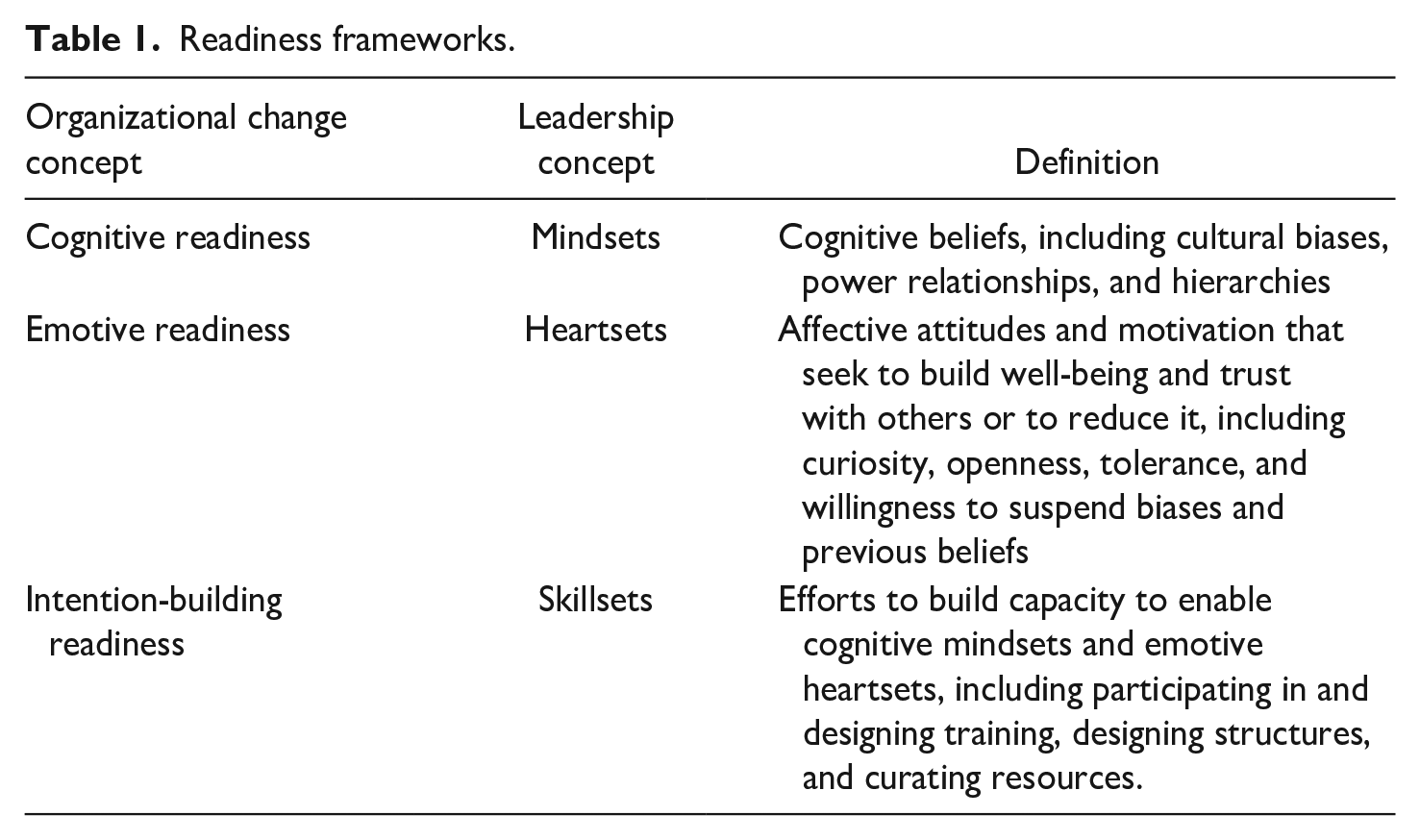
Using this combined set of constructs from two fields with differing empirical approaches and language, we offer a framework for understanding teacher readiness. Table 1 offers a merged definition of terms based on both literatures. Using this framework, this study examines the following question: What are conditions that contribute to teacher readiness to engage in SVPs?
Readiness frameworks.
Methods
This article is one piece of a larger study looking at the relationship between types of classroom or school SVPs and subsequent student outcomes. As a result of the growing interest in SVPs, we embarked on a multiyear study to examine the relationships between SVP structures, relationships, and student outcomes (Holquist et al., 2023). This study stemmed from what was missing from the data as much as what was present. This article speaks of the absence of SVPs within a district context that supported and encouraged SVPs. We therefore have sought in this article to explore where we expected SVPs to grow in school sites based on the suppositions of students, the interests of teachers, and subsequent emerging SVPs.
Participants
We based our research sample on representativeness of the concept in schools within a large urban district that encourages SVPs (Strauss & Corbin, 1998). We developed a case study design intended for the purpose of explanation building (Yin, 2012). We included an equal sample of schools with ongoing student voice focus and schools lacking a student voice focus.
We selected a district in the Western region of the United States that was known to be committed to student voice activities. The district has a dedicated staff and resources at the district and school levels to implement the SVPs. Yet, district-level decisions that prioritize student voice might not be reflected in schools, and this is exactly what our project explores: the implantation of SVPs and how this implementation is reflected in student outcomes—in essence, a policy-versus-practice dilemma (Skerritt et al., 2022).
With the assistance of district officials, we selected four schools—two high schools and two middle schools—that had high proportions of students of color. The school pairs were well-suited for a comparative study design that can allow an examination of constructs across contexts (Halaweh et al., 2008). Both high schools consisted of approximately 1,500 students, 70% of whom identified as Latiné, 15% as other historically marginalized youth, and 15% as white. The middle schools served 1,000 and 1,500 students, respectively. The smaller school served 70% Latiné, 20% other historically marginalized students, and 10% white students. The larger school had 73% of Latiné students, 20% white students, and 7% other historically marginalized students.
Ethics approval was obtained from the ethics institutional review board committees at Penn State University and Villanova University, and through Solutions IRB. In accordance with ethical procedures, all identifying school and individual names have been removed or changed.
Data Collection
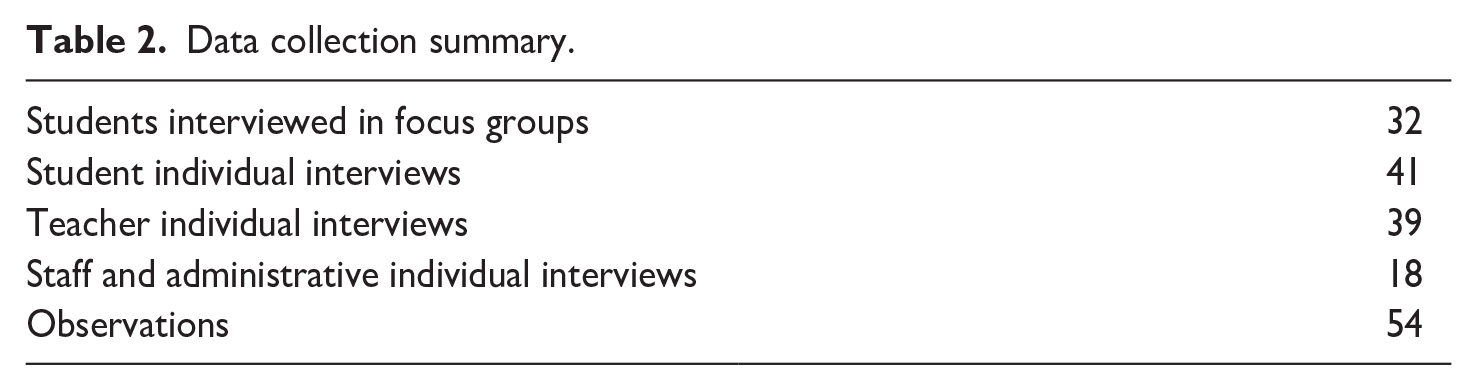
Our question on conditions for teacher readiness was examined through open-ended exploration using interviews and observations to find themes. We conducted in-person data collection in spring 2022 and spring 2023. In between the on-site visits, we conducted online interviews and focus groups in fall 2022 to learn about changes in school conditions and to prepare for the second in-person data collection. When on-site, we focused our time in the schools on interviews and observations. Table 2 details our data collection.
Data collection summary.
Our data are strengthened by our design, which captures the student experience, the teacher experience, and the interaction between the two. Comparing teacher and student data enabled us to build a working understanding of how relationships influence SVPs. Student and teacher selection for the first round of data collection was organized by the school student voice coordinator, who was asked to provide us with a wide range of student and teacher experiences, from those most engaged to those struggling with SVPs. On-site, researchers also requested the opportunity to interview and observe additional faculty and students based on what we learned on-site. During subsequent data collection opportunities, the researchers requested follow-ups with a subset of the first set of students and teachers. They also asked the student voice coordinator to use their expertise to suggest additional interviews across the spectrum of readiness and engagement. The Appendix outlines the demographic information on interview and focus group participants for the four schools. Aligning with school populations, we mostly interviewed Black and Latiné students and white teachers.
At each school during each site visit, student interviews were conducted with at least five individuals, and three focus groups were conducted. We asked for a cross-section of grade levels and student success in school. Adult interviews consisted of at least one administrator and five teachers. Semi-structured protocols guided individual interviews and focus groups. The in-person interviews and focus groups occurred in person and lasted between 30 and 60 minutes. The interviews explored experiences with SVPs as well as participants’ perceptions of school culture. All recorded interviews and focus groups were transcribed, cleansed for accuracy, and coded.
When possible, we also conducted teacher interviews and conducted on-site classroom observations of the teachers we interviewed. Our data collection also varied at each school based on the events occurring in the school. We sought out students who took advantage of opportunities to engage in leadership and SVP opportunities, and we spoke with students who were not involved in these opportunities.
We used our initial pilot framework of relationships and structures (Holquist et al., 2023) as the initial focus of our observations. Observations helped to triangulate findings from interviews of teachers and students. Researchers took detailed notes, documenting all opportunities for student voice and the use of any other instructional practices that may be tied to supporting student voice work. When possible, dialogue relevant to the study was captured verbatim so we could understand interactions between students and teachers.
Data Analyses
Pilot work (Holquist et al., 2023) also developed the basis for the initial coding structure. This initial framing, derived from cognitive interviews and a systematic literature review, centered themes on the concepts of structures and relationships within SVPs. In our search for discrepant data, we noticed the ways in which students, teachers, and school administrators discussed the absence of student voice as much as the presence. We noted missed opportunities and disappointment as much as success. The analyses for this article emerged from this observation—an exploration of what readiness for SVPs might look like. Our second round of qualitative data collection (spring 2023) enabled us to focus the interviews on questions of what conditions appear to predict emerging SVPs. In this second round, we asked students which teachers would be most likely to engage in SVPs and why, and we asked teachers to explain their willingness to conduct SVPs and looked at the responses compared with how teachers articulated their classroom philosophy. Our observations of these classes allowed for a third set of data to compare to understand teacher intentions and practice.
Using Dedoose, we coded interviews to identify themes after this second round of data collection. The analysis began with open coding, in which we each coded transcripts to examine the ways in which participants articulated their experiences with student voice. Initial themes for this article consisted of relationships; engagement, classroom change, and sense of belonging/trust; school issues; cultural considerations in SVPs; teacher agency; teacher collaboration; student voice barriers; disconnect; examples of classroom student voice; school culture; and school context conditions.
Based on the initial open coding, we conducted axial coding by developing a series of data displays to show the relationships among the codes (Miles & Huberman, 1994). Discrepancies were discussed until we reached 100% agreement. Based on themes emerging from the data, the main coding bins that emerged for this study were (a) cognitive processes, (b) emotional connection and caring, and (c) structures and capacity building. This process was exhausted when saturation was achieved—that is, it continued until no new categories emerged, and no further variations within categories could be determined.
We then returned to the literature to examine how these concepts have been discussed in previous research. We looked across educational leadership, postsecondary, and organizational change literature. We moved back and forth between the interview, focus group, and literature review data to create an explanatory framework of teacher readiness for SVPs (Miles & Huberman, 1994; Strauss & Corbin, 1990).
Positionality and Trustworthiness
Our approach to conducting this research was inherently affected by our positionality (Creswell & Poth, 2016). All the authors are normatively committed to the potential of student voice. The three principal investigators of the project identify as white females who work as researchers of education policy and had previous experiences as K–12 teachers or as school administrators. Our coauthors also include a Lebanese Middle Eastern graduate student who is interested in researching equitable school structures and opportunities, and a white female graduate student who was the first in her family to attend college. Because we are adult middle-class female-identifying individuals, our intersectionality “looks like” people who have power and traditionally participate in education change efforts. These traits may have made us more hopeful about the possibility of students participating in education decision-making.
Our research team was selected in part to ensure a broad view of data based on ethnicity, gender, age, and social class. The data team included a Latiné graduate student working toward his master’s degree in higher education, two African American high school students, two white female college students, and a white female teacher still in the classroom. To help manage our individual subjectivities, our division of work ensured that our collective perspectives and experiences were captured in the findings, and one perspective or experience did not outweigh those of the group. Throughout data collection and analyses, we met weekly to discuss similarities and differences in our perspectives and experiences that may have influenced data collected, analyses, and findings. Differences were discussed until we were in agreement. We strove to manage our collective subjectivities by using multiple data sources (e.g., previous research, and interview and focus group data) and implementing an iterative coding strategy (described earlier), and we were committed to thorough member-checking to ensure that participants’ perspectives were represented. We employed participant-oriented member-checking by sharing the explanatory framework with teachers and district administrators in the study. During these member checks, participants offered additional insights but did not disagree with the findings.
Findings
We found strong support for all three constructs of our proposed framework, aligning with the emergent themes. The intersection of cognitive mindsets, emotive heartsets, and intended skillsets aligned well with the themes that teachers and students shared with us. In the next section, we share evidence for each of the constructs in relation to SVP.
Cognitive Readiness: Mindsets
We found that teachers spoke of cognitive mindsets as ways that student voice improves their practice and aligns with their own values and purpose. We identify in this section the particular mindsets that help to support the implementation of SVPs: (1) Students have the right to share their voice, (2) students offer insights that adults cannot learn otherwise, and (3) organizational and classroom change is more likely to occur when students are partners. These mindsets impact all aspects of SVPs; students and teachers both must believe in the value of working together.
Students have the right to share their voice
Some teachers spoke strongly about young people having a right to voice. As one high school teacher explained, “Well, first of all, you have to believe that their opinions matter, which I would hope most teachers do, that they have value to bring to those kinds of conversations.” At the classroom level, such a mindset might also include a belief that teaching and learning is a joint responsibility and that students have expertise that no one else could provide. One teacher observed, “I find that [getting feedback on my teaching from] my students reinforces, for me, what I’m doing right. It helps me to see the modifications that I might need to make it be more effective.” Students can help teachers to find areas for improvement and to reaffirm effective teaching practices.
This mindset focuses on supporting students to grow in confidence and agency, and supporting students’ beliefs that they can partner with teachers and that teachers will be receptive to partnership. Student voice activities encourage young people to develop a sense of self-efficacy—that they have insights and perspectives that no one else could share. Often such a belief occurs in the doing: When they are given opportunities to participate in student voice activities, they learn of the possibility of making a difference.
One middle school student explained how teachers helped him to develop a sense of agency and belonging in the school because he had a perspective to share with new students that a teacher could not offer. He now gives tours to new people in the school. The student explained to us the impact of the opportunity that the librarian offered: During the fourth period, I come here to the library to help [the librarian]. Sometimes they pull me down from other classes to give tours to new students from other places like Texas or coming from other countries. And I feel like that’s very useful for them. Because l feel like they can trust me.
Opportunities for leadership within the school led to building a sense of engagement and agency within the school.
Students offer insights that adults cannot learn otherwise
A second teacher mindset for individuals championing student voice centered on the acknowledgment that students possess distinct knowledge and perspectives that otherwise would not be heard. Teachers spoke of the value of student expertise that otherwise would be lost. One middle school teacher explained, That’s hard for a person with a master’s degree to say out loud: “Oh, no, these 15-year-olds know the world better than me.” But the reality is, it’s true in a lot of ways. If I, as a teacher, can’t acknowledge that, then I’ve failed. Looking for ways in which my students can help me understand a changing world, it’s important to me.
Teachers with a student voice mindset articulated not always needing to be correct and understanding the value of student insights. Another teacher concurred, You have to believe that your students have things to show you. And probably the thing that I say to my peers the most, that they fight me on more than anything, is: You have to believe that your students understand the world better than you do. Because we’re from a different one than they are.
Classroom SVPs can include students giving feedback to teachers on their instruction. One teacher modeled this voice as, I always tell [my students] to speak [their] mind, and if [they]see something, to say something. I think they understand that if we stay quiet, there’s a 100% chance that it’s not going to happen; whereas, if we speak out, maybe a 50% chance that it’ll happen, and 50 is better than zero.
This quotation shows the value of students voicing questions and concerns in their curriculum.
Organizational and classroom change is more likely to occur when students are partners
Our data in this article point to ways that layers of cognitive mindsets can help to implement classroom-based SVPs. At the classroom level, such a mindset might include a willingness to give students choices within the curriculum (Conner, Mitra, Holquist, & Boat, 2024; Conner, Mitra, Holquist, Rosado, et al., 2024). A band director spoke of the purpose of being a part of a band as a transformational practice of teaching students how to belong and how to lead in their communities. The teacher said, If they feel like you don’t have ownership over their school community, it is probably because they don’t feel like they have a voice. How do we get them to [feel ownership]? When somebody takes responsibility for something, it’s because they feel like they have ownership over it. So, if you ask the kids, “What do you take responsibility for?” They say, “My homework, my room, my pet.” One of the things we try to make them feel . . . in band class is, “This is not my band. This is your band.” I don’t make any sound at the concert. I want them to feel that sense of ownership, and then therefore, they can have that sense of . . . responsibility for it. Then, the cool thing about that is they can flip that. Whatever they take responsibility for, they will feel a sense of ownership over that. So, hopefully, they can feel ownership in their adult years over their community—if they take responsibility for the excellence of that.
Embedded in this assumption of growth and change is the role that students must take to feel ownership of the process.
The data also support ways in which involving students in school-focused decision-making processes can help to inform and lead to directed change. A teacher leader observed, “I think we have a building of pretty young, innovative, open staff that would be open to changing their ways and listening to what the students have to say.” Adults in this school system signaled a readiness to partner with students. Teachers benefit from school, and even district, encouragement to engage in SVPs in classrooms.
We especially were able to observe the value of student input during a districtwide student voice group meeting. A diverse group of student representatives partnered with a paid facilitator to consider how student data might inform the district’s next strategic plan. Around the room, the facilitator had hung chart paper with pieces of data—results from a student survey question, a graph of student attendance, open-ended student responses to a question, and student achievement data. Students circled the room and scribbled reactions on the chart paper, with a focus on the ways that these data might impact the types of changes needed in the next strategic plan. The students’ interpretations of the data were different than what teachers had observed in the past; the students’ lived experiences offered stronger relationships between inequitable structures and relationships than teachers had noted in their analyses.
At one high school, a student reported on this district process at a student voice team meeting the next day:.
Student: [Students attending the meeting yesterday focused on] analyzing data from surveys, graduation rates, [and standardized test scores]. What we should strengthen. At the end, we focused on a “graduate profile” that helped us to consider, “What [traits and talents] do we expect students to have when they graduate?” We all talked about what we thought was most important. We gave our input so they can see what students think. They showed us what adults came up with. And they asked what we liked, what we’d suggest. Faculty advisor: The student voice “big guy” at district emailed me this yesterday: “Just wanted to send a big thank you for sending such a GREAT group of four students who were phenomenal representatives last night. We hope they will continue to be representatives at the district’s student advisory board meetings for the rest of the year.”
The students then spoke of wanting to do more of this analysis at a school level. They hoped to see how SVPs could increase “border-cross” mindsets. The students hoped that ongoing work at the district could also move back to their school.
Barrier: Ongoing adultism
Barriers to SVP cognitive mindsets include the belief that teachers should always behave as experts, and students as clients or recipients of knowledge. One teacher reflected, I think our admin definitely would support this, and I think most teachers are open to it to a degree, but some, I think, some still have that older hierarchy thought where it’s like, “I’m the expert and I’m going to teach the students. What I think is best for them.”
Our study found some evidence of traditional teacher-centered mindsets, called adultism in the literature (Bertrand et al., 2020; Conner et al., 2016). A student explained, “I feel like some teachers would try and do their best to [partner with students], and then some people would just try and be like, ‘Oh, they’re just students and we know what’s best for it to happen.’” The quotation articulates the principles of adultism as a lack of receptivity to student viewpoints. In some interviews, like this one, we heard students articulate a perception that adults fail to value student perspectives in decision-making. In other interviews, we heard evidence that students can internalize this idea and also believe that their voices are not as valuable as those of adults in the shaping of classrooms and schools.
Emotive Readiness: Heartsets
The building of emotive readiness (heartsets) required well-being to be valued as a primary goal by the teacher; the student in turn realizes this caring stance that enables trust with the teacher. This process can be seen with one high school teacher in our study: Everybody said that when I was getting started, that building strong relationships with students is one of the most important things. And I really think it’s true. I believe it. It’s hard sometimes because I think they’re feeling you out, especially at the beginning of the year. It takes some time, and some kids are much shyer than others, of course. It’s a really important thing to me. I try to talk to them about things going on around school. And because I’m new here, I learn a lot from my students. I think that’s part of it, too. I ask them about things like if it was homecoming week, and “Oh, there’s a dance, what’s that going to be like, where’s that going to be?” That kind of stuff. [Plus, formally] I survey students at least once a quarter . . . I surveyed them about the classroom expectations and classroom procedures to see if there was anything they really disagreed with or anything they’d like to add to what we do in class, or what their expectations are here. I always survey them about how they feel about how things are going in class and how I’m doing, and whether there’s anything I can improve on. What some of the activities they’ve enjoyed in class have been, what things they didn’t like as much.
While a focus on growth mindsets has been common rhetoric in education reform, our readiness analysis found strong evidence for a need to focus on relationships, with themes of (1) trust and (2) creating safe relationships and spaces
Trust
Students and teachers overwhelmingly named trust as a key component of what was working in student voice work, some of which was sporadic and some ill-defined. We defined trust based on themes from our empirical data. Our definition takes into consideration the classic research on trust-building among teachers (Brown, 2015; Demerath et al., 2022; Tschannen-Moran & Hoy, 2001) and also noticed where our students and teachers amplified aspects of trust research. Trust in this study is therefore defined as care and respect (Mitra & Al Saghir, 2024).
Respect and patience were components of building trust. A student reflected on the teacher that he identified as using SVPs: “The way she teaches, and she’s overall, she doesn’t get as mad at certain things, but like, she’s also very respectful to our students. And she’s very patient.” The ability to value students was a key aspect of trust-building.
For example, we observed ways to build relationships with the school social worker as a way for students to regulate their nervous systems and be able to focus in class. Over the course of the day, students regularly sought out the school social worker on a one-on-one basis—for hugs, for healthy snacks that she kept hidden in her classroom, and for a safe place to store their valuables during the day. Students having a rough day also would take respite in her office during breaks to avoid acting out in class and to regroup to finish the school day. One student reflected on having a safe space to turn: I can trust her [because of] her mood or the way [she] talks to students. It’s like you get your confidence up when you’re talking to her. If I’m pissed off about something, she just helps me calm down. Also, I come in here to make my mood go up. [She also] helps me do my work—if I’m not feeling good or need more help. So, talking to [the social worker] is just . . . it’s a booster for the mood, and that’s why.
This person created a safe place to land, and perhaps it is no surprise that the principal chose her as a leader for the student voice initiative. She had the experience and training that helped students to feel safe and also to train teachers on how to provide more emotional support to students. The choice of this person as leader of the student voice efforts signaled an awareness of the emotional heartsets necessary to create effective SVPs.
One student who helped at the library explained the importance of being seen by a teacher and building trust through that initial connection: The [librarian] picked me . . . because she can trust me the most. She says I give perfect tours around the school. That makes me feel like I’m important. It makes me feel like they trust me, at least someone takes me seriously. It makes me feel good.
It is important to note that neither of these students was perceived as a high achiever academically. Rather, the librarian saw the students as struggling but saw potential in them, with a hunch that investing in them would help them to bloom.
Creating safe relationships and spaces
For the schools in our study, building trust appeared as a precursor to feeling safe. The core issue that took the majority of the time in our case study sites was a high rate of physical violence and lack of physical safety in the schools. In one school, the amount of fighting that occurred during lunch periods caused the school to rearrange the school day to separate students into smaller, same-age groupings for meals. Another school’s physical plant consisted of so many corridors and nooks and crannies that five to 10 staff were placed on duty at any given time to flush students out of bathrooms and corners to get to class—only to have students scatter and regather in other places on the property. A district official spoke of an administrator’s commitment to student voice, but she found herself putting out fires nonstop.
Themes in student focus groups were lack of safety, needing to have places to build social relationships, and needing to have classroom management so that the spaces could feel calm and physically protected. They provided few examples of opportunities to engage with content with teachers. Instead, they spoke of fear of personal safety, theft of personal property, and not feeling safe to share their concerns with adults.
In one focus group of middle school students, the young people contrasted calm and wild classrooms: I feel like the teachers actually, that they are calmer, like, actually care and why we think that, and they come either talk to us about why they think it’s not right, and give us other options, and they would agree. In calm classes, it feels like we get to talk, and the teachers actually listen—understanding what students’ experiences are like and really realizing that some days you just are having a tough day. And then in more wild classes, it feels like, even though the teacher tries to hear us, they can’t because no matter how many times she screams over the mic, they don’t be quiet. So, it feels like we don’t get to [share our voice]. And then the entire class gets punished, because the bad kids decide to ruin it.
Barrier: Teacher turnover
In schools with 40%–50% teacher turnover, as was true for two of our cases, the creation of a culture of safety and trust is absent for teachers as much as students. Several administrators and teachers explicitly expressed their concern about the reasons, situation, and consequences of teacher turnover. An illustrative quote shared by one of the students specifically reflected on how consistency affected trust: I would trust [one teacher] and maybe one of the counselors, but I wouldn’t trust a lot of the teachers. With the counselor, I built trust with them over time. Some teachers, I didn’t get to do it over time because I moved up in grades and they would go to different schools.
This evidence pointed to the value of school structures that could help to foster longer term relationships, such as having the same advisor over many years.
The issue of stability was one of the struggles at the schools in our sample because the schools experienced great teacher turnover. The working conditions left the teaching staff in a vulnerable position and influenced the overall training quality, implementation of school initiatives, and, ultimately, teacher–student relationships. One administrator mentioned, In eighth grade, they had a rotating door of some new teachers. And we have had that issue [teacher turnover], like a lot of other schools where we’ve had teachers try to start teaching this year and be like, Oh my gosh, I’m out. We’ve had four teachers leave this year, five [teachers], actually, now that I think of it. So, it’s been really rough.
When teachers do not feel empowered in their classrooms and school buildings, it is hard to share those notions of power with students. It is perhaps not surprising, then, that a student reflected, “I feel like that would be more comfortable for the student to speak their mind, but the problem is with the teacher. The teacher doesn’t have that internal resolution to make a change.” The communication patterns of administrators also signaled to students and teachers the extent of a trusting relationship or an adversarial one. A teacher explained that the administration communicates in edicts more and more: A lot of times with our administration, they will say no. Very punitive. So, kids shut down. I can even see when she came in and she asked our student voice group for questions, and they would not speak in front of her. And I knew she would tell them no. That atmosphere of “We are open to hearing your concerns”—we are working on that. I am working on bridging that gap. Even morning announcements [reflect this tone]. Even today, they announced they would shut down access to the bathroom. We need to work on that access to the culture.
This communication pattern sends a strong signal of a lack of willingness to collaborate with teachers or students.
Teacher and student turnover also disrupted the intention of building bonds of trust over an extended period. The same teacher explained, In classes, there’s new teachers and new kids [all the time]; the [advisory] groups keep changing. I don’t think there’s been enough time to build community. It is intimidating. It takes time. You need to be willing to devote your time to get to that point. The reality of where we’re at and the number of teachers that leave and the teachers that don’t buy into advisory, [we’re] not going to get that sense of community. Over time, what builds the respect . . . has to be the longevity component to make it work.
Teacher turnover and large numbers of teachers new to the profession in the school meant that more than half of the teachers in the building never received the extensive training on advisory circles that was the focus of school professional development three years before our data collection. A teacher reflected, You have to have classroom management, and a lot of the advisory teachers are not general education teachers, so they didn’t have the classroom management piece. Their circles were really difficult for them, because it does take a lot of time and practice to get the kids to want to do it.
The lack of management skills created chaos and disruption—barriers to building relationships and safety for students and teachers.
Intention-Building Readiness: Skillsets
Teachers who wanted to deepen their SVP practices often felt the need to redesign classroom interactions and to gain training to do so. Building skillsets can consist of a range of expertise and knowledge needed to help to solve organizational problems. We found that SVPs needed (1) training for adults and students and (2) designing structures for classrooms.
Training for adults and students
Engaging in SVPs necessitates common training for students and teachers; such training could include how to collaborate, how to listen to one another, how to scaffold the contributions of students, and even how to broaden the scope of possibility regarding what SVPs could look like. A teacher reflected, I would love to be able to take a group of young leaders, not necessarily in the leadership classes, but include them and go to some of these leadership conferences where students can learn about what they have control over and how much power they have. These guys don’t know. They haven’t gotten to experience that. And until you do, until you get to go to other schools and see what they’re doing, or go to conferences and see what’s possible, they can’t do it.
District officials also spoke of the need to share information across schools and to try to bring adult student voice leaders together for SVP training. They felt that building a community of adults supporting SVPs could expand the possibility of what SVPs could do.
In addition to collaborative training, adults and youth also require specific sets of training for their distinct roles. Adults need to learn how to create spaces that avoid the barriers of adultism. Adults needed support in how to safely step out of “teacher mode,” including distributing the balance of decision-making and roles among youth and adults. One school in our study encouraged teacher professional learning toward this end by including student voice as one of a handful of passion project options that could be integrated into the teachers’ evaluations. One teacher explained, When I did the [alternative licensure] program in the district, I’d gone through a lot of training. I started this semester where I asked for their feedback. I spend more time with them [my students] than with anyone else. They’re more qualified to critique me than anybody. I also made forming the guidelines and procedures [of my classes] a more involved process for them. That came from also a training that the school district does that I’ve been doing this semester. I presented procedures and guidelines, most of which I’ve been using the first semester. I tweaked it a bit after the first semester, but I talked to them about it the first day of this semester, and then I surveyed them after doing it just to say, do you think this is fair, these are fair procedures and expectations? Or is there anything you would add? Anything you think we should change?
Six of approximately 30 teachers in one school chose to pursue student voice as their required focus project for the year. Teachers and administrators in our study affirmed the need to create student training that explains the design of school structures and processes. This understanding, teachers explained, could boost student confidence and willingness to suggest changes. Students agreed that they felt confused about school processes and how change processes work.
While the district offices in these cases strongly supported the work and did provide some support to schools, the district in this case lacked the capacity to be the supportive organization, given its large size and shorthanded student voice staffing of only one coordinator position—and this position experienced turnover during our study. Turnover in student voice work is inevitable as students move on, and it is also an issue for teachers in many high-needs schools. The shared information of reform work therefore must continue to be shared through knowledge transfer; it can also be embedded in artifacts, symbols, and rituals, such as in strategic plans, budgetary allocations, and governance structures (Drori & Honig, 2013).
Designing classroom and schoolwide structures for encouraging SVPs
Our data show that schools can learn how to design structures that can foster SVPs. For example, one school identified advisory circles as classroom periods in which they hoped SVPs could grow. In the best sense, the teacher, over the course of years, could create a process in which older students would take responsibility to welcome new students and acclimate them into the culture. The space would provide a safe teacher for the student and a set of students beyond classrooms to begin to partner; partnerships would sustain across classes of students and with teachers. A teacher explained how the process looks when it is working: [SVPs could] occur within the school’s advisory period. I’ve had my eighth graders since they were in sixth grade, so that just continued the relationship with the kids. My eighth graders know that we are respectful to everybody’s ideas. So, my sixth graders still kind of feel intimidated, but my eighth graders are really nice. The very first day when the sixth graders came in, the eighth graders interviewed them, introduced themselves, then the sixth graders got to interview them. The intention is to build a classroom community and help kids learn how to be functioning adults. [We work on how they can] identify their strengths and weaknesses, how to resolve conflicts, and how to build a community of people that are different from you. I see it as giving kids at least one safe space that has nothing to do with academics.
Another seasoned teacher pointed to the value of building SVPs over time. Rather than expecting students to contribute immediately, teachers can allow space and build toward students’ feeling safe to engage in the work.
I think that we have to believe that [students] do want to share those things with us. In advisory circles, you pass the talking piece, and each kid has a voice. A lot of [students will] pass: “I don’t want to share. I don’t want to share. I don’t want to share.” I think that it is important to hold that space for them to talk, because eventually, they come around. Adults can’t [say], “They didn’t do it that time. Let’s not do it anymore.” We need to keep giving [students] opportunities to share; they might be somebody who will share if we just keep allowing them an opportunity to. Even if they never do, at least they feel like somebody wants to hear them.
In our data, the advisory structure was designed using evidence-based research, such as the value of a multiage advisory structure with a constant teacher who can create a space for each student to connect with a trusted adult and a set of peers within the school.
Nevertheless, conditions within the school hampered the implementation of this strategy. Advisory circles in this study also included an embedded assumption that a cross-age grouping of students would help to build rapport among students in the school. Yet, a student focus group raised concerns about the multiage grouping: I don’t think it’s really effective. Because none of the kids really listen to it. And the thing is, you’re not hanging out with those kids in your other classes. So, you don’t know those kids, especially if they’re in sixth and seventh grade [and she is in eighth grade]. We’re just put in groups [with kids we don’t know, and we are expected to share personal information with].
The school tried moving the advisory from lunchtime to the beginning of the day to respond to teacher concerns about needing prep time. Yet, truancy is high at the school, and many students do not arrive on time for the advisory period. Setting up strong curricula still requires that teachers have the skills to implement the content available to them.
Discussion
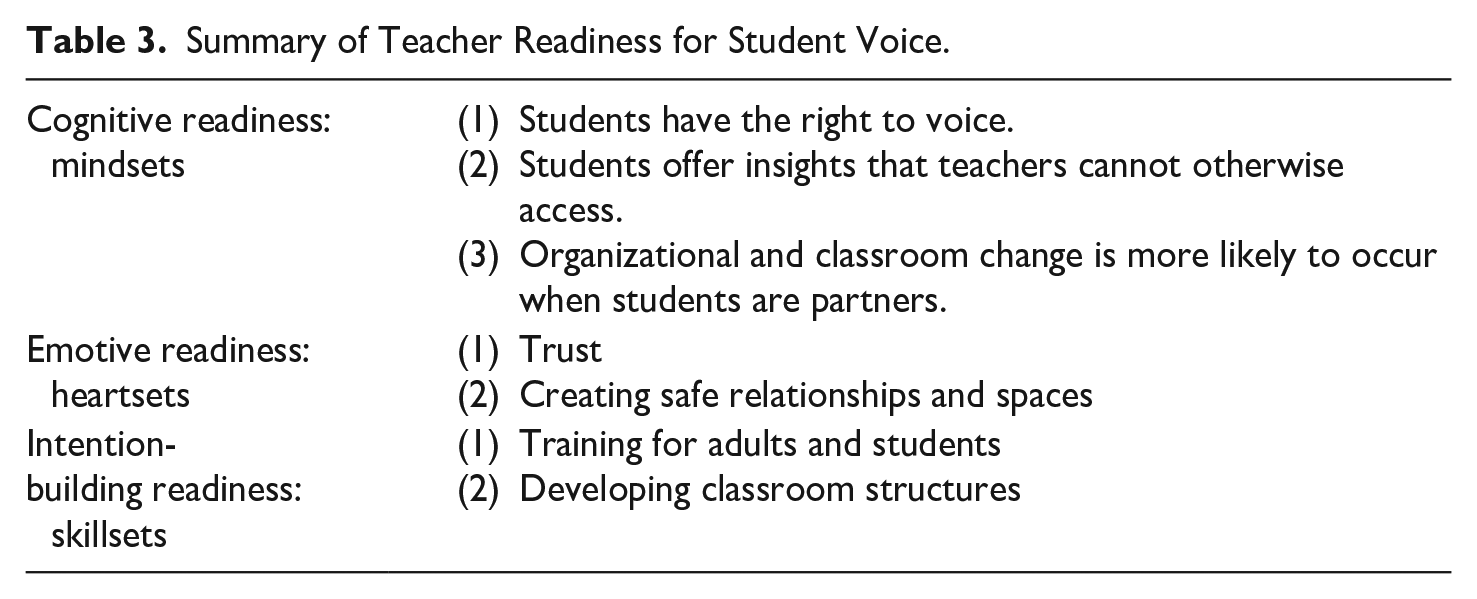
Whereas organizational change literature focuses on the constructs of cognitive, emotional, and intent, the educational research focuses on mindset, heartsets, and skillsets. We keep both terms, however, to emphasize that this article’s contribution be informative for both organizational change and educational leadership literature. The combining of field concepts also can help to encourage cross-pollination of these literatures to improve conceptual understanding of teacher experience. The growing interest in SVPs as a pathway toward equity-based changes offered a useful set of cases to examine teacher readiness in embracing these changes. Table 3 provides a summary of our findings.
Summary of Teacher Readiness for Student Voice.
Building cognitive readiness through cognitive mindsets enables teachers to embrace activities that push against adultism, or the traditional belief of a hierarchy of power between adults and students in schools (Bertrand & Lozenski, 2023; Rodela & Bertrand, 2021; Salisbury et al., 2020). A common practice is to frame student voice as a rights-based practice in other nations that have ratified the United Nations Convention on the Rights of the Child (Lundy, 2018; Robinson, 2011)—even if these countries still struggle with implementation. Most literature from U.S. schools does not speak about the right of voice (Mitra, 2018), given that U.S. students do not have a legal basis to participate in decisions that affect them. We were therefore surprised to find in these data the regularity with which teachers and students spoke of student voice as a right for young people. Future research might want to consider if student voice cognitive mindsets are fixed or whether teachers with “adultist” mindsets can shift toward engaging with young people when contexts and conditions support this work. In other words, are adultist mindsets usually “fixed” mindsets, or can they be growth mindsets?
Our data also indicate that layers of cognitive mindsets at the classroom, school, and district levels can reinforce SVPs. Leadership can buffer the dilution of SVP building that results from competing priorities, and place the work as central to a school’s vision and budget (Mager & Nowak, 2012; Mitra & Serriere, 2012; Skerritt et al., 2022). These findings align with organizational change research demonstrating that leaders support change efforts by creating expectations of the work as “the way we do things here”; by offering a vision and a plan (Mitra, 2021; Nelson & Bishop, 2013); by offering training and scaffolding for teachers and students to opt in to the work (Fernandez et al., 2022; Holquist et al., 2023; Holquist & Walls, 2023); and by showing a willingness to protect the work from external pressures (Mitra, 2004; Skerritt et al., 2022; Taines, 2014).
Emotional heartsets are less discussed than cognitive needs in the literature (Rafferty et al., 2013). Although mindsets and skills are often discussed when planning for change, the affective components of individuals identifying common ground and openness to building relationships are critical elements of change that are often ignored in discussions of implementing change efforts, despite growing evidence of the importance of relationships within institutions entrenched in racist structures and beliefs (Lac et al., 2022; Philippo, 2012). Nel Noddings (1986) espoused an ethic of care that undergirds much of the research on building relationships and positive feelings between teachers and students. This attention to relationship building helps students to feel valued as human beings beyond academic content. Building and sustaining trust and connection even through conflict and anger has been shown to be an important aspect of emotional heartsets in previous literature for students in trauma-filled spaces (Cook et al., 2018).
Echoing findings in other research on student voice implementation (Fernandez et al., 2022), our research found trust and safety to be the central themes of emotional heartsets. Because of this strong finding regarding trust, we are working to develop a measure for studying relational trust in SVPs (Conner, Chen, et al., 2024). Future research might also consider ways in which practices focused on restorative justice and culturally responsive discipline and pedagogies could interact with SVP principles as ways to build trust and heal relationships between teachers and students in areas with large populations of white teachers and Black and Latiné students.
Educators also needed to acquire skillsets that could offer spaces to build cognitive mindsets and emotive heartsets. The support structures, often a critical component of capacity, are perhaps the component most discussed in organizational change (Amis & Aïssaoui, 2013; Tichnor-Wagner et al., 2017; Wilcox & Zuckerman, 2019) and for SVPs (Brasof & Specter, 2016; Mitra, 2018; Zeldin et al., 2005). In this study, intended skillsets included training for adults and students, and learning how the design of classroom and school structures can help to enable relationships and activities of SVPs. We found specific practices of providing training to both adults and young people, and creating systems to share learnings across teachers and schools. For example, reciprocal mentorship training (Gabriel & Kaufield, 2008; Haddock-Millar et al., 2023) provides a structured protocol for colearning, including ways that the teacher can learn from students.
These three concepts can build on one another and intersect. Teachers who have experience building trust understand that structures, such as advisory circles, become stronger and clearer as the trust grows. Strong emotive heartsets can even buffer SVPs from racist mindsets (Lac et al., 2022). For students, building stronger relationships with teachers and school administrators can help to persuade adults to adopt the cognitive mindset of the right to student voice and acknowledge that adults can learn from students what they could not otherwise learn (Anderson & Graham, 2016; Davies, 2011; Leat & Reid, 2012). Skillset strategies of ongoing training can involve spaces to build these stronger heartsets. Teacher perceptions of student skills can also impact teacher mindsets of willingness to engage in partnership (Gillett-Swan & Sergeant, 2019).
Readiness is not just a precursor to a change process, but a set of supports that are essential throughout. It therefore might be helpful to think of readiness as absorptive capacity (Amis & Aïssaoui, 2013; W. M. Cohen & Levinthal, 1990; McLaughlin & Mitra, 2001), which values creating a culture of ongoing growth mindset and learning. Although this article sought to expand understanding of teacher readiness by intersecting organizational change and postsecondary leadership research, we note that the concepts of cognitive mindsets, emotive heartsets, and intended skillsets could expand beyond readiness to next phases in the change process. To help to encourage future research, we propose a rubric to explore this broader notion of the use of these concepts in Table 4, and we hope that future research might test it empirically. Table 4 is phased as a series of questions to encourage future research regarding the extent to which a teacher and a school are ready to engage in SVPs, and potential threats to readiness.
Stretching the scope of the framework beyond traditional readiness.
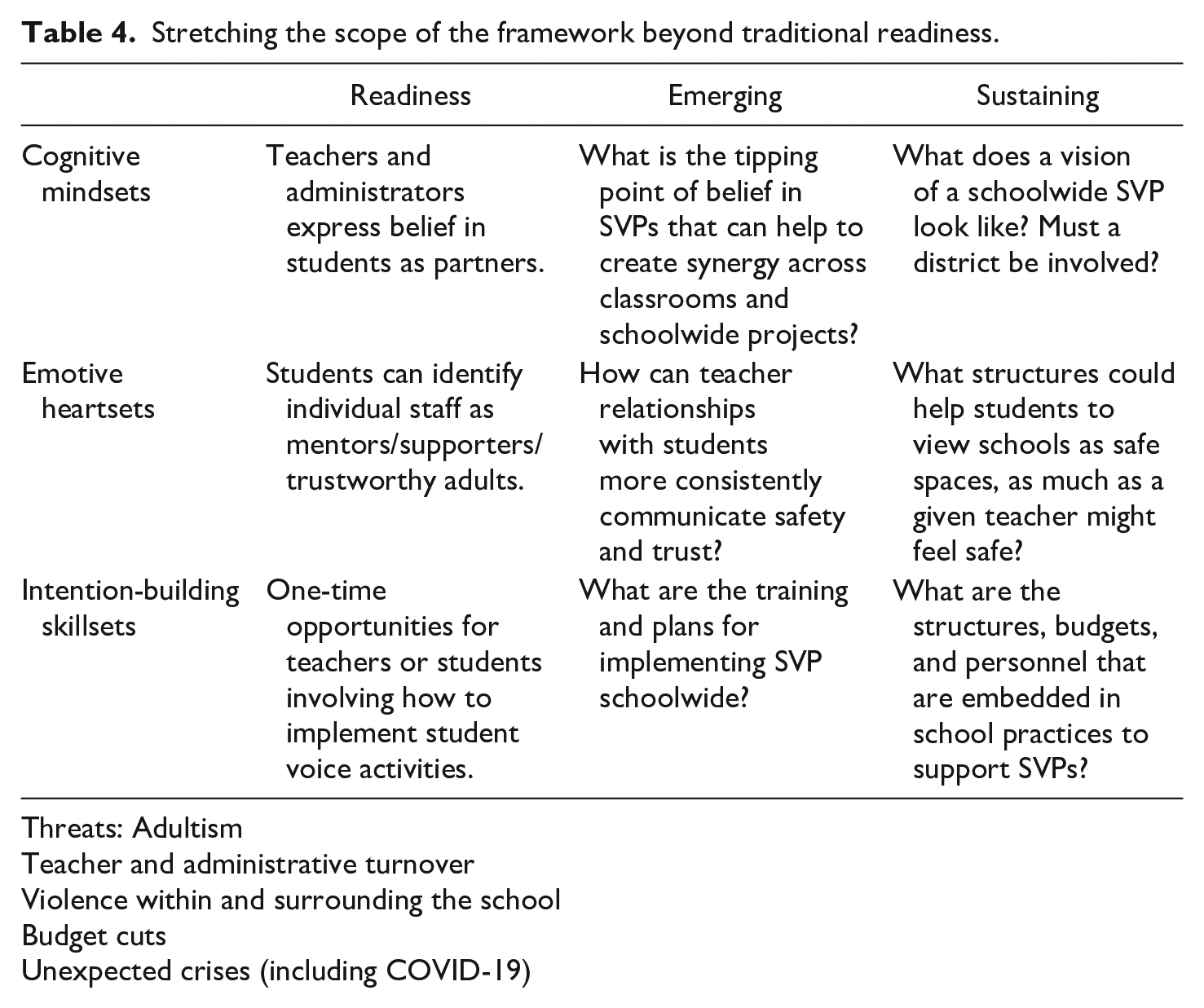
Threats: Adultism
Teacher and administrative turnover
Violence within and surrounding the school
Budget cuts
Unexpected crises (including COVID-19)
Although this study provides significant contributions, several limitations should be considered when interpreting the findings. The limited number of established, long-term student voice programs in our sample restricted our ability to observe the full trajectory of readiness. Future research should investigate the long-term development of readiness in more mature contexts. Moreover, the study’s focus on a district with a majority-Latiné student population suggests that demographic factors may play a role in SVP implementation and outcomes. Finally, the study was conducted during the years immediately following the COVID-19 pandemic, a period of significant upheaval in school systems. The ongoing reconstruction of school structures and the reported challenges with student engagement and teacher retention may have influenced our observations.
Conclusion
This article offers evidence that greater attention to developing teacher readiness can help to address some of the classic dilemmas of implementation for SVPs. The article addresses a gap in the literature by identifying mindsets, heartsets, and skillsets that can build readiness for SVPs. Our findings indicate that embedded support structures at the classroom, school, and district levels foster mindsets, heartsets, and skillsets that promote readiness for SVPs. Specifically, SVPs benefit from cognitive mindsets that empower students’ voices and offer distinct insights for teachers, and from organizational and classroom structures that encourage student partnership. Furthermore, emotional mindsets emphasizing trust and safety strengthen SVPs. We identified key skillsets for both students and adults, along with the importance of intentional classroom structures and collaborative spaces for SVP development. Our research provides practical guidance for improving SVP training and preparation, and contributes to organizational theory and educational leadership by highlighting conditions that enable or hinder the development and sustainability of SVPs.
Footnotes
Appendix
Declaration of Conflicting Interests
The author(s) declared no potential conflicts of interest with respect to the research, authorship, and/or publication of this article.
Funding
The author disclosed receipt of the following financial support for the research, authorship, and/or publication of this article: This work was supported by the Bill & Melinda Gates Foundation, Seattle, WA (ID INV-031504).
