




Abstract
Background:
In 2008, Grossman and McDonald called for the development of a common language of “core practices” for describing the practice of teaching. They argued that a shared language of practice would help teacher educators and teachers work together on practice and develop nuanced, complex, and shared conceptualizations of instruction.
Purpose:
This article interrogates the claim that core practices promote shared language development by investigating a practice-based professional development (PD) program on project-based learning (PBL). Within the PD program, we study how teachers’ conceptualizations of high-quality teaching shifted and how this related to their use of core practices language.
Research Design:
This qualitative content analysis examines if and how teachers’ conceptualizations of high-quality teaching and their use of core practices language shifted across pre- and post-PD interviews.
Conclusions:
After the PD program, teachers’ conceptualizations of high-quality teaching had changed. However, despite this shift, teachers rarely used the language of core practices when describing their teaching. These findings raise questions about the relationships between core practices of teaching, professional language, and teachers’ conceptualizations of teaching. The authors discuss these questions and offer a framework differentiating core practices from best practices. The framework compares divergent purposes for developing a shared language to describe the practice of teaching.
Keywords
In 1999, Mary Kennedy coined the phrase “the problem of enactment” to describe the stubborn reality that teachers’ espoused beliefs and knowledge about teaching and learning are often not aligned with their practice. While the problem of enactment likely has many causes, Grossman and McDonald (2008) named the absence of a professional language in teaching as one important contributor. They argued that without a shared lexicon for describing the practice of teaching, teacher educators would struggle to support teachers to instantiate their knowledge and beliefs in action because it would remain difficult for teachers and teacher educators to discuss and work on practice together. To remedy this, Grossman and McDonald (2008) called for the development of “core teaching practices” (p. 186), which, they argued, would allow researchers to study “underlying grammars of practice” while supporting practitioners to work closely together on the nuances of their practice through discourse.
Numerous scholars have responded to this call by proposing a wide variety of core teaching practices. Examples include positioning students as competent sensemakers (Kazemi & Cunard, 2016), supporting ongoing changes in thinking (Windschitl et al., 2012), supporting students in making a contribution to the world (Grossman et al., 2019, 2022), and legitimizing students’ feelings of wanting to belong (Calabrese Barton et al., 2020). Typically, these scholars conceptualize core practices not as a priori strategies that apply across contexts (e.g., wait time, cold-calling, giving praise), but rather as goal-oriented, principle-driven actions that can be cocreated with students and are necessarily shaped and reshaped by the contexts in which they are enacted (Grossman et al., 2018; Kavanagh, 2022, 2023; Lampert et al., 2013). The recent proliferation of proposed core practices suggests that some teacher education scholars find the concept of a vocabulary of practice to be a useful tool for research and practice. The research produced around proposed core practices, however, has mostly stayed silent about Grossman and McDonald’s (2008) original argument about the need for a shared vocabulary. Instead, core practice research has tended to focus on teacher educators’ pedagogy (Ghousseini, 2015; Grosser-Clarkson & Neel, 2020; Lampert et al., 2013) and teachers’ instruction in classrooms (Brataas & Jenset, 2023; Monte-Sano et al., 2020; Reisman et al., 2019). Aside from the early conceptual calls for core practices (Ball & Forzani, 2009; Grossman, Hammerness, & McDonald, 2009; Grossman & McDonald, 2008), research has mostly avoided deep engagement with questions relating to the language that teachers use to talk about their work.
While scholarship on core practices has evolved away from investigating teachers’ use of language, other scholarship has conducted sociolinguistic analyses of teachers’ in situ language use and discussed the implications of such analyses for teacher professional learning (Horn, 2010; Horn & Garner, 2022; Horn & Kane, 2019; Horn & Little, 2010). The sociolinguistic literature on teacher talk tends to conceptualize teacher learning as conceptual change rather than shifts in classroom implementation (Horn & Garner, 2022). Toward the end goal of conceptual change, this body of work has illustrated the affordances of dialogic discourse between teachers (Horn, 2010; Horn & Kane, 2019) who have shared language and shared frames of reference (Horn & Little, 2010). From a conceptual change perspective, the shared language that groups of teachers draw on in conversation is always entwined with those teachers’ existing conceptual understandings. For this reason, teacher educators and professional development providers cannot simply offer new language or concepts in the hopes that it will transform teachers’ understanding. Such an assumption would deny the constructivist premise that “learners build new ideas in the context of old ones” (Horn & Garner, 2022, p. 11).
This project is grounded in a conceptual change orientation toward teacher learning and driven by an interest in interrogating Grossman and McDonald’s (2008) claims about how a language of core practices might address the problem of enactment. We ground our investigation in one core practice focused professional development (PD) program designed to support middle and high school teachers to facilitate project-based learning (PBL) (Dean et al., 2023; Farrow et al., 2022, 2024; Grossman et al., 2019, 2022; Kavanagh et al., 2023; Kavanagh, Farrow, et al., 2024). The PBL core practice framework, which we describe in greater detail in later sections of this article, was developed through a modified Delphi study in which K–12 teachers and community members played a central role in the development of the framework (Dean et al., 2023). Because PBL represents a progressive pedagogical approach that is far afield from the type of instructional practice found in most U.S. schools (Kohn, 2015; Potvin et al., 2022), the program offers a helpful site for studying the relationship between teachers’ conceptual understandings of practice and the language that they use to describe that practice as they attempt to make profound shifts in their instruction. Within this PD program, we wondered, when offered a technical vocabulary for describing teaching practice (e.g., a core practice framework), what do teachers do with this framework? Does engagement with it spark transformations in the language that they use? If so, are shifts in language representative of underlying conceptual changes? To this end, we asked:
To what extent and in what ways did teachers’ conceptualizations of high quality instruction shift across a year of core practice-focused PD?
To what extent and in what ways did teachers use the PD program’s language of core practices shift? Did shifts in language use align with shifts in conceptualizations of teaching?
Theoretical Framework
A Professional Language of Practice
When Grossman and McDonald (2008) called for a shared professional language for describing practice, they called their imagined, field-level lexicon “core practices” and argued that its identification would support teachers to connect conceptual knowledge to applied instructional practice. To further their call, Grossman, Hammerness, and McDonald (2009) proposed a set of criteria for identifying core practices, suggesting that although different researchers and practitioners might identify different practices as “core,” all core practices should have a set of common characteristics. They should be practices that “occur with high frequency in teaching,” are enactable “across different curricula or instructional approaches,” allow teachers “to learn more about students and about teaching,” “preserve the integrity and complexity of teaching,” and are “research-based” (Grossman, Hammerness, & McDonald, 2009, p. 277). They then further clarified that these criteria were intended to challenge scholars and teacher educators to avoid approaching core practices as oversimplified lists of specific moves or best practices (McDonald et al., 2013). This assertion that “core practices” are not the same as “best practices” and should not reduce instructional practice to discrete sets of moves or teaching strategies, but rather draw attention to the complexities of instruction and the importance of responsiveness to students, has been a consistent drumbeat of the literature on core practices in years since (Anagnostopoulos et al., 2018; Lampert et al., 2013; Kavanagh, 2022, 2023).
Some practice-based scholarship suggests that the field should adopt a common set of core practices around which the field might aggregate knowledge (Ball & Forzani, 2009). Other practice-based scholarship suggests that any one set of core practices will be unlikely to meet the needs of teachers working in vastly different contexts, arguing instead for program-specific sets of core practices (McDonald et al., 2013). Along with debates within scholarship on core practices, debates have also arisen over whether having a shared professional language for describing teaching practice is beneficial in the first place. Critics of core practices argue that a shared professional language of practice may not adequately capture the unique, contextualized realities in teachers’ classrooms, may contribute to teachers’ enactment of rote or prescribed practices that are disconnected from broader instructional visions or goals, or may reinstate Western epistemological superiority and thus marginalize other ways of knowing (Horn & Kane, 2019; Kennedy, 2016; Philip et al., 2018).
Interestingly, critics and proponents alike ground their arguments in theoretical perspectives that see language use as a social practice, where language is a force that both constitutes and is constituted by people’s thoughts and actions (Bourdieu, 1977). For critics of core practices, linguistic theories underscore their concern that those interested in identifying core practices are, in essence, interested in making the meanings of words static and fixed—a futile task given that meaning is always negotiated by speech communities (Horn & Garner, 2022; Horn & Kane, 2019). For proponents of core practices, however, linguistic theories that understand language as social practice underscore their argument that professional languages—like the lexicons that surround core practices— are not just collections of neutral terms, but instead are actors shaping the way professional communities think and act. Calls for shared terminology rest on a belief that without a robust vocabulary for describing the nuances of practice, teachers, teacher educators, and researchers will continue to be limited when sensemaking together about the nuances of instructional practices.
The terms we use to describe teaching practices are dynamic ideas that express shared goals about teaching and learning, and whose meanings are situated and (re)negotiated in specific contexts, settings, and interactions (Windschitl et al., 2012). In this way, both arguments for and against core practices are grounded in a belief that language is negotiated in speech communities, which both shape and are shaped by the languaging that they do with one another. Calls for core practices can also be read as understanding language as a matter of play and as an object that is always in play (Butler, 1997; Derrida, 1970, 1972).
Conceptualizations of High-Quality Instruction
The language that teachers use to describe teaching both shapes and is shaped by their conceptualizations of what high-quality instruction is. These conceptualizations are grounded in teachers’ idealized images of teaching—their ideal instructional goals, purposes, beliefs, and practices, what scholars typically refer to as instructional vision (Hammerness, 2001, 2003, 2006; Jansen et al., 2020). Teachers’ conceptualizations of high-quality teaching are also influenced by what those teachers enact, believe, and pursue in the actual world of their daily work (Matsko et al., 2024). While changes in instructional vision may prompt shifts in a teachers’ conceptualization of high-quality instruction, so too can changes in enacted practice.
Just as teachers’ have their own conceptualizations of what constitutes good instruction, most teacher learning experiences are oriented toward their own particular conceptualizations of high-quality teaching. Consequently, we find it helpful to differentiate between two types of conceptualizations: (1) programmatic conceptualizations of high-quality instruction as communicated in professional development, teacher education, and PD programs, and (2) personal conceptualizations of high-quality instruction held by teachers. We refer to these two types of conceptualizations of teaching as programmatic conceptualizations and personal conceptualizations. It is often the objective of teacher education or PD programs to bring teachers’ personal conceptualizations into closer alignment with programmatic conceptualizations. How these conceptualizations become more aligned is part of a complex process of participatory appropriation (Rogoff, 1995): Through participating with other teachers in the PD program and trying out teaching practices in their own classrooms with students, teachers “hone their participation in the ongoing activity, [while simultaneously] shap[ing] the flow of cultural practices of their community” (Rogoff, 2023, p. 66). Sociocultural theories of learning and participatory appropriation are particularly helpful because of the theoretical attention to the role of language as an important tool that mediates collaborative and social activities and an individual teacher’s process of learning and development (e.g., Rogoff, 1995; Vygotsky, 1978). In the following sections, we describe in detail what we mean by programmatic and personal conceptualizations, including a description of the specific programmatic conceptualization that informed the particular PD at the center of this study.
Programmatic Conceptualizations of High-Quality Instruction
We use the term “programmatic conceptualization” to describe the ideas about high-quality instruction that are communicated in teacher education or PD programs. Programmatic conceptualizations of high-quality instruction are often communicated through the instructional goals, frameworks, or objectives of teacher learning experiences. In the case of core practice-focused PD programs, programmatic conceptualizations are often communicated through sets of core practices, which make teaching practices the containers that hold programmatic attention to relevant beliefs, knowledges, stances, principles, and instructional goals. This research studies a PBL PD program, which saw high-quality instruction as student-centered, inquiry-driven, and oriented toward real-world problems that reach beyond the classroom to make authentic contributions to the world beyond the school. The program communicated this conceptualization of high-quality instruction through a framework of both core goals and core practices. This core practice framework is laid out in Figure 1 and was used by the program’s teacher educators and coaches to support teachers’ enactment of PBL instruction.
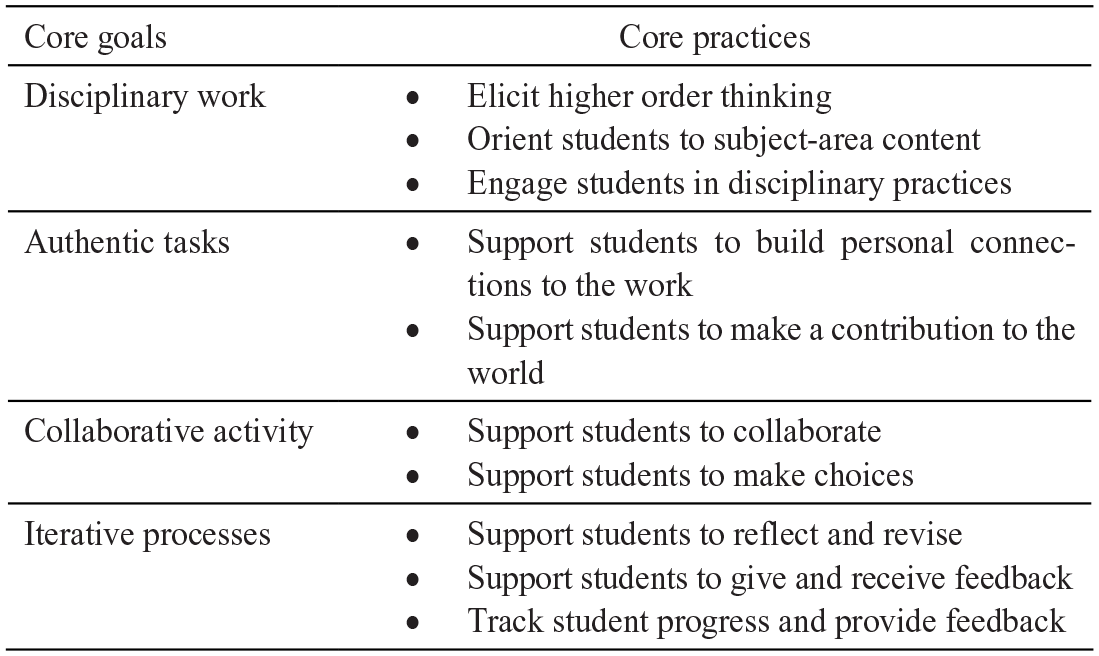
The PD program’s core practices framework.
This framework of PBL core practices was adapted from the findings of a modified Delphi study in which 50 educators were surveyed and 15 were interviewed about their goals and practices in PBL instruction (Dean et al., 2023). The resulting framework consists of 10 core practices organized around four classroom goals: disciplinary work, authentic tasks, collaborative activity, and iterative processes. Using a Delphi study to develop a set of core practices supported us in grounding the framework in the expertise of one particular community: K–12 educators with strong commitments to and backgrounds in PBL. It is likely that a Delphi study conducted in a community grounded in different ontological and epistemological assumptions would have resulted in a different framework (Philip et al., 2018). The PD program’s coaches and teacher educators sought to bring teachers’ personal conceptualization into closer alignment with this program’s conceptualization of PBL. Consequently, throughout this work, the term “programmatic conceptualization” is used to describe the PD’s ideas about PBL instruction specified in Figure 1.
Personal Conceptualization
We use the term “personal conceptualization” to refer to individual teachers’ articulated ideas about teaching. Personal conceptualizations are sometimes voiced as abstract ideas, such as teachers’ beliefs, aspirations, and purposes, and sometimes as descriptions of teachers’ enacted instruction. Because we were interested in understanding how teachers translate concepts from the PD’s programmatic conceptualization of PBL in their own thinking and teaching, our study distinguished between two types of personal conceptualization: (1) teachers’ instructional vision and (2) teachers’ described instruction. Figure 2 illustrates the distinction between the two components of a teacher’s personal conceptualization of high-quality instruction. Although these constructs of instructional vision and described instruction can be related (e.g., a teacher’s vision of their goals for PBL instruction can inform the instruction they enact and describe), they can also be distinct. For example, a teacher may not feel that they are able to fully enact their vision for PBL because of many factors, from curricula or testing mandates (da Silva & Mølstad, 2020) to the ways that classroom technologies (Kavanagh, Bernhard, & Gibbons, 2024) and students’ biases (Kavanagh, 2018) shape teachers’ practice.
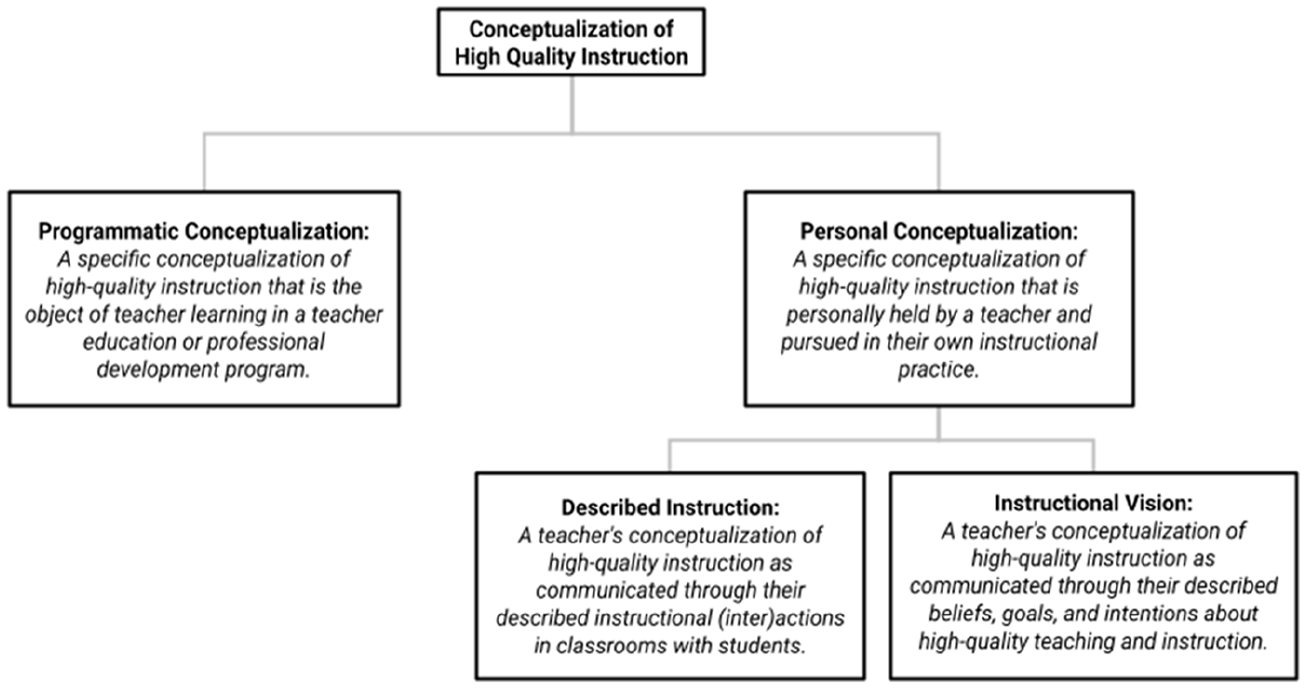
Programmatic and personal conceptualizations of high-quality PBL instruction.
Given that there is often a gap between what teachers know and believe and what teachers do (commonly referred as the “problem of enactment”) (Kennedy, 1999), we find that distinguishing between teachers’ described instruction and their instructional vision helps us to better understand the ways in which teachers in this PBL PD take up aspects of the PD.
Instructional Vision
We use the term “instructional vision” to refer to teachers’ descriptions of their beliefs and goals about PBL instruction, regardless of whether they have enacted these beliefs, goals, and intentions in their own teaching. Instructional visions often sound aspirational, given that teachers describe what they hope that they (or their students) will achieve, rather than what they will do or have done (Hammerness, 2001, 2003, 2006; Jansen et al., 2020). Because our study focuses specifically on PBL, we are particularly interested in teachers’ conceptualizations of what makes PBL instruction high quality.
Described Instruction
The term “described instruction” refers to teachers’ descriptions of their own teaching, often including contextualized details of specific instructional decisions that teachers made in their classrooms with students. Teachers’ described instruction involves the translation of teachers’ knowledge and beliefs into enacted actions and interactions with their specific students. (Table 2 in the Methods section provides examples of teachers expressing their described instruction, in contrast to their instructional visions of PBL teaching.)
Methods
Context
The context of this research is a PBL PD program for in-service Grade 6–12 teachers. This PD was developed and led through a graduate school of education at a large research university in the United States. The PD program lasted 14 months, beginning with a week-long, in-person summer institute that was followed by group coaching cycles that occurred during the academic year. The academic year coaching cycles involved content-specific teams of teachers meeting with a content area expert coach for a series of virtual sessions. The program then concluded with a second week-long, in-person summer institute for teachers. The structure of this PD engaged teachers in cycles of decomposing, planning, enacting, and reflecting on each of the PBL core practices (McDonald et al., 2013). See Appendix A for additional program context.
The structure and work of the PD program was extensively organized around the core practice framework in Figure 1. Throughout the PD summer institutes and academic year, teachers, PD facilitators, and coaches repeatedly engaged in dialogue, practice, and reflection around the core practice framework as teachers worked to situate and adapt these practices to their own classroom contexts and to be responsive to students’ interests, ideas, and contributions (Kavanagh et al., 2023; Kavanagh, Farrow, et al., 2024). Because of the tight focus on a core practice framework, the program was an ideal site for studying the relationship between a shared professional language of core practices and teachers’ conceptualizations of PBL teaching.
At the time of the study, all of the authors were part of a research team affiliated with the university sponsoring the PBL professional development program. The research team investigated the PD framework, model, and pedagogies as well as teacher reasoning, language use, and instruction. None of the authors of this analysis was involved in facilitating the PD, summer institutes, or coaching cycles during the academic year; however, the first author helped develop the PBL practices framework.
Participants
This study is nested within a larger project studying this PBL PD experience and participating teachers’ perspectives and practices. The larger investigation enrolled 48 teacher participants across two cohorts: Cohort 1 (n = 25) and Cohort 2 (n = 23). Participants self-selected into this PD experience based on their interest in PBL. Participants came from public and charter districts across five regions in the United States and were distributed across two content areas: 22 participants taught a secondary science subject, and 26 taught a secondary humanities subject.
For this investigation, we focused on a subsample of participants. Because the COVID-19 pandemic arose in the middle of the second cohort’s PD experience, we focused only on teachers from the first cohort. From the 25 teachers in the first cohort, we further narrowed our sample to focus on the 12 participants for whom we collected both a pre- and post-program interview. The 12 teacher participants in this study were, at the time of the research, all high school (Grades 9–12) science (n = 3) or social studies (n = 9) teachers. Participants taught in three different U.S. school districts; one educator taught in a large, urban West Coast public school district, six educators taught in a large, urban mid-Atlantic public school district, and five educators taught in a large, suburban mid-Atlantic public school district. Teachers had from one to 28 years of teaching experience, with an average of 13.5 years. Participating teachers varied by race and gender; however, similar to the teaching workforce as a whole (National Center for Education Statistics, 2023), the majority of teacher participants self-identified as female, and half of participants identified as White. In total, 10 teachers self-identified as female and two as male. Two educators self-identified as Black, four as Asian, and six as White. Eight of the 12 teachers worked in Title I schools. We offer these data (Table 1) to broadly contextualize our participants and the school settings in which they teach.
Participant Summary.
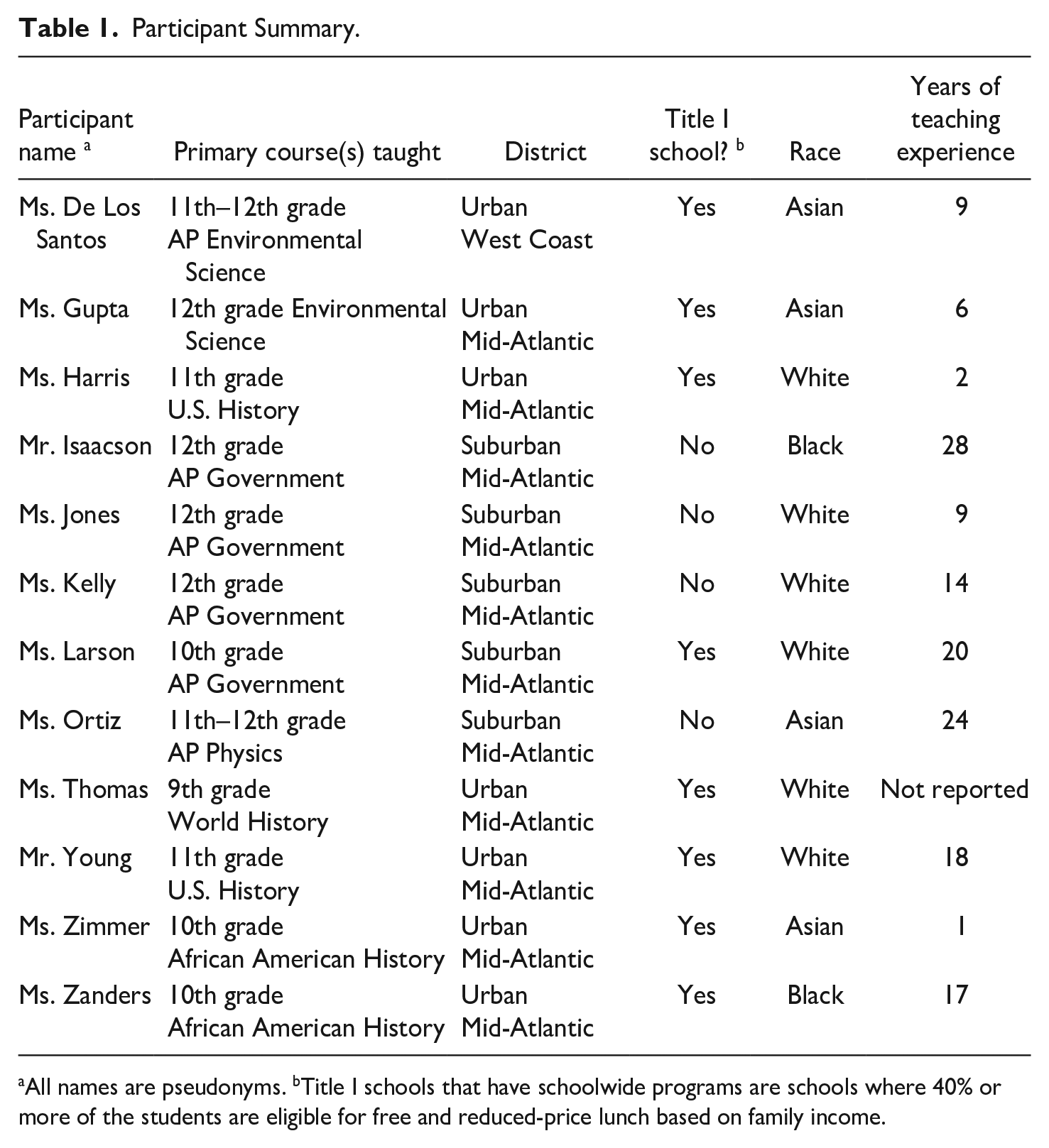
All names are pseudonyms. bTitle I schools that have schoolwide programs are schools where 40% or more of the students are eligible for free and reduced-price lunch based on family income.
Data Sources
The primary data source for this analysis is a set of semi-structured interviews (n = 24). Teachers (n = 12) participated in semi-structured interviews at two points in time: before the PD program in spring 2018 (“baseline”), and after the conclusion of the PD program in fall 2019 (“post-program”). The interview protocol consisted of two sections. In the first section, teachers were asked to describe their enacted instruction, including the design of their projects, their students’ learning, and their pedagogical decisions. In the second section, teachers were asked to describe their instructional vision of PBL.
Data Analysis
This study engaged a qualitative content analysis to study teachers’ use of the PD program’s language, as well as shifts in teachers’ conceptualizations of high-quality instruction. This approach involves two phases of qualitative coding for evidence of teachers’ conceptualizations of high-quality instruction and language use. Qualitative coding was followed by an analysis of those codes to reveal shifts over time in teachers’ conceptualizations and frequency of core practice language use (Elo & Kyngäs, 2008; Mayring, 2014).
Although the PD program was built around four goals (disciplinary work, authentic tasks, collaborative activity, and iterative processes) and 10 core teaching practices, we narrowed our focus to only one of the core goals: disciplinary work and its three associated core practices (see Table 2). We made this decision based on a separate analysis of teachers’ use of disciplinary core practices, which involved analyzing videos of their classroom teaching before, throughout, and after the course of their participation in the PD program; this analysis had found significant growth in teachers’ observed enactment of disciplinary core practices from pre- to post-PD. (See Kavanagh et al., 2023, and Kavanagh, Farrow et al., 2024, for more detail on the video observation analyses, and see Appendix A for more information on the videos of teaching practice collected during this PD). Intrigued by the fact that teachers were becoming more sophisticated in their enactment of disciplinary practices over time, we were interested in uncovering whether similar shifts were also occurring in teachers’ personal conceptualizations of disciplinary PBL teaching practices.
Personal Conceptualization Coding Scheme.
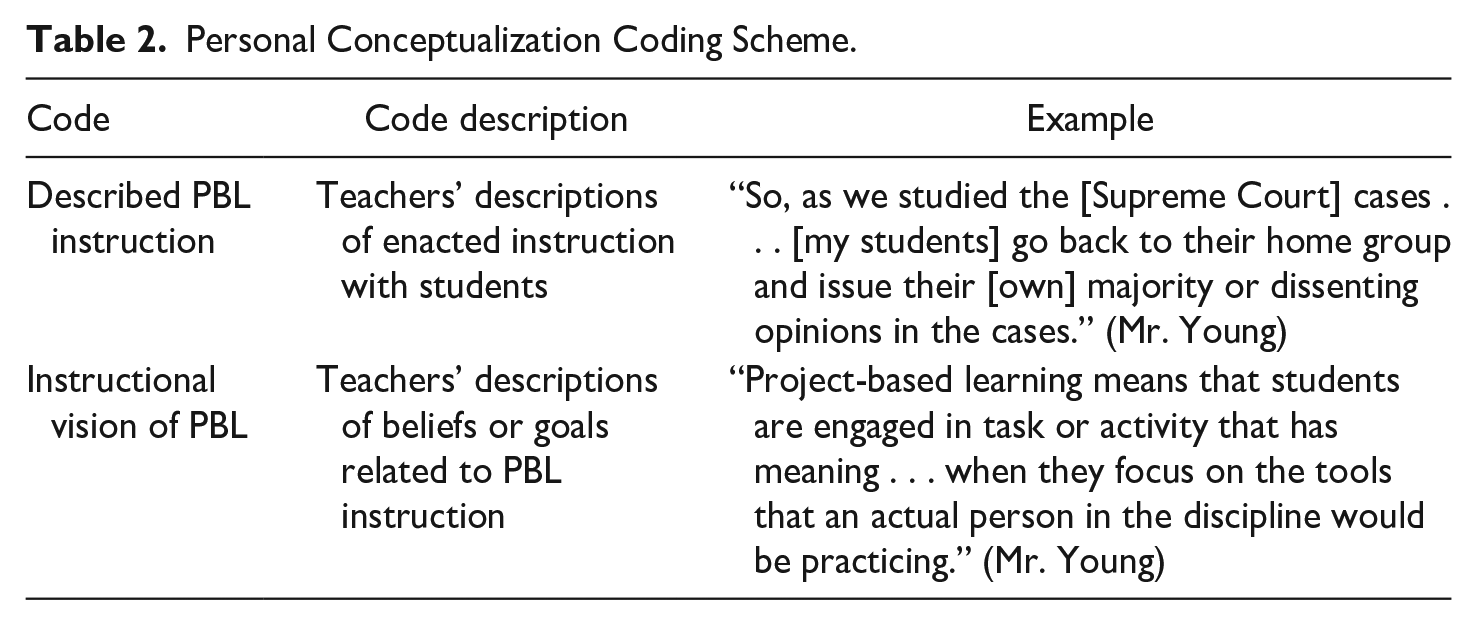
This decision to focus on the core practices that resulted in significant growth in teachers’ observed enactment was important to the design of our study. We wanted to understand what shifts are also observable in teachers’ language and conceptualizations of instruction when a practice-based PD is successful in changing teachers’ observed practice. However, although this decision was purposeful for our analysis, it is a limitation of our study that we did not analyze teachers’ language use and conceptualizations related to core practices that did not reveal significant growth in teachers’ enactment (Kavanagh et al., 2023; Kavanagh, Farrow, et al., 2024).
Phase 1: Identifying Teachers’ Alignment to the PD’s Programmatic Conceptualization
To answer our first research question, we developed a coding scheme to examine how the program’s disciplinary core practices appeared in teachers’ described instruction during interviews. Recall from our theoretical framework that it is possible for teachers to communicate their personal conceptualization in two ways: through their described instruction and through their instructional vision of PBL. Teachers’ described instruction includes their self-reported teaching actions and interactions with their specific students. In contrast, teachers’ instructional vision of PBL includes descriptions of teachers’ more abstract, or broader, beliefs and goals about PBL teaching, even if they did not see themselves fully achieving that vision of PBL in their own instruction. Given findings from separate video observation analyses (Kavanagh et al., 2023; Kavanagh, Farrow, et al., 2024), which showed that teachers grew significantly in their enacted core practices related to disciplinary work (Kavanagh et al., 2023; Kavanagh, Farrow, et al., 2024), we were curious to study in this analysis whether their described instruction similarly changed. Definitions and examples of our codes for the interviews are provided in Table 2.
To explore this question, the first phase of our coding scheme was designed to understand the extent to which teachers’ described instruction aligned with the PD’s programmatic conceptualization of disciplinary core teaching practices.
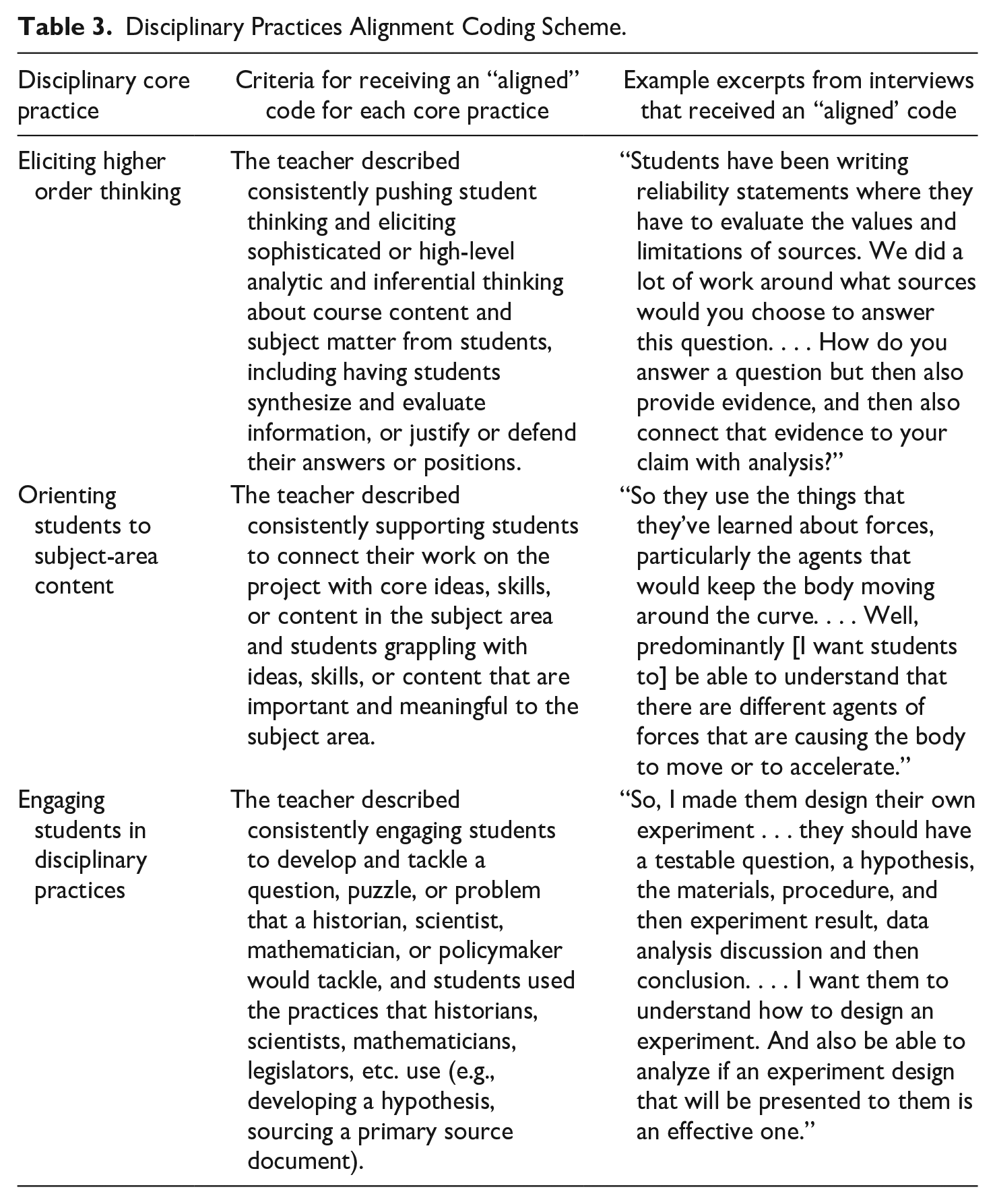
This coding scheme included the PD program’s three core practices associated with disciplinary work: (1) elicit higher order thinking; (2) orient students to subject-area content; and (3) engage students in disciplinary practices. We used program documents to define the PD program’s conceptualization of these disciplinary PBL teaching practices. We then treated entire interviews as units of analysis and coded each interview holistically as “aligned” or “misaligned” with the program’s conceptualization for each disciplinary core practice. Because we were interested in the alignment of teachers’ described instruction with the programmatic conceptualization, an interview had to contain at least one description of an enacted teaching practice that corresponded to the programmatic conceptualization to be coded as aligned. The code of misaligned was applied when a teacher described their instruction in ways that only partially aligned to the programmatic conceptualization for the selected disciplinary practice. “Absent” was applied when coders were unable to find any descriptions of teaching that corresponded to the selected disciplinary teaching practice. Each interview received three codes, one for each of the three disciplinary practices. In Table 3, we provide our criteria for how we evaluated alignment, as well as examples of described instruction that were aligned to the programmatic conceptualization of high-quality PBL teaching.
Disciplinary Practices Alignment Coding Scheme.
Phase 2: Uncovering Whether Teachers Used Programmatic Language
To address our other research question, we developed a coding scheme to examine teachers’ language use in the interviews. We explored how teachers used the program’s language of core practices, not because we believe that core practice scholarship suggests that teachers should adopt a standardized language. Instead, identifying the instances in which teachers used the program’s language of core practices allowed us to examine what the teachers were doing with that language and whether what they were doing changed over time. To embark on this aspect of our analysis, we first looked for instances in which teachers used the exact terms of the program, regardless of whether the way they were using the term signaled conceptual alignment with the program’s conceptualization of high-quality instruction. For example, if a teacher said that there was “no collaboration” in their classroom, we still coded the excerpt as “verbatim language use” because collaboration was one of the core goals of the program. This is because the teacher was using the language of the program even though the described instruction was not aligned with the programmatic conceptualization. While this would receive a verbatim language use code, it would also have been coded as conceptually misaligned to the program’s ideas about instruction. We excluded the few instances in which terms appeared with categorically different meanings (e.g., talk about “classroom discipline” instead of teaching within or across “disciplines”). For this phase of coding, we looked for teachers’ verbatim use of the program’s four core goals: “disciplinary,” “authentic,” “collaborative,” and “iterative” in all of their configurations (e.g., “discipline,” “disciplinary,” “disciplinarian,” “interdisciplinary”). Coders (the article’s second, third, and fourth authors) participated in interrater reliability testing for the verbatim coding and achieved a Cohen’s kappa of .94. See Appendix B for a list of all the configurations of the verbatim goal terms we looked for in the interviews.
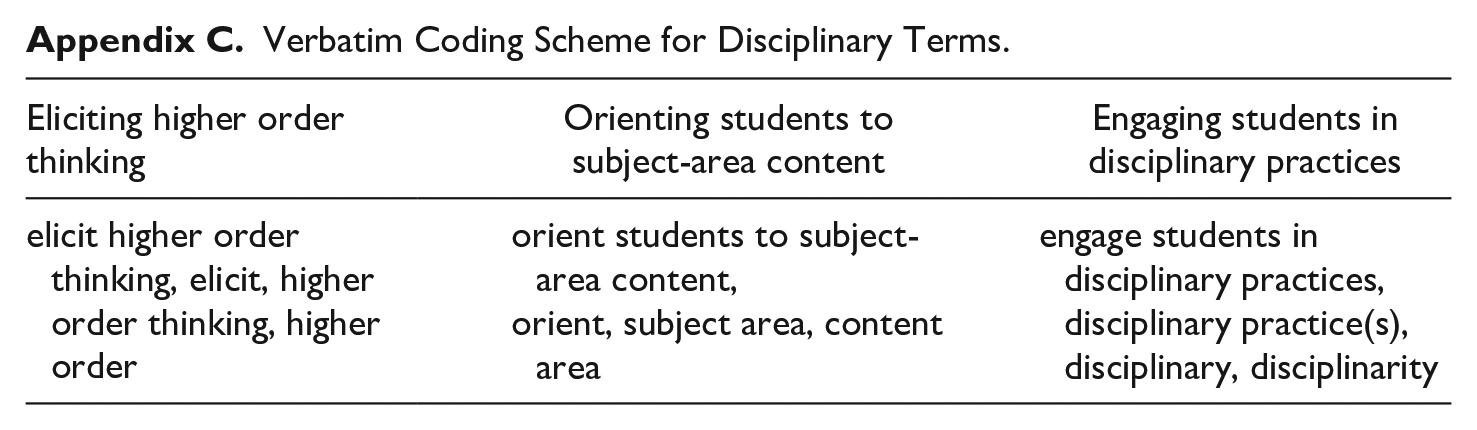
In the second part of Phase 2, we looked for teachers’ verbatim use of the language associated with the three core practices within the goal of disciplinary work: “eliciting higher order thinking,” “orienting students to subject-area content,” and “engaging students in disciplinary practices.” We looked for teachers’ use of terms and phrases associated with these three disciplinary practices using the same search technique we used for the goal terms. See Appendix C for a list of all the configurations of disciplinary core practices we looked for in the interviews. For both parts of this second phase of coding, we noted how and when teachers used verbatim programmatic terminology. Specifically, we noted if teachers used the terminology in reference to their described instruction (in explaining the teaching they do in their own classroom) or their instructional vision (when more abstractly describing PBL goals).
Findings
Shifts in Described Instruction
Our analysis revealed that teachers’ described instruction increasingly aligned with the programmatic conceptualization from their pre- to post-PD interviews, as shown in Table 4.
Percentage of Teachers’ Whose Described Instruction Aligned With Programmatic Conceptualizations of Instruction.
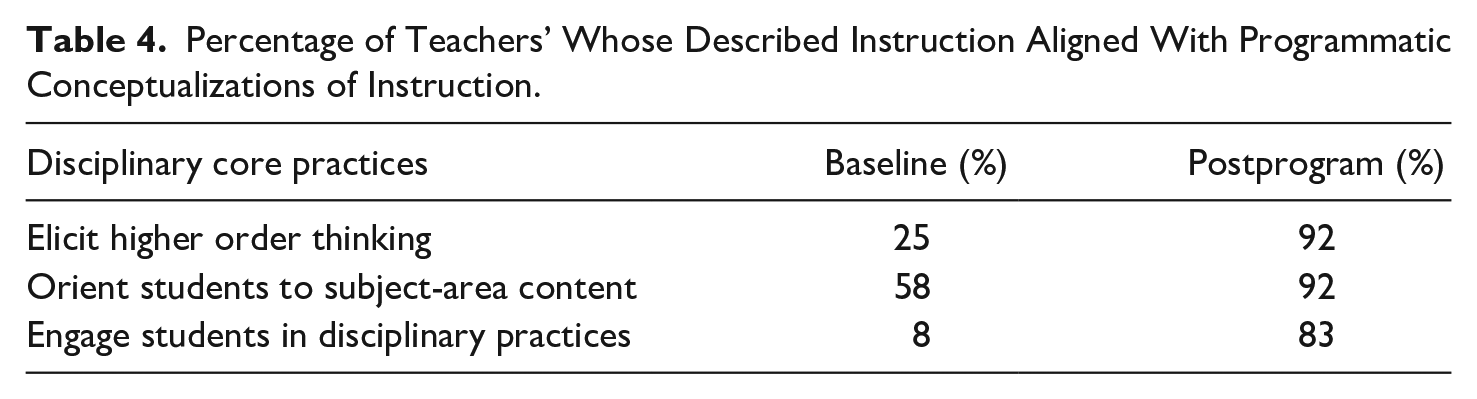
This analysis revealed that the lowest level of teachers’ described instruction alignment with described instruction at baseline was for the core practice of engaging students in disciplinary practices, with only 8% of teachers describing instruction that was coded as aligned with the program’s conceptualization of PBL. Despite starting with low alignment, teachers’ interviews showed significant shifts toward alignment with the programmatic conceptualization for this core practice. In their post-program interviews, 83% of teachers’ described instruction aligned with the programmatic conceptualization of this practice. Alignment was also low at baseline (25%) for the core practice of eliciting higher order thinking. However, by post-program, 92% of teachers’ described instruction of this practice aligned to the programmatic conceptualization. The core practice of orienting students to subject-area content started with higher alignment at baseline (58% of teachers), but also showed growth as 92% of teachers finished the program with their described instruction aligned to the program.
These findings reveal that after the PD, more teachers described their instruction in ways that aligned with how the PD conceptualized the three focal core disciplinary teaching practices. An illustrative example of how teachers shifted their described instruction comes from Mr. Isaacson’s AP Government class. Before the PD, in a description of his instruction during a unit on state and local government, Mr. Isaacson explained how students did “a scavenger hunt using the county website . . . reading and filling out a handout delineating the differences between the towns and the cities.” These were tasks leading up to a final project of a travel brochure in which they answered questions to provide information about state leader elections, landmarks, and demographics. We coded Mr. Isaacson’s interview as “absent” for the core practice of eliciting higher order thinking, because in this quote and throughout his interview, he described asking students to only identify information. He did not speak about students synthesizing, evaluating, defending, or justifying the selection of information—which, according to the program’s conceptualization, are essential to engaging in higher order thinking (as defined in Table 3). Post-PD, Mr. Isaacson again described his instruction in a unit exploring whether or not the U.S. Constitution should have been ratified. Here, Mr. Isaacson illustrated how “each of the students [was] assigned one of the signers of the Constitution, [they] had done some research, and then they defend[ed] their position [on] whether or not they think it should be ratified.” In his described instruction from this unit, Mr. Isaacson repeatedly spoke about students synthesizing information from multiple historical sources to defend a position on constitutional ratification. Given his detailed descriptions of how students synthesized information from multiple sources to defend a particular argument and position, we coded his post-program interview as “aligned” with the programmatic conceptualization of eliciting higher order thinking. Mr. Isaacson illustrates just one example of how teachers shifted toward describing instructional actions that were aligned with the PD’s programmatic conceptualization of disciplinary practices after they had gone through the PD.
This analysis revealed that following the program, teachers were more likely to describe their teaching in ways that aligned with the program’s conceptualizations of PBL teaching. After participating in the PD program, teachers offered specific, distinct examples of enacting these core practices in their own classrooms. This illustrates the potential of PD that is organized around core teaching practices to support teachers as they develop, expand, and deepen their conceptualizations of instruction. While this analysis captured shifts in teachers’ conceptualizations of teaching, it did not explore the degree to which teachers relied on the verbatim programmatic language. Next, we investigated the extent to which teachers used the language of the core practices as they described their instruction.
Appropriation of a Shared Professional Language
After our first analysis, we were confident that, over the course of the PD, teachers’ personal conceptualizations had shifted into closer alignment with the program. However, we still did not know what role, if any, having access to a shared language of practice played in this shift. We wanted to understand whether there was a relationship between the language of the core practice framework and the shift we were seeing in teachers’ conceptualizations.
To interrogate this, we first focused on the goal word that anchored the three core practices we had just analyzed in teachers’ interviews: “disciplinary.” We wanted to see whether this term was ever used verbatim by teachers as they described their personal conceptualizations. Interestingly, we found that before the PD, teachers never used this term in their interviews, but after the PD, three quarters of teachers were using this term in their interview. Intrigued by this finding, we wanted to see in what context within the interview teachers were using the term “disciplinary.” We found that almost all of the references were found within teachers’ descriptions of their instructional vision of PBL—we found nine of the teachers using the word to delineate their vision of PBL teaching, while only two used “disciplinary” in the context of describing their enacted PBL instruction. We then wondered if this pattern was distinct to the ways teachers specifically used the word “disciplinary,” or if it was a pattern that held for the other three goal words: “iterative,” “authentic,” and “collaborative.” We found that the pattern did hold; we have visualized it in Figure 3, of which we provide a detailed interpretation.
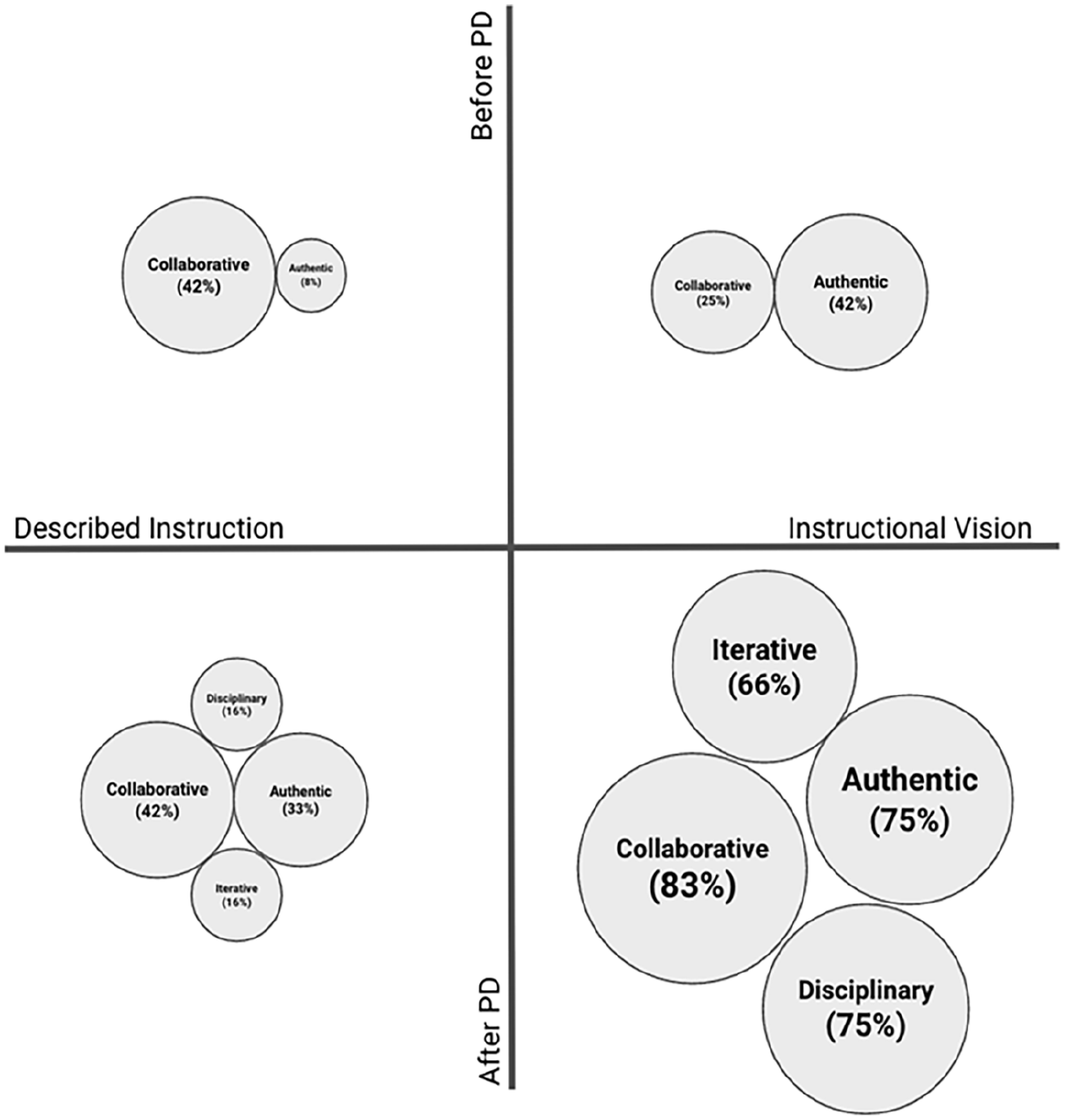
Percentage of teachers using core practice goal terms in their instructional vision of PBL vs. described instruction before and after PD.
In the portions of the interviews in which teachers described their instruction, we found that teachers used goal terms minimally. Any increases in the percentage of teachers who used these terms in describing their own instruction were quite small. The left side of Figure 3 shows the percentage of teachers (out of 12) who used goal terms to describe their own instruction—a larger circle indicates a larger percentage of teachers using these terms, while a smaller circle indicates a small percentage of teachers using them. The top left quadrant shows the percentage of teachers using these words to describe instruction before the PD, in comparison with the bottom left quadrant, which shows the percentage of teachers who used these words to describe their instruction after the PD. There was no increase in the percentage of teachers using the word “collaborative,” 16% more teachers used the terms “disciplinary” and “iterative,” and 25% more teachers used the term “authentic.” These percentages are small when compared with increases reported in the findings section around the increasing alignment of teachers’ described instructional practice with the program’s conceptualizations of high-quality, disciplinary PBL practices. Overall, we found that teachers, both before and after the PD, infrequently used these goal words to describe the instructional work they did in their own classrooms.
Interestingly, a different pattern emerged in portions of the interview in which teachers were asked about their instructional visions of PBL; there, they described their broader beliefs and goals related to high-quality PBL instruction. In questions about their PBL instructional visions, teachers’ use of the four goal terms dramatically increased from pre- to post-program. This difference is illustrated on the right-side quadrants of Figure 3. Before the PD, as shown in the top right quadrant, a quarter of the teachers used some form of the word “collaborative,” and less than half (42%) used the word “authentic” when describing their instructional visions of PBL. Before the PD, no teachers used any terminology related to “iterative” or “disciplinary” instruction when describing their vision of PBL instruction. The percentage of teachers using these goal words when articulating their instructional visions of PBL grew substantially after the PD, as seen in the bottom right quadrant. All four goal terms appeared in the majority of the teachers’ descriptions of their instructional visions of PBL—83% of the participants used the term “collaborative,” 75% used the term “disciplinary,” 75% used the term “authentic,” and 66% used the term “iterative.” If we then compare the left quadrants of Figure 3, which represent teachers’ described instruction, to the right quadrants, which represent teachers’ instructional visions of PBL, we can see a much higher use of the programmatic goal terminology when teachers spoke more abstractly about their visions of PBL, rather than concretely about their own instruction. Overall, Figure 3 illustrates that we only saw substantial verbatim use of the program’s goal terms in teachers’ instructional visions of PBL after the PD, as depicted in the bottom right quadrant.
We found that teachers tended to mostly use these four goal terms when describing their personal beliefs or goals about PBL teaching and learning broadly. Goal terms were rarely used when teachers described enacted practice from their own classrooms. However, teachers heavily referenced the four programmatic PBL goals when describing their instructional vision of PBL. In this portion of their interviews, teachers were asked questions about their instructional vision of PBL. To guard against participants answering these questions with official definitions of PBL rather than their personal conceptualizations of PBL, we asked a series of probes all intended to press for teachers’ personal visions. These included questions such as, “Do you consider yourself to be a project-based teacher? Why or why not?” and “What does project-based learning mean to you?” It is, of course, possible that some teachers may have told interviewers what they thought interviewers wanted to hear rather than describing their personally held beliefs, and that is a limitation of this study. In Table 5, we see examples of how both Ms. Jones and Ms. Ortiz responded to this line of questioning by using the goal terms from the PD’s framework of PBL practices in their post-PD interview.
Two Teachers’ Descriptions of Their Instructional Vision of PBL After Participating in the PD Program.
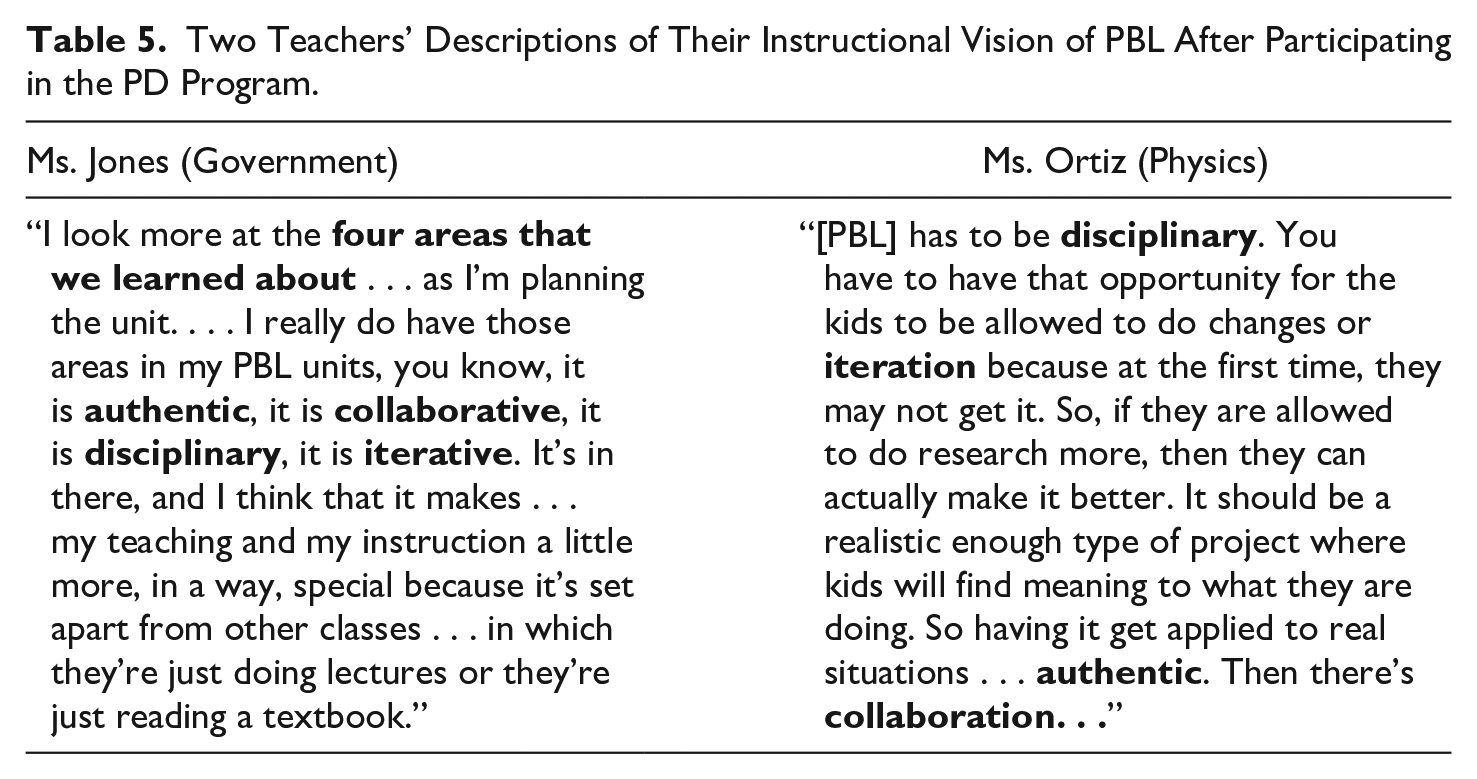
Rather than the conceptual shifts we saw in teachers’ described instruction, these quotations show teachers taking up the PD’s goal terms as dimensions of PBL —though it is unclear from these quotes alone whether teachers are just listing these words or more deeply internalizing them. In this “vision of PBL” portion of the interview, all teachers used at least one goal term, and a majority of the teachers in our sample, 58%, used all four goal terms. While the teachers tended to use the goal terms in the ways that Ms. Jones and Ms. Ortiz did in Table 5 in delineating a vision of PBL, these goal words were much less evident in teachers’ described instruction. Seeing the extent to which teachers used these terms in their instructional visions of PBL instruction, we began to wonder whether teachers were truly expressing a shared instructional vision of PBL that was grounded in deeper, contextualized understandings of these concepts, or simply listing goal terms without having internalized them in meaningful ways.
To investigate this, we performed another analysis to see whether the more specific language of the disciplinary core practices were similarly taken up in their interviews. We searched for teachers’ use of programmatic terms associated with the three practices tied to the goal of disciplinary work—the focus of this study. When looking at portions of the interview in which teachers described their own classroom practice, none of the teachers used the program’s verbatim core practice language; for example, no teacher ever used the phrase “eliciting higher order thinking” (or variations of the phrase) when they described their instruction. A large majority (92%) of teachers did not use the language of the specific core practices even though they frequently used the goal terms. If the program’s goal had been to support teachers to use the language of core practices, by this metric, the PD would have been considered a failure.
However, when we investigated what language teachers were using instead of the program’s verbatim language when speaking about their practice, we found that they were providing situated examples of how they enacted a core practice in their specific classroom context without drawing on any verbatim program language. In Table 6, when talking about the enactment of particular projects in their classrooms after the PD, we see how Ms. Jones and Ms. Ortiz described each practice, using their own language without using the program’s language.
Teachers’ Post-PD Descriptions of Enacting the Program’s Disciplinary Core Practices.
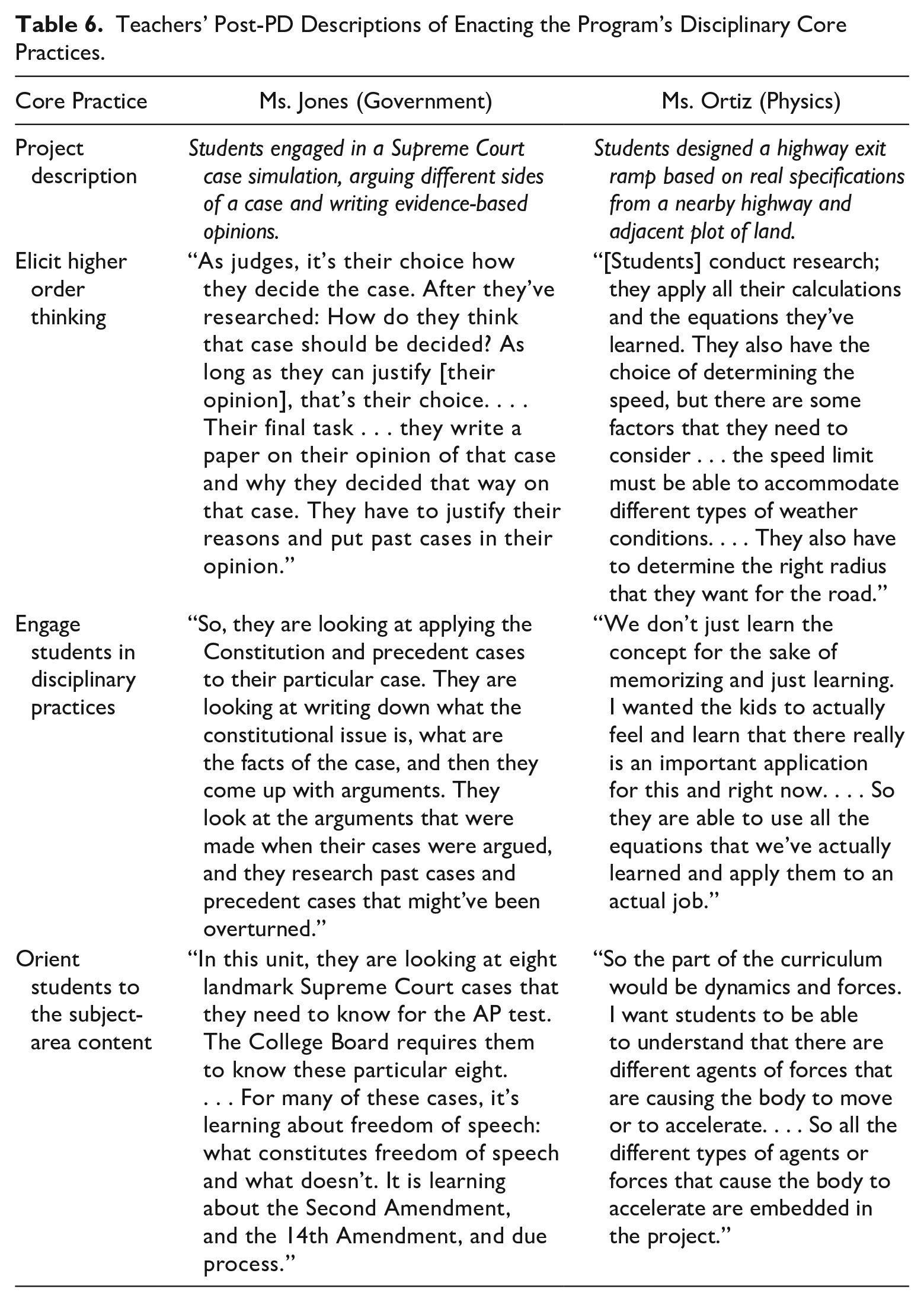
While Ms. Jones and Ms. Ortiz relied heavily on the program’s goal terms to describe their more aspirational and abstract instructional vision of PBL when planning units (see Table 5), they did not similarly rely on the goal terminology to describe how they enacted core practices (see Table 6)—a pattern that we saw mirrored across all teachers in our sample. For example, without ever using the language of “eliciting higher order thinking,” both teachers nonetheless expressed specific ways that their teaching involved the enactment of this practice. Without relying on the verbatim terminology of the program’s disciplinary core practices, these teachers instead used situated descriptions of their practice to illustrate how they enacted this practice.
While teachers used the goal term “disciplinary” throughout descriptions of their instructional vision of PBL, this term did not appear in their descriptions of what they did in their own classroom related to disciplinary practices. The teachers were not using core practice language to describe what they did in their classroom, but the conceptualization and meaning behind the language of the core practices clearly appeared in their described instruction. Teachers’ interviews provide evidence of deep, contextualized understandings of the disciplinary core practices. In looking for teachers’ use of core practice language in their interviews, we found not just an overall absence of verbatim core practice language, but also a presence of deeper understanding and contextually rich descriptions of enactment that became more aligned with the program’s conceptualization of PBL over time.
Additionally, in looking at teachers’ described instructional practice, we found a remarkable diversity in the ways that teachers brought these practices to life in their classrooms. Despite undergoing PD and yearlong coaching that uniformly and intensively used a shared language of core practices, the participating teachers described using these practices in various ways and without adopting the program’s verbatim language. As seen in Table 5, even though Ms. Jones and Ms. Ortiz enacted the same three disciplinary core practices, their enactments were entirely different and specific to their own disciplines, students, and contexts. In her classroom, Ms. Jones elicited higher order thinking by giving students opportunities to justify their opinions using Supreme Court precedents. In her classroom, Ms. Ortiz elicited higher order thinking by having students apply calculations to different real-world engineering scenarios. While a shared language existed within the PD program to discuss eliciting higher order thinking among coaches and teachers, there was not a singular approach or set of teaching moves that teachers enacted to elicit higher order thinking. Instead, teachers described flexibly enacting these practices to fit their contexts, students, and subject matter.
Discussion
We found that after teachers engaged in a PD program that was tightly organized around a framework of core practices, the way that they talked about their conceptualizations of high-quality instruction related to core practices became more closely aligned with the PD program’s conceptualizations of quality teaching. Although this was a heartening finding, we also wanted to investigate how, if at all, this conceptual shift was related to the program’s language of core practices. Were teachers using the core practice terminology of the PD program? If so, did their use of core practice terms represent shifts in their underlying conceptual perspectives on learning, teaching, and students?
Results illustrated that for these disciplinary core practices, teachers used more of the program’s terms when describing their instructional visions of PBL after participating in PD, but they rarely used the PD program’s language of core practices when describing their enacted instructional practice. This was true even though teachers’ descriptions of what they did in their classrooms markedly changed in ways that were aligned with the goals of the PD program. In fact, teachers seemed to align themselves with the principles underneath the core practices without adopting the core practice language itself. We assume that most readers will see this as a positive outcome—after all, what matters to student learning is not the words that teachers use to describe their practice, but the practice itself.
That said, the implications of this study must be understood within the context of its limitations. This study looked only at a small group of teachers who were enrolled in a particular PD program that was closely aligned to a clearly defined core practice framework. Although this context afforded us the ability to study shifts in teachers’ language use and conceptualizations of core practices, the size and scope of this analysis limits our ability to draw broad implications about the orientation of other PD experiences around core practices. We acknowledge that many factors not explored in this study may have influenced the observed outcomes, including participant characteristics and the characteristics of their school contexts, the selected focal core practice, the core practice framework, and teacher educator pedagogies. We instead encourage readers to consider how the findings of this study speak to contemporary academic discussions about having a shared language for describing the practice of teaching for the purpose of teacher education. If the teachers in this practice-based teacher learning experience were shifting their perspectives and enacted practices (as we have found in other recent analyses; Kavanagh et al., 2023; Kavanagh, Farrow, et al., 2024) without shifting the language they use, it seems that the promise of core practices in this case was not primarily about teachers’ language use. Instead, the promise of the program’s core practices may have been that they offered teacher educators linguistic and practical scaffolds for putting the practice of teaching at the center of learning to teach (Ghousseini, 2015). If this is the case, we believe that our study offers the field more nuanced perspectives on the purposes of having shared language for describing the practice of teaching.
While the earliest scholarship on core practices argued for the development of a common technical language of practice (Ball & Forzani, 2009; Grossman, Hammerness, & McDonald, 2009; Grossman & McDonald, 2008), the vast majority of core practice scholarship has paid little attention to the role of language in teacher learning. Rather, core practice scholarship has focused on how grounding teacher learning opportunities in specific practices allows for practice-based pedagogical, curricular, and structural transformations in the designs of teacher learning experiences (Chan, 2023; Grosser-Clarkson & Neel, 2020; Metz et al., 2020; Neel, 2017; Peck & Kavanagh, 2024; Peercy et al., 2022). The fact that work on core practices is not, at its heart, about shifting teachers’ language practices may explain the relative absence of linguistic arguments and analyses in core practice scholarship. Even though the early calls for core practices were about proposing a common technical vocabulary, core practice work over the last 15 years has moved in a different direction. Rather than trying to offer the field a dictionary, the vast majority of scholars doing work on core practices are trying to offer the field a set of tools for grounding teacher learning experiences in practice (Ghousseini, 2015; Kang & Windschitl, 2018; Kloser et al., 2019; Thompson et al., 2013; Windschitl et al., 2012). Given this evolution in core practice scholarship, the findings of our study make perfect sense: The program’s language of core practices was meant to be a scaffold, not an outcome.
This, then, may be the difference between “core practices” and “best practices”—a distinction that the field has been grappling with for years. Some have argued that the two stances are synonymous (Philip et al., 2018), while others have vehemently argued that they are distinct (Dinkelman & Cuenca, 2020; Kavanagh 2022, 2023; McDonald et al., 2013). We argue that perhaps a central element of the distinction is that a best practice stance is anchored by a static language of practice describing a set of teaching practices that have a priori, fixed definitions and idealized enactments that can be abstracted from context. Best practices are outcomes of teacher learning. From a best practice stance, successful teacher learning is achieved when a teacher can enact a best practice with fidelity to its static and universal definition. “Core practices,” on the other hand, are scaffolds for teacher learning. A language of core practices is meant to offer definitions that are specific enough that teachers and teacher educators know where, in the vast landscape of teaching practice, to meet up with one another. However, their definitions are also loose by design (Kavanagh, 2022, 2023). In Grossman and McDonald’s (2008) original call, the authors argued for definitions that provide the “flexibility required to recognize the significant differences in how [core practices] might be enacted” (p. 186). This looseness and flexibility supports teachers and teacher educators in negotiating the meaning of practices and considering the affordances and constraints of a wide variety of possible approaches to enactment across a diversity of contexts. Therefore, from a core practice stance, the goal is not that everyone agree on which practices are best and how best to enact them, but rather that everyone have a dynamic map of practice that allows them to meet each other at particular places in practice for the purpose of learning together (Lampert et al., 2013). The goal is not field-level agreement about a set of best practices (McDonald et al., 2013). Instead, the goal is to know with more specificity what it is about practice that we are disagreeing about.
Not all core practice work is currently grounded in these assumptions, however. Some scholars use the language of core practices to describe work that might be better characterized as best practice work (Bastable et al., 2021; Filter et al., 2022). Because of this, it is important for the distinction between these two stances to be elaborated by the field. We offer a start to this process of elaboration in Table 7.
The Assumptions Undergirding Best Practice and Core Practice Stances.
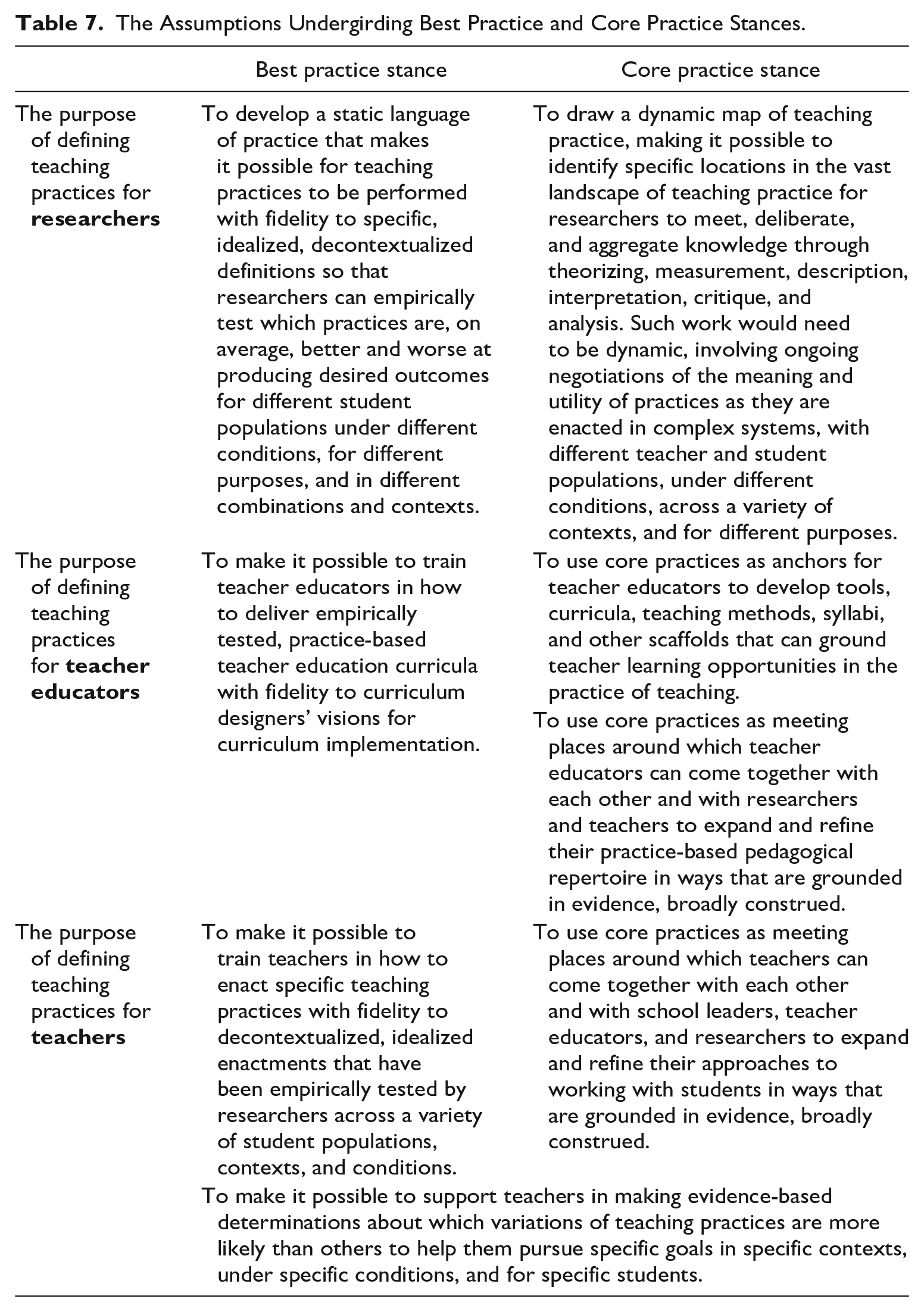
As evidenced in Table 7, both best practice and core practice stances assume that teachers and students benefit when the field has linguistic tools that allow us to easily put the practice of teaching at the center of teacher learning opportunities. The two stances differ, however, when it comes to their assumptions about the nature of the field’s knowledge about the practice of teaching. A best practice stance is grounded in the assumption that a specific, detailed language of practice will allow for fidelity-focused teacher training and, therefore, causal research into the efficacy of different teaching practices across purposes, contexts, conditions, and populations (Bastable et al., 2021; Filter et al., 2022). A core practice stance, on the other hand, is grounded in the assumption that a language of practice will offer ways for researchers, teacher educators, teachers, and leaders to clearly communicate with one another about practice for the purpose of learning at all levels of the system—including teacher learning, teacher educator learning, and researcher learning (Ghousseini, 2015; Gotwalt, 2023a, 2023b; Grossman et al., 2018; Kavanagh, 2022, 2023; Lampert et al., 2013; McDonald et al., 2013).
These two stances represent two quite different logic models for how a language of practice supports the improvement of teaching at scale: One model finds promise in specifying language because it supports replication, fidelity, and standardization, and the other model finds promise in specifying language because it supports shared meaning making, the negotiation of ideas, and the sharing of expertise, experience, and evidence. In both cases, a language of practice matters, but in each case, it matters for different reasons. Future research might investigate the ways in which being grounded in these different stances might promote different designs for professional development, different outcomes for teacher learning, or different programmatic structures for teacher education. It may be that practice-based designs for teacher learning that are grounded in best practice rather than core practice stances may lead to very different outcomes at the level of teachers’ language use, classroom practice, and conceptual understandings, and perhaps even, ultimately, student learning. If this is the case, future research investigating the distinctions between these stances could prove very useful to the field.
By distinguishing between best practice and core practice stances, we hope to offer the field more specific language (pun intended) for negotiating meaning and engaging in interpretation about designs for teacher learning and approaches to reform. Best practice and core practice stances are each grounded in different assumptions about (1) the nature of knowledge about teaching and learning, (2) the mechanisms that drive instructional reform, and (3) the role that language plays in knowledge production, teacher learning, and efforts to promote system change. As researchers grounded in a core practice, rather than a best practice, stance, we see immense promise in drawing linguistic maps of teaching practice—maps that allow teachers, teacher educators, researchers, and school and system leaders to meet each other in specific locations within the vast landscape of the practice of teaching. We see practice-based teacher learning opportunities as invitations to gather at these locations, to come together around dots on the map of practice. We do this type of gathering not to promote rote memorization of standardized approaches to teaching, but as an opportunity for nuanced dialogue and collective meaning making about the specifics of the practice of teaching. For us, the goal of gathering around teaching practice has never been a field-level standardization of practice; rather, it has been the ability to come together so that we might learn, in an embodied and enacted way, what we share, where we disagree, and what we are able to imagine together.
Footnotes
Appendix
Verbatim Coding Scheme for Disciplinary Terms.
| Eliciting higher order thinking | Orienting students to subject-area content | Engaging students in disciplinary practices |
|---|---|---|
| elicit higher order thinking, elicit, higher order thinking, higher order | orient students to subject-area content, orient, subject area, content area |
engage students in disciplinary practices, disciplinary practice(s), disciplinary, disciplinarity |
Acknowledgements
The authors would like to extend gratitude to Pam Grossman, Christopher Pupik Dean, and Zachary Herrmann for their leadership of the Core Practices of PBL project, and to the many data collectors and participants in this project, without whom the work would not be possible.
Declaration of Conflicting Interests
The author(s) declared no potential conflicts of interest with respect to the research, authorship, and/or publication of this article.
Funding
The author(s) disclosed receipt of the following financial support for the research, authorship, and/or publication of this article: This research was funded by Lucas Education Research. Any opinions, findings, conclusions or recommendations expressed in this material are those of the authors and do not necessarily reflect the views of the funders.
