




Abstract
Background/Context:
One of the most complex and systemic challenges U.S. public schools face is the disproportionate identification of multilingual learners in special education. Currently, students with multidimensional identities are often trapped in ambiguous and contradictory education policies and practices that contribute to both under- and over-representation in special education. Given the legacy of racial discrimination in the United States and in Virginia due to its history, students who have multidimensional identities where social categories intersect and interact with power dynamics are more likely to have their needs and outcomes overlooked.
Purpose, Objective, Research Question, or Focus of Study:
For these reasons, this mixed-methods study, situated within a Virginia school district, built on extant disproportionality research by applying a multilevel model of intersectionality to understand the relationship between social categories (i.e., race/ethnicity, gender, socioeconomic status [SES]), practices, and policies and the disproportionate representation of multilingual learners in special education. We also examined the extent to which multilingual learners are disproportionately over- or under-represented in special education in Virginia, and how disproportionality varies by school level (i.e., grades K–5 for elementary, grades 6–12 for secondary), race/ethnicity, gender, and SES.
Research Design:
The quantitative findings from phase one were used to focus on one school district to find out how eligibility processes and services are impacted by organizational structures and school and community contexts. Our results demonstrate disparities for multilingual learners with disabilities by race/ethnicity, gender, and SES. Quantitative findings from this study both support and refute what is known in the extant literature about outcomes related to grade level, race/ethnicity, gender, and SES of multilingual learners with disabilities. The qualitative results, however, illustrate how the larger sociopolitical landscape and perceptions of ability/disability shape eligibility processes and outcomes for these students. Our qualitative data provide insight into multilingual learner disproportionality and the role of context and educational practices that contribute to these types of disparities in special education.
Conclusions or Recommendations:
The implications of these results for future practice, policy, and research are discussed. Generally speaking, this mixed-methods study shows that (1) using intersectional framing in a risk analysis of multilingual learner disproportionality reveals disparities a one-dimensional approach obscures, (2) representation in special education is associated with a multilingual learner’s social categories (i.e., race/ethnicity, gender, SES), and (3) contextual factors impact how multilingual learner eligibility policies and practices are communicated and implemented within schools. The fact that multilingual learner identification with a disability is correlated with social categories suggests that how we address learning challenges may reflect social problems rather than issues related to learning.
Keywords
Multilingual learners 1 with disabilities 2 represent a growing K–12 student group, yet contradictions and challenges in ensuring appropriate services are provided based on students’ multidimensional needs continue to trouble the field of education (Takanishi & Le Menestrel, 2017; Tankard Carnock & Silva, 2019). The students’ multidimensional needs are implicit in the descriptors “multilingual” and “with disabilities.” The percentage of multilingual learners increased from 9.2% in 2010 to 10.4% in 2019 and is projected to grow to 25% by 2025 (National Center for Education Statistics, 2022; National Education Association, 2020), with a growing trend of immigrant families in new destinations, which are defined as towns and cities throughout the United States that have experienced an unexpected growth in the number of immigrants, unlike traditional cities and states, which are defined as locales that have a history of immigration (Massey, 2008). In addition, the percentage of multilingual learners who received special education services nearly doubled from 9% in 2001 (Zehler et al., 2003) to 15% in 2017 (Tankard Carnock & Silva, 2019). Given this growth, it is critical to understand the intersectional lives of multilingual learners with disabilities (Shifrer & Frederick, 2019; Takanishi & Le Menestrel, 2017). Furthermore, extant research focuses primarily on longstanding immigrant settlements (e.g., New Mexico, Arizona, California, New York). The focus on traditional cities and states provides a limited view of how new destination towns and cities in other regions of the United States respond to a changing geography of immigration and growing new immigrant populations (González et al., 2015; Massey, 2008). Moreover, it is increasingly common to see entire families settle in new towns and cities that lack the social and economic infrastructure and policies to support their transition and that of their children in K–12 public schools. These new destinations often struggle with higher disparities due to a lack of educational tools, guidance, and training to implement evidence-based eligibility practices to appropriately identify multilingual learners with disabilities. This is further challenged by a lack of clear education policies within school systems that often position these students as deficient and invisible (Cioè‑Peña, 2020). Moreover, educators often use “the language-or-disability filter”—a deficit lens that presumes the root of the problem is either the language or disability—while dismissing systemic barriers and ignoring students’ cultural assets (Kangas, 2021; Martínez-Álvarez et al., 2015).
Given the lack of data and research about multilingual learners with disabilities, we can only surmise that they require more attention because decades of research shows both multilingual learners and students with disabilities often have the lowest academic and social outcomes. A lack of intersectional data on academic outcomes for these students contributes to an inability to understand disproportionality³ or the degree to which these students are over- or under-represented in special education. Moreover, intersectional data and analysis have the potential to build on existing literature and provide new insight into how multilingual learner representation for special education is associated with social categories (i.e., race/ethnicity, gender, socioeconomic status [SES]). Social categories are social constructs used to sort and place people (Anthias, 2012). For example, race is a concept that has been socially constructed to categorize people, typically based on physical characteristics, ancestry, or language (American Psychological Association, 2023), whereas ethnicity is a social category focused on a particular culture or ethnic group (e.g., “Latinx” represents Latin America geographically). Typically, data on Latinx students excludes race, which is a problem because it distorts the complexity of this issue for these students. A nuanced risk analysis can also provide ways of measuring disproportionality in a more granular way for students who have multidimensional identities where multiple social categories impact how they are treated and positioned within education systems.
In addition, mixed-methods research is needed to understand education stakeholders’ contexts and to what extent schools are organized to support the multidimensional educational needs of multilingual learners with disabilities, particularly in new destination cities or towns. This is due to how immigration, racial integration in public schools, and language learning have been contentious and often politicized issues, even more so in new destination towns and cities. Multilingual learners with disabilities have multidimensional identities, where race/ethnicity, gender, SES, and other social categories collide, and where education stakeholders respond to them through practices that may or may not be informed by policy and research. The lack of mixed-methods research further limits the ability to identify and better understand the practices and policies that contribute to fewer educational opportunities and lower outcomes and why disparities in representation for special education services occur.
Disproportionate Representation of Multilingual Learners in Special Education
Research demonstrates that racial disproportionality in special education 3 has been an educational inequity facing students of color (e.g., Harry & Klingner, 2022; Losen & Orfield, 2002; U.S. Department of Education [DOE], 2016) and multilingual learners for decades (e.g., Artiles et al., 2002; Gage et al., 2013; Samson & Lesaux, 2009; Sullivan, 2011; Umansky et al., 2017). Specifically, studies show a higher likelihood of multilingual learner representation in disability categories, including specific language impairment, intellectual disability, and specific learning disability (SLD) (Sullivan, 2011). Most recently, national data show students identified with intellectual disability were more likely to be a multilingual learner than all students with disabilities (13.16% and 11.8%, respectively; Office of Special Education Programs, 2023). When looking at high-poverty schools, researchers found multilingual learners were overrepresented in SLD and underrepresented in emotional behavioral disorder (EBD) in both high- and low-poverty schools (Artiles et al., 2010). These mixed results demonstrate the complexity of disproportionality for students at the intersection of several social categories (e.g., race/ethnicity, gender, SES), and the ways disproportionality emerges differently by context. Evidence also revealed disparities by grade level and instructional program (Artiles et al., 2002; Samson & Lesaux, 2009). Specifically, Artiles and colleagues (2002) found significant over-representation of multilingual learners in special education in secondary grades 6–12, particularly toward the end of high school when a lack of language support and services (i.e., English for speakers of other languages [ESOL]) is often a factor. Conversely, research shows multilingual learners were underrepresented in kindergarten and first grade, when students are learning to decode words, but overrepresented in third grade, when students are reading for content, across all disability categories (Samson & Lesaux, 2009). Notably, Park (2020) found school districts may have de facto policies about the amount of English instruction a multilingual learner needs before proceeding with a referral for special education. This was particularly true for educators who worked with young multilingual learners and used a “two years of instruction” rule to delay the referral process due to a “wait to be sure” stance that violated federal policy. Whether waiting due to uncertainty or taking a “sooner the better” stance, educators conceptualized both the labels of “multilingual learner” and “disability” using a deficit lens and co-constructed destructive statuses that worked against these students (Park, 2020).
Education Policies for Multilingual Learners with Disabilities
Despite research that identified racial disproportionality as a civil rights issue as early as 1968 (Dunn, 1968), it was not until the Individuals with Disabilities Education Act (IDEA, originally the Education for All Handicapped Children Act, 1975) was amended in 1997 that the issue of disproportionality appeared in federal legislation. However, trends in racial disproportionality continued to increase even with renewed legislation in 1997 and a new enforcement policy from the Office of Civil Rights (OCR) (Albrecht et al., 2012) using risk ratios (RRs) as a standard calculation of racial disproportionality. Due to heightened awareness of these disparities, Congress added provisions to address racial disproportionality, least restrictive environment, and school discipline considerations, with another reauthorization of the IDEA in 2004. Importantly, IDEA only requires states to identify school districts with significant disproportionality by race/ethnicity, overlooking multilingual learners.
In Virginia, the context of this study, there has been a record of over-representation of students of color in special education (DOE, 2016). From 2011 to 2014, 5.3% of Virginia school districts had an over-representation of Asian students with autism and 4.6% of school districts had an over-representation of Latinx students with an SLD. Furthermore, there was an over-representation of Black students with an SLD in approximately 9% of school districts. Examining disproportionality for students who are at the intersection of racial/ethnic, disability, and linguistic differences is, however, untracked by local and federal governments. This is significant given that research indicates instances of both under-representation and over-representation of multilingual learners in special education, and the detrimental impact erroneous identification and misdiagnosis can have on social and academic outcomes of multilingual learners (Artiles et al., 2002; Gage et al., 2013; Samson & Lesaux, 2009; Sullivan, 2011; Umansky et al., 2017). The lack of monitoring of multilingual learner status is also important because services for multilingual learners with disabilities require an extra layer of resources and unique considerations (González et al., 2015; Tefera et al., 2017).
Given the growing evidence of inconsistent eligibility practices for multilingual learners and the problem of both under-representation and over-representation, in 2015 the U.S. Department of Justice (DOJ) and the DOE disseminated a Dear Colleague letter to state education agencies (SEAs) providing guidelines on, in part, research-based practices to mitigate issues with identifying multilingual learners (Lhamon & Gupta, 2015). In addition to providing procedures based on language skills and needs, the OCR and DOJ highlighted other common compliance issues, including denying intersecting language acquisition and disability services, failing to include language acquisition teachers during the eligibility process, and neglecting to provide an interpreter to parents/guardians of multilingual learners during special education meetings (Lhamon & Gupta, 2015). These actions are critical to ensuring multilingual learners receive equitable language acquisition and disability services. However, federal guidelines and policies are often interpreted by SEAs, who then provide instructional directives to their school districts. Indeed, a lack of clear policy guidance contributes to fragmented and questionable practices in schools, which undermine policies and practices intended to mitigate the disproportionality of multilingual learners in special education.
In part, the challenge is that policy rarely considers the intersectional identities of students and instead focuses on a one-size-fits-all approach (González et al, 2015; Hankivsky & Cormier, 2011) with a focus on technical compliance (Cavendish et al., 2015). This leads to a lack of consideration for complex inequities and interlocking forms of oppression that students at the intersection of multiple social categories of difference represent (Annamma et al., 2013). It can also contribute to inaccurate beliefs that multilingual learner and disability statuses are mutually exclusive, often resulting in inadequate services. For example, special education services eclipsing language acquisition services or vice versa (Zehler et al., 2003), and the provision of dual services and academic tracking contributing to interrelated social, linguistic, and academic oppression for multilingual learners with disabilities (Kangas & Cook, 2023). Cioè-Peña (2020), for instance, outlined the ways schools overlooked and minimized the ways Latinx, Spanish-speaking mothers of disabled children engaged in their children’s academic lives at home. Although consideration of intersectional perspectives in education is designed to accommodate differences, education policy tends to focus on single identity markers (Hankivsky & Cormier, 2011; Tefera & Artiles, 2022). In special education policy, for example, there is a tendency to center or have as the main subject students with disabilities and disregard the ways other identity markers (i.e., home languages, ethnocultures) intersect and converge with a disability, resulting in a form of intersectional erasure. For instance, IDEA currently precludes the examination of differences by SES and ethnocultures in the identification process for students with SLD. This one-dimensional way of identifying SLD prevents the intersectional analyses of disability with other markers of difference (Tefera & Artiles, 2022). Moreover, a focus on students’ single-identity markers presents several challenges for education practitioners who attempt to learn about and address the needs of multilingual learners who might be struggling academically (Tefera et al., 2017).
The cultural and linguistic subtraction in these policies impacts assessment tools and procedures. For example, some students require bilingual assessments, but state policies can deny access despite federal provisions because states are given autonomy to determine what is best for their students. Moreover, the quality of bilingual assessments is sometimes questionable. Also, assessments are often culturally and linguistically biased because they are normed for English-dominant students (e.g., Abedi, 2006). There is a need for more flexibility and expansive thinking in terms of selection of assessment tools and procedures for these students at every stage. This includes pre-referral processes when students are demonstrating an area of need and require interventions or additional support. During the pre-referral or intervention stage, school professionals should be collecting student data, collaborating with language acquisition experts (i.e., ESOL staff), and comparing student data to true peer data instead of data from English-dominant students. True peers are other multilingual learners who have similar educational backgrounds, language proficiencies, and experiences with im/migration (Brown & Doolittle, 2008). If the student is making the same level of progress as their true peers, then language programming should be in question. If not, the team should consider a referral. Mitigating disproportionality is a multilayered issue that requires awareness that each multilingual learner is a complex and nuanced student who possesses a variety of assets and needs that monolingual adults and systems may not understand; therefore, we must “trouble how our racialized system tends to obscure their individuality” (Cuba et al., 2021, p. 75).
Multilevel Model of Intersectionality
To examine how intersecting labels of race/ethnicity, gender, and SES influence disproportionality for multilingual learners, we engaged in a multilevel model of intersectionality as a theoretical lens and tool (Anthias, 2012). Intersectionality is a product of critical race theorist and legal scholar Kimberlé Crenshaw’s (1989) examination of the limitations of one-dimensional models used to analyze the experiences of Black women as they navigate different systems and face discrimination based on their race/ethnicity, gender, and SES. Rather than examining a single marker of identity, intersectionality provides language and framing to recognize multiple experiences and outcomes due to social categories that interrelate and overlap and are acted upon by systems of oppression. Intersectionality in education provides critical insight into both the power of assigning designations to students and the weight those labels carry by attending to the multidimensional identities of groups who “have complicated and politically charged histories linked to assumptions of deficit often used to justify inequities” (Artiles, 2013, p. 329).
Drawing on Crenshaw’s work, Anthias (2012) posited the need for an intersectional framing that exposes power dynamics, hierarchies, and spatial and temporal contexts through a multilevel model of intersectionality. We applied this multilevel model of intersectionality in this study. More specifically, at the first level, Anthias proposes that social categories provide criteria on how individuals are “sorted or placed” to produce a “map” of how individuals are positioned based on, for example, race/ethnicity, gender, and SES. Notably, although each social category has boundaries and hierarchies that sometimes overlap, they appear differently in dialogue and practice over time and in specific contexts within the four arenas outlined by Anthias: organizational, experiential, representational, and intersubjective. The following are definitions for each arena adapted from Anthias (2012):
● Organizational (structural positions): How population categories are organized within institutional frameworks (e.g., family structures and networks, educational systems, political and legal systems, the state apparatus, the system of policing and surveillance).
● Representational (discourses): The images and texts, documents, and information that flow around social divisions in different institutional frameworks.
● Intersubjective (practices): Practices with others, including nonperson actors (i.e., the police, the Social Security system). It also denotes patterns of practices of identity and otherness (i.e., bonding, friendship, distancing).
● Experiential (narratives): Narratives relating to meaning-making and sociality (e.g., the affective, the emotional, the body). This includes narrations of identification, distinction, and othering.
To address temporal and spatial aspects, this analytic tool includes historicity because it helps unpack processes and outcomes based on social divisions. To do this, we aimed to unpack multilingual and disability education processes and outcomes within a specific time frame and physical context and the ways they relate to forms of social marginalization.
Study Purpose
Due to a legacy of racial discrimination in the United States, students who have multidimensional identities where social categories intersect and interact with power dynamics are more likely to have their needs and outcomes overlooked. This is even more plausible in Virginia, a state with a record of over-representation of students of color in special education (DOE, 2016); increasing waves of immigrants in its communities, particularly from Asia, Latin America, and Africa (Liebert & Rissler, 2022); a countermovement history against Brown v. Board of Education (Ryan, 2010); and a curriculum focused on race. For these reasons, we build on extant disproportionality research by presenting a situated, mixed-methods study that examined how social categories (i.e., race/ethnicity, gender, SES), eligibility policies, and related practices influenced multilingual learner representation in special education in Virginia. Subsequently, we examined the extent to which multilingual learners are disproportionately over- or under-represented in special education in Virginia and how disproportionality varies by school level (i.e., grades K–5 for elementary, grades 6–12 for secondary), race/ethnicity, gender, and SES. We took these findings and focused on one school district to find out how eligibility processes and services are impacted by organizational structures and school and community contexts. We used the following research questions to guide this study:
● To what extent are multilingual learners disproportionately over- or under-represented in special education by grade level and when social categories (i.e., race/ethnicity, gender, SES) are added to the risk analysis?
● How are educational stakeholders’ perceptions of multilingual learners with disabilities and multilingual learners without disabilities and their families mediated by school and community contexts?
● How do schools’ organizational structures between special education and ESOL shape services provided to multilingual learners with disabilities?
Research Methodology
We used intersectional framing in an explanatory sequential mixed-methods design (Creswell & Plano-Clark, 2007) because Virginia has a record of racial disproportionality in special education (DOE, 2016). Given this history, we sought to use the second strand of qualitative findings to help explain the first strand of quantitative results that show disparities of over- and under-representation in special education. This allowed us to focus on a context, specifically one high school and its district, and triangulate the results.
During the first phase or quantitative strand of this study, we measured the rate of representation of multilingual learners in special education in Virginia as a whole and in each of its 132 school districts by intersectional groupings that varied by social categories (i.e., race/ethnicity, gender, SES). Based on those results, we selected one school district for education stakeholder interviews for the second phase or qualitative strand of this study. The school district we selected had an over-representation of multilingual learners by race/ethnicity and SES, particularly at the secondary level. Given this, we interviewed school personnel (i.e., special education teachers, ESOL teachers) in one high school, central office program staff in this school district, and state agency staff. All interview participants either worked directly with or served through programming multilingual learners with disabilities. Qualitative findings shed light on contextual factors and power dynamics that contributed to the disproportionate representation of multilingual learners in special education in this community. The interview responses provided a better understanding of why there were disparities in the quantitative results within their context (Ivankova et al., 2006). As a result, there was a convergence or triangulation of the findings from both methods. In the following sections, we describe the procedure, data analyses, study context, and sampling and data collection.
Procedure and Data Analyses
During the quantitative strand, the theoretical framework informed how we measured disproportionate representation in special education in a granular way by calculating RRs for nuanced multilingual learner groups that varied by race/ethnicity, gender, and SES. We used Stata 14.2 software to conduct the statistical analysis. This consisted of two stages of analysis: descriptive statistics and a risk analysis of RRs given federal policy to measure the level various multilingual learner groups were disproportionately over- or under-represented in special education. Scholars have suggested an acceptable range or threshold of RRs are values between 0.80 and 1.20, where values above 1.20 indicate over-representation and values below 0.80 indicate underrepresentation (Kozleski, 2005; Sullivan, 2011). 4 We applied this threshold to the RR analysis. As seen in the formula below, RRs indicate the probability that a group of interest is disproportionately represented in special education when compared to a reference group. The equation for an RR calculation is the following:
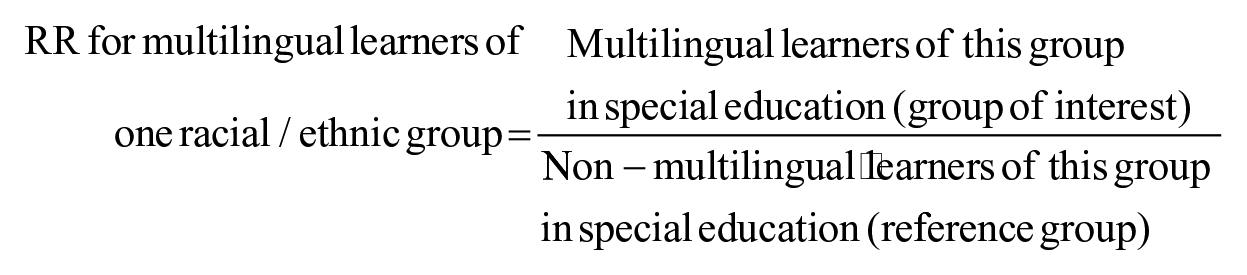
When comparing a group of interest to a reference group, only one variable changed: multilingual learner status. We compared the group of interest to the reference group; for example, Asian multilingual learners in special education (e.g., group of interest) were compared to Asian non-multilingual learners in special education (e.g., reference group). The group of interest is identical to the reference group except for the multilingual learner status, so the multilingual learner status variable is isolated. At the end of this process, we selected one school district for interviews with key stakeholders because these students were over-represented by race/ethnicity and SES in special education, particularly at the secondary level (grades 6–12).
For the qualitative strand, we used the multilevel model of intersectionality put forth by Anthias (2012) to develop interview protocols that had different levels of inquiry to better understand the boundaries and hierarchies of ESOL and special education. The interview questions aligned with the framework’s four arenas: organizational, experiential, representational, and intersubjective. Some interview questions included:
● Would you describe the community as diverse? Please elaborate.
● How do ESOL and special education staff collaborate in your context (i.e., school, district, state)?
● Are multilingual learners and students with disabilities represented in educational opportunities (e.g., advanced coursework, specialty programs)? If not, what keeps them from accessing these opportunities?
● What is your role when thinking about the eligibility process for a multilingual learner?
● How does your context communicate new policies that impact the eligibility process for a multilingual learner?
Interviews were conducted with education stakeholders at the state, district, and school levels. During the recruitment process, we contacted all school administrators, all special education teachers, and all ESOL teachers who work in one high school as well as school district and state leaders of special education and ESOL programming. At times, we were directed to people who have this area of expertise. In total, eight interviews were conducted with two special education teachers, two ESOL teachers, two district staff in ESOL and special education, and two SEA staff who support Title III and special education. However, one ESOL teacher asked to be removed from the study after being interviewed. These participants were selected because they either work directly with multilingual learners with disabilities and have knowledge of the eligibility process or support the development of programming and/or technical assistance that impacts these students. These interviews lasted between 60 and 90 minutes and were conducted in English by the first author. To ensure the accuracy and internal validity of the data, all interview participants had the opportunity to review, validate, and edit their interview transcript during the member check process (Lincoln & Guba, 1985). All but one participant responded with agreement of their transcript. One participant omitted approximately 20% of the text in their interview transcript. All other participants made no changes to their transcript.
We used MAXQDA2018 software to code interview data using inductive codes and tools from grounded theory while using our theoretical framework. Table 1 describes how we applied each arena of the multilevel model of intersectionality developed by Anthias (2012) to this study and provides some sample codes.
Application to Study and Sample Codes by Arena from the Theoretical Framework.
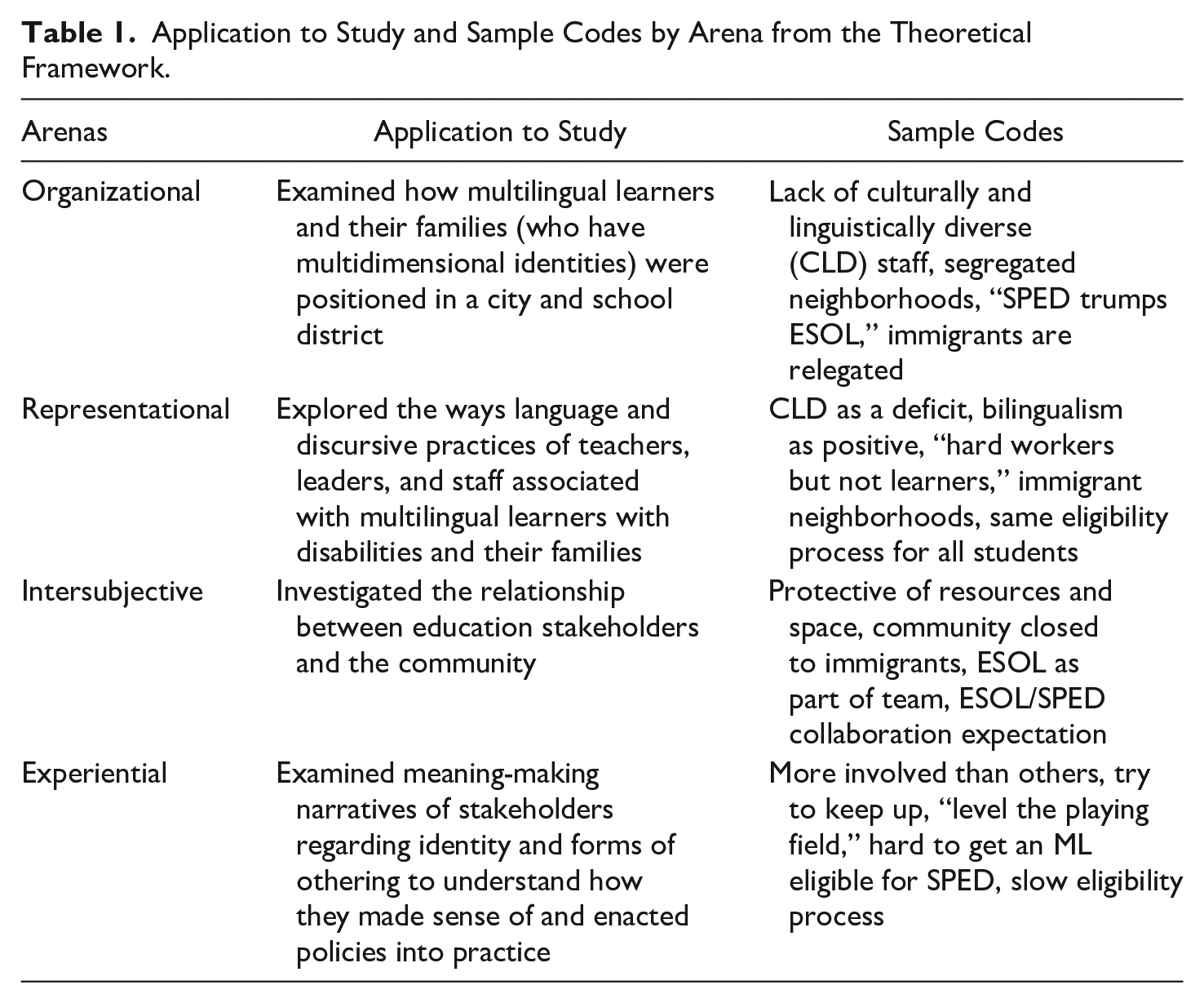
The first level of coding focused on marginalization by social categories (i.e., home language(s), disability, race/ethnicity, gender, SES). In this first stage of open coding, we separated small, meaningful chunks of data to closely examine and compare them for similarities and differences (Charmaz, 2014; Corbin & Strauss, 2014). The second cycle of coding focused mostly on power dynamics and spheres of influence of the four domains by organizing and reanalyzing previously coded data using an axial approach to determine which themes were dominant and best representative (Boeije, 2010; Charmaz, 2014). In the final stage of analysis, we triangulated responses from the education stakeholder interviews to elucidate contextual factors that may have contributed to disproportionality in the quantitative results. To ensure interrater reliability, 25% of the interview transcripts were reviewed by a second researcher to ensure the reliability of the codes; no discrepancies were found (Denzin & Lincoln, 2000). Agreement was reached by both researchers about the coding process. For this paper, we present only two main themes that answer the research questions focused on (1) how school and community contexts influenced perceptions of multilingual learners (with and without disabilities) and their families, and (2) how schools’ organizational structures shape services for multilingual learners. Given the literature and our framing, we knew that context plays an important role in how marginalized students are viewed, treated, and positioned. We were also interested in the impact of policies and practices; therefore, we focused on one area that impacts the disproportionate representation of multilingual learners in special education: collaboration.
Both authors contributed to the interpretation of the research process for this manuscript and recognize their identities shape their positionality. The first author identifies as a cis-gender Latinx woman from Peru with Indigenous heritage who as a multilingual learner experienced educational challenges that have informed her scholarship and work as a former ESOL/special educator. The second author identifies as a Black cis-gender woman who is currently not identified with a disability. Her research on equity, policy, and intersectionality is influenced by her sister’s experience in special education and work in urban and suburban schools.
Study Context
For the quantitative strand and to answer our first research question, we focused on Virginia, a state with more than 8.5 million residents that has a growing culturally and linguistically diverse population with towns and cities that are considered new destinations for immigrant families (Massey, 2008). Approximately 62% of Virginia residents are White, 19% Latinx, 12% Black, 10% of more than two races, and 6% Asian (U.S. Census Bureau, 2020). In addition, Virginia’s trends show the percentage of new immigrant populations is growing at more than twice the national rate, with percentages of Asian-born and African-born populations growing higher than national averages (Sugarman & Lee, 2017). In turn, residents who speak home language(s) other than English represent 17% of the Commonwealth. These trends extend to Virginia’s public schools, where multilingual learners represent 14% of the total PK–12 student population (Virginia Department of Education [VDOE], 2022). Based on the findings of this part of the analysis, we selected one school district out of the 132 in the state. In this school district, multilingual learners were overrepresented by race/ethnicity and SES, particularly at the secondary level (grades 6–12). This reflects what is noted in the literature (e.g., Artiles et al., 2005; Samson & Lesaux, 2009), which is why we interviewed key stakeholders at one high school in this school district.
For the qualitative strand and to answer the second and third research questions, we selected a Virginia school district that had an over-representation of multilingual learners in special education at the secondary level (grades 6–12) by race/ethnicity and SES. This school district is located in a small, new destination city that was part of rural Virginia’s countermovement history against the 1954 Brown v. Board of Education decision to racially integrate schools, known as Massive Resistance (Ryan, 2010). This school district began school desegregation in 1964, and by 1966 all of its public schools were integrated and had implemented a new system of school districting. Concurrently, this community began experiencing a new wave of immigration, refugee resettlement, and transnational migration, starting with Cuban and Vietnamese refugees in the mid-1960s. All of this means this city has a rich immigration history, with the second largest country of origin being Iraq as well as groups of Honduran, Salvadorean, Congolese, Ethiopian, Jordanian, Ukrainian, and Syrian refugees. These social processes impacted the demographic composition of the school district, which has the second-highest multilingual learner population (43%) in the Commonwealth of Virginia, with numerous home languages and over 46 countries represented.
Sampling and Data Collection
Data for the quantitative strand were of all public school students enrolled in the fall of school year 2017–18. The data were publicly available on the VDOE website as fall student membership counts at the district and school levels. The sample included 1,292,706 students in grades K–12 in public schools across Virginia’s 132 school districts. Variables of interest were multilingual learner status, disability status, grade level, race/ethnicity, gender, and SES. The data related to SES came from the state’s classification of whether students are economically disadvantaged based on eligibility for free and reduced price lunch. All values were dichotomous (e.g., yes or no, female or male) except for grade level and race/ethnicity. These state data did not contain third or other gender variables, and race and ethnicity were combined variables. This means that Latinx student data considered only ethnicity and not race.
Based on the results of the initial risk analysis, one school district and one high school within it were selected for education stakeholder interviews. This district and school are in a rural city that is smaller than most cities across the state. Virginia’s districts have significant variability in student population sizes and representation by race/ethnicity and SES. Despite this, this school district is different from most because multilingual learners represent 43% of the total student population. This district had more racial/ethnic and SES diversity than the average district in Virginia and would be considered a new destination for immigrant and refugee families. One SEA was also selected for interviews to better understand how policies were communicated and implemented. A total of eight interviews were conducted, but one participant asked to be removed from the study. Participant roles were two special education teachers, two ESOL teachers, a school psychologist, the ESOL coordinator for the district, the director of a federal program in the state, and a state agency employee who provides technical assistance and professional development in the area of special education. No school administrators responded to our request for an interview. These stakeholders were selected because they work with and/or represent multilingual learners with and without disabilities through their work in ESOL or special education at the school, district, or state level. This work could have involved providing technical assistance on eligibility for these students, overseeing programming that impacts service delivery, and/or directly working with multilingual learners with disabilities. Each participant was involved in working with or for multilingual learners with disabilities and knew the eligibility process. In the next section, we present our results through a merged analysis and initial interpretation of the quantitative and qualitative results.
Results
Overall, we found that some multilingual learner groups were disproportionately over- or under-represented in special education, particularly intersectional groups who varied by race/ethnicity, gender, and SES. Below we describe the quantitative results from the risk analysis, then we provide qualitative findings from the education stakeholder interviews but only present two main themes. These findings elucidate why disparities occurred in this context and shed light on factors that contribute to this type of disproportionality in other communities across Virginia.
Beyond Universality: How Intersectional Approaches Expose Identification Disparities
Initially, we examined to what extent multilingual learners were overrepresented or underrepresented in special education in Virginia using RR. The risk analysis showed multilingual learners as a whole and on average were not disproportionately represented in special education (RR = 1.09, 95% CI [1.08, 1.11]), as seen in Table 2 below. This means that multilingual learners were not at a higher or lower risk for identification for special education than non-multilingual learners. This value fell within the acceptable threshold of RRs between 0.80 and 1.2 (Kozleski, 2005; Sullivan, 2011). It is important to note that Virginia is a state with significant diversity in terms of race/ethnicity, SES, and other social categories, as noted earlier. Given this prior knowledge, we examined RR by school level (i.e., elementary, secondary) and social categories to support and further an intersectional agenda.
Risk Ratios of Multilingual Learner Representation in Special Education, Compared to Non-multilingual Learners.
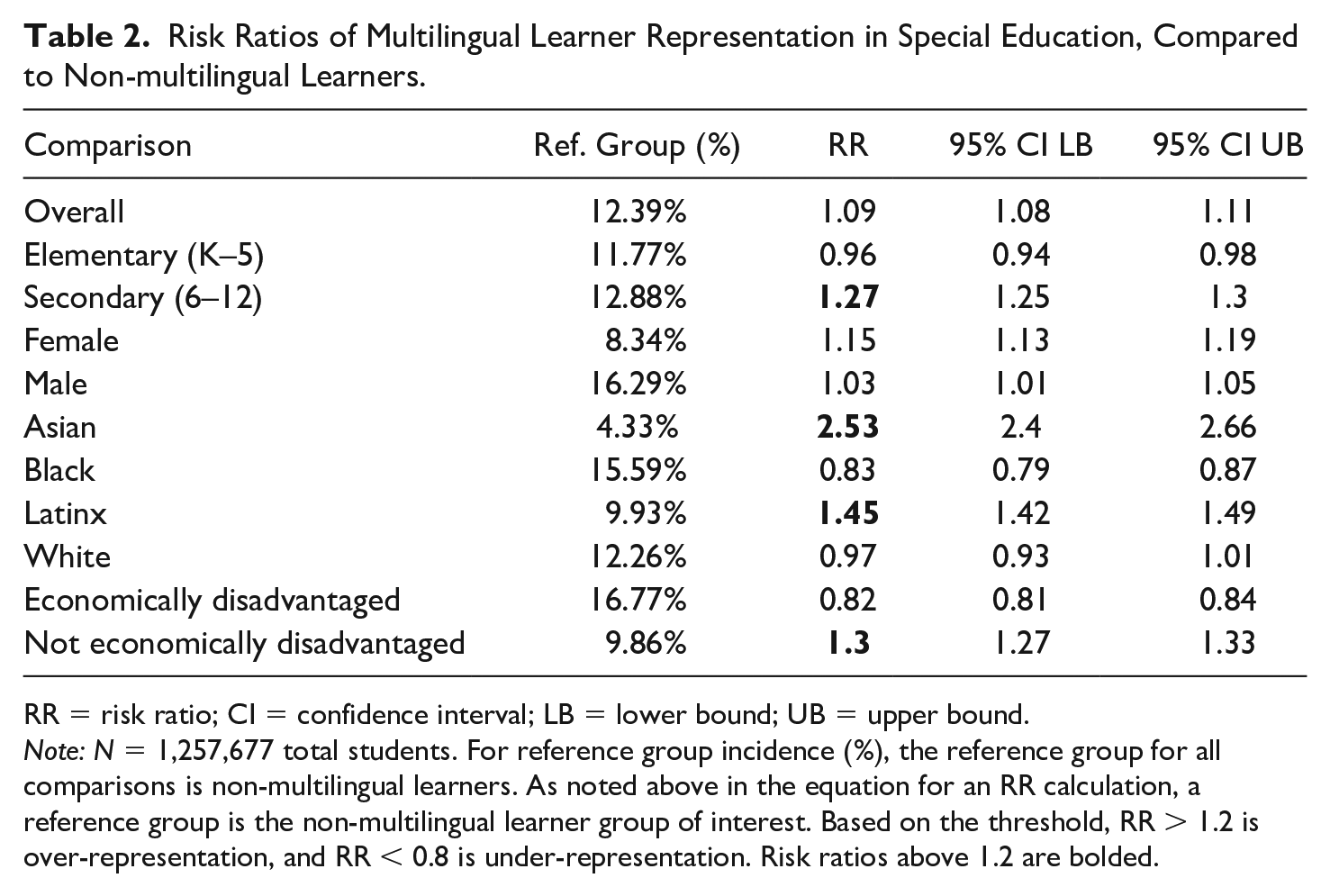
RR = risk ratio; CI = confidence interval; LB = lower bound; UB = upper bound.
Note: N = 1,257,677 total students. For reference group incidence (%), the reference group for all comparisons is non-multilingual learners. As noted above in the equation for an RR calculation, a reference group is the non-multilingual learner group of interest. Based on the threshold, RR > 1.2 is over-representation, and RR < 0.8 is under-representation. Risk ratios above 1.2 are bolded.
When we examined the relative risk at the elementary and secondary levels, the analysis produced varying results. At the elementary level (grades K–5), multilingual learners were not over-represented or under-represented in special education, which means disproportionality was not found. On the contrary, evidence suggested at the secondary level (grades 6–12), multilingual learners had a 7% higher risk for identification than their non-multilingual learners (RR = 1.27, 95% CI [1.25, 1.30]), based on the acceptable range established earlier. Although these results are valuable, in the next section we delve deeper into the multidimensionality of these students by examining how race/ethnicity, gender, and SES can contribute to inequitable student outcomes.
Recognizing the complexity and difference within the category of multilingual learners, we included a risk analysis of special education identification by race/ethnicity, gender, and SES. As seen in Table 2, our risk analysis by race/ethnicity suggested multilingual learners who are Asian and Latinx were overrepresented in special education when compared to non-multilingual learners of the same racial/ethnic group. Specifically, the results showed that Asian multilingual learners had a 133% higher risk for identification compared to Asian non-multilingual learners (RR = 2.53, 95% CI [2.40, 2.66]). Latinx multilingual learners had a 25% higher risk for identification compared to Latinx non-multilingual learners (RR = 1.45, 95% CI [1.42, 1.49]). Our analysis did not show that Black or White multilingual learners were disproportionately represented in special education when compared to non-multilingual learners of the same race. Similarly, our quantitative results did not show gender disparities in the identification of multilingual learners with disabilities. On the other hand, the risk of identification in special education for multilingual learners who were not economically disadvantaged was 10% higher than for non-multilingual learners of the same SES level (RR = 1.3, 95% CI [1.27, 1.33]). As noted earlier, acceptable RRs are values between 0.80 and 1.20 (Kozleski, 2005; Sullivan, 2011). See note four at the end of this article for a description of how to use the RR to calculate the percentage of risk.
Given this nuanced view of within category differences, we extended our intersectional risk analysis by examining the relative risk of 12 groups of multilingual learners who varied by race/ethnicity, gender, and SES, as seen in Table 3.
Risk Ratios of Multilingual Learner Representation in Special Education, Compared to Non-multilingual Learners in Intersectional Categories.
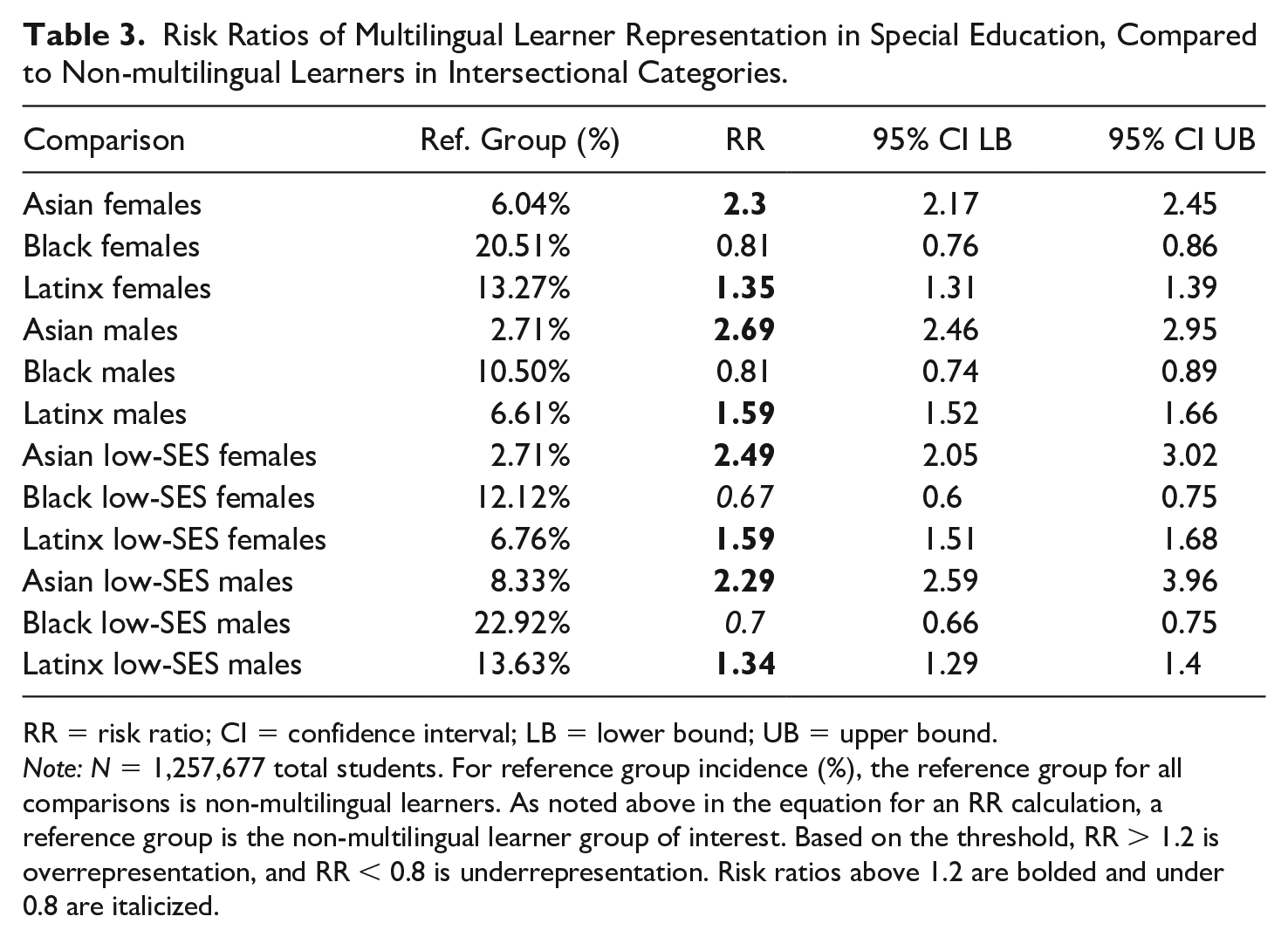
RR = risk ratio; CI = confidence interval; LB = lower bound; UB = upper bound.
Note: N = 1,257,677 total students. For reference group incidence (%), the reference group for all comparisons is non-multilingual learners. As noted above in the equation for an RR calculation, a reference group is the non-multilingual learner group of interest. Based on the threshold, RR > 1.2 is overrepresentation, and RR < 0.8 is underrepresentation. Risk ratios above 1.2 are bolded and under 0.8 are italicized.
The results revealed that Asian male multilingual learners had the highest risk, with a 149% higher risk of representation than Asian male non-multilingual learners (RR = 2.69, 95% CI [2.46, 2.95]). This RR slightly decreased to 109% when adding low SES as a variable (RR = 2.29, 95% CI [2.59, 3.96]). It is important to note that the latter RR falls outside its confidence intervals. Therefore, it should be interpreted with caution. Similarly, Asian female multilingual learners had a 110% higher risk than their non-multilingual learner counterparts (RR = 2.3, 95% CI [2.17, 2.45]); this increased to 129% when low SES was added to the analysis (RR = 2.49, 95% CI [2.05, 3.02]). To a lesser extent, Latinx male multilingual learners had a 39% higher risk of representation than Latinx males who were not multilingual learners (RR = 1.59, 95% CI [1.52, 1.66]); this decreased to 14% when adding low SES as a factor (RR = 1.34, 95% CI [1.29, 1.4]). Conversely, the risk increased for Latinx female multilingual learners from 15% (RR = 1.35, 95% CI [1.31, 1.39]) to 39% when low SES was added (RR = 1.59, 95% CI [1.51, 1.68]). These results reveal important questions regarding how and why race/ethnicity, gender, and SES intersect to shape disproportionality among multilingual learners with disabilities. To answer these questions, in the section that follows we explore how one school district’s practices failed to consider how their local context and organizational practices shaped language acquisition and special education services to ensure students’ intersectional needs were served.
Paradoxes and Inequities in Responding to Multilingual Learners With and Without Disabilities and Their Families in Community and School Context
Using Anthias’s (2012) intersectional framing, interview responses exposed hierarchies and power differentials that impacted multilingual learners with disabilities and their families. These conversations with education stakeholders, who hold positions within ESOL and special education programs and departments, revealed how multilingual learners with and without disabilities and their families were positioned differently within this education system and community. Participants discussed the gaps between the growing diversity and representation among leaders in the community. The ESOL coordinator noted this by describing the ways the city and its public schools experienced a growing refugee and new immigrant population over the last 20 years and shared “it’s been quite a swing for us.” She went on to describe the community as “really open and supportive” of the demographic changes, but also elaborated on tensions regarding resource allocation. She said, “It's a lot of well-intended people with a charitable mind . . . who say they want the best for every kid and sometimes, I think, are troubled by the fact that they want the best for all kids provided it doesn’t take away from their own.” Similarly, an ESOL teacher of newcomers, students who are new to the United States, who grew up in this community, provided a picture by emphasizing how new immigrants were treated in the community. Even though he described the city as “very welcoming,” he noted:
I still feel that there’s some marginalization of the immigrant population. . . . they’re still mostly relegated to working in. . .factories and don’t have as many opportunities. I would like to see them . . . become more established and accepted as leaders.
Both this ESOL teacher and the program coordinator shared frustrations about the lack of multilingual representation in positions of authority and fewer opportunities for new immigrant populations in the community and school.
Both described these contradictions and inequities within the school system, but the ESOL teacher also provided examples of this within the community. “I think there are definitely people, like in the larger community, that come to town and don’t understand the real issues that immigrants face, and why they’re here.” He went on to say, “. . . when I go get my haircut, for example, I can hear things that show that people aren’t maybe as open or understanding of our migrant population.” Similarly, the ESOL coordinator indicated the lack of change despite good intentions by saying:
We struggle with a change in demographics over the last 25 years, struggling to understand how best schools should run with the changing nature of our school population, struggling a little bit when we look in the mirror and see that our leadership, including our teachers, don’t look like our students.
These teachers’ perceptions demonstrated the contradictions in responses to immigrant families and their children. On the one hand, there was a desire to be supportive and open, yet leadership and teachers within schools, mostly from dominant communities—White and monolingual English speaking—reified deficit perspectives.
Indeed, we found that participants grappled with a persistent lack of opportunities for multilingual families because it contradicted how the community and its schools were described and revered. This paradox of fewer employment and leadership opportunities in a “diverse” community with more than half a century of refugee resettlement infrastructure shaped new immigrant families’ sense of efficacy and advocacy for their students. These struggles demonstrated the organizational sphere of Anthias’s intersectional framework (2012) given anti-im/migrant policies within the community that translated into inequitable schooling practices for multilingual learners with disabilities and their families.
Positioning multilingual learners and their families as inferior when compared to English-dominant students and their families was also noted when discussing perceived intelligence. When asked what keeps multilingual learners from accessing educational opportunities, such as advanced coursework and specialty programs, the director of a federal program in the state office said:
I think some of it, though, is a staff issue and staff understanding that needing language instruction or language support is completely separate in many cases from a student’s ability or potential to achieve at high levels and to understand very rigorous content. So, I think that a piece of it is if a staff member, a teacher doesn’t understand a student’s native language, and the student doesn’t understand the teacher’s language . . . doesn’t understand English, then I think sometimes the teachers still don’t see that student as having high intelligence. So, I think that that is still there and that is still something very much to overcome.
In this example, the state leader grappled with how educators’ deficit views shaped perceptions of ability, while some teachers appeared to believe in a culture of poverty rather than recognize the role of structural and contextual factors in shaping students’ and families’ opportunities. The ESOL teacher who worked with newcomers shared this deficit perspective by saying:
I know we’re Title I. We have a lot of [multilingual learners on] free and reduced lunch, where they’re not wealthy. They’re children of very hardworking parents, and they’re very hardworking students, also. [They] don’t always know how to translate hard work into learning, but they’re very hardworking.
This teacher reified the stereotype that multilingual learners and their families, who are often poor given structural inequities, are academically unmotivated and do not care about their education or that of their children. Similarly, a special education teacher who worked with students with severe disabilities also engaged in deficit perspectives about multilingual and immigrant families:
I’m taking a class on poverty and education. . . . I wonder about socioeconomic status and I know that because that’s what I’ve been studying, so I don’t know if the same opportunities have been afforded to [multilingual] students and their families. . . . I'm reading about diet, nutrition, and stress and the way stories are told and language and vocabulary are acquired at an early age. How did those things impact learning later on in life and in the school? And so the gap between their learning can have a cultural background behind it.
Indeed, there has been a resurgence in the “culture of poverty” explaining inequalities rather than recognizing how organizations, policies, and practices structure inequality (McDermott & Vossoughi, 2020). The ESOL teacher went on to describe the culture of poverty students faced and shared, “I experience a lot of poverty in my classroom. I experience personally, I would say 80% of my students are a minority of some sort. . .predominately Hispanic . . .”. When asked what type of classes she taught, she said, “I would call myself a self-contained class.” Interestingly, this teacher also noted, “yes, there’s probably bias” during the identification process and shared a story of how she “wasn’t given instruction. . .on how to administer the Woodcock-Johnson in Spanish.” Instead, she “was just handed it and told to do it.” This special education teacher was not the only participant who grappled with these contradictions. When asked if implicit bias impacted access to educational opportunities for multilingual learners, the ESOL teacher who worked with newcomers said:
I’m sure they have to be. Yeah. I’m sure it has to be, but I don’t really, I don’t know, it doesn’t really feel like, I don’t know what bias is. Yeah. I guess systematic racism is something I’m trying to understand, and how that relates to like personal choices of how that relates to like decisions that are made in a classroom or even at an administrative level of the school, and whether that is systematic racism or not. I don’t always feel like it is, but I know that these things exist, and I know that there are biases. Everyone has biases.
The culture of poverty myth can constrain opportunities for multilingual learners by reifying the idea that poor people, who are often new immigrants and people of color, are unmotivated and do not care about their education or that of their children. Aligned with the representational sphere of intersectionality given the perpetuation of deficit assumptions, these fallacies positioned multilingual learners with disabilities as inferior by encouraging teachers and other education stakeholders to believe tropes that poor students and their families shared a way of thinking and behaving that was unexceptional and lazy. These deficit perspectives contributed to lowering expectations and ignoring systemic inequities, such as inequitable access to well-trained teachers, that perpetuate the cycle of poverty and can contribute to inequities, including disproportionality of multilingual learners in special education.
Intersectional Erasures and Fissures between ESOL and Special Education
Interview responses also revealed a lack of collaboration between ESOL and special education, at times within and other times between the state agency, the school district’s central office, and the high school. Even though the director of a federal program within the state indicated her office was “very collaborative with multiple offices within the agency,” participants outside of the agency were unaware of the existence of republished state guidance that informs eligibility for multilingual learners. Although leaders at the state level were aware of important federal policies related to guidance in meeting the needs of multilingual learners with disabilities, we did not find this was the case as policies moved to district and school levels. This was further demonstrated when a state agency employee who provided technical assistance and professional development in the area of special education said both special education and Title III (ESOL services) “maintains what I would consider a strong collaborative relationship with folks at the local level. . . . [We offer] different statewide meetings throughout the year, opportunities for folks at the local level to come and hear the latest guidance, the latest information.” However, district and school participants either stated they did not know this guidance existed or confused it with other guidance (e.g., DOE toolkit). These examples demonstrate the intersubjective dynamics given the ways different groups (e.g., ESOL and special education teachers) related to one another and the challenges that emerged in coordinating efforts across language and disability services.
In addition, participants at the district and school levels alluded to a recurring theme that collaboration of “SPED always trumps ESOL,” as stated by the ESOL coordinator. She indicated ESOL and special education were not viewed and treated “as being equally important in the growth of a student” given how “ESOL and SPED are positioned differently within the system.” One clear example of this was provided when she described how multilingual learners are pulled out of ESOL without consultation:
I’ll get messages that’ll say, “Oh, sorry. . .the [special education] director says this kid . . . needs to have more SPED services. So, we’ve taken him out of your EL [English learner] support program,” and it’s like a done deal. . . . We got to work on that.
The sentiment that special education takes precedence over language contributed to the organizational failure of policies and practices to account for students’ intersecting needs. Moreover, these examples point to both the intersubjective and experiential spheres of intersectionality given the ways ESOL teachers internalized notions that special education “always trumped” ESOL services.
Notably, making a decision regarding identification for special education without consulting a language acquisition expert (i.e., ESOL teacher) and potentially not considering the student’s language development needs were violations of federal guidance. Collaboration between ESOL and special education should happen before referral, during eligibility, and after identification for services to ensure appropriate services and support that include language acquisition considerations. For instance, the ESOL teacher who worked with newcomers recalled his “most memorable student,” a Congolese student who demonstrated learning difficulties at school and home, and how eligibility was “a long process” and “somewhat incredulous.” When asked if this student continued receiving ESOL services after being found eligible for special education services and if they will return to the newcomer program, he said:
Yeah, so he’ll probably get back to ESOL classes at some point. Yeah. I don’t know how that’ll work. He’ll have to get some. . . . I don’t know how the SPED program works exactly, but I think. . .they’re required to be in some form of general education and not just self-contained all day. I don’t know what all the requirements for that really are.
This ESOL teacher demonstrated a clear lack of understanding of how to meet both the language development and learning needs of this student. This is particularly concerning because this ESOL teacher who worked with newcomers should have been collaborating with special education staff to best serve this student. Eligibility for special education services does not warrant removal from language programming (i.e., ESOL services). This removal violated a multilingual learner’s civil rights and placed their school and district in legal jeopardy. When a multilingual learner does not receive the language acquisition services they need and are legally entitled to, they are more likely to face challenges that lead to lower social and academic outcomes. Moreover, most multilingual learners need explicit or sheltered language instruction to access and learn academic content and skills. Therefore, teaching multilingual learners with disabilities requires consistent collaboration between ESOL and special education to ensure specially designed instruction includes language development.
In addition, the dynamics between departments within the high school were not conducive to collaboration, unlike dynamics at the elementary and middle schools. The ESOL coordinator and a school psychologist noted how collaboration mostly occurred in elementary schools but varied by grade level, often due to class scheduling, varying team-teaching approaches, and resources (i.e., time, professional development). The school psychologist said:
That’s going to probably depend on the level and the age of the students. . .in the middle school model they work in teams. So, if a student is on a certain team they will have the same three teachers, so they have collaborative planning that they do weekly where the special education teacher and any other service providers would collaborate during that team meeting time. . . . The same goes for the elementary level. . .they stack their planning time to be able to meet with certain grade levels at a certain time. . . . At the elementary level you’re probably going to see a lot more of the ESOL teachers and special education teachers within the classroom, so they do a lot of team planning with the teachers.
Collaboration between ESOL and special education at the elementary level was described as stronger than collaboration at the secondary level. For example, special education teachers at the high school indicated a lack of collaboration between ESOL and special education programs and staff and discussed ways special education teachers often had to assume full responsibility for multilingual learners who were found eligible. A lack of collaboration at the high school level can impact the development of various skills and absorption of content knowledge for better social and academic outcomes (i.e., gainful employment, college readiness, life skills). To this point, a teacher for the deaf and hard of hearing said, “It mainly, honestly, falls on the special ed teacher. . . . If they’re eligible for special education and they’ve already received accommodations for ELL [English language learners], that gets wrapped into the IEP [individualized education program].” This belief was shared by the special education teacher who worked with students with severe disabilities. She described often feeling “a little bit more isolated” and only consulting with special education colleagues during breaks, despite having several multilingual learners with disabilities on her caseload and in her classes. Given the greater emphasis on special education, these teachers described being overburdened but also neglectful of their students’ language acquisition needs. This imbalance positioned ESOL teachers and programming lower than special education teachers and services, when they should be collaborating to identify multilingual learners and serve those who have disabilities.
Conversations with education stakeholders also revealed how they interpreted and implemented eligibility policies and practices specific to collaboration. Federal and state guidance mandates ESOL and special education collaboration during referral and eligibility processes as well as after identification to best serve multilingual learners with disabilities. However, both school and district personnel noted a lack of organized collaboration and a step-by-step process to support collaboration. The ESOL coordinator noted, “We have not systematically created a way for our SPED teachers and our ESOL teachers to come together. I’m going to say that for most of my experience here, up through the last maybe three years, ESOL largely seated services to SPED teachers.” Similarly, the special education teacher who worked with students with severe disabilities said: “I think if it [collaboration] happens at all, it’s when a case manager goes and approaches the general ed teacher or the ESOL teacher or vice versa. There’s no organized collaboration.” Both school and district personnel described how the lack of a systematic process and school support for collaboration impacted how ESOL and special education were positioned and the role these practitioners assumed.
For example, based on federal and state guidance, ESOL teacher participation is required during special education meetings starting with the referral process and even after identification for special education services. However, when asked if ESOL teachers are invited to special education meetings, a state agency employee who provides technical assistance and professional development in the area of special education said:
They are supposed to be. Again, I have no hard data to say whether or not that happens, but in our guidance and best practices, we do communicate that that is an expectation, because they [ESOL teachers] have some unique information about language learning that can help the [acronym removed] team construct appropriate goals, address questions, and figure out what kinds of accommodations and support would be required.
Notably, both special education and ESOL teachers and district administrators specified that ESOL teachers are typically only invited to participate in the initial referral meeting—if they are the referring teacher who worked with a newcomer. Thus, education stakeholders faced a paradox in that, even though they had a professional obligation to collaborate and receive consultation from an ESOL teacher during the referral and eligibility processes as well as after the student was found eligible, they often did not. Leaving ESOL teachers out of these important conversations is concerning due to research that shows how excluding practitioners’ knowledge of language acquisition and the student’s needs often contributes to greater inequities and disparities. Thus, the question of how ESOL and special education teachers interpret collaboration practices and policies can be increasingly challenging and layered if practitioners lack knowledge of key information about services and programming that impacts multilingual learners with disabilities.
Discussion
This study demonstrates the benefits of engaging in mixed-methods research from an intersectional perspective to understand RR for identification and the practices and policies that impact disability eligibility for multilingual learners. By developing quantitative and qualitative research questions, we uncovered to what extent disproportionality—both under-representation and over-representation—shaped eligibility practices of multilingual learners with disabilities and how and why this dynamic emerged in one Virginia school district’s high school. Drawing on an intersectional mixed-methods design revealed important information about generalizable results related to multilingual learners with disabilities in Virginia.
Results from the quantitative strand of this study contradict and at times reaffirm what is known from existing yet limited research about grade level, race/ethnicity, gender, and SES. For example, our results at the grade level contrast with previous evidence that multilingual learners in elementary grades are over-represented across disability categories (e.g., Samson & Lesaux, 2009). Although we did not find over-representation or under-representation in elementary grades K–5, our results revealed multilingual learners were over-represented in secondary grades 6–12, aligning with research demonstrating over-representation in the secondary grades (e.g., Artiles et al., 2002). These results suggest there may be uncertainty about how to support older multilingual learners who require English language instruction to access academic content and pass state-mandated assessments for verified credits toward graduation from high school. This doubt only intensifies if there is a lack of collaboration between ESOL and special education as found in qualitative results and may shed light on why there is a slight over-representation of secondary-level (grades 6–12) multilingual learners in special education. Virginia requires multilingual learners who are newcomers to pass assessments on various subjects, such as biology, world history, and government, and in English after attending school for one year. A disability designation often affords older students more opportunities to graduate with a diploma. However, some diploma options are equivalent to a certificate of attendance and are not accepted by community colleges to continue an advanced education.
In terms of race/ethnicity, our results showed significant levels of overidentification for Asian multilingual learners—more than any other racial group—and less so for Latinx multilingual learners. These results align with research demonstrating an over-representation of Latinx multilingual learners in special education (e.g., Sullivan, 2011) but counter research demonstrating an under-representation of Asian students in special education (e.g., Cooc, 2018; Kulkarni, 2017). In addition, it is important to note the need for ethnocultural data (or intracategorical considerations) to better understand the variance in outcomes and experiences of Asian students from different countries. The same can be said for Latinx students because there is significant racial diversity that is not accounted for within this ethnic group, despite the lack of acceptance and recognition of ethnocultures that have deep-rooted Indigenous and African traditions. Our work demonstrates the importance of engaging in a multidimensional understanding of students’ ethnocultures to inform educator practices and reveal potential group differences and patterns related to both under-representation and over-representation.
As for gender, our results revealed no disparities for female and male multilingual learners in Virginia but over-representation when adding race/ethnicity and SES. Even though, generally speaking, without considering multilingual learner status, there is evidence of females being under-represented and males being over-represented in special education (Arms et al., 2008; Coutinho & Oswald, 2005), the case for gender disparities in special education has received minimal academic attention– and even less for multilingual learners. The same can be said for SES. Our results of higher risk of identification for multilingual learners who were not economically disadvantaged disrupt dominant narratives that poverty is the primary driver of disproportionality. The results also contradict extant research that indicates students who are not economically disadvantaged tend to be under-represented in special education (Kincaid & Sullivan, 2017). This appears to align with qualitative findings that show participants focused on the culture of poverty as a contributing factor instead of systemic inequities and organizational failures. Furthermore, these results point to what Anthias (2012) discusses as the first level of abstraction: “conceptions about different realms in the world or ways the world is organized” (p. 6) based on different social categories. Equipped with this information, educators can more mindfully consider the educational needs of students rather than rely on preconceived notions of who is and is not in danger of being over-represented or under-represented in special education.
The qualitative results from this study provide critical insights into disproportionality among multilingual learners and the role of institutional and organizational practices that contribute to disproportionality in schools. We found that despite a desire to welcome the growing number of Latinx families and migrant workers in the community, educators and leaders carried notable deficits of the changing demographic broadly and multilingual learners with disabilities specifically. In this sense, an intersubjective lens enabled an understanding of how school and community practices contributed to the otherness of new immigrant communities and multilingual learners with disabilities (Anthias, 2012). For example, we found it was often the case that multilingual learners with disabilities were not considered for important academic opportunities (i.e., advanced courses, Seal of Biliteracy, dual enrollment) and were often described as lacking ability simply due to English not being their dominant language. Our results related to the role of deficit perspectives in shaping responses to and understandings of disproportionality correspond with several studies (e.g., Cuba, 2020; Harry & Klingner, 2022; Tefera et al., 2023). In part, a lack of racial and linguistic diversity among educators and leaders likely shaped understandings about multilingual learners with disabilities and their abilities. It is important to recognize that a lack of multilingual representation in the school and district personnel may have shaped resource allocation for multilingual learners. Indeed, all of these pieces are connected. If fewer multilingual communities are represented in leadership positions and have fewer employment opportunities in schools where they feel empowered to advocate for students, fewer resources and less funding will likely be available for programming that supports multilingualism.
We also found higher levels of collaboration at the elementary level compared to the secondary level, given the team planning approach and support for planning from school administrators. This may provide important insights about how such collaboration can be extended to secondary grades, where there appears to be a slight over-representation of multilingual learners in grades 6–12. At the same time, research documents challenges with the eligibility process that may vary by elementary level and secondary level. At the elementary level, particularly before third grade, students are learning to decode text as part of reading development and are acclimating to school. This presents additional challenges for teachers who are often undertrained to support multilingual learners and recognize the difference between language acquisition versus a learning disability:
This language-or-disability filter . . . inordinately focuses on language and disability alone while ignoring the systemic contributors to the academic difficulties ELs [English learners] with disabilities encounter. By attributing disability or language as the sole source of a wide range of “problems,” the filter reinforces a deficit mindset rooted in ableism and monolingualism. (Kangas, 2021, p. 673)
Our results also showed district leaders emphasized how opportunities to collaborate varied by grade level, often due to class scheduling and varying team-teaching approaches. More resources, such as time for co-planning, professional development opportunities on racial and linguistic biases as well as ollaboration, and an evaluation of policy implementation for inclusive dual service provision as noted by Kangas and Cook (2023) would benefit school personnel. Furthermore, we found the school district and schools’ practices marginalized multilingual learners with disabilities by “failing to account for their intersecting needs namely through implementing policies and practices that subsume individuals’ intersectional needs into one minoritized status or another” (Kangas, 2021, p. 678). Given the ways students’ intersectional needs were left unaddressed and regarded as inferior, we found monolingualism and ableism were embedded in the practices and policies of schools.
Limitations
The current study presented limitations beyond what is inherent in both quantitative and qualitative methods. Only using district- and school-level data to analyze the relative risk provides a limited perspective. An analysis with student-level data to examine individual factors with disaggregated counts would provide a clearer picture. Additionally, student counts under 10 for multilingual learners, economically disadvantaged, and special education were suppressed in the data (VDOE, 2022). For this reason, the data were aggregated into two grade-level groups: elementary (grades K–5) and secondary (grades 6–12) because the sample size by grade level would have been too small to run tests for some nuanced student groups. In addition, this data does not account for the race of Latinx students.
For the education stakeholder interviews, a purposive sample was selected that included different perspectives, and several attempts were made to recruit more participants, including those in different roles. Despite this, there were challenges with recruiting a more robust sample of participants that included school leadership (i.e., principals, assistant principals). These groups were not represented despite their importance in making programming decisions. All school administrators were recruited for interviews but none responded. There were also limitations in recruiting more teachers in special education and ESOL. For example, one participant, an ESOL teacher, completed the interview and the next day opted out of participating in this study. It is important to note that we did not recruit general education teachers outside of ESOL because these teachers often lack essential knowledge of special education laws and processes (O’Connor et al., 2016). For this reason, the representativeness of the sample may be another limitation. Another limitation is that information about participant identities was not collected during the interview process.
Implications
Addressing the challenges our results illuminate requires intersectional research, practices, and policies. At the most basic level, federal and state data collection methods must include intersections with language differences when reporting outcomes related to disproportionality (i.e., identification, placement, discipline). Furthermore, drawing on intersectional perspectives offered the opportunity to understand how schools are organized and structured in ways that either do or do not support students’ intersecting identities and educational needs, including multilingual learners with disabilities. Our study also provides insight into the need for more complex and nuanced calculations (i.e., RR) to measure and monitor disproportionality for students who have multidimensional identities and provides better insight into appropriate thresholds and reference categories when discussing these students. Perhaps most importantly, the mixed-methods approach of this study revealed the promise of examining students’ intersecting social categories to understand disproportionality more deeply at multiple levels—for example, organizationally and experientially. This is particularly important given the contextually situated and informed ways state and federal identification policies for multilingual learners with disabilities should be enacted in practice. Using these intersecting approaches also informed instructional practices—for example, the need for educators to ask themselves if their instruction is relevant and appropriate for their students’ backgrounds, identities, and needs. Considering such questions and engaging in practices that tend to students’ intersectional lives may help educators move away from deficit-oriented perspectives that can lead to misidentification. To support the implementation of these practices, school districts should offer professional development on federal and state guidance, collaboration models, and racial and linguistic biases, and develop and monitor local policies with education stakeholders.
Conclusion
Overall, this mixed-methods study shows that (1) using intersectional framing in a risk analysis of multilingual learner disproportionality reveals disparities that a one-dimensional approach obscures; (2) representation in special education is associated with a multilingual learner’s social categories (i.e., race/ethnicity, gender, SES); and (3) contextual factors impact how multilingual learner eligibility policies and practices are communicated and implemented within schools. The fact that multilingual learner identification with a disability is correlated with social categories suggests that how we address learning challenges may reflect social problems rather than issues related to learning. Given this, multilingual learner disproportionality in special education is a complex issue, particularly as we face a sociopolitical context that positions students of color who are immigrants and their families lower in school and community hierarchies. They are impacted by not only the school’s political context but also the broader social landscape of power and hierarchy. To address these issues, we must challenge perceptions of ability by providing greater opportunities and professional development on evidence-based practices that capitalize on linguistic abilities and challenge discrimination.
Footnotes
Declaration of Conflicting Interests
The author(s) declared no potential conflicts of interest with respect to the research, authorship, and/or publication of this article.
Funding
The author(s) received no financial support for the research, authorship, and/or publication of this article.
Ethical Approval
This study received approval number HM20015992 from Virginia Commonwealth University’s Institutional Review Board.