




Abstract
The importance of educator diversity is becoming increasingly evident as research demonstrates the positive impact of Teachers of Color and Indigenous Teachers (TOCIT) on student learning and achievement, particularly among underrepresented groups (Dee, 2004; Gershenson et al., 2018; Grissom & Redding, 2016; Shirrell et al., 2021). Despite this, progress toward diversifying the educator workforce remains slow, signaling the need to advance educator diversity through a radical reimagining of teacher development systems. The use of research–practice partnership (RPP), a research approach that facilitates collaboration between practitioners and researchers, may be a promising model for addressing this perennial challenge.
Keywords
The importance of educator diversity is becoming increasingly evident as research demonstrates the positive impact of Teachers of Color and Indigenous Teachers (TOCIT) on student learning and achievement, particularly among underrepresented groups (Dee, 2004; Gershenson et al., 2018; Grissom & Redding, 2016; Shirrell et al., 2021). Despite this, progress toward diversifying the educator workforce remains slow, signaling the need to advance educator diversity through radically reimagining (i.e., envisioning novel and unconventional approaches to address persistent inequities; Kelley, 2002) teacher development systems. A community of over 75 researchers began consolidating research to catalyze progress and published the Handbook of Research on Teachers of Color and Indigenous Teachers (Gist & Bristol, 2022), outlining research and policy directives related to recruiting, preparing, supporting, and retaining TOCIT in K–12 schools. One recommendation of the Handbook is to use research–practice partnerships (RPPs) to address local problems of practice related to ethnoracial educator diversity.
The National Center for Research on Educator Diversity’s (NCRED) mission is to advance educator diversity (NCRED, 2023). Carrying the recommendation on RPPs from the Handbook one step forward, NCRED launched the Educator Diversity RPP Lab in 2023, composed of RPPs from across the nation committed to radically reimagining teacher development systems. At NCRED, we believe RPPs hold promise for uniquely addressing educator diversity and, networked together, can serve as fertile ground for applying and generating research through genuine collaboration among practitioners, researchers, and local communities. The partnerships in the Educator Diversity RPP Lab are working together to authentically center equity in RPPs by starting to radically reimagine domains of teacher development systems, such as mentorship. RPP Lab members have a vision of mentorship as a safe, community-oriented system of mutual investment among TOCIT that supports practitioners at various stages of their career to navigate power dynamics, and sustain their wellness and longevity in the teaching profession. With RPPs in the Lab working toward testing their designs—like structures that foster mutual investment among TOCIT—in their local contexts, we will build on the extant research literature about RPPs in general and expand the limited research literature on RPPs dedicated to educator diversity.
RPPs for System Transformation
RPPs hold promise for system transformation in education. They have historically been defined as long-term collaborations between researchers and practitioners addressing persistent problems of practice (Henrick et al., 2017). The core tenets of RPPs involve establishing routines for working together, norms for decision making, and respect for diverse perspectives, and considering the varied roles and demands of team members (William T. Grant Foundation, 2023). More recently, Farrell et al. (2021) offer a definition for RPPs that fosters educational equity in partnerships, describing them as: A long-term collaboration aimed at educational improvement or equitable transformation through engagement with research. RPPs are intentionally organized to connect diverse forms of expertise and shift power relations in the research endeavor to ensure that all partners have a say in the joint work. (p. iv)
This focus on equity is key, as Diamond (2021) notes that many RPPs opt for a mainstream framework devoid of critical perspectives, arguing “. . .that these truncated theoretical foundations need to be reexamined if RPPs seek to live up to their transformative aspirations” (p. 3). Ishimaru et al. (2022) provide a way of moving toward transformative realities by suggesting three shifts related to RPPs’ use in education: (1) center justice in multidimensional systems change; (2) develop equity-centered data systems; and (3) enlist the expertise of racially minoritized youth, families, and communities. RPPs must be positioned as a mechanism for equitable transformation in order to engineer systems change. For example, by grounding them in participatory research (Bang & Vossoughi, 2016) and solidarity co-design (Ishimaru et al., 2019), RPPs enable solutions to be generated from, with, and for the community. This approach helps decolonize research (Patel, 2015) by exploring how community members organize, develop theories of change, and implement nontraditional approaches to advance educator diversity.
Though the potential benefits of RPPs are straightforward (i.e., coordination of education researchers, practitioners, and community stakeholders toward a central focus and public good, and enhanced relevance of research in policy and practice; Welsh, 2021), they are not without challenges. Aligning the interests and investments of multiple stakeholders requires skill, and the process necessitates significant time and effort (Booker, 2023). RPPs do not offer quick fixes; forming and sustaining RPPs that center community engagement and adopt an intersectional stance develops over time through constant refinement (Ishimaru et al., 2022). Despite these challenges, the long-term impact of RPPs resides in their potential for fostering a regenerative and liberatory culture among researchers, educators, and community members. By engaging in generative conflict and co-design, RPPs can develop more effective interventions that incorporate relational knowledge from community members, K–12 students, and teachers, ultimately yielding greater results (Anderson, 2023).
RPPs Suited to Address Educator Diversity
Although RPPs show promise, current research on RPPs focused specifically on advancing educator diversity is limited. NCRED aims to close the gap in both research and practice by focusing on the study of educator diversity RPP practices across the RPP Lab. One intended output will be new knowledge about how to develop effective collaborations among a network of educators, thought leaders, researchers, and community leaders focused on advancing educator diversity. The Lab builds on a strong foundation of research about RPPs, seeking to understand challenges related specifically to educator diversity such as:
What conditions enable researchers, educators, and community members to join together in creative exploration and generative conflict?
What practices enliven a healing consciousness in RPPs focused on educator diversity?
What infrastructure supports RPPs to endure and change as communities change?
What design features of RPPs best position them to create effective, community-centered educator diversity interventions?
From current research, NCRED developed an initial theory of change (see Table 1) outlining how RPPs can be used to circumvent current systems of harm in schools, communities, and institutions of higher education to radically reimagine teacher development systems for marginalized and minoritized educators and students.
The National Center for Research on Educator Diversity (NCRED) Theory of Change for Research Practice Partnership.
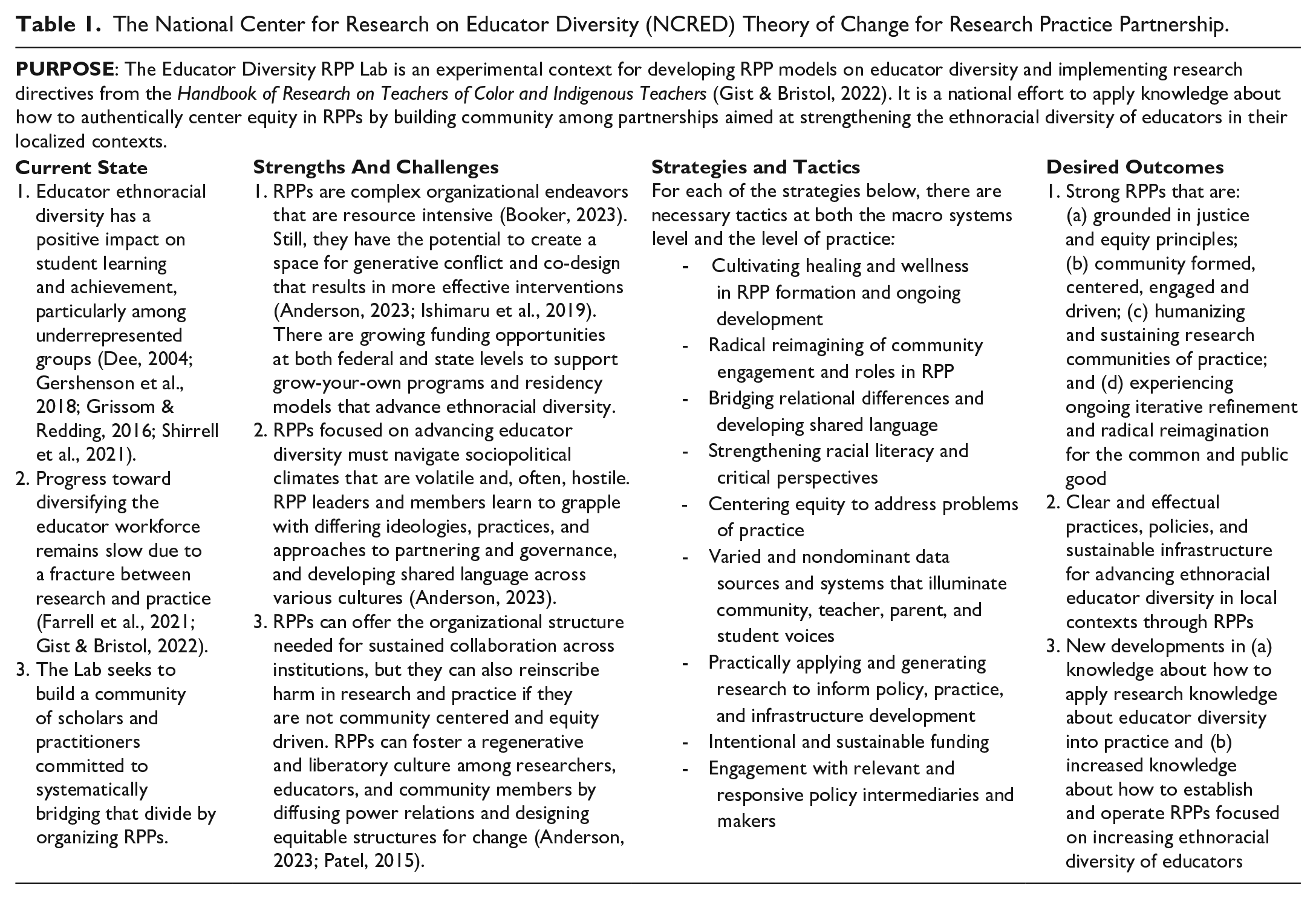
This theory of change serves as a roadmap for the RPP Lab, and it is a first step forward for the field toward developing measures and being able to answer the above questions. As captured in this theory of change, a potential strength of RPPs is fostering a more equitable and sustainable approach to advancing ethnoracial educator diversity that diffuses power structures and relations among education reformers, policymakers, researchers, practitioners, and community members. Practitioners and community members are rarely engaged as leaders and innovators for teacher development initiatives (Gist, 2022); if they are involved, they may not be included in important decision-making processes (Cochran-Smith et al., 2018). As noted in the theory of change, RPPs that confront the challenge of radically reimagining power structures and relations, and navigate the volatile sociopolitical environments in which they may be situated, can advance tactics (e.g., cultivating healing and wellness, developing shared language and critical literacy, and developing nondominant research measures) that work toward creating an opportunity for ethnoracially diverse teacher development systems to be intentionally built and iteratively nurtured.
For instance, an RPP may decide to create a teacher initiative focused on recruiting Black, Indigenous, and other People of Color (BIPOC) school-affiliated staff (e.g., cafeteria workers, bus drivers, crossing guards) from the community to support economic mobility in the community. School staff positions are typically racialized and gendered in pronounced ways, and there could be a range of intersectional standpoints for consideration with this group of workers related to immigration, language, and family status, in addition to grappling with the sociopolitical community context of limited social service resources and histories of economic divestment. In this case, the principle of relationality is vital because community voice, representation, and agency within the RPP must be radically reimagined to remap power relations for those groups, and uplift and support empowerment in ways that invest in and advance community goals (Gist, 2022). Though complex, it represents a core outcome of our theory of change, which is to develop effective practices and sustainable infrastructure for advancing ethnoracial educator diversity in local contexts.
A Call to Action
In the NCRED Educator Diversity RPP Lab we are challenging ourselves as a body of researchers, practitioners, and community members to collectively engage in freedom dreaming about the types of educational futures possible in schools and districts committed to advancing educator diversity. Presently, we are setting up the foundations for learning together and charting a new research agenda that builds and sustains RPPs focused on educator diversity. To do this, we intend to develop criteria and measures for healthy, thriving RPPs focused on educator diversity to share with the field, and use the tools we create to support collaborative research models committed to engineering more equitable teaching and learning systems. We hope you will consider joining us as colleagues and critical friends to generate and advance meaningful and impactful research approaches to advance educator diversity.
Footnotes
Declaration of Conflicting Interests
The author(s) declared no potential conflicts of interest with respect to the research, authorship, and/or publication of this article.
Funding
The author(s) received no financial support for the research, authorship, and/or publication of this article.