




Abstract
As colleges and universities continue to navigate the longer-term impacts of the COVID-19 pandemic, a wealth of knowledge and insights exists within many community colleges to inform how to best prepare students for the fast-changing demands of learning, work, and life. Using a strengths-based approach and interviews with students from three large community colleges in the Midwest, this study explores how a community college education prepared students for the pandemic and areas in which students could be better equipped. The students appreciated their community college education for its practicality of training and research capacity, technology and communication skills in virtual formats, cultivating resilience, diversity as a highlight, and an education for the community. Areas where the students wished they had learned more were handling stress and managing time, engaging with diverse perspectives and work styles, and keeping up with the evolving technology landscape.
The ongoing COVID-19 pandemic has taken its toll on nearly all postsecondary institutions that contend with myriad challenges. These span enrollment declines (Bird et al., 2022; National Student Clearinghouse Research Center, 2022), pivoting to virtual learning (Bird et al., 2022; Davis et al., 2022), integrating student supports (D’Amico et al., 2022; Hu, 2020), and shifts in skill demands (Hart et al., 2021), among others. As colleges and universities continue to grapple with emergent challenges, a wealth of knowledge and insights exists within the vital sector of community colleges. Since their inception, these institutions have been serving widely diverse populations while being responsive to emerging societal needs (Amey, 2020; Amey et al., 2007; Cohen et al., 2014; Eddy, 2012, 2013).
As we continue to navigate the longer-term impacts of the pandemic and related crises (e.g., racial, learning, technological inequities, etc.), these institutions hold great promise to inform how to best prepare students for the evolving demands of learning, work, and life. Although many community colleges already contend with declining enrollment, underfunding, and limited resources (Bulman & Fairlie, 2022; Schudde & Goldrick-Rab, 2016), their adaptability allows them to build and support students’ resilience (Amey, 2021; Wang, 2020). Our study employs a strengths-based approach to explore how a community college education prepared students for the pandemic and areas in which students could be better equipped. Specifically, we draw on interviews with students from three large community colleges in the Midwest and ask the following questions:
How did a community college education prepare students for the challenges brought upon by the pandemic?
What else could students have learned to better equip them to deal with these challenges?
Background and Framing
COVID-19 set in motion a number of challenging issues for higher education, such as unexpected and sudden campus closures, as well as the move of all courses and organizational infrastructures to a remote environment in a matter of days or weeks (Bird et al., 2022; Davis et al., 2022; Lederer et al., 2021). This pivot was especially difficult considering the disparate access to online and technology resources and training across colleges (Hart et al., 2021), all of which impacted student performance, persistence, and enrollment (Bird et al., 2022; D’Amico et al., 2022; Hart et al., 2021). Also, because the pandemic touched areas of life broader than higher education, students faced additional difficulties and crises that revolved around work, finances, childcare, transportation, illness, mental health, and food and housing security, among other areas (Bird et al., 2022; García-Louis et al., 2022; Manze et al., 2021).
Other challenges included health and public safety decisions, policies, and measures to maintain safe learning and working spaces for students and staff amid evolving information (Floyd, 2021; Frazier, 2022; Harper, 2020), complicated by swift shifts in skill demands (Hart et al., 2021). As higher education keeps contending with this multiplicity of challenges spurred by COVID-19, there is an opportunity to rethink how institutions can best position themselves and their students moving forward. To this end, a community college education is brought to the forefront as a valuable blueprint given community colleges’ long-standing tradition of social change and responsiveness to critical historical moments (Cohen et al., 2014; Price et al., 2017). As postsecondary institutions continue their quest for innovative solutions, it is both pivotal and long overdue for higher education research and practice to closely examine how a community college education can prepare and support students during times of crisis.
A Strengths-Based Approach
Despite their open access and democratizing role, for too long, the community college sector has been overlooked and undervalued (Cohen et al., 2014; Jain et al., 2020; Wang, 2020). A deficit perspective is often used to portray these institutions through a narrow, often uninformed view of them as academically inferior with poor outcomes (Hagedorn, 2010; Robinson, 2022). To challenge this deficit narrative, we used a strengths-based approach to guide our study. Rooted in positive psychology (Park & Peterson, 2008) and social change theory (Aguilera et al., 2007), a strengths-based approach is anchored in the proposition that every individual, organization, and community has strengths. Starting within this positive paradigm allows the research practice to identify strengths and build from them toward generative, positive change.
A strengths-based approach saw earlier development and application in the field of social work (Rapp, 1998; Rapp et al., 2006), but has expanded its influence into the field of education research. Yet, its application has primarily centered on students and less on institutions. On these grounds, our study extends a strengths-based approach to community colleges. Through this lens, we acknowledge community colleges’ diverse missions, functions, and educational offerings to meet wide-ranging student interests, goals, and needs, all of which result in outcomes and purposes that make them distinct as a higher education sector. Thus, a strengths-based perspective capitalizes on these institutions’ unique capacity and resilience, combatting the persistent undervaluing of community colleges. For these reasons, we approach all phases of our inquiry using a strengths-based approach.
Research Design
Our research draws on an interpretive qualitative approach (Merriam & Tisdell, 2016) with descriptive phenomenological underpinnings (Colaizzi, 1978; Giorgi, 2009; Moustakas, 1994), which are suitable for capturing and understanding experiences (Merriam & Tisdell, 2016). In our study context, the experiences of interest were those that students had at their community colleges and the implications of those experiences for the pandemic challenges. Interpretive qualitative research aims to empower and honor individuals and their subjective sensemaking of experiences within their unique contexts (Creswell et al., 2006; Plano Clark et al., 2013). Descriptive phenomenology similarly focuses on the situated experience with a phenomenon (Giorgi, 2009). Our study specifically centers students’ experiences and how those shaped the way they lived and coped with the phenomenon of interest, namely the community college education as preparation and support for navigating the challenges of COVID-19. We detail our procedures in light of this design in the following sections, particularly our data analysis.
Context and Participants
This research is grounded in a longitudinal mixed methods study that followed approximately 1,670 students starting at three two-year colleges in the Midwest (referred to as Great Lakes College, Two Lakes College, and West Shore College) in fall 2014. The initial focus of the project was on student transfer from these community colleges to four-year universities in science, technology, engineering, and mathematics (STEM) fields of study. As the research unfolded with extensive longitudinal survey and interview data collection, the project evolved significantly to extend beyond STEM and transfer, allowing us to holistically examine how students navigated their community college education and the diverse directions in which their educational journeys have since taken them.
Prior to the current research, we had already built connections with this cohort of students through three waves of survey and interview contact and interactions. To answer the questions for this particular study, we conducted student interviews during summer 2020 when the pandemic was underway, six years after students first enrolled in their community colleges. At that point, some of the students were still enrolled, while others were not. A number of the students had transferred, graduated, and/or were working. This latest wave of data collection was helpful because it allowed students to reflect and take a retrospective look back at their educational journeys thus far and the influence of those experiences on their current situations. We recruited the participants through a brief online survey sent to the cohort during spring 2020, which asked about students’ experiences to date and those related to the pandemic, along with an invitation for a follow-up interview. Of these students, 32 consented to an interview.
Data Collection
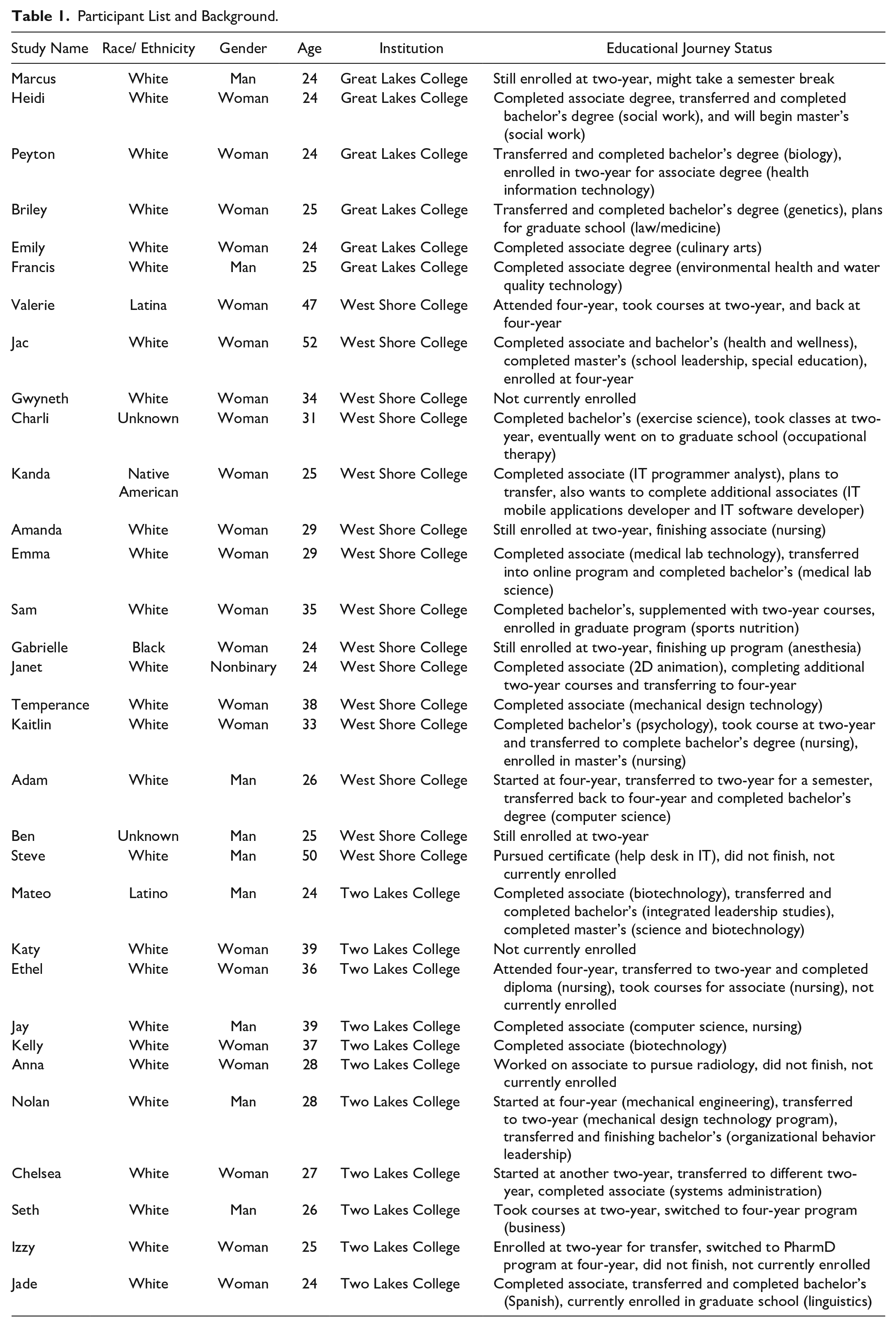
We (the lead author and third author) conducted 60- to 90-minute interviews with each participant through an online video conference platform or by phone during summer 2020 due to COVID-19 guidelines and social distancing recommendations. In the interviews, we focused on two facets of students’ experiences and insights. First, we invited participants to reflect on their time as a student at their community college and share what they learned and/or experienced that had helped them cope with the current pandemic. Second, we asked students to consider and identify things they wished they had learned or experienced that would have helped them better deal with the pandemic. We addressed this aspect because strengths-based inquiry does not ignore issues of concern. Rather, this inquiry aims to achieve balance in centering strengths against the backdrop of potential problems to resolve challenges in appreciative, productive ways. We audio recorded all interviews and transcribed them verbatim. We also gathered reflective memos for context and sensemaking of the data. For participant list and background information, see Table 1.
Participant List and Background.
Data Analysis
Our analysis consisted of engaging interpretive qualitative and descriptive phenomenological techniques (Colaizzi, 1978; Merriam & Tisdell, 2016), which was important for two reasons. First, they permitted us to engage with the data in an interactive and humanistic way aligned with our design and strengths-based lens. Second, these approaches allowed us the flexibility inherent in each individual approach to draw out emergent codes, categories, and themes from the data, yet maintain the rich descriptions and complexities laid out by participants.
We began the analysis by reading and re-reading interview transcripts to make holistic sense of the participants, their experiences as community college students, and how they were coping with the pandemic. We then went back to the transcripts using inductive logic (Plano Clark et al., 2013) as well as searching for significant statements, descriptions, and patterns of meaning (Colaizzi, 1978; Giorgi, 2009) aligned with our interpretive and descriptive phenomenological approaches and related to our phenomenon of interest (i.e., community college experience as preparation for COVID-19 and related crises). Open and in vivo coding (Saldaña, 2015) further assisted this process as we refined our codes toward categories. We clustered these categories into themes that were common across participants. All three authors engaged in data analysis iteratively until we arrived at themes reflective of the research questions and participants’ shared experiences grounded in the data.
Based on this process of developing and organizing the codes and categories, two key themes emerged. The first depicts how students’ experiences at their community college equipped them to navigate unprecedented crisis and its precipitating impacts. The second theme speaks to other areas in which community colleges could have strengthened education and training for students. Our analysis also allowed us to delve into and generate nuanced subtopics related to the two themes that detail the opportunities and challenges students experienced in preparing for crisis, along with their retrospective thoughts on what additional skills and opportunities could have better prepared them during their time at the community colleges. In the following section, we relied on descriptions of our themes and integrated students’ voices to center their insights, experiences, and contexts when outlining our findings.
Findings
We organize our findings based on the two guiding research questions: how the community colleges in our study—Great Lakes College, Two Lakes College, and West Shore College—prepared their students for crisis and what the students wished they had learned. We delineate the themes that emerged from each area in the following sections.
How the Community Colleges Prepared Students for Crisis
The students in our study appreciated how their community colleges cultivated educational opportunities and spaces that generally prepared them to cope with the pandemic, but especially for their focus on the following five elements: practicality of training and research capacity, technology and communication skills in virtual formats, cultivating resilience, diversity as a highlight of education, and an education for the community.
Practicality of Training and Research Capacity
The students highlighted the practical nature of their community college education. Students who received training in science and allied health—prominent fields of study that are disproportionately offered by community colleges—pinpointed their knowledge and awareness of community health and health care, something they found remarkably relevant amid COVID-19. For instance, Peyton noted that, at Great Lakes College, her “professors always linked out different scientific research” and showed them “how to properly look for good scientific research.” As a result, her time as a biology student helped her understand viruses and the rationale behind reducing transmission: . . .the scientific reasons behind why we did initiate the quarantine and the masks.. . . I’ve seen a lot of people who don’t have a science background who were like, “Why are we doing this?”. . .I’m like, “Yeah, but we are helping take care of other people”. . .having that scientific background and that knowledge to know how viruses work and how to help slow down that spread.
Ethel, a licensed nurse practitioner, explained how her courses on community health care at Two Lakes College taught her about infection control and putting “the patient first, [but] not above our own safety.” She shared how those courses informed her interactions with patients in thoughtful and responsible ways. Kelly also described how her molecular biology coursework at Two Lakes College educated her about epidemics and cell life, which was invaluable to her during COVID-19: I took Mol[ecular] Bio[logy] I and II. I took Bioprocessing, which also taught me a lot about what a cell needs to grow . . . what it takes to kill a cell . . . taught me about the different factors that will start cell death. Understanding like how—I think COVID is alive for four hours on a bench. . .it has an astounding life four hours on a bench still alive and still produce a colony. . . . I [also] learned how to take off my gloves properly; how to not contaminate something; how to not be contaminated.
Briley also affirmed how her science education at Great Lakes College validated her approach to the pandemic amid varying voices and perspectives: . . .the science background helps me take it more seriously, even at work. . .other paralegals were like, “No, it’s fine,” like, “It’s. . .this isn’t a big deal.”. . . For me, thinking back [to] immunology. . .safety-wise, [I am] taking it seriously. . .my classes prepared me for that, like Microbiology and that kind of stuff.. . .I know more of like how the virus works, not the specific one but just generally speaking made me a little more cautious about it.
A related and prominent value added by a community college education was research capacity, such as identifying and engaging credible sources to reach well-informed judgments and decisions about the pandemic and beyond. As Jay put it: “My education at Two Lakes College helped me to be comfortable reading the medical literature so I can resolve in my own head, like how I would deal with COVID-19.” Valerie, a Latina elementary school teacher, shared that the science education background she received from West Shore College was “very helpful to understand things, because it’s a novel coronavirus, information is changing all the time. So, I feel I’m very open-minded to the changing nature of recommendations or how it spread or knowing that it can mutate.” The practical and applied nature of students’ community college education helped them investigate and make sense of COVID-19 within their individual contexts. These students also exercised their research capacity, including through online platforms, often relying on the technology and communication skills they also gained through their time at the community college, as described in the following section.
Technology and Communication Skills in Virtual Formats
Community colleges have long offered online courses to ensure flexibility for their students. Online options, albeit imperfect, provide access and accommodate scheduling needs or hardships without students missing out on learning altogether. The students noted how their community college education developed their technology and communication skills in virtual environments. For example, Kanda noted that West Shore College taught her “how to conduct things online.” During some difficult life experiences, the college offered consistency through flexible learning options: West Shore College always had, at least in my time there, they always had some form of online learning. . . . when my uncle died and when my cat died, I had to actually do schooling online for a while . . . being able to figure out how to work online is super helpful.
Online learning options helped Kanda translate those skills when she had to work from home due to the pandemic: “[T]hat is a skill that has helped me so much with preparing for going into the workplace and knowing I’m gonna be working from home for a while.”
Remote learning not only offers consistency during difficult times but is responsive to students’ needs. Temperance explained her education at West Shore College taught her: . . .how to reach out to people via internet, emailing for help. . .back and forth with instructors, they were always very good about answering emails and things like that. . .through like a classroom portal, they would have information or slides that they had used in class, uploaded afterwards onto the site so you can go back and look at them.
The structure of many community colleges provided students a support line when needed and access to important academic tools to further develop their technology and communication skills.
Although COVID-19 propelled many institutions, organizations, and companies into online learning and work for the foreseeable future, that transition did not mean that everyone was tech-savvy. This was especially true for communicating in a virtual space. Interacting online in efficient, respectful, inclusive, and productive ways with evolving technology can be a challenge. Yet, the students found themselves prepared due to their community college education. For instance, Valerie’s IT background from West Shore College positioned her well compared to her coworkers with higher credentials: “Communicating via online and Zooming, being very clear in emails, being more flexible, and how I perceive others’ communication—that has been important, because some people don’t communicate in a tone that is professional, respectful, or even informational.” Plenty of community college students were ready for online work and collaboration long before the pandemic. Kanda also noted how tasks and habits developed at her college prepared her for productivity at work: . . . that was really a skill I learned a lot at West Shore College, ‘cause I would look at assignments. . .when does this final need to be done. . .the expectation for the final.. . .I knew what to do ahead of time. . .that has carried over quite a bit with going into the workplace.
Although COVID-19 prompted a rapid pivot to remote communications, these community colleges remained true to their mission of being responsive to the everchanging lives of their students—life contexts unique to the community college students that cultivated resilience. The students’ experiences at the colleges helped them further harness that resilience in navigating the pandemic, which we outline next.
Cultivating Resilience
Community colleges are designed to offer access and flexibility for the many working adults, first-generation, low-income, and other minoritized students who contend with work, education, and life obligations. That flexibility comes with a price—less structured support—compounded by the underfunded and underresourced nature of many community colleges. This conundrum shaped students’ experiences in complex ways. They gained resilience by pressing on in the face of multiple responsibilities and challenges that were amplified by the pandemic. This was especially notable among students of color, who navigate more societal, economic, and institutional barriers that have been exacerbated by COVID-19 and health equity issues. Mateo shared that Two Lakes College “prepared me for times like this [the pandemic] where you have this pressure, this looming thing that you can’t really control, but you just have to get through it.” He expanded that he also worked 36 to 40 hours a week in addition to being a student. As a result, the students of color tended to leverage their resilience from the community college to cope with added stressors from COVID-19.
On a similar note, Sam shared that her experiences returning to her community college after time away helped cultivate her resilience: I think even going back to West Shore College and first starting like this journey again, going back to school, I definitely gain resilience because of needing to work full-time and go to school at night. And I tried to go to the gym as much as I could and have some sort of social life. So, I think, [I] at least learned some resilience that is obviously helping in this situation now. And that’s sort of been true for my, the entire journey of whatever, no matter what school that I’ve been. It’s always been trying to juggle a lot of things at once rather than just only school or whatever, so I think that is at least hopefully helping.
Resilience was also bolstered through instructors, often the primary contacts and supports for students at community colleges. Before and throughout the pandemic, community college faculty promoted student well-being and resilience, as highlighted in Janet’s reflection from their time at West Shore College: Teachers were very open-minded and willing to work with you when we transitioned from classrooms to computers. Even though I enjoy having online classes, I don’t like being thrown into situations I’m not familiar with. So, to have them be like, “It’s okay, take your time, we will work it out.” It was very helpful and supportive.
Resilience carried over from the community college to the workplace for many students. Emma, employed at a medical facility throughout the pandemic, recognized how West Shore College’s environment allowed her to gain the skills needed for honest communication. She felt comfortable seeking support during difficult times in school and work: . . .when I had that [COVID-19] exposure, I reached out to employee health. I know what my contacts are and what my support system is through work right now, but also friends and family in general. So, making sure that you reach out before it’s too late. Just keeping that open line of communication.
Students’ resilience takes various forms, and the community college has been a place where students learned critical self-advocacy skills. It is important to note that resiliency often manifests in students’ realities before attending college. Yet, it is also a trait further cultivated during their time at the community college, whether through the support of instructors or self-advocacy and navigational skills. These colleges historically serve and support resilient and diverse student bodies. It was this diversity that also stood out to the students as preparation and support for dealing with crisis, which we highlight next.
Diversity as a Highlight of Education
The students praised their community college education for opening their eyes and minds to diverse opinions, even in seemingly objective fields like science and health. Such experiences challenged their thinking and developed their capacity to “to listen to both sides” as Jac put it. Further, the students described racial diversity as another highlight of their education. These experiences helped them make sense of racial inequities in light of the pandemic. Izzy reflected on how her education at Two Lakes College allowed her to better comprehend the dual pandemics of COVID-19 and racial injustices: When I took Intro to Anthropology, my teacher was going over the DNAs between a Black person and a White person and how they’re more similar than if you take two people in the same race and compare them. And that blew my mind, especially coming from a racist family.
A community college education contains multiple layers of diversity, bringing students to a deeper level of understanding of both the pandemic and systemic inequities, often resulting in a greater appreciation and care for others around them. This also led them to pursue and leverage their education to serve those in their communities, which we discuss in the following section.
An Education for the Community
As evidenced in their name, community colleges serve their communities. It was no surprise that the students’ education cultivated a strong desire to give back. The students pointed out the importance of contributing to their neighborhoods and beyond, like Katy: What [my education at Two Lakes College] transferred for me is that knowledge or that mindset: What I do with my time needs to be stuff that matters. It needs to be useful to the world as a whole or to the people around.
This goal to serve others was further confirmed by Emily: There’s people out there that you can reach out to, to not feel alone ‘cause I think a lot of people right now are feeling alone. . .there’s a lot of uncertainties and the resources of having like your teachers there are willing to help you [in Great Lakes College]. There’s always been people there that can help you. That’s something that they kind of teach you a little bit is that there’s always like somebody there that you can reach out to.
This support endures as students continue to pour themselves into their communities. The students are primed to serve and innovate, often feeling personally responsible for caring for others throughout and long after the pandemic. Taken together, the students found great value in their community college education that supported them in navigating a variety of challenging situations during the pandemic.
What Students Wished They Had Learned
Overall, the students had very few lingering concerns about their community college education, but they mentioned a few areas around stress and time management, engaging with differences, and keeping up with technology.
Handling Stress and Managing Time
Because the pandemic amplified stress levels, the students wished their community colleges had provided them with crisis-response training and skills. Specific areas included managing difficult life situations, self-care, and mental health. Community college students disproportionately experience mental health concerns, an issue intensified by the pandemic, but their institutions are financially challenged to support them. Moreover, community colleges serve a large proportion of underrepresented students who may not have access to mental health services, or mental wellness may be a stigmatized topic in their communities. Mateo, a Latino student, wished that mental health at Two Lakes College was “just more known or more acceptable, or just reach out.. . . ‘Hey, you’re a college student, this is how you cope with stress.’”
Similarly, Emma hoped to learn about managing crises like that of COVID-19 during her time at West Shore College: . . .it should be like a required class of how to manage difficult life situations whether that’s within your career, your family, the world, or whatever. Because even in like on way back to my undergraduate degree, that’s not like a required course or anything. . .some of those more basic skills we’re expected to maybe learn from our families. . .but a lot of the time we’re not. So, I think that would be helpful.
In considering the needs of the community, students are hopeful the above knowledge could be a new area of growth within community colleges.
Although some students hoped to have learned specific stress management skills, others wished they learned more about time management. This was not ordinary time management; it was negotiating what appeared to be scarce time in the face of disruptions and shifting responsibilities. Jade reflected on her education from Two Lakes College and the competing demands throughout the pandemic that led to difficulty prioritizing work tasks: I wish that I would have figured out how to manage my time in such a way that I wasn’t sitting at my desk for 12 hours a day trying desperately to get things done. Because even though I’ve been able to work effectively and even though I’ve been able to keep myself from experiencing the kind of like sort of breakdown in function that I’ve noticed a lot of other people having. . .it’s still really hard on me, because I never learned how to sort of make myself focus even when everything else is sort of falters, which one would assume that I would have and it’s a skill that I definitely want, but it’s not quite there yet.
Students were already crunched for time among competing roles and responsibilities before the pandemic, which worsened when COVID-19 hit. Time management and prioritization became highly desired skills, as well as adapting to diverse perspectives and work styles described next.
Engaging with Diverse Perspectives and Work Styles
Although many students picked up practical and relevant scientific knowledge during the pandemic, their education often did not purposefully integrate skills around engaging with people from diverse perspectives, backgrounds, and work styles. The students wished they had learned how to thoughtfully converse with and educate fellow citizens on important yet contentious matters, including but not limited to COVID-19. As an example, Emma hoped to have learned at West Shore College “how to have a difficult conversation or how to—if you’re not comfortable opening up to people, like what resources are there.” In an effort to learn more about oneself, personal views, and the opinions of others, students sought to grow when engaging with diverse viewpoints.
In addition to diverse viewpoints, students also encountered people who approached their work in different ways. As a more contextualized learner, Temperance craved more learning from West Shore College that would have helped her adapt to varying work styles: “There was never really an opportunity. . .to be like, ‘Hey, this is school, we’re going to do it this way, but in the real world you’re going to need these skills.’” For community colleges, real-world knowledge and connections are often how their students learn and retain information as they transition into careers. Kanda, who graduated and works at a financial institution, explained, “I think one of the big things is just working with everyone who thinks differently is something I wish was kind of taught more at West Shore College.” At times, she felt like an outsider because her colleagues have different backgrounds and work styles. She advocated for herself by sharing ideas and offering new perspectives. Kanda is working toward finding “a happy medium and working with people who have different opinions, different ideas, that’s really something I wish was taught more in schools that just usually isn’t.” As many adapted and engaged with new viewpoints, opinions, and work styles, the pandemic added another complexity to learning: the fast-changing technological landscape.
Keeping Up with the Evolving Technology Landscape
The pandemic has demanded rapid, constant updates and advancements in technology. As a result, the students wished they had received more training to navigate the countless new technologies implemented during COVID-19. Infinite platforms emerged for college, work, meetings, and more, making it hard to predict which virtual tools are necessary and optimal. The students believed they might have benefitted from a broader knowledge base to adapt and translate across various platforms. For instance, Valerie hoped to have learned more about web-based tools while at West Shore College. When learning switched to a virtual modality, she reflected: I thought to myself, huh, I’m going to have to set up the Zoom type interactions. I was like, “How did you learn how to do that?”. . . I wish I [was] more tech savvy and integrate that more into how I’m learning and how I’m going to teach at the same time.
Kaitlin also wished West Shore College had taught her how to navigate web-based tools such as Zoom, “using technology better, figuring out how to do things remotely and still get stuff out of it.” As technology continues to advance long after COVID-19, community colleges and higher education more broadly will be challenged to provide the necessary training and skills for their students to succeed in college and the workforce. Taken together, although the community colleges in our research provided valuable student preparation and support, there were a few areas that present growth opportunities.
Discussion
The students we interviewed affirmed the many contributions of their community college education that allowed them to cope or even thrive. Although resources were a major contributor to institutions successfully navigating the pandemic, the colleges in our study demonstrated how they could adapt and support students, even amid underfunding and enrollment challenges. They also offered food for thought in terms of what the future could hold. These takeaways are not only pertinent to community colleges, but also bear broader relevance to other institutions and contexts. As faculty, advisors, and leaders strive to continue high-quality education and supports, we offer the following ideas of how institutions can build on their existing contributions and make thoughtful adjustments moving forward.
Building a Stronger Curriculum to Help Students Thrive
The community colleges’ strength in cultivating research capacity from our study can be taken to the next level by means of a purposeful integration of research skills across the curriculum. Rather than isolated incidences, there should be common features that transfer across courses and programs to help students develop their research skills. These features may include how to identify credible sources, as well as how to sift through and identify the most helpful and relevant ones to avoid information overload.
Similarly, our findings illuminate a need to improve capacity and literacy around mental health and well-being. Mental health prevalence and visibility is on the rise in higher education (Broton et al., 2022). It is especially important that institutions provide students with a variety of knowledge, skills, and resources to engage and receive the support they need in ways that work best for them, including online or through text message. In addition, institutions need to ensure that all students, not just those in technology-related programs, are equipped to navigate evolving technologies and work environments so they can keep up instead of falling behind. To facilitate this endeavor, colleges should work on structural integration of advanced skill development through learning opportunities that lead to credential and job opportunities to further cultivate students’ resiliency, especially during challenging times (Price et al., 2017).
Establish Purposeful and Structured Community Engagement Opportunities
Community colleges and their students are well positioned to serve and address community needs (Cohen et al., 2014; Wang, 2020). Accordingly, institutions should work with students to explore and cultivate a passion for their field that would translate into meaningful service to their community. Examples may include a career exploration course, along with intentional work and research experiences. Engaging students in these opportunities as soon as they enroll would help them reflect and map out concrete educational and career goals. Faculty and advisors are also key to supporting and guiding students toward programs and related opportunities. Otherwise, many students are left to wander until they stumble upon a course or program that sparks purpose toward serving a larger good, or they may miss out on a potential passion altogether. Because COVID-19 has enduring impacts on communities on multiple levels, it is all the more crucial to align students’ motivation to give back with purposefully structured educational opportunities.
Encourage Support-Seeking and Cultivate Connection
Although community college students are agentic and resilient (Wang, 2017, 2020), this should not be the default, especially when it comes to extreme challenges or crises like COVID-19. A clear, explicit, and consistent message from the institution is essential for students to feel that they can and should ask for help. Beyond broad approaches of messaging and support, institutions should ensure diverse channels and ways to cultivate a strong sense of connection for students during difficult times, ranging from instructor communication and classroom interactions to student services and outreach.
Conclusion
Community colleges’ ability to adapt and respond to students, industry, and communities despite limited resources is far-reaching (Cohen et al., 2014). Through a strengths-based lens, we learn how some of these colleges prepared students to cope and manage through hardships associated with crises, along with areas for future growth. As we take a page out of their playbook, we acknowledge how these institutions’ resilience and resourcefulness can guide us to do right by our students with community and care. On that note, we close this piece by amplifying community as a central theme of a community college education—both a highlight and a desire shared by the participants. Community is not explicitly taught but felt. It is connecting with one another and humanizing relationships, now and well beyond COVID-19. Katy captured this perfectly: I think until we understand and connect with each other as humans, we maybe don’t have to share beliefs or respect the same overall ideologies, but really as a society, if we want to be a place that’s safe for people, we really gotta recognize humans are humans, and we need to be careful and kind.
Footnotes
Declaration of Conflicting Interests
The author(s) declared no potential conflicts of interest with respect to the research, authorship, and/or publication of this article.
Funding
The authors disclosed receipt of the following financial support for the research, authorship, and/or publication of this article: This study is based on work supported by the National Science Foundation under Grant No. [DUE- 1430642].