



Abstract
Background:
Within the body of literature on do-it-yourself (DIY) music scenes, researchers have routinely placed an emphasis on the role of material space in shaping the sociocultural and musical practices of punk music and other related genres. Scholars have also examined the teaching and learning processes of these musical subcultures under the banner of “punk pedagogy” scholarship. However, investigations into the intersection between these two strands of research need to occur because theories of punk pedagogy have largely overlooked the role of physical space within the educative practices of DIY music. Research into the thematically related space of the maker movement amplifies this need, because maker education scholars have repeatedly shown the multiple ways that materials and space shape how individuals learn through DIY production.
Research Questions:
I use this paper to attend to the following questions: How do DIY music venues shape the pedagogical practices of DIY music scenes? And in what ways do those pedagogies align with the ideological and ethical aims of these communities? By focusing on learning within DIY venues, I consider multiple forms of musical production outside of the context of a specific genre (i.e., punk). This study therefore provides insight into the mechanisms through which individuals learn and how those mechanisms relate to the physical affordances of these spaces.
Research Design:
To address these questions, I conducted a year-long comparative case study into two intertwined music series centered on noise music (an experimental subgenre within DIY music’s broad umbrella) and located in two separate DIY venues. Although each of the 13 events in this series included both a workshop and a concert, I focus my analysis on the concert portion of the series to explore a common site of interaction within DIY scenes. Through open and iterative qualitative analyses of field notes generated from observations of concerts in the series and interviews with featured artists and audience members, I provide a nuanced understanding of learning within DIY music venues and the role that both material space and technologies play in shaping that process.
Conclusions:
Drawing on this analysis, I contend that the stageless design of DIY venues provides a physical affordance that allows “gear toucher conversations” to occur. These conversations involve audience members engaging performers in discussions about the music technologies they use mere seconds after they finish performing, thus linking this pedagogical moment to the material attributes of the venue. However, these conversations reinscribe masculine notions of technology and undermine DIY music’s egalitarian politics, a finding that mirrors critical research into maker education. This work therefore calls on both researchers and practitioners to contend with the pedagogies of place and the educative processes that emerge out of situated technologies to further the liberatory praxes that DIY production can produce.
In describing Old Mount Happy, a do-it-yourself (DIY) music venue in Chicago specializing in punk music, Makagon (2015) depicts a space that some might describe as the polar opposite of a conducive learning environment (much less a functional venue): This basement is a bit of a mess. There is a steady flow of dust coming from somewhere (enough that when I get home and hop into the shower, black snot flows from my nose). Metal pipes are strewn about on the floor. . .. Then the lights go out. The basement is pitch black. Someone screeches. The lights come back on. A guy is messing with the power box, which is partially dislodged from the eastern wall. . .. [A band named] The Stasi aren’t getting any sound from their instruments or the PA, and the lights at that end of the basement are not working. . .. The Chicago punks who should know how to solve this problem seem more interested in smoking cigarettes, choking on weed, and running their beer table. (pp. 129–130)
Although this description paints a rather extreme and chaotic picture that does not apply to all DIY music venues, the example provided by Makagon does not exist far outside of the norm. But Tucker (2012) also argues that DIY venues “facilitate what Foucault calls popular knowledges, those particular, local, disqualified knowledges (whether progressive or reactionary) that may stand in opposition to dominant generalizable discourses and claims on universal truths” (p. 211). To this end, DIY music venues serve as sites for learning, even in more chaotic spaces like the one described above.
Although some studies do position DIY music venues as unique learning environments (Tucker, 2012; Woods, 2021a), extant literature on “punk pedagogy” (or the study of education within and related to punk and DIY music) has generally focused on the translation of music-based cultural politics into formal classrooms (Miklitsch, 1994; Miner & Torrez, 2012; Niknafs & Przybylski, 2017) or how individuals construct and share knowledge within music scenes and through musical artifacts (Cordova, 2016; Dines, 2015; Niknafs, 2018; Woods, 2021b) without considering the role of venues themselves. This happens in spite of the emphasis on materiality within DIY music research (Klett & Gerber, 2014; Makagon, 2015; Verbuc, 2014). But, as Gruenewald (2003) notes, all pedagogies emerge in conversation with the material spaces that surround given learning communities. Extending this argument toward critical education practices (a stance that seamlessly aligns with the countercultural ideologies of most DIY music scenes), McLaren and Giroux (1990) assert that “at the most general level. . .a critical pedagogy must be a pedagogy of place” (p. 163). In failing to consider the influence of music venues on learning within DIY music scenes, extant research has overlooked a crucial component of these cultural contexts.
To further explore “the cultural, political, economic, and ecological dynamics of places [that determine] the purpose and practice of learning” (Gruenewald, 2003, p. 11) within DIY music scenes, I draw on extant research into the histories and cultures of DIY music to address the following research questions: How do DIY music venues shape the pedagogical practices of DIY music scenes? And in what ways do those pedagogies align with the ideological and ethical aims of these communities? By focusing on learning within DIY venues, I consider multiple forms of musical production outside of the context of a specific genre (i.e., punk) and subsequently provide insight into the mechanisms through which individuals learn and how those mechanisms relate to the physical affordances of these spaces.
To address these questions, I start by presenting an overview of DIY literature with a dual emphasis on research into informal music education and, in lieu of education research focused on DIY venues, the maker movement. In doing so, I argue that scholarship on learning in the maker movement can inform this investigation because of a shared dedication to self-sufficiency and learning through creative production (Wehr, 2013). Extant research into maker education has deeply explored the role of materiality and space within informal learning praxes (Keune & Peppler, 2019; Parekh & Gee, 2019; Sheridan et al., 2020; Wohlwend et al., 2017), revealing how the physical affordances of makerspaces produce site-specific processes of teaching and learning within maker communities. Additionally, research into the connection between the maker movement and DIY production within other contexts (including music scenes) can create a bridge toward deeper investigations of both research contexts (Hollett & Vivoni, 2021). Maker education research can therefore produce a valuable theoretical foundation for new investigations into DIY music venues as sites of learning and vice versa, providing new insights into maker education, the pedagogies of DIY music scenes, venues as informal education spaces, and beyond.
From there, I turn toward comparative case study research into two concert series housed within DIY music venues. Through an analysis of participant interviews and observations, I argue that the absence of a barrier between the artist and the audience creates the conditions necessary for pedagogical interactions I describe as “gear toucher conversations” to occur. This lack of a barrier, a common physical affordance of DIY music venues, then creates an opportunity for all attendees to share and co-construct musical knowledge (with an emphasis on knowledge related to music technology). I also problematize this pedagogical interaction and illustrate how gear toucher conversations lead to the reinscription of gendered norms, a finding that also holds implications for education initiatives in makerspaces. This paper therefore contributes to the ongoing project of defining and analyzing modes of teaching and learning within informal learning contexts and through DIY production, musical or otherwise.
Background
The Ethics and Pedagogies of DIY Music
Although Wehr (2013) defines DIY simply as “when ordinary people build or repair the things in their daily lives without the aid of experts” (p. 1), varying cultural contexts have taken up competing understandings of the term. The emergence of punk music in the late 1960s, for example, applied DIY to the creation and sharing of music and infused the practice with an ethics of resistance. Independently running music venues, organizing concerts, starting bands, and managing labels outside of commercial music infrastructures took on a political component within this music scene, aligning an ethos of self-sufficiency with an anti-capitalist/hegemonic ideology (Blush, 2010; Spencer, 2005; Verbuc, 2014). This ideological take on community formation and cultural production has influenced contemporary DIY music more than the musical aesthetics of punk itself: the evolution of DIY music scenes after the first wave of punk (and especially during the 1990s) expanded far beyond the narrow confines of a single genre to include a wide array of musical traditions including hip-hop, indie music, folk, noise music, and others (Bailey, 2009; Makagon, 2015; Spencer, 2005; Verbuc, 2014). DIY music scenes therefore represent communities of individuals dedicated to an ideology of cultural production, infusing the making and sharing of music with an ethics of resistance and self-sufficiency, rather than a specific genre.
Beyond these historical and sociocultural investigations, extant research has also produced valuable insight into informal music education praxes and identity development within DIY music. In terms of developing musical knowledge, Green (2002) contends that popular musicians (including those from DIY scenes) develop their technique through a combination of formal lessons, peer mentoring, listening to and copying other musicians, and performing for others. Outside of making or listening to music, Green (2002) also argues that DIY musicians learn by routinely discussing music and generally interacting with community members at shows, band practices, and other social events. These interpersonal interactions, a core component of DIY music pedagogy, both lead to the co-construction of musical knowledge and provide a mechanism for communal and individual identity development (Niknafs, 2018; Tucker, 2012; Verbuc, 2014). DIY music scenes enable these pedagogical encounters by creating space for individuals and communities to experiment with and interrogate different ideological formations and identities through social interaction (Cordova, 2016; Dines, 2015; Woods 2022a), with participants learning through cultural resistance and developing political ideologies that extend beyond musical practices (Malott & Carroll-Miranda, 2003; O’Hara, 1999). DIY scenes therefore represent a rich learning ecology to not only construct musical knowledge, but also develop ideological and ethical frameworks.
Although participants routinely espouse this ideological framing of musical production and pedagogy, critical scholarship reveals that the egalitarian aims of DIY scenes do not always materialize. Within the context of the United States in particular, DIY music scenes have historically been homogenous communities consisting mostly of white men that consistently (yet unintentionally) reproduce this cultural exclusivity by excluding people of marginalized gender identities and people of color (Dietrich, 2016; Griffin, 2013; Woods, 2017). Although some scholars have challenged this argument by amplifying the contributions of artists from overlooked communities (see Ensminger, 2010; Pietschmann, 2010; Rocha, 2019), the framing of DIY as a white male subculture in the United States remains entrenched within popular discourse and practice. Turning toward issues of gender disparity, the unintentional reinscription of patriarchal norms leads to a gendered difference in participation, with men often taking on the role of cultural producer (musician, venue organizer, etc.) and women positioned as audience members (O’Hara, 1999). Despite high-profile movements to expand women’s visibility within DIY music (e.g., Riot Grrrl) (see Spencer, 2005) and a growing sense of diversity (Makagon, 2015), the U.S. scene has historically remained a boy’s club.
Embodying Egalitarian Ideologies Within DIY Music Venues
Despite these critiques, the foregrounding of self-sufficiency as a guiding ideology not only informs artistic production, but also shapes the creation and maintenance of DIY music venues. According to Makagon (2015), three different categories of DIY music venue exist: house venues, where musicians perform for public audiences in the spaces where scene members live; volunteer-run venues dedicated to hosting concerts and providing space for other aspects of DIY music scenes (e.g., distributing zines, political organizing); and liminal spaces that transform into music venues for short periods of time but primarily serve a different purpose (such as public outdoor spaces or businesses after they have closed for the evening). Participants in DIY music scenes therefore greatly expand what counts as a venue beyond the usual establishments that normally host concerts (such as bars, clubs, and concert halls). Organizers also differentiate DIY venues from more traditional establishments by employing a contrasting economic model. Instead of running venues to earn a profit, participants foreground an ethics of egalitarianism by adopting the mindset that making and sharing music exists as the ultimate end (Makagon, 2015). With a broadened conception of what counts as a venue in place and the drive for financial gain removed, establishing and maintaining DIY venues becomes a much simpler process: decide on a space to host musicians, tell people where and when the show is happening, let the show happen, and repeat (Blush, 2010; Verbuc, 2014). Cultural reproduction then occurs as DIY music scene veterans pass on the knowledge of how to set up and run venues to participants with less experience, who also learn how to organize venues and shows by participating in the community and observing others as they do so (Perry, 2011).
Beyond expanding the repertoire of places where musicians perform, the shift in physical space embodied by DIY venues produces distinctive interpersonal interactions. For example, the common lack of a stage or backstage area within DIY venues that physically separates the band from the audience produces an increased sense of intimacy and higher level of social interaction between listeners and performers (Tucker, 2012; Verbuc, 2014). This architectural feature creates a different social hierarchy within DIY music scenes (with artists and audiences physically and metaphorically existing on the same level) and produces opportunities for audience members to casually and frequently interact with musicians and venue/concert organizers (Makagon, 2015). This leads to audience members and musicians at DIY shows engaging in what I call “gear toucher conversations.” Named after a common descriptor for music technology–obsessed audience members (Leyva, 2018), the gear toucher conversation refers to a specific interaction at DIY shows 1 where audience members approach musicians immediately after a performance has ended (sometimes within seconds) and begin asking questions about their set or, more commonly, musical equipment. Importantly, gear toucher conversations and other similar interactions cannot occur in traditional concert venues: architectural features such as a large stage or a backstage area physically separate the audience from the performer. Even in DIY venues where a small stage might exist, the cultural norm of audience members getting on stage before, during, and after performances challenges the positioning of the stage as a barrier to performer–audience interaction (Blush, 2010; O’Hara, 1999; Reynolds, 2005). The physically and culturally open nature of DIY venues subsequently leads to a socially open environment where interpersonal (and, subsequently, pedagogical) interactions can occur between all participants.
Investigating the Intersection of DIY Music and Maker Education
Although DIY music literature provides valuable insight into the venues, pedagogies, and ideological commitments of these scenes, previous studies have not fully explored the intersection of these three components. With this in mind, I now turn toward research into the maker movement, another subculture dedicated to DIY production and self-sufficiency, to provide further insight into the role physical space might play in shaping DIY music pedagogies. Broadly speaking, the maker movement refers to “the growing number of people who are engaged in the creative production of artifacts in their daily lives and who find physical and digital forums to share their processes and products with others” (Halverson & Sheridan, 2014, p. 496). Although makers, educators, and scholars have taken efforts to broaden the scope of making, the movement has often reproduced a technocentric focus on using high-end and cutting-edge technologies to make new artifacts that mirrors its historical roots in Silicon Valley tech culture (Anderson, 2012; Hatch, 2013). Makerspaces, the physical homes of the maker movement and the localized communities that emerge within these cultural spaces (Halverson & Sheridan, 2014), often reinforce this conception of making by providing open access to a wide range of technological tools (such as 3D printers and laser cutters) for members to use (Anderson, 2012; Hatch, 2013). Still, makerspaces provide a space for communities of interested makers to bond, work together, and develop both individual and communal identities (Halverson & Sheridan, 2014; Hatch, 2013).
Mirroring the importance of materiality within DIY music scenes, makerspaces as physical environments play a crucial role within the maker movement because they facilitate knowledge sharing and allow for a communal set of tools that engender making practices and hands-on learning (Halverson & Peppler, 2018; Hatch, 2013; Sheridan et al., 2014). But more than just developing skills related to tools and technologies, Clapp et al. (2016) argue that “maker-centered learning” creates opportunities for individuals to develop a sense of agency and self-sufficiency beyond making practices. The interpersonal interactions enacted within these physical spaces also allow for communal identity development through the production of unique learning processes and modes of cultural production (Halverson & Sheridan, 2014; Litts et al., 2019; Sheridan et al., 2014). Building on these assertions, maker education researchers have routinely explored the roles that tools, physical space, and materiality play in maker-centered learning (Parekh & Gee, 2019; Wohlwend et al., 2017). Well-designed makerspaces not only facilitate interactions with certain types of materials, but also embody the pedagogies of making (Sheridan and Konopansky, 2016; Sheridan et al., 2020), encouraging participants to work through problems and obstacles in a tangible way as they build understanding and meaning over time (Keune & Peppler, 2019; Parekh & Gee, 2019). Echoing the physical affordances of DIY venues, the open nature of makerspaces (in which participants can move around the space, freely interact with tools and materials, and observe others) also facilitates forms of interpersonal learning and collaboration that may not happen in more physically restricting learning environments (Halverson et al., 2018).
Parallel critiques into the maker movement and DIY music also provide a window into how these cultural spaces ethically align as learning ecologies, because people of marginalized gender identities and people of color often get separated from recognized forms of making because of the assumptions behind who makers are and what they look like (Barton et al., 2016; Stornaiuolo & Nichols, 2018; Vossoughi et al., 2016; Woods, 2020). Focusing on gender, the reinscription of makerspaces as male spaces occurs in part because of the gendered nature of the technologies commonly associated with the maker movement (Britton, 2015; Buchholz at al., 2014). Circuits, programming, and heavy machinery, for example, have all been gendered as male within larger cultural spheres and have historically dominated conceptions of making. Creating a parallel within DIY music scenes, guitars and electronic music gear produce the same issue (Kelly, 2009; Rodgers, 2010). Maker education researchers have responded by investigating alternately gendered technologies (e.g., e-textiles) to counteract this issue (Buchholz et al., 2014; Buechley & Hill, 2010; Kafai et al., 2014; Litts et al., 2019). But research into both maker-centered learning and DIY music pedagogies must continue to deeply and critically examine the cultural norms surrounding technology that lead to gendered and racialized understandings within these contexts to end the reinscription of oppressive forces.
Methods
With this literature in mind, I draw on new empirical data to approach the following research questions: (1) How do DIY music venues shape the pedagogical practices of DIY music scenes? (2) In what ways do those pedagogies align with the ideological and ethical aims of these communities? In doing so, I unveil not only the role venues play in shaping the informal pedagogies of DIY music scenes, but also how those pedagogies work with or against the egalitarian cultural politics of these communities.
Sites of Research
To begin this investigation, I draw on findings from a comparative case study (Bartlett & Vavrus, 2016) investigating two intertwined music series in Milwaukee, Wisconsin: the Experimental Education Series (EES) and the Noise Knowledge Consortium (NKC). The EES occurs quarterly at a DIY venue called the Jazz Gallery Center for the Arts, a volunteer-run community space that consists of one large open room with a roughly 3-inch raised platform in the corner that sometimes serves as a stage but largely goes ignored as a barrier to audience members (i.e., all participants walk on and off the platform constantly during events). The NKC is hosted at Brinn Labs, a makerspace run by the local children’s museum. Brinn Labs represents a more liminal space in Makagon’s (2015) categorization of DIY venues, transforming into a venue at night or on the weekends when the business would normally be closed. Because Brinn Labs normally functions as a makerspace, the layout of the venue is open and suited to host concerts (despite some musicians needing to move large pieces of furniture on and off the side of the room designated as the stage area and other performers having to set up around partially built museum exhibits, conference tables, and piles of office supplies).
I have chosen to focus on these series because both occur in DIY music venues and center learning within these contexts. Both series follow a similar format, with featured artists designing and facilitating a one-hour workshop based on their own practice before performing at a concert alongside local musicians. The EES and NKC also focus on the noise music genre, an experimental subgenre of DIY music that emerged in parallel to punk and embodied the same ideological dedications (Bailey, 2009). In response to my own research into the ways that DIY scenes in North America reproduce themselves as homogenous (white, masculine) social spaces (Woods, 2017), the EES specifically featured all women artists as a means to address issues of gender disparity in DIY music (Dietrich, 2016; Griffin, 2013; Klett & Gerber, 2014; O’Hara, 1999). I recruited featured artists for the EES from various places around the United States and Canada. Although the NKC did not have the same focus on nationally dispersed women artists, 4 of the 12 artists came from outside of Milwaukee and 3 were women.
Taken as a whole, the EES and NKC provide sites for research that foreground learning and teaching within DIY music scenes (and the Milwaukee DIY music scene specifically) and between community members, both through the contextually unusual inclusion of workshops and the more common sharing of music and social bonding that occurs at DIY shows. I therefore build on Green’s (2002) contention that the roles of educator and learner remain constantly in flux as participants learn through highly informal practices (e.g., conversations about music during concerts) by considering both artists and audience members as potential learners and teachers within this study. The fact that women ran 7 of the 16 workshops also creates an opportunity to investigate issues of gender within DIY music pedagogies and scenes. In this paper, I explicitly emphasize data collected from and referring to the concert portion of both series to root my findings in the usual practices of DIY scenes (i.e., organizing, playing, and attending shows) as opposed to the more unusual workshop setting. In doing so, I center this study on the typical space of interaction within DIY music scenes to unearth how DIY venues (as physical spaces) and the concerts they host (as sociocultural spaces) act as informal (and often unrecognized) learning contexts. Data collected from the workshop portion of the series appears in other publications (Woods, in press).
Data Collection and Analysis
Applying Bartlett and Vavrus’s (2016) comparative case study methodology, I conceptualize this investigation along three separate axes. First, a horizontal axis engages multiple related but separate sites of research such as the EES and NKC. I therefore construct what Barlett and Vavrus (2016) define as a homologous axis, one where “the entities being compared have a corresponding position or structure to one another,” which allows for a deep investigation of “how similar forces. . .result in similar and different practices, and why” (p. 52). In this particular study, the homologous cases allow for an exploration of the role music venues play in DIY music pedagogies. Second, a vertical axis considers larger structures that contain and contextualize the sites of research. Here I engage the North American DIY music scene by inviting featured artists from across the United States and Canada to participate. Finally, a temporal axis historicizes both the vertical and horizontal axes and further contextualizes findings from case study research. Although I do not include insights from research into this axis in this paper, I have been analyzing albums and performances from seminal noise artists in related publications (Woods, 2022b).
To collect data, I drew inspiration from previous studies within maker education (Halverson et al., 2018; Parekh & Gee, 2019; Stornaiuolo & Nichols, 2018) and DIY music pedagogy research (Cordova, 2016; Perry 2011) by drawing on three major sources: interviews with audience participants, interviews with featured artists, and participant observations of concerts. First, I recruited five participants (four men, one woman) who self-identified as interested in attending the workshops and concerts to develop their own musical practice. All participants volunteered to join the study after seeing public posts I made on various social media sites. Participants attended between 6 and 12 events based on availability. Although audience participants ostensibly joined the study to develop their own practice as musicians, they were not required to do so. This led to a range of results: although two of the participants did not create any new music, two others applied what they learned to their emerging musical practice and another made their debut performance during the series itself. Additionally, I interviewed three other audience participants (one man, one woman, and one nonbinary participant) after the series had ended. I invited these participants into the study because they had attended most of the workshops and performances but had not responded to my original recruitment efforts. Before the study began and throughout the data collection process, participants were given the opportunity to choose an alias or use their own name. All participants chose to use their own name except for one (listed as John A.). See Table 1 for audience participant details.
Background Information on Audience Participants.
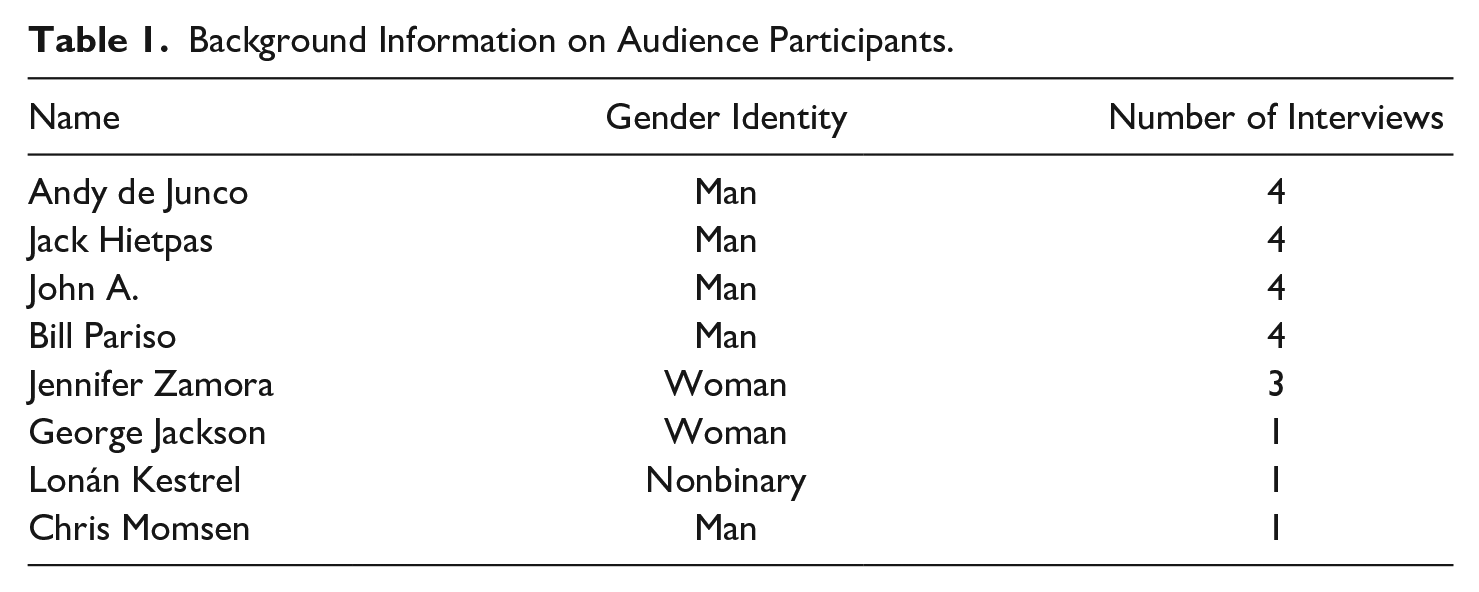
When interviewing participants, I used Seidman’s (2005) three-interview series to organize multiple semistructured interviews. The first interview, conducted before the first event, investigated the context surrounding the participant by creating space for the interviewee to discuss their existing relationship and understanding of DIY music. The second interview, which took place partway through the year, focused on the details of their experience thus far. This interview included prompts such as “What stood out to you about your experience at the last concert? Do you see this influencing your work as an artist? If so, how?,” creating space for participants to interpret their own learning in connection to moments from the series. Because of the number of workshops and the length of time between events, I conducted two iterations of this interview with all but one participant (due to scheduling issues and frequency of participation). Finally, the last interview encouraged participants to reflect on the meaning of their experience and how their understandings of DIY music had changed after the series concluded. For the three participants who joined the study after the series had ended, I only conducted one interview with each of them but covered the same set of topics.
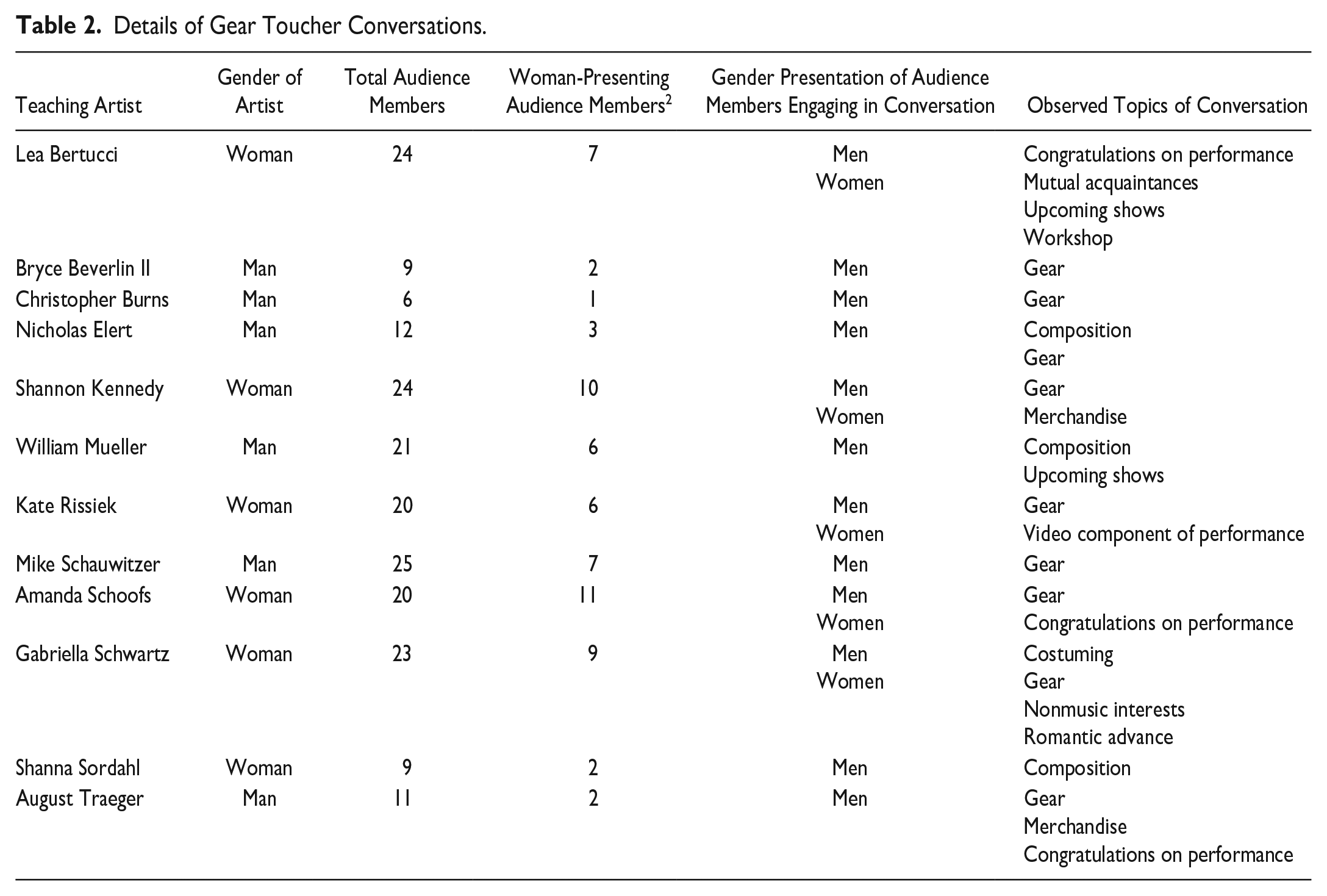
Second, I conducted semistructured pre- and post-interviews with the 17 featured artists from the EES and NKC. Pre-interviews focused on multiple elements: the artists’ conceptions of developing their individual artistic practice, learning within both formal and informal music education spaces, their intentions for the workshop, and how they developed those plans. Post-interviews centered on their experiences teaching and performing during the series. Although most questions asked during post-interviews were intentionally open-ended (e.g., “Were there any moments during the workshop or performance that stuck out to you? Why?”) to allow the artists to share their own interpretations of the events, I also asked the artists to respond to and reflect on video recordings of the workshops and concerts. In doing so, I allowed participants to provide insight into the intentions and motivations behind their interactions during the concerts. Due to the unique nature of the series, all participants agreed to using their names in publications. See Table 2 for artist details.
Details of Gear Toucher Conversations.
Finally, I produced and analyzed field notes during the series by engaging all workshops and concerts as a participant observer. This involved listening to the teaching artists during workshops, engaging in hands-on activities, conversing with audience members, watching the performances, and jotting notes on what I observed. I then expanded those observations into full ethnographic field notes. I treated these field notes not only as data, but also as a means for contextualizing interviews and providing material for interview questions. Once field notes were written and interviews fully transcribed, I analyzed this data by employing an open and iterative coding scheme generated through descriptive and thematic coding techniques (Saldaña, 2015) to produce insight into teaching and learning within DIY music venues. Taken together, this data set composed of observations and interviews speaks to a holistic understanding of teaching and learning within DIY music by providing evidence of what participants learned through the series, how they conceptualized teaching and learning over time, and their insight into the role of both music scenes and venues within these processes. In turn, this study also aligns with the theoretical framings of research into the maker movement described by Halverson & Sheridan (2014) by attending to the identities (both individual and communal), spaces, and practices that define DIY music scenes, creating further opportunity to draw comparisons between these cultural contexts.
Positionality Statement
In terms of my own relationship to this research, I come to this project as a long-standing member of the Milwaukee DIY music scene, having been an active musician and organizer for over 15 years. In developing this study, I relied on my position within this scene (including my role as a member of the Jazz Gallery Center for the Art’s music committee) to facilitate and curate both series. I also consider most of the performers in this study to be my colleagues and friends. Although some I met for the first time through this series, I have toured with, performed alongside, and attended countless shows with the majority of the artists featured here. Although this familiarity may lead to some biases, I also contend that my position has multiple benefits. First, my standing as an established musician creates a sense of familiarity, allowing participants to feel more comfortable sharing critical and nuanced thoughts about DIY music scenes. This became especially crucial when discussing critical issues of gender with the women and nonbinary participants because I am a cisgender man. Second, my deep knowledge of each participant’s music allowed me to ask detailed and specific questions during these interviews. To this end, I contend that my standing in this community helped produce a robust set of findings.
Results
In line with Bartlett and Vavrus’s (2016) homologous approach to comparative case study research, this study presented an opportunity to unveil similarities and differences between what Makagon (2015) would describe as two categorically different DIY venues: the Jazz Gallery Center for the Arts being a volunteer-run community space and Brinn Labs representing a liminal venue. Because no meaningful differences between venues emerged during my observations or analysis, I focus here on moments of overlap. In doing so, these findings provide insight into the shared teaching and learning practices of DIY music scenes (and the North American noise scene in particular) that potentially expand beyond these specific cases.
Reframing the Gear Toucher Conversation as Pedagogical Interaction
To better understand the role that music venues play in shaping the pedagogies of DIY music scenes, I focus on the plethora of gear toucher conversations afforded by these material spaces. During my observations of the concerts in the series, I repeatedly witnessed audience members engaging musicians in conversation immediately after they had finished performing, perfectly illustrating what I describe in the background section. Across the 16 events in the series, gear toucher conversations occurred at 12 of the concerts (see Table 2). Regarding the four exceptions, the conversations did not happen at two events because the featured artists decided to only conduct the workshop and not perform. In the other two events, the artists immediately followed their performances with directed, whole group discussions, thus precluding gear toucher conversations from occurring.
Importantly for this study, both the artist and audience participants framed gear toucher conversations as holding educative significance. Lea Bertucci exemplified this when she said, So much learning on my part has been done in that conversational context, where you're talking to somebody and they bring up a film or a record or even non-art and music-related stuff. That can really serve as the basis of new work or new ideas.
The gear toucher conversation therefore provides a specific example of the pedagogies described by Green (2002) when she discusses the learning that occurs through casual conversation across music scenes. In other words, DIY music participants use gear toucher conversations to teach and learn from each other. But because the lack of a physical barrier between artists and audiences at these venues allows these conversations to occur, a physical affordance found in the open design of both DIY venues (Makagon, 2015; Verbuc, 2014) and makerspaces (Sheridan & Konopasky, 2016), I argue that gear toucher conversations represent a specific example of how DIY music venues materially shape the pedagogical practices of music scenes. If artists could separate themselves from the audience by standing on a large stage or retiring to a backstage area, both common architectural features of traditional music venues, these conversations (and their embedded pedagogical interactions) could not occur.
Additionally, Bertucci positions gear toucher conversations as a way to learn about not only music, but also a broad range of cultural production within DIY scenes. However, my observations indicate a more limited set of subjects: during the 12 concerts where gear toucher conversations occurred, 9 included or focused on discussing the performer’s instruments and music equipment (see Table 1), far exceeding any other topic of conversation. In both my interviews with participants and observations of these conversations, two themes related to what individuals learned in these technology-centric conversations emerged: learning about gear and learning through gear. Discussing each individually further reveals how gear toucher conversations act as pedagogical interactions.
Learning About Gear
During the gear toucher conversations, most audience participants wanted to learn what music technologies a performer used but not how they used them. When describing the conversations he had during the series, featured artist Mike Schauwitzer said, “All the questions that they were asking were about the specific delay pedal that I was using. They’re not usually asking how I’m using it. It’s more about what it is.” For musician Bryce Beverlin II, this process of learning about someone’s gear extends into a nonverbal space: “They’re very curious about the instruments and people will just come and gawk. They won’t actually talk to me. They’ll just look at the stuff.” The observation that people will completely avoid talking with Beverlin emphasizes that audience members want to learn about what a musician used on stage and not their performance technique. Moreover, both conversations focused on music technologies despite the instrumentation being vastly different: Schauwitzer uses cassette tapes, effects pedals (i.e., distortion, delay), and other electronic devices whereas Beverlin repurposes found objects (e.g., paper, scrap metal, cigar boxes) as percussion instruments to create acoustic sounds.
What audience members hope to do with the information about the performer’s gear, however, varies. In some cases, participants asked about a performer’s gear to inform their artistic practice. Chris Momsen (a frequent conversation starter at these events) explains what he learned when engaging these conversations: “A part of it’s like, ‘if I could get that one sound, I would really love to glean that.’ Because if you love the performance, you might want to borrow or learn and bring that into your own thing.” Here, Momsen aligns his own artistic growth within the DIY music scene with Green’s (2002) assertion that popular musicians often learn by copying the techniques, sounds, or approaches of other musicians. Yet Andy de Junco distances gear toucher conversations from the act of copying other performers when reflecting on a conversation he had with Schauwitzer about manipulating cassette tapes: “I would like to take that same idea and apply it to something else, but I wouldn’t want to do it where it’s completely derivative of what he did.” Mirroring the kinds of collaborative knowledge building found in makerspaces (Halverson et al., 2018), Momsen and de Junco conceptualize these conversations as an act of appropriating or recontextualizing gear within their own practice as opposed to trying to outright re-create the artist’s performance, knowledge that subsequently materialized in their music. 3
Although study participants emphasized the pedagogical value of observed gear toucher conversations, the artists also indicated strong negative feelings towards gear-focused versions of these interactions. Jon Mueller exemplified this hostility when describing his experience at a previous concert: “I was almost explosive with anger. It was such a contradiction to what I was experiencing. Like, that’s what you’re thinking about? That is so irrelevant to everything that I’m experiencing.” Amanda Schoofs shares a similar sentiment when she says, “I hate those arbitrary gear things because it’s a dumb thing to talk about after you had just experienced somebody performing art live.” This points to a shared preference among the artists in this study for discussions about composition, thematic meaning, or performance technique over conversations focused solely on technology, thus aligning with critical scholarship that rebukes the technocentric focus of maker education (Blikstein & Worsley, 2016; Vossoughi et al., 2016). This finding also alludes to the contentious place gear toucher conversations hold in DIY communities in spite of their pedagogical value.
Learning Through Gear
Despite a common interest in learning about the performer’s equipment, participants did not always initiate gear toucher conversations to learn about gear. De Junco emphasizes this point when describing his own interactions at the concerts: “It’s hard to ask questions regarding their practice because, usually, [it’s] something I’ve never seen before. The first thing I can relate to is, ‘What kind of gear do you have?’ and then see where that tangents to.” Within this conception of the gear toucher conversation, the goal is not learning about a performer’s gear but instead using that gear to initiate a discussion about the performer’s artistic practice. Audience participant Bill Pariso applied a similar lens when having his own gear toucher conversation: I saw his gear and I’m like, “What is this stuff?” He started to explain his process and he’s like, “I sometimes try to incorporate instruments that really don’t belong.” It started to make more sense. That helped inform me while watching him perform.
Although the conversation started with Pariso asking about the gear being used, it transformed into a conversation that helped Pariso learn about the musician’s creative process. Again, this conversation emerged out of the physical affordances produced by the venue: because Pariso could see the music technology up close and approach the artist, this pedagogical interaction could occur.
Gear toucher conversations not only allow audiences to learn, but also create a collaborative process of constructing knowledge related to musical expression, technique, and instrumentation shared between artist and audience that mirrors the kinds of collective engagement that occur in makerspaces (Barton et al., 2016). Christopher Burns recognizes this collaboration when he states that gear toucher conversations “can be bidirectional. They can tell me something about [the audience’s] experience of the work, good or bad. If I receive that in an open-minded way, it might be something that I can get an insight from.” Gabriella Schwartz, who often performs in costume under the stage name Nummy, reaffirms this notion by describing how these conversations helped inform her own practice during the series: I had to use the reflection in the glass near the entryway [of the venue] to put my mask on. Bill [Pariso] was standing there and he said to me, “I’ve never seen the costume change. As soon as you come back in the costume, my mind goes to another place. It separates Ella from Nummy.” That was the weirdest conversation I’ve ever had after a set. Because, to me, Ella and Nummy—that’s the same thing. But I learned a lot about my project. I need to make sure people know Nummy is Ella.
Although a mask may seem categorically different than most music gear, it serves the same purpose: it provides a material starting point for participants to investigate artistic intent and process. In this case, the conversation allowed Schwartz to not only describe how she conceptualizes her own work, but also to understand how others view her performances. Schwartz therefore draws on DIY music pedagogy’s propensity for identity development (Dines, 2015; Malott & Carroll-Miranda, 2003; Niknafs, 2018) as she learns about the relationship between her onstage and offstage identity through this conversation and can use that knowledge to develop her practice.
Gear Toucher Conversations as Gendered Interaction
Returning to my research question about the alignment between DIY music pedagogies and the ideological aims of DIY music scenes, I uncovered another pattern within the observed gear toucher conversations related to the gender of participants: If the featured artist was a man, then the only audience members who engaged the artist in conversation were male-presenting. But if the featured artist was a woman, then audience members of all gender presentations would ask the performer questions (see Table 2). Artist Nicholas Elert strongly connects with this observation when discussing his own experience in DIY music contexts: “It became very apparent that most of the people in those post-set gear conversations were other white dudes. I can recall totally dreading that, the possibility of that conversation.” The women and nonbinary audience participants also shared this aversion and avoided gear toucher conversations entirely, whereas the male participants frequently engaged artists during the concerts. Jennifer Zamora describes her reluctance as follows: “I guess I could ask. That’s what [the musicians] are there for. I’m sure they want people to ask them. I noticed I get really quiet and it’s almost like I’m just listening, like I’m trapped.” This finding therefore raises questions about whether gear toucher conversations embody the egalitarian politics of DIY music (Blush, 2010; Makagon, 2015; Reynolds, 2005) or if they reinscribe the gender-based exclusion found in both DIY music scenes (Griffin, 2013; O’Hara, 1999) and makerspaces (Britton, 2015; Bucholz et al., 2014). With this critique in mind, I use this section to focus on how participants of marginalized gender identities in this study experienced and conceptualized these conversations.
Overwhelmingly, the women and nonbinary participants recognized that their reluctance to engage in gear toucher conversations as audience members stems from anxiety related to music technology. For audience participant (and formally trained musician) George Jackson, this issue intertwines itself with her status as a newcomer: “I come to these things and there’s so many people who have been [using electronic music gear] for years, longer than I’ve been alive. To suddenly be the inferior one is significant. And that’s hard.” Considering Jackson’s comments alongside societal framings of music technology as masculine (Kelly, 2009; Rodgers, 2010), the fact that gear toucher conversations overwhelmingly focus on gear (a focus that makes Jackson feel “inferior”) indicates why these conversations produce such a strong gender divide. Amanda Schoofs explicitly states this when describing her experience as a young artist: I was always scared to talk to people. I wanted to, but my anxiety had more to do with gear than the music. I do think it plays into these social constructs of gear-oriented dude world, which I have always hated.
It is important to recognize that Schoofs did not feel anxious about discussing the music or performance itself, just technology. In centering the overtly masculine topic of music technology, gear toucher conversations then exacerbate the gender disparities in the scene and further ostracize people of marginalized gender identity within these spaces.
Even when the women artists in this study took on the role of performer in gear toucher conversations, participants still felt the influence of technology’s gendered framing (Ensmenger, 2012; Kafai et al., 2014; Kelly, 2009; Rodgers, 2010). Schoofs provides one example from a previous performance: The sound person came over to tell me I set up my gear up incorrectly. Not only do I perform with my gear regularly, but I also teach electronic music. I’m like, “Why do you feel empowered to tell me these things?”
Despite Schoofs demonstrating that she knew how to use her own gear by performing with it, the male audience member still assumed that he knew more about this instrumentation then Schoofs. As a result, the audience member discursively reasserted assumed gender roles within DIY scenes. In an even more extreme version of gear toucher conversations, men from the audience will use this interaction as an opportunity to make inappropriate romantic advances toward women. According to Schwartz: People don’t want to ask me about my creative process, how I built whatever [I’m using], or if I sewed whatever I was wearing. Typically, it’s somebody [who] wants to find out how they can stay in touch with me. It’s 95 percent creepy conversations.
Although one would hope that these sexist conversations represent an outlier, the fact that one of these conversations occurred during the series indicates otherwise.
Discussion
Towards A More Critical DIY Music Pedagogy
Based on the close alignment between audience interpretations of observed conversations and the reflections from artists on their own learning in DIY scenes, my analysis reveals multiple insights into the interactions among music venues, music technologies, and DIY music pedagogies. Placing Verbuc’s (2014) and Makagon’s (2015) investigations into DIY music venues in conversation with these findings, for instance, a connection between the ubiquitous existence of gear toucher conversations and the material affordances of DIY venues begins to emerge: Because DIY venues rarely have stages or backstage areas that separate the musician from the audience, audience members can freely approach musicians shortly after they finish performing. Combined with my observation and interview data that frame these conversations as pedagogical interactions, I respond to the question “how do DIY music venues shape the pedagogical practices of DIY music scenes?” by proposing that gear toucher conversations, as vital pedagogical interactions within DIY music scenes, provide an example of Gruenewald’s (2003) assertion that pedagogy “emerges from the particular attributes of place” (p. 7). Following Tucker’s (2012) assertion that venues act as the material embodiment of popular knowledge produced by DIY music scenes, these communities rely on the pedagogies embodied by DIY venues to construct and distribute that knowledge. In creating a space that largely flattens the social hierarchy separating musicians from audience members, the material affordances of DIY venues enable the mechanisms for constructing and sharing knowledge related to cultural production, music making, and technology between members of DIY scenes. The gear toucher conversation provides one such mechanism, embodying Green’s (2002) understanding of peer mentoring within popular music education by creating a space for conversation between performers and listeners. Artists and audiences construct new knowledge through these interactions that most overlook as pedagogical within popular music contexts.
However, in exploring my second research question (In what ways do DIY music pedagogies align with the ideological and ethical aims of these communities?), my analysis also found that gear toucher conversations routinely reproduce hierarchical gender norms. Considering the pedagogical importance participants placed on gear toucher conversations, these interactions provide a means through which gender disparity within DIY music scenes can, in part, replicate itself. Because gear toucher conversations, both historically in North American DIY music contexts and during this study, primarily happen between men (as men have represented the majority of musicians in these scenes) (Griffin, 2013; O’Hara, 2001), social reproduction occurs because mostly men learn valuable knowledge related to DIY music through these conversations. At the very least, the gendered nature of these exchanges produces the social and spatial marginalization of women described by O’Hara (2001), with men claiming the stage (or the space where a stage would be) and everyone else being pushed to the edges of the venue. Although these conversations hold the dialectically opposed potential to also empower people of marginalized gender identities described by Griffin (2013) and illustrated by Lea Bertucci, this finding sits in direct opposition to the assertion of egalitarian cultural politics espoused by many DIY communities (Blush, 2010; Makagon, 2015; Reynolds, 2005). The oppressive social reproduction behind gear toucher conversations reveals that the universality of DIY politics often falls short in practice (Woods, 2017) while simultaneously providing a pedagogical mechanism through which this cultural politic both forms and fails. From an educational perspective, this finding further complicates Tucker’s (2012) framing of DIY spaces as centers of countercultural, anti-capitalist, or counterhegemonic knowledge and challenges all informal educators to critically examine the pedagogies they enact in relation to technology. Despite holding the potential to produce new knowledges, the reality of DIY music scenes proves more complex because of their inclination toward reinscribing those aspects of mainstream culture (e.g., patriarchal norms) they hope to challenge.
Expanding DIY Pedagogies Through Maker Education (and Vice Versa)
Drawing a connection between DIY music and maker education literature, makerspaces often produce their own manifestation of gear toucher conversations. According to Sheridan and Konopasky (2016) and Keune and Peppler (2019), the openness and accessibility of makerspace design (here referring to a very material sense of both terms) can enact or restrict maker-centered learning in distinct ways. The findings in this study extend that same framing of material space within maker-centered learning to DIY music venues: through an open design, DIY venues enable conversations between audience members and musicians that serve as pedagogical interactions. This occurs through both verbal and nonverbal forms of gear toucher conversations, mirroring the varied types of collaboration afforded by the open design of makerspaces described by Halverson et al. (2018). In turn, the findings from this study reassert Gruenewald’s (2003) critique of “placeless” curricula and challenge scholars who investigate or theorize teaching and learning within DIY music scenes to move beyond a framing that displaces educative practices from the spaces that embody them. Education research within DIY music needs to consider how DIY venues shape, embody, restrict, and afford these pedagogies as well.
In one point of divergence between the pedagogies of makerspaces and DIY venues, these spaces produce a different set of roles for learners to engage. This occurs in part because of the connection these two cultural spaces have with education. As shown by those writing about maker-centered learning, the maker movement has explicitly designed educational experiences as part of the culture (Clapp et al., 2016; Halverson & Peppler, 2018). Within DIY music scenes, however, these educational affordances often go unnoticed: when people go to shows, they usually do not go with the intention of learning something. Because pedagogical moments (like gear toucher conversations) in DIY music scenes blend into the cultural background, the barrier between teacher and learner dissolves along with the metaphorical and physical stages that DIY scenes avoid. Especially considering that DIY scene members (including those in this study) fluidly shift between various roles, often multiple times over the course of a single show (Blush, 2010; Makagon, 2015; Verbuc, 2014), traditional understandings of teaching and learning shift into a more collaborative, distributed, and often unnoticed process in DIY venues. Rather than aligning the performer with the teacher and the audience with students, DIY scenes allow for the coproduction of musical knowledge to occur between both performers and listeners. And as Christopher Burns and Gabrielle Schwartz attest, the gear toucher conversation provides one means toward that educative goal.
Beyond revealing the pedagogies enabled by DIY music venues, the findings in this study illustrate how masculine understandings of technology pedagogically reproduce themselves in informal learning communities. Maker education scholars have both proposed and responded to this critique. Although many have argued that uncritical conceptions of making and maker technologies reproduce dominant narratives (Blikstein & Worsley, 2016; Sheridan et al., 2020; Vossoughi et al., 2016), other scholars have acted on these critiques by promoting technologies divorced from masculine narratives (such as e-textiles) in an effort to reframe makerspaces as gender inclusive (Buchholz et al., 2014; Buechley & Hill, 2010; Kafai et al., 2014; Litts et al., 2019). However, the findings in this study raise questions of whether this approach can fully address these issues on their own. Although electronic music gear remains firmly enmeshed in a masculine understanding of technology, the women artists in this study use a wide range of (varyingly gendered) musical gear ranging from Shanna Sordahl’s high-tech modular synthesizers to Schwartz’s decidedly low-tech bowl of cherries and a microphone. Yet the outcome of the gear toucher conversations remains the same as men in the audience reassert their dominance within DIY scenes.
This finding therefore challenges scholars and educators within informal education contexts (including makerspaces and DIY music scenes) to not only replace masculine technologies, but also consider how pedagogies themselves reproduce dominant narratives. Although new materials and technologies may embody new approaches to teaching and learning (Keune & Peppler, 2019; Sheridan et al., 2020), new tools do not always equate to new pedagogies. Using Holbert’s (2016) terminology, this involves “highlighting the importance of mental dispositions and ‘ways of knowing’ that have not been adequately considered in the way we frame maker activities and workshops” (pp. 37–38), shifting the means through which knowledge production (as both an end and a process) occurs toward a more equitable outcome. Although exploring the pedagogical affordances of alternatively gendered technologies proves valuable, researchers need to engage a parallel project that uncovers how pedagogies surrounding all types of technology reinforce gendered norms. Although the gear toucher conversation remains unique to DIY music scenes, similar pedagogical interactions and moments of collaborative learning exist within makerspaces because of a shared relationship to material space (Halverson et al., 2018). The findings from this study should therefore challenge researchers to uncover how those pedagogies reinscribe dominant narratives.
Conclusion
Although the promise of creative accessibility behind DIY music (Blush, 2010; Reynolds, 2005; Spencer, 2005) and agency in the maker movement (Clapp et al., 2016; Halverson & Sheridan, 2014) hold immense potential both within and beyond these cultural spaces, informal education praxes can only reach that promise through a constant, critical analysis of place. The old punk slogan “learn these three chords, now join the band!” sounds inspiring enough, but so much else goes into being in the band that also needs attention. This article represents one small step in the process of engaging this critical work within DIY spaces, but the work is far from over. Within both academia and DIY scenes themselves, future research (formal and informal) needs to map how informal learning communities (musical, maker, or otherwise) enact culturally specific pedagogies while simultaneously critiquing those pedagogies by examining them through the lens of gender, class, and race. In the absence of this work, DIY music scenes and other sociocultural spaces will continuously reproduce the same oppressive relationships that dominate the culture they act against. If the DIY promise that anyone can do it is true, then it falls on punks of all types to make sure everyone does.
Footnotes
Acknowledgements
I would like to thank Dr. Erica Halverson, Dr. Matthew Berland, Dr. Thomas Popkewitz, Dr. Michael Peterson, and Dr. Karis Jones for their help in shaping this project. I would also like to thank the participants for providing both their time and their wisdom throughout the study.
Declaration of Conflicting Interests
The author declared no potential conflicts of interest with respect to the research, authorship, and/or publication of this article.
Funding
The author received no financial support for the research, authorship, and/or publication of this article.