



Abstract
Background:
In recent years, school districts have experienced a complex policy environment with myriad reforms aimed at addressing longstanding and historically entrenched disparities in opportunities and outcomes between racially minoritized students and White students. One such reform is standards-based accountability, with its emphasis on documenting and addressing racial disparities in testing outcomes. Recently, educators and lawmakers have sought to address persistent racial disproportionality in disciplinary actions. New behavioral policies may be seen as a response to national attention and outrage regarding the “school-to-prison pipeline,” which indicates that school discipline practices contribute to the over-representation of Black men in the criminal justice system. In recent years, local leaders have been tasked with implementing new disciplinary reforms alongside their ongoing efforts at instructional improvement.
Purpose:
As districts face an increasingly complex policy environment and constrained resources, researchers must understand how district leaders make sense of and manage the varied policies they are tasked with implementing. This study contributes to the knowledge base on K–12 policy implementation by examining how school district leaders manage multiple policies—particularly when some new practices engage beliefs around racial discrimination or structural racism. We contribute to the gap in the literature by asking: What differences emerged in the early implementation processes of an instructional policy and a discipline policy in the Elmwood school district, and what might explain those differences?
Research Design:
To answer this question, we employ a comparative, embedded case study design and examine extensive qualitative data from a single school district. Oakes’s (1992) framework of technical, normative, and political dimensions of policy change guided the analysis and was applied to rich interview data.
Conclusions:
Overall, our findings highlight significant differences in how Elmwood leadership implemented the two policies. Our study indicates that though both instructional and disciplinary reforms purport to address racial outcome gaps, district leaders may view discipline in a racialized way that they do not view instructional policy. The perceived racialized nature of discipline policy may significantly influence implementation practices. Ultimately, the data suggests that racialized normative beliefs and values, along with political and technical investments, greatly influence the implementation process and raise larger questions about the role of racism in education reform.
A purported goal of numerous school reforms is to bring equity to K–12 education (Bulkley, 2013). Of particular concern is addressing longstanding and historically entrenched disparities in opportunities and outcomes between racially minoritized students and White students (Howard & Banks, 2020). In recent years, school districts have experienced a complex policy environment with myriad reforms aimed at achieving this goal (Hyler et al., 2021). One such reform is standards-based accountability, with its emphasis on documenting and addressing racial disparities in testing outcomes (Harris & Herrington, 2006). The 1983 publication of A Nation at Risk, with its pronouncement that U.S. students were unprepared to face the technological and economic challenges of the future (National Commission on Excellence in Education, 1983), represented the beginning of a policy era focused on establishing academic standards, measuring student progress on those standards, and enacting instructional reforms intended to improve achievement and close gaps (Mehta, 2013). Widespread state adoption of the Common Core State Standards (CCSS) and associated standardized tests represent a continuation of this policy approach (Coburn et al., 2016).
In recent years, local leaders have been tasked with implementing new disciplinary reforms alongside their ongoing efforts at instructional improvement. Within the past decade, educators and lawmakers have sought to address persistent racial disproportionality in disciplinary actions (Welsh & Little, 2018). New discipline policies call for schools to reduce suspensions and to approach school discipline relationally. These policies are a reversal of punitive zero-tolerance discipline policies of the 1990s and 2000s. Further, new behavioral policies may be seen as a response to national attention and outrage regarding the “school-to-prison pipeline” (Gregory et al., 2017), which indicates that school discipline practices contribute to the over-representation of Black men in the criminal justice system (Skiba et al., 2011).
Despite the widespread call for instructional and disciplinary reforms in districts, extant literature leaves important gaps in knowledge. Studies indicate that racial disparities in discipline persist in spite of the enactment of alternative approaches (Gregory & Fergus, 2017; Vincent & Tobin, 2010), leading to calls for more research into the implementation of such policies (Ispa-Landa, 2018). Although an in-depth body of scholarship examines the implementation of standards-based reform (e.g., Coburn, 2003; Spillane et al., 2002), little is known about the ways in which simultaneous implementation of discipline policies affect their enactment. As districts face an increasingly complex policy environment and constrained resources, researchers must understand how school district leaders make sense of and manage the varied policies they are tasked with implementing—particularly when a new practice engages beliefs around racial discrimination or structural racism.
This study explores these issues by examining how a single California school district, Elmwood (pseudonym), began the simultaneous implementation of both an instructional policy (Common Core State Standards) and a discipline policy (Positive Behavior Intervention and Supports [PBIS]). At the time of our study, Elmwood’s approach to instructional reform was widely regarded as a success, suggesting that the district did have the capacity to enact ambitious policy change. However, participants suggested that the district was struggling to enact the disciplinary reform of PBIS. We set out to understand how and why these two implementation processes differed within the same district. Specifically, our study investigated the question: What differences emerged in the early implementation processes of CCSS and PBIS in the Elmwood school district, and what might explain those differences?
In the end, the study deepens our understanding of policy implementation generally and discipline policy implementation specifically. Applying Oakes’s (1992) theory of technical, normative, and political dimensions of policy change, we find that implementers may view discipline policy and instructional policy as fundamentally different, and that these normative beliefs and values, along with political and technical investments, greatly influence the implementation process. In particular, though both instructional and disciplinary reforms purport to address racial outcome gaps (in achievement and expulsion/suspension rates, respectively), educators may view discipline in a racialized way that they do not view instructional policy. Further, district leaders may see instructional policies as imperative to the work of the district and discipline as supplemental, directly impacting the resources each reform receives. Our study suggests that the perceived racialized nature of discipline policy may significantly influence implementation practices, pointing to challenges of color-evasive policy implementation more broadly.
In the following, we first review the relevant empirical literature on CCSS and PBIS. Next, we describe our conceptual framework and research methods, followed by a discussion of our findings. We conclude with implications for policy, practice, and future research.
Literature Review
The state of California, like many states, has experienced a number of policy shifts within the past 10 years. During this time, the state legislature mandated CCSS implementation and suspension rate reduction. Although both are mandates, the reforms differ in that CCSS is part of an established wave of instructional reforms (e.g., data usage, state standards) and PBIS is part of a relatively newer set of reforms that focus on disciplinary practices (e.g., restorative justice, multitiered systems of supports [MTSS], and PBIS). To inform our investigation of CCSS implementation and PBIS implementation, we review the literature on the two policies in California. We end with a discussion of how color-evasiveness has shaped education policy implementation, indicating implications for the policies at the center of our study.
Common Core State Standards
The Common Core State Standards (CCSS) represent the latest iteration in the movement for standards-based reform in educational policy (Coburn et al., 2016). Heralded by the publication of the 1983 report A Nation at Risk, standards-based reforms emphasize explicitly articulated, high academic standards for all students, accompanied by standards-aligned, externally administered quantitative measures of student achievement (Mehta, 2013). In the 1990s and 2000s, states adopted their own standards and assessments, raising concerns about a lack of consistency across the nation, which some argued undermined U.S. economic competitiveness (Schmidt & Houang, 2012).
Initially developed by a 2009 working group of governors and educational leaders, CCSS represented a path toward a consistent national curriculum in English language arts and mathematics (Porter et al., 2011). Obama-era federal policies such as the 2010 Race to the Top program offered incentives to states adopting CCSS, and, as of 2020, 41 states and the District of Columbia had adopted the standards. California adopted CCSS in 2010, initiating a pilot program in 2013–2014 that included $1.25 billion in one-time funding for districts (California Department of Education, 2018). All California districts were expected to implement CCSS by the 2014–2015 school year, with new CCSS-aligned state assessments administered in spring 2015. Districts were tasked with creating or adopting new standards-aligned curricula and training teachers and staff, with relatively little guidance from the state (McLaughlin et al., 2014; Warren & Murphy, 2014).
The transition to CCSS presented a notable challenge for many states, schools, and districts. CCSS placed a greater emphasis on student conceptual understanding and problem-solving skills than did previous standards, required teachers to employ constructivist rather than direct instruction pedagogies, and increased the expectations of teacher content knowledge (Cobb & Jackson, 2011; Shanahan, 2015; Warren & Murphy, 2014). Many educators struggled to meet the new expectations of CCSS (Barrett-Tatum & Smith, 2018; Kolluri, 2018), and school and district leaders faced challenges in helping teachers develop the skills to implement the new standards (McLaughlin et al., 2014). For instance, in a study focused on California’s CCSS enactment, McLaughlin and colleagues (2014) found that teachers expressed anxiety about their ability to implement the new curriculum. Many district leaders felt that teachers required extensive development to implement CCSS correctly, yet they reported feeling ill-equipped to provide adequate training. The authors’ findings align with national research that argues that in order for teachers to transition to CCSS, many of them require intense and deep professional development (Swars & Chestnut, 2016; Wu, 2011).
Positive Behavioral Interventions and Supports
In the 2010s, concurrent with the enactment of CCSS, California adopted several state-level disciplinary reform policies (Cook et al., 2015). These policies reflected a national trend and were rooted in a critique of the zero-tolerance policies of the 1980s and 1990s (Diem & Welton, 2020). Advocates, scholars, and policymakers voiced concern regarding high rates of exclusionary discipline (including expulsions, suspensions, and office referrals) resulting from the zero-tolerance era, as well as alarm regarding disparities in disciplinary outcomes. Extensive research has documented that Black students are more frequently targets of exclusionary discipline relative to their White peers (e.g., Gregory et al., 2010; Skiba et al., 2011), and that there are higher rates of exclusionary discipline for Latinx, Indigenous, Pacific Islander, disabled, and LGBTQ students (Nguyen et al., 2019; Welsh & Little, 2018). Public discourse decried the “school-to-prison pipeline,” a metaphor suggesting that being targeted by exclusionary discipline would later result in students’ criminal incarceration (Skiba et al., 2014). As a symbol, the school-to-prison pipeline rhetorically links evidence of racial inequity in school discipline to a critique of racism, particularly anti-Black racism, within the criminal justice system (Alexander, 2010; Diem & Welton, 2020).
Concern regarding the racialized “school-to-prison pipeline” prompted a wave of reforms intended to reduce exclusionary discipline and introduce alternative approaches to addressing student behavior (Rafa, 2019). In 2014, the federal Departments of Justice and Education released a joint letter urging state and local educators to address racial disproportionality in discipline rates (Lhamon & Samuels, 2014) and enacted several campaigns and grant programs encouraging schools to adopt alternative models (Diem & Welton, 2020). As of 2019, 16 states and the District of Columbia limited the use of suspension or expulsion for certain grade levels (Rafa, 2019), and numerous schools and districts have adopted alternative programs such as response to intervention, restorative justice, and PBIS (Welsh & Little, 2018).
In 2012, the California legislature passed AB 1729, amending the state’s education code regarding suspension, specifically citing the disproportionate suspension of Black students as justification for the new policy. The legislation mandated that schools employ at least one of nine approved means of behavior correction prior to suspending a student. Approved options included PBIS, parent–teacher conferences, counseling referrals, and restorative justice programs. In a 2012 survey of 315 school districts in California, PBIS was reported to be the most popular approach to discipline, with 38% of responding districts implementing the strategy (Freedberg & Chavez, 2012). Further, in 2013 California enacted a new school finance policy, the Local Control Funding Formula, which made lowering expulsion and suspension rates district priorities (Koppich et al., 2018). In 2015, PBIS was further bolstered by a $30-million state program to encourage the adoption of multitiered systems of supports, including PBIS. According to the California PBIS Coalition (CPC, 2022), more than 3,000 schools in California were implementing PBIS as of 2019.
Under PBIS, schools establish schoolwide norms for student behavior and a system for rewarding adherence to norms, and strategically intervene to address problematic student conduct (Horner & Sugi, 2015). PBIS has three tiers: (1) primary preventions are a set of norms for all students in the school, (2) secondary preventions focus on supports for a small population of students (10–15 percent of the population) who display ongoing behavior issues, and (3) tertiary preventions are individualized plans for a few students (0–5 percent of the population) with the most pressing behavior concerns (Horner & Sugai, 2015). The research base suggests that PBIS requires the buy-in of administrators and teachers (McIntosh et al., 2016; Reinke et al., 2013), as well as an organizational cultural shift in how school-based staff view discipline (e.g., Bradshaw et al., 2008; Cressey et al., 2014; Netzel & Eber, 2003).
Although PBIS and other disciplinary reforms are typically successful at reducing exclusionary discipline rates overall, researchers have found that racial discipline gaps persist (Anyon et al., 2016; Hashim et al., 2018; Vincent & Tobin, 2010). Scholars have theorized that PBIS and other disciplinary reforms inadequately address educators’ implicit racial biases, and that implementation is constrained by beliefs about the causes of behavior and the value of punitive consequences (Gregory & Fergus, 2017; Ispa-Landa, 2018; Welsh & Little, 2018). Indeed, a nascent body of scholarship suggests that educators’ knowledge about racism and personal beliefs about punitive discipline influence the enactment of discipline reforms (DeMatthews et al., 2017; Wiley et al., 2018).
Color-Evasiveness in Education
Despite decades of policy reforms, racial inequities remain prevalent in K–12 education. Scholarship suggests policies are often designed and implemented in color-evasive ways, perpetuating racial inequity through ostensibly well-intentioned efforts (Diem & Welton, 2020; Milner, 2012; Welton et al., 2015). Here, we understand color-evasiveness as a form of White supremacy that analyzes social problems through lenses void of an understanding of structural-institutional racism (Annamma et al., 2017; Bonilla-Silva, 2006; Chang-Bacon, 2022; Kohli et al., 2017). For instance, under color-evasive ideology, one can notice that a Latinx person is Latinx and poor, but not examine the systemic or historical factors that might cause race and poverty to be linked.
Color-evasiveness allows for race to be avoided altogether, often in service of making White actors feel comfortable (Annamma et al., 2017). In education, the color-evasive perspective attributes racial disparities in student achievement to biology or culture, rather than acknowledging systemic racism. Color-evasiveness is often utilized to appease White educators, who may become defensive, angry, or sad when confronted by racial privilege (DiAngelo, 2011; Diem & Welton, 2020).
Scholars of policy reforms have critiqued policies for failing to consider race and racism in their designs (Wells, 2014). Prominent reforms such as standards-based accountability and school choice profess to advance equity by aiming to close racial achievement gaps, yet these reforms neglect the problem of racism itself. For instance, studies show that many school choice policies are designed so that White and affluent families—who have access to high-quality information, social networks, and transportation—experience the most benefits from the policies (Roda & Wells, 2013; Sattin-Bajaj & Roda, 2020; Scott, 2005). Color-evasive policy implementation allows educators to disregard racial differences and societal inequality and to attribute disparities in outcomes to students’ aptitude and choices (e.g., Bertand & Marsh, 2015). As Diem and Welton (2020) suggest, leaders may think color-evasive policy implementation is the “less dangerous approach”; however, it is harmful—especially to racially minoritized students and educators—because it allows racist practices and mindsets to endure within districts, schools, and classrooms (p. 7).
Scholarship has widely established that color-evasive approaches to policy and policy implementation are widespread in schools. Nevertheless, more research is needed to examine if some policies lend themselves to color-evasive implementation more than others. For instance, given the research on color-evasive policy implementation, one might assume that school leaders would approach both CCSS and PBIS in color-evasive ways. However, PBIS, a policy connected to discipline disparities and the need to lower suspension and expulsion rates for racially minoritized students, may be more challenging to implement in color-evasive ways than CCSS. As a result, the race-forward nature of PBIS may raise challenges for leaders as they implement the policy.
Summary
The preceding sections elucidate how, in the 2010s, many educational leaders in California and across the nation found themselves tasked with the simultaneous enactment of instructional reform (i.e., CCSS) and disciplinary reform initiatives such as PBIS. Although a fairly extensive body of scholarship has explored the enactment of standards-based instructional reform (e.g., Coburn et al., 2016; Hamilton et al., 2008), discipline reform is relatively new, and scholars have called for more systematic investigation of disciplinary reform implementation (Ispa-Landa, 2018). Further, scholars have yet to examine the concurrent implementation of these two distinct reforms within the same context, nor have they attended to the role of race and racism in their implementation. To understand how these different state mandates play out together at the local level, we focus on one district in California.
Conceptual Framework
To guide our inquiry, we draw on the framework of technical, normative, and political dimensions of policy change (Oakes, 1992). Scholars developed this lens while investigating leaders’ efforts to disrupt racially inequitable tracking practices that sorted students into low-, medium-, and high-ability course sequences, or “tracks” (Oakes et al., 1993; Wells & Oakes, 1996). Scholars noted that leaders assumed detracking could be accomplished through technical reforms—attention to technology, logistics, and structures, such as curricula, pedagogical strategies, scheduling, and organizational systems. This approach assumed that educators were well-meaning, inclined to move away from racially inequitable practices, and simply needed technical assistance to do so (Oakes et al., 2005). However, research evidence challenged this assumption: addressing technical issues alone appeared insufficient for substantive change, and racialized tracking remained engrained in schools.
Scholars theorized, then, that there was a need to attend to other dimensions of policy change—in particular, the intertwined normative and political dimensions of detracking (Oakes, 1992). The normative dimension refers to values, cultural assumptions, and beliefs, such as beliefs about the nature of intelligence, meritocracy, and learning speeds and styles. The political dimension includes the power dynamics of relationships and coalitions; for example, a coalition of teachers and affluent White parents might act to block a detracking reform (Trujillo, 2013). Scholars posited that these local normative and political conditions are informed by broader sociopolitical and cultural contexts (Oakes et al., 2005). School systems function as mediating institutions, with school-level actors translating societal-level political and normative dynamics to their local context. This ongoing mediation process between local actors and societal forces determines the “zone of normative and political mediation,” which sets boundaries for policy and practice within the school community (Oakes et al., 2005, p. 288). Leaders’ decisions that fall within the zone of mediation are accepted by the school community; decisions that fall outside of the zone will face community objection.
Although this theory was developed in the context of research on detracking, recent scholarship has posited that this lens is also useful for examining disciplinary reforms such as PBIS. Wiley et al. (2018) employed the framework to investigate the enactment of multiple disciplinary reforms, including PBIS, in Denver, concluding that the lens helped illuminate the distinct factors supporting reform. Through interviews with 198 educators, the authors found that the technical aspects of disciplinary reform included professional development, scheduling changes, and staff hiring. Normative dimensions included specific beliefs that supported reform, such as beliefs that prevention was preferable to punishment; suspension was ineffective; strong student–teacher relationships were necessary for instruction; education should promote a growth mindset; and traditional disciplinary practices were racially inequitable. For the political dimension, the authors observed that leaders used their power to reinforce expectations for how teachers address conflict in classrooms, and to hire and retain staff who held beliefs aligned with disciplinary reform.
This framework of technical, normative, and political dimensions of policy change provides a useful lens for analyzing and comparing the implementation of CCSS and PBIS in our case district. The enactment of both CCSS and PBIS, in theory, involves actions that are technical, normative, and political. Yet, the nature of these two reforms may position them differently within or outside of a district’s zone of mediation. PBIS, like detracking and the discipline reforms examined by Wiley et al. (2018), may challenge beliefs about race and class in ways that place it in conflict with prevailing external forces much more so than a change in curricular standards, which sits more comfortably within the zone of mediation. Based on prior research, we also consider how educators’ impulse to implement policies in color-evasive manners may shape how educators approach the zones of normative and political mediation for both policies. Overall, this lens facilitates comparison of multiple aspects of policy implementation, offering a nuanced understanding of how and why the enactment of these two policies differed. By linking normative and political dynamics to societal-level forces, this lens also sheds light on the role of broader cultural and political dynamics—particularly the social construct of race—in the implementation of these two policies.
Methods
To answer our research question, we employ a comparative, embedded case study design (Yin, 2014). Although our data derive from a single school district, we were interested in understanding the two distinct processes of CCSS and PBIS implementation. Therefore, we chose to employ an embedded design, treating the implementation of each policy as its own case. In the following sections we describe the study site and our data collection and analysis processes.
Study Site
The Elmwood School District is a small K–8 district in a working-class suburb of a large California city. Elmwood serves a predominantly low-income population, and the student body is about two-thirds Latinx and one-fifth Black. Over 90 percent of English Learner (EL) students in the district report Spanish as their primary language. In contrast, Elmwood’s teachers and staff are predominantly White, reflective of the California and national education force. Multiple sources of data indicate that Elmwood outperforms other districts with similar demographics; yet, there were some internal disparities. At the time of our study, Black students underperformed Latinx students in ELA and math, and Black students were disproportionately suspended compared to their peers. Furthermore, although Elmwood outperformed districts with similar demographics, Elmwood’s students underperformed compared to White students in the state.
Elmwood district leaders chose to begin the transition to the CCSS before the California state mandate in the 2012–2013 school year. During the transition, Elmwood convened a districtwide team of teachers and administrators to unpack the standards and to choose a new CCSS-aligned curriculum. In the 2014–2015 school year, in response to California’s policy banning suspension for willful defiance in grades K–3, Elmwood adopted PBIS to reduce suspensions, particularly among Black students. District leaders did not convene a similar team of educators to inform this adoption decision in the way they approached CCSS implementation.
The leadership and teaching force of Elmwood were notably stable. The average time employed in the district for our study participants was 16 years. Elmwood implemented CCSS and PBIS under the same superintendent and high-level district leadership. Further, the central office and the teachers’ union reported a productive working relationship. The stability and relatively high performance of the district make Elmwood an ideal case to compare the implementation of instructional and behavioral policies. Given the context of Elmwood, potential differences in CCSS and PBIS implementation are most likely not attributable to factors such as staff turnover or district turmoil. Through studying a high-functioning school district, we are able to highlight and isolate differences in how instructional and discipline policies are interpreted and articulated.
Data Collection
The research presented in this article was collected in two phases. The first phase occurred in the winter of 2018 for a single case study examining district policies and practices likely accounting for high academic achievement for marginalized student groups. The study included interviews, focus groups, observations, and document collection (see Table 1). We spoke to district leaders as well as administrators, teachers, and staff at one elementary and one middle school. Interviews explored enactment of standards and instructional policies, as well as other efforts to support student success, including the district’s recent adoption of PBIS.
Data Collection.
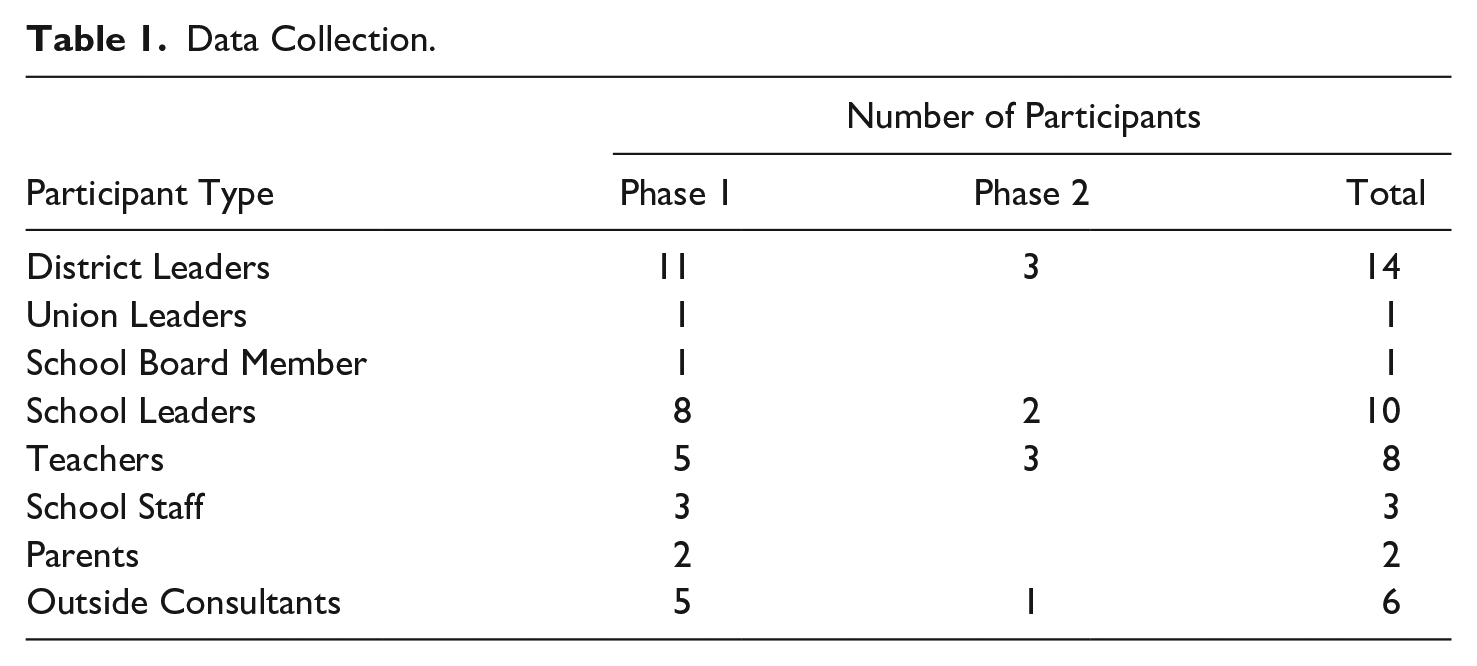
During this first phase, the three co-authors noticed a phenomenon that we had not intended to study—the stark difference between the buy-in teachers communicated for CCSS and their views of PBIS. We noticed that although teachers were generally positive about CCSS, many expressed negativity toward PBIS. We wondered if different approaches in the early implementation of these two reforms contributed to these divergent attitudes. We decided to explore this phenomenon further by addressing the research questions stated previously.
In spring 2018, we returned to Elmwood for a second round of data collection, including interviews, observations, and document collection. (See Table 1.) At the district level, we conducted additional interviews to gain deeper insight into the history of PBIS and the district’s approach to supporting its implementation. We also observed professional development sessions focused on PBIS. Finally, we conducted interviews at a third school site (a middle school) to triangulate our preliminary findings from the first two school visits.
Overall, we conducted three site visits. We interviewed school-based teachers and staff in our sample once (23 interviews) and Elmwood district leaders, including outside consultants hired to lead staff trainings, as well as a teacher’s union leader and a school board member, one to three times (23 interviews). All interviews were recorded and later transcribed. The participants were predominately White and female, mirroring the staff and leadership demographics of the district (see Table 2). To capture social interactions around data, the research team observed two district-led professional development (PD) sessions, one aligned to CCSS and the other aligned to PBIS. In interviews and observations, we also requested copies of relevant documents: five documents pertaining to CCSS and nine documents pertaining to PBIS, including training and implementation assessment materials for both policies.
Participants’ Sociocultural Background.
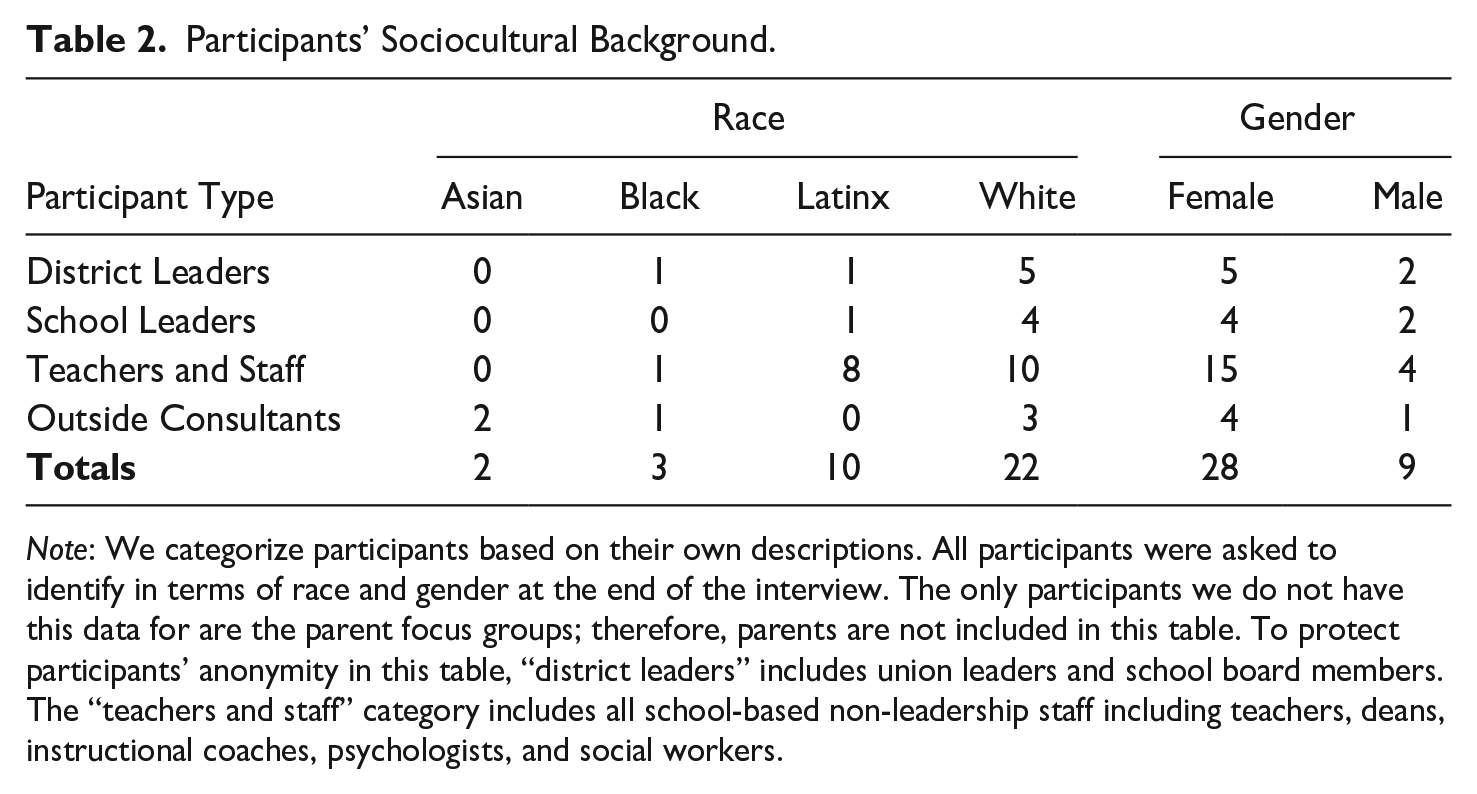
Note: We categorize participants based on their own descriptions. All participants were asked to identify in terms of race and gender at the end of the interview. The only participants we do not have this data for are the parent focus groups; therefore, parents are not included in this table. To protect participants’ anonymity in this table, “district leaders” includes union leaders and school board members. The “teachers and staff” category includes all school-based non-leadership staff including teachers, deans, instructional coaches, psychologists, and social workers.
Data Analysis
The constant comparative method is derived from grounded theory but is foundational to analysis in other traditions of qualitative research (Boeije, 2002; Glaser & Strauss, 1967). Drawing on Boeije (2002), we followed a three-step constant comparative method plan, with the following steps: (1) comparison within a single interview, (2) comparisons between codes within the same case, and (3) comparison of emerging themes from different cases.
Comparison within a single interview
We began our multiphase data analysis approach by coding all transcripts and observation notes using Dedoose qualitative analysis software. We coded all data using both inductive open coding and a priori coding aligned with the main aspects of our understanding of policy implementation. During this step, we treated CCSS implementation and PBIS implementation as distinct cases. Therefore, we conducted two rounds of initial coding where each transcript was coded for CCSS-specific data and then for PBIS-specific data.
Comparisons between codes within the same case
After the first phase of data analysis, we turned our attention to understanding the implementation process for each case. First, we analyzed the CCSS data, studying the patterns in CCSS policy implementation through axial coding and memo writing (Miles & Huberman, 1994). In order to aid our axial coding process, we created conditional relationship guides (Scott & Howell, 2008) to assist in understanding the relationship among categories. At this stage, we were able to identify patterns and preliminary themes that emerged from the CCSS data. We then followed an identical process for the PBIS-related data. At this point in the analysis, the significance of the technical, normative, and political policy dimensions emerged from our data.
Comparison of emerging themes from different cases
In this final stage of analysis, we brought in notions of race-consciousness and race-evasiveness and reanalyzed our findings through the lens of technical, normative, and political dimensions of implementation. We employed a second round of axial coding and memo writing (Miles & Huberman, 1994) to identify patterns between the CCSS and PBIS data. We also compared our CCSS and PBIS conditional relationship guides and memos. At the end of this stage, we identified patterns and preliminary themes across cases.
Limitations
Our study is not without limitations. Although an ultimate focus of this study is color-evasiveness in policy implementation, that was not the original intent of the study. Color evasiveness emerged as a key finding in the data analysis processes. Therefore, the study’s protocols were not designed to elicit participants’ thoughts on how students’ race or educator racial bias shaped policy implementation. When participants brought up the concept of racism or racial bias in an interview—always in relation to PBIS implementation—we probed to better understand their perspective, but did not consistently probe on subgroups. In other words, we cannot provide data on how participants thought of racial bias toward Black or Latinx students specifically. Given the discipline data in the district, we may assume that district leaders were implying that discipline practices were shaped by anti-Black racism; however, we cannot be sure. Yet, even with this limitation, this study provides a deeper understanding of how beliefs around racial bias and structural racism (broadly defined) shape policy implementation.
Findings
Our analysis of district-level observations and interviews with district leaders and school-based staff suggests that the early implementation processes of CCSS and PBIS were quite different. Participants regarded the transition to CCSS as positive—a view supported by statewide and national recognition of Elmwood’s CCSS efforts. District leaders took direct and decisive control over CCSS implementation. Elmwood proactively implemented the CCSS policy process two years before the state mandate, with leaders investing in a series of educator supports and structures (technical), and communicating that teachers needed to develop their content and pedagogy skills to implement the new standards (normative). To facilitate teacher development, district leaders engaged volunteer teachers and school-based leaders in a series of PDs to unpack the new standards. The volunteer teachers, in turn, helped to train their school staff on the standards. The district also placed a literacy and math coach at each school to aid teachers in the transition. District leaders utilized their authority to protect coaches from other administrative duties and to mandate teacher participation in PD (political). Uniformly, participants at the district and school level expressed that teacher development was the priority for CCSS implementation. Teachers in the study were largely invested in the CCSS process and spoke positively about the shift.
Conversely, the implementation process of PBIS was less structured and prescriptive. The Elmwood district adopted PBIS in response to the state mandate. The district’s direction of PBIS was far looser and allowed much more latitude for school site variation than its implementation of CCSS. District leaders reported that teachers were required to change their behaviors and mindsets under the new policy. However, there were many other competing beliefs about who should be the target of behavior change (normative), and the practices that Elmwood engaged in to motivate policy adoption were disjointed and not targeted toward teachers (technical). The district did not involve teachers in the initial policy adoption and provided limited support and inconsistent expectations around teachers’ implementation of PBIS. In contrast to CCSS, leaders did not exercise considerable authority to enforce implementation (political). Further, a dean was placed at each school who was primarily student-facing and did not offer support to teachers to learn the new behavior system. The majority of participants reported that PBIS implementation was a work in progress with many misconceptions. Teachers were mostly critical of PBIS and questioned its usefulness for all students.
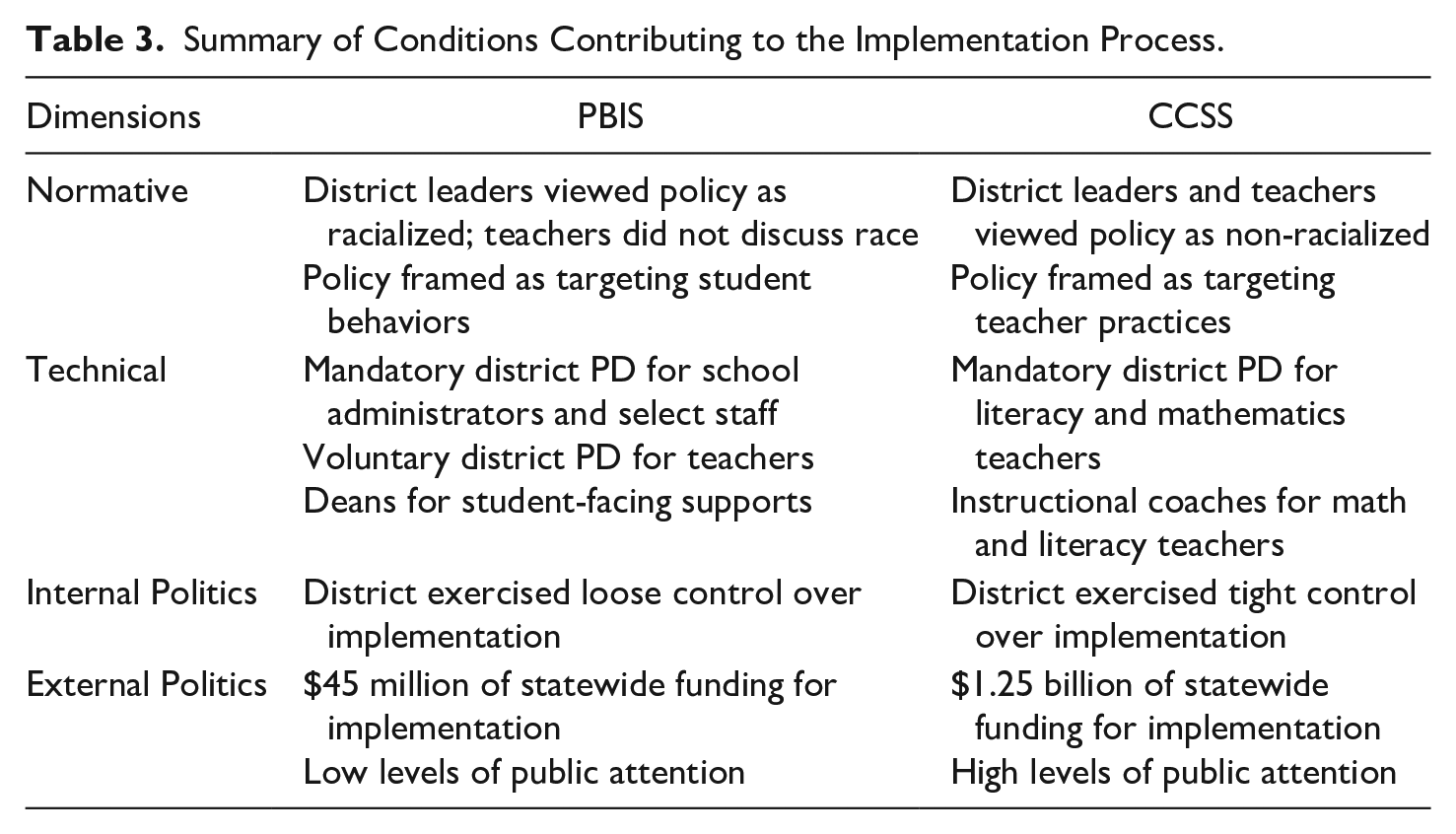
In the remainder of this section, we explore how and why the initial implementation processes and outcomes for these two policies were so divergent. As Table 3 shows, we offer a set of interconnected conditions that contributed to the different implementation processes: (1) normative beliefs; (2) internal political factors; (3) technical, teacher-facing supports; and (4) external political forces. Although we present our findings in these four categories, we recognize that these categories are deeply intertwined, and the distinctions between them are sometimes blurred; for example, the differences in beliefs that we discuss in the normative dimension, particularly notions of race and racism, appeared to influence the political and technical categories as well.
Summary of Conditions Contributing to the Implementation Process.
Normative Dimensions: The Role of Race
The vastly different technical and political investments in these two reform efforts are best understood in relation to the normative dimensions of implementation. As Table 4 indicates, in our early analysis process we noticed that administrators and school leaders often mentioned students’ and educators’ racial identities when discussing PBIS. In regard to CCSS, we found that participants discussed race primarily in the context of data use (e.g., comparing test results for racial subgroups). We also found that views on the racialized nature of each policy influenced whether district leaders targeted the policy toward teachers or students. Upon further analysis, our data suggest that normative views on racism shaped political and technical conditions of both policies, contributing to the differences we found in implementation.
Prevalence of Race in the Data, by Role Type.
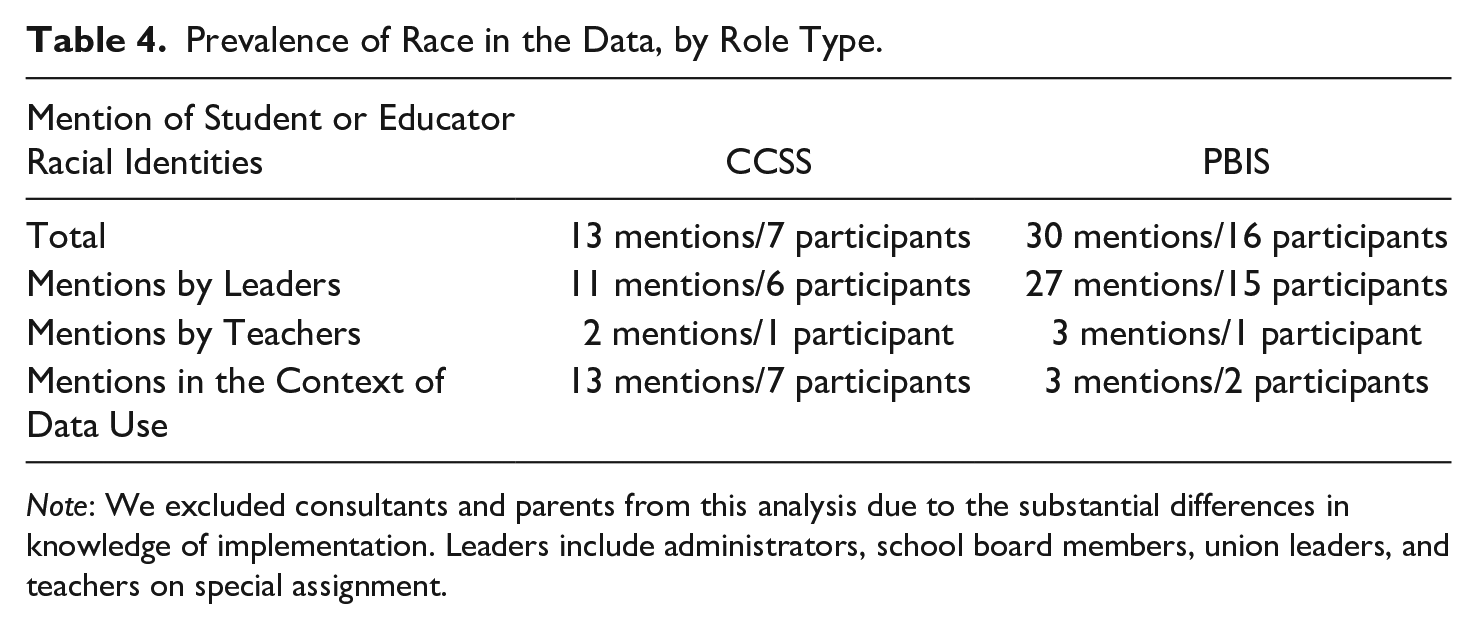
Note: We excluded consultants and parents from this analysis due to the substantial differences in knowledge of implementation. Leaders include administrators, school board members, union leaders, and teachers on special assignment.
Beliefs about race/racism
During our time at Elmwood, it became clear that district leaders viewed PBIS and discipline as distinctly racialized. For instance, when discussing PBIS, multiple district and school-based participants tied discipline issues to the inherently racialized concept of the school-to-prison pipeline. The PBIS coordinator explained how she highlights this pipeline when training staff: Instead of sending kids out, we’re really looking at this school systematic problem that society has and we’re saying that this problem is going to stop here. . . . What happens when the child is involved in the juvenile justice system? To show [teachers] that look, our old way, that zero tolerance way, is broken. It doesn’t work.
Here, the PBIS coordinator’s comments regarding a “school systematic problem” and the “juvenile justice system” invoke the school-to-prison pipeline idea, which, as discussed earlier, is primarily employed to talk about the over-representation of Black men in the criminal justice system (e.g., Castillo, 2014; Dancy, 2014). The PBIS coordinator’s phrasing thus gestures toward racism without explicitly mentioning race itself, an example of the color-evasive discourse discussed in the literature review.
Relatedly, several participants described an explicit link between perceptions of behavior and students’ “culture,” “backgrounds,” or “home.” These terms were used euphemistically (and sometimes explicitly) to refer to students’ racial identities. Participants implied that teachers were not often culturally aware enough to understand that students may behave in specific ways due to their racialized backgrounds and therefore punished students for behaviors that were not malicious but rather misunderstood. For instance, the elementary school dean stated: Having the teachers understand that this is that child’s background, this is where they come from, this is the norm in how they communicate at home. . .I think some of that definitely goes on with the African American population. Sometimes with the different Latin communities or Asian communities, just with speaking to kids and wanting the eye contact. Well, this is not the culture’s norm here, so we don’t need to press for the eye contact.
The elementary dean indicated that a lack of cultural understanding leads teachers to misinterpret the behavior of racialized students.
Participants also shared that teacher bias led to discipline decisions that were not always fair for Black and Latinx students, particularly male students. For example, the elementary school psychologist connected the racial and gender demographics of the Elmwood teaching force and discipline issues: We’re still, teaching is predominately female. Most of them are White. . . . I would like to see more diversity, especially males in the classroom because sometimes, whether we like it or not, there’s going to be a bias as a female versus when you’re interacting with a male or different culture child. It’s hard to really be bias free.
The elementary school psychologist suggests that teachers’ demographics influence discipline decisions. She argues that it is difficult for White women to not have bias when they are interacting with racially minoritized male students. Theoretically, PBIS could be a way to stem discipline bias by providing teachers with routines that emphasize noticing students’ positive behavior, rather than penalizing students. The comments from the elementary school dean and psychologist are emblematic of a belief, especially among deans and particular district administrators, that behavior and discipline were linked to students’ racial identities. We also see the implication that teachers’ misunderstanding of students’ cultures or motivations lead to discipline disparities within the district.
Although the majority of district leaders and a number of school leaders and staff connected PBIS to larger societal and district racial dynamics, teachers’ discussion of PBIS largely avoided acknowledging race. The majority of teachers described the purpose of PBIS as rewarding students for positive behaviors. Teachers expressed skepticism toward the policy and cited a lack of student consequences. A middle school English teacher detailed discipline routines in her school: “There just doesn’t seem to be any consequences and the kids know it. Behavior this year is a real challenge. . .. Honestly, I’m kind of ignoring PBIS. I just do my own thing. I do my own form of discipline.” This teacher’s comment, focused on current implementation but unmoored from the cultural and political factors that led to the policy, was typical among the teachers we interviewed.
When teachers did discuss racial dynamics of PBIS, often at the probing of interviewers, there were two themes. The first was skepticism. For instance, the union president stated: Then with the study that came in the state that said the majority of African American and Hispanic students are getting suspended at a higher rate than any others, in my personal opinion, I don’t understand since the majority of our students in this district are minorities. So to me it’s a moot point since 80 percent of our kids are minorities. So to me that just makes no sense here. But because of that study, we’ve gone into PBIS.
Here the union president questions why the district worries about discipline disproportionality when the majority of the students are racially minoritized. His comments signal that racial disproportionality in discipline is a problem experienced in other districts, but not one central to Elmwood. Another example comes from the middle school gym teacher, who when asked why PBIS was necessary for Elmwood, sarcastically replied that “news, TV” accused teachers of “suppressing the poor youth of America.” This comment implied that public discourse on school discipline was blaming teachers for harming low-income youth, a criticism of which he was skeptical.
The second way that teachers connected PBIS and race was to tie behavior to students’ situational or cultural experiences. Participants discussed student trauma, family engagement, and the need for student mentorship. For instance, attempting to pinpoint the root of a child’s disruptive class behavior, the middle school arts teacher shared: Well, it could be a lot of things. It could be [because the student was] neglected a lot. [They] could have some pretty harsh parents that put them down a lot. Or they could be babied a lot, who knows. It could be a lot of different things. Or their family could be falling apart and they’re just reacting. I mean, there’s so many variables that I don’t know.
With her assessment, the art teacher seems to indicate that the student’s home life was to blame for his behavior in class. Research suggests that teachers, especially White ones, may connect student behavior to pathologies within racially minoritized families in communities (Gregory & Mosley, 2004; Latunde & Clark-Louque, 2016). This is not to say that familial factors are never a cause for student behavioral challenges; however, across our data, teachers commonly pointed to family or community issues as a root cause of discipline concerns. Such assessments rarely extended to the role of teachers in discipline processes and remained largely student focused.
In recognition of districtwide inconsistencies in the rationales for and perspectives on PBIS, Elmwood leadership eventually brought in an outside consultant to conduct cultural awareness trainings. One of the district coaches explained the purpose of these trainings: They specifically target the African American subgroup as far as wanting the teachers to be culturally aware of [students’] backgrounds. . . being aware of why African American students maybe demonstrate particular behaviors and not looking at that as punishing them, but understanding their culture and where these things are coming from.
The coach noted trainings intended to develop teachers’ understanding of the cultural underpinnings of discipline and help them reflect on their own practices. District and school leaders reported that the cultural awareness trainings were not always well received by staff. One elementary school principal suggested that overall the trainings were “a little bit tougher for teachers to accept.”
In contrast, discussions of CCSS implementation with participants at all organizational levels were largely color-evasive. The exception to this dynamic was the disaggregation of academic data by race. Educators mentioned on numerous occasions that all teachers districtwide regularly reviewed the test scores of African American and EL students. Indeed, one of the roles of instructional coaches was to lead teachers in data talks with a focus on students in different racial groups. A middle school literacy coach described how she supported teachers in data reviews: Each teacher will get a complete printout of how every single student did in all of their classes. Then there’s a sheet where we have to break it down. How did your ELs do? How did your African Americans do?. . . You go from how did your personal 30-plus kids do to how did our population do? How did African Americans do?
From the coach’s comments and others, it is clear that teachers having discussions about how students in certain racial categories are performing was a district norm. All of the ELA and math teachers interviewed discussed participating in coaching meetings and receiving data disaggregated by student subgroup. The disaggregation of data by race and status did not seem to stir the same emotions that emerged in discussions of racial disproportionality in discipline in the context of PBIS implementation.
Discomfort with Addressing Racism
Our data suggest that key district leaders had a level of discomfort or concern with tackling the racialized issues at the center of PBIS because they were worried about their teaching staff’s reaction. For instance, the associate superintendent explained his staff’s response when attempting to discuss racial disproportionality data during his tenure as an Elmwood principal: “People weren’t really ready for those conversations at that time. I don’t think those were as well received. . .. The idea was, ‘Are you saying that we’re racist? Are you saying we have a bias against these students?’” This leader’s experience revealed to him that teachers may interpret discussions about discipline data in a moralistic and personal matter. Notably, this administrator was a champion of discipline reform in Elmwood and believed implicit racial bias shaped discipline in the classroom. However, the fear of teachers believing that they were being called “racist” seemed to undergird a hesitancy to construct PBIS as a teacher-focused policy or to express urgency regarding PBIS implementation.
In one interview, the associate superintendent compared discipline and instructional policies and concluded that discipline policies evoke a strong, more defensive teacher response: Ultimately, talking about response to student behavior elicits a different reaction than talking about shifting curriculum or some other things at a school site, because a lot of it is personal. Teachers internalizing things and saying, “What are you saying about me and the fact that I send this student out more frequently than that student?”
It appears that district leaders may have feared that discipline policy would be interpreted as targeting teachers’ morality and did not want to alienate teachers in this way. These fears seemed to shape key actions taken by Elmwood leaders in the implementation of PBIS and CCSS—notably who they framed as the targets of each policy. As we explain below, leaders may have focused PBIS on students as the primary targets requiring behavioral change to avoid uncomfortable conversations with teachers about their racial biases. Importantly, participants did not suggest that discomfort with addressing racism shaped CCSS implementation, perhaps because educators’ biases were not perceived as central to instructional reform.
Beliefs About Policy Target
Although district leaders believed that PBIS implementation would require teachers to adjust their mindsets, the way they communicated about the reform to school-based staff focused solely on students and the students’ need to change their behavior. An outside PBIS consultant who trained administrators to introduce PBIS to teachers described her training this way: “So it’s like we have this problem, PBIS is going to help address it. So we have these [student] behavioral issues. . .and so we wanted them to be able to articulate that to the teachers.” The problem was framed around student behavior and not teacher actions. When asked what the purpose of PBIS was, the middle school gym teacher stated: “Just using positive behavior as a, you know, incentives, rewards, that kind of thing. See if that can inspire kids to behave the way we want them to, kind of.” Similarly, when asked about the purpose of PBIS, the art teacher responded: “Adding more positive incentives as a focus rather than punishment, punishment, punishment.” Although teachers understood PBIS as a new way to approach students’ problematic behaviors, the majority did not see it as a new way to view students’ behaviors or see the need to interrogate why and how they responded to students. Out of the 10 teachers interviewed, only one indicated that PBIS required shifts in teachers’ mindsets around discipline. The nine remaining teachers shared that the purpose of PBIS was to change student behavior by “rewarding the positive.” Teachers generally were not reflective of how their biases might affect discipline decisions.
Although leaders communicated, and teachers understood, that PBIS was intended to change student rather than teacher behavior, district leaders identified teachers as the main target of CCSS implementation. Early in the transition to the new standards, leaders expressed that teachers needed to develop their content and adjust their pedagogy skills. The associate superintendent explained: When we really looked at the Common Core State Standards at the time of adoption. . . . They weren’t just change in font size. There were some significant shifts in what students were expected to know and be able to do, and then all of the correlated shifts that would have to happen in instructional practice for that to happen.
To facilitate teacher development, district leaders engaged volunteer teachers and school-based leaders in a series of PDs to unpack the new standards. These volunteers, in turn, trained their school staff on the standards. All of the teachers in our original sample indicated that the purpose of CCSS was to change teachers’ instructional practice.
Ultimately, the normative dimensions of policy implementation, in particular the beliefs about race and discipline, shaped the technical and political dimensions, which we explore next.
Technical Dimensions: Investments in Teacher Supports
Our data suggest that the normative dimension, especially how the district chose to frame the targets of the policy, shaped the support given to help teachers understand and implement the two policies. For instance, although the district hired substitutes so that teachers could attend the CCSS transition PDs, the same action was not taken for PBIS. The majority of the PBIS PD was provided at the district central office for school-level administrators and deans. District-level participants reported that teachers were not included due to the cost of hiring substitutes to cover the classes while teachers attended the meetings. The district offered one series of PBIS-focused PDs for teachers, but those PDs were voluntary and offered in the summer. The PBIS consultant noted the different resources and value that the two reforms received: You guys are looking at Common Core training. During that time teachers were pulled for weeks at a time to teach them how to implement Common Core. I personally feel [PBIS] is just as important and we should provide that much training, but it just doesn’t get the resources.
The differences in technical supports for the two policies were particularly evident when comparing the role of deans and instructional coaches. At the beginning of the transition to PBIS, district leaders decided to place deans at each school—in large part, to free up time for school principals and assistant principals to become instructional leaders guiding CCSS implementation. Therefore, the dean position was created to relieve some of the discipline responsibilities from those leaders and to run the PBIS program at the school site. The superintendent described the dean’s role and impact: “[Deans are] working really well, because I think that as administrators when we’re dealing with discipline, you go with the shortest, easiest, best way because you got to move on to the next thing.” Most interviewees at the district and school level viewed deans as behavioral support for students and a relief for administrators. Indeed, several participants called them “discipline deans.”
Three district participants—who most closely oversaw PBIS in Elmwood—suggested that deans should have had a component of their role that was teacher-facing, but recognized deans rarely embraced that role or provided behavior management feedback to teachers. Participants indicated the labeling of the “discipline” dean seemed to limit their role in school and constructed the dean job as student-facing. As a result, participants reported a myriad of answers when asked who supported teachers with classroom management issues. For instance, the PBIS coordinator suggested administrators should support with classroom management. In contrast, two principals suggested that teachers would be able to handle issues themselves if they read the book Teach Like a Champion. One middle school principal shared: I always recommend Teach Like a Champion [to teachers] and I try to do some staff development with that book. In PBIS they also use a couple of strategies from TLAC, like Call and Response, you know what I mean? Things like that, maybe some call and response.
Additionally, the middle school art teacher suggested that a teacher who was struggling with discipline could call the dean who would deal with the student: “Sometimes they’ll have them come down to the room, and he will talk to the kid. And he’ll decide if he needs to leave or not leave, and he usually knows the kid already.” When asked how deans supported struggling teachers, many respondents echoed the art teacher, focusing on how the deans spoke with the students, rather than the coaching or development teachers received. Overall, there seemed to be a lack of consistent or coherent support for teachers who needed help implementing PBIS or with classroom management in general. Rather than developing teachers, it was expected that the dean would come and “fix” the student.
Instructional coaches, on the other hand, were an influential teacher-facing support in the transition to CCSS. At the start of Common Core implementation, district leaders placed a literacy and math instructional coach at each school. The coaches supported the teachers in CCSS implementation at their school sites by reviewing data, assisting in lesson planning, and modeling instructional strategies. In speaking about the coaches, the associate superintendent stated: I think it’s critical that the teachers have that out-of-classroom contacts that they can seek out when they have questions; that there’s somebody that can come in and observe and provide feedback to support them in their instructional practice, not in an evaluative manner, to improve their instructional practice.
Coaches also relieved teachers of some instructional burdens. For instance, responding to teacher complaints about the time-consuming nature of data analysis required for CCSS, district leaders decided that coaches would analyze CCSS-aligned benchmark testing data for teachers, including disaggregating the data by students’ race and status. The coaches led teachers in data conversation meetings, guiding them to reflect on results and to create next steps. Uniformly, the participants described coaches as helpful in CCSS enactment. A middle school math teacher shared: I feel that the best support that they’ve given us is our math coach. . .. She’s a great resource. We get to discuss unit by unit. We assess that data. . . . that’s a really important piece that has helped me.
Participants frequently mentioned coaching as one of the most important strategies the district adopted in the shift to CCSS.
In summary, district leaders made important personnel investments to support the implementation of both PBIS and CCSS; however, the roles were constructed differently, with deans offering behavioral support and relieving administrative burdens, and coaches directly supporting teachers in adjusting instructional practice.
Internal Political Dimensions: District Control Over Reforms
We find that the racialized perspectives of PBIS and the race-neutral perspectives of CCSS may have shaped how willing district leaders were to exercise their power during the implementation of the two policies. In the case of both PBIS and CCSS, the implementation of the policies could have led to tighter control of teacher practices; however, our data suggest that Elmwood leaders left PBIS implementation largely up to the local school sites. For example, the middle school gym teacher shared how staff at his school first learned about PBIS: It was during a [school] staff development. . .the first rollout of it was very, very rough because there was very little teacher buy-in. Since it was the beginning of it, kind of a lot of questions that weren’t answered, and we didn’t really have anyone to answer them.
Further, the district gave school leaders a good deal of discretion over how PBIS would look at each school site. For instance, in discussing how schools should handle a teacher who makes too many discipline referrals, the director of school climate, who oversaw PBIS, explained, “Every site’s different, every [school] culture’s different, so whether or not they feel comfortable having that conversation in the open would probably depend on the dynamics of the site.” According to the climate director, each school can employ a different approach to PBIS. She also suggests that if school leaders are not “comfortable” discussing potential overuse of discipline referrals, the conversation is not required.
The loose control that the district had over PBIS stood out in stark contrast to the tight control it exercised during CCSS implementation. The district mandated schools to adopt uniform curricula, pacing guides, coaching models, and leadership practices. Although slight variance to these practices was described as acceptable, overall, the expectation was that CCSS practices were to be consistent across the school sites. The superintendent explained: “I think the philosophy in this district is that every person in this district touches children, and so we all have to be on the same page that students are the focus of everything we do.” The “same page” and “students are the focus” attitude was largely mirrored by teachers involved in the CCSS implementation.
District supervision of the dean and coach roles also reflect the discrepancy in the political will district leadership extended to both policies. Deans were often burdened with administrative tasks and pulled in myriad directions—reflecting little political will on the part of district leaders to protect their time for PBIS implementation. The PBIS coordinator described how it was challenging for deans to get into the classroom and offer targeted support to teachers due to other administrative responsibilities: That first day back, it was “what we want to do this year is really to block out a window of time. . .. Deans we want you to have some sacred time to get into the classrooms.” Some of the deans really took hold of that and did it but, I think the majority were never really able to block out that time.. . . Sometimes if the administrator is out, the dean is the admin designee so they might get pulled for different things.
The added responsibilities that deans took on did not leave time to help support or train teachers who struggled with the new PBIS system.
The responsibilities of the deans contrasted sharply with the responsibilities of coaches. District leaders attempted to shield coaches from administrative tasks in their schools, to ensure a consistent focus on supporting teachers with CCSS implementation. Indeed, the superintendent shared that she told her principals: “‘I better not catch [coaches] doing administrative stuff,’ that’s not their job.” The same protections were not extended to deans. Further, the PBIS district leader also indicated that school-based administrators were not addressing discipline or PBIS implementation. The deans were then expected to handle all of the discipline concerns and support all of the teachers in behavior management issues and concerns. Compared to instructional coaches who were responsible for five or six teachers each, the task before the deans was monumental.
External Political Dimensions: Broader Policy Context and Public Opinion
The broader policy and political context in California and beyond created another set of conditions greatly shaping the divergent implementation of these two reforms. Overall, these external political forces leaned heavily in favor of prioritizing CCSS over PBIS implementation. First, the availability of resources appeared to influence the early implementation process of both policies. We found that the CCSS transition received more financial and personnel resources at the beginning of the implementation process than did PBIS, due in large part to how the state of California allocated resources to both reforms. Districts were able to apply for state funding for both reforms, but the overall amount available for CCSS was significantly higher than the amount available for PBIS. In 2013, California allotted $1.25 billion for CCSS implementation (California Department of Education [CDE], 2018), compared to only $45 million for PBIS implementation (CDE, 2018). Elmwood leaders had fewer resources to give to PBIS and therefore were not able to mirror their CCSS implementation processes.
Yet, we cannot attribute the disparity in resources between these efforts solely to state funding. Participants indicated that public and organizational perceptions of the importance of discipline reform impacted resource allocation decisions. The PBIS district leader suggested that PBIS received fewer resources because discipline reform was not a high priority relative to academic reform and that the public was not as concerned with discipline data. She explained: “You know, people are used to seeing API data, they’re used to having reporting.. . . People are not reporting discipline data like they are academic data.” Here, the PBIS district leader is referring to the Academic Performance Index (API), a publicly reported accountability metric based on standardized test scores for California schools from 1999 to 2013 (CDE, 2020). In 2017, the API score was replaced by the state’s new accountability system and dashboard that reports suspension rates alongside multiple additional measures (test scores, English learner reclassification, graduation rates, absenteeism, and college/career readiness; CDE, 2021). Thus, whereas Californians had over a decade of familiarity with performance metrics on standards-based testing, the reporting of discipline data in a multiple-measure system was still in its infancy at the time of our data collection in 2018. The state accountability system’s historical premium on standards-aligned test scores might reinforce expectations to prioritize CCSS over PBIS.
Discussion
In this study we compare how a school district implemented CCSS and PBIS policies concurrently, finding significant differences in how Elmwood leadership implemented the two policies. In particular, we found that district leadership exercised tight control and expressed a clear vision when it came to CCSS. However, despite their largely successful approach to CCSS, district leaders followed a different path for PBIS implementation—leading to relatively less buy-in from teachers. To better understand these differences, we return to the “zones of normative and political mediation” (Oakes et al., 2005). We contend that Elmwood district leaders viewed the normative and political dimensions of these policies quite differently, shaping the technical reform the district implemented. Ultimately, we suggest that these conceptions around the policies shaped implementation and raise larger questions about the dangers of color-evasiveness in education policy implementation.
Elmwood stands out as an essential site to study. Through the district’s implementation of CCSS we know that the district has had stable leadership (a frequent barrier to enactment in other districts) and a track record of implementing policies in ways that invest in teachers and staff and lead to improved student outcomes. The success of CCSS here indicates that the capacity to implement policy exists. Therefore, the challenges facing the implementation of PBIS suggest unique challenges related to discipline—and potentially other racial equity—policies. Understanding the unique challenges that discipline policies face may lead to better guidance for policymakers and leaders implementing such policies. Further, by comparing how district leadership implemented the two policies simultaneously over the same time period, we are able to examine how practices shift depending on normative and political values intertwined with the policies, building a deeper understanding of the policy implementation process. In particular, this study highlights that different policies bring with them different values and racialized meanings that are consequential for how policies are supported (or not) and taken up in practice.
Examining the CCSS Zone of Mediation
Elmwood district leadership did not hesitate to wield its political power in implementing CCSS. Elmwood leadership saw CCSS as a vast undertaking, but one that the district had experienced before in light of the state’s long history of instructional reforms (CDE, 2018; Cohen & Hill, 1998; Spillane & Thompson, 1997). The district focused on developing teachers’ capacity and shifted a plethora of organizational structures to meet this goal. We argue that the perception that CCSS was “race neutral” or did not challenge staff’s normative views on pedagogy allowed district leadership to feel comfortable in exercising tight control over the implementation of CCSS.
Participants rarely discussed students’ racial backgrounds when referring to the implementation of CCSS. The only instances when race did emerge were when participants addressed the district’s practice of data disaggregation. Elmwood educators regularly examined instructional data specifically for African American students 1 (as well as EL students) and yet participants did not seem to view CCSS as a racialized issue. In fact, one could easily connect CCSS to broader public discourse around the “achievement gap” (e.g., Lee, 2002) or the “education debt” (e.g., Ladson-Billings, 2006), both of which document the persistent gaps in educational testing scores and college completion rates between White students and their racialized counterparts. We can only infer possible explanations for this finding. It seems possible that disaggregation of student data has become institutionalized, routine, and even mundane—as one district leader stated: “It is what we do.” The routinization of data disaggregation also may be, in part, shaped by California’s school finance policy, the Local Control Funding Formula, which incentivizes data disaggregation and public reporting (Koppich et al., 2018). As such, individuals may take for granted the practice of data analysis, leading to a compliance behavior that no longer questions the purpose or probes deeply for explanations. Furthermore, we wonder if educators are so used to disaggregating data for African American and EL students that any observed disparities are not conceptually associated with systemic racism. This finding might also suggest that the practice of disaggregation has been absorbed into dominant color-evasive racial ideologies.
At the time of our study, Black students underperformed Latinx students in the district. Therefore, the fact that data disaggregation for the African American and English Learner subgroups was a common practice in Elmwood, and that teachers commonly discussed how these two groups were performing, may be seen as a best practice. However, the discussion of achievement data was disconnected from the historical and cultural ramifications of race or language. We also found little evidence that when students were underperforming, teachers engaged in larger questions about their role in perpetuating and sustaining racist practices. Nor did we find evidence that culturally sustaining teaching practices were included in Elmwood’s CCSS implementation process. Furthermore, we find it troubling that participants rarely discussed Latinx students, instead referring solely to EL students. Although Elmwood’s Latinx students outperformed Black students in Elmwood and their peers in the state, they did not outperform their White peers, indicating the need to continue to examine the performance of that subgroup. Ultimately, data disaggregation in Elmwood raises questions about the impact of the practice untethered to larger conversations about race and power.
Elmwood’s CCSS implementation leaves us with a paradox. On one level, CCSS in Elmwood was successful, achieving national recognition for its standardized testing scores. Color-evasive approaches to policy promote a level of comfort and security among actors (Diem & Welton, 2020). Such an approach is exemplified in Elmwood’s CCSS processes; although district leadership explicitly labeled teachers’ instruction as something to be improved and altered, teachers did not seem to take undue offense. The color-evasiveness as a normative framing for the policy seemed to facilitate a relatively smooth implementation process. Leadership then supported its framing of CCSS with training and resources. However, we wonder if CCSS in Elmwood could have achieved even more academic growth if teachers were encouraged to truly consider the relationship between racial bias and student outcomes within their classrooms.
Equity-minded policy theory maintains that a subset of policies requires confronting power arrangements and personal bias (Oakes, 1992; Oakes et al., 1993, 2000). In this literature, scholars focus on obviously racialized policies such as tracking (Oakes, 2003), school discipline (Wiley et al., 2018), and demographic shifts (Holme et al., 2014), and argue that explicitly racialized reforms must address the social context in which they are embedded (Wiley et al., 2018). We suggest the same may be true for instructional reform. A critical stance contends that issues of power and race always matter in education policy (Dixson & Rousseau Anderson, 2018; Gillborn, 2013), and reform movements that do not address issues of power are doomed to fail (Diem & Welton, 2020). For example, scholars have suggested that a limitation of the standards-based movement at large has been a failure to recognize how racial structures influence teaching and learning (Bennett, 1995; Futrell & Brown, 2000; Van Hook, 2002). Further, research shows that teachers’ racialized perceptions of students matter for their academic performance (e.g., Ferguson, 2003; Grissom & Redding, 2016; McGrady & Reynolds, 2013; Ouazad, 2014). To truly transform instructional practice, it seems that educators must contend with the realities of structural-institutional racism—a topic absent from interviews and observations related to CCSS in Elmwood.
In the end, our findings on CCSS yield implications for practitioners and research. First, leaders might notice the limitations of disaggregation as a practice without looking at the data through an antiracist lens (Diem & Welton, 2020). We suggest that leaders facilitate conversations about the root causes of patterns in data by using tools such as the ERASE framework suggested by Myers and Finnigan (2018). The ERASE framework leads educators through a data selection process that centers issues of power. To facilitate such work, leadership preparation programs should seek to develop leaders’ historical and conceptual understanding of racism, as well as their awareness of their own racial identities, through exercises such as racial autobiographies (Gooden & Dantley, 2012; Gooden & O’Doherty, 2015). Next, researchers might consider the ways that our field has historically approached analysis of instructional reform in color-evasive ways. Integrating perspectives that consider the role of systemic racism in the design and implementation of instructional reforms might open new pathways of understanding and analysis. In particular, scholars may want to interrogate seemingly “equitable” practices such as data disaggregation.
Examining PBIS Zone of Mediation
The nature of discipline reform requires educators to examine their normative beliefs about student behavior (Lewis & Diamond, 2015; Welsh & Little, 2018). Research shows that implicit bias impacts teachers’ discipline decisions and that racially minoritized students, particularly Black students, are often perceived to misbehave more than their peers (e.g., Downer et al., 2016; Gilliam et al., 2016). The negative perceptions of student behavior exist even though research shows that racially minoritized students behave similarly to their White peers (e.g., Bradshaw et al., 2008; Thomas et al., 2009). Elmwood district leaders and some school-based leaders seemed to be aware of how race and teachers’ perceptions of behavior were intertwined and understood PBIS to require shifts in normative beliefs about the racialized issues at the core of discipline practices.
However, district leaders appeared reluctant to address these issues with staff and seemed intent on implementing PBIS in a color-evasive manner. It seemed that to explicitly discuss the connection between race and discipline would mean calling or being perceived to be calling the teachers “racist” or “immoral.” In part due to this apprehension, the widely circulated messaging around PBIS was that the policy aimed at correcting students’ behavior. Often what was ignored or overshadowed was that teachers needed to shift their own actions and perceptions. With PBIS, it seemed more comfortable to focus on students’ shortcomings than to have teachers dissect their own practices and to consider if racial bias played a role.
By framing the policy around students, leaders were able to avoid discussing topics like implicit bias or, indeed, racism, with their mostly White teaching force. However, by avoiding race, the district did not have a compelling reason for why teachers needed to change their classroom management strategies—leading to staff frustration. Further, the policy’s nebulous normative framing was accompanied by limited technical supports (such as limited PD opportunities) that did not assist teachers in changing their practices. Teachers’ attitudes toward discipline reflected this approach, because they often blamed student misbehavior on students, their families, or the failures of PBIS itself. However, the fact that Black students were disproportionately punitively disciplined compared to all other racial subgroups within the district points to issues of anti-Black racism (Quereshi & Okonofua, 2017; Rudd, 2014). Although administrators and district leaders were able to articulate an understanding of racism, they felt that color-evasion was the safest approach in order not to trigger White rage and block implementation altogether. These findings raise questions about Elmwood’s PBIS implementation as discipline reform without attending to issues of racial bias and the ways in which these practices continue to perpetuate inequality (Diem & Welton, 2020; Welsh & Little, 2018).
Our findings provide two insights into how district leaders may better support their staff in discipline reform endeavors. First, just as teachers need to be taught skills related to instruction, teachers need support in handling classroom management. It is well documented that instructional coaches can lead to improved classroom instruction (e.g., Desimone & Pak, 2017; Marsh et al., 2010). Perhaps teachers need behavior management coaches to aid their understanding of new discipline policies. The practice, although not widely adopted, has been taken up in some cases with positive results (Hershfeldt et al., 2012). Second, there may be a tendency to avoid the racial dynamics of discipline and classroom management. Rather than avoid the topic, district leaders should consider facilitating conversations and training around race and discipline before they institute discipline policy changes such as PBIS. In Elmwood, district leaders brought in cultural awareness training only after PBIS had been in place for multiple years. We recognize that such endeavors take financial resources; however, we contend that educators need to understand the racialized issues at the heart of discipline reform and be invested in addressing them early to ultimately achieve the policies full potential (Irby, 2018; Welsh & Little, 2018). Importantly, local leaders may need their own training in how to address these issues with staff.
Our study adds to a small but growing body of work on the implementation process of discipline policies. Further work is still needed in this area. First, other studies could consider what teacher supports and resources impact discipline policy implementation under contexts different than the ones present in Elmwood. Second, our findings of the racialized nature of discipline reform acting as a barrier to implementation should also be investigated in different contexts.
Policymaker’s Ability to Shape Zones of Mediation
Our study suggests that CCSS implementation was privileged by both the state of California and the Elmwood community, influencing district leaders’ decision making. Elmwood leaders shared that funding from the state influenced the attention they paid to each policy. Given the relatively larger amount of state funding for CCSS, Elmwood leaders were more easily able to hire substitute teachers, so teachers could attend PD. The same choices were not available for PBIS. District leaders also suggested that CCSS was more of a priority because parents cared more about test scores than discipline data. We do wonder if this study had been conducted after the 2020 protests against police brutality, whether more public attention would have been paid to discipline data.
We encourage policymakers to consider how they allocate money to discipline reforms. If school districts are expected to implement such reforms with fidelity, they will need the financial resources to do so. Further, resources may also signal legitimacy. Policies with less funding may be seen as less valued. Policymakers should also consider the role of discipline in accountability systems and the message that their choices send to the greater public.
Conclusion
Education policies cannot be separated from their normative and political contexts, and the advancement of equity requires policymakers, practitioners, and researchers to contend with the challenges of race and power. We add to the growing voices calling for the end of color-evasive policy implementation and the advance of race-consciousness in policy design and implementation.
Footnotes
Acknowledgements
The authors would like to thank Suneal Kolluri for his invaluable feedback on earlier versions of the study. We also thank Kate Kennedy for her support with data collection.
Declaration of Conflicting Interests
The author(s) declared no potential conflicts of interest with respect to the research, authorship, and/or publication of this article.
Funding
The author(s) received no financial support for the research, authorship, and/or publication of this article.