



Abstract
Background/Context:
Since the early 1990s, the United States has been witnessing reforms in large, high-visibility cities, with mayors granted the power to appoint school boards, superintendents, or both. This shift away from elected school board governance has been characterized as marginalizing traditional educators and ushering in reforms that traditional educators oppose. On the other hand, Japan’s experience with mayoral control of schools is nationwide and longer-lived. In 1956, mayors were given authority to appoint members of the school board, and in 2015 they were given further authority to appoint school superintendents.
Purpose/Objective/Research Question/Focus of Study:
This study analyzes whether Japanese mayors appoint superintendents whose backgrounds make them likely to challenge the education establishment and introduce dramatic educational reforms. We provide some early evidence on how mayors have been using their new powers and how they interact with the superintendents they select.
Research Design:
We used data from nationwide surveys conducted by the Japanese government to map the broad pattern of superintendent characteristics over time as well as for a sampling framework to identify and select a smaller number of superintendents to be interviewed for obtaining in-depth information. Semistructured interviews of six superintendents were conducted to delve more deeply into the relationship between mayors and superintendents, and the communication between the superintendents and the school board members in Japan. To triangulate the interview data, transcripts of school board meetings, city council meetings, election bulletins (official campaign manifestos), demographic data, and national test scores of students were collected from 2015 to 2019.
Conclusions/Recommendations:
We identified important differences between the United States and Japan. Rather than aligning with the reform-oriented mayors against school boards and education bureaucracies, the Japanese mayor-appointed superintendents act as mediators between the mayors and the school boards. The difference may be that, in the United States, only mayors who sought mayoral control had the right to appoint school superintendents, whereas in Japan the national government gave all mayors the right to appoint superintendents, regardless of the political context.
Educational policy is becoming increasingly politicized, and one significant question is: Who should govern education? Different countries apply different governance structures to education; however, despite differences in traditions, cultures, and beliefs, they face some common challenges. One challenge that has garnered substantial attention relates to the degree to which education decisions are centralized at the national level or delegated to the state, provincial, or local government levels. Another challenge, which has received considerably less attention, concerns the relative roles of elected and general-purpose institutions and actors, such as mayors, versus appointed professionals with education-specific expertise, such as superintendents.
Since the early 1990s, in several large cities in the United States, traditionally elected boards of education have been replaced by mayoral control (Henig, 2013; Henig & Rich, 2004; Wong et al., 2007). Other countries, including Japan, which have been deeply influenced by the traditional U.S. model, have also taken up the mayoral control approach (Wang, 2007). Indeed, because the Japanese system is more centralized, this pivot toward mayoral control is more sharply defined than in the United States, where the impetus depends on a combination of state and local decisions. This contrast between Japan and the United States allows scholars and policymakers to draw lessons on what mayoral control augers when it is more broadly adopted.
This article takes advantage of that opportunity by describing recent educational reforms in Japan that have given mayors a strong formal role in education. Since 2015, Japanese mayors have been able to appoint superintendents directly and have been given the authority to set basic education policy. We provide some early evidence on how mayors have been using their new powers and how they interact with the superintendents they select. In the United States, the shift to mayoral control has frequently been associated with reforms that challenge and disrupt the norms and practices of education professionals. However, we found that the anticipated tension between general-purpose elected officials and education-specific bureaucrats is less evident in Japan, with appointed superintendents playing bridging and mediating roles. We conclude with some speculations about whether and in what ways the United States and Japanese experiences converge.
Mayoral Control in the United States and Japan
At the beginning of the 20th century, it was common for public schooling in large U.S. cities to be run under the auspices of a municipal agency overseen by the mayor. However, reformers of that era promoted a switch to separate school districts overseen by an elected board of education. Mayors at that time were often associated with partisan machines, but reformers argued that an elected school board could be buffered from party politics and patronage. In theory, board members would reflect the values and concerns of voters who cared deeply about schools. They might be civic leaders without deep knowledge of curriculum and instruction techniques, but they would set broad policy priorities and appoint a school superintendent with professional expertise and administrative skills to fine-tune and implement their vision.
The school board model quickly became dominant in the United States. However, during the latter half of the 20th century, criticism began to accumulate, culminating in the early 1990s with direct challenges to the elected school board structure from politicians, business leaders, and philanthropists (Henig, 2013; Henig & Rich, 2004; Henig et al., 2019; Howell, 2005). This criticism arose from concerns about mismanagement, waste, and educational performance, including gaps in race and social class achievements. Critics argued that elected school boards were amateurish meddlers driven by personal ambition, overly deferential to teacher unions, and too inclined to tie the hands of, or replace, superintendents (e.g., Miller, 2008).
In contrast to school board members elected by and held directly accountable to voters who are most focused on education, mayors are responsible for a much wider array of issues, including economic development, housing, transportation, and crime prevention (Freidus, 2019). That means that mayors, in principle, are better positioned to understand and address spillover effects that occur across policy arenas. It also means that mayors have broader and more diverse constituencies, and they regularly interact with voters and interest groups for whom schools are not a central concern. Irrespective of whether they are granted formal power, mayors are also typically interested in education, because a school district with a good reputation attracts businesses and wealthier residents, improving the local area’s reputation and strengthening its tax base.
In the United States, local school boards are legal creations of state governments, and mayoral control of education is possible only when the state permits it. Thus, a mayor who wants control of the school board must persuade the state legislature to grant it (Morel, 2018; Wong & Shen, 2003). At the same time, some state legislatures are attracted to the idea of having a mayor, rather than a school board, as their local partner and have even imposed mayoral control in some cases in which the sitting mayor was reluctant to take on the role (Henig & Rich, 2004). Although the specifics of the governance arrangements can vary, the term mayoral control generally indicates that the mayor appoints some or all of the school board members and determines the selection of the superintendent, either directly or indirectly, by influencing the appointed board.
There is a considerable amount of literature on mayoral control, but some dimensions have received more attention than others. Much of the published research has focused on the politics that give rise to mayoral control or the ways that mayoral control reshuffles politics (Henig & Rich, 2004; McGlynn, 2010; Portz, 2000; Shen, 2012; Wong, 2011). The central preoccupation has been with the contention between education reformers who favor disruptive policies like charter schools, test-based accountability, and school closures versus teacher unions (Cuban & Usdan, 2003; Edelstein, 2014; Henig, 2013). Traditionally, school board superintendents usually come up through the ranks of district leadership positions and are regarded as being generally supportive of the organizational norms and values embedded in the existing arrangements. Some advocates of mayoral reform argue that instituting genuine change requires a different type of superintendent, one who might come from a nontraditional background, like business or the military, and accordingly is more willing to challenge teacher unions and others invested in familiar and comfortable practices. However, much less attention—conceptually and empirically—has been paid to the role of the superintendent and interactions between superintendents and the mayors who bring them into office. Superintendents are somewhat casually assumed to be agents of those who appoint them, with mayor-appointed superintendents portrayed as reform agents in contrast to board-appointed superintendents, who are expected to be resistant to political intrusion by noneducators and are largely protective of the educational status quo (West et al., 2014).
The evidence from some high-profile cases is consistent with the notion that mayoral control causes conflict between reform-oriented superintendents and traditional education actors such as school board members, teacher unions, and parent associations (Beck, 2003; Lofton, 2010; Maranto et al., 2017). This was the case in Washington, D.C., where the appointed superintendent, Michelle Rhee, decided to fire central office staff and implement a significant teacher compensation reform without broad community agreement 1 (Rhee, 2014; Wong, 2011). Further, in New York City, Joel Klein aggressively pushed for school closures and charter schools, sparking resistance from teachers and many parent groups (Gold et al., 2011). However, such high-profile cases may not be fully representative, and previous studies of mayoral control have not dealt in detail with the relationship between a mayor and a superintendent in city hall. Although previous studies have focused on changes in the superintendent’s role and the relationship between the school board and the superintendent (Alsbury, 2014; Usdan et al., 2002), there has been little focus on micromanagement and communication between mayors and superintendents (Beck, 2003; Cuban & Usdan, 2003; Johnson & Johnson, 1996; Kowalski, 1995). The present study addresses this gap in the literature by focusing on superintendents’ daily interactions with their mayors and school board members. The study investigated how the superintendent’s role changes when mayoral control over education governance is strengthened.
This study took place in Japan, where in 2015 mayors were given the authority by the Japanese government to appoint school superintendents (Tanigawa & Suzuki, 2018). Prior to this, since 1956, a superintendent was appointed by the members of the school board, and the school board members were appointed by the mayor. In 2015, mayors were also given the authority to set up general councils for education (GCEs) 2 in their cities and establish basic education policy (BEP). The GCE consists of the mayor, the superintendent of education, and the education board members. The GCE is the arena for consultation with mayors in developing BEP but is not involved in the appointment of the superintendent of education. At the same time, city councils became more concerned with the changing role of school superintendents and the influence that mayors can exert over educational policies by pressuring superintendents. For this reason, city councils were empowered to approve their mayors’ choices of superintendents. These reforms mean that decision making about public schooling in Japan takes place more in general-purpose governance institutions than in education-specific ones, as is much more typical in the United States (Henig, 2013).
A publicly elected school board system existed in Japan for a brief period between 1948 and 1956 but faced various problems. Although many superintendents had experience as school principals, their salary levels were lower than those of principals, making it difficult to attract suitable candidates for the position of superintendent of education. Prefectural school board members were often supported by teachers’ unions and tended to be at odds with the governor. Many municipal school board members had conservative political views, but in some cases those who were unsuccessful in city council elections were elected as school board members. Voter turnout was lower than in general elections, and the quality of the winners was poor. The board of education was empowered to submit budget proposals to the councils separately from the mayor, which caused conflict between the mayor and the board of education. The superintendent of education struggled to stand between the governor and the school board members.
The appointive school board system, initiated in 1956, resolved some problems, but potential points of tension remained between education-specific officials (school boards and superintendents) and general-purpose officials (mayors and governors). Governors and mayors were given the authority to appoint school board members. School boards were now established in all prefectures 3 and municipalities. The prefectural governor appointed five prefectural school board members, and the board of education appointed the superintendent of education from outside the board of education. Further, the mayor appointed five municipal board of education members, and the board of education appointed the superintendent from among the board members. In practice, the person appointed as the superintendent of education was recognized in advance (Aoki, 2010). However, the city council’s consent was required for the appointment of school board members, and the appointment of the superintendent of education also required the approval of the superior government (the Minister of Education for the prefectural superintendent, and the prefectural board of education for the municipal superintendent). The authority to submit budget proposals was taken away from the boards of education and the superintendent of education, and budgeting authority was centralized in the hands of the governors and mayors. Thus, conflicts between the mayors and the boards of education became less likely to arise. The attributes of superintendents of education remained the same as during the period of public election, in that many of them were former teachers. Still, their salary level gradually rose, and there was an increasing tendency to appoint influential retired school principals. In contrast, many school board members took honorary positions because they came to have the attributes of former school principals, professionals, and managers of private companies. The superintendents of education began to take leadership roles on the school boards, and the school boards became committees only able to rubber-stamp decisions.
After the occupational reforms, the local government political administration system and intergovernmental relations system were restructured in the direction of reversing excessive decentralization and democratization, which are seen as a threat to professional administration, rather than hostility to the idea of democracy, and the 1956 reforms were part of that process. The idea of educational reforms was raised by the Ministry of Education to deal with the problems in the publicly elected school board system, which allowed incumbent teachers to run for office. The ruling conservative party even attempted to abolish the school board system, but the Ministry of Education, in an effort to preserve it, introduced an appointment system and, in response to the ruling party’s request to reduce administrative costs, began appointing superintendents from among the school board members. The 1956 reform was not influenced by the U.S. policy but was a result of political negotiations among actors within Japan. Although the system was designed through negotiations between the Ministry of Education and the ruling party, the lobbying of superintendents, school board members, and teacher organizations had little impact, and these groups only campaigned against the reform proposals presented by the government.
The 1956 reform was intended to give de facto leadership to the superintendent of education, which was achieved in many municipalities. However, because the superintendent of education was formally subject to the direction and supervision of the board of education, a discrepancy existed between the institutional regulations and the actual situation. Conflicts were especially likely to arise when the mayor who appointed the superintendent and school board members left office and a new mayor was elected, with flashpoints sometimes centering on the use of national achievement tests. For example, from 2006 to 2009, Inuyama City in Aichi Prefecture experienced conflict between a board of education that announced its nonparticipation in the national achievement test and a new mayor who demanded participation. In Osaka Prefecture (2008), Osaka City (2012), and Shizuoka Prefecture (2013), conflicts arose regarding the publication of the results of the national achievement test between governors/mayors and superintendents/school board members. One important example of such a conflict, and a distant cause of the 2015 reforms, was the failure of the board of education to provide information about the suicide of a junior high school student to the new mayor, who took office in January 2012 (Otsu City, Shiga Prefecture). Critics portrayed this as an example of how boards of education conceal information to protect their own interests, even at the expense of students’ human rights. Concerned by this incident, the Liberal Democratic Party, the ruling party of the national government, proposed reforms with the abolition of the board of education system in mind. Eventually, reforms were realized that strengthened the authority of mayors, and mayors gained the authority to appoint superintendents of education.
One advantage of researching the Japanese context is that the mayoral appointment system was introduced in all municipalities in 2015 and was imposed from the top down regardless of local politics. In the United States, in contrast, mayoral control has been instituted at different times, dependent to a large degree on local political dynamics. The literature on mayoral control in the United States tends to assume that the mayor will manipulate the superintendent to implement his or her education policies, but it is possible that this pattern for mayor‒superintendent relations reflects the political pressures that led to the governance change rather than being attributable to the change in the governance structure itself (Henig, 2013). Japan’s universal and simultaneous introduction of mayoral control was an external shock that makes it more feasible for analysts to distinguish the results of the formal change in governance from the consequences of various other social and political factors operating at the local level. Also simplifying matters is that political analysis of education in local government in Japan rarely needs to take teachers’ unions into account. In the United States, it can be difficult to disentangle the effects of governance structures from the influence of teacher unions, which are sometimes seen as the most powerful actor in the political ecosystem (Moe, 2011). Japan’s centralized system of teacher pay and compensation does not allow teachers’ unions to conclude collective agreements with local governments. In addition, the political influence of teachers’ unions is weak because of internal splits and low membership. As of 2022, Japan’s largest teachers’ union (JTU) has a membership rate of approximately 20%, a figure that has steadily declined from 94.3% in 1958. Especially since the 2000s, the political activities of teachers have been strictly restricted.
Methodology
We used data from nationwide surveys by the Ministry of Education, Culture, Sports, Science and Technology (MEXT) to map the broad pattern of superintendent characteristics over time as well as for a sampling framework from which to locate and select a smaller number of superintendents to be interviewed in greater depth. The Educational Administration Survey has been conducted on May 1 every other year since 2003 to clarify the status of the organization of local educational administrative bodies and obtain basic data for examining and planning educational policies at the national and local levels. The survey covers all school boards, and the most recent data for 2019 include responses from all school boards in 47 prefectures and 1,809 municipalities. These data allowed us to summarize the job histories, age, and sex of school superintendents in Japan’s villages, towns, and cities for three years before the enactment of the Act on the Organization and Operation of Local Educational Administration of 2015 (2003, 2007, 2011) in the year of enactment (2015), and four years after the act was put into place (2019).
At the same time, we conducted a secondary analysis of individual data for all 676 cities in Japan from another MEXT survey on the transition to the new school board system to identify the job histories of the new superintendents as of September 1, 2017. This survey allowed us to look more precisely at the previous occupations of recently appointed individual superintendents, but it did not provide the longitudinal data needed to compare pre- and postreform patterns. We broadly classified the job histories of the superintendents into two categories: backgrounds related to the education sector and backgrounds not related to education. The education-related backgrounds were further categorized into experience working in education departments, teaching experience, and both. We analyzed whether these aspects of job history varied across jurisdictions of different population sizes.
To delve more deeply into the relationship between mayors and superintendents and the communication between superintendents and school board members, semistructured interviews with six school superintendents were conducted. Although the overall data include cities, towns, and villages, for this part of our analysis, we focused on cities. A city is a local government of 50,000 or more people. The six cities selected were small (Cities A and C), medium (Cities B, D, and F), and large (City E). There were 771 cities as of September 11, 2017, when the first interviews were conducted. In selecting respondents, we ensured that there was variation in whether they had teaching experience and whether they had been the superintendent in the city before transitioning to the new system.
The semistructured interviews were conducted in Japanese by one of the authors (when presenting the results, we paraphrase the responses in English) and focused on four kinds of changes since the new school board system was introduced in 2015. The first related to changes in the superintendent’s role or level of involvement in appointments, education policy, and the education budget. The second was on changes in the relationship between the superintendent and other important actors, such as mayors, schools, interest groups, prefectural boards of education, and MEXT. The third topic of discussion concerned possible changes in the situations under which the superintendent of education exercised leadership, including possible new opportunities or constraints. Finally, we asked superintendents what they considered to be the most desirable qualifications for a school superintendent and the most desirable method for appointing a school superintendent.
Interviews were conducted individually, but one of the superintendent’s subordinates was present in cities A and E. Before starting, the content and methodology of the surveys were approved by the Research Ethics Review Committee of the lead author’s university. In addition, before carrying out the interviews, the interviewees were asked to fill out consent forms explaining the survey procedure. All interview data were recorded with permission, transcribed, and paraphrased in English. They were inductively coded according to the research questions.
To triangulate the interview data, transcripts of school board meetings, GCE meetings, and city council meetings; mayors’ and city council members’ reports posted on websites and social networking sites; election bulletins (official campaign manifestos); demographic data; and a national test score of students were collected from 2015 to 2019. After transcribing and coding the interview data, the respondents’ remarks were compared with the meeting minutes and posted reports to check for accuracy. First, using city council minutes, we confirmed the correspondence between mayors and superintendents regarding their appointments and their answers to city councilors’ questions. Second, we used the minutes of the GCEs to identify the opinions expressed by the mayors, superintendents, and school board members. We also confirmed how the mayors expressed their educational policy preferences and whether the views of the superintendents and school board members were consistent with them. Third, using the school board meeting minutes, we confirmed how the superintendents displayed their leadership during the meetings and the board members’ discussions.
Results
Whereas mayoral control in the United States is commonly portrayed as a sharp shift in governance regimes from the dominance of education insiders to increased centrality of education outsiders, we found something quite different in Japan. Mayors are not using their new appointment powers to unseat those with backgrounds in the traditional education sector. Rather, we found that mayor-appointed superintendents act as mediators between their mayors and school boards and do not align with reform-oriented mayors against school boards and education bureaucracies. The superintendents we interviewed were acting as mediators alongside other important actors, working toward winning mayoral trust, and developing a shared understanding between the mayor and the school board members of education policies and education budget allocations.
Mayors’ Strategic Appointment of Superintendents
The literature on mayoral control in the United States strongly associates such shifts in governance with the marginalization of traditional educators. Reformers argue that, especially in large school districts, the knowledge and skills needed for system transformation have less to do with curriculum and instruction than with the knowledge and skills required for running any large organization. Eisinger and Hula (2004) refer to nontraditional superintendents as gunslinger superintendents, likening them to the outsider in American frontier mythology “who rides into town and solves a menacing problem that the townsfolk cannot manage themselves” (p. 623). The corporate, nonprofit, or military executives who appeal as nontraditional superintendents “were never functionaries in a local school bureaucracy nor are they products of its culture. In fact, one of their chief functions is to challenge that culture, which is seen by many members of the public as obstructionist, hide-bound, and self-seeking” (p. 627). Convinced that nontraditional leaders were critical to the reform effort, philanthropist Eli Broad created the Broad Superintendents Academy to train such noneducation leaders to spearhead reform in willing districts. Broad and other reform leaders believed that mayoral appointment was much more likely to lead to hiring such leaders as opposed to reliance on elected school boards (Dee et al., 2020).
We find something quite different in Japan. Under the new education governance system, there has not been a broad shift toward appointing noneducators as superintendents. As Table 1 shows, the characteristics of superintendents in all municipalities have not changed since the 2015 reform. Rather than shunning traditional educators, Japanese mayors appear, if anything, to be looking even more favorably on candidates who have been teachers or have worked in educational bureaucracies and are somewhat less likely to favor those who have worked in government outside the education sphere. The only attribute that shows a postreform uptick in nontraditional appointments is the proportionally large, albeit still strikingly small, willingness to appoint a female to this high post. It should be noted, however, that those with teaching experience include principals who have worked in the private sector and have the potential to implement drastic educational reforms (e.g., Rie Hirakawa, Superintendent of Hiroshima Prefecture, 2018‒present). Generally, to become a principal in Japan, one needs to have a career of approximately 30 years as a teacher, during which time the candidate often gains experience working at the board of education office. In FY2018, there were 64 civilian principals in public elementary, junior high, and senior high schools (33,000 schools).
Characteristics of School Superintendents Nationwide.
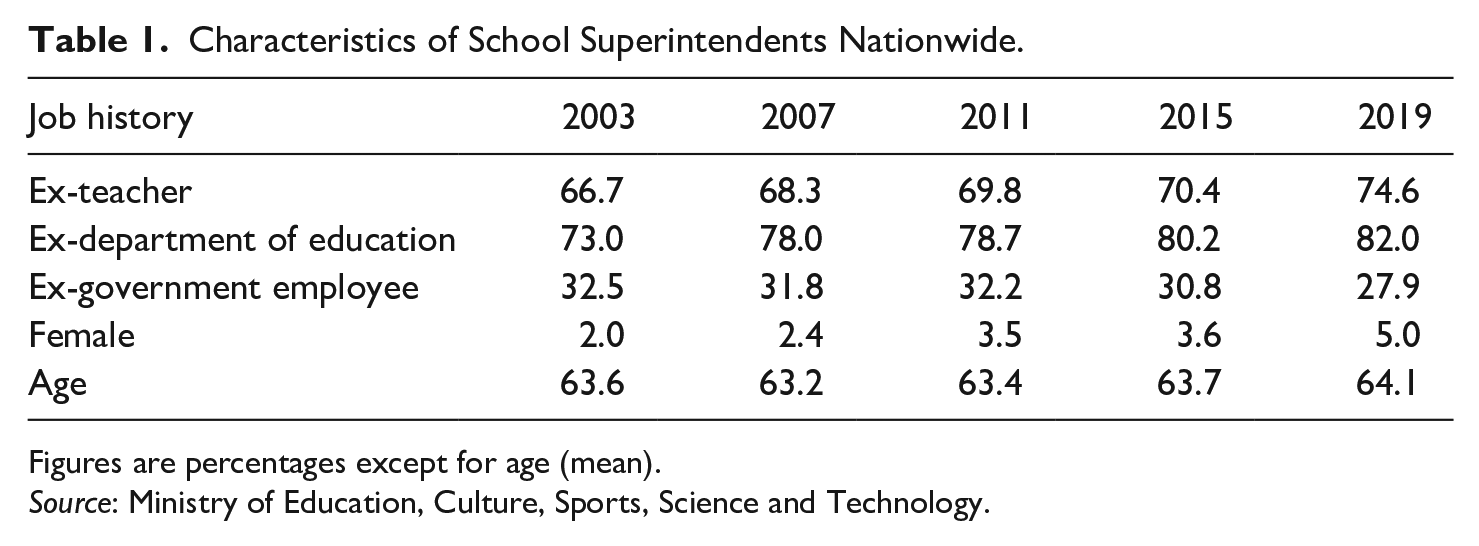
Figures are percentages except for age (mean).
Source: Ministry of Education, Culture, Sports, Science and Technology.
Table 2 shows the individual-level data from the 2017 survey and provides detailed information on the work history of city superintendents. Even under the new school board system, only 6.8% had a job history unrelated to education. Larger cities, however, show a little more of the pattern associated with mayoral control in the United States. In cities with populations over 500,000, 18.8% of the superintendents did not have education-related work experience. Overall, 51% of the superintendents had both teaching and education department experience. Because only 16.3% of the superintendents had only teaching experience, it can be assumed that many of the elite teachers also had experience in the education department. In contrast, only 25.9% of superintendents had experience in the department of education. It is likely that many of them were employed as general administrators and worked for several years in the education department. In other words, even under the new school board system, mayors appoint people with educational backgrounds as superintendents of education, just as they did before, and rarely appoint individuals without educational backgrounds. The results of a similar analysis of prefectural heads of education show that governors are more likely than mayors of municipalities, including large cities, to appoint superintendents with a noneducation background (38.6%). Conversely, none of the superintendents had experience only as a teacher, 40.9% had experience only in the education department, and 20.5% had experience both as a teacher and in the education department.
Career History of New School Superintendents.
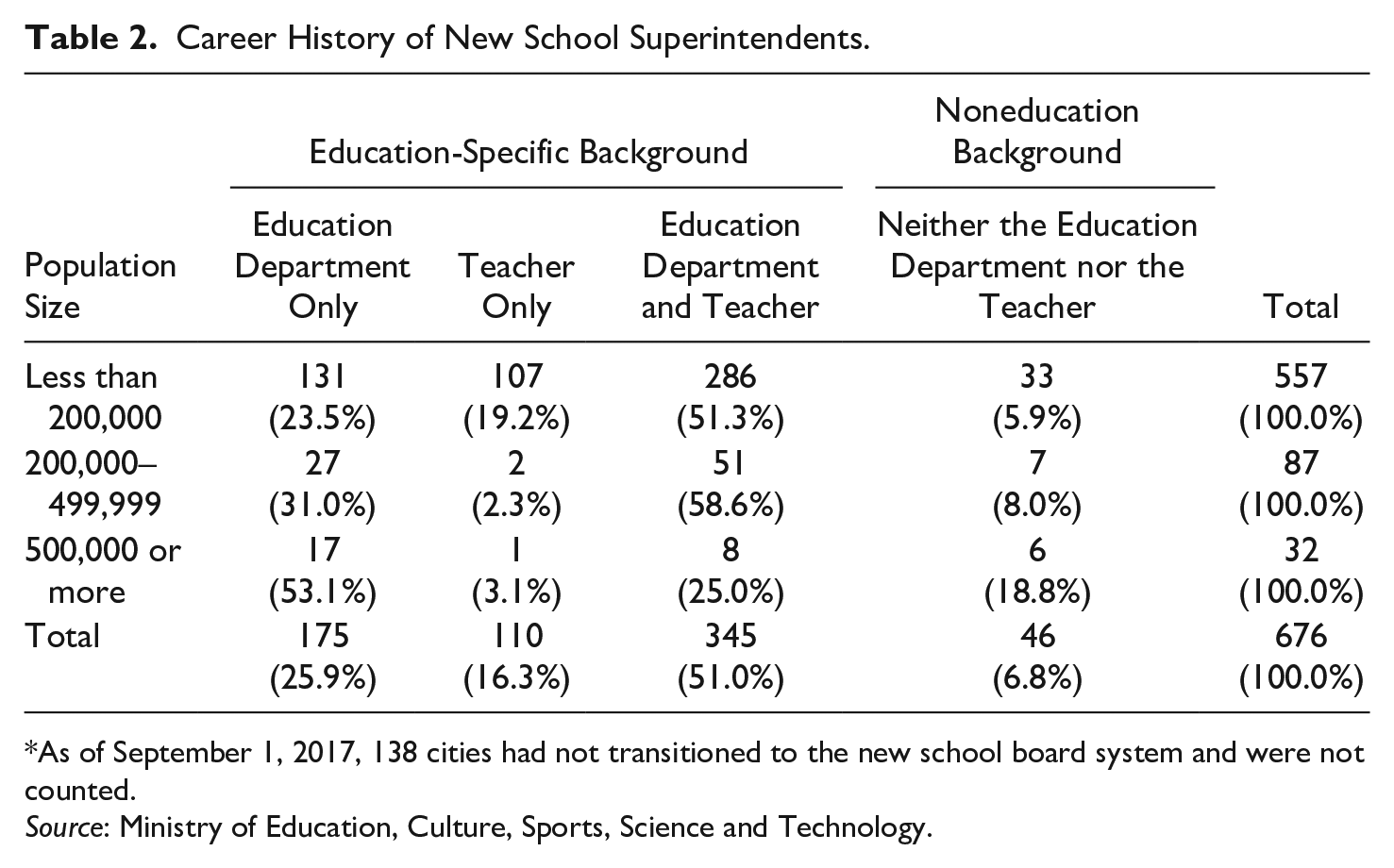
As of September 1, 2017, 138 cities had not transitioned to the new school board system and were not counted.
Source: Ministry of Education, Culture, Sports, Science and Technology.
Although the employment histories of Japan’s mayoral-appointed superintendents look like those of the superintendents before the governance reform, there are numerous ways that the position might have changed in scope of authority and in how superintendents relate to mayors and other government and political actors. To gain insight into these aspects, we turn to our interviews. The characteristics of the six superintendents and the six cities covered in the interview survey are shown in Table 3. The six mayors were all the first to appoint a superintendent under the new system (appointment year). In other words, the six interviewed superintendents worked with the mayor who had appointed them. All six superintendents had worked for their education departments at the prefecture or city level as teachers or government employees, such as city hall officers (ex-teacher, ex-education department, and ex-government employee). Two of them had been appointed as superintendents before 2015 (appointed as old superintendents). Table 3 also shows the school expense assistance rate, special education rate, and foreign student population rate. In Japan, the demographic characteristics of parents and students do not differ significantly among municipalities, with City D having the highest poverty rate and special education needs among the six cities, and City B having the highest foreign student rate. However, neither City D nor City B has included these policy issues in the GCE agenda or mayoral manifesto. In addition, none of the six cities has adopted drastic education policies such as the establishment of charter schools or mass layoffs of teachers, as in the United States.
Background of Interviewed Superintendents and Case Cities.
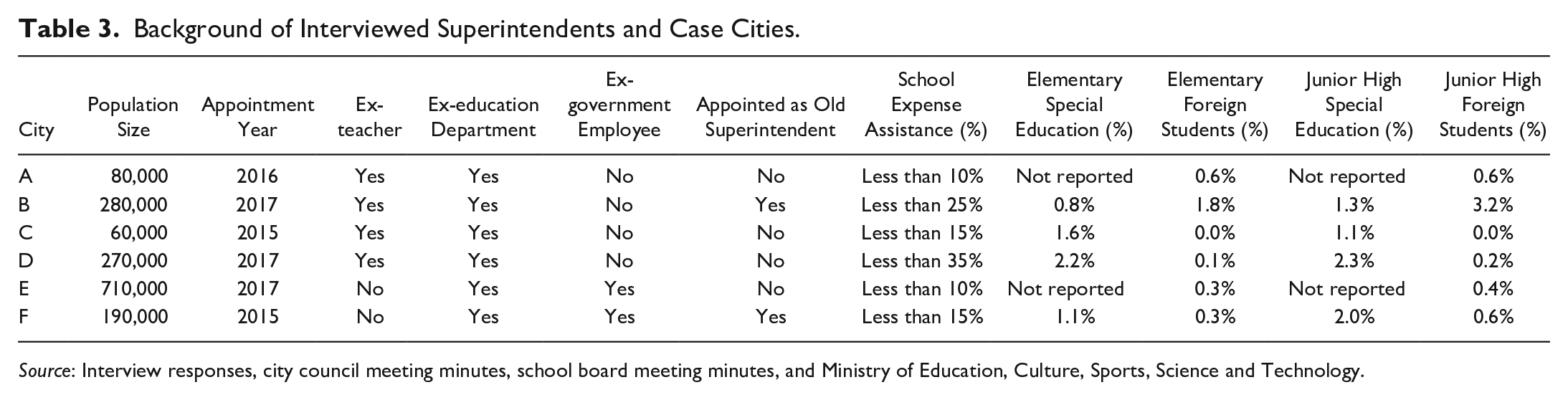
Source: Interview responses, city council meeting minutes, school board meeting minutes, and Ministry of Education, Culture, Sports, Science and Technology.
As shown in Table 4, the six mayors were in at least their second term when they appointed the superintendents, meaning that they had been re-elected at least once (mayoral term). We asked whether the prior superintendents had resigned before the end of their terms (resignation of prior superintendent), whether the work experience of school superintendents under the new system differed from that of previous school superintendents in each city (mayoral appointment), and whether the city council posed questions during the selection meeting and whether the superintendent candidate gave a policy speech (questions from city council). In addition, we also asked whether the city councils’ votes on the appointments of superintendents were unanimous (city council approval). Resignation of the prior superintendent and mayoral appointment could be indicators that the mayor exercised their authority to appoint the superintendents. Questions from the city council and its approval could also be indicators of whether there was political tension between the city council and the mayor in appointing the superintendents.
Political Context in Case Cities.
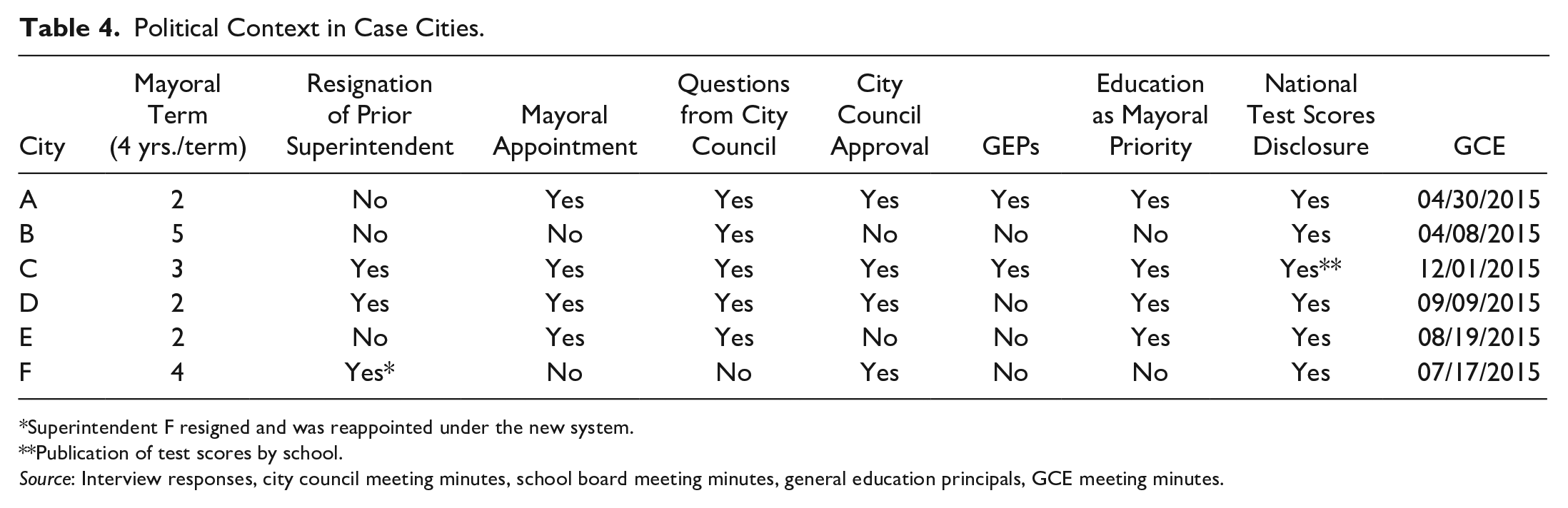
Superintendent F resigned and was reappointed under the new system.
Publication of test scores by school.
Source: Interview responses, city council meeting minutes, school board meeting minutes, general education principals, GCE meeting minutes.
We investigated whether the mayor’s policy was reflected in the city’s general education principles (GEPs) as formulated by the city’s GCE. Specifically, if the city’s education plan was based on existing GEPs, we recorded it as no. If GEPs were newly formulated, this was considered a reflection of the mayor’s intention and recorded as yes. If the mayor stated that they would exercise influence over education policy in front of the GCE, we considered the GCE to be under mayoral control (education as mayoral priority). If the national test 4 scores were disclosed to the public by the city, we recorded yes (national test scores disclosure). This variable is an indicator of a mayor’s interest in and influence over educational policy because, in the Japanese context, the disclosure of a municipality’s national test score would be strongly opposed by parents, school board members, and educators.
All the mayors were seen as likely to be interested in education because they had all published their cities’ national test scores. 5 In general, the decision to publish strongly reflects the mayor’s involvement in educational policy, because public disclosure of a school district’s national scores is often criticized by board members, educators, and parents as a threat to competition. To obtain higher test scores compared with other cities, schools are encouraged to raise test scores by focusing heavily on having students practice the previously tested units, thus emphasizing test preparation over other means of instruction, and competition among cities for test scores increases. It is reasonable to think that a superintendent appointed by such a mayor tends to share the mayor’s policy preferences.
One important finding is that mayors appointed former principals and educational administrators in the same numbers as were elected before the 2015 reforms; however, four out of the six mayors appointed a superintendent whose background was different from the previous superintendent’s, such as Mayor A. 6 In general, superintendents were appointed just after they retired as school principals. In contrast, superintendent A had not been in the education field for several years since retiring as a principal.
In the past, most individuals appointed as superintendents had worked as teachers or in school management; however, the superintendent of City D, who was the first appointed since 2015, previously served as a staff member in the prefectural education department. This implies that the mayor broke the unwritten rule that an ex-principal should be appointed. This finding denotes a significant change to the customary appointment practice, because the mayor appointed a person whose career was different from that of the previous superintendent, because he worked in public administration. According to the superintendent, the mayor wanted him to consider education broadly from childcare and preschool level to higher education, not just compulsory K–12 education.
Regarding the nature of political appointees, a superintendent’s position is vulnerable to the mayor’s policy preferences. Mayor F strategically appointed the superintendent according to the mayoral election timetable. Mayor F, who was elected to their fourth term in 2015, asked the previous superintendent to resign under the old system one year earlier than scheduled in anticipation of the mayoral election in 2019. They had appointed that superintendent under the new system on October 1, 2015, reappointed the superintendent in 2018, and run for mayor in 2019. However, Mayor F lost the election, and the superintendent resigned. As of 2020, three of the six superintendents had been reappointed (Cities A, D, and F); the other three had not. However, one of the remaining three had been reappointed as superintendent under the old system (City B), and the other two successors are now a principal and a city hall senior officer (City C and City E), respectively. Overall, the superintendents’ career histories post-2015 were not significantly different from those under the old system.
The case of City B, in which the superintendent who was reappointed under the old system was also appointed under the new system, is an interesting one: Mayor B has not displayed a strong interest in education, at least openly, as evidenced in the few references to education in his election manifesto. It can be inferred that the mayor’s strategy in appointing a superintendent with teaching experience under the old system and reappointing this superintendent under the new system was to delegate the responsibility of formulation and implementation of the education policy to the superintendent and minimize the associated political risks. In fact, under this superintendent, there was less political conflict over education policy, and it was easier to obtain the consent of the council, resulting in repeated reappointments of superintendents. The city’s education policy was oriented toward gradual improvement without causing major conflicts or significant changes in the existing educational policy framework. It can be concluded that the mayor did not expect radical educational reforms from the superintendent and that political equilibrium, with respect to the educational policy, was maintained.
Involvement of City Councils
The interview data also reveal that new superintendents were sensitive about being portrayed as subordinates to the mayors that appointed them, taking steps to counter the perception they lacked autonomy to do their jobs. In five of six cities, the superintendents were asked to make a speech or answer questions in a city council meeting and explain how they would work for the school board and cooperate with the mayor. One city council asked the appointed superintendent to speak before voting on the appointment.
Overall, the city councils’ appointments of the six superintendents were approved, and five of the six city councils unanimously agreed on the selection. Aware that the new system concentrates educational authority in the hands of these superintendents, there may be factions within city councils that oppose the mayor and want to confirm whether the appointee has the right outlook to ensure a smooth transition. In a city council meeting in City B, the appointee outlined his views before being approved. 7 In City F, the appointee stated that he would work closely not only with the mayor’s departments in administering education, but also with the school board to alleviate councilors’ concerns that he would act as the mayor’s subordinate.
In the United States, when mayors have the power to appoint a superintendent, they sometimes look for individuals whose expertise lies in management and implementation rather than policymaking. Japanese mayors might similarly have appointed superintendents with nontraditional career histories; however, our results did not reveal this to be the case. Rather, as shown in Table 3, the percentages of former teachers and retired principals appointed as superintendents have not decreased since 2015. In the national surveys of about 1,700 municipalities in 2015 and 2019, the percentage of former teachers and former employees of departments of education had increased, whereas the percentage of former government employees had decreased.
GCEs and Mayors
Since 2015, mayors have had the authority to establish GCEs to influence educational policy. Five of the six mayors had established a GCE before appointing a new superintendent, so mayors influence educational policy not only through their appointment of a superintendent, but also through the establishment of a GCE. Superintendents use GCEs to persuade mayors to allocate more funding for education by coordinating school board members’ decisions. For example, the superintendent of City C mentioned that it is vital for both the superintendent and school board members to attend GCE meetings and express their views on educational policy in front of the mayor. Executives in local governments also attend these meetings, so educational issues are discussed alongside other policy areas, such as social services. In this way, the superintendent and board members can persuade the mayor to allocate more budget money to education.
According to the City C superintendent, the GCE is politically advantageous for the mayor because it provides an opportunity to display a willingness to increase the education budget in support of education policies. 8 The superintendent of City E reported that the mayor encouraged board members to use the GCE meetings as a platform to attract funds. 9 Superintendent A also mentioned that when a proposal is debated in the GCE, it is almost guaranteed to become a policy. These superintendents’ statements indicated that mayors, superintendents, and school board members could find ways to jointly frame their actions to claim mutual credit via GCE meetings. However, as in City E, where some city council members attend GCE meetings, the city council generally keeps a close eye on the GCE. Thus, a mayor, a superintendent, and board members must be careful to consider the city council’s authority.
Some superintendents mentioned that the education governance reform of 2015 provided a way for mayors to insulate themselves from accusations that they interfere in education policies. The superintendent for City E mentioned that both the mayor and board members are empowered to propose the agenda for GCE meetings. 10 Although the mayor convenes the GCE meetings, the school board retains the right to set the agenda. In other words, the mayor’s office must confer beforehand with the city council’s secretariat, the superintendent, and the officers of the department of education regarding the agenda. This process might effectively preempt accusations that the mayor is interfering in educational policies. Even if the mayor rejects a school board proposal in a GCE meeting, the superintendent and the school board members can avoid being blamed for not getting the proposal accepted because it is the mayor who refused it. However, although the mayor’s office runs the GCE, the superintendent and school board members share the responsibility with the mayor for setting the agenda.
One of the roles of the GCE is to develop the GEPs. Mayor A and Mayor C led the formulation of the GEPs. The following section focuses on these two mayors and their interest in and influence over educational policy based on their commitments to educational policies stated at GCE meetings and their input to the GEPs.
Superintendents as Mediators
In addition to countering the notion that superintendents are subordinates of the mayor, the interview data also show that superintendents sought to craft a role for themselves that involved developing a bridge between the mayor and school board. It is in their best interest to maintain a good relationship with both the mayor and the school board and be a mediator who coordinates the interest of the mayor and board members. Although the superintendents were empowered to chair school board meetings, they were careful not to control meeting discussions and took the initiative to establish cooperative relationships with school board members. The superintendent of City C reported that if the superintendent and board members did not reach a consensus on a particular policy at the GCE meeting, the mayor could lose trust in them. When the education governance reform of 2015 was being formulated, there were concerns that school boards would cease to function as collegiate decision-making bodies in which laypeople control policy. 11 The superintendent of City A stated that he never failed to account for his decisions to the school board members to gain their support. Moreover, according to the transcripts of GCE meetings, superintendents tended not to make comments in board meetings to make room for other board members to give their opinions. The superintendent of City C stated that he and the board members usually held closed meetings to exchange views regarding the agendas for future GCE meetings.
In Cities A and C, the mayors exerted a strong influence on education, and these cities merit further analysis. In City A, the mayor took a strong interest in education policy, as demonstrated by his decision to publish the city’s national test scores with a congratulatory message for the top schools on the city’s website. The city’s GCE was established on April 30, 2015, one of the first in the country. As the number of junior high school students increased, the first policy issue was to decide whether to build a new junior high school or adjust the number of students in each junior high school by redistricting the catchment areas. At a school board meeting, the superintendent proposed redistricting in line with the mayor’s preferences, and an agreement was reached. In this sense, the superintendent was the mayor’s agent. However, the superintendent acted cautiously, because he said he had to be careful not to be seen by the school board as an agent for the mayor. The superintendent said that if he were seen as an agent of the mayor, a conflict could arise between the mayor and the school board. The superintendent arranged a school board meeting on the morning of the same day that the GCE was to meet to discuss the redistricting, and the board members came to a consensus. This consideration ensured that the GCE respected the decision of the school board.
Superintendent A demonstrated that he was not an agent of the mayor when he considered board members’ views on English education and managed to double the English language budget for assistant language teachers, allocated over several years. The superintendent asked the school board to allow discussion of the English language education budget one month before the upcoming GCE meeting and obtained the board’s approval. In this way, the superintendent did not act as the mayor’s subordinate, because he coordinated the views of the school board members with the mayor’s GCE agenda.
In City C, the mayor’s commitment to education policy was also strong, as demonstrated by the schools’ publication of national test scores. The mayor sought to promote two educational policies: hiring more librarians for school libraries and incorporating 1,000 years of the city’s history into the curriculum. By 2019, more librarians had been hired for elementary and junior high schools. In our interview, the superintendent declared himself an agent for the mayor, and he thought he would have no choice but to resign if he ever disagreed with the mayor. The mayor and the superintendent communicated daily and strived to deepen mutual understanding. The superintendent, for example, reported even small donations to schools, and this close communication ensured that the mayor could never be accused of being ignorant of any school matter.
The superintendent of City C tried to understand school board members’ opinions of education policy. An example was his strategy for history education, a favorite policy area of the mayor. The city has precious historical resources, and the mayor wanted to include these in the curriculum. The superintendent proposed digitizing the history education materials at a GCE meeting so that they could be better utilized. This strategy was used to obtain a bigger budget for history education, which the mayor favored, along with a budget for digitization of the materials and purchase of information and communication technology equipment.
Even in Cities A and C, where the mayors had a strong influence on educational policy, both superintendents coordinated school board members’ views so that the mayors had confidence in the school boards. In addition, the superintendents devised policy ideas that met the mayors’ preferences and were able to increase budget allocations. In this way, the superintendents acted as mediators between mayors and school boards. The fact that boards of education and superintendents of education have not been given the authority to compile budget proposals in Japan since 1956 shapes this perception of the role of the superintendent of education. The membership rate of teachers’ unions in the prefecture that includes City A is less than 5%, and the membership rate of teachers’ unions in the prefecture that includes City C is less than 20%. This is one of the lowest membership rates in Japan, and there was no evidence of strong opposition by teachers’ unions to mayoral control in either city.
Since the start of the new school board system, there have been 11 mayoral elections in which six mayors ran for office. Of those elections, only the 2019 election for Mayor F was unsuccessful, and her loss was attributable to non-education-related issues. The only close election was the 2019 election in City E because the conflict with the governor worsened and led to the candidacy of the former mayor. Including these two elections, the school board system was not a major election issue in six cities. There was no clear indication that teachers’ unions or parent organizations had a significant impact on the election campaigns.
Discussion
The present study’s results are somewhat speculative and based on a small sample. However, they suggest that Japan’s new education governance system has not encouraged mayors to take over school boards’ abilities to determine education policies. On the contrary, the results indicate that superintendents, selected for their educational experience, generally build moderate and cooperative relationships between the mayor and school board members to pursue the best interests of the education sector.
The most noteworthy finding is that mayor-appointed superintendents in Japan appear to play a mediating role between the mayor and school board members. This finding is inconsistent with previous studies in the United States, where mayoral control produces a nontraditional and active superintendent who acts as a reform agent by executing the mayor’s educational reforms even at the risk of angering traditional education leaders.
There are several possible explanations for our results. First, although mayors have been able to appoint superintendents directly since the 2015 educational reform in Japan, all six superintendents had previously been school principals, education department staff, or city hall staff. These backgrounds were also typical of superintendents before the 2015 reform. A mayor interested in education seems to appoint a superintendent of education who has had a conventional job background to show that they are committed to educational reform. However, in the mayoral-controlled cities in the United States, a nontraditional superintendent who is unconnected to more politically oriented city hall actors and primed to challenge the status quo is often appointed (Henig, 2013).
A second reason that Japan’s experience, to date, differs from that in the United States may be related to formal differences in the allocation of power. In Japan, unlike the United States, the institution of mayoral control is coupled with the requirement that the city council approves mayors’ appointment of a superintendent, 12 and this system may restrict who the mayor appoints and the superintendent’s behavior. The mayor may, therefore, try to appoint a superintendent who is likely to be approved by the city council, because the mayor will not want to create conflicts that carry over into other policy areas so that they can maintain a cooperative relationship with the city council.
A third meaningful difference may be the absence in Japan of a strong political constituency pushing mayors to take a more aggressive role. In the United States, proponents of sharper educational changes have encouraged and backed strong mayoral intervention, not least because they see mayors as more willing and able to challenge teacher unions. In Japan, where no such reservoir of reform pressure is readily available, mayors may be unwilling to risk a confrontation with the city council by appointing nontraditional superintendents with visions of instituting ambitious change. Whereas a city’s GCE functions as a place for the mayor, superintendent, and school board members to exchange ideas on educational policy, mayors do not have as much scope, because the city council sets the education budget based on the mayor’s proposal. This ensures that there are institutional checks and balances among the mayor, superintendent, school board, and city council, which prevents the mayor from holding total sway over the appointment of the school superintendent and influencing educational policy.
Finally, there is a possibility that the U.S. mayors tend to control the educational reforms, whereas mayors in Japan behave in a restrained manner and exercise moderate control. Much of what is known about mayoral control in the United States has been based on the experiences of a few large cities where the first generation of empowered mayors (like Richard Daley in Chicago; Adrian Fenty in Washington, D.C.; and Michael Bloomberg in New York) were eager to assert their newly assigned powers and appointed superintendents with a mandate to shake up the education policy status quo. In each of these cases, mayoral control engendered political pushback, and the subsequent administrations learned the lesson that aggressive education reform can be a political hot potato that they may not want to grasp too eagerly. On the contrary, in Japan, mayors were generally involved in education policy in a restrained manner immediately after mayors were given the right to appoint superintendents nationwide in 2015, the period covered by this report, as city councils and other stakeholders closely watched the operation of the new school board system. However, since then, it appears that student suicides due to bullying and school closure due to COVID-19 have triggered a strong interest in education policy among citizens in some cities. The citizens seem to expect the mayors, rather than the superintendents, to solve problems, and a gradual trend of leadership by the mayors, rather than the superintendents, would seem to indicate that mayors are taking a more active and important role in education policy.
Footnotes
Acknowledgements
The author(s) would like acknowledge Dr. Naoko Ohata, Dr. Takaaki Hirotani, Ayaka Toyoda, and anonymous reviewers for their thoughtful and critical feedback on this project.
Declaration of Conflicting Interests
The author(s) declared no potential conflicts of interest with respect to the research, authorship, and/or publication of this article.
Funding
The author(s) disclosed receipt of the following financial support for the research, authorship, and/or publication of this article: This work was supported by JSPS KAKENHI Grant Numbers JP17KK0042, JP15H03306, JP19H01445, JP18H00815, and International Joint Research Promotion Grant FY2017, Graduate School of Education, Tohoku University, Japan.